UNIVERSIDAD TÉCNICA PARTICULAR DE LOJA
La Universidad Católica de Loja
ÁREA SOCIO HUMANÍSTICA
TÍTULO DE LICENCIADO EN CIENCIAS DE LA EDUCACIÓN
MENCIÓN INGLÉS
“The influence of classroom environment on students learning at a private
high school in the city of Loja.”
TRABAJO DE TITULACIÓN
Autora: Orellana Rosillo, Karen Alejandra
Directora: Solano Jaramillo, Lida Mercedes, Mgs.
LOJA - ECUADOR
Esta versión digital, ha sido acreditada bajo la licencia Creative Commons 4.0, CC BY-NY-SA: Reconocimiento-No comercial-Compartir igual; la cual permite copiar, distribuir y comunicar públicamente la obra, mientras se reconozca la autoría original, no se utilice con fines comerciales y se permiten obras derivadas, siempre que mantenga la misma licencia al ser divulgada. http://creativecommons.org/licenses/by-nc-sa/4.0/deed.es
ii
APROBACIÓN DEL DIRECTOR DEL TRABAJO DE TITULACIÓN
Magister
Lida Mercedes Solano Jaramillo DOCENTE DE LA TITULACIÓN
De mi consideración:
El presente trabajo de titulación: The influence of classroom environment on students learning at a private school in the city of Loja realizado por Orellana Rosillo, Karen Alejandra, ha sido orientado y revisado durante su ejecución, por cuanto se aprueba la presentación del mismo.
Loja, Agosto 2016
f) ….……….
iii
DECLARACIÓN DE AUTORÍA Y CESIÓN DE DERECHOS
“Yo, Orellana Rosillo, Karen Alejandra declaro ser autora del presente trabajo de titulación: The influence of classroom environment on students learning at private schools in the city of Loja, de la Titulación de Ciencias de la Educación mención Inglés, siendo la Mgs. Lida Mercedes Solano Jaramillo directora del presente trabajo; y eximo expresamente a la Universidad Técnica Particular de Loja y a sus representantes legales de posibles reclamos o acciones legales. Además certifico que las ideas, conceptos, procedimientos y resultados vertidos en el presente trabajo investigativo, son de mi exclusiva responsabilidad.
Adicionalmente, declaro conocer y aceptar la disposición del Art. 88 del Estatuto Orgánico vigente de la Universidad Técnica Particular de Loja que en su parte pertinente textualmente dice: “(…) forman parte del patrimonio de la Universidad la propiedad intelectual de
investigaciones, trabajos científicos o técnicos y tesis o trabajos de titulación que se realicen con el apoyo financiero, académico o constitucional (operativo) de la Universidad”.
f. ………..
iv
DEDICATION
v
CONTENTS
Cover………….………..……….i
Aprobación del Director del Trabajo de Fin de Titulación……….…………..ii
Declaración de autoría y cesión de derechos………..……….…………...iii
Dedication………...……….………....iv
Contents………..………..……….………....v
Abstract……….……….………..1
Resumen ………..…....…………...……….……...2
Introduction………...………..………..…………...3
Literature Review………....…...5
Method………..……..………...20
Discussion………..………..…....………..………..…...….22
Description, analysis and interpretation of the results……….…………..…22
Conclusions…………..……….……….…...43
Recommendations………..……….…………...44
References……….………...………..…….45
1
ABSTRACT
This study investigates the influence of the learning environment on student´s learning at a private high school in the city of Loja. The main purpose of this study was to investigate the influence of classroom environment on students’ learning.
The quantitative and qualitative methods were used to carry out this research. The sample consisted of 50 students from eight grades between 11 and 12 years old. The principal sources of data collection were students’ questionnaires and class observations. Questionnaires were applied based on three different areas classroom environment factors, teacher specific factors, and students’ specific factors.
The most important finding obtained from this study was that inside the class there are some factors that affect the learning environment such as the lack of natural light inside the classroom and that inside the classroom there is no fresh air coming from out side.
2
RESUMEN
Este trabajo investiga la influencia del ambiente en el aprendizaje de los niños in una escuela privada de la ciudad de Loja. El factor principal de este estudio fue identificar y analizar los factores que afectan el ambiente de aprendizaje en los estudiantes. Para llevar acabo esta investigación cuestionarios fueron aplicados basados en tres diferentes áreas factores del aula, factores específicos del profesor y factores específicos del alumno.
La muestra consistió en 50 estudiantes de octavo grado entre las edades de 11 a 12 años pertenecientes a una escuela privada de la ciudad de Loja. Con el fin de obtener datos el método cuantitativo y cualitativo fueron usados. La fuente principal de la recolección de datos fueron los cuestionarios a los alumnos y las observaciones de clases.
La profesora y los alumnos contestaron las 50 preguntas, las respuestas fueron analizadas basadas en los estudios realizados anteriormente sobre el tema, las encuestas y las observaciones de las clases, de esta manera se pudo concluir que dentro del aula hay muchos factores que afectan el ambiente del aprendizaje como la falta de luz natural dentro del aula y que dentro del aula no hay aire fresco que venga de afuera del aula.
3
INTRODUCTION
The impact of the classroom environment in the learning process has become a really important part of education nowadays, because it has to deal with how students feel inside the classroom, how they see teacher as an authority or as a friend, or how they get along with their classmates.
The present research project focuses on the influence of the learning environment in student’s learning at a private high school in the city of Loja. The main purpose of this research is to investigate the influence of classroom environment on students’ learning. The objectives that guided this research were to identify and analyze the factors that influence in the classroom environment and to determine the impact of the classroom environment on students’ learning.
Some previous studies based on the influence of the learning environment in student’s learning have been conducted.
An interesting study was conducted by Blackmore, Betaman, Cloonan, Dixon, Loughlin, Mara, and Senior (2010), whose main purpose was to research about the extent to which innovative learning environments contribute to improve cognitive, affective, and social learning outcomes for students. As conclusion the authors said that improving students’ learning is possible by changing the habits of the minds and hearts of teachers to focus on student learning. This means focusing on the purpose and rationale for change, the social practices of teaching and leading, relationships with colleagues, and organizational structures and cultures that support collaborative inquiry. At the same time, there are ranges of external factors which impact on an individual school’s capacity to improve student learning, the neighborhood environment, the policy environment, and the built environment. The limitations were the time that has elapsed in each of these environments constrains any substantial or enduring predictors of cognitive, affective and social learning outcomes for students. The very short period of data collection for this study exacerbates this situation.
4
exploring the extent to which features of the learning environment are proximally related to engagement and learning. Identifying environmental dimensions that promote engagement has the potential to enhance high school instruction and learning for the benefit of both teachers and students. Foundational perspectives on motivation and contemporary theories of educational psychology continue to push our thinking with respect to design and implementation of learning environments that promote engagement and positive experiences likely to advance student learning.
Finally, the purpose of the study conducted by Samani (2012) was to identify the influence of indoor lighting on students’ learning performance within learning environments from knowledge internalization perspective. The most important finding obtained from this study was that good lighting classrooms could motivate students for better learning. In a good lighting classroom students are more relax, do not sleepy, and they have a kind of motivation in that place to learn better. Any limitation was found in this study.
The present research will benefit to teachers because the results obtained from this research may help them know the problems that students have inside the classroom; it will also help them change some attitudes or methods used in class. Moreover, this research also gives a better view of what is causing students’ bad performance, bad behavior inside the classroom and what is affecting students’ learning inside the classroom. In addition, directors from the institution will also be benefited from the results of this research since this will help them have a clear idea of what things they should change or progress in the classrooms in order to improve the learning environment in which students are involved.
5
LITERATURE REVIEW
In this section some topics will be presented. These topics will be related to the learning influence of the classroom environment that provides the basis of the present research.
Learning environment
Stronge (2002) states that at the beginning of the year teachers have the goal of
establishing a classroom environment that is favorable for helping all students’ work
cooperatively in order to learn. The author also says that the classroom environment can
either improve or impede the student's ability to learn and feel safe and comfortable as a
member of the class. Stronge also claims that creating an atmosphere of mutual respect,
where students feel relaxed in asking questions and expressing their thoughts and feelings
will cause a great effect on students learning.
Some areas to consider when creating an atmosphere of mutual respect are classroom design, classroom procedures, and classroom strategies. Implementing a few
strategies that address these areas can help develop a strong sense of community and
encourage positive interactions and cooperative learning for students. A warm classroom
environment can lead to increase academic achievement and a sense of pride and belonging
in the school (Stronge, 2002).
The Early Childhood Curriculum Framework (2009) states that structuring the environment both indoors and outdoors is important in order to ensure that it supports
children’s learning and development across planning, organizing, resourcing, and evaluating;
the adult continually makes decisions about equipment, materials, and people in the
environment.
School and classroom environment
6
In addition, Howard, Howell, and Brainard (1987) state that a positive school environment is an integral component of an effective school. They also say that school environment is consistently identified as a variable that is a characteristic of effective schools and one that is positively associated with academic success. The authors also claim that the eight factors characterizing effective schools include: leadership, school environment, teacher/student relations, curriculum instruction, resources and finance, physical environment, evaluation, and parent/community.
The authors also say that the nature of the school environment has been shown to have a strong influence on the way students develop and learn. They also refer to the association of school environment with improved student outcomes; for example, it is more likely that students will have higher achievement, more positive self concepts, improved behavior, and higher aspirations when the environment of the school is positive. In some cases, the link between school environment and student outcomes is relatively direct. In other cases, school environment may have a more indirect effect, such as promoting a positive sense of belonging, participation in school tasks and activities, and attendance (Howard, Howell, & Brainard, 1987).
Pilarand Brown (2008) establishes that students spend a large proportion of their day in school or pursuing school-related activities. While the primary purpose of school is the academic development of students, its effects on students are far broader; also, their physical and mental health, safety, civic engagement, and social development. Further, its effects on all these outcomes are produced through a variety of activities including formal pedagogy, after-school programs, caretaking activities (e.g., feeding, providing a safe environment) as well as the informal social environment created by students and staff on a daily basis.
7
attachment to that space. It may become a place where students love to learn, a place they seek out when they wish to learn, and a place they remember fondly when they reflect on their learning experiences.
Clearly, some learning environments are more comfortable and offer fewer distractions than others. In any learning environment, physical characteristics that cause discomfort can be expected to interfere with learning; environments that produce positive emotional states can be expected to facilitate learning and the development of place attachment (Shalaway, 2005)
Moreover, Miller (2011) indicates that classrooms with highly cooperative groups appear to have students with more positive perceptions of fairness in grading, stronger class cohesion, and higher degree of social support, as well as higher achievement scores.
In addition, Nosal (2012) claims that the atmosphere must be conducive to taking safe challenges with out fear of ridicule. A positive environment is the building block in developing a child with the positive self-efficacy to take safe challenges. If a child fears shame and ridicule from peers and teachers, they will avoid taking risks to protect themselves from embarrassment.
Nosal also says that the classroom environment will dictate how well or poorly a child will learn. The author also states that a major factor in the classroom environment is the teacher’s role. Teachers must take their position as a role model seriously. Through observing role models, children hone skills that well assist their successful assimilation into society. Nosal also claims that a classroom that lacks a teacher that exhibits quiet control will see behavioral issues exacerbate. So structuring a classroom so positive teacher - student relationships develop will have a trickle down effect. Positive behavior will appear in venues such as the playground, parental interaction, and socialization with other children.
Characteristics of the classroom learning environment
8
future to look like, as well as knowledge of the skills needed to reach that goal. As the classroom has being such an important place in the growth of a child, it is important to understand the ways in which its environment affects on students learning in order to receive maximum effectiveness in instruction.
If not approached correctly, a classroom can be set up in a way that stifles creativity or does not promote a positive learning environment. There are many things that can affect this environment. There are physical elements such as wall art, arrangement of desks, or resources. Also, there are intangible elements such as the energy of the classroom, the rules, or the sounds within the room. Each of these can impact a student’s focus and achievement in the class. They can also affect a teacher’s attitude in the class (Hannah, 2013).
Another characteristic that is inside the elements of the classroom is the emotional environment. The way, in which a teacher organizes their class, or how they control it, will yield positive or negative consequences for their students. If a teacher is unmotivated or negative there will be a direct impact on the students within the classroom. Similarly, if a teacher is motivated and positive they will likely have a beneficial impact on their students as well. It is important for a teacher to understand this cause and effect in order to understand how to organize their classroom to create a better learning environment (Hannah, 2013).
Hannah (2013) also states that developing rapport with students is essential in creating a good classroom environment. It can be difficult, though, to maintain authority if not handled well. There are a few strategies that a teacher can use to establish a good relationship with their students. The first one is how the teacher dresses. It is understandable that a teacher must maintain a level of professionalism in their attire. Teachers should not dress in the exact same fashion as their students either. However, if a teacher is always wearing a suit or dress they can be perceived as unapproachable. This is where the balance comes into play. A teacher should be dressed professionally enough to establish authority, but relaxed enough that a student isn’t intimidated to ask them questions. The teacher should convey that they are the rule maker, but that they also genuinely care about the student’s problems or questions. To do this teachers should dress modestly but relaxed. They should cross fun with professionalism.
9
students lose focus and creates a higher number of disruptions in the classroom. This structure does not encourage interaction between students and focuses more on the student as an individual completing their own work. Humans are social creatures that want attention, and if they aren’t going to be able to get it from their classmates then they will commonly act out to get attention from their teacher.
Additionally, when student first steps into a room they will make a judgment about the type of class they are going to be taking. They will look to see how desks are arranged. They will notice what is hanging on the walls. The way in which a teacher sets up their class allows them to communicate with their students non-verbally. By adding various learning centers or activity centers, the students will know that this is a classroom that likes to do hands-on experiments. It also conveys that they will not just sit and take notes, but they will act out whatever subject they are learning. The wall art will demonstrate to the student that the teacher cares about their work enough to show it off (Hannah, 2013).
Another aspect of the classroom that is difficult to control but can play a large part in keeping students engaged is the classroom temperature. This can be a tricky facet to modify in the classroom since many schools use a central heating system. Too cold or too warm of a classroom can make students sluggish or inattentive. Also, poor circulation of air can create dust or air pollution that can affect students’ allergies. A classroom with fresh, warm air can create an atmosphere conducive to learning. Thirty students will look for anything to distract them from the lesson, regardless of how trivial it may seem. Removing problems created by things such as temperature, light, or sound removes potential distractions for students (Hannah, 2013)
According to National Curriculum Framework (2005) states that children are constantly interacting with the physical environment of their schools during structured or unstructured time, consciously or unconsciously. Yet not enough attention is paid to the importance of physical environment for learning. Often classrooms are overcrowded, with no alternative spaces to learn, nor are they attractive, inviting or sensitive towards children’s needs. Inappropriate school design may drastically affect the teacher’s productive output and classroom management. In fact, the role of this all encompassing, physical environment has been restricted merely to shelter the educational activity.
10
nooks and corners, animals, plants, flowers, trees, and toys. In order to attract and retain children, the school environment must have all these elements in and around them (National Curriculum Framework, 2005).
Classrooms can be brightened up by first ensuring adequate natural light inside and then made lively by displaying children’s work on the classroom walls as well as in different parts of the school. Drawings, art, and craftwork put up on the walls and shelves send out a powerful message to children and their parents that their work is appreciated. These must be displayed at locations and heights that are physically and visually comfortably accessible to children of various ages.
Other authors Scott, Leach, and Bucholz (2008) claim that one of the first things a teacher does at the beginning of the school year is to organize, arrange, and decorate the classroom. The physical environment of a classroom plays a part in the ownership students feel about their school and more specifically their class. The classroom environment should do as much to foster cooperation and acceptance as the instructional method the teacher uses.
In addition Rutter, Maughan, Mortimore, and Ouston (1979) expressed that decorating a classroom with some kind of warmth can help to promote a sense of comfort and security. Classrooms tend to be rather cold, bare places until they are decorated. Adding a splash of color can bring life to a sterile environment. Color choice is important when decorating a classroom. Teachers should keep in mind that red and orange can make children feel nervous and unsettled while blue and green can help students feel calm. Furthermore, Hathaway (1987) says that, dark colors take natural sunlight out of a room and can even make people feel drowsy and listless. Hathaway also says that plants, soft chairs, rugs, and pillows can help to add warmth and comfort to a class environment.
Interpersonal and socio-environmental factors influencing the classroom environment
11
encouragement from their teachers and academic support from their peers, they are more likely to be on-task in the classroom and use self-regulated strategies.
On the other hand, some students and classrooms are more focus on obtaining grades than on the mastery of objectives; these students and classrooms are said to be performance oriented rather than mastery oriented. Patrick, Ryan, and Kaplan (2007) examined this social-cognitive aspect of classrooms and they stated that the classroom-level learning goal can be linked to both behavioral and academic outcomes. Students in classrooms where performance is emphasized are more likely to engage in cheating, avoid help seeking, and exhibit lower levels of academic engagement. In contrast, students who are in a classroom where the focus is on learning and improvement demonstrate higher levels of self-efficacy and engagement as well as more positive affect. Students who are more focused on grades tend to have higher grades; those students who are more focused on mastering objectives tend to engage in more academically challenging tasks and retain information learned for a longer period of time.
Rodriguez (2004) refers to children and adolescents, both when there are barriers for participation and learning and not only by curriculum, but especially by the conditions in which all development takes place, including the multiple intra-individual factors and systems of social relations and discourses and condition of the environments in which they participate. Classroom environment concerns the affective-relational area; it observes, for example, feeling of meaning, participation, well being, respect, self-confidence, and perceptions formed in the interaction between pupils and school. All children have the right to feel that the school involves and welcomes them in a positive way. The impact of the classroom environment on learning processes through social interactions has been defined as the group of psychological and social characteristics of a classroom, determined by structural, personal and functional factors. The classroom environment has to do with characteristics and behavior of the teachers, of the pupils, the interaction among these and, in consequence, the class dynamic is unique and particular to these elements.
12
these interactions are in turn influenced by many factors, including their satisfaction, self-image, process of learning and social competence, among others.
The discourse beliefs, expectations, and attitudes of teachers in school, particularly in view of the difference, have profound effects on various socio- emotional dimensions, including level of self-concept, the process of acceptance and rejection among peers and the social adjustment among the pupils. The relationship between peers (in that it promotes self-knowledge and understanding of each other in a horizontal relationship with significant others) is also a reflection of the skills brought into play by each individual, and thus an important factor in the upholding or modification to the level of those skills (Chang, 2003 and Wentzel, 2002).
Specific dimensions correlated with self-esteem, as a preference, or social rejection by peers are also well known not only as a consequence but as determinants of relationships, social adjustment and the academic success (Santos, 2007).
In addition, Monsen and Frederickson (2004) explain that although peer groups have an important influence, the teacher has a vital role in changing attitudes. Even if language and attitudes are important research shows that infra-verbal signals underlying the dynamic in the emotional environment is ever important. In classes where the teachers have a positive attitude and inclusion of all students is emphasized, there is a higher degree of satisfaction, and a distinctively lower level of disagreement or quarrelling among students.
Ljusberg (2009) established that inclusion requires a deep acceptance of all individuals with variations in their ethnicity, religion, language, gender, class, in their diversity of needs, opportunities and difficulties. In this perspective it is indispensable to add the pupil’s own experience of participation, as well during classroom time and during breaks – being able to take part in and have access to the information that flows in and outside of the classroom. The creation and maintenance of this environmental and socio-emotional environment in which all pupils can feel that they and their classmates are psychologically safe, valued and accepted, ensure active involvement and sense of belonging is therefore a non-condition for the successful development of any inclusive practice.
13
some students are not accepted or just cannot suit in class with the rest of classmates and when this happens it is when the learning process starts to fail and frustration and self-confidence are damaged (Ljusberg, 2009).
Attitudes of the Learners
In an English class, the teacher attitude is really important, but it is more essential how the students feel about learning a new language. When a student feels comfortable about the learning of a foreign language, the result is going to be successful not just for the student but for the teacher too. On the other hand, if the student has a bad attitude about learning because he or she doesn`t like the language or just because of the fear of making mistakes can lead to frustration on keeping learning; so student’s attitude will be different and the learning process will fail.
According to Weimer (2009) students who have the impression that nothing they do will alter the results of the learning process, or who attribute success to good luck and failure to bad luck, or who see the pedagogy and didactic practice of the professor as the determinant of success or failure, will make little effort to contribute to their own learning. It is important for them to remember that what students believe about learning and themselves as learners play a key role in determining their success as learners. If a student believes that no matter what they do, they won’t succeed in a course, even being in a course with a highly rated effective teacher does not change the effects of those beliefs.
14
International Journal of Scientific and Research Publications (2013), argue that Education is the powerful tool, which helps to modify the behavior of the child according to the needs and expectancy of the society. Student’s attitude is an integral part of learning and it should, therefore, become an essential component of second language learning pedagogy. Especially in Education, if students have positive attitude towards any subject, they can achieve many things in that specific area. There is an interaction between language learning and the environmental components in which the students were grown up. Both negative and positive attitudes have a strong impact on the success of language learning.
According to Glanz, Rimer and Viswanath (2008)
Attitude is determined by the individual’s beliefs about outcomes or attributes of performing the behavior (behavioral beliefs), weighted by evaluations of those outcomes or attributes. Thus, a person who holds strong beliefs that positively valued outcomes will result from performing the behavior will have a positive attitude toward the behavior. Conversely, a person who holds strong beliefs that negatively valued outcomes will result from the behavior will have a negative attitude (p. 71).
Learning Styles
Ldpride (2008) explains that learning styles refer to the variations in the ability to accumulate as well as assimilate information. Basically, learning style is the method that best allows the learner to gather and use knowledge in a specific manner. Each individual may possess a single style or could possess a combination of different learning styles. In most cases, the characteristics of a learning style can even be observed at a relatively young age. Once someone has identified its particular learning style, it will be able to identify ways in which adapt its learning process and its studies to maximize its education. The way that students apply the techniques to study is their learning style, which allows them to get better results in their learning process.
15
without understanding them because they are just worried about grades and the desire to be evaluated positively by others.
Bedford (2004) establishes that teachers have to bear in mind that people differ consistently from each other in their preferences (e.g., emotional, environmental) for certain ways of processing information, these individual differences are measurable. Matching or mismatching students' learning styles with instructional techniques affects learning significantly. It is important that the teacher has a good understanding of the different learning styles. This will not only help teacher to understand the method that children use to learn, but it will also help to customize the method that the teacher uses to teach his/her children. Teacher doesn`t have to assume the way he/she learns, is the way the children learn best. If the teacher is able to teach in ways that compliment a specific learning style, he/she will find that the children are able to retain more information over a longer period of time.
Teacher Attitude
Teacher’s attitude is connected with instructional behavior that influences student’s achievement. Gourneau (2005) states that effective attitudes and actions employed by teachers ultimately can make a difference on the learning of their students. Furthermore, teacher’s attitudes are reflected in their daily practice and interactions with colleagues, parents, and students. Besides, students perceive teacher’s attitude and place value of them.
Gourneau (2005) also establishes that teachers have the opportunity to leave an indelible impression on their students’ lives. School experiences mold, shape, and, can influence on how children view themselves inside and outside of school. These school memories have the potential to last a lifetime in students’ minds and can play a consequential role with present and future decisions. It does not take long for students to realize that teachers make the difference between a long and boring school year and an exciting and challenging year. The effective attitudes and actions employed by teachers ultimately can make a positive difference on the lives of their students.
16
environment; an effective teacher must not be overly possessive or need complete control of the children and environment. It is important to allow students both responsibility and freedom within the classroom community. A sincere sensitivity to the students’ diversity this attitude deals with empathy and the importance of understanding teacher`s students.
Gourneau (2005) also states that intimidation in front of the class, results in reluctance to volunteer. Particular groups feel strongly that effective teachers believe every child can and will learn. Teachers do not point out weakness, but instead stress individual strengths and talents by encouraging creativity. This attitude stresses the importance of stimulating the students’ creativity, teachers who listen to students’ ideas and suggestions for lessons and activities. In fact, the effective teachers are open to students’ ways of being imaginative and also utilized many approaches to learning. So, students appreciate and are personally motivated when teachers designed lessons that considered their interests, skills, and needs.
It is known that attitudes have a profound impact on teacher practices and behaviors. Richardson (1996) states that, "attitudes and beliefs are a subset of a group of constructs that name, define, and describe the structure and content of mental states that are thought to drive a person’s actions”; with effective attitudes, teachers, and students can develop relationships of mutual respect and trust.
In conclusion, there is potential in every student, and a teacher’s attitude and actions can leave lasting impressions. Teachers need to be risk takers by being themselves and by trusting their students. They also need to create independent individuals so learning is more likely to take place. Effective teachers genuinely care, like, accept, and value their students. These teachers will demonstrate kindness, share responsibility, accept diversity, foster individual instruction, and encourage creativity (Gourneau, 2005).
In the following pages some studies about the influence of classroom environment on students learning will be included.
17
seven, ninth, through 12th grade class sessions in a variety of core subjects: English, math, science, social studies, and Spanish. A total of five teachers and 140 students in two schools (referred to as School A and School B) participated in this study.
As a conclusion the authors found a feature of optimal learning environments, which was related to cognitive apprenticeship, in which the teacher modeled and made explicit the thinking processes required for complex problem solving. Such conditions provided strong scripts or prescriptions for directing student action or expression. Simultaneously, students felt emotionally supported through a positive relational tone often created by very subtle use of positive feedback and affirmation, expressions of student interest, and use of humor.
Another study is the one carried out by Lizzio, Wilson, and Simons (2002) the authors seek to make both a theoretical and practical contribution to the literature regarding the nature and impact of university students’ perceptions of an academic environment on their learning approaches and outcomes.
For carrying out this study a broad-based survey of students from the same university was conducted with 5000 students being randomly selected from within the university to represent approximately equal numbers of males and females across 14 faculties (including humanities, business, commerce, environmental sciences, computing sciences, social sciences, law, education, health sciences, and visual and performing arts) and all years of study. Questionnaires were mailed to individual students’ home addresses in approximately 3 months after the completion of the academic year.
In this study the authors found that perceptions of a good teaching environment influence students towards deep approaches to studying, and conversely, students’ perceptions of a bad teaching environment influence them towards surface approaches to studying.
18
As conclusions the authors established that this study indicates that there is no simple coincidence between an ILE and flexible learning spaces, whether renovated and new, and no simple association between innovative learning environments and/or flexible learning spaces and improved student learning outcomes. The study can confidently identify effective steps in the preparation for, and the transition to, new learning spaces or other innovative learning environments. It also provides a detailed and insightful mapping of how teachers and students are currently using Innovative Learning Environments by identifying significant engagement with collaborative and flexible teaching. They also say that designing built environments on sound pedagogical and architectural principles that are appropriate to community needs provide new opportunities for teachers and leaders to create new partnerships and imagine new pedagogical possibilities.
Ševkušić, Anđelković, and Milin (2014) carried out a study with the main goal of
answering the following two research questions: (1) How do teachers assess the importance of certain aspects of the classroom climate and their own engagement in creating favorable climate, and (2) which factors determine the quality of classroom climate. The research encompassed teachers from 40 primary schools in Serbia. The schools were randomly chosen from a representative school sample, with attention to appropriate regional representation. The sample was made up of 43.2% of lower elementary class teachers and 56.8% subject teachers, while 77.8% were female and 22.2% male teachers. The average school teaching experience was 17 years and the average number of students per class was 24.
19
Finally, Samani (2012) carried out a study with the purpose of identifying the influence of indoor lighting on students’ learning performance within learning environments from knowledge internalization perspective. In this study, the researcher used Pulay (2010) survey and measured the influence of lighting on students’ learning performance. Data consisted on 150 students from Alpha course in Malaysia.
The authors agree with the importance of lighting in classrooms and the influence of that on students` performance. They argued that lighting quality has direct influence on students‟ learning performance. According to the experts interview “Good lighting
20
METHOD
Setting and participants
This study was conducted in the city of Loja. One private school was selected to be part of this research. The sample was taken from a group of 50 students from 8th grade of basic general education. The students were from 11 to 12 years old.
Procedures
To carry out this research, it was essential to start collecting relevant information about the topic in order to build up the literature review. Also, some previous studies related to the research topic were reviewed and included.
The methods used were qualitative and quantitative. The main instruments used were a students’ questionnaire and an observation sheet.
After that, the field research was conducted. The first step was to ask to the director of the institution for permission to apply a questionnaire to students and perform class observations. After that, the process of gathering information started; a questionnaire was applied to students from 8th grade. The questionnaires were divided into three aspects: Classroom Environment Factors, Teacher- Specific Factors, and Students-Specific Factors that are represented in different Tables. The first aspect consisted on 8 questions, the second in 19 questions, and the third aspect in 17 questions.
Also, class observations were made during one week and for a period of 45 minutes; it helped to gather detailed information about the classroom environment.
21
The next step was the analysis and interpretation of the data collected. It was done by analyzing students’ answers and class observations; then it was supported with information taken from the literature review.
22
DISCUSSION
Description, analysis and interpretation of results
This section contains the results obtained from students’ questionnaires and class observations, which are going to be analyzed and interpreted in order to know the influence of classroom environment on students leaning. The information gotten from the students’ questionnaire was quantified; then it was presented in percentage form. So the analysis of results is presented below.
[image:29.595.41.533.327.693.2]Qualitative and Quantitative Analysis Table 1
Classroom Environment Factors
Nº Classroom
Environment Factors
Never Rarely Sometime s
Often Alway s
Blank Total
F % F % F % F % F % F % F %
1 Everything is organized in your class.
3 6 6 12 20 40 11 22 10 20 50 100
2 Your classroom is always clean
1 2 12 24 10 20 17 34 6 12 4 8 50 100
3 Your classroom is well illuminated
19 38 6 12 8 16 4 8 11 22 2 4 50 100
4 The frequency the windows are open to allow fresh air
17 34 7 14 12 24 9 18 4 8 1 2 50 100
5 There is always didactic material available to develop class activities
2 4 4 8 4 8 13 26 25 50 2 4 50 100
6 The physical environment allows for alternative seating arrangements
1 2 4 8 9 18 11 22 25 50 50 100
7 Students are comfortable with the classroom
environment
2 4 6 12 10 20 13 26 19 38 50 100
8 Students feel motivated with the environment in each class
1 2 4 8 11 22 12 24 22 44 50 100
Author: Karen Alejandra Orellana Rosillo
Source: Students’ questionnaire
23
the organization of the classroom; it was found that 40% of students indicated that their class is sometimes organized, 22% often, 20% always, 12% rarely, 6% never, and 8% of students did not provide an answer.
Based on these results and the observations performed, it is stated that the classroom sometimes is organized; in fact, the materials in the classroom were in different places, students had to look for them and they lost too much time doing it. This fact confirms that when a class is not well organized, students are not going to pay attention to the teacher because they are going to be distracted for the disorganization inside the class. In this regard, Kohn (1996) claims that classroom organization is evident in a room, even when no one is present. He also states that Furniture arrangements, location of materials, displays, and fixed elements are all part of organization.
Statement number two allowed to know if the classroom is always clean, 34% of students answered that their classroom is often clean, 24% indicated that the class is rarely clean, and 20% sometimes, 12% always, 6% never, finally, 8% of students did not answer question number two.
According to class observations, the classroom before the break was really clean, but at the end of the class it was really dirty; there was some paper and some backpacks all over the floor. It was noticed that when the classroom is really dirty while students are inside it they lose interest and they do not feel comfortable in the class, so the learning environment changes into one that is full of distractions.
According to Shalaway (2005), the physical characteristics of learning environment can affect learners emotionally, with important cognitive and behavioral consequences.
Statement number three refers to if the classroom is well illuminated, 38% of the students agreed that the classroom was never well illuminated, 16% of them answered sometimes, 12% rarely, 8% often and 4% in blank. On the other hand, 22% of students claim that the class is always well illuminated.
24
also, the teacher couldn’t see their students clearly; so these problems influence negatively to the learning process. In this concern, Shalaway (2005) explains that learning appears to be affected adversely by inadequate light, extreme temperatures, and loud noises variables maintained within acceptable ranges in most college classrooms.
Moreover, National Curriculum Framework (2005) establishes that classrooms can be brightened up by first ensuring adequate natural light inside and then made lively by displaying children’s work on the classroom walls as well as in different parts of the school.
Following with statement number four, which refers to the frequency the windows are opened to allow fresh air, 34% of the students said that the windows were never opened to allow fresh air; besides, 24% of them indicated sometimes, 18% often, 14% rarely, and the remaining 8% partially agreed that the windows were always opened to allow fresh air; only 2% of students did not give an answer to the statement.
Once more, the observation helped to determine that the windows sometimes were opened; actually, when students got really tired and distracted, the teacher asked to a student to open the window so students could breathe fresh air. This fact confirms that opening the windows positively influences in the classroom-learning environment since it contributes to have better atmosphere and get students’ attention.
Hanna (2013) claims that a too cold or too warm classroom can make students sluggish or inattentive. Also, poor circulation of air can create dust or air pollution that can affect students’ allergies. A classroom with fresh, warm air can create an atmosphere conducive to learning.
Statement number five refers to didactic material available to develop class activities. It was found that 50% of students agreed with this statement, 26% often, 8% sometimes and rarely. However, 4% of the students claim that there is never didactic material to develop activities, and 4% did not provide an answer.
25
this catch students’ attention and motivates them to learn more. In this way, students see learning English as a good thing. It also helps to avoid boredom in class and positively influences on students’ learning.
In this concern, Mondal (2015) states that it cannot be denied that the type and quality of instructional materials and equipment play an important part in the instructional efficiency of the school. It is difficult to do a good job of teaching in a poor type of building and without adequate equipment and instructional materials.
Statement number six contributed to know if the physical environment allows for alternative seating arrangements; it was found that 50% of students completely agreed that they always can arrange their chairs in different ways. On the other hand, 22% of them said often, 18% sometimes, 8 rarely and only 2% of then said never.
Based on the observations performed, it is confirmed that the physical environment of the classroom allowed for alternative seating arrangement because the class was big enough for the number of students. In fact, it was noticed that it was easy for the teacher to move chairs; one day they moved the chairs and place them like a semi circle to have better view of the teacher.
Besides, it was observed that teacher gave students two different activities to be done in class, one of them consisted on getting together in eight groups of five, they had to get together and move with their chairs to the group in an specific part of the classroom. For them, it was really easy to move through the class and put their chairs in circles and work in their groups. They could work in different activities that allow them to move around the class; it was clear that this kind of activities influence the learning environment in a good way due to students have the opportunity to interact with their classmates. The National Curriculum Framework (2005) confirms the opinions above when they say that children are constantly interacting with the physical environment of their schools during structured or unstructured time, consciously or unconsciously.
26
In the observation made, students seemed to feel comfortable with the classroom environment; it was noticed that the classroom environment allowed students to feel relaxed and they enjoyed participating their ideas and feelings, which contributed to have a good learning process. It is truly important that students feel comfortable with the classroom environment because that way they feel free to participate and collaborate in classes. In this regard, Shalaway (2005) emphasizes about environments that elicit positive emotional responses may lead not only to enhance learning but also to a powerful, emotional attachment to that space. It may become a place where students love to learn, a place they seek out when they wish to learn, and a place they remember fondly when they reflect on their learning experiences.
The last statement refers to if students feel motivated with the environment in each class. It was found that 44% of them indicated that they always feel motivated with the environment of their class, 24 % often, 22% sometimes, while 8% rarely and just 2% agreed in never.
27
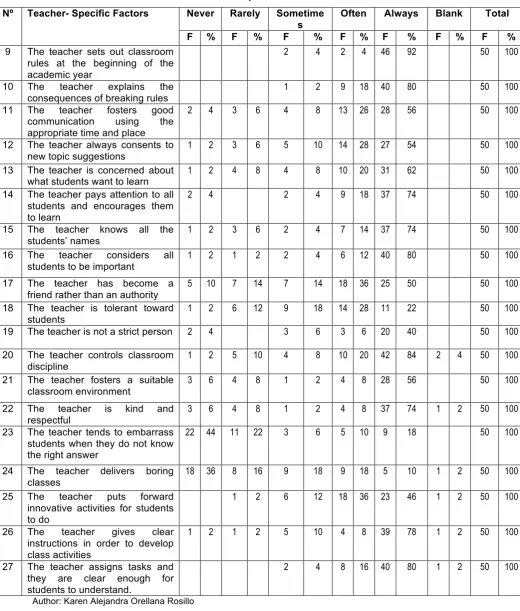
Table 2
Teacher- Specific Factors
Nº Teacher- Specific Factors Never Rarely Sometime s
Often Always Blank Total
F % F % F % F % F % F % F %
9 The teacher sets out classroom rules at the beginning of the academic year
2 4 2 4 46 92 50 100
10 The teacher explains the consequences of breaking rules
1 2 9 18 40 80 50 100
11 The teacher fosters good communication using the appropriate time and place
2 4 3 6 4 8 13 26 28 56 50 100
12 The teacher always consents to new topic suggestions
1 2 3 6 5 10 14 28 27 54 50 100
13 The teacher is concerned about what students want to learn
1 2 4 8 4 8 10 20 31 62 50 100
14 The teacher pays attention to all students and encourages them to learn
2 4 2 4 9 18 37 74 50 100
15 The teacher knows all the students’ names
1 2 3 6 2 4 7 14 37 74 50 100
16 The teacher considers all students to be important
1 2 1 2 2 4 6 12 40 80 50 100
17 The teacher has become a friend rather than an authority
5 10 7 14 7 14 18 36 25 50 50 100
18 The teacher is tolerant toward students
1 2 6 12 9 18 14 28 11 22 50 100
19 The teacher is not a strict person 2 4 3 6 3 6 20 40 50 100 20 The teacher controls classroom
discipline
1 2 5 10 4 8 10 20 42 84 2 4 50 100
21 The teacher fosters a suitable classroom environment
3 6 4 8 1 2 4 8 28 56 50 100
22 The teacher is kind and respectful
3 6 4 8 1 2 4 8 37 74 1 2 50 100
23 The teacher tends to embarrass students when they do not know the right answer
22 44 11 22 3 6 5 10 9 18 50 100
24 The teacher delivers boring classes
18 36 8 16 9 18 9 18 5 10 1 2 50 100
25 The teacher puts forward innovative activities for students to do
1 2 6 12 18 36 23 46 1 2 50 100
26 The teacher gives clear instructions in order to develop class activities
1 2 1 2 5 10 4 8 39 78 1 2 50 100
27 The teacher assigns tasks and they are clear enough for students to understand.
2 4 8 16 40 80 1 2 50 100
Author: Karen Alejandra Orellana Rosillo
28
The table above shows the results obtained from the second section of the student’s questionnaire, which is about teacher specific factors. Statement number nine contributed to know if the teacher sets out classroom rules at the beginning of the academic year. It was found that 92 % of the students agreed that their teacher always sets classroom rules at the beginning of the academic year, 4% often, and 4% sometimes.
This factor influences the learning environment in a huge way because through it the teacher lets students know what they can do and what they cannot do in the classroom since the beginning of the academic year; it also contributes to have a friendly environment, which is beneficial for the learning process and the relationship between students and teacher. Some rules that the teacher set out were: do not speak in Spanish during the class; do not eat inside the classroom and, to ask for permission when students want to go to the bathroom.
During the class observation, it was evident that students follow the rules because all the time they tried to speak in English and everyone asked for permission to go to the bathroom. The students clearly followed the rules and they knew what was allowed to do inside the classroom. In this regard, Moore and Hansen (2012) state that creating limits helps teachers maintain classroom in order so more teaching and learning can take place. Teachers who avoid setting limits/ rules and imposing necessary structure will often find that chaos results.
Statement number ten permitted to know if the teacher explains the consequences of breaking rules. It was obtained that 80% of students agree with the fact that their teacher always explains them the consequences of breaking rules, while 18% answered often, and 2% sometimes.
29
In statement number eleven it was obtained that 56% of students indicated that their teacher always foster good communication using the appropriate time and place, 26% often, 8% sometimes, 4% never, and 6%rarely.
According to the observations done, it can be said that the teacher let students finish the first activity and when she saw them tired or bored she started a group conversation in which all students had to participate, she stared to ask questions to individual students. This strategy is a good way to help students forget just a moment about studying and it helps students to be relaxed and confident inside the class. Stronge (2002) claims that creating an atmosphere of mutual respect, where students feel relaxed in asking questions and
expressing their thoughts and feelings will cause a great effect on students learning.
Statement twelve and thirteen allowed to know if the teacher always consents to new topic suggestions and if teacher is concerned about what students want to learn. The results indicated that 54% of students said that their teacher always lets them to talk about new topics related to the ones they are learning, 28% often, 10% sometimes, 6% rarely, and 2% never. It was also obtained that 62% of students agreed that their teacher is always concerned about what students want to learn, 20% often, 8% sometimes and rarely, and 2%never.
Referring to the class observation, it was noticed that the teacher gave students 5 minutes to think about topics that they would like to learn; then those topics were, in somehow, related with the grammar of the textbook. Clearly, it was a great strategy from the teacher to give them the opportunity to express and talk about topics that they would like to learn; in this way, the teacher created a great learning environment because students’ thoughts were being taken into account creating a space of good relationship. Gourneau (2005) establishes that a teacher must have the ability to provide meaningful learning opportunities for all students. Students appreciated teachers who helped them succeed with their learning experiences.
30
In the observation performed, it was noticeable that the teacher paid a lot of attention to students; specially, on how students were doing the activities. It was noticed that while students were working the teacher went to each single group to ask if they had questions or needed any help at the end of an activity; the teacher almost always told students that they had done a great work. It was a great idea from the teacher to motivate her students because that way she created on students a concern about learning more and improving their knowledge. To support this asseveration, Gourneau (2005) affirms that effective teachers genuinely care, like, accept, and value their students. These teachers will demonstrate kindness, share responsibility, accept diversity, foster individual instruction, and encourage creativity.
Statement number sixteen shows that80% of students totally agreed that their teacher considers that all of them are important, 12 said often, 4% sometimes, and 2% rarely and never. Based on the class observation, it can be said that when students were presenting their class work, the teacher was really concern at listening to all students. It was also noticed that the teacher gave the same time to each student to present class; it was easy to realize that the students were motivated to learn more and cooperate in the class and this situation is because the teacher makes students feel important and secure about what they know. Concerning this, Ljusberg (2009) states that to improve learning a deep acceptance of all individuals with variations in their ethnicity, religion, language, gender, class, in their diversity of needs, opportunities and difficulties is necessary.
Analyzing statement number seventeen, which refers to if the teacher has become a friend rather than an authority, 50% of students indicated always, 26% often, 14% sometimes, and 6% rarely, whereas 4% marked never.
31
Statement number eighteen contributed to know if the teacher is tolerant toward students, 36% of them absolutely agreed that their teacher is often tolerant with them, 22% always, 14% sometimes and rarely, 10% never, and 4% do not answer to this statement.
Meanwhile, during the observation, it was clear that the teacher was really tolerant and patient with students. In addition, when students got bored and they started to talk to each other the teacher always asked them to please be quiet, if they once again started to speak the teacher gave them 5 minutes to get distracted so then they could continue with the class.
According to Zeiger (2015) teachers must be disciplinarians, doling out fair and consistent punishments to students who break the rules. At the same time, teachers must show care and concern for students.
Statement number nineteen and twenty, which permitted to know if the teacher is a strict person and if she can control the discipline of the classroom; it was found that 40% of students indicated that their teacher is always a strict person, 6% sometimes and rarely, and 4% never. It was also found that 84% of students indicated that their teacher always manages the classroom discipline, 28% often, 18%sometimes, 12% rarely and 2% never.
The results of the students’ questionnaire match with the observation done due to it was evident that the teacher could control the classroom discipline; in fact, the teacher just had to told students twice to be quiet so they calm down. Also, it is confirmed that students followed the classroom rules because it was noticed that most of the times students asked for permission to sharpen the pencil, or asked for permission to go to the bathroom.
Besides, the teacher was not too strict but neither too permissive with students; it was also observed that the teacher was comprehensive when students asked her for something. Soin this case, it can be said that the teacher had a respectable classroom environment. In this regard, Evertson, Emmer, and Worsham (2000) say that effective teachers establish and maintain an environment in which learning can occur. To create this optimal learning environment, teachers need a repertoire of strategies for establishing rules and procedures, organizing groups, monitoring and pacing classroom activities, and handling misbehavior.
32
sometimes, 2% that she never foster a suitable learning environment, and 4% did not gave an answered for this assertion.
In the observation made in class, the teacher was all the time positive and enthusiastic about teaching to students, which allowed a suitable learning environment due to students were motivated to keep learning. It is evident that the teacher fostered an appropriate learning environment because the learning process occurred in a positive way on students. So it is really important that the teacher presents and creates an environment in which all students are included and their opinions are respected and taken into account. Stronge (2002) states that at the beginning of the year teachers have the goal of establishing a classroom environment that is favorable for helping all students work cooperatively in order to learn. The classroom environment can either improve or impede the student's ability to learn and feel safe and comfortable as a member of the class.
Statement number twenty two, which lets to know if the teacher is kind and respectful, 74% of students claim that their teacher is always kind and respectful, 8% indicated often, 8% rarely, 6% never, 2% sometimes and 2% did not answered.
The observation performed permitted to know, that the teacher was all the time respectful with students; the teacher heard all students’ opinions and even more when students were presenting their work; it was also noticed that when the teacher asked the students to do something the teacher always was polite and kind. In this classroom, teacher and students respect each other; it was evident that the classroom environment was well managed for both parts given the opportunity to students to feel comfortable and to the teacher to feel free to teach in a peaceful and respectful classroom influencing the learning environment in a positive way.
The whole analysis made above, confirms what Lannier (1997) teachers job is to counsel students as they grow and mature, helping them integrate their social, emotional, and intellectual growth.
33
the class, sometimes, some students laughed when the teacher corrected to a students’ mistake. So, it can be said that when teacher corrects mistakes to an individual student in front of the whole class, the only thing that the teacher is doing is creating insecurity in the student. This factor will strongly affect the learning environment due to the next time that the pupil is going to participate he or she will do it but with the faradism of making a new mistake and be embarrassed in front of the class. This opinion is confirm by Marachi, Midgley, Friedel (2002)who say that when students perceive that their teacher takes care not to embarrass them, they report lower levels of maladaptive behaviors. In addition, students’ perceptions of teacher care not to embarrass moderates the relation between mastery goal perceptions and projective coping, and between performance-approach goal perceptions and avoidance of help seeking.
In statement number twenty four it was found that 36% of students agreed that their teacher never presents boring classes, 18% agreed that sometimes and often, 16% rarely, 10% always and 2% did not answer. According to the class observation made, it was noticed that in different days the teacher presented two different activities, which students developed with enthusiasm, it was also observed that the way how teacher explained the new grammar was really creative; so it was evident that students did not get bored at attending the class because they worked really well and paid attention to the teacher. According to Flanagan (2013) states that there is a strong acting/entertainment factor in dynamic teaching. Great teaching should inspire learning through more than attention grabbing.
Statement number twenty five shows that46% of students agreed that their teacher always puts forward innovative activities for them to do36% indicated often, 12% sometimes, 4% rarely, and 2% did not answer. In this case, it was easy to observe that the teacher used an innovative activity every class. In fact the teacher used the lyrics of songs to practice the new grammar. So, while students had fun listening to the song they were learning and practicing the new grammar. The classroom environment is affected when teacher uses old ways to teach, like translation or dictation, but in this case the teacher look for new ways of teaching and engaging students attention. Keppel (2013) says that educational institutions are facing new challenges resulting from technologically driven changes in teaching and learning, globalization of higher education and changes in the economic climate.
34
Statement number twenty six and twenty seven allowed to know if the teacher gives clear instructions in order to develop class activities and if the teacher assigns tasks that are clear enough for students to understand. It was found that 78% totally agreed that their teacher always gives them clear instructions, 10% sometimes, 8% often, and 2% rarely and never. Referring to the fact that the teacher assigns tasks that are clear for students; it was found that 80% of students indicated always, 16% often, 4% sometimes, and 2% did not answer question number twenty seven.