UNIVERSIDAD TÉCNICA PARTICULAR DE LOJA
ESCUELA DE CIENCIAS DE LA EDUCACIÓN MENCIÓN INGLÉS
DISTANCE SYSTEM
The use of supplementary materials for teaching children in EFL classes Research done in order to achieve the
Bachelor’s Degree in Teaching English as a Foreign Language
AUTHORS:
Garzón Peña, Verónica Catalina Guamán Sarmiento, Sonia Karolina ADVISOR:
Mgs. Pinza Tapia, Eliana Ivanova
ii
CERTIFICATION Mgs. Pinza Tapia Eliana Ivanova
Certifies that:
This research study has been thoroughly revised by the graduation committee. Therefore, authorizes the presentation of this thesis, which complies with all the norms and internal requirements of the Universidad Técnica Particular de Loja.
Loja, March, 2012
iii
CONTRATO DE CESIÓN DE DERECHOS DE TESIS DE GRADO
“Nosotras Verónica Catalina Garzón Peña y Sonia Karolina Guamán Sarmiento declaramos ser autoras del presente trabajo y eximo expresamente a la Universidad Técnica Particular de Loja y a sus representantes legales de posibles reclamos o acciones legales.
Adicionalmente declaramos conocer y aceptar la disposición del Art. 67 del Estatuto Orgánico de la Universidad Técnica Particular de Loja que en su parte pertinente textualmente dice: “formar parte del patrimonio de la Universidad la propiedad intelectual de investigaciones, trabajos científicos o técnicos y tesis de grado que se realicen a través, o que el apoyo financiero, académico o institucional (operativo) de la Universidad”.
iv
AUTHORSHIP
The thoughts, ideas, opinions and the information obtained through this research are the only responsibility of the authors.
March, 2012
……… ………
v
DEDICATION
This thesis is dedicated to God, who is the owner of my life and always sends me by the good path of life. It is also dedicated to my family because they support me in every moment and in everything I decide to do. Finally, I dedicate this thesis to my daughter to show her that everything is possible with dedication and effort and that never give up when started doing something.
Here is the example for my daughter Victoria.
Verónica Garzón
This thesis is dedicated to my God and Lord for guiding my life, blessing every step I take, and taking care of me; to my dear parents for their love and endless support, to my brothers and sisters for their comprehension and patience, to my nieces and nephews for whom I am an example to follow, to all my special friends who have been with me all the time. Thanks everyone for depositing your trust in every challenge presented to me without questioning my intelligence and aptitude.
Here you have the result of my effort and dedication. Love you with all of my life,
vi
ACKNOWLEDGMENT
We wish to express our gratitude to God for guiding our lives always. We have to thank our families for their love, support and patience during the time we have developed this thesis, to the Universidad Técnica Particular de Loja for providing us the opportunity to study in its distance system allowing us to be where we are today and to our thesis advisor, Mgs. Eliana Pinza for her help and support during this process.
vii
CONTENTS
CERTIFICATION………..………. ii
CONTRATO DE CESIÓN DE DERECHOS……….……... iii
AUTHORSHIP ……….. iv
DEDICATION………... ……… v
ACKNOWLEDGMENT………... ………. vi
CONTENTS ……….. vii
ABSTRACT ……….……….. 1
INTRODUCTION ………. 2
METHOD……….………... 5
DISCUSSION ……….. 8
Literature Review………. 8
Results………. 22
Description, Analysis, and Interpretation of Results……… 27
Conclusions……….. 56
Recommendations……….57
REFERENCES ……….58
1
Abstract
This study analyzes the use of supplementary materials for teaching children in EFL classes for finding out whether or not teachers use supplementary materials, and if they are used, how pertinent, appropriate, and qualified those materials are.
The field research was done in two private educational institutions where English is taught as a foreign language to male and female children of eight, nine and ten years old, in the urban zone of Cuenca, Ecuador. In every group, ten observations were made to register the detailed aspects of the lessons in the observation sheets. At the end of the class, two students were randomly chosen to develop a survey; in the same way, a survey was applied to the teacher.
The methods were qualitative and quantitative. For carrying out the tabulation process, the data obtained from the observations was analyzed for determining the type of supplementary material used to teach children, and its frequency of use.
2
Introduction
For many years, the teaching of English as a foreign language has played an important role within the society because day after day it becomes essential to be aware of the necessity of learning a new language in order to obtain benefits in the future. In the teaching learning process, teachers need to know about conveying information to students in an interesting way and communicating love and passion for the English language.
To accomplish these goals it is necessary to consider the different contexts in which it is developed. That is, where English is going to be taught and the aspects that are taken into account when teaching it, the materials that are used in the class, and the methods, resources and techniques used by the teacher.
For achieving success within the teaching learning process, teaching materials are an important part because teachers need to rely on a diverse range of aids that can support their student’s learning and reach their objectives. One of these aids is the use of supplementary materials that becomes in an advantage for teachers since if they are properly used, they will work effectively at the moment of imparting classes to the students.
Using supplementary materials can make classes more interesting and motivating if this material is correctly selected at the moment of planning the lessons. When teachers choose what material to use in each class, it is very important to consider its pertinence and appropriateness in order to achieve the proposed goals.
3
however, just some teachers are using them. Based on what is said lately, we propound to investigate about the use of supplementary materials for teaching children in EFL classes. The purpose of this study is to verify if teachers are using or not supplementary materials during the class, and if they are using them, aspects like the importance of the material used in relation to the content (pertinence) , the student’s level and understanding (appropriateness), and the design and elaboration of the supplementary material (quality) are being considered.
In accordance with the purpose of this study, the stated objectives are: identify and analyze supporting materials used for teaching children in EFL classes, describe and analyze each one of the supplementary materials used in EFL classrooms in terms of pertinence (content), appropriateness (student’s needs), and quality; and determine the frequency and variety of the supplementary material used in the observed classes. Using supplementary materials help teachers and students to develop the class in an interesting and motivating way to attract students’ attention, giving them the opportunity to have a better understanding and getting involved in the whole process that the contact with the didactic material implies.
4
female students, and the fact that all of the participants came from the same department means that the results cannot be extrapolated to the general student population. On the other hand, we have the study made by Peacock (1997) to explore whether authentic materials increase the classroom motivation of learners, a claim often made, but rarely, if ever tested, which had as a limitation the generalizability of the results is limited by the small scale of the study and the level of the learners, who were all beginners. Finally, a Panjwani, Micallef, Fenech, Toyama(2009) study that was done to examine the effects of treating learners in a classroom to digital visual materials on a shared display, while interleaving such materials with scanned copies of relevant textbook pages, with no limitations identified by the author.
5
Method Settings and Participants
The field research was done by selecting two private educational institutions where English is taught as a foreign language to male and female children of eight, nine and ten years old, in the urban zone of Cuenca, Ecuador.
Procedures
In order to carry out the bibliographical research, it was necessary to investigate and select theories, definitions and concepts that allowed us having a clear view of the topic to be examined. This information was found in books, magazines and journals of different libraries of universities; and, on the internet. The data was organized in the recollection index cards that contained the most relevant and related information about the themes and subthemes of different sources and authors. Additionally, previous studies about “Supplementary material used in EFL classrooms” were researched with the purpose of deepen on the topic, and recognize the procedure of other similar studies. Techniques like reading, note-taking and surveys; and, instruments such as data collection and observation formats, tables and questionnaires were used to recollect the data.
6
survey was applied to each teacher in order to know their opinion about the use of supplementary materials.
The general approach of this study is Qualitative and Quantitative. The qualitative data was collected in the observation sheets in which we ticked the supplementary material variables used by the teacher. In the description of the used material sheet, it was registered if the ticked material was used appropriately in relation to the topic and objectives of the class, to the student´s age and level; and if it was elaborated and applied with creativity and originality. In order to register the qualitative data on charts two, three and four, and determine if the used supplementary materials were pertinent and appropriate, we checked the observation and description sheet (annex 5) employed during the ten observed classes in each group of children. The quantitative data was based on the information of the observation sheets to determine the frequency of use of supplementary material. For the purpose of making the quantitative tabulation and establishing the frequency of use of supplementary material on chart five, we needed to go back to the observation and description sheet (annex 5) to define how many times each material was used in each group of children.
For carrying out the tabulation process, the collected data was explored, analyzed, and described under the qualitative and quantitative approach.
7
8
DISCUSSION Literature Review
Supplementary materials are a very important aid for the English language teachers because they provide practice and information for areas students may have more difficulty understanding. The appropriate selection and use of materials not only contribute to improve instruction and performance but also to increase interest in and enthusiasm for learning by getting a funny and successful class.
Visual, audio, audiovisual, realia and online are considered supplementary materials to be used in the classrooms to guard against the dullness of falling into the same teaching old strategy and same source of learning content over and over again.
Considering what has been said about the use of supplementary materials for achieving teaching learning goals, it is necessary to mention that aspects like the influence of age, differences and motivation of learners, learning styles; and teaching techniques and contexts must be taken into account by teachers during the teaching process.
It is helpful to refer to previous studies in order to have a clearer view of how supporting materials have been used and applied in different cases and contexts.
9
memorize, provide them with sources for learning a foreign language, use foreign language when talk and interact with the students, and make them to act together with a person who speaks the foreign language.
Dekeyser (2006) stated that it is well known that children tend to pick up easily any new language that they are rounded by. One of the advantages of learning a foreign language early is the pronunciation; however a disadvantage of learning a language early is the grammar and the capability of the size of learning vocabulary. Anyway it is demonstrated that there are more advantages of learning a language early, for that reason each time elementary schools are implementing more programs. Also to teach well a foreign language depends on the time that will be invested by the teacher and the students.
Littlewood (1981) suggested that in a foreign language teachers have to let students to communicate effectively by using different communicative activities that give practice, enhance motivation, and produce a learning context. Those activities are divided into functional activities that refers to develop the language in particular situations; social interaction activities in which language is used according to the social context where it is carried out; and listening activities that has to do with the action to use the language face to face.
10
traced their objectives; this makes adults more able to study theory. Adults have larger attention than children. Teachers need to vary to keep children’s attention and interest on the activity they are doing.
There are different reasons why people reach a low or high level of academic performance and it is due to the fact that exists differences like socioeconomic status, culture and gender between learners. Socio-economic status has been thought to explain why, on average, children from impoverished backgrounds underperform when compared to children from non impoverished backgrounds (Howard, Dresser, & Dunklee, 2009). However, there are exceptions that show that not all poor children are low performers and vice versa. Children interact and learn in different ways also according to their culture. Gender talks about the manner boys and girls learn.
Talking about motivation, Woolfolk (2007, p.372) states that “Motivation is usually defined as an internal state that arouses, directs, and maintains behavior”.
11
motivation in which people do activities to maintain their identities and their interpersonal relation between the communities.
Leaver (2005, p. 65) says that “learning styles are habitual patterns of perceiving, processing, or reacting to information”.
Learning styles are divided into visual learning, auditory learning, and motor or kinesthetic learning. Visual learning is when something is learned by sight. Auditory learning is when students acquire data through sound. Kinesthetic learning is when students use their whole body to learn, it involves total physical response activities. Felder & Soloman (2005) proposed that there are active and reflective learners. Active learners develop information by doing something with it. Reflective learners learn by first understanding the information and then acting. Also there are sensing and intuitive learners. Sensing learners prefer to learn with concrete information while intuitive learners prefer abstract information. Another type of learners is visual and verbal learners. Visual learners like visual presentations of the material that is going to be taught. Verbal learners like written and spoken information. Finally there are sequential and global learners. Sequential learners prefer to organize information in a systematic way. Global learners prefer to organize in a holistically way the information.
12
vocabulary in context, giving students meaning in different context. Another technique is to encourage the students guessing the meaning of the words. In addition teachers can use synonyms and antonyms to teach new words.
For teaching grammar Beare affirmed that
Teaching grammar plays a central role in every ESL / EFL teacher's classroom. The important question that needs to be answered is: how do I teach grammar? In other words, how do I help students learn the grammar they need. This question is deceptively easy. At first look, you might think that teaching grammar is just a matter of explaining grammar rules to students. However, teaching grammar effectively is a much more complicated matter. There are a number of questions that first need to be addressed for each class:
What are the objectives of this class?
What type of learning background do the learners have? What learning materials and resources are available? What kind of learning style does each student have?
13
One of the main aspects of contexts for teaching refers to the fact that language learners have to know that in order to communicate in a successful way; the use of the language has to do with a cultural behavior. For reaching this behavior, teachers can treat cultural factors in an explicit topic for discussion. When English is taught as a second language, it should be used in socially appropriate communication, so that students could learn through linguistic and cultural norms. Cultural activities should be included into lesson plans to supplement teaching content.
Culture defines our social identity and makes us members of a group or subgroup within the society. Culture is something we learn and it is also transmitted socially. It is important to know that in culture interview two points, one of them is socio-cultural knowledge that includes every aspect of social activities such as religion, politics, sports, occupations, arts, medicine, education, science and language. The second point is cultural knowledge that is something which you do or do not have as a whole. Consequently, culture is the relationship between knowledge and social identity.
Going ahead with the use of supplementary materials, Tomlinson (1998, p. 2), considers a teaching material as:
14
they can be anything which is deliberating used to increase the learners' knowledge and/or experience of the language.
Supplementary materials are important sources because they motivate student’s skills and are useful tools to create mental images and representations. They play a significant role within the teaching learning process because they need to be motivating because they make students to stimulate their performance on the language, and help teachers to create systems of values about the language and culture.
Cunningsworth (1984) states that a visual aid is a “teaching aid designed to give a visual stimulus, act as a visual prompt or provide visual reinforcement for language items being learned. Photos, cartoons, film strips, blackboards drawings puppets and wall pictures can be used as visual aids.”
15
Cunningsworth (1984) says that audio aids “such as radios, record players, tape recorders and language laboratories which help the learners by exposing them to the spoken language.”
They are conformed by: songs that are powerful resources of teaching English to improve the vocabulary, grammar and accents of the students. It is important to use selective songs that are good to listen to. Dialogues help students to enhance their conversation skills in class. For teaching dialogues in the classroom teachers should introduce new vocabulary to make students to become familiar, apply fill in gap exercises, use role plays, ask students to finish a dialogue, and memorize dialogues. A story refers to tell a tale to people through voice and gesture.
According to Cunningsworth (1984)” Audiovisual aids: such as television, film and video equipment which allow the learners to see a situation as well as listen to the language used in it.” Videos are one of the audiovisual aids that can be presented as short clips to show any type of information. We have to take into account that to present videos it is necessary to have a well equipped room.
As Soames (2011) said, “the word realia means using real items found in everyday life as an aid to teaching English. Using realia helps to make English lessons memorable by creating a link between the objects and the word or phrase they represent.”
Online refers to the use of the internet as a classroom tool that open up a world to the students giving them the opportunity to access to many options around the world.
16
A study done by Sato & Susuki in 2010 has been taken into account. Its purposes are to examine the superiority of multimedia-oriented gloss in comparison with traditional glosses, and to demonstrate the spatial relationship of prepositions such as “above”, “across”, “below”, “in”, “on”, and “over”, which are regarded as difficult to learn because of the appropriate choice of the words’ several senses based on various contexts. For this study the participants were divided into two groups and answered 40 questions about physical senses of special prepositions. The used procedure is based on a paper by Al- Seghayer (2001), in which he shows that animation is a more effective technique than the use of planar images.
They used two different types of multimedia glosses in a multimedia English–Japanese dictionary for seven spatial prepositions, such as above, across, below, in, into, on and over. The first dictionary included a static 2D gloss while the other dictionary included a 3D animation gloss.
17
test, the scores were analyzed using t-test and two-way ANOVA to validate our null hypothesis.
The conclusions this study present are that image schema, or schematic representations of spatial relationships, are more effective in learning the meaning of spatial prepositions and in choosing appropriate prepositions according to context, there is no difference between multimedia oriented visual gloss and planar visual gloss which can be shown in print-based dictionary or textbook., and dictionaries with such multimedia-oriented glosses could extend programs from being mere reference tools which provide an appropriate meaning or definition for learners, to becoming learning tools.
The study made by Kelsen (2009) has as objective to explore the use of Youtube as supplementary material with EFL students in Taiwan. It uses a quantitative method in which the students who participated in this study used the same textbook and material in both classes. The first class the students were given a simple questionnaire regarding their gender, access to computers and experiences using YouTube prior to this course. The students chose a video clip from YouTube covering interesting historical places in the world. For the listening part the teacher used a video that has an interesting script and a rich vocabulary. The last day of classes, the students were given a follow up questionnaire to respond “What do you usually use YouTube for?” All the statistical results were calculated using the descriptive statistics function of SPSS for Windows, version 10.0.
18
can be involved in creative ways to incorporate YouTube in a variety of classroom environment.
19
questionnaire. From this total class mean score for the day was computed. The questionnaire was translated into Korean, the learners’ L1, which appeared alongside the English version, to avoid learner misunderstanding. Further (qualitative) data was collected via five-minute post class interviews (two learners each day), designed to allow learners to give in their own words their views on the materials used that day. All the data from observation sheets 1 and 2 and the learner questionnaires were analyzed separately via repeated-measures multivariate analysis of variance, to investigate whether type of material (artificial or authentic) had a greater effect on motivation than class (A or B), day, or activity. As a conclusion of this study they found that, overall, learners reported authentic materials to be significantly less interesting than artificial materials.
These results also indicate that, at least for the learners who participated, interest in the materials in use is quite separate as a component of motivation from levels of attention or action and persistence with the learning task.
20
presentation tool with the digital materials collected prior to the study, and the tool ran on the same hardware as was used during the field tests. The materials used were identical for both groups except for one key difference: the materials for the treatment group included scans of textbook pages whereas those for the control group did not. As conclusions they got that Digitized versions of textbooks are useful in improving students’ retention of visual materials utilized during classroom instruction. Digital visual materials are useful to increase students’ attention levels in the classroom, and they often lead to an improvement in students’ comprehension of the class content as well.
21
model sentences, and by means of contextual cues the students inferred what the meaning of each word was. In the other experimental class (picture group), some pictures were prepared in which the new words were presented through them. The third class (control group), didn’t receive these types of treatment, but the new words were presented through definitions and synonyms. At the end of the semester vocabulary development of the students in all three groups were tested using the posttest. On the basis of these tests the efficacies of the two methods of vocabulary teaching were determined.
22
Results
Chart One: Type of supplementary material used to teach children
Variable
Indicators
Yes
No
flashcards
power point presentations maps
pictures charts handouts posters word cards white/black board songs
dialogues stories tales videos movies
documentaries
Realia
objects (toys, plants, fruits)Online
websitesAudio
Audiovisual
Visual
Authors: Verónica Garzón, Karolina Guamán
23
Chart two: Pertinence and Appropriateness of the supplementary material used to teach children. P er t. A p p ro p . P er t. A p p ro p . P er t. A p p ro p . P er t. A p p ro p . P er t. A p p ro p . P er t. A p p ro p . P er t. A p p ro p . P er t. A p p ro p . P er t. A p p ro p . P er t. A p p ro p . flashcards power point presentations maps pictures charts handouts posters word cards white/black board songs dialogues stories tales videos movies documentaries R ea
lia objects (toys, plants, fruits) O n lin e websites 9t h c la ss 10 th c la ss Indicators V ar ia b le 1s t cl as s 2n d c la ss 3r d c la ss 4t h c la ss 5t h c la ss 6t h c la ss A u d io A u d io vi su al V is u al 7t h c la ss 8t h c la ss
24
Chart three: Pertinence and Appropriateness of the supplementary material used to teach children P er t. A p p ro p . P er t. A p p ro p . P er t. A p p ro p . P er t. A p p ro p . P er t. A p p ro p . P er t. A p p ro p . P er t. A p p ro p . P er t. A p p ro p . P er t. A p p ro p . P er t. A p p ro p . flashcards power point presentations maps pictures charts handouts posters word cards white/black board songs dialogues stories tales videos movies documentaries R ea
lia objects (toys, plants, fruits) O n lin e websites A u d io A u d io vi su al V is u al 7t h c la ss 8t h c la ss 9t h c la ss 10 th c la ss Indicators V ar ia b le 1s t cl as s 2n d c la ss 3r d c la ss 4t h c la ss 5t h c la ss 6t h c la ss
25
Chart four: Pertinence and Appropriateness of the supplementary material used to teach children P er t. A p p ro p . P er t. A p p ro p . P er t. A p p ro p . P er t. A p p ro p . P er t. A p p ro p . P er t. A p p ro p . P er t. A p p ro p . P er t. A p p ro p . P er t. A p p ro p . P er t. A p p ro p . flashcards power point presentations maps pictures charts handouts posters word cards white/black board songs dialogues stories tales videos movies documentaries R ea
lia objects (toys, plants, fruits) O n lin e websites 9t h c la ss 10 th c la ss Indicators V ar ia b le 1s t cl as s 2n d c la ss 3r d c la ss 4t h c la ss 5t h c la ss 6t h c la ss A u d io A u d io vi su al V is u al 7t h c la ss 8t h c la ss
26
Chart five: Frequency of use of supplementary material.
TOTAL PERCENTAGE
f %
flash cards 0 0 0 0 0,00
power point presentations 0 0 0 0 0,00
maps 0 0 0 0 0,00
pictures 0 0 0 0 0,00
charts 1 0 0 1 2,13
handouts 2 1 0 3 6,38
posters 0 0 0 0 0,00
word cards 2 1 0 3 6,38
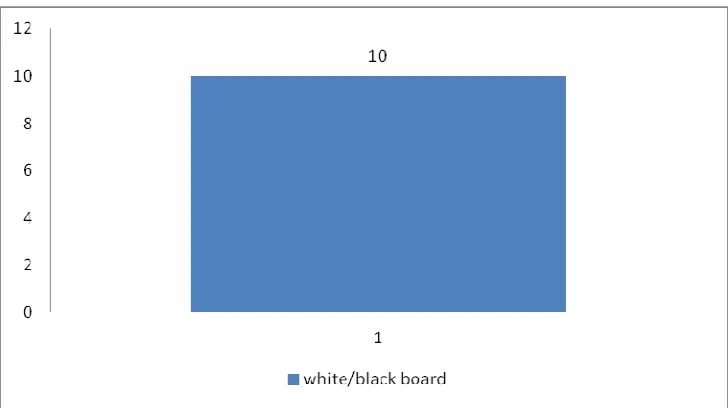
white/black board 10 10 10 30 63,83
songs 2 2 0 4 8,51
dialogues 0 1 0 1 2,13
stories 1 2 0 3 6,38
tales 0 1 0 1 2,13
videos 0 0 0 0 0,00
movies 0 0 0 0 0,00
documentaries 0 0 0 0 0,00
Realia objects (toys, plants, fruits) 1 0 0 1 2,13
Online websites 0 0 0 0 0,00
TOTAL 47 100,00
5th Grade (9 years approx)
6th Grade (10 years
approx)
Visual
Audio
Audiovisual
Variable Indicators
4th Grade (8 years approx)
Authors: Verónica Garzón, Karolina Guamán
27
Description, Analysis, and Interpretation of Results
This section contains the results obtained in the field research carried out in two private educational institutions where English is taught as a foreign language to children. The results are analyzed in a qualitative and quantitative form. In the qualitative analysis, the supplementary materials used in the observed classes are described considering the characteristics of pertinence, appropriateness, quality and learning styles. In the quantitative analysis, the frequency of use of supplementary material is analyzed based on the observations sheets, surveys and our personal criteria.
Qualitative Analysis
4th Grade/ 8 Years old
Charts
In class number eight, a chart with different sounds was used to introduce the topic “Sounds like English” to teach the students to differentiate the sounds between “t”, “th”, “ch”, and “s”.
It was not related to the students’ level because this class was about phonetics. It was designed to an intermediate level; and they did not have previous knowledge about each sound. On this activity, the teacher pronounced different words beginning with “t”, “th”, “ch”, and “s” and the students had to say to what chart each word belonged to. Considering the age of the kids, this class was not adequate because the teacher used difficult sounds for them.
28 Handouts
The handouts in class number six were applied to practice “Wh- questions” and to remember the verb to be (singular and plural). The kids liked the handout because it had pictures on the activity that was going to be developed.
On the handout they had to fill in the gaps with the correct verb to be (am, is, are) depending on the picture that was next to each Wh-question to be completed, on this activity the objective of the class was reached because the children for completing the activity used the verb to be correctly and differentiated from singular and plural.
The activities on the handouts were according to the student’s level because it was a topic that they already have learned.
These handouts were copies with no color; however, the students were motivated because of the pictures about materials used in the classroom on it.
In class seven, handouts were given to students to introduce the theme “what is it?” taking into account the singular and plural of different objects. The handouts contained exercises in which students had to complete the sentences, filling in the gaps with the respective verb to be (am, is, are) taking into account the name of food that was written on it. Students were not really interested in developing those activities because they were simple and did not have any picture that could attract their attention.
The handouts were related to the students’ level because the sentences they had to fill in had easy vocabulary they could recognize quickly.
29 Word cards
In the forth class, the teacher presented word cards to review the use of “have” and “has”. Its objective was to make students remember what they learned the last classes about how “have” and “has” are used to show possession, and that “have” is used with first person and “has” with third person. These word cards were used in a good way to reach the objective of the class. For developing this activity the teacher stood up in front of the class and showed the children the word cards, after explaining the use of have and has the teacher asked three students to pass near the whiteboard and taking them as examples, the teacher showed when to use have for first person, and has for third person. This didactic material was related to the students’ level because the vocabulary used in the examples was adequate for this beginner’s level. The use of word cards allowed the teacher to explain the topic clearly, with known vocabulary that let the children to understand the lesson better. It was noted that it awoke students’ participation; they showed their interest in learning through these word cards.
The word cards used by the teacher had a size that let all the students to appreciate them. The text was big enough that enabled everyone to see them.
30
complete sentences. The word cards made the class easier to develop with the kids. They were visible and legible to the students. They were made of different colors. White board
Considering that in the first class, the topic of the lesson was the use of the pronoun “whose”, the board was correctly used to explain with examples how this pronoun is used to show possession and how it replaces possessive pronouns (my, your, his, her, its, our, their). There was students’ participation during the whole lesson; the teacher asked different students to come to the front and write examples on the white board.
The board was a good aid to teach this topic because on it the teacher did examples of replacing the possessive pronouns, and then made the students create their own examples. The used vocabulary suited with the level of the students because the words used by the teacher for explaining this lesson, were known by the children.
The teacher used different colors of markers on the board to highlight possession and to highlight when it was replaced by possessive pronouns. The surface of the board was correctly organized that all the students could observe and read the information written on it with a right size of letters.
In the second class, the teacher used the white board to explain the topic “Octopuses” which had as objective to teach about the use of the verb “have”, the nouns “difference” and “emergency”, the adjective “over there”, and the preposition “between”. It was important to explain the lesson by this mean because the teacher had the opportunity to write the meaning of the unknown words.
31
their age because the teacher used simple words they could identify. The students were asked to look for new vocabulary and this activity awoke their interest in the class. The goal of the class was carried out because the students developed the activity successfully.
The quality of this aid was useful because the written words were big in a way that all students appreciated them.The board was well organized because the examples of the verb were one behind another and the examples of the nouns were in the other part of the board. The teacher used good handwriting.
In class number three, the white board was used to continue with the topic “Octopuses”. The teacher asked the children to look for sentences from the reading that contained the words “have” and “has” and to write them on the board. This activity was interesting for the students because it allowed them to participate and give more examples of the use of “have” and “has”.
The board was correct to the students’ level taking into account that they had previous knowledge about the vocabulary reviewed in the last classes.
Since the letters used were visible, clear and colorful, and the teacher did not block the learners view, the students could appreciate every detail of the explained lesson. The purpose of this class was accomplished in a good way.
32
The easy and comprehensible words used to give the examples made the use of the board suitable to their age and level.
The use of the board was good because the teacher divided it into sections, one part for using during the lesson which could be cleaned off and re-used, and another part for important information which could stay there for the whole lesson. The letters were big enough for everyone to see them and the teacher used different colors for differentiating issues; the part of the board which could be cleaned off was written with blue and with black the other side of the board.
In the fifth class, the use of the board was important to teach the topic “In the Jungle” which objective was to introduce the animals there are in the jungle like: spider, snake, monkey, frog, tiger and crocodile.
The teacher chose only those items that need special and focused attention to write on the board taking into account the level of understanding and age of pupils because they knew some facts about those animals.
Key grammar points and vocabulary needed for the lesson were written with colorful and big letters that allowed all students see them, making it a good quality aid. The space of the board was well distributed that students had a good understanding of the topic; key grammar points were on one side and the vocabulary was in the other side of
the board.
The students practiced the names of the animals in the jungle, in that way the purpose of the class was accomplished.
33
competition on the board, in that way students were interested. This activity was done as a warming up.
The questions were written with one color of marker and the answer with another one; for that reason, it was easy for students to distinguish the questions and the answers. The written questions were in order, and well elaborated because they were one behind another. The space on the board was equilibrated because they had the same space between them.
White board was used in class number seven to learn the lesson “What is it”, to practice singular and plural of different things. There were food draws on the board like: apples, oranges, bread, potatoes, tomatoes, pretzels, fish, bananas, milk, pizza and candies; some were in singular and some in plural, the teacher named one of these food and students had to touch them with a fly swatter.
The drawings helped the students to learn more about food; the vocabulary was easy and in concordance with their age because the teacher used words that are used daily, in that way the children could produce their own examples.
The draws on the board were well handmade, with different colors and in a size that everybody observed them. The draws were separated enough between them; the draws were made with different color of markers like green, blue, red and black. The objective of the class was fully accomplished.
34
This material was according to the students’ age because the teacher used simple words they could understand and guess, all the children participated and interacted in the class. The game made on the board was well done; the teacher used big letters and colors. This activity caused a little bit of disorder; however, the teacher controlled the discipline. In the ninth class, the white board was used to teach the lesson “Around Town” in which students had to ask and answer about directions. On the board, there was a figure of a small town, where students had to give directions. The students were animated because it had interesting places to children like parks, an ice cream parlor, and a fast food place. The figure drawn on the board was correctly used because the vocabulary about places was adequate for their age considering that those are the common places visited by people daily. After the teacher read the names of the places, they had to repeat them. The figure on the board was clear and attracted the students’ attention because it used colors and funny draws.
In the tenth class, the teacher made some draws about clothing on the white board to teach the students new vocabulary and to ask and answer questions about “what are you wearing?”. The draws on the board were really well done that students were enthusiastic to learn this lesson.
As draws were on the board, it was according to the students’ needs because all of them knew the vocabulary to describe what they were wearing at that moment. At this time, it was seen that the objective of the class was achieved
35 Songs
In the forth class, the teacher used a song called “Octopuses” related to the animals there are on the sea to remember the topic “Octopuses” in order to review the use of “have” and “has” and to encourage a positive atmosphere. This song awoke student’s interest because it was noted that they enjoyed it a lot because they were singing and clapping their hands.
The song was apt to teach this lesson taking into account the level of understanding of the children because it used easy vocabulary known by the students; as a result, they felt more confident at the moment of singing because they knew what they were saying. The sound of the song was clear; it had the enough volume that allowed all students to listen to it.
In the fifth class, the song called “Where’s our car” was used to review the topic of the last class “The adventure Car” which objective was to practice the use of “have” and “has”. At using this aid for beginning the class, a good atmosphere was created in the class that the children and changed their mood because they were tired.
The children were taught with this aid considering their age because of the use of comprehensive vocabulary in the song.
It had good sound, the vocabulary had good intonation and everyone in the class listened to it.
Stories
36
students had to listen to the story and fill in the gaps with words they listened in the story.
As the words used in the story were easy, this audio material fit on the age and level of the students.
The language was simple with few words and repetitive language patterns. It could be listened to by all the class because it had clear sounds. The children learnt about the use of have and has.
Objects (apples, pretzels, lemon and bread)
In the seventh class, objects were used altogether teacher and students, to learn about singular and plural in the topic “What is it?, The purpose of this class was to make students identify different food for learning about singular and plural. The teacher made the students taste different food like apples, pretzels, lemon and bread. Students had to describe the flavors they tasted and say it aloud.
In this class the objects were used considering the student’s level because the teacher used objects than can be identify easily by them. Besides they were used according the children’s age because it was a funny and interesting activity that attracted their attention.
As students interacted with the objects, saw and felt them; they were perfect to this class, and the goal of the class was successfully carried out since at the end of the class the children could identify the food.
Learning styles
37
which techniques and learning styles must be applied to make all the students reach the same level of understanding. It was noticed that at the moment of using the materials, the teacher considerated visual, auditory and kinesthetic learning styles to apply to the children.
5th Grade/9 Years old
Handouts
The handouts were used in class number four to review the topic “Around Town”, which goal was to check the prepositions. The students had to fill in the handout with the right preposition according to the pictures they saw. The pictures were about directions and they had to complete with the prepositions in, on at.
The material was according to the students’ age because they only had to fill in the spaces. As the handout had pictures, it attracted the interest and attention of them. The teacher used appropriate vocabulary according to their level, making easy to them to understand the contents. The purpose of the class was accomplished successfully.
The copy of the handout was clear enough for them to read understand and develop the activities. Although it did not have color, it was visible and legible to everyone. It had plenty of white space for students' own notes; it used wide margins, and left substantial gaps between topics.
Word cards
38
The word cards were applied in obedience to the students’ level and understanding because it was observed that the use of this material helped them to understand better the grammatical rules they were learning since the sentences were not difficult to put in order.
The material was elaborated by the teacher. The word cards were written by hand, with different colors and with clear and visible letters, in two inches sizes. At the end of the class, the children could recognize phrases for expressing their likes and dislikes. White board
In the first class the teacher used the white board to make the students draw about healthy and unhealthy food in order to talk about likes and dislikes. Students had to write two sentences, one with “like” and the other with “don’t like”. This was a nice activity because they had a lot of fun at completing the sentences and drawing it on the board. They were enthusiastic and participated actively in the whole class.
This activity was according to the students’ level because all of them had previous knowledge about food names and expressions to say what they like and do not like. It was easy for them to use those expressions.
The teacher distributed the space well on the board and used blue, red and black markers to differentiate issues. Handwrite was legible for everyone. When students wrote the sentences it was seen that they understood the use of like, in that way the goal of the class was accomplished in a good manner.
39
It could be seen that the explanation was related to the students understanding because they expressed their opinions about animals and it was a topic according to kids. The teacher made the children use the expression “I think” for expressing their opinions, in that way, the goal of this class was carried out.
The explanation on the board was clear and well distributed. The teacher wrote with different colors of markers to differentiate the positive and negative ideas. The letters were clear and big enough for everyone to see. The board looked colorful and attractive for the students.
In the third class, the students learned the topic “Around Town” in which they had to use prepositions to describe places. The children had to describe the directions of the places there were drawn on the board. The students were not attracted by this class because at the beginning they did not understand some meanings. But, at the end of the class they understood everything.
The class was in concordance with the kids’ level because prepositions were taught to the children correctly, in this way the goal of the class was accomplished.
The teacher did a good use of the board to explain the class to the students because the whole board was exploited from left to right and top to the bottom. Handwrite was clear in a way that the learners had a great chance to assimilate the lesson better.
40
This lesson was taught according to their age because easy vocabulary about the children’s addresses was used. When they were describing their addresses, it was seen that the object of the class was carried out in a good manner.
The teacher gave the students the chance to use the board to do their draws. Although the kids they did not draw very well, the important thing was to describe it right.
The fifth class, the teacher used the board to continue with the topic “Back in time: Monster in the lake” in which the objective was to review the use of “was - wasn’t” and “were- weren’t”. The children showed their curiosity and interest in the previous information written on the board about the story the teacher was going to tell them. The teacher wrote some sentences related to the story leaving some gaps, children had to pass to the board and fill in the gaps with was and were.
It was important for the teacher to take advantage of the interest demonstrated by the students about the information on the board. This visual aid was related to the age of the students because it contained comprehensible examples that helped them to understand the topic better. The purpose of the class was accomplished since they learned about the use of “was - wasn’t” and “were- weren’t”
41
Students had previous knowledge about the use of these words; consequently, the board was used in relation to the level of the children.
The surface of the board was exploited correctly to accomplish the objective of the class, which was to teach about the use “wasn’t” and “weren’t “.The letters used to expose the topic were clear, legible and colorful.
In the seventh class, the board was applied to teach about the topic “Back in time: Monster in the lake” in which the objective was to review the use of “was - wasn’t” and “were- weren’t”, and the use of “Let’s”. It activated participation because almost all students wanted to pass to the board to write their sentences. The activity they developed consisted on passing to the board and writes their own sentences using “was” and “were”.
The use of the board in this lesson was appropriate to the level of understanding of the students because the students knew the vocabulary used by the teacher.
The teacher wrote the information with visible and colorful letters, in that way all the students could see clearly what was written on the board. When the teacher wrote something on the board moved away quickly so that students could see what it was written.
In the eighth class, the white board was applied to continue with the topic “Who invented money” that had as its objective to teach about regular past simple. But in this class the teacher made an explanation about the use of did. It was important to use this aid because the teacher could write examples to the students.
42
was according the students’ age. Moreover, when students were giving the examples it was seen that the objective of the class was accomplished.
The marker the teacher was using was in a color that everyone could read. Blue and black markers were used in the white board. The ink of the markers was visible; consequently, the letters were clear for everyone to see.
The ninth class, the board was employed to introduce the topic “Who invented money” that had as its objective to teach about regular past simple. The teacher wrote up important information and key grammar points needed for the lesson.
Taking into account the level of understanding of the students, the board was used in a correct way that everyone could understand the contents of the lesson. In this class the goal was reached because students learned about past verbs.
The contents of the lesson were written clearly and simply on the board, in a straight line and large enough to be seen. The teacher used blue and black markers.
In the tenth class, the teacher used the board to mention the topic “Where did they go” in order to introduce the past simple question form and some irregular past simple forms (bought, came, found, got, gave, had, ran, sold).
For teaching this lesson, the teacher considered their level, used simple vocabulary the students already knew; as a result it was easier for them to understand the topic and in this way the goal of the class was accomplished successfully.
43 Songs
In the class number four, the teacher made the students to listen to a song about a neighborhood, which objective was to teach about prepositions. Students followed the song in the book while they were listening.
The song was related to the level and understanding of the students because it had an adequate vocabulary that allowed them to have fun and increase their interest on the topic.
Although the volume of the song was a little bit low, the sound of the song was enough for the students to listen to it and to carry out the goal of the class.
In the sixth class, the teacher used a song about dinosaurs to introduce the topic “Back in time” and teach the use of “wasn’t” and “weren’t”. The use of this material enhanced motivation on the students because they enjoyed it a lot and the lyric was familiar for them. The children had to listen to the song first, and then they had to sing it following the lyrics on the book.
The children were very interested in the lyric and rhythm of the song that was related to their age and level, it provided a great opportunity for children to move around and dance.
44 Dialogues
In class number one, students had to listen to some dialogues using the expressions “like” and “don’t like”. They had to repeat it and say in front of the whole class. Some students were nervous when they had to say it, but it was a successful activity.
This activity helped students to develop their speaking and listening skills. It was in concordance with their knowledge.
The dialogues were of good quality because of the pronunciation of words and the used language was comprehensible for them. The class was developed according to the proposed goal.
Stories
In the fifth class, there was a story time. The children listened to the story “Monster in the Lake” in order to review the topic “Back in time: Monster in the lake” in which the objective was to review the use of “was - wasn’t” and “were- weren’t”. This story helped to lift the atmosphere in class and to capture the children's attention and motivate them to learn English. In this class, they had to listen to the story and then develop an activity in which they had to fill in the gaps with the missing information using “was - wasn’t” and “were- weren’t”.
45
In the ninth class, the story about “How do the children choose the second school subject” was recorded to present the topic “Who invented money”. It caught the attention from the children because it was interesting. The students had to listen to the story of four children and they may comments about what they heard.
The use of the story helped students to make the children to feel comfortable and to have fun. It was easy for them to understand it because in the last classes they learned about the related vocabulary used in this lesson. The class was developed according to its purpose.
The illustrations showed the events in the story clearly and colorfully to help the children understand and to engage them visually. On the other hand, the sound was adequate for them.
Tales
The ninth class, the teacher used a tale called Corduroy for introducing the topic “Who invented money” which objective was to teach about regular past simple. It awoke the interest and curiosity of the children.
It contained simple words that all the students could appreciate in the tale. Moreover, it enhanced their level of understanding.
The tale was colorful, it had big and clear letters, and the pictures about the girl and the teddy bear were attractive for the students. The objective of the class was reached because the kids understand most of the regular past verbs.
Learning styles
46
the activities were designed to the ones who learn more by visual presentations, spoken information and recorded information. The teacher did not consider the kinesthetic learning style to exploit the energy of the kids. The audiovisual style was not used neither because the teacher never used videos, movies, or documentaries during the classes.
6th Grade/10 Years old
White board
The first class the teacher used the white board to introduce the topic “Animals under the sea” which objective was to review the prepositions in, on, at and under. Students had to use the prepositions to describe where different animal lived.
Taking into account the age of the children, this aid was used in a correct way by the teacher because the students could understand the explanation and were able to do the exercises without problems, in that way the object of the class was reached.
The hand writing used by the teacher was legible. Different colors of markers were used on the board, and the space on it was well distributed.
The second class, the board was applied for mentioning the topic “Adventures in the Jungle” which objective was to learn about the use of “there is” and “there are”. They had to describe what there were in the jungle using “there is” or “there are”. The students were very interested in this topic and in the explanation the teacher did a good use of this tool.
47
according to their level of understanding. The kids gave good examples using there is and there are that the goal of the class was accomplished successfully.
The teacher kept eye contact with the class as she wrote, and allowed the students to see what she was writing. The spaces of the board were distributed in a way that showed the grammatical rules clearly.
In the third class, the topic “In the Jungle” was taught by the use of the board to introduce the animals there are in the jungle. The teacher used it to write the sentences, words and phrases she planned to teach. The children told the teacher the names of animals they learned in the last classes.
This aid was applied for introducing the topic and new vocabulary as a preparation for reading a text. As the lesson was about animals, the teacher took into account the previous knowledge students had about animals. The objective of the class was carried out.
The teacher distributed the surface of the board in a good way that students could understand the topic better. She used only one color of marker.
In the fourth class, the white board was used to teach the topic “The old box” in order to introduce the use of “do” and “does”. The explanation of this lesson by the teacher using the board achieved active participation from the children.
48
The children paid attention to the explanation the teacher made in the whiteboard. It activated participation from them because they made a lot of questions and gave their own examples adding –s in third person verbs.
The information on the board showed clearly how the structures were formed, and the differences between structures that the teacher attempted to introduce to the students. The children understood the use of adding –s to the verbs when they are used with third person pronouns, for this reason the purpose of the class was reached.
The information was written in straight lines with red and black colors. The teacher wrote across a section of the board, not across the whole board.
In the sixth class the teacher used the white board to introduce the topic “Fire and water”, which objective was to learn when to use “do” and “does” and its negative form. Students had to change sentences from affirmative to negative.
It was related to the students understanding because the teacher explained the lesson in a motivating way that made students to formulate questions about the topic. The objective of the class was accomplished.
The teacher used the white board in an organized form. It was well distributed, in that manner students did not get confused. As it was a topic that needed a lot of attention, the teacher used different color of markers to explain them better.
In class number seven, the white board was used by the teacher to get in the lesson “The Giant”, in order to learn the use of “these” and “those”. The teacher made some draws on the white board to make the students understand the difference between them.
49
completing the gaps using these or those according to how near or far the pictures they saw were located.
The draws on the board were colorful and attractive to the students, in that way they were motivated and participated in the class. In this way, the goal of this class was carried out.
In the class number eight, the teacher used the white board to teach the lesson “Adventure in the space”. The teacher made a review of “Wh- questions”. She wrote Wh- words and then made the students write questions on the board. Students were awake because they had to write the questions on it.
The use of the board was in agreement with the knowledge of students about Wh- questions, in that way, they got the topic quickly.
The white board was used in a correct way, it was well distributed. This time the teacher used only a color of marker.
In the class number nine the topic “In space” was introduced on the board. The objective of this class was to talk about different occupations of people. The students gave names of occupations and they had to talk about what they thought about them. The topic was interesting to the students because they said what they thought about different jobs. The students paid attention to what the teacher was explaining, for that reason the objective of this class was reached.
The distribution of the written material on the board was well organized and different colors of markers were used.
50
rules and after that the students said some examples. The children were enthusiastic because they were giving examples about what they knew.
The explanation of the class was right to the kids because they were talking about things animals can do and what things they cannot.
The teacher used the white board for a short time. Red marker was applied to highlight the words “can” and “cannot”. In this manner, the objective of the class was accomplished in a good way.
Learning styles
Since in the ten classes it was used only the white board, it could be said that the teacher referred only to visual learning style. In this group, the teacher did not consider verbal, kinesthetic and auditory learning styles for planning the lessons. The teacher did not develop all the activities of the book.
Quantitative Analysis
In order to develop this analysis, it is necessary to take into consideration the thirty observed classes to children of eight, nine and ten years old, which were divided into three groups of ten observations each one. In all the observations, nine of the eighteen proposed indicators were applied. Among them we have charts, handouts, word cards, white board, songs, dialogues, stories, tales, and objects. Following we refer to the used materials observed in each group.
Figure one
51
In this figure, it can be seen that the most used material was white board with 10 times of frequency (52.6%). It is followed by handouts (10.5%), word cards (10.5%) and songs (10.5%), which were used twice each one. Finally, charts (5.3%), stories (5.3%) and objects (5.3%) were applied once each material.