www.depeco.econo.unlp.edu.ar/cedlas
C
C
|
E
E
|
D
D
|
L
L
|
A
A
|
S
S
Centro de Estudios
Distributivos, Laborales y Sociales
Maestría en Economía Universidad Nacional de La Plata
Financial Inclusion in Latin America and the
Caribbean: Review and Lessons
Ricardo N. Bebczuk
Final Version March 2008
Financial Inclusion
in Latin America and the Caribbean:
Review and Lessons
(*)
Ricardo N. Bebczuk
UNLP and CEDLAS
Abstract
Our study critically surveys financial inclusion in Latin American and Caribbean countries, gauging access to both credit and deposit accounts by poor households. Our review confirms some pieces of conventional wisdom in this area, but challenges some others. Regarding the latter, we claim that (a) Limited financial inclusion does not simply follows from unfair discrimination against the poor, but to a great deal from a low demand for financial services and scarce access for the population at large. In this sense, we argue that supply-side constraints have a second-order importance; (b) Despite the impressive progress of microfinance in recent years, stakeholders should avoid over-optimism, rooted in an apparent over-advertisement of a few successful cases. While a potentially powerful tool to fight poverty, microcredit must be carefully targeted, and granted by highly specialized intermediaries under commercially-oriented criteria; (c) Although financial inclusion is a social matter, the private sector has provided more and better responses than the public sector. Furthermore, these private programs have proven to be quite profitable; (d) Recent experiences in several LAC countries hint that governments can play a decisive role in coordinating financial inclusion initiatives, leading normative changes, and supporting innovative banking outreach strategies without engaging directly in credit allocation; and (e) Governments, donors and intermediaries should make coordinated efforts to assemble microdata and encourage sound impact evaluations comparable across countries and time. A number of policy recommendations emerge from the analysis.
INDEX
Page
Introduction ……… 3
Section 1: Access to Financial Services by Poor Households in Latin America and the Caribbean ……… 4
Section 2: Microcredit 2.1 Impact Evaluation ………. 7
2.2 Regulation and Supervision ………. 12
2.3 MFI Performance Indicators ………... 13
2.4 Case Studies in Microfinance in LAC: Lessons from Experience …… 15
Box: The Role of Credit Registries. The Case of Red Financiera Rural (Ecuador)……… 20
Section 3: Banking the Unbanked in Latin America and the Caribbean 3.1 Benefits of and Barriers to Financial Inclusion ……….. 22
3.2 State Programs ………... 27
3.3 Case Studies ……… 30
Box: Saving Arrangements for the Poor……… 27
Conclusions and Main Lessons ………... 38
References ………. 44
Introduction
Financial inclusion refers to the delivery of financial services –encompassing credit, savings, payments, remittances, insurance, and others- to disadvantaged and low income
groups at an affordable cost. Our paper will critically review the extent of and the conventional wisdom about financial inclusion in Latin America and the Caribbean, with the ultimate goal of drawing lessons on best practices and proposing fruitful avenues for policy design and further research. In view of their relative importance and the data at hand, most of the analysis will focus on the access to credit and to banking accounts. Futhermore, for the sake of expositional clarity, credit and deposit facilities will be treated separately, although a few cross references will of course come up along the way.
Section 1: Access to Financial Services by Poor Households in Latin America and the
Caribbean
The few available figures attest to an insufficient financial outreach to the poor in Latin American and the Caribbean (LAC) countries. National household surveys conducted in the late 1990s and early 2000s are our primary data source. Table 1 shows for 8 countries in the region that only 10.1% of households receive credit of any kind, and this percentage slightly declines to 9.5% when it comes to poor households. In the latter case, the range goes from a minimum of 3% in Peru for 2002 to a maximum of 27.3% in Ecuador for 2005. In turn, Table 2 gives account of a small average loan size for another subset of countries: the amount of credit represents 23.3% for all households and 20.2% for poor ones.1 Table 3 displays the fraction of total and poor households having credit and saving accounts with formal financial institutions in 12 countries. According to the weighted average, 6.3% of total households have credit and 18% owns a deposit account, and these values fall to 4.5% and 10% for poor households. While low from both sides, the larger fraction accessing the
deposit market just reflects the fact that lending is typically easier than borrowing. For microenterprises, the fraction with access to credit is a modest 5.7%, with a maximum of
18.7% in Uruguay and a minimum of 0.7% in Honduras (see Table 4).
From a more international perspective, Table 5 shows the number of loan and deposit accounts in the formal banking system in LAC countries and in other 180 developed and developing countries.2 For LAC, there are 131 loan accounts and 432 deposit accounts per 1,000 people. This implies quite a low participation in financial markets, and even more so if it is likely that some people possess more than just one account. As expected, the number of deposit accounts is three times larger than that of loan accounts. LAC fares slightly better in loans and worse in deposits with respect to other developing economies, but more interesting is the comparison to the subset of developed countries, where the average is 321
1
For comparison, Beck et al. (2007) find that the loan-income ratio in OECD commercial banks is 3.5. 2
loan and 1862 deposit accounts, indicating that: (i) LAC lags well behind developed economies in terms of financial breadth. This of course is a reflection of financial shallowness: on average for the last three decades, the ratio of credit to the private sector to GDP is of 33.9% for LAC, 105.3% for high income OECD countries and 73.6% for East Asian countries; (ii) Credit access is restricted to a minority even in industrial countries -only about 30% of the population has a loan in these economies; and (iii) In deep financial markets individuals tend to open more than one deposit account -that is why there are almost 2,000 accounts per 1,000 people.
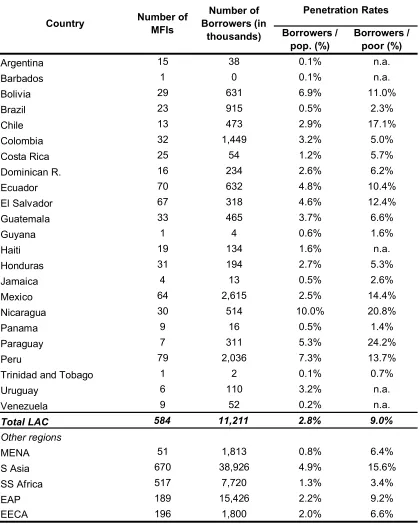
The microfinance hope rests, at first glance, on some impressive figures. For instance, MIX (2007) offers end-2006 information on the top 100 MFIs in the region, showing that they cover 10.2 million clients with a joint portfolio of US$10,500 million. However, relative rather than absolute figures must be examined upon before making any statement about credit poverty outreach. For a larger sample of 584 MFIs in the region, the same source reports, as seen in Table 6, a combined clientele of 11.2 million, representing a simple
average of 2.8% of total population and 9% of poor population. These proportions are similar across other regions in the world.3
All in all, these data reveal an often neglected fact: while the poor patently seem to be excluded from the credit market, and to a lesser extent from the deposit market, they are not much more so than the population at large. The previous figures should not come as a surprise after recalling that LAC countries display very shallow credit markets.
Aggregate numbers are not enough to determine whether poor households are unfairly discriminated in financial markets. Navajas and Tejerina (2006) and Bebczuk (2004) make a strong case about the need to distinguish demand and supply factors in explaining the scarcity of credit – some entrepreneurs may not demand external funding, be it due to lack of good investment opportunities, adequate internal funding, risk aversion, or lack of knowledge (or mere apathy) about financial alternatives. Although it is hard to make this
3
notion operational, disregarding it might lead to the overestimation of the actual degree of financial constraint. On the supply side, as forcefully argued by IDB (2008), World Bank (2007) and Beck et al. (2007), exclusion from both the deposit and the credit markets for poor households is often associated to the inability to meet usual bank requirements such as the payment of high transaction costs and minimum balances, as well as proof of personal documentation and formal employment –we will resume this discussion in Section 3. Ultimately, the problem stems from the usual asymmetric information syndrome: borrowers have better information and control over the projects and enjoy limited liability on their unpaid debts, which in turn encourage debtors to disguise the actual risk of their projects (adverse selection), to apply the funds to riskier projects than the ones agreed upon with the creditor (moral hazard) and to falsely declare default. As a conflict of interest unravels jeopardizing their expected returns, uninformed creditors react by requiring more documentation on the project and the entrepreneur, raising the cost of capital (or plainly rationing it), shortening the repayment period, and asking for collateral and cofinancing. All in all, this self-protective behavior ends up undermining access to credit to many
Section 2: Microcredit
The term microcredit labels the provision of small-scale loans to poor borrowers. These loans, most generally, are extended for business (as opposed to consumption) purposes and normally charge market-level interest rates. They are also typically collateral-free, targeted to female household heads, and are based on non-traditional repayment incentive devices such as group lending (see Karlan and Golderg (2006)).4 This section goes over the development of this instrument in LAC and tackles a few unsettled issues, such as the impact on key social and economic variables, the arguments for and against regulation, the industry performance, and some lessons from the experience of successful MFIs in the region.
2.1 Impact Evaluation
Impact evaluations are aimed to measure how a microfinance program affects income,
education, health and other welfare indicators of those enrolled in it. As they are an essential tool to assess commercial profitability, operational efficiency, and poverty
outreach and alleviation, these exercises are of utmost importance for private and social parties, including MFI managers, international donors, and local policymakers.
A priori, credit can help improve income growth prospects by boosting either the volume or the productivity of investment. For financially constrained households, credit may turn out to be essential to exploit good productive projects that would otherwise be passed up. On top of this, and even for household not facing financial constraints, borrowing can push up productivity because:
(a) Formal and informal lenders screen applicants and select only those with adequate repayment ability. This selection process provides free and professional information to the
4
very entrepreneur concerning the actual profitability of the project, and should lead them to discard those with a bleak outlook;
(b) The effort devoted to the project may be reinforced in the face of a fixed financial obligation and the psychological and pecuniary costs of not fulfilling it, such as reputation losses and shutting down of the business;
(c) Banks are especially well equipped to establish close lending relationships with their clients so as to assess the character and expected cash flows of the borrower. Microfinance institutions take fuller advantage of these relationships than formal institutions. Given their proximity to the borrowers and a smaller and more manageable loan portfolio, these institutions pay frequent visits to the business and household, talking with the entrepreneur and their relatives and partners to draw valuable information and prevent in advance inefficient and opportunistic decisions on the part of the borrower;5
(d) The microlending technology encompasses a variety of incentive devices to ensure debt repayment, such as group lending (all borrowers within each group are held responsible if any member defaults), progressive schemes (performing borrowers are granted increasing
amounts and terms in subsequent rounds of borrowing), and short-term, revolving lending to facilitate monitoring. In turn, group lending adopts two possible forms: solidarity groups
of about 5 members, and village banking, which involve larger groups of up to about 30 people. Joint liability introduces a self-enforced financial mechanism, which is supplemented by the reputational costs of default for individuals living in small communities and having scant spacial mobility;6 and
(e) Most microcredit programs include technical assistance and other supporting learning activities that may provide beneficial guidance to entrepreneurs.
In spite of the expected positive outcome grounded on these arguments, it would be naïve to assert that credit will always deliver on its promises. For instance, there could be a moral hazard behavior at play, inducing entrepreneurs to divert loans to current consumption instead of investment projects, or merely to substitute self-financing for debt. People with
5
However, excessive frequency of visits and collective meetings with borrowers may turn out be counterproductive and discourage some entrepreneurs from signing up with a microcredit program.
6
low education or business skills are equally prone not to make a profitable use of loans or to over-borrow, especially in unstable macroeconomic environments. The amount of credit the household gets may also influence the observed impact. Small loans (as a fraction of current household income) are less likely to help reshape educational and labor choices of poor families, provided the additional money does not take them out of the subsistence level or do not create any sense of income security. In a similar vein, the borrower is likely to make different choices according to the maturity and expected rollover of the loan - for instance, he or she will be less inclined to make productive investments when receiving a non-renewable, short-term loan.
On more practical grounds, controversy surrounds this issue as two polar visions fail to reach a consensus: on one hand, there are practitioners and non-technical microcredit advocates that display an almost blind belief in a strongly positive impact; on the other hand, there are scholars that have a more pessimistic stand, rooted in rigorous analyses that highlight a series of caveats on merely casual evidence, in particular: (a) Microcredit
supporters often rely on a handful of individual successful stories rather than on a thorough program evaluation; (b) The available evidence, even with large borrower samples, is built
upon already successful programs; (c) Lack of proper control for selection bias overestimates the actual impact; and (d) Studies are not fully comparable across programs due to differences in methodology, term over which benefits are measured (short- or long-term), and outcome under analysis (food security, shock response, poverty, income, employment, health, education, women empowerment, etc.).
improve not solely due to having taken the loan but to some of these attributes. A similar case takes place when loans are extended to villages favored by better infrastructure or more dynamic sectors; if the control group does not belong to such villages or sector, the credit impact will be overstated. Scholars have resorted to different procedures to eliminate this endogeneity, but this kind of evidence is still limited and comes in overwhelming proportion from Asian case studies.7
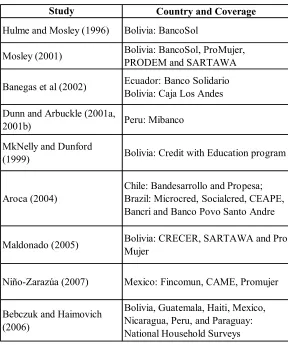
Most of the existing evidence uses data from Asian microcredit programs. Studies for Latin America are much more scarce. For instance, Montgomery and Weiss (2005), in a survey of impact evaluation in both regions, document 14 studies for Asia and 5 for Latin America. After an extensive search, we found a total number of 10 academic studies on LAC countries, which are listed in Table 7. While in general they uncover a positive impact of microcredit on income, poverty and food security, this verdict is not at all unanimous. For instance, Aroca (2004) finds positive but fragile income responses in Brazil and Chile, Maldonado (2005) claims ambiguous results on education outcomes in Bolivia, and
Bebczuk and Haimovich (2006), exploiting national household surveys, find a positive and significant impact of credit on income in Bolivia, Guatemala, Haiti, but not in Nicaragua
and Paraguay, with mixed results on education as well.
Another open question is whether microcredit has targeted extremely or moderately poor households. Hasemi and Rosenberg (2006) admit, based on available evidence, that microcredit does not serve the poorest. They attribute this in part to self-selection: very poor individuals may believe that taking a financial obligation makes their lives even riskier. Also, in group-based MFIs, the other members may be reluctant to jointly guarantee the repayment by people in this particularly risky income bracket. For MFIs to stay in business it is necessary to keep under tight control the default rate, avoiding excessively
risky prospects. If some clients start to default, this behavior may rapidly spread over the entire loan portfolio, especially when punishment is not harsh enough. Also it weighs in the
7
MFI decision the existence of unmet basic needs that can encourage the use of the credit for consumption purposes, jeopardizing the ability to repay.
This concise review makes it clear that impact evaluation could be greatly improved in LAC by taking note of the following reflections:
(a) For the most part, the excitement around microfinance in LAC has been based so far more on rhetoric than on hard evidence;
(b) Not only sophisticated, endogeneity-free studies should be deemed as valid hard evidence. Although it is desirable to gradually move towards well designed and conducted studies, this field is underdeveloped in LAC to the degree that there is even scarcity of simple “before and after” exercises on a regular basis for a representative set of MFIs. Even if a weaker test than the treatment/control group approach, long time series for particular programs would provide very rich information. Overstressing the requirement to have an ideal control group may discourage badly needed and less complex measurements. Besides, it would be important in time to have an approximation to the actual upward bias in the estimations. As a digression, it is striking that while many question the real effect of microfinance, there is an ample agreement that the formal banking system promotes economic growth, despite the fact that there is no microdata comparable to that used in microcredit impact studies.
(c) Many of the unanswered impact questions to date will be best addressed once stakeholders manage to push, support and converge to some broad guidelines on data collection and impact methodology. The extraordinary progress observed in collecting and making available reliable MFI accounting data should be extended to their microdata. In particular, governments and international donors have the correct incentives (the social interest) and means (control and funding of MFIs) to make this
2.2 Regulation and Supervision
Whether to regulate MFIs is a debatable matter. The modern approach to financial regulation states that two goals must be pursued: systemic risk minimization and consumer protection. Both of them are thought to mitigate market failures: in one case, the negative externality from the bankruptcy of individual financial intermediaries on other intermediaries and on credit-dependent nonfinancial firms; in the other case, potential non-competitive behavior and especially the lack of information faced by small depositors prone to become fraud victims.
Based on these premises, it is not fully clear that all MFIs should be regulated, as most of them are quite small, informal and do not take deposits from the public. Nevertheless, it is indisputable that big, deposit-taking MFIs must be regulated as other formal banks are, although an ulterior matter is where to draw the line. This does not necessarily mean that the remaining MFIs should go utterly uncontrolled. Consumer protection considerations are
still present in all cases, especially in profit-maximizing MFIs. In the same spirit, the need to have proper account of all financial activity in the country and evaluate their impact on
income and welfare warrants some overall industry oversight. Hence, deciding the optimal degree of regulation requires fine-tuning discrimination across the heterogeneous spectrum of MFIs. In particular, for small MFIs, the additional reporting duties and activity restrictions may impose costly staff workload and reduced product innovation and outreach. As in LAC and other emerging countries financial regulation is focused on systemic risk arising from major formal banks, the recommended consumer protection and data collection tasks may be commissioned to a more specialized government department within or outside the banking regulatory agency. Indeed, specific regulatory guidelines should be applied on the sector, in light of the pronounced differences, vis-à-vis formal banks, in loan size, clientele profile, interest rate, contractual features, and the like.
NGOs remain unregulated. A CGAP comprehensive regulatory survey confirms that this model also applies to LAC countries. According to Table 8, in all 11 countries covered by the survey, NGOs are generally unregulated, while cooperatives and credit unions are either under the bank regulator orbit (5 cases) or under a specific regulator (6 cases).8
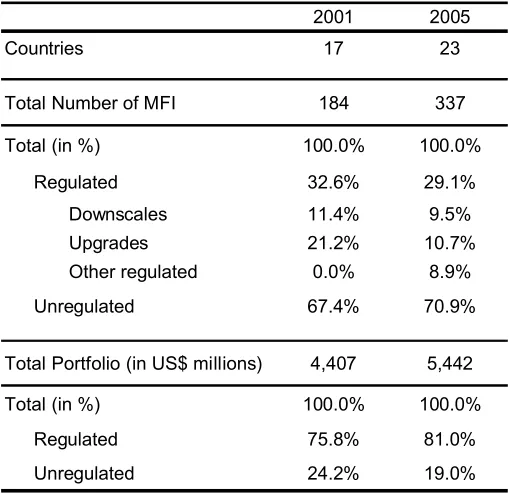
A related issue is the market structure in terms of regulated and unregulated entities. For the LAC case, as shown in Table 9, Navajas and Tejerina (2006) find that 71% of a sample of 337 surveyed MFIs were unregulated as of 2005 (67% in 2001 from a sample of 184 MFIs). These figures should be taken with caution as regulated entities might be over-represented in the sample, but they still illustrate the point that MFIs mostly remain outside the scope of financial regulation. In turn, regulated MFIs are much larger on average (they hold 81% of total portfolio).
More importantly, downscaling (commercial banks undertaking microfinance businesses) and upgrades (formerly unregulated MFIs now under official supervision) had in 2005 a
similar fraction of the regulated market, with 32% and 37% respectively. This speaks of an interesting market dynamics, whereby regulatory coverage is likely to increase over time in
an endogenous rather than compulsory way: on one hand, already regulated banks enter the microfinance industry to exploit attractive business opportunities; on the other hand, some previously unregulated MFIs, under pressure by their donors or looking to expand their financing by accepting deposits, may decide to abide by the regulatory framework. In other words, where microfinance goes, regulation follows, not the other way around. Therefore, as MFIs do not pose a threat for systemic stability, as it is largely the case in Latin America, there does not seem to exist any urgent need to forcefully and universally regulate this market.
8
2.3 MFI Performance Indicators
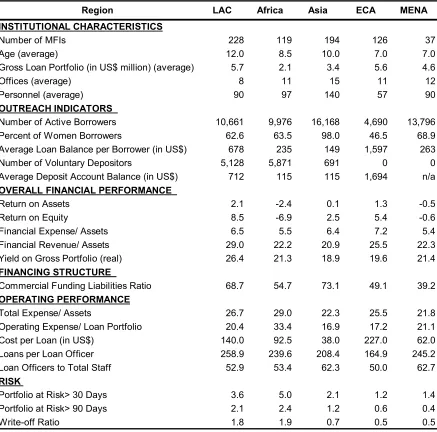
This section is devoted to describe major trends in size, structure, outreach, profitability, and risk of MFIs in Latin America in 2006. In view of the widespread informality of the microfinance business, statistical information on the whole universe of MFIs is hard to obtain and made comparable across institutions and time. Fortunately, the Microfinance Information Exchange (MIX) reports those statistics for a sample of 700 MFIs around the world, 228 of which are from LAC.9
Table 10 presents LAC data, accompanied by that from other regions for the sake of comparison. For completeness, Tables 11 to 13 report data for each subregion (South America, Central America, and the Caribbean) and for each available country. Since no obvious differences are detected across regions and countries, we will focus on LAC averages. The mean portfolio of US$ 5.7 million, staff of 90 employees, and 8 offices
confirm the typical small size of these intermediaries. The average portfolio includes about 10,600 borrowers with a balance of U$S 678. Although the average deposit balance is
slightly over US$ 700, less than half of the clients hold voluntary deposits, implying that to a large extent deposits serve as a sort of cash collateral.
Both the return on assets (2.1%) and on equity (8.5%) are strong in absolute and comparative terms to other regions. As measured by the ratio of financial revenues to assets or the real portfolio yield, MFIs charge high loan interest rates close to 30%, even though their funding cost (financial expenses to assets) is about 7%. Almost 70% of their liabilities is explained by voluntary deposits and commercial borrowing.
In spite of the relatively low cost of funding, MFIs confront high operating costs, which in the case of LAC amount to 20.4% of total portfolio and to US$140 per loan. Loan officers
9
are about 53% of total personnel, which is consistent with the relationship-intensive nature of microlending. Coupled with their diseconomies of scale, this implies that MFIs are forced to lend at above-market rates (taking prime rates in the formal banking system as market rates) should they want to attain financial self-sufficiency. Letting along these steep costs, it is clear that the low non-performing loan rate (1.8%) remains the greatest and most striking success of this financial industry.
Table 14 splits the sample by type of MFI, namely, banks, credit unions, non-bank financial institutions, and NGOs, and also by for profit versus non-for-profit institutions. Banks and for profit MFIs appear to have much larger portfolios, clientele bases, loan sizes, number of offices, and more personnel. Nevertheless, these differences do not clearly translate into better performance vis-à-vis peer groups. Although a wider sample of MFIs and over time data would be needed to make a sounder statement, these results suggest that the organizational structure is not a crucial factor in shaping MFI performance.
Few studies have tried to unveil regularities between organizational characteristics and performance. Navajas, Navarrete, Simbaqueba, Cuevas and Salamanca (2006) use a sample
2.4 Case Studies in Microfinance in LAC: Lessons from Experience
Over and above the theoretical arguments for and against microfinance, much of the buzz about the industry is rooted in successful case studies. Although such small samples suffer from evident selection bias, it is nonetheless a useful starting point to identify some of their crucial singularities and draw lessons for the future. Ten case studies in the field from different countries in LAC are examined: BancoEstado y Bandesarrollo (Chile), Compartamos (Mexico), BancoSol, Banco Los Andes y FIE (Bolivia), Crediamigo (Brazil), Banco Caja Social (Colombia), Credife (Ecuador) y Mibanco (Peru). The choice was not guided by any particular criterion except for the fact that they are all matured projects and list among the 100 largest MFIs in the region –with a share of 26% of total clients and 34% of portfolio within this group as of 2006-, making them highly representative examples. Their very success has attracted the attention of a number of scholars –the list of studies the following analysis is based on is at the bottom of Table 15, where some major
characteristics of each program are summarized.
The main lessons to be highlighted are:
a. No particular organizational structure seems to prevail. The literature distinguishes alternative organizational designs for MFIs, and the associated pros and cons in terms of cost minimization, funding, branding, flexibility and other considerations (see Westley (2006)).
is in some cases private (in Bandesarrollo and Credife) and public in others (BancoEstado and Crediamigo). A noticeable trend, though, is that the entry of banks into the market dates to a few years back, mostly since the 1990s, while NGOs are generally older and enter the formal banking system also in recent years. This reflects (i) the discovery by formal intermediaries of this profitable and beforehand neglected niche, and (ii) the NGOs self-awareness of financial constraints preventing them from continued growth and the need to tap the banking and capital markets. In this sense, the regulatory status seems to be dictated by funding rather than reputational or efficiency motives;
b. Capital structure also varies across successful MFIs. The way any company finances its assets may in principle affect not only its average cost of capital but also its incentives for cost and revenue optimization. As shown in Table 15, the deposit to loan ratio moves within a wide range (from 22.1% for Bandesarrollo to 119.1% for Banco Caja Social).10 For a longer time series, we would certainly find much variation, especially for those MFIs that began as NGOs and then transformed themselves into banks. As Fernando (2004) and
Jansson (2003) show, ownership structure is also different across LAC MFIs: while in most cases a large chunk of capital was retained by the founder NGO, in some of them
international donors, specialized funds and individual investors have acquired important stakes. Nevertheless, despite the often believed differences in disciplining power and business profiles associated to different shareholder compositions, there is no clear indication in the data of significantly distinct performance or strategies among the 10 cases. Nonetheless, it remains true that soft funding was crucial to jump start the projects until they gained some financial sustainability;
c. Appropriate staffing. Reviewers of these successful microfinance stories find a common concern about the quality of human resources. They all underscore the presence of a dedicated, knowledgeable and experienced top management, supported by a well-trained and efficient administrative and executive staff. The ability of loan officers, endowed with adequate incentive contracts, to screen out bad borrowers and to take actions to secure
10
repayment is frequently emphasized as a key factor. Despite this considerable labor intensity, more and more accent is put in the competitive edge given by the use of computer tools for setting up initial filters, credit scoring systems, repayment scheduling, and standarization of administrative procedures;
d. Closeness and responsiveness to demand needs. With slight variations, all MFIs have adopted standard microfinance technologies (collective liability, no physical collateral, short repayment periods, and the like) coupled with personal visits to the borrower and periodical meetings with groups of borrowers and village representatives. This sort of market research in the field confers them a greater ability to generate tailor-made products with high potential demand;
e. Flexibility, learning and pragmatism. In all cases, MFIs display enough flexibility in decision-making so as to take corrective measures as needed, by changing contractual clauses or adjusting the visits or meetings regime. In this way, pragmatism and
learning-by-doing are also essential explanatory elements of their success. Examples abound of the readiness and timeliness whereby some of the MFIs have made radical strategic shifts to
deal with unanticipated increases in deliquency rates or operating costs, or to slow down a rapid but hardly manageable growth process; and
After this brief inspection of flourishing microfinance experiences, a little digression is in order. In the midst of the enthusiasm around microfinance and the palpable fruition of many programs, it is legitimate to wonder why there are still millions of potential customers unserved in a number of countries in LAC and other regions. Accumulated experience over the last three decades has seemingly rendered the microfinance business a replicable model free from prohibitive entry barriers. However, the fact is that microfinance will continue to be a specific, labor- and learning-intensive technology difficult to develop for outsiders, even for banks with proven experience in traditional intermediation. Also crucial is the minimum scale problem for commercial banks to enter the market.
Another puzzling observation is that the microfinance industry does not seem to have suffered systemic crises of the kind that formal banking systems go through all around the world from time to time. This is all the way more shocking after pondering the much stringent regulations banks are subject to, their strict conditions for granting a loan (documentation, collateral, etc.), and the fact that systemic shocks –that have repeatedly hit
the economies in the region- should have a stronger impact on MFIs, which are often poorly diversified across sectors and regions.11 This can be explained by two factors: for
one, the difference can be an spurious artifact of the different press coverage received by the formal banking system and the microfinance industry, which in turn is due to their relative size and visibility to the general public. Consequently, it could be the case that the financial distress or bankruptcy of a commercial bank rapidly becomes a massive news while the mortality of dozens of small NGOs goes unnoticed, save for market players. Secondly, and probably foremost, MFIs should be more resilient to liquidity problems than banks, as their financiers are social investors for the most part, and they are less concerned about repayment than commercial ones.
11
Box: The Role of Credit Registries. The Case of Red Financiera Rural (Ecuador)
In light of microenterprise opacity, a promising remedy is the setup of credit registries through which MFIs and other regulated intermediaries can exchange both black and white information on borrowers. This reciprocity mitigates adverse selection and moral hazard behavior without seriously compromising the benefits of close lending relationships (which rely more on character knowledge than on business information). A flourishing literature has developed in recent years, accompanied by the creation of new private and public institutions (see Pagano (2001) for theory and a review of experiences in LAC countries). Moreover, the presence and quality of credit bureaus is considered a key indicators in assessing investment climate and access to credit around the world by the World Bank’s project Doing Business (see www.doingbusiness.org). However, these institutions are mostly focused on clients from regulated intermediaries, leaving outside the clients of unregulated MFIs.
Section 3: Banking the Unbanked in Latin America and the Caribbean
This section gauges the access to financial services different from credit, with special emphasis on the use of banking accounts. Besides cataloging the barriers for a wider financial inclusion, we will discuss two areas of government action (development banks and conditional cash transfers), with the final part taking stock of several public and private programs that are exhibiting an incipient progress in fostering a more active participation of the poor in financial markets.
3.1 Benefits of and Barriers to Financial Inclusion
Although the paper has been so far concerned about credit for productive uses, it is evident that a better access to other financial services such as means of payment and saving deposits can make a positive contribution to the welfare as well as the disposable income of poor households. Some of the expected benefits are:
(1) the ability to make payments using debit cards, which often carry a discount over other means of payment;
(2) the security that being paid and storing the money in a bank offers compared to being paid in cash and keeping the money at home;
(3) the money saved from avoiding the cash conversion of checks, particularly in remote or marginal communities;12
(4) the ability to smooth consumption by safely saving in good times and borrowing (via overdrafts, for instance) in bad times, even in small amounts and for short periods;
(5) the inflationary tax avoided and the real interest revenue from time deposits, which are especially valuable during episodes of macroeconomic instability;
(6) the time saved and the more efficient liquidity management from using bank deposits and electronic means of payments;13
12
Caskey, Durán, and Solo (2006) claim that the cost of making and receiving payments, plus getting credit, outside the formal banking system represents between 5% and 15% of the median household income in Mexico.
13
(7) the likely increase in the saving rate, as long as bank deposits may be a partial remedy for the lack of self-control and the urge to spend cash holdings;14 and
(8) the increased probability of becoming eligible for a loan from a formal bank once the applicant has a deposit account.
Against the background of these private and social gains, actual data reveals a scarce use of financial instruments by poor households, as documented at the start of the paper (see also IDB (2008)). Demand and supply factors explain this situation. On the supply side, high fees and minimum balances –explained by large fixed intermediation costs as well as potential non-competitive behavior by banks- appear as major barriers for financial inclusion. Economies of scale also justify why banks are unwilling to expand their branch and agency network into distant, scarcely populated and poor areas. Likewise, stringent eligibility criteria are imposed on new customers, including identification, address, and job formal proofs, a set of conditions unlikely to be met by poor and informal workers.15
On the demand side, potential users of banking services usually express lack of trust in financial institutions and straight disinterest in establishing ties with banks. Distrust and
disinterest, in turn, respond to some underlying factors, such as:
(i) the recurrent nature of costly financial crises in developing countries, which has created some social resentment towards the financial sector in every social layer, not only among the poor;
(ii) financial illiteracy, which deprives people from a clear understanding of benefits, costs, and risks; 16
(iii) the belief of some people that financial providers will not serve them or will turn them down, which might be based either on experience or mere prejudice;
14
Huffman and Barenstein (2004) document that bank card holders attain a smoother monthly consumption than cash-only users in the UK.
15
Whether these requirements are unilaterally set by the commercial banks or obey regulatory norms in different countries remains an open research question. In many cases, recent anti-laundering norms have stiffened legal requirements to open accounts.
16
(iv) low and volatile income, which translates into a limited and uncertain amount of financial saving capacity; and
(v) the payment practices in informal labor markets, which operate mostly on a cash basis.
Over and beyond this list of usual suspects, we would like to stress three elements that are not given enough priority in the policy agenda:
(1) Macro-level factors have a dominant influence on bankarization. International figures show that the percentage of unbanked urban households strongly covaries with economic development: while in the US and the UK, this proportion is 9% and 5%, respectively, in Colombia, Brazil, and Mexico, it climbs to 61%, 57%, and 76%, respectively (see Caskey (2006) and UK Treasury (2007));
(2) Income-related reasons stand out as the main reason for not having a bank account. 17 Porteus (2005) classifies these reasons into three categories: Income-related issues
(insufficient or fluctuating incomes), access-related issues (documentation requirements, minimum balance, transaction costs), and personal choice issues (no perceived need, trust).
[image:25.612.80.302.532.619.2]We follow the same approach in Table 16 for urban surveys in Mexico and Brazil (see Caskey (2006) for the original survey format):
Table 16
Motives for Not Having a Bank Account
In % of total urban survey responses
Reasons South
Africa
Mexico Brazil
Income-related 78 49 71
Access-related 13 29 20
Personal Choice 9 20 4
Other 3 2 5
Sources: Own elaboration based on Porteus (2005) and Caskey (2006).
17
Supply-side (grouped in the access-related item) and preference explanations are consistently overshadowed by income considerations.18,19 Another piece of evidence in this direction is the proportion of unbanked in the lowest and highest income decile: for Brazil and Colombia, 68% and 81% among the poorest are unbanked, but only 8% and 24% among the richest (see Kumar (2005) and Solo and Manroth (2006)); and
(3) The access constraint problem is not as pervasive as it may seem. First, affordable and readily available bank accounts exist in large number (relative to standard accounts) in many countries. Indeed, Peachey and Roe (2006) report results from a worldwide, painstaking survey of accounts opened at alternative or double-bottom line institutions (including savings banks, postal banks, development banks, credit unions, cooperatives, and MFIs). CGAP (2004b) labels them as accessible accounts, under the reasonable assumption that these institutions have a social outreach objective, are not-for-profit and target poor strata of the population, so it is most likely that they seek to minimize the cost of financial access (even though there is no direct data on costs or the clientele income
profile). A total 1.4 billion of such accounts were identified for about 120 countries. For Latin America, information on the number of accounts per adult is presented in Table 17:
18
The latter might in practice be even more important than these surveys reveal, as the inability to maintain a minimum balance requirements does in fact reflect insufficient income. On the other hand, the income insufficiency survey response may be partly associated to disinterest or unawareness of financial opportunities. For example, the failure to open an account to improve money management over the wage cycle, even without any saving purpose, cannot be entirely blamed on low income.
19
Table 17
Number of Accessible Bank Accounts per Adult in LAC Countries
Number of accessible accounts per adult
Countries
0.01 – 0.1 Venezuela, El Salvador, Guyana,
Nicaragua, Costa Rica
0.1 – 0.2 Guatemala, Colombia, Honduras,
Paraguay
0.2 – 0.5 Ecuador, Brazil, Argentina,
Mexico, Peru
0.5 – 1 Bolivia, Cuba, Chile, Uruguay
Source: Peachey and Roe (2006).
These figures are not particularly low relative to the total number of deposit accounts in the regulated banking system (see Beck, Demirguc-Kunt and Martinez-Peria (2007)). For example, in Brazil, there exists one accessible account for each regular account –in Argentina and Mexico, the proportions is 0.6 and 0.5.
Second, Beck et al (op. cit.) survey a small but representative set of commercial banks in 54 countries, and show that the sample median of the minimum amount to open a saving account is 1.21% of per capita GDP and that of annual fees is 0.01%. These again do not strike as particularly prohibitive even for low-income households.
To close this subsection, it is interesting to note that the costs of being unbanked affect also the poor in advanced economies. Family Welfare Association (2007) reports that in the UK households on low incomes pay more than others for basic necessities due to their lack of
credit of any sort. For example, they are forced to buy their durable goods from sub-prime credit shops that charge annual interest rates of 70%-200%. Similarly, poor households
3.2 State Programs
Development Banks and Other Government-led Programs
Banking theory asserts that, since private banks may refuse to serve poor clients, state-owned banks and related government-sponsored financial programs are able to undo this market failure. The usual caveat is that public sector institutions suffer from severe agency problems themselves, as they are subject to distorting political interference, have managers
Box: Saving Arrangements for the Poor
It is usually believed that the poor only save in real assets, such as housing, jewelry, livestock, seeds, and so on, although available experience and theory prove this presumption to be inaccurate. For instance, CGAP (2005), in assessing saving practices in Mexico, finds that, compared to high income earners, the low income ones save less in formal banks (11% against 67% of total households in each group), but more in physical assets such as grain, animals and construction materials (47% against 17%).
appointed based on political connections rather than on professional skills, lack performance-linked remuneration structures, and enjoy some degree of regulatory forbearance. These conditions incubate socially harming actions, such as corruption, state capture, and soft-budget constraints. In the absence of the right incentives, proper accountability, transparency and checks and balances, these institutions are unlikely to perform as expected in terms of solving the deficient access to credit of some economic units.
In the case of LAC, a handful of recent papers examine development banking in some countries, namely: Marulanda and Paredes (2005) for Colombia, Castillo Torres (2005) for Peru, Pulgar Parada (2006) for Chile, Bebczuk (2007) for Argentina, and Anaya Mora (2007) for Mexico. A common thread to these reviews is a conspicuous lack of:
(i) disclosure and transparency towards the public and oversight bodies regarding detailed credit allocation and impact evaluation;
(ii) reliable and consistent methodologies to target promising sectors and borrowers, and doubtful role as market failure solvers;20
(iii) effective enforcement devices to eradicate the perception of loans as implicit subsidies;21
(iv) mechanisms to promote a permanent relationship of beneficiaries with the commercial banking system without depending on state assistance;
(v) coordination of multiple and overlapping national and subnational programs;22 and (vi) dissemination plans to create awareness and involvement of potential users, and avoiding discretional and inefficient fund allocation.
20
Bebczuk (2007) argues in the Argentine case that public banks do not differ from private banks with respect to their strong concentration on large borrowers and in highly populated, urban areas. Marulanda and Paredes (2005) assert that development banks in LAC have been more successful acting as second- rather than first-floor banks.
21
PNUD (2005) investigates some MFIs in Argentina and finds that private ones have a non-performing portfolio of 2.1%, against 25% in the case of the microcredit program of the public sector-owned Banco Nación.
22
Table 16 enumerates some major state programs directed to financially support microentrepreneurs by granting credit in a first-floor fashion, channeling funds at low cost to other commercial banks fulfilling a second-floor service, subsidizing MFIs, and offering guarantees for MFI borrowing. Two salient features are worth mentioning: first, committed funds are still quite low vis-à-vis other credit sources; and, second, information is notoriously scarce in all cases.
From this brief overview a striking stylized fact emerges: in the face of a flagrant market failure in the credit access for the poor, the natural candidate to deal with this distortion (the state) seems to be doing a poorer job and displaying worse disclosure and governance standards than the commercially-oriented private sector.
Conditional Cash Transfers
Conditional cash transfers (CCT) are aimed at reducing current poverty while fighting future poverty by conditioning the transfer on compliance with some human capital-related requirements such as schooling, health and nutrition. Programs in this line in LAC countries include, among others: Bolsa Familia (Brazil), Familias en Acción (Colombia), Red de Protección Social (Nicaragua), Oportunidades (Mexico), Red Solidaria (El Salvador), Superémonos (Costa Rica), Tekopora (Paraguay), Jefes y Jefas de Hogar (Argentina), and Chile Solidario (Chile). Kakwani, Soares and Son (2005), Soares, Ribas and Guerreiro Osorio (2007), Standing (2007), Soares and Britto (2007), and Lindert, Skoufias and Shapiro (2006) describe and analyze the impact of some of this programs, concluding that they generally have had positive effects on the targeted human capital investments.
Given the ample coverage of these programs, it appears that financial components could be included in the benefit package so as to encourage more participation in the financial
with the use of transaction and saving accounts and, afterwards, with credit facilities. Nevertheless, on a more optimistic note, the achievements of some particular programs seems to be creating a positive spillover effect across the region, and most welcome developments are foreseen in coming years.23
3.3 Case Studies
Some case studies forcefully demonstrate the potential gains that could be reaped in terms
of financial inclusion. Exemplary cases include the following:
Argentina: Plan Jefes y Jefas
The Plan Jefes y Jefas de Hogar started in 2002 and provides a monthly subsidy of AR$150 (about US$47) to 1,500,000 households heads as long as they are unemployed and have at least one child under 18. The payment switched from cash to electronic baking payment in gradual stages during 2004-2005, with the opening of a free deposit account at
Banco Nación, the largest public bank in the country, and the provision of a debit card to withdraw money from ATMs and make payments at stores. Duryea and Schargrodsky (2007) conducted a thorough econometric research on the effects of the reform through end-2006, exploiting three databases (a satisfaction survey, the national household survey, and one on consumer expenditures). They reach the following results:
a. About 90% of the respondents expressed that the new system was better than the previous one, with an equally overwhelming majority stating that the reason for that was the avoidance of long waiting lines at cashiers´ windows;
23
b. In relation to time savings, the average time spent to cash the benefit went down from 251 from 43 minutes, and the percentage of people able to walk to the bank instead of taking a bus increased from 32% to 49% due to the higher penetration of ATMs;
c. The new platform did not increase the likelihood that the families will be able to stretch the subsidy until the end of the month. This suggests either that the change had no bearing on consumption smoothing behavior or plainly that the grant is too small relative to basic needs so that it cannot materially affect consumption planning;
d. No change in the level of bankarization (measured by the opening of additional deposit accounts beyond the one attached to the benefit) was found. This again can be a consequence of lack of interest in participating in the formal banking system, the low income level, or a delayed adjustment to new financial practices;
e. The percentage of people declaring to share part of the benefit with the organization or person that sponsored his or her affiliation to the program fell from 4% to 0.3% (allegedly explained by the higher transparency and more difficult access to the money by the community´s political bosses); and
f. The possession of a debit card significantly increased the share of purchases made at supermarkets and wholesalers, motivated by the VAT rebate (15% of the price) in place in
Argentina when using electronic means of payment.
Mexico: Proyecto Regional de Asistencia Técnica al Microfinanciamiento Rural
(PATMIR)
medium term, and that new intermediaries can reach financial self-sufficiency in 2-5 years. A 5-year panel survey on 5,800 households for 2004-2008 is under way, but partial results are still being processed and analyzed. Descriptions of the program can be found in Paxton (2007), Zapata Alvarez (2007), and SAGARPA (2006).
Mexico: La Red de la Gente
L@ Red de la Gente (People´s Network, in English) is an alliance, launched in 2001, between BANSEFI (Banco del Ahorro Nacional y Servicios Financieros) with a number of small non-bank financial institutions (Entidades de Ahorro y Crédito Popular, EACP), including cooperatives, credit unions, and savings and loan associations, to provide financial services to low income clients in urban and rural areas. BANSEFI leads and coordinates the network, and provides technical and regulatory assistance. It comprises 167 EACPs with 1,530 branches in 700 cities and counties (the second financial network in the country), with a clientele of around 4 million people. Accounts can be opened at no cost
with an initial balance of just US$5.
Active workers can also apply for a housing loan subsidized by the Instituto del Fondo Nacional de la Vivienda para los Trabajadores (INFONAVIT), a governmental organization devoted to the promotion of housing for low income households. Applicants must first open a savings account for the equivalent of US$5 and save in it 5%-15% of the loan. The accumulated savings are used to cancel the loan at maturity.
Mexico: The Oportunidades Program
Created in 1997 (under the name of Progresa until 2001), the Oportunidades program consists of a cash transfer to households in extreme poverty under well-defined education and health conditions to be met by the beneficiaries (98% of which are women). About 5 million households receive this benefit that amounts to a minimum of US$16 a month per household for food plus additional amounts for health and other items. In particular, households are eligible for higher payments depending on the educational attainment of their young members: for instance, if the child is assisting to third grade (primary school), the household receives US$11, but gets US$69 when the child reaches twelfth grade (senior high school).
About 1.3 million households are paid through a free-of-charge bank account at BANSEFI (and a minor fraction through the private bank BBVA Bancomer). Anecdotal evidence shows that, first, after a few months recipients begin to put aside some of the benefit in
their accounts; and second, beneficiaries find it easier to get microloans, due to their stable income flow and the good signal of fulfilling the strict requirements to be entitled to the
transfer.
Jóvenes con Oportunidades is a component put forward in 2003 to encourage higher schooling levels. Students from a beneficiary household who finish senior high school before they turn 22 years old are granted a savings account of US$300 that can be used to pay for tuition in a superior education institution, housing improvement, health insurance, or put as collateral for a microloan from an EACP member of the Red de la Gente. During the 2003-2006 period, 289,000 students became eligible, and 74% chose to formalize the bank account.
invest them in productive activities with a rate of return of about 15%, boosting consumption by 48% after 5 years in the program.
Brazil: Caixa Econômica Federal
Caixa Econômica Federal, a government-owned bank, has dramatically extended outreach by setting up the Caixa Aqui account, accesible through debit card and numerous point-of-sale terminals at correspondents such as the State Lottery, which have added 12,000 new access points to the bank’s main network of 2,200 offices. These Unidades Lotericas are spread even in remote areas and are licensed to pay social benefits, accept deposits and withdrawals via cashier or ATM (for small amounts of up to US$ 500), and receive card and account opening applications. Three million accounts (10% of all Caixa accounts) have been opened until 2006. The account opening includes a pre-agreement to provide credit, and after ninety days of account use –provided documentation is in order- the bank automatically sends the customer a contract to sign if they want to take an initial credit of
up to US$ 70 for a period of four months at an interest cost of 2% per month. After this period, scoring of the client’s actual credit performance and continued account usage
allows access to larger amounts for longer periods (up to a year).
microcredit program for the 11 million beneficiary households from Bolsa Familia. However, the project is still in the working until the many operational obstacles will be solved.
In parallel, Caixa launched an electronic account for Brazilians working abroad who want to send remittances home direct from a host-country credit card. The account is available in 50 countries and the transfer cost is just 2% compared to the 8-15% typical of more traditional channels. These remittances can feed Aqui accounts of relatives, and a second stage of the international e-banking project will allow migrant workers in the US to access their Caixa Aqui accounts directly through terminals of banks that have celebrated agreements with Caixa.
Ecuador: La Chauchera
Banco Solidario, an Ecuadorian bank specialized in microfinance, issued in 1999 La Chauchera (purse in local Spanish), a smart card for microentrepreneurs to buy raw materials at wholesale prices directly from big suppliers. Banco Solidario opens a credit
Colombia: La Banca de las Oportunidades
La Banca de las Oportunidades is an official program launched in August 2006 that began its operation in January 2007 under the oversight of an inter-ministerial committee. Rather than a first- or second-floor bank, the scheme seeks to support and coordinate efforts to increase the access to financial services to low income households. Its plan encompasses regulatory changes as well as cost subsidies, project cofinancing, and technical assistance to private banks and non-bank providers. It is endowed with an annual budget of about US$63 million. For the time being, a major achievement has been the authorization to financial intermediaries to appoint non-bank correspondents all over the Colombian territory, inspired by the Brazilian model. As of November 2007, 3,436 correspondents have been licensed in 346 towns, contributing to a much broader geographic scope of financial services. La Banca de las Oportunidades has also set ambitious targets for 2010 in terms of microcredits granted, including a stock of 5 million loans, with 1.5 million conferred to newcomers in the financial sector. However, the concrete tools and action plans to fulfill
this objective have yet to be specified.
Argentina: Cuentas Sueldo
stock of personal loans (the most dynamic loan type in the post-crisis period) was granted to Cuenta Sueldo holders. Banks report the direct knowledge of the client’s cash flow and the ability to automatically debit installments from the very account as key factors in their preference for these borrowers. Intense competition exists in the market to attract these clients, and loans are agreed on average for more than 48 months and annual interest rates below 20% -these are very favorable conditions for the Argentine personal credit market. It is worth noting that this is an entirely commercial product, with no subsidy component of any kind from the government (although public banks also are major players in the market).
Mzansi Account in South Africa
Created in August 2004 under a joint initiative of the 4 major South African banks –yet with an initial push by the government, which encouraged banks to take some social responsibility steps-, the Mzansi Account has no management fees and allows one monthly free deposit. The only requirement to open it is to have a valid ID and proof of address. The
account owner is entitled to a debit card usable at any ATM (with the same cost no matter the ATM network) and postal offices. By August 2006, just two years after its inception,
3.3 million accounts were opened, 90% of them by people that had never previously had one.24Another healthy outcome of the reform has been its commercial viability, as revealed by the fierce competition between banks (including the emergence of a similar product issued by other financial institutions), their expensive marketing campaigns, and the broadened menu of financial products offered to the account holders.
24
Conclusions and Main Lessons
The study has sought to characterize the current status of financial inclusion in Latin America and the Caribbean, distinguishing the involvement of the public and the private sector and identifying the obstacles for a wider outreach. Given the broad scope of the paper, the effort was aimed at reviewing the profuse but dispersed literature and data with a critical eye. Emphasis has been placed into challenging conventional wisdom on the basis of the available research and case studies. The main lessons from the analysis are the following:
1. Low financial penetration is undoubtedly a worrying issue in poverty reduction policies in Latin America.
2. All interested parties should form realistic expectations about the potential contribution of microfinance. The benefits seem to have been over-advertised, especially in the media, by highlighting individual success stories and failing to recount less fortunate
cases of MFIs and borrowers’ defaults. Hard evidence, in contrast, has so far reached mixed results regarding impact evaluation and extreme poverty outreach, although they
are not categorical due to some data and statistical limitations. The main risk from taking the positive view at face value is that it might give rise to overconfidence by donors and lenders, thus debilitating the needed degree of oversight, monitoring and discipline in running the business. Also, as in the banking system, rapid, unmanageable credit booms might turn out to be self-defeating.
4. The specificity of the microlending technology makes it optimal for MFIs to have a leading role in the provision of small scale loans. Among other differences, commercial banks are unlikely to establish the kind of close relationship with the borrower inherent in a typical microcredit operation. Of course, the downscaling of commercial banks can and actually has worked in numerous cases, but only when the institution has committed enough resources and adopted the required philosophy to serve these new clients within a functionally separated unit. In sum, not every bank, and not even every MFI, can safely embark into microfinance.
5. By the same token, public banks should preferably refrain from acting as first floor microlenders. As a rule, the operational structure of public banks in the region is similar to that of other commercial banks. Compounding the problem, public banks display evident inefficiencies in resource allocation. Moreover, some evidence shows that public bank clients, including micro borrowers, tend to adopt a moral hazard behavior by refusing to repay the loans. This stems from a decades-long history of subsidies and defaulted but unprosecuted borrowers.
6. Recent experiences in Mexico, Brazil and Colombia hint that governments can play a decisive role in coordinating financial inclusion initiatives, leading normative changes,
and supporting innovative banking outreach strategies without engaging directly in credit allocation. Equally important, yet obvious, is the preservation of an adequate climate of political commitment and accountability.
8. More research is required to quantify the impact of microcredit on economic and social outcomes. This research should be a decisive element of judgment for donors, local governments, and other stakeholders. Unfortunately, this line of work is still in its infancy in LAC countries. A sensible first step forward would be to encourage or mandate MFIs to disclose borrower microdata on a regular basis (respecting basic rules of confidentiality and commercially sensitive information). As these organizations receive different kinds of local or international subsidies, donors and governments have the bargaining power to obtain MIFs collaboration towards this objective. Additionally, a more coordinated academic effort should be undertaken, preferably supported by a multilateral organization, to produce high quality impact evaluations based on a comparable methodology and performance measures.
9. An interesting paradox is that microfinance is a matter of social interest that is and should be mostly provided by private, commercially-driven parties under commercial terms. Furthermore, there is a widespread consensus that MFIs should strive for financial self-sufficiency, avoid subsidized credit, and charge market (but not abusive)
interest rates on loans.
10. The proactive involvement of international organizations, such as the IDB, World Bank,
USAID and others is also, based on worldwide experience, an invaluable external catalyst for reforms and market development.
11. As in the case of microcredit, a positive lesson from bankarization experiences is that they are generally pushed by private sector intermediaries (or commercial public ones that compete with them). This implies that well-run projects on financial inclusion are profitable. It also indicates that some lowering of entry barriers for the poor into the financial system -in the form of cost-free accounts and other services- pays off in the short or medium term.