A Comparison Between Non-Monotonic Formalisms
Telma Delladio
Nicol ´as D. Rotstein
Guillermo R. Simari
Laboratorio de Investigaci´on y Desarrollo en Inteligencia Artificial
Departamento de Ciencias e Ingenier´ıa de la Computaci´on
Universidad Nacional del Sur
{
td,ndr,grs
}
@cs.uns.edu.ar
ABSTRACT
It is interesting and important to compare, analyze and as-sess the alternative tools that could be used in the area of Knowledge Representation. In this paper we present a reasearch line associated to this goal: to formally establish the relation among Knowledge Representation formalisms in order to make a sensible use of them. As a part of this main task, we present a comparison between Normal Default Theory and Defeasible Logic Programming. This comparison is achieved introducing a DELP variant, called DELP∅, which allows to associate the answers of a DELP interpreter to the consequences, credulous and skeptical, of a Normal Default Theory.
Keywords: Knowledge Representation, Non-monotonic Reasoning, Default Logic, Defeasible logic programming.
1 INTERESTS AND MOTIVATION
In general, it is interesting and important to compare, analyze and assess the alternative tools that could be used to confront a specific problem. In particular, in the area of Artificial Intelligence there are several research lines dedicated to the development of for-malisms and tools regarding Knowledge Representa-tion. These formalisms are so diverse that many times it is difficult to recognize their advantages, disadvan-tages and differences in order to make a plausible use of them. For this reason, it is interesting to analyze the relation among knowledge representation formalisms to evaluate their differences and similarities. Sev-eral works relating diverse approaches of defeasible and non-monotonic reasoning have been developed [6, 5, 4, 3, 1, 2].
In this paper, we present, as a part of a major work, a preliminary analysis about the relation be-tween Default Logic and Defeasible Logic Program-ming (DELP). The current goal is to establish the pos-sibility of defining a set of conditions and transfor-mation rules that allows us to study this relation in
Partially supported by Agencia Nacional de Promoci´on Cient´ıfica y Tecnol ´ogica, SGCyT - UNS, and Consejo Nacional de Investigaciones Cient´ıficas y T´ecnicas (CONICET)
a formal way. In this first stage, we analyze several scenarios and specific examples that evidence the dif-ferences between these two formalisms, in order to establish their causes. This is the first step to clarify the relation under study.
2 DEFAULT LOGIC AND DELP
In this section, we briefly describe the theoretical background of both Default Logic and DELP. We will also introduce a variant of DELP that will be used for comparison.
2.1 Default Logic
A Default Theory T = hW, Diconsists of a set of facts W of ground sentences. Each default rule in
D has the form a:b1,...,bn
c (sometimes written a : b1, . . . , bn/c), where a is called the prerequisite, bi
are the justifications andcis the consequent of the de-fault. The intuitive meaning of a default is: ifacan be derived and it is possible to consistently assume each
bi, then concludec. In this first work, we will consider default theories with the following characteristics:
(C1) The theories are normal. The defaults have the forma:c/c; for short, we writea ֒→c.
(C2) Only propositional sentences are allowed.
(C3) For every defaulta ֒→c, the sentencecis a sin-gle literal.
2.2 DELP and DELP∅
allows strong negation, and DELP uses an argumen-tation formalism to deal with contradictory knowl-edge. In DELP, a literalhiswarrantedif there ex-ists a non-defeated argument A supporting h. An
argumenthA, hifor a literalhis a minimal
consis-tent set of defeasible rules that infersh. In order to establish whetherhA, hiis a non-defeated argument, argument rebuttals or counter-argumentsthat could bedefeatersforhA, hiare considered,i.e.,
counter-arguments that, by some criterion, are preferred to
hA, hi. Since counter-arguments are arguments, there
may exist defeaters for them, and defeaters for these defeaters, and so on. Thus, a sequence of arguments calledargumentation linemay appear, where each ar-gument defeats its predecessor in the line. Usually, each argument has more than one defeater and more than one argumentation line exists. Therefore, a tree of arguments called dialectical tree is constructed, where the root ishA, hiand each path from the root
to a leaf is an argumentation line. Adialectical anal-ysis of this tree is used for deciding whether h is warranted. This dialectical analysis is carried out la-belling the arguments conforming the dialectical tree. The arguments in the leaves of the tree are considered undefeated. Every inner node with at least a child marked as undefeated, is considered and marked as a defeated argument. In the other case, it is undefeated. Following this analysis, a literalhis said warranted if there is a dialectical tree where the root is an argument forhthat has been marked as undefeated.
In this formalism, several elements can be adjusted to define variants of DELP; for instance, the notions of attack and defeat, as well as the conditions required for acceptable argumentation lines. We will consider a DELP variant, that we call DELP∅, observing the following condition:
• The relation defining the comparison criterion is the empty set. This criterion turns attack into defeat.
In general, given two conflicting arguments A and B, they can be compared using some criterion. In that case, if A is better than B, A is aproper defeaterfor B. But, if neither of the two is better than the other, A is ablocking defeaterfor B, and vice versa. Note that, in DELP∅every attack is a blocking defeat and there are no proper defeaters.
3 EXTENSIONS AND ANSWERS
Default Logic allows the existence of multiple exten-sions; therefore, in these cases, it is necessary to de-fine what pieces of information (or beliefs) will be accepted. For instance, a reasoner may choose to be-lieve only in those pieces of information present in
every extension. Several semantics had been defined, but we will consider the classical notions of conse-quence: skeptical and credulous. If a literallbelongs to every extension of a default theory,lis said to be
skeptical, denotedl ∈SKEP. Otherwise, if there ex-ists an extensionEsuch that literalldoes not belong toE, we say that literallis acredulousconsequence, denotedl∈CRED. In the general case, it is possible for a default theory to have no extensions, but, in the case of normal theories, the existence of at least one extension is ensured.
In a defeasible logic program (de.l.p.) Pit is possi-ble to associate each literal inPto one of the follow-ing three sets:
• YES={L:Lis warranted fromP} • NO={L:Lis warranted fromP}
• UND={L:L, Lare not warranted fromP}
We want to determine the relation between Nor-mal Default Theories and DELP∅. The de.l.p. asso-ciated to a default theory will be determined through an transformation from default rules (in the default theory) into defeasible rules (in the de.l.p.).
Other research works had established the relation between Logic Programs and Default Logic. For this, the standard translation considers: rules of the form
c←a1. . . , an,notb1, . . . ,notbm
can be viewed as the default rule
a1, . . . , an:¬b1, . . . ,¬bm/c
wherenotrepresents negation as failure.
We will show that, for our purpose, a default rule can be expressed as a defeasible rule. In both for-malisms the existence of this kind of rules (defaults and defeasible) follow a similar goal: to represent a relation among pieces of knowledge that could be de-feated if new or global information is considered. For instance, we can accept the general rules:
- if it is Sunday and there is no reason against going shopping, we go.
- if we have homework and nothing is contrary to keep working at home, we stay at home.
and the strict rule:
- if we stay at home, we do not go shopping.
This information could be represented by a normal default theory with the rules:
(sunday ֒→go) (homework ֒→stay) (stay→ ¬go) (sunday) (homework)
(go—≺sunday) (stay—≺homework) (¬go←stay) (sunday←) (homework←)
Considering the fact “we have homework”, both formalisms conclude reasonably “do not go shop-ping”, but additional knowledge about the fact “it is Sunday”makes no conclusion drawn about going shopping or not.
Therefore, we use a defeasible rule:
b—≺a
to represent each default rule
a:b/b.
Then, given a normal default theoryT =hW, Di, such thatD={δ1, . . . , δn}, whereδi=ai֒→bi, the
associated defeasible logic programis
PT = (Π,∆)
where∆ = {bi—≺ai : δi ∈ D}andΠ consists of
strict rules originated from clauses inW.
In the rest of the article we will show that every lit-eral belonging to the set SKEPof a normal default the-oryT will be in the set YESof the associated de.l.p.
PT, and vice versa.
4 EXAMPLES
In this section we present some examples in order to clarify the relation between Normal Default Logic and DELP∅.
Example 1
Consider the default theoryT1 = hW1, D1i, where W1={a, b}
D1={(a ֒→x),(b ֒→ ¬x),(b ֒→w)}
The corresponding de.l.p. will bePT1 = (Π1,∆1), where
Π1={(a←),(b←)},
∆1={(x—≺a),(¬x—≺b),(w—≺b)}
TheoryT1has two extensions. Literalxbelongs to
one of these extensions, whereas¬xbelongs to the other, andw is in both extensions. For this reason, we say that{x,¬x} ⊆CRED andw ∈ SKEP. In
PT1, literalwiswarranted, but literalsxand¬xare
undecided. That is,w∈YESand{x,¬x} ⊆UND.
Example 2
Consider the following theoryT2 =hW2, D2iwhere W2 ={a, b, c}
D2 ={a ֒→x, b ֒→x, c ֒→ ¬x}
The corresponding de.l.p. isPT2 = (Π2,∆2), where
Π2={(a←),(b←),(c←)}
∆2={(x—≺a),(x—≺b),(¬x—≺c)}
In example this example, we can also see that for theoryT2,{x,¬x} ⊆CREDand forPT2,{x,¬x} ⊆
UND.
Note that, in example 2 there are two default deriva-tions for literalx, one using the default rulea ֒→x
and the other using b ֒→x, whereas there is only a single derivation for¬x. Each default derivation in
T2can be associated to a defeasible derivation in the
associated de.l.p.P2. Then,there are two arguments
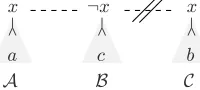
forxand only one argument for¬x. However, since in DELP∅ every attack is a defeat, and all defeaters are blocking defeaters, there is no chance ofdefense. That is, if an argumentAis defeated by argumentB
there is no chance of defeatingB using a third argu-mentC. This is because of the condition that avoids blocking-blocking situations in the formation of argu-mentation lines.
c :x
!
a x
!
b x
!
[image:3.595.367.467.358.403.2]A B C
Figure 1: Blocking situation en DELP∅
It is important to note that, in normal default the-ories, the existence of two applicable conflicting de-fault rules makes their conclusions to be in different extensions. Since DELP∅ avoids any opportunity of defense among arguments (see figure 1), the literals supported by conflicting arguments areundecided.
The next example shows that the concept of “de-fense among arguments” arises just when a prefer-ence criterion among arguments can be established. If an argumentAis preferred over an argumentB,A coulddefendan argumentCfrom being attacked by B.
Example 3
Given the theoryT3=h{x, w, z},{δ1, δ2, δ3}iwhere
δ1=x ֒→b,
δ2=x, w ֒→ ¬b,
δ3=x, w, z ֒→b
The associated de.l.p. isPT3= (Π3,∆3), where
Considering the normal default theory T3,
{b,¬b} ⊆CRED, and considering DELP∅, we have
{b,¬ b} ⊆ UND. Nevertheless, suppose that the information supplied by the ruleδ3is preferred to the information given byδ2, and this is preferred to δ1. Normal Default Logic and DELP∅ cannot express this preference.
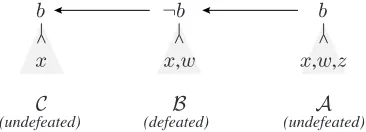
Observe that the de.l.p. of example 3 allows the construction of argumentsA = {b—≺x, w, z},B =
{(¬b—≺x, w)}, andC = {(b—≺x)}. Suppose that
we are considering a DELP variant with a preference criterion based on a relation establishing thatAis bet-ter thatB, andBis better thanC. In others words, ar-gumentAis a proper defeater forB, andBis a proper defeater forC. This situation allows the construction of an acceptable argumentation lineC−B−A(see figure 2), and the literalb, which is supported byC, is finallywarranted.
x,w
:b
!
B (defeated)
A b
!
x,w,z
(undefeated) (undefeated)
C b
!
[image:4.595.343.481.195.268.2]x
Figure 2: Preference in DELP
In Default Logic, conflict between default rules ap-pears either directly or indirectly. A direct conflict occurs when two applicable defaults rules conclude complementary literals, which will end up in sepa-rate extensions. Regarding the associated de.l.p., one argument for each literal is built and since these argu-ments are in conflict, both literals will beundecided. The other kind of conflict we are considering is the indirect conflict. This one occurs when the strict in-formation of the theory concludes a literal that blocks the application of a default rule.
Next, we describe an example that evidences the occurrence of an indirect conflict in a normal default theory, and we show how DELP∅models this conflict, and gives the expected answers.
Example 4 (Buy)
Consider the theoryT4 = hW4, D4iwhereW4
con-sists of the facts and rules:
(pricy) (studyBook) (mandatory→buy)
andD4consists of the default rules:
δ1=interesting֒→buy
δ2=pricy֒→ ¬buy
δ3=studyBook֒→mandatory
Figure 3 shows that the associated DELP∅ deter-mines a mutual attack between arguments for¬buy
andbuy. However, the attack is indirectly determined by literalsbuyandmandatory.
expensive :buy!
A B
studyBook
mandatory!
buy
Figure 3: Indirect conflict
Example 5
Given the theoryT5=hW5, D5iwhere
W5 ={p, x, z}
D5={p ֒→a, x ֒→ ¬c, z ֒→c, c ֒→ ¬a,},
The corresponding de.l.p. has the rules:
Π5={(p←),(x←),(z←)}
∆5={(a—≺p),(¬c—≺x),(c—≺z),(¬a—≺c)}
The theory T5has three extensions and the sets of
conclusions{c, a},{c,¬a}and{¬c, a}are subsets of CRED. In DELP∅ literalsa,¬a, cand¬care un-decided. Figure 4 depicts extensions and arguments defined by this theory.
:
a
:
a
:
c
:
c
!
p
p
a
a
c
c
z
z
x
x
!
[image:4.595.86.269.332.398.2]!
!
[image:4.595.336.531.544.680.2]Example 6
Given the theoryT6 =hW6, D6iwhereW6consists
of the following rules and facts:
anniversary rain noon
(overcast→ ¬sunny) (anniversary→winter.day)
andD6consists of the default rules:
δ1=noon֒→sunny δ2=winter.day֒→overcast δ3=¬sunny֒→cold δ4=rain֒→ ¬sunny
δ5=overcast,cold֒→take.a.taxi
The associated de.l.p. determines, for instance, that
take.a.taxi∈UND, because of the presence of an ar-gument forsunnythat attacks (and defeats) the argu-ment fortake.a.taxi. The default theoryT6in a
simi-lar way, sanctionstake.a.taxi∈CRED, because there is an extensionEsuch that sunny ∈E and both lit-eral are incompatible, sincetake.a.taxiis derived from
¬sunny. Hence,take.a.taxi∈Eand it is a credulous consecuence.
Example 7 (A classical example)
Given the theoryhW7, D7iwhere:
W7={evidenceA,evidenceB}
D7={֒→ ¬guilty,
evidenceA֒→responsible,
responsible֒→guilty,
evidenceB֒→ ¬responsible}
In this final example, we can see again that de-fault theory sanctions literals guiltyandresponsible
as credulous conclusions, and the de.l.p. associated to this theory classifies both literals asundecided.
Note that the default rule (֒→ ¬guilty) states the presumtion of innocence. This rule is associated to the defeasible rule (¬guilty—≺.)
5 DELP∅AND DEFAULT THEORY: FUTURE WORK
In this article, we have presented a variant of DELP, which we call DELP∅, which allows to model the be-havior of a Normal Default Logic via defeasible ar-gumentation. The relation under study maps the dif-ferent kinds of consequences from the default logic to
the different answers given by DELP∅. In this way, every skeptical consequence of a particular normal default theory will be a warranted literal in DELP∅, whereas every credulous consequence of a default logic will be an undecided literal in DELP∅. The vari-ant we are considering defines the argument prefer-ence criterion as the empty relation. This decision im-plies that no argument is better than any other. Thus, there are no proper defeats since every defeat is a blocking defeat. The definition of DELP∅follows the behavior of the normal default theories. In this for-malism, the application of a default rule blocks the derivation of a literal that conflicts with the conclu-sion of the rule being applied. In default logic, when-ever thisblockingsituation arises, a new extension is generated. In DELP∅, this situation turns the conflict-ing literals intoundecided.
Future work in this research line includes the study of the relation between DELP and general default theories, prioritized default theories, and other exten-sions.
References
[1] ANTONIOU, G., MAHER, M., BILLINGTON, D.,AND GOVERNATORI, G. Comparison of sceptical naf-free logic programming approaches. Logic Programming and Non-monotonic Reasoning 1730 (1999), 347–356.
[2] ANTONIOU, G., MAHER, M. J.,ANDBILLINGTON, D. Defeasible logic versus logic programming without negation as failure.Journal of Logic Programming 42, 1 (2000), 47–57.
[3] BREWKA, G. Well-founded semantics for extended logic programs with dynamic preferences. Journal of Artificial Intelligence Research 4(1996), 19–36.
[4] BREWKA, G. On the relation between defeasible logic and well-founded semantics.LPNMR(2001), 121–132.
[5] BREWKA, G.,ANDGOTTLOB, G. Well-founded se-mantics for default logic.Fundamenta Informaticae 31, 3/4 (1997), 221–236.
[6] CHESNEVAR˜ , C. I., DIX, J., STOLZENBURG, F.,AND SIMARI, G. R. Relating defeasible and normal logic programming through transformation properties. The-oretical Computer Science 290, 1 (2002), 499–529.
[7] GARC´IA, A.,ANDSIMARI, G. Defeasible logic pro-gramming, an argumentative approach. Theory and Practice of Logic Programming 4(1)(2004), 95–138.
[8] REITER, R. A logic for default reasoning. AI 13