Managing the Commons:
Edited by
LETICIA MERINO AND JIM ROBSON
CONSEJO CIVIL MEXICANO PARA LA SILVICULTURA SOSTENIBLE A.C. THE CHRISTENSEN FUND
FORD FOUNDATION
SECRETARÍA DE MEDIO AMBIENTE Y RECURSOS NATURALES INSTITUTO NACIONAL DE ECOLOGÍA
Managing the Commons:
Copyright © 2005 by CSMSS, The Christensen Fund, Ford Foundation, Semarnat, INE
All rights reserved under International and Pan-American Copyright Conventions. No part of this book may be reproduced in any form or by any means without permission in writing from the publisher.
Copy editor and technical revision: Jim Robson Typography: Raúl Marcó del Pont
Cover design: Álvaro Figueroa Cover photo: Claudio Contreras Koob
ISBN: 968-817-737-7
Contents
FOREWORD
Elinor Ostrom
A WORD FROM THE EDITORS
ABBREVIATIONS
THEMATIC INTRODUCTION. INDIGENOUS RIGHTS AND THE COMMONS: LAND, GOVERNANCE, DEVELOPMENT AND IDENTITY
Vincenzo Lauriola
SOCIOPOLITICAL DIMENSIONS OF INDIGENOUS COMMON PROPERTY TENURE IN SOUTHERN BELIZE
Emma Caddy
COMMUNITY-BASED FRAMEWORK FOR MEASURING THE SUCCESS OF INDIGENOUS PEOPLES’ FOREST-BASED ECONOMIC DEVELOPMENT IN CANADA
Peggy Smith
COMMUNITY RESOURCES: INTELLECTUAL PROPERTY SYSTEMS, TRADITIONAL KNOWLEDGE, AND THE GLOBAL LEGAL AUTHORITY OF LOCAL COMMUNITY
Johanna Gibson
MANAGING THE COMMONS: INDIGENOUS RIGHTS, ECONOMIC DEVELOPMENT & IDENTITY. EMERGING ISSUES, CONCLUSIONS AND RECOMMENDATIONS
Peggy Smith
ABOUT THE CONTRIBUTORS
9
10
13
15
23
38
53
66
Preface 9
Foreword
WRITING A FOREWORD for this excellentset of referencing tools is a pleasure for me. It brings back pleasant and intense memo-ries of the Tenth Biennial Conference of the International Association for the Study of Common Property (IASCP) held in Oaxaca, Mexico, in August of 2004. These meetings were well attended by scholars from all parts of the world, by policymakers, by volunteers and staff from many countries, by members of Indigenous communities, and by students. The multi-lingual, disciplinary exchanges that occurred within the sessions, and on the fabulous grounds where the meetings were held, were intense, fun, and exciting. We all came away enriched by new findings and mo-tivated to do even better work in the future.
So many edited books by academics are focused primarily on scientific topics of in-terest primarily to one discipline. These four volumes dramatically differ from most post-conference publications. The volumes are written by scholars who address broad issues of interest across scientific disciplines that are of major interest to citizens and policymak-ers in all parts of the world. If scientists are to have any impact on the policy world, efforts like this are essential to provide readable syn-theses that document important findings and their policy implications.
In this volume on Indigenous Rights, Eco-nomic Development, and Identity, Caddy
focus-es on the Maya of Belize and concludfocus-es that without a unified voice, the Mayan peoples have lost ground in defending their common property and Indigenous knowledge. In her article, P. Smith examines how Indigenous rights are not a stationary concept describing the past but rather must be jointly developed over time by Indigenous peoples themselves working with governance regimes at multiple levels. Finally, Gibson asks whether the inter-national law that has evolved related to intel-lectual property rights can be used to protect Indigenous knowledge as well as Indigenous property rights. Her answer is “no,” and she proposes a new organization within the UN to work on protecting Indigenous rights. In her concluding analysis, P. Smith reviews several viewing points for examining Indige-nous rights and urges IASCP to continue the dialogue between common-property schol-ars and Indigenous peoples that blossomed at the Oaxaca meetings.
My recommendation is to put these vol-umes where you will be sure to read them! We all are inundated with too many publica-tions that swamp our inbox (both electronic and paper) and have to make tough choices as to which we can read. These volumes already provide excellent summaries of an immense body of research—and they are written by authorities who know the field well.
A Word from
the Editors
THIS VOLUME is one of four books that have been put together as a follow-up to the Tenth Biennial Conference of the International As-sociation for the Study of Common Property (IASCP), which took place from August 9– 13, 2004, in Oaxaca, southern Mexico.
A brief analysis of the conference showed that this was the best-attended and most geographically diverse IASCP Conference to date, helping to attest to the global im-portance of IASCP and the relevance of the themes under discussion. The confer-ence brought together a new configuration of knowledge across disciplinary, institutional, regional and generational lines. It produced analyses of direct and contemporary rele-vance for policy-makers and political estab-lishments, and it introduced new topics for specific debate and discussion at an IASCP event.
With such advances having been made, as the organizers of IASCP2004 we felt it ex-tremely important that a concerted effort be undertaken to follow-up on the conference with a series of short, mid and long-term post-conference projects. This set of four publica-tions is the result of the long-term project of producing a series of cutting edge “referenc-ing tools”, based around what were regarded as the most interesting and pertinent confer-ence themes under discussion in Oaxaca. Our hope is that these publications will: encourage
the exchange of knowledge among diverse dis-ciplines, regions, areas of study, and resource types; promote policies and institutional de-signs that strengthen sustainable development and sustainable resource management strate-gies; and promote a more permanent struc-ture of Common Resource studies in Spanish and across Latin America.
As mentioned, these four “referencing tools” cover what we believe to be some of the most interesting, relevant topics / themes that came out of conference discussions. These are: Payment for Environmental Ser-vices; Conservation of Biological Diversity; Markets, Commodity Chains and Certifi-cation; and, Indigenous Rights, Economic Development and Identity. We believe that these are critical themes for contemporary policy making; and that CPR theory and re-search provides an important fresh perspec-tive for the governance of natural resources for this new century.
re-A Word from the Editors 11
search currently being carried out within the field of CPR study.
Within each volume, the first section pro-vides introductory information on the theme under discussion, its relevance within CPR study, a run down of the most pertinent is-sues under that theme discussed at the IAS-CP2004 conference, and an introduction to the three featured articles. The featured articles are not simple reproductions of the papers that were presented during the confer-ence but have been modified to produce texts that are clear and concise, not overly technical, and accessible enough for them to be used and understood by a wide range of actors. In addi-tion, the articles in each publication are con-ceptually and thematically inter-linked so as to compliment each other as part of the same referencing tool. The final section of each vol-ume looks at the key emerging issues from each article, and tries to draw out a set of prin-cipal conclusions and recommendations that can provide pointers for future research and policy-making.
ACKNOWLEDGEMENTS
The following texts are very much the result of an important investment in collective action, and we would like to take this opportunity to thank all those who’ve been responsible for bringing this project to fruition.
Firstly, we would like to say a very special thank you to our fantastic group of thematic experts who were involved in (i) the evalu-ation and selection of papers earmarked for inclusion in these books and (ii) responsible for the excellent thematic introductions and concluding sections which book-end each one of these publications. These individuals are: David Bray, Daniel Klooster, Augusta Molnar, Peggy Smith, Heidi Wittmer, Su-san Kandel and Hernan Rosa (PRISMA), Vincenzo Lauriola, and Victoria Edwards. Without their advice, generous support, punctuality, and expert comments these books would never have come about or cer-tainly wouldn’t be as good as they are. We also greatly appreciate Elinor Ostrom for her support of this project and for provid-ing these publications with their Foreword, which introduces each one of these volumes so beautifully.
Next, our thanks go out to all the authors of the featured articles for their continued support for the project, collaborative spirit, and willingness to be flexible when it came to meddling with their manuscripts! We would also like to say thank you to those who very kindly provided us with photos and other im-ages to help spruce up the publications.
On the editorial side of things, we have a number of people to thank who were indis-pensable when it came to editing and
trans-lating texts, and helping with the design and format of these books. Firstly, we very much appreciate the work of Ma. Teresa Ruiz Ramírez, who, as well as translating a number of the articles, was also responsible for coordi-nating the translation and editing of all texts in Spanish, along with her team of transla-tors: José Ignacio Rodríguez Martínez, Adri-ana Villagra Peña, Fátima Andreu Marín, and Ayari Pasquier Merino. Teresa and her team worked very hard to ensure that the versions in Spanish were as faithful as possible to their counterparts in English. For the design and formatting of these books, we have to thank Raúl Marco del Pont Lalli, head of publica-tions at the Government of Mexico’s Instituto Nacional de Ecologia (INE), who has been responsible for putting these texts together into such attractive volumes.
Work that stretches back from early 2003 right through to this latest project—the post-confer-ence publications—some three years later.
A final word of thanks is left for Michelle Curtain, IASCP’s Executive Director, and
Alyne Delaney, Assistant Editor of the Asso-ciation’s quarterly publication, the CPR Di-gest, for their help in advertising these books and getting them out to as wide an audience as possible.
Enjoy!
Abbreviations 13
Abbreviations
CBD Convention on BiologicalDiversity
CCFM Criteria and Indicators of Sustainable Forest Management
CIDA Canadian International Development Agency
CPPCR Convention for the Promotion and Protection of Community Resources
ESTAP Environmental and Social Technical Assistance Project
GIS Geographic Information Systems
GoB Government of Belize
IACHR Inter-American Commission on Human Rights
IASCP International Association for the Study of Common Property
ICC Indigenous Circumpolar Conference
ICJ International Court of Justice
IDB Inter-American Development Bank
ILO International Labour Organization
ILRC Indian Law Resource Centre
KCB K’ekchi Council of Belize
MCMMP Maya Co-Management Mapping Project
NAFTA North American Free Trade Agreement
NGO Non-governmental
Organization
OAS Organization of American Status
OEA Organización de los Estados Americanos
SFM Sustainable Forest Management
TAA Toledo Alcaldes’ Association
TEK Traditional Ecological Knowledge
TMCC Toledo Maya Cultural Council
TMWC Toledo Maya Women’s Council
TRIPS Trade-related Aspects of Intellectual Property Rights
UN United Nations
UNCRP United Nations Community Resources Programme
UNPFII United Nations Permanent Forum on Indigenous Issues
VCA Village Council Act
VCAT Village Council’s Association- Toledo
Introduction 15
Managing the Commons:
Indigenous Rights,
Economic Development
and Identity
Thematic Introduction
Indigenous Rights and the
Commons: Land, Governance,
Development and Identity
Vincenzo Lauriola
NELSON LEMUS CRUZ had some of the audi-ence at the Tenth Biennial Conferaudi-ence of the International Association for the Study of Common property (IASCP) in tears as he de-scribed the “ancestral struggle and resistance” of the Paez people of Colombia. Although unique, his story of the Paez’s determination to protect their lands was common to many other Indigenous peoples around the globe. In their desire to carry out their sacred duty as stewards of their land, the Paez people have been facing state incursions, invasion by gue-rillas involved in civil war and the lawlessness of drug traders. In spite of this, they continue to assert their own stewardship and custom-ary laws. Lemus Cruz’s story wove together with so many other Indigenous peoples’ sto-ries at the IASCP conference. All these voices at the conference, whether speaking directly through Indigenous participants, or indirect-ly through academic studies, conveyed both a tremendous diversity of unique experiences, as well as some key features common to their struggles for recognition and survival of In-digenous rights.
Although Indigenous issues have been on the agenda of past IASCP conferences, this was the first time that Indigenous rights were raised to the theme level. Given the history of Mexican Indigenous peoples’ struggles to maintain ownership and management of their lands, shared by other Indigenous
peo-ples in Latin America, it is no surprise that the Oaxaca conference organizers embraced this theme. Indigenous representatives came from Latin America (Belize, Bolivia, Brazil, Chile, Colombia, Ecuador, Guyana, Mexico, Panama, Peru and Venezuela), North Amer-ica (Canada and the United States), Asia & Oceania (Australia, Bangladesh, India, In-donesia and Nepal), and Africa (Zambia and Zimbabwe).
From a qualitative standpoint, assessing the impact of discussions on this theme is not straightforward: it requires an effort to read through the richness and diversity of the con-tributions provided, trying to synthesize and bring out the core ideas, common to most of the experiences and studies presented. It is with this goal in mind that this publication has been put together.
Indeed, the volume’s very title, Indigenous Rights, Economic development and Identity,
by exploring these issues that we are able to read into and understand the ways in which Indigenous peoples deal with these times of global change, face up to new and long-stand-ing challenges and seize what opportunities come their way.
Rights play a crucial role in the relationship between Indigenous peoples and common property. They are externally crucial in In-digenous peoples’ struggle within and against nation states, whose legal systems—which historically came to justify and support the monopoly of power, force and coertion use, in the name of a written law—are not shared by Indigenous peoples’ cultural traditions and cosmovisions. There is limited room for com-mon property regimes, rules and institutions in the legal systems of modern nation states, dominated by the expansion of central state regulation and domestically or globally driv-en privatisation processes. The way in which modern nation states treat land, turning into a piece of merchandise one of the pillars of human existence and identity, is fundamen-tally alien to Indigenous cultures. To them land does not belong to man, and man does not inherit land: it is man who belongs to land, which he is merely borrowing from his children. That is why Indigenous people do not recognize the concept of private property, nor do they wish to organize their territories in the form of a nation state. There is not a
single day in which they do not have to face the arrival of a fence or the threat of an en-closure onto their lands, natural or cultural resources, if not their very bodies and tradi-tional knowledge. Pressures on Indigenous commons first came in the form of predatory economic activities, lusting after the forest wood or subsoil minerals and oil found on their traditional lands. Then they started ar-riving masked by political promises of devel-opment in the name of the nation’s interests, priorities and strategies, removing them from traditional lands to give way to cattle ranch-es, roads, towns, or hydroelectric basins. To-day, new fences are needed to develop new commodity markets. Instead of chainsaws, bulldozers and concrete, the new enclosures sneak in hidden behind environmental flags, armed with: maps, to promote the creation of untouchable conservation parks; laws and contracts, to introduce state and market reg-ulation on access and use of water, biodiver-sity and traditional knowledge. The notion of rights, and the struggle to have their own rights systems based on common property regimes, embracing customs and cultural traditions, recognised and respected by na-tion states and the internana-tional community, is fundamental if Indigenous peoples are to face up to these kinds of external pressures.
Rights are also internally crucial in allow-ing Indigenous communities to develop,
Introduction 17
struggle to maintain common property-based governance systems and internal socio-cul-tural cohesion, to build bridges between past, present and future, reconstructing and updat-ing traditions and identities based on commu-nity values, common resources management rules and institutions.
In practice, these two ideally distinct lev-els—external recognition of common proper-ty Indigenous rights and internal governance system efficacy—are inextricably linked. This could be observed in so many of the “In-digenous theme” presentations in Oaxaca. I will refer to just a few examples from the Brazilian Amazon Indians’ sessions. Brazil’s case is interesting because, although through what Indigenous law specialist Carlos Marés defines as a “circular concept”, the Federal Constitution practically defines Indigenous lands as common property, while also recog-nizing Indigenous jurisdiction over them. On the one hand, this legal framework has been crucial in demarcating Indigenous territo-ries, setting aside 12.5% of Brazil’s territory (1,063,863 km2) for the permanent
exclu-sive use of an Indigenous population of some 427,000. No doubt, a positive situation for the country’s Indigenous peoples. However, if the external legal and political framework is a necessary condition for Indigenous com-mon property-based rights systems to exist and be effective (a condition shared by
differ-ent countries’ realities and case studies, and a point clearly illustrated by Emma Caddy’s featured article on Belize, this volume), to be sustainable it also needs to be complemented by Indigenous governance systems (own cus-toms, uses and traditions, as recognized by the Brazilian Constitution) that can resist the powerful pressures of state and private property enclosures.
Using their own words and concepts, these were the stories told by most Brazilian Ama-zonian Indigenous presenters in Oaxaca. Af-ter describing the hardships of contact and conflicts on land demarcation, many of the presentations focused on today’s external and internal struggles to keep Indigenous com-mon property-based rights systems alive and functioning. Externally, even with the consti-tutional guarantee of their boundaries, illegal and predatory logging, fishing, mining, dams and monoculture are current history in the Indigenous lands of the Brazilian Amazon. Internally, many of the presentations looked at the experiences and challenges of re-build-ing common property-based natural resource management rules and productive activities. Nino Fernandes, of the Tikuna people, state of Amazonas, described the efforts of his peo-ple to keep outsiders from practicing preda-tory fishing in their rivers and lakes, while simultaneously setting up and implementing a fishing management plan to allow fish
pop-ulations to reach pre-invasion levels, a project which also requires the development of short term fish breeding alternatives for consump-tion. After describing the impacts through contact with external groups (during the late 1960s, half of the population died from diseases), Almir Narayamoga, of the Suruí people, state of Rondonia, described current efforts to develop a formal environmental management plan for local Indigenous lands, through the interaction between traditional knowledge and technical expertise. Alvino da Silva, of the Macuxi people, state of Ror-aima, described a situation similar to Almir’s in the difficult task of re-building an environ-mental governance system by Macuxi, Wapi-chana and Taurepang communities. Here, the recent expulsion of invaders left a void in land and natural resource management rules, which communities are now trying to fill and re-build.
communi-ties, increasingly encircled by cattle ranches and soybean monocultures, as well as the cultural impacts suffered from a century of violent contacts with outsiders. The story of Henrique Aleuta Gimenes, of the Ye’kuana people, living on what was officially demar-cated as Yanomami Indigenous land, in the state of Roraima on the border with Ven-ezuela, was also different from most others. Living in a remote area, side by side with the Sanuma people, of the Yanomami family, his people did not experience contact through invasion of their territory, common to most other peoples and participants. From the Ye’kuana perspective, the external frontier did not materialize in the face of white set-tlers, but in the context of inter-ethnic rela-tions with a different Indigenous people. Showing participatory maps mentally drawn by 3 generations of Ye’kuana on the Auaris river, Henrique described the sophisticated and complex sets of rules developed by his community through negotiations with Sa-numa neighbors, to share the common land and mutually recognize exclusive use areas of the two tribes for agriculture, hunting, fishing and collecting. At the same time, he highlighted the fragility of these rules in the current context of inter-generational and cul-tural change, where after the introduction of formal education in the community, the young no longer learn from the elders like
they did before, and consequently traditional knowledge is being eroded.
Throughout the conference the theme of Indigenous rights emerged not only as cru-cial, but also as one of the most difficult issues for researchers to address and understand.
INDIGENOUS RIGHTS RECOGNITION
AND GOVERNANCE
A principal recognition was that Indigenous rights, especially those based around com-mon property systems, vary widely between different nation states. In some countries, Indigenous rights systems are recognized by national constitutions; in others some infra-constitutional recognition exists with regards common property-based land and/or natural resource use systems; whilst in others, there is no recognition at all. Rights and gover-nance are inextricably linked: if Indigenous rights systems are not recognized strongly enough, there is little chance for Indigenous governance to remain effective. Undoubtedly, one of the main issues is how to reconcile, or at least guarantee mutual co-existence be-tween common property-based Indigenous rights on the one hand, and state and private property on the other. Some insisted on the need for improved dialogue between Indig-enous governance institutions and the state, whether at different levels of public
adminis-tration, with regards to the appropriate defi-nition of specific public policies, or through institutional “middle ground” mechanisms for negotiation and conflict management. But the issue of how to allow for the effec-tive representation, presence and weight of Indigenous peoples as principal actors—and not mere spectators—in the global arena, a space traditionally occupied by nation states and increasingly dominated by transnational corporations, also appeared on the agenda. In this “search for a middle ground”, the de-mand for broader recognition of collective representation mechanisms, and the need to generalize the operational application of guiding principles such as the right to free, full and informed consent, participation, just compensation and benefit-sharing stood out as being among the main proposals.
CONSERVATION
Introduction 19
from being responsible co-managers of a com-mon resource into illegal poachers or invaders, to be prosecuted or removed; and, secondly because no value is placed on, nor benefit paid to, the traditional ethno-conservation service these groups have always provided for free. At best, conservation projects offer compensa-tion to local Indigenous peoples, in exchange for giving up use rights and traditional prac-tices. However, from Indigenous peoples’ perspective, and in the light of common prop-erty-based ethno-conservation studies, it is increasingly clear that: sustainable conserva-tion is the consequence of Indigenous peoples’ self-determination and governance, based on traditional knowledge, customary law and common property; biodiversity is highly cor-related to cultural diversity; and, Indigenous knowledge, management and governance sys-tems, invisible or ignored, are threatened by business-as-usual conservation policies.
DEVELOPMENT
When applied to Indigenous societies, the deceiving realities and conceptual limits and fallacies of the development ideology and theoretical framework, increasingly evident in our own societies and economies, become outstanding and flagrant. Some presentations questioned the pertinence of assessing Indig-enous peoples’ development within a narrow
economic focus, such as measuring formal jobs and monetary income, while giving no value to community well-being, cultural sur-vival and informal solidarity mechanisms. It is true that most of the world’s Indigenous peoples live at the margins of their coun-tries’ formal economies, facing social and economic inequity, and it is no wonder that economic development is a key issue. But this does not mean that the standard pov-erty assessment indicators, for instance, have much to tell us about social well-being in In-digenous societies. If equity and justice for Indigenous peoples in benefit-sharing from natural resource use and development was a frequent claim, the clearest message of all was that Indigenous peoples want to make their own decisions about appropriate economic development, including poverty alleviation measures now being touted by development agencies. Indigenous communities are not necessarily opposed to participating in wider economic systems and market integration, but they want to be the ones to decide how to transform their economies and institutions. New economic initiatives, related to environ-mental protection and ecological services, are regarded as opportunities that match their traditional views of land stewardship. Much will depend on the format in which they are actually developed: whether as new market services or new public policies.
SELECTED ARTICLES
Following the above premises, the articles fea-tured in this publication have been selected in an attempt to provide an overview of some of the issues that emerged as crucial and rep-resentative of case studies and conceptual de-bates at Oaxaca’s IASCP 2004 conference.
features, providing abundant evidence of their sustainability. However, as the author points out, “traditional ecological knowledge and the common property systems that sus-tain them do not exist in isolation from the nation-states in which they are situated”. On the contrary, they “are indeed heavily influ-enced by the political frameworks in which they are situated, which can either strength-en or undermine their long term viability, and potential contribution to contemporary resource management initiatives”. The Be-lize case study which Caddy provides is a re-markable piece of evidence for her thesis, as it clearly demonstrates that, where the state law and political system does not provide the possibility of official recognition of common property based land tenure rights, the efforts of Indigenous peoples to maintain the cohe-sion of their traditional natural resource use governance systems (even if well supported by grassroots mobilization, competent ad-vocacy and qualified technical assistance, in-cluding participatory land use mapping and planning) can unpredictably lose momen-tum, strength and viability. If, after years of collective mobilization and struggle, Indig-enous communities see no recognition by the state of their common land rights, an isolated event, such as the death of a traditional lead-er, can lead to hope being suddenly lost with the only alternative being to claim individual
plots, or accept protected areas on traditional lands. Moreover, by failing the goal of collec-tive land rights recognition, the accumulated experiences of mobilization, advocacy and participatory mapping can end up serving particular and competing interests between and among communities, thus creating ten-sions and further diviten-sions. By providing an extremely interesting and well supported point, Caddy’s article stimulates common property researchers, theorists and practi-tioners to carry out further thinking and comparative research. At the same time, by observing that “common property theorists have embraced the important contribution that can be made by traditional ecological knowledge and Indigenous management re-gimes, this acceptance has not been univer-sally paralleled in other social and political systems. (…) many states (especially in de-veloping countries) nevertheless continue to believe that individual ownership is the only progressive option. Communal ownership systems are regarded as antiquated means of land use and tenure, thus retarding ef-fective development”, it also provokes com-mon property specialists to question: why do the results of common property theory and practice have such a hard time in penetrat-ing more deeply into academic curricula and political agendas? Would it not be time to engage more actively in politically oriented
actions? If we do not act now at politically pertinent and relevant levels, common prop-erty resource use and management systems may no longer be there for us to study, wiped out by the increasingly pervasive and power-ful advance of the enclosures.
Introduction 21
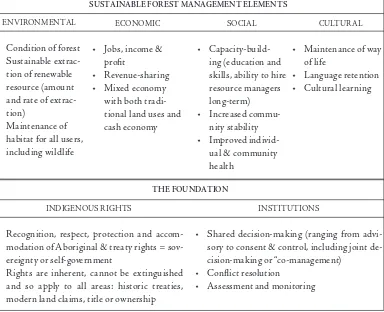
development” and still today “many forest-based Indigenous communities in Canada suffer severe underdevelopment with high unemployment and social problems”. In a genuine effort to carry out sensible socio-economic research of forest Indigenous com-munities, to produce a reliable assessment of their economic development and social well-being, which could possibly serve as a basis to design and implement consistent and appro-priate development and/or social problem-solving policies, Smith faces the challenge of designing a new methodological framework. After making a quick review of different eco-nomic development paradigms, from deter-ministic to human agency theories, then on to sustainable development, and acknowledging the limits of strict economic indicators, the author proposes the adoption of an adapted version of the Sustainable Forest Manage-ment paradigm. Culture is incorporated as a fourth dimension of development and well-being, to reflect the wider sets of socio-cultur-al vsocio-cultur-alues relevant to Indigenous communities. The result is a stimulating methodological framework, open to evaluation and testing in current as well as future research. As is often the case when facing methodological challenges and innovations, many questions arise, and the author herself asks a few: “Can such a framework provide a more comprehen-sive examination of the success of Indigenous
peoples’ forest-based economic development? What criteria for success would need to be assessed under such a framework? How is it possible to move from a single indicator ap-proach—measuring jobs and income or envi-ronmental sustainability—to understanding the interaction of all elements and the po-tential trade-offs among them? Under whose directions are such decisions to be made?”. The reader will no doubt come up with some question of their own, such as: Provided that unemployment, social and cultural problems, or what we refer to as underdevelopment are not specific or exclusive features of Indige-nous communities, but increasingly pervasive phenomena in all modern industrial societies, should we not make a further effort to reduce the weight of economic indicators in the as-sessment of social well-being of our own so-cieties? What can we learn from Indigenous societies in this respect? Isn’t the cultural dimension of paramount importance for in-dustrial societies’ well-being too? And if the assessment of development continues to be focussed on economic and quantitative vari-ables, doesn’t this make the very concept of economic development less significant?
Johanna Gibson’s “Model of Communi-ty Resources” deals with a particularly new, fuzzy and thorny issue: the relationship be-tween intellectual property and traditional knowledge. An issue in which much research
and thinking is needed to design viable sys-tems, simultaneously capable of protecting traditional knowledge as a common resource against the piracies of misappropriation and privatization, and enabling local communi-ties to capture some of its potential economic value. The author’s proposal of a sui generis
upon socio-cultural mechanisms of sharing and gift reciprocity. The author states clearly that mechanisms based on existing intellec-tual property rights are wholly inadequate to be applied to traditional knowledge. One could even question whether their long term application to western, modern and/or scien-tific knowledge is socially or culturally desir-able. On the other hand, she argues that “the proposed protection must be compatible with the international intellectual property sys-tem”. Finally, her proposal for “Global Legal Authority of Local Community” faces the issue of community authority, capacity and standing within the current global
interna-tional and political arena, where the sole ful-ly recognized actors are nation states, with transnational corporations well established just behind the official scene. The question is whether “the international treaty system can proceed beyond the conventional model of state sovereignty”. In response to this, Gib-son advocates “the negotiation of a binding international agreement (…) the Convention for the Promotion and Protection of Com-munity Resources (CPPCR), (which) will formalize fundamental respect for and obli-gations to cultural diversity with an applica-ble framework of standards of protectio. The proposal is well argued and the description of
Sociopolitical Dimensions 23
INTRODUCTION
THE LIVELIHOODS of approximately 60 mil-lion Indigenous peoples worldwide, today depend upon the use of and access to com-mon property forest resources to meet their subsistence needs (Scherr et al. 2004). Al-though often extremely poor, Indigenous for-est-dwelling peoples have survived because of their historical access to the forest ecosys-tems that sustain them. However, the erosion of tropical forest ecosystems due to agricul-tural conversion, industrial logging, and land privatization increasingly undermines the futures of forest-dependent Indigenous com-munities. The extent to which such processes undermine Indigenous common property systems is very much related to the broader sociopolitical context in which they are situ-ated, and the level of recognition, opportuni-ties and constraints that this encompassing state framework affords them.
This article explores how the broader so-ciopolitical context influences the long-term sustainability of Indigenous common prop-erty systems. It considers how, in an effort to negotiate space within inflexible political sys-tems, Indigenous peoples’ perspectives with regard their common property resources and systems can become modified by the experi-ence of advocacy, affecting their future lon-gevity. Through case study illustrations of
Sociopolitical Dimensions
of Indigenous Common
Property Tenure in
Southern Belize
Indigenous efforts in southern Belize to se-cure common property resources within an unaccommodating political and legal envi-ronment, utilizing often non-traditional rep-resentation methods and resources, it will be shown how these often necessary strategies can nevertheless transform their manage-ment practices, articulation of land claims and very perceptions of common property systems. Analysis will show how these sys-tems extend far beyond their most visible ecological characteristics, and are subject to change, opportunity and extreme stress due to the sociopolitical context in which they are found. Implications for the longevity of Indigenous common property systems will then be considered.
POLITICAL IMPLICATIONS OF
COMMON PROPERTY THEORY
relevance of such systems in addressing the major management issues of today, and even to “inject a measure of ethics into the science of ecology and resource management” (Ber-kes 1999). Indigenous common property systems have been shown to maintain resil-ience and relevance not only because of the ecological knowledge and spatial references accumulated over time that scientific systems are hard pressed to replicate, but also due to the adaptability of Indigenous cultures and institutional systems to continuous change. Common property systems have been ac-knowledged as providing valuable lessons for institutional management and development, given the pronounced ability of Indigenous institutions to adapt to changing circum-stances over time (Watson 2003).
While TEK‘s contributions to the study of ecology have become apparent, compli-mentary political analyses considering the broader contexts in which common property systems operate, and seek to survive in, have been less visible. Nevertheless, TEK and the common property systems that sustain them do not exist in isolation from the nation states in which they are situated. As noted by Pritchard and Sanderson (2002), “consider-ation of human management of and response to natural systems would be incomplete with-out a consideration of politics”. Indigenous common property systems are indeed heavily
influenced by the political frameworks that surround them, which can either strengthen or undermine their long-term viability and potential contributions to contemporary re-source management initiatives. Since Indig-enous cultures and interrelated ecosystems are globally threatened, it is clearly important to examine the broader conditions and con-straints that are precipitating their erosion. Through this analysis, we should be in a bet-ter position to develop innovative strategies in their defense.
Although common property theorists have embraced the important contribution that can be made by TEK and Indigenous management regimes, this acceptance has not been universally paralleled in other so-cial and political systems. Although common property researchers have emphatically dem-onstrated that open-access regimes, wherein no rules of management apply and costs of individual pursuit are offloaded to society, result in disastrous consequences for the re-source in the long-term (Bromley 1991; Ber-kes 1999), many states nevertheless continue to believe that individual ownership is the only progressive option. Communal own-ership systems are regarded as antiquated means of land use and tenure, retarding ef-fective development.
These political perspectives, and the policies they engender, clearly threaten
In-digenous common property systems. It is important to note that Indigenous common property regimes are not static social systems. As research amongst Masai pastoralists has demonstrated, land-use strategies are deter-mined as much by new opportunities for di-versification and income generation offered by the dominant economy, as by cultural consid-erations (Thompson and Homewood 2002). Anthropological research confirms the his-torical dimension of this process, showing that Indigenous cultures remain fluid and adaptive, whilst norms of practice are simul-taneously and constantly renewed and main-tained through a shared sense of identity and affiliation to social grouping and place (Gor-don, Gurdián and Hale 2003). As such, an alternative political spin used to undermine the legitimacy of Indigenous common prop-erty systems can also be neutralized. Less bi-ased assessments of Indigenous management systems are clearly needed, ones that take into account the various social, ecological and political conditions affecting them (de Castro and McGrath 2003:124).
Sociopolitical Dimensions 25
common property systems through legal and political avenues. However, the nature of the system in which they operate has created new tensions and challenges with regards Indig-enous institutions, leadership and percep-tions of common property. As a result, the future of these systems, the ecosystems that they contain, and the cultures that depend on them are inevitably affected by the experi-ence. Possible strategies to mitigate such ten-sions and to protect these critical interrelated resources will subsequently be considered.
CASE STUDY: SOUTHERN BELIZE
Belize’s southernmost Toledo District con-tains approximately 14,000 Maya, from two ethnic groups, Ke’kchi and Mopan, dispersed among 37 villages, ranging from 50 to 1200 inhabitants (Maya Atlas 1997). Toledo’s historical isolation from the centres of state power and development has facilitat-ed the persistence of strong Mayan cultural identity, as demonstrated by traits such as language, organization and livelihood prac-tices. An itinerant population, the location of Mayan communities has shifted over time in response to resource availability and land quality. Nevertheless, the Maya’s presence clearly predates the creation of modern-day Belize and the arrival of the Spanish in the sixteenth century (Leventhal 1997).
The persistent mobility of the Maya is mirrored in their daily livelihood practices, with forest-based, shifting slash-and-burn agriculture still representing the dominant form of subsistence activity. In addition to this extensive agricultural system, known as milpa, the Maya have traditionally con-ducted a range of other resource use activi-ties within broad swathes of communal and inter-communal forest lands, strengthening the resilience of their livelihood systems. These include hunting, and the gathering of forest products such as palm heart, tree vines, and plants for consumption, build-ing and medicinal purposes (Boster 1973). Maya communities generally maintain a common forest reserve of palm trees to pro-vide thatching for house roofs (Wilk 1997), while cultivating permanent tree crops such as fruits, cocoa and coffee for household use and sale. This diversified system has enabled the Mayans to remain self-sufficient, despite being the most materially disadvantaged ethic group in Belize.
Over time, in common with many In-digenous cultures, the Maya’s livelihood strategies have been modified in response to available options. In recent decades, the in-creasing shortage of available cultivable land, impoverishment of forest ecosystems and concomitant resources due to logging, land conversion and encroachment, and the
intro-duction of new wage-labour opportunities - however fleeting - have decreased milpa’s dominant role in Mayan livelihoods. Mayans have remained open to these opportunities for livelihood adaptation, without relinquish-ing their strong sense of cultural identity.
One of the more obvious examples of livelihood innovation is provided by the in-creasing number of farmers engaged in the commercial cultivation of a traditional
yan crop, cacao. A decade ago, a local produc-er organization, the Toledo Cacao Growproduc-ers’ Association (TCGA), signed a commercial agreement with a British organic chocolate company, Green & Black’s, to export or-ganic, Fair Trade-certified cacao to Europe. Funding from the British Government has enabled the rapid expansion in cacao farm-ing over the past few years. Since cacao de-pends upon shade to flourish, Mayans are voluntarily reducing the amount of forest be-ing cleared for milpa cultivation, and growbe-ing cacao trees (within the natural forest cano-py) instead. Their incentive to grow cacao is strengthened by the fact that milpa rotations have been gradually reduced, leading to de-creased soil fertility, yields, and economic re-turns. The cultivation of cacao is a potential win-win situation: it is culturally compat-ible, economically viable, and helps rehabili-tate natural forest ecosystems. In the search for other socially appropriate, economically viable options, Mayans are also becoming involved in cultural eco-tourism, and addi-tional non-timber forest product industries. That said, Mayans are also being engaged in equal numbers in less eco-friendly industries, such as logging, roadwork projects and inten-sive agricultural plantations. Clearly, both the sustainable or non-sustainable options before them have concomitant impacts on the integrity of their common property systems;
the Mayans’ effort to achieve an effective bal-ance between the two remains greatly influ-enced by the broader socio-political context in which they are situated.
INDIGENOUS LEADERSHIP AND
INSTITUTIONS
Traditional Mayan village leaders continue to play an important role in regulating how communal land and resources are used and owned. Indeed, while the term common property can foster the assumption that no individual ownership of resources exists, In-digenous common property systems are, in fact, governed by internal institutions, which demonstrate a variety of individual rights of access, preference and seniority in the dis-tribution of communal land rights (Watson 2003).
For example, within the Mayan tenure system, village leaders or alcaldes uphold farmers’ rights to own riverside matahambre plots; cultivation lands used for permanent farming. These plots are inherited and can be rented or sold within the village, but not out-side it. Milpa lands are, however, less tightly controlled, and village leaders will readily oversee change of user if the previous one is no longer actively using them. Since fruit trees also denote ownership of an area, vil-lage leaders will use their presence to resolve
disputes between contesting farmers should these arise. Within the residential village zone, village leaders also allocate house lots, determine lot boundaries, and arbitrate inter and intra-household disputes (Nietschmann 1997: 7-10). Village leaders are also respon-sible for adjudicating any inter-communal dispute that should arise between their re-spective village members.
Although alcaldes continue to play a pri-mary role in the management of common property systems, the introduction (by the Government of Belize (GoB)) of new au-thority figures within Mayan villages in the 1970s created an additional level of complex-ity within village leadership structures. In an attempt to streamline village management nationwide, village councils were created throughout the country but with no regard for the prior existence of parallel leadership figures in Mayan communities. The resulting
Sociopolitical Dimensions 27
division of authority has, in general terms, translated into alcaldes being in charge of ad-judicating internal village matters and imple-menting customary law, while village councils and chairmen have been responsible for li-asing with government to represent village needs. In reality, roles and responsibilities of the alcalde and village chairmen remain somewhat blurred and overlapping, with in-ternal dynamics and individual personalities determining whether the alcalde or chair-man wields more control in any given vil-lage. Indeed, the adaptability of Indigenous management systems has meant that Mayan communities have been able to absorb these institutional changes, and develop internal rationale to ensure their coexistence.
In addition to village-level authority fig-ures, the Maya developed a new tier of rep-resentation for general advocacy purposes. In April 1978, the Toledo Maya Cultural Council (TMCC) was created to safeguard the economic, social, cultural and educa-tional interests of the Mayas. The TMCC was subsequently registered in 1986, with its 12-member (6 Ke’kchi and 6 Mopan) Executive Council elected on a biannual basis. As will be discussed later in greater detail, the TMCC
provided the Maya with a new vehicle for na-tional political advocacy. The TMCC’s work would later be enhanced by the formation of the Toledo Alcaldes’ Association (TAA) in
1992; a general assembly consisting of rep-resentatives from each of Toledo’s elected community alcaldes. Since the TAA aimed to safeguard both the alcalde system and com-munity interests, their objectives matched closely with those of the TMCC. Together, the
TMCC and TAA would take Mayan political mobilization, which began in the 1970s, to a new level in the mid to late 1990s.
POLITICAL-LEGAL DIMENSIONS OF
MAYAN ADVOCACY
Before examining the course of Mayan ad-vocacy in greater depth, the political-legal dimensions in which this process played out must first be examined. To put the Belize situation into context, first consider that a quarter of forests in the world’s most heavily forested countries (including Brazil, Bolivia, Columbia, Guyana and Argentina in Latin America), are today either owned by Indige-nous or rural communities (White and Mar-tin 2002). Belize’s neighbours, Mexico and Guatemala, can showcase many examples of successful, community-owned forest man-agement systems that are legally recognized by their respective governments. Recognition of community-based ownership is a clearly accepted practice in many countries of the world, which has moreover yielded notable conservation and development benefits.
Belize cannot be counted amongst this group of progressive states. Mayan common property systems have survived despite a lack of national political support and recognition. The forested lands that the Maya live, use and depend upon are either national lands or reserves, or pri-vate property. The Belizean legal system has provided no mechanism to recognize, demar-cate or entitle Mayan communal lands; nor as we shall see, has the Government of Belize (GoB) proven particularly eager to amend this state of affairs. During the colonial period, in an effort to placate the Mayas, the British established 10 ‘Indian Reservations’ within Toledo, totalling 77,000 hectares. However, these reservations existed on paper only, were never physically demarcated, nor legally titled as Mayan lands in the Belizean constitution (Maya Atlas 1997). Moreover, this area did not reflect the true extension of Mayan com-munal land use. Since both colonial and then independent governments ultimately retained the right to bestow private property within the Reservations’ confines, and did so with-out consulting local Mayan communities, the physically limited reservations provided no tangible safeguard for the Mayans. Only To-ledo’s geographical isolation and underdevel-opment helped the Maya’s common property systems to persist.
initia-tives, Mayan communal systems’ continued lack of legal recognition has left their lands, resources and communities ever more vul-nerable to the pressures of land privatiza-tion, encroachment and logging. Although Belize enjoys relative political stability and prosperity compared to its Central American neighbours, the Mayans live on the economic fringes of national growth. Belize’s 2002 Na-tional Development Report indicated that while 33.5% of the national population was considered poor, in Toledo, where the major-ity of the population is Maya, this figure was more than double that at 79%. One factor contributing to and compounding the Maya’s marginal socioeconomic status is their paral-lel subsidiary political status in Belize. Until 1998, no Maya had ever been elected to Be-lize’s parliament, while the Belize Senate has never seen a Mayan occupied seat. The invis-ibility of Mayan issues in Belizean social and political discourse has not helped to resolve the issue of land tenure insecurity that affects all Mayan communities in Toledo.
MAYAN ADVOCACY STRATEGIES
It was largely in response to the increased threat to communal forests posed by a Gov-ernment-granted Malaysian logging conces-sion in the 1990s that the modern Mayan advocacy movement began. The large-scale
logging concessions helped Indigenous com-munities to understand the threat posed to their communal lands by the government’s readiness to bestow titles and concessions in the so-called “empty” territory of Toledo. The TAA/TMCC alliance provided a vehi-cle by which to mount an organized protest against these developments. This process was further facilitated by the election of a new TMCC chairman in 1995; Julian Cho, a Mopan Maya educated to post-graduate level in the United States, whose ability to operate effectively within both national political and grassroots community circles proved a criti-cal factor in coalescing the process. However, to succeed, the focus of Mayan advocacy— their communal lands—needed to be clearly and specifically defined.
The TMCC and TAA elicited the support of a team from the Department of Geogra-phy, University of California–Berkeley, led by Barney Nietschmann, as well as the Indian Law Resource Centre (ILRC), a pro bono In-digenous legal rights firm from Washington
D.C., to assist them in this process. Between 1996 and 1997, these groups mapped each of Toledo’s 37 Mayan communities, training in-dividuals from each village to lead the pro-cess in their respective areas. A set of hand drawn but detailed maps depicting the lands used by the Maya communities was produced and published as the Maya Atlas in 1997.
These maps later provided the basis of a peti-tion submitted to the Inter-American Com-mission on Human Rights by TMCC, later joined by the TAA, on behalf of the 37 com-munities, which claimed that the GOB had violated the Maya’s human rights by not rec-ognizing their ownership of their communal lands and resources. This petition, developed for the Mayan by the ILRC, cited logging, oil and development concessions as major threats to the integrity of Mayan communal lands, and called on the IACHR to evaluate the merits of the Mayan claim.
As well as mapping and legal strategies, the TMCC/TAA (with support from ILRC) also engaged in the direct lobbying of multi-national corporations that were funding na-tional development projects in Belize; most notably, the Inter-American Development Bank (IDB), who had signed a multi-million loan with the GoB to construct a highway connecting Toledo with the rest of the coun-try. Arguing that the highway would foster unprecedented land speculation and migra-tion south, a process which was anticipated to further marginalize Mayan communities, the TMCC attempted to block the project al-together. As a mediatory measure, the IDB
Sociopolitical Dimensions 29
could facilitate sustainable development in the region, while addressing Maya land con-cerns. The then Prime Minister of Belize, Manuel Esquivel, recognized this commit-ment in a letter to the President of the IDB, in which he noted that:
(the) Government is fully appreciative of the concerns, which have been expressed by the Ma-yans in connection with land tenure. Allow me to reiterate the Government’s commitment to addressing Maya land tenure issues within the context of ESTAP.1
Before ESTAP’s reports were completed, Said Musa’s PUP party were elected in the 1998 general election, replacing the Esquivel admin-istration. The new Government appeared even more willing than its predecessor to engage in di-rect dialogue with the TMCC and TAA over the question of Mayan land rights. The parties em-barked upon a lengthy but sporadic negotiation process, which eventually yielded an agreement known as the ‘10 Points of Agreement’. This was signed on October 12, 2000 by the GoB and an association of Indigenous representative organi-zations, namely the TMCC, TAA, Toledo Maya Women’s Council (TMWC), Ke’kchi Council of Belize (KCB) and the Village Council’s
As-sociation-Toledo (VCAT)
(known collectively as the Maya Leaders). The 10 Points was intended to act as a platform for resolving disputes over the Mayan’s land claims and the GoB’s development objectives for the Toledo area.
The agreement was significant in that it pro-vided the first ever for-mal recognition by the GoB that Mayan com-munities have rights to lands and resources in southern Belize, based
on their long-standing use and occupancy of these areas.2 The GoB and Maya Leaders also
agreed to set up a Task Force to establish legis-lative and administrative measures to identify, recognize and protect Maya traditional land tenure and resource use, including the demar-cation of lands, and recognition and protection of communal lands and resources.3 How this
process would be financed was not addressed. Nevertheless, the Maya Leaders were able to secure significant resources to meet these needs themselves, having recently launched an
ambitious CIDA-funded project—the Maya
Co-Management Mapping Project (MCMMP)
—in conjunction with a northern Indigenous
NGO, the Indigenous Circumpolar Confer-ence (ICC). The objectives of the project were to train local Mayans in GIS and data collection methods to upgrade the hand-drawn Maya Atlas maps, while developing co-management plans and alternative livelihood strategies for the many inter-communal lands in existence, drawing upon the experience of the ICC. As a result of combined legal and political pressure, and external fundraising and technical sup-port, several negotiation and planning spaces had been created by 2001, suggesting that
le-1 December 8th 1997.
2 10 Points of Agreement: Point 6. 10 Points of Agreement: Point 7.
gal recognition of Mayan communal lands and resources would imminently be secured.
STALLED MOMENTUM
On October 24, 2003, the IAHCR deter-mined that the GoB had violated the Mayas’ human rights, by not recognizing their own-ership of communal lands and resources. This decision, made public in early 2004, should have represented the victorious cul-mination of several decades of struggle, and perhaps even been preceded by national le-gal recognition of Mayan communal lands and resources through the advocacy and technical avenues already being pursued. Unfortunately, the IAHCR’s announcement represented a muted achievement, occurring as it did against a backdrop of dislocation and loss of momentum within the Mayan advocacy movement, and the weakening of previously created political spaces for land tenure reform. This new context prevented the Maya communities and leaders from effectively capitalizing upon this otherwise significant accomplishment. The primary factors that had colluded to create this situ-ation will be briefly reviewed, providing in-sights into the sociopolitical conditions that can enable—or inhibit—state recognition of Indigenous common property rights.
LEADERSHIP AND ORGANIZATIONAL
CAPACITY
Clearly, although the IAHCR found in favour of the Maya, international legal recognition is not enough to ensure the protection of Indig-enous common property. Other key factors determining success include the effectiveness of Indigenous leadership and institutions. In a globalized age of communication, human rights and environmental consciousness, new political and moral space is available for In-digenous peoples to help them advance their domestic agendas. Indigenous peoples’ orga-nizations are increasingly likely to be repre-sented by relatively younger, more educated individuals familiar with modern values and customs, who possess skills such as bilin-gualism and literacy to function in external political and economic circles (Baland and Platteau 1996: 341:2). These younger In-digenous leaders appear most effective when they work in tandem with older or commu-nity-based leaders, who might not possess their political representation and negotiation skills, but nevertheless hold moral author-ity in the communities by which to influence community-based action.
The Mayan political movement of the mid-1990s mirrored this model of dual lead-ership, with the TMCC representing the younger, innovative generation of leaders, and the TAA, the traditional moral authority of
customary village leadership. However, this effective political partnership had become substantially weakened by 2004. Most dev-astating of all, was the death of the TMCC’s
charismatic leader Julian Cho, in mysterious circumstances in December 1998. The com-munities believed he was killed because of his opposition to land privatization and logging; as a result, enthusiasm for Indigenous advo-cacy was replaced by an underlying sense of unease and fear.
Julian’s death also exposed the weakness of existing Indigenous institutions. Julian’s Vice-Chairman automatically succeeded him as TMCC chairman. However, this individu-al lacked Julian’s unusuindividu-al worldliness, educa-tion and the capacity to effectively verbalize and represent the Mayan strategy, both ex-ternally and inex-ternally. The new Chairman did not maintain regular communication with community leaders, and as the prac-tice of Julian’s weekly informal visits to the communities was discontinued, a dislocation of communication and purpose between the
Sociopolitical Dimensions 31
by the TMCC, which led them to step back considerably from institutional management affairs and focus on legal issues alone. Nev-ertheless, their partnership with the TMCC
fostered accusations that the process was an internationally orchestrated initiative, un-dermining its local legitimacy. Increasingly weakened, the TMCC lacked the capacity to effectively counter this charge.
Meanwhile, latent tensions between the
TMCC and the Ke’kchi Council of Belize be-gan to surface in the late 1990s out of a belief that the TMCC was dominated by Mopans.
KCB, the TMWC and even the TAA resented the TMCC’s greater visibility in the process, and demanded an equal role in the negotia-tions with the GoB. Initially, the outcome of these inter-institutional Indigenous ten-sions was positive; the creation of the Maya Leaders saw a broader coalition of Mayan organizations lead the lands rights struggle. However, the difficulties of sustaining the broad coalition and individual member orga-nizations proved critical in reducing the co-hesion of Mayan political advocacy.
INTERNATIONAL FUNDING AND
INDIGENOUS ADVOCACY
While the Indigenous movement struggled to sustain itself, increasing opportunities pro-vided by the unprecedented levels of funding
for environmental and development activities in southern Belize led many Mayan leaders to subtly refocus their energies. With Ma-yan communal rights being of low priority to these new agencies, and seen as too politically contentious, land tenure resolution now be-gan to take a back seat to conservation, which provided a means of income to Mayan leaders, and direct benefits to communities impatient for tangible livelihood benefits. Land tenure advocacy became increasingly a marginal, ex-tra-curricular, volunteer activity. Meanwhile, as advocacy efforts decreased, the Mayans felt more and more distanced from their lead-ers and the land advocacy movement, and less supportive of it.
At the same time as funding for conser-vation programs in southern Belize grew, re-sources to promote Indigenous land rights issues were dissipating. Funds from the IDB and Government of Luxembourg were cur-tailed or completed. Both these funds had been facilitated by the ILRC and so without their constant support, local organizations lacked the technical capacity to secure replace-ment financing. Meanwhile, the CIDA- MC-MMP project hit insuperable problems due to conflicts between the ICC and CIDA, which the Maya Leaders were powerless to prevent. The project was suspended in 2002, with only one Maya Atlas community remapped.
In the midst of these difficulties, threats
to Mayan lands continued to grow. The pav-ing of the southern highway was virtually completed by 2002, and as expected, inter-est in Toledo’s economic potential increased. The IDB-ESTAP project ran out of steam by 2001, having failed to produce more than a handful of pilot community plans, no zone level plans, and only a theoretical regional plan. New logging concessions were granted, and land privatization continued unabated. In the absence of strong Maya leadership or institutions, the Mayan Leaders effectiveness was greatly reduced, and negotiations with the GoB became sporadic and unproductive. By 2002, the TMCC offices had closed down; the organization that had galvanized Indig-enous advocacy in previous decades had ef-fectively ceased to exist.
WHAT ARE COMMUNAL LANDS?
overlap-ping or shared areas could be avoided. How-ever, the “Maya Homeland” concept proved politically untenable in Belize, as it was seen as effectively creating a state within a state. As a result, the Maya Leaders later eschewed references to the “Maya Homeland”, and in-stead called for demarcation on the basis of individual communal lands.
This new position nevertheless created
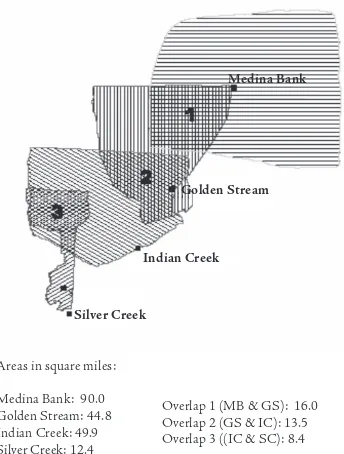
another set of tensions. Researchers working for the MCMMP project geometrically trans-posed the Maya Atlas maps to a single com-prehensive District map, showing a complex array of overlaps that would be extremely difficult to resolve. Although the University of California geographers knew that the re-spective community maps presented indi-vidually in the Maya Atlas likely overlapped one another, the extent to which this was true was never fully appreciated by the communi-ties themselves, who had since taken owner-ship of the maps depicting ‘their’ respective lands. As revealed from research into Indig-enous mapping processes in Nicaragua, the very process of map creation can transform participants’ perceptions of their land claim, strengthening their sense of exclusive owner-ship of the recorded area and undermining prior acceptance of collective use practic-es within the lands depicted (Gordon et al. 2003; Offen 2003). Claiming Indigenous lands on the basis of communities therefore threatened to create conflicts between Mayan villages, a situation which would only benefit their opponents. That being said, the MC-MMP’s holistic experience in remapping one community during its short time in existence, Indian Creek, and mediating discussion of their overlaps with the neighbouring com-munities of Golden Stream and Silver Creek yielded a surprisingly rapid resolution. The
Indian Creek experience therefore suggested that the issue of inter-communal boundaries might not prove as problematic as anticipat-ed. Nevertheless, the premature termination of the MCMMP project meant that it was eventually impossible to determine how im-portant inter-communal boundaries might be in the definition of communal lands.
The threat of potential inter-communal conflicts was not the only obstacle faced. The proliferation of individual lease and prop-erty titles within communal land areas, held by outsiders and Mayans themselves, repre-sented an additional challenge to the formu-lation of a cohesive land claims position. In response to the continuous encroachment of private land tenure into their communal land areas, and as a result of their increasing fa-miliarization with the Belizean land system, Mayans took advantage of the right of every Belizean to apply for individual plots of land as the only opportunity by which to stabilize their respective tenure concerns. Land titles have been secured for household plots and agricultural lands alike, entailing an inevi-table reduction in land available to be demar-cated as communal. Although the Maya were not consciously relinquishing their rights to communal lands by securing land leases and titles, but rather pursuing a necessary surviv-al strategy in the face of furious land priva-tization, this process nevertheless fostered
Source: Maya Leaders’ Co-Management Mapping Project.
Co-management Area “A”. Community Land Use and Overlap Areas
Medina Bank
Golden Stream
Indian Creek
Silver Creek
Areas in square miles:
Medina Bank: 90.0 Golden Stream: 44.8 Indian Creek: 49.9 Silver Creek: 12.4
[image:32.765.87.259.104.331.2]