SIMULATION OF THE INFLUENCE OF A CLEFT ON ACOUSTIC
CHARACTERISTICS OF HUMAN SUPRAGLOTTAL SPACES
PACS : 43.70 Bk
Horáček Jaromír 1, Krampera Pavel 2, Dedouch Karel 2, Vampola Tomáš 2
1 Institute of Thermomechanics, Academy of Science of the Czech Republic, Dolejškova 5, 182 00 Prague 8, Czech Republic,
Tel.:+420 2 6605 3125, Fax:+420 2 8658 4695, E-mail: [email protected] 2 Czech Technical University Prague, Faculty of Mechanical Engineering, Institute of Mechanics, Karlovo nám. 13, 121 35 Prague 2, Czech Republic, Tel.:+420 2 2435 7377, Fax:+420 2 24916709,
E-mail: [email protected]; [email protected]; [email protected]
ABSTRACT
Approximate finite element (FE) models of acoustic spaces corresponding to the human vocal and nasal tracts were created according to the geometrical data published in literature. The FE models for English vowels / a / and / i / were analyzed for increasing size of a cleft, which
joints both acoustic spaces. The influence of the cleft palate on the pronunciation of the vowels / a / and / i / is analyzed by using modal and transient analysis of the FE models. The pulse excitation of the vocal tract is realized by the time dependent displacement of a small circular plate moving at the position of the vocal folds. The time response and frequency response functions are calculated at several points in the supraglottal spaces, near the lips and the vocal folds, and in the nasopharynx. The results of numerical solution are in reasonable agreement with clinical observations of handicapped children.
FINITE ELEMENT MODELS OF SUPRAGLOTTAL SPACES
The contribution is a continuation of previously published papers [1,2] of the authors where the acoustic frequency modal characteristics of the vocal tract of a healthy human were studied by using FE modelling. The simplified FE models of male vocal tract for the English vowels / a /
and / i / were developed according to the MRI data published by Story et al. [3]. Recently, a
simplified FE model of the nasopharynx and the nasal cavity was added to the original FE models, and the influence of the cleft palate connecting both acoustic spaces on the formant frequencies for the the vowel /a / was modelled [4]. Here the study is extended to the time
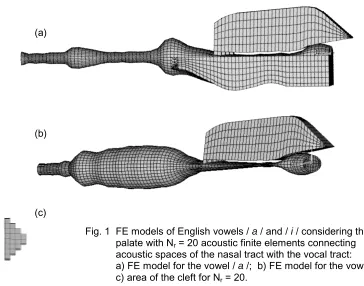
domain analysis and to the analysis of FE models for both vowels, /a/ and / i /. The designed FE models approximating the human supraglottal acoustic spaces are presented in Fig. 1. The total length of the vocal tract from the vocal folds (on the left side) to the lips (on the right) was
174.58 mm.
The acoustic transient and modal analysis were realized by the finite element software system ANSYS 5.7 using the acoustic finite elements FLUID30 considering the speed of sound c0 = 353 ms-1 and the air density ρ 0 = 1.2 kgm-3. Zero acoustic pressure ( p = 0 ) was assumed in the nodes that belong to the areas of lips and nostrils. The other boundary walls of the acoustic spaces were supposed as acoustically hard and no absorption was considered.
folds [3]. The interaction between the plate and the acoustic space was realized by the interactive acoustic FE elements.
Fig. 1 FE models of English vowels / a / and / i / considering the cleft
palate with Nr = 20 acoustic finite elements connecting acoustic spaces of the nasal tract with the vocal tract:
a) FE model for the vowel / a /; b) FE model for the vowel / i /,
c) area of the cleft for Nr = 20.
NUMERICAL SOLUTION AND RESULTS
The main aim of numerical solution was to obtain the transfer functions given generally as
H
sr=
X
s(
ω
)
F
r(
ω
)
,
(1)where Xs(ω) and Fr(ω) aretheFourier images corresponding to a force excitation fr(t) applied in the point r and xs(t) is the time response of the system investigated in the point s. The results of the transient dynamic analysis of the FE models were the time responses of the acoustic pressure in selected points. The first point was on the axis of symmetry of the FE model of supraglottal space near the plain of lips, the second point was situated near the vocal folds and the third in the nasopharynx. Because the results of the ANSYS transient analysis were obtained in the form of extensive data files, an optimal choice of the time step and the computed time interval was very important for successful calculation of the transfer functions concerning the computation time and the computer memory capacity. The FFT images of the exciting acoustic pressure pulses and the pressure time responses were afterwards calculated by MATLAB.
The Fig. 2 presents the excitation pulse of the airflow volume velocity in the time domain as well as the corresponding displacement of the rigid plate and the velocity of the air flowing throw the glottis. The last graph shows the autospectrum of this pulse used for excitation of the FE models. The pulse signal covers a sufficiently wide frequency bandwidth of the excitation relating to the formants F1-F3 of both vowels investigated.
The results of transient analysis of the FE models for English vowels /a / and / i / are presented
in Figs. 3, 4 and 5.
The Fig. 3 shows the results of numerical solution that corresponds to the FE models with separated acoustic spaces of the nasal and vocal tracts, i.e., for the models without the cleft palate (Nr = 0). Calculated acoustic pressures near the lips are presented here in the time and
(a)
(b)
[image:2.595.117.481.114.400.2]frequency domains. The resonant frequencies of the nasopharynx are not embodied in the frequency response functions among the formant frequencies F1-F3, because the nasal tract was completely separated, and thus it was not excited in this case. The level of the acoustic pressure in the time response for the vowel /i/ is approximately two times higher than the pressure response calculated for the vowel /a/.
Fig. 2 Characteristics of the pulse excitation: airflow volume velocity, translation of the rigid plate, air flow velocity in the glottis and the autospectrum of the pulse.
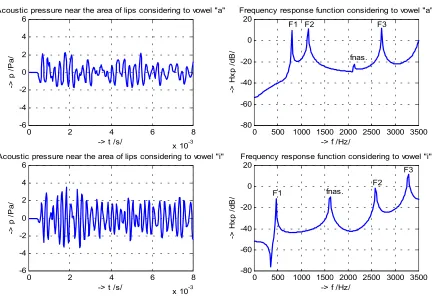
Similarly, the Fig. 4 presents the results of transient analysis of the FE models for the magnitude of the cleft area equal to Nr = 20 elements. The resonant frequencies of the nasal tract fnas are now visible in the frequency response functions between the formant frequencies F2 and F3 for the vowel /a /, and between the formant frequencies F1 and F2 for the vowel /i /,
respectively. Comparing the results in Fig. 4 with the previous results presented in Fig.3 for Nr = 0, it can be concluded, that the influence of the cleft on the pronunciation of the vowel /i/ is much more significant than for the vowel /a/. The reasons for this conclusion are as follows: • for the vowel /a/, the first eigenfrequency fnas of the nasal tract is much higher than the
lowest formant frequencies F1 and F2, and simultaneously the corresponding peak in the frequency response function near the frequency fnas is small,
• on the other hand for the vowel /i/, the resonance peak in the frequency response function near the frequency fnas is considerably more significant than for the vowel /a/, and it is between the lowest formant frequencies F1 and F2. In addition, a deep antiresonance appears in the spectrum near 400 Hz due to the cleft, and the amplitude of the pressure in the time response is nearly two times smaller than the acoustic pressure near the lips for the case Nr = 0. It is probably caused by a higher relative leakage of the acoustic energy trough the cleft and afterwards through the nostrils out of the vocal tract.
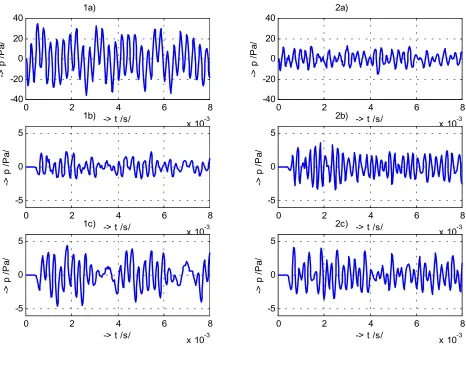
The time responses of the acoustic pressure calculated in three different nodes of the FE models with the cleft for the vowels /a/ and /i/ are shown in Fig. 5; for the nodes: a) near the
vocal folds, b) near the lips and c) in the space of nasopharynx. The pressure levels near the vocal folds are much higher than the acoustic pressur near the lips; more than ten times higher
0 0.5 1 1.5 2
x 10-4 -20
0 20 40 60 80
100
-> t /s/
->
U
g
/m
ls
-1/
Acoustic volume velocity
0 0.5 1 1.5 2
x 10-4 -5
0 5
10
15 20
-> t /s/
->
v
/m
s
-1/
Velocity trough area of vocal fold
0 0.5 1 1.5 2
x 10-4 0
0.5
1 1.5 2 2.5x 10
-3
-> t /s/
->
s
/m
/
Displacement of hard plate
0 500 1000 1500 2000 2500 3000 3500 -20
-10 0
10 20
-> f /Hz/
->
S
xx
/d
B
/
for the vowel /a/ - see the responses 1 in Fig. 5 on the left side, and more than four times higher for the vowel /i/ - see the responses 2 in Fig. 5 on the right side.
Fig. 3 Time and frequency response functions for the acoustic pressure near the lips calculated for the FE models of vowels / a / and / i / without any cleft (Nr = 0).
Fig. 4 Time and frequency response functions for the acoustic pressure near the lips calculated for the FE models of vowels / a / and / i / with the cleft palate for Nr = 20 elements connecting nasal tract with the vocal tract.
0 2 4 6 8
x 10-3 -6 -4 -2 0 2 4 6
-> t /s/
->
p
/P
a/
Acoustic pressure near the area of lips considering to vowel "a"
0 500 1000 1500 2000 2500 3000 3500 -60 -40 -20 0 20 40
-> f /Hz/
-> H x p /d B/
Frequency response function considering to vowel "a"
0 2 4 6 8
x 10-3 -6 -4 -2 0 2 4 6
-> t /s/
->
p
/P
a/
Acoustic pressure near the area of lips considering to vowel "i"
0 500 1000 1500 2000 2500 3000 3500 -60 -40 -20 0 20 40
-> f /Hz/
-> H x p /d B/
Frequency response function considering to vowel "i"
F1 F2 F3
F1
F2 F3
0 2 4 6 8
x 10-3 -6 -4 -2 0 2 4 6
-> t /s/
->
p /
P
a/
Acoustic pressure near the area of lips considering to vowel "a"
0 500 1000 1500 2000 2500 3000 3500
-80 -60 -40 -20 0 20
-> f /Hz/
-> H x p /d B /
Frequency response function considering to vowel "a"
0 2 4 6 8
x 10-3 -6 -4 -2 0 2 4 6
-> t /s/
->
p /
P
a/
Acoustic pressure near the area of lips considering to vowel "i"
0 500 1000 1500 2000 2500 3000 3500
-80 -60 -40 -20 0 20
-> f /Hz/
-> H x p /d B /
Frequency response function considering to vowel "i" F1 F2
fnas. F3
F1 fnas.
[image:4.595.80.512.418.717.2]Fig. 5 Time responses of the acoustic pressure for the FE models with the cleft palate (Nr = 20) for the vowel /a / - see the variants 1 shown on the left,
and for the vowel / i / - see the variants 2 shown on the right,
calculated in three different nodes for the acoustic pressure:
a) near the vocal folds; b) near the lips; c) in the space of nasopharynx.
The frequencies F1, F2, F3 and fnas resulting from the transient analysis are compared in Tab. 1 with the eigenfrequencies computed by using the acoustic modal analysis. The results of both types of analysis, used for all FE models of the vowels / a / and / i / , either with or without the
cleft, are in reasonable agreement.
resonant and eigenfrequencies [ Hz ]
F1 F2 F3 fnas
vowel numberof elements
in cleft TRAN MOD TRAN MOD TRAN MOD TRAN MOD
Nr = 0 760 759 1152 1158 2 670 2708 - 1060
/ a /
Nr = 20 800 796 1145 1133 2 714 2736 2 121 2065
Nr = 0 282 283 2 195 2216 2 968 3020 - 1282
/ i /
Nr = 20 467 471 2 585 2621 3 276 3348 1 612 1621
Tab. 1 Resonant frequencies evaluated from the transient analysis (TRAN) and the eigenfrequencies calculated by the modal analysis (MOD) of the FE models
for the English vowels / a / and / i / , without (Nr = 0) and with (Nr = 20) the cleft palate.
0 2 4 6 8
x 10-3
-40 -20 0 20 40
-> t /s/
->
p /
P
a/
1a)
0 2 4 6 8
x 10-3
-5 0 5
-> t /s/
->
p /
P
a/
1b)
0 2 4 6 8
x 10-3
-5 0 5
-> t /s/
->
p /
P
a/
1c)
0 2 4 6 8
x 10-3
-40 -20 0 20 40
-> t /s/
->
p /
P
a/
2a)
0 2 4 6 8
x 10-3
-5 0 5
-> t /s/
->
p /
P
a/
2b)
0 2 4 6 8
x 10-3
-5 0 5
-> t /s/
->
p /
P
a/
CONCLUSIONS
Investigation of the acoustic transfer functions corresponding to simplified FE models of English vowels / a / and / i / considering the cleft palate is presented in the paper. The computed data
files, essential for further analysis of the transfer functions, were obtained as the results of the transient analysis of the FE models by finite element system ANSYS 5.7. The FE models were excited by a transient translation motion of a small rigid plate situated in the area of the vocal folds and driven by a time signal that corresponds to a volume velocity of the air flowing through the vocal folds during phonation.
The main conclusions resulting from the numerical simulations are as follows:
• the frequency bandwidth, which corresponds to the pressure pulse excitation used, was sufficient for excitation of the first three formants considering the frequency range of a normal human voice for both modeled vowels,
• the formant frequencies F1 and F2 evaluated from the resonances of the calculated frequency response functions for the pressure are in good agreement with the experimental data known for the formants from the literature [8,9] as well as with the results of the modal analysis performed,
• the influence of the cleft on the pronunciation of the vowel / a / was found to be much smaller than the influence of the cleft palate on the sound produced during pronunciation of the vowel / i / .
The last and probably the most important conclusion resulting from the FE modeling presented here is in good agreement with the data published in literature dealing with the velopharyngeal insufficiency [5] as well as with the clinical observations of handicapped children with the cleft palate.
REFERENCES
[1] Dedouch, K., Horáček, J., Švec, J. G.: Frequency modal analysis of supraglottal tract. In: Structural Dynamics: Recent Advances. Proc. of the 7th International Conference, (Eds. Ferguson N. S. et al.), University Southampton, U.K., 2000, pp. 863 – 874.
[2] Dedouch K., Horáček J., Vampola T, Kršek P., Švec JG.: Mathematical modelling of male vocal tract. In: Proc. of the 2nd International Workshop on Models and Analysis of Vocal Emissions for Biomedical Applications, Sept. 13-15, 2001, Firenze, Italy, 6 p. (CD-ROM, Univ. of Firenze, Depts. of Electr. and Physics).
[3] Story, B. H., Titze, I.R. and Hoffman, E. A.: Vocal tract area functions from magnetic resonance imaging. J. Acoust. Soc. Am., 100 (1), 537 – 554, 1996.
[4] Dedouch K., Horáček J., Vampola T., Vohradník M.: Finite element models
of supraglottal tract. In: 5th Int. Conf. Advances in Quantitative Laryngoscopy, Voice and Speech Research, Groningen, the Netherlands, April 27-28, 2001 (CD-ROM, comp. by H. K. Schutte, Dept. of BioMedical Eng., University of Groningen), 7 p.
[5] Vohradník, M.: Speech Communication Disorders Originated in Velopharyngeal
Insufficiency. Scriptorium, Dolni Brezany, Czech Republic, 2001, [ISBN 80-86197-24-7], (in Czech).
[6] Randall, R.B.: Frequency Analysis, Bruel & Kjaer, Glostrup, 1987.
[7] Skudrzyk, E.: The Foundations of Acoustics, Springer – Verlag, Wien, New York, 1979. [8] Titze, I., R.: Principles of Voice Production. Prentice – Hall, London, 1994.
[9] Palková, Z.: Phonetics and Phonology of the Czech Language. Charles University, Karolinum, Prague, 1994 (in Czech).