
Determinants of the educational use of digital learning materials: The mediating role of self efficacy, perceived norm and attitude
14
0
0
Texto completo
(2) attitude. ICT proficiency was in its turn the strongest predictor of self-efficacy. Perceived norm played only a limited role in the intention to use DLMs. Concluding, it seems paramount for the success of projects such as Wikiwijs to train teachers in the use of digital learning materials and ICT (e.g. the digital blackboard) and to impact on their attitude. Keywords digital learning materials, attitude, self-efficacy, Integrative Model of Behavior Prediction, determinants of ICT use, perceived norm. Recommended citation:. Van Acker, F.; Van Buuren, H.; Kreijns, K. et al. (2010). Determinants of the educational use of digital learning materials: The mediating role of self-efficacy, perceived norm and attitude. In Open ED 2010 Proceedings. Barcelona: UOC, OU, BYU. [Accessed: dd/mm/yy].< http://hdl.handle.net/10609/5242>. Determinants of the educational use of digital learning materials: The mediating role of self-efficacy, perceived norm and attitude, Frederik Van Acker, Hans van Buuren, Karel Kreijns et al.. Proceedings | Barcelona Open Ed 2010 | http://openedconference.org/2010/ Universitat Oberta de Catalunya | Open Universiteit Nederland | Brigham Young University. 2.
(3) Introduction 1. Why are teachers reluctant to integrate digital learning materials into their classroom practices? Since over two decades ago, ICT was introduced into classroom practice it has gained much attention and ever growing confidence in its effectiveness. ICT is believed to be more than the core of the Information Society. It is supposed to be paramount to the education of knowledge workers (Pelgrum, 2001). Although benefits of ICT use in education have been acknowledged (e.g. Hayes, 2005; Vichitvejpaisal et al., 2001; Higgins, 2003; Meijer, van Eck, & Felix, 2008) teachers do not seem to integrate it into their teaching activities (Cuban, 2001; Varank, & Tozoğlu, 2006; Yang, & Huang, 2008) and, thus, the use of digital learning materials (DLMs). Failure to motivate teachers to use DLMs could make the development of such materials seem less rewarding or attractive. The lack of newly developed materials could in its turn lead to an increased underuse of DLMs, hereby completing a vicious circle. In the Netherlands, the Wikiwijs initiative aims at disclosing open DLMs for use in all strata of education. The effectiveness of this initiative depends largely on the actual use of DLMs in education. Therefore, in the current research paper, important determinants of using ICT in education and the lack of ICT in classroom practice will be further investigated in the context of teacher’s usage of DLMs. More precisely, we will test several hypotheses concerning DLM use basing on the Integrative Model of Behavior Prediction (IMBP: Fishbein, 2000; Fishbein & Yzer, 2004; Yzer, Capella, Fishbein, & Hornik, 2004).. 2. Developing a theoretical model of DLMs usage based on the IMBP The IMBP constitutes the theoretical framework on which the current study is based. This model integrates the “theory of planned behaviour” (Ajzen, 1991), the “social cognitive theory” (Bandura, 1986), and the “health believe model” (Janz & Becker, 1984) and contains a number of critical factors which determine educational ICT use. A discussion of the IMBP will be followed by a brief review of literature in support of the application of this model in the domain of the advancement of the integration of ICT in teachers’ pedagogical practices . In the IMBP, dispositional variables are key determinants with respect to a specific behaviour, here teacher’s usage of DLMs in education. Although the model takes into account organizational variables, the main focus of the IMBP is on individual level characteristics. Attitude, self-efficacy and perceived norm are the most important dispositional variables in the IMBP. When combined, these factors are conjectured to influence behavioural intention which, in turn, is related to the actual behaviour. According to the model, the intention-behavior relationship may be moderated by. Determinants of the educational use of digital learning materials: The mediating role of self-efficacy, perceived norm and attitude, Frederik Van Acker, Hans van Buuren, Karel Kreijns et al.. Proceedings | Barcelona Open Ed 2010 | http://openedconference.org/2010/ Universitat Oberta de Catalunya | Open Universiteit Nederland | Brigham Young University. 3.
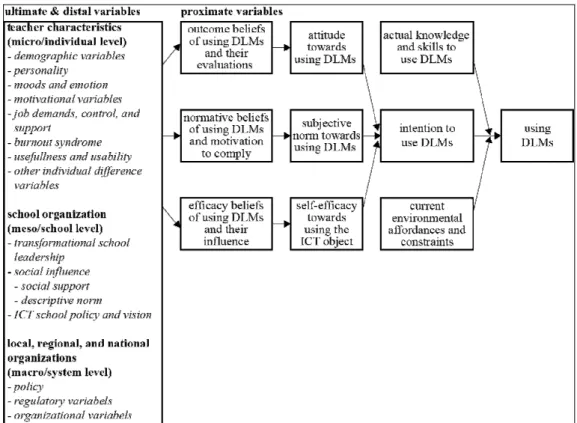
(4) environmental variables (such as the non-availability of DLMs or the proper ICT infrastructure) and by teacher’s actual ICT knowledge and skills. Furthermore, IMBP considers the positive and negative outcome beliefs teachers have should they use DLMs (e.g., DLMs give more variations during class and DLMs require more class preparation) to be antecedent variables of attitude. The antecedent variables of subjective norm concern teachers’ normative beliefs that important people (e.g. colleagues and parents) may think that they should use DLMs. Finally, self-efficacy antecedent variables concern the convictions (i.e. the efficacy beliefs) teachers have that they can use DLMs and that they can overcome the impediments to use DLMs. Figure 1 displays an adaptation of the IMBP for the current domain (i.e. the advancement of the integration of ICT in teachers’ pedagogical practices). This figure also shows that the variables are grouped into proximal, distal and ultimate variables. Proximal variables include all the dispositional variables and, therefore, the terms dispositional and proximal are interchangeable. The distal variables encompass all the variables at the level of teachers’ characteristics and school organization, and the ultimate variables the determinants at the level of local, regional, and governmental organization.. 3. Empirical studies in support of the application of IMBP in the current domain A comprehensive review of the literature by Mumtaz (2000) resulted in a number of contextual as well as some dispositional variables influencing teacher’s use of ICT. Contextual variables include the environmental variables (in IMBP moderating the relationship between behavior intention and actual behavior), the distal, and ultimate variables (in IMBP, the effects of these variables are mediated by the dispositional variables), but exclude the individual level characteristics. The most influential contextual variables according to the Mumtaz study were access to resources, quality of the ICT infrastructure, perceived ease of use, incentives to change, support and collegiality in the school and school and national polices. Individual level characteristics found to be of importance were commitment to professional learning and background in formal computer training. Contextual environmental variables will not be discussed in this paper as we consider in the current study only the direct and mediating effects of the determinants of behaviour intention. The effects of all other variables on the other hand will be empirically tested. A more recent study by Tondeur, Valcke and van Braak (2008) attempting to integrate both school and teacher level characteristics in an explanatory model of ICT use, found that gender and previous computer use were significant predictors of the adoption of ICT for pedagogical use. Contextual school level characteristics and contextual environmental variables found to be of importance were similar to the previously cited study (Mumtaz, 2000) and included availability of ICT (hardware and an Internet connection in the classroom), schools’ openness to change, presence of a school ICT policy and availability of ICT support. In a recent review of antecedents of laptop use among educators (Moses, Khambari, & Luan, 2008), it was found that gender, lack of time, technology competence as well as administrator and ICT support are important predictors of actual ICT usage. Moreover, this study also acknowledges the impact of attitude. Other authors (Cuban, 2001; Teo, Lee, & Chai, 2007; Kersaint, Horton,. Determinants of the educational use of digital learning materials: The mediating role of self-efficacy, perceived norm and attitude, Frederik Van Acker, Hans van Buuren, Karel Kreijns et al.. Proceedings | Barcelona Open Ed 2010 | http://openedconference.org/2010/ Universitat Oberta de Catalunya | Open Universiteit Nederland | Brigham Young University. 4.
(5) Stohl, & Garofalo, 2003; van Braak, 2001) assert that notwithstanding the potential of ICT, effective implementation of technology is highly dependent on positive attitudes. Attitude is considered to be a key variable in IMBP and will, therefore, take a central role in the current paper. Several studies thus confirm the roles of distal (e.g. support in school, background and training) and environmental variables (e.g. access to and quality of infrastructure) , hereby providing support for the applicability of the model to the context of educational ICT use. The cited studies clearly show the importance of several contextual factors, but largely ignore the main dispositional variables of interest in this study.. 4. The current study The aim of the current research is to disentangle the interrelationships between attitude, selfefficacy and perceived norms and to discover which other variables affect their relationship with behaviour. If teachers have explicit knowledge about the advantages ICT offer in educational practice, why does their behaviour point in the other direction? Which variables (contextual or dispositional) inhibit the use of computer related technology in education? According to IMBP it is conjectured that self-efficacy, attitude and perceived norm will directly impact on the intention to use DLMs. Next, we hypothesize that these dispositional variables will indeed mediate the effect of several other distal factors. This results in three additional hypotheses: (1) ICT proficiency and entrepreneurship (cfr. commitment to professional learning; Mumtaz, 2000) will be positively related with the intention to use learning materials, mediated by selfefficacy, (2) (negative) outcome expectations and computer anxiety will be negatively related with intention, mediated by attitude and (3) received support will be positively related with intention, mediated by perceived norm.. Method A questionnaire was administered electronically in December 2009 to teachers of primary and secondary schools. The latter encompass pre-vocational secondary education (four years), senior general secondary education (five years), and pre-university education (six years). A total of 1484 teachers completed the questionnaire entirely. Table 1 contains the most important sociodemographic information about the sample. Apart from the demographical variables, the questionnaire included the measures for the proximal and distal variables of interest. The measures were either adapted from existing measures or newly constructed. Cronbach’s alpha was calculated for each scale as a measure of internal consistency.. Determinants of the educational use of digital learning materials: The mediating role of self-efficacy, perceived norm and attitude, Frederik Van Acker, Hans van Buuren, Karel Kreijns et al.. Proceedings | Barcelona Open Ed 2010 | http://openedconference.org/2010/ Universitat Oberta de Catalunya | Open Universiteit Nederland | Brigham Young University. 5.
(6) Attitude towards the use of DLMs Attitude was measured using a 12-item bipolar scale. Respondents rated several aspects of DLM usage on a 7-point rating scale with end anchors such as boring versus fun or useful versus useless (α = .97). Self-efficacy The self-efficacy scale consisted of three items such as “I am convinced I can effectively make use of digital learning materials in my courses”. Questions were answered on a seven point rating scale with end anchors being “fully agree” and “fully disagree” (α = .91). Perceived norm Perceived norm was measured using three items gauging to what extent teacher thought that colleagues in the own section, other sections and other schools were making use of DLMs. Answers ranged from “not at all” to “very frequently” on a seven-point scale (α = .80). Intention to use DLMs Seven items were used to measure the intention to use DLMs. All items were answered on a sevenpoint rating scale with end anchors being “extremely likely” and “extremely unlikely”. An example of an item was: “I have the intention to use digital learning materials frequently in my courses” (α = .97). Distal variables A single item measured ICT proficiency. Respondents could answer how well they could use ICT in their pedagogical practices on a scale ranging from beginner to guru. The entrepreneurship scale (α = .90) consisted of 10 items measuring the extent to which teachers were taking initiative to school themselves in the domain of ICT and DLMs. Outcome expectations (α = .86) and anxiety (α = .96) were measured with 7 and 5 items respectively such as “Regularly using digital learning materials will increase my workload” and “The use of digital learning materials in my courses makes me anxious”. Finally, to measure perceived support, respondents were asked to indicate whether they received support from other teachers, could take courses, take part in support teams or none of the above (α = .55). Scores ranged from 0 to 3. For each scale, items were reverse scored if applicable and the average scale score was computed. Due to the use of prompts in the Web-based survey, the data set had no missing values.. Analysis The first hypothesis regarding the importance of the proximal variables, was tested using multiple linear regression analysis. Structural equation modelling (with the AMOS 8.0 software) was used to test hypotheses 2 to 4 and to assess model fit. Model fit was evaluated using (1) the χ² statistic, which becomes lower as model fit improves; (2) the comparative fit index (CFI), for which values between .90 and .94 indicate good fit, whereas values of .95 and higher indicate very good fit; (3) the Tucker Lewis index (TLI), for which values of above .95 indicate good model fit and (4) the. Determinants of the educational use of digital learning materials: The mediating role of self-efficacy, perceived norm and attitude, Frederik Van Acker, Hans van Buuren, Karel Kreijns et al.. Proceedings | Barcelona Open Ed 2010 | http://openedconference.org/2010/ Universitat Oberta de Catalunya | Open Universiteit Nederland | Brigham Young University. 6.
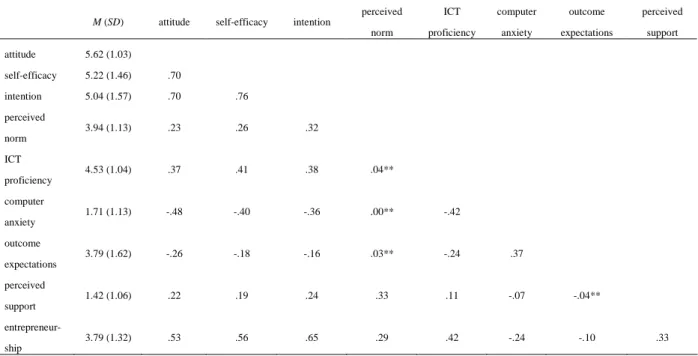
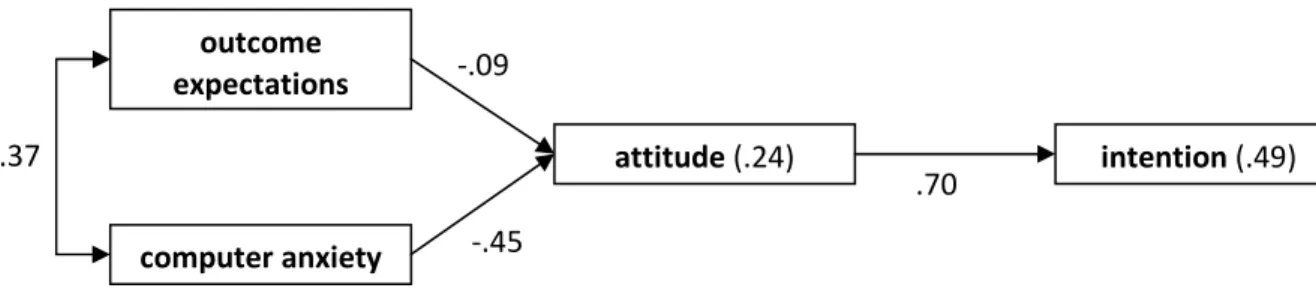
(7) root mean square error of approximation (RMSEA), for which values of .06-.08 indicate a good fit and values of .05 and less indicate a very close fit (Hu & Bentler, 1999).. Results Correlations between the variables in the different models can be observed in Table 2. The same table also includes the mean score and standard deviations for each variable. Hypothesis 1: the influence of attitude, self-efficacy and perceived norm A regression analysis was performed using intention to use DLMs as the dependent variable. Results can be found in Table 3. All predictors have a significant effect on the intention to use DLMs. The standardized regression coefficients show that, when controlling for attitude and perceived norm, self-efficacy is the strongest predictor. Hypothesis 2: Self-efficacy mediates the influence of entrepreneurship and ICT proficiency SEM was used to assess the adequacy of a fully mediated model. Model fit was poor and modification indices suggested to add a direct path between entrepreneurship and intention. The resulting model and its estimated parameters can be found in Figure 2. The resulting model showed very good fit (χ²(1, N = 1484) = .20, p = .64, CFI = 1.00, TLI = 1.00 and RMSEA = .00). Hypothesis 3: Attitude mediates the relationship between outcome expectations and computer anxiety Here as well, SEM was used to assess the adequacy of a fully mediated model. The model showed very good fit (χ²(2, N = 1484) = 4.59, p = .10, CFI = .99, TLI = .99 and RMSEA = .03). Figure 3 contains the conjectured paths as well as the estimated coefficients. Hypothesis 4: Perceived norm mediates the effect of perceived support The SEM analysis indicated that the fully mediated model showed poor fit and therefore the saturated model was adopted. Figure 4 shows the resulting model and the associated path coefficients.. Discussion Analyses revealed the importance of the three proximal variables under study. Together, these variables explained 65 percent of variance in intention to use DLMs. Self-efficacy was found to be the strongest predictor, closely followed by attitude. Compared to those two variables, perceived norm played only a limited role in predicting teachers’ intention to use DLMs. Attitude, which was the second most important predictor of DLM use, seems to impact more on intention than selfefficacy, when basing on the direct paths between (see Figures 2 and 3 respectively). The strong. Determinants of the educational use of digital learning materials: The mediating role of self-efficacy, perceived norm and attitude, Frederik Van Acker, Hans van Buuren, Karel Kreijns et al.. Proceedings | Barcelona Open Ed 2010 | http://openedconference.org/2010/ Universitat Oberta de Catalunya | Open Universiteit Nederland | Brigham Young University. 7.
(8) relationship between attitude and self-efficacy (see Table 2) tempers this effect however. When considering the unique impact of both variables in the multiple regression, self-efficacy remains the important predictor. Entrepreneurship was strongly related to self-efficacy. Teachers who take training initiatives and who actively seek support from peers or experts experience higher levels of self-efficacy. The conjectured mediation of self-efficacy on the relationship between entrepreneurship and intention was only partially confirmed. There was a moderate direct effect of entrepreneurship as well. The effect of ICT proficiency, which comes down to more general ICT skills, on the other hand was fully mediated by self-efficacy. Moreover this effect was clearly less pronounced than the impact of entrepreneurship. Negative outcome expectations as well as computer anxiety were negatively related to intention to use DLMs. As expected, these relationships were fully mediated by attitude. Although levels of computer anxiety were reasonably low, computer anxiety still plays an important role in the extent to which teachers use DLMs. In the final model, the impact of perceived support and perceived norm was tested and a partial mediation effect was found. Although the relationship between perceived norm and intention was fairly weak, a direct effect as well as an indirect effect of perceived support were found. It must be noted that when controlling for both other proximal variables, the explanatory power of perceived norm is even smaller. The influence of perceived norm could be underestimated due to the consistently low scores. Anecdotically, in several interviews concerning the Wikiwijs project, teachers indicated that they experienced little to no pressure to use ICT or DLMs. Most of them explained this by the lack of a clear policy concerning DLM use on school and governmental level. If government and school management would communicate a clear strategy concerning the use of open educational resources in education, the effect of perceived norm could possibly be discerned more prominently.. Conclusion The Integrative Model of Behaviour Prediction was found to be a useful paradigm to research teachers’ intentions to use DLMs. Although some predictions made by the model do not fully comply with the empirically found relationships, the alterations (i.e. addition of direct paths) can be justified. Future research should focus on self-efficacy and attitude as determinants of DLM use and policy makers should mainly develop strategies to impact on those variables by providing sufficient training and support for teachers in using DLM’s and ICT in general. The importance of entrepreneurship should be further studied in combination with new distal variables. The IMBP can provide directions for this future research.. Determinants of the educational use of digital learning materials: The mediating role of self-efficacy, perceived norm and attitude, Frederik Van Acker, Hans van Buuren, Karel Kreijns et al.. Proceedings | Barcelona Open Ed 2010 | http://openedconference.org/2010/ Universitat Oberta de Catalunya | Open Universiteit Nederland | Brigham Young University. 8.
(9) Figures and tables primary education (N = 742) M = 41.59; SD = 12.01 men: N = 140; women: N = 602. age gender. secondary education (N = 742) M = 44.31; SD = 12.37 men: N = 410; women: N = 332. Table 1 - Socio-demographic information about the sample. M (SD). attitude. attitude. self-efficacy. perceived. ICT. computer. outcome. perceived. norm. proficiency. anxiety. expectations. support. intention. 5.62 (1.03). self-efficacy. 5.22 (1.46). .70. intention. 5.04 (1.57). .70. .76. 3.94 (1.13). .23. .26. .32. 4.53 (1.04). .37. .41. .38. .04**. 1.71 (1.13). -.48. -.40. -.36. .00**. -.42. 3.79 (1.62). -.26. -.18. -.16. .03**. -.24. .37. 1.42 (1.06). .22. .19. .24. .33. .11. -.07. -.04**. 3.79 (1.32). .53. .56. .65. .29. .42. -.24. -.10. perceived norm ICT proficiency computer anxiety outcome expectations perceived support entrepreneurship. Table 2 - Correlations between the measured variables; the second column contains the descriptives for each measure Note: All correlations are significant at the .001 level, except those marked by **. All scores ranged from 1 to 7, except for perceived support where the maximum score was 4.. Variable Attitude Self-efficacy Perceived norm. B .49 .55 .16. SE B .04 .03 .02. ß .32 .51 .12. p < . 001 < . 001 < . 001. Table 3 - Regression results for the three proximal variables predicting intention to use DLMs (N = 1484) Note. R2 = .65 (F(3, 1480) = 818.52, p < .001).. Determinants of the educational use of digital learning materials: The mediating role of self-efficacy, perceived norm and attitude, Frederik Van Acker, Hans van Buuren, Karel Kreijns et al.. Proceedings | Barcelona Open Ed 2010 | http://openedconference.org/2010/ Universitat Oberta de Catalunya | Open Universiteit Nederland | Brigham Young University. 9. .33.
(10) Figure 1- IMBP adapted to the domain of the advancement of the integration of ICT in teachers’ pedagogical practices. entrepreneurship. .33. .47 .42. self-efficacy (.35). intention (.65) .58. .21 ICT proficiency Figure 2 - Path analysis testing the mediating role of self-efficacy in the relationship between entrepreneurship, ICT proficiency and intention (all p’s < .001). Values between brackets indicate the explained variance (R2).. Determinants of the educational use of digital learning materials: The mediating role of self-efficacy, perceived norm and attitude, Frederik Van Acker, Hans van Buuren, Karel Kreijns et al.. Proceedings | Barcelona Open Ed 2010 | http://openedconference.org/2010/ Universitat Oberta de Catalunya | Open Universiteit Nederland | Brigham Young University. 10.
(11) outcome expectations. -.09. .37. attitude (.24) computer anxiety. intention (.49). .70. -.45. Figure 3 - Path analysis testing the mediating role of attitude in the relationship between outcome expectations, computer anxiety and intention (all p’s < .001). Values between brackets indicate the explained variance (R2).. .15. perceived support. intention (.12). .33. perceived norm (.11). .27. Figure 4 - Path analysis testing the mediating role of perceived norm in the relationship between perceived support and intention (all p’s < .001). Values between brackets indicate the explained variance (R2).. Determinants of the educational use of digital learning materials: The mediating role of self-efficacy, perceived norm and attitude, Frederik Van Acker, Hans van Buuren, Karel Kreijns et al.. Proceedings | Barcelona Open Ed 2010 | http://openedconference.org/2010/ Universitat Oberta de Catalunya | Open Universiteit Nederland | Brigham Young University. 11.
(12) Bibliographic references Ajzen, I. (1991). The theory of planned behavior. Organizational Behavior and Human Decision Processes, 50, 179–211. Bandura, A. (1986). Social foundations of thought and action: A social cognitive theory. Englewood Cliffs, NJ: Prentice Hall. Cuban, L. (2001). Oversold and underused: Computers in the classroom. Cambridge, MA; London: Harvard University Press. Fishbein, M. (2000). The role of theory in HIV prevention. AIDS Care, 12, 273–278. Fishbein, M. & Yzer, M.C. (2003). Using theory to design effective health behavior interventions. Communication Theory, 13, 164–183. Hayes, D. N. A. (2005). ICT and Learning: Lessons from Australian Classrooms. Computers & Education, 49, 385-395. Higgins, S. (2003). Does ICT improve learning and teaching in schools? A professional user review of the UK research undertaken for the British educational research association. Southwell: British Educational Research Association. Hu, L., & Bentler, P.M. (1999). Cutoff criteria for fit indexes in covariance structure analysis: Conventional criteria versus new alternatives. Structural Equation Modeling, 6, 1–55. Janz, N. K., & Becker, M. H. (1984). The health believe model: A decade later. Health Education Quarterly, 5, 34–41. Kersaint, G., Horton, B., Stohl, H., & Garofalo, J. (2003). Technology beliefs and practices of mathematics education faculty. Journal of Technology and Teacher Education, 11, 549–577. Meyer, J., van Eck, E., & Felix, C. (2008). Leren met meer effect: Rapportage van het onderzoek. Amsterdam: SCO Kohnstamm Instituut. Moses, P., Khambari, M. N. M., & Luan, W. S. (2008). Laptop use and its antecedents among educators: a review of the literature. European Journal of Social Sciences, 7, 104-114. Mumtaz, S. (2000). Factors Affecting Teacher’s Use of Information and Communications Technology: a Review of the Literature. Journal of Information Technology for Teacher Education, 9, 319-342. Pelgrum, W. J. (2001). Obstacles to the Integration of ICT in Education: Results from a Worldwide Educational Assessment. Computers & Education, 37, 163-178. Teo, T., Lee, C. B., & Chai, C. S. (2007). Understanding pre-service teachers’ computer attitudes: Applying and extending the Technology Acceptance Model. Journal of Computer Assisted Learning, 24, 128-143. Tondeur, J., Valcke, M., & van Braak, J. (2008). A multidimensional approach to determinants of computer use in primary education: teacher and school characteristics. Journal of Computer Assisted Learning, 24, 494-506. Van Braak, J. (2001). Factors influencing the use of computer mediated communication by teachers in secondary schools. Computers & Education, 36, 41-57. Varank, I. & Tozoğlu, D. (2006). Why are teachers resistant to change? Key issues and challenges in technology integration. Afyon Kocetepe Universitesi Sosyal Bilimler Dergisi, 8, 193-207. Vichitvejpaisal, P., Sitthikongsak, S., Preechakoon, B., Kraiprasit, K., Parakkamodom, S., Manon, C., & Petcharatana, S. (2001). Does Computer-Assisted Instruction Really Help to Improve the Learning Process? Medical Education, 35, 983-989.. Determinants of the educational use of digital learning materials: The mediating role of self-efficacy, perceived norm and attitude, Frederik Van Acker, Hans van Buuren, Karel Kreijns et al.. Proceedings | Barcelona Open Ed 2010 | http://openedconference.org/2010/ Universitat Oberta de Catalunya | Open Universiteit Nederland | Brigham Young University. 12.
(13) Yang, S. C. & Huang, Y.-F. (2008). A study of high school English teachers’ behavior, concerns and beliefs in integrating information technology into English instruction. Computers in Human Behavior, 24, 1085–1103. Yzer, M. C., Capella, J. N., Fishbein, M., & Hornik, R. (2004). The Role of Distal Variables in Behavior Change: Effects of Adolescent’s Risk for Marijuana Use on Intention to Use Marijuana. Journal of Applied Social Psychology, 34, 1229-1250.. About the authors Frederik Van Acker Assistant Professor, Open Universiteit Nederland. Frederik Van Acker has an MSc and PhD in psychology from the Vrije Universiteit Brussel and is currently employed as an Assistant Professor at the Open University of the Netherlands. His main research interests are statistics and methodology and the use of ICT in education. Frederik is one of the main investigators in Wikiwijs, a project funded by the Dutch government with the objective to construct a Web-based platform to share and create Open Educational Resources for all levels of education. Open Universiteit Nederland Valkenburgerweg 177 6419AT Heerlen The Netherlands [email protected]. Hans van Buuren Associate Professor, Open Universiteit Nederland. Hans van Buuren is head of the Research Methods and Statistics department of the School of Psychology of the Dutch Open University. He designed, developed, implemented and evaluated in an electronic learning environment the so-called Research Competence Curriculum in which research methods and statistics have been integrated in a series of cumulative and concentrically designed practicals in the field of psychology. At this moment he is program manager of the Wikiwijs Project for studying the effects of Wikiwijs on making, developing and sharing open digital learning materials by teachers for all levels of education.. Open Universiteit Nederland Valkenburgerweg 177 6419AT Heerlen The Netherlands [email protected]. Determinants of the educational use of digital learning materials: The mediating role of self-efficacy, perceived norm and attitude, Frederik Van Acker, Hans van Buuren, Karel Kreijns et al.. Proceedings | Barcelona Open Ed 2010 | http://openedconference.org/2010/ Universitat Oberta de Catalunya | Open Universiteit Nederland | Brigham Young University. 13.
(14) Karel Kreijns Associate Professor, Open Universiteit Nederland. Karel Kreijns has an MSc in electrical engineering and a PhD in educational technology. He is currently an associate professor at the Ruud de Moor Center for the Professionalization of Teachers which is at the Open University of the Netherlands. He is also lector at Fontys University for Applied Sciences. His research interest are ecological psychology in relation to the construction of CSCL environments, social psychology of distributed learning groups using CMC, and the application of motivational and social cognitive theories regarding the use of ICT in pedagogical practices. Open Universiteit Nederland Valkenburgerweg 177 6419AT Heerlen The Netherlands [email protected]. Marjan Vermeulen Associate Professor, Open Universiteit Nederland. Marjan Vermeulen has an MSc and a PhD in education. She is currently working as an associate professor at the Ruud de Moor Center for the Professionalization of Teachers. She has expertise in the field of policy regarding the teaching profession and is closely involved in the Wikiwijs research. Open Universiteit Nederland Valkenburgerweg 177 6419AT Heerlen The Netherlands [email protected]. This proceeding, unless otherwise indicated, is subject to a Creative Commons Attribution-Non commercial-No derivative works 3.0 Spain licence. It may be copied, distributed and broadcast provided that the author, and the institutions that publish it (UOC, OU, BYU) are cited. Commercial use and derivative works are not permitted. The full licence can be consulted on http://creativecommons.org/licenses/by-nc-nd/3.0/en/deed.en.. Determinants of the educational use of digital learning materials: The mediating role of self-efficacy, perceived norm and attitude, Frederik Van Acker, Hans van Buuren, Karel Kreijns et al.. Proceedings | Barcelona Open Ed 2010 | http://openedconference.org/2010/ Universitat Oberta de Catalunya | Open Universiteit Nederland | Brigham Young University. 14.
(15)
Figure
Documento similar
In the preparation of this report, the Venice Commission has relied on the comments of its rapporteurs; its recently adopted Report on Respect for Democracy, Human Rights and the Rule
As generalization depends precisely on the degree of conditioning of this common element, this mechanism can elegantly explain perceptual learning within standard
SECTION 3 - The role of RINGO proteins in the brain 123 RingoA mRNA is expressed in neural stem cells and proliferating progenitor cells 123 Analysis of neural stem cells
In the previous sections we have shown how astronomical alignments and solar hierophanies – with a common interest in the solstices − were substantiated in the
Díaz Soto has raised the point about banning religious garb in the ―public space.‖ He states, ―for example, in most Spanish public Universities, there is a Catholic chapel
In terms of moderation, gender affects three relationships: (1) ease of use –› perceived usefulness; (2) perceived usefulness –› attitude, and (3) intention –› actual
The broad “WHO-ICF” perspective on HrWB provided at Figure 1 has a significant implication also for HRQoL. The develop- ment of ICF and its conceptual approach has challenged to
Even though the 1920s offered new employment opportunities in industries previously closed to women, often the women who took these jobs found themselves exploited.. No matter
