SSCR/AAACYIG/SASci Meeting, February 2012
Session on Construction of the Person
Organizer: David Lancy
Becoming a person from Mbya Guarani perspective (Misiones Province, Argentina)1
Carolina Remorini
Graduate in Social Anthropology . Dr in Natural Sciences
Associate Professor of Ethnography
Assitant Researcher
Argentina, National University of La Plata and National Council of Scientific and
Technological Research
Contact: [email protected]
Purpose
The aim of this paper is to describe and discuss some results from an ethnographic
research on Argentinian Mbya communities focused on representations and practices
related to childrearing and development during the first stages of life course.
Firstly, I describe Mbya lingüistic categories, representations and values about growth
and development, focusing on processes and events which allow children to be
transformed into persons.
Mitã ñemongakuaa is the Mbya language expression used to refer to rearing practices;
literally, it means “to make a child grow”. Being “kakuaa” , the term used to refer to
children´s growth and development which is considered by Mbya people as a cultural
and not natural process. In this sense, kakuaa means the achievement of certain
socially recognized skills and attributes which makes the transition between life stages
possible, bringing a change in children’s status. Therefore, being a “Mbya” is a status
that is not achieved by birth but only when the personal name (sacred name) is given
to the child. In this sense, one of the most important transitions in life course, which
allows children to become persons, is the giving name ceremony called Ñemongarai.
Secondly, I present some aspects of Mbya parental ethnotheories about childrearing
and children´s growth and development. I specially analyze motor function as a central
indicator of growth and health, describing daily practices oriented to promote
movement as well as the beliefs and knowledge that justify them.
Finally, based on that, I stress the close relationship among movement, children´s
health, personhood and identity notion from Mbya perspective.
Who are the Mbya Guarani people?2
The Mbya, together with the Kayova, the Ñandeva and the Ava Guarani or
“Chiriguanos,” are the Guarani groups with the largest number of members. They
speak languages belonging to the Tupí‐Guaraní linguistic family. According to recent
estimations the total number of Mbya in Brazil, Paraguay and Argentina adds up to
about 19,200 individuals (Assis and Garlet, 2004).
The Mbya communities where we developed our research settled down in a
Reservation between Cainguas and Libertador General San Martín departments,
Misiones Province (Northeastern Argentina). (Figures 1‐2: Maps).
In our country, according to the 2005 ECPI (Complementary Survey of Indigenous
Peoples), there exist around 3,975 people who identify themselves as belonging to the
Mbya Guarani people (Figure 3: ECPI). The Mbya presence in Misiones dates back to the end of the nineteenth or beginning of the twentieth century (Garlet, 1997) when
they begin migrating outward from the midsouthern region of the forest in modern
day Paraguay (Remorini, 2001).
The Mbya inhabit the Paranaense rainforest, one of the most complex and biologically
diverse ecosystems in South America (Figure 1: Images of Paranaense Rainforest together with the map). Mbya culture has been characterized by their constant spatial
mobility as they exploit forest resources and search for areas having favorable
conditions for Mbya reko, that is, the Mbya way of life. Periodical movement within
the ecosystem’s limits has allowed them to recover and reuse previously occupied
spaces. At present, the Mbya population tends to form small, relatively stable
settlements, although some individuals or small family units still move regularly. The
more sedentary lifestyle embraced by the Mbya in recent years is the result of several
factors (Remorini, 2009; Crivos et al, e.p) (Figure 4‐5: Mbya Communities)
In other words, Mbya Guarani people have a deep history of movement and
settlement across the South‐american tropical forests. The individual´s life trajectory is
also marked by a constant circulation between different communities.
The Mbya prefer to live in rural areas on the province far from urban lifestyle, trying to
keep those practices, knowledge and values that integrate the Mbya reko. At present,
they practice a variety of subsistence strategies including horticulture, hunting, fishing
and gathering—the latter of which takes place in both the “chacras” (orchards) and the
“monte” (forest). Subsistence activities are combined with temporary employment in
“colonias” (rural settlements devoted to the production of yerba mate, tea, tobacco
and tung) and the selling of handicrafts. Some individuals receive also government
allowances, while others earn salaries from working as teaching assistants or sanitary
agents. The money obtained from either activity allows them to obtain industrially
elaborated supplies (flour, sugar, pasta, rice, beans, cold cuts, sodas, candy, among
others) has resulted in a lesser degree of commitment to traditional food‐obtainig
activities (Remorini, 2009)3.
(Figures 6‐7: Subsistence activities)
Our research
The information presented here comes primarily from fieldwork (12) conducted
between 2001 and 2008 in two communities Mbya called Ka´aguy Poty (flower of the
forest) and Yvy Pytã (red earth).
From the methodological point of view, our research was based on the combination
and complementary use of qualitative techniques. We apply different ethnographic
observation techniques –systematic at fixed intervals, spot observations, day of life,
participant observations‐, semi‐structured interviews, life histories and genealogies.
Giving special emphasis to ethnographic observation of rearing practices and children’s
daily activities at the domestic scope.
Agreeing with Solis Cámara et al (2007), studies about parents´ beliefs involved in child
rearing have been developed in parallel, rather than convergently with studies about
practices. As a consequence, there are few observational studies, and the majority are
based on verbal reports. Frequently, studies in psychology and sociology focus on
"parenting styles" defined as "parents’ general attitudes or beliefs about their own
children’s upbringing". In contrast, the authors suggest that parenting practices relate
to "parents’ specific behaviors to guide children towards achieving goals of
socialization".
In line with this argument we stress the heuristic potential of systematic observation of
child’s everyday life at domestic scope as the most important technique to get to
know what it means to be a child in each ecological context and to characterize
everyday experiences with an impact on their growth, development and health.
Based on observation results, we interviewed caregivers (parents, grandparents or
other individuals) and local experts about their knowledge, values and experiencies
related with these rearing practices. Interviews also aimed us to access to Mbya
categorization and definition of life cycle, identifying events and processes that mean
discontinuities in child development were carried out.
In this sense our purpose was to recognize “parental ethnotheories” (Harkness and
Super, 1986) about the person, the course of life, health and illness, and childcare.
These are specific cultural models on one stage of life that provides a framework for
adults to build their experience and knowledge that guide community and parental
action. From these ethnotheories, certain children´s behaviors, skills, ways of knowing
and expression are privileged (Cervera & Mendez, 2006). Parental ethnotheories and
practices refer to a wide set of cultural specific ideas and values about the child and
their body, growth and development, and also the stages of life, personhood and
family and community social ties (Remorini, 2010).
We consider parenting as a sociocultural process, historically anchored (Elder, 1998;
Lalive d'Epinay, 2005) and inserted in a specific ecological context (Bronfenbrenner,
Therefore childrearing refers to the "construction of person” according to the values of
society and can be thought as a "cultural project". As Greenfield et al points out “(…)
culturally relevant develpomental goals are represented in the form of implicit or explicit ethnotheories of development, e.g. a system of beliefs and ideas concerning the nature of the ideal child and the socialization practices necessary to achieve this ideal.
These ethnotheories are shared (and negociated) among members of cultural
communities (…)” (Greenfield et al, 2003: 464‐465).
Becoming a person
In his work, Alma Gottlieb (2004) says that “....When a new baby arrives among the
Beng people of West Africa, they see it not as being born, but as being reincarnated after a rich life in a previous world. Far from being a tabula rasa, a Beng infant is thought to begin its life filled with spiritual knowledge”. And then, ask herself “¿How do these beliefs affect the way the Beng rear their children?”
Similarly, we wonder ¿What is a little child from Mbya perspective? ¿What is supposed
to do with them? ¿what is supposed to teach them? ¿What do and know infants and
children? ¿In which kind of activities they can participate or be integrated? ¿How
should care for young children?¿What are the risks for them?
We accord with Gaskings (2000) when states that cultural understandings about the
nature of the world and about the nature of children significantly shape the child’s
experiences.
In line with the issue of this session ¿When a child begins to be considered a person?
¿How this affects the way children are raised in this society?
From Mbya perspective “kakuaa”, that is, "to grow" is viewed as a process that
involves a set of physical achievements together with the development of skills and
habits associated with an idea of person rooted in the culture (Mbya reko: Mbya way
of life).
The expression mitã ñemongakuaa, literally means "to make the child grow" and is
used to refer to rearing practices4. Being "grow" the achievement of certain socially
4 The semantic range of this expression includes other three terms: to care ("
recognized skills and attributes that makes the transition between life stages possible,
bringing a change in children´s status. Therefore to be a “Mbya” is a status that is not
achieved by birth but only when the personal name (sacred name) is given to the child.
In this sense, "growth" (kakuaa) makes possible the passage between life stages and
children receive different names, depending on recognizable changes in their physical
and cognitive skills, in their behavior and their ability to participate in different
activities. In this regard, through the discourse obtained from caregivers and local
experts, we could delimit a set of growth indicators of transition between stages
associated with changes in children´s postures and motor behavior, feeding, games,
language, learning and social network.
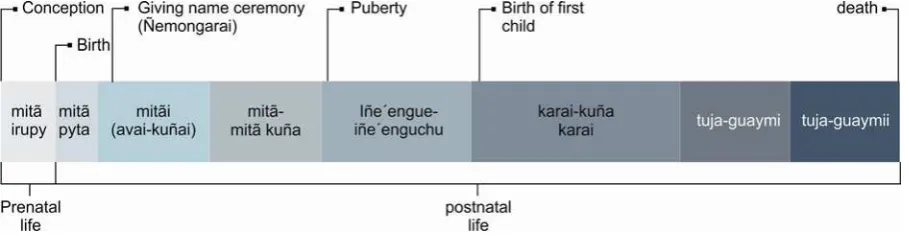
Lying on the description of scenes that depict the variety of behaviors and activities of
individuals of different age and sex, we intend a progressive approach to life course
model. It allows us to know Mbya criteria to characterize its stages as well as qualities
and values assigned to individuals in each one. We focus on stages between
gestational period and Mbya ceremony of giving a personal name (Ñemongarai)5.
Figure 8:.Mbya life course
Source: Remorini, 2009 ©
Human life (teko) begins when the human spirit or soul (ñe'e), sent by one of the four
gods (Ñe'e Ru Ete:” the true fathers of our souls”) "sits down" (oñemboapyka) in the
women uterus at conception. When child is conceived they acquire their name but it is
means that someone, adult and / or child, is temporarily or regularly responsible for childcare. "Emae" simply implies to take a look at the child. Finally, “ñe' mboe” means teaching and refers to oral transmission of knowledge, guidelines, advice and experiences..
[image:6.595.85.540.464.582.2]discovered (by the religious leader: Opyguã6) and given to them in a ceremony called
Ñemongarai. In this ceremony the Opyguã discovers the origin of the child´s soul (it
means, their father). It is important because the person’s abilities, skills, preferences
and future social roles are based on their soul origin. For example, children of “Jakaira
Ru Ete” (one of the Ñe´e Ru Ete) are called Karai and Jachuka, men and women
respectively. They have a special orientation toward religious and therapeutic
activities, and when they reach old age, are often chosen as Opyguã of their
communities. Instead, the children of “Tupa Ru Ete”, have special skills for political
leadership (Cadogan 1997).
There are four names for boys and four for women, combined with secondary names.
As a result, the same sacred name can be attributed to more than one person. Also,
members of the same family may incarnate spirits from any of the four deities.
***
The Ñemongarai ceremony occurs around the second year of life. Only when the child
can stand up, walk, speak some words and “understand their name” is ready to receive
their “sacred name”, i.e. the name of their soul/spirit (ñe´e).
In Mbya Guarani language newborn children and those in their first two months of life
are called ava pyta i and kuña pyta i (boys and girls respectively) . Pyta means “new”.
“Mitãi” is the term used to refer to breastfed children from two months to the age of
4‐5 (after that they are called “mitã).
So, we can consider the naming ceremony (Ñemongarai) as a kind of “rite de passage”
which allows the “mitã i” (kuña i or ava i, girl or boy respectively) to become “a
member of teko´a” (Mbya community). This ceremony represents a social recognition
of a change in the children ontological status.
Mbya person consists of, at first, a spirit/name (ñe’e) and a body (hete), each with
different origins, divine and human respectively, closely related. Being their
dissociation a sign of disease or death (Remorini, 2009).
Considering that name/spirit /person are inseparable, the Mbya people explain that
giving the wrong name may cause serious illnesses or even death. The main signal of
this is that the child has no signs of “normal” growth and development. According to
our informants: “(s)he doesn’t want to grow” (ndokakuaa), (s)he is undernourished
(ipiru i), or “(s)he gets sad” and “doesn’t find him/herself” (“no se halla” ndojaveima).
“no levanta” doesn’t stand up (ãi eŷ va’e) it means he/she doesn’t stand on their feet,
doesn’t walk. In this sense, to be “on your feet” means “to be healthy” (Cf. Cadogan,
1997).
In these cases, it is the Opyguã’s responsibility to find out the correct name, that is,
baptize the child again. In this sense, giving the name is equal to giving back the child’s
health. When the child is thought to be getting ill, changing its name implies taking
protection measures.
In Mbya language, spirit/soul, personal name and language are designated with the
same term (ñe’e). Ñe’e then has a double meaning: “expressing ideas” and “divine
portion of the soul” (Cadogan, 1997; Clastres, 1993). Thus, the soul is identified with
the name and the ability to speak. It is the individual’s vital force “it is something that
stands erect the flow of his words”7 (Cadogan, 1997). The ñe’e is what enables a
person to belongs to the community of those who share the ayvu (human language),
that is, the teko’a (community). (Garlet, 1997)
Because of that, stimulation of the upright posture and speech are central components
of childrearing. Associated with this, the great concern expressed by parents when
their children do not walk (ndoguatai) or speak (ndaijayvui) in the expected time is
remarkable.
In religious language, Mbya people say that ñe´e “keeps upright” the child i.e. it makes
life possible. In this sense, to be “ erect” means “to be healthy”. Also, to belong to
human beings, and to be different from animals. Unlike gods ‐who “stand up” from the
beginning‐ people must achieve that status throughout their life. Being erected not
only from the anatomical point of view but also from a spiritual point of view (Clastres,
1993; Cadogan, 1997). In Mbya mythology, animals used to be humans but lost their
condition because of their inappropriate behavior and because they broke the social
7 In Mbya religious language:
rules and taboos. Due to this, they cannot “stand upright” and, consequently, they are
“imperfect beings” (Cadogan, 1997). Thus, the transition from crawling to walking is
one of the most important body transfomations in the process of becoming a Mbya
person.
On the other hand, Ñemongarai ceremony allows a change in children feeding. After
that, children may consume meat from forest animals. Before that it is prohibited
because it causes severe gastrointestinal diseases such as intestinal parasites
(Remorini, 2009)8.
In sum, the beginning of straight walking (guata), together with two other capabilities,
like speaking (ayvu) and eating meat (karu cho´o), are highly valued by the Mbya as
indicating their children’s growth and maturity9. Only when they can stand upright and
walk, they begin to be regarded as true Mbya 10 .
Motor training
(Figure 10)
The Mbya recognize different stages of locomotor development which are
differentiated by a set of categories below:
oguapy opoñi ña’ã Opoñi oguata
To sit down To creep To crawl To walk
According to the beliefs about human condition mentioned above, my observations of
everyday parents` behaviors show the importance attributed to the achievement of
8 Just as infants are not able to consume the flesh of wild animals before they are “baptized”, so too are they not to inhale the aroma of wild meat as it is being grilled. The main cause of parasitic infection in little children is related to the transgression of dietary and cultural taboos. The wind is described as the agent enabling the “activation” and growth of parasites that exist “naturally” within the infant’s body from its formation in utero. It is nevertheless the parents’ responsibility to protect the child from exposure to the smell of grilling meat and the possible parasitic infection that may result. The role of the parent in protecting the child is also evident in the second cause of infection: inappropriate food choices and regimen. Feeding a child forbidden food that is too “heavy” for his/her age, as well as stopping breastfeeding and simultaneously giving different types and flavors of foods potentially “activates” latent parasites within the human body and triggers symptoms of parasitic illness. For more detalis see Remorini, 2009 and Crivos et al; in press).
9 In that respect, kamby ryru (milk stomach) designates the child´s digestive organ during lactation and is different from that of the children who can already receive “adult food”, which is called gekue guachu kue. (Remorini, 2009)
10
upright posture and walk training through various practices. In this sense, "healthy"
children have a potential to be encouraged, since no process of development and body
growth is seen as simply "natural".
While Mbya children under one year, spend some time in the arms or loaded into the
shawl (monde'a) or sleeping within hammoks (ky'a) (figure 11) , sustained and/or limited in their movements, as they are beginning to sit up and crawl, they spend a lot
of time on blankets laid on the floor, where tested various postures and movements.
Mbya parents provide these conditions for the child to move independently and to
play with various objects that are offered, although in their speeches give little
attention to these movements and to preparatory stages of the vertical motion (creep,
crawl) being the latter which represents the main interest.
Except during sleep, when infants remain in the ky'a (hammock) for a few hours, there
is no other object or construction that limits their movement. When the child begins to
crawl, they are allowed to "explore" the environment while their short movements are
closely monitored. Although at the beginning caregivers help children, then they are
free to rehearse balance holding from various objects available in the house or patio as
well as people.
Pictures 12‐15 depict the begining of uprigth posture and walk training. From 8‐9
months of age, children are encouraged to rehearse both their upright posture and
first steps. It is common to see mothers or older siblings holding children to help them
walk, even if they are not yet ready to do so.
Once a safer walking is acquired, caregivers play with children and teach them to
follow the path of a ball, kicking it at different distances, searching and collecting
various items from the floor or encouraging the child to imitate movements they
make. Thus, these games promote motion training (pictures ... to...)
These boys and girls (pictures 16‐17) are learning to walk. They have different ages and are at different stages of the procurement of vertical position. Their parents build
for them the “mitã amba” wich means in Mbya language “the place or dwelling for
children”.
This object is located in houses´s courtyard and serves the child to hold standing and
walking around them. There children rehearse different movements previous to walk
watch them while they perform tasks near them or ask another of her sons to take a
look at the child (for example: emae chichi! Emae nde kypyi re!).
We also note other practices aimed at "accelerating" growth, specifically, the
achievement of lower limbs development that allows the child to stand up and walk.
Around the fifth or sixth month of life, Mbya parents puts this thing called ipykuaa
below the knees, made from the leg bones of a bird called araku or saracura (Aramides
saracura) (Figure 18). Observation of the way this bird walks behind this practice, as it is expected that children gain strength in his legs through contact with the leg bone of
the animal.
Some parents said "... there are some who are not used, they have not the habit", that
is, don´t know the value of this object, especially young parents. On the other hand,
other parents recognize the importance of this practice but states that it is difficult
now to create this element, because is not usual to capture the bird in the area where
they live. In relation to this, states that when the ipykuaa is broken (due to increased
child´s musculature) it should be replaced. However, given the lack of resources they
usually put another ipikuaa made with the same bone, but claim that this is not so
effective.
Likewise, and based on the same kind of explanation, the Mbya believe that children
could acquire undesirable physical characteristics if they eat meat of some birds. For
example, is prohibited for growing children eat meat of jeruchi (Leptolila verreauxi)
and saracura as its "hardens" and "closes" the leg´s bones, making difficult
locomotion. However, the consumption of this meat is allowed once bone growth is
completed.
If analogies with animals are established in relation to locomotion, analogies with
plants are established in connection with the upright posture. "To be upright" makes
humans to be similar to plants, trees, and different from animals which lost their
verticality and humankind because they broke moral rules (cf. Cadogan, 1997). In this
sense, being "upright" indicate, first, that the child is in the process of achieving the
status of person and secondly, he/she is healthy. As we said previously, if children or
adults can´t stand up it is a sign of their spirit weakness and therefore, they could
When children walk without help, the children wander around different spaces near
the house. As we can see, the little cloth or being naked facilitate the movement of the
child. (figures 10‐19‐20) In this respect, Mbya parents do not care contact the child's body to the ground. Although this may have consequences for health. For example, an
increased risk of exposure to parasites, higly prevalent in this communities because of
soil humidity and other enviromental factors (Crivos et al, e.p). But from the Mbya
perspective contact skin/soil is not a risk factor, stressing other causes of parasites as
we pointed out previously.
However, there are some occasions in which intentionally restricted the movement of
the child, when they consider that there may be a risk for it, or when the caregiver can
not leave their task to follow the child´s movements.
As there are not many movement restrictions mothers should be careful and avoid
children exposure to risks.e.g. fireplaces, wires, glasses, knives, rubbish and domestic
animals excrements. At the same time, vegetation growing in patios should be cleaned
to prevent rodents ans snakes hiding there.
When children become able to wander freely they can integrate other children’s
games, and go even further than the patio, i.e. paths connecting houses, streams and
water sources. This doesn’t means total freedom. On the contrary, they are not alone
for long periods until they are two years old.
Children who are able to walk are viewed as more independent than babies who
depend on their mother to get from one place to another.
As children get older these movement patterns are combined with other Mbya
education rules seeking for their independence and autonomy
Finally, at dusk or night, parents do not allow children to go far from the houses,
because pathways are inhabited by evil spirits at these times. They can kill or sicken
children, especially, if they have not been “baptized” yet.
To protect them against these evil spirits, parents are accostumed to burn and smoke
tobacco on child´s crown using a ceremonial pipe, and calling for the protection of
"Ñande Ru Ete" (Our True Father). (See figures 21‐ 22)
In this sense, there are some health concerns for Mbya parents, including
environmental hazards and supernatural dangers. These lead to specific limitations on
A culture of movement
Based on these considerations, much of my interest was to analyze the movement and
displacement as indicators of growth and development, its importance in terms of the
Mbya concepts of person, the life course, health and cultural identity.
When the child walks independently is integrated into the activities that develop other
children, i.e. the group of siblings, which are designated by adults as kĩrĩngue or “la
gurisada”, it means, children who circulate and play together in different spaces of
community and integrates the “community of play” (Melia 1979, en Larricq, 1993: 49).
Through integration into peer groups, child "walks with others", which introduces at
least three transformations: wide their relationships, expands their environment and
acquires new knowledge and skills.
(Fig 23‐24‐25)
In these displacements the child learns the paths that connect homes and other
relevant places in the village, identifies who live in each household, recognizes the
distances and the alternatives to go and coming from different parts of the village.
The knowledge of space and environmental resources is a highly valued acquisition
because it indicates that the child is "growing like a Mbya", it means, is learning what
he/she need to know to live in the forest. Over the years, and in so far as he/she
accompany others in search of water or firewood, collecting medicinal plants or other
activity that children are earlier trained, this knowledge is expanded and refined,
enabling the transition to adulthood.
As the life course progresses, initiation of boys in walking on the forest is related to
cultural expectations about their activities in adulthood. While girls begin to visit this
space at a later age, the daily displacements of girls include other areas delimited by
the routine activities of household women. Thus, the walking in men is associated with
subsistence activities taking place in the forest and on the farm (“chacras”). In the case
of girls, they walk alone or with other women for washing clothes, collecting water,
gathering food, visiting other women or sell handicrafts to nearby towns. Then young
relatives in other villages, wage labor in colonies11, study or the searching of couple.
There is a gender differentiation in displacements. (Remorini, 2009; 2010)
In summary, movement is part of everyday life and is a central goal of rearing practices
from early childhood.
Finally, one aspect that emerges from the analysis of conditions that makes possible
the children movement is its relation to the adaptation to the environment. I mean,
ecological characteristics of the environment in which Mbya live, the pattern of
settlement and economic activities, encourage and require the movement. The Mbya
way of life (Mbya reko) need, even today and despite the changes, the displacements
in the forest for hunting, gathering, fishing or farming activities. The forest resources
are not concentrated but scattered, these availability forces the indigenous to move in
its search. In this sense, the current ethnographic and ethno‐ecological studies about
forest of South America suggest that the characteristics of this environment favors the
displacement of people, animals and plants (see Balee, 1998; Rival, 1998; 2004). Also,
through these micro‐scale displacement, these people design and transform their
environment, adapt to it and adapt it to their needs and projects (Crivos et. al, 2006).
In conclusion, motion tranining is one of the most important component of the process
of becoming a person in Mbya society. In this sense, I link the practices that enable the
upright posture and movement with cultural identity, as the expression of a set of
values, meanings, knowledge and techniques learned and trasmited
intergenerationally as a cultural heritage of Mbya Guarani people. Our results allowed
us to state the close interdependence between child development, well‐being,
environment and cultural identitity.
Acknowledgments
This research was supported by National University of La Plata and National Council of Scientific and Technological Research (CONICET). I want to thank to all members of Mbya communities of Ka´aguy Poty e Yvy Pytã for their warm hospitality during our fieldworks. Specially I thank to the children of both communities because since my
ethnographic work with them I understand the importance of ethnography in the study of child development.
Finally, I'm very grateful with David Lancy for his kindness and help and for making possible my participation on this meeting
References
‐ Assis, V. y Garlet, I. (2004). Análise sobre as populações guarani contemporâneas: demografía, espacialidade e questõs fundiárias. Revista de Indias LXIV (230): 35‐54.
‐ Balée, William (Ed.) (1998) Advances in Historical Ecology. Columbia University Press. New
York.
‐ Bronfenbrenner, Urie. (1987). La ecología del desarrollo humano. Experimentos en entornos naturales y diseñados. Barcelona: Paidós.
‐ Cadogan León. (1950). La Encarnación y la Concepción; la Muerte y la Resurrección en la Poesía Sagrada esotérica de los Jeguaka Tenonde Pora‐güe (Mbyá‐Guarani) del Guaira, Paraguay. Revista do Museu Paulista Nova Serie. IV: 233‐246.
‐ Cadogan, L. (1992). Diccionario Mbyá‐Guaraní‐Castellano. Asunción: CEADU: Biblioteca Paraguaya de Antropología. Vol. XVII. Fundación “León Cadogan”.
‐ Cadogan, L. (1997). Ayvu Rapyta. Textos Míticos de los Mbyá‐Guaraní del Guairá. Asunción:
CEADUC, Biblioteca Paraguaya de Antropología. Volumen XVI. Fundación “León Cadogan”. ‐ Cervera, M.D. and Méndez, R.M. (2006). Temperament and ecological context among Yucatec Mayan children, International Journal of Behavioral Development, 30, 326‐337.
‐ Clastres, Pierre. (1993). La Palabra Luminosa. Mitos y cantos sagrados de los guaraníes. Serie Antropológica. Ediciones del Sol, Buenos Aires.
‐ Crivos, Marta; María Rosa Martínez, María Lelia Pochettino, Carolina Remorini, Anahí Sy y Laura Teves. (2006). “Paths as Landscape Signatures. Towards an Ethnography of Mobility
Among the Mbya‐Guarani (Northeastern Argentina)”. Journal of Ethnobiology and
Ethnomedicine. Ed. Andrea Pieroni. University of Bradford, UK.
‐ Crivos,M; M. R. Martínez, C. Remorini y A. Sy. E.p. Some Considerations Regarding the Origin
and Functions of Parasites among Two Mbya Communities in Misiones, Argentina. Enviado
para su publicación en Brenda Gardenour (ED): The Wormy Corpus: Worms, Parasites, and the
Body in Religion and Culture, East and West. Peter Lang Publishing. In press.
‐ Elder, G. H. Jr. (1998). The Life Course as Developmental Theory, Child Development 69: 1‐12.
‐ ENCUESTA COMPLEMENTARIA DE PUEBLOS INDÍGENAS (ECPI). 2004‐2005. Provincia de
‐ Garlet, Ivori. (1997). Mobilidade Mbya: historia e significacao [Tesis de Maestría]. Pontificia
Universidade Católica do Rio Grande do Sul. MS.
‐ Gaskings, S. 2000. Children’s Daily Activities in a Mayan Village: A Culturally Grounded Description. Cross‐Cultural Research 2000 34: 375
‐ Gottlieb, Alma (2004). The Afterlife Is Where We Come from: The Culture of Infancy in West
Africa . Chicago: University of Chicago Press.
‐ Greenfield, P., Keller, H., Fuligni, A. y Maynard, A. (2003). Cultural Pathways through universal development. Annual Review of Psycholoy 54: 461‐490.
‐ Lalive d’Epinay,C.; Bickel, J. F.; Cavalli, S; Spini, D. (2005), Le parcours de vie: émergence d’un paradigme interdisciplinaire. En: Guillaume, J. F. (ed.), Parcours de vie. Regards croisés sur la
construction des biographies contemporaines. Liège, Les éditions de l’Université de Liège.
‐ Larricq, Marcelo. (1993). Ipytuma. Construcción de la persona entre los Mbyá‐Guaraní. Posadas: Ed. Universidad Nacional de Misiones.
‐ Martínez, M.R.; M. Crivos y C. Remorini (2002). Etnografía de la vejez en comunidades Mbya‐ Guaraní, provincia de Misiones, Argentina. Guerci, A & S. Consigliere (Eds): Il Vecchio allo Specchio. Vivere e curare la vecchiaia nel mondo. Vol. 4. Génova: Erga Edizione
‐ Navone, Graciela T, MI Gamboa, E Oyhenart, AB Orden. (2006). Parasitosis intestinales en poblaciones Mbyá‐Guaraní de la Provincia de Misiones, Argentina: aspectos epidemiológicos y nutricionales. Cad. Saúde Pública v.22 n.5, Rio de Janeiro.
‐ Remorini, C. 2006. Considerations about health/illness processes in the first stages of the life cycle in two Mbyá‐Guaraní communities from the Province of Misiones, Argentina.” Journal of
Global Bioethics, Vol. 18, 2006. A.B. Chiarelli. (Ed.) Lab. of Anthropology, Univ. De Florencia
(Italia) PP. 125‐139. ISSN 1128‐7462.
‐ Remorini, Carolina. 2001. “Caminar a través del monte. Una aproximación a la movilidad
Mbya en el pasado y en el presente”. Publicación Especial de las II Jornadas sobre Poblamiento,
Colonización e Inmigración en Misiones. Posadas, Ediciones Montoya, Pp. 309‐326
‐ Remorini, Carolina. 2005. Persona y Espacio. Sobre el concepto de “teko” en el abordaje etnográfico de las primeras etapas del ciclo de vida Mbya”. Scripta Ethnologica, XXVIII. pp. 59‐
75. CAEA‐CONICET, serie indexada en IUAES, International Bibliography of the Social Sciences, Religious and Theological Abstracts, CLASE y LATINDEX. ISSN 0325‐6669.
‐ Remorini, Carolina. 2009. Aporte a la Caracterización Etnográfica de los Procesos de Salud‐
Enfermedad en las Primeras Etapas del Ciclo Vital, en Comunidades Mbya‐Guaraní de Misiones,
República Argentina. (Tesis de Doctorado). La Plata: Universidad Nacional de La Plata, Edulp,
1ra ed. ISBN 978‐950‐34‐0602‐1. Disponible en:
http://sedici.unlp.edu.ar/search/request.php?id_document=ARG‐UNLP‐TDG‐0000000330 ‐ Remorini, Carolina. 2010. ¿De qué y por qué se enferman los niños Mbya? Representaciones y prácticas en torno a la salud en contextos socioculturales y ecológicos vulnerables. En: Raquel Drovetta y María Laura Rodríguez (Comp.) Padecimientos en grupos vulnerable del
interior de Argentina. Procesos históricos y actuales de salud, enfermedad y atención. Centro
de Estudios Avanzados‐Unidad Ejecutora de CONICET y Ferreyra Editores
‐ Remorini, Carolina. 2010. Crecer en movimiento. Abordaje etnográfico de la crianza y el desarrollo infantil en comunidades Mbya (Misiones, Argentina). Revista Latinoamericana de
Ciencias Sociales sobre Niñez y Juventud. Vol 8 (2) julio‐diciembre de 2010. pp. 961‐980
Universidad de Manizales, Colombia.
dialnet.unirioja.es/servlet/fichero_articulo?codigo=3356384&orden=0
‐ Remorini, Carolina. 2011. Being “mitãi” in the forest and “guagua” in the valleys. Children’s upbringing in two regions in Argentina. Preliminary results. International Conference. Towards
an Anthropology of Childhood and Children. Ethnographic Fieldwork Diversity and Construction
of a Field. 9‐11 de marzo de 2011. Institute of Human and Social Sciences, University of Liege
(Bélgica).
‐ Rival, Laura. (1998). Domestication as a Historical and Symbolic Process. In Advances in
historical Ecology Edited by: Balée W. Columbia University Press:232‐250.
‐ Rival, Laura. (2004). El crecimiento de las familias y de los árboles: la percepción del bosque Huaorani. En: Surralles, Alexandre y Pedro Garcia Hierro (Eds.). Tierra Adentro. Territorio
Indígena y percepción del entorno. Documento 39, Copenhague: IWGIA.
‐ Solis Cámara, P. and Diaz Romero, M. (2007). Relaciones entre creencias y prácticas de crianza de padres con niños pequeños. Anales de Psicología 23 (2): 177‐184.
‐ Super, C y S. Harkness. 1986. The developmental niche: A conceptualization at the interface of child and culture, International Journal of Behavioral Development, 9: 545‐569.
‐ Weisner, T. (1996). Why Ethnography Should Be the Most Important Method in the Study of Human Development. En: Jessor, R, A. Colby y R. Shweder (Eds) Ethnography and Human
Development. Universtity of Chicago Press