
Effect of the combined use of gamma cyclodextrin and a chiral ionic liquid on the enantiomeric separation of homocysteine by capillary electrophoresis
25
0
0
Texto completo
(2) EFFECT OF THE COMBINED USE OF -CYCLODEXTRIN AND (R)-. 1 2. N,N,N-TRIMETHYL-2-AMINOBUTANOL-BIS(TRIFLUOROMETHANE-. 3. SULFON)IMIDATE CHIRAL IONIC LIQUID ON THE ENANTIOMERIC. 4. SEPARATION OF HOMOCYSTEINE BY CAPILLARY ELECTROPHORESIS Maider Greño1, María Luisa Marina1,2, María Castro-Puyana1,2*. 5 6. 1. 7. de Alcalá. Ctra. Madrid-Barcelona Km. 33.600, 28871, Alcalá de Henares (Madrid),. 8. Spain.. 9. 2. 10. Departamento de Química Analítica, Química Física e Ingeniería Química. Universidad. Instituto de Investigación Química Andrés M. del Río. Universidad de Alcalá. Ctra.. Madrid-Barcelona Km. 33.600, 28871, Alcalá de Henares (Madrid), Spain.. 11 12 13 14 15. Correspondence: Dr. María Castro-Puyana, Departamento de Química Analítica,. 16. Química Física e Ingeniería Química. Universidad de Alcalá, Ctra. Madrid-Barcelona. 17. Km. 33.600, 28871, Alcalá de Henares (Madrid), Spain.. 18. E-mail: [email protected]. 19. Tel./Fax: +34 918856430. 20. 1.
(3) 21. Abstract. 22. The enantioseparation of the non-protein amino acid homocysteine by CE was. 23. investigated in this article using seven neutral cyclodextrins and five chiral ionic liquids. 24. as chiral selectors. Using a previous derivatization step with FMOC and the subsequent. 25. separation under neutral conditions, homocysteine enantiomers were only separated when. 26. γ-CD. 27. (EtCholNTf2) were employed as sole chiral selectors in the separation buffer. On the one. 28. hand, γ-CD gave rise to the enantiomeric separation in 10 min with a resolution value of. 29. 1.9, whereas EtCholNTf2 let to obtain a resolution value of 1.4 in more than 50 min. Then,. 30. the evaluation of the combined use of both selectors was also carried out, resulting in a. 31. considerable increase in the Rs. The best enantioseparation for homocysteine was. 32. obtained when 10 mM EtCholNTf2 was added to 50 mM phosphate buffer (pH 7.0). 33. containing 2 mM γ-CD. In an attempt to discriminate specific chiral cation effect from. 34. the salt effect, the influence of adding LiNTf2 to the separation medium was also. 35. evaluated, resulting in lower resolution values for homocysteine when compared to those. 36. achieved with the addition of EtCholNTf2, indicating a synergistic effect between. 37. EtCholNTf2 and γ-CD. Interestingly, the enantiomer migration order changed depending. 38. on the chiral selector used. When EtCholNTf2 or γ-CD were used as sole chiral selectors,. 39. D-enantiomer was the first-migrating enantiomer. However, an inversion in the migration. 40. order was observed when both selectors were employed in a dual system being the L-. 41. enantiomer the first-migrating one.. or. (R)-N,N,N-trimethyl-2-aminobutanol-bis(trifluoromethane-sulfon)imidate. 42 43. Keywords: Capillary electrophoresis, chiral ionic liquids, cyclodextrins, homocysteine,. 44. enantioseparation.. 45 2.
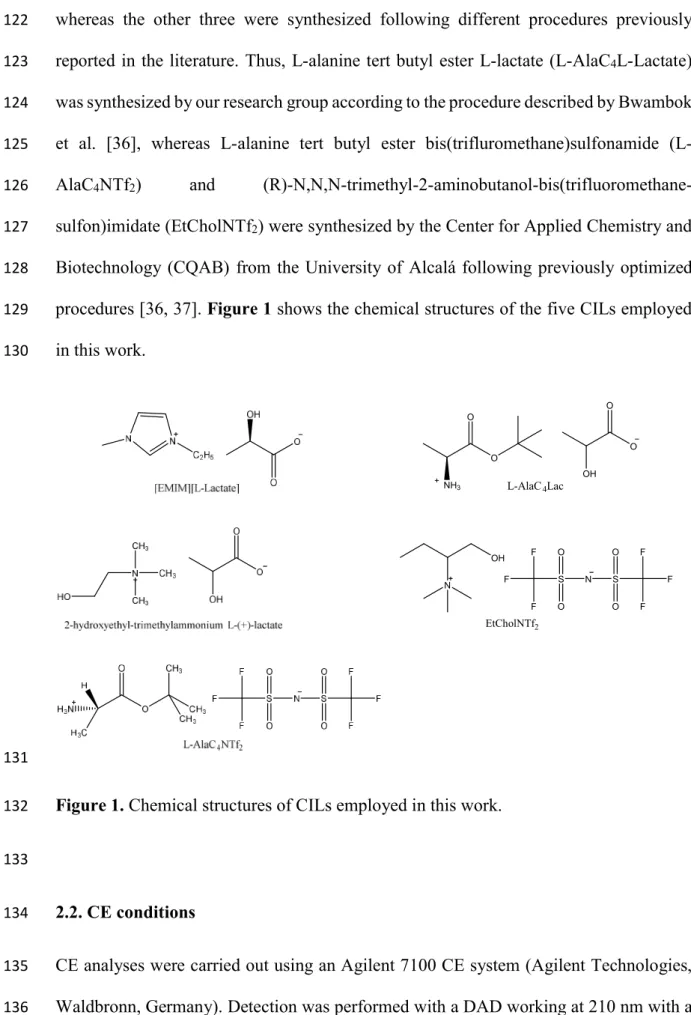
(4) 46. 1. Introduction. 47. Capillary electrophoresis (CE) has already demonstrated its high potential in the field of. 48. chiral separations [1-3]. In fact, this separation technique has been applied to the. 49. enantioseparation of a broad range of compounds of interest in the pharmaceutical, food. 50. or environmental fields. Among the great variety of compounds that can be used as chiral. 51. selector in CE (cyclodextrins (CDs), antibiotics, crown ethers, cyclofructants, or. 52. polysaccharides among others [1, 4] CDs continue being nowadays the most employed. 53. [2, 5-6] However, the use of all these compounds as chiral selectors have some. 54. limitations. For instance, in some cases their low solubility, high UV absorptivity,. 55. instability at high temperature, high cost and tedious synthesis could limit their use in CE. 56. [7]. All these reasons promote the search of new compounds that can be used as chiral. 57. selectors. This fact is indeed one of the most relevant challenges in the field of chiral. 58. separations by CE.. 59. In this regard, a great interest has been paid in the last years to the evaluation of chiral. 60. ionic liquids (CILs) as new potential selectors for enantiomeric separations by CE [7-13].. 61. Ionic liquids (ILs) are salts with melting points below 100 ºC constituted by a bulky. 62. organic cation and an organic or inorganic anion which have influence on the. 63. physicochemical properties of ILs, such as, high conductivity, low volatility, high thermal. 64. stability and miscibility in organic solvents [10]. In particular, ILs which have a chiral. 65. cation and/or anion are called CILs. CILs have been used in CE as sole chiral selectors. 66. (undecenoxycarbonyl-L-pyrrolidinol bromide, undecenoxycarbonyl-L-leucinol bromide,. 67. (R)-N,N,N-trimethyl-2-aminobutanol-bis(trifluoromethane-sulfon)imidate,. 68. dimethylephedrinium-bic(trifluoromethanesulfon)imidate,. 69. hydroxypropyltrimethylammonium-β-cyclodextrin tetrafluoroborate, L-alanine tert butyl. 70. ester lactate and tetramethylammonium-lactobionate), in dual systems with other chiral. 71. selectors, ((R)-N,N,N-trimethyl-2-aminobutanol-bis(trifluoromethane-sulfon)imidate, L-. (+)-N,N6-O-2-. 3.
(5) 72. alanine. 73. bis(trifluoromethanesulfon)imidate,. 74. tetramethylammonium L-Arginine, among others) and as chiral ligands in ligand-. 75. exchange capillary electrophoresis (including 1-butyl-3-methylimidazolium L-alanine, 1-. 76. ethylpyridinium L-Lysine, 1-ethyl-3-methylimidazolium L-tartrate, etc) [13]. Most of the. 77. works that have reported the use of CILs as chiral selectors in CE were devoted to the. 78. study of their synergistic effect with other selectors, mainly CDs, using drugs [14-22] or. 79. protein amino acids as model compounds [23]. With the exception of a work in which an. 80. improvement in the chiral resolution was not obtained by adding the CILs to the. 81. separation media [24] all the other works demonstrated that combination of CILs can be. 82. a useful tool to increase the enantiomeric resolution and selectivity obtained with other. 83. chiral selectors, in particular, CDs, polysaccharides or macrocyclic antibiotics. However,. 84. until now, dual systems combining a CD and a CIL have scarcely been used to achieve. 85. the enantioseparation of non-protein amino acids. In fact, only a work reported the use of. 86. a. 87. bis(trifluromethane)sulfonamide (D-AlaC4NTf2) to carry out the enantiomeric separation. 88. of the non-protein amino acid pipecolic acid [25]. Non-protein amino acids, are a class of. 89. compounds which are not found in protein chains, but play important roles in metabolic. 90. pathways as intermediates [26]. A high number of these non-protein amino acids are. 91. chiral molecules.. 92. Homocysteine (Hcy) is a sulfur containing non-protein amino acid implied in the. 93. metabolism of methionine and whose metabolism is related with other important. 94. metabolites like S-adenosylmethionine, folic acid and B vitamins [27, 28]. This non-. 95. protein amino acid is also considered a biomarker in cardiovascular and. 96. neurodegenerative diseases since high levels of Hcy in serum and plasma are associated. dual. tert. system. butyl. based. ester. on. lactate,. L-alanine. tert. 1-ethyl-3-methylimidazolium. -CD. and. D-alanine. tert. butyl. ester L-lactate,. butyl. ester. 4.
(6) 97. with coronary heart disease [29], Alzheimer`s [30] and Parkinson`s diseases [27].. 98. Although Hcy is a chiral amino acid, only few works reported its enantiomeric separation. 99. by HPLC [31-34] and just one work reported its enantiomeric separation by CE using a. 100. high concentration of γ-CD with a resolution value of 1.26 [35].. 101. The aim of this work was to study the enantiomeric separation of the non-protein amino. 102. acid homocysteine with different neutral CDs and CILs as sole chiral selectors in CE, and. 103. to investigate the effect of the combined use of both types of chiral selectors on the. 104. enantioseparation of this model compound.. 105 106. 2. Materials and methods. 107. 2.1. Reagents and samples. 108. All chemicals and reagents used were of analytical grade. Boric acid, sodium hydroxide. 109. and pentane were purchased from Sigma-Aldrich (Madrid, Spain). Disodium hydrogen. 110. phosphate was provided by Panreac Química S.A. (Barcelona, Spain). Acetonitrile and. 111. hydrochloric acid were obtained from Scharlau (Barcelona, Spain). The chiral selector β-. 112. CD, Heptakis(2,3,6-tri-O-methyl)-β-CD, (2-Hydroxi)propyl-β-CD (DS ~ 3), and γ-CD. 113. were purchased from Fluka (Buchs, Switzerland). α-CD, methyl-β-CD and Heptakis(2,6-. 114. di-O-methyl)-β-CD were from Sigma-Aldrich (Madrid, Spain). Water used to prepare. 115. solutions was purified through a Milli-Q system from Millipore (Bedford, MA, USA).. 116. DL-homocysteine. 117. homocysteine. 118. fluorenylmethoxycarbonyl chloride (FMOC-Cl) were provided by Sigma-Aldrich. 119. (Madrid, Spain). Two of the five CILs employed in this work, namely 1-ethyl-3-. 120. methylimidazolium. 121. trimethylammonium L-Lactate were obtained from Sigma-Aldrich (Madrid, Spain). (DL-Hcy),. thiolactone. L-homocysteine. hydrochloride,. L-lactate. and. (L-Hcy), the. ([EMIm][L-Lactate]). DL-homocystine,. derivatization. and. reagent. DL9-. 2-hydroxiethyl-. 5.
(7) 122. whereas the other three were synthesized following different procedures previously. 123. reported in the literature. Thus, L-alanine tert butyl ester L-lactate (L-AlaC4L-Lactate). 124. was synthesized by our research group according to the procedure described by Bwambok. 125. et al. [36], whereas L-alanine tert butyl ester bis(trifluromethane)sulfonamide (L-. 126. AlaC4NTf2). 127. sulfon)imidate (EtCholNTf2) were synthesized by the Center for Applied Chemistry and. 128. Biotechnology (CQAB) from the University of Alcalá following previously optimized. 129. procedures [36, 37]. Figure 1 shows the chemical structures of the five CILs employed. 130. in this work.. and. (R)-N,N,N-trimethyl-2-aminobutanol-bis(trifluoromethane-. O O O O OH. L-AlaC 4Lac. NH3. OH. F. F. N. O S. F. O. O N. F. S O. F F. EtCholNTf2. 131 132. Figure 1. Chemical structures of CILs employed in this work.. 133 134. 2.2. CE conditions. 135. CE analyses were carried out using an Agilent 7100 CE system (Agilent Technologies,. 136. Waldbronn, Germany). Detection was performed with a DAD working at 210 nm with a. 6.
(8) 137. bandwidth of 4 nm. The instrument was controlled by the ChemStation software (B. 04.. 138. 03 SP1) from Agilent Technologies. Separation capillary was an uncoated fused-silica. 139. capillary of 50 µm ID (362.8 µm OD) with a total length of 58.5 cm (50 cm effective. 140. length) provided by Polymicro Technologies (Phoenix, AZ, USA). Injections were made. 141. applying a pressure of 50 mbar for 4 s and the electrophoretic separation was achieved. 142. using a voltage of 20 kV and a working temperature of 20 ºC.. 143. Before its first use, the capillary was conditioned (applying 1 bar) with 1 M sodium. 144. hydroxide for 30 min, followed by 5 min with Milli-Q water and with buffer solution for. 145. 60 min. At the beginning of each day the capillary was pre-washed (applying 1 bar) with. 146. 0.1 M sodium hydroxide during 10 min, Milli-Q water for 5 min, buffer solution for 15. 147. min and BGE during 10 min. Between runs, the capillary was conditioned with 0.1 M. 148. sodium hydroxide (2 min), Milli-Q water (1 min) and BGE (3min).. 149. 2.3. Preparation of solutions and samples. 150. Borate buffer solution (200 mM, pH 9.0) needed for the derivatization step was prepared. 151. dissolving the appropriate amount of boric acid in Milli-Q water. The buffer solution was. 152. prepared dissolving the amount needed of disodium hydrogen phosphate to achieve a. 153. concentration of 50 mM and adjusting the pH with hydrochloric acid before completing. 154. the volume with water. The BGE was obtained by dissolving the proper amount of chiral. 155. selectors in the buffer solution. The stock standard solution of Hcy was prepared by. 156. dissolving the appropriate amount of the amino acid in borate buffer and stored at 4 ºC. 157. until its derivatization with FMOC.. 158. All solutions were filtered before its use through 0.45 µm pore size disposable nylon. 159. filters from Scharlau (Barcelona, Spain).. 160 7.
(9) 161. 2.5. Derivatization procedure. 162. Homocysteine was derivatized following the procedure previously described in the. 163. literature [38, 39]. Taking into account that an excess of FMOC of at least three times. 164. was necessary to obtain a complete derivatization of homocysteine, a solution of 30 mM. 165. in ACN was freshly prepared each day. Then, 200 µL of this solution were mixed with. 166. 200 µL of homocysteine standard solution (10 mM). The reaction was kept at room. 167. temperature for 2 min. The excess of FMOC-Cl was extracted with 0.5 mL pentane and. 168. the resulting solution was diluted ten times with Milli-Q water before injection in the CE. 169. system.. 170. 2.6. Data treatment. 171. Migration times and values of resolution (Rs), calculated from the migration times of. 172. enantiomers and their peak widths at half height, were obtained using the Chemstation. 173. software from Agilent Technologies. The effective electrophoretic selectivity [14, 40]. 174. (eff) was calculated according to the following equation: eff = µep1/µep2. 175 176. were µep1 and µep2 are the effective mobilities of enantiomers 1 and 2, respectively.. 177. Origin 8.0 software was used to carry out the composition of graphs with different. 178. electropherograms.. 179 180. 3. Results and discussion. 181. 3.1. Enantiomeric separation of homocysteine with neutral CDs as sole chiral. 182. selectors. 8.
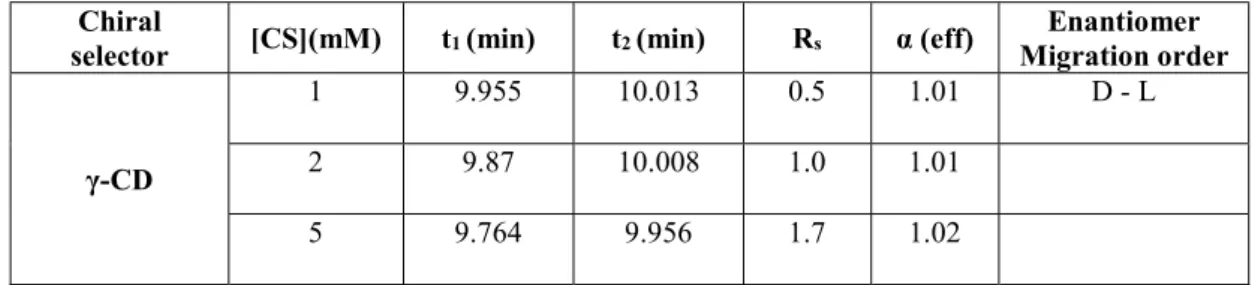
(10) 183. In order to achieve the enantioselective separation of Hcy using CDs, a set of different. 184. neutral CDs (α-CD, β-CD, γ-CD, methyl-β-CD, Heptakis(2,3,6-tri-O-methyl)-β-CD, (2-. 185. Hydroxi)propyl-β-CD, Heptakis(2,6-di-O-methyl)-β-CD) was selected to evaluate their. 186. discrimination power at pH 7.0 in which FMOC-Hcy is negatively charged (pKa = 3.77).. 187. In these experiments, all CDs were tested using a concentration of 10 mM in 50 mM. 188. phosphate buffer (pH 7.0) using a voltage of 20 kV and a temperature of 20 ºC. Among. 189. all the CDs employed, only the use of γ-CD gave rise to the chiral separation of Hcy. The. 190. separation of the Hcy enantiomers was achieved in 10 min with a resolution value of 1.9.. 191. The influence of the concentration of γ-CD on the enantioselective separation of Hcy was. 192. evaluated in the range from 1 to 15 mM due to the fact that the concentration affects the. 193. affinity of the enantiomers for the chiral selector. As it can be seen in Figure 2 and from. 194. the data shown in Table 1, the resolution gradually improved when the γ-CD. 195. concentration increased up to 10 mM. A higher concentration of γ-CD led to a slight. 196. decrease in the resolution value. Regarding to the enantiomer migration order for Hcy, it. 197. was established injecting a solution of DL-Hcy spiked with L-Hcy, so that it was possible. 198. to assign the D-Hcy as the first migrating enantiomer and L-Hcy as the second one.. 199. The separation conditions optimized in this work with γ-CD enabled to obtain the best. 200. chiral separation of Hcy in the shortest migration time when comparing these results with. 201. that previously reported in the literature for the enantiomeric separation of Hcy [35].. 202 203 204. Table 1. Migration times, electrophoretic selectivity and resolution for Homocysteine enantiomers using different chiral selectors. Chiral selector. γ-CD. [CS](mM). t1 (min). t2 (min). Rs. α (eff). 1. 9.955. 10.013. 0.5. 1.01. 2. 9.87. 10.008. 1.0. 1.01. 5. 9.764. 9.956. 1.7. 1.02. Enantiomer Migration order D-L. 9.
(11) EtCholNTf2. Dual system 1mM γ-CD + EtCholNTf2. Dual system 2 mM γ-CD + EtCholNTf2. Dual system 2 mM γ-CD + LiNTf2. 10. 9.813. 10.008. 1.9. 1.02. 15. 9.892. 10.068. 1.8. 1.02. 1. 22.031. -. -. -. 5. 27.636. -. -. -. 10. 34.611. 34.935. 0.6. 1.01. 20. 39.098. 39.618. 0.8. 1.01. 40. 51.745. 53.682. 1.4. 1.04. 60. 54.393. 55.900. 1.6. 1.03. 1. 10.066. 10.151. 1.0. 1.01. 5. 10.525. 10.938. 4.7. 1.04. 10. 12.767. 13.52. 4.8. 1.06. 20. 15.839. 16.516. 3.1. 1.04. 1. 9.741. 10.264. 4.0. 1.05. 5. 10.235. 10.900. 7.7. 1.06. 10. 11.890. 12.737. 8.0. 1.07. 20. 12.716. 13.456. 5.9. 1.06. 1. 10.591. 11.014. 4.1. 1.04. 5. 10.968. 11.719. 7.1. 1.07. 10. 11.386. 12.105. 6.4. 1.06. 20. 12.038. 12.561. 3.8. 1.04. 205. t1: time of the first-migrating enantiomer. 206. t2: time of the second-migrating enantiomer. D-L. L-D. L-D. L-D. 10.
(12) mAU. 140 120 100 80 60 40 20 0 6. 207. 8. 10. 12. t (min). 208. Figure 2. Electropherograms corresponding to the enantiomeric separation of Hcy using. 209. different concentrations of γ-CD. Experimental conditions: 50 mM phosphate buffer (pH. 210. 7.0); uncoated fused-silica capillary, 58.5 cm (50 cm to the detector window) x 50 µm. 211. ID; UV detection at 210 nm; applied voltage, 20 kV; temperature 20 ºC; injection by. 212. pressure, 50 mbar for 4s.. 213 214. 3.2. Enantiomeric separation of homocysteine with CILs as sole chiral selectors. 215. As mentioned in the introduction, the potential of CILs as selectors in chiral CE has been. 216. demonstrated in different works [13]. For this reason, the discrimination power of. 217. different CILs to achieve the enantioselective separation of Hcy was also investigated. A. 218. total of five different CILs were tested. Two of them were commercially available. 219. (namely [EMIm][L-lactate] and 2-hydroxiethyl-trimethylammonium L-Lactate), other. 220. two were amino acid based ionic liquids (L-AlaC4NTf2 and L-AlaC4Lac) which synthesis. 221. is easy, low cost and the chirality is stable [15], and the last one was EtCholNTf2 that was. 222. chosen due to the good results obtained when it was employed both as sole chiral selector. 223. for the enantioseparation of different compounds including alcohols, amines, acids and. 224. protein amino acids [41] and in combination with CDs forming a dual separation system. 11.
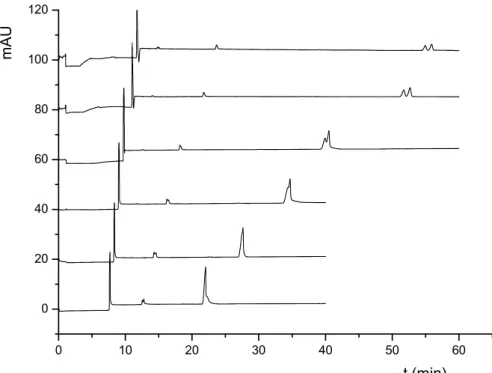
(13) 225. for the enantioseparation of drugs [14], different binaphthols [24] and a synthetic key. 226. intermediate of benzopyran derivatives [42]. The evaluation of the discrimitation power. 227. of the five CILs was performed by a screening test in which each CIL was at a. 228. concentration of 20 mM in 50 mM phosphate buffer (pH 7.0) and applying a voltage of. 229. 20 kV at 20 ºC. The results obtained in these experiments showed that only the use of. 230. EtCholNTf2 gave rise to a partial separation of DL-Hcy (Rs = 0.8) (data not shown). Then,. 231. the influence of the concentration of this chiral ionic liquid on the Hcy enantioresolution. 232. was investigated. The concentration range studied was from 1 to 60 mM, and the. 233. electropherograms obtained at each concentration are shown in Figure 3. As it can be. 234. observed, at low concentrations (1 and 5 mM) the enantioseparation was not achieved.. 235. When concentrations of 10 and 20 mM were employed, the separation was not. 236. satisfactory (Rs values of 0.6 and 0.8, respectively). However, an increase in the. 237. concentration resulted in a significant increase in resolution (Rs values of 1.4 and 1.5 for. 238. 40 and 60 mM, respectively) although the analysis time was too high (> 50 min) and peak. 239. broadening took place. Using EtCholNTf2 as chiral selector, the enantiomeric migration. 240. order for Hcy was the same as that obtained using γ-CD, i.e. D-enantiomer migrates faster. 241. than the L-enantiomer.. 12.
(14) mAU. 120. 100. 80. 60. 40. 20. 0 0. 10. 20. 30. 40. 50. 60. t (min). 242 243. Figure 3. Effect of EtCholNTf2 concentration on the separation of Hcy enantiomers.. 244. Other conditions same as in Fig 2.. 245 246. An interesting fact than can be seen in Figure 3 is that as the concentration of EtCholNTf2. 247. increased, the peak corresponding to the electroosmotic flow migrated always around the. 248. same analysis time, therefore its electrophoretic mobility was practically constant in all. 249. the experiments. This seems to indicate the no adsorption (or a low adsorption) of the. 250. cationic moiety of the CIL on the capillary wall since otherwise a decrease in the. 251. electroosmotic mobility should be observed [14].. 252 253. 3.3. Effect of the combined use of γ-CD and EtCholNTf2 on the enantiomeric. 254. separation of homocysteine. 255. Until now, most of the applications of CILs in chiral CE have employed dual recognition. 256. systems based on the combination of a CIL with other chiral selector (mainly CDs) [13]. 13.
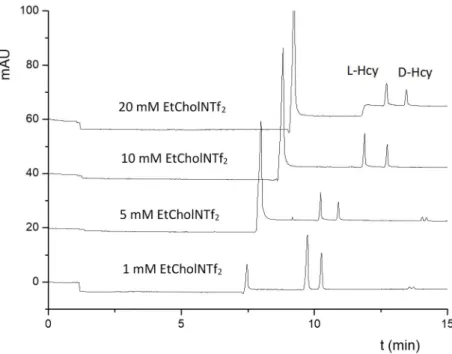
(15) 257. Taking into account that among the different selectors evaluated in this research work,. 258. only the use of γ-CD and EtCholNTf2 were able to provide the enantioseparation of Hcy,. 259. the dual system formed by the combination of both selectors was evaluated in order to. 260. determine if a synergistic effect may exist between them to improve the enantiomeric. 261. separation of Hcy.. 262. With this aim, low concentrations of γ-CD (1 and 2 mM) were chosen since both enabled. 263. to achieve a partial resolution of Hcy (Rs values of 0.5 and 1.0, respectively). With these. 264. concentrations of γ-CD, different concentrations of EtCholNTf2 (from 1 to 60 mM) were. 265. investigated to evaluate the role of the CIL in a possible synergistic effect. As it can be. 266. seen from the data shown in Table 1, for both combinations of γ-CD plus EtCholNTf2,. 267. the resolution of Hcy increased with the concentration of EtCholNTf2 till reaching a. 268. maximum value when 10 mM EtCholNTf2 was employed. In fact, Rs values of 4.7 and. 269. 8.0 were obtained using 1 or 2 mM γ-CD plus 10 mM EtCholNTf2, respectively. Higher. 270. concentrations of EtCholNTf2 gave rise to a decrease in the Rs probably due to a. 271. saturation in the complexation between the chiral selector and the analyte. The results. 272. obtained in these experiments demonstrated a significant improvement of the. 273. enantiomeric separation of Hcy (Rs increased 8 and 14.5 times) when a dual system was. 274. employed compared to the use of the chiral selector alone at the same concentration than. 275. that employed in the dual system. Figure 4 depicts the electropherograms obtained for. 276. the enantiomeric separation of Hcy using 2 mM of γ-CD and different concentrations of. 277. EtCholNTf2. It can be seen that the best results were achieved when adding 10 mM CIL.. 278. Interestingly, a reversal in the enantiomeric migration order was observed for Hcy using. 279. the dual system. In fact, D-Hcy was the first-migrating enantiomer when using γ-CD or. 280. EtCholNTf2 as sole chiral selectors whereas when the dual system was employed, the. 281. opposite migration order was observed being the D-enantiomer the second-migrating one.. 14.
(16) 282. To study if the increase in the Rs value was due to a synergistic effect between both chiral. 283. selectors (CD and CIL) and to discriminate specific chiral cation effect from the salt. 284. effect, the influence of adding LiNTf2 to the separation medium instead of the CIL was. 285. investigated under the same experimental conditions. With this aim, increasing. 286. concentrations of this salt (from 1 to 20 mM) were added to the separation medium when. 287. a 2 mM concentration of γ-CD was employed. Along with the resolution values, the. 288. effective electrophoretic selectivity (eff), a thermodynamic parameter independent of. 289. the electroosmotic flow variation, was also calculated (see Table 1). Figure 5 depicts the. 290. variation of Rs and eff as a function of the concentration of both LiNTf2 and. 291. EtCholNTf2. As it can be observed, with the addition of the salt, Rs and eff increased. 292. till 5 mM where they reached their highest values (7.07 and 1.07, respectively) and then,. 293. they decreased when increasing the salt concentration. These results were in agreement. 294. with those previously observed by other authors [14, 42] and were difficult to explain. 295. since the salt is not chiral and the migration times for the Hcy enantiomers were very. 296. similar when using the salt and when using the CIL being the variations in the. 297. electroosmotic flow not significant. In the case of EtCholNTf2, the highest values for Rs. 298. and eff were obtained at a 10 mM concentration and it was this CIL which originated. 299. the highest values of Rs showing the existence of a synergistic effect between -CD and. 300. EtCholNTf2.. 15.
(17) 301 302. Figure 4. Electropherograms corresponding to the chiral separation of Hcy using a dual. 303. system based on the combination of -CD (whose concentration was fixed at 2 mM) and. 304. increasing concentrations of EtCholNTf2. Other experimental conditions as in Fig 2.. 305 306. Figure 5. Effects of the addition of EtCholNTf2 and LiNTf2 at different concentrations. 307. on Rs and αeff values. Fixed concentration of 2 mM γ-CD. Other conditions as in Fig 2. 16.
(18) 308. Finally, as shown in Figure 4 the optimized separation conditions enabled to observe the. 309. degradation of Hcy in solution over the time since two additional peaks were observed in. 310. the electropherograms. In fact, Hcy can form the chiral dymer homocystine via. 311. dehydrogenation reaction or give rise to the homocysteine lactone [43]. Both degradation. 312. products were injected in the CE system to identify which of them corresponded to the. 313. peaks observed in the electropherograms. Homocystine could be clearly identified as the. 314. degradation product gradually formed from Hcy although it could not be clarified it the. 315. two peaks observed corresponded to the separation of two enantiomers or two. 316. diastereomers (homocystine has two chiral centers).. 317 318. 4. Conclusions. 319. A set of seven neutral cyclodextrins and five chiral ionic liquids were evaluated to achieve. 320. the enantiomeric separation of homocysteine, a non-protein amino acid selected as model. 321. compound. Enantiomeric discrimination was observed when both -CD and EtCholNTf2. 322. were employed as sole chiral selectors in the separation buffer, but resolution values. 323. lower than 2 were obtained. Then, a BGE based on the combination of both selectors was. 324. subsequently investigated to look for a possible synergistic effect which could increase. 325. the enantiomeric separation of homocysteine. A dual system combining 2 mM γ-CD plus. 326. 10 mM EtCholNTf2 enabled the enantiomeric separation of Hcy in a short analysis time. 327. (~11 min) with a high Rs value (8.0). Under these conditions, the L-enantiomer migrated. 328. faster than the D-enantiomer, what was opposite to the migration order observed when. 329. both chiral selectors were used alone. The simultaneous increase of eff and resolution. 330. obtained in the presence of EtCholNTf2, compared to the experiments with salt and -CD. 331. alone indicated a synergistic effect between EtCholNTf2 and γ-CD towards the. 17.
(19) 332. enantioseparation of homocysteine. This is the first time that EtCholNTf2 is applied to the. 333. enantiomeric separation of a non-protein amino acid.. 334 335. Acknowledgements. 336. Authors thank financial support from the Spanish Ministry of Economy and. 337. Competitiveness for project CTQ2016-76368-P and the University of Alcalá for project. 338. CCG2016/EXP-071. M.G. thanks the University of Alcalá for her pre-doctoral contract. 339. and M.C.P. thanks the Ministry of Economy and Competitiveness for her “Ramón y. 340. Cajal” research contract (RYC-2013-12688). Authors also thank the Center for Applied. 341. Chemistry and Biotechnology (CQAB) from the University of Alcalá for the synthesis of. 342. some CILs.. 343. 18.
(20) 344. References.. 345. [1] G.K.E. Scriba, Chiral recognition in separation science-an update, J. Chromatogr. A. 346. 1467 (2016) 56-78.. 347. [2] Q. Zhu, G.K.E, Scriba, Advances in the use of cyclodextrins as chiral selectors in. 348. capillary. 349. Chromatographia 79 (2016) 1403-1435.. 350. [3] C. Fanali, S. Fanali, Chiral separations using miniaturized techniques: state of the art. 351. and perspectives, Isr. J. Chem. 56 (2016) 958-967.. 352. [4] I.J. Stavrou, M.C. Mavroudi, C.P. Kapnissi-Christodoulou, Chiral selector in CE:. 353. Recent developments and applications (2012-mid 2014), Electrophoresis 36 (2015) 101-. 354. 123.. 355. [5] J.M. Saz, M.L. Marina, Recent advances on the use of cyclodextrins in the chiral. 356. analysis of drugs by capillary electrophoresis, J. Chromatogr. A 1467 (2016) 79-94.. 357. [6] J. Zhou, J. Tang, W. Tang, Recent development of cationic cyclodextrins for chiral. 358. separation, Trends Anal. Chem. 65 (2015) 22-29.. 359. [7] C.P. Kapnissi-Christodoulou, I.J, Stavrou, M.C. Mavroudi, Chiral ionic liquids in. 360. chromatographic and electrophoretic separations, J. Chromatogr. A 1363 (2014) 2-10.. 361. [8] Y.H. Boon, M. Raoov, N.N.M, Zain, S. Mohamad, H. Osman, Combination of. 362. cyclodextrin and ionic liquid in analytical chemistry: current and future perspectives, Crit.. 363. Rev. Anal. Chem. 47 (2017) 454-467.. 364. [9] Z.Q. Tan, J.-F. Liu, L. Pang, Advances in analytical chemistry using the unique. 365. properties of ionic liquids, Trends Anal. Chem. 39 (2012) 218-227.. electrokinetic. chromatography:. fundamentals. and. applications,. 19.
(21) 366. [10] L.A. Kartsova, E.A. Bessonova, E.A. Kolobova, Ionics Liquids as Modifiers of. 367. Chromatographic and Electrophoretic Systems. J. Anal. Chem. 71 (2016) 141-152.. 368. [11] Y. Huang, S. Yao, H. Song, Application of Ionic Liquids in Liquid Chromatography. 369. and Electrodriven Separation. J. Chromatogr. Sci. 51 (2013) 739-752.. 370. [12] I. Ali, M. Suhail, M.M. Sanagi, H.Y. Aboul-Enein, Ionic liquids in HPLC and CE:. 371. A hope for future. Crit. Rev. Anal. Chem. 47 (2017) 332-339.. 372. [13] M. Greño, M.L. Marina, M. Castro-Puyana, Enantioseparation by capillary. 373. electrophoresis using ionic liquids as chiral selectors, Crit. Rev. Anal. Chem. DOI:. 374. 10.1080/10408347.2018.1439365.. 375. [14] Y. François, A. Varenne, E. Juillerat, D. Villemin, P. Gareil, Evaluation of chiral. 376. ionic liquids as additives to cyclodextrins for enantiomeric separations by capillary. 377. electrophoresis. J. Chromatogr. A. 1155 (2007) 134-141.. 378. [15] J. Zhang, Y. Du, Q. Zhang, J. Chen, G. Xu, T. Yu, X. Hua, Investigation of the. 379. synergistic effect with amino acid-derived chiral ionic liquids as additives for. 380. enantiomeric separation in capillary electrophoresis. J. Chromatogr. A 1316 (2013) 119-. 381. 126.. 382. [16] M. C. Mavroudi, C.P. Kapnissi-Christodoulou, Combined use of L-alanine tert butyl. 383. ester lactate and trimethyl-β-cyclodextrin for the enantiomeric separations of 2-. 384. arylpropionic acids nonsteroidal anti-inflammatory drugs. Electrophoresis 36 (2015). 385. 2442-2450.. 386. [17] L. Zuo, H. Meng, J. Wu, Z. Jiang, S. Xu, X. Guo, Combined use of ionic liquid and. 387. β-CD for enantiosperation of 12 pharmaceuticals using CE. J. Sep. Sci. 36 (2013) 517-. 388. 523.. 20.
(22) 389. [18] Y. Cui, X. Ma, M. Zhao, Z. Jiang, S. Xu, X. Guo, Combined use of ionic liquid and. 390. hydroxypropyl-β-cyclodextrin for the enantioseparation of ten drugs by capillary. 391. electrophoresis, Chirality 25 (2013) 409-414.. 392. [19] Q. Zhang, X. Qi, C. Feng, S. Tong, M. Rui, Three chiral ionic liquids as additives. 393. for enantioseparation in capillary electrophoresis and their comparison with conventional. 394. modifiers. J. Chromatogr. A 1462 (2016) 146-152.. 395. [20] M. Stanescu, C.-M. Monciu, M. Nitulescu, C. Draghici, I. Doicin, G. Lupascu, A.. 396. Lupu, C.-C. Arama, Amino acid based chiral ionic liquids for enantiomer separation by. 397. capillary electrophoresis, Farmacia 65 (2017) 46-55.. 398. [21] B. Wang, J. He, V. Bianchi, S. A. Shamsi, Combined use of chiral ionic liquid and. 399. cyclodextrin for MEKC: Part I. Simultaneous enantioseparation of anionic profens,. 400. Electrophoresis 30 (2009) 2812-2819.. 401. [22] Y. Zhang, S. Du, Z. Feng, Y. Du, Z. Yan, Evaluation of synergistic Enantioseparation. 402. systems with chiral spirocyclic ionic liquids as additives by capillary electrophoresis,. 403. Anal. Bioanal. Chem. 408 (2016) 2543-2555.. 404. [23] Y. Wu, G. Wang, W. Zhao, H. Zhang, H. Jing, A. Chen, Chiral separation of. 405. phenylalanine and tryptophan by capillary electrophoresis using a mixture of β-CD and. 406. chiral ionic liquid ([TBA][L-ASP]) as selectors, Biomed. Chromatogr. 28 (2014) 610-. 407. 614.. 408. [24] N. Mofaddel, H. Krajian, D. Villemin, P.L. Desbène, Enantioseparation of. 409. binaphthol and its mono derivatives by cyclodextrin-modified capillary zone. 410. electrophoresis, J. Chromatogr. A 1211 (2008) 142-150.. 411. [25] C. A. Hadjistasi, I. J. Stavrou, R.-I. Stefan-Van Staden, H. Y. Aboul-Enein, C.P.. 412. Kapnissi-Christodoulou, Chiral separation of the clinically important compounds fucose. 21.
(23) 413. and pipecolic acid using CE: Determination of the most effective chiral selector, Chirality. 414. 25 (2013) 556-560.. 415. [26] S. Hunt, The non-protein amino acids, in: G.C. Barret (Ed.), Chemistry and. 416. Biotechnology of Amino Acids, Oxford Polytechnic, London (UK), 1985 (pp.55).. 417. [27] M. Isokawa, T. Kanamori, T. Funatsu, M. Tsunoda, Analytical methods involving. 418. separation techniques for determination of low-molecular-weight biothiols in human. 419. plasma and blood, J. Chromatogr. B 964 (2014) 103-115.. 420. [28] J. Selhub, Homocysteine metabolism, Annu. Rev. Nutr. 19 (1999) 217-246.. 421. [29] T. Li, B. Yu, Z. Liu, J. Li, M. Ma, Y. Wang, M. Zhu, H. Yin, X. Wang, Y. Fu, F.. 422. Yu, X. Wang, X. Fang, J. Sun, W. Kong, Homocysteine directly interacts and activates. 423. the angiotensin II type I receptor to aggravate vascular injury, Nat. Commun. 9 (2018). 424. 11.. 425. [30] T. Roostaei, D. Felsky, A. Nazeri, P.L. De Jager, J.A. Scheneider, D.A. Bennett,. 426. A.N. Voineskos, Genetic influence of plasma homocysteine on Alzheimer´s disease,. 427. Neurobiology of aging 62 (2018) 243.. 428. [31] Z. Deáková, Z. Duracková, D. W. Armstrong, J. Lehotay, Two-dimensional high. 429. performance liquid chromatography for determination of homocysteine, methionine and. 430. cysteine enantiomers in human serum, J. Chromatogr. A 1408 (2015) 118-124.. 431. [32] Z. Bystrická, R. Bystrický, J. Lehotay, Thermodinamic study of HPLC. 432. enantioseparations of some sulfur-containing amino acids on teicoplanin columns in ion-. 433. pairing reversed-phase mode, J. Liq. Chrom. Rel. Technol. 39 (2016) 775-781.. 22.
(24) 434. [33] J. P. Kullman, T. Yu, X. Chen, R. Neal, N. Ercal, D. W. Armstrong, Resolution of. 435. chiral thiol compounds derivatized with N-(1-pyrenyl)-maleimide and thiogloTM3, J.. 436. Liq. Chrom. Rel. Technol. 23 (2000) 1941-1952.. 437. [34] R. Bhusban, R. Dubey, Synthesis of (S)-naproxen-benzotriazole and its application. 438. as chiral derivatizing reagent for microwave-assited synthesis and indirect high. 439. performance liquid chromatographic separation of diastereomers of penicillamine,. 440. cysteine and homocysteine, J. Chromatogr. A 1218 (2011) 3648-3653.. 441. [35] I-J. Kim, S-J. Park, H-J. Kim, Chiral separation of homocysteine by derivatization. 442. with. 443. electrophoresis using γ-CD, J. Chromatogr. A 877 (2000) 217-223.. 444. [36] D. K. Bwambok, H. M. Marwani, V. E. Fernand, S. O. Fakayode, M. Lowry, I.. 445. Negulescu, R. M. Strongin, I. M. Warner, Synthesis and characterization of novel chiral. 446. ionic liquids and investigation of their enantiomeric recognition properties, Chirality 20. 447. (2008) 151-158.. 448. [37] P. Wasserscheid, A. Bösmann, C. Bolm, Synthesis and properties of ionic liquids. 449. derived from the “chiral pool”, Chem. Comm. (2002) 200-201.. 450. [38] H. Wang, P.E. Andersson, A. Engström, L.G. Blomberg, Direct and indirectchiral. 451. separation of amino acids by capillary electrophoresis, J. Chromatogr. A 704 (1995) 179-. 452. 193.. 453. [39] L. Sánchez-Hernández, E. Domínguez-Vega, C. Montealegre, M. Castro-Puyana, M.. 454. L. Marina, A. L. Crego, Potential of vancomycin for the enantiomeric resolution of. 455. FMOC-amino. 456. Electrophoresis 35 (2014) 1244-1250.. 4-aminosulfonyl-7-fluoro-2,1,3-benzoxadiazole. acids. by. capillary. followed. electrophoresis-ion-trap-mass. by. capillary. spectrometry,. 23.
(25) 457. [40] F. Lelièvre, P. Gareil, A. Jardy, Selectivity in capillary electrophoresis: application. 458. to chiral separation with cyclodextrins, Anal. Chem. 69 (1997) 385-392.. 459. [41] L.M. Yuan, Y. Zhou, X. Meng, Z.Y. Li, M. Zi, Y.X. Chang, (R)-N,N,N-trimethyl-. 460. 2-aminobutanol-bis(trifluoromethane-sulfon)imidate chiral ionic liquid used as chiral. 461. selector in HPCE, HPLC and CGC, Anal. Lett. 39 (2006) 1439-1449.. 462. [42] A. Rousseau, X. Florence, B. Pirotte, A. Varenne, P. Gareil, D. Villemin, P. Chiap,. 463. J. Crommen, M. Fillet, A-C. Servais, Development and validation of a nonaqueous. 464. capillary electrophoretic method for the enantiomeric purity determination of a synthetic. 465. intermediate of new 3,4-dihydro-2,2-dimethyl-2H-1-benzopyrans using a single-isomer. 466. anionic cyclodextrin derivative and an ionic liquid, J. Chromatogr. A 1217 (2010) 7949-. 467. 7955.. 468. [43] G. P. McDermott, J. M. Terry, X. A. Conlan, N. W. Barnett, P. S. Francis, Direct. 469. detection of biologically significant thiols and disulfides with Manganese (IV). 470. chemiluminescence, Anal. Chem. 83 (2011) 6034-6039.. 24.
(26)
Figure
Documento similar
