
Enantioseparation by capillary electrophoresis using ionic liquids as chiral selectors
44
0
0
Texto completo
(2) 1. ENANTIOSEPARATION BY CAPILLARY ELECTROPHORESIS USING. 2. IONIC LIQUIDS AS CHIRAL SELECTORS. 3. Maider Greño1, María Luisa Marina1,2, María Castro-Puyana1,2*. 4 5. 1. 6. de Alcalá, Ctra. Madrid-Barcelona Km. 33.600, 28871, Alcalá de Henares (Madrid),. 7. Spain.. 8. 2. 9. Madrid-Barcelona Km. 33.600, 28871, Alcalá de Henares (Madrid), Spain.. Departamento de Química Analítica, Química Física e Ingeniería Química, Universidad. Instituto de Investigación Química Andrés M. del Río, Universidad de Alcalá, Ctra.. 10 11 12 13 14 15 16 17 18 19 20 21 22 23 24 25 26 27 28 29 30 31 32 33 34 35 36. Abbreviations: L-UCPB, undecenoxycarbonyl-L-pryrrolidinol bromide; L-UCLB, undecenoxycarbonyl-L-leucinol bromide; [EtChol][NTf2], (R)-N,N,N-trimethyl-2aminobutanol-bis(trifluoromethane-sulfon)imidate; [DMP][NTf2], (+)-N,Ndimethylephedrinium-bis(trifluoromethanesulfon)imidate; [HPTMA-β-CD][BF4], 6-O2-hydroxypropyltrimethylammonium-β-cyclodextrin tetrafluoroborate; L-AlaC1Lac, Lalanine methyl ester lactate; L-AlaC2Lac, L-alanine ethyl ester lactate, L-AlaC4Lac, Lalanine tert butyl ester lactate, D-AlaC4Lac, D-alanine tert butyl ester lactate; LAlaC4NTf2, L-alanine tert butyl ester bis(trifluromethane)sulfonamide; [TMA]+[LA]-, tetramethylammonium-lactobionate; (S)-[CHTA][NTf2], S-[3-(chloro-2hydroxypropyl)trimethylammonium][bis((trifluoro-methyl)sulfonyl)amide; [LValC4][NTf2], L-valine tert butyl ester bis(trifluoromethanesulfon)imidate; [DAlaC4][NTf2], D-alanine tert butyl ester bis(trifluoromethanesulfon)imidate; [EMIm][LLactate], 1-ethyl-3-methylimidazolium L-lactate; L-UCAB, N-undecenoxy-carbonyl-Lalaninol bromide, [BMIm][BLHvB], (1-butyl-3-methylimidazolium(T-4)-bis[(2S)-2(hydroxy-κO)-3-methyl-butanoato-κO]borate; [BMIm][BSMB], 1-butyl-3methylimidazolium(T-4)-bis[(αS)-α-(hydroxy-κO)-4-methyl-benzeneacetato-κO]borate; [C6mim][L-Pro], 1-hexyl-3-methylimidazolium L-proline; [TMA][L-OH-Pro], tetramethylammonium L-hydroxyproline; [L-Phn][CF3COO], L-phenylalaninamide trifluoroacetate; [L-Prn][CF3COO]2, L-prolinamide trifluoroacetate; [LAln][CF3COO]2, L-alaninamide trifluoroacetate; [BMIm][L-Ala], 1-butyl-3methylimidazolium L-alanine; [EMIm][L-Ala], 1-ethyl-3-methylimidazolium Lalanine; [HMIm][L-Ala], 1-hexyl-3-methylimidazolium L-alanine; [C6mim][L-Lys], 1hexyl-3-methylimidazolium L-lysine; [Epy][L-Lys], 1-ethylpyridinium L-lysine; [Bpy][L-Lys], 1-butylpyridinium L-lysine; [Hpy][L-Lys], 1-hexylpyridinium L-lysine; [Opy][L-Lys], 1-octylpyridinium L-lysine; [EMIm][L-Tar], 1-ethyl-3methylimidazolium L-tartrate. 1.
(3) 37. *Correspondence:. 38. Química Física e Ingeniería Química. Universidad de Alcalá, Ctra. Madrid-Barcelona. 39. Km. 33.600, 28871, Alcalá de Henares (Madrid), Spain.. 40. E-mail: [email protected]. 41. Phone/Fax: 34-918856430/34-918854971. Dr. María Castro-Puyana, Departamento de Química Analítica,. 42. 2.
(4) 43. Abstract. 44. Capillary electrophoresis is one of the most widely employed analytical techniques to. 45. achieve enantiomeric separations. In spite of the fact that there are many chiral selectors. 46. commercially available to perform enantioseparations by CE, one of the most relevant. 47. topics in this field is the search for new selectors capable of providing high enantiomeric. 48. resolutions. Chiral ionic liquids have interesting characteristics conferring them a high. 49. potential in chiral separations although only some of them are commercially available.. 50. The aim of this article is to review all the works published on the use of chiral ionic liquids. 51. as chiral selectors in the development of enantioselective methodologies by CE, covering. 52. the period of time from 2006 (when the first research work on this topic was published). 53. to 2017. The use of chiral ionic liquids as sole chiral selectors, as chiral selectors in dual. 54. systems or as chiral ligands will be considered. This review also provides detailed. 55. analytical. 56. enantioseparations in different fields as well as on the separation mechanism involved.. information. on. the. experimental. conditions. used. to. carry. out. 57 58 59 60. Keywords:. Chiral. ionic. liquids,. 61. enantioseparation, chiral selector.. capillary. electrophoresis,. chiral. analysis,. 62 63. 3.
(5) 64. 1. Introduction. 65. Capillary electrophoresis (CE) has already demonstrated its high potential to face. 66. different challenges in the field of chiral separations. In fact, it is probably one of the most. 67. employed separation techniques in analytical enantioseparations due to different reasons. 68. such as its high separation efficiency, versatility, and feasibility to use different chiral. 69. selectors to obtain high enantiomeric resolutions. Among the great variety of compounds. 70. employed as chiral selectors (monomeric and polymeric surfactants, antibiotics, chiral. 71. crown ethers, polysaccharides), cyclodextrins continue being by far the most frequently. 72. used in CE (Zhu and Scriba, 2016). Even though all these kinds of selectors have been. 73. effectively employed, different parameters such as low solubility, high UV absorptivity,. 74. instability at high temperature, complicated synthesis and high cost, may limit their use. 75. (Kapnissi-Christodoulou et al., 2014). For this reason, the search for new compounds. 76. offering high chiral resolution to carry out enantioseparations by CE continues being. 77. nowadays one of the most relevant challenges that researchers have to face. In this sense,. 78. a significant attention has been devoted to chiral ionic liquids (CILs).. 79. Ionic liquids (ILs) have been widely used in different areas of chemistry since their. 80. discovery in 1914 (Ho et al., 2014). In particular, within the scope of analytical chemistry,. 81. ILs have been applied in the extraction, characterization, detection and separation of. 82. different analytes (Tan et al., 2012). The word “ionic liquids” refers to salts with melting. 83. points below 100 ºC. These liquids are formed by bulky organic cations (ammonium,. 84. alkylimidazolium, pyridinium) and organic or inorganic anions (hexafluorophosphate. 85. (PF6), tetrafluoroborate (TFB), etc.) (Kartsova et al., 2016). The type and size of cations. 86. and anions influence the unique physicochemical properties of ILs: high conductivity,. 87. low volatility and vapor pressure, good thermal stability, high miscibility in water and 4.
(6) 88. organic solvents, etc. In the last years, ILs have shown a great potential as stationary. 89. phases, selectors, additives in BGE, ligands or coating materials in separation techniques. 90. such as GC, LC, and CE (Kapnissi-Christodoulou et al., 2014; Tan et al., 2012; Kartsova. 91. et al., 2016; Huang et al., 2013; Boon et al., 2017; Ali et al., 2017). There is a subtype of. 92. ILs known as CILs which have a chiral moiety in their structure, i.e. the anion, the cation. 93. or both may be chiral. Whereas the chiral cation is often an imidazolium, pyridinium,. 94. ammonium or azole group, the anion could include an amino acid, lactic acid, borate, or. 95. camphorsulfonate. Resolution abilities and liquid properties of CILs give them a dual. 96. functionality since they may be used as chiral selectors, as chiral solvents, or both. 97. simultaneously. This means that CILs can, at the same time, show chiral selectivity and. 98. dissolve compounds of a broad range of polarity. All these characteristics confer CILs a. 99. high potential to play a key role in chemistry (Li et al., 2010). In the field of chiral. 100. separations, CILs have been used in chromatographic and electrophoretic techniques. 101. (Kapnissi-Christodoulou et al., 2014; Kartsova et al., 2016; Huang et al., 2013; Boon et. 102. al., 2017; Ali et al., 2017) as well as in chiral spectroscopy discrimination by NMR. 103. (Bwambok et al., 2008; de Rooy et al., 2011; Foreiter et al., 2014), NIR (Tran et al., 2006). 104. or fluorescence (Bwambok et al., 2008; Tran and Oliveira, 2006). In spite of the fact that. 105. these designable properties of CILs make them particularly attractive to achieve. 106. enantiomeric separations, one of the main reason that hinders their application in this field. 107. is that only a few CILs are commercially available. In principle, the synthesis of these. 108. liquids is simple although it sometimes needs rather expensive reagents and elaborated. 109. schemes. Readers interested on gaining a deeper knowledge on the synthesis of CILs are. 110. referred to an excellent review article published by Payagala and Armstrong (2012).. 5.
(7) 111. In chiral CE, CILs can be used in three different ways to achieve a enantioseparation: as. 112. sole chiral selectors in the background electrolyte, as chiral selectors in dual systems, and. 113. as chiral ligands. In the period of time covered by this article, several reviews were. 114. published in the literature dealing with the general use of ionic liquids in analytical. 115. chemistry or separation techniques, such as HPLC or GC, including some brief sections. 116. to describe the application of CILs to chiral analysis by CE (Kapnissi-Christodoulou et. 117. al., 2014; Ho et al., 2014; Kartsova et al., 2016; Huang et al., 2013; Payagala and. 118. Armstrong, 2012; Yuanhong and Wang, 2009; Sun and Armstrong, 2010; Tang et al.,. 119. 2014; Boon et al., 2017; Ali et al., 2017). Although this fact reflects the interest in the use. 120. of these compounds in separation techniques, until now, only a review (published in 2015). 121. has been exclusively focused on electrophoretic separations using CILs (Stanescu et al.,. 122. 2015).. 123. The goal of this review is to provide a critical view on the potential of CILs as chiral. 124. selectors in the development of enantioselective methodologies by CE covering the. 125. literature from 2006 to 2017. The structures of all CILs employed as well as the detailed. 126. experimental conditions used to achieve the enantiomeric separation of a variety of. 127. analytes by CE are shown in Table 1. The use of CILs as sole chiral selectors, as chiral. 128. selectors in dual systems, and as chiral ligands, is described in the three following. 129. sections. In this way, the particularities and separation mechanism of each approach is. 130. appropriately discussed.. 6.
(8) 131. Table 1. Chiral ionic liquids and experimental conditions employed in the enantiomeric separations by CE. Classification CILs as sole chiral selectors. CIL L-UCPB L-UCLB poly-L-SUCLS poly-L-SUCL. CE mode/ Optimal Separation conditions* MEKC-UV (214 nm) 25 mM L-UCPB or L-UCLB in 25 mM phosphate (pH 7.5) Capillary, 50 µm × 56.0 cm; -20 kV, 20°C. [EtChol]+[NTf2]-. CE-UV (254 nm) 5 or 10 mM [EtChol]+[NTf2]- in 20 mM phosphate or 20 mM borate (pH 4.0-12.5) Capillary, 75 µm × 45.0 cm; 9-17 kV. [DMP]+[NTf2]-. NACE-UV (295 nm) 60 mM [DMP]+[NTf2]- in AcN-MeOH 60:40 (v/v) Capillary, 50 µm × 40 cm; 10 kV. Analyte. Samples. Ref.. (±)- α-bromophenylacetic acid, (±)2-(2-chlorophenoxy)propanoic acid. Standards. Rizvi and Shamsi, 2006. α-methylbenzylamine, tryptophan, α-phenylglycine, 1-phenyl-1,2ethanediol, phenylalanine, 2-phenyl1-propanol, 3-benzyloxy-1,2propane diol, tyrosine, propranolol, 1-(1-naphthyl)ethanol, Di-O,O`ptoluyl tartaric acid, 1-indanol, trans2-phenyl-1-cyclohexanol, 2,3-obenzylidene-threitol, 1,1,2-triphenyl1,2-ethane diol Raberprazol, omeprazole. Standards. Yuan et al., 2006. Standards. Ma et al., 2010. 7.
(9) [HPTMA-β-CD]+[BF4]-. CE-UV (254 or 249 nm) 13 mg/mL [HPTMA-β-CD]+[BF4]- in 30 mM phosphate (pH between 4 and 8 depending on the compound analyzed) Capillary, 50 µm × 40 cm; 20 kV, 25 ºC. Chlorpheniramine, tropicamide, bifonazole, promethazine, warfarin, liarozole, brompheniramine, pheniramine. Standards. Yu et al., 2013. 8.
(10) 9.
(11) CILs as chiral selectors in dual systems. [L-AlaC4]+[Lactate]-. CE-UV (214 nm) 60 mM [L-AlaC4]+[Lac]- in 100 mM Tris/10 mM borate (pH 8.0) Capillary 50 µm × 55.5 cm; 30 kV, 25 ºC. 1,1-binaphthyl-2,2diylhydrogenphosphate (BNP). Standards. Stavrou and KapnissiChristodoulou, 201. [TMA]+[LA]-. CE-UV (215nm, 220 nm, 230 nm) 200 mM [TMA]+[LA]- in 40 mM borate 40% v/v MeOH (pH 7.6) Capillary, 50 µm × 38.5 cm; 20 kV, 15ºC. Atenolol, metoprolol, nefopam, duloxetine, bisoprolol, propanolol. Standards. Zhang et al., 2015. [EtChol]+[NTf2][PhChol]+[NTf2]-. CE-UV (200, 230, 240, 254, or 300 nm) 10 mM [EtChol]+[NTf2]- or [PhChol]+[NTf2]- + 30 mM DM-β-CD or TM-β-CD in 5 or 60 mM acetate (pH 5.0) containing 0, 10 or 25 % MeOH Capillary, 50 µm × 26.5 cm; 25 kV, 25 ºC. Carprofen, suprofen, naproxen, ketoprofen, indoprofen, ibuprofen. Standards. François et al., 2007. [EtChol]+[NTf2]-. CE-UV (214 nm). Binapthol. Standards. Mofaddel al., 2008. 10. et.
(12) (S)(+)-tetrabutylammonium camphorsulfonate. 0-30 mM γ-CD + 0-20 mM CIL in 80 mM phosphate (pH 11.5) Capillary, 50 µm × 30 cm; 10 kV, 20 ºC. [EtChol]+[NTf2]-. NACE-UV (250 nm) 1.5 mM HDMS-β-CD + 5 mM CIL and 10 mM formate in MeOH (acidified with 0.75 M formic acid) Capillary, 50 µm × 40 cm; 30 kV, 15 ºC. 4-amino-2,2-dimethyl-6ethoxycarbonylamino-3,4-dihydro2H-1-benzopyran. Standards. Rousseau al., 2010. et. [D-AlaC4]+[NTf2]-. MEKC-UV (214) 10 mM CIL + 30 mM β-CD + 30 mM SDS + 15% IPA in 40 mM borate Capillary, 50 µm × 50.0 cm; 25 kV, 15 ºC. FMOC-Pipecolic acid. Standards. Hadjistasi al., 2013. et. [L-AlaC4]+[NTf2][L-ValC4]+[NTf2]-. CE-UV (210, 215, or 235 nm) 15 mM CIL + 20 mM Me-β-CD in 30 mM citrate with 20 % EtOH or ACN (pH 5.0) Capillary 50 µm × 24.5 cm; 20 kV, 25 ºC. Naproxen, pranoprofen, warfarin. Standards. Zhang et al., 2013a. 11.
(13) [L-AlaC4]+[NTf2][L-ValC4]+[NTf2]-. CE-UV (210, 225, 230, or 235 nm) 15 mM CIL + 2 mM vancomycin in 50 mM phosphate + 20 % MeOH (pH 7.0) Capillary, 50 µm × 24.5 cm; 20 kV, 25 ºC. Naproxen, carprofen, pranoprofen, ketoprofen. (S)-[CHTA]+[NTf2]-. CE-UV (214 nm) 20 mM CIL 30 mM sodium cholate (ibuprofen) 10 mM 1-S-octyl-β-D-thioglucopyranoside OTG (flurbiprofen) Capillary, 50 µm × 37 cm; 10-30 kV. [L-AlaC4]+[Lactate]-. CE-UV (200 or 230 nm) 15 or 20 mM CIL + 10-35 mM TM-β-CD in 5 mM acetate (pH 5.0) Capillary, 50 µm × 50 cm; 30 kV, 20 ºC. ibuprofen,. Standards and naproxen bulk sample. Zhang et al., 2014. Ibuprofen, flurbiprofen. Standards. Tran and Mejac, 2008. Ibuprofen, ketoprofen, carprofen, indoprofen, flurbiprofen, naproxen, fenoprofen. Standards. Mavroudi and KapnissiChristodoulou, 2015. 12.
(14) [D-AlaC4]+[Lactate]-. CE-UV (230 nm) Huperazine A: 40 mM CIL + 2 mM SCF-7 in 4 mM acetato de amonio/5% MeOH (pH 4.0) Warfarin: 20 mM CIL +40 mM IPCF-6 in 4 mM acetate/20 % MeOH Coumachlor: 40 mM CIL + 40 mM IPCF-6 in 4 mM acetate/20% MeOH Capillary, 50 µm × 30 cm; 20 kV, 20 ºC CE-UV 20 mM CIL + 10 mM β-CD in 30 mM Tris/phospahte (pH 2.5, except for homatropine methylbromide, pH 2.0) Capillary, 50 µm × 40 cm; 20 kV, 25 ºC. Huperazine A, warfarin, coumachlor. Standards. Stavrou et al., 2015. Zopiclone, repaglinide, chlorphenamine, brompheniramine , dioxopromethazine, promethazine, liarozole, carvedilol, homatropine hydrobromide, homatropine methylbromide, venlafaxine, sibutramine. Standards and Eszopiclone tablets. Zuo et 2013. [EMIm]+[L-lactate]-. CE-UV 30 mM CIL + 40 mM HP-β-CD in 50 mM phosphate (pH 2.75) Capillary, 50 µm × 41 cm; 20 kV. Ofloxacin, propranolol, dioxopromethazine, isoprenaline, chlorpheniramine, liarozole, tropicamide, amlodipine benzenesulfonate, brompheniramine, homatropine methylbromide. Standards and Ofloxacin bulk sample. Cui et al., 2013. [TMA]+[L-Arg]-. CE-UV (220, 230, or 237 nm) 60 mM CIL + 2.5 % glycogen in 36.67 mM Tris/phosphate (pH 3.0) Capillary, 50 µm × 41.5 cm; 18.9 kV, 19.2 ºC. Nefopam, citalopram, duloxetine. Standards. Zhang and Du, 2013. [EMIm]+[L-Lactate]-. 13. al.,.
(15) [TMA]+[L-Arg]-. CE-UV (220, 215, 237, or 230 nm) 60 mM CIL + 7.0 % maltodextrin in 50 mM Tris-H3PO4 (pH 3.0) Capillary, 50 µm x 41.5 cm; 18 kV, 25 °C. Nefopam, duloxetine, ketoconazole, cetirizine, citalopram. Standars. Chen et al., 2017. [TMA]+[L-Arg]-. CE-UV (237, 230, 220, or 225 nm) 30 mM CIL + 20 mM HP-β-CD in 40 mM Tris/H3PO4 (pH 2.6) Capillary 50 µm × 41.5 cm; 20 kV, 15 ºC. Amlodipine besylate, nefopam, propranolol. Standards. Zhang et al., 2016a. [TBA]+[L-Asp]-. CE-UV (214 nm) 4 mM [TBA]+[L-Asp]- + 5 mM β-CD in 15 mM borate (pH 9.5) Capillary, 50 µm × 50.2 cm; 10 kV, 25 ºC. phenylalanine, tryptophan. Amino acids injections. Wu et al., 2014. [TBA]+[Leu]-. CE-UV (216.4, 226.4, or 279 nm) 15 mM HP-β-CD + 15 mM [TBA]+[Leu]- in 50 mM citrate (pH 3.0) Capillary, 50 µm x 40 cm; 10, 15, 20 kV, 1620 ºC. Ondansetron, ofloxacin, mianserin. Standars. Stanescu et al., 2017. duloxetine,. 14.
(16) [TMA]+[L-OH-Hyp]-. CE-UV (230, 237, 265, or 289 nm) 30 mM CIL+ 80 mM clindamicyn in 40 mM borate + 20 % MeOH (pH 7.6) Capillary 50 µm × 41.5 cm; 20 kV, 20 ºC. Propranolol, nefopam, citalopram, chlorphenamine. Standards. Xu et al., 2015. L-UCLB. MEKC-UV (214 nm) 2.0 mM CIL + 35 mM TM-β-CD in 5 mM acetate (pH 5.0) Capillary, 50 µm × 56.0 cm; 30 kV, 16 ºC. Ibuprofen, fenoprofen, ketoprofen, suprofen, indoprofen. Standards and ibuprofen tablets. Wang et al., 2009. L-UCLB L-UCAB. MEKC-UV BOH: 5 mM L-UCLB + 30 mM TM-β-CD in 10 mM acetate (pH 5.0) THBP: 3 mM L-UCLB + 30 mM TM-β-CD in 10 mM acetate (pH 5.0) TFAE: 5 mM L-UCLB + 30 mM TM-β-CD in 10 mM acetate (pH 5.0) TSO: 5 mM L-UCAB + 30 mM TM-β-CD in 10 mM phosphate (pH 7.0) Capillary 50 µm × 56 cm; 30 kV, 16 ºC. 1,1`-bi-2-naphthol (BOH), 7,8,9,10tetrahydro-benzo[a]pyren-7-ol (THBP), 2,2,2-trifluoro-1-(9anthryl)ethanol (TFAE), transstilbene oxide (TSO). Standards. Liu and Shamsi, 2014. 15.
(17) CILs as chiral ligands. [BMIm]+[BLHvB][BMIm]+[BSMB]-. CE-UV (289 nm, 230 nm, 237 nm, 205 nm, or 250 nm) 30 mM [BMIm]+[BLHvB]- + 20 mM HP-βCD in 20 mM Tris/H3PO4 (pH 2.5) Capillary 50 µm × 41.5 cm; 25 kV, 20 ºC. Propanolol, duloxetine, amlodipine besylate, nefopam, tropicamide,. Standards. Zhang et al., 2016b. [C6mim]+[L-Pro]-. LE-CE-UV (200 nm) 30 mM [C6mim]+[L-Pro]- + 15 mM Cu(II) + 30 % MeOH (pH 4.0) Capillary, 50 µm × 40 cm; 30 kV, 25 ºC. His, Phe, Trp, Tyr. Standards. Liu et al., 2009. [L-Pro]+[CF3COO]-. LE-CE-UV (254 nm) 50.0 mM [L-Pro]+[CF3COO]- + 25.0 mM Cu(II) + 20% MeOH (pH 4) Capillay, 75 µm × 45 cm; 20 kV; 25 ºC. Ala, Asn, Asp, Ile, Met, Ser, Phe, Thr, Tyr (all derivatized with Dns). Standards. Mu et 2012a. [L-Phn]+[CF3COO]2-. LE-CE-UV (254 nm) 20 mM [L-Phn]+[CF3COO]2- + 10 mM Cu(II) in 15 mM ammonium acetate (pH 5.0) Capillary, 75 µm x 45 cm; 16 kV, 25 °C. Ile, Tyr, Ala, Gln, Ser, Met, Asn, Phe (all derivatized with Dns). Standars. Jiang et al., 2017. 16. al.,.
(18) [TMA]+[L-OH-Pro]-. LE-CE-UV (200 nm) 60 mM [TMA]+[L-OH-Pro]- + 30 mM Cu(II) (pH 4.5) Capillary, 50 µm × 41.5 cm; 25 kV, 25 ºC LE-MEKC-UV (200 nm) 10 mM SDS 60 mM [TMA]+[L-OH-Pro]- + 30 mM Cu(II) (pH 4.5) Capillary, 50 µm × 41.5 cm; 25 kV, 25 ºC LE-CE-UV (254 nm) 5.0 mM [BMIm]+[L-Ala]- + 5.0 mM β-CD + 2.5 mM Mn(II) in 100 mM borate + 5.0 mM acetate (pH 8.3) Capillary, 75 µm × 45 cm; - 23 kV, 25 ºC. [BMIm]+[L-Ala]CH3. O. N H3C. LE-CE-UV: Phe, His, Trp, DOPA. Standards. Liu et al., 2015. Thr, Val, Tyr, Leu, Ile, Pro, Met, Ser, His, Phe, Ala, Asn, Trp, Gln, Orn, Glu, Arg, Asp, Cys, Lys (all derivatized with Dns). Standards. Su et al., 2015. Ser, Met, Ile, Phe, Tyr, Cys, Asn, Arg, Ala, His, Thr, Asp, Leu, Lys (all derivatized with Dns). Standards. Mu et 2012b. LE-MEKC-UV: Trp and DOPA. O N NH2 CH3. [BMim][L-Ala]. [BMIm]+[Orn]-. LE-CE-UV (254 nm) 15 mM [BMIm]+[Orn]- + 3.0 mM Zn(II) in 100 mM borate + 5.0 mM acetate (pH 8.4) Capillary, 75 µm × 45 cm; 21 kV, 25. 17. al.,.
(19) [C6mim]+[L-Lys]-. LE-CE-UV (254 nm) 6.0 mM [C6mim]+[L-Lys]- + 3.0 mM Zn(II) in 100 mM boric acid + 5.0 mM acetate (pH 8.2) Capillary, 50 µm × 50 cm; -20 kV, 25 ºC. Ser, Met, Ile (all derivatized with Dns). Standards. Zhang et al., 2013b. [Epy]+[L-Lys]-. LE-CE-UV (254 nm) 6.0 mM [Epy]+[L-Lys]- + 3.0 mM Zn(II) in 100 mM boric acid + 5.0 mM acetate Capillary, 75 µm × 60 cm; -21 kV. Ala, Asn, Asp, Ile, Leu, Met, Phe, Ser, Thr, Trp, Tyr (all derivatized with Dns). Standards. Sun et 2014. [EMIm]+[L-Tar]-. LE-CE-UV (200 nm) 54 mM [EMIm]+[L-Tar]- + 9 mM Ni(II) + 5 mM SDS in 10 mM borate (pH 8.5) Capillary, 50 µm × 52 cm; 25 kV, 20 ºC. Trp, Tyr, Phe. Standards. Huang et al., 2016. 18. al.,.
(20) 132 133 134 135 136 137 138 139. * Capillary dimension expressed as internal diameter × effective length (cm to the detector). poly-L-SUCLS, polysodium N-undecenoxycarbonyl-L-leucine sulfate; poly-L-SUCL, polysodium N-undecenoxycarbonyl-L-leucinate; [PhChol]+[NTf2]-, (R)-2-hydroxy, N,N, N- trimethyl-1phenylethanaminium-bis(trifluoromethylsulfonyl)imide; DM-β-CD, heptakis(2,6-di-O-methyl)-β-CD; TM--CD, heptakis(2,3,6-tri-O-methyl)-beta-cyclodextrin; HDMS--CD, heptakis(2,3-diO-methyl-6-O-sulfo)-β-CD; FMOC-Cl, 9-fluorenylmethoxycarbonyl chloride; SDS, sodium dodecyl sulfate; Me--CD, methyl--CD; SCF-7, sodium sulfated cyclofructan 7; IPCF-6, isopropyl cyclofructan-6; HP--CD, 2-hydroxypropil-β-CD; [TMA]+[L-Arg]-, tetramethylammonium L-arginine; [TBA]+[L-Asp]-, tetrabutylammonium L-aspartic acid; [TBA]+[L-Leu]-, tetramethylammonium L-leucinate; [L-Pro]+[CF3COO]-, L-proline trifluoroacetate; Dns, 5-(dimethylamino)naphthalene-1-sulfonyl chloride; [BMIm]+[Orn]-, 1-butyl-3-methylimidazolium ornithine. *Others are listed in abbreviation section.. 19.
(21) 140. 2. CILs as sole chiral selectors. 141. There are very few examples where CILs have been used as the sole chiral selector in the. 142. background electrolyte in CE (see Table 1). The first enantioseparations obtained using. 143. CILs were reported in 2006. On the one hand, Rizvi and Shamsi (2006) synthesized the. 144. monomeric. 145. (undecenoxycarbonyl-L-pyrrolidinol bromide (L-UCPB) and undecenoxycarbonyl-L-. 146. leucinol (L- UCLB)) for the separation of two acidic analytes. The comparison between. 147. the chiral separations achieved using both the monomers and the polymers revealed that. 148. the factor affecting analyte-micelle interactions was the presence of opposite charges so. 149. that the chiral recognition was due to the interaction of the acidic analytes with the. 150. cationic group of the selector. The structural compatibility between analyte and selector. 151. was also an important factor (Rizvi and Shamsi, 2006). On the other hand, Yuan et al.. 152. (2006) demonstrated the discrimination power of (R)-N,N,N-trimethyl-2-aminobutanol-. 153. bis(trifluoromethanesulfon)imidate ([EtChol]+[NTf2]-) to perform the enantioseparation. 154. of fifteen different compounds including alcohols, amines, acids, and amino acids by CE,. 155. HPLC and GC. In CE, the CIL was added at concentrations of 5 or 10 mM to phosphate. 156. or borate buffer at different pHs depending on the analyzed compounds. Under the best. 157. conditions selected for each compound, resolution values between 0.6 and 6.8 were. 158. achieved, showing the effectiveness of this CIL as chiral selector (Yuan et al., 2006).. 159. Later, an ephedrine-based CIL, whose anionic moiety was the same as that employed by. 160. Yuan et al. (2006), served as selector to achieve the enantioseparation of rabeprazole and. 161. omeprazole by NACE. Resolution values around 1 for both pharmaceuticals were. 162. reached. 163. bis(trifluoromethanesulfon)imidate ([DMP]+[Tf2N]-) in ACN:methanol (60:40 v/v). The. 164. experiments showed that DMP+ cations play a key role in the separation mechanism. In. and. using. polymeric. 60. forms. mM. of. two. of. amino. acid. CILs. surfactants. (+)-N,N-dimethylephedrinium-. 20.
(22) 165. fact, the enantioseparation was based not only on the ion-pair formation between this. 166. cation and the negatively charged enantiomers but also on the hydrogen bonding (between. 167. the hydroxyl group of DMP+ and the sulfoxide group of the analytes) which provided a. 168. supplementary interaction for stereoselectivity (Ma et al., 2010).. 169. An. 170. hydroxypropyltrimethylammonium-β-cyclodextrin. 171. CD]+[BF4]-) was synthesized and used as chiral selector for the enantioseparation of eight. 172. drugs including chlorpheniramine, brompheniramine, pheniramine, tropicamide,. 173. bifonazole, promethazine, warfarin and liarozole. [HPTMA-β-CD][BF4] showed a higher. 174. solubility in aqueous buffers than -cyclodextrin, and produced a stable reversed EOF.. 175. Under optimal buffer pH and CIL concentration, the enantiomers of the eight compounds. 176. analyzed were separated with resolution values ranging from 1.00 to 2.90. The. 177. comparison between the chiral separation of chlorpheniramine and promethazine. 178. obtained using -cyclodextrin or [HPTMA-β-CD][BF4] as selectors showed that the CIL. 179. provided clearly a better enantioseparation than the native cyclodextrin. This fact was. 180. attributed to a higher stability of the inclusion complex and to a higher differentiation in. 181. the intermolecular interactions established between the CIL and the analyte (provided by. 182. the nonsymmetrical chemical environment generated by charge localization) (Yu et al.,. 183. 2013).. 184. Stavrou and Kapnissi-Christodoulou, (2013) demonstrated for the first time the potential. 185. of amino acid ester-based CILs, (L-alanine methyl ester lactate (L-AlaC1Lac), L-alanine. 186. ethyl ester lactate (L-AlaC2Lac), L-alanine tert butyl ester lactate (L-AlaC4Lac), D-. 187. alanine tert butyl ester lactate (D-AlaC4Lac) and L-alanine tert butyl ester. 188. bis(trifluromethane)sulfonamide L-AlaC4NTf2) as the sole chiral selectors in CE. The. interesting. CIL. functionalized. with. -cyclodextrin. tetrafluoroborate. (6-O-2[HPTMA-β-. 21.
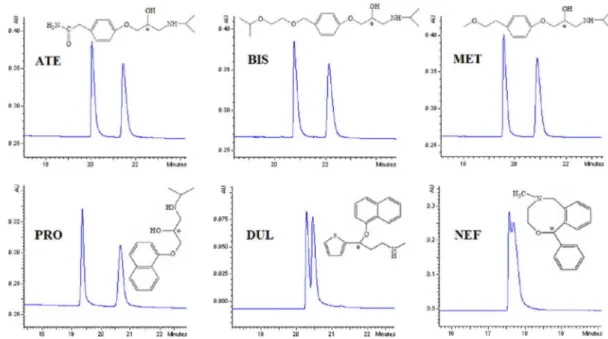
(23) 189. authors performed a systematical and interesting study about how different parameters. 190. concerning amino acid ester-based CILs affect the enantioseparation of 1-1´-binaphthyl-. 191. 2,2-diylhidrogenphosphate (BNP). Thus, the effect of the alkyl ester group, the anion. 192. employed, the cation configuration, the CIL concentration and the buffer pH on the chiral. 193. separation, was studied. The results obtained revealed that the determining factors to. 194. separate BNP enantiomers were the presence of the tert butyl ester group in the cation. 195. (which implies that steric hindrance is involved in the separation mechanism), the cation. 196. configuration (the enantiomer migration order was based on the L or D configuration),. 197. and the working pH (CILs tested were pH-dependent; the positive charge of the amino. 198. group decreases when increasing the pH which results in fewer electrostatic interactions. 199. between the CIL and BNP enantiomer). Under the optimal experimental conditions (see. 200. Table 1), BNP enantiomers were well-separated (Rs = 1.94) in less than 13 min (Stavrou. 201. and Kapnissi-Christodoulou, 2013).. 202. Another promising trend to develop CILs was proposed by Zhang et al. (2015) who. 203. transformed a conventional saccharide chiral selector into a CIL. They compared the. 204. discrimination power of three separation systems (lactobionic acid, lactobionic acid +. 205. tetramethylammonium-chloride, and the CIL tetramethylammonium-lactobionate (TMA-. 206. LA)) to achieve the chiral separation of six basic model drugs. Taking into account that. 207. the. 208. tetramethylammonium-chloride were less than those achieved employing TMA-LA, it. 209. cannot be considered as a simple combination of lactobionic acid and the salt. Figure 1. 210. depicts the chiral separation obtained for the six studied drugs using TMA-LA as the sole. 211. chiral selector. In this case, the separation mechanism was not fully demonstrated. 212. although it could be related with the CIL dissociation degree which could affect the ionic. 213. strength of the running buffer (Zhang et al., 2015).. chiral. separations. obtained. using. the. system. lactobionic. acid. +. 22.
(24) 214 215. Figure 1. Electropherograms corresponding to the chiral separation of atenolol (ATE),. 216. bisoprolol (BIS), metoprolol (MET), propranolol (PRO), duloxetine (DUL) and nefopam. 217. (NEF) using TMA-LA as the sole chiral selector. Separation conditions: BGE, 200 mM. 218. TMA-LA in 40 mM borate containing 40 % methanol v/v (pH 7.6), voltage, 20 kV;. 219. temperature, 15 °C. Reprinted from (Zhang et al., 2015), copyright (2015) with. 220. permission from Wiley-VCH.. 221 222. 3. CILs as chiral selectors in dual separation systems.. 223. During the period of time covered by this review, most of the applications of CILs in CE. 224. employed dual recognition systems based on the combination of a CIL and other chiral. 225. selectors such as cyclodextrins, antibiotics, cyclofructans, polysaccharides, or surfactants.. 226. As it can be observed in Table 1, different works employed CILs based on a chiral. 227. cationic moiety with bis(trifluoromethanesulfon)imidate) as anion in combination with. 228. cyclodextrins (François et al., 2007; Mofaddel et al., 2008; Rousseau et al., 2010;. 229. Hadjistasi et al., 2013; Zhang et al., 2013a), antibiotics (Zhang et al., 2014) or chiral 23.
(25) 230. surfactants (Tran and Mejac, 2008) to achieve the enantioseparation of a broad range of. 231. chiral compounds. Basically, three different types of chiral cationic moieties have been. 232. used. The first type includes choline derivatives such as ethylcholine (EtChol) and. 233. phenylcholine (PhChol) which were employed for instance in combination with dimethyl-. 234. β-CD and trimethyl-β-CD with the purpose of separating six arylpropionic acids.. 235. Parameters such as the nature and the concentration of the CIL and the cyclodextrin,. 236. buffer concentration, and hydro-organic composition of BGE were evaluated to. 237. investigate a possible synergistic effect between both selectors. In spite of the fact that a. 238. general trend was not established, the increase of resolution and selectivity in certain. 239. cases suggested that the synergistic effect could be due to ion-paring interactions between. 240. the cation of CILs and the analyte (François et al., 2007). The effect of [EtChol]+[NTf2]-. 241. , and (S)(+)-tetrabutylammonium camphorsulfonate, in combination with -cyclodextrin. 242. for the enantioseparation of binaphthol was also investigated (Mofaddel et al., 2008). In. 243. this case, a central composite experimental design was achieved using as factors the. 244. concentrations of the cyclodextrin and the CIL. An improvement in the chiral resolution. 245. was not obtained by adding the CILs to the separation media. In fact, a neutral effect was. 246. observed when [EtChol]+[NTf2]- was employed whereas a weak antagonist effect was. 247. obtained employing (S)(+)-tetrabutylammonium camphorsulfonate. The discrimination. 248. potential of [EtChol]+[NTf2]- in combination with anionic cyclodextrins (heptakis(2,3-di-. 249. O-methyl-6-O-sulfo)-β-cyclodextrin) also allowed to determine the enantiomeric purity. 250. of an intermediate formed in the synthesis of a new benzopyran by NACE (Rousseau et. 251. al., 2010). The addition of the CIL to the separation system gave rise to an increase of. 252. resolution and selectivity that indicated a synergistic effect of both chiral selectors. Under. 253. the best experimental conditions, it was possible to determine percentages of 0.1 % of. 254. one enantiomer in presence of the other. 24.
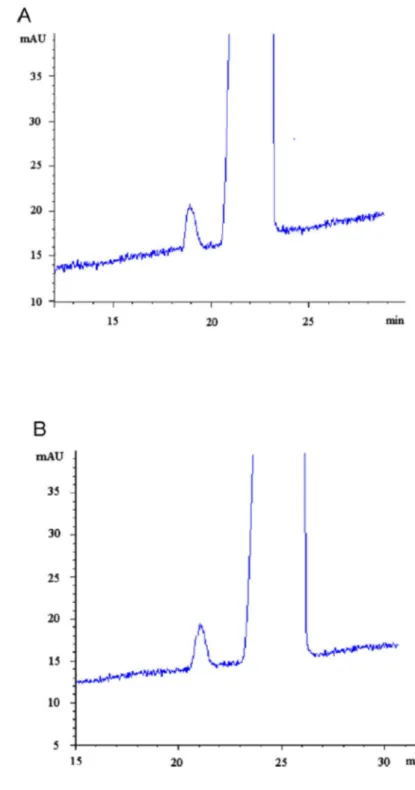
(26) 255. The second type of CIL based on the combination of a chiral cation with [NTf2]- described. 256. in. 257. [bis((trifluoromethyl)sulfonyl)amide] (S-[CHTA]+[NTf2]-). Its combined use with a. 258. second. 259. thioglucopyranoside) allowed the chiral separation of ibuprofen and flurbiprofen,. 260. respectively (Tran and Mejac, 2008). The need for these systems suggested that the chiral. 261. cation of IL provided one or two of three interactions points needed for the chiral. 262. separation. Finally, as it can be seen in Table 1, amino acids are the third type of chiral. 263. cationic moiety employed (Hadjistasi et al., 2013; Zhang et al., 2013a; Zhang et al., 2014).. 264. The potential synergistic effects of L-alanine and L-valine tert butyl esters (L-AlaC4NTf2,. 265. L-ValC4NTf2) with β-CD derivatives or vancomycin for the enantioseparation of different. 266. racemic drugs was evaluated by Zhang et al. (Zhang et al., 2013a; Zhang et al., 2014).. 267. Compared to cyclodextrin or vancomycin alone, significant improvements in the. 268. separation of all the analytes were observed when CILs were added to the separation. 269. media. In both dual systems (CIL/cyclodextrin or CIL/vancomycin), the chiral. 270. recognition process was based on hydrogen-bonding and ionic interactions. The addition. 271. of an organic modifier caused a decrease in EOF which gave more chances for. 272. interactions between the analyte and selectors improving the chiral resolution and. 273. effective selectivity. It is worth noting that the dual systems vancomycin/L-AlaC4NTf2. 274. and vancomycin/L-ValC4NTf2 were successfully applied to test the chiral impurity of. 275. naproxen samples (Zhang et al., 2014). Figure 2 shows the electropherogram obtained. 276. for the optical purity test of (S)-naproxen (bulk drug) with both chiral systems. In both. 277. cases, the content of (S)-naproxen as enantiomeric impurity was 1 %.. the. chiral. literature. selector. is. (sodium. S-[3-(chloro-2-hydroxypropyl)trimethylammonium]. cholate),. and a. third. one. (1-S-octyl-β-D-. 278 279. 25.
(27) 280 281. Figure 2. Optical purity test of (S)-naproxen sample with (A) vancomycin/L-AlaC4NTf2. 282. and (B) vancomycin/L-ValC4NTf2 as chiral systems. Separation conditions: BGE, 15. 283. mM CIL 2 mM vancomycin in 50 mM phosphate buffer containing 10 % methanol v/v. 26.
(28) 284. (pH 7.0), voltage, 20 kV; temperature, 25 °C. Reprinted from (Zhang et al., 2014),. 285. copyright (2014) with permission from Elsevier.. 286 287. Pipecolic acid was also separated by a MEKC methodology in which β-CD and D-. 288. AlaC4NTf2 were combined. To improve the sensitivity, 9-fluorenylmethoxycarbonyl. 289. chloride (FMOC-Cl) was employed as derivatizing agent. The addition of the CIL to the. 290. separation medium containing β-CD, SDS and isopropanol as organic modifier provided. 291. and increase in the resolution of pipecolic acid from 1.14 to 1.87 (Hadjistasi et al., 2013).. 292. Recently, a subtype of this kind of amino acid based CILs characterized by the use of L-. 293. Lactate as anion instead of NTf2 was also employed along with cyclodextrins (Mavroudi. 294. and Kapnissi-Christodoulou, 2015) or cyclofructans (Stavrou et al., 2015) for the. 295. enantioseparation of different chiral drugs. Both studies showed that the use of binary. 296. systems (trimethyl-β-CD/L-AlaC4Lac or cyclofructans/D-AlaC4Lac) enabled to achieve. 297. values of resolution and peaks efficiencies higher than those obtained using the. 298. cyclodextrin or the cyclofructans alone. This fact clearly pointed out that the addition of. 299. the amino acids based CILs provided a synergistic effect needed to obtain a better. 300. enantioseparation of the studied compounds. Lactate was also used as anionic part in. 301. imidazolium CILs. Thus, researchers from Guo´s group investigated the combination of. 302. β-CDs with 1-alkyl-3-methylimidazolium-L-Lactate [EMIm]+[L-Lactate]- which is. 303. commercially available (Zuo et al., 2013; Cui et al., 2013). On the one hand, they applied. 304. a dual system made up of [EMIm]+[L-Lactate]- and β-CD which, under the optimal. 305. conditions, provided the separation of twelve drugs with values of resolution ranging. 306. from 1.26 to 5.20. In addition, they proved as longer alkyl (butyl instead of ethyl-) chains. 307. of the cationic part of CIL offered a slightly higher resolution, at the expense of longer. 308. analysis time. This observation was related to the fact that longer alkyl chains form a 27.
(29) 309. stable bilayer inside the capillary which may provide a more stable environment for the. 310. chiral separation (Zuo et al., 2013). On the other hand, the same research group also. 311. demonstrated the synergistic effect between hydroxypropyl-β-CD and [EMIm]+[L-. 312. Lactate]- for the enantioseparation of ten different drugs. In this case, they illustrated the. 313. low influence of the chirality and nature of the anionic part of CIL on the. 314. enantioseparation (Cui et al., 2013). The two methods optimized by Gou et al. (see Table. 315. 1) were successfully applied to the chiral impurity determination of eszopiclone in. 316. commercial tablets (Zuo et al., 2013) and ofloxacin in bulk samples (Cui et al., 2013).. 317. The zwitterionic structure of amino acids allows their use not only as chiral cations to. 318. obtain CILs but also as chiral anions. As it can be seen in Table 1, within the period of. 319. time covered by this review, different studies were performed to explore the synergistic. 320. effect of this kind of CILs using as amino acids L-Arg, L-Asp, L-Hyp, L-Ile, L-Leu, L-. 321. His, L-Pro in combination with polysaccharides (Zhang and Du, 2013; Chen et al., 2017),. 322. cyclodextrins (Zhang et al., 2016a; Wu et al., 2014; Stanescu et al., 2017), or antibiotics. 323. (Xu et al., 2015). In these works, experimental parameters such as CIL and chiral selector. 324. concentration, buffer pH, type and concentration of organic modifier, voltage and. 325. temperature were systematically optimized. A relevant factor that deserves to be. 326. highlighted is that the structure and properties of the chiral part of these CILs (i.e. the. 327. amino acids) have a high influence on the separation process which may be attributed to. 328. the hydrogen bonding interactions between basic analytes and CILs. Although these. 329. amino acid based CILs were mainly applied to the chiral separation of model drugs. 330. (Zhang and Du, 2013; Chen et al., 2017; Zhang et al., 2016a; Stanescu et al., 2017; Xu et. 331. al., 2015), they have demonstrated to be adequate for the quantification of underivatized. 332. phenylalanine and tryptophan in amino acids injections (Wu et al., 2014).. 333. 28.
(30) 334. The same amino acid derived CIL (L-UCLB) employed by Rizvi and Shamsi (2006) as. 335. sole chiral selector was used also in dual systems with β-CD derivatives. On the one hand,. 336. Wang et al. (2009) carried out the enantiodiscrimination of five anionic drugs using 2,3,6-. 337. tri-O-methyl-β-cyclodextrin and L-UCLB (which forms micelles in aqueous separation. 338. media). As Figure 3 shows, the use of the cyclodextrin alone resolved partially the. 339. enantiomeric mixture of the drugs whereas the addition of L-UCLB to the buffer. 340. containing the cyclodextrin provided the baseline separation for all of them except for. 341. ibuprofen (whose resolution value was 1.32). The effect was the result of the interaction. 342. between the CIL and the cyclodextrin which reduced the interaction of CIL with the. 343. capillary wall. The developed dual system was successfully applied to the quantitative. 344. analysis of ibuprofen racemate in commercial tablets. On the other hand, Liu and Shamsi,. 345. (2014) used the same CIL to resolve four neutral chiral compounds. In addition to L-. 346. UCLB, other cationic CIL surfactants with different head groups were evaluated in. 347. combination with 2,3,6-tri-O-methyl-β-cyclodextrin. A significant effect of the head. 348. group hydrophobicity on the resolution and migration time was observed so that both the. 349. optimum head group and CIL concentration must be screened for each compound. As. 350. Table 1 shows, the most suitable dual system for 1,1´-bi-2-naphthol (BOH), 2,2,2-. 351. trifluoro-1-(9-anthryl)ethanol. 352. (THBP) was 2,3,6-tri-O-methyl-β-cyclodextrin/L-UCLB, whereas for trans-stilbene. 353. oxide (TSO), the system 2,3,6-tri-O-methyl-β-cyclodextrin/ N-undecenoxy-carbonyl-L-. 354. alaninol bromide (L-UCAB), provided better enantioresolution.. (TFAE). and. 7,8,9,10-tetrahydro-benzo[a]pyren-7-ol. 355 356 357 358. 29.
(31) 359 360. Figure 3. Electropherograms corresponding to the chiral separation of ibuprofen,. 361. fenoprofen, indoprofen, suprofen and ketoprofen with (A) absence and (B) presence of. 362. L-UCLB. Separation conditions: BGE, 5 mM acetate containing (A) 35 mM TM-β-CD. 363. and (B) 35 mM TM-β-CD and 1.5 L-UCLB, voltage 30 kV, temperature, 16 ºC. Reprinted. 364. from (Wang et al., 2009), copyright (2009) with permission from Wiley-VCH. 365 366. Finally, Zhang et al. (2016b), synthesized and applied for the first time two spirocyclic. 367. chiral ionic liquids (1-butyl-3-methylimidazolium(T-4)-bis[(2S)-2-(hydroxy-κO)-3-. 368. methyl-butanoato-κO]borate, BMIm+BLHvB-) and (1-butyl-3-methylimidazolium(T-4)-. 369. bis[(αS)-α-(hydroxy-κO)-4-methyl-benzeneacetato-κO]borate, BMIm+BSMB-), as chiral. 370. selectors in a dual separation system with β-cyclodextrin derivatives. The synergistic. 371. effect established in the dual system consisting of BMIm+BLHvB-/ hydroxypropyl-β-CD. 372. provided a significant improvement of the chiral separation for the five drugs analyzed.. 373. The better enantioresolution exhibited by BMIm+BLHvB- compared to BMIm+BSMB-. 374. was attributed to the presence of an aromatic ring in BSMB- which may hinder the 30.
(32) 375. recognition interactions. In addition, the results obtained by a molecular modeling study. 376. indicated that the associated state of CIL and hydrogen bonding interactions played an. 377. essential role in the chiral recognition process.. 378 379. 4. CILs as chiral ligands. 380. A considerable number of works published showed that chiral amino acid ILs are. 381. promising alternatives as chiral ligands in Ligand-Exchange Capillary Electrophoresis. 382. (LE-CE). The first enantioseparation based on the use of this type of CIL was reported in. 383. 2009 by Liu et al. In that work, [1-hexyl-3-methylimidazolium][L-Pro] ([C6mim]+[L-. 384. Pro]-), coordinated with Cu(II) was employed for the enantioseparation of phenylalanine. 385. (Phe), histidine (His), tryptophan (Trp) and tyrosine (Tyr). The results obtained in this. 386. study, in which the CIL was used as both chiral ligand and BGE, demonstrated that the. 387. cation part of CIL and the pH were the key factors in the separation mechanism. The. 388. former factor affected the separation due to the formation of ion pairs of alkylimidazolium. 389. cation and the CIL on the surface of the capillary, where the latter was relevant for the. 390. difference in charge-to-mass ratio between the amino acid-Cu complex and the. 391. uncomplexed amino acid. Subsequently, other Cu(II)-amino acid based CILs were also. 392. applied with success to the separation of other amino acids. Thus, the discrimination. 393. power of a CIL made up L-Proline as cation and [CF3COO]- as anion was evaluated for. 394. the separation of nine pairs of enantiomers of amino acids (derivatized with dansyl. 395. chloride (Dns)) (Mu et al., 2012a). Under the optimal conditions of CIL concentration,. 396. pH and organic acid concentration (see Table 1) resolution values between 0.93-6.72. 397. were achieved for the amino acids analyzed. The use of other anions (such as nitrate (NO3-. 398. ), tetrafluoroborate (BF4-) or sulfate (SO42-)) in the CIL structure also provided the chiral. 399. separation of isoleucine which demonstrated the availability of this system for ligand 31.
(33) 400. exchange separation. Liu et al. (2015), also evaluated the potential of other Cu(II)-amino. 401. acid based CIL, namely tetramethylammonium L-hydroxyproline, [TMA]+[L-OH-Pro]-,. 402. for the enantioseparation of different underivatized aromatic amino acids and 3,4. 403. dihydroxyphenylalanine (DOPA) both in LE-CE and in LE-MEKC. The LE-CE system. 404. enabled to achieve excellent separations for tryptophan and DOPA (resolution of 3.0 and. 405. 4.3, respectively) but no separation was observed for phenylalanine and histidine.. 406. However, when SDS was added, the separation mechanism was based not only on the. 407. differences in complex stability, but also in the differences of partition coefficients. In. 408. this case, although the resolution of DOPA decreased (probably due to its catechol group. 409. which prevents the interaction with the micellar phase), it was possible to reach the. 410. separation of all the amino acids (even the RS of tryptophan increased up to 3.8).. 411. Recently, Jiang et al. (2017) have studied the effect of Cu(II)-amino amide ionic liquids. 412. in the separation of Dns-D,L-amino acids. Among the CILs studied (L-. 413. phenylalaninamide trifluoroacetate, [L-Phn][CF3COO]2, L-prolinamide trifluoroacetate,. 414. [L-Prn][CF3COO]2, and L-alaninamide trifluoroacetate, [L-Aln][CF3COO]2), L-. 415. phenylalaninamide based ionic liquid was chosen as it gave the highest resolution in the. 416. shortest retention time. Parameters such as pH, buffer concentration or Cu(II) and CIL. 417. ratio were evaluated and under the best conditions (see Table 1) 8 pairs of Dns-D,L-. 418. amino acids enantiomers could be baseline separated. In order to stablish the recognition. 419. mechanism that may involve the stabilization of the ternary complex formed between. 420. Cu(II)-IL and the enantiomers, different experiments were carried out. In a first. 421. experiment L-Phn was used as the chiral ligand and in a second one L-Phn and CF3COOH. 422. were used together as additives. However, the best resolution values were obtained with. 423. the addition of the CIL. The method was also applied for the quantification of Dns-D,L-. 424. amino acids and for the enantiomeric purity determination. 32.
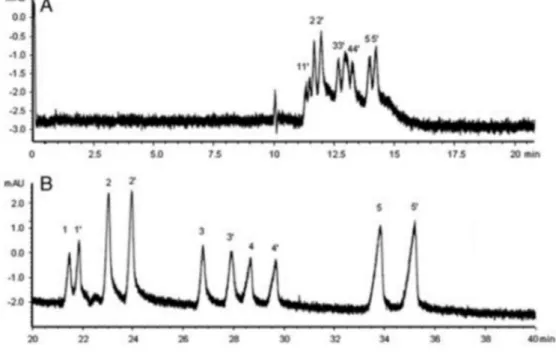
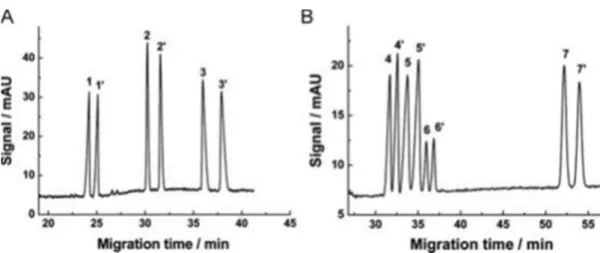
(34) 425. Besides Cu(II), other metal ions such as Zn(II) or Mn(II) were employed to form ligand. 426. selectors with amino acid based CILs (Su et al., 2015; Mu et al., 2012b; Zhang et al.,. 427. 2013b; Sun et al., 2014). The baseline separation of twelve Dns-amino acids and the. 428. partial separation of six Dns-amino acids were obtained using a dual system made up of. 429. (Mn(II)-[1-butyl-3-methylimidazolium][L-alanine]), Mn(II)-[BMIm][L-Ala], and β-CD. 430. as chiral selectors in LE-CE (Su et al., 2015). This CIL was chosen among others with. 431. different alkyl chain length ([1-ethyl-3-methylimidazolium][L-Ala] ([EMIm][L-Ala]),. 432. [1-hexyl-3-methylimidazolium][L-Ala] ([HMIm][L-Ala])) in the imidazolium cation.. 433. Even though the resolution of three model amino acids improved when increasing the. 434. alkyl chain length, [BMIm]+ was selected based on the principle of short migration time. 435. and high resolution. After the quantitative analysis of tyrosine (Tyr) which is the substrate. 436. of tyrosinase, the developed LE-CE methodology was successfully applied to study the. 437. inhibition efficiency of the tyrosinase inhibitors (Su et al., 2015). Regarding Zn(II), its. 438. coordination with an amino acid based CIL whose anion was L-ornithine gave rise to the. 439. baseline separation of eleven pairs of enantiomers of Dns-amino acids (Mu et al., 2012b).. 440. This ligand-exchange system was successfully applied in the screening of D-amino acid. 441. oxidase inhibitors based on the decrease of the concentration of D-methionine (Mu et al.,. 442. 2012b). Zn(II) was also used along with CILs in which L-lysine was employed as anion. 443. (Zhang et al., 2013b; Sun et al., 2014). Zhang et al. (2013b) investigated CILs with. 444. different alkyl chain lengths in the imidazolium cation (Cnmim, from C4 to C8) for the. 445. enantioseparation of seven pairs of enantiomers of Dns-amino acids. Among them, the. 446. best chiral separation was achieved using [C6mim][L-Lys]. Figure 4 depicts the. 447. electropherograms obtained under optimal experimental conditions for the separation of. 448. the amino acids analyzed. On the other hand, Sun et al. (2014) developed a LE-CE. 449. methodology based on the use of CILs with pyridinium as cation and L-Lys as anion and 33.
(35) 450. coordinated with Zn(II). 1-ethylpyridinium [Epy][L-Lys], 1-butylpyridinium [Bpy][L-. 451. Lys], 1-hexylpyridinium [Hpy][L-Lys] and 1-octylpyridinium [Opy][L-Lys] were. 452. synthesized and tested as ligand selectors for the separation of Dns-amino acids. The. 453. results obtained demonstrated that an increase in the alkyl chain length diminished the. 454. solubility of the CILs in the buffer which had a negative effect on the enantioseparation.. 455. Using [Epy][L-Lys]/Zn(II) and the appropriate experimental conditions (see Table 1). 456. eight pairs of enantiomers of Dns-amino acids were baseline separated and three pairs. 457. partially separated. In addition, this LE-CE system was employed to study the kinetics of. 458. L-amino acid oxidase.. 459 460. Figure 4. Electropherograms corresponding to the chiral separation of Dns-amino acids. 461. using [C6mim][L-Lys] as chiral ligand. Separation conditions: BGE, 100 mM boric acid,. 462. 5 mM ammonium acetate, 3 mM ZnSO4, 6 mM [C6mim][L-Lys] (pH 8.2), voltage, -20. 463. kV; temperature, 25 °C. Peak identity: (A) 1. Dns-D-Ile, 1’. Dns-L-Ile; 2. Dns-D-Met, 2’.. 464. Dns-L-Met; 3. Dns-D-Ser, 3’. Dns-L-Ser; (B) 4. Dns-D-Thr, 4’. Dns-L-Thr; 5. Dns-D-. 465. Phe, 5’. Dns-L-Phe; 6. Dns-D-Tyr, 6’. Dns-L-Tyr; 7. Dns-D-Asn, 7’. Dns-L-Asn.. 466. Reprinted from (Zhang et al. 2013b), copyright (2013) with permission from Wiley-VCH.. 467. 34.
(36) 468. Even though most of the works described in the literature to carry out chiral separations. 469. by LE-CE employed an amino acid CIL, Huang et al. (2016) demonstrated the potential. 470. of [EMIM][L-Tar] as chiral ligand for the enantioseparation of tryptophan, tyrosine and. 471. phenylalanine enantiomers. Under alkaline conditions, the use of [EMIM][L-Tar]. 472. combined with Ni(II) gave rise to the best enantioseparations whereas the complexation. 473. with other metals such as Zn(II) or Co(II) provided only partial separation and no. 474. separation was observed with Cu(II). The study of the separation mechanism. 475. demonstrated that the effect of CIL in the separation is complex and it cannot be. 476. considered as simple superposition of the effect of cations and anions.. 477 478. 5. Concluding remarks. 479. Despite many chiral selectors are available to carry out chiral separations by CE, the. 480. search for new selectors able to provide high enantiomeric resolutions is a relevant topic. 481. in this field. As it is shown in this review, over the last ten years different CE. 482. methodologies based on the use of CILs as sole chiral selectors, chiral selectors in dual. 483. systems, or chiral ligands have been developed for the enantioseparation of a broad range. 484. of chiral compounds (mainly pharmaceuticals and amino acids). From the positive results. 485. obtained in all these studies it is quite clear that CILs possess a high potential to carry out. 486. chiral analyses by CE. Among the different parameters that must be optimized to achieve. 487. with success the resolution of enantiomers using CILs, the type and concentration of. 488. CILs, the buffer pH and the chain length of the cationic part have demonstrated to be the. 489. most relevant. These parameters have a high influence on the adsorption of the cationic. 490. part of the CIL on the capillary wall which modifies the EOF as well as on the effective. 491. charge mobility of both the analytes and the CILs that influence their interactions. In spite 35.
(37) 492. of the high discrimination power showed by CILs, till now their contribution in the chiral. 493. analysis of real samples is scarce. Therefore, although CILs have received a significant. 494. attention, their full potential as chiral selectors in CE has not yet achieved so that it is. 495. expected that the development of new methodologies by CE using CILs as chiral selectors. 496. will keep growing in the near future.. 497 498. Acknowledgements. 499. Authors thank financial support from the Spanish Ministry of Economy and. 500. Competitiveness (MINECO) (project CTQ2016-76368-P) and the University of Alcalá. 501. (project CCG2016/EXP-071). M.C.P. also thanks MINECO for her “Ramón y Cajal”. 502. research contract (RYC-2013-12688), and M.G. thanks the University of Alcalá for her. 503. pre-doctoral contract.. 504. 36.
(38) 505. References. 506. Ali, I.; Suhail, M.; Sanagi, M. M.; Aboul-Enein, H. Y. Ionic liquids in HPLC and CE: A. 507. hope for future, Crit. Rev. Anal. Chem., 2017, 47, 332-339.. 508. Boon, Y. H.; Ravoov, M.; Zain, N. N. M.; Mohamad, S.; Osman, H. Combination of. 509. cyclodextrin and ionic liquid in analytical chemistry: Current and future perspectives,. 510. Crit. Rev. Anal. Chem., 2017, 47, 332-339.. 511. Bwambok, D. K.; Marwani, H. M.; Fernand, V.E.; Fakayode, S. O.; Lowry, M.;. 512. Negulescu, I.; Strongin, R. M.; Warner, I. M. Synthesis and characterization of novel. 513. chiral ionic liquids and investigation of their enantiomeric recognition properties,. 514. Chirality, 2008, 20, 151-158.. 515. Chen, J.; Du, Y.; Sun, X. Investigation of maltodextrin-based synergistic system with. 516. amino acid chiral ionic liquid as additive for enantioseparation in capillary. 517. electrophoresis, Chirality, 2017, 29, 824-835.. 518. Cui, Y.; Ma, X.; Zhao, M.; Jiang, Z.; Xu, S.; Guo, X. Combined use of ionic liquid and. 519. hydroxypropyl-β-cyclodextrin for the enantioseparation of ten drugs by capillary. 520. electrophoresis, Chirality, 2013, 25, 409-414.. 521. de Rooy, S.L.; Li, M.; Bwambok, D.K.; El-Zahab, B.; Challa, S.; Warner, I.M.. 522. Ephedrinium-based protic chiral ionic liquids for enantiomeric recognition, Chirality,. 523. 2011, 23, 54-62.. 524. Foreiter, M.B.; Nimal Gunaratne, H.Q.; Nockemann, P.; Seddon, K.R.; Srinivasan, G.. 525. Novel chiral ionic liquids: physicochemical properties and investigation of the internal. 526. rotameric behavior in the neat system, Phys. Chem. Chem. Phys., 2014, 16, 1208.. 527. François, Y.; Varenne, A.; Juillerat, E.; Villemin, D.; Gareil, P. Evaluation of chiral ionic. 528. liquids as additives to cyclodextrins for enantiomeric separations by capillary. 529. electrophoresis, J. Chromatogr. A, 2007, 1155, 134-141. 37.
(39) 530. Hadjistasi, C.A.; Stavrou, I.J.; Stefan-Van Staden, R-I.; Aboul-Enein, H.Y.; Kapnissi-. 531. Christodoulou, C.P. Chiral separation of the clinically important compounds fucose and. 532. pipecolic acid using CE: Determination of the most effective chiral selector, Chirality,. 533. 2013, 25, 556-560.. 534. Ho, T.D.; Zhang, C.; Hantao, L.W.; Anderson, J. L. Ionic liquids in analytical chemistry:. 535. Fundamentals, advances and perspectives, Anal. Chem, 2014, 86, 262-285.. 536. Huang, L.; Yu, L-S.; Chen, Y-T.; Li, Y-X. Separation of amino acid enantiomers using. 537. capillary electrophoresis with a new chiral ligand, LCGC Europe, 2016, 29, 618-623.. 538. Huang, Y.; Yao, S.; Song, H. Application of ionic liquids in liquid chromatography and. 539. electrodriven separation, J. Chromatogr. Sci., 2013, 51, 739-752.. 540. Jiang, J.; Mu, X.; Qiao, J.; Su, Y.; Qi, L. New chiral ligand exchange capillary. 541. electrophoresis system with chiral amino amide ionic liquids as ligands, Talanta, 2017,. 542. 175, 451-456.. 543. Kapnissi-Christodoulou, C.P.; Stavrou, I.J.; Mavroudi, M.C. Chiral ionic liquids in. 544. chromatographic and electrophoretic separations, J. Chromatogr. A, 2014, 1363, 2-10.. 545. Kartsova, L.A.; Bessonova, E.A.; Kolobova, E.A. Ionics liquids as modifiers of. 546. chromatographic and electrophoretic systems, J. Anal. Chem., 2016, 71, 141-152.. 547. Li, M.; Bwambok, D.K; Fakayode, S.O.; Warner, I.M. Chiral ionic liquids in. 548. chromatographic separation and spectroscopic discrimination. In Chiral recognition in. 549. separation methods; Berthod, A., Ed.; Springer-Verlag: Berlin, Germany, 2010; pp. 289-. 550. 329.. 551. Liu, Q.; Wu, K.; Tang, F.; Yao, L.; Yang, F.; Nie, Z.; Yao, S. Amino acid ionic liquids. 552. as chiral ligands in ligand-exchange chiral separations, Chem. Eur. J., 2009, 15, 9889-. 553. 9896.. 38.
(40) 554. Liu, R.; Du, Y.; Chen, J.; Zhanf, Q.; Du, S.; Feng, Z. Investigation of the. 555. enantioselectivity of tetramethylammonium L-hydroxyproline ionic liquid as a novel. 556. chiral ligand in ligand-exchange CE and ligand -exchange MEKC, Chirality, 2015, 27,. 557. 58-63.. 558. Liu, Y. Shamsi, S.A., Combined use of chiral ionic liquid surfactants and neutral. 559. cyclodextrins: Evaluation of ionic liquid head groups for enantioseparation of neutral. 560. compounds in capillary electrophoresis, J. Chromatogr. A, 2014, 1360, 296-304.. 561. Ma, Z.; Zhang, L.; Lin, L.; Ji, P.; Guo, X. Enantioseparation of rabeprazole and. 562. omeprazole by nonaqueous capillary electrophoresis with an ephedrine-based ionic liquid. 563. as the chiral selector, Biomed. Chromatogr. 2010, 24, 1332-1337.. 564. Mavroudi, M.C.; Kapnissi-Christodoulou, C.P. Combined use of L-alanine tert butyl ester. 565. lactate and trimethyl-β-cyclodextrin for the enantiomeric separations of 2-arylpropionic. 566. acids nonsteroida anti-inflammatory drugs, Electrophoresis, 2015, 36,. 567. Mofaddel, N.; Krajian, H.; Villemin, D.; Desbène, P.L. Enantioseparation of binaphthol. 568. and its mono derivatives by cyclodextrin-modified capillary zone electrophoresis, J.. 569. Chromatogr. A 1211, 2008, 142-150.. 570. Mu, X.; Qi, L.; Zhang. H.; Shen, Y.; Qiao, J.; Ma, H. Ionic liquids with amino acids as. 571. cations: Novel chiral ligands in chiral ligand-exchange capillary electrophoresis, Talanta,. 572. 2012a, 97, 349-354.. 573. Mu, X.; Shen, Y.; Zhang, H.; Qiao, J.; Ma, H. A novel chiral ligand exchange capillary. 574. electrophoresis system with amino acid ionic liquid as ligand and its application in. 575. screening D-amino-acid oxidase inhibitors, Analyst, 2012b, 137, 4235-4240.. 576. Payagala, T.; Armstrong, D.W. Chiral ionic liquids: a compendium of syntheses and. 577. aplications (2005-2012), Chirality, 2012, 24, 17-53.. 2442-2450.. 39.
(41) 578. Rizvi, S.A.; Shamsi, S.A. Synthesis, characterization, and application of chiral ionic. 579. liquids ans their polymers in micellar electrokinetic chromatography, Anal. Chem., 2006,. 580. 78, 7061-7069.. 581. Rousseau, A.; Florence, X.; Pirotte, B.; Varenne, A.; Gareil, P.; Villemin, D.; Chiap, P.;. 582. Crommen, J.; Fillet, M.; Servais, A-C. Development and validation of a nonaqueous. 583. capillary electrophoretic method for the enantiomeric purity determination of a synthetic. 584. intermediate of new 3,4-dihydro-2,2-dimethyl-2H-1-benzopyrans using a single-isomer. 585. anionic cyclodextrin derivative and an ionic liquid, J. Chromatogr. A, 2010, 1217, 7949-. 586. 7955.. 587. Stanescu, M.; Arama, C.; Monciu, C.M. Chiral ionic liquids in chiral electrophoretical. 588. separations, Farmacia, 2015, 63, 623-630.. 589. Stanescu, M.; Monciu, C-M.; Nitulescu, M.; Draghici, C.; Doicin, I.; Lupascu, G.; Lupu,. 590. A.; Arama, C-C. Amino acid based chiral ionic liquids for enantiomer separation by. 591. capillary electrophoresis, Farmacia, 2017, 65, 46-55.. 592. Stavrou, I.J.; Kapnissi-Christodoulou, C.P. Use of chiral amino acid ester-based ionic. 593. liquids as chiral selectors in CE, Electrophoresis, 2013, 34, 524-530.. 594. Stavrou, I.J.; Breitbach, Z.S.; Kapnissi-Christodoulou, C.P. Combined use of. 595. cyclofructans and an amino acid ester-based ionic liquid for the enantioseparation of. 596. huperzine A and coumarin derivatives in CE, Electrophoresis, 2015, 36, 3061-3068.. 597. Su, Y.; Mu, X.; Qi, L. Development of a capillary electrophoresis system with Mn(II). 598. complexes and β-cyclodextrin as the dual chiral selectors for enantioseparation of dansyl. 599. amino acids and its application in screening enzyme inhibitors, RSC Adv., 2015, 5, 28762-. 600. 28768.. 40.
(42) 601. Sun, B.; Mu, X.; Qi, L. Development of new chiral ligand exchange capillary. 602. electrophoresis system with amino acid ionic liquids ligands and its application in. 603. studying the kinetics of L-amino acid oxidase, Anal. Chim. Acta, 2014, 821, 97-102.. 604. Sun, P.; Armstrong, D.W. Ionic liquids in analytcal chemistry, Anal. Chim. Acta, 2010,. 605. 661, 1-16.. 606. Tan, Z-Q.; Liu, J-F.; Pang, L. Advances in analytical chemistry using the unique. 607. properties of ionic liquids, Trends Anal. Chem., 2012, 39, 218-227.. 608. Tang, S.; Liu, S.; Guo, Y.; Liu, Z.; Jiang, S. Recent advances of ionic liquids and. 609. polymeric ionic liquids in capillary electrophoresis and capillary electrochromatography,. 610. J. Chromatogr. A, 2014, 1357, 147-157.. 611. Tran, C.D.; Oliveira, D.; Yu, S. Chiral ionic liquid that functions as both solvent and. 612. chiral selector for the determination of enantiomeric composition of pharmaceutical. 613. products, Anal. Chem. 2006, 78, 1349-1356.. 614. Tran, C.D.; Oliveira, D. Fluorescence determination of enantiomeric composition of. 615. pharmaceuticals via use of ionic liquid that serves as both solvent and chiral selector,. 616. Anal. Biochem. 2006, 356, 51-58.. 617. Tran, C.D.; Mejac, I. Chiral ionic liquids for enantioseparation of pharmaceutical. 618. products by capillary electrophoresis, J. Chromatogr. A, 2008, 1204, 204-209.. 619. Wang, B.; He, J.; Bianchi, V.; Shamsi, S.A. Combined use of chiral ionic liquid and. 620. cyclodextrin for MEKC: Part I. Simultaneous enantioseparation of anionic profens,. 621. Electrophoresis, 2009, 30, 2812-2819.. 622. Wu, Y.; Wang, G.; Zhao, W.; Zhang, H.; Jing, H.; Chen, A. Chiral separation of. 623. phenylalanine and tryptophan by capillary electrophoresis using a mixture of β-CD and. 624. chiral ionic liquid ([TBA][L-ASP]) as selectors, Biomed. Chromatogr., 2014, 28, 610-. 625. 614. 41.
(43) 626. Xu, G.; Du, Y.; Du, F.; Chen, J.; Yu, T.; Zhang, Q.; Zhang, J.; Du, S.; Feng, Z.. 627. Establishment and evaluation of the novel tetramethylammonium-L-Hydroxyproline. 628. chiral ionic liquid synergistic system based on clindamycin phosphate for. 629. enantioseparation by capillary electrophoresis, Chirality, 2015, 27, 598-604.. 630. Yu, J.; Zuo, L.; Liu, H.; Zhang, L.; Guo, X. Synthesis and application of a chiral ionic. 631. liquid functionalized β-cyclodextrin as a chiral selector in capillary electrophoresis,. 632. Biomed. Chromatogr. 2013, 27, 1027-1033.. 633. Yuan, L.M.; Zhou, Y.; Meng, X.; Li, Z.Y.; Zi, M.; Chang, Y.X. (R)-N,N,N-trimethyl-2-. 634. aminobutanol-bis(trifluoromethane-sulfon)imidate chiral ionic liquid used as chiral. 635. selector in HPCE, HPLC ad CGC, Analytical Letters, 2006, 39, 1439-1449.. 636. Yuanhong, X.; Wang, E. Ionic liquids used and analyzed by capillary and microchip. 637. electrophoresis, J. Chromatogr. A, 2009, 1216, 4817-4823.. 638. Zhang, H.; Qi, L.; Shen, Y.; Qiao, J.; Mao, L. L-Lysine-derived ionic liquids as chiral. 639. ligands of Zn (II) complexes used in ligand-exchange CE, Electrophoresis, 2013b, 34,. 640. 846-853.. 641. Zhang, J.; Du, Y.; Zhang, Q.; Chen, J.; Xu, G.; Yu, T.; Hua, X. Investigation of the. 642. synergistic effect with amino acid-derived chiral ionic liquids ad additives for. 643. enantiomeric separation in capillary electrophoresis, J. Chromatogr. A, 2013a, 1316, 119-. 644. 126.. 645. Zhang, J.; Du, Y.; Zhang, Q.; Lei, Y. Evaluation of vancomycin-based synergistic system. 646. with amino acid ester chiral ionic liquids as additives for enantioseparation of non-. 647. steroidal anti-inflamatory drugs by capillary electrophoresis, Talanta, 2014, 119, 193-. 648. 201.. 42.
(44) 649. Zhang, Q.; Du, Y. Evaluation of the enantioselectivity of glycogen-based synergistic. 650. system with amino acid chiral ionic liquids as additives in capillary electrophoresis, J.. 651. Chromatogr. A, 2013, 1306, 97-103.. 652. Zhang, Q.; Du, Y.; Zhang, J.; Feng, Z.; Zhang, Y.; Li, X. Tetramethylammonium-. 653. lactobionate: A novel ionic liquid chiral selector based on saccharides in capillary. 654. electrophoresis, Electrophoresis, 2015, 36, 1216-1223.. 655. Zhang, Q.; Qi, X.; Feng, C.; Tong, S.; Rui, M. Three chiral ionic liquids as additives for. 656. enantioseparation in capillary electrophoresis and their comparison with conventional. 657. modifiers, J. Chromatogr. A, 2016a, 1462, 146-152.. 658. Zhang, Y.; Du, S.; Feng, Z.; Du, Y.; Yan, Z. Evaluation of synergistic enantioseparation. 659. systems with chiral spirocyclic ionic liquids as additives by capillary electrophoresis,. 660. Anal. Bioanal. Chem., 2016b, 408, 2543-2555.. 661. Zhu, Q.; Scriba, G.K.E. Advances in the Use of Cyclodextrins as Chiral Selectors in. 662. Capillary. 663. Chromatographia, 2016, 79, 1403-1435.. 664. Zuo, L.; Meng, H.; Wu, J.; Jiang, Z.; Xu, S.; Guo, X. Combined use of ionic liquid and. 665. β-CD for enantiosperation of 12 pharmaceuticals using CE, J. Sep. Sci, 2013, 36, 517-. 666. 523.. Electrokinetic. Chromatography:. Fundamentals. and. Applications,. 43.
(45)
Figure
Documento similar
