Reception date: 5 June 2017 • Acceptance date: 29 July 2017
Developing Self-Efficacy through a Massive Open Online
Course on Study Skills
Brenda Cecilia Padilla Rodriguez
Autonomous University of Nuevo Leon (Mexico) [email protected]
Alejandro Armellini
University of Northampton (United Kingdom) [email protected]
Abstract
Self-efficacy is a strong predictor of academic performance, and an area of interest for higher education institutions. This paper reports on a massive open online course (MOOC) on study skills, aimed at increasing self-efficacy. Participants (n=32) were from Mexico and Colombia, with ages ranging from 21 to 45 years. At the beginning and the end of the MOOC, learners answered a survey that included the General Self-Efficacy Scale, items on specific study skills, and space for optional comments. Findings show statistically significant increases in general self-efficacy after completing the MOOC, as well as in the perceived self-efficacy related to five out of six study skills. Comments suggest that participants are aware of and value their own improvement. For students, MOOCs can represent low-risk, formative opportunities to widen their knowledge and increase their self-efficacy. For academic institutions, well-designed MOOCs on study skills provide a means to support students.
Keywords: Self-efficacy; study skills; massive open online courses; MOOCs; online learning
Introduction
Self-efficacy refers to people’s beliefs about their capabilities to produce expected outcomes (Bandura, 1994). It is a strong predictor of academic performance and learning (Aurah, 2013; Bartimote-Aufflick, Bridgeman, Walker, Sharma & Smith, 2015). It has also been positively correlated to student retention (Devonport & Lane, 2006; Street, 2010). Beliefs on self-efficacy influence how people feel, think, behave and motivate themselves (Bandura, 1994). Students with a high level of self-efficacy are confident in their own skills for success, self-motivate, regulate their learning, require minimal guidance, persist in the face of difficulties and tend to have high goal achievement. On the other hand, students with a low level of self-efficacy are insecure about their ability for success, report believing that intelligence is unchangeable, are vulnerable to procrastination and tend to have deficient academic results (Bandura, 2002; Komarraju & Nadler, 2013; Wäschle, Allgaier, Lachner, Fink & Nückles, 2014).
identify their own misconceptions, capitalising on the affordances of technology, including multimedia, providing additional resources and activities for challenging concepts, and encouraging students to share their own personal experiences. These strategies match course design recommendations (eg, McGee & Reis, 2012) and what is generally considered ‘good’ teaching. It thus seems that well-designed and adequately-facilitated learning interventions have a role in enhancing self-efficacy.
Educators have long sought ways to conceptualise learning in an attempt to help students thrive in a constantly evolving society. Heutagogy suggests that learners are autonomous and self-determined. It emphasises the development of competencies (the ability to acquire knowledge and skills) and capabilities (confidence in one’s own competencies). A capable, self-determined individual will exhibit self-efficacy (see Blaschke, 2012).
Higher education institutions have designed and implemented different ways to support students in the development of their self-efficacy. A study with university participants measured their level of self-efficacy before and after an optional 14-week workshop on learning strategies and study techniques. Students (n=23) showed a minor but significant increase in their self-efficacy, while a control group (n=24) showed no improvement (Gargallo, Campos & Almerich, 2016). A report on college students taking a 7-week study skills course (n=126) and students enrolled in a general education course (n=111) showed similar results. The first group had a lower initial level of self-efficacy. They showed significantly greater improvements than comparison students, reaching equivalent levels or surpassing them at post-test. Focusing on self-efficacy in study skills courses appears to foster academic success (Wernersbach et al., 2014). This implies going beyond the content to address learners’ confidence in their own skills. For example, students’ beliefs that they can achieve their goals might be more important for their success than their knowledge of different note-taking techniques or reliable academic databases.
Universities have recently turned to massive open online courses (MOOCs) as a space to study learners’ self-efficacy (eg, Hood, Littlejohn & Milligan, 2015; Verzat, Jore, Toutain & Silberzahn, 2015). MOOCs are considered massive not necessarily because they have a large number of participants but because their technological infrastructure could support them (Stewart, 2013). They are online because they are delivered via the Internet. They are open because any person in the world with Internet access can participate free of charge, without having to meet any pre-requisites of knowledge or demographics (Anderson, 2013). They are courses because they represent coherent academic interventions with a defined set of learning outcomes (Youell, 2011), and usually have start and end dates. MOOCs have been widely used to test different approaches to learning and teaching (Sharples et al., 2014). They can benefit people with different demographic profiles (eg, location, gender, educational level and employment status) and motivations (Bayeck, 2016; Padilla Rodriguez, Estrada Rocha & Rodriguez Nieto, 2017). They seem to have the potential to enhance learner self-efficacy through a well-designed (though often ignored) use of videos, quizzes and discussion forums (Hodges, 2016). MOOCs can be studied on their own, or as part of a blended learning strategy, in which some MOOC resources are reused in or outside the classroom (Bruff, Fisher, McEwen & Smith, 2013).
type of intervention as a way to support struggling students. This paper reports on the first pilot of a Study Skills MOOC that was delivered jointly between the Autonomous University of Nuevo Leon (Mexico) and the University of Northampton (United Kingdom). The objective of the study was to assess participants’ self-efficacy before and after taking the MOOC, and thus to evaluate the suitability of the MOOC as a means of enhancing learners’ self-efficacy.
Study Skills MOOC
The Study Skills MOOC found its inspiration on the Study Skills for Academic Success (SSAS) MOOC, developed by the University of Northampton. The SSAS free online course was designed for everyone, but it focused on first-year university students. Specifically, it aimed to help participants transition to higher education, improve their study skills, develop their academic confidence, gain a greater understanding of what is expected of them as they study for a degree, develop their metacognition, and achieve better grades in their assignments.
While maintaining the spirit of the SSAS MOOC, the Study Skills MOOC was adapted to better suit the needs of a Latin American audience. It was delivered in Spanish on the Blackboard Open Education platform. Course topics were based on key academic challenges reported by first-year students at the Autonomous University of Nuevo Leon. These difficulties included the following study skills:
1. Managing time efficiently 2. Taking effective notes
3. Searching for reliable information 4. Understanding academic texts 5. Using APA format
6. Writing academically
The Study Skills MOOC, which was discipline-neutral and non-credit bearing, provided a structured space where students could practice and develop their academic skills over a period of six weeks. Each week participants viewed a lesson with several units. Each lesson matched one study skill and had explicit learning outcomes. Each unit included multimedia materials and a formative activity. Activities mostly relied on student engagement in discussion forums and followed the e-tivity framework (Salmon, 2002), which promotes active and participative online learning. These activities included the following key elements:
• ‘Spark’ – a resource, such as an image or a video, aimed at generating interest in the topic of the activity
• Learning objective – contributing to the achievement of the lesson’s overall learning outcome
• Task – with specific and clear instructions of what was expected from the learners
• Response – requiring participants to reflect and comment on others’ contributions
Some activities were based on multiple-choice questions with automated feedback. The final unit of each lesson included an overarching assignment that encouraged learners to practice that week’s study skill.
Skills MOOC, outlining the structure of the course and including links to materials and activities (in
Spanish), is available at http://tinyurl.com/hemooc-guion.
Two staff facilitators and three student moderators provided support throughout the MOOC. Participants received weekly follow-up emails with summaries of discussions and tips on how to optimise their learning experience. A Twitter hashtag (#hemooc) enabled interactions beyond the boundaries of the MOOC platform. Facilitators tweeted regularly during the delivery of the MOOC. The recommended study time was three hours per week. Non-credit bearing certificates of participation were available for learners who completed each overarching assignment.
Methodology
Participants
The first pilot of the Study Skills MOOC was advertised on social media (Facebook & Twitter) and through word of mouth. Only 125 of the 323 people who signed up for the MOOC effectively started the course posting at least one message on the discussion forums. The sample of this study comprises 32 participants (14 female and 18 male), which is the total number of learners who completed the initial and final surveys. While this number might seem small, it represents 25.6% of the 125 MOOC participants who started the course. This is above the current MOOC completion average of 15% (Jordan, 2015).
Participants’ ages ranged from 21 to 45 years, with an average of 26.4. Eight were from Colombia, and 24, from Mexico. Most participants (n=23) were time undergraduate students; seven were full-time employees; one had a part-full-time job, and one was retired. Twenty-two had previous experience with online courses. Ten had previously studied online for academic credits. Nine had studied online as part of their job’s continuous professional development.
Instruments
An online survey assessed participants’ self-efficacy at the beginning and the end of the Study Skills MOOC. It included the Spanish version of the General Self-Efficacy Scale (Baessler & Schwarzer, 1996), which focuses on the global sense of a person’s confidence in their own ability to face a range of new or stressful situations. This instrument has been widely tested in Spanish-speaking countries, such as Mexico and Spain (Padilla, Acosta, Gomez, Guevara & González, 2006). It is considered a reliable and valid measure of the perception of self-efficacy. It has a Cronbach alpha of around 0.86. It consists of 10 items, with answer options corresponding to a four-point Likert scale.
Six additional items addressed self-efficacy related to the specific study skills the MOOC covered. Using a five-point Likert scale, participants were asked to rate their confidence in their own study skills: managing their time efficiently, taking effective notes, searching for reliable information, understanding academic texts, using APA format and writing academically. Space for optional comments was also available.
Procedure
During the first and final lessons of the MOOC, participants were invited to answer the survey. The mean of the answers to the General Self-Efficacy Scale was calculated, as well as the means of the six items that addressed specific study skills. The nonparametric Wilcoxon signed-rank test (Shier, 2004) was conducted to check the significance of self-efficacy differences before and after the MOOC. Comments were analysed for salient themes and common patterns. Participants were assigned a generic ID (eg, P1, P2).
Results & Discussion
This pilot of the Study Skills MOOC yielded encouraging results. Participants reported increases in their self-efficacy. The General Self-Efficacy Scale showed an initial mean of 3.48 out of 4 (s.d. = 0.30) and a final one of 3.7 (s.d. = 0.38). While the difference is minimal, a Wilcoxon signed-rank test confirmed that it is statistically significant (z = -2.82, p=0.005). This finding is in line with previous studies (eg, Gargallo et al., 2016; Wernersbach et al., 2014), and suggests that MOOC participants improved their confidence in their own skills for success, self-motivation, learning regulation, endurance and goal achievement (Komarraju & Nadler, 2013; Wäschle et al., 2014). For comparison purposes, we calculated the mean of the initial general self-efficacy of MOOC participants who only answered the first survey (n=81). It was the similar to the one of completers, x̅ = 3.51, s.d. = 0.49.
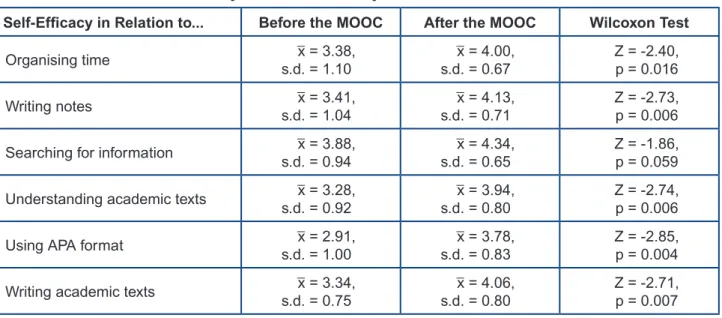
The means of self-efficacy related to specific study skills (maximum value = 5) provided further information addressing the need to assess at task level (Wang & Baker, 2015). The differences between participants’ mean self-efficacy before and after the MOOC ranged from 0.46 to 0.87 points. They were all statistically significant, except self-efficacy related to searching for information (see Table 1).
Table 1: Study Skills’ Self-Efficacy Before and After the MOOC
Self-Efficacy in Relation to... Before the MOOC After the MOOC Wilcoxon Test
Organising time s.d. = 1.10x̅ = 3.38, s.d. = 0.67x̅ = 4.00, Z = -2.40,p = 0.016
Writing notes s.d. = 1.04x̅ = 3.41, s.d. = 0.71x̅ = 4.13, Z = -2.73,p = 0.006
Searching for information s.d. = 0.94x̅ = 3.88, s.d. = 0.65x̅ = 4.34, Z = -1.86,p = 0.059
Understanding academic texts s.d. = 0.92x̅ = 3.28, s.d. = 0.80x̅ = 3.94, Z = -2.74,p = 0.006
Using APA format s.d. = 1.00x̅ = 2.91, s.d. = 0.83x̅ = 3.78, Z = -2.85,p = 0.004
Writing academic texts s.d. = 0.75x̅ = 3.34, s.d. = 0.80x̅ = 4.06, Z = -2.71,p = 0.007
Some participants provided optional comments in the open section at the end of the surveys, 18 in the initial application and 14 in the final one. Salient themes were identified. At the beginning of the MOOC, students focused on difficulties faced, for example:
• I don’t trust my skills to use some study strategies. [P2]
• Whenever I deal with a topic, I need to read it -more or less- two times to understand it. [P27]
Respondents also described the strategies they used to address their challenges:
• Mental maps help me study. [P30]
• Sometimes I listen to classical music, as it helps me concentrate… [P9]
At the end of the MOOC, 12 out of the 14 comments focused on learning, either in general:
• This course was very useful for me; I learned a lot. [P1] • I think my existing skills have been perfected. [P6]
Or specifically:
• Thanks to this course I have improved in several aspects, such as organising my time and using an adequate space for academic activities. I am also now able to use effective notes to understand texts more efficiently. Many questions I had on how to use citations and references were answered in this course…. [P18]
• I have learned about the search engine Google Scholar. [P32]
A change in the narratives is clear: The focus shifted from challenges to learning and acquired skills, suggesting participants’ awareness of their own improvement. As self-efficacy is a strong predictor of academic performance, its increase will likely translate into better academic results (Aurah, 2013; Bartimote-Aufflick et al., 2015; Komarraju & Nadler, 2013; Putwain et al., 2013; Wäschle et al., 2014), which could in turn enhance retention and progression.
Well-designed and facilitated MOOCs on study skills could represent an interesting opportunity in challenging educational contexts, such as Mexico, as they can offer not only delivery at scale but also a way to tackle common causes of attrition in universities (eg, Torres Balcazar et al., 2011) and promote student retention (Davenport & Lane, 2006; Street, 2010). Additionally, they address recommendations for the incorporation of technology in education (ANUIES, 2000; México Digital, 2015). They can be used on their own, embedded within a different programme of study or as part of a blended learning strategy (Bruff et al., 2013), offering a broad range of support possibilities for academic institutions. As was the case in this study, MOOCs can benefit different audiences, such as undergraduate students and full-time employees (Bayeck, 2016; Padilla Rodriguez et al., 2017).
Conclusions
their own abilities. MOOCs are a means through which colleges and universities can reach a global audience with a potentially high value learning opportunity.
The strong link between academic achievement and self-efficacy suggests that MOOCs, such as the one we report on in this article, can be a valuable resource to address attrition, enhance retention and improve students’ study skills. The associated benefits of well-designed MOOCs that foster self-efficacy are yet to be thoroughly assessed. Future research should focus on the impact of increased self-efficacy on different target audiences operating in different contexts. While the Study
Skills MOOC was created originally with a traditional student population in mind, non-traditional
learners, such as full-time employees and retired individuals, also joined. What are the benefits for the different audiences? In addition, we encourage other researchers to explore different ways in which the Study Skills MOOC or parts of it can be incorporated into the higher education curriculum.
Acknowledgement
This work was supported by the National Council of Science and Technology (CONACYT) in Mexico.
References
Anderson, T. (2013). Promise and/or Peril: MOOCs and Open and Distance Education. Vancouver: COL. Retrieved from http://hdl.voced.edu.au/10707/327825
Asociación Nacional de Universidades e Instituciones de Educación Superior (ANUIES) (2000). La
Educación Superior en el Siglo XXI. Líneas estratégicas de desarrollo. Una propuesta de la ANUIES. México. Retrieved from http://www.ses.unam.mx/curso2016/pdf/12-ago-anuies.pdf
Aurah, C. (2013). The Effects of Self-efficacy Beliefs and Metacognition on Academic Performance: A Mixed Method Study. American Journal of Educational Research, 1(8), 334–343. https://doi. org/10.12691/education-1-8-11
Baessler, J., & Schwarzer, R. (1996). Evaluación de la autoeficacia: Adaptación española de la es-cala de Autoeficacia General. Ansiedad y Estrés, 2(1), 1–8.
Bandura, A. (1994). Self-efficacy. In V. S. Ramachaudran (Ed.). Encyclopedia of human behavior (Vol. 4, pp. 71–81). New York: Academic Press.
Bandura, A. (2002). Growing Primacy of Human Agency in Adaptation and Change in the Electronic Era. European Psychologist, 7(1), 2–16. https://doi.org/10.1027/1016-9040.7.1.2
Bartimote-Aufflick, B., Bridgeman, A., Walker, R., Sharma, M., & Smith, L. (2015). The study, evalu-ation, and improvement of university student self-efficacy. Studies in Higher Educevalu-ation, 41(11), 1918–1942. http://dx.doi.org/10.1080/03075079.2014.999319
Bayeck, R. Y. (2016). Exploratory study of MOOC learners’ demographics and motivation: The case of students involved in groups. Open Praxis, 8(3), 223–233. http://dx.doi.org/10.5944/ openpraxis.8.3.282
Blaschke, L. (2012). Heutagogy and lifelong learning: A review of heutagogical practice and self-determined learning. The International Review of Research in Open and Distributed Learning,
13(1), 56–71. http://dx.doi.org/10.19173/irrodl.v13i1.1076
Bruff, D. O., Fisher, D. H., McEwen, K. E. & Smith, B. E. (2013). Wrapping a MOOC: Student Percep-tions of an Experiment in Blended Learning. MERLOT Journal of Online Learning and Teaching,
9(2), 187–199. Retrieved from http://jolt.merlot.org/vol9no2/bruff_0613.pdf
Devonport, T. J., & Lane, A. M. (2006). Relationships between self-efficacy, coping and student reten-tion. Social Behavior and Personality, 34(2), 127–138. https://doi.org/10.2224/sbp.2006.34.2.127
Revista Iberoamericana sobre Calidad, Eficacia y Cambio en Educación, 12(1), 25–34. Retrieved
from http://www.rinace.net/reice/numeros/arts/vol12num1/art2.pdf
Gargallo, B., Campos, C., & Almerich, G. (2016). Learning to learn at university. The effects of an instrumental subject on learning strategies and academic achievement. Culture and Education,
28(4), 1–19. http://dx.doi.org/10.1080/11356405.2016.1230293
Hodges, C. (2016). The Development of Learner Self-Efficacy in MOOCs. In Proceedings of Global
Learn 2016 (pp. 517–522). Association for the Advancement of Computing in Education (AACE).
Hood N., Littlejohn A. & Milligan C. (2015). Context Counts: how learners’ contexts influence learning in a MOOC. Computers & Education, 91, 83–91. http://dx.doi.org/10.1016/j.compedu.2015.10.019
Jordan, K. (2015). MOOC Completion Rate: The Data. Retrieved from http://www.katyjordan.com/ MOOCproject.html
Komarraju, M. & Nadler, D. (2013). Self-efficacy and academic achievement: Why do implicit beliefs, goals, and effort regulation matter? Learning and Individual Differences, 25, 67–72. http://dx.doi. org/10.1016/j.lindif.2013.01.005
McGee, P. & Reis, A. (2012). Blended course design: A synthesis of best practices. Journal of
Asyn-chronous Learning Networks, 16(4), 7–22. Retrieved from http://secure.onlinelearningconsor- tium.org/sites/default/files/jaln_v16n4_1_Blended_Course_Design_A_Synthesis_of_Best_Prac-tices.pdf
México Digital (2015, October 17). Cursos gratuitos en línea en la plataforma MéxicoX [blog post]. Retrieved from https://www.gob.mx/mexicodigital/articulos/cursos-gratuitos-en-linea-en-la-plata-forma-mexicox?idiom=es
Organisation for Economic Cooperation and Development (OECD) (2010). How many students drop
out of tertiary education? Highlights from Education at a Glance 2010. OECD Publishing. http:// dx.doi.org/10.1787/eag_highlights-2010-8-en
Padilla, J., Acosta, B., Gómez, J., Guevara, M., & González, A. (2006). Propiedades psicométricas de la versión española de la escala de autoeficacia general aplicada en México y España [Psy-chometric properties of the Spanish version of the general self-efficacy scale applied in Mexico and Spain]. Revista Mexicana de Psicología, 23(2), 245–252.
Padilla Rodriguez, B. C., Estrada Rocha, F. J., & Rodriguez Nieto, M. C. (2017). Razones para es-tudiar un curso en línea masivo y abierto (MOOC) de habilidades de estudio [Reasons to study a massive open online course (MOOC) of study skills]. In C. Delgado Kloos, C. Alario-Hoyos & R. Hernández Rizzardini (eds.). Actas de la Jornada de MOOCs en español en EMOOCs 2017
(EMOOCs-ES) (pp. 54–61).
Putwain, D., Sander, P., & Larkin, D. (2013). Academic self-efficacy in study-related skills and behav-iours: Relations with learning-related emotions and academic success. British Journal of
Educa-tional Psychology, 83(4), 633–650. https://doi.org/10.1111/j.2044-8279.2012.02084.x
Salmon, G. (2002). E-tivities: the key to active online learning. Sterling, VA: Stylus Publishing Inc. Sharples, M., Adams, A., Ferguson, R., Gaved, M., McAndrew, P., Rienties, B., Weller, M., &
White-lock, D. (2014). Innovating Pedagogy 2014: Open University Innovation Report 3. Milton Keynes: The Open University.
Shier, R. (2004). Statistics: 2.2 The Wilcoxon signed rank sum test. Mathematics Learning Support Centre. Retrieved from http://www.statstutor.ac.uk/resources/uploaded/wilcoxonsignedranktest. pdf
Stewart, B. (2013). Massiveness + Openness = New Literacies of Participation? MERLOT Journal
of Online Learning and Teaching, 9(2). Retrieved from http://jolt.merlot.org/vol9no2/stewart_bon-nie_0613.htm
Torres Balcázar, E., Osuna Lever, C., & Sida Vargas, P. C. (2011). Reprobación en las carreras del área de Ciencias de la Salud de la Universidad Autónoma de Baja California, México [Failing in degrees of the field of health sciences of the Autonomous University of Baja California, Mexico].
Educación y Humanismo, 13(21), 34–50.
Verzat, C., Jore, M., Toutain, O., & Silberzahn, P. (2015). What do participants learn in a MOOC on ef-fectuation? Impact study on self-efficacy and self-directed learning in entrepreneurial education (summary). Frontiers of Entrepreneurship Research, 35(5). Retrieved from http://digitalknowl-edge.babson.edu/fer/vol35/iss5/13
Wang, Y. & Baker, R. (2015). Content or platform: Why do students complete MOOCs? MERLOT
Journal of Online Learning and Teaching, 11(1), 17–30. Retrieved from http://jolt.merlot.org/vol-11no1/Wang_0315.pdf
Wäschle, K., Allgaier, A., Lachner, A., Fink, S., & Nückles, M. (2014). Procrastination and self-effica-cy: Tracing vicious and virtuous circles in self-regulated learning. Learning and Instruction, 29, 103–114. http://dx.doi.org/10.1016/j.learninstruc.2013.09.005
Wernersbach, B., Crowley, S., Bates, S., & Rosenthal, C. (2014). Study Skills Course Impact on Academic Self-Efficacy. Developmental Education, 37(3), 14–33. Retrieved from http://files.eric. ed.gov/fulltext/EJ1070256.pdf
Youell, A. (2011). What is a course or programme or route or pathway or learning Opportunity…? London, UK: JISC, Higher Education Statistics Agency.