Chapter 10
Decentralised management strategies
for heritage in rural areas
ignacio Molinadela torre
University of Valladolid
UMMARy:
S I. INTRODUCTION. II. THE COMPLICATIONS FOR HERITAGE
MANAGEMENT IN RURAL AREAS. III. A NEW STRATEGIC APPROACH TO HERITAGE MANAGEMENT IN CASTILE & LEON: THE TERRITORIAL SySTEMS OF HERITAGE VALUE. 1. The Plan PAHÍS: a change of paradigm in heritage management. 2. The diversity of territorial heritage systems. IV. THE PLAN MUDEJAR: FROM HERITAGE INTERVENTION TO ENHANCEMENT. 1. A singular territorial system: the Mudejar in Castile & Leon. 2. From heritage intervention to enhancement: the Plan Mudejar. V. CONCLUSIONS. VI. BIBLIOGRAPHy.
I. INTRODUCTION
Beyond the different conceptualisations that can be made of heritage or heritage resources, there is a widespread idea of its value in development strategies. This value is even more important, at least in relative terms, when the analysis focuses on rural spaces. This is due to the difficulties in setting up positive dynamics for socio-economic development and in the notion of territorial heritage, as this increases its value due to scarcity and social valuation (Ortega, 1998).
rural settings, with concrete examples from the autonomous region of Castile & Leon.
On the basis of this analysis, some of the measures that have been carried out through public intervention to enhance the said heritage resources will be considered, stressing the possibilities that arise with regard to the theoretical and practical definitions of the territorial systems of heritage value, a notion that appears in the Plan PAHIS 2020, but which is also found, with slight differences, in other heritage valuation strategies in Spain.
Finally, a pilot initiative is evaluated that has been set up in Castile & Leon, within the framework of the Plan PAHIS 2020, called the Plan Mudejar, to value the Mudejar heritage over a wide area of the autonomous region. This plan take steps towards a more decentralised management, in which greater weight is given to the local actors in the design and execution of the heritage valuation initiatives. On the basis of a cursory diagnosis of the value of the Mudejar in the area under study, the objectives of the Plan Mudejar are evaluated and its potential and limitations in valuing these resources in their rural sphere of reference are explained.
II. THE COMPLICATIONS FOR HERITAGE MANAGEMENT IN RURAL AREAS
Although the statement that heritage is an essential element for the enhancement of rural areas is common, and there is evidence to support it in some cases (Ray, 1998; Šmid, Bole & Pipan, 2015; Molina & Pascual, 2016); there are significant complications when it comes to managing heritage in rural areas. To be precise, and from the analysed territories, four fundamental problems can be identified.
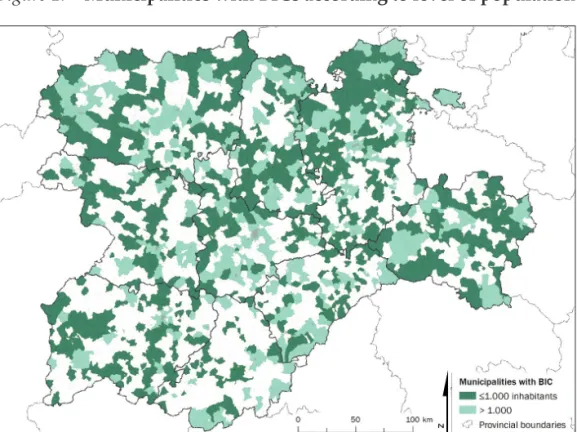
Figure 1. Municipalities with BICs according to level of population
Source: Own elaboration from JCyL: Cultural heritage and INE: Municipal Census of Inhabitants 2016.
In this sense, it should be remembered that most heritage resources, both material and immaterial, are situated in areas with a very low demographic density. This is not coincidental, in so far as it is in these rural spaces where things are seen to be more permanent in the territory, given the less intense physical transformation or substitution of traditional elements. However, this supposes that a good part of the heritage is controlled by administrative bodies with less capacity to manage or revitalise the said resources, whether because of demographic scarcity, the characteristics of the population, or through a lack of economic activities upon which any development initiative can rest.
Leon1, 699, that is, almost 80%, have less than 1,000 inhabitants. Of
these, 578 municipalities have less than 500 inhabitants and even 181 (one in five) have less than 100 people in the census. Even considering the accumulation of heritage assets in the urban spaces and largest district centres, of the more than 2,000 BICs declared in the regional sphere, over half are located in municipalities with less than 1,000 inhabitants.
In addition to the reduced demographic size of the municipalities with heritage resources, there are also three demographic traits which, although they are well known and studied (Martínez & Delgado, 2013, Molina & Martínez, 2015), suppose added problems for new management initiatives. They are, on the one hand, the low population density in the said rural areas; on the other, the depopulation process, with severe demographic losses in many of these areas (Serrano, 2007); and finally, ageing, which means there is a very small active population in most of the municipalities analysed.
So any study of heritage management in Castile & Leon comes up against a demographic reality in which most of the municipalities with BICs have fewer than five inhabitants/km²; where the average age of the population is 70 years of age; and where 25% of the population has been lost since the start of the 21st century.
This reality concerning the demographics of the regional rural environment, which can be extrapolated to a national scale, is exacerbated by the scarcity of tertiary activities. This means that, on average, most municipalities have only a very limited number of economic activities on which to base any rural development initiative that could revitalise the heritage. It also requires extra efforts to be made by the administration or entrepreneurs (Alario & Baraja, 2006; Martínez, García & Delgado, 2014).
The second problem detected concerns the concrete characteristics of the heritage resources that can be found in the rural environment. There are, however, as is often pointed out, numerous heritage resources in the rural environment (Troitiño, 1998) which are elements that, in the context of these spaces, have a great importance because of their historical value, their role in the makeup of the local identity, their singularity, etc. Through their own intrinsic value, they have a very limited potential for setting up local revitalisation strategies.
Figure 2. Church of San Andrés, in Aguilar de Campos (Valladolid)
Author of the photograph: Ana Íñigo Íñigo.
The above figure shows an example of a heritage resource with a high artistic value, but scarce and difficult valuation on the part of the local community. The church of San Andrés, in Aguilar de Campos (Valladolid), was declared a BIC in 19792. It has some very singular and
valuable Mudejar elements, such as the arches or the frame (Urrea & Brasas, 1981: 11; Duque, Regueras & Sánchez, 2007: 174). It is, however, located in a village with scarcely 266 inhabitants in 2016 and is far from the major roads; this means that one has to travel specifically to the village in order to visit it. What is more, there are no other monuments in the municipality with a similar artistic or historic value, even though its territorial context (the district known as «Tierra de Campos») has a cultural landscape that is ever more valued for its geographical and historical characteristics (Alonso, 1994; Baraja, 2012). The result is that
2. Agreement 37/2009, of April 2nd, of the regional government, which concedes
the Category of Monument to the church of San Andrés in Aguilar de Campos (Valladolid), defining a protection setting (BOCyL nº 67, of April 8th 2009; BOE nº
its use is restricted to a religious one and this is on the decline; neither is it included in the usual tourist routes around the district.
In fact, as can be seen from the figure, almost 60% of the municipalities with BICs in Castile & Leon have only one declared BIC. In addition, 95% of these rural municipalities have fewer than 5 assets; to this must be added the geographical distances between these heritage elements in the rural setting. In reality, cities and some market towns are the exception in so far as the critical mass of heritage resources for setting up revitalisation strategies is concerned.
Figure 3. BICs on the heritage red list in rural municipalities of
Castile & Leon
2007), highlights the heritage problems in the rural setting. In the case of Castile & Leon3, of the 242 assets included in the red list, 162 (or 67%) are
situated in villages of fewer than 1,000 inhabitants; while those in cities or towns (only 12 on the list) are much less significant. In other words, the heritage recuperation policies in no case cover all the existing necessities in the regional or national territory. Furthermore, due to their intrinsic value or their relative importance, a large part of the interventions take place in urban areas. By way of example, of the subsidised works within the framework of the «cultural 1.5%»4 in Castile & Leon in the
last convocation, as shown in the figure below, 11 are located in cities or market towns, while only 7 are in rural municipalities.
Figure 4. Interventions with the 1.5% cultural subsidy in Castile &
Leon
Source: Ministry of Public Works.
3. Association «Hispania Nostra»: Heritage Red List, 2017.
4. Order FOM/1932/2014, of September 30th, approving the regulatory bases of the
Fourthly and finally, the difficulties entailed in reaching agreements between so many actors and interested parties within the framework of heritage conservation and management must also be taken into account. It must also be kept in mind that, above and beyond the territorial or identity value of heritage, that in most cases the burden on profits entailed in management and valuation are uppermost. Title IV of the Law 16/1985, on Spain’s Historic Heritage5, concerning the protection
of both moveable and immoveable assets, or Title II of the Law 12/2002, on the Cultural Heritage of Castile & Leon6, concerning the regime of
conservation and protection of the cultural heritage of Castile & Leon, are examples of the burden that owning heritage assets supposes. As pointed out in article 24 of this law: «the owners, holders and other entitled persons with real rights over assets forming part of the Cultural Heritage of Castile & Leon are obliged to duly conserve, safeguard and protect them so as to ensure their integrity and avoid their loss, destruction or deterioration)»7. In addition to this initial duty, there are
other legal questions that concern access to the heritage, to the rights of first refusal and pre-emptive rights, or to changes in ownership. All these questions make owning heritage resources much more complicated.
In the rural environment, management is complicated because, in many cases, the property lacks the capacity to comply with the inherent duties of its legal situation, and because the competent administrations, especially the local ones, cannot comply with the basic work of tutelage either. Similarly, problems derived from the existence of a very high number of owners due to successive processes of inheritance sharing are also usual. Beyond the idealism of the image of «the family inheritance made collective memory for visitors» (Fernández de Rota, 1998: 81) that sometimes arises from the extension of the concept of cultural heritage, the management of heritage resources in the rural setting is certainly complex, especially when it is expected that, in addition to being conserved, they should also be enhanced and put to use through territorial revitalisation strategies.
In addition, although there is a basic legal framework concerning access to cultural heritage, especially in the case of the BICs8, complications
5. Law 16/1985, of June 5th, on Spain’s Historic Heritage (BOE nº 155, of June 29th
1985).
6. Law 12/2002, of July 11th, on the Cultural Heritage of Castile & Leon (BOCyL nº
139, of July 19th 2002).
7. Law 12/2002, art. 24.1.
also arise because of owners’ diverse interests, as well as those of the administrations and sponsors of heritage enhancement initiatives. Because of this, some of the heritage elements of greatest value in the rural setting cannot be used in touristic revitalisation initiatives; in these cases access and visits are more difficult and sometimes prohibited. The impossibility of visiting the «Casa Blanca», in Medina del Campo, or the limited access of two hours per week to the Hermitage of La Lugareja9,
in Arévalo, despite the aforementioned regulations, are two of the numerous examples that can be found in this sense.
So, even when considerable progress has been made in redefining cultural heritage in the direction of a more territorial concept, and despite the fact that, in this context, the rural environment has underused resources that could also be used to help revitalise a space suffering from demographic and economic problems, these complications require the design of heritage management and enhancement systems that will help to solve the said problems. The notion of territorial heritage systems is an advance that, as will be seen below, opens up new possibilities for the enhancement of cultural heritage.
III. A NEW STRATEGIC APPROACH TO HERITAGE
MANAGEMENT IN CASTILE & LEON: THE TERRITORIAL SYSTEMS OF HERITAGE VALUE
The problems pointed out above are the basis of some of the strategies followed for the enhancement of heritage resources in Castile & Leon. In particular, and taking into account the geographical dimension, those in which the heritage asset spans two wider territorial spheres are of special interest, as they provide strategic context and vision to the initiatives that can be carried out on the different assets analysed. In particular, it is essential to analyse, in the case being dealt with here, the possibilities and limitations of the notion of territorial heritage systems that arose in the framework of both PAHÍS Plans (2004-2012 and 2020). Thus, taking into account the fact that the said plans have been analysed in detail by
permit access to researchers following prior reasoned application. They should also facilitate public visits in determined conditions, which should always be without cost for four days a month, on fixed days and hours to be announced». 9. Both the church of La Lugareja in Arévalo (Ávila) and the «Casa Blanca» in Medina del
Campo (Valladolid) are declared historic-artistic monuments through the Decree of June 3rd 1931, declaring the indicated assets Historic-Artistic Monuments, belonging
numerous authors10, only a brief description will be given before posing
the objective, characteristics and interventions carried out with regard to the setting up of the said territorial heritage systems.
1. THE PLAN PAHÍS: A CHANGE OF PARADIGM IN HERITAGE MANAGEMENT
Although the assumption of competences in heritage questions by the Regional Government of Castile & Leon through the approval of the Statute of Autonomy in 198311 has brought numerous policies and
plans concerning the conservation and management of the region’s heritage assets12, the approval in 2004 of the Plan PAHIS 2004-2012
supposed a change of paradigm in heritage management13.
From the point of view of heritage resources in rural areas, there are two aspects that stand out in this plan. Firstly, the accurate diagnosis it sets down concerning the problems faced by heritage in rural areas, and the difficulties to carry out any type of action. Thus, the first Plan PAHÍS explicitly indicates that «the most characteristic territorial environment of our Region is the least built up, which has more limited possibilities
10. For an analysis of the significance of the Plan PAHIS in the context of the changes in the management of cultural heritage, it is worth looking at the work of Calderón & García (2016), and Fernández & Burón (2009), among others, as well as the bibliographic references in these works.
11. The first Statute of Autonomy of Castile & Leon states in article 26.13 that, among the exclusive competences of the Regional Government is that referring to «historic, artistic, monumental and archaeological heritage of interest to the Region. Museums, libraries, newspaper archives, music conservatories and other centres of cultural interest for the Region and which do not have state ownership» (Organic Law 4/1983, of February 25th, on the Statute of Autonomy of Castile &
Leon – BOE nº 52, of March 2nd 1983).
The Organic Law 14/2007, of November 30th, on the reform of the Statute of
Autonomy of Castile & Leon (BOE nº 288, of December 1st 2007), sets out as one
of the guiding principles of public policies in Castile & Leon «the protection and diffusion of the cultural and heritage wealth of the Region, favouring artistic creation in all its manifestations and guaranteeing equality of opportunity to all citizens as far as access to culture is concerned. The public authorities of Castile & Leon will develop interventions to return to the Community those cultural heritage assets that are currently outside the territory» (Law 14/2007, art. 14.17). 12. The closest precedent is the Intervention Plan in the Historic Heritage of Castile &
Leon 1996-2002 (Decree 176/1996, of July 4th, approving the Intervention Plan on
the Historic Heritage of Castile & Leon for the period 1996-2002 – BOCyL nº 131, of July 9th 1996).
for economic and demographic dynamism. It is, however, the physical and historic-cultural support of most of the rich and excellent heritage, which is why the maintenance and conservation processes are largely conditioned by this fact and why it is desirable that it should be incorporated in the social and economic development»14.
Secondly, and in relation to this diagnosis, the Plan establishes a strategic view in which heritage is conceived in a wider territorial context; in such a way that «the individual heritage elements acquire an adequate valuation in so far as references are established for other assets as a whole (whether similar of different) with those that are related and complementary through links concerning their cultural and historical genesis». Thus, the heritage elements, in direct relation with the environment in which they are set, «form an identifiable, integral heritage system within which processes of a social and cultural nature, as well as function and use, are developed»15. As Calderón & García (2016)
point out, the integration of the heritage and territorial dimensions lend coherence to both parts, opening up new paths to heritage management.
This new concept of heritage can, in practice, be translated into the definition and development of, among other plans and interventions, the so-called «territorial heritage system» (THS). Although they are not specifically defined in the Plan, they can be understood as territorial units or sets of heritage assets with common characteristics, linked to a common territory, understanding the plan’s coherence as a certain geographical or conceptual homogeneity, whose final objective is to design heritage management strategies (Fernández & Burón, 2009).
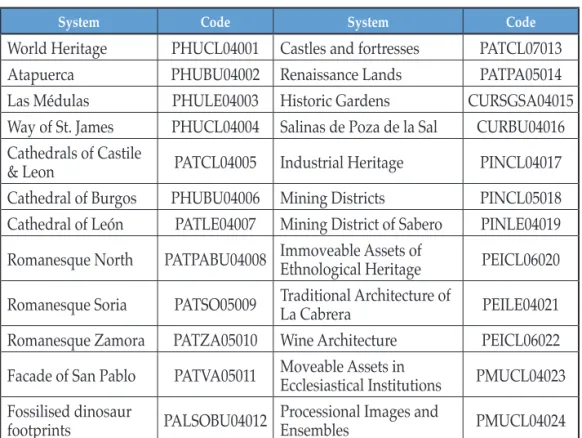
Unlike previous interventions, the territorial systems do not have a fixed structure, but can be understood as instruments of work that are adaptable and aimed at heritage management. Within this flexibility, a high number of THSs are initially defined, aimed at such diverse heritage assets as the World Heritage assets, the Way of St. James, the Castles and Fortresses, the Industrial Heritage, the Mining Districts, etc16. The attached Table shows precisely the territorial systems initially
proposed in the plan.
14. Agreement 37/2005, of March 31st, of the Regional Government of Castile & Leon,
approving the Plan PAHIS 2004-2012, on the Historic Heritage of Castile & Leon (BOCyL nº 65, of April 6th 2005), Annex.
15. Agreement 37/2005, Annex.
16. To Access the database of territorial heritage systems, consult the heritage web site of the Regional Government of Castile & Leon (http://www.patrimoniocultural.
Table 1. Territorial Heritage Systems proposed in the Plan PAHIS
2004-2012
System Code System Code
World Heritage PHUCL04001 Castles and fortresses PATCL07013
Atapuerca PHUBU04002 Renaissance Lands PATPA05014
Las Médulas PHULE04003 Historic Gardens CURSGSA04015
Way of St. James PHUCL04004 Salinas de Poza de la Sal CURBU04016 Cathedrals of Castile
& Leon PATCL04005 Industrial Heritage PINCL04017
Cathedral of Burgos PHUBU04006 Mining Districts PINCL05018 Cathedral of León PATLE04007 Mining District of Sabero PINLE04019 Romanesque North PATPABU04008 Immoveable Assets of Ethnological Heritage PEICL06020
Romanesque Soria PATSO05009 Traditional Architecture of La Cabrera PEILE04021 Romanesque Zamora PATZA05010 Wine Architecture PEICL06022 Facade of San Pablo PATVA05011 Moveable Assets in Ecclesiastical Institutions PMUCL04023 Fossilised dinosaur
footprints PALSOBU04012 Processional Images and Ensembles PMUCL04024 Source: Regional government of Castile & Leon. Plan PAHIS 2004-2012, THSs in Castile & Leon.
Although we cannot say that all the objectives of the Plan 2004-2012 have been accomplished, especially those concerning the THSs, the strategic change brought about, which directs the planning towards the territorialisation of the interventions in heritage, should take root in the following programming period. The Plan PAHÍS 2020, approved in 201517, provides continuity and depth, among other aspects, to
the notion and application of the territorial heritage systems. Thus, within the strategic lines of the plan, in the third axis, concerning the sustainable management of cultural heritage, the territorial systems are already explicitly included18.
17. Agreement 22/2015, of April 9th, of the Regional Government of Castile & Leon,
approving the Plan PAHIS 2020 on the Cultural Heritage of Castile & Leon (BOCyL nº 71, of April 15th 2005).
In this new plan, three objectives can be highlighted that strengthen the territorialisation of cultural heritage management. First of all, the Plan promotes the definition of the map of territorial heritage systems in Castile & Leon with heritage value criteria, but also with reference to regional territorial planning. The comparison between the sectorial plans defined in the Plan PAHIS 2004-2012 and the THSs presented in the Table above accurately reflects the need for a better definition of these homogeneous spheres of heritage management. Thus, while advances have been made in the work of the THSs, such as those concerning World Heritage, cathedrals, fortifications and especially the Romanesque in Castile & Leon19, hardly any steps have been taken in other heritage fields
such as those of the abbeys, monasteries and convents, civil architecture, modern architecture or Mudejar and brick architecture.
The second aim is to intensify the involvement of a greater number of actors in the management of heritage resources and the territory in which they are situated, fundamentally through the creation of networks20. The Plan affects the basic principle of cooperation, taking
into account the fact that both the protection and revitalisation of heritage resources affects an important number of actors in the territory, both public and private, and that «those policies turn out to be more efficient and longer lasting when the institution or community most directly benefitted does not reduce its role to being the receiving agent of the said benefits, but becomes an active agent»21.
Thirdly, complementary programmes to the THSs are developed for smaller interventions, such as the Cultural Projects22, understood as
interventions that include documentation and inventory, intervention projects, restorations and diffusion during the development of the project. As in the case of the THSs, though on a reduced scale, it supposes overcoming the idea of intervening in the monument to encourage revitalisation through the heritage.
19. In fact, the Regional Government of Castile & Leon considers the existence of a generic THS concerning Romanesque heritage, from which four complementary systems are derived: Romanesque North, Romanesque Soria, Romanesque Zamora and Romanesque Atlantic, differentiated by geographical areas.
20. With respect to the importance of collaboration in the management of cultural heritage, the indicators established for evaluating the objectives of the Plan PAHIS 2020 refer to such matters as agreements with centres and institutions, what agreements are reached (number and participating entities) or participation in networks (Plan PAHIS 2020; 45).
Therefore, the passage from monument to territory in the management of heritage resources is a great advance as far as the possibilities for enhancing these elements in the development strategies are concerned. However, as is considered in the Plan PAHIS, the THSs are basically a framework or a tool with which to materialise objectives, actions or actors, in order to boost the revitalisation of the heritage resources. So the THSs can be very varied and they can be used for heritage management in many different ways.
2. THE DIVERSITy OF TERRITORIAL HERITAGE SySTEMS
As pointed out above, since the turn of the millennium, we have opted for planning models with fewer regulations and more strategies in order to overcome the notion of the monument as the centre of heritage and integrate it into a territorial context that explains it and, in most cases, gives it meaning. Nevertheless, as we have also been able to verify, this more relaxed view of planning leads to the fact that the same planning and management tool can develop very different strategies, both from the point of view of the territory it affects and that of the actors involved.
So there are notable differences between one THS, such as that of the Facade of San Pablo (Valladolid)23, that affects a very restricted
space in the historic centre and whose fundamental aim is to provide information concerning the restoration work and the social value that heritage conservation has, and another THS such as the Architecture of Wine24, which is spread throughout the territory, covering the Wine
Designations of Origin (DOs) in Castile & Leon, in which the actors involved are many. As pointed out in the file on the said system, apart from the competent administration concerning heritage, the Provincial authorities, local bodies, regulating councils of the DOs, as well as entrepreneurs and proprietors of heritage assets to be revitalised, should also participate in the management of the plan.
It would thus seem evident, according to the proposed model, that the territorial heritage systems can adopt very diverse forms and strategies. This is a basic characteristic of revitalisation initiatives for territorial heritage in rural areas, where, as has already been pointed out, there are usually neither heritage resources capable of sustaining
a socio-economic revitalisation strategy by themselves, and nor do they have sufficient population to act individually within the territory.
So the essential aspect for achieving a THS is to «identify heritage asset ensembles that have common characteristics and whose existence or development is linked to a space or territory, the latter being understood as physical and continuous or as conceptual, setting up its own landscape» (Fernández & Burón, 2009: 79). In the search for a logical heritage continuum, another advantage of the THSs is the possibility of fabricating some systems within others, in such a way that an asset can be a THS of itself (e.g., a Cathedral or a Castle) and, at the same time, form part of a wider system (e.g., World Heritage THS or Cathedral THS).
One of the most eloquent examples of the possibilities of the THSs is the fortified architecture of Castile & Leon25. Cobos & Retuerce (2011)
establish a valuation and hierarchy of the fortifications of Castile & Leon, with over 1,000 buildings of very diverse geographical, historical, construction and landscape characteristics. To do so, they use different scales of THSs in such a way that these assets can be grouped, firstly, in supra-systems, a notion that «groups sets of THSs associated through common characteristics of a chronological or typological nature» (Cobos & Retuerce, 2011: 37)26. These are then divided into systems, sets of
fortifications (although they can include other non-fortified buildings) related to each other, and among which there will be «chronological coherence (all built in the same era), stylistic coherence (all in the same style or possessing the same artistic characteristics), or geographic coherence (all in the same geographical area)» (Cobos & Retuerce, 2011: 38). Finally, subsystems can also be established, in which the traits of the heritage assets are more homogeneous and specific27.
As for the involvement of the local actors in setting up this type of plan, the experience developed in some THSs has allowed the possibilities of the model to be evaluated, as well as its difficulties. As pointed out by Fernández & Burón concerning the heritage systems developed around the Romanesque supra-system, the characteristics
25. The work was included within the studies of the Plan PAHIS 2004-2012, for the development of the THS «Castles & fortresses» (PATCL07013).
26. The study poses four basic supra-systems: Frontier & Reconquest Fortifications (8th
to 11th centuries), Consolidation of the Kingdom and Repopulation Fortifications
(12th to 13th centuries), Royal and Stately Castles (13th to 15th centuries), and
Bastioned & Artillery Fortifications (15th to 18th centuries).
27. By way of example, the Castle of Gormaz (Soria) would be part of the Supra-system A (Frontier & Reconquest Fortification (8th to 11th centuries)), System A1
of the rural environment where the heritage asset is situated must be taken into account. This is because, although they are supported by cultural foundations, the management models should be on a local scale, «which makes decentralisation and more local participation, greater accessibility and consequently greater use, possible. In short, it makes garnering more support possible, and not only economic support, but also the social involvement and determination needed for the success of these programmes» (Fernández & Burón, 2009: 80).
IV. THE PLAN MUDEJAR: FROM HERITAGE INTERVENTION TO ENHANCEMENT
Considering the possibilities for heritage resource management in Castile & Leon, it would seem evident that an important part of this heritage is still underused, either because it is not in adequate conditions, or because the characteristics of the heritage assets within the territory make it very complicated to set up socio-economic revitalisation strategies.
One of the most representative ensembles in this situation is, without doubt, that of the Mudejar heritage. As the Plan PAHIS 2004-2012 pointed out, within the sectorial plans, there was a need to draw up and develop a strategic plan for this type of heritage that would go from the conservation and restoration of the most important buildings to the diffusion of this ensemble28. However, this work was delayed
in favour of previously mentioned heritage revitalisation plans. Nevertheless, in 2007, a project was approved for the «Documental Systematisation of the Mudejar Architecture in Castile & Leon», which would provide a basic inventory of the Mudejar heritage, and at the end of 2015, the Regional Government of Castile & Leon approved the Plan Mudejar, in which, as will be analysed below, a decentralised heritage management model is proposed.
1. A SINGULAR TERRITORIAL SySTEM: THE MUDEJAR IN CASTILE & LEON
The analysis of the Mudejar heritage in Castile & Leon starts from a complex initial premise, which is the fact that there is a technical and scientific debate about the characteristics of Mudejar art which makes
the consideration of which assets have to be valued as strictly Mudejar and which form part of an also valuable brick architecture, but which should not be confused with Mudejar, more difficult. The debates, which even include the use or not of the word Mudejar, are based on the fact that «both the wide chronological sphere, which covers four centuries (12th to 15th centuries) and the geographical dispersion and
its numerous and significant regional variations, make the extensive and comprehensive limits of this historic-artistic category diffuse and debatable» (de la Plaza, 2007: 11)29.
Figure 5. Location of inventoried assets of Mudejar architecture in
Castile & Leon
Source: Own elaboration from IPE: Mudejar architecture in Castile & Leon
As the theoretical debate is not the subject of this study, the geographical and heritage reference framework used is that of the assets included within the work on Mudejar architecture in Castile &
Leon mentioned above. As can be appreciated from the attached figure, the Mudejar assets catalogued cover more than 66,000 km², although more than 270 of them do not have an isomorphic distribution, mainly being concentrated in the area situated to the south of the Douro River, in the provinces of Valladolid, Ávila, Segovia and, to a lesser extent, Salamanca and Zamora. If we limit the analysis to the south of Valladolid, scarcely 14,000 km², we find 206 assets, or over 75%.
As for the typology of municipalities in which these assets are located, as can be seen in the figure, of the 156 municipalities with Mudejar assets included in the base inventory, over three quarters have fewer than 1,000 inhabitants (and two thirds fewer than 500 inhabitants). Apart from the seven cities, those which, according to the inventory, have Mudejar heritage assets, scarcely 30 of them can be typified as district centres or sub-centres.
Figure 6. Municipalities with Mudejar assets according to
population thresholds (2016)
Source: Own elaboration from INE: Municipal Census of Inhabitants.
In most cases, the municipalities have very few assets inventoried as Mudejar. In fact, of the 156 municipalities with assets, 137 (88% of those analysed) only have one or two, while only seven have more than 5 catalogued Mudejar assets30.
In addition, the fact that the state of conservation of these assets is not, in many cases, adequate, must also be taken into account; though there are notable differences between cases. This is because, first of all, the assets themselves may be very different, from brick fortifications, such as the castles of La Mota and Coca, to religious buildings, or even civil buildings and infrastructures. The use of the assets is an essential factor in their maintenance, so much so that those that maintain their use, such as for instance the castles or some parish churches, are the ones that are best conserved; while there are many ills being suffered by the buildings where the assets have lost their use31. The initial
study carried out indicates the need for interventions, with different degrees of urgency and intensity, in most Mudejar assets. It is within this framework that the Plan Mudejar must fit.
2. FROM HERITAGE INTERVENTION TO ENHANCEMENT: THE PLAN MUDEJAR
As has been pointed out, the existence of heritage resources is not a sufficient condition for setting up local development strategies based on the heritage, and much less in rural areas. The Mudejar heritage is a good example of this because of the described characteristics, the location of the assets, their condition and the difficulty of their being the driving force of themselves for tourist initiatives. Setting up a plan to cover the entire Mudejar in Castile & Leon, in its territorial and socio-economic context, is practically impossible. So the Plan Mudejar must be understood as an experimental initiative, with limited size, whose aims can bring to fruition new forms of territorial heritage management in rural areas; especially when the state of conservation of numerous Mudejar cultural assets requires intense and urgent intervention.
So the Plan Mudejar is a Cultural Project within the context of the Plan PAHIS 202032. Approved at the end of 2015, this Cultural Project
hopes to work with 40 Mudejar assets of the provinces of Ávila,
31. The study on Mudejar Architecture in Castile & Leon carries out a brief diagnosis of each inventoried asset. Each file indicates the state of conservation, which goes from «restored» to «in ruins», analysing the different parts of the resources (roofs, apses, naves, towers or facades).
Segovia and Valladolid. Nevertheless, the aim of the project is not a simple architectural intervention, but one that goes further, based on the knowledge of these assets in their territorial context. As pointed out in the objectives of the plan, it aims to «strengthen the knowledge and conservation of the proposed cultural assets, transmitting the experiences generated to society, including both the specialised and the general public, simultaneously carrying out studies and interventions on the various assets, as well as their diffusion»33.
However, although the Mudejar assets and their needs are the starting point, the Plan aims to go beyond individual interventions, to «offer global knowledge of the ensemble of Mudejar assets in the territorial sphere considered»34. Thus, the proposed work has three
main spheres: methodological, social and didactic; where the first two are, in this case, the most relevant. The first refers basically to the knowledge and intervention programmes (from the analyses of the assets through diagnostic records, accessibility analysis, studies of a territorial nature, or topographic and photogrammetric surveys, to concrete intervention proposals, with their budgeted technical reports, accessibility improvements, priority of interventions, etc.).
33. Document concerning technical requirements that must be met in the work contract of the «Drawing up of the Plan Mudejar South in the provinces of Ávila, Segovia & Valladolid», p. 2.
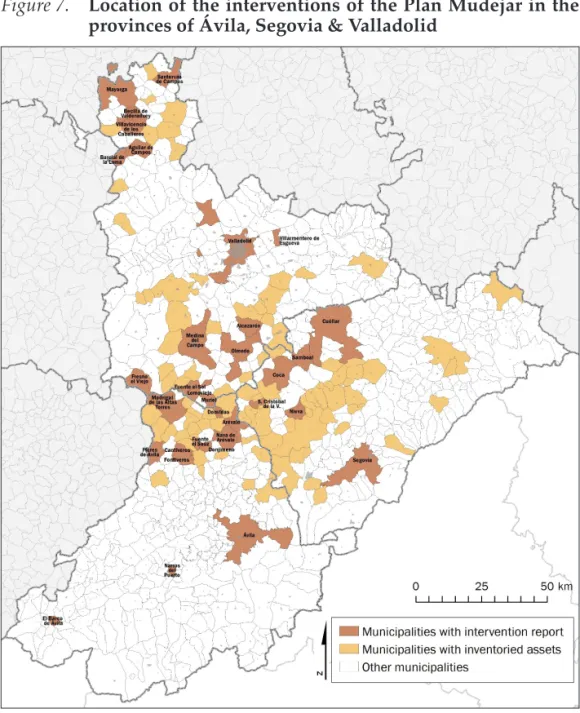
Figure 7. Location of the interventions of the Plan Mudejar in the
provinces of Ávila, Segovia & Valladolid
Source: Own elaboration from the Plan Mudejar
the assets to the diffusion of the physical interventions carried out. The final aim of the cultural and leisure activities, visits, etc., is to «involve and motivate social participation and awareness, attending in particular to the local population».
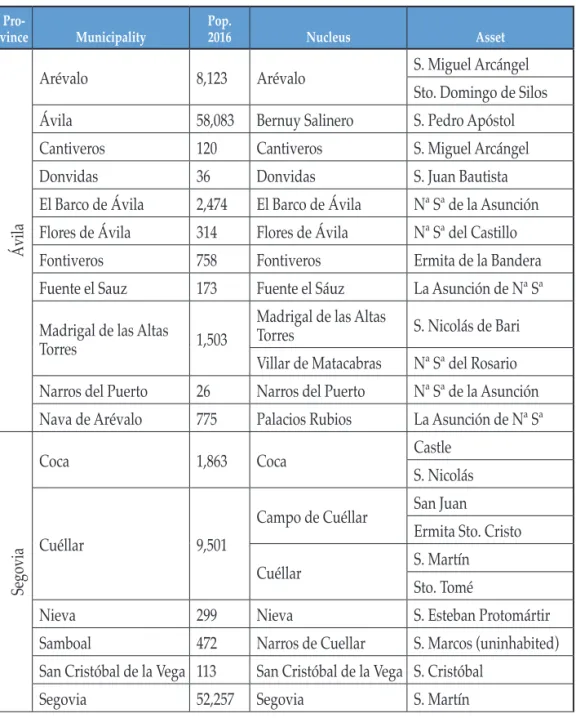
Table 2. Planned interventions of the Plan Mudejar
Pro-vince Municipality Pop. 2016 Nucleus Asset
Ávila
Arévalo 8,123 Arévalo S. Miguel Arcángel
Sto. Domingo de Silos Ávila 58,083 Bernuy Salinero S. Pedro Apóstol
Cantiveros 120 Cantiveros S. Miguel Arcángel
Donvidas 36 Donvidas S. Juan Bautista
El Barco de Ávila 2,474 El Barco de Ávila Nª Sª de la Asunción Flores de Ávila 314 Flores de Ávila Nª Sª del Castillo
Fontiveros 758 Fontiveros Ermita de la Bandera
Fuente el Sauz 173 Fuente el Sáuz La Asunción de Nª Sª
Madrigal de las Altas
Torres 1,503
Madrigal de las Altas
Torres S. Nicolás de Bari Villar de Matacabras Nª Sª del Rosario Narros del Puerto 26 Narros del Puerto Nª Sª de la Asunción Nava de Arévalo 775 Palacios Rubios La Asunción de Nª Sª
Segovia
Coca 1,863 Coca CastleS. Nicolás
Cuéllar 9,501
Campo de Cuéllar San Juan Ermita Sto. Cristo
Cuéllar S. Martín
Sto. Tomé
Nieva 299 Nieva S. Esteban Protomártir
Samboal 472 Narros de Cuellar S. Marcos (uninhabited) San Cristóbal de la Vega 113 San Cristóbal de la Vega S. Cristóbal
Pro-vince Municipality Pop. 2016 Nucleus Asset
Valladolid
Aguilar de Campos 266 Aguilar de Campos S. Andrés
Alcazarén 692 Alcazarén Santiago Apóstol
Barcial de la Loma 104 Barcial de la Loma S. Pelayo
Becilla de Valderaduey 249 Becilla de Valderaduey S. Miguel Arcángel Fresno el Viejo 946 Fresno el Viejo S. Juan Bautista Fuente el Sol 181 Fuente el Sol San Juan BautistaTower
Lomoviejo 183 Lomoviejo La Asunción de Nª Sª
Mayorga 1,649 Mayorga Sta. María de Arbás
Medina del Campo 20,774 Medina del Campo Castle of La Mota
Muriel 143 Muriel Sta. María del Castillo
Olmedo 3,674 Olmedo S. Juan Bautista
S. Miguel Olmos de Esgueva 98 Villarmentero de Esgueva Sta. Juliana
Valladolid 301,876 Valladolid María de Molina Palace Villavicencio de los C. 235 Villavicencio de los C. S. Pelayo
Source: Plan Mudejar.
Although the cities have a disproportionate representation in the Plan as far as the number of assets is concerned, two thirds of the municipalities have fewer than 1,000 inhabitants, and over half have fewer than 500. In addition to this difficulty, there is the fact that most of the assets to be intervened are churches35, property of their
respective dioceses; although some of them have already lost their use and have been deconsecrated. In this sense, the purpose sought by the proprietors does not coincide, in some places, with the proposals that exist for the cultural or socio-economic revitalisation of the territory, and this requires greater efforts of cooperation and agreement between agents. On the other hand, these agents are fairly scarce, not only in relation to ageing and loss of population, but also the scarce economic revitalisation, the lack of any strong associative network and the inability of the local administrations to set up any type of endogenous development strategy (Molina & Pascual, 2016).
In order to solve this problem, which comes up against the objectives of the Plan and even the heritage management strategy of Castile & Leon, a decentralised heritage management model has been devised based on the capacities and competences of the Local Action Groups (GAL in Spanish) that exist in the territorial sphere of the Plan Mudejar. Taking into account the characteristics of the work area, there is very little sense in generating new participation structures for heritage management, when public organisation and participation mechanisms already exist for associations, enterprises and individuals, as well as local public institutions, through these GAL. Within the framework of the participative, local development strategy and, to be more precise, in relation with measure 19 of the PDR of Castile & Leon 2014-2020, aimed at supporting local development via the traditional LEADER approach36, the possibility is being considered of subsidising
initiatives concerning the «conservation, improvement, promotion and dissemination of rural heritage, including the architectural,
35. From the list of Table 2, it can be deduced that only the castles of Coca and Medina del Campo, the towers of Fuente el Sol and Coca, and the Gate of María de Molina fall outside this category; even though, in this case, it is situated within the cloistered precinct with the consequent problems for correctly valuing it and making people aware of its existence.
36. Regulation (EU) nº 1303/2013 of the European Parliament and of the Council
of December 17th 2013, establishing the common dispositions concerning the
environmental, cultural, or ethnographic aspects, etc.»37. In addition,
in the context of the so-called sub-measure 19.3, the possibility is established of setting up cooperative activities between different GAL, indicating that «the cooperation must permit the achievement of a critical mass necessary for the viability of a common project and the search for complementarities»38.
Thus, the setting up of a cooperative project within the Leader 2014-2020 framework is a possible response to the objectives promoted by the Plan Mudejar in the sphere of the management and revitalisation of cultural assets, decentralising a part of the design and execution of the projects towards local actors more firmly rooted in their territorial environments. As can be seen in Table 3, the step taken from considering an asset on a municipal level to a district level, that of the Leader areas, allows the project to acquire much superior dimensions, so the asset is no longer an isolated one and becomes integrated in a wider ensemble with greater possibilities of setting up endogenous revitalisation strategies.
Table 3. Local Action Groups (GAL) involved in Mudejar cooperative
projects
GAL Municipal.Nº Population 2016
Municipal. with Mudejar
assets AssetsNº
Municipal. with an intervention
Nº Interventions
in the Plan
ADRIMO 72 24,320 31 52 9 11
Route of the Mudejar 53 43,010 21 35 6 8
HONORSE -
Tierra de Pinares 49 31,749 10 25 2 5
AIDESCOM 51 20,820 22 36 3 4
Valladolid North 40 8,465 12 25 5 5
ADERAVI 87 36,975 1 1 1 1
ASIDER 64 12,761 1 1 1 1
Campos & Torozos 22 10,458 3 3 1 1
Douro - Esgueva 53 21,207 4 4 1 1
Source: Own elaboration.
On the GAL scale, a much higher critical mass can be seen than that of Table 2, in so far as there are 5 groups with more than 20 inventoried Mudejar assets, affecting between 10 and 30 municipalities per group, and they make up the greater part of the interventions of the Plan Mudejar. The cooperative project, in which the participation of the different groups varies with respect to both interest in the Plan and the importance that these heritage resources have in their districts, allows both the promotion of common actions, such as the elaboration of a common heritage and tourist management diagnosis, the creation of a brand, or the setting up of a joint communication strategy, as well as individual initiatives, such as the design of tourist routes within the GAL areas, agreements with local agents to adapt the cultural assets to the tourist offer, etc.
In short, even when the setting up of the project is in its initial phases, the proposal can be capable of facing the complications already pointed out concerning heritage resource management in rural areas through the decentralisation of the actions to local actors who, through the GAL, already have experience in the design and execution of endogenous development strategies.
V. CONCLUSIONS
The theoretical possibilities that local development brings to heritage resources for setting up cultural and socio-economic revitalisation strategies come up against the characteristics of the rural environment, where Castile & Leon is paradigmatic as far as depopulation, ageing, low density and difficulties to revitalise the cultural heritage are concerned.
The Plan Mudejar is an example of the possibilities and limitations that the revitalisation of cultural heritage has in the rural environment. Even though, because of its size, such an ample framework as a territorial system cannot be considered, it has opened doors in the field of heritage management and diffusion to the participation of local actors through the work that the GAL have been carrying out in the rural districts of Castile & Leon. Coordination between agents, territories, political authorities and operational programmes opens up new paths where the difficulties that are met should not make us forget that it is a necessary change if we wish to achieve the proposed objectives in the field of cultural heritage revitalisation in rural areas.
VI. BIBLIOGRAPHY
alario trigueros, M. and BaraJa rodríguez, e.: «Políticas públicas de desarrollo rural en Castile & Leon. ¿Sostenibilidad consciente o falta de opciones?: LEADER II». Boletín de la Asociación de Geógrafos Españoles, nº 41, 2006, pp. 267-293.
alonso Ponga, J. l.: La arquitectura del barro. Valladolid, Junta de Castilla y León, 1994.
BaraJa rodríguez, e.: «La Tierra de Campos», In Molinero, F. oJeda,
J.F. and tort, J.(ed.): Los paisajes agrarios de España. Caracterización, evolución y tipificación. Madrid, Ministerio de Medio Ambiente y Medio Rural y Marino, 2012.
calderón calderón, B. and garcía cuesta, J.l.: «Patrimonio y territorio en España: fundamentos y estrategias para la gestión de la cultura territorial», In Manero, F. and garcía, J.l. (coord.): Patrimonio cultural y desarrollo territorial. Cizur Menor, Ed. Thomson Reuters – Aranzadi, 2016, pp. 51-105.
coBos guerra, F., and retuerce velasco, M.: Metodología, valoración y criterios de intervención en la arquitectura fortificada de Castile & Leon. Catálogo de las provincias de León, Salamanca, Valladolid y Zamora. Valladolid, Junta de Castile & Leon, 2011.
duQue, c., regueras, F. and sÁnchez, a.: Rutas del mudéjar en la provincia de Valladolid. Valladolid, Castilla Ediciones, 2005.
FernÁndez de rota y Monter, J. a.: «Herencia familiar y cultural en la ruralía», In daiyun, y., le Pichon, a., and FernÁndez de
FernÁndez Moreno, J.J. and Burón Álvarez, M.: «Modelos para la gestión del Patrimonio Cultural. Propuestas del Plan PAHIS 2004-2012 del Patrimonio Cultural de Castile & Leon». Estudios del Patrimonio Cultural, 2009, nº 3, pp. 71-84.
lóPez FernÁndez, M.i.: La arquitectura mudéjar en Ávila. Ávila, Institución Gran Duque de Alba de la Diputación de Ávila, 2004.
– El Mudéjar, provincia de Ávila. Ávila, Institución Gran Duque de Alba
de la Diputación de Ávila, 2007.
lóPez guzMÁn, r.: Arquitectura mudéjar: del sincretismo medieval a las alternativas hispanoamericanas. Madrid, Ed. Cátedra, 2000.
Martínez FernÁndez, l.c. and delgado urrecho, J.M.: «Población, administración y territorio en Castile & Leon: desequilibrios y desafíos del modelo de poblamiento». Ería, Revista cuatrimestral de Geografía, Universidad de Oviedo, 2013, nº 90, pp. 5-30.
Martínez, l.c., garcía, a., and delgado, J.M.: «Situaciones y tendencias de los pequeños municipios rurales de Castile & Leon», In cortizo, J., redondo, J.M., and sÁnchez, M.J. (coord.): De la geografía rural al desarrollo local: homenaje a Antonio Maya Frades. León, Servicio de Publicaciones, 2014, pp. 479-489.
Molina de la torre, i. and Martínez FernÁndez, l.c.: «La normativa de Ordenación del Territorio en áreas rurales de baja densidad demográfica: una revisión desde la Geografía». Polígonos, Revista de Geografía, Universidades de León, Salamanca y Valladolid, 2015, nº 26, pp. 277-320.
Molina de la torre, i. and Pascual ruiz-valdePeñas, h.: «El patrimonio territorial en el marco del desarrollo local», In Manero,
F. and garcía, J.l. (coord.): Patrimonio cultural y desarrollo territorial. Cizur Menor, Ed. Thomson Reuters – Aranzadi, 2016, pp. 371-392.
Morenésy MariÁtegui, c.: «La Lista Roja, una llamada de atención sobre el patrimonio en peligro». PH Boletín del Instituto Andaluz del Patrimonio Histórico, 2007, nº 63, pp. 4-25.
ortega valcÁrcel, J.: «El patrimonio territorial: El territorio como recurso cultural y económico». Ciudades: Revista del Instituto Universitario de Urbanística, Universidad de Valladolid, 1998, nº 4, pp. 33-48.
ray, C.: «Culture, intellectual property and territorial rural development», Sociologia Ruralis, 1998, nº 38, pp. 3-20.
saíz Martín, E.: «La gestión comprometida con un territorio. El patrimonio cultural en Castile & Leon, un recurso activo». Her&Mus. Heritage & Museography, 2013, nº 12, pp. 8-19.
ŠMid, M., Bole, d., and PiPan, P.: «Sustainable heritage management: social, economic and other potentials of culture in local development», Procedia-Social and Behavioral Sciences, 2015, 188.
troitiño vinuesa, M.a.: «Patrimonio arquitectónico, cultura y territorio». Ciudades: Revista del Instituto Universitario de Urbanística, Universidad de Valladolid, 1998, nº 4, pp. 95-104.
urrea FernÁndez, J. and Brasas egido, J.c.: Catálogo monumental de la provincia de Valladolid. XII: Antiguo partido judicial de Villalón de Campos. Valladolid, Publicaciones de la Diputación de Valladolid, 1981.