Carbon sequestration in Spanish Mediterranean forests under two
management alternatives: A modeling approach
Felipe Bravo1, Andrés Bravo-Oviedo2 and Luis Diaz-Balteiro3
1 ETS Ingenierías Agrarias. Avda. Madrid 44, 34001 Palencia, Spain. Phone: (+34) 979 10 84 24. Fax: (+34) 979
10 84 40. Corresponding author e-mail address: [email protected]
2 Forest Research Center CIFOR-INIA. Ctra. A Coruña km. 7.5, 28040. Madrid, Spain.
3 Departamento Economía y Gestión Forestal. ETSI Ingenieros Montes. Ciudad Universitaria s/n, 28040 Madrid,
Spain.
ABSTRACT
Management implications associated with two different silvicultural strategies in two Spanish pine forests (Scots pine stands in northern Spain and Mediterranean Maritime pine stands in Central Spain) were explored. Whole-stand yield, growth models and individual tree equations were used to estimate carbon stock in forests under different silvicultural alternatives and site indexes. Each alternative was evaluated on the basis of the land expectation value (LEV). Results reveal the appropriateness of implementing carbon payments, because it can clearly complement traditional management objectives in economic terms. Longer rotations on the poorest sites result in a positive economic return by introducing carbon output. The proportion of carbon stock in the final harvest relative to total fixed carbon is always higher in long rotation scenarios. However, short rotation systems produce the highest values of carbon MAI regardless of site index. The impact of carbon price is higher in Maritime pine stands than in Scots pine stands. For both species, changes in the discount rate have a minor impact in Carbon LEV. Notwithstanding, the proportion of total LEV due to carbon is greater when the discount rate increases.
Key words: Pinus sylvestris/ Pinus pinaster/ Growth models/ Silviculture/ Kyoto protocol/ Carbon sequestration.
This is a pre-copyedited, author-produced PDF of an article published in 2008 in European Journal of Forest Research following peer review.
INTRODUCTION
Different studies have demonstrated that the accumulation of greenhouse gases in the atmosphere is causing changes in the Earth’s climate conditions. According to recent estimates of the global carbon situation, 44 % of carbon remains in the atmosphere, while the remaining 56 % is distributed to two pools: ocean and terrestrial ecosystems. Forests, regardless of their geographic location, continue to play an important role in CO2 fixation. Consequently, the Kyoto Protocol allows countries to count net changes in gas emissions due to human induced land use and forestry activities, such as afforestation, reforestation and deforestation (art. 3.3) and optionally forest management (art. 3.4). Watson et al (2000) states that 6.42 % of the terrestrial carbon stock is located in the temperate forests (59 GtC in vegetation and 100 GtC in soils), underscoring the importance of forest lands in carbon storage.
The carbon stored in terrestrial ecosystems is distributed in three compartments: biomass of living plants (stem, branches, foliage and roots), plant detritus (branches and cones, forest litter, tree stumps, toppings and logs) and soil (organic mineral humus, surface and deep mineral soil). Forests are a main component of carbon cycling. Trees get energy through photosynthesis that requires CO2, which is captured by stomata in the leaves. Part of this CO2 is used to create living biomass (stem, branches, leaves and roots), whereas the rest is released back to the atmosphere by autotrophic respiration. When living biomass dies and falls off, it becomes part of the detritus, which incorporates carbon into the soil fraction by means of organic matter content. A small part is driven out to the atmosphere by means of heterotrophic respiration. The role of forests as a carbon sink is ensured as long as living biomass increment exceeds carbon losses due to dying biomass, forest fires and harvest. In a climate change context, the Mediterranean forest type is considered to be vulnerable to loss of biodiversity and carbon sequestration services (Fischlin et al. 2007). Consequently, sustainable forest management must be applied according to multi-criteria objectives that optimize both increasing biomass and carbon sequestration.
The Second Spanish National Forest Inventory shows that the Mediterranean area of pure stands of Mediterranean maritime pine (Pinus pinaster Ait.) and Scots pine (Pinus. sylvestris L.) is 723,819 ha and 678,685 ha, respectively, which represent 10 % of the total forest area in Spain (DGCN, 1998). The former occurs mainly in the northern plateau and Central Mountains at elevations under 1,500 meters, with uneven precipitation and high temperatures in summer. The latter grows in mountain ranges up to 2,000 meters of elevation mainly on northern aspects, with more precipitation and mild temperatures. Within its habitat, a greater number of growth and yield studies have been conducted for Scots pine (Rojo and Montero 1996; Bravo and Montero 2001; Río et al. 2001; Bravo and Montero 2003; Palahí et al 2003) than for Mediterranean maritime pine (García and Gómez 1989; Bravo-Oviedo et al. 2004 and 2006). In addition, some economic analyses of silvicultural treatments (Palahí and Pukala, 2003; Bravo and Diaz-Balteiro, 2004) have been done. In the wide region occupied by both species, ecological, silviculture and economic studies are needed to ensure sustainable forest management under uncertainty scenarios.
Although the Kyoto Protocol allowed enhanced forest management as a mechanism to reduce CO2 emissions, the benefits linked to carbon sequestration by forests still cannot be converted to Euros because they are not recognized as green credits in a trading scheme. However, it is widely recognized that this carbon stored has a value equivalent to the value of these green credits in an accepted emission trading scheme. Traditional management promotes a sustained yield, therefore it can be useful for the landowner to know the economic benefits of incorporating the carbon uptake as an objective in their silvicultural alternatives.
that the economic returns associated with both timber production and carbon sequestration will be optimized. Silviculture strategies are of paramount importance for achieving the most “satisficing” alternatives, by balancing the economic (net present value) and environmental (CO2 uptake) criteria.
The main objective of this paper is to explore the economic implications associated with two different silvicultural strategies in two Spanish pine forests (Scots pine stands in northern Spain and Mediterranean Maritime pine stands in Central Spain), considering two main management objectives: timber production and carbon sequestration. The results could be used to implement sound silvicultural practices in our target forests.
METHODS
In the following sections the study areas, the silvicultural alternatives, the yield and growth models, the carbon estimations and the economic assumptions are introduced.
Study areas
The Upper Ebro Basin is a transitional area located in northern Spain between Mediterranean and Atlantic climates with altitudes ranging from 700 to 900 meters above sea level. The annual precipitation is near 800 mm. Annual mean temperature is 11 ºC and drought periods are frequent between June and August. Soils are calcareous cambisols evolving to luvisols in humid sites. Scots pine dominates the vegetation community mixed with Quercus faginea Lamk., Fagus sylvatica L. and Quercus ilex L. Detailed information about the characteristics of the studied area can be found in Bravo and Montero (2001 and 2003) and in González-Martínez and Bravo (2001).
The Maritime pine study area is located in the middle of the Central Mountain Range, and is known as Gredos Provenance. The annual precipitation is near 1400 mm, although drought periods are common between June and August. Annual temperature oscillates between 14 and 17 ºC. Soils are acid on granite bedrock. Maritime pine stands occupy nearly 39,200 ha in elevations ranging between 400-1400 m. More information on ecological and provenance features can be found in Nicolás and Gandullo (1967) and Alía et al. (1996).
Silvicultural alternatives
(Bravo and Montero, 2001), while in the Maritime pine simulations the site indexes used were 15 and 21 meters at an age of 80 years, according to Bravo-Oviedo et al. (2004).
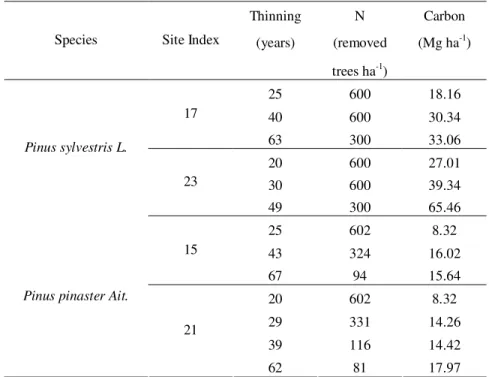
In this analysis, even-aged management consisted of clear-cutting, followed by natural regeneration and a low thinning regime after pre-commercial thinning to reduce density to 1600 trees/ha in Scots pine and to 1500 trees/ha in Maritime pine. Thinnings were performed at different ages for each species and site index considered (Table 1). Extended rotation is similar to traditional even-aged management, but the rotation has been lengthened to 122 years in site index class 23 and to 137 years in site index class 17 in Scots pine stands, while in Maritime pine stands rotation has been extended to 128 and 149 years in site index classes 21 and 15, respectively. The lengthening of rotation is justified on ecological grounds (e.g., enhancement of biodiversity, nutrient cycling), and to obtain trees with larger dimensions and a greater percentage of high-quality wood. The silvicultural systems simulated constitute a range of options that can allow foresters to meet different requirements that society demands today.
Table 1. Main characteristics of the silvicultural regimes chosen.
Thinning N Carbon
(years) (removed (Mg ha-1)
Species Site Index
trees ha-1)
25 600 18.16
40 600 30.34
17
63 300 33.06
20 600 27.01
30 600 39.34
Pinus sylvestris L.
23
49 300 65.46
25 602 8.32
43 324 16.02
15
67 94 15.64
20 602 8.32
29 331 14.26
39 116 14.42
Pinus pinaster Ait.
21
62 81 17.97
Growth and Yield Models
A whole-stand static yield model developed by Bravo and Montero (2003) was used to estimate timber yield under the different silvicultural alternatives simulated in Scots pine stands. The yield model was elaborated for Scots pine stands in northern Spain using 75 temporary plots from the Second National Forest Inventory of Spain. These plots were selected to cover a wide variety of silvicultural situations. The whole-stand static yield approach was selected because only one measurement from the plots was available when the model was developed. A multiplicative model based on the law of limiting factors was selected as a basic model form. This model form has been previously used in forest yield modeling (Eriksson 1976; Persson 1992). Equations for basal area (BA), quadratic mean diameter (QMD) and total volume (V) were fitted (Bravo and Montero, 2003). Each equation in the model was fitted independently. Compatibility between BA and QMD models was checked, and at the end the basal area equation was maintained in the model, while the quadratic mean diameter equation was discarded. The model’s statistical attributes and biological consistency were evaluated to assure the accuracy and reliability of predictions. As the original data set included high-graded stands, the model was calibrated using permanent plots (Bravo and Montero 2003) to assure the accuracy of its predictions in non high-graded stands. More information about the yield model can be found in Bravo and Montero (2003).
Silvicultural regimes in the Mediterranean maritime pine stands were simulated with a compatible growth system of equations relating projected stand basal area and volume to initial stand age, time projection, site index and initial basal area. The model includes one equation to calculate current volume depending on site index, stand age and basal area at initial age, and two equations to estimate basal area and volume. Data were provided by the permanent sample plot network of the Forest Research Center consisting of 92 plots spread throughout the entire Mediterranean distribution of Maritime pine in Spain. The model was completed with a control function of QMD after thinning. For further details on the model see Bravo-Oviedo et al. (2004).
Carbon estimations
In order to evaluate carbon balance, biomass estimation functions developed by Montero et al. (2005) were applied. They felled three sample trees per diameter class and cut them into different fractions to evaluate stem, branches under 2 cm diameter, branches between 2 and 7 cm diameter, branches above 7 cm diameter and needle biomass, and one tree per diameter class to evaluate root biomass. Those samples were weighted in the field to calculate the fresh weight by fractions and a sample of the different parts of the biomass was heated in the laboratory at 102±2 ºC to a constant weight to obtain dry-weight conversion factors.
An allometric function with diameter at breast height as the independent variable was fitted to each fraction and to total biomass to calculate the dry biomass (eq. 1)
LnD b a
LnBi = + ⋅ (1)
where
b
i CF A D
B = ⋅ ⋅ (2)
and
(
2)
expSEE2
CF= (3)
where Bi is biomass of each fraction i, D is the diameter at breast height, SEE is the standard error of the estimation, CF is the bias correction factor, a and b are parameters to be obtained and A is the natural logarithm of parameter a. Table 2 shows the parameters for each equation and species.
The percentage of carbon in each fraction and in the whole tree is calculated by multiplying each biomass value by 0.5 according to Kollmann (1959) and IPCC recommendations (Penman et al. 2003).
A mean basic density of 0.50 t/m3 was assumed in Scots pine stands, while for Maritime pine stands, the basic density was assumed to 0.54 t/m3 (Guindeo et al. 1997). Finally, in this paper a scenario including carbon storage in harvested wood products has not been included, following IPCC Guidelines (Penman et al. 2003).
Table 2. Parameters of the biomass functions proposed by Montero et al., 2005.
Biomass fraction Pinus sylvestris L. Pinus pinaster Ait.
a b R2
adj a b R2adj
Total Biomass -2.50275 2.41194 95.1 -3.00347 2.49641 96.9
Stem -3.80519 2.70808 94.7 -3.43957 2.56636 96.4
Branches 7 cm -15.0469 4.80367 81.6 -23.0418 6.52359 92.7
Branches 2-7 cm 4.07857 2.1408 72.1 -6.66264 2.63946 64.1
Branches < 2 cm -2.08375 1.51001 62.5 -4.66658 2.38009 75.2
Needles -2.36531 1.5099 62.5 - - -
Roots -4.56044 2.62841 97.0 -3.85184 2.37592 98.5
Economic Assumptions and Methodologies
with a single tree of 0.5 cubic meters is about 20 €. If the tree yields 2 or more cubic meters, the price exceeds 52 €/m3.
Some financial components such as planting costs have not been considered because the applied silviculture is oriented towards the existence of natural regeneration. The performance of silvicultural activities (thinning, etc.), and the fixed costs associated with final cutting were included in the analysis. Moreover, we have considered a fixed cost per hectare per year of 24 € in both cases. In this work we have used a real discount rate of 3%. A sensitivity analysis was carried out to show the effects of variation in this parameter.
Initially, our calculations used 10 € for each metric Mg of carbon captured. Tassone et al. (2004) also considered the same starting price their analysis. However, there is not a standard price for this new commodity. National markets (London, Chicago) offer very different carbon prices, and many studies expect prices higher than 10 €/t in the future (Benitez-Ponce, 2005). In order to address this uncertainty, a sensitivity analysis was carried out for this parameter. Finally, although recent works indicate the importance of carbon monitoring costs and other transactional costs (Robertson et al. 2004), they are not included in our analysis.
In order to calculate the profitability of the different management alternatives, we utilized the methodology proposed by Faustmann (1849), which defines the optimum rotation as the life of the stand for which the net present value of the underlying investment achieves a maximum value, taking into account the land rent. Following Samuelson (1976), this land rent can be introduced assuming the existence of an infinite series of rotation cycles. However, this classic procedure is not applicable since we are considering a joint production process of timber and carbon captured. To overcome this problem we followed a methodology proposed by Romero et al. (1998). With this approach, and including the value of carbon sequestration, the land expected value (Total LEV) is calculated as follows.
e NPV LEV Total t i⋅ − − =
1 (4)
where NPV is the net present value, where revenues are generated by sawnwood, pulpwood and carbon credits:
I(t) corresponds to total income obtained as the result of the wood harvested, K represents the plantation costs, G accounts for general annual management costs, Yjis the sum of the silvicultural treatments and Jlare the receipts derived from thinning operations. The last term,IC, gives the net discounted revenues of carbon sequestration (carbon captured less carbon released). This net revenue is the sum of the annual growth in aboveground biomass multiplied by the carbon price, wood density and the carbon content. The discount rate is represented by i and is applied to timber and carbon benefits. Because the stands analyzed are predominantly publicly owned, the analysis does not include a consideration of any type of tax on the income received due to final felling. Finally, no type of subsidy has been considered.
RESULTS
An evaluation of carbon sequestration, and its economical impact, under two different silvicultural systems in two Mediterranean conifer forest types has been carried out. The evaluation is based upon economic and silvicultural analysis of including carbon sequestration into practical forestry and simulation outputs from growth and yield models.
Carbon mean annual increment (Mg ha-1 year-1) is always higher for Scots pine than for Mediterranean Maritime pine (Table 3). Furthermore, the short rotation system produces the highest values of MAI for carbon sequestration regardless of site index, although better quality sites fixed more carbon. Long rotation management on poor sites commonly leads to carbon storage similar to that on better sites with short rotation management. Findings show that it is necessary to double the length of the rotation age on poor sites of Scots pine, whereas the rotation age must be lengthened more than three quarters on poor sites of Mediterranean Maritime pine to obtain a similar carbon storage and quadratic mean diameter (44 cm). In all cases long rotation implied higher proportion of stem carbon at final harvest (Table 3). Carbon MAI increases in short rotation regimes. Long rotation implies a reduction of MAI of around 21 % for Maritime pine in both site indexes (22 % in poorest sites and 20.4% in best sites) while in Scots pine the reduction ranges from 23.6% (best site) to 46.9% in the poorest site (Table 3).
proportion decreases. On the other hand, in Maritime pine stands, stem carbon proportions increase with age while roots and branch carbon proportion decrease. However, in both species, carbon proportion of roots at rotation ages is always over 20 % while carbon proportion of stems at these ages is always above 60 %.
Table 3. Harvested carbon at rotation ages for the silvicultural regimes chosen.
Species Index Site Rotation (years) (Mg yrMAI -1) (Mg haCarbon -1) final harvest % carbon
83 2.16 179.70 54.61
17
137 1.47 203.09 59.60
69 2.99 206.73 68.12
P. sylvestris L.
23
122 2.42 294.99 77.66
101 1.28 129.06 75.19
15
149 1.06 157.95 79.72
83 1.89 156.89 71.91
P. pinaster Ait.
21
128 1.57 200.87 78.06
MAI is the mean anual increment of carbon fixed. Carbon represents stem carbon storage at the rotation age. % Carbon at final harvest represents the proportion of carbon harvested at rotation age over total carbon harvested (final harvest plus thinning considering only stems).
Table 4 shows the results when carbon payments are included in the analysis and the discount rate is 3%. For Scots pine, when carbon price is less than or equal to 10 € t-1, LEV associated timber is always (in the two site indexes and for the two rotations) greater than LEV associated with carbon sequestration (Carbon LEV). LEVs in long rotation stands are sensitive to carbon payments, because if carbon price is higher than 10€ Mg-1, Carbon LEV is greater than Timber LEV. The economic profitability is very high for site index 23 under a short rotation, since the carbon payments involve only the 11% of total LEV when carbon price is 10€.
Table 4. Impact of Carbon price on LEV for a fixed discount rate (3 %) for both species.
Carbon price
5 € Mg-1 10 € Mg-1 25 € Mg-1 50 € Mg-1 Species Index Site Rotation
Total LEV
Carbon LEV
Total LEV
Carbon LEV
Total LEV
Carbon LEV
Total LEV
Carbon LEV 83 3503.5 438.8 3942.3 877.7 5258.8 2194.2 7453.0 4388.4 17
137 1563.5 474.3 2037.8 948.6 3460.7 2371.5 5832.2 4743.0 69 8265.8 501.1 8766.9 1002.1 10270.1 2505.4 12775.4 5010.7
P. sylvestris L.
23
122 3491.8 588.9 4080.7 1177.9 5847.5 2944.7 8792.3 5889.4 101 57.4 282.1 564.2 339.5 1185.8 1410.5 2596.3 2821.0 15
149 -219.6 303.3 606.6 83.7 993.6 1516.5 2510.1 3033.0 83 939.9 293.5 1233.4 587.1 2144.1 1467.7 3581.8 2935.5
P. pinaster Ait.
21
Scots pine-SI 23-Long Rotation
0% 20% 40% 60% 80% 100%
20 25 30 35 42 49 58 69 86 122
Stand age
%
c
ar
bo
n
co
nt
en
t
Scots pine-SI 17-Long Rotation
0% 20% 40% 60% 80% 100%
25 32 40 50 63 83 137
Stand age
%
c
ar
bo
n
co
nt
en
t
Stem Branches > 7 cm Branches betweeen 2 and 7 cm Branches < 2 cm Needles Roots
Figure 1. Carbon content in different fractions of Pinus sylvestris long rotation alternative (Site index 23 and
Maritime pine-SI 21-Long Rotation
0% 20% 40% 60% 80% 100%
20 24 29 34 39 46 54 62 72 83 128
Stand age
%
c
ar
bo
n
co
nt
en
t
Maritime pine-SI 15-Long Rotation
0% 20% 40% 60% 80% 100%
25 34 43 54 67 83 101 149
Stand age
%
c
ar
bo
n
co
nt
en
t
stem branches>7 cm Branches between 2 and 7 cm Branches < 2 cm Needles Roots
With the purpose of monitoring the response to changes in the discount rate, a sensitivity analysis was implemented. Table 5 includes the changes in the LEVs when the discount rate varies from 2% to 5% and carbon price is 10 € Mg-1. For Scots pine stands, the results show that total LEV is always positive, regardless of the discount rate used. A higher elasticity for LEV is observed when discount rates vary, in particular for the poorest site index. In the case of Maritime pine (Table 5), the results show a different behavior. If the discount rate is greater than 3%, the LEV associated with timber is negative. Carbon payments result in a positive total LEV for Maritime pine on the best site index, even with higher discount rates. Finally, LEV elasticity is more evident than in Scots pine regimes, mainly in the poor site index.
DISCUSSION
We estimated carbon sequestration and economic tradeoffs using simulations of two silvicultural alternatives in two pine species on low and high productivity sites. Long rotation management was simulated by clear-cutting at rotation age (137 years in site index 17 and 122 years in site index 23 for Scots pine, and 128 years in site index 21 and 149 years in site index 15 for Mediterranean maritime pine), following natural regeneration and a low thinning regime after pre-commercial thinning to reduce density to 1600 trees/ha (Scots pine) or 1500 trees/ha (Maritime pine). In more intensive management, rotation has been reduced to 69 years in site index class 23 to 83 years in site index class 17 (Scots pine), to 83 years in site index class 21, and to 101 years in site index class 15, while the thinning regime remained constant (Table 1). Whole-stand yield and growth models developed by Bravo and Montero (2003) for Scots pine and by Bravo-Oviedo et al. (2004) were used in order to estimate carbon sequestration under the different silvicultural alternatives. Montero et al (2005) allometric equations have used to estimate the biomass in the different tree fractions (stems, roots, needles, branches). The results obtained from these models were used on a comparative basis for the different silvicultural systems.
As in longer rotations, the products obtained in final harvest should have a longer life-cycle than those obtained from shorter rotations, therefore, the reduction of MAI can be equilibrated because the carbon will be fixed for longer time in products. However, currently carbon storage in harvested wood products is not considered under the Kyoto Protocol. Long rotations in poor sites allow both species to store a similar amount of carbon as short rotations on good sites. In addition, a short rotation on poor sites does not provide large enough trees to obtain profitable income. So, we recommend long rotations on the poorest sites to achieve both objectives: carbon sequestration and highly valued timber products. Moreover, long rotations have also a positive impact upon biodiversity. If even-aged stands are managed with this environmental objective at the landscape level, areas under intensive management can be combined with retention of forest patches (Green Tree Retention) to meet all of these objectives (biodiversity, carbon sequestration and timber production) and result in economic feasibility. Bravo and Diaz-Balteiro (2004) stated that more extensive management systems that involve lengthening the rotation mean giving up a large part of the economic return obtained through traditional management. However, when carbon sequestration is included in the analysis, long rotation alternatives show a positive LEV.
Timber production in Scots pine stands, especially on the best sites, show a high profitability. The impact of carbon storage in total LEV is low, but its importance increases with higher carbon prices (Table 4). Maritime pine stands on poor sites led to timber production with no economic benefits. In these stands, carbon payments allow managers to obtain positive LEV. However, with low carbon prices (5 € Mg-1), total LEV on the poorest site under a long rotation is negative. The impact of carbon price is higher in Maritime pine stands than in Scots pine stands. For both species, changes in the discount rate have a minor impact in Carbon LEV (Table 4). Notwithstanding, the proportion of total LEV due to carbon is greater when the discount rate increases.
not included in our analysis, should also be considered because of its importance under irregular weather scenarios.
Additionally, the importance of other carbon pools can not be overlooked. Soil carbon represents a major component, reaching more than 50 % of total carbon (Laclau 2003). We also did not consider the carbon pool in dead organic matter. The inclusion of these pools could impact the analysis. In fact, studies show that including soil and detritus carbon pools would decrease carbon storage when clear-cutting is applied (Krankina and Harmon, 1994), while others suggest that the management of woody slash, along with the rotation length, would determine the amount of carbon stores (Harmon and Marks, 2002). Further research is needed to include them in evaluating operational forestry.
CONCLUSIONS
The results from the cases studied reveal the appropriateness of implementing carbon payments, because it can clearly complement traditional management objectives (timber production) in economic terms. Longer rotations on the poorest sites allow reaching a positive economic outcome when introducing this new output.
The proportion of carbon stock in final harvest relative to the total amount of carbon fixed is always higher in long rotation scenarios. However, short rotation systems produce the highest values of carbon MAI regardless of site index. Long rotation management on poor sites leads to carbon storage similar to that on better sites with short rotation management. The impact of carbon storage is higher on Maritime pine stands than Scots pine stands, showing the importance from an economic point of view of this new commodity in low site index forests. Furthermore, given the lack of full cost-benefit analyses that include calculations of positive externalities produced in forests, practices such as lengthening traditional rotations can serve as an example of how new demands on forest outputs can be integrated into forest management.
Finally, from a strictly financial perspective, and if we accept the hypotheses introduced in this paper, it is verified that the alternatives tested are clearly feasible and provide sound economic results, even when the different parameters included in the LEV (discount rate and carbon price) are modified. This finding cannot be claimed for silvicultural alternatives that would a priori have the same effects on goods with no market price.
ACKNOWLEDGEMENTS
02) and a collaborative research agreement between the Consejería de Medio Ambiente (Junta de Castilla y León) and the University of Valladolid. Luis Diaz-Balteiro work’s in this paper was undertaken with the support of the Spanish “Comisión Interministerial de Ciencia y Tecnología” (CICYT) under the projects SEJ2005-04392 and AGL2005-04514. Robert J. Pabst (Dept of Forest Science, Oregon State University) checked the English version and provided generous linguistic advice. Helpful comments of two anonymous reviewers are also highly appreciated.
REFERENCES
Alía R, Martín R, de Miguel J, Galera RM, Agúndez D, Gordo J, Salvador L, Catalán G, Gil LA (1996) Regiones de procedencia Pinus pinaster Ait. D.G.C.N., Madrid
Balboa-Murias, M.A., Rodríguez-Soalleiro, R., Merino, A., and Álvarez-González, J.G. 2006. Temporal variations and distribution of carbon stocks in aboveground biomass of radiate pine and maritime pine pure stands under different silvicultural alternatives. Forest Ecology and Management 237: 29-38
Benítez-Ponce, PC (2005) Essays on the Economics of Forestry-Based Carbon Mitigation, PhD thesis, Wageningen University. Wageningen, The Netherlands
Boisvenue, C., and Running, S.W. (2006) Impacts of climate change on natural forest productivity-evidence since the middle of the 20th century. Global Change Biology 12: 862-882
Bravo F, Montero G (2001) Site index estimation in Scots pine (Pinus sylvestris L.) in the High Ebro Basin (northern Spain) using soil attributes. Forestry 74(4): 395-406
Bravo F, Montero G (2003) High-grading effects on Scots pine volume and basal area in pure stands in northern Spain. Ann For Sci 60 (1): 11-18
Bravo F, Diaz-Balteiro, L (2004) Evaluation of new silvicultural alternatives for Scots pine stands in northern Spain. Ann For Sci 61(2): 163-169
Bravo-Oviedo, A, del Río, M, Montero, G, (2004) Site index curves and dynamic growth model for mediterranean maritime pine (Pinus pinaster Ait.) in Spain. For Eco Manage 201: 187-197
Chen W, Chen J M, Price, D T, Cihlar J (2002) Effects of stand age on net primary productivity of boreal black spruce forests in Ontario. Can J For Res 32: 833-842 DGCN, (1998) El Segundo Invenatrio Forestal Nacional. España. MMA-DGCN, Madrid Eriksson H (1976) Yield of Norway Spruce in Sweden. Dept of Forest Yield Rep nº 41 Faustmann M (1849) Berechung des Wertes welchen Waldboden sowie noch nicht haubare
Holzbestände für die Waldwirtschaft besitzen. Allg Forst Jagdztg 15. Reissued in: Faustmann M (1995) Calculation of the value which forest land immature stands possess for forestry. J Forest Econ 1: 7-44
Fischlin, A., G.F. Midgley, J.T. Price, R. Leemans, B. Gopal, C. Turley, M.D.A. Rounsevell, O.P. Dube, J. Tarazona, A.A. Velichko, 2007: Ecosystems, their properties, goods, and services. Climate Change 2007: Impacts, Adaptation and Vulnerability. Contribution of Working Group II to the Fourth Assessment Report of the
Intergovernmental Panel on Climate Change, M.L. Parry, O.F. Canziani, J.P. Palutikof, P.J. van der Linden and C.E. Hanson, Eds., Cambridge University Press, Cambridge, 211-272
García JL, Gómez, JA (1989) Tablas de producción de densidad variable para Pinus pinaster Ait. en el sistema central. Com INIA Serie Recursos Forestales, nº 47, Madrid
González-Martínez SC, Bravo F (2001) Density and population structure of the natural regeneration of Scots pine (Pinus sylvestris L.) in the High Ebro Basin (Northern Spain) Ann For Sci 58: 277-288
Guindeo A, García L, Peraza F, Arriaga F, Kasner C, Medina G, de Palacios P, Touza M (1997) Especies de maderas para carpintería, construcción y mobiliario. AITIM, Madrid
Harmon, M.E., and Marks, B. 2002. Effects of silvicultural practices on carbon stores in Douglas-fir-western hemlock forests in the Pacific Nortwest, U.S.A.: results form a simulation model. Can. J. For. Res. 32(5): 863-877
Hoen HF, Solberg B (1994). Potential and economic efficiency of carbon sequestration in forest biomass through silvicultural management. For Sci 40: 429-451
Kollmann F (1959) Tecnología de la madera y sus aplicaciones/ translation of second edition in German of ‘Tecnologie des Holzes und der Holzwerkstoffe : mit 1194 Abbildungen im Text und 6 Tafeln’. Springer, Berlin
Laclau P (2003) Biomass and carbon sequestration of ponderosa pine plantations and native cypress forests in northwest Patagonia. For Eco Manage 180: 317-333
Montero G, Rojo A, Alía R (1992) Determinación del turno de Pinus sylvestris L. en el Sistema Central. Montes 29: 42-48
Montero G, Ruiz-Peinado R, Muñoz, M (2005) Producción de biomasa y fijación de CO2 por parte de los bosques españoles. Monografías INIA: Serie Forestal nº 13, Madrid, 270 pp
Nabuurs G J, Pussinen A, Karjalainen T, Erhad M, and Kramer K (2002) Stemwood volume increment changes in European forests due to climate change- a simulation study with the EFISCEN model. Global Change Biol 8: 304-316
Nicolás A, Gandullo J (1967) Estaciones ecológicas de los pinares españoles I. Pinus pinaster Ait. I.F.I.E. Madrid
Palahí M., Pukkala, T., Miina, J., Montero, G. (2003) Individual-tree growth and mortality models for Scots pine (Pinus sylvestris L.) in north-east Spain. Ann. For Sci 60: 1-10 Palahí, M., and Pukkala, T., (2003) Optimising the management of Scots pine (Pinus
sylvestris L.) stands in Spain based on individual-tree models Ann. For Sci 60: 105-114
Penman J, Gytarsky M, Hiraishi T, Krug T, Kruger D, Pipatti R, Buendia L, Miwa K, Ngara T, Tanabe K, Wagner F (2003) Good Practice Guidance for Land Use, Land-Use Change and Forestry. Intergovernmental Panel on Climate Change (IPCC)
Persson OA (1992) A growth simulator for Scots pine (Pinus sylvestris L.) in Sweden. Dept of Forest Yield-SLU Rep, 31
Río M, Montero G, Bravo F (2001) Analysis of diameter-density relationships and self-thinning in non-thinned even-aged Scots pine stands. For Ecol Manage 142: 79-87 Robertson K, Loza-Balbuena I, Ford-Robertson J (2004) Monitoring and economic factors
Rojo A, Montero G (1996) El pino silvestre en la Sierra de Guadarrama MAPA, Madrid Romero C, Ríos V Diaz-Balteiro L (1998) Optimal forest rotation age when carbon captured
is considered: theory and applications. J Oper Res Soc 49: 121-131
Sabaté S, Gracia CA, Sánchez A (2002) Likely effects of climate change on growth of Quercus ilex, Pinus halepensis, Pinus pinaster, Pinus sylvestris and Fagus sylvatica forests in the Mediterranean region. For Eco Manage 162: 23-37
Samuelson PA (1976) Economics of forestry in an evolving society. Econ Inq 14: 466-492 Schoene D, Netto N (2005). ¿Qué significa el Protocolo de Kyoto para los bosques y la
selvicultura? Unasylva 222, 56: 3-11
Tassone VC, Wesseler J, Nesci FS (2004) Diverging incentives for afforestation from carbon sequestration: an economic analysis of the EU afforestation program in the south of Italy. Forest Policy Econ 6: 567-578
van Kooten GC, Binkley CS, Delcourt G (1995) Effect of carbon taxes and subsidies on optimal forest rotation age and supply of carbon services. Am J Agric Econ 77: 365-374