
The impact of CLIL implementation on lebanese students’ attitudes and performance
16
0
0
Texto completo
(2) 1. Introduction Interest in bilingual education has impressively grown over the mid of the 20th century due to globalization and internationalization. This has imposed a great need for foreign language proficiency in addition to mother tongue proficiency especially in Europe. Learners there have been oriented and encouraged to be proficient in two community languages besides their native language. This has propelled the European Commission to devise an Action Plan that adopts “MT+2 formula” (Marsh, 2003) that aims at boosting European learners’ native as well as foreign language proficiency by providing them with real life opportunities to develop communicative competence in two different European languages besides their mother language. To attain this aim, Content and Language Integrated Language (CLIL) approach has been adopted. CLIL is a dual-focused educational approach which promotes academic content learning and foreign language learning at the same time (Richard, 2005). It refers to “all types of provision in which a language different to the language of schooling is used to teach certain curriculum subjects other than languages themselves” (Baidak, 2017). Indeed, there has been a move from learning the content separately from learning the foreign language to the integration of content learning and language learning. Language is no more learnt in isolation (Mohan, 1986). In other words, meaning as well as form has been emphasized in instructional and learning practices. In light of CLIL approach, Language is used as a tool to facilitate academic content learning. This means that the direct target of learning and instruction is content rather than language structure and grammatical rules (Coyle, 2008). As for Language learning, it occurs in a natural way and through motivation and an exposure to authentic and meaningful input in a functional environment (Darn, 2006). The use of a foreign language to teach content subject is a common function between CLIL and other approaches in education such as Content Based Instruction, Bilingual teaching, Immersion Education, Dual Language Programs, English Across the Curriculum, and others. But what distinguishes CLIL from these approaches is the fact that it gives priority to both language and content learning simultaneously (Coyle, 2007). In fact, the CLIL approach is “an umbrella term referring to instructional approaches that make a dual, though not necessarily equal, commitment to language and content-learning objectives” (Marsh, 2000). Throughout CLIL implementation, learners develop content knowledge and communicative ability in the foreign language to fluently articulate thoughts and concepts pertaining to the content of the subject. 2. Theoretical Background of CLIL The theoretical bedrock of CLIL is mainly the theory of constructivism which has been influenced by the cognitive theory of learning. According to cognitivists, learners understand concepts and gain knowledge, organize them, and behave with regards to their own attitudes, views, beliefs, interests, and environment. Skeet pointed out three fundamental principles of constructivism (Skeet, Jason). One of them is active learning which means that the learner plays a central role; he/she constructs meaning, applies it, and reflects on to reach a decision. Another principle is the progression in task difficulty. Learners are first given non-sophisticated tasks that require them to use lower-order thinking skills and 65 THE IMPACT OF CLIL IMPLEMENTATION ON LEBANESE STUDENTS’ ATTITUDES AND PERFORMANCE Badrie, EL-D., Abir, A. Encuentro 27, 2018, ISSN 1989-0796, pp. 64-79.
(3) then they are encouraged to fulfil complicated ones that require higher-order thinking skills. The third principle is making learning an enjoyable experience for learners by arousing their interest and motivating them to perform tasks. Indeed, CLIL is primarily founded on Vygotsky’s theory of social constructivism. (Vygotsky, 1986). Vygotsky believes that learning occurs initially from an interaction with the learner’s social milieu and then moves to the learner to become individualized. In other words, construction of knowledge is first channeled through social interaction and collaboration, and then these constructs are organized in the learner’s schemata to become personalized. Vygotsky matched learning with the concept of the Zone of Proximal Development (ZPD) which is the difference between what a learner is capable of doing without any assistance from others and what he/she is capable of doing with assistance; he clarified that scaffolding and social interaction and engagement with more experienced peers and /or adults enables the learner to construct knowledge that she/he is not capable of doing individually (Vygotsky, 1986). In light of Vygotsky’s theory, Bruner (Bruner, 1986) view learning as an active process in which learners acquire new constructs of knowledge and use them to encounter new situations. Thus, learners become active; first, they resort to scaffolding to accomplish tasks and solve problems till they are able to perform alone and reach autonomy in learning. In a CLIL framework, scaffolding comprises backing strategies such as streamlining content tasks, chunking them, and completing them progressively through proper use of the foreign language in an authentic environment. Another example of support techniques that can be employed in a CLIL classroom is the integration of technology in content and language instruction. Various technological tools can be invested in instruction and learning to clarify difficult content as well as language terminology and structure. Indeed, they can facilitate the implementation of CLIL approach with in the realm of Coyle’s 4Cs framework (Coyle, 2011). CLIL lessons and materials are devised so as to induce better understanding of content, enhance cognition by boosting learner’s high thinking skills, facilitate communication by encouraging learners to employ their own resources and sharpen their linguistic skills to be able to communicate in a comprehensible, appropriate and accurate way (Swain, 1993), and arouse cultural awareness “offering the key to deeper learning and promoting social cohesion” (Coyle, 2009, p.12). In brief, CLIL is a pedagogical approach that involves psychology, sociology and innovation in its application (Awan, 2018). 3. CLIL and Learners’ Attitudes and Self-efficacy Perceived self-efficacy is defined as “people’s judgments of their capabilities to organize and execute courses of action required attaining designated types of performances” (Bandura, 1986). Learner’s selfefficacy has a valuable effect on academic achievement and plays a key role in language learning (Csizer, 2014), especially the English language since “English serves as the link language in many parts of the world and globalization had necessitated being proficient in this language” (Vency, 2013). Another influential factor on academic performance is the learner’s attitude. A learner’s attitude means “the individual’s reaction to anything associated with the immediate context in which the language is taught” (Papaja, 2017, p. 125). Learner’s self-efficacy, beliefs and attitudes tell about the required conditions for optimal learning and teaching since learners are strategic stakeholders in the educational system. Also, learners’ attitudes and beliefs towards a certain pedagogical approach are paramount in 66 THE IMPACT OF CLIL IMPLEMENTATION ON LEBANESE STUDENTS’ ATTITUDES AND PERFORMANCE Badrie, EL-D., Abir, A. Encuentro 27, 2018, ISSN 1989-0796, pp. 64-79.
(4) motivating learners to acquire a foreign language. Learners who are highly motivated and get positive attitudes show more tendencies to acquire a foreign language and exert much effort to overcome any potential impediments in the learning process (Eshghinejad, 2016). Plenty of research studies endorse the efficacy of CLIL on leading learners to adopt favorable attitudes toward content and language learning. Indeed, Papaja (2012) studied the attitude of university students towards CLIL; the students are enrolled in the department of psychology and study many subjects in English. The researcher found out that students tended to have positive attitude towards CLIL approach which enabled them to achieve educational and upcoming goals. Along the same line, Lasagabaster and Sierra (2009) analyzed the attitudes of EFL secondary school learners in the Basque Autonomous Community who are enrolled in a CLIL program and concluded that they demonstrated better attitudes towards English and find learning English easier than non-CLIL learners. Likewise, Yassin, et al. (2009) conducted a study in Malaysia on fourth year secondary students who learned science in English through CLIL approach; they notified that they got more positive attitudes toward studying science in English and were more proficient in English than non-CLIL learners. In the same vein, CLIL studies carried out in Asian context (Lee, 2008) revealed the promising effect of CLIL on learners’ attitudes, perceptions, and motivation. Huang (2015) probed students’ attitudes toward the English medium instruction (EMI) courses at Southern Taiwan University of Science & Technology (STUST). He concluded that there is a correlation between learners’ attitudes and self-perceived English proficiency. In actual fact, researchers correlate learners’ positive attitudes towards CLIL to numerous factors as learners’ proficiency level in English (Denman, 2013), learners’ awareness of the importance of a foreign language in seeking better job opportunities (Denman, 2013), and the quality of teaching methods, strategies, and materials used in CLIL implementation (Czura, 2013). 4. The Study Context and Significance Lebanese University students in the faculty of pedagogy study minor courses in their native language or first foreign language, English or French. Some students choose to study them in Arabic because they lack mastery in the foreign language. For instance, they find it difficult to understand English terminology and expressions pertaining to the course content, and they are unable to express their thoughts and comment on the course content in English. As to instructional methods, these courses are usually taught in a traditional ways like lecturing and reading (Ballou, 2018) rather than involving students in authentic and interactive activities that enable them to communicate in English and improve their foreign language abilities. Language courses, in their turn, do not focus on nomenclature and terminology of various subject matter topics that students need to better comprehend content courses and to use in their upcoming professions. Such hindrances discourage students from studying any minor courses in English and overwhelm them with a feeling of low self-efficacy. Here lies the significance of the present study and the important role of CLIL implementation in teaching minor courses as “Psychology Development”. Indeed, CLIL approach makes foreign language learning serve content needs; hence, students feel the foreign language in its applicable form. They do not learn the foreign language for the sake of language learning but rather for attaining content purposes. This enables students to overcome any language barriers and gain more content knowledge. Thus, students start to perform at the higher level of thinking, so they become able to analyze, criticize, and evaluate the 67 THE IMPACT OF CLIL IMPLEMENTATION ON LEBANESE STUDENTS’ ATTITUDES AND PERFORMANCE Badrie, EL-D., Abir, A. Encuentro 27, 2018, ISSN 1989-0796, pp. 64-79.
(5) content under study. In other terms, CLIL develops students’ cognitive abilities, for it involves them in tasks that require problem solving, critical and creative thinking and decision making. As to students’ language abilities, CLIL encourages students to fluently communicate in the foreign language by engaging them in cooperative work. It also employs differentiated instruction, incorporates technology and creates stress-free learning environment, the thing which increases students’ self-confident and motivates them to participate actively in the learning process. In a nutshell, CLIL promotes the acquisition of twenty first century skills and leads students to be autonomous learners. Based on the above-mentioned discussion, it becomes crucial to implement CLIL in school and university classes. The present study is one of the very few studies that were carried out in Lebanon, especially at the university level. Thus, it is highly beneficial to inspect the potentiality of CLIL approach in Lebanese university classes. 5. The Purpose of the Study The present study aims to examine the use of CLIL approach in teaching the content of “Developmental Psychology” course using English as a language of instruction and its effect on university students’ academic achievement and self-efficacy. It also investigates students’ attitudes towards CLIL implementation in learning the course. In order to achieve the research purpose, three research questions were formulated: Q1: Does CLIL instructional approach enhance university students’ academic achievement? Q2: Does CLIL instructional approach boost university students’ self-efficacy? Q3: Do university students develop positive attitudes towards CLIL instructional approach? 6. Method 6.1. Participants The participants are 21 Lebanese students enrolled in the department of Math and Sciences- Faculty of Pedagogy, Branch One- at the Lebanese University. They are first year university students and major in teaching Math for elementary classes. They study English as a first foreign language and their level of English ranges between pre-intermediate, intermediate, and advanced. 6.2. Instrumentation The instruments of the present study comprised a set of achievement tests, two 5 Likert scale questionnaires (1 indicating “strongly disagree”, 2 indicating “disagree”, 3 indicating “I don’t know”, 3 indicating “agree”, and 5 indicating “strongly agree”) and a reflection log. The achievement tests were devised and assessed by two professors in the Lebanese University; their scores were calculated on content (60%) and language (40%). One questionnaire, the General Self-Efficacy Scale (Schwarzer, 68 THE IMPACT OF CLIL IMPLEMENTATION ON LEBANESE STUDENTS’ ATTITUDES AND PERFORMANCE Badrie, EL-D., Abir, A. Encuentro 27, 2018, ISSN 1989-0796, pp. 64-79.
(6) 2010), was administered to the participants before and after the CLIL intervention; it consisted of ten items that measure self-efficacy of the participants. The second questionnaire was administered to the participants after the CLIL intervention and at the end of the semester; it consisted of thirty items that inspect the beliefs and attitudes of the participants toward the CLIL intervention. As to the reflection logs, each participant wrote a reflection log to express his/her beliefs, feelings, and attitudes toward CLIL intervention and to describe his/her learning experience with CLIL implementation. 6.3. Materials The foremost materials in the current study were the CLIL lessons that consist of the content of the “Development Psychology” course. The “Development Psychology” course is a 4-credit course taught in English throughout forty instructional periods. The objectives of the course were to: - introduce the student teachers to the concept and principles of development and how it is influenced by hereditary and environmental factors, - identify the individual developmental stages according to different theories of development (with an emphasis on childhood and adolescence stages), and - relate the different aspects of development to the different stages of development (cognitive, physical, emotional, social…). With respect to the learning outcomes of the course, student teachers were expected to: - indicate the aspects and needs per each developmental stage, - identify the factors influencing development and respect the individual differences among the students, - understand the interconnection among the aspects of development and their impact on each other, - reason the child’s behavioral problems and help in resolving them, and - guide the parents in understanding their children needs according to the developmental stages. To attain the course objectives and learning outcomes, student teachers studied the following references: - Bee, H. (2000). The Developing Child. Pearson. - Feldman, R.S. (2015). Understanding Psychology. Mc Graw Hill. - Moris, C. G. & Maisto A.A. (2008). Understanding Psychology. Pearson Prentice Hall. - Ormrod, J.E. (2011). Educational Psychology: Developing Learners. Pearson. - Salvin, R. (2009). Educational Psychology, Theory and Practice (9th ed). Pearson Education: Upper Saddle River, NJ. - Santrock, J.W. (2011). Educational Psychology. Mc Graw Hill. - Shunck, D.H. (2012). Learning Theories: An Educational Perspective. Pearson.. 69 THE IMPACT OF CLIL IMPLEMENTATION ON LEBANESE STUDENTS’ ATTITUDES AND PERFORMANCE Badrie, EL-D., Abir, A. Encuentro 27, 2018, ISSN 1989-0796, pp. 64-79.
(7) Additional materials were online resources (YouTube videos, websites, online dictionaries,…) that contribute to clarifying some terminology, expressions, and concepts pertaining to the course content. 6.4. Study Hypotheses The present research study explored the following hypotheses: H1: CLIL instructional approach enhances university students’ academic achievement. H2: CLIL instructional approach boosts university students’ self-efficacy. H3: University students develop positive attitudes towards CLIL instructional approach. 6.5. Procedure The data collection procedure of the present study comprises three phases: pre-CLIL intervention phase, the CLIL intervention phase, and the post-CLIL intervention phase. During the pre-CLIL intervention phase, the instructor explained to the learners what CLIL means, how it is implemented, and why it is beneficial. Afterwards, she administered the self-efficacy questionnaire and the pre-achievement test to all the participants. Throughout the CLIL intervention phase, the instructor clarified basic terminology of the course content by referring the participants to online resources. She sometimes made certain linguistic modifications to simplify the course content, help the learners understand content related concepts, and keep them interested in learning. She, also, used differentiated instruction that suit the language level of each learner and meet his/her linguistic and intellectual needs. Moreover, the instructor was so keen to create authentic, communicative, and meaningful learning environment that actively engage learners in the learning process. She divided the course content into chunks, set the participants into mixed ability groups, engaged them in interactive and collaborative activities and tasks to better understand the course content, and then asked them to share what they understood with other groups through oral discussions, power point/oral presentations, or gallery walk of poster display. During this phase, the participants received linguistic or content support from each other or from the instructor, and their performance was assessed by a series of achievement tests that comprise analysis and problem solving that demanded from the participants to think critically and be somehow creative. As to the post-CLIL intervention phase, the instructor administered to all the participants the self-efficacy questionnaire again, another questionnaire that examined the participants’ beliefs and attitudes toward the CLIL intervention, and the post-achievement test. She also asked each participant to write a reflection log to comment on the CLIL learning experience and to express his/her beliefs and attitude toward it. 7. Results The first hypothesis was analysed by means of quantitative and qualitative data collected from a set of achievement tests and reflection logs. With regards to quantitative data in Table 1, descriptive statistics revealed that there is a difference in means between pre-test scores (M=62.71; SD=12.23) and post-test 70 THE IMPACT OF CLIL IMPLEMENTATION ON LEBANESE STUDENTS’ ATTITUDES AND PERFORMANCE Badrie, EL-D., Abir, A. Encuentro 27, 2018, ISSN 1989-0796, pp. 64-79.
(8) ones (M=76.10; SD=7.28). Along the same line, Table 2 indicated that the difference in means is significant with P (t(20) = -5.74, df = 20) < 0.05. Therefore, it can be concluded that CLIL implementation has considerably improved the academic achievement of the participants.. N 21 21. PretestPost test.exp Note: M: Mean SD: Standard Deviation Pair. M 62.71 76.10. SD 12.23 7.28. Table 1. Descriptive Statistics of Pretest-posttest Scores of Achievement Tests. Paired Differences 95% Confidence Interval of the Difference Lower Upper Pair. Pretest- post test.exp. -18.24. -8.52. t. df. Sig. (2-tailed). -5.74. 20. .00. Table 2. Paired Samples Test of Pretest-posttest Scores of Achievement Tests Experimental. As to qualitative data, the participants’ reflection logs verified the quantitative findings. A lot of participants confirmed that CLIL enabled them to acquire content terminology and expressions. They clarified that reading references in English pertaining to their course motivate them to learn new vocabulary words and structures. Some participants stated that CLIL helped them understand and learn the course content despite the fact that their linguistic competence is below average; they explained that the use of digital resources as YouTube videos, websites, dictionaries, and blogs related to the content of the course allowed each one of them to learn according to his/her pace. Such resources, also, make them more exposed to the foreign language and consequently this enhances their lexical and syntactic competence. The majority of students underscored the usefulness of the interactive and collaborative activities in providing an opportunity to communicate with others in English, explain intricate concepts and terms, and provide linguistic and content support to each other; hence, they become able to express their thoughts more fluently and accurately in class discussions and tests. Few participants highly valued the CLIL approach as it addressed them as high achievers; they explicated that they felt cognitively satisfied when they were asked to think critically and express opinions.. Pair 1 Pair 2 Pair 3 Pair 4. Q1B Q1A Q2B Q2A Q3B Q3A Q4B Q4A. N 21 21 21 21 21 21 21 21. M 2.52 4.08 3.35 1.83 2.63 1.91 4.58 4.05. SD 1.05 .62 1.15 .52 1.04 .50 .71 .50. t. df. Sig. (2-tailed). -2.540. 20. .02. -3.078. 20. .00. -3.202. 20. .00. -3.907. 20. .00 71. THE IMPACT OF CLIL IMPLEMENTATION ON LEBANESE STUDENTS’ ATTITUDES AND PERFORMANCE Badrie, EL-D., Abir, A. Encuentro 27, 2018, ISSN 1989-0796, pp. 64-79.
(9) Pair 5 Pair 6 Pair 7 Pair 8 Pair 9 Pair 10. Q5B Q5A Q6B Q6A Q7B Q7A Q8B Q8A Q9B Q9A Q10B Q10 A. 21 21 21 21 21 21 21 21 21 21 21. 4.10 1.91 4.20 1.90 3.05 2.05 4.03 1.91 3.30 4.05 2.90. .90 .50 .96 .50 1.44 .50 .90 .61 1.23 .65 1.17. 21. 4.14. .53. -5.433. 20. .00. -4.481. 20. .00. -4.074. 20. .00. -3.839. 20. .00. -1.441. 20. .16. -4.076. 20. .00. Table 3. Descriptive Statistics and Paired Samples Test of Students’ Self Efficacy. Table 3 shows the results of the descriptive statistics and paired samples t-test of the questionnaires administered to students before CLIL implementation (time 1) and after it (time 2). As displayed in the table, there is a difference in the mean values of all pairs between time 1 (M = 2.52 , SD = 1.05; M = 3.35, SD = 1.15 ; M = 2.63, SD = 1.04; M = 4.58, SD = .71; M = 4.10, SD = .90; M = 4.20, SD = .96; M = 3.05, SD = 1.44; M = 4.03, SD = .90; M = 3.30, SD = 1.23; M = 2.90; SD = 1.17) and time 2 (M = 4.08, SD = .62; M = 1.83, SD = .52; M = 1.91, SD = .50 ; M = 4.05, SD = .50; M = 1.91, SD = .50; M = 1.90, SD = .50; M = 2.05, SD = .50; M = 1.91, SD = .61; M = 4.05, SD = .65; M = 4.14, SD = .53). The table also shows that the difference in the mean values is significant in pairs 1 (P = .02), 2 (P = .00), 3 (P = .00), 4 (P = .00), 5 (P = .00), 6 (P = .00), 7 (P = .00), 8 (P = .00), and 10 (P = .00). According to results, participants believed that after the CLIL intervention, they become more able to find several solutions when they are confronted with a problematic learning situation; also, CLIL enabled them to manage and solve problems if they exert enough work and deal efficiently with bewildering circumstances; in addition, it made them encounter complications if they invest the necessary effort and feel calm when meeting difficulties; Plus, it is easy for participants to stick to their aims and accomplish their goals after experiencing CLIL; furthermore, students believed that CLIL enabled them to handle unforeseen situations and whatever comes in their way due to their resourcefulness, and when someone opposes them, they can find the means and ways to get what they want. Thus, findings revealed in Figure 1 ascertain that CLIL implementation boosted the self-efficacy of the participants and these were cross validated by qualitative data collected from participants’ reflection logs. For instance, some learners conveyed their satisfaction in CLIL implementation, for it made them trust their learning abilities and become more confident to interact and communicate in English with their peers. A lot of students stated that CLIL collaborative activities, authentic tasks, and digital resources allowed them to perform in a stress-free learning environment and overcome content and language difficulties.. 72 THE IMPACT OF CLIL IMPLEMENTATION ON LEBANESE STUDENTS’ ATTITUDES AND PERFORMANCE Badrie, EL-D., Abir, A. Encuentro 27, 2018, ISSN 1989-0796, pp. 64-79.
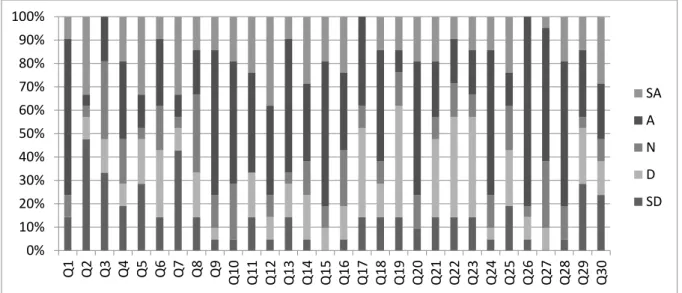
(10) 80 60 40. Before. 20. After. 0 Q1 Q2 Q3 Q4 Q5. Q6. Q7. Q8. Before Q9. Q10. Figure 1. Learners’ self-report measure of self-efficacy. A thirty-item questionnaire was administered to the participants to determine their beliefs and attitudes toward the CLIL experience in studying “Development Psychology” course. The questionnaire items were examined and analyzed; 14 items (Q2, Q3, Q5, Q7, Q8, Q14, Q15, Q17, Q19, Q21, Q22, Q23, Q25, & Q29) were written in a negative form and the others were stated in an affirmative form. As Figure 2 shows, the majority of participants liked the instructor’s approach in this course; they improved mainly in the language because they got used to studying the course in English and learning the course in English allowed them to access further information on it through various search engines; they became able to take notes about the course in English; they tried to understand what they have read or read without translating it word-for-word into Arabic and their vocabulary was enriched while studying the course in English; they also became able to think about the course content and understand it in English. Few participants (19% agree; 0% disagree) felt embarrassed when they expressed their ideas in English, and 29% of the participants think that their grade in the course is affected by their level of English. More than half of the participants disagreed that they found it difficult to articulate their thoughts in English, felt nervous when they have to speak in English, and thought that their weakness in English hindered their understanding of the course content. They also disagreed that they would get through more materials if the course content were in Arabic, would prefer the course to be taught in Arabic, and would be less afraid of the exams if they had exams in Arabic. Around two thirds of the participants enjoyed learning a lot of content terminology in English, felt comfortable when they made the exams in English, and had enough opportunities to communicate in English and became better in grammar and sentence structure during the CLIL lesson. Finally, 53% of the participants exerted more effort to study this course because it was taught in English and 47% of them took more time in studying this course than other courses because the content was in English. Hence, the findings of the data analysis of the thirty question items indicated that the participants expressed positive attitude towards the use of CLIL method. These findings were verified by the participants’ reflection logs. Indeed, almost all participants pointed out that CLIL method facilitated content and language learning and motivated them to express their ideas in English and to deliver oral presentations without being afraid. A lot of them pinpointed the role of CLIL interactive and collaborative activities in creating an unperturbed and enjoyable learning environment. Some of them stated that they no more feel apprehensive when they make an exam in English. Few participants wrote that the strategies used in CLIL lessons allowed them to self-regulate their learning at the end of the course. However, one participant stated that CLIL lessons 73 THE IMPACT OF CLIL IMPLEMENTATION ON LEBANESE STUDENTS’ ATTITUDES AND PERFORMANCE Badrie, EL-D., Abir, A. Encuentro 27, 2018, ISSN 1989-0796, pp. 64-79.
(11) made her feel tense because her low level in English prevented her from understanding the content well and from sharing ideas with others during the lesson. Another one was annoyed because she preferred to work alone and to receive direct instruction from her professor. 100% 90% 80% 70%. SA. 60%. A. 50%. N. 40% 30%. D. 20%. SD. 10%. Q1 Q2 Q3 Q4 Q5 Q6 Q7 Q8 Q9 Q10 Q11 Q12 Q13 Q14 Q15 Q16 Q17 Q18 Q19 Q20 Q21 Q22 Q23 Q24 Q25 Q26 Q27 Q28 Q29 Q30. 0%. Figure 2. Learners’ beliefs and attitudes toward CLIL learning experience. 8. Discussion Quantitative and qualitative data analyses of the achievement tests, two questionnaires, and reflection logs proved the following three alternative hypotheses: H1: CLIL instructional approach enhances university students’ academic achievement. H2: CLIL instructional approach boosts university students’ self-efficacy. H3: University students develop positive attitudes towards CLIL instructional approach. In regard to the first hypothesis, findings revealed that CLIL enhanced the academic performance of the students. This conforms to previous line of research. For instance, Koch et al. (2006) stated that CLIL could lead to a more profound content comprehension because of deeper information processing. Bonnet and Andreas (2004) pointed out that CLIL could help students acquire intricate scientific concepts since using the second language as the language of instruction in a content course prevents students from mixing up daily concepts with scientific concepts related to the same term. Sylven (2004) carried out a longitudinal study on 363 students in upper secondary classes in Sweden where English is taught as a foreign language. The results of the study revealed that CLIL students significantly outperformed regular students with respect to incidental vocabulary acquisition. Another study was conducted by Dafouz and Minano (2016) to examine the effect of English-Medium Instruction on student academic performance in a Spanish university. The research involved experimental and control groups with a total of 383 students. The experimental group studied Financial Accounting I course in English and the control group studied it in Spanish. Results indicated no statistical differences in academic performance across groups and that the use of English as the language 74 THE IMPACT OF CLIL IMPLEMENTATION ON LEBANESE STUDENTS’ ATTITUDES AND PERFORMANCE Badrie, EL-D., Abir, A. Encuentro 27, 2018, ISSN 1989-0796, pp. 64-79.
(12) of instruction did not lower students’ final scores in achievement tests. This means that English as a language of instruction did not impede Spanish students’ comprehension of business content. With respect to the second hypothesis, findings showed that CLIL instructional approach boosts university students’ self-efficacy. These findings can be interpreted in light of Bandura’s social cognitive theory (Bandura, 1986). According to the social cognitive theory, a learner’s self-efficacy is influenced by the joint interaction among the following three factors: environment, behavior, and personal aspects including physiological, cognitive and affective ones. This is validated by a series of studies (Cakr, 2009) which reveal that both internal and external factors such as, learners’ interest, successful experiences, peers’ successful performance, knowledge in the content area, positive feedback from others, and social and cultural context all boost learners’ self-efficacy beliefs. As to the third hypothesis, findings signified that university students develop positive attitudes towards CLIL instructional approach. The findings of the present study along with some previous studies indicate that students’ positive attitude towards the implementation of CLIL verified the theoretical merits attributed to CLIL. Indeed, CLIL implementation offers authentic materials and interactive tasks accomplished by collaborative efforts among peers and language assistance from instructors and digital resources in a relatively anxiety-free environment. Such learning situation induced students to adopt constructive views towards CLIL. However, in some research studies, students’ attitudes were in accordance with many factors such as students’ language proficiency level, teacher’s mastery of CLIL application, and the level of difficulty of the content course. 9. Implications The research study should be conducted at a larger scale; it should comprise participants from other departments and faculties in the Lebanese university as well as participants from private universities. It is, also, advisable that CLIL approach be implemented in many content courses so that students can augment their knowledge in various content areas and develop their language proficiency levels. Since research literature highlighted the correlation between motivation and the foreign language proficiency level of students and instructors on one hand and optimal benefits of CLIL approach on the other hand, language and content instructors should be enrolled in workshops that train them on devising interesting materials and practicing interactive methods for CLIL implementation and boost their foreign language skills. Last but not least, investigating the views of language and content university instructors can be illuminating for improving CLIL implementation. 10. Conclusion In a nutshell, implementing CLIL approach in language and content university courses produces significant learning outcomes. CLIL students were able to better understand the content in the foreign language and improve their academic achievement in content subjects. Moreover, the majority of CLIL students viewed the CLIL experience positively and believed that they are able to perform well during the CLIL implementation phase. However, the CLIL experience entails several challenging factors that 75 THE IMPACT OF CLIL IMPLEMENTATION ON LEBANESE STUDENTS’ ATTITUDES AND PERFORMANCE Badrie, EL-D., Abir, A. Encuentro 27, 2018, ISSN 1989-0796, pp. 64-79.
(13) are decisive to its success. In order to implement CLIL properly, teachers and instructors have to receive adequate training on how to apply it. Another factor is the role of motivation in CLIL classes. In fact, content and language materials have to be motivating and match the students’ proficiency levels in a foreign language. In addition, CLIL students have to be active learners through engaging them in authentic, meaningful, and interactive tasks and activities. Any disregard for one of these factors would impede the success of the CLIL implementation.. References Awan, M. A., & Sipra, M. A. (2018) "CLIL: Content based Instructional Approach to Second Language Pedagogy". Arab World English Journal, 9(1). Baïdak, N., Balcon, M.-P. & Motiejunaite, A. (2017) "Key Data on Teaching Languages at School in Europe. 2017 Edition. Eurydice Report." Education, Audiovisual and Culture Executive Agency, European Commission, p.55. Ballou, K. (2018) "Nuclear Negotiations: Using an E-learning Simulation in a CLIL Course for Students of Foreign Studies". Proceedings of Multidisciplinary Academic Conference, pp.268-273. Bandura, A. (1986) "Social Foundations of Thought and Action". Englewood Cliffs, NJ. Bonnet, A. Chemie im bilingualen Unterricht. Vol. 4. Springer DE (2004) cited in Haagen-Schützenhöfer, Claudia, and Martin Hopf. Bruner, J. (1986). “Actual Minds, Possible Worlds". Cambridge, MA: Harvard University Press. Çakır, Ö. & Alıcı, D. (2009) "Seeing Self as Others See You: Variability in Self‐Efficacy Ratings in Student Teaching". Teachers and Teaching: theory and practice,15(5) pp. 541-561. Chularut, P. &. DeBacker, T. K. (2004). "The Influence of Concept Mapping on Achievement, Self-Regulation, and Self-Efficacy in Students of English as a Second Language". Contemporary Educational Psychology, 29 (3), pp. 248-263. Claudia, and Martin Hopf. (2010) "Content and Language Integrated Learning in Physics Teaching: Benefits, Risks, Requirements and Empirical Studies". In Teaching and learning physics today: GIREP conference. Content and Language Integrated Learning in Physics Teaching: Benefits, Risks, Requirements and Empirical Studies. In Teaching and Learning Physics Today: GIREP conference, 2010. Coyle, D. (2007) "Content and Language Integrated Learning: Towards a Connected Research Agenda for CLIL Pedagogies." International Journal of Bilingual Education and Bilingualism10.5, pp. 543-562. Coyle, D., Holmes, B. & King, L. (2009). Towards an Integrated Curriculum. CLIL National Statements and Guidelines. London: The Languages Company. Coyle, D., Hood, P. & Marsh, D. (2010)." CLIL: Content and Language Integrated Learning". UK: Cambridge University Press. 184. Csizér, K., & Magid, M. (Eds.) (2014). "The Impact of Self-Concept on Language Learning". Vol. 79, Multilingual Matters. 76 THE IMPACT OF CLIL IMPLEMENTATION ON LEBANESE STUDENTS’ ATTITUDES AND PERFORMANCE Badrie, EL-D., Abir, A. Encuentro 27, 2018, ISSN 1989-0796, pp. 64-79.
(14) Czura, A. & Papaja, K. (2013). "Curricular Models of CLIL Education in Poland". International Journal of Bilingual Education and Bilingualism, 16(3), pp. 321-333. Dafouz, E. & Camacho-Miñano, M. M. (2016) "Exploring the Impact of English-Medium Instruction on University Student Academic Achievement: The Case of Accounting". English for Specific Purposes 44, pp. 57-67. Darn, S. (2006) "Content and Language Integrated Learning (CLIL): A European Overview." Online Submission. Denman, J., Tanner, R. & de Graaff, R. (2013) "CLIL in Junior Vocational Secondary Education: Challenges and Opportunities for Teaching and Learning". International Journal of Bilingual Education and Bilingualism, 16(3), pp.285-300, cited in Syzdykbayeva, Rizagul. Eshghinejad, S. (2016). "EFL Students’ Attitudes Toward Learning English Language: The Case Study of Kashan University students." Cogent education 3.1: http://dx.doi.org/10.1080/2331186X.2016.1236434 Finardi, K. R., Silveira, N. & Alencar, J. G. (2016) "First Aid and Waves in English as a Foreign Language: Insights from CLIL in Brazil". Electronic Journal of Science Education, 20(3). Goker, S. D. (2006) "Impact of Peer Coaching on Self-Efficacy and Instructional Skills in TEFL Teacher Education". System, 34 (2), pp. 239-254. Gorsuch, G. (2009) "Investigating Second Language Learner Self‐Efficacy and Future Expectancy of Second Language Use for High‐Stakes Program Evaluation". Foreign Language Annals, 42 (3), p. 505-540. Huang, D.-F. (2015) "Exploring and Assessing Effectiveness of English Medium Instruction Courses: The Students’ Perspectives". Procedia-Social and Behavioral Sciences, 173, pp.71-78. Hunt, M. (2011). "Learners’ Perceptions of their Experiences of Learning Subject Content Through a Foreign Language". Educational review, 63(3), pp.365-378. Ikeda, M. (2013). "Does CLIL Work for Japanese SecondarySchools?" International CLIL Research Journal, 2 (1), pp. 31-43. Koch, A., & Bünder, W. (2006) "Fachbezogener Wissenserwerb im bilingualen naturwissenschaftlichen Anfangsunterricht. Zeitschrift für Didaktik der Naturwissenschaften, 12" pp. 67-76; cited in HaagenSchützenhöfer. Lasagabaster, D. & Sierra, J. M. (2009) "Language Attitudes in CLIL and Traditional EFL Classes." International CLIL Research Journal 1(2), pp. 4-17. Lee, B., and Chang, K. (2008) "An Overview of Content Language Integrated Learning in Asian Countries". Studies in English Education, 13(2), pp. 166-184. Mackenzie, A. S. (2008) "English Next in Easy Asia". In The proceeding of primary innovations regional seminar, pp. 23-30. Marsh, D. & Langé, G. (2000) "Using Languages to Learn and Learning to Use Languages." Eds. D. Marsh-G. Langé. Finland: University of Jyväskylä. Marsh, D. (2003) "The Relevance and Potential of Content and Language Integrated Learning (CLIL) for Achieving MT+ 2 in Europe." ELC Information Bulletin 9.4. 77 THE IMPACT OF CLIL IMPLEMENTATION ON LEBANESE STUDENTS’ ATTITUDES AND PERFORMANCE Badrie, EL-D., Abir, A. Encuentro 27, 2018, ISSN 1989-0796, pp. 64-79.
(15) Marsh, D. (2007) "Diverse Contexts, Converging Goals: CLIL in Europe". Ed. Dieter Wolff. Frankfurt: Peter Lang. Marsh, D. & Hood, P. (2008) "Content and Language Integrated Learning in Primary East Asia Contexts (CLIL PEAC)". In The proceeding of primary innovations regional seminar, pp. 43-50. Masgoret, A.M. & Gardner, R.C. (2003) "Attitudes, Motivation, and Second Language Learning: A Meta– Analysis of Studies Conducted by Gardner and Associates". Language learning, 53(1), pp.123-163, cited in Kofou, Ifigenia, and Kostas Philippides. Mehisto, P., Marsh, D. & Frigols. M. J. (2008) "Uncovering CLIL Content and Language Integrated Learning in Bilingual and Multilingual Education". Macmillan 2008. Mohan, B. A. (1986) Language and content. Vol. 5288. Addison Wesley Publishing Company. Nazarbayev. (2017). "Students’ Attitudes and Perceptions of Content and Language Integrated Learning in a Secondary School." PhD diss., University Graduate School of Education. Papaja, K. L. (2012). "The Impact of Students' Attitudes on CLIL." Latin American Journal of Content & Language Integrated Learning 5.2, pp. 28-56. Richards, J. C. & Rodgers, T. S. (2014) "Approaches and Methods in Language Teaching". Cambridge university press. Sasajima, S., Ikeda, M., Hemme, C. & Reiley, T. (2011) "Current Practice and Future Perspectives of Content and Language Integrated Learning (CLIL) in Japan." In The JACET 50th Commemorative International Convention Proceedings, cited in Huang, Da-Fu. Schwarzer, R. & Jerusalem, M. (2010) "The General Self-Efficacy Scale (GSE)". Anxiety, Stress, and Coping 12, pp. 329-345. Shang, H.-F. (2010) "Reading Strategy Use, Self-Efficacy and EFL Reading Comprehension". Asian EFL Journal, 12 (2), pp. 18-42. Skeet,. J. "Which learning theories are important in CLIL?" [Online]. Available from: http://www.academia.edu/download/50771985/Which_learning_theories_are_important_in_ CLIL.pdf. Swain, M. (1993). "The Output Hypothesis: Just Speaking and Writing Aren't Enough". The Canadian Modern Language Review, 50, pp. 158-164. Sylvén, L. K. (2004) "Teaching in English or English teaching?" On the effects of content and language integrated learning on Swedish learners' incidental vocabulary acquisition. PhD diss., Göteborg University. Vázquez, V. P., Prieto Molina, M. & Ávila López, F. J. (2015) "Perceptions of Teachers and Students of the Promotion of Interaction Through Task-Based Activities in CLIL". Porta Linguarum: revista internacional de didáctica de las lenguas extranjeras, (23), pp.75-91; cited in Syzdykbayeva, Rizagul. Vency, H. J., & Ramganesh, E. (2013) "Is Language Proficiency Taken Care of at Higher Education Level?" Need for self-efficacy of postgraduate students. Journal of Language Teaching and Research, 4(6), p.1176.. 78 THE IMPACT OF CLIL IMPLEMENTATION ON LEBANESE STUDENTS’ ATTITUDES AND PERFORMANCE Badrie, EL-D., Abir, A. Encuentro 27, 2018, ISSN 1989-0796, pp. 64-79.
(16) Vygotsky, L.S. (1986) "Mind and Society: The Development of Higher Mental Processes". Cambridge, MA: Harvard University Press. Vygotsky, L. S. (1986) "Thought and Language". Cambridge, MA: MIT Press. Wang, Ch. & Pape, S. J. (2007) "A Probe into Three Chinese Boys' Self-Efficacy Beliefs Learning English as a Second Language". Journal of Research in Childhood Education, 21 (4), pp. 364-377. Wolff, D. (2005)"Approaching CLIL." The CLIL quality matrix. Central workshop report. Yassin, S. M., Marsh, D., Ong Eng Tek, & Lai Ying Ying. (2009) "Learners’ Perceptions Towards the Teaching of Science through English in Malaysia: A Quantitative Analysis." International CLIL Research Journal 1(2), pp. 54-69; cited in Syzdykbayeva, Rizagul. (2017) "Can Teaching of Forces Enforce Language Learning?" Research Papers in Language Teaching and Learning, 8(2), p. 120.. 79 THE IMPACT OF CLIL IMPLEMENTATION ON LEBANESE STUDENTS’ ATTITUDES AND PERFORMANCE Badrie, EL-D., Abir, A. Encuentro 27, 2018, ISSN 1989-0796, pp. 64-79.
(17)
Figure



Documento similar
