CLIL: Its Effect on High School Students´ English Speaking Performance
Mauricio Cadavid Palacio Código 16229596 Diego Alejandro Jiménez Código 14572082
Lic. Claudia Munera Mora Advisor
Universidad Nacional Abierta Y A Distancia UNAD
Licenciatura En La Enseñanza Del Idioma Inglés Como Lengua Extranjera Escuela Ciencias De La Educación
ECEDU
To the memory of Our father, Francisco Emilio.
TABLE OF CONTENTS
Acknowledgements ... 6
Abstract ... 6
Introduction ... 7
1. Analytical Summary of the Research ... 10
2. Descriptionof the Context and description of the problem ... 15
3. Research Question and Objectives... 20
4. Theoretical Framework ... 21
5. Methodology ... 52
6. Research stages, Analysis and Results ... 54
7. Discussion and Findings ... 92
8. Conclusions and Recommendations ... 102
9. References ... 107
LIST OF GRAPHS
Page
Graph 1 ... 59
Graph 2 ... 57
Graph 3 ... 60
Graph 4 ... 58
Graph 5 ... 58
Graph 6 ... 58
Graph 7 ... 59
Graph 8 ... 59
Graph 9 ... 59
Graph 10 ... 59
Graph 11 ... 61
Graph 12 ... 61
Graph 13 ... 61
Graph 14 ... 61
Graph 15 ... 615
Graph 16 ... 615
Graph 17 ... 616
Graph 18 ... 617
Graph 19 ... 617
Graph 20 ... 617
Graph 21 ... 618
Graph 22 ... 618
Graph 23 ... 618
Graph 24 ... 618
Graph 25 ... 619
Graph 26 ... 619
Graph 27 ... 619
Graph 28 ... 70
Graph 29 ... 70
Graph 30 ... 74
Graph 31 ... 86
Graph 32 ... 86
Graph 33 ... 86
Graph 34 ... 86
Graph 35 ... 87
Graph 36 ... 87
Graph 38 ... 87
Graph 39 ... 90
Graph 40 ... 90
Graph 41 ... 90
Graph 42 ... 91
Graph 43 ... 91
Graph 44 ... 91
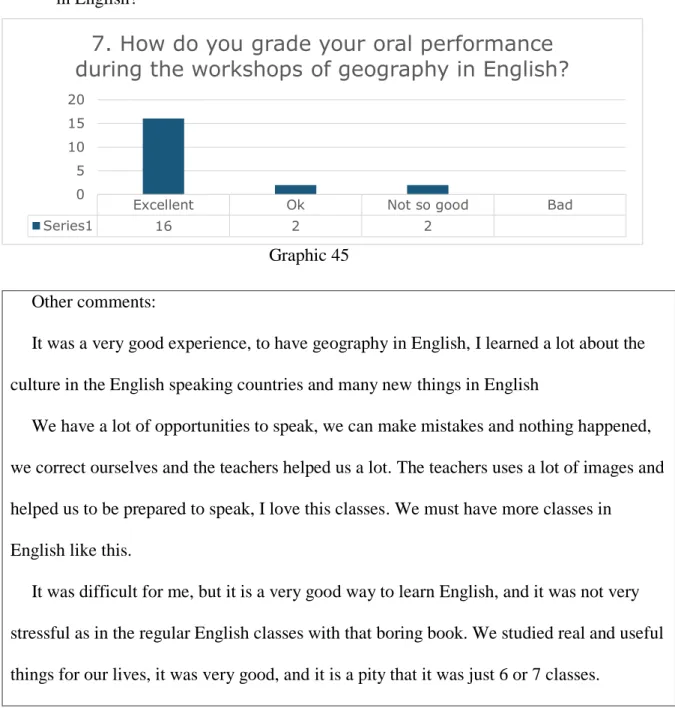
Graph 45 ... 92
LIST OF TABLES Page Table 1 ... 358
Table 2 ... 54
Table 3 ... 55
Table 4 ... 56
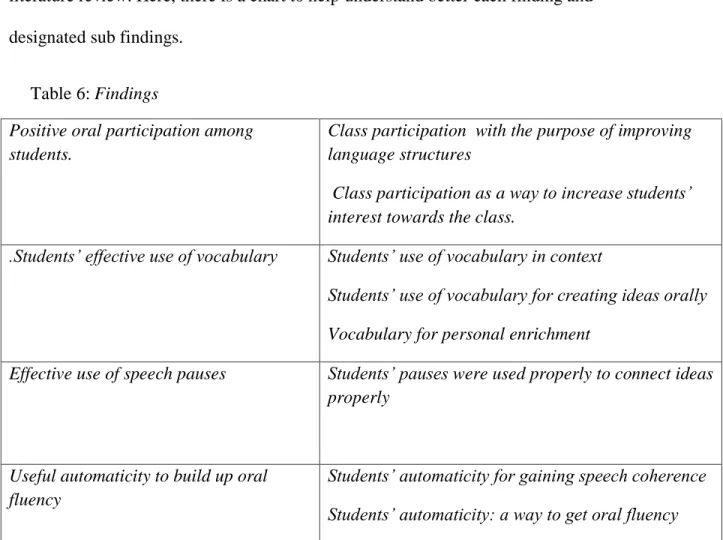
Table 5 ... 85
Acknowledgements
First, we wish to thank our kind advisor, Professor Claudia Munera Mora, UNAD university. She has been very patient, helpful and supportive in all the senses, she always has a word to encourage us to continue in this hard path to construct this researching paper. She had the ability of combine her knowledge with her personal values in order to help us in some difficult moments we have had in our personal lives during this process, but if it were not for her, we would not be here presenting this document.
we have to thank all the professors, because each of them gave us ideas to choose and continue working with this topic, but especially to professor Claudia Munera Mora, who provided us with insights that made us shape this research in order to demonstrate how this new approach (CLIL) contribute to enhance students‟ speaking skills.
Abstract
The purpose of this research was to determine to which extent the use of Content Language and Integrated Learning (CLIL) supports and helps to improve the oral performance of a group of eight graders at a private high school, it was done by following the CLIL characteristics and theory that describe the steps in order to prepare a CLIL lesson and how to apply it in the English classroom, as it was stated by (Marsh, 2009).The project involved a diagnostic stage in which some instruments where applied, also an action stage where seven workshops where carried out, and finally an evaluation stage in which other instruments where used to evaluate the process, in the speaking performance of the students in eighth grade. The findings reported the usefulness of CLIL in the English as a Foreign Language classroom as a way of improving students‟ speaking performance, vocabulary, and at the same time acquiring some knowledge about social sciences that reinforce their learning process in these subjects in Spanish and at the same time working on their English skills. The study also reported to be a curriculum innovation to be taken into account at all levels at Rafael Pombo High School; in fact, these findings suggest that CLIL resources increase students‟ interest, enthusiasm and language understanding, improving their language performance. Conclusions and pedagogical implications are presented for teachers, school administrators, and policy makers to include CLIL in future curriculum endeavours.
CLIL: Its Effect on High School Students´ English Speaking Performance
The aim of this research project was to present new possibilities of teaching English to students in high school. Nowadays, there are many methods and
approaches to teach English in Colombia and around the world. One of them is introduced as CLIL (Content Languageand Integrated Learning) the approach that will be discussed in this paper,which describes the way high school students improve their oral performance in English. In the action stage the researcher implemented some workshops about Geography with topics related to English Speaking Countries with the purpose of motivating students to learn content and language at the same time.
In the first part of the thesis, the terms of innovation and what can be considered as new methods or new approaches to teach English in Colombia and especially in high school are described. In the next chapters in which a
characterization of the target population of the project was done, their behavior, the way they thought and the way they learn were analyzed using different instruments of data collection.
The conclusions of this project showed that through this methodology students improved their oral performance using the steps of the CLIL method. Having in mind that CLIL is not a very used approach in our context, there is a very important contribution with this research project, because it can help other
classroom. In addition, the advantages and disadvantages of using CLIL, the obstacles teachers or schools have to overcome and the differences between CLIL and other similar methodswereexplored. One of the intentions of this project was to show how CLIL could be used in Colombia, especially to improve the speaking skill, which is the most important and representative weakness in the students according to the Ministry of Education (2014 report on Bilingualism). Furthermore, the Project reports on how some bilingual schools in order to demonstrate how to set up a CLIL lesson and what teachers need to keep in mind while creating such experiences in the classroom.
In addition, the Project intended to find out whether this method could be efficiently used at high school level in order to improve the oral skill of the students in the school where it was applied and then have the opportunity to share the
1. Analytical Summary of the Research
This study is important because it serves as a benchmark to English teachers, administrators, policy makers, and the academic community in general to consider the use of Content Language and Integrated Learning (CLIL) in the EFL scenario to develop students‟ speaking ability in order to enhance fluency, pronunciation, intonation and vocabulary considering the speaking process, as the union of many elements that converge in the process of communicating a message clearly, and CLIL as a mean of instruction to engage students with tasks according to their interests and wishes.
In attempts to understand the impact of CLILto overcome students‟ difficulties in terms of oral fluency, this project Takes into account some important theoretical and practical outcomes, especially, regarding students‟ speaking skills and how CLIL helps to develop communicative abilities of EFL learners with a different point of view about how CLIL teaching methodology improves students‟ fluency components: range, automaticity, intonation, and decrease the number of long pauses while they are speaking. On the one hand, the speaking tasks proposed were designed following the stages stated by mars (1987) having a significant impact on students‟ speaking process given the fact these phases provide learners with opportunities to be prepared to performance speaking tasks using content, in this case Geography.
encourage teachers to explore other alternatives in the class that facilitate the use of content to overcome a class problem. Furthermore, the importance of being
autonomous was another aspect that this project provided given the fact that this type of methodology helped learners to increased their confidence and interest towards the class allowing them to find opportunities to fulfill their needs and at the same time learn a new subject using English as the channel to accomplish it.
Another important consideration regarding this project is the contribution to improve the quality of education at the school level and change students‟ perceptions towards the learning of the English language. For high school students, English is seen as a boring and compulsory subject and not as the possibility to enrich their skills. Being more specific, from Our professional experience as an English language facilitator, the study, CLIL: Its Effect on English Speaking Performance allowed me to gain insights and to reflect, change and improve some aspects of Our teaching practice; especially, related to oral tasks and the connection they need to have with students‟ real needs and context. Moreover, I consider that the project helped me to show to Our students the advantages they have when they are good at sharing ideas orally.
This project aimed to improve the speaking skill because it promoted students‟ positive attitudes towards the use of content, in this case Geography to helps them to acquire language fluency improving their perceptions towards speaking, that is, moving away from negative perceptions to high commitment, interest, so thatthey are encourage to use the language to speak following the process of using input, analyse content, create an idea and finally express it by using speaking skills following the CLIL 4 Cs (Content, Communication, Cognition and culture). Furthermore, it is beneficial because it improves students‟ speaking skills to convey language functions such as convincing, suggesting, comparing, retelling, and providing points of view about a particular topic related to current issues in their context.
Concerning curriculum trends and policies, this project is innovative because it enhances internal curriculum and language practices at the institution in response to local, national, and international policies in the teaching of EFL, additionally it encouraged teachers to explore and design lesson plans that drive students to use English by means of content in this specific case Geography about the countries where English is spoken. This research is also important because it fosters the use of
activities in which students had to work in groups and individually, in order to promote team work and learners‟ self-independence and also confidence allowing them to get acquainted with the vocabulary and topics about geography but in English, which allowed them moving ahead in the development of their language abilities.
world encouraging them to immerse in a new field; that is, Geography in English, therefore, promoting autonoOur, interest and knowledge to go beyond the traditional learning process to incorporate in the classroom innovative content to encourage them to use the language.
Additionally, this study contributes to adopting and promoting new policies in favour of using CLIL as a resource that assists language learning. Accordingly, this project benefits the institutional curriculum by promoting the use of the English as a cross curriculum subject in order to expose students to new topics and cultural experiences that allow them to build their language skills, thus, serving as a vehicle for language instruction. This study becomes a basis for further studies under similar conditions in order to improve the use of CLIL in the classroom to better the speaking skill at different levels.
Particularly, the effects of CLIL focused on the speaking skills will affect the way I will keep conducting Our English lessons making them more interesting, meaningful, and engaging where learners can make the most of the experience from it gaining confidence, raising awareness, improving facts of the language and exploring the world so they can have better language opportunities in their professional fields. Likewise, it will affect Our personal and academic life because it will give me more proficiency in the field of action research; specifically, CLIL and speaking, hence, empowering Our teaching practices and students‟ language learning.
particularly, the academic community will be the most benefited because of new practices in the local context providing access to an outsider world where students can have the best of the experience by interacting with content from different subjects to move forward in their language learning. Besides that, this research responds to the national program of English 2015 -2025, which establishes as a main goal that all the Colombian people have to be proficient in English, and also to the new bilingual law 1651 of 2013, which states that teaching English in Colombia has to be mandatory and using the new tendencies and methodologies in teaching English, in which
2. Descriptionof the Context and description of the problem
2.1 Description of the Context
Colombia is facing many challenges regarding international issues such as Trading, Science, and Technology. Education represents the main foundation to
achieve competitiveness in the globalized world ofnowadays (Ministerio de Educación Nacional, 2006). Concerning educational factors, the learning of English, plays an important role in the achievement of our students‟ professional success which, in the long run, will result in the Colombian‟s driving force towards development and
progress. This has created a personal interest in looking for new approaches that foster students to improve their English skills, therefore; Content Languageand Integrated Learning (CLIL) appears to be an innovative way to do it in the context of a school where English is the core of their academic program and the policy of the school is to introduce content in English as part of the evolution of the English department.
Taking into consideration that communicative competence is the ultimate goal in language teaching and learning, the speaking skill is one of the most relevant communicative events for the transmission of knowledge and information among people. For that reason, the application of communicative approaches to language teaching as CLIL can result into positive contributions in the learning process and opportunities for learners at Rafael Pombo School as future users of English, to achieve effective and efficient interactions in the target language. Furthermore, the present research study is in accordance with the policies set by the Ministry of
at students: “To use English as a tool to communicate with the world and to improve their labor opportunities.”
Theprojectwascarried out in Cartago, which is a city in the southwestern part ofColombia,it is in the extreme northern portion of the Valle del Cauca Department. it is the fourth largest city in Valle after Cali, Palmira, and Tuluá. It has a population of approximately 155,000 inhabitants (2014). Cartago features warm weather, about 30 degrees Celsius.
This research was conducted at Rafael Pombo High School, which is a private school.It has about 420 students and about 24 Teachers. The Mission and Vision of the school deals with the learning English as the base for their curriculum. The students only study in the morning shift. In the afternoon they have special classes which they call “Ludicas”.
In regard to the English area of the school, students take 8 to 10 hours of English class a week, about 400 a year. There is a very well structured English plan aligned with the Common European Framework of Reference for the Languages. The teachers‟
proficiency in English is C1 and there are all the technological conditions to have a very dynamic and interactive class. Each classroom has a video beam and there is internet connection all the time. Regarding students, they are from medium and high social classes. For this specific study students from 8thgrade were selected, they were 10 and 11 years old.
They are very motivated to leaning and also the English teachers have the support from other teachers and the administrative staff.
2.2 Description of the Problem
In its document Basic Standards for Foreign Languages: English, The Ministry of Education (2006) regards teaching speaking as one of the main goals of English instruction at the secondary education in Colombia. However, due to the school teachers‟ lack of preparation in the language, learners are not achieving the language proficiency standards proposed by the Common European Framework of References for the Languages. When learners finally begin the first year of secondary, they are not able to comply with the academic demands of this subject area, and the language teacher has to start English lessons from the very beginning, which happens in the public sector according to the Ministry of Education. However, at Rafael Pombo School this does not happens, because students are taught English since elementary school and with professional English teachers, but the problem here is how the classes are conducted, because according to the diagnostic stage the school still uses a very traditional methodology to teach English, with a text book that has to be covered by the end of the year. No matter how fast the teachers have to work in order to cover all the pages.
In order to come to a more accurate description of the problem, classroom observation diaries, questionnaires, interviews, and documentary observations were conducted and administered during the diagnostic stage. It was found that the teachers stick to the book and students do not have many opportunities to do
of aspects that constrain the development of the speaking skills in the students were identified.
From these instruments, it can be inferred that the main problems that students and teacher had at the institution regarding the teaching and learning of English were:
Studentswerenot motivated to speak during the lessons.
Students were afraid of making mistakes in front of their classmates when doing speaking activities.
Learners‟ sentences when speaking are very limited (monosyllabic or very few words).
Students work mostly in grammar activities from the workbook (Pacesetter book from Oxford University press).
Classes are very traditional. The teacher explains grammar concepts and vocabulary and then they work on the book, with little or no opportunity to interact in English.
Lack of innovation in class, as mentioned before the teachersrelytheir class on the textbook they use in the school.
Teaching Talking time is very high,lessons are teacher-centered because he explains and then corrects himself the activities, without giving students the opportunity to speak in class.
From the analysis of these instruments, it is clear that students from Eighth grade at Rafael Pombo High School in Cartago were exposed to traditional classes, as it was observed during the visits to the classes and the interviews done the students. In which they used a text book that has been required by the administrative staff and teachers based their classes following the book and working individually in their workbooks, because that is the vision of teaching that teachers have at the school. Another important aspect is the little group work implemented in class.
3. Research Question and Objectives
3.1 Research Question.
What is the impact of CLIL lessons on the 8th grade students’ speaking performance at a private school in Cartago?
3.2 Objectives
3.2.1 Research objectives
General research objective:
To recognize, how Content Language and Integrated Learning (CLIL), impacts 8th graders‟ speaking performance.
Specific research objectives:
To apply CLIL approach as a way to enhance learners‟ speaking performance in English.
4. Theoretical Framework
This research was based on Content Language and Integrated Learning (CLIL) methodology, and it made use of Geography as the main core for its application in the school selected for this project. In this way, the theoretical component aimed at providing a definition about CLIL, as well as explaining some relevant facts about its background, its current situation in the Colombian context, and its role in the English language classroom, with a special focus on important steps related to didactics for teaching Geographyand the development of the speaking skill of the students..
4.1 Definition of CLIL
Mehisto, Marsh and Frigols (2008) stated that “We live in a time of innovation, and new ways of living and working.This often involves changing the way we do things.” These changes mentioned by the authors can be represented in education in a modern methodological approach known as CLIL, which has attracted to a certain degree a lot of attention in the most of the English as a Second Language and English as a Foreign Lamguage professional world (Els, 2005).It serves as a general term for practice of bilingual education (Marsh, 2009). As Coyle, Hood and Marsh (2010) wrote that CLIL “…is not a new form of language education. It is not a new form of subject education. It is an innovative fusion of both.
In regards to Colombia, this method has been scarcely explored, which subsequently leaves researchers and experts in the topic with limited proof to determine its influence in this context. For this reason, as stated by the
education system works in Colombia, specifically on the field of teaching English as a foreign language, since what has been done in regards to bilingualism has not been a real success according to the Ministry of Education in its annual report (2015), where they invited language instructors to use new approaches that help students and
teachers to be motivated in terms of the teaching and learning of English.
Furthermore, as it was mentioned before, the acronym CLIL is used “as a general term to define all types of bilingual or immersion education. It basically involves the action of teaching in at least two different languages, other than language lessons themselves,” (Eurydice, 2008, p.112). This methodological approach
emphasizes on the importance to “develop proficiency in both the non-language subject and the language in which this is taught,” (Eurydice, 2005, p.7).
4.2 The role of content in CLIL
The term content in CLIL does not refer specifically to academic subjects; rather, it is used to mention any different subject. As stated by Genesee (1994) content is any “topic, theme or non-language issue of interest or importance to the learners” (Genesee, 1994). It is also important to emphasize that the material selected for a CLIL lesson must be something that really engages, challenges and impacts learner‟s cognition, so as to activate their critical thinking skills and at the same time, to cover the target language and culture (Met, 1991, p.150).
In this way, the purpose of conducting this research study is to use Geography, in this case, using as a reference the one from English speaking countries as the
content, in order to engage and motivate the students to participate in class, since there is a wide range of themes that can be used for such aim.
4.3 The role of language in CLIL
In CLIL, “an additional language is used for the learning and teaching of both content and language. It is often a learner‟s foreign language, but it may also be a second language or some form of heritage or community language” (Coyle et al., 2010, p.1). In this way, CLIL is certainly very flexible, since depending on the
teachers‟ or the school staff‟s decision, the focus of the lesson can be directed towards the target language or the content itself. It means that in a situation where the main purpose is to improve oral skills, the focus would rather be directed to content than to language.
Furthermore, according to Eurydice (2005), the use of target language varies across countries. In Europe, the most frequently languages used for CLIL are a combination of foreign languages and regional and/or minority languages. In
Colombia, it is an exception since “CLIL focuses exclusively on foreign languages.” Besides, Eurydice (2005) confirmed that “close examination of CLIL target languages reveals that English is the most widespread foreign target language in west countries in order to apply CLIL.”
In addition to this, in CLIL language is commonly seen as a “tool for
forgetting content, which is the most important part of CLIL. For this reason, it is a must for language teacherstohave a balance in order to avoid separating lessons into sequences of content and language; that is to say, content and language objectives need to be interrelated. As such, these connections are made by “the Language Triptych,” which means that language use has “three interrelated perspectives: “language of learning”, “language for learning” and “language through learning” (Coyle et al., 2010).
“Language of learning” is language needed to acquire the content. This is language that is used when speaking about specific topics and themes of subjects. Emphasis is put on ability to use language with appropriate vocabulary (terminology), phrases and grammar so that the content is covered in a meaningful way. It is also important to keep in mind that the main objective of CLIL is content. For this reason, in order to have a successful process with content, there must be a good development of the program, and balanced quantity between content and language in the CLIL curriculum that facilitates teachers to provide the students the necessary tools to acquire content and progress in language at the same time.
naturally to use the target language (English in this case), in a communicative way, using vocabulary and expressions taken from the content selected for one specific group (Geography in the case of this research).
Likewise, language is improved through the acquisition of new thinking processes and knowledge (Coyle et al., 2010). Although the language used in CLIL is relevant for carrying out the processes, every teacher should bear in mind that the mother tongue or first language (L1) plays a critical role in these lessons. The ratio of L1 and L2 exposure depends on the level of proficiency in L2: the lower degree, the higher exposure of L1. It has also been shown that the use of L1 is especially helpful for explaining and understanding basic concepts, since it provides important support in academic learning;it is needed for explanation and clarification of new subject matters and/or for instructional purposes (Echevarria, Vogt & Short, 2008). Although the purpose of CLIL is to provide content using a foreign language to support its acquisition in a more natural way, the methodology recommends the use of the mother tongue as a way of comparing the two languages, and in some occasions, clarifying concepts from the content used in the classes.
4.4 CLIL in Colombia
Currently, bilingualism is starting to take on a new role in Colombia. Schools and universities are not concerned with just learning English anymore, but are more concerned with what students can do with the new language. Graddol (2005) stated that English is no longer a foreign language, rather it is becoming more of a core skill very much like ICT skills, as it transforms and repositions the curriculum. This, in turn, has brought about crucial changes in the way English language researchers and professionals look at the teaching of English. In the case of schools that have the vision of becoming bilinguals, the application of a new methodology like CLIL might be the start to a new way of encouraging students and teachers in the process, and at the same time, strengthening the curriculums in the search for a better and more effective way of teaching and learning English.
Recently, the Ministry of Education in Colombia, through the Bilingual Project established English as part of the State Curriculum, in which the Common European Framework for Languages (CEF) is used as a source of reference. The new state language curriculum contains a comprehensive description of language proficiency along with associated assessment standards, so that there is transparency and consistency in the teaching of English language in Colombia.
Concerning bilingual schools or schools with a strong focus on English, CLIL is an appropriatealternative to increase the exposure of the students to the foreign language through subjects. In a more specific case, the use of a subject like Geography provides greater opportunities to practice the target language in the classroom, since it offers not only broad content but also extensive practice of the different skills of language, and at the same time, it can be adapted to any requirements of the curriculum.
In the same way, current research in second language acquisition indicates that an essential element for effective instruction in English as a second language is the access to comprehensible input (Krashen&Biber, 1988). One way to provide students with comprehensible input is by teaching content in English in an engaging and interesting way, through the use of strategies and techniques that allow them to both acquire language almost automatically and become active participants in its use, thus responding to the need communicating something selected and discussed in the input (Content).
students “just become conversant in „General English‟, but they should study their subject in English” (Graddol, 2005). Although CLIL varies as far as being described or implemented, it is an approach that can be easily adapted to current educational and bilingual programs in Colombia.
To summarize the previous information,although there is some research
surrounding CLIL in other educational contexts, further exploration is needed in terms of content and language integration using the CLIL approach in Colombia. Research should focus on the different stages of implementation taking into consideration the different educational stages. Increased in-service courses are feasible in order to re-train teachers on different teaching methods, as well as different ways of working with specific language in a CLIL environment. It is also important to establish
opportunities for content specialists to know more about language learning and teaching, in order to successfully promote the students‟ language skills.
4.5 Advantages of using CLIL
CLIL is an innovative and relatively new methodological approach that offers a series of advantages to teachers and students in the teaching and learning context. These advantages go hand in hand with the main purpose of this approach, which is to use content as a channel to provide students with language input, so as to enable them to practice the different skills of the L2.
and adaptable to different contexts and types of school worldwide. Likewise, the “educational success” of CLIL lies in the basis of this dual-focused approach which involves both content and language exposure integrated in the classroom (Coyle et al., 2010). An additional advantage has to do with the possibility of using any kind of content, either academic or informal, to raise interest in the learners, which subsequently leads them to improve language skills.
Besides, CLIL responds to the development of modern age with its demands on perfect academic knowledge which can be used around the world. Students have the opportunity to learn “subject-specific vehicular language terminology” which prepares them for their future as professionals (Coyle et al., 2010). Hence, the integration of both, language use and content helps to improve learner‟s cognitive development and stimulate cognitive flexibility. As Mehisto et al. (2008) claimed, “Thinking (cognition) is the mental faculty of knowing.” In a world where
bilingualism has become such an important issue, schools and institutionsnow concentrate their efforts on designing and delivering subjects entirely in English. For this reason, CLIL is intended to be the appropriate approach for achieving this purpose.
languages by using them.” He also confirmed that “learning is improved through increased motivation and the study of natural contextualized language and the
principle of language acquisition becomecentral. “In other words, while implementing a CLIL program, students come to a moment in which they learn language
unconsciously because they are more aware of the content; this certainly depends completely on the teacher‟s ability to engage them.
Likewise, communication is enabled through active learning. Students become dynamic, fully engaged in lessons, and cooperative with their peers using scaffolding, that leads them to negotiate both language and content, and take the teacher as a sparing-partner. Besides, CLIL lessons are based on students existing knowledge, abilities, skills, interests and experience which contribute to creative and critical thinking (Mehisto et al., 2008). As previously mentioned, it is the content chosen and the teacher who encourages all these interactions among students; in the same way, the lesson must be based on communication and cognition, focused on the content chosen and on the use of the target language in a clear and organized way, so as to enable students to show their best while performing in the different skills, not only in the target language, but also in the content proposed by the teacher in the lesson.
4.6 Disadvantages of using CLIL
is not possible to learn the same amount of content in second language as in their native language; in addition to this, CLIL students are unable to reach high academic results, and their skills in their mother tongue are diminished. However, as
demonstrated by researchers on the issue, these opinions are distorted. Most of the CLIL detractors argue that learners exposed to CLIL do not learn enough content, and at the same time do not acquire language, because the methodologylacks of a clear focus on both issues, therefore students are unable to carry out an effective learning process.
An additional disadvantage deals with the fact that there is a lack of trained teachers on CLIL. As Eurydice (2008) published, in most countries teachers are not required to have any specific qualifications for CLIL. Followingthis idea, “the number of individuals, who speak a given CLIL language and have subject area qualifications, is limited” (Mehisto et al., 2008, p.21). Yet, even if there are such qualified teachers, this does not guarantee that they are able to focus on and teach both content and language at the same time. In some cases, teachers have knowledge and skills to cope withboth; in some others, language teachers do not comprehend content subjects, or they simply lack of sufficient level of language or are too self-critical about using it.
Another disadvantage of using CLIL is related to time. Preparing CLIL lessons is time consuming and it “takes a conscious effort to set content, language and
learning skills goals for every lesson and to develop activities that involve a maximum number of students at a given time” (Mehisto et al., 2008). Time needed for
them to specific students and lessons. Mehisto et al. (2008) emphasized that “the language input needs to be simple enough and presented in a reader-friendly manner as to facilitate comprehension, while at the same time being sufficiently content-rich and cognitively challenging to capture students‟ interest.” Greater workload is not supported enough by school administrators; hence a lot of teachers have to take responsibility on this, but not so many are willing to.
In addition to this, teachers have complained about assessment in CLIL. Questions such as what, when, how and who to assess should be taken into account. Coyle et al. provide main assessment principles to guide teachers on this important task.As such, a CLIL teacher should specify clear learning objectives which “include content/skills first, then language in some form. A positive aspect in regards to this is that CLIL has no preference of assessment types; it rather should be a mixture of formal andinformal assessment with a mixture of specific tasks. As for content, it should be “assessed using the simplest form of language” and for language “should be assessed for a real purpose in a real context” (Coyle et al., 2010). For this reason, it is important for teachers to help students be familiarized with assessment criteria and scaffolding, asto participate in both self- and peer-assessment.
Nevertheless, complaints are not only from teachers. CLIL is an example of student-centered approach which is closely connected with demands on students‟ activity and development of skills such as “analysis, contextualization and
state, “anxiety can be related to classroom climate and/or to the instructional conditions. Especially difficult are speaking tasks with certain speed of target
language, great amount of new vocabulary and importance to speak in front of a class. In such cases, it depends on how skillful the teacher is to drive students along the process to make it smooth.
Also, positive classroom climate such as no social comparing, supporting of cooperation and showing importance of mistake making can be helpful (Dörneyi, 2001, p. 94). Hence, by facilitating this in the classroom, students will feel confident and comfortable while performing in front of others, eliminating the pressure of getting grades and giving the possibility to get valuable feedback that will help them realize and overcome mistakes and at the same time, reinforce their skills.
4.7 CLIL Methodology
CLIL as an example of an innovative methodological approach fairly differs from traditional teaching. CLIL is accurately defined as “a methodology based on a Vygotskyan model of constructing ways and means for learners to get from where they are to where they need to be and packages that within an environment of interaction with peers and the teacher.”Even if there is no strict lesson plan, no exact methods and no obligatory organizational forms to use, CLIL lessons have some common features that a competent CLIL teacher should keep in mind.
(language learning and using), cognition (learning and thinking processes) and culture (developing intercultural understanding and global citizenship)”. This integration is done within certain contexts and shows the importance of symbiotic relationship between these components.
By the same token, Mehisto et al. (2008) provided a more detailed characteristic of the individual elements as it can be seen in the following table:
Table1
There is something that must be clear when talking about CLIL lessons; it is that the first objective should be the content subject. As Darn (2006) stated, the language needed to learn is determined by the subject matter. L2 should not be used only to provide students with vocabulary or applied in texts only to revise what has been done in the mother tongue. It should be put in use to learn as well as
communicate. Moreover, CLIL teachers ought to bear in mind students` level of L2 when planning lessons and specific activities inCLIL. It is why there must be a very clear knowledge about what kind of students are going to be exposed to CLIL lesson, what is their background in the content subject, as well as in the L2 language to be used as mean of instruction.
Grenfell (2002) points out the development of communicative skills with acceptance of language-switching during lessons. Communications and understanding a prior feature thus L1 is useful in activities such as problem solving. Encouragement of L2 use can be done with text reading and tape-recording. As for assessment, communicative skills should be assessed together with the content knowledge and skills, but the teacher should be aware of students` linguistic limitations. But at the same time must prepare challenging activities to encourage students to improve their communicative skills in this case their abilities to express ideas and opinions orally.
accuracy and on how students use the language they receive in the input stage in order to produce coherent speech in terms of language and content.
A variety of tasks used in CLIL lessons depends on the “learning purpose and learner styles and preferences” (Darn, 2006). Schools and teachers should pay
attention to learners` need and prepare suitable and challenging materials which enable them to develop their cognitive and linguistic levels in the Content and Language Integrated Learning (CLIL)methodology”, for this purpose, organizational forms likepair work, work in groups or cooperative learning are of a high importance in order to activate debates, and other tools that encourage students to apply critical thinking in their outcomes from the activities proposed by the teacher.
Students cooperate with their peers, they negotiate language and content together while the teacher`s role is a facilitator. Furthermore, scaffolding is a useful point in CLIL methodology. Students help each other constructing creative and critical thinking at the time when a more experienced student explains a piece of information to a less experienced one(s) (Mehisto et al., 2008). Grenfell (2002) also stresses in the student-student interaction the need of helping less proficient students by proficient peers. He adds that in CLIL lessons, before moving on to a general topic, it is of a big importance to use particular cases. To train learners in productive and reception strategies, let them mark lack of comprehension, ask for help, repeat, paraphrase, among others.
4.8 Lesson planning in CLIL
The success of CLIL relies on an effectiveness of CLIL lessons, if well planned a CLIL lesson will be the main tool to an excellent performance of both teachers and learners using this methodology in the classroom. Although there is no strict guidance of CLIL lessons and individual lessons can differ a lot, CBI (Content Based Instruction) uses a specific lesson framework described by Brinton &Holten (1997) which can be well applied to CLIL. Learning units have three stages: into, through and beyond. Each of them has some specific features which maximize students` learning development.
chart” can be very useful and at this point, students fill in only “What I know” and “What I want to know”. Techniques such as free association, brainstorming, content-related visualization, reviews of formerly gained content-knowledge, vocabulary input are helpful means to help learners to access the new content material (Brinton
&Holten, 1997).
In practice, students usually experience a lack of vocabulary knowledge. Teachers tend to use the translation from L2 into L1. A glossary with expressions` explanations in L2 is much better or as Baldwin (n.d.) suggests, teacher could give students the task to match words with definitions or pictures, gap-filling activity or guessing the meanings from a given text. To resume the “Into” phase, the main goal is to find out how deep the prior knowledge is, to introduce students to the topic, gain their attention, engage and motivate them and prepare them for the following stage. “Through”, the second stage is the main part of learners` development of both language skills and content comprehension. According to what students know and what they are interested in, they receive new content which is closely connected with the development of suitable and necessary grammar and an appropriate vocabulary input. Learners deal with hypotheses they had formed in the “Into” stage broadening their “knowledge base with new facts, ideas or opinions” (Brinton &Holten, 1997).
In the final stage of the lesson framework called “Beyond”, learners apply creatively what they have learned and got to know. To adopt the gained knowledge to personal experience, following activities and methods can be used: debates,
the last phase of this framework, through activities to these. These activities are based on the reinforcement of vocabulary and content, group discussions, individual
presentations, making posters and writing about the topic. Brinton &Holten (1997) conclude the characteristic of the last stage declaring that “the end goal is for students to demonstrate both conceptual and linguistic mastery and to provide a forum for communicative language practice”.
The model given by Marsh (2005) is similar to this division. The model
contains four stages: “sensitizing”, “research”, “developing”, and a “consolidation and synthesis stage”. In the first stage, “sensitizing”, for which the process of
de-construction is typical, learner`s cognitive operations such as noticing ought to be activated. This operation is enabled by the material recognition. The “research” stage is grounded in task-based learning. Students should deal with the text “mind mapping their understanding and generating the language” and thus be active and learn
autonomously (Marsh, 2005).
In the “development” stage, learners develop especially their communicative competences at the time when they teach their peers their topic and present the mind maps. And finally, “consolidation” phase is done by improving language-specific features. Marsh (2005) reasons that “conceptual challenges around the content in the form of debates, the establishment of expert groups within the class and/or written tasks enable the synthesis of the new knowledge”.
than in teacher centered classes. Learners are motivated, challenged, engaged, active and autonomously learning. As there is no best CLIL method, teacher should decide which method or method combination is suitable for which aims, learners and under which conditions (Do Coyle, 2011). It follows that teachers should remember a variety of activities, tasks, organizational forms and methods which should be used. The learning process is founded upon participants` prior knowledge which is further applied to the development of their abilities, skills and cognition. Teachers should pay attention to the “4Cs” when preparing the lessons. And last but not least, every
learning unit should contain specific stages (e.g. “into, through, beyond”) to assist learners in gaining their linguistic and content mastery.
4.9 Competences of CLIL Teachers
CLIL lessons are not easy to prepare, plan, realize and keep going. They have certain characteristics, which should be held and which a good CLIL teacher needs to keep in mind. The most important features can be regarded as competences of a CLIL teacher. Competence is defined by Marsh et al. (2010) as “the demonstrated ability to use knowledge, skills and personal, social and/or methodological abilities, in work or study situation and in professional and personal development”. In every area of competences, CLIL teacher uses certain knowledge (what is needed to know), values (what is needed to appreciate), skills (what he/she needs to be able to do) and also some activities by which skills and values can be developed by (“CLIL across
done with the impact of their own “attitudes and behavior on the learning process” (Marsh et al., 2010).
CLIL Teachers require a number of specific abilities because they teach both content and language integrated identifies way and competences of CLIL teacher, which belong to three basic areas: proficiency in a non-language subject, language skills and didactic skills. Naturally, the language competence is present in all lessons as words, phrases and other linguistic forms are used to comprehend the content. In reverse, content grants the meaning to language skills (“CLIL across contexts: A scaffolding framework for CLIL teacher education”, 2009). To create effective learning environment, didactic skills are needed. A good CLIL teacher is able to use activating teaching methods and different organizational forms to form various learning situations, and also respect students` needs and level of language.
Figure 1
Learners-teacher or learner-learner interactions in L2 are crucial for forming and developing cognitive, critical thinking and linguistic skills. Some aspects of subject literacies help learners to use the language in an appropriate way to acquire an adequate content. Assessment and evaluation is done not only to test students but constantly by a teacher and peers which sustains learner`s self-reflection (“CLIL across contexts: A scaffolding framework for CLIL teacher education”, 2009). Marsh et al. (2010, p.20) agree that learners ought to give and receive teacher and peers assessment/feedback. Besides, the cooperation of language-and subject expert improves the ability of teacher`s own reflection, too. The last area, context and culture, forms the basis of all learning situations and emphasis on intercultural values which are important in the modern world (“CLIL across contexts: A scaffolding framework for CLIL teacher education”, 2009).
Competences of a CLIL teacher go hand in hand with methodological features used in CLIL. The difference between a subject teacher and a CLIL teacher lies in the knowledge of CLIL strategies, and abilities and skills how to put the theory in use. The preparation is much more demanding and time consuming and even if CLIL lessons are well-prepared, the teacher must be flexible to respond to students` unique needs in an appropriate way.
4.9.1 Didactics of Geography
natural and socio-economical complexes of land sphere and its components (Hájek, 1999, p.35).
In Framework Educational Programme for Secondary General Education, Geography belongs to the educational area Man and Nature and partially to Man and Society and it is divided into geography and geology. Its educational content consists of topics in natural environment, social environment, regions, geographical
information and field trip education. In addition, Geology deals with composition, structure and evolution of the Earth, geological processes in the lithosphere, water and man and inorganic nature (VÚP, 2005). From the list of Geography content topics, it is evident that geography does not relate only to regions and tourism as a lot of uninitiated affirm, but its subject matter extends to the Earth as a celestial body, population, global econoOur, landscape, cartography and topography, internal and external geological processes, soil profiles, (VÚP, 2005).
Geography is not taught in all types of secondary schools. The number of Geography lessons is determined by every school and is given in the School
According to Hájek (1999), didactics of Geography is a Science about processes of acquiring geographical information and skills, about mechanisms and connections in the progress of these processes. This science studies the process of formation of students‟ personality in pedagogical educational school work on the basis of geographical cognition. The didactics of geography explores content, methods, organizational forms, pedagogical means related to geographical education. It investigates issues related to the preparation, progress, results and evaluation of pedagogical educational process in the subject geography. A short definition by Balyan&Hovsepyan can be used as a summary (in A. Hübelová (ed.), 2009, p.187) saying that didactics is “a science about teaching and education, about their goals, content, methods, means, and organization as well as about practical use of gained knowledge.”
The didactics of Geography have to do with many objectives. The content of geography is closely connected with materials needed to build knowledge, skills and abilities. As for materials, visual aids such as maps, charts, graphs, schemes, pictures, atlases, encyclopedias, and so on are frequently used in geography (Hájek, 1999, p.14). Kühnlová (1999) adds that other resources are used such as worksheets, compendium, yearbooks, historical materials, specialized publications, education computer programmes, and landscape, village and city surroundings.
Balyan&Hovsepyan, 2009) state, geography is a dynamic subject in which the use of “visual presentation, technological means like video tapes or other visual effects are highly encouraged and effective.”Foltýnová&Mrázková (in A. Hübelová (ed.), 2009) said that an innovative method in teaching geography is with the support of
Information and Communication Technology (ICT). ICT can help in searching for information, geographical investigating and/or communication which leads to the development of student`s “skills and knowledge with emphasis on their application in practice”.
New trends in education provide a various range of teaching methods which are well-applied in the field of Geography. Teachers can change seat arrangements according to organizational forms and methods used in class. Asking questions, discussions, class debates, debate clubs, panel discussions, workshops, team teaching, brainstorming, authentic learning, geographical projects and didactic games are of a great value (Kühnlová, 1999).
Because of the wide content, Geography is a good example of integrated approach in teaching and interconnection between other subjects and of course is a perfect subject to be used it in a CLIL approach. Geography provides a real picture of the world based on cultural basis. This is very important for life in the world without borders (Kühnlová, 1999, p.92). Geography is closely connected with other sciences such as history, art and culture, sociology, languages which are necessary to
4.10 The Speaking skill
Since the main objective of this present study is to improve students‟ oral fluency through the implementation of theme based lessons, it is paramount to define the term speaking skill because oral fluency is part of this language ability. Brown, 1994 cited in Burns and Joyce (1997) stated that speaking is an interactive process of
constructing meaning that involves producing,receiving and processing information. These processes are dependent on the context in which they occur, including the participants themselves, their collective experiences, the physical environment, and the purposes for speaking. Brown et al also explain speaking is divided into two factors which are interaction and speech. The former is characterized by spontaneous language use and expressions where more than one individual is involved in a
conversation; the latter one individual is in charge of preparing a discourse where there is a group of people listening to it. In the speech component, the speaker has to be fluent enough to transmit the idea coherently. Thus, fluency plays a crucial role in this research as students need to be able to give short speeches about different types of topics related to their academic programs.
4.10.1 Oral fluency
Due to internationalization this term has become an essential word in different academic programs that are thinking of helping students to get better job
outstanding theory about language skills. According to Harmer (2011), oral fluency is a speaking component since it is derived from the speaking skill. This component deals with the ability that the speaker has to produce speeches and connect ideas and words easily without much hesitation. Harmer points out that oral fluency is
determined by the speaker‟s knowledge about the topic being addressed, the time for planning, and the familiarity the speaker has with the topic.
Additionally, the Longman Dictionary of language Teaching and Applied Linguistics (2010:222) defines fluency as the level of proficiency in communication which
includes the ability to produce written and/or spoken language with ease, the ability to
speak with a good but not necessarily perfect command of intonation, vocabulary, and
grammar the ability to communicate ideas effectively, and the ability to produce
continuous speech without causing comprehension difficulties or a breakdown of
communication. It is also mentioned in this dictionary that fluency provides the features which give the oral speech the qualities of being natural and normal,
including native-like use of pausing, rhythm, intonation, stress, rate of speaking, and use of interjections and interruptions.
In the same fashion, Blevins (2001) states that oral fluency has some components that let the teachers know if a student is fluent or not at speaking. This author explains that the components of fluency are automaticity, accuracy and speed, intonation and phrasing. Automaticity refers to accurate, quick word, grammar, and topical
with the speakers‟ ability to use the appropriate words with an effective tone of voice in order for the audience to understand the main points of a speech. The last fluency component explained by Blevins is phrasing; this is related to the ability to re-state and re-organize the main ideas of the speech with the purpose of clarifying ideas. It is important to recognizethat to foster these oral fluency components in language
students, teachers need to encourage students to participate in class given the fact that this will help learners to improve their oral fluency by giving opinions, definitions or examples. Therefore, class participation is crucial in the development of this research project.
4.10.2. Class participation
participation in the promotion of oral fluency, it is necessary to take into consideration some elicitation techniques; these will guide the facilitator in the process of having students gain this component; also these elicitation techniques will motivate students to participate in class.
4.10.3 Elicitation techniques
Elicitation techniques constitute a fundamental part of class participation as well as in the development of oral production in class. In a research study called An analysis of teacher’s elicitation techniques in the classroom at SMA Penbangunanlaboratorium
UNP carried out by Tiarina, Jufri and Sasmita (2011); elicitation techniques are defined as a technique used by the teacher to stimulate students to talk in the
5. Methodology
5.1 Type of Study
This research is a qualitative study, which has its bases in action research, since it provides the necessary structure to carry out an intervention in order to promote successful changes in students‟ oral performance. An action research involves observation and examination of subjects and teaching practices in the
classroom in a period of time to discover a problem or situation; it requires an ongoing observation and reflection to propose effective changes and improve the situation. (Meyer,2000).
wellhelped the study to collect reliable information since it comes from three different sources; teachers, students, and outside observer.
5.2 Participants
This study was developed in eighth grade at Rafael Pombo High School.The intervention stage was implementedduring their regular English classes and some extra moments, during their Social lessons, since Geography was used as content for the purpose of the research in CLIL. The group had twenty students, whose ages range from 12 to 14 years old; there were thirteen Boys and Seven Girls.
Twenty students from a private school in Cartago, who were exposed to CLIL classes using Geography, were the subjects‟ participants of this study; they provided the researcher with qualitative data regarding their speaking skills.
6. Research stages. Analysis and Results
6.1 Diagnostic stage:
To explore the issues that were encountered in the oral fluency process, I investigated how the implementation of Content Language and Integrated Learning could help learners to improve their speaking skills. That is why; We decided to conduct this research project by usingdifferent instruments and techniques in the Diagnostic Stage.To begin with, We applied a questionnaire to the English teachers in order to know their opinion on the English teaching and learning process at the school, and then We used another questionnaire for Content teachers (Social Sciences), to know about their point of view about the English program at school and their opinion regarding the possibility ofincluding content from their areas in the English classes. We also applied a questionnaire to students to have a big picture of how they see the English classes and their own performance, we observed the English teachers to see how in general the class was conducted and the way students worked and what skills they concentrate in. Finally we applied a pre-test to determine the student‟s oral performance at the beginning of the research.
Table 2
Summarizing the data collection instruments used in the Diagnostic Stage
DATA COLLECTION
TECHNIQUE
DATA COLLECTION INSTRUMENT
OBJECTIVE
written questionnaire
(non-observational) English Teachers‟ Questionnaire
about the development of the class written questionnaire
(non-observational)
Content Teachers‟ Questionnaire
To learn about, the inclusion of some special topics in the class and the importance of English for students and how useful it was to include English in other subjects at school. written questionnaire
(non-observational)
Students‟ Questionnaire
To know about students‟ preferences for learning English, skills they practiced more and the importance of having communicative activities in the class. Their interest in learning English, and the possibility of having content from other subjects in the English class.
Observation (observational)
ObservationFormat To observe an English class at the target school in order to make some basic conclusions about the process of teaching and learning English at the institution.
Testing Pre-Test Exam Establishing the learners‟ current proficiency in English before the intervention phase
In the same way, during the evaluation stage, other instruments were administered. Thefollowingtable condenses thoseinstruments.
Table3
Technique Instrument Objective
Questionnaires (non-observational)
- Students‟
Questionnaire Nº 2 - Teachers‟
Questionnaire Nº 2
- Determining the learners‟ opinions about their own performances in the English lessons, the tasks implemented by the teacher, and their preferences - Determining the teachers‟
lessons, the tasks implemented in the workshops and to analyze the improvement of the students in their English speaking skill. Externalobservation
(Observational)
- ExternalObservation Nº 1
- ExternalObservation Nº 3
(TALOS scheme)
- Finding out information about the students‟ participation, interest, and general performance in relation to tasks and to see how the workshops were applied and if they are effective in improving their oral skill, which is the objective of this.
Testing(non-observational)
- ProgressWorkshop Nº 7
- Establishing the learners‟ current proficiency in English during and after the implementation stage
6..2 Instruments and Analysis of the Diagnostic Stage
The aim of this section is to show the results and analysis from the data collection instruments.
6.2.1 English Teachers‟ Questionnaire
Graph 1 Graph 2 Graph 3 3 1 2 1 0 1 2 3 4
Speaking Writing Listening Reading
1. What ability do you consider
important to reinforce in your
students?
0 1 2 0 0 0,5 1 1,5 2 2,5Excellent Good Not very good Bad
2. How do you grade your students’
performance in English?
3
0 0 0
0 1 2 3 4
Speaking Writing Listening Reading
Graph 4 Graph 5 Graph 6 2 1 0 0,5 1 1,5 2 2,5
Book Activities Questions in Class
4. How do you motivate your students
to speak in English in Class?
0 1
2 0 0 0,5 1 1,5 2 2,5 Lack of vocabulary
Pronunciation Afraid of speaking
Lack of knowledge about
topics
5. What are the main problems that
your students find more difficult when
speaking?
0 0 0 1 0 0 0
2
0 0,51 1,52 2,5
7. Do your students find it difficult to express themselves in English in class?
SOMETIMES 3
YES 0
NO 0
Graph 7
8. Which strategies do you use in speaking activities?
THE ONES FROM THE BOOKS 3
REPETITION 0
NOTRANSLATE EVERY WORD 0
MEMORIZE 0
TEACH ISOLATED VOCABULARY 0 Graph 8
Graph 9
10. Which speaking strategies would you like to implement in the institution with our students?
DISCUSSIONS 2
DEBATES 3
ORAL PRESENTATIONS 3
Graph 10 2 0 1 2 0 1 2 0 0,5 1 1,5 2 2,5
9. WHAT CONTENT FROM OTHER
SUBJECTS, DO YOU CONSIDER
INTERESTING TO BE INCLUDED IN
6.2.3 Analysis of the Graphics
It is important to mention according to the teachers answers that speaking and listening are the most difficult skills, it might be linked to the way the class is conducted, taking into account that they work mostly on the book activities (A grammar and reading based book) as it was confirmed in a class observation.
I can infer that teachers recognize that the students‟ level of English is low,which means that there is a need of implementing new methodologies or approaches to improve the English learning and teaching process at school.
In relation to the speaking skill, it can be said that all of the teachers have identified their students‟ ability to communicate as very weak and there is a need to improve this situation in the school, because based on the number of hours (Eight Per Week) this should not be happening, however, this situation might be linked to the excessive use of the book in class and the lack of communicative activities as It was seen in the class observation.
According to the results, Students are afraid of speaking, which might be the cause of their low performance in the oral production in English, according to Our experience in teaching, these phenomena can be eliminated proposing different approaches that creates more confidence in the students to use the language without feeling nervous.
According to the answers the three teachers agree on the idea of using content from other subjects to motivate students to improve their English performance and to support and rehearsewhat they do in their English classes.
All of the English teachers agree that oral presentation, debates and discussion are good tools to work on students speaking performance and among activities that might be used to improve oral performance in students.
6.2.4 Content Teachers’ Questionnaire
This instrument was applied to two teachers from Social Sciences and the purpose was to know about their opinion on the inclusion of some topics from Geography in the English classes and their general view of the English program at school (See Appendix 2).
1. What subjects do you teach?
GEOGRAPHY AND HISTORY 1
GEOGRAPHY AND PHILOSOPHY 1 Graph 11
2. Do you consider that English is important in your subject?
Yes 2
No 0
Graphic 12
3. Should your students have concepts of your subject in English?
Yes 2
No 0
Graph 14
15. At what level doesthe subject you teach has a relation with English?
MUCH 2
FEW 0
VERY FEW 0
Graph 15
What skills should students at the institution improve in their English performance?
SPEAKING 2
LISTENING 2
WRITING 0
READING 0
Graph 16
6.3.4 Analysis of the Graphics
This information can be seen as an opportunity for Social sciences because of its flexibility in the content might be a good chance to involve these topics in the English class and give another tool the school in order to strength their process of teaching and learning English.
Geografia Historia Filosofia Cuantas horas a la
semana tiene de clase
en su asignatura? 2 2 1
0 0,51 1,52 2,5
How many hours of class do you have
in your subject per week?
How many hours of class do you have in your subject per week?
Geograp hy
Teachers from Social Sciences see English as a very important topic, since this is the school‟s emphasis, so they are interested in supporting from their area, the process of including content from their subjects in the English class.
Teachers are aware of the importance of Geography and History in English as a way of not only teaching the Language, but also its culture and origins;this is why they find a relation between the language and their subjects.
According to this information, and after having a debate with both English teachers and content teachers, both of the groups agree that speaking is the biggest weakness of the students.
6.3.5 Students’ Questionnaire
This instrument was applied to20 students; they were asked about their preferences for learning English, skills they practiced more and the importance of having communicative activities in the class,their interest in learning English, and the possibility of having content from other subjects in the English class (See appendix 3).
1. Do you feel motivated in the English Classes?
YES 5
NO 15
Why?
It is always the same Verymonotonous We only work on the book