Artículo original
Disordered eating behaviors and binge
drinking in female high-school students:
the role of impulsivity
René Ocampo Ortega,
1Ietza Bojorquez Chapela,
2Claudia Unikel Santoncini
3SUMMARY
Introduction
It is widely accepted that psychiatric comorbidity can increase the sever-ity, chronicsever-ity, and treatment resistance of psychiatric disorders. In vari-ous studies worldwide, it has been estimated that the prevalence of al-cohol use disorders in women with disordered eating behaviors (DEB) is situated at between 2.9 and 48.6%. It is worth noting that previous stud-ies have not considered the analysis of the variables that could explain the comorbidity between DEB and alcohol use in adolescents, such as impulsivity, which is the key variable for explaining this comorbidity. On the other hand, most studies have addressed the adult population in psychiatric hospitals or people with eating disorders (ED) or alcohol use disorders. It is considered that those subjects have already developed psychiatric comorbid disorders. Impulsivity could be an unspecific trait that aggravates the psychiatric condition of a determined person and it is therefore more likely for that person to seek specialized care. Accord-ing to the above, the role of impulsivity in the comorbidity of ED and alcohol use might not be similar to that of the general population, mostly among those who have not yet developed a whole clinical syndrome. Therefore, we consider that it is important to clarify the involvement of impulsivity in the comorbidity between disordered eating behaviors (DEB) and binge drinking (BD) in high school students. It is also crucial to analyze the association between impulsivity and the coexistence of DEB and binge drinking (BD) in female students aged between 15 and 19 years at public high schools in the State of Mexico.
Methods
Data for this study were drawn from the Project entitled “Prevalence and Factors Associated with Disordered Eating Behaviors in Ado-lescent Women with Different Levels of Urbanization and Migration Intensity” (CONACyT-SEP-2004-46560). The design for this study is cross-sectional and analytical. A sample of 2357 female students at 11 public high schools in the State of Mexico was randomly selected during the 2006-2007 school year. For data collection for this project, a questionnaire was used that included socio-demographic variables, the Plutchik Impulsivity Scale (PIS), the Brief Questionnaire to Measure Risky Eating Behaviors (BQREB), and the questions on alcohol use included in the Questionnaire of Surveys on Substance Use in Students
in Mexico (2003 version). Data were analyzed with the STATA version 10 survey function.
Results
Impulsivity was associated with the coexistence of DEB and BD (U=224 427; p<0.01). The 3.5% of female students with impulsiv-ity presented DEB and BD together vs. 0.6% who did not; 19.6% of female students with impulsivity presented one of the two behaviors
vs. 7.8% without this trait. Impulsivity was associated positively and significantly with the coexistence of DEB and BD (t=3.8; p<0.01), re-gardless of socioeconomic variables, such as the father’s educational attainment, the mother’s educational attainment, and the number of services in the household.
Conclusion
The results of this paper indicate a statistically significant association between impulsivity and the coexistence of DEB and BD. This means that there is a greater percentage of coexistence of DEB and BD in female high school students considered to be impulsive in compari-son with adolescents without this trait. This occurs regardless of so-cioeconomic variables, such as the father’s educational attainment, the mother’s educational attainment, and the number of services in the household. Future research should establish the role of other variables such as depression and examine the association of impulsivity with socioeconomic variables.
Key words: Impulsivity, disordered eating behaviors, binge drink-ing, students, Mexico.
RESUMEN
Introducción
En términos generales, se acepta que la comorbilidad psiquiátrica puede incrementar la gravedad, la cronicidad y la resistencia al trata-miento de los trastornos psiquiátricos. En diversos estudios en todo el mundo se ha estimado que la prevalencia de trastornos por consumo de alcohol en mujeres con conductas alimentarias de riesgo (CAR) se sitúa entre el 2.9 y el 48.6%. Es importante señalar que los estudios
1 Hospital Naval de Veracruz. Secretaría de Marina-Armada de México. Veracruz, Ver. 2 Departamento de Estudios de Población. El Colegio de la Frontera Norte, Tijuana, BC.
3 Dirección de Investigaciones Epidemiológicas y Psicosociales, Instituto Nacional de Psiquiatría Ramón de la Fuente Muñiz.
Correspondence: Dra. Claudia Unikel Santoncini, Dirección de Investigaciones Epidemiológicas y Psicosociales, Instituto Nacional de Psiquiatría Ramón de la Fuente Muñiz, Calz. México-Xochimilco 101, San Lorenzo Huipulco, Tlalpan, 14370, México, DF. E-mail: [email protected]
anteriores no han considerado el análisis de las variables que podrían explicar la comorbilidad entre las CAR y el consumo de alcohol en los adolescentes, tales como la impulsividad, que es la variable considera-da como la más importante para explicar dicha comorbiliconsidera-dad. Por otro lado, la mayor parte de la literatura ha estudiado a población adulta en hospitales psiquiátricos o a sujetos que ya han cumplido con los criterios diagnósticos de los trastornos de la conducta alimentaria (TCA) y de los trastornos por uso de alcohol. Se ha considerado que dichas poblaciones ya han desarrollado trastornos psiquiátricos comórbidos y que la impulsividad puede ser un rasgo inespecífico que agrava la situación psiquiátrica de una persona y que de esa forma sea más pro-bable que acuda a una institución hospitalaria. Por lo tanto, es posible que la participación de la impulsividad en la comorbilidad entre los TCA y el consumo de alcohol no sea similar en la población general, sobre todo en la que no ha desarrollado los trastornos aún. Por lo tanto, consideramos importante aclarar la participación de la impulsividad en la comorbilidad entre las conductas alimentarias de riesgo (CAR) y el consumo excesivo de alcohol (CEA) en la población general y especialmente en aquellos sujetos en riesgo de presentar estos trastor-nos. Para ello se consideró importante analizar la asociación entre la impulsividad y la coexistencia de las conductas alimentarias de riesgo y el consumo excesivo de alcohol en estudiantes de sexo femenino de entre 15 y 19 años en escuelas públicas del Estado de México.
Método
Los datos para este estudio fueron obtenidos del Proyecto “ Preva-lencia y Factores Asociados a Conductas Alimentarias de Riesgo en Mujeres Adolescentes en Localidades con diferente Nivel de Urbani-zación e Intensidad de Migración” (CONACyT-SEP-2004-46560). El diseño del estudio es transversal-analítico. La unidad de análisis fue-ron las estudiantes de sexo femenino entre 15 y 19 años de edad en instituciones educativas públicas de nivel medio superior en el Estado de México. Para la selección de las estudiantes, se utilizó un muestreo aleatorio estratificado. La muestra consistió en 2357 estudiantes de 11 escuelas públicas en el Estado de México durante el año escolar 2006-2007. Para la recolección de datos se empleó un cuestionario que incluía variables sociodemográficas, la Escala de Impulsividad Plutchik, el Cuestionario Breve de Conductas Alimentarias de Riesgo, y las preguntas sobre el consumo de alcohol, incluidas en el cuestio-nario de estudiantes (versión 2003) de las encuestas sobre consumo
de sustancias en estudiantes de México. Los datos fueron analizados con la función survey del programa estadístico STATA versión 10 con una ponderación de la muestra que correspondió a la probabilidad de selección debido al nivel de marginación y estatus migratorio. Para determinar la asociación entre la impulsividad y la coexistencia entre las CAR y el CEA, se realizó un análisis de regresión ordinal.
Resultados
La impulsividad se asoció con la coexistencia entre las conductas ali-mentarias de riesgo y el consumo excesivo de alcohol (U=224427, p<0.01). El 3.5% de las estudiantes con impulsividad presentaron CAR y CEA de manera conjunta vs. el 0.6% que no cumplieron con dicha definición, mientras que el 19.6% de las estudiantes con impulsi-vidad presentaron una de las dos conductas vs. 7.8% sin dicho rasgo. La impulsividad se asoció de manera positiva y significativa con la coexistencia CAR & CEA (t=3.83; p<0.01), de manera independiente a las variables socioeconómicas como la escolaridad del padre, la escolaridad de la madre y el número de servicios en la vivienda.
Conclusión
Los resultados de este trabajo indican una asociación estadísticamen-te significativa entre la impulsividad y la coexisestadísticamen-tencia de CAR y CEA. Lo anterior significa que hay un porcentaje mayor de la coexistencia de CAR y CEA en las estudiantes que cumplieron la definición opera-cional de impulsividad en comparación con las estudiantes sin dicho rasgo, de manera independiente a las variables socioeconómicas como la escolaridad del padre, la escolaridad de la madre y el nú-mero de servicios en la vivienda. Los resultados del presente estudio muestran que la impulsividad está asociada con una serie de conduc-tas que pueden incrementar el desarrollo de un TCA comórbido con un trastorno por consumo de alcohol, y por lo tanto, sugieren un peor pronóstico para las adolescentes incluidas en el estudio. Lo anterior plantea la necesidad de detectar a los sujetos en riesgo de desarrollar ambos trastornos y su canalización a los servicios de salud especiali-zados. Queda pendiente establecer el papel de otras variables como la depresión, y estudiar la asociación entre la impulsividad con las variables socioeconómicas mencionadas.
Palabras clave: Impulsividad, conductas alimentarias de riesgo, consumo excesivo de alcohol, estudiantes, México.
INTRODUCTION
It is widely accepted that psychiatric comorbidity can in-crease the severity, chronicity, and treatment resistance of psychiatric disorders.1 In various studies worldwide, it has
been estimated that the prevalence of alcohol use disorders in women with disordered eating behaviors (DEB) is situ-ated at between 2.9 and 48.6%.2,3 In this regard, some studies
found that, among adolescents with bulimia nervosa, sub-stance use is related to other disordered behaviors, such as suicide attempts, stealing, and compulsive sexual conduct.4,5
It has also been found that the severity of alcohol use in pa-tients with anorexia nervosa predicts their mortality.6
Studies on the US general population7 indicate that 36%
of adolescent women with “abnormal eating behaviors” were binge drinkers (BD) in comparison with adolescent women without these behaviors (18.1%) (Odds ratio [OR], 2.7; 95% confidence interval [95% CI], 2.3-3.2). The literature
in Mexico that has studied this association is scarce.8,9 In
2002, Gutierrez et al.9 studied the relationship between DEB
and BD in 286 adolescent women in Mexico City. Among the results of this study, it was found that adolescents with DEB consumed five or more drinks of alcohol on each occa-sion more frequently (37.1 vs. 14%; χ2 = 21.46; p<0.01) than
those who did not present this risk. Recently, in a sample of adolescent students in the State of Mexico, Unikel et al. (2011) found that BD during the last 12 months was nearly four times greater in high school students at risk of having disor-dered eating than in high school students without this risk, with no differences in stratifying for marginalization levels.
Sa-hakian14 as “a multiplicity of behaviors and responses that
are premature, inappropriate, and incomprehensible and that frequently lead to damaging and undesirable results”. These authors describe various cognitive domains linked to impulsivity, such as the ability to accumulate and evaluate information prior to arriving at a decision (reflection), the ability to opt for long-term rewards instead of small, short-term rewards (deferred gratification), and the ability to sup-press motor responses (response inhibition).
As mentioned earlier, most of the literature has studied the adult population in psychiatric hospitals or subjects who have already met the diagnostic criteria for eating disorders (ED) and substance use disorders. Welch & Fairburn15
con-sidered that these populations have already developed co-morbid psychiatric disorders and that impulsivity can be an unspecific trait that aggravates the psychiatric situation of a person meaning that the subject is therefore more likely to seek hospital care. It is therefore important to clarify the in-volvement of impulsivity in the comorbidity between DEB and BD in a different setting to the mental health hospital.
On the other hand, it is essential to consider that vari-ables such as socioeconomic level can exert an influence on the emergence of substance use disorders and DEB. With respect to the former, a higher occurrence of BD has been found in US and Latin-American adolescent populations in those with a high socioeconomic level.16-18 Regarding DEB,
although mixed results have been found, studies in Mexico and in other countries have found that their occurrence is higher among subjects with a high socioeconomic level.19,20
In this respect, we consider that it is crucial to study impulsivity as a factor associated with the occurrence of DEB and BD, regardless of socioeconomic level. This is par-ticularly important in populations that have not complete-ly developed psychiatric disorders, yet who are an at risk population, such as high school students. It is important to consider that people with DEB can be considered high risk groups for the development of ED. These subjects experi-ence behavioral and cognitive manifestations that could af-fect their psychosocial functioning, and can also be afaf-fected by comorbid illnesses, such as alcohol use disorders.19-21 On
the other hand, BD in adolescence can increase the risk of developing alcohol abuse or dependence and of progression to other substances.22-26 We therefore thought it was
impor-tant to conduct a study in which the link between impul-sivity and the coexistence of DEB and BD were analyzed in female high school students in the State of Mexico.
METHODS
Data for this study were drawn from the project entitled
“Prevalence and Factors Associated with Disordered Eat-ing Behaviors in Adolescent Women with Different Levels of Urbanization and Migration Intensity”
(CONACyT-SEP-2004-46560). The project was approved by the Ethics and Re-search Committee from the National Institute of Psychiatry Ramón de la Fuente Muñiz.
Study population
The study design is cross-sectional and analytical. The unit of analysis comprised female students aged between 15 and 19 years at public high schools in the State of Mexico. For the selection of students, we utilized a stratified, randomized sampling described previously in other articles.27
Instruments
For data collection for this project, we used a questionnaire that included sociodemographic variables, the Plutchik Im-pulsivity Scale (PIS), the Brief Questionnaire to Measure Risky Eating Behaviors (BQREB), and the questions on al-cohol use included in the Questionnaire of Surveys on Sub-stance Use in Students in Mexico (2003 version).
In this study, we included age as a sociodemographic variable, and socioeconomic variables such as the number of household services and parents’ educational attainment, because in previous studies an association had been found between these variables and impulsivity28,29 and between
DEB and alcohol use-related disorders.16-18 In the case of
so-cioeconomic variables, the majority of studies have found that the higher the academic level of the head of the fam-ily (an approximation of the socioeconomic level used in Mexico),30 the greater the frequency of DEB19 and the greater
the alcohol use in Mexican adolescents.16,18 It is important to
consider that by solely including one socioeconomic-level indicator, a misleading image could be created of the social conditions in which the population grew up.17 We therefore
decided to include household services together with paren-tal educational attainment in the model analyzed.
The PIS developed by Plutchik & Van Praag31 evaluates
the tendency to engage in impulsive behaviors that reflect a possible loss of control. This scale was validated in Mexican high school students in urban as well as in rural populations in the State of Mexico by Unikel et al.*
Factorial analysis yielded a factor that explained the 36.13% variance (Cronbach’s alpha, 0.72). In this study, high school students were considered in the group of high im-pulsiveness if their score on this questionnaire was found to be at one standard deviation (SD) above the mean of the population studied.
The BQREB was drawn up in 1997 to identify DEB in young Mexican women based on ED DSM-IV32 diagnostic
criteria.33 The questionnaire was previously validated in
high school students in the State of Mexico.* Factorial
sis yielded three factors that explained the 62.9% variance. The behaviors mentioned were evaluated during the three months prior to the application of the BQREB33 and it was
considered that adolescents had these behaviors if they ob-tained a score of >10.
To evaluate alcohol use in high school students, we used the Smart Student Questionnaire (designed in 1980). Originally in English, the questionnaire was translated into Spanish and validated by Medina-Mora et al. in Mexican stu-dents.34 This questionnaire contains central questions such as
substance use recommended by the World Health Organiza-tion (WHO) and has been utilized in surveys on substance use in students in Mexico over the past 20 years.18,35,36 The
questionnaire includes queries on alcohol use throughout the lifetime of the respondent, in the previous 12 months, and in the previous 30 days. This study regarded binge drinking as the consumption of five or more drinks on one occasion with a frequency of more than once a month.
Statistical analysis
Data were analyzed with the survey function of the STATA software version 10 with a sample weight that corresponded to the probability of selection due to marginalization level and migratory status.
Data are given in percentages for categorical variables with 95% confidence intervals (95% CIs). Continuous vari-ables are presented as means and SDs. For bivariate analysis, the variables of age (with the categories of 16-17 years, and 17 or more years), father’s and mother’s educational attain-ment (with the categories “less than secondary school,” and
“secondary school or more”), number of household services (“fewer than seven services,” or “more than seven services”), and impulsivity were compared with the “coexistence of disordered eating behaviors and binge drinking” variables. We created a variable called “coexistence of disordered eat-ing behaviors and beat-inge drinkeat-ing,” which had an ordinal measurement level. It comprised the following categories: 1. coexistence of disordered eating behaviors and binge drinking (DEB & BD), made up of high school students who fulfilled the operational definition of both problems (n=21); 2. disordered eating behaviors or binge drinking (DEB/BD) when the high school students met the definition of only one problem (n=206), and 3. no condition: high school students who at the time of the survey had not consumed alcohol and those who consumed fewer than five drinks per occasion with a lower frequency than that defined (monthly or annu-ally), as well as those who scored 10 or less on the BQREB (n=1932). The statistical test selected was the Mann-Whitney U. In the multivariate analysis and to determine the associa-tion between impulsivity and the coexistence of DEB and BD, an ordinal regression analysis was carried out, which allowed for the formation of the dependence of a polytomic ordinal response on a set of predictors, which can comprise
factors or covariables.37 The association was considered
sig-nificant if p<0.05.
RESULTS
The total number of students who participated in the sur-vey was 2357, with an average age of 16.28 (range 15-19; SD 1.0). The remaining sociodemographic data are presented in table 1. The PIS was answered by 2272 high-school students (percentage of non-response: 3.6%). The mean score of this scale was 20.5, with an SD of 5.1. Given the operational defi-nition of impulsivity, the cut-off point was established at 25. With this cut-off point, 15.4% (95% CI, 13.8-17.0) of
adoles-Table 1. Sociodemographic variables of the sample
Variable n % 95% CI
The teenager lives with
• Mother, father, and siblings 1763 75.7 73.6-77.7 • Mother and siblings, father 344 14.8 11.0-18.5 does not live in the home
• Uncles and aunts or grandparents 96 4.1 0.1-8.0
• Other relatives 22 1.0 0.1-5.1
• Other persons 104 4.5 0.5-8.4
• Total 2329* 100.0
Parents’ Educational Attainment • Mother
- Did not study 153 6.6 2.6-10.5 - Primary school 1118 48.0 45.0-50.9 - Secondary school 659 28.3 24.8-31.7
- High school 176 7.5 3.6-11.3
- Technical career 124 5.3 1.3-9.2 - University undergraduate degree 75 3.2 0.7-7.1 or teachers’ college
- Master or Doctoral degree 23 1.0 0.3-5.0
- Total 2328* 100.0
• Father
- Did not study 135 6.0 1.9-10.0 - Primary school 916 40.8 37.6-43.9 - Secondary school 724 32.2 28.7-35.6
- High school 237 10.5 6.5-14.4
- Technical career 88 3.9 0.1-7.9 - University undergraduate degree 107 4.7 0.6-8.7 or teachers’ college
- Master of Doctoral degree 39 1.8 0.0-5.9
- Total 2246* 100.0
Home ownership
• Own 1951 83.2 81.5-84.8
• Rented 207 8.8 4.9-12.6
• Loaned 186 7.9 4.0-11.7
• Total 2345* 100.0
Construction materials of dwelling
• Sheet metal 122 5.3 1.3-9.2
• Wood 30 1.3 0.2-5.3
• Adobe 128 5.6 1.6-9.5
• Bricks and cement 2018 87.8 86.3-89.2
• Total 2297* 100.0
cents in the total sample displayed a significant impulsivity level (n = 352). On the other hand, the study found that 96 high school students (4.2% of the sample; 95% CI, 1.4-7.0) pre-sented a score of >10 in the BQREB and that 173 of the high school students sampled (11.7%; 95% CI, 8.9-14.6) presented BD. In other words, they consumed five or more drinks on one occasion with a frequency of more than once a month. The prevalence of BD in high school students with DEB was estimated at 27.3% (n=21; 95% CI, 17.3-37.2). This percent-age was significantly greater that that found in high school students without this behavior, estimated at 11.2% (n=150; 95% CI, 9.5-12.8) (χ2, 17.5; p<0.01).
The bivariate analysis showed that impulsivity was as-sociated with coexistence between DEB and BD (U=224427; p<0.01). A total of 3.5% of high-school students who com-plied the operational definition of impulsivity presented DEB & BD in a combined manner, compared with 0.6%
(n=10) of high school students who did not meet this defini-tion. On the other hand, 19.6% (n=62) of high-school stu-dents with impulsivity displayed some of the conditions (DEB/BD) in comparison with 7.8% (n=127) of high-school students without these traits (table 2).
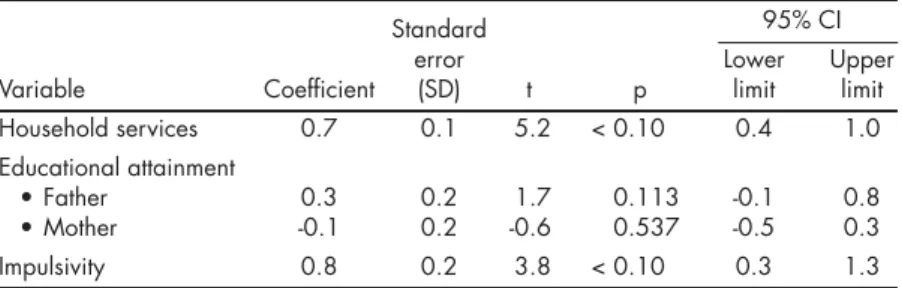
Lastly, the bivariate analysis showed that having a mother and father who were high school graduates together with a greater number of household services, was signifi-cantly associated with impulsivity (data not shown), as well as with the coexistence of DEB and BD. We therefore de-cided to control by means of these variables as potential confounders in the ordinal regression analysis (table 3). In this analysis, we found a positive and statistically signifi-cant association between household services and the coexis-tence of DEB and BD (t= 5.2; p<0.01) and between impulsiv-ity and the coexistence of DEB and BD (t=3.8; p=<0.01). In other words, high school students with impulsivity showed
Table 2. Bivariate analysis: association among age, parent’s educational attainment, and household services with the existence of disor-dered eating behaviors (DEB) and Binge drinking (BD)
DEB/BD Only No
Coexistence DEB or BD condition
(n=21) (n=206) (n=1932) Total Whitney
n % n % n % n % U test p
Age
• 17-19 14 1.1 123 9.7 1129 89.2 1266 100 505094 .268
• 15-16 7 0.8 83 9.3 803 89.9 893 100
• Total 21 206 1932 2159
Parents’ educational attainment • Father
- High school or more 13 3 54 12.4 370 84.7 437 100 296209 .001
- Secondary school or less 8 0.5 144 8.9 1469 90.6 1621 100
- Total 21 198 1839 2058
• Mother
- High school or more 4 1.1 50 13.5 317 85.4 371 100 273990 .006 - Secondary school or less 17 1.0 152 8.6 1592 90.4 1761 100
- Total 21 202 1909 2132
Household services
• 7 or more 17 1.6 141 13.2 912 85.2 100 480729 <0.001
• Fewer than 7 4 0.4 65 6.0 1008 93.6 100
• Total 21 206 1920
Impulsivity
• PIS >25 11 3.5 62 19.6 244 77 317 100 224427 <0.001
• PIS ≥25 10 0.6 137 7.8 1618 91.7 1765 100
• Total 21 199 1862 2082
Table 3. Ordinal regression: the coexistence of disordered eating behaviors and binge drinking
Standard 95% CI
error Lower Upper
Variable Coefficient (SD) t p limit limit
Household services 0.7 0.1 5.2 < 0.10 0.4 1.0 Educational attainment
• Father 0.3 0.2 1.7 0.113 -0.1 0.8
• Mother -0.1 0.2 -0.6 0.537 -0.5 0.3
a greater likelihood of displaying this coexistence, regard-less of household services.
DISCUSSION
The results of this paper indicate a statistically significant association between impulsivity and the coexistence of DEB and BD. This means that there is a greater percentage of coex-istence of DEB and BD in high school students considered to be impulsive in comparison with high school students with-out this trait, regardless of socioeconomic variables, such as the father’s educational attainment, the mother’s educational attainment, and the number of services in the household.
The association between impulsivity and the presence of DEB is an issue that has been approached previously in studies conducted in the US, Italy, and Australia.11,12,38 Most
of these studies emphasize the association between this trait and EDs such as bulimia nervosa and binge eating disor-der, in which the spontaneous component of impulsivity plays an important role in uninhibited behavior and loss of control during episodes of excessive eating, above all in the negative affect response.12,39 On the other hand and in terms
of alcohol use, the novel, social aspects of first substance use can initially appear attractive, while repeated use in large amounts increases the value of the substance in itself. This point, together with the deterioration of the brain’s inhibi-tory function that contributes to uninhibited behavior and the inability to suspend this use, can translate into more se-rious addictive behavior in clinical terms which, in turn, can be accompanied by negative consequences for the health of these high school students.12,40 Finally, once the reward
path-ways have been activated, other reward-implying behaviors could acquire greater relevance, as in the case of food, lead-ing to problems regardlead-ing the lead-ingestion of food.11
In a previous study, Welch & Fairburn15 suggested that
in hospitalized populations with EDs, alcohol use might not be a response to an impulsive action, but could instead be related to other factors (major depressive disorder, anxiety disorders, personality disorders, etc.). However, the results of this study in student populations show that impulsivity is associated with a series of behaviors that could increase the possibility of presenting an ED comorbidity with an alcohol use disorder in the future and, therefore, suggest a possibly worse prognosis for the high-school students included in this study. This suggests the need for screening programs at school and in the general population in order to identify at-risk subjects for both disorders, for proper referral to avail-able health services. It should be noted that early manage-ment of these disorders could prevent complications at the physical and mental level as well as improving prognosis.1
In the study we decided to use household services as an indicator of the socioeconomic conditions of the sample, which was positively associated with the coexistence of DEB
and BD. In this respect, there are previous studies that have found an association between socioeconomic status and DEB, with the possibility of increased exposure to an aes-thetic ideal and greater accessibility of services and products for weight loss.20 With regard to alcohol consumption, this
might be more common in the upper socioeconomic strata since people in these strata may regard alcohol consumption as a cultural norm and because they are able to afford it.16,17
In relation to study limitations and despite possessing a general population sample one should be cautious about gen-eralizing the results. The sample of high school students in the State of Mexico who have access to studying high school probably displays characteristics that are different from sub-jects without this access. On the other hand, this study did not include males, so the relationship between study vari-ables cannot be generalized to this population. Lastly, the study design does not show the time frame of the variables,41
although the literature indicates that impulsivity is more a predisposing factor than a consequence of DEB or BD.11,42,43
In conclusion, impulsivity is associated with the coexis-tence of DEB and BD in a randomized sample of adolescent students. The role of other variables such as depression and studying the association between impulsivity with socio-economic variables has yet to be established.
ACKNOWLEDGMENTS
The authors wish to thank the Public Education Ministry of the State of Mexico and personnel at the schools in which this study was conducted, as well as Fátima García-Castro for her participa-tion in the various stages of this project.
REFERENCES
1. Conason AH, Brunstein Klomek A, Sher L. Recognizing alcohol and drug abuse in patients with eating disorders. Q J Med 2006;99:335-339. 2. Blinder B, Camella E, Sanathara V. Psychiatric comorbidities of female
inpatients with eating disorders. Psychol Med 2006;68:454-462. 3. Gadalla T, Piran N. Co-occurrence of eating disorders and alcohol
use disorders in women: a meta analysis. Arch Womens Ment Health 2007;10:133-140.
4. Higuchi S, Susuki K, Yamada K, Parrish K et al. Alcoholics with ea-ting disorders: prevalence and clinical course. A study for Japan. Br J Psychiatry 1993;162:403-406.
5. Castro J, Díaz R, Goti J, Calvo R et al. Prevalence and factors related to substance use among adolescents with eating disorders. Eur Addict Res 2010;16:61-68.
6. Keel P, Dorer D, Eddy K, Franko D et al. Predictors of mortality in eating disorders. Arch Gen Psychiatry 2003;60:179-183.
7. Pisetsky E, Chao Y, Dierker L, May A et al. Disordered eating and subs-tance use in high-school students: results from the Youth Risk Behavior Surveillance System. Int J Eat Disord 2008;41:464-470.
8. Gutiérrez R, Unikel C, Villatoro J, Medina-Mora ME. El consumo de drogas en una muestra de mujeres estudiantes que presentan conductas alimentarias de riesgo. Salud Mental 2001;24:55-61.
10. Susuki K, Takeda A, Matsushita S. Coprevalence of bulimia with alcohol abuse and smoking among Japanese male and female high school stu-dents. Addiction 1995;90:971-975.
11. Loxton N, Dawe S. Alcohol abuse and dysfunctional eating in adolescent girls: the influence of individual differences in sensivity to reward and punishment. Int J Eat Disord 2001;29:455-462.
12. Dawe S, Loxton N. The role of impulsivity in the development of substan-ce use and eating disorders. Neurosci Biobehavior Rev 2004;28:343-351. 13. Bulik C, Klump K, Thornton L, Kaplan A et al. Alcohol use disorder
comorbidity in eating disorders: a multicenter study. J Clin Psychiatry 2004;657:1000-1006.
14. Chamberlain S, Sahakian B. The neuropsychiatry of impulsivity. Arch Gen Psychiatry 2007;20:255-261.
15. Welch S, Fairburn C. Impulsivity or comorbidity in bulimia nervosa. A controlled study of deliberate self-harm and alcohol and drug misuse in a community sample. Br J Psychiatry 1996;169:451-458.
16. Wiles N, Lingford A, Daniel J, Hickman M et al. Socio-economic sta-tus in childhood and later alcohol use: a systematic review. Addiction 2007;102:1546-1563.
17. Ortiz L, López S, Borges G. Desigualdad socioeconómica y salud mental: revisión de la literatura latinoamericana. Cad Saúde Pública 2007;23:1255-1272.
18. Villatoro J, Gutiérrez ML, Quiroz N, Moreno M et al. Encuesta de es-tudiantes de la Ciudad de México 2006. Prevalencias y evolución del consumo de drogas. Salud Mental 2009;32:287-297.
19. Unikel C, Bojorquez I, Villatoro J, Fleiz C et al. Conductas alimentarias de riesgo en población estudiantil del Distrito Federal: tendencias 1997-2003. Rev Invest Clin 2006;58:15-27.
20. Striegel-Moore RH, Bulik CM. Risk factors for eating disorders. Am J Psychol 2007;62:181-198.
21. Agras WS, Bryson S, Hammer L, Kraemer H. Childhood risk factors for thin body preoccupation and social pressure to be thin. J Am Acad Child Adolesc Psychiatry 2007;46:171-178.
22. Schmidt U, Lee S, Perkins S, Eisler I, et al. Do adolescents with eating di-sorders not otherwise specified or full-syndrome bulimia nervosa differ in clinical severity, comorbidity, risk factors, treatment outcome or cost? Int J Eat Disord 2008;41:498-504.
23. Wagner F, Anthony J. From first drug use to drug dependence: Develo-pmental periods of risk for dependence upon marijuana, cocaine, and alcohol. Neuropsychopharmacology 2002;26:479–488.
24. Lanza ST, Collins LM. Pubertal timing and the onset of substance use in females during early adolescence. Prevention Science 2002;3:69–82. 25. Clark D. The natural history of adolescent alcohol use disorders.
Addic-tion 2004;99(Sppl. 2):5-22.
26. Guttmanova K, Bailey JA, Hill KG, Lee JO et al. Sensitive periods for ado-lescent alcoholuse initiation: predicting the lifetime occurrence and chro-nicity of alcohol use disorders. J Stud Alcohol Drugs 2011;72:221-231.
27. Unikel C, Ocampo-Ortega R, Zambrano-Ruiz J. Exactitud del autorre-porte de peso y talla en mujeres de 15 a 19 años del Estado de México. Salud Pública Mex 2009;51:194-201.
28. Flory JD, Harvey PD, Mitropolou V, New AS et al. Dispositional impul-sivity in normal and abnormal samples. J Psychiatr Res 2006;40:438-447. 29. Matthews KA, Flory JD, Muldon MF, Manuck S.B. Does socioeconomic
status relate to central serotonergic responsivity in healthy adults? Psy-chosom Med 2000;62:231-237.
30. Infante C, Schlaepher L. Las variables socioeconómicas en la investiga-ción en salud pública en México. Salud Pública Mex 1994;36:364-373. 31. Plutchik R, Van Praag, H. The measurement of suicidality, aggressivity
and impulsivity. Prog Neuro-Psychopharmacol Biol Psychiatr 1989;13: S23-S34.
32. American Psychiatric Association. Diagnostic and Statistical Manual of Mental Disorders. Fourth edition. Washington, DC: DSM-IV; 1994. 33. Unikel C., Bojorquez I,Carreño S. Validación de un cuestionario
bre-ve para medir conductas alimentarias de riesgo. Salud Pública Mex 2004;46:509-515.
34. Medina-Mora ME, Castro S, Campillo C, Gómez F. Validity and reliabili-ty of a high school drug use questionnaire among Mexican students. Bull Narcotics 1981;33:67-76.
35. Villatoro J, Medina-Mora ME, Rojano C, Fleiz C et al. ¿Ha cambiado en consumo de drogas de los estudiantes? Resultados de la encuesta de es-tudiantes. Medición otoño de 2000. Salud Mental 2002;25:43-54. 36. Villatoro JA, Medina-Mora ME, Hernández M, Fleiz C, La encuesta de
estudiantes de nivel medio y medio superior de la Ciudad de México: noviembre 2003. Prevalencias y evolución del consumo de drogas. Salud Mental 2005;28:38-51.
37. Kerlinger F, Lee H. Investigación del Comportamiento. Métodos de In-vestigación en Ciencias Sociales. México: McGraw Hill; 2002.
38. Fassino S, Abbate-Daga G, Amianto F, Leombruni P et al. Temperament and character profile of eating disorders: a controlled study with the temperament and character inventory. Int J Eat Disord 2002;32:412-425. 39. Franko D, Dorer D, Keel P, Jackson S et al. How do eating disorders and
al-cohol use disorder influence each other? Int J Eat Disord 2005;38:200-207. 40. Malouff J, Thorsteinsson E, Rooke S. Schutte N. Alcohol involvement
and the five-factor model of personality: a meta-analysis. J Drug Educa-tion 2007;37:277-294.
41. Hernández B, Velasco-Mondragón H. Encuestas transversales. Salud Pública Mex 2000;42:447-455.
42. Acton, S. Measurement of impulsivity in a hierarchical model of per-sonality traits: implications for substance use. Substance Use Misuse 2003;38:67-83.
43. Stice E, Whitenton K. Risk factors for body dissatisfaction in adolescent girls: a longitudinal investigation. Development Psychol 2002;38:669-678.