
Brazil Argentina trade and its impacts in brazilian states
25
0
0
Texto completo
(2) 06 Haddad. 16/11/05. 114. 09:25. Página 114. Haddad, E. A., Domingues, E. P. and Perobelli, F. S.. ción de los niveles de actividad económica en los Estados Brasileños del Sur y del Sureste. Clasificación JEL: C68, F17, R13. Palabras clave: modelos de equilibrio general computables, política comercial, comercio interregional y análisis regional.. 1.. Introduction. Since its establishment in December 1994 at the Ouro Preto meeting, Mercosur has endured at least three major crises (devaluation of the real in January 1999, global economic recession starting in the second half of 2000, and the recent Argentine crisis). It is hard to envisage favorable prospects for its reintegration and consolidation in the near future. The economy of Argentina, the main trading partner in the bloc, achieved large surpluses in its trade with Brazil, thanks to the steady appreciation of the real during 1995-1998. These trade surpluses enabled Argentina to offset the difficulties it was increasingly facing in its trade with the United States, the European Union and Southeast Asia, resulting from a lack of competitiveness in its main productive sectors. The devaluation of the real reversed Brazil-Argentina trade flows, generating an increase in Brazil’s exports to its neighbor. In addition to losing this considerable trade surplus, Argentina faced other problems such as dwindling privatization-related capital inflows, deteriorating terms of trade, and mistrust surrounding the sustainability of the currency board (which involved free peso-dollar convertibility at a fixed parity), all of this against a backdrop of domestic political instability. At the present time, with the Argentine economy in a process of recovering from a state of near-collapse following the demise of convertibility, the future of Mercosur seems uncertain. This paper aims to evaluate a number of spatial aspects of Brazil’s current commercial policy, emphasizing those relating to bilateral trade with Argentina. Apart from this introduction and the final thoughts, the second section of the study provides a brief description of trade flows between the Brazilian states and other countries in Mercosur (highlighting trade with Argentina). Sections III and IV present the models used in our commercial policy simulations. Section V presents the results of simulations involving hypothetical developments of bilateral agreements with Argentina, and changes in the parameters of trade between the two countries, identifying their implications for Brazil at the subnational level.. 2.. Structure of trade: 1996-20011. To analyze the structure of Brazil’s international trade with Argentina in 19962001, it is first necessary to make a few brief comments on the external situation, 1. The authors gratefully acknowledge assistance provided by William Thomas in compiling the data used in this section..
(3) 06 Haddad. 16/11/05. 09:25. Página 115. Brazil-Argentina trade and its impacts in brazilian states. 115. current circumstances in Brazil and issues concerning the process of Mercosur consolidation. The period 1997-2000 was one of instability in the global economy, marked by economic crises in various parts of the world that had direct consequences on Brazil’s trade flows: a) it became more difficult to finance the country’s external trade; b) there was a decline in the purchasing power of several agriculturalgoods-importing countries; c) contagion caused a slowdown in the growth of Latin American economies; and d) the performance of EU countries also weakened. During this period the situation in Brazil was characterized by very small increases in GDP in the middle years (0.2% in 1998 and 0.8% in 1999), flanked by higher growth rates in 1997 (3.3%) and 2000 (4.5%). In January 1999 the exchange rate regime was revamped2 and the real was put into a float, resulting in a steep devaluation of the local currency. The external and domestic situations had impacts on Brazil’s trade balance. Following a period in which exports and imports both expanded (by 11 and 15%, respectively, in 1997 compared to the previous year), the country’s external trade retreated in the two ensuing years, before recovering again in 2000 with exports rising by 15% and imports by 13% compared to 1999. This stronger performance was largely the result of changes in export promotion policy, the entry of foreign firms, and also the strategies of firms operating in external trade.3 With regard to Mercosur, despite progress made in the integration process, there are still a variety of factors that hinder the expansion of trade between the countries of the bloc. These include balance of payments instability in a number of countries, infrastructure shortcomings especially in the transport sector; domestic inequalities; technological differences between productive sectors; and the productive structures of the various countries4. Accordingly, steps need to be taken to reduce the differences that exist between member-countries, with a view to overcoming the persistent obstacles that prevent economic integration being brought to fruition. As pointed out by Mendes [1997], analysis of trade structure based on aggregate trade flows identifies the short-run circumstantial elements of the process more accurately than structural ones, but does not show the behavior of the various economic sectors and types of products involved in trade. Accordingly, as a contribution to our understanding of these aspects, this section aims to study the composition of import and export baskets and the main sectors involved in Brazil-Argentina trade. To carry out this analysis we compare the periods 1996-1998 and 1999-2001. This division is justified because the first period saw the consolidation of the Real Plan, and in 1999 Brazil revamped its currency regime. These two elements are a priori highly relevant in understanding the behavior of Brazil’s external trade. 2. Until January 1999, exchange-rate fluctuations were managed by the Central Bank in a currency band system allowing for variations of between 7 and 8% per year. 3 For a more detailed analysis of Brazil’s trade balance in 1997-2000, see Piccinini and Puga [2001]. 4 Allied to differences in productive structures, soil and climate differences stimulate specialization in the production of certain goods and services, resulting in different modes of integration in the intra-bloc trading process from country to country..
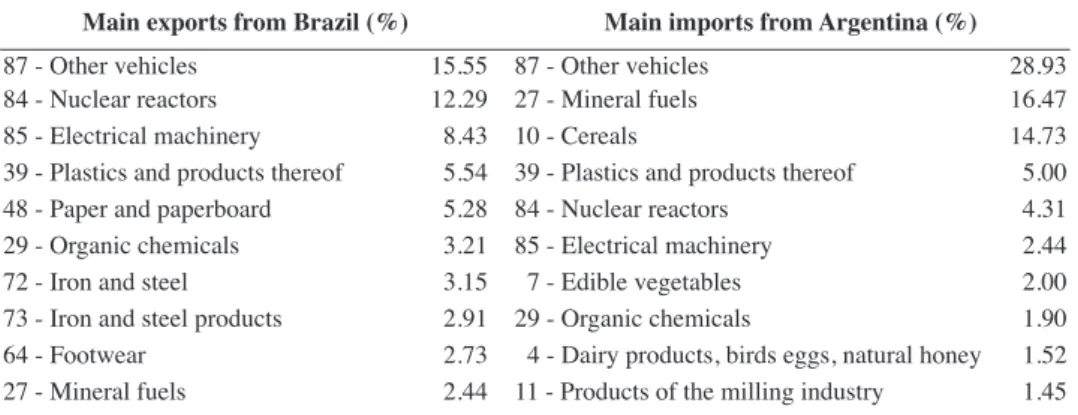
(4) 06 Haddad. 16/11/05. 116. 09:25. Página 116. Haddad, E. A., Domingues, E. P. and Perobelli, F. S.. Characteristics of Brazil-Argentina Trade Table 1 shows the 10 leading export and import categories in Brazil’s trade with Argentina. The 10 leading export products account for 61.53% of Brazil’s total exports to Argentina. This demonstrates an aspect of concentration in Brazil’s export product list. The same feature is also present on the import side, with the 10 leading products accounting for 78.76% of Brazil’s total imports from its neighbor. The data shown in table 1 reveal the existence of intra-industry trade, since similar products are included in both baskets in the following chapters: other vehicles, nuclear reactors, plastics and products thereof, organic chemicals and mineral fuels. Table 1.. Brazil-Argentina merchandise trade, 2001. Main exports from Brazil (%) 87 - Other vehicles 84 - Nuclear reactors 85 - Electrical machinery 39 - Plastics and products thereof 48 - Paper and paperboard 29 - Organic chemicals 72 - Iron and steel 73 - Iron and steel products 64 - Footwear 27 - Mineral fuels. Main imports from Argentina (%) 15.55 12.29 8.43 5.54 5.28 3.21 3.15 2.91 2.73 2.44. 87 - Other vehicles 27 - Mineral fuels 10 - Cereals 39 - Plastics and products thereof 84 - Nuclear reactors 85 - Electrical machinery 7 - Edible vegetables 29 - Organic chemicals 4 - Dairy products, birds eggs, natural honey 11 - Products of the milling industry. 28.93 16.47 14.73 5.00 4.31 2.44 2.00 1.90 1.52 1.45. Source: Ministry of Development, Industry and International Trade (MDIC) - Foreign trade data analysis system (Alice) (authors’ calculations).. A more detailed analysis of the regional and sectoral characteristics of Brazil’s trade with Argentina and other Mercosur countries makes it possible to more precisely identify the different patterns in the macro regions, federal units and main productive sectors involved in trade with Mercosur. This analysis leads to inferences concerning: a) the general conditions of sectors in the context of the country’s productive structure; b) the behavior of each sector as trade evolves; c) the share of each state and/or region in trade with these countries; and d) interaction between the evolution of trade and local productive structure (see Mendes [1997]). In its trade with Argentina, Brazil’s exports slipped from 12.46% (1996-1998) to 10.46% (1999-2001), partly as the result of a worsening of the Argentine crisis (see table 2). In terms of Brazil’s macro regions, this trend shows through as a decline in Argentina’s importance as a destination for exports from the southeast (from 15.20% to 11.57%), and from the northeast and center-west. Exports from the southern region of Brazil to Argentina held steady throughout the period. In contrast, trade between Brazil’s northern region and Argentina expanded from 3.39% (1996-1998) to 8.17% (1999-2001)..
(5) 06 Haddad. 16/11/05. 09:25. Página 117. Brazil-Argentina trade and its impacts in brazilian states. 117. Table 2 also reveals the importance of Argentina as a destination for merchandise exports from a number of Brazilian states (see figure 1). Of total exports from Amazonas, about 21% was sent to Argentina in the first period, rising to 29.74% in 19992001. In the northeast region, the states of Bahia, Ceará and Sergipe claimed the largest proportion of trade with Argentina in both periods. For the vast majority of federal units, exports to Argentina exceed the total exported to Paraguay and Uruguay. Table 2 shows the small proportion of exports from Brazil’s macro regions and states that goes to these countries. Brazil’s external trade with Argentina displays great regional concentration, with the southeast and southern regions accounting for over 85% of the total exported in both periods (table 3). The southern region gained share at the expense of the southeast during the period under analysis. The state of São Paulo accounted for over 50% of exports to Argentina, followed by Rio Grande do Sul, Minas Gerais, Paraná, Santa Catarina, Bahia and Rio de Janeiro, which between them accounted for 39% of exports to that country. Figure 1. Brazillian states and south american countries. The states are: Acre (AC), Amapá (AP), Amazonas (AM), Pará (PA), Rondônia (RO), Roraima (RR), Tocantins (TO), Alagoas (AL), Bahia (BA), Ceará (CE), Maranhão (MA), Paraíba (PB), Pernambuco (PE), Piauí (PI), Rio Grande do Norte (RN), Sergipe (SE), Espírito Santo (ES), Minas Gerais (MG), Rio de Janeiro (RJ), São Paulo (SP), Paraná (PR), Santa Catarina (SC), Rio Grande do Sul (RS), Distrito Federal (DF), Goiás (GO), Mato Grosso (MT) and Mato Grosso do Sul (MS)..
(6) 06 Haddad. 16/11/05. 118. 09:25. Página 118. Haddad, E. A., Domingues, E. P. and Perobelli, F. S.. Table 2.. North AC AP AM PA RO RR TO Northeast AL BA CE MA PB PE PI RN SE Southeast ES MG RJ SP South PR SC RS Center-west DF GO MT MS Brazil. Brazilian states’ exports and imports by destination and origin, 1996-1998 and 1999-2001 (Percentages) Argentina 1996-1998 1999-2001 Exp Imp Exp Imp 3.39 1.13 8.17 1.20 1.38 1.98 22.90 7.80 2.30 0.09 2.86 0.50 21.13 0.45 29.74 0.44 1.71 10.84 1.82 9.85 10.12 3.81 8.00 3.61 0.00 0.00 0.00 0.00 0.36 14.22 0.29 46.16 11.52 15.24 10.49 18.79 0.99 16.74 0.62 21.16 16.16 13.21 13.56 20.67 11.06 22.12 9.17 25.03 7.12 4.00 7.89 2.05 7.58 10.74 8.21 11.13 8.58 18.59 11.67 19.83 0.84 2.54 0.75 5.61 7.02 9.89 4.23 18.51 19.13 26.00 23.30 36.33 15.20 11.86 11.57 9.60 4.92 27.64 2.75 16.08 8.31 19.75 6.89 16.77 12.61 8.49 11.56 13.90 19.59 9.41 14.28 7.23 9.45 21.74 9.61 21.32 6.45 25.86 8.33 16.54 11.31 14.88 9.79 14.18 10.87 20.56 10.54 28.63 3.27 15.66 2.16 7.57 0.14 3.70 2.26 1.28 3.10 10.50 2.08 18.25 0.48 4.20 1.00 11.79 10.91 35.16 6.21 3.22 12.46 12.81 10.46 11.75. Rest of Mercosur 1996-1998 1999-2001 Exp Imp Exp Imp 0.93 0.05 0.98 0.46 0.94 0.03 0.82 0.00 0.47 0.00 0.20 0.06 8.96 0.02 3.67 0.48 0.07 0.38 0.07 0.02 9.66 1.74 5.58 2.10 0.01 0.00 0.01 0.00 0.18 0.43 0.71 0.09 1.95 1.69 1.09 1.35 1.83 1.30 0.07 7.87 1.88 0.48 0.88 0.32 4.33 2.05 2.97 3.20 0.00 0.25 0.00 0.03 3.11 4.63 1.63 3.68 3.00 3.04 1.88 1.76 1.72 5.75 0.74 2.54 2.05 0.82 1.07 3.76 5.67 4.70 10.18 4.82 4.46 1.55 2.43 0.91 0.43 1.31 0.29 0.74 2.16 0.91 0.97 0.56 4.97 1.16 2.74 0.76 5.87 1.73 3.16 1.00 5.65 12.63 4.36 5.11 4.60 5.15 3.33 3.79 5.02 16.69 4.16 11.37 6.72 17.66 5.27 5.17 3.04 3.60 1.90 1.63 0.09 0.30 0.64 0.13 2.38 6.71 2.16 0.36 0.96 11.22 0.21 0.36 9.55 3.95 7.20 10.62 4.35 3.11 2.71 1.65. Source: Ministry of Development, Industry and International Trade (MDIC) - Foreign trade data analysis system (Alice) (authors’ calculations). The states are: Acre (AC), Amapá (AP), Amazonas (AM), Pará (PA), Rondônia (RO), Roraima (RR), Tocantins (TO), Alagoas (AL), Bahia (BA), Ceará (CE), Maranhão (MA), Paraíba (PB), Pernambuco (PE), Piauí (PI), Rio Grande do Norte (RN), Sergipe (SE), Espírito Santo (ES), Minas Gerais (MG), Rio de Janeiro (RJ), São Paulo (SP), Paraná (PR), Santa Catarina (SC), Rio Grande do Sul (RS), Distrito Federal (DF), Goiás (GO), Mato Grosso (MT) and Mato Grosso do Sul (MS)..
(7) 06 Haddad. 16/11/05. 09:25. Página 119. Brazil-Argentina trade and its impacts in brazilian states. Table 3.. North AC AP AM PA RO RR TO Northeast AL BA CE MA PB PE PI RN SE Southeast ES MG RJ SP South PR SC RS Center-west DF GO MT MS Brazil. 119. Brazilian states’ share of national exports and imports by destination and origin, 1996-1998 and 1999-2001 (Percentages) Argentina 1996-1998 1999-2001 Exp Imp Exp Imp 1.4 0.7 4.6 0.7 0.0 0.0 0.0 0.0 0.0 0.0 0.0 0.0 0.7 0.2 3.7 0.2 0.6 0.4 0.8 0.4 0.1 0.0 0.1 0.0 0.0 0.0 0.0 0.0 0.0 0.0 0.0 0.1 7.2 8.5 7.4 13.4 0.0 0.3 0.0 0.2 4.8 2.8 4.7 6.6 0.6 2.1 0.8 2.5 0.8 0.2 0.9 0.2 0.1 0.3 0.1 0.2 0.5 2.2 0.6 2.9 0.0 0.0 0.0 0.0 0.1 0.1 0.1 0.2 0.1 0.4 0.1 0.6 70.8 64.1 64.2 53.4 2.0 13.8 1.3 6.5 9.2 9.1 8.1 7.8 3.7 5.8 4.2 10.8 55.9 35.5 50.7 28.3 19.9 25.1 23.0 31.0 4.6 11.6 7.0 11.7 4.9 2.7 5.0 2.0 10.3 10.8 11.1 17.3 0.8 1.6 0.7 1.5 0.0 0.2 0.0 0.1 0.2 1.3 0.2 1.1 0.1 0.1 0.2 0.2 0.5 0.1 0.4 0.1 100.0 100.0 100.0 100.0. Rest of Mercosur 1996-1998 1999-2001 Exp Imp Exp Imp 1.1 0.1 2.1 1.9 0.0 0.0 0.0 0.0 0.0 0.0 0.0 0.0 0.8 0.0 1.8 1.8 0.1 0.1 0.1 0.0 0.2 0.0 0.2 0.1 0.0 0.0 0.0 0.0 0.0 0.0 0.0 0.0 3.5 3.9 3.0 6.9 0.3 0.1 0.0 0.6 1.6 0.4 1.2 0.7 0.7 0.8 1.0 2.3 0.0 0.1 0.0 0.0 0.1 0.5 0.1 0.5 0.5 1.5 0.4 1.8 0.0 0.1 0.0 0.0 0.1 0.0 0.1 0.3 0.1 0.3 0.2 0.5 59.4 34.5 52.1 35.9 0.5 2.7 0.5 2.1 6.9 1.7 4.4 1.8 4.1 3.2 3.8 4.2 47.9 26.8 43.4 27.8 33.9 60.0 40.3 53.0 9.5 9.5 10.7 19.1 6.2 12.4 8.2 11.6 18.2 38.1 21.4 22.2 2.1 1.5 2.5 2.3 0.0 0.1 0.0 0.1 0.5 0.6 0.7 0.1 0.3 0.3 0.2 0.1 1.3 0.6 1.6 2.0 100.0 100.0 100.0 100.0. Source: Ministry of Development, Industry and International Trade (MDIC) - Foreign trade data analysis system (Alice) (authors’ calculations). The states are: Acre (AC), Amapá (AP), Amazonas (AM), Pará (PA), Rondônia (RO), Roraima (RR), Tocantins (TO), Alagoas (AL), Bahia (BA), Ceará (CE), Maranhão (MA), Paraíba (PB), Pernambuco (PE), Piauí (PI), Rio Grande do Norte (RN), Sergipe (SE), Espírito Santo (ES), Minas Gerais (MG), Rio de Janeiro (RJ), São Paulo (SP), Paraná (PR), Santa Catarina (SC), Rio Grande do Sul (RS), Distrito Federal (DF), Goiás (GO), Mato Grosso (MT) and Mato Grosso do Sul (MS)..
(8) 06 Haddad. 16/11/05. 120. 09:25. Página 120. Haddad, E. A., Domingues, E. P. and Perobelli, F. S.. This structural differentiation between regions and states stems from the historical concentration of economic activity in the southeast and south of the country. Another relevant point is that a proportion of exports from the southern and southeastern states may include products manufactured or originating in other states and regions of Brazil (i.e., re-exports). Thus the simple analysis of external trade cannot capture interstate trade, yet in many cases this generates more income for the state than international trade does.. 3.. The EFES-ARG model. A national computable general equilibrium model was developed and implemented (EFES-ARG), in order to evaluate the sectoral impact of different aspects of Brazil’s commercial policy with Argentina. The model’s structure represents an extension of the EFES model [Haddad and Domingues (2001)], which is a deterministic model, specified to generate annual projections for the Brazilian economy. It can also be used for comparative statics exercises in short-run simulations (with constant capital stock). The model identifies 42 sectors and 80 products, two products used as margin (commerce and transport services), three types of indirect tax, and five user groups (producers, investors, households, external sector and «other demands»). Its extension (EFES-ARG) pays special attention to the specification of international flows. The external sector was broken down into six different components representing specific trade blocs, namely Argentina, rest of Mercosur, NAFTA, rest of FTAA, EU, and rest of the world. This makes it possible to evaluate the effect of policies relating to changes in the structure and determinants of bilateral trade flows in the Brazilian economy5. The mathematical structure of EFES-ARG is based on the MONASH model, developed for the Australian economy [Dixon and Parmenter (1996)]. EFES-ARG belongs to the Johansen class of models, which produce solutions on the basis of a system of linearized equations. A typical result shows the percentage variation in the set of endogenous variables following implementation of a given economic policy, compared to their values in the absence of that policy in a given economic setting. The schematic presentation of Johansen solutions for these models is standard in the literature. Further details can be found in Dixon et al. (1982), Harrison and Pearson (1994, 1996), and Dixon and Parmenter (1996). In this paper EFES-ARG was integrated with an interstate trade model such that the national results obtained were regionalized. The interstate model is presented in the next section.. 4.. Interstate trade model6. The development of the interstate trade model is based on Haddad, et al [1999] and was implemented for the first time in Haddad et al. (2002). Whereas that article dealt 5 6. The basic structure of the model is presented in Annex 1. This section is based on Haddad et al. (2002)..
(9) 06 Haddad. 16/11/05. 09:25. Página 121. Brazil-Argentina trade and its impacts in brazilian states. 121. with trade flows between countries in a global economy, the present study focuses attention on interactions between states in a national economy. A matrix of interstate trade flows was constructed for 1997, based on data from the Conselho de Política Fazendária (Confaz, 1999) and IBGE (IBGE, 1999)7. Given production and final demand in each state, the following identity is established: Xi + Ci + Ii + Gi ≡ Mi + Yi where:. Xi + Ci + Ii + Gi → → Mi + Yi. and:. → → → → →. CIF Ii Gig Xi Mi. total demand for the production of state i total expenditure of state i. [1]. [2] [3]. private consumption in state i investment in state i government spending in state i exports from state i imports by state i. X and M are composed of interstate domestic and external flows, i.e. they encompass both interstate and international flows. The components of domestic absorption are consumption, investment and government expenditure. The trade flows X and M for each state can be broken down into two parts, domestic and external: n – xij + Xi Xi = j Σ =1. [4]. n. Mi =. – Σ mij + M i j=1. [5]. xij represents sales from state i to state j; Xi represents exports from state i to other countries; similarly, mij represents purchases by state i from state j, and Mi represents purchases made by state i abroad. By definition, the interstate flow matrices [xij] and [mij] are the same. Substituting [4] and [5] in [1], gives: n. n. Σ xij + X–i + Ci + Ii + Gi = Σ mij + M–i + Yi = Zj j=1 j=1. [6]. This enables us to obtain a matrix similar to the traditional input-output system, the rows of which contain the sales made by each state to all other states (interstate 7. The structure of this matrix was studied in Domingues et al. (2002)..
(10) 06 Haddad. 16/11/05. 122. 09:25. Página 122. Haddad, E. A., Domingues, E. P. and Perobelli, F. S.. flows) together with final demand, representing the total distribution of the state’s production. The columns represent the structure of expenditure in each state. In this theoretical framework, the key assumption involves a fixed domestic import coefficient, similar to the technical coefficient of the input-output matrix: [tij] =. 1 [x ] where Zj is total expenditure by state j Zj ij. The coefficient tij measures the proportion of total expenditure by state j on imports from state i, and the diagonal element (tij for i = j) is null. As in input-output models, this proportion is assumed fixed regardless of the state’s total expenditure. Accordingly, for each state there is an optimal amount of imports for any level of expenditure in a given period. Based on this hypothesis, equation [6] can be written as follows: n. Σ t Z + Fi = Zi for i = 1,...,n j = 1 ij i. [7]. Where Fi is the final demand in state i. This n-equation system can be written in matrix notation as follows: TZ + F = Z. [8]. where: T is the matrix of interstate import coefficients (nxn). Z is the vector of total output (nx1). F is the final demand vector (nx1). Solving [8] gives the output of each state needed to satisfy the total demand for domestic production: Z = (I – T)–1 F. [9]. In other words, given the exogenous components of domestic absorption and external demand, Z measures the output of each state needed to satisfy this final demand. (I – T)–1 is the Machlup-Goodwin domestic trade multiplier matrix, which captures the direct and indirect impacts of changes in final demand in a given state on the total production of all states, given the existing interstate trade structure. In the same way input-output models operate, the effects of an increase in final demand can be observed through (I – T)–1. For example, assuming an increase in final demand in the state of São Paulo, and given that state’s menu of domestic imports (tij for j = São Paulo), the first impact would be a direct rise in the state’s import requirements and, hence, an increase in exports to São Paulo from other states. The income generated by São Paulo’s purchases in other states generates an increase in production followed by further increases in expenditure. These effects have repercussions throughout the economy, whose total effect is given by the trade multiplier matriz (I – T)–1..
(11) 06 Haddad. 16/11/05. 09:25. Página 123. Brazil-Argentina trade and its impacts in brazilian states. 5.. 123. Regional aspects of Brazil-Argentina commercial policy. In this section, we use the EFES-ARG integrated to the interstate trade model to evaluate short-run aspects of Brazil-Argentina commercial policy. 5.1.. Description of Simulations. The simulations performed in this section represent four Brazil-Argentina trade scenarios. They were developed on the basis of recent events in Argentina and aim to capture potential developments in trading relations between the two countries. Simulation 1: 20% reduction in Brazilian exports to Argentina The first simulation imposes a 20% reduction in Brazil’s exports to Argentina. This scenario reflects the recession in the Argentine economy, and its direct repercussions on external demand from that country. The percentage fall stipulated was based on estimates made in the specialist press. As the impacts on the Brazilian economy are measured relative to this shock, its precise magnitude is unimportant. Analysis of the results focuses on the sectors and regions of the Brazilian economy that are relatively most affected. Simulation 2: Liberalization of Brazil-Argentina trade flows One of the measures discussed for responding to the Argentine crisis involves enhancing trade openness in Mercosur, in order to stimulate intra-bloc trade and help economic activity in Argentina to recover. Accordingly, the second simulation estimates the impact of full Brazil-Argentina trade liberalization, with abolition of all import tariffs on bilateral trade between the two countries. The EFES-ARG model simulates this by abolishing tariffs on imports from Argentina and imposing subsidies on Brazilian exports to that country such that a zero-tariff-equivalent reduction in their prices could be implemented. The latter seeks to capture the improved access for Brazilian exports to the Argentine market, as a result of tariff reduction. The results obtained from the simulations capture not only the macroeconomic impact on the Brazilian economy, but especially its sectoral and spatial implications. Simulation 3: Liberalization of the automotive sector As referred in section II, one of the key areas in Brazil-Argentina trade is the automotive sector. The sectoral regime in Brazil aims, among other things, to regulate trade flows between the two countries in the automotive product chain. Given the importance of that sector in the structure of the Brazilian economy, a specific simulation was carried out, imposing trade openness between Brazil and Argentina in the automotive sector alone. As this represents a subset of the shocks generated by the full.
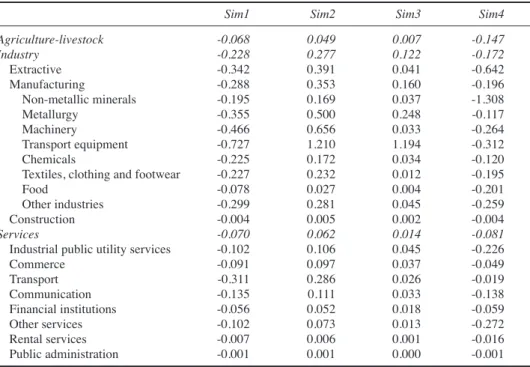
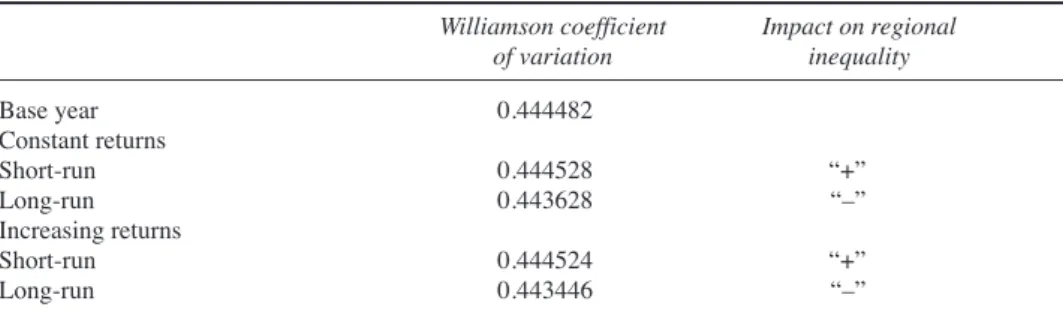
(12) 06 Haddad. 16/11/05. 124. 09:25. Página 124. Haddad, E. A., Domingues, E. P. and Perobelli, F. S.. openness simulation, its results can be viewed comparatively. In other words, the relative weight of automotive sector openness in the impact of full liberalization between Brazil and Argentina can be directly observed. Simulation 4: Currency devaluation in Argentina A final simulation was carried out to project the impact on the Brazilian economy of exchange-rate devaluation in Argentina. Currency devaluations are one of the most characteristic features of balance of payments crises, and a movement in this direction can already be discerned in Argentina. Insofar as exchange-rate devaluations directly make Argentine exports more competitive, a shift impact on Brazilian imports and production can be expected. This is simulated in the EFES-ARG model, via a shift in the FOB price of Argentine imports in the Brazilian market, equivalent to the 20% devaluation of the Argentine peso against the Brazilian real. This scenario assumes the Brazilian monetary authorities do not retaliate. 5.2.. Results. Table 4 shows the results of the four simulations for selected macroeconomic variables. The sectoral impacts of each simulation are presented in table 5, through a breakdown of GDP components. Table 6 then shows the regional impacts, in terms of variations in activity level. Table 7 summarizes the spatial impacts by analyzing the effect on the Williamson coefficient of variation, which measures regional inequality. The results of each simulation are discussed in turn below. Simulation 1: 20% reduction in Brazilian exports to Argentina This scenario implies a 0.105% fall in Brazil’s real GDP. Although small, the impact is not negligible, bearing in mind the share of exports to Argentina in Brazil’s total external trade. This drop in activity level entails a reduction in imports, although less than the fall in exports, probably resulting in a marginal trade deficit (table 4). Given the structure of Brazil’s exports to Argentina, the industrial sector is most affected, especially in branches with high technological content, such as machinery and transport equipment (table 5). This sectoral concentration, together with interstate trade relations, results in a negative impact concentrated in the states of the south and southeast (especially Minas and São Paulo), in addition to Bahia and Amazonas (table 6). Simulation 2: Liberalization of Brazil-Argentina trade flows Full trade liberalization between the two largest Mercosur partners boosts real GDP growth. In this scenario, exports expand by nearly three times the rise in imports, which suggests the potential for a marginal trade surplus (table 4). This result naturally depends on the import tariff estimate used..
(13) 06 Haddad. 16/11/05. 09:25. Página 125. Brazil-Argentina trade and its impacts in brazilian states. Table 4.. Impact on selected macro variables (Percentage variation). Real GDP Aggregate employment Real wage Volume of exports Volume of imports. Table 5.. 125. Sim1. Sim2. Sim3. Sim4. -0.105 -0.217 0.299 -1.984 -0.332. 0.086 0.243 -0.229 2.253 0.777. 0.028 0.083 -0.049 0.764 0.283. -0.101 -0.227 0.739 0.515 1.702. Impact on sectoral components of GDP (Percentage variation). Agriculture-livestock Industry Extractive Manufacturing Non-metallic minerals Metallurgy Machinery Transport equipment Chemicals Textiles, clothing and footwear Food Other industries Construction Services Industrial public utility services Commerce Transport Communication Financial institutions Other services Rental services Public administration. Sim1. Sim2. Sim3. Sim4. -0.068 -0.228 -0.342 -0.288 -0.195 -0.355 -0.466 -0.727 -0.225 -0.227 -0.078 -0.299 -0.004 -0.070 -0.102 -0.091 -0.311 -0.135 -0.056 -0.102 -0.007 -0.001. 0.049 0.277 0.391 0.353 0.169 0.500 0.656 1.210 0.172 0.232 0.027 0.281 0.005 0.062 0.106 0.097 0.286 0.111 0.052 0.073 0.006 0.001. 0.007 0.122 0.041 0.160 0.037 0.248 0.033 1.194 0.034 0.012 0.004 0.045 0.002 0.014 0.045 0.037 0.026 0.033 0.018 0.013 0.001 0.000. -0.147 -0.172 -0.642 -0.196 -1.308 -0.117 -0.264 -0.312 -0.120 -0.195 -0.201 -0.259 -0.004 -0.081 -0.226 -0.049 -0.019 -0.138 -0.059 -0.272 -0.016 -0.001. As in the previous simulation, industry is the sector most affected, albeit positively this time. The machinery and transport equipment segments benefit most in this scenario. In addition, the rise in other branches of industry, and in service sectors (such as transport and communication), implies a major intra-industry and inter-sectoral impact (table 5). The spatial distribution of these positive impacts (table 6) indicates greater benefit for states with high levels of exports to Argentina, such as São Paulo, Amazonas and those of the southern region..
(14) 06 Haddad. 16/11/05. 126. 09:25. Página 126. Haddad, E. A., Domingues, E. P. and Perobelli, F. S.. Table 6.. Impact on activity level: Brazilian states (Percentage variation). AC AL AP AM BA CE DF ES GO MA MS MT MG PA PB PR PE PI RN RS RJ RO RR SC SP SE TO. Sim1. Sim2. Sim3. Sim4. -0.021 -0.016 -0.013 -0.109 -0.106 -0.036 -0.008 -0.085 -0.033 0.014 -0.038 -0.063 -0.112 0.038 -0.017 -0.093 -0.022 -0.007 -0.024 -0.128 -0.053 -0.030 -0.010 -0.139 -0.162 -0.035 -0.008. 0.016 0.015 0.023 0.093 0.071 0.042 0.006 0.067 0.031 -0.113 0.041 0.046 0.075 -0.073 0.020 0.099 0.023 0.006 0.021 0.130 0.037 0.029 0.009 0.142 0.132 0.029 0.006. 0.007 0.002 0.002 0.031 -0.003 0.002 0.003 0.014 0.008 -0.108 0.013 0.011 0.041 -0.069 0.001 0.022 0.001 0.001 0.004 0.023 0.007 0.005 0.003 0.014 0.059 0.005 0.001. -0.064 -0.095 -0.076 -0.182 -0.119 -0.084 -0.042 -0.092 -0.102 -0.075 -0.098 -0.096 -0.084 -0.093 -0.087 -0.091 -0.102 -0.074 -0.299 -0.106 -0.104 -0.080 -0.083 -0.124 -0.097 -0.217 -0.080. The states are: Acre (AC), Amapá (AP), Amazonas (AM), Pará (PA), Rondônia (RO), Roraima (RR), Tocantins (TO), Alagoas (AL), Bahia (BA), Ceará (CE), Maranhão (MA), Paraíba (PB), Pernambuco (PE), Piauí (PI), Rio Grande do Norte (RN), Sergipe (SE), Espírito Santo (ES), Minas Gerais (MG), Rio de Janeiro (RJ), São Paulo (SP), Paraná (PR), Santa Catarina (SC), Rio Grande do Sul (RS), Distrito Federal (DF), Goiás (GO), Mato Grosso (MT) and Mato Grosso do Sul (MS).. Table 7.. Summary of spatial impacts Williamson coefficient of variation. Base year Constant returns Short-run Long-run Increasing returns Short-run Long-run. Impact on regional inequality. 0.444482 0.444528 0.443628. “+” “–”. 0.444524 0.443446. “+” “–”.
(15) 06 Haddad. 16/11/05. 09:25. Página 127. Brazil-Argentina trade and its impacts in brazilian states. 127. Simulation 3: Liberalization of the automotive sector This simulation is a subset of the full openness simulation, so its results are qualitatively similar, including positive GDP growth and an improvement in the marginal trade balance. An interesting aspect of this exercise is its evaluation of the relative importance of automotive-sector openness in the framework of full Brazil-Argentina trade liberalization. The results given in table 4 show that about 30% of the impact of full Brazil-Argentina trade openness is provided by liberalization in the automotive sector. Table 5 suggests even greater dependence in the case of industry: nearly 44% of the positive impact of openness stems from the impact of liberalization in the automotive sector. The importance of liberalization in this sector can also be seen in the growth of directly related sectors, such as metallurgy, or indirectly related ones, such as construction, commerce, communications and financial institutions. The regional effect shown in table 6 reveals that the impact is concentrated in the main producer states (São Paulo, Paraná and Minas Gerais), in the production of both automobiles and autoparts. The positive impact in Amazonas is explained partly by exports of electronics and autoparts from the duty free zone, and the high share of electronics shipped as inputs in producer states. Simulation 4: Currency devaluation in Argentina The simulation of exchange-rate devaluation in Argentina produces a negative impact on real GDP in Brazil, tending towards a marginal trade deficit, with exports growing nearly three times less than imports (table 4). This scenario entails a major negative impact on agriculture-livestock and industry, especially extractive activities and nonmetallic minerals (table 5). These are probably the sectors most affected by the increasing competitiveness of Argentine products in the Brazilian market, with potentially significant input substitution effects. The spatial distribution of the results is shown in table 6. There is a major negative effect on states with strong agricultural and agricultural-related production, such as Santa Catarina, Rio Grande do Sul, Mato Grosso and Mato Grosso do Sul. The trend towards input substitution has major implications in states such as São Paulo, Bahia, Rio de Janeiro and Amazonas. As the results suggest, the role of interstate trade in state economies needs to be highlighted. Regional interactions need to be studied to gain a better understanding of how regional economies are affected, in international markets and domestic ones, since for the smaller economies, in particular, the performance of the more developed regions is crucial. An inspection of table 8, which contains estimates of interstate and international export coefficients for all federal units of the country, reveals several important features of the Brazilian regional system. In all states to a greater or lesser extent, interstate sales outstrip exports abroad. In general, interstate flows are relatively more important for the less developed states8. 8. Exceptions include the states of Amapá, Maranhão and Pará, which have transport and communications systems predominately aimed at transporting mining exports..
(16) 06 Haddad. 16/11/05. 128. 09:25. Página 128. Haddad, E. A., Domingues, E. P. and Perobelli, F. S.. Table 8.. Interstate and international export coefficients: Brazilian states, 1997 (Percentages) Interstate exports/GDP (A). AC AL AP AM BA CE DF ES GO MA MS MT MG PA PB PR PE PI RN RS RJ RO RR SC SP SE TO. 25.7 30.8 5.3 87.7 30.5 28.9 10.4 90.2 52.6 13.1 76.5 41.6 57.5 14.5 27.5 59.1 31.2 13.5 23.8 36.1 32.3 17.6 13.8 61.7 49.0 39.1 20.5. International exports/GDP (B) 0.1 4.6 3.4 1.9 4.4 2.1 0.0 5.6 2.3 8.7 7.9 2.6 7.6 14.0 0.9 7.7 1.1 1.2 1.4 7.6 1.6 1.0 0.3 7.9 5.4 0.6 0.6. Source: Confaz, MDIC, IBGE (authors’ calculations). The states are: Acre (AC), Amapá (AP), Amazonas (AM), Pará (PA), Rondônia (RO), Roraima (RR), Tocantins (TO), Alagoas (AL), Bahia (BA), Ceará (CE), Maranhão (MA), Paraíba (PB), Pernambuco (PE), Piauí (PI), Rio Grande do Norte (RN), Sergipe (SE), Espírito Santo (ES), Minas Gerais (MG), Rio de Janeiro (RJ), São Paulo (SP), Paraná (PR), Santa Catarina (SC), Rio Grande do Sul (RS), Distrito Federal (DF), Goiás (GO), Mato Grosso (MT) and Mato Grosso do Sul (MS).. Apart from this, when one considers the Brazilian states’ main trading partners, together with the degree of openness (exports plus imports, divided by GDP) vis-àvis specific partners, whether states or countries, the importance of interstate flows, mainly with São Paulo, becomes even clearer (table 9). If Brazil’s states were independent countries, willing to grant most favored nation (MFN) status to some of their partners, the «countries» listed in table 9 would probably be the potential beneficiaries. Little attention would be paid to our Mercosur partner except in Espírito Santo and states in the southern region, where Argentina is one of the 10 main trading partners..
(17) 06 Haddad. 16/11/05. 09:26. Página 129. Brazil-Argentina trade and its impacts in brazilian states. 129. Table 9. Brazilian states’ main trading partners, 1997 (Highlighting the ranking of Argentina) AC. AP. AM. PA. RO. RR. TO. AL. BA. SP. SP. SP. SP. SP. SP. SP. SP. SP. MG. RS. USA. MG. PR. MG. GO. PE. MG. RS. MG. RJ. USA. MT. PR. MG. BA. RJ. SC. RJ. RS. RJ. MG. RJ. PA. SE. PE. MT. SC. MG. PR. RS. RS. CE. RJ. SE. 19-Argentina 22-Argentina 21-Argentina 21- Argentina 15-Argentina 37-Argentina 16- Argentina 20-Argentina 13-Argentina CE. MA. PB. PE. PI. RN. SE. ES. MG. SP. SP. PE. SP. SP. SP. SP. SP. SP. PE. MG. SP. BA. CE. CE. BA. MG. RJ. RN. CE. CE. PB. PA. PE. PR. RJ. ES. MG. PA. MG. MG. PE. MG. PE. USA. GO. RJ. PE. RN. CE. MG. BA. MG. Argentina. PR. 18-Argentina 15-Argentina 19-Argentina 19-Argentina 21-Argentina 16-Argentina 15-Argentina RJ. SP. PR. RS. DF. GO. 12- Argentina MT. MS. SP. MG. SP. SP. SP. SP. SP. SP. SP. MG. RJ. SC. PR. SC. MG. MG. PR. PR. RS. PR. RS. RS. PR. GO. MT. GO. MG. ES. RS. MG. RJ. RJ. RJ. DF. MG. MT. PR. AM. RJ. MG. PR. PR. SC. RJ. 13-Argentina 12-Argentina 9-Argentina. 6.. SC. MG 9-Argentina. 8-Argentina 18-Argentina 20-Argentina 30-Argentina 13-Argentina. Conclusions. This analysis of the short-run regional aspects of Brazilian commercial policy, focusing on economic integration and bilateral relations with Argentina, reveals a trend towards concentration of the level of economic activity in the states of the Brazilian south and southeast. We can summarize this findings as follows: a) For simulation 1 the states of south and southeast (mainly Minas Gerais and São Paulo), in addition to Bahia and Amazonas concentrated the negative impact; b) For simulation 2 the positive aspects are at São Paulo, Amazonas and at those states located at the southern region. c) For simulation 3 there is also a positive impact at São Paulo, Paraná and Minas Gerais. d) For simulation 4 the major negative effects are at Santa Catarina, Rio Grande do Sul, Minas Gerais and Mato Grosso do Sul. The results draw attention to a.
(18) 06 Haddad. 16/11/05. 130. 09:26. Página 130. Haddad, E. A., Domingues, E. P. and Perobelli, F. S.. phenomenon that has permeated the debate on the regional issue, namely the role of trade as an engine of growth. An inspection of table 8, enables us to conclude that in all states to a greater or lesser extent, interstate sales outstrip exports abroad. In general, interstate flows are relatively more important for the less developed states. It is necessary to emphasize that the importance of trade between the Brazilian states and Argentina is more concentrated in states in the southern region of Brazil. For the other states the results shows that interstate trade is more important. The estimates reveal the importance of interstate trade flows in the states’ economies. It is therefore necessary to make a more in-depth analysis of trade flows between the Brazilian states, potentially leading to generalizations regarding the type of trade involved, changes in its composition through time as the Brazilian economy develops, and the implications of these structural differences in the coordination and implementation of development policies. Thus, the future for many regions of Brazil depends more on their linkages with other domestic markets than on their performance in international ones. So, there is room for public policy action, through interventions to modernize the country’s transport network, improve integration between producer and consumer markets and thereby maximize the effects of Brazil’s trade policy strategies.. References Baer, W.; Haddad, E. and Hewings, G. J. D. (1998): «The Regional Impact of Neo-Liberal Policies in Brazil», Economia Aplicada, vol. 2, n.º 2. Devlin, R. and French-Davis, R. (1998): «Towards an Evaluation of Regional Integration in Latin America in the 1990’s», INTAL-ITD Working Paper # 2. Buenos Aires: BID/INTAL. Confaz (1999): Balança comercial interestadual de 1997. Brasília: Ministério da Fazenda. Dixon, P.B.. and Parmenter, B.R. (1996): «Computable General Equilibrium Modelling for Policy Analysis and Forecasting», in Amman, H. M.; Kendrick, D. A. and Rust, J. (eds.), Handbook of Computational Economics, vol. 1, pp. 3-85. Elsevier, Amsterdam. Dixon, P.B.; Parmenter, B.R.; Sutton, J. and Vincent, D. P. (1982): ORANI: A Multisectoral Model of The Australian Economy. North-Holland, Amsterdam. Domingues, E.P. and Haddad, E. (2005): «A. Sensitivity analysis in computable general equilibrium models: An Application for the Regional Effects of the Free Trade Area of the Americas (FTAA)». Brazilian Review of Econometrics, vol. 25, n.º 1. Domingues, E. P.; Hewings, G.J.D.; Haddad, E.A. and Perobelli, F. (2002): «Structural changes in the Brazilian interregional economic system, 1985-1997: holistic matrix interpretation», Australasian Journal of Regional Studies, vol. 8, n.º 1. Domingues, E. P. and Lemos, M. B. (2004): «Regional impacts of trade liberalization strategies in Brazil», in European Regional Science Conference. Porto, Portugal. Haddad, E.A. y Domingues, E. (2001): «EFES - Um Modelo Aplicado de Equilíbrio Geral para a Economia Brasileira: Projeções Setoriais para 1999-2004», Estudos Econômicos, vol. 31, n.º 1. Haddad, E.A.; Domingues, E. and Perobelli, F. S. (2002): «Regional Effects of Economic Integration: The Case of Brazil», Journal of Policy Modeling, vol. 24. Haddad, E.A., Hewings, G.J.D. and Sonis, M. (1999): «Trade and Interdependence in the Economic Growth Process: A Multiplier Analysis for Latin America», Economia Aplicada, vol. 3, n.° 2. Harrison, W.J. and Pearson, K.R. (1994): «Computing Solutions for Large General Equilibrium Models Using GEMPACK», Preliminary Working Paper, n.° IP-64, IMPACT Project, Monash University, Clayton..
(19) 06 Haddad. 17/11/05. 11:44. Página 131. Brazil-Argentina trade and its impacts in brazilian states. 131. Harrison, W.J. and Pearson, K.R. (1996): «An Introduction to GEMPACK», GEMPACK User Documentation GPD-1, IMPACT Project and KPSOFT, 3rd edition. September, 1996. Ibge (1997): Sistema de contas nacionais: Brasil. Rio de Janeiro: Fundação IBGE. Mendes, C.C. (1997): «Efeitos do Mercosul no Brasil: Uma visão setorial e locacional do comércio», Discussion Paper n.° 510. Brasílea: IPEA. August, 1997. MDIC. Ministry of Development, Industry and International Trade. Piccinini, M.S. and Puga, F.P. (2001): «A balança Comercial Brasileira: Desempenho no período 1997/2000», Discussion Paper 90. Rio de Janeiro: BNDES. September, 2001.. Annex 1. Structure of the EFES-ARG Model This annex presents the functional forms of the main equations of the model, and defines its main variables, parameters and coefficients. In terms of notation, capital letters are used for variables measured in level terms, and lower case for their annual growth rates. Superscripts (u), u = 0, 1j, 2j, 3, 4b, 5, refer, respectively, to production (0) and to the five types of users of the products identified in the model: producers in sector j (1j), investors in sector j (2j), households (3), purchasers of goods exported in region b (4b), and government and “other demands” (5). Inputs are identified by two subscripts: the first takes the values 1,...,g, for goods, g + 1, for primary factors, and g + 2, for «other costs» (basically taxes and production subsidies); the second subscript identifies the origins of the input, whether domestic (1) or imported from region b (2b), or provided by labor (1) or capital (2). The symbol (∑) is used to indicate summation on a given index. Equations (A1). Substitution between goods imported from different origins (u) (u) (u) (u) Σ x(u) [i(2b)] = x[i(2•)] – σ (i) (p[i(2b)] ) – l ∈ S* {V [i, 2l, (u)]/V [i, 2•, (u)] (p[i(2l)] )}. i = 1, ..., g; b = 1, …,r; (u) = 3 and (kj) for k = 1 and 2 and j = 1, …, h (A2). Substitution between domestic and imported goods (u) (u) (u) x(u) (is) = x(i•) – σ (i) {p(is) –. Σ [V (i, l, (u))]/V [i, •, (u)] [p(u) ]} (il). l = 1, 2•. i = 1, ..., g; s = 1 and 2•; (u) = 3 and (kj) for k = 1 and 2 and j = 1, …, h (A3). Substitution between labor and capital (1j) (1j) (1j) (1j) (1j) (1j) x(g+1, s) – a(g+1, s) = x(g+1•) – σ (g+1) {p(g+1, s) + a(g+1, s) (1j) Σ [V [g + 1, l (1j)]/V (g + 1,•, (1j))] [p(1j) (g+1, l) + a(g+1, l) ]}. l = 1, 2•. j = 1, ..., h; s = 1 and 2.
(20) 06 Haddad. 16/11/05. 132. (A4). 09:26. Página 132. Haddad, E. A., Domingues, E. P. and Perobelli, F. S.. Household demand for composite goods (3) V [i,•,(3)] (p(3) (i•) + x(i•) = (3) (3) γ(i) P(3) (i•) Q [p(i•) + x(i•) ] + β(i) {C –. Σ γ(j) P(3) Q [p(3) + x(3) ]} (i•) (i•) (i•). j∈G. i = 1, ..., g (A5). Prices of composite goods for households p(3) (i•) =. Σ {V [i,l,(3)]/V [i,•,(3)]} p(3) (il). l = 1, 2•. i = 1, ..., g (A6). Demand for composite, intermediate and investment goods, primary factors and other costs (u) (u) + α(i) x(u) (i•) = z. u = (kj) for k = 1, 2 and j = 1,…,h if u = (1j) then i = 1, ..., g + 2 if u = (2j) then i = 1,…, g (A7). Demand for exports (4qb) (4b) (4pb) [x(4b) (is) – f(is) = η(is) (p(is) – e – f(is) ]. i = 1, ..., g; s = 1, 2b for b = 1, …, r (A8). Other demands (5) (5) x(5) (is) = f(is) + f. i = 1, ..., g; s = 1, 2b for b = 1, …, r (A9). Demand for margins for domestic goods (u) x(is)(u) (m1) = x(is). m, i = 1, ..., g; (u) = (3), (4b) for b = 1,...,r, (5) and (kj) for k = 1, 2; j = 1, …, h; s = 1, 2b for b = 1, …, r (A10) Sectoral composition of production (0j) x(i1) = z(1j) σ(1j) {p(0) (i1) –. j = 1, ..., h; i = 1, ..., g. Σ (Y (t, j)/Y (•, j)]p(0) } (t1). t∈G.
(21) 06 Haddad. 16/11/05. 09:26. Página 133. Brazil-Argentina trade and its impacts in brazilian states. (A11) Demand for domestic goods equals supply Σ Y (l, j) x(0j) = Σ B [l, 1, (u)] x(u) (l1) (l1) u∈U. j∈H. +. Σ. Σ. Σ M [l, i, s, (u)] x(is)(u) (l1). i∈G s∈S u∈U. l = 1, ..., g (A12) Revenue equals costs for sectors Σ Y (l, j) (p(0) + a(0) = (l1) (l1). l∈H. Σ. Σ V [l, s, (1j)] [p(1j) ] (ls). l ∈ G* s ∈ S. j = 1, ..., h (A13) Basic price of imported goods (w) (0) p(0) [i (2b)] = p[i (2b)] – e + t[i (2b)]. i = 1, ..., g; b = 1,…,r (A14) Purchase prices related to basic prices, margins and taxes (0) Σ V [i, s, (u)] [p(u) (is) ] = {B [i, s, (u)] + τ ∈ T T [τ, i, s, (u)]} [p(is) + t (τ, i, s, u)]. Σ M [m, i, s, (u)] [p(0) ] (m1). m∈G. i = 1,...,g; (u) = (3), (4b) for b = 1, ..., r, (5) and (kj) for k = 1, 2 and j = 1, …, h; s = 1, 2b for b = 1, …, r (A15) Investment (1j) (j) x(1j) (g + 1, 2) (1) – x(g + 1, 2) = f(k) + f(k) (1j) (1j) (1j) (1j) + αi {P(1j) (g + 1, 2) / [P(g + 1, 2) + (1 – δ(j)) P(k) ) (p(g + 1, 2) – p(k) ). j = 1, ..., h (A16) Capital accumulation (1j) (1j) (1j) (2j) (2j) X(1j) (g + 1, 2) (l) x(g + 1, 2) (1) = X(g + 1, 2) (1 – δj) x(g + 1, 2) + Z(k) z(k). j = 1, ..., h (A17) Cost of capital (1j) (2j) (2j) Σ Σ V [•, •, (2j)] (p(1j) (k) – a(k) = i ∈ G s ∈ S V [i, s, (2j)] [p(is) + a(is) ]. j = 1, ..., h. 133.
(22) 06 Haddad. 16/11/05. 134. 09:26. Página 134. Haddad, E. A., Domingues, E. P. and Perobelli, F. S.. (A18) Wage determination (1j) (1j) p(g + 1, 1) = ipc + f(g + 1, 1) + f(g + 1, 1). j = 1, ..., h (A19) Consumer price index – – ipc = i ∈ΣG s =Σ1, 2• {V [i, s, (3)]/V [•, •, (3)]} p(3) (15) (A20) Taxes on sales to users t [τ, i, s, (u)] = f(τ) + f(iτ) + f(u) (i) i = 1, ..., g; s = 1, 2b for b = 1, ..., r; t = 1, 2, 3 (u) = (3), (4b) for b = 1, ..., r (5) and (kj) for k = 1, 2; j = 1, …, h (A21) Relation between investment and consumption (real) iR = cR + fic (A22) Relation between short-term investment and rates of return (1j) (1j) – α SR (j) {x(g + 1, 2) [1] – x(g + 1, 2)} r(j) = ω + f(2j). j = 1, ..., h Other definitions include: Aggregate employment, real aggregates, nominal aggregates, price indices, trade balance, other equilibrium conditions, specific aggregations by sectors or products. Variables Variable (u). x (is). (u). p (is). Indices. Description. (u) = (3), (4b) for b = 1,…,r, (5) and (kj) for k = 1, 2 and j = 1,…,h; s = 1, 2b for b = 1,…,r; if (u) = (1j) then i = 1,…,g + 1; if (u) ≠ (1j) then i = 1,…,g. Demand by user (u) for primary factor is. (u) = (3), (4b) for b = 1,…,r, (5) and (kj) for k = 1, 2 and j = 1,…,h; s = 1, 2b for b = 1,…,r; if (u) = (1j) then i = 1,…,g + 1; if (u) ≠ (1j) then i = 1,…,g. Price paid by user (u) for good is.
(23) 06 Haddad. 16/11/05. 09:26. Página 135. Brazil-Argentina trade and its impacts in brazilian states. Variable (u) x [i(2•)]. Indices (u) = (3) and (kj) for k = 1, 2 and j = 1,…,h if (u) = (1j) then i = 1,…,g + 1; if (u) ≠ (1j) then i = 1,…,g. (1j). a (g + 1, s) (u). a (i ). 135. Description Demand for composite good or primary factor i by user (u). j = 1,…,hand s = 1, 2. Technological change: use of primary factors. i = 1, ..., g, (u) = (3) and (kj) for k = 1, 2 and j = 1, ..., h. Technological change related to use of good i by user (u). c. Total household expenditure. q. Number of households. (3) p(i•). i = 1,…,g. Prices of composite goods consumed by households. z (u). (u) = (kj) for k = 1, 2 and j = 1,…,h. Activity levels: current production (k = 1) and investment (k = 2) by industry. 4qb. i = 1,…,g; s = 1, 2b for b = 1,…,r. Shift term in the export demand curve, for quantities. (4pb). i = 1,…,g; s = 1, 2b for b = 1,…,r. Shift term in the export demand curve, for prices. f(is). f(is) e. Exchange rate, R$/US$ m, i = 1,…,g; s = 1, 2b for b = 1,…,r (u) = (3), (4b) for b = 1,…,r, (5) and (kj) for k = 1, 2 and j = 1,…,h. Demand for good r1 used as margin to facilitate flow of is for (u). i = 1,…,g; j = 1,…,h. Production of domestic good i by industry j. i = 1,…,g; s = 1, 2b for b = 1,…,r. Basic price of good i from origin s. i = 1,…,g, b = 1,…,r. C.I.F. price of imported good i in US$. t[i(2b)]. i = 1,…,g, b = 1,…,r. Tariff power on imports of i (tariff power is defined as 1 plus the tariff rate). t [τ, i s, (u)]. i = 1,…,g; τ = 1, 2, 3; s = 1, 2b for b = 1,…,r (u) = (3), (4b) for b = 1,…,r, (5) and (kj) for k = 1, 2 and j = 1,…,h. Power of tax τ on sales of good is for user (u) (tax power is defined as 1 plus the tax rate). j = 1,…,h. Shift term for growth in capital stock in industry j. (is)(u). x(m1). (0, j). x(i1) (0). p(is) (w). p[i2b)] (0). (j). f(k).
(24) 06 Haddad. 16/11/05. 136. 09:26. Página 136. Haddad, E. A., Domingues, E. P. and Perobelli, F. S.. Variable. Indices. Description. f(k) (1j). Shift term for total capital stock. x (g + 1, 2) (1). j = 1,…,h. Capital stock in industry j at year end; i.e. capital stock available for use in the following period. (1j). p (k) (1j). f (g + 1, 1). j = 1,…,h. Cost of construction of a unit of capital for industry j. j = 1,…,h. Shift term for real wage in industry j. f (g + 1, 1). Shift term for real wage in the economy. ipc. Consumer price index. f(τ) f(iτ) (u). f(τ). τ = 1, 2, 3. Shift term for uniform percentage variation in tax power τ.. i = 1,…,g; τ = 1, 2, 3. Shift term for uniform percentage variation in tax power on good i. (u) = (3), (4b) for b = 1,…,r, (5) and (kj) for k = 1, 2 and j = 1,…,h. Shift term for uniform percentage variation in tax power τ on user (u). iR. Real aggregate investment. cR. Real aggregate consumption. fic. Relation between real investment and real consumption. (5). f (is). i = 1,…,g; s = 1, 2b. Shift term for expenditure on «other demands». for b = 1,…,r f. (5). Generic shift term for expenditure on «other demands». ω. Expected rate of return on capital. r(j). j = 1, ..., h. Sectoral rate of return on capital. (2j) z (k). j = 1, ..., h. Sectoral investment. f(2f). j = 1, ..., h. Shift term for sectoral investment. trend(j). j = 1, ..., h. Long-term sectoral rate of return on capital. Others. Relating to model definition. Exogenous variables: q, a(u) , f(τ) , f(iτ) , f(u) , f4(is)pb , f(5) (i) (i) (is) fic, f(k), f(2j), f4(is)qb. , x5(••), t(0) , p(w) , cR, a(1j) , e, x(1j) , [i(2b)] [i(2b)] (g + 1, s) [g+1, 2].
(25) 06 Haddad. 16/11/05. 09:26. Página 137. Brazil-Argentina trade and its impacts in brazilian states. 137. Parameters, Coefficients and Sets Symbol (u) σ (i). σ. (0 j). Description Parameter: Elasticity of substitution for user (u) between alternative origins of good or factor I Parameter: Elasticity of substitution in the production of different goods in industry j. V [i, l, (u)]. Input-output flow: value of purchases of good or factor i from origin l used by user (u). V [i, •, (u)]. Input-output flow: V [i, s, (u)] summed for s. V [•, •, (u)]. Input-output flow: V [i, s, (u)] summed for s and l. V [i, 2l, (u)]. Input-output flow: value of purchases of good or factor i from import origin 2l used by user (u). V [i, 2•, (u)]. Input-output flow: V [i, 2l, (u)] summed over import origins. γ(i). Parameter: subsistence parameter in linear expenditure system. β(i). Parameter: marginal budgetary share of good i in linear expenditure system. η(is). Parameter: elasticity of demand for exports of good l. Y (l, j). Input-output flow: basic value of production of good l by sector j. Y (•, j). Input-output flow: sum of Y (l, j) on j; i.e., basic value of production of sector j. B [l, s, (u)]. Input-output flow: basic value of ls for user (u). M [l, i, s, (u)]. Input-output flow: Basic value of domestic good l used as margin to facilitate flow of is for (u). T [τ, i, s, (u)]. Input-output flow: set of taxes on sales of is for (u). δ(j). Parameter: rate of depreciation in industry j. α(j) – V [i, s, (3)] – V [•, •, (3)]. Parameter: sensitivity of growth of capital stock to rates of return in industry j. G. Set: {1, 2, ..., g}, g = number of composite goods. Parameter: initial values of V [i,s,(3)] Parameter: initial values of V [•, •, (3)]. G*. Set: {1, 2, ..., g + 1}, g + 1 = number of composite goods and primary factors. H. Set: {1,2, ..., h}, h = number of industries. U. Set: {(3), (4), (5), (kj) for k = 1, 2 and j = 1, ..., h}. U*. Set: {(3), (kj) for k = 1, 2 and j = 1, ..., h}. S. Set: {1, 2,…, r + 1}, r + 1 = number of regions (including domestic). S*. Set: {1, 2,…, r}, r = number of foreign regions.
(26)
Figure


+4

Documento similar
This viewpoint paper is a combination of reflections by leading Brazilian tourism academics; most are members of ABRATUR, the International Academy for the Development of
Chronic hepatitis C and cirrhosis due to Hepatitis C – Brazil, 2008: Disability Adjusted Life Years (DALY) distribution according to gender, the pro- portion of Years of Life Lost
We have compiled data of farm imports and exports of Argentina, Brazil, Chile, Mexico and Peru for which FAOSTAT provided production data as well as trade data.. We looked at the
As both the Walrasian equilibrium allocation and the Nash bargaining solution share the characteristic that they are located in the utility possibility frontier of the economy, we
Scenario analysis using an augmented version of the CARD/FAPRI agricultural modeling system (augmented to include planted forests in Brazil) seem to provide evidence, that
The findings show that the effect of openness on economic growth is positive, permanent, and not just statistically significant, but also economically substantial: raising trade as
Se llevaron a cabo análisis no destructivos utilizando la técnica ED-XRF para caracterizar Keywords ED-XRF Northwest Argentina Formative Period Caravan trade Beads Chrysocolla
http://dx.doi.org/10.5565/rev/qpsicologia.1174 The oppressive construction of poverty in Brazil and its consequences in the psyche A construção opressora da pobreza no Brasil e suas
