More Evidence for the Genetic Susceptibility
of Mexican Population to Nonalcoholic
Fatty Liver Disease through PNPLA3
Paulina Chinchilla-López,* Oscar Ramírez-Pérez,* Vania Cruz-Ramón,* Samuel Canizales-Quinteros,† Aarón Domínguez-López,‡ Guadalupe Ponciano-Rodríguez,§ Fausto Sánchez-Muñoz,|| Nahum Méndez-Sánchez*
* Liver Research Unit, Medica Sur Clinic & Foundation, Mexico City.
† Unit of Genomic, National Institute of Genomic, Mexico City, Mexico. ‡ Department of Postgraduate Courses and Research,
Laboratory of Molecular Biology, Superior School of Medicine, National Polytechnic Institute. Mexico City, Mexico
§ Public Health Department, Faculty of Medicine, National Autonomous University of Mexico, Mexico City, Mexico. || Department of Immunology, National Institute of Cardiology “Ignacio Chávez”, Mexico City, Mexico.
March-April, Vol. 17 No. 2, 2018: 250-255
INTRODUCTION
Non-alcoholic fatty liver disease (NAFLD) is defined as the presence of simple steatosis (SS) with no evidence of hepatocellular injury which can progress to non-alco-holic steatohepatitis (NASH). NASH is characterized his-tologically by the presence of hepatic steatosis, lobular inflammation, cytological ballooning, and, in some cases progressive fibrosis. Finally, NASH can lead to cirrhosis or hepatocellular carcinoma (HCC). These diseases are strong research areas due to their worldwide increment in prevalence. Several studies have reported that NAFLD prevalence in developed countries is about 20-30% and
2.7-12.2% for NASH.1
The evidence has demonstrated that the development of hepatic steatosis is consequence of dysfunction of sev-eral metabolic pathways. It seems that the increase of cir-culating fatty acid pool is a major determinant factor for fatty liver pathogenesis. Nowadays, it has been increas-ingly recognized the role of certain transcription factors activation, adipokines action, hepatic fat oxidation de-rangements and very-low-density lipoprotein secretion. However, the environmental and genetic factors have shown an important role in the NASH progress,
cirrho-sis and HCC.2 In fact, the first genome-wide association
study (GWAS) on NAFLD has demonstrated that the non-synonymous variant I148M (rs738409 C/G), located
in human PNPLA3 gene (also known as adiponutrin), is
The Official Journal of the Mexican Association of Hepatology, the Latin-American Association for Study of the Liver and
the Canadian Association for the Study of the Liver
Manuscript received: Manuscript received: Manuscript received: Manuscript received:
Manuscript received: April 2, 2017. Manuscript accepted:Manuscript accepted:Manuscript accepted:Manuscript accepted:Manuscript accepted: July 6, 2017.
DOI:10.5604/01.3001.0010.8644 A B S T R A C T A B S T R A C T A B S T R A C T A B S T R A C T A B S T R A C T
Background. Background.Background. Background.
Background. The gene for patatin-like phospholipase domain containing 3 (PNPLA3) is associated with non-alcoholic fatty liver disease (NAFLD) development. We previously found that Mexican indigenous population had the highest frequency reported of the PNPLA3 148M risk allele. Further, we observed a relationship between M148M genotype with elevated ALT levels in individuals with normal weight, overweight and obese. We sought to investigate whether PNPLA3 polymorphism is associated with NAFLD develop-ment in Mexicans. Material and methods.Material and methods.Material and methods.Material and methods.Material and methods. We enrolled 189 Mexican patients with NAFLD and 201 healthy controls. Anthropo-metric, metabolic, and biochemical variables were measured, and rs738409 (Ile148Met substitution) polymorphism was genotyped by sequencing. Results.Results.Results.Results.Results. Logistic regression analysis, using a recessive model, suggested that PNPLA3 polymorphism in Mexican population is significantly associated (OR = 1.711, 95% CI: 1.014-2.886; P = 0.044) with NAFLD. Conclusions:Conclusions:Conclusions:Conclusions:Conclusions: The PNPLA3 gene is associated with NAFLD in Mexican population. More studies are required to explain the high prevalence of PNPLA3 polymor-phism in Mexican-Americans, Mexican-Indians, and Mexican-Mestizos.
Key words. Key words.Key words. Key words.
associated with fatty liver. In addition, this is the strong-est ever report for a common variant modifying the ge-netic susceptibility of NAFLD (5.3% of the total variance).3,4
GWAS study by Dallas Heart Study,5 was conducted
in a U.S.-based population and published in 2008. This study identified a highly significant association of
in-creased hepatic triacylglycerol (TAG) levels with
PNP-LA3 (rs738409) variation. The investigators found ethnic
differences in susceptibility to hepatocellular TAG ac-cumulation. In this connection, Rs738409 has been more commonly observed in Hispanic individuals (0.49), less in those of European ancestry (0.23), and the
least in African-Americans (0.17).5 In another study
con-ducted in a U.S.-based population, the investigators an-alyzed data from 4,804 adults (1,825 Non-Hispanic
White; 1,442 Non-Hispanic Black; 1,537 Mexican
American).6 The aim of this study was found an
associa-tion between genetic variants of PNPLA3, GCKR, PPP1R3B, LYPLAL1, NCAN and these ethnicities. They observed that PNPLA3 variants were more fre-quent in Mexican Americans (effect allele frequency [EAF]:0.54) compared with Non-Hispanic Whites and Non-Hispanic Blacks (EAF: 0.25 and 0.14,
respective-ly). In Mexico, the group of Torre, et al. diagnosed 211
patients with different progression of the disease (SS, NASH and fibrosis spectrum), observing the G risk
al-lele in 89% of individuals (CC: 23 [10.5%[, GC: 73
[34.7%], GG 115[54.7%]) and an overall allele
frequen-cy of 77%. Further, they reported that the allele fre-quency was 71% for NASH, 80% for SS and 73% for
fibrosis. Furthermore, GG genotype carriers showed
3.8 times (CI 95%:3.03-4.79) increased risk of steato-hepatitis and 2.3 times more (CI95%:1.77-3.23) risk of
having liver fibrosis (CC).7 We hypothesized that
Mex-ican patients with hepatic steatosis are more likely to
harbor PNPLA3 polymorphism compared to controls.
MATERIAL AND METHODS
We recruited 390 patients at the University Hospital in Mexico City to participate in the present study. The sam-ple size included 189 Mexican patients with NAFLD and 201 healthy controls. The hepatic steatosis was diagnosed by abdominal ultrasound and anthropometric, metabolic, and biochemical variables were measured in both groups. The PNPLA3/I148M variant (rs738409) was genotyped us-ing TaqMan assays. Genotype frequencies of rs738409 were compared by logistic regression analysis using reces-sive and dominant models adjusting for age, gender, and
body mass index (BMI). Liver PNPLA3 mRNA levels
were assessed by Polymerase Chain Reaction (PCR) in 11 biopsies.
The local research ethics approved this study.
Table 1. Table 1. Table 1.
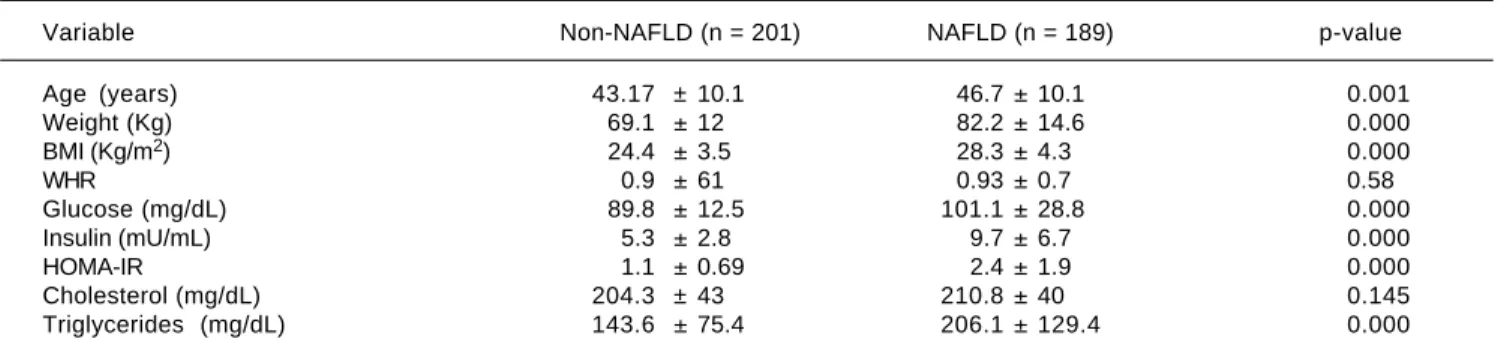
Table 1. Table 1. Demographic, clinical and biochemical characteristics.
Variable Non-NAFLD (n = 201) NAFLD (n = 189) p-value
Age (years) 43.17 ± 10.1 46.7±10.1 0.001
Weight (Kg) 69.1 ±12 82.2±14.6 0.000
BMI (Kg/m2) 24.4 ±3.5 28.3±4.3 0.000
WHR 0.9 ±61 0.93±0.7 0.58
Glucose (mg/dL) 89.8 ±12.5 101.1 ±28.8 0.000
Insulin (mU/mL) 5.3 ±2.8 9.7±6.7 0.000
HOMA-IR 1.1 ±0.69 2.4±1.9 0.000
Cholesterol (mg/dL) 204.3 ± 43 210.8 ±40 0.145 Triglycerides (mg/dL) 143.6 ±75.4 206.1 ±129.4 0.000
Database expressed in mean ± DE. NAFLD: Non-alcoholic Fatty Liver Disease. BMI: Body Mass Index. WHR: Waist-Hip Ratio. HOMA-IR: Homeostatic Mod-el assessment-Resistance Insulin. Values p < 0.05 were significant.
Figure1. Figure1.Figure1.
Figure1.Figure1. G Allele frequency differences between different groups (case vs. control). NAFLD: Non-alcoholic Fatty liver disease.
200
160
120
80
40
0
NAFLD NON-NAFLD
G allele 95(50%) 78(39%)
(I148M)
Other 94(50%) 123(61%)
polymorphisms
RESULTS
The demographic and biochemical test results, of pa-tients with and without NAFLD, at the time of diagnosis are listed in Table 1. In general, most of NAFLD patients presented specific characteristics of metabolic syndrome. On the other hand, the cholesterol and waist-hip ratio (WHR) had not significant differences. G allele (I148M) was found in 50% of NAFLD patients compared with healthy subjects (39%) (Figure 1). The significant associa-tion was observed by recessive model (OR = 1.711, 95% CI: 1.014–2.886; P = 0.044). We observed a significantly higher levels of aspartate aminotransferase and alanine transaminase (ALT) in I148M homozygote NAFLD pa-tients and controls (P = 0.002 and 0.036, respectively).
DISCUSSION
We found that I148M variant of PNLPA3 is more
fre-quent in Mexican patients with NAFLD than in those without it. Two previous studies by our group support these findings. The first, by Larrieta-Carrasco, et al.,8 was
conducted in indigenous Mexican and Mestizo individu-als, observing an impressive association between the ge-netic variant and high levels of ALT. Their findings showed a frequency about 18.7% of elevated ALT levels in indigenous population, being modified by BMI. There-fore, they observed raised ALT levels above 14.4% in nor-mal weight, 19.9% in overweight, and 24.5% in obese individuals. The I148M genotype was significantly associ-ated with elevassoci-ated ALT levels in indigenous individuals (OR = 3.15, 95% CI: 1.91–5.20; P = 7.1 x 10⁻⁶), and this
as-sociation was confirmed in Mexican-Mestizos (OR = 2.24, 95% CI: 1.50-3.33; P = 8.1 x 10⁻⁵).4 The second one,
by León-Mimila, et al.,9 assessed 130 participants aged
18-59 years with severe obesity (BMI ≥ 40 kg/m2) that
under-went bariatric surgery. The aim of their study was associated the genetic variants with genetic risk score for elevated liver fat content and NASH in morbidly obese Mexicans. To make this possible, they genotyped its popu-lation for six single-nucleotide polymorphisms (SNPs): rs738409 (PNPLA3), rs12137855 (LYPLAL1), rs780094 and rs1260326 (GCKR), rs2228603 (NCAN) and rs4240624 (PPP1R3B). Consequently, they found after adjusting for age, sex and admixture that PNPLA3, LYPLAL1, GCKR were significantly associated to higher hepatic fat content (PNPLA3, LYPLAL1, GCKR: p < 0.05). Surprisingly, our population had similar results according to PNPLA3 “G” allele (P = 0.011).
Similarly, Xu R, et al. meta-analysis assessed a relation-ship between the PNPLA3 rs738409 polymorphism and susceptibility to develop NAFLD, including its subtypes SS and NASH. They included twenty-three case-control
studies of several countries which involve 6071 NAFLD patients and 10,366 controls. Their findings showed a sig-nificant association between the rs738409 polymorphism and NAFLD risk in all genetic models (OR: 3.41; 95% CI: 2.57-4.52; p < 0.00001) as well as with NASH risk (OR: 4.44; 95%CI: 3.39-5.82; p < 0.00001). However, they ob-served that this susceptibility was not influenced by ethnic groups, ages of subjects or the source of controls. Addi-tionally, they demonstrated that the rs738409 polymor-phism was only significantly associated with SS risk in the allele contrast model and had no effect in the other genetic models. Therefore, it could be suggested that the rs738409
polymorphism in PNPLA3 gene confers high
cross-eth-nicity risk to develop NAFLD and NASH. Likewise, Sin-gal, et al. performed a systematic review of 24 studies, with
9,915 patients, to determine the relationship between
PN-PLA3 and liver fibrosis severity, HCC risk as well as
prognosis among patients with liver disease.11 They
ob-served that cirrhotic patients had an increased risk to de-velop HCC (OR: 1.40; 95% CI: 1.12-1.75). This risk was higher in patients with NASH or Alcohol-related cirrho-sis (OR: 1.67; 95% CI: 1.27-2.21) than in those with other etiologies of cirrhosis (OR: 1.33; 95% CI: 0.96-1.82).
Fur-ther, they demonstrated an association between PNPLA3
and fibrosis severity (OR 1.32, 95 % CI: 1.20-1.45), with a consistent increased risk across liver disease etiologies.
How can we explain the high prevalence of the
PNP-LA3 polymorphism in Mexican-Americans,
Mexican-In-dians, and Mexican-Mestizos? We believe that the genetic background of Mexicans is important due to Mexican-Americans are a genetically diverse ethnic group with wide ranges of Native American (NA), European, and Af-rican ancestry. Also compared with non-Hispanic Euro-pean Americans, NA and Hispanic Americans have higher BMI, an increased prevalence of obesity, and a higher inci-dence of type 2 diabetes (T2D). Several studies have sug-gested that NA genes are involved in susceptibility to
metabolic disorders. For example, Norden-Krichmar, et
al.12 found that genetic and cultural environmental, rather
than socioeconomic factors, contribute to higher BMI in Native American community. It is well known that exces-sive BMI is linked to major medical disorders such as
dia-betes and cardiovascular disease. Martinez-Marignac, et
al.13 performed a study in Mexico City in which they
showed an association with ancestry, being increased in NA admixture proportion (OR: 1.6; CI 95%: 0.6-4.3). Consequently, it can be assumed that NAFLD may pre-cede the development of T2D.
On the other hand, Garner, et al. studied the frequencies of NAFLD susceptibility SNPs in non-Hispanic white and Hispanic population who attended a clinic in Albu-querque, New Mexico.14 The investigators found that
chronic disease indicators were associated with specific alleles in NAFLD susceptibility SNPs but were not the same between non-Hispanic white and Hispanic popula-tions.15 However, they observed that the major allele of
PNPLA3 (rs738409) was more frequent in non-Hispanic
whites.
In terms of therapeutic targets for NAFLD, the feeding and genetic factors have been recognized as promising treatments. Particularly, herbal extracts or flavonoids con-sumption, such as quercetin, in individuals with
non-fa-vourable genotype GG of PNPLA3. Rojas, et al. performed a study in which elucidated, in an in-vitro model, the role of quercetin and other water soluble-extracts on decreas-ing lipid accumulation in hepatocytes.15 They
demonstrat-ed that quercetin and other natural extracts can rdemonstrat-educe the intracellular lipid accumulation and triglycerides levels by
the down-regulation of SREBP-1c, PPARγ and ACAT1
expression levels as well as by the increment of PPARα
expression. At present, there are not approved therapies for NASH patients due to inconsistent results in clinical trials. However, the treatment suggested by Rojas, et al. could be novel to modify, from lipids metabolism, the natural history of the disease. In fact, in the last issue of
Journal of Hepatology, Konerman, et al.16 carried on a review
comparing the endpoints and outcomes of main trials. In-terestingly, they showed the pioglitazone as the drug with the best results for NASH resolution, hepatic steatosis and fibrosis improvement.
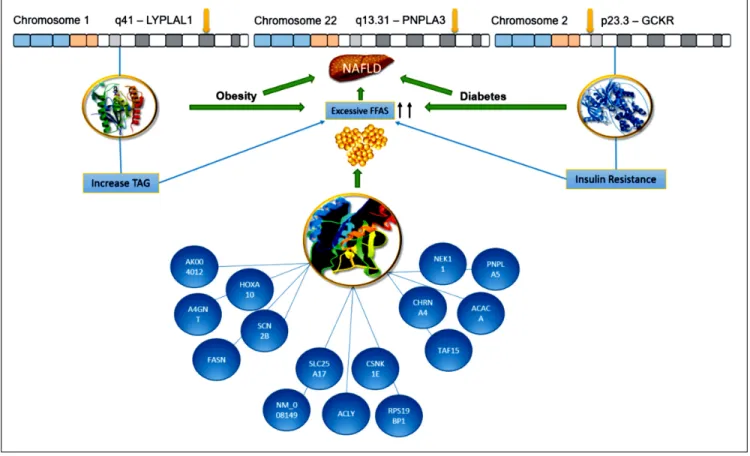
Figure 2. Figure 2.Figure 2.
CONCLUSION
PNPLA3 has been the main gene for the development of NAFLD in Mexican population. We suggested (Figure 2) that the enormous interaction among diverse genes, particu-larly the variants of LYPLAL1 and GCKR and their linkage with several others, could help us to understand the develop-ment and progression of the disease. We know that all of these genetic variants are related to the increase of TAG and resistance of insulin, leading to obesity or diabetes. This is of particular importance for Mexican population due to Mexico has the highest prevalence rates of dyslipidemia, obesity and diabetes.17,18 In this regard, Mexico has an overall obesity
prevalence of 72.5%, being the second most obese country worldwide.19,20 Further, diabetes is the first cause of death for
Mexicans, having a prevalence of 10.4%.21,22 Consequently,
the overview is alarming, especially, if we keep in mind that SNP PNPLA3 is very frequent in Mexican population. For this reason, the implementation of health policies is urgent in order to diminish the risk of NAFLD development in these vulnerable inhabitants.
ABBREVIATIONS
• ALT: Alanine Transaminase.
• BMI: Body Mass Index.
• NA: Native American.
• NAFLD: Non-Alcoholic Fatty liver Disease.
• NASH: Non – Alcoholic Steatohepatitis.
• PCR: Polymerase Chain Reaction.
• PNPLA3: patatin-like phospholipase domain
contain-ing 3.
• SNPs: Single-Nucleotide Polymorphisms.
• T2D: Type 2 diabetes.
• TAG: Triacylglycerol.
• WHR: Waist-Hip Ratio.
FUNDING
This work was supported by Medica Sur Clinic and Foundation.
CONFLICTS OF INTEREST
The authors declare no competing professional or fi-nancial interests. This study followed the Declaration of Helsinki on medical protocol and the informed consent was obtained from all individual participants.
REFERENCES
1. López-Velazquez JA, Silva-Vidal KV, Ponciano-Rodriguez G, Chavez-Tapia NC, Arrese M, Uribe M, Méndez-Sánchez
N. The prevalence of nonalcoholic fatty liver disease in the Americas. Ann Hepatol 2014; 2: 166-78.
2. Mendez-Sánchez N, Arrese M, Zamora-Valdés D, Uribe M. Current concepts in the pathogenesis of nonalcoholic fatty liver disease. Liver International 2007; 4:423-33.
3. Sookoian S, Pirola CJ. Meta-analysis of the influence of I148M variant of patatin-like phospholipase domain containing 3 gene (PNPLA3) on the susceptibility and histological se-verity of nonalcoholic fatty liver disease. Hepatology 2011; 53: 1883-94 36.
4. Sookoian S, Castaño GO, Burgueño AL, Gianotti TF, Rosselli MS, Pirola CJ. A nonsynonymous gene variant in the adipo-nutrin gene is associated with nonalcoholic fatty liver dis-ease severity. J Lipid Res 2009; 50: 2111-16.
5 Romeo S, Kozlitina J, Xing Ch, Pertsemlidis A, Cox D, Penn-acchio LA, BoerwinkleE, et al. Genetic variation in PNPLA3 confers susceptibility to nonalcoholic fatty liver disease. Nat Genet 2008; 12: 1461-5.
6 Hernaez R, McLean J, Lazo M, Brancati FL, Hirschhorn JN, Borecki IB, Harris TB, et al. Association between variants in or near PNPLA3, GCKR, and PPP1R3B with ultrasound-de-fined steatosis based on data from the third National Health and Nutrition Examination Survey. Clin Gastroenterol Hepa-tol 2013; 9: 1183-90.
7. Martínez LA, Larrieta E, Calva JJ, Kershenobich D, Torre A. The expression of PNPLA3 Polymorphism could be the key for severe Liver Disease in NAFLD in Hispanic Population.
Annals of Hepatol 2017; 6: 909-15.
8. Larrieta-Carrasco E, Acuña-Alonzo V, Velazquez-Cruz R, Barquera-Lozano R, León-Mimila P, Villamil-Ramýrez H, Men-jivar M, et al. PNPLA3 I148M polymorphism is associated with elevated alanine transaminase levels in Mexican Indigenous and Mestizo populations. Mol Biol Rep 2014; 7: 4705-11. 9. León-Mimila P, Vega-Badillo J, Gutiérrez-Vidal R,
Villamil-Ramí-rez H, Villareal-Molina T, Larrieta-Carrasco E, López-Contre-ras BE, et al. Genetic risk score is associated with hepatic triglyceride content and non-alcoholic steatohepatitis in Mexi-cans with morbid obesity. Exp Mol Pathol 2015; 2: 178-83. 10. Xu R, Tao A, Zhang S, Deng Y, Chen G. Association
be-tween patatin-like phospholipase domain containing 3 gene (PNPLA3) polymorphisms and nonalcoholic fatty liver dis-ease: a HuGE review and meta-analysis. Sci Rep 2015; 5: 9284.
11. Singal AG, Manjunath H, Yopp AC, Beg MS, Marrero JA, Gopal P, Waljee AK. The effect of PNPLA3 on fibrosis pro-gression and development of hepatocellular carcinoma: a meta-analysis. Am J Gastroenterol 2014; 3: 325-34. 12. Norden-Krichmar TM, Gizer IR, Libiger O, Wilhelmsen KC,
Eh-lers CL, Schork NJ. Correlation analysis of genetic admixture and social identification with body mass index in a Native American community. Am J Hum Biol 2014; 26: 347-60. 13. Martinez-Marignac VL, Valladares A, Cameron E, Chan A,
Perera A, Globus-Goldberg R, Wacher N, et al. Admixture in Mexico City: Implications for admixture mapping of type 2 dia-betes genetic risk factors. Hum Genet 2007; 120: 807-19. 14. Garner C, Conn C, Cohen D, Luo L, Castillo JJ, Shah V,
Garver W. NAFLD susceptibility genes and their association with type 2 diabetes and obesity in a New Mexico popula-tion. J Diabetes Obes 2015; 2: 10.15436/2376-0494.15.024. 15. Rojas A, Gallego P, Gil-Gómez A, Muñoz-Hernández R, Ro-jas L, Maldonado R, Gallego-Durán R, et al. Natural Extracts Abolish Lipid Accumulation in Cells Harbouring Non-Favoura-ble PNPLA3 genotype. Ann of Hepatol 2018; 2 [In press]. 16. Konerman MA, Jones J, Harrison SA. Pharmacotherapy for
17. Escobedo-de la Peña J, de Jesús-Pérez R, Schargrodsky H, Champagne B. Prevalence of dyslipidemias in Mexico city and Its relation to other cardiovascular risk factors. Gac Med Mex 2014; 2: 128-36.
18. Aguilar-Salinas CA, Gómez-Pérez FJ, Rull J, Villalpando S, Barquera S, Rojas R. Prevalence of dyslipidemias in the Mex-ican National Health and Nutrition Survey 2006. Salud Públi-ca de México 2010; 52: S1 44-53.
19. Palloni A, Beltrán-Sánchez H, Novak B, Pinto G, Wong R. Adult Obesity, disease and longevity in Mexico. Salud Públi-ca Mex 2015; Supp. 1: S22-30
20. Instituto Nacional de Salud Pública. Encuesta Nacional de Salud y Nutrición de Medio Camino 2016 Informe Final de Re-sultados. Available on: http://oment.uanl.mx/wp-content/up-loads/2016/12/ensanut_mc_2016-310oct.pdf Accessed: January 26th, 2018.
21. World Health Organization – Diabetes country profiles, 2016. Available on: http://www.who.int/diabetes/country-profiles/ mex_en.pdf Accessed: January 26th, 2018
22. Meza R, Barrientos-Gutierrez T, Rojas-Martinez R, Palacio-Mejia LS, Lazcano-Ponce E, Hernández-Ávila M. Burden of Type 2 Diabetes in Mexico: Past, Current and Future Preva-lence and Incidence Rates. Prev Med 2015; 81: 445-50.
Correspondence and reprint request:
Prof. Nahum Méndez-Sánchez, M.D., MSc, Ph.D. Liver Research Unit, Medica Sur Clinic & Foundation, Puente de Piedra 150, Col. Toriello Guerra, ZP 14050,