
15M: The movement in its third anniversary
76
0
0
Texto completo
(2) Universitat Oberta de Catalunya http://www.uoc.edu/ Av. Tibidabo, 39-43 08035 Barcelona Spain Tel. 93 253 23 00. The texts published in this publication are – unless indicated otherwise – covered by the Creative Commons Spain Attribution 3.0 licence. You may copy, distribute, transmit and broadcast provided that you attribute it (authorship, publication name, publisher) in the manner specified by the author(s) or licensor(s). The full text of the licence can be consulted here: http://creativecommons.org/licenses/by/3.0/es/deed.en..
(3) 15M: The movement in its third anniversary. Arnau Monterde, Antonio Calleja-López, Daniel Blanche & Mireia Fernández-Ardèvol. Table of contents. Abstract ................................................................................................................... 4 Introduction ............................................................................................................. 6 1. Background and conceptual framework. ............................................................ 6 2. Research goals. .................................................................................................. 8 3. Methods. ............................................................................................................. 8 3.1. Data collection and processing. ............................................................. 9 3.2. Basic characteristics of the sample. .................................................... 10 4. Results. ............................................................................................................. 12 4.1. The 15M movement and me. ................................................................. 12 4.2. Issues and political participation before 15M. .................................... 15 4.3. 15M practices and uses of ICTs. .......................................................... 17 4.4. Emotions in the 15M movement. .......................................................... 23 4.5. The evolution of the 15M movement. ................................................... 25 4.6. The 15M movement and institutional politics. .................................... 28 4.7. 15M impacts............................................................................................ 30 5. Conclusions. ..................................................................................................... 35 Acknowledgments................................................................................................. 37 Bibliographic references ....................................................................................... 37 Annex 1 ................................................................................................................. 41 Annex 2 ................................................................................................................. 72. Working Papers is a research monograph series promoted by the Universitat Oberta de Catalunya. Working Papers (2017) ISSN 2462-7461 working-papers.uoc.edu. 3.
(4) Arnau Monterde, Antonio Calleja-López, Daniel Blanche & Mireia Fernández-Ardèvol. 15M: The movement in its third anniversary. 15M: The movement in its third anniversary Arnau Monterde ([email protected]) IN3-Universitat Oberta de Catalunya Antonio Calleja-López ([email protected]) IN3-Universitat Oberta de Catalunya Daniel Blanche ([email protected]) IN3-Universitat Oberta de Catalunya Mireia Fernández-Ardèvol ([email protected]) IN3-Universitat Oberta de Catalunya. Abstract The emergence of networked social movements in 2011 has opened a new door in the social movements’ literature. By adopting a technopolitical and situated approach, in this paper, we explore the case of the 15M movement three years after its formation in May 2011. Through an online survey and a nonprobabilistic sampling procedure, we pay special attention to the perceptions and opinions of the movement’s participants. We distinguish seven thematic sections: the relationship with the movement, previous political participation and motivations, the use of information and communication technologies (ICTs), the emotions experienced, the evolution of the movement, its influence on elections, and the impacts on several aspects of social life. The results show that the respondents (N=1320) are to a large extent adherent to the movement and largely prompted into action due to political issues. Also, they mostly believe that the movement remains alive yet in new forms, and perceived impacts on different areas, institutions, behaviours, and ideas. We conclude by describing 15M as a case that adequately fits the concept of a networked social movement.. Working Papers is a research monograph series promoted by the Universitat Oberta de Catalunya. Working Papers (2017) ISSN 2462-7461 working-papers.uoc.edu. 4.
(5) 15M: The movement in its third anniversary. Arnau Monterde, Antonio Calleja-López, Daniel Blanche & Mireia Fernández-Ardèvol. Finally, we suggest future steps in the understanding of these movements by further applying the online survey designed for this study and complementing analyses via other research methods.. Keywords 15M, Networked social movements, Technopolitics, Information and communication technologies (ICTs), Spain. Working Papers is a research monograph series promoted by the Universitat Oberta de Catalunya. Working Papers (2017) ISSN 2462-7461 working-papers.uoc.edu. 5.
(6) 15M: The movement in its third anniversary. Arnau Monterde, Antonio Calleja-López, Daniel Blanche & Mireia Fernández-Ardèvol. Introduction In 2011, networked protests emerged in Tunisia, Egypt, Greece, Portugal, Spain and the US. A common feature was their innovative and performative connections of social media and urban spaces for collective action. The emergence of these movements and their strategic use of information and communication technologies (ICTs) (defined as the converging set of technologies that process information and communication by electronic means, including transmission and display [Castells, 1996; OECD, 2011]) constitutes a key factor in the transformation of the practices of contentious politics, which, in cases like Spain, is also transforming the political culture and State institutions. New public spheres appear, connected to the spaces of autonomy (Castells, 2012) that movements create on the basis of the possibilities offered by the Internet. Labelled as “networked social movements” (Castells 2012; Juris, 2004), there are numerous analyses of their relationship to digital practices and social media, both with the case of 15M (Aguilera, Morer, Barandiaran & Bedia, 2013; Alcazan et al., 2012; Linares, 2013; Peña-López, Congosto, & Aragón, 2014; Toret et al., 2015), and beyond (Bennett & Segerberg, 2012; Castells, 2012; Chadwick, 2013; Gerbaudo, 2012; Juris, 2012; Postill, 2014). In this paper we follow a technopolitical approach (Toret et al., 2015) that takes into account the intensification and complexification of the technological mediation of collective action (Bennett & Segerberg, 2012; Castells, 1996, 2009, 2012; Earl & Kimport, 2011) and situates social practices around digital communication technologies at the centre of the analysis (Couldry, 2012). In this line, we focus on the 15M movement (or indignados movement) in its third anniversary, which depicts fundamental characteristics of the forms of collective action arising with the wave of networked social movements since 2011 (Castells, 2012), and displays a rich history of evolution (Monterde, 2015). The movement emerged in May 2011 in the midst of a deep economic and political crisis in Spain, and took the form of a multitudinous and networked self-organized process (Toret et al., 2015) probably unique in the world. 15M operates through a multi-layered structure that connects offline interactions with mass and digital social media (Toret et al., 2015). The movement is particularly relevant as it opened a cycle of contention (Tarrow, 1989) that has shaped the social and political dynamics of the Spanish society since 2011. Born within digital networks, it evolved and multiplied in relation to them. Due to their novelty and relevance, there is a need for a closer examination of social media and emerging technopolitical practices in social movements of the likes of 15M.. 1. Background and conceptual framework. The first collective initiative that can be safely labelled as “15M” is the grassroots platform DRY (Democracia Real Ya!, or Real Democracy, Now!), which on March 2011 called for demonstrations on May 15th, 2011, to. Working Papers is a research monograph series promoted by the Universitat Oberta de Catalunya. Working Papers (2017) ISSN 2462-7461 working-papers.uoc.edu. 6.
(7) 15M: The movement in its third anniversary. Arnau Monterde, Antonio Calleja-López, Daniel Blanche & Mireia Fernández-Ardèvol. demand “real democracy”. Much of the organization took place in a web forum and Facebook groups. The DRY label was soon appropriated by citizens all over Spain who were encouraged to create their local nodes, without any central authorization or supervision (Toret et al., 2015). On May 15th, 2011, simultaneous demonstrations took place in 60 cities, with 130,000 participants (Serrano, 2012). Afterwards, between May 16th and 22nd, a small sit-in in Madrid’s main square, Puerta del Sol, evolved into a camp (Acampada Sol) that operated as the first node of a network of camps that soon reached over 130 cities across Spain. The camps spread, multiplying the ‘camp’ form via socio-technologically structured processes of replication (Toret et al., 2015). A vast network of connected camps and squares emerged within which information, calls, and actions circulated and reverberated engaging between 6 and 8 million people in the protests (Garea, 2011). When compared with forerunners such as the alternative globalization movement (Juris, 2004), 15M exhibits an increase in the range and variety of participants’ networked practices, for example, viral campaigns on Facebook, activity coordination on Twitter, or protest live-streaming (Pérez & Gil, 2014). In line with these practices, Internet traffic in Spain increased by 17% from April to May 2011, and there was a 20% increase in smartphones’ data traffic (Monterde & Postill, 2014). In the following years, the movement evolved through a continuous renewal of its repertoire of practices, combining periods of latency with periodical outbreaks of massive mobilizations, displacing the centre of gravity from DRY and the camps to new or renewed initiatives. Some acquired special importance within the 15M ecosystem and became permanent spaces for action (e.g., the teachers and public health workers mobilizations under the label “mareas” [tides] or the fight against housing evictions by the Platform of Mortgage Victims, the PAH). These practices entailed intensive use of social media and digital tools, open labels (easily appropriated by social media users) and transversal calls to action not centred on ideological premises (Candón Mena, 2013; Monterde & Postill, 2014; Toret et al., 2015). The first post-15M political party to emerge was the X Party, in 2013. It was followed by Podemos, which obtained 1.2 million votes in the May 2014 European elections, nearly 8% of all casted votes, and ranking fourth among Spanish parties. Both parties made intensive use of social network sites (SNS) for the construction and spreading of their narratives and organization (Tormey & Feenstra, 2015). From 2011 to 2014, participants maintained part of the initial technopolitical practices of the movement, but transformed and adapted them into new goals and needs (Monterde, 2015). It is, therefore, relevant to examine the 15M movement across time to understand its evolution and its social and political impacts. The unfolding of movements such as 15M leads us to reassess the study of social movements in the information and knowledge age. The proliferation and massive extension of technopolitical practices for the organization of collective action, the availability of open and distributed communication, the role of emotions in the main events as drivers of networked communication, the emergence of self-organizing forms at a large scale, or the hybridization of layers (physical and digital) in the movement’s development are some of the factors that guide us towards new approaches in the study of social movements in the network society. In this sense, we aim at further developing the notion of networked movement (Monterde, 2015) as a concept that extends and includes most of the characteristics of these emerging social movements, which are articulated both by hyper-connected and complex dynamics. This development would enable new arguments for a better understanding of these movements, arguments that neither allude to technocentric ideas nor neglect the essential role of technologies in these movements. Such a novel and broader approach is captured in the term. Working Papers is a research monograph series promoted by the Universitat Oberta de Catalunya. Working Papers (2017) ISSN 2462-7461 working-papers.uoc.edu. 7.
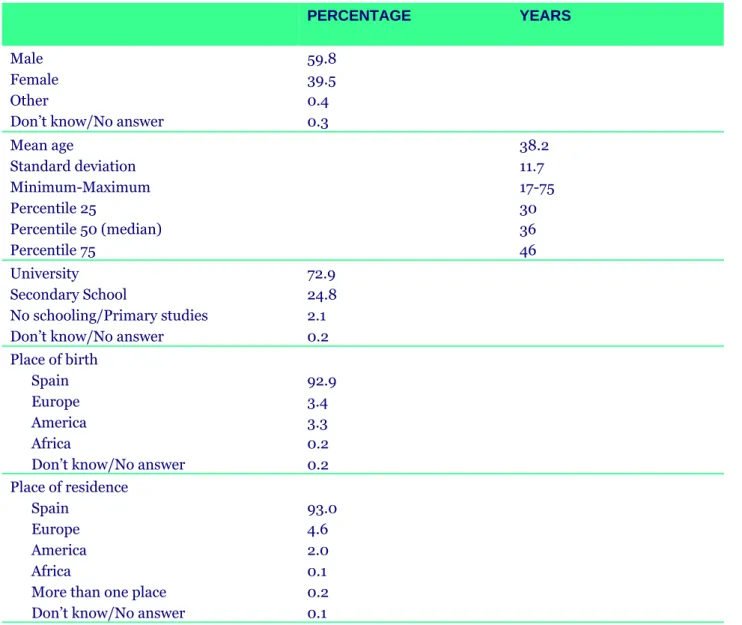
(8) 15M: The movement in its third anniversary. Arnau Monterde, Antonio Calleja-López, Daniel Blanche & Mireia Fernández-Ardèvol. “technopolitics”, which has been defined as the strategic and tactical use of digital tools in the organization and communication of collective action (Toret et al., 2015). These new conceptual developments in the intersections of social movements and information and communication technologies literatures pave the way for new directions in the analysis of social movements in the context of the current network society. Therefore, we adopt these new advancements in the examination of the 15M movement in Spain.. 2. Research goals. In this study, we primarily approach 15M from the viewpoint of its participants. This provides extremely valuable information to understand how they conceive the movement. We believe that their experience and views are crucial for a better understanding of 15M. Having this said, our main goal in this paper is to look into the practices, evolution and impacts of the 15M movement from the perspective of its participants, in a transdisciplinary and situated manner. Furthermore, we define several specific goals that delve into greater detail on the experiences and perceptions of the 15M participants. First, to identify the degree of adherence of 15M participants to the movement. Second, to examine their previous political participation and motives to participate. Third, to identify the forms of participation and the technological means used in relation to the movement. Fourth, to explore the emotions experienced by participants regarding the movement. Fifth, to examine the perceived persistence or evolution of the movement through time. Sixth, to explore the influence of the movement on political elections. Finally, to look into the perceived effects of the movement on different domains and institutions in the social and political spheres. In the following section, we describe in greater detail the methodology applied in this study.. 3. Methods. Given the increasing pervasiveness of information and communication technologies in Spain, and, especially, the intensive use of digital technologies by the 15M movement (which is a distinctive characteristic of networked social movements), we designed an online survey to collect the desired information. Accordingly, we deem this method to be adequate to reach our main target audience (participants in the movement), who are presumably frequent users of digital technologies or frequently exposed to digital contents. An encouraging precedent is the online survey conducted by Linares (2013), who gathered 6,000 responses in a very short period (from May 14th to May 15th, 2013) thanks to the involvement of 15M participants. This. Working Papers is a research monograph series promoted by the Universitat Oberta de Catalunya. Working Papers (2017) ISSN 2462-7461 working-papers.uoc.edu. 8.
(9) 15M: The movement in its third anniversary. Arnau Monterde, Antonio Calleja-López, Daniel Blanche & Mireia Fernández-Ardèvol. experience demonstrated that it was possible to get a considerable amount of in-depth information on 15M participants through a non-randomized online survey. Our survey relies on a similar strategy. We first involved 15M participants in the design phase through several survey pilots. The goal was to include the perspective of the movement’s participants, test the questionnaire and software repeatedly, and obtain their support in sharing the survey. Once the tools reached an optimal level, we released the survey through the main information channels and social network accounts of the movement. We circulated the survey through 15M key diffusion and communication networks, in which members of our research group are deeply involved in. By using some key 15M accounts in social network sites (SNS) we expected to generate a (network of) trust effect, therefore increasing the probabilities of a larger sample and completed questionnaires. The dissemination strategy proved to be successful since in a few days we collected more than a thousand answers, despite of its length (20 minutes in average to be completed). Although successful in the data collection stage, we are aware of the limitations of conducting an online survey based on a snowball sampling strategy, especially in terms of a lack of representativeness of the target population. In addition, the sampling procedure entails difficulties in terms of the replicability of the results, meaning that our data cannot offer full certainty of its robustness. In spite of these problems, we believe this strategy is adequate to collect a relatively high amount of data, in a standardized form, and to appeal, primarily, the 15M participants and supporters.. 3.1. Data collection and processing. The survey was conducted through an electronic questionnaire available on a web server and reproduced in Annex 1. The questionnaire was written in Spanish as it is the predominant first language in Spain. A selfselected, non-probabilistic sample was generated by making an open invitation through digital means, making use of social network sites. Most part of the distribution channels were related to the movement’s ecosystem of communication, so we expected participants would mostly identify themselves as part of it. Three channels were used to disseminate the survey: email, Twitter and Facebook. For each channel, an access link to the questionnaire was created, which allowed us to identify the source of the questionnaires filled (yet filled by unknown respondents). In addition, the questionnaire could be also accessed through the research group’s website, Tecnopolítica.net. The questionnaires answered through this channel were homologated with those reached by email, since the main purpose was to classify responses according to the three channels of interest. In Twitter, we used the hashtag #Encuesta15M2014 in every tweet along with the link to the questionnaire. Some of the key Twitter accounts related to the movement that participated in the dissemination of the survey were @democraciareal, @Datanalysis15m, @Acampadasbd, @Psicodromo, @15MBruselas, @iaioflautas, and @bufetalmeida, among some highly followed profiles. Fieldwork was conducted between May 13th, and May 22nd, 2014. A proprietary digital platform called Survey Manager (NetQuest) was used for data collection. The electronic questionnaire could be viewed in computers, smartphones and tablets, although it was better suited for the first two devices. The platform only registered responses if the questionnaire was opened in one browser window or tab. We received a total of. Working Papers is a research monograph series promoted by the Universitat Oberta de Catalunya. Working Papers (2017) ISSN 2462-7461 working-papers.uoc.edu. 9.
(10) 15M: The movement in its third anniversary. Arnau Monterde, Antonio Calleja-López, Daniel Blanche & Mireia Fernández-Ardèvol. 1,330 responses (434 from the questionnaire distributed via email and website, 797 via Twitter, and 99 via Facebook). Subsequently, we checked the quality of gathered data by analysing outliers, response patterns, and inconsistent answers (e.g., answering “stable job” along with “I have no income” as “Economic situation:”). Cases with failed system records and odd selection of answers in different questions were excluded from the sample. In addition, data entries of cases that submitted inconsistent answers in multiple choice questions were recoded as missing entry points. After data cleaning, the final sample size consists of 1,320 observations. The database, the data dictionary, and the questionnaire are available under an open license at http://tecnopolitica.net/content/encuesta15m2014. Regarding statistical techniques, in this working paper we conducted descriptive statistics: frequency tables, contingency tables, and chi-square tests for significant differences. All data analyses were carried out in the statistical package SPSS 23.. 3.2. Basic characteristics of the sample. Table 1 below gathers the basic socio-demographic characteristics of the survey respondents1. As the data was not collected to reproduce the Spanish society, their characteristics differ from the country population. Gender distribution of respondents is unbalanced, with more men (59.8%) than women (39.5%). Level of studies is above the Spanish average, as 72.9% declares holding, at least, a university degree. With ages ranging between 17 and 75 years old, the median age of participants in the survey is 36. The sample concentrates in young adults and medium-age adults: 25% of participants are under 30 years old, while 75% of the sample is under 46. Most respondents were born and live in Spain (92.9% and 93.0%, respectively). Finally, 65.8% of respondents report to currently participate in the labour market either as paid-employees, self-employed, or business owners, while up to 18.6% report being unemployed (see table 34 in Annex 2).. 1 For a comparison of basic socio-demographic characteristics between self-reported 15M participants and non-participants (“Others”), see table 32 in Annex 2.. Working Papers is a research monograph series promoted by the Universitat Oberta de Catalunya. Working Papers (2017) ISSN 2462-7461 working-papers.uoc.edu. 10.
(11) Arnau Monterde, Antonio Calleja-López, Daniel Blanche & Mireia Fernández-Ardèvol. 15M: The movement in its third anniversary. Table 1. Basic socio-demographic characteristics of the sample (N=1320) PERCENTAGE Male Female Other Don’t know/No answer. YEARS. 59.8 39.5 0.4 0.3. Mean age Standard deviation Minimum-Maximum Percentile 25 Percentile 50 (median) Percentile 75. 38.2 11.7 17-75 30 36 46. University Secondary School No schooling/Primary studies Don’t know/No answer. 72.9 24.8 2.1 0.2. Place of birth Spain Europe America Africa Don’t know/No answer. 92.9 3.4 3.3 0.2 0.2. Place of residence Spain Europe America Africa More than one place Don’t know/No answer. 93.0 4.6 2.0 0.1 0.2 0.1. Note. Categories sorted in descending order (except for “don’t know/no answer”).. Working Papers is a research monograph series promoted by the Universitat Oberta de Catalunya. Working Papers (2017) ISSN 2462-7461 working-papers.uoc.edu. 11.
(12) 15M: The movement in its third anniversary. Arnau Monterde, Antonio Calleja-López, Daniel Blanche & Mireia Fernández-Ardèvol. 4. Results. In this paper, we select the most relevant results of the survey. We present them in seven sections or blocks according to the specific research goals: the adherence of the sample participants to the movement, the previous organized political participation and motivations for participation, the forms of participation and technological means used, the reported emotional experiences, the perceived persistence or evolution of the movement, the influence of 15M on the upcoming European Parliament Elections of May 2014, and the perceived social and political impacts of the movement on areas and institutions. In addition, we mainly present results of those respondents who reported having participated in the 15M movement. When appropriate, we compare this group to Others of the sample2. Whenever the case, results are divided into three groups: “15M participants”, “Others” and “Total sample”.. 4.1. The 15M movement and me. The goal of this set of questions is to identify the involvement of respondents with the 15M movement at different levels. They look at actual participation, personal identification, level of interest, degree of agreement with 15M’s demands, and degree of involvement in the movement. Beginning with the most determining question in our survey, up to 76.8% of respondents (n=1014) report having participated in the 15M movement in some way (see table 2). As expected, this relatively high proportion of self-reported participants represents over three quarters of the obtained sample. In contrast, 21.7% of respondents (n=286) report not having taken part of the movement in any way. Lastly, a 1.5% report either not knowing the answer, or decided not to answer the question (n=20). From here on, it will be possible to delve into specific questions addressed to 15M participants, as well as compare answers between participants and “Others” (combining those who did not participate and who did not know or did not answer). Table 2. Participation in the 15M movement (N=1320) PERCENTAGE Have participated in 15M in some way Have not participated in any way Don’t know/No answer. 76.8 21.7 1.5. Note. Categories sorted in descending order (except for “don’t know/no answer”).. 2. Some questions were valid only for those who reported having participated in the 15M movement.. Working Papers is a research monograph series promoted by the Universitat Oberta de Catalunya. Working Papers (2017) ISSN 2462-7461 working-papers.uoc.edu. 12.
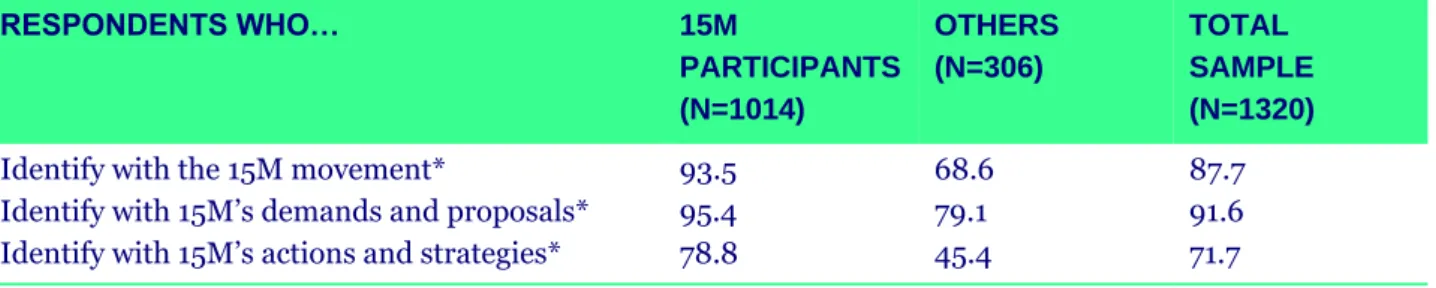
(13) Arnau Monterde, Antonio Calleja-López, Daniel Blanche & Mireia Fernández-Ardèvol. 15M: The movement in its third anniversary. Table 3 shows three different degrees of 15M participants’ personal identification with the movement: “general identification” (93.5%), “identification with demands and proposals” (95.4%) and “identification with actions and strategies” (78.8%). Support for 15M’s demands and proposals is higher than support to actions and strategies across all three groups. It is also interesting to notice that almost 70% (68.6%) of people falling within the “Others” category identify themselves with the movement. Table 3. Relationship with the 15M movement by participation in 15M (%) RESPONDENTS WHO…. 15M PARTICIPANTS (N=1014). OTHERS (N=306). TOTAL SAMPLE (N=1320). Identify with the 15M movement* Identify with 15M’s demands and proposals* Identify with 15M’s actions and strategies*. 93.5 95.4 78.8. 68.6 79.1 45.4. 87.7 91.6 71.7. Note. *Chi-Square Test p-value 0.000.. Table 4 shows the extent to which respondents were interested in the movement in the course of time. Most 15M participants report to be interested (and involved) three years after its emergence (85.0%), while nearly a quarter of 15M participants report having been interested only during the movement’s early days (13.0%). In addition, a majority of non-participants (“Others”) report being still interested and, somehow, involved in the movement, although not participating in any way. Table 4. Degree of interest in the 15M movement across time by participation in 15M* (%) RESPONDENTS FOR WHOM THE 15M MOVEMENT.... 15M PARTICIPANTS (N=1014). OTHERS (N=306). TOTAL SAMPLE (N=1320). Has never interested her or him Interested her or him back in 2011, but not anymore Did not interest her or him then, but now it does Still interests her or him and is still involved Don’t know/No answer. 0.2 13.0. 8.2 27.1. 2.0 16.3. 1.2 84.5 1.1. 5.6 52.6 6.5. 2.2 77.1 2.3. Note. *Chi-Square Test p-value 0.000.. Working Papers is a research monograph series promoted by the Universitat Oberta de Catalunya. Working Papers (2017) ISSN 2462-7461 working-papers.uoc.edu. 13.
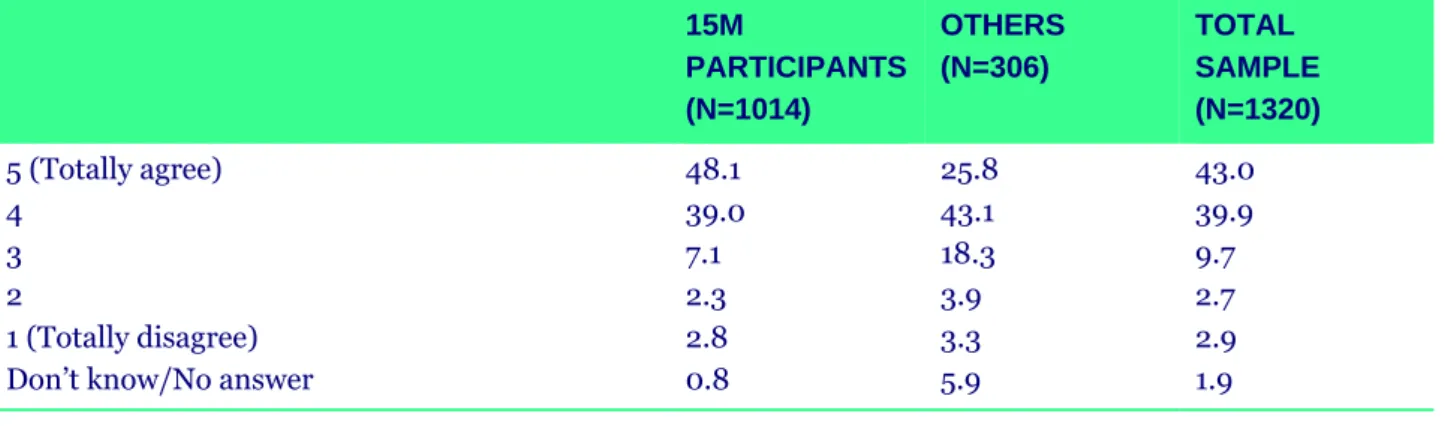
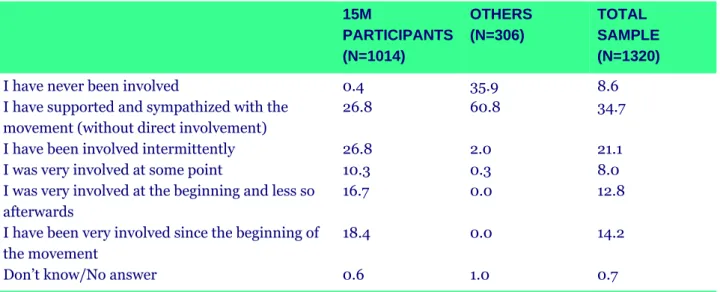
(14) Arnau Monterde, Antonio Calleja-López, Daniel Blanche & Mireia Fernández-Ardèvol. 15M: The movement in its third anniversary. Table 5, shows the level of agreement with demands, divided in a scale from 5 (totally agree) to 1 (totally disagree), and the main result indicates that 48.1% of 15M participants totally agree (5) with the demands of the movement, while 39.0% simply agrees (4) with them. That means nearly 90% of participants show a clear support (summing up 4 and 5) for 15M’s demands. Among those not participating, the number is still high, reaching nearly 70%. In other words, all respondents show a high degree of support towards 15M, which compared to degree of support at the national population level at the moment of the survey, is somewhat above the Spanish average (see, for instance, Ferrándiz, 2014). Table 5. Degree of agreement with 15M’s demands by participation in 15M* (%). 5 (Totally agree) 4 3 2 1 (Totally disagree) Don’t know/No answer. 15M PARTICIPANTS (N=1014). OTHERS (N=306). TOTAL SAMPLE (N=1320). 48.1 39.0 7.1 2.3 2.8 0.8. 25.8 43.1 18.3 3.9 3.3 5.9. 43.0 39.9 9.7 2.7 2.9 1.9. Note. *Chi-Square Test p-value 0.000.. Table 6 shows 15M participants’ type of involvement across time. One of the most interesting results suggests that the permanent core may have been composed by an 18.4% of respondents who remained intensively involved for the first three years. On the other hand, we see that a considerable percentage of Others has supported the movement even if they were not involved (60.8%).. Working Papers is a research monograph series promoted by the Universitat Oberta de Catalunya. Working Papers (2017) ISSN 2462-7461 working-papers.uoc.edu. 14.
(15) Arnau Monterde, Antonio Calleja-López, Daniel Blanche & Mireia Fernández-Ardèvol. 15M: The movement in its third anniversary. Table 6. Involvement in 15M by participation in 15M* (%). I have never been involved I have supported and sympathized with the movement (without direct involvement) I have been involved intermittently I was very involved at some point I was very involved at the beginning and less so afterwards I have been very involved since the beginning of the movement Don’t know/No answer. 15M PARTICIPANTS (N=1014). OTHERS (N=306). TOTAL SAMPLE (N=1320). 0.4 26.8. 35.9 60.8. 8.6 34.7. 26.8 10.3 16.7. 2.0 0.3 0.0. 21.1 8.0 12.8. 18.4. 0.0. 14.2. 0.6. 1.0. 0.7. Note. *Chi-Square Test p-value 0.000.. 4.2. Issues and political participation before 15M. The second block of the survey looked at public issues that contributed to the mobilization of 15M participants, as well as their previous political experience. Since collective action is grounded on motives and previous experiences, examining the motivations and background of 15M participants is relevant to understand the political orientation and formation of the movement. As for table 7, “lack of democracy” was the most cited motivation among 15M participants (88.8%), with corruption coming second (77.6%), and the economic crisis in third place (66.6%).. Working Papers is a research monograph series promoted by the Universitat Oberta de Catalunya. Working Papers (2017) ISSN 2462-7461 working-papers.uoc.edu. 15.
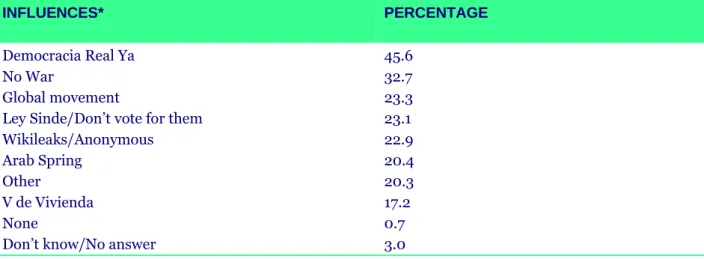
(16) 15M: The movement in its third anniversary. Arnau Monterde, Antonio Calleja-López, Daniel Blanche & Mireia Fernández-Ardèvol. Table 7. Issues that fostered participation in the 15M movement. 15M participants (N=1014) PROBLEMS*. PERCENTAGE. Lack of democracy Corruption Economic crisis Social cuts Unemployment Housing Other None Don’t know/No answer. 88.8 77.6 66.6 64.2 53.0 46.4 28.9 0.5 0.4. Note. *Non-exclusive categories.. Table 8 shows the role of Democracia Real Ya as a key actor in the beginning of the movement (45.6%). Another point to notice is the shared relevance of other previous movements (all of them cited as influences by around 20-30% of participants): the No War movement, the Global movement, the Ley Sinde (Movement for Internet neutrality defence), Wikileaks, Anonymous or the Arab Spring. Table 8. Movements that influenced 15M participants. 15M participants (N=1014) INFLUENCES*. PERCENTAGE. Democracia Real Ya No War Global movement Ley Sinde/Don’t vote for them Wikileaks/Anonymous Arab Spring Other V de Vivienda None Don’t know/No answer. 45.6 32.7 23.3 23.1 22.9 20.4 20.3 17.2 0.7 3.0. Note. *Non-exclusive categories. Categories sorted in descending order (except for “don’t know/no answer”).. Table 9 indicates a clear increase in political participation in Internet and social movements, a minor rise in participation in political parties or unions, and a drop in the levels of involvement with solidarity, third sector, associations, and NGOs.. Working Papers is a research monograph series promoted by the Universitat Oberta de Catalunya. Working Papers (2017) ISSN 2462-7461 working-papers.uoc.edu. 16.
(17) 15M: The movement in its third anniversary. Arnau Monterde, Antonio Calleja-López, Daniel Blanche & Mireia Fernández-Ardèvol. Table 9. Political participation before the emergence of 15M in 2011 and on May 2014. 15M participants (N=1014) (%) PARTICIPATION IN…*. BEFORE 15M. MAY 2014. Solidarity, third sector, associations, NGOs Social movements Internet and cyber activist movements Political parties or unions None Others Don’t know/No answer. 48.4 42.4 27.1 19.4 19.5 16.6 0.2. 42.0 58.2 48.9 22.9 10.3 16.5 0.7. Note. *Non-exclusive categories.. 4.3. 15M practices and uses of ICTs. ICTs are central to the 15M movement. Probably, 15M is one of the most important movements in the last decade in terms of uses of networked digital technologies for collective action. In this sense we examine 15M’s different uses of media, devices, the role of social networks, and the influence of the movement in the uses of social networks. The analysis of 15M practices in table 10 shows the pre-eminence of demonstrations (79.5%) as the most frequent form of participation in the movement, closely followed by participation in assemblies (65.6%) and digitally mediated practices such as signing an online petition (63.3%), using SNS (61.5%), and, perhaps more crucially, using SNS while attending face to face activities (58.8%). We can see the similar levels of participation in face to face and digitally mediated activities, and, more importantly, the high frequency of combination between the two. Also, only 19.2% of participants camped at a square. We can identify two subgroups of activities as for their level of engagement is concerned: those in which it is easier to participate, such as demonstrations, assemblies, or SNS activities (80%-50%), and those in which a higher level of involvement or commitment is required, such as camping, stopping evictions or organizing an action (30%10%).. Working Papers is a research monograph series promoted by the Universitat Oberta de Catalunya. Working Papers (2017) ISSN 2462-7461 working-papers.uoc.edu. 17.
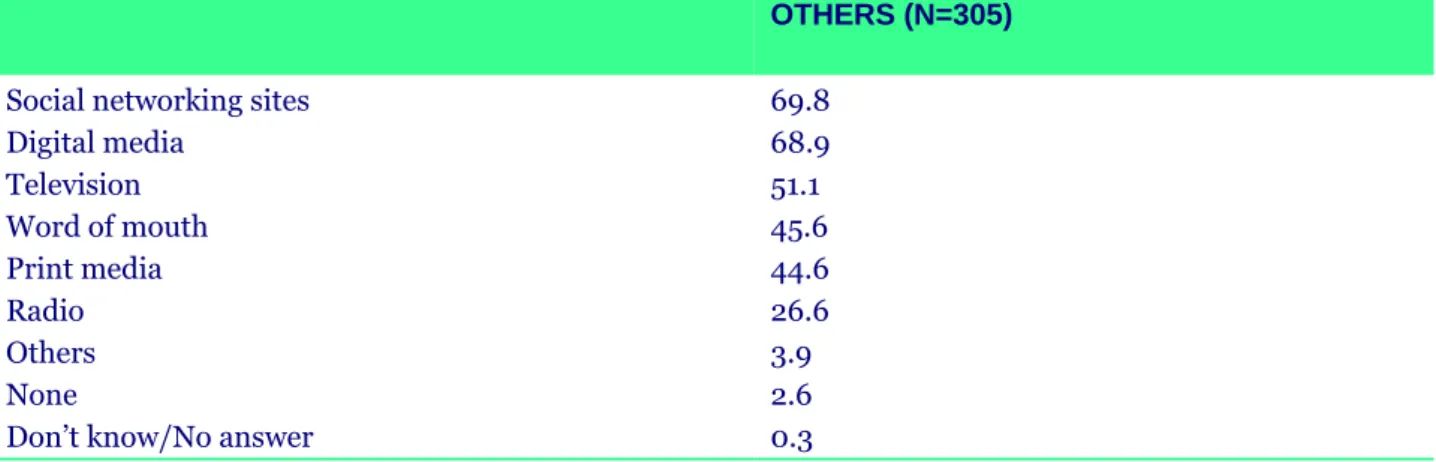
(18) Arnau Monterde, Antonio Calleja-López, Daniel Blanche & Mireia Fernández-Ardèvol. 15M: The movement in its third anniversary. Table 10. 15M practices.* 15M participants (N=1014) (%) FORMS OF PARTICIPATION. PERCENTAGE. Demonstration Assembly Signing an online petition Social Network Sites (SNS) In SNS from demonstrations, camps... Tide Organizing an action Email bombing politicians Making a banner Donating money to a crowdfunding Stopping an eviction Writing a blog post Camping in a square Recording a video / streaming “Escrache” Others None Don’t know/No answer. 79.3 65.6 63.2 61.5 58.8 31.3 28.4 24.5 23.3 21.8 20.3 20.2 19.2 11.6 11.3 0.5 0.1 0.1. Note. *Non-exclusive categories.. When it comes to the use of channels to share information on the protest movement, it is worth stressing the extremely high use of SNS among 15M participants (93.0%, see table 11), which is remarkably higher than the use among Others (69.8%, table 12). Among the former, word of mouth and digital media are also notably higher, while the use of both television and print media is lower. This suggests a much stronger presence of peer to peer, high involvement, interactive channels among 15M participants compared to Others. Yet, within this group, there is higher frequency of use of SNS (69.8%) and digital media (68.9%) than traditional media such as television (51.1%) or print media (44.6%), being also relevant word of mouth (45.6%).. Working Papers is a research monograph series promoted by the Universitat Oberta de Catalunya. Working Papers (2017) ISSN 2462-7461 working-papers.uoc.edu. 18.
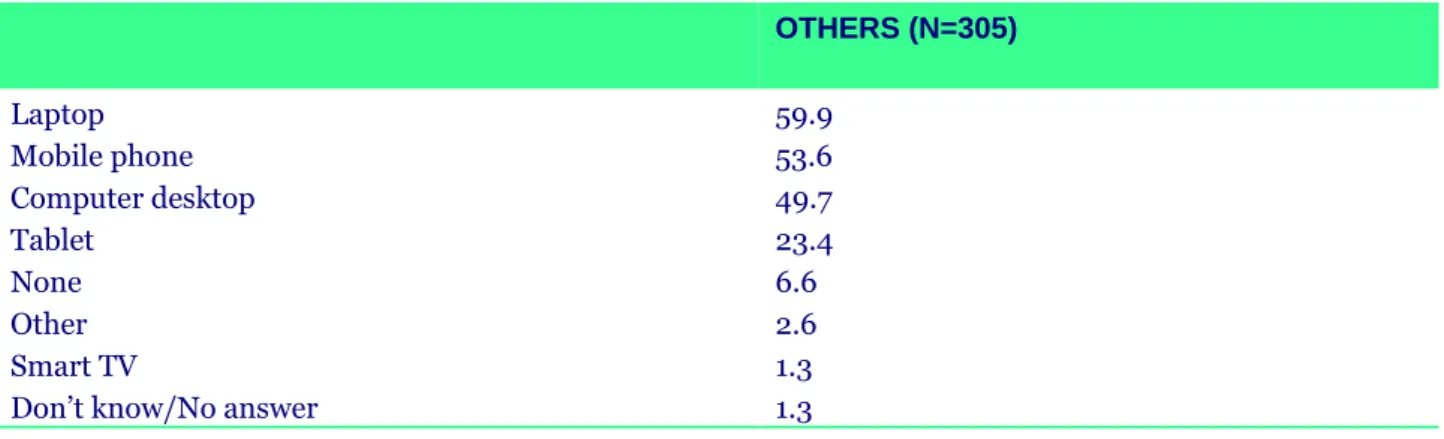
(19) Arnau Monterde, Antonio Calleja-López, Daniel Blanche & Mireia Fernández-Ardèvol. 15M: The movement in its third anniversary. Table 11. Use of channels to get or send information on 15M* (%) 15M PARTICIPANTS (N=1011) Social networking sites Word of mouth Digital media Print media Television Radio Others None Don’t know/No answer. 93.0 78.5 77.3 38.9 30.7 27.9 8.9 0.1 0.1. Note. *Non-exclusive categories.. Table 12. Use of channels to get information on 15M* (%) OTHERS (N=305) Social networking sites Digital media Television Word of mouth Print media Radio Others None Don’t know/No answer. 69.8 68.9 51.1 45.6 44.6 26.6 3.9 2.6 0.3. Note. *Non-exclusive categories.. Attending to the role of communication technologies and their uses, we highlight the intensive use of tech devices by 15M participants to share information about the movement (table 13), well ahead of Others (table 14) in the uses of laptops (79.1% vs 59.9%), mobile phones (73.4% vs 53.6%) or computer desktops (59.3% vs 49.7%). These data give us an initial confirmation of the intensive uses of electronic devices in 15M. The social media uses of the whole sample is another relevant aspect. In terms of mainstream social media, the use of Facebook is slightly lower among 15M participants (78.4%) than among Others (83.2%), but we find significantly higher levels in the use of Twitter (75.6% versus 60.1%) and Youtube (54.0% versus 49.5%) among 15M participants. Another significant difference can be found in the use of N-1 among 15M. Working Papers is a research monograph series promoted by the Universitat Oberta de Catalunya. Working Papers (2017) ISSN 2462-7461 working-papers.uoc.edu. 19.
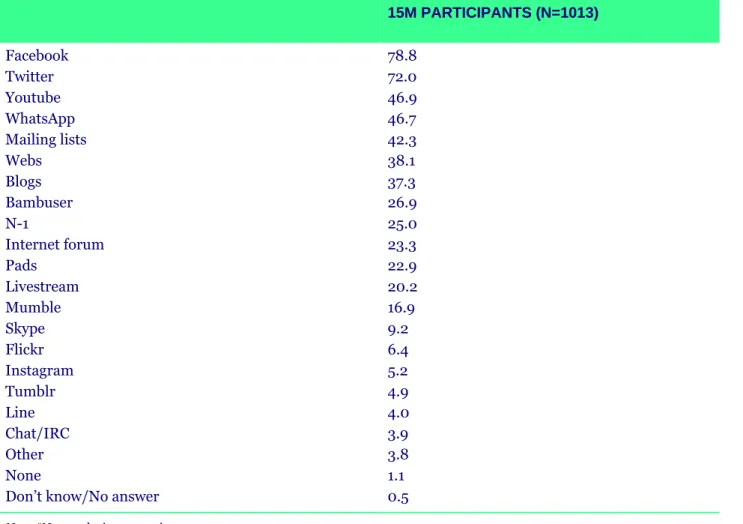
(20) 15M: The movement in its third anniversary. Arnau Monterde, Antonio Calleja-López, Daniel Blanche & Mireia Fernández-Ardèvol. participants (17.9%) in relation to Others (1%); this is a social network used almost exclusively by the movement. If we focus on social media uses only among 15M participants (see table 15), we can point out the relevance of commercial digital services such as Facebook (78.8%), Twitter (72.0%) and Youtube (46.9%), instant messaging applications such as WhatsApp (46.7%), and mailing lists (42.3%), but also other technologies which is a key feature of 15M, such as the streaming platform Bambuser (26.9%), N-1 (26.0%), etherpads (22.9%) or the voice over IP service Mumble (16.9%). All of these figures show the heterogeneous ecosystem generated around 15M technopolitical practices. Table 13. Use of devices to access or spread information about 15M* (%) 15M PARTICIPANTS (N=1011) Laptop Mobile phone Computer desktop Tablet Other Smart TV None Don’t know/No answer. 79.1 73.4 59.3 22.6 3.2 1.4 0.3 0.4. Note. *Non-exclusive categories.. Table 14. Use of devices to access information about 15M* (%) OTHERS (N=305) Laptop Mobile phone Computer desktop Tablet None Other Smart TV Don’t know/No answer. 59.9 53.6 49.7 23.4 6.6 2.6 1.3 1.3. Note. *Non-exclusive categories.. Similarly, we looked at 15M as a tech-diffusion phenomenon: some technologies were first used because of 15M (see table 16). Note the relevance of Twitter (31.9%), N-1 (19.7%), Bambuser (19.4%) or Pads (16.3%). Working Papers is a research monograph series promoted by the Universitat Oberta de Catalunya. Working Papers (2017) ISSN 2462-7461 working-papers.uoc.edu. 20.
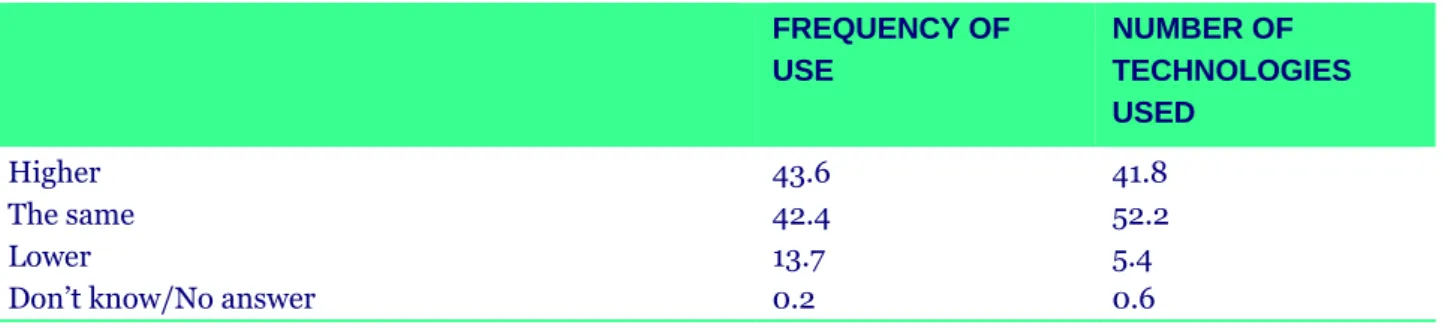
(21) 15M: The movement in its third anniversary. Arnau Monterde, Antonio Calleja-López, Daniel Blanche & Mireia Fernández-Ardèvol. among those who identify themselves as 15M participants. Finally, the increase in frequency in the use of technologies (43.6%) and the higher number of technologies used (41.8%) (see table 17) indicates the contribution of the movement to the penetration of communication technologies in social practices. Our hypothesis is that some digital practices of the movement spread to everyday life practices of participants and, through them, to other sectors of society. Table 15. Social media uses in 15M* (%) 15M PARTICIPANTS (N=1013) Facebook Twitter Youtube WhatsApp Mailing lists Webs Blogs Bambuser N-1 Internet forum Pads Livestream Mumble Skype Flickr Instagram Tumblr Line Chat/IRC Other None Don’t know/No answer. 78.8 72.0 46.9 46.7 42.3 38.1 37.3 26.9 25.0 23.3 22.9 20.2 16.9 9.2 6.4 5.2 4.9 4.0 3.9 3.8 1.1 0.5. Note. *Non-exclusive categories.. Working Papers is a research monograph series promoted by the Universitat Oberta de Catalunya. Working Papers (2017) ISSN 2462-7461 working-papers.uoc.edu. 21.
(22) 15M: The movement in its third anniversary. Arnau Monterde, Antonio Calleja-López, Daniel Blanche & Mireia Fernández-Ardèvol. Table 16. Technologies used for the first time during 15M (%) 15M PARTICIPANTS (N=980) Twitter None N-1 Bambuser Pads Mumble Livestream Facebook Mailing lists WhatsApp Blogs Webs Internet forum Flickr Youtube Tumblr Instagram Line Skype Chat/IRC Other Don’t know/No answer. 31.9 24.5 19.7 19.4 16.3 13.7 11.0 9.6 8.2 5.5 2.8 1.8 1.6 1.5 1.5 1.2 1.2 1.0 0.7 0.6 0.1 2.1. Note. *Non-exclusive categories.. Table 17. Digital technologies use evolution. 15M participants (N=997) (%). Higher The same Lower Don’t know/No answer. Working Papers is a research monograph series promoted by the Universitat Oberta de Catalunya. FREQUENCY OF USE. NUMBER OF TECHNOLOGIES USED. 43.6 42.4 13.7 0.2. 41.8 52.2 5.4 0.6. Working Papers (2017) ISSN 2462-7461 working-papers.uoc.edu. 22.
(23) Arnau Monterde, Antonio Calleja-López, Daniel Blanche & Mireia Fernández-Ardèvol. 15M: The movement in its third anniversary. Note. Categories sorted in descending order according to frequency of use values.. 4.4. Emotions in the 15M movement. This block of the survey is oriented to explore the role of emotions in 15M. Emotions are crucial in social life in general, and in collective action in particular (Goodwin, Jasper, & Polleta, 2001; Jasper, 1998, 2011; Melucci, 1996). This is especially true in a movement associated with a concrete affection: outrage. Analysing emotions, especially in a retrospective manner, is plagued with difficulties3. In spite of those caveats, we believe this block provides some broad, valuable information about emotional aspects of the movement both in 2011 and 2014, including variations between those years. The first question concerns the emotional importance of the early days of 15M. Remarkably, 95% of participants reported affirmatively (see table 18). In contrast, only 64% of participants considered 15M to be a relevant emotional experience in March 2014 (see table 19). Table 18. The early days of 15M were an important emotional experience to me by participation in 15M (%). Yes No Don’t know/No answer. 15M PARTICIPANTS (N=1014). OTHERS (N=306). TOTAL SAMPLE (N=1320). 95.0 4.1 0.9. 72.5 21.6 5.9. 89.8 8.2 2.0. Note. Categories sorted in descending order according to 15M participants’ values.. Table 19. 15M, in its current form, is an important emotional experience to me by participation in 15M (%). Yes No Don’t know/No answer. 15M PARTICIPANTS (N=1014). OTHERS (N=306). TOTAL SAMPLE (N=1320). 64.0 28.6 7.4. 32.7 57.8 9.5. 56.7 35.4 7.9. Note. Categories sorted in descending order according to 15M participants’ values.. 3 Some of these difficulties are specific to this survey: it is problematic to approach emotions 3 years after they were felt, since memory constructs and reconstructs them in fundamental ways (Reisberg & Hertel, 2004).. Working Papers is a research monograph series promoted by the Universitat Oberta de Catalunya. Working Papers (2017) ISSN 2462-7461 working-papers.uoc.edu. 23.
(24) Arnau Monterde, Antonio Calleja-López, Daniel Blanche & Mireia Fernández-Ardèvol. 15M: The movement in its third anniversary. When it comes to the primary emotions felt by 15M participants at the time of the encampments, it is worth stressing that the four most frequently reported ones were of a positive kind: hope (85.6%), excitement (83.7%), joy (78.3%) and empowerment (56.3%) (see table 20). Only one arguably negative emotion (i.e., outrage) felt by 42.4% of respondents, holds a comparable relevance. Interestingly, the three most common emotions among Others were the same, albeit mentioned less frequently. Table 20. Emotions felt at the time of 15M at the time of the encampments in 2011 by participation in 15M (%). Hope* Excitement* Joy* Empowerment* Outrage* Rage* Fear* Frustration* Other* Nostalgia* Sadness* Disgust** Indifference* Don’t know/No answer**. 15M PARTICIPANTS (N=1013). OTHERS (N=306). TOTAL SAMPLE (N=1319). 85.6 83.7 78.3 56.3 42.4 17.0 7.6 7.1 6.5 5.9 4.0 1.0 0.7 0.5. 69.9 58.5 44.8 17.6 20.9 8.2 3.6 7.2 9.2 6.5 7.2 2.3 5.6 2.0. 82.0 77.9 70.5 47.3 36.6 14.9 6.7 7.1 7.1 6.1 4.8 1.3 1.8 0.8. Note. Non-exclusive categories. Chi Square Test *<1% **<5% ***<10%.. Three years later (see table 21), the predominance of such positive emotions clearly decreased among 15M participants. Although the encampments in squares evoked emotions at a relatively high intensity, these were not equalled by new political initiatives sprouting from 15M at the time of the survey, such as the case of the electoral formation Podemos. Arguably negative emotions, on the other hand, are on the rise among participants in 2014, wherein nostalgia climbed to the third most frequent emotion experienced (34.4%). Also, frustration (24.7%), outrage (22.8%) and disappointment (19.5%) were reported more frequently compared to the early days of 15M. In a broader sense, we observe a larger number of emotions close or surpassing the 20% threshold among respondents, as well as a less spread distribution in terms of percentages of participants reporting to feel them. Among the sample, it is worth noticing a sharp rise of disappointment (30.2%) and indifference (19.3%) as well as a strong drop in rather positive emotions.. Working Papers is a research monograph series promoted by the Universitat Oberta de Catalunya. Working Papers (2017) ISSN 2462-7461 working-papers.uoc.edu. 24.
(25) Arnau Monterde, Antonio Calleja-López, Daniel Blanche & Mireia Fernández-Ardèvol. 15M: The movement in its third anniversary. Table 21. Emotions three years after 15M by participation in 15M (%). Hope* Excitement* Nostalgia* Empowerment* Joy* Frustration* Outrage* Disappointment* Sadness* Rage* Other* Indifference* Fear* Disgust** Don’t know/No answer*. 15M PARTICIPANTS (N=1011). OTHERS (N=305). TOTAL SAMPLE (N=1316). 60.2 36.7 34.4 34.1 26.9 24.7 22.8 19.5 12.7 9.1 7.9 7.0 3.5 1.1 1.7. 40.0 16.1 16.1 8.9 6.6 21.0 9.8 30.2 11.8 5.2 6.6 19.3 1.3 2.3 5.2. 55.5 31.9 30.2 28.3 22.2 23.9 19.8 22.0 12.5 8.2 7.6 9.9 3.0 1.4 2.5. Note. Non-exclusive categories. Chi Square Test *<1% **<5% ***<10%.. 4.5. The evolution of the 15M movement. Many studies of social movements focus on their general political views or their dynamics for short periods of time. One of our initial intuitions was that 15M was radically changing from the very beginning. We have translated this intuition into a set of questions concerning how this transformation is perceived, and who have been the main actors in the different stages of the movement. Table 22 shows that an overwhelming majority of 15M participants (85.5%) agree with the idea that 15M has mutated into other events, actions, projects or processes. Likewise, 60.7% of Others believe the same. However, the differences between participants and Others are significant and suggest a clear impact of participation in ideas concerning the persistence of the movement. 15M participants show to be inclined to believe the movement is still relevant and alive in other forms, while a sizeable proportion of Others tends to believe it disintegrated with time.. Working Papers is a research monograph series promoted by the Universitat Oberta de Catalunya. Working Papers (2017) ISSN 2462-7461 working-papers.uoc.edu. 25.
(26) Arnau Monterde, Antonio Calleja-López, Daniel Blanche & Mireia Fernández-Ardèvol. 15M: The movement in its third anniversary. Table 22. Degree of agreement with following statements by participation in 15M (%). 15M has mutated into other events, actions, projects, or processes* 15M is still relevant* 15M had a great impact at first, but then disintegrated* 15M ended when the encampments did* Don’t know/No answer**. 15M PARTICIPANTS (N=1012). OTHERS (N=306). TOTAL SAMPLE (N=1318). 85.5. 60.7. 79.7. 36.8 26.0. 13.4 41.0. 31.4 29.4. 2.4 0.5. 7.9 3.9. 3.6 1.3. Note. Non-exclusive categories. Chi Square Test *<1% **<5% ***<10%.. In table 23 we can see a list of activist collectives, events and initiatives emerged between 2010 and 2014 and the percentage of respondents that associate them with 15M. Unsurprisingly, we see a statistically significant effect of participation over the responses, with a higher percentage of participants associating collectives, events and initiatives with the 15M movement. Noteworthy, an absolute majority of 15M participants associate 12 out of 15 specified groups or events to the movement, remarkably high in the case of the Platform of Mortgage Victims (PAH) and the older people’s activist group, Iaioflautas. In contrast, an absolute majority of Others links only these two activist groups to the 15M movement.. Working Papers is a research monograph series promoted by the Universitat Oberta de Catalunya. Working Papers (2017) ISSN 2462-7461 working-papers.uoc.edu. 26.
(27) Arnau Monterde, Antonio Calleja-López, Daniel Blanche & Mireia Fernández-Ardèvol. 15M: The movement in its third anniversary. Table 23. Association of 15M with the following groups or events by participation in 15M (%). Platform of Mortgage Victims (PAH)* Iaioflautas* Neighbourhood Assemblies* 15MpaRato* Tides* 25s - Surround Congress* Dignity Rallies* 12M15M Anniversary* Nudge to Bankia* 15O demonstration* Debt Audit* Gamonal Effect* Valencian Spring* 29M - General Strike* 14N - General Strike* Other None*** Don’t know/No answer*. 15M PARTICIPANTS (N=1011). OTHERS (N=303). TOTAL SAMPLE (N=1314). 87.1 85.2 77.7 76.3 76.3 74.5 73.6 71.0 68.5 56.4 54.4 50.9 46.9 28.8 24.5 6.5 0.4 0.6. 69.0 55.4 49.8 43.2 41.6 47.2 47.9 35.6 36.6 16.8 17.5 25.1 15.5 12.5 7.3 5.6 1.3 8.6. 83.0 78.3 71.3 68.6 68.3 68.2 67.7 62.9 61.2 47.3 45.9 45.0 39.6 25.0 20.5 6.3 0.6 2.4. Note. Non-exclusive categories. Chi Square Test *<1% **<5% ***<10%.. In regards to actual participation in these associated acts, the overall figures are, unsurprisingly, lower compared to mere associations (see table 24). Most 15M participants report having participated also in demonstrations (i.e., 15O, Tides), in 15M’s first anniversary, in strikes (i.e., 14N and 29M general strikes), and in neighbourhood assemblies. Among Others, participation in both strikes are the most frequently reported acts; yet, a great majority of this group reports not having participated in any of the listed groups or events (53.0%).. Working Papers is a research monograph series promoted by the Universitat Oberta de Catalunya. Working Papers (2017) ISSN 2462-7461 working-papers.uoc.edu. 27.
(28) Arnau Monterde, Antonio Calleja-López, Daniel Blanche & Mireia Fernández-Ardèvol. 15M: The movement in its third anniversary. Table 24. Participation in the following groups or events by participation in 15M (%). 15O demonstration Anniversary 12M15M 14N - General Strike Tides 29M - General Strike Neighbourhood Assemblies Dignity Rallies Platform of Mortgage Victims (PAH) 25s - Surround Congress 15MpaRato Nudge to Bankia Debt Audit None Gamonal Effect Iaioflautas Valencian Spring Other Don’t know/No answer. 15M PARTICIPANTS (N=1013). OTHERS (N=302). TOTAL SAMPLE (N=1315). 50.8 48.0 45.5 45.4 44.4 42.5 36.7 34.6 27.0 19.8 15.7 8.6 7.7 7.5 6.9 4.8 4.7 1.7. 7.9 5.3 19.2 10.3 19.9 6.0 7.6 4.3 2.0 1.3 0.0 0.3 53.0 1.3 0.0 1.3 4.0 7.6. 41.0 38.2 39.5 37.3 38.8 34.1 30.0 27.6 21.3 15.6 12.1 6.7 18.1 6.1 5.3 4.0 4.6 3.0. Note. Non-exclusive categories. Chi Square Test *<1% **<5% ***<10%.. 4.6. The 15M movement and institutional politics. A frequent question in the literature on social movements concerns the issue of their influence on institutionalized politics. This block of questions is oriented to map the relation between the movement and several political parties in the European Elections to be celebrated a few days after the closure of this survey, in May 2014. Table 25 shows that most 15M participants believed the movement would have an impact on the results (64.9%), whereas a relatively lower proportion of Others believed so as well (42.2%).. Working Papers is a research monograph series promoted by the Universitat Oberta de Catalunya. Working Papers (2017) ISSN 2462-7461 working-papers.uoc.edu. 28.
(29) Arnau Monterde, Antonio Calleja-López, Daniel Blanche & Mireia Fernández-Ardèvol. 15M: The movement in its third anniversary. Table 25. “I think 15M will influence the 2014 European Parliamentary Elections” by participation in 15M* (%) 15M PARTICIPANTS (N=1014). OTHERS (N=306). TOTAL SAMPLE (N=1320). 64.9. 42.2. 59.6. Note. Chi Square Test *<1% **<5% ***<10%.. In terms of associated political parties or electoral formations with 15M (see table 26), the X Party is the party most frequently linked to the movement (63.6%), closely followed by Podemos (56.0%, see Table 26), while the rest of electoral formations are associated by less than 22% of 15M participants (and less than 13% of Others). As a matter of fact, the X Party disappeared after the European elections, while Podemos achieved important result. At the moment we write this paper, Podemos is a relevant player in the Spanish political arena.. Working Papers is a research monograph series promoted by the Universitat Oberta de Catalunya. Working Papers (2017) ISSN 2462-7461 working-papers.uoc.edu. 29.
(30) Arnau Monterde, Antonio Calleja-López, Daniel Blanche & Mireia Fernández-Ardèvol. 15M: The movement in its third anniversary. Table 26. “I perceive the following electoral formations as associated with 15M” by participation in 15M (%). X Party* Podemos* European Spring (Compromís, Equo, CHA...)* Pirates’ Confederation - European Pirates* White Seat * Plural Left (IU, ICV, Anova...)* Cero Cuts* None* Citizen movement of Democratic Renewal (RED)* Animalist Party (PACMA)* People Decide (Bildu, BNGa...)* Ciudadanos (C's)* L’esquerra pel dret a decidir (ERC...)** UPyD** VOX*** PSOE** Citizen Forum (Asturias Forum)*** PP** Coalition for Europe (CIU, PNV, CC and CxG)*** Don’t know/No answer*. 15M PARTICIPANTS (N=1009). OTHERS (N=304). TOTAL SAMPLE (N=1313). 63.6 56.0 21.2 17.1 15.8 15.2 12.3 11.6 11.4. 35.5 34.9 12.8 7.6 10.5 12.2 7.9 22.4 12.2. 57.1 51.1 19.3 14.9 14.5 14.5 11.3 14.1 11.6. 3.8 3.2 2.6 0.8 0.6 0.6 0.5 0.3 0.1 0.1 5.9. 3.3 2.0 3.3 2.3 0.0 0.7 1.3 0.3 1.0 0.0 14.8. 3.7 2.9 2.7 1.1 0.5 0.6 0.7 0.3 0.3 0.1 8.0. Note. Non-exclusive categories. Chi Square Test *<1% **<5% ***<10%. 4.7. 15M impacts. Finally, the last block of the questionnaire focused on general impacts of the movement. One set of questions (see table 27) asked about several social and political phenomena that may have potentially been affected by the movement. Among 15M participants, the most cited aspect were the practices of social movements (77.3%), and the participants’ own forms of political participation came in third place as the most frequently reported aspects (58.1%). Perhaps even more noteworthy is the considerable percentage of participants (significantly higher compared to Others) reporting that 15M changed the ability of people to change things (66.0%), while around half of the participants (51.6%) also noted a change in their ways of understanding politics. On the other hand, the impact seems to have been much smaller (although potentially relevant) when it comes to changing the respondents’ vote intention (26.1% among participants, 13.0% among Others).. Working Papers is a research monograph series promoted by the Universitat Oberta de Catalunya. Working Papers (2017) ISSN 2462-7461 working-papers.uoc.edu. 30.
(31) Arnau Monterde, Antonio Calleja-López, Daniel Blanche & Mireia Fernández-Ardèvol. 15M: The movement in its third anniversary. Table 27. “I think 15M has changed…” by participation in 15M (%). The practices of social movements The ability of people to change things My forms of political participation My way of understanding politics The media agenda What I consider intolerable in a society What I consider desirable in a society My vote intention The issues that interest me Other None Don’t know/No answer. 15M PARTICIPANTS (N=1012). OTHERS (N=300). TOTAL SAMPLE (N=1312). 77.3 66.0 58.1 51.6 35.9 27.5 27.2 26.1 19.1 4.8 2.6 0.8. 55.0 34.3 18.0 25.3 18.3 16.3 23.3 13.0 9.0 2.7 17.7 4.3. 72.2 58.8 48.9 45.6 31.9 24.9 26.3 23.1 16.8 4.3 6.0 1.6. Note. Non-exclusive categories. Chi Square Test *<1% **<5% ***<10%.. 15M participants tend more frequently than Others to think that the legitimacy of political institutions, parties, unions, media, and financial institutions has deteriorated, while that of social movements has improved (see table 28). Regarding the several institutions listed in the table, the response patterns provided by both 15M participant and Others are significantly different: 15M participants believe that the legitimacy of these institutions has either deteriorated or improved significantly more compared to Others.. Working Papers is a research monograph series promoted by the Universitat Oberta de Catalunya. Working Papers (2017) ISSN 2462-7461 working-papers.uoc.edu. 31.
(32) Arnau Monterde, Antonio Calleja-López, Daniel Blanche & Mireia Fernández-Ardèvol. 15M: The movement in its third anniversary. Table 28. “I think the legitimacy of…” by participation in 15M (%) 15M PARTICIPANTS (N=995). OTHERS (N=299). TOTAL SAMPLE (N=1294). Political institutions* Has deteriorated Has remained the same Has strengthened Don’t know/No answer. 90.4 8.2 0.9 0.5. 78.6 18.4 1.0 2.0. 87.6 10.6 0.9 0.9. Political parties* Has deteriorated Has remained the same Has strengthened Don’t know/No answer. 94.4 5.1 0.5 0.0. 85.3 12.4 1.3 1.0. 92.3 6.8 0.7 0.2. 87.6 10.5 1.2 0.7. 78.3 16.4 2.7 2.7. 85.5 11.8 1.5 1.2. 2.3 7.2 89.5 0.9. 12.0 12.0 74.6 1.3. 4.6 8.3 86.1 1.0. 74.5 22.2 2.1 1.2. 59.9 34.1 3.3 2.7. 71.1 25.0 2.4 1.5. 91.1 7.2 1.7 0.0. 80.6 14.4 3.0 2.0. 88.6 8.9 2.0 0.5. Unions* Has deteriorated Has remained the same Has strengthened Don’t know/No answer Social movements* Has deteriorated Has remained the same Has strengthened Don’t know/No answer Media* Has deteriorated Has remained the same Has strengthened Don’t know/No answer Financial institutions and banks * Has deteriorated Has remained the same Has strengthened Don’t know/No answer Note. Chi Square Test *<1% **<5% ***<10%.. When it comes to the areas that the movement has influenced the most (see table 29), both 15M participants and Others point to democracy, housing, and political parties. There are statistically significant differences. Working Papers is a research monograph series promoted by the Universitat Oberta de Catalunya. Working Papers (2017) ISSN 2462-7461 working-papers.uoc.edu. 32.
(33) Arnau Monterde, Antonio Calleja-López, Daniel Blanche & Mireia Fernández-Ardèvol. 15M: The movement in its third anniversary. between the two groups, with a clear higher percentage of participants perceiving the influence of the movement on several areas.. Table 29. “I think 15M has influenced the following areas” by participation in 15M (%). Democracy* Housing* Political Parties* Media* Transparency* Health* Education* Economy* Others* None* Don’t know/No answer*. 15M PARTICIPANTS (N=1003). OTHERS (N=302). TOTAL SAMPLE (N=1305). 68.3 65.0 58.5 55.3 54.8 49.3 47.9 31.4 5.2 3.6 3.9. 41.7 32.8 32.1 27.5 29.1 16.6 15.6 9.3 5.0 19.2 7.9. 62.1 57.5 52.4 48.9 48.9 41.7 40.4 26.3 5.1 7.2 4.8. Note. Non-exclusive categories. Chi Square Test *<1% **<5% ***<10%.. When it comes to the achievement of objectives (see table 30), it is worth noticing that 15M participants seem not to be over optimistic: over 60% think 15M has achieved few or none of its objectives, compared to a 28.4% who think that it achieved quite enough objectives, and to a 5.9% that believe it achieved many of them. Among Others, the percentage that thinks that few or none of the objectives were achieved rises up to nearly 80%.. Working Papers is a research monograph series promoted by the Universitat Oberta de Catalunya. Working Papers (2017) ISSN 2462-7461 working-papers.uoc.edu. 33.
(34) Arnau Monterde, Antonio Calleja-López, Daniel Blanche & Mireia Fernández-Ardèvol. 15M: The movement in its third anniversary. Table 30. “Do you think 15M has achieved its objectives?” by participation in 15M* (%). Few Quite Many None Don’t know/No answer. 15M PARTICIPANTS (N=1014). OTHERS (N=306). TOTAL SAMPLE (N=1320). 57.6 28.4 5.9 4.6 3.5. 66.7 11.4 2.0 12.7 2.7. 59.7 24.5 5.0 6.5 4.3. Note. Chi Square Test *<1% **<5% ***<10%.. Views shift considerably when the analysis moves from past achievements to future changes. With different declinations (see table 31), 96% of participants and 80% of Others responded affirmatively to the question of whether they believed if 15M contributes to social and political change or not. This reveals an overall strong perception of efficacy of the movement that seems to be shared also by those who did not participate in the movement.. Table 31. “15M contributes to a social and political change” by participation in 15M** (%). No Yes Yes, in part Yes, but only in the long term Don’t know/No answer. 15M PARTICIPANTS (N=1014). OTHERS (N=306). TOTAL SAMPLE (N=1320). 3.3 42.8 28.2 24.9 0.9. 17.6 24.5 35.9 19.6 2.3. 6.6 38.6 30.0 23.6 1.2. Note. Chi Square Test *<1% **<5% ***<10%.. Working Papers is a research monograph series promoted by the Universitat Oberta de Catalunya. Working Papers (2017) ISSN 2462-7461 working-papers.uoc.edu. 34.
(35) 15M: The movement in its third anniversary. Arnau Monterde, Antonio Calleja-López, Daniel Blanche & Mireia Fernández-Ardèvol. 5. Conclusions. In the survey, 76.8% of respondents affirm they participated in 15M, and 91.6% of the total identifies with 15M’s demands and proposals. This means almost the whole sample has a relation to, or shows some degree of agreement with, the movement. The issues that fostered participation in the movement were, preeminently, lack of democracy (88.8%), the economic crisis (66.6%) and social cuts (66.4%). This suggests that the question of democracy has been at the very root of the movement. Regarding one of our main topics of attention, movement practices, we found a more intensive use of communication technologies by 15M participants in terms of electronic devices and social media uses in general. 15M grew into a technological ecosystem of practices combining several kinds of technologies, from commercial SNS to autonomous tools developed by the movement itself. An important group of 15M participants started to use some technologies thanks to their involvement in 15M, while Others increased the frequency of their use of technologies as well as their variety. This situates the movement as a relevant technological (or technopolitical, rather than only political) actor in society. It is also important to mention the role of emotions in the movement. An important result regards respondents who affirmed that the early days of 15M were an important emotional experience to them (95.0%). Looking at concrete emotions, we see hope, joy, excitement or empowerment, all of them positive emotions, occupying the highest positions in the ranking (>50%). The block of questions on the evolution of the movement has provided us evidence that, according to its participants, 15M has mutated into other events, actions, projects, or processes (85.5%). This continuity has gone hand in hand with a diversification of the scope of the movement into several fields (housing, corruption, public health, education...). In the last block of questions, it is noticeable the perceived impact of 15M on social movements, politics and political participation, the contribution of the movement to the loss of legitimacy of the main actors in our political system (political parties, unions, media and financial institutions or banks) and its clear perceived contribution to a social and political change. The possibility of splitting the results based on participation or otherwise in the 15M movement allowed us to get a broader picture as well as a finer interpretation of what characterizes networked social movements. A preliminary view of the results shows, for example, a hybridization of physical and digital participation. The differences in these patterns could be, perhaps, more related to the different degrees of involvement by 15M participants than to the conventional opposition between physical and digital participation. At the same time, we could observe the central role of digital technologies in the organization and communication of actions. Another relevant issue is the blurred borders of aggregated groups and collectivities around 15M. Many of them were largely identified with the movement, suggesting changes in the notion of identity and how this identity operates at higher levels, whether meso or macro (Monterde et al., 2015). Emotions are another crucial aspect: results reflect how mainly positive emotions are experienced during the protests in May 2011. We would be unable to understand these feelings during the protests if we neglect their networked dimension and the way in which the technologically structured contagion works (Toret et al., 2015). These initial and. Working Papers is a research monograph series promoted by the Universitat Oberta de Catalunya. Working Papers (2017) ISSN 2462-7461 working-papers.uoc.edu. 35.
(36) 15M: The movement in its third anniversary. Arnau Monterde, Antonio Calleja-López, Daniel Blanche & Mireia Fernández-Ardèvol. preliminary results suffice to continue and extend the task opened by Castells (2012) and other scholars in characterizing networked social movements, in this particular study, via quantitative techniques. Our technopolitical approach helped us to frame the blocks in which the survey is divided. Although the thematic blocks proved us useful to focus attention on several aspects of participation in 15M, we wish to highlight some aspects of this division to be improved in future works. Firstly, we initially designed three similar questions to identify the involvement of the respondent with the movement. However, the distinction between identification (table 3) and interest (table 4) does not provide us any relevant difference information-wise, suggesting we could have chosen just one of them. Secondly, the set of questions about impacts of the movement may appear somewhat confusing, specially table 28, concerning the change in the perceived legitimacy of different political actors. Perhaps an alternative would be to present it as a binary, rather than as a range of options. At the same time, the list of predefined answers in table 27 could be more systematic or exhaustive, having clear indicators to identify the impacts of the movement. Nonetheless, we stress the appropriateness of the rest of questions, which provide us with relevant information and constitute a starting point for a rich and complex analysis of the 15M movement. Open online surveys face limitations in justifying their sample in terms of representativeness of the target population and robustness of the data. In this work, however, it becomes an excellent tool to gather, analyse, and interpret a networked social movement. By launching our survey on communication networks that are essential for the unfolding of 15M, and by focusing on those who identify themselves as “participants”, we have been able to look into a relevant social group in order to better understand the movement. In this sense, participation works as a key independent variable to interpret the results. At the same time, the filter allows us to focus on the “practitioners” and their relation with the rest of the sample, allowing an important remark to the analysis of the practices according to our situated approach. In this sense, we believe our methodological approach has been appropriate, while we strongly recommend comparing or complementing its results with other data sources based on qualitative analysis or network analysis. To conclude, we wish to note that this working paper is an initial descriptive analysis of the survey. It is aimed to liberate the data and to contribute to the understanding of 15M three years after its emergence. In parallel, we are working on two similar studies: one related to the Occupy Wall Street movement, and another to the Journeys of June in Brazil. Both studies are based on the present one and adapted to the American and Brazilian contexts. Our next step is to carry out a comparative study of these movements in the near future. We also aim to establish the survey designed for this study as a prototype for other networked social movements, in order to have a broader base for comparison and to better understand them.. Working Papers is a research monograph series promoted by the Universitat Oberta de Catalunya. Working Papers (2017) ISSN 2462-7461 working-papers.uoc.edu. 36.
(37) Arnau Monterde, Antonio Calleja-López, Daniel Blanche & Mireia Fernández-Ardèvol. 15M: The movement in its third anniversary. Acknowledgments This research was made possible thanks to the second half of the 2013 Balzan Prize for Sociology assigned to Manuel Castells. Participants in the design and development of this survey were Noelia Díaz, Àlex Penina, Eunate Serrano, Javier Toret and Datanalysis15M. We want to thank specially the over 50 people that collaborated in the pilot survey.. Bibliographic references AGUILERA, M., MORER, I., BARANDIARAN, X. E., & BEDIA, M. G. (2013). Quantifying political selforganization in social media: Fractal patterns in the Spanish 15M movement on Twitter. In P. Liò, O. Miglino, G. Nicosia, S. Nolfi & M. Pavone (Eds.), Advances in artificial life: ECAL 2013, 2-6 September 2013, Taormina, Italy. Proceedings of the 12th European Conference on the Synthesis and Simulation of Living Systems (pp. 395-402). Cambridge, MA: MIT Press. doi:10.7551/978-0-262-31709-2-ch057 ALCAZAN, ARNAUMONTY, AXEBRA, QUODLIBETAT, SIMONA LEVI, SUNOTISSIMA, TAKETHESQUARE, & TORET. (2012). Tecnopolítica, internet y R-evoluciones: Sobre la centralidad de redes digitales en el #15M [Technopolitics, internet and R-evolutions: On the centrality of digital networks in #15M]. Barcelona, Spain: Icaria. BENNETT , W. L., & SEGERBERG, A. (2012). The logic of connective action: Digital media and the personalization of contentious politics. Information, Communication & Society, 15(5), 739-768. CANDÓN MENA, J. (2013). Toma la calle, toma las redes: El movimiento #15M en internet [Take the streets, take the networks: The #15M movement in the Internet]. Andalusia: Atrapasueños Editorial. CASTELLS, M. (1996). The information age: Economy, society and culture. The rise of the network society (Vol. 1). Oxford, United Kingdom: Blackwell. CASTELLS, M. (2009). Communication power. United Kingdom: Oxford University Press. CASTELLS, M. (2012). Networks of outrage and hope: Social movements in the Internet age. Cambridge, United Kingdom: Polity Press.. Working Papers is a research monograph series promoted by the Universitat Oberta de Catalunya. Working Papers (2017) ISSN 2462-7461 working-papers.uoc.edu. 37.
(38) 15M: The movement in its third anniversary. Arnau Monterde, Antonio Calleja-López, Daniel Blanche & Mireia Fernández-Ardèvol. CHADWICK, A. (2013). The hybrid media system: Politics and power. United Kingdom: Oxford University Press. COULDRY, N. (2012). Media, society, world: Social theory and digital media practice. Cambridge, MA: Polity. EARL, J., & KIMPORT, K. (2011). Digitally enabled social change: Activism in the internet age. Cambridge, MA: MIT Press. FERRÁNDIZ, J.P. (2014, May 15). El apoyo ciudadano al 15M tres años después [Citizens’ support towards 15M three years after]. Metroscopia. Retrieved from http://metroscopia.org/el-apoyo-ciudadano-al-15mtres-anos-despues/ GAREA, F. (2011, June 5). Apoyo a la indignación del 15-M [Support towards 15M’s indignation]. El País. Retrieved from http://politica.elpais.com/politica/2011/06/05/actualidad/1307231940_787459.html GERBAUDO, P. (2012). Tweets and the streets: Social media and contemporary activism. London, United Kingdom: Pluto Press. GOODWIN, J., JASPER, J. M., & POLLETTA, F. (Eds.). (2001). Passionate politics: Emotions and social movements. IL: University of Chicago Press. JASPER, J. M. (1998). The emotions of protest: Affective and reactive emotions in and around social movements. Sociological Forum, 13(3), 397–424. JASPER, J. M. (2011). Emotions and social movements: Twenty years of theory and research. Annual Review of Sociology, 37(1), 285–303. JURIS, J. S. (2004). Networked social movements: global movements for global justice. In M. Castells (Ed.), The network society: A cross-cultural perspective (pp. 341-362). Cheltenham, United Kingdom: Edward Elgar. JURIS, J. S. (2012). Reflections on #Occupy Everywhere: Social media, public space, and emerging logics of aggregation. American Ethnologist, 39(2), 259-279. LINARES, J. (2013). El 15-M en España y los flujos de información: Medios, entornos y relatos. Del 9 de febrero al 19 de junio de 2011 [15M in Spain and information flows: Media, environments and stories. From February 9 to June 19, 2011] (Master’s thesis). Universitat Pompeu Fabra, Barcelona, Spain. MELUCCI, A. (1996). Challenging codes: Collective action in the information age. United Kingdom: Cambridge University Press.. Working Papers is a research monograph series promoted by the Universitat Oberta de Catalunya. Working Papers (2017) ISSN 2462-7461 working-papers.uoc.edu. 38.
Figure
+7

Documento similar
El Trabajo Final (TFM) del Máster Universitario de Fiscalidad de la Universitat Oberta de Catalunya (UOC) tiene por objeto la elaboración individual de un trabajo
This study has been carried out as part of the collaboration between the Universitat Oberta de Catalunya (hereinafter, “UOC”) and Accentu- re to gain deeper knowledge and
EADA Business School y UOC Universitat Oberta de Catalunya han creado el Executive Master en Dirección de Operaciones, Logística & SCM, un programa de 12 meses
ARNAU DE VILANOVA’S CASE ANTÒNIA CARRÉ Universitat Oberta de Catalunya Centre de Documentació Ramon Llull - IRCVM UB Resum: Anàlisi de l’evolució del lèxic en els dos testimonis
Las comisiones de diversidad funcional en el 15M español: poner el cuerpo en el espacio público Míriam ARENAS CONEJO Universitat Oberta de Catalunya [email protected] Asun
Nos complace presentarte el grado de Humanidades de la Universitat Oberta de Catalunya (UOC), unos estudios cuyo objetivo es proporcionar una formación que garantice el
La primera edición se realizó en Buenos Aires, organizada por la UOC (Universitat Oberta de Catalunya) y el CPAU (Consejo Profesional de Arquitectura y Urbanismo), con la
Ignasi Beltran de Heredia Ruiz Universitat Oberta de Catalunya (UOC) ORCID: 0000-0002-4218-7569 [email protected] Resumen: a partir de una síntesis de los
