Correlation between the latent heats and cohesive energies of metal
clusters
Anne K. Starace,1 Colleen M. Neal,1 Baopeng Cao,1 Martin F. Jarrold,1,a兲 Andrés Aguado,2,b兲and José M. López2
1
Chemistry Department, Indiana University, 800 East Kirkwood Ave., Bloomington, Indiana 47405, USA 2Departamento de Física Teórica, Universidad de Valladolid, Valladolid 47011, Spain
共Received 10 June 2008; accepted 27 August 2008; published online 9 October 2008兲
Dissociation energies have been determined for Aln +
clusters共n= 25– 83兲using a new experimental approach that takes into account the latent heat of melting. According to the arguments presented here, the cohesive energies of the solidlike clusters are made up of contributions from the dissociation energies of the liquidlike clusters and the latent heats for melting. The size-dependent variations in the measured dissociation energies of the liquidlike clusters are small and the variations in the cohesive energies of solidlike clusters result almost entirely from variations in the latent heats for melting. To compare with the measured cohesive energies, density-functional theory has been used to search for the global minimum energy structures. Four groups of low energy structures were found: Distorted decahedral fragments, fcc fragments, fcc fragments with stacking faults, and “disordered.” For most cluster sizes, the measured and calculated cohesive energies are strongly correlated. The calculations show that the variations in the cohesive energies共and the latent heats兲 result from a combination of geometric and electronic shell effects. For some clusters an electronic shell closing is responsible for the enhanced cohesive energy and latent heat共e.g.,n= 37兲, while for others共e.g.,n= 44兲a structural shell closing is the cause. ©2008 American Institute of Physics.
关DOI:10.1063/1.2987720兴
INTRODUCTION
As the size of an object decreases, its properties change. The change starts as a smooth evolution in the mesoscopic size regime and becomes discontinuous in the cluster size
regime 共fewer than around 103 atoms兲. Here we are
con-cerned with the evolution of the dissociation energy, and specifically how the energy needed to remove an atom from an object at 0 K changes with size. For the bulk, the
disso-ciation energy is the same as the cohesive energy 共and
equivalent to the atomization energy兲, but for a small cluster they are not the same because the dissociation energies are size dependent.
Heating a bulk solid usually causes it to melt and then with further heating the liquid eventually boils. A heating curve, a plot of temperature against added energy, appears in most introductory chemistry texts. It shows that the latent heat of melting is part of the energy that must be added to remove an atom from the solid. The dissociation energy can be determined from the latent heat of melting, the latent heat of vaporization, and the heat capacities of the solid, liquid, and gas.
The dissociation energy of an isolated molecule or ion is usually measured by determining how much energy must be added to drive fragmentation. For small molecules and ions, fragmentation occurs promptly when enough energy has been added to exceed the dissociation threshold. However, for molecules with more than a few atoms, the energy is
dispersed among the vibrational modes and additional energy must be added to speed up the fragmentation so that it occurs within the experimental time frame. The excess energy can be accounted for by a statistical model. There is no consid-eration of the phase of the dissociating molecule in this analysis. Most molecules have a well-defined connectivity between their constituent atoms, which does not change as they are heated to the point where they dissociate. In other words, molecules do not melt.
In the past, the dissociation energies of metal clusters have been determined using the same strategy that is used to measure the dissociation energies of isolated molecules and ions.1–9This is the correct approach for the very small clus-ters that behave like molecules and do not melt. However, it is now well established that even relatively small metal clus-ters can undergo a meltinglike transition with a significant latent heat.10–19 Does the latent heat need to be considered when determining the dissociation energy?
Figure 1 shows the relationship between solidlike and
liquidlike clusters and the dissociation threshold. In this work we take the dissociation threshold to mean the energy required for half of the clusters to dissociate on the experi-mental time scale. This is different from a true threshold measurement which seeks to identify the minimum energy required for dissociation. Consider what occurs if we start with a solidlike cluster with an internal energy corresponding to the average at 300 K. As the internal energy is increased, the clusters melt and become liquidlike. Melting is accom-panied by a latent heat,L共n兲. More energy is then added to the liquidlike cluster until it is eventually energized to the a兲Electronic mail: [email protected].
b兲Electronic mail: [email protected]
point where it dissociates. Dissociation occurs by loss of an
atom and we will show below that the n− 1 atom product
cluster is liquidlike. Since dissociation occurs from the liq-uidlike state to give a liqliq-uidlike product, a rigorous analysis of the measured dissociation threshold 共using a statistical model to account for the excess energy兲yields DL, the dis-sociation energy of the liquidlike cluster. The liquidlike clus-ter does not exist at 0 K; however,DL is still a meaningful quantity in the sense that its value can be deduced by ex-trapolation from finite temperatures. Below, we show that the
relationship between DL and the dissociation energy of a
solidlike cluster DSis
DS共n兲 ⬇DL共n兲+L共n兲−L共n− 1兲, 共1兲
where L共n兲 andL共n− 1兲 are the latent heats of melting for
clusters with n and n− 1 atoms, respectively. The cohesive
energy共the total binding energy of the cluster divided by the
number of atoms兲is given by
CS共n兲=
兺nDS共n兲
n ⬇
L共n兲+兺nDL共n兲
n . 共2兲
Since 兺DL is not expected to show significant
size-dependent fluctuations, fluctuations in the cohesive energies of the solidlike clusters are expected to result almost entirely from fluctuations in the latent heats.
In this paper we report on dissociation energies for sol-idlike aluminum cluster cations with 25–83 atoms deter-mined from dissociation thresholds for liquidlike clusters and latent heats for melting. In addition, calculations were per-formed at the Kohn–Sham density-functional-theory level to search for the global minimum energy structures of cluster cations with 34–83 atoms. For most cluster sizes, the fluc-tuations in the calculated cohesive energies are strongly
cor-related with fluctuations in the experimental values. The cal-culations provide insight into the physical factors that cause
some clusters to have enhanced cohesive energies 共and
en-hanced latent heats兲. Finally, in order to confirm the gener-ality of the correlation between the cohesive energies and latent heats reported here for aluminum clusters, we have tested it for sodium clusters.
EXPERIMENTAL METHODS
The dissociation thresholds are measured using multicol-lision induced dissociation.20–22 Aluminum cluster ions are generated by pulsed laser vaporization of a liquid metal target.23Before they exit the source, their temperature is set to 300 K in a 10 cm long temperature-variable extension. The exiting cluster ions are focused into a quadrupole mass spectrometer where a specific cluster size is selected. The size-selected clusters are then focused into a high pressure collision cell. As the clusters enter the collision cell they undergo numerous collisions with the helium collision gas, each one converting a fraction of the ion’s translational en-ergy into internal enen-ergy and translational enen-ergy of the col-lision partner. If their initial translational energy is high enough, the cluster ions may be heated to the point where they dissociate. Dissociation occurs through loss of alumi-num atoms. The fragment ions and undissociated clusters are focused into a second quadrupole mass spectrometer where they are analyzed. The fraction of the cluster ions that disso-ciate is determined from the mass spectrum. Typically six measurements were performed as a function of the initial translational energy, and the initial translational energy re-quired to dissociate 50% of the clusters is determined from a linear regression. Four independent measurements of the dis-sociation thresholds were made. The average root-mean-square deviation is 0.3%.
ANALYSIS OF MEASURED DISSOCIATION THRESHOLDS
In order for the clusters to dissociate in the experimental time scale they must have an internal energy much larger than their dissociation energy. We account for this excess energy using a statistical model. The fraction of the clusters that dissociate is given by
f=兰0
⬁dE
VV共EV兲e−EV/kBT共1 −e−k共E,D兲t兲 兰dEVV共EV兲e−EV/kBT
, 共3兲
whereEV is the initial vibrational energy of the cluster,Tis the temperature of the source extension,tis the time that the
clusters remain hot, and V is the vibrational density of
states.k共E,D兲is the rate constant for unimolecular dissocia-tion of a cluster with dissociadissocia-tion energyDand total internal
energy E. In this work, we use the quantum
Rice-Ramsperger-Kassel共RRK兲model24for the reaction rate con-stant,
k共E,D兲=g p!共p−q+s− 1兲!
共p+s− 1兲!共p−q兲! 共4兲
withp=E/h,q=D/h,s= 3n− 6, where is the character-istic vibrational frequency of the cluster,n is the number of L(n)
L0(n) 300K
Solid-like Liquid-like
Dissociation Threshold
Energy
L0(n-1)
DL
DS
Aln-1++ Al Products
Aln+Parent
Liquid-like
Solid-like
FIG. 1.共Color online兲Schematic diagram showing the relationship between solidlike and liquidlike clusters and the dissociation threshold that results from the loss of a single atom from the cluster. At 300 K the cluster is solidlike but dissociation occurs from the liquidlike cluster.DSis the 0 K energy difference between the solidlike Aln+cluster and solidlike Aln−1+
+ Al products, andDLis the 0 K energy difference between liquidlike Aln+ cluster and liquidlike Aln−1
++ Al products.L共n兲is the latent heat for melting
of the Aln+cluster at its melting temperature共where the number of solidlike clusters equals the number of liquidlike兲.L0共n兲andL0共n− 1兲are the energy
atoms in the cluster, and g is the reaction path degeneracy
共the number of equivalent ways the reaction can occur兲. Using the approach described above, a value of the dis-sociation energy can be deduced from the total internal en-ergy required to dissociate the cluster on the experimental time scale. However, as pointed out in the Introduction, dis-sociation occurs from the liquidlike state of the cluster. The total internal energy of the liquidlike clusterEis
E=EV+EC−L0共n兲, 共5兲
where EV is the initial vibrational energy in the solidlike cluster at 300 K and ECis the internal energy added by the collisions. The fraction of the ions translational energy con-verted into internal energy is obtained from an impulsive collision model.20 Note that EV and EC have distributions associated with them. We account for the distribution of ini-tial vibrational energies using Eq. 共3兲 but use an average value forEC. TheECdistribution is quite narrow because of the averaging inherent in the multicollision excitation process.20 L0共n兲in Eq. 共5兲is the energy difference between the solidlike and liquidlike clusters at 0 K共see Fig.1兲,
L0共n兲=L共n兲+⌬E共n兲, 共6兲
where⌬E共n兲is the difference between the internal energies of the solidlike and liquidlike clusters at the melting tem-perature. A cluster does not have a melting point but melts over a range of temperatures. Assuming that we are in dy-namic coexistence regime, where the transitions are between fully liquidlike and fully solidlike clusters,25–28 the melting temperature is defined as the temperature where the number of liquidlike clusters present in an ensemble equals the num-ber of solidlike.
The dissociation of a liquidlike cluster could yield an
共n− 1兲 atom product that is liquidlike or solidlike. Referring to Fig.1, a process where a liquidlike cluster evaporates an atom and the product cluster simultaneously freezes is lower in energy than a process where the liquidlike cluster dissoci-ates to form a liquidlike product 共because of the latent heat released on freezing the product cluster兲. However, both dis-sociation and freezing are relatively slow processes共i.e., un-likely events兲 and the probability that both occur simulta-neously is likely to be low. Formation of a solidlike product might occur, for example, in a true threshold measurement
共which determines the minimum energy required for
disso-ciation兲.
In order for a solidlike cluster product to form, enough energy must be removed during dissociation for the product cluster to freeze. Assuming a classical heat capacity, evapo-rating a single atom from the cluster will lower the
temperature29of the product by approximately
⌬T= DL+RT
共
3n−152兲
R, 共7兲wheren is the number of atoms in the parent cluster. Using
theDL values determined below,⌬Tranges from 509 K for
Al25+to 150 K for Al83+. The temperature of the evaporating clusters can be estimated from the measured dissociation
thresholds to be ⬎2000 K 共assuming a classical heat
capacity兲.30 So, in the worst case, the temperature after
evaporating one atom is still⬎1500 K. This is well above all
of the melting temperatures for the Aln
+
clusters with n
= 25– 83, which average around 650 K. So, for the clusters studied here, dissociation must occur from the liquidlike state to yield liquidlike products.
The dissociation energies of the liquidlike clusters are obtained by fitting the measured average dissociation thresh-olds with Eq. 共3兲. For g in Eq. 共4兲 we use n2/3 共which is
approximately the number of surface atoms兲 and for we
use the Debye frequency of bulk aluminum. The fraction that dissociates is relatively insensitive to the value of. For Eq.
共6兲, a value forL共n兲is available from the previously reported
heat capacity measurements for aluminum clusters.19⌬E共n兲
is expected to be small, although not entirely negligible. In the case of bulk aluminum, the difference is around
−0.008 eV/atom.31 Since we lack a reliable estimate for
⌬E共n兲 we set L共n兲=L0共n兲. The dissociation energies ob-tained from this analysis are shown as the unfilled green circles in Fig.2. These dissociation energies are for the dis-sociation of liquidlike clusters to give liquidlike products共DL in Fig. 1兲. TheDL values show only small fluctuations with cluster size over then= 25– 83 range examined here.
The relationship between the dissociation energy of the solidlike cluster DSandDLis
DS=DL+L0共n兲−L0共n− 1兲. 共8兲
The origin of the L0共n兲term is evident from Fig.1; it is the energy difference between the liquidlike and solidlikenatom cluster at 0 K. The L0共n− 1兲 term results because the n− 1 atom product is liquidlike, and the dissociation energy for the solidlike cluster DS is for the reaction Aln
+共s兲→Al n−1
+共s兲 + Al共g兲, where the product is solidlike.L0共n兲 and L0共n− 1兲 are given by L0共n兲=L共n兲+⌬E共n兲 and L0共n− 1兲=L共n− 1兲 +⌬E共n− 1兲, respectively. We lack reliable estimates for ⌬E共n兲and⌬E共n− 1兲, since they are expected to be small and largely cancel, we setL0共n兲=L共n兲andL0共n− 1兲=L共n− 1兲.
The filled black points in Fig. 2 showDS values
deter-mined using the prescription described here. The DLvalues
were obtained by analyzing the measured dissociation thresholds共see above兲, and the latent heats were taken from
30 40 50 60 70 80
Cluster Size (atoms)
1.5 2.0 2.5 3.0 3.5 4.0
Dissoc
iation
Energy
(eV)
previous heat capacity measurements共where the heat capac-ity, the derivative of the internal energy with temperature, is obtained by monitoring the change in the dissociation
thresh-old with temperature兲.19 The DS values show much larger
fluctuations than theDLvalues. There are substantial minima
in the DS values at n= 38, 40, and 45. The minima occur
when the latent heat for the n atom cluster is smaller than
that for the n− 1. Peaks in the DS values occur when the
latent heat for the n atom cluster is larger than that for the
n− 1; for example,n= 35, 39, and 43.
The cluster cohesive energies are given by
CS共n兲=
兺nDS共n兲
n =
兺n关DL共n兲+L0共n兲−L0共n− 1兲兴
n
⬇L共n兲+兺nDL共n兲
n . 共9兲
Since the dissociation energies of the liquidlike clusters change smoothly with n, the variation in the cohesive ener-gies of the solidlike clusters will track the variations in the latent heats. The cohesive energies are shown in Fig.3as the filled black points. The latent heats, determined from heat
capacity measurements,19 are shown in the lower panel of
Fig.3. Local maxima in the cohesive energies are correlated with peaks in the latent heats.
The unfilled red circles in Fig.3show cohesive energies derived from the lowest energy structures found in calcula-tions 共see below兲. In the experimental work reported here, dissociation energies were determined for aluminum cluster cations with 25–83 atoms, and so in order to convert the measured dissociation energies into cohesive energies, it is necessary to assume a value for the cohesive energy of Al24+
共because an experimental value is not available兲. For the
re-sults shown in Fig. 3 we chose a value that led to the best
overlap with the calculated cohesive energies.
THE SEARCH FOR GLOBAL MINIMA
Calculations were performed at the Kohn–Sham
density-functional-theory32 level to search for the global
minimum structures of Aln +
cations withn= 34– 84. We con-sider this size range because the latent heats for n= 24– 33 are almost size independent, and the cohesive energies
in-crease smoothly with cluster size. We employ the SIESTA
code,33 with exchange and correlation effects treated within the spin-polarized generalized gradient approximation,34and norm-conserving pseudopotentials to describe the core electrons.35,36 The basis set employed to expand the cluster
wave function contains five basis functions per Al atom 共a
double zeta plus polarization or DZP basis in the standard notation33兲. The spatial extension of the basis functions is determined by an energy shift33of 20 meV. The fast-Fourier-transform mesh employed to evaluate some terms in the
Hamiltonian is determined by a mesh cutoff33 of 100 Ry.
The quality of the chosen basis set and pseudopotential was
tested by performing calculations for the Al2 molecule and
bulk aluminum, with results in good agreement with experi-ment and previous calculations at the same level of theory.37 The ideal search for global minima would employ an
unbiased search method 共such as a genetic38 or basin
hop-ping algorithm39兲in conjunction with anab initioevaluation of the cluster energy. Unfortunately, this is still impractical for the size range we are considering. Therefore, the search for global minima was planned as a multistage task. In a first stage, we generated a sufficiently diverse set of initial struc-tures for each cluster size. These strucstruc-tures are either taken directly from existing databases,40explicitly built by consid-ering typical icosahedral, decahedral, and octahedral atomic packings, or taken from finite temperature simulations
per-formed with an approximate, orbital-free, energy
functional.41These trial structures include, in particular, the global minima of different potential models not necessarily mimicking aluminum clusters. In this sense, we are employ-ing the system comparison approach advocated by Johnston and coworkers.38In a second stage, these structures are fully
optimized with the SIESTA code. The different structural
families usually have quite different energies already at this stage, so some of them共for example, all the icosahedral clus-ters兲 can be excluded from further consideration. In a last and most computationally expensive stage, we take the five to ten more stable structures for each size, and consider them as seeds for further refinement. From each cluster of sizen, we buildn+mandn−mclusters共withm= 1 – 5兲by adding or removing atoms from its surface in many different ways. Each time we identify a better minimum for a given cluster size, it is considered the seed for a new refinement cycle. The procedure is possibly as systematic as it can be without the explicit employment of unbiased algorithms, and the number of different isomers tried for each size is about 300. The success of the global minima search will be demonstrated by the explicit comparison to the experimental results.
30 40 50 60 70 80 2.85
2.90 2.95 3.00 3.05
Cohesive
Energy
(eV/a
tom)
30 40 50 60 70 80
Cluster Size (atoms)
0.0 0.5 1.0 1.5 2.0 2.5 3.0
La
te
nt
Heat
(eV)
30 40 50 60 70 80
Cluster Size (atoms)
0.0 0.5 1.0 1.5 2.0 2.5 3.0
Latent
Heat
(eV)
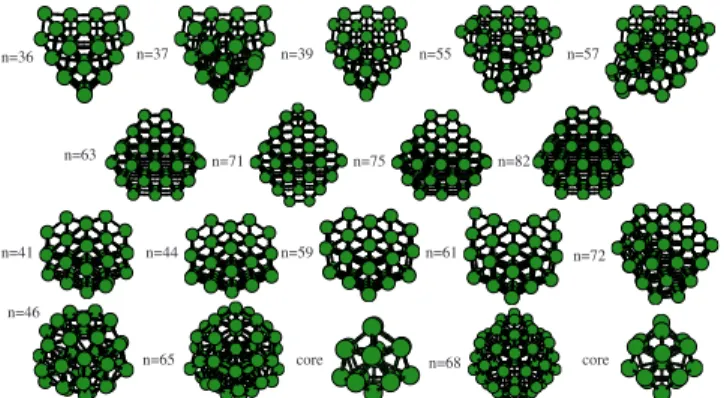
A representative selection of cluster structures is shown in Fig. 4, and the atomic coordinates for the putative global
minima will be made available through the internet.42 The
structures can be grouped into four different types which prevail over different size ranges: Distorted decahedral frag-ments, fragments of a face-centered-cubic 共fcc兲 lattice, fcc fragments with stacking faults共SFs兲, and other “disordered” rounded structures characterized by a crowded cluster core
共the central atom is coordinated to 15 neighbors兲and a wider distribution of bond lengths. Examples of these four types of structure are shown in different rows of Fig.4.
The atoms in the distorted decahedral family do not grow symmetrically around the fivefold decahedral axis, which is located close to the cluster surface. Figure5shows schematically how these distorted decahedra are obtained by removing atoms from a perfect parent decahedron. The par-ent decahedron is of a special kind as it does not expose any
noncompact 共100兲 facets, so it is a pentagonal bipyramid.
The resulting decahedral fragment exposes two共100兲facets, which is energetically unfavorable for aluminum clusters
共see below兲. Then, the displacement of a full row of atoms results in a perfect 36-atom cluster, which only exposes
com-pact 共111兲 facets. The distorted decahedra are the global
minima for cluster sizes around n= 36 and n= 55. Similar
larger structures can be built around n= 76 but they are not the global minima at this point.
For most other sizes, pure fcc and SF structures domi-nate. Like the distorted decahedra, a large fraction of the surface exposed by these structures has compact, 共111兲-like surface terminations. In fact, for most sizes it is possible to
devise more compact fcc and SF structures共with more
inte-rior atoms兲, but they have a higher energy because of a
rela-tively large proportion of 共100兲 facets. However, for n
= 77– 84 a larger proportion of共100兲facets is obtained. This might imply that simpler packing effects determine the opti-mal structures in this size range, although the poor
agree-ment with experiagree-ment for these large sizes 共see Fig. 3 and
explanation below兲suggests that more stable geometries,
ex-posing mostly 共111兲 facets, may not have been found.
Rounded disordered structures only occur close to the spheri-cal electron shell closings predicted by the jellium model at 138 and 198 electrons 共see below兲.
DISCUSSION
Comparison with previous theoretical studies
The parametrized model potentials usually employed to
describe aluminum共embedded atom, glue and similar
mod-els兲 predict the structures to be either icosahedral43 or
polytetrahedral,44 and locate the transition to bulklike fcc fragments at significantly larger sizes than examined here. Our ab initio results clearly show that icosahedral isomers have very high energies; roughly spherical polytetrahedral isomers are more stable than icosahedra for all sizes but they are the global minima only close to the spherical electron shell closings. Thus, our calculations demonstrate that the present parametrizations of aluminum potential models should be revised. Improved interatomic potentials should more strongly penalize the bond strain typical of icosahedra.
Aguado and López45 published a preliminary report on
the ab initio structures of Aln+ clusters withn= 46– 62.
Al-though the main structural trends 关the preponderance of
structures with low strain and a high proportion of 共111兲
facets兴were identified there, the global minima reported here for most sizes withn= 46– 62 are significantly lower in ergy. Only the structures identified here lead to cohesive
en-ergies in good agreement with experiment 共see below兲.
Moreover, in the present work, we significantly enlarge the size range covered by the calculations. Kanhere and collabo-rators recently published putative global minima for a few selected sizes using theVASPcode.46The global minima
pre-sented here have lower energies 共both in SIESTA and VASP
calculations47兲than the structures suggested by Kanhere for
all sizes except n= 46, for which we obtain similar
disor-dered structures. Other ab initio studies48 focused on a few selected sizes, and in some cases found evidence for the high stability of fcc structures. We have explicitly checked that
n=36 n=37 n=39 n=55 n=57
n=72
n=46
n=65
n=63 n=71 n=75 n=82
n=61 n=59
n=44 n=41
core n=68
core
FIG. 4. 共Color online兲A selection of cluster structures. The different rows, from top to bottom, show examples of distorted decahedral fragments, per-fect fcc, fcc with stacking faults共SFs兲, and disordered polytetrahedral iso-mers, respectively. The number of atoms is shown in the left side of each structure. For two of the disordered structures, we also show the first coor-dination shell of the innermost atom.
100 facets
(a) (b)
90 degrees
(c)
(d)
the structures suggested in those studies are high-energy iso-mers according to theSIESTAcalculations presented here.
Comparison of measured and calculated cohesive energies
The cohesive energies for the lowest energy geometry found for each cluster size are shown in Fig.3as the unfilled red circles. Most of the fluctuations observed in the mea-sured cohesive energies are reproduced in the calculated val-ues. Note in particular the maxima at 37, 39, 44, and 66 atoms which are evident in both the experimental values and the calculated cohesive energies. The maximum in the mea-sured cohesive energies at 57 is not reproduced in the calcu-lations, and there is a narrow range of cluster sizes 共56–61兲 where the calculated cohesive energies are significantly be-low the measured values. It is possible that the be-lowest energy structures have not been found for these cluster sizes. Inter-estingly, for clusters with 56–62 atoms, there are “dips” or
local minima18 in the heat capacities at temperatures just
below the peaks in the heat capacities due to the melting transition. The dips, which are only observed for a few spe-cific cluster sizes, have been attributed to annealing from a high-energy geometry to the ground state,18,49and their pres-ence may be related to a structural change.
For clusters with more than around 71 atoms, the calcu-lated cohesive energies are significantly below the measured values. Again, it is possible that the lowest energy structures have not been identified in the calculations. As the cluster size increases, it becomes more difficult to find the lowest energy geometry, particularly if the structure changes signifi-cantly. There are dips in the heat capacities for clusters with 77–83 atoms, which again seem to be consistent with an annealing transition and hence a structural change in this size regime.22,49The discrepancy between theory and experiment in this size regime is sufficiently large that we believe the true ground states do not have pure fcc or SF structures, but probably have a structure with mixed symmetry.
For clusters with more than about 500 atoms, Martinet
al. showed that aluminum clusters adopt fcc structures with
an octahedral shape.50 Our calculations suggest that the fcc-like structures 共possibly with some stacking faults兲 are al-ready energetically competitive for clusters with about 60 atoms. Nevertheless, the transition to fcc-like structures is far from complete within the size range considered in this work. We believe we are observing the initial part of the transition, which will probably occur over a broad size range.
For a few clusters in Fig.3共for example,n= 45 and 49兲, it appears that the experimental cohesive energy共filled black circles兲 is significantly below the calculated value 共unfilled red circles兲. In these cases there may be a problem with the
experimental value. The peaks in the heat capacities of n
= 45 and 49 are broad and low in intensity and it is plausible that the latent heat has been underestimated for these clus-ters.
Factors controlling the stabilities of Aln+clusters
The stabilities of metal clusters are influenced by both structural and electronic effects. We address first the
struc-tural stability, which is determined by several competing fac-tors. Based on the observed structural trends, we choose the following indicators.
共a兲 The average bond distance 具db典. Shorter and stronger bonds are usually associated with more stable struc-tures. To calculate the average bond distance, we as-sume that two atoms have a bond when their separation is shorter than a cutoff distance. The cutoff is chosen to be 10% longer than the bulk bond distance, although the observed trends are not very sensitive to small variations in the precise value.
共b兲 The root-mean-squared deviation from the average
bond length d=共具db 2典−具d
b典2兲1/2. Our results suggest that bond strain is significantly penalized in aluminum clusters. A larger bond strain will result in a largerd value.
共c兲 The number of surface atoms contributing to
noncom-pact共100兲facets,N100. When a given atom belongs to several surface facets, we count the appropriate frac-tion. For example, for one atom lying on a corner site joining two共111兲and one 共100兲facets, we count one-third of an atom on the共100兲facet. This way we have
an operational measure for N100 which is simple to
evaluate.
共d兲 The Hill–Wheeler asphericity parameter .51 This pa-rameter is evaluated from the inertia tensor and is ex-actly zero for a spherical cluster. The larger, the less spherical the cluster shape. This shape parameter is in-teresting in connection with the electronic stabilities shown below.
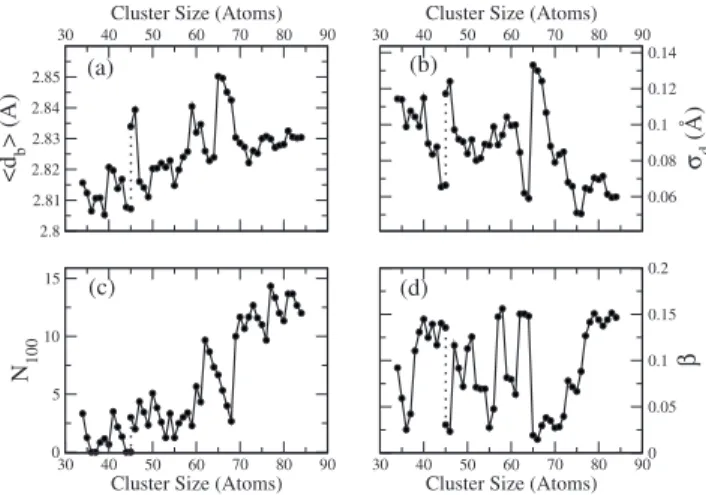
Plots of these four structural indicators are shown in Fig. 6. Forn= 45, there is one disordered isomer which is nearly degenerate with the ordered ground state and we show the structural indicators for both isomers. Regarding the average bond length 关Fig. 6共a兲兴, there are clear local minima at n
= 36, 39, 44, 49, and 55, and important local maxima for the
disordered isomers around 46 and 66 atoms 共hence the two
30 40 50 60 70 80 90
Cluster Size (Atoms)
2.8 2.81 2.82 2.83 2.84 2.85
<d
b
>(
Å
)
30 40 50 60 70 80 90
Cluster Size (Atoms)
0.06 0.08 0.1 0.12 0.14
σd
(Å)
30 40 50 60 70 80 90
Cluster Size (Atoms)
0 5 10 15
N100
30 40 50 60 70 80 90
Cluster Size (Atoms)
0 0.05 0.1 0.15 0.2
β
(a) (b)
(c) (d)
FIG. 6. Structural indicators for Aln+clusters from the calculations. 共a兲 shows the average bond length,共b兲its root-mean-squared deviation,共c兲the number of atoms at共100兲facets and共d兲the asphericity shape parameter, for the global minimum structures found in this work. For Al45+, there is one
very different values for n= 45兲. The bond length dispersion
关Fig. 6共b兲兴 has local maxima for the disordered structures, showing that those structures sustain significant bond strain. For the rest of the structures, it consistently shows the small-est values for fcc clusters共n= 62– 63 and the largest sizes兲, and intermediate values for SF and distorted decahedral clus-ters. On top of this general trend, there are clear local minima atn= 36, 39, and 44.N100关Fig.6共c兲兴is exactly zero for n= 36, 37, and 44共for n= 45 it depends on the isomer兲,
and has significant local minima at n= 53, 55, and 68.
Fi-nally, the most spherical clusters关local minima in Fig.6共d兲兴 aren= 36, 46, 55, 65, and 66. All these sizes are close to the observed electron shell closings for the cations or to the ex-pected electron shell closings of neutral aluminum clusters
共see below兲.
Overall, Al36+and Al44+satisfy all the structural stability requirements and can be considered as geometrical “shell closings.” They have short and strong bonds, little strain
compared to their immediate neighbors, and perfect 共111兲
surface terminations. Al55+also has short bond lengths and a low proportion of 共100兲 facets, but the bond strain is not particularly small; Al39+has a short average bond length and shows a local minimum in the bond strain but exposes a relatively large proportion of 共100兲 facets as compared to their neighbors. Therefore,n= 39 and 55 should also have an enhanced structural stability but lower thann= 36 and 44.
Contribution of electronic shell closings to stability of Aln+
Figure 7 shows the calculated vertical electron affinity
共VEA兲. This quantity is defined as the total energy difference between the cluster cation and the neutral cluster, both clus-ters being at the optimal geometry of the cation. It can be used as a measure of the electron shell contribution to cluster stability.52 The clusters showing an enhanced electron shell stability共particularly low VEA values兲aren= 37, 39, 43, 53, 55, and 67. Schriveret al.53measured the vertical ionization energy 共VIE兲of neutral aluminum clusters in the size range relevant to this study. The VIE is the total energy difference between the neutral cluster and the cluster cation, both clus-ters being at the optimal geometry of the neutral. If the glo-bal minimum geometries of the neutral clusters are the same
as those of the cations studied here, then the VIE of the neutrals and the VEA of the cations should be correlated. Schriver et al. found electron shell openings 共particularly low VIE values兲for neutral Alnclusters with n= 37, 39, 43, 47, 55, and 67, in good agreement with our theoretical re-sults. Additional calculations for neutral clusters54 show that the cation and neutral lowest energy structures are not the
same for n= 47, and confirm the experimentally observed
shell opening for neutral Al47, as well as the expected spheri-cal shell closings for neutral Al46 共138 electrons兲 and Al66
共198 electrons兲. Thus, the theoretically determined cluster structures not only reproduce the measured cohesive energies but also fully explain 共for the first time to the best of our
knowledge兲 the photoionization experiments of Schriver et
al.53 This gives indirect support to the strategy adopted to locate the global minima.
Many of the observed electron shell closings cannot be explained by the spherical jellium model or by its ellipsoi-dally distorted extensions. This was already noticed in the
experimental work of Schriver et al.: “Although there is
clear evidence of electron shell filling, substantial deviations
from shell model predictions remain.”53 At the time when
this experimental work was published, there was such a strong expectation that the structure of aluminum clusters should be icosahedral, that Schriveret al.suggested an inter-pretation of their results in terms of the crystal-field splitting of high angular momentum electron levels in icosahedral clusters. The present calculations show that crystal-field ef-fects, as determined by the precise location of the aluminum atoms, are certainly very important but the structures are not icosahedral. The complex interplay between the atomic structure and the spectrum of electron energy levels suggests that devising accurate potential models for aluminum clus-ters of this size will be a very complicated task.
Size evolution of cohesive energies and latent heats
The calculations demonstrate that the size evolution of the cohesive energies共and therefore of the latent heats兲 re-sults from the combined action of electronic and structural effects. Al37+ is not particularly stable from the structural point of view, as it contains one atom with low coordination on top of the 36-atom geometrical shell closing but it is strongly stabilized by an electronic shell closing. Preliminary results for neutral clusters54 show that Al36 is both a geo-metrical and an electronic shell closing and, in fact, the en-hancement of the cohesive energy of Al36 in the neutral se-ries is bigger than for the 37-atom cluster in the cation sese-ries. Al66+ and Al67+ are similar cases: Here the electron shell closing stabilizes highly strained but spherical structures which would be otherwise quite unstable. An opposite ex-ample is Al44+, whose enhanced stability is due only to the structural effects, as its VEA is not particularly small. Fi-nally, the enhanced stabilities ofn= 39, 43, and 55 are due to the combined structural and electronic effects.
Extensive and systematic experimental results on the melting properties of unsupported clusters are still scarce, so a comparison with the other paradigm共sodium clusters兲is in
order here. The experiments of Haberland and
30 40 50 60 70 80 90
Cluster Size (Atoms)
4.8 5 5.2 5.4 5.6 5.8
Vertical
Electron
Affinity
(eV)
co-workers13–15,55 and the ab initio molecular dynamics
simulations of Aguado and co-workers56 demonstrated that
structural effects alone can explain the size dependence of the latent heats of sodium clusters. This is in marked contrast with the aluminum clusters studied here, where the enhanced electron stabilities significantly affect the latent heats of melting. Due to a stronger electron-ion interaction in alumi-num, the gaps separating electron energy levels are much larger than in Na clusters of a similar size. In fact, disconti-nuities in the VIE values at the electron shell closings for aluminum are about four times larger than for the alkali met-als. It is therefore not surprising that electron shell closings have a stronger effect on the thermal properties of aluminum clusters than on sodium clusters of similar size. According to this view, electron shell effects might also be visible in the melting properties of sodium clusters of sufficiently small size, where the quantum confinement effect leads to large
gaps in the electron energy level spectrum. Ghazi et al.57
have recently found a significant influence of the 40-electron shell closing on the melting temperatures of Na clusters with 39–41 atoms, although they do not provide the associated latent heats.
In order to show the generality of the correlation be-tween cohesive energies and latent heats, we test it explicitly here for sodium clusters Nanwithn= 135– 154 atoms. In this size range, an electron shell closing occurs forn= 138 and an icosahedral structural shell closing is observed atn= 147, but a local maximum in the latent heat is observed only for the geometrical shell closing.55,56 We have optimized the struc-tures of these clusters with theSIESTAcode using as starting structures those provided by the previous orbital-free calculations.56Figure8shows the calculated dissociation and cohesive energies. The dissociation energy curve shows two large drops, one after the electronic shell closing and the other one after the icosahedral shell closing. In the evapora-tive ensemble realized in typical mass abundance experi-ments, only the electron shell closing survives because the sodium clusters are sufficiently hot that the atoms evaporate from liquidlike clusters.
When one atom is added to the共n− 1兲-atom cluster, the
cohesive energy will increase if and only if DS共n兲⬎CS共n − 1兲. This is easily demonstrated using the relationship be-tween the cohesive and dissociation energies关Eq.共9兲兴. Right after the electron shell closing at n= 138, the dissociation energies remain, on average, larger than the cohesive ener-gies.DS共139兲is only slightly smaller thanCS共138兲, and thus
the induced local maximum in the cohesive energy at n
= 138 is not very important共in fact, it is of a similar order of
magnitude as the odd-even oscillations seen between n
= 130 andn= 147兲. In other words, the electron shell closing is not sufficiently strong to induce a marked local maximum in the cohesive energy curve.DS共148兲, on the other hand, is substantially smaller than CS共147兲, which induces the only large drop in the cohesive energy curve. The atom added to the perfect three-shell icosahedron is very easily dissociated.
The cohesive energy curve shown in Fig. 8 reproduces the
main trends in the experimental latent heats for this size range: A rapid increase up to the electron shell closing, then a more steady increase between the electron and the tural shell closings, and finally a large drop after the struc-tural shell closing. Therefore, the correlation between the latent heats and cohesive energies holds both for aluminum and sodium clusters, but the relative weight of electron shell closings is smaller in sodium clusters.
More generally, whenever the electron shell contribution to cluster stability is significantly different in solidlike and liquidlike phases, electronic effects must affect the melting properties. For example, a solidlike cluster may have a large highest occupied molecular orbital–lowest unoccupied
mo-lecular orbital 共HOMO-LUMO兲 gap which is significantly
decreased upon melting, so the liquidlike cluster is much less stable from the electronic point of view. Such a difference in electronic stability of the two phases will then be reflected in the latent heat of melting. This is, in fact, what we observe for aluminum clusters 共see Fig. 2兲. In the case of sodium
clusters, Aguado and López56checked a few sizes and found
that the HOMO-LUMO gaps were similar in the solidlike and liquidlike clusters 共although slightly smaller in the liq-uidlike phase兲. The slight cohesive energy stabilization in-duced by the electron shell closing for the 138-electron
sol-idlike cluster 共see Fig. 8兲 is then of the same order of
magnitude as the corresponding stabilization of the liquidlike cluster. Furthermore, the gaps are significantly smaller than the latent heats per atom, so the electronic effect on the melt-ing properties is small. We are presently undertakmelt-ingab ini-tiosimulations of liquid aluminum clusters to check the cor-responding situation in simple trivalent metals.
CONCLUSIONS
In this manuscript we have outlined the connections be-tween the latent heats and cohesive energies of metal clus-ters. The cohesive energies of solidlike clusters are given by
CS共n兲 ⬇
L共n兲+兺nDL
n . 共10兲
Since 兺DL shows only small fluctuations with cluster size, the size-dependent variations in the cohesive energies are due almost entirely to the size-dependent variations in the
135 140 145 150
Cluster Size (Atoms)
0.6 0.7 0.8 0.9 1 1.1
Cohesive
or
Dissociation
Energy
(eV)
Dissociation Energy Cohesive Energy
135 140 145 150 155
Cluster Size (Atoms)
0.911 0.912 0.913 0.914 0.915
Cohesive
Ener
gy
(eV)
Na148 Na138 Na138
Na139
Na148
FIG. 8. 共Color online兲The left panel shows a comparison of dissociation and cohesive energies for neutral sodium clusters with 135–154 atoms. Note that the dissociation energy of Na148is substantially lower than the cohesive
latent heats. The cohesive energies of solidlike Aln+clusters determined from the measured latent heats and theDLvalues closely track cohesive energies determined for the lowest energy geometry Aln+found with density-functional theory. In most cases where theory and experiment depart, it is likely that the ground state has not been found in the calculations. The calculations also account for many of the features in the measured ionization energies of Aln clusters.
The lowest energy structures found in the calculations are characterized by low strain and a high proportion of共111兲 facets. They can be grouped into four different types which prevail over different size ranges: Distorted decahedral frag-ments, fcc fragfrag-ments, fcc fragments with SFs, and disordered rounded structures. Icosahedral geometries are high-energy isomers and we suggest that present aluminum potentials should be revised to more strongly penalize the bond strain typical of icosahedra. According to the calculations, the size evolution of the cohesive energies共and therefore of the latent heats兲results from a combination of electronic and structural effects. For some clusters 共e.g., Al37+ and Al66+兲, an elec-tronic shell closing causes a maximum in the cohesive en-ergy and the latent heat, while for others共e.g., Al44+兲, a struc-tural shell closing is responsible. For Al66+, the electronic shell closing stabilizes a highly strained but spherical geometry.
Our calculations show that the correlation between co-hesive energies and latent heats also holds for sodium clus-ters, which demonstrates the generality of this effect. For the size range covered in the calorimetric experiments on so-dium clusters, however, the energy stabilization associated with the electronic shell closings is not sufficiently strong to induce significant local maxima in the cohesive energies of solidlike clusters, so structural effects alone can explain the main trends in the size evolution of the latent heat.
The strong correlation between the cohesive energies and latent heats observed in this work is expected to hold quite generally, as long as the two following conditions are met: 共1兲 The size evolution of the dissociation energies of liquidlike clusters should be much smoother than that for the solidlike clusters;共2兲there should not be a premelting tran-sition共such as a solid-solid isomerization transition兲 involv-ing a large latent heat. In those cases, Eq. 共10兲 should be generalized to
CS共n兲=
L共n兲+LS-S共n兲+兺nDL
n , 共11兲
where LS−S共n兲 is the latent heat absorbed at the solid-solid transition.
ACKNOWLEDGMENTS
We gratefully acknowledge the support of the National Science Foundation, the Spanish MEC, and the European
Regional Development Fund 共Projects Nos.
MAT2005-03415 and VA068A06兲.
1C. E. Klots,J. Phys. Chem. 92, 5864共1988兲.
2C. Brechignac, P. Cahuzac, J. Leygnier, and J. Weiner,J. Chem. Phys.
90, 1492共1989兲.
3U. Ray, M. F. Jarrold, J. E. Bower, and J. S. Kraus,J. Chem. Phys. 91,
2912共1989兲.
4P. P. Radi, M. T. Hsu, J. Brodbelt-Lustig, M. Rincon, and M. T. Bowers, J. Chem. Phys. 92, 4817共1990兲.
5D. A. Hales, L. Lian, and P. B. Armentrout,Int. J. Mass Spectrom. Ion Process. 102, 269共1990兲.
6C. Brechignac, P. Cahuzac, F. Carlier, M. Defrutos, and J. Leygnier,J. Chem. Phys. 93, 7449共1990兲.
7C. E. Klots,Z. Phys. D: At., Mol. Clusters 21, 335共1991兲.
8L. Lian, C. X. Su, and P. B. Armentrout,J. Chem. Phys.97, 4084共1992兲. 9C. Brechignac, P. Cahuzac, N. Kebaili, and J. Leygnier,J. Chem. Phys.
112, 10197共2000兲.
10C. L. Briant and J. J. Burton,J. Chem. Phys. 63, 2045共1975兲. 11R. D. Etters and J. Kaelberer,J. Chem. Phys. 66, 5112共1977兲. 12R. S. Berry, J. Jellinek, and G. Natanson,Chem. Phys. Lett. 107, 227
共1984兲.
13M. Schmidt, R. Kusche, W. Kronmüller, B. von Issendorf, and H.
Hab-erland,Phys. Rev. Lett. 79, 99共1997兲.
14M. Schmidt, R. Kusche, B. von Issendorf, and H. Haberland, Nature 共London兲 393, 238共1998兲.
15M. Schmidt and H. Haberland,C. R. Phys. 3, 327共2002兲.
16G. A. Breaux, R. C. Benirschke, T. Sugai, B. S. Kinnear, and M. F.
Jarrold,Phys. Rev. Lett. 91, 215508共2003兲.
17G. A. Breaux, D. A. Hillman, C. M. Neal, R. C. Benirschke, and M. F.
Jarrold,J. Am. Chem. Soc. 126, 8628共2004兲.
18G. A. Breaux, C. M. Neal, B. Cao, and M. F. Jarrold,Phys. Rev. Lett.94,
173401共2005兲.
19C. M. Neal, A. K. Starace, and M. F. Jarrold,Phys. Rev. B 76, 054113 共2007兲.
20M. F. Jarrold and E. C. Honea,J. Chem. Phys. 95, 9181共1991兲. 21J. M. Hunter, J. L. Fye, M. F. Jarrold, and J. E. Bower,Phys. Rev. Lett.
73, 2063共1994兲.
22C. M. Neal, A. K. Starace, and M. F. Jarrold,J. Am. Soc. Mass Spectrom.
18, 74共2007兲.
23C. M. Neal, G. A. Breaux, B. Cao, A. K. Starace, and M. F. Jarrold,Rev.
Sci. Instrum. 78, 075108共2007兲.
24O. K. Rice and H. C. Ramsperger,J. Am. Chem. Soc. 50, 617共1928兲. 25R. S. Berry, J. Jellinek, and G. Natanson,Phys. Rev. A 30, 919共1984兲. 26T. L. Beck, J. Jellinek, and R. S. Berry,J. Chem. Phys. 87, 545共1987兲. 27J. P. Rose and R. S. Berry,J. Chem. Phys. 98, 3246共1993兲.
28B. Vekhter and R. S. Berry,J. Chem. Phys. 106, 6456共1997兲. 29We use temperature here loosely, as defined byT=E
int/共共3n− 6 + 3/2兲R兲.
This is a reasonable approximation because the internal energy distribu-tion is close to Gaussian with a standard deviadistribu-tion significantly less than the average.
30This is estimated from dissociation thresholds measured at 1073 K. These
measurements will be reported elsewhere.
31Based on the enthalpy differences between the liquid and the solid at the
melting temperature and at 298 K, determined from information on the NIST Chemistry WebBook共http://webbook.nist.gov/chemistry/兲.
32W. Kohn and L. J. Sham,Phys. Rev. 140, 1133共1965兲.
33J. M. Soler, E. Artacho, J. D. Gale, A. García, J. Junquera, P. Ordejón,
and D. Sánchez-Portal,J. Phys.: Condens. Matter 14, 2745共2002兲.
34J. P. Perdew, K. Burke, and M. Ernzerhof,Phys. Rev. Lett. 77, 3865 共1996兲; 78, 1396共1997兲.
35R. Hamann, M. Schlüter, and C. Chiang, Phys. Rev. Lett. 43, 1494 共1979兲.
36L. Kleinman and D. M. Bylander,Phys. Rev. Lett. 48, 1425共1982兲. 37I. Lee and R. M. Martin,Phys. Rev. B 56, 7197共1997兲.
38D. M. Deaven and K. M. Ho,Phys. Rev. Lett. 75, 288共1995兲; L. O.
Paz-Borbón, R. L. Johnston, G. Barcaro, and A. Fortunelly, J. Chem. Phys. 128, 134517共2008兲.
39D. J. Wales and J. P. K. Doye,J. Phys. Chem. A 101, 5111共1997兲. 40The Cambridge Cluster Database, D. J. Wales, J. P. K. Doye, A.
Dullwe-ber, M. P. Hodges, F. Y. Naumkin, F. Calvo, J. Hernández-Rojas, and T. F. Middleton共http://www-wales.ch.cam.ac.uk/CCD.html兲.
41A. Aguado, D. J. González, and J. M. López, in Trends in Chemical Physics Research, edited by A. N. Linke共Nova Science Publishers, Inc., New York, 2005兲, Chap. 10, pp. 205–269.
42Web page of the Nanometric Properties of Matter Research Group共http://
metodos.fam.cie.uva.es/~GIR兲.
43R. Werner,Eur. Phys. J. B43, 47共2005兲; E. G. Noya, J. P. K. Doye, and
F. Calvo,Phys. Rev. B73, 125407共2006兲; S. Alavi and D. L. Thompson,
J. Phys. Chem. A 110, 1518共2006兲; W. Zhang, F. Zhang, and Z. Y. Zhu,
44D. Y. Sun and X. G. Gong,Phys. Rev. B57, 4730共1998兲; J. P. K. Doye, J. Chem. Phys. 119, 1136共2003兲; J. Joswig and M. Springborg,Phys. Rev. B 68, 085408共2003兲.
45A. Aguado and J. M. López,J. Phys. Chem. B 110, 14020共2006兲. 46C. M. Neal, A. K. Starace, M. F. Jarrold, K. Joshi, S. Krishnamurty, and
D. G. Kanhere,J. Phys. Chem. C 111, 17788共2007兲.
47K. Joshi, personal communication共21 January 2008兲.
48H. P. Cheng, R. S. Berry, and R. L. Whetten,Phys. Rev. B 43, 10647 共1991兲; J. Yi, D. Oh, and J. Bernholc,Phys. Rev. Lett. 67, 1594共1991兲; J. Akola, M. Manninen, H. Häkkinen, U. Landman, X. Li, and L. Wang,
Phys. Rev. B 62, 13216共2000兲; K. Manninen, J. Akola, and M. Man-ninen,ibid. 68, 235412共2003兲; R. Fournier,J. Chem. Theory Comput.
3, 921共2007兲; W. Zhang, W. Lu, J. Sun, C. Z. Wang, and K. M. Ho,
Chem. Phys. Lett. 455, 232共2008兲.
49M. F. Jarrold, B. Cao, A. K. Starace, C. M. Neal, and O. H. Judd,J.
Chem. Phys. 129, 014503共2008兲.
50T. P. Martin, U. Näher, and H. Schaber,Chem. Phys. Lett. 199, 470 共1992兲.
51A. Bulgac and D. Kusnezov,Phys. Rev. B 45, 1988共1992兲.
52We prefer to show the VEA rather than the HOMO-LUMO gap because
the latter quantity is not easily defined within a spin-polarized framework when the cluster has an odd number of electrons. For clusters with an even number of electrons, the electron shell closings predicted by the VEA共see Fig.7兲coincide with maximum values of the HOMO-LUMO gap, as they should.
53K. E. Schriver, J. L. Persson, E. C. Honea, and R. L. Whetten,Phys. Rev.
Lett. 64, 2539共1990兲.
54共Unpublished兲.
55H. Haberland, Th. Hippler, J. Donges, O. Kostko, M. Schmidt, and B.
von Issendorff,Phys. Rev. Lett. 94, 035701共2005兲.
56A. Aguado and J. M. López, Phys. Rev. Lett. 94, 233401共2005兲; A.
Aguado,J. Phys. Chem. B 109, 13043共2005兲; E. G. Noya, J. P. K. Doye, D. J. Wales, and A. Aguado,Eur. Phys. J. D 43, 57共2007兲.