Essays on Labor Markets and
Macroeconomic Policy
Lien Laureys
TESI DOCTORAL UPF / ANY 2013
DIRECTOR DE LA TESI
Acknowledgments
This thesis has been made possible thanks to the advice and support of many people. First and foremost, I extend my deepest gratitude to my advisor Jordi Gal´ı for his guidance and encouragement at all stages of this thesis. I have also benefited greatly from discussion with R´egis Bar-nichon, Vasco Carvalho, Jan Eeckhout, Kristoffer Nimark, and Thijs van Rens. Moreover, I am grateful to Tim Kehoe for having given me the op-portunity to visit the University of Minnesota while working on the first chapter.
For valuable comments and suggestions at various stages of the first chapter, I would also like thank Jonathan Heathcote, Edouard Schaal, Robert Shimer, Kjetil Storesletten, and participants of the CREI macro-breakfast seminar, the 2011 Workshop on Dynamic Macroeconomics, the EEA Meeting Oslo 2011, the Annual Search and Matching meeting 2012 in Cyprus, the Macro Group at the University of Warwick, and the student seminar at the UAB. I also would like to thank seminar participants at the Bank of England, the Bank of Canada, the ECB, the Federal Reserve Board, HEC Paris, the London Business School, the Riksbank, the Uni-versity of Bonn, the UniUni-versity of Cologne, the UniUni-versity of Mannheim, the University of Montreal, and the University of Quebec in Montreal.
I am grateful to Marta Araque and Carolina Rojas for their help with all the administrative issues. I am also indebted to the Spanish Ministry of Education for their financial support. Furthermore, I would like to thank Benedikt, Isabel, Paula, and Tomaz for helpful discussion, and Ilse and Steffi for having been such great office mates.
Abstract
This thesis sheds light on several macroeconomic aspects of the labor market and economic policy. Chapter 1 analyzes whether the presence of human capital depreciation during unemployment calls for policy inter-vention. I argue that the latter is required because human capital deprecia-tion during unemployment generates an externality in job creadeprecia-tion. Chap-ter 2 looks at whether the prescription for conducting monetary policy changes once it is taken into account that workers’ human capital depre-ciates during periods of unemployment. In a New Keynesian framework, I find that optimal monetary policy stays close to strict inflation targeting. Chapter 3 investigates how the effect of an increase in government spend-ing on labor market outcomes depends on the strength of the short-run wealth effect on labor supply. I show that the role of the latter crucially depends on the degree of price and wage stickiness.
Resum
Foreword
The 2007-2009 financial crisis has led to a deterioration of labor market outcomes in many countries around the globe. This has triggered a debate about whether or not policy intervention is required, and how effective specific policy measures are in improving labor market outcomes. The three self-contained chapters of this thesis contribute to this debate.
Chapter 1, “The Cost of Human Capital Depreciation during Unem-ployment”, analyzes whether the presence of human capital depreciation during unemployment calls for policy intervention. This issue seems of particular concern now that unemployment duration has increased in the Great Recession. I argue that loss of skill during unemployment gener-ates an externality in job creation: firms ignore how their hiring decisions affect the skill composition of the unemployment pool, and hence the out-put produced by new hires. Overall, job creation is too low, but contrary to conventional wisdom less so in recessions than in booms. The larger share of job-seekers with eroded skills in the unemployment pool in reces-sions lowers the social cost of having a worker losing her skills because it decreases the expected difference in productivity between a new hire and a job-seeker with eroded skills. As a consequence, everything else equal, loss of skill during unemployment may warrant procyclical employment subsidies.
Al-though optimal price inflation is no longer zero, strict inflation targeting is shown to stay close to the optimal policy .
Contents
List of Figures xvi
List of Tables xvii
1 THE COST OF HUMAN CAPITAL DEPRECIATION
DUR-ING UNEMPLOYMENT 1
1.1 Introduction . . . 1
1.2 Related Literature . . . 5
1.3 The Economy . . . 8
1.3.1 Population and Technology . . . 9
1.3.2 Labor Market . . . 10
1.3.3 Firm’s Problem . . . 14
1.3.4 Worker’s Problem . . . 17
1.3.5 Wages . . . 18
1.3.6 Equilibrium . . . 20
1.4 Skill Erosion as a Source of Inefficiency . . . 21
1.4.1 Constrained Efficient Allocation . . . 22
1.4.2 Constrained Efficient versus Decentralized Allo-cation . . . 27
1.5.1 Wage Setting Mechanism . . . 33
1.5.2 Optimal Labor Market Policy . . . 35
1.6 Labor Market Outcomes . . . 37
1.6.1 Calibration . . . 39
1.6.2 Comparative Statics . . . 41
1.6.3 Cost of Skill Loss during Unemployment . . . . 44
1.7 Extension: Effect of Match Specific Productivity . . . . 54
1.8 Conclusion . . . 56
1.9 Appendix A . . . 58
1.9.1 The Economy with Separate Labor Markets . . . 58
1.9.2 Proof of Proposition 2 . . . 64
1.9.3 Proof of Proposition 3 . . . 64
1.9.4 Optimal Labor Market Policy . . . 66
1.9.5 Multiple Equilibria . . . 67
1.9.6 Generalized Version of the Model . . . 68
1.10 Appendix B . . . 74
1.10.1 Allowing for Match Specific Productivity . . . . 74
1.10.2 Constrained Efficient Allocation . . . 78
1.10.3 Constrained Efficient versus Decentralized Allo-cation . . . 82
1.11 Figures . . . 84
2 OPTIMAL MONETARY POLICY IN THE PRESENCE OF HUMAN CAPITAL DEPRECIATION DURING UNEMPLOY-MENT 89 2.1 Introduction . . . 89
2.2 The Model . . . 91
2.2.1 Labor Market . . . 92
2.2.3 Intermediate Good Firms . . . 96
2.2.4 Final Good Firms . . . 99
2.2.5 Wages . . . 100
2.2.6 Equilibrium . . . 103
2.3 Job creation in the Presence of Skill Erosion . . . 105
2.4 Optimal Monetary Policy . . . 109
2.4.1 Optimal Policy Plan . . . 109
2.4.2 Trade-offs Faced by Policy Maker . . . 111
2.5 Dynamics . . . 113
2.5.1 Calibration . . . 114
2.5.2 Results . . . 115
2.6 Relation to the Literature . . . 117
2.7 Conclusion . . . 119
2.8 Appendix . . . 121
2.8.1 Equilibrium . . . 121
2.8.2 Special case: l=g=1 . . . 124
2.9 Figures . . . 128
3 A NOTE ON FISCAL STIMULUS AND LABOR MARKET OUTCOMES: THE ROLE OF SHORT-RUN WEALTH EF-FECTS AND WAGE RIGIDITY 133 3.1 Introduction . . . 133
3.2 Model . . . 136
3.2.1 Households . . . 137
3.2.2 Labor Market . . . 138
3.2.3 Firms and Price Setting . . . 141
3.2.4 Monetary and Fiscal Policy . . . 142
3.3 Labor Market Outcomes . . . 142
[image:13.595.112.457.161.595.2]3.5 Fiscal Stimulus and Labor Market Outcomes . . . 145
3.5.1 Calibration . . . 145
3.5.2 Results . . . 146
3.6 Conclusion . . . 150
3.7 Appendix . . . 151
3.7.1 Equilibrium . . . 151
List of Figures
1.1 Role of the human capital depreciation rate in shaping labor market outcomes . . . 84 1.2 Role of the probability of skill loss in shaping labor
mar-ket outcomes . . . 85 1.3 Role of the probability of regaining skills in shaping labor
market outcomes . . . 85 1.4 Role of the human capital depreciation rate in shaping
labor market dynamics . . . 86 1.5 Role of the probability of skill loss in shaping labor
mar-ket dynamics . . . 86 1.6 Role of the probability of regaining skills in shaping labor
market dynamics . . . 87 1.7 Labor market dynamics in the decentralized versus the
constrained efficient allocation for1/l = 4 . . . 87
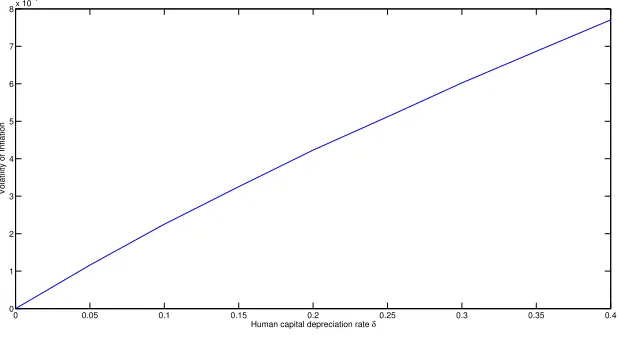
2.1 Optimal volatility of inflation (in percent) as a function of the rate of human capital depreciationδ . . . 128
2.2 Optimal volatility of inflation (in percent) as a function of the pace of skill loss(1/l) . . . 129
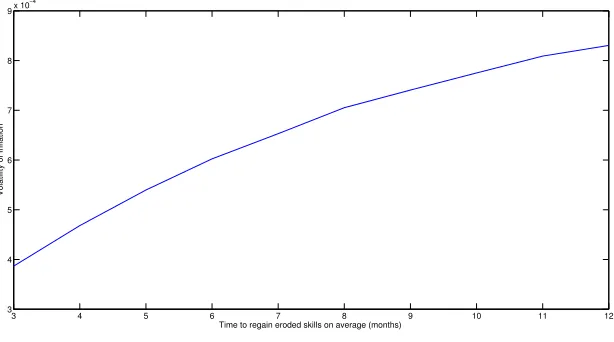
2.3 Optimal volatility of inflation (in percent) as a function of the pace of regaining skills(1/g) . . . 129
2.4 Ramsey policy versus zero inflation policy for δ = 0.3
2.5 Ramsey policy for different rates of human capital depre-ciation, and whereg =l = 0.5 . . . 130
2.6 Ramsey policy for different values of the probability of skill loss, and whereδ= 0.3andg = 0.5 . . . 131
2.7 Ramsey policy for different values of the probability of regaining skills, and whereδ = 0.3andl= 0.5 . . . 131
3.1 Labor Market . . . 153 3.2 Responses to an increase in government consumption for
varyingθp andζ . . . 154 3.3 Responses to an increase in government consumption for
varyingθw andζ . . . 155 3.4 Responses to an increase in government consumption for
varyingθw andζforθp = 0.1 . . . 156 3.5 Responses to an increase in government consumption for
varyingθp andθw . . . 157 3.6 Responses to an increase in government consumption for
List of Tables
1.1 The cost of skill loss during unemployment . . . 49
1.2 The optimal employment subsidy . . . 51
1.3 The role ofξandη . . . 53
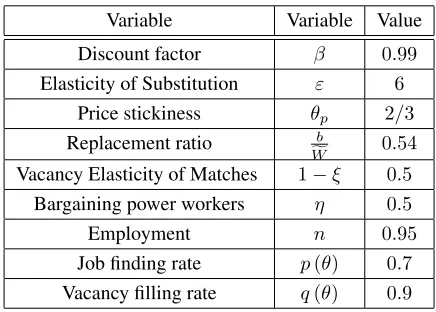
2.1 Parameterization . . . 115
Chapter 1
THE COST OF HUMAN
CAPITAL DEPRECIATION
DURING UNEMPLOYMENT
1.1 Introduction
“...One concern we do have, of course, is the fact that more than 40 percent of the unemployed have been unemployed for six months or more. Those folks are either leaving the labor force or having their skills
eroded. Although we haven’t seen much sign of it yet, if that situation persists for much longer then that will reduce the human capital that is
part of our growth process going forward.” (Ben Bernanke, 2012)1
The Great Recession has brought back the specter of long-term unem-ployment. In the U.S. the average unemployment duration has increased
1Question and answer session of the Senate Banking Committee hearing on the
from an average of around 15 weeks in the period 1960-2008 to an aver-age of close to 40 weeks in 2012.2 This increase has been of great concern
to policy makers. One reason is the widely held belief that long unem-ployment spells lead to the depreciation of a worker’s human capital.3
But does the presence of skill loss during unemployment call for pol-icy intervention? This paper looks at this issue through the lens of an otherwise standard random search model with aggregate uncertainty in which loss of skill is introduced. Workers who had their skills eroded while being unemployed are less productive upon re-employment than workers whose skills were not affected. At the same time, I allow for learning-by-doing such that workers with eroded skills can regain their initial skill level while being employed.
In the presence of skill loss during unemployment, firms’ hiring de-cisions do not only affect the unemployment rate but also the share of workers with eroded skills in the unemployment pool. Hiring influences workers’ chance of finding a job, average unemployment duration, and thus the extent of skill erosion. For example, when firms hire less, unem-ployed workers have a smaller chance of finding a job, which increases their unemployment duration. Longer unemployment spells in turn raise the probability that their skills erode. As a result, a drop in hiring in-creases the relative share of job-seekers with eroded skills in the unem-ployment pool.
The skill composition of the unemployment pool determines how likely it is that job-seekers with or without eroded skills show up for job inter-views. Thus, the pool’s composition determines the average productivity of job candidates. Consequently, firms’ hiring decisions, through their ef-fect on job-seekers’ skills, afef-fect the output that can be generated by new matches.
Comparing hiring decisions in the laissez-faire economy and the con-strained efficient economy reveals that skill erosion is a source of
inef-2Source: Bureau of Labor Statistics series LNS13008275.
3Empirical evidence for human capital depreciation is provided by e.g. Addison and
ficiency. This is the consequence of a composition externality related to job creation which arises in addition to the familiar congestion external-ity following from the search frictions. The composition externalexternal-ity arises because firms ignore how their hiring decisions affect the average skills of next period’s job-seekers, and hence the output that can be generated by new matches. Firms neglect that through hiring they prevent workers from being unemployed and exposed to skill erosion. At the same time, firms do not take into account that by employing a worker, this worker keeps her skills or regains her skills, and hence that there is an additional job-seeker without eroded skills when the match separates. In other words, when skills erode during unemployment, there are gains from job creation which are not fully internalized.
I analyze if constrained efficiency can be attained in the absence of policy intervention. Given that I assume that wages are set every period through Nash bargaining, I examine, in the spirit of Hosios (1990), if there exists a parameter condition for workers’ bargaining power which restores efficiency. I find this is not the case when aggregate uncertainty is present and workers’ bargaining power is constant across states. Thus, policy intervention is required to restore constrained efficiency.
reces-sions explains why the composition externality matters less. Through the same mechanism, one can explain why the composition externality mat-ters more during good times. In booms, the fraction of workers in the unemployment pool with eroded skills decreases. Therefore, the impact on the expected productivity of new hires of having an additional unem-ployed worker with eroded skills is larger. As a result, the social cost of letting a worker be unemployed and lose skills increases, which makes the composition externality more important.
Next, I look at how the presence of skill loss during unemployment changes job creation relative to an economy without skill loss. Job cre-ation and hence labor market outcomes are expected to change relative to an economy where the unemployed are not exposed to skill erosion be-cause its presence affects the workers’ and the firms’ problem. However, whether on average more or less jobs are created is not clear because of two opposing effects. On the one hand, the expected gain from job creation drops because the expected productivity of a new hire decreases relative to a world without skill loss. On the other hand, workers’ outside option becomes worse when they face the possibility of losing some of their skills when being unemployed. This deterioration of their outside option leads to lower wages, which stimulates job creation. I find that the presence of skill loss can lower the average unemployment rate in the de-centralized allocation. However, the unemployment rate is still too high from a social point of view because of the composition externality.
workers’ earnings and wages.4 The cost in terms of efficiency is
con-siderable. When skill loss is the only source of inefficiency, restoring constrained efficiency entails a drop in the average unemployment rate of up to1percentage point.
The remainder of the paper is organized as follows. Section 1.2 dis-cusses the related literature. Section 1.3 describes the model. Section 1.4 compares the job creation decision in the decentralized and the strained efficient allocation. Next, section 1.5 explores whether con-strained efficiency can be attained through the wage setting mechanism, and what the implications are for optimal labor market policy. Section 1.6 contains two exercises. The first exercise shows how labor market outcomes in the presence of skill loss change relative to an economy with-out skill loss. In the second exercise, the model is calibrated to the U.S. economy and it is analyzed what the cost of human capital depreciation is in terms of efficiency by looking at the extent to which labor market outcomes should change to attain constrained efficiency. Section 1.7 dis-cusses an extension. Finally, section 1.8 concludes.
1.2 Related Literature
This paper relates to three main strands of the literature. First of all, it relates to the literature investigating how the presence of human capital depreciation during unemployment should affect the design of policy. The literature has focused in the first place on how policies providing insur-ance for risk-averse workers in an economy with incomplete markets are affected by the presence of skill loss. For example, Pavoni (2009) and Shimer and Werning (2006) have computed the optimal scheme for un-employment benefits in the presence of skill loss. Pavoni and Violante (2007) have derived an optimal welfare-to-work program in the presence of skill loss. Such a program consists of a mix of policy instruments tar-geted at the unemployed, including among others unemployment
insur-4See e.g. Addison and Portugal (1989), Couch and Placzek (2010), Jacobson et al.
ance and job search monitoring. Spinnewijn (2010) has analyzed how op-timal training schemes for unemployed workers should be designed when workers’ are exposed to both skill loss at the moment of displacement and during their unemployment spell.
My contribution to this strand of the literature lies primarily in its different focus. I focus on whether loss of skill affects the efficiency of aggregate labor market outcomes. I show that those outcomes are not con-strained efficient in the presence of skill loss, and hence policy interven-tion is required. Moreover, I find that loss of skill during unemployment is an argument for procyclical employment subsidies.
Second, this paper relates to the literature looking at how skill erosion during unemployment affects labor market outcomes. The main findings in this literature are the following. Pissarides (1992) has shown that skill loss can be a potential explanation for the observed persistence of unem-ployment fluctuations. This effect has also been explored by Esteban-Pretel and Faraglia (2010) in a model with both labor market and nominal frictions. Furthermore, Ljungqvist and Sargent (1998) have found that the presence of skill loss, together with differences between welfare sys-tems, is important to understand labor market outcomes in the U.S. ver-sus Europe. Related work has been done by den Haan et al. (2005) and Ljungqvist and Sargent (2004, 2007, 2008). Moreover, Pissarides (1992) and Coles and Masters (2000) have shown in a framework without ag-gregate uncertainty that multiple equilibria can arise when unemployed workers are exposed to skill loss. Additionally, Coles and Masters (2000) provide the composition externality as an explanation for the existence of multiplicity, and have argued that those multiple equilibria are Pareto rankable.
cru-cial. This is because a worker’s outside option deteriorates when she faces the possibility of losing some of her human capital when being unem-ployed. This in turn leads to lower wages, which has a positive effect on job creation. When this positive effect is sufficiently strong, it outweighs the negative effect on job creation induced by part of the job candidates having eroded skills.5 However, from a social point of view job creation
is always too low in the laissez-faire economy because of the composi-tion externality. Moreover, I show that taking into account that the unem-ployed are exposed to skill erosion does not only matter for understanding unemployment outcomes but also for understanding the welfare costs re-lated to unemployment. Loss of skill alters those welfare costs because it gives rise to a composition externality, whose magnitude varies over the cycle.
Finally, this paper relates to other work showing that a composition externality can arise when the pool of searchers is heterogeneous. Bur-dett and Coles (1997, 1999) have shown that a sorting externality arises in an environment characterized by random search and two-sided hetero-geneity. This externality arises because agents do not take into account how their decision to match with an agent of a particular type affects the matching possibilities of the remaining agents. Moreover, Shimer and Smith (2001) have shown that the decentralized-allocation is ineffi-cient in an environment characterized by random search where hetero-geneous agents have to decide about their search intensity. Their find-ing follows from workers who choose their search intensity ignorfind-ing how their search intensity affects the probability that matches of a certain type will be formed. Furthermore, Albrecht, Navarro and Vroman (2010) have shown that in a framework with random search and workers who are heterogeneous with respect to their market productivity, the
decen-5The importance of workers’ outside option in the presence of skill loss during
tralized allocation is no longer constrained efficient under the standard Hosios condition when workers’ participation decision is endogeneous. Their result follows from workers not internalizing how their participa-tion decision affects the average productivity of newly formed matches. Finally, Fernandez-Blanco and Preugschat (2011) have shown in a frame-work with directed search, frame-worker heterogeneity, and imperfect informa-tion about the worker’s type, that labor market outcomes are no longer constrained efficient because firms do not internalize how their hiring de-cisions affect the unemployment’s pool composition in terms of worker types.
My paper contributes to this strand of the literature in the following aspects. First, I show that in a market characterized by random search the decentralized allocation is not constrained efficient in the presence of human capital depreciation during unemployment because the latter gives rise to a composition externality. This composition externality is driven by firms ignoring how their hiring decisions affect job-seekers’ skills and hence the output that can be produced by other firms’ newly formed matches. Moreover, I show that this finding hinges on both work-ers with and without eroded skills searching for jobs in the same market. When workers with and without eroded skills search for jobs in separate markets, with each of those markets characterized by random search, and firms choose in which market to post vacancies, the decentralized alloca-tion is constrained efficient if the standard Hosios condialloca-tion holds in each market. Finally, and in contrast to previous work, I explore the compo-sition externality in an environment subject to aggregate shocks. Those shocks make the composition of the pool of searchers time-varying. This in turn allows me to analyze whether and how the externality’s magnitude depends on the composition of the pool of searchers.
1.3 The Economy
ag-gregate uncertainty. In this framework unemployed workers face the risk of losing some of their human capital, making them less productive upon re-employment.6 The longer the unemployment spell, the more likely a
worker has eroded skills. At the same time the model allows for learning-by-doing such that workers can regain their human capital while being employed.7
1.3.1 Population and Technology
There is a continuum of infinitely-lived, risk-neutral workers on the unit interval. These workers maximize their expected discounted utility, which is defined over consumption and home production. Employed workers earn a wagewi depending on their skills, whereas unemployed workers engage in home production which generates a valueb. The latter can be
thought of as the opportunity cost of working and is assumed to be the same for all workers.
Workers are heterogeneous in their skills because skill erosion dur-ing unemployment and learndur-ing-by-dodur-ing on the job makes workers’ hu-man capital depend on their employment history. To keep the analysis simple, workers’ human capital can only take two values, and is either high (H) or low (L). A worker’s skills determine her productivity: high-skilled workers have high productivity, whereas low-high-skilled workers have low productivity. The transition between skill types occurs as follows. In each period, an unemployed high-skilled worker becomes low-skilled with probabilityl∈(0,1]. Thus the longer a worker’s unemployment
du-ration, the larger the chance that her human capital has depreciated. At the same time, when being low-skilled, she can regain her productivity while being employed through learning-by-doing. In each period, an employed low-skilled worker becomes high-skilled with probabilityg ∈(0,1].
A large measure of risk-neutral, profit-maximizing firms employs work-ers. As is standard in the literature, each firm consists of a single-worker
6This framework abstracts from firm specific human capital. Therefore, workers only
face the risk of losing some of their human capital while being unemployed and not when the match separates.
production unit. Its output depends on the worker’s human capital and aggregate productivityA. The latter follows the process
log(A) = ρalog(A−1) +ε (1.1)
where ε is an iid shock. Given the production technology, output
pro-duced by matches with a high and low-skilled worker is determined by equations (1.2) and (1.3) respectively
yH(A) =A (1.2)
yL(A) = (1−δ)A (1.3) where the skill level of a high-skilled worker is normalized to one, and that of a low-skilled worker is defined by1−δ. The parameterδ ∈[0,1)
can be interpreted as the rate of human capital depreciation. Whenδ ∈
(0,1)skill erosion is present, making some workers less productive upon
re-employment.8 When δ = 0, the model boils down to the standard
model.
1.3.2 Labor Market
The labor market is characterized by random search `a la Diamond-Mortensen-Pissarides. I assume that all workers search in the same market. Thus when a firm opens a vacancy at costκ > 0, both workers with and
with-out eroded skills can apply for the job opening. Since a firm meets at most one worker at each round of interviews, which is a standard assumption in this class of models, all interviews lead to successful hiring as long as the match surplus is non-negative. In every period, the total number of interviews in the economy is determined by a matching function. This
8 The interpretation that workers who have suffered from human capital
function is strictly increasing and concave in both arguments and displays constant returns to scale. It is given by
m(v, u) =Bv1−ξuξ
whereB represents the efficiency of the matching process, 1−ξ is the
elasticity of vacancies whereξ ∈(0,1),vis the total number of vacancies
posted by firms, anduis the total number of job-seekers weighted by their
search effectiveness. Because I assume that unemployment duration does not affect workers’ search effectiveness, and normalizing search effective-ness to one, the relevant measure of job-seekers in the matching function is given by the total number of unemployedu. The latter is defined as the
sum of high-skilled�uH�and low-skilled�uL�unemployed
u≡uH +uL (1.4)
Labor market tightness is defined as θ(x) ≡ uv((xx)), where x denotes the
state of the economy and is defined below. The probability for a firm posting a vacancy to meet a job-seeker is defined as
q(θ(x))≡ m(v(x), u(x))
v(x) =Bθ(x)
−ξ (1.5)
where q(θ(x)) is decreasing in labor market tightness. The probability
that a job-seeker gets a job interview is given by
p(θ(x))≡ m(v(x), u(x))
u(x) =Bθ(x)
1−ξ (1.6)
where p(θ(x)) is increasing in labor market tightness. The job finding
probability is the same for both worker types because unemployment du-ration has no effect on search effectiveness. When the match surplus is non-negative for both skill types, workers also have the same hiring prob-ability.
Timing. At the beginning of the period, a shock to aggregate produc-tivityAis realized. After observing the economy’s state, firms post
and newly hired workers. After production some workers’ type changes: unemployed high-skilled workers become low-skilled with probabilityl,
and employed low-skilled workers become high-skilled with probability
g. Next exogenous separation takes place, and a fractionγ of the matches
breaks up.9
Labor market flows and the economy’s state. The unemployment
pool’s heterogeneity affects the economy’s statexcompared to the
stan-dard model. In addition to aggregate productivity A,the number of
va-cancies posted by firms also depends on the fraction of low-skilled job-seekers in the unemployment pool. The latter is given by
s(x)≡ u
L(x)
u(x) (1.7)
The number of high and low-skilled job-seekers evolve according to
uH(x) = (1−l) ˜uH−1+γ�nH(x−1) +gnL−1
�
(1.8)
uL(x) = ˜uL−1+lu˜H−1+γ(1−g)nL−1 (1.9)
whereu˜iare the job-seekers of typei={H, L}who remain unemployed after hiring takes placeu˜i ≡(1−p(θ(x)))ui(x), andniis the number of workers of typeiemployed in a given period. Equation (1.8) shows that
the skilled job-seekers are all previous period’s unemployed high-skilled workers who have not lost their skills, and all the high-high-skilled workers who just got fired. The latter consists on the one hand of those who were operating in the previous period as high-skilled workers, and on the other hand of those who were low-skilled but regained their skills because of learning-by-doing. Similarly, equation (1.9) shows that the low-skilled job-seekers are last period’s unemployed low-skilled workers and high-skilled workers who have lost some of their skills, and all the low-skilled workers who were employed last period but did not regain skills and just lost their job.
9The timing assumption in this model is standard in the business cycle literature, see
High-skilled and low-skilled employment are given by
nH (x) = (1−γ)�nH(x
−1) +gnL−1
�
+p(θ(x))uH(x)
nL = (1−γ) (1−g)nL
−1+p(θ(x))uL(x)
So high-skilled employment is given by the high-skilled and low-skilled employees with regained skills who kept their job, and the high-skilled new hires. Similarly, the low-skilled employed are on the one hand those who did neither regain skills nor got fired, and on the other hand the newly hired low-skilled unemployed.
Given the labor market flows, keeping track of the fraction of low-skilled workers in the unemployment pool (equation (1.7)), implies keep-ing track of the distribution of worker types across employment states. However, when taking into account the definition of the total labor force, it can be seen that either the number of high or low-skilled unemployed af-ter hiring takes place(˜ui)or the number of high or low-skilled employed
(ni) can be expressed as a function of the other three. Normalizing the total size of the labor force to one and abstracting from labor force partic-ipation decisions gives
1 = ˜uH + ˜uL+nL+nH(x)
As a result, workers and firms can keep track of the composition of the pool of job-seekers, by for example keeping track of u˜H,u˜L and nL. Therefore, the economy’s state is given byx=�A,u˜H
−1,u˜L−1, nL−1
�
. In the following sections, I will focus on the special case where g =
l = 1.10 Thus a low-skilled worker’s productivity is restored with
prob-ability1after having worked for one period, and a high-skilled worker’s
productivity deteriorates with probability1after having been out of work
for one period. The latter implies that human capital depreciation during unemployment can only be avoided when a worker who loses her job in a given period finds a new one during that same period. The reason for
10Derivations for the generalized version of the model withg ∈(0,1]andl∈(0,1]
focusing on this specific case is because it allows me to derive analytical expressions which provide insights into this economy. Numerical analysis shows that the same insights hold in the general case.
Imposing the parameter restrictiong =l = 1, the number of high and
low-skilled job-seekers respectively is defined as
uH(n−1) = γn−1 (1.10)
uL(n−1) = 1−n−1 (1.11)
wherenrepresents total employment, which is defined asn ≡ nH +nL and evolves according to:
n= (1−γ)n−1+p(θ(x)) (1−(1−γ)n−1) (1.12)
As can bee seen from equations (1.10) and (1.11), both the number of high and low-skilled job-seekers can be written as a function of previous period’s employment, and hence so can be the fraction of low-skilled job-seekers in the unemployment pool. Consequently, the economy’s state is now given byx={A, n−1}.
1.3.3 Firm’s Problem
The firm’s value of employing a worker of typei={H, L}is given by
Ji(x) = yi(A)−wi(x) + (1−γ)βEx
�
JH(x�)� (1.13)
whereβ ∈ (0,1)represents the discount factor. The firm’s value of
em-ploying a worker depends on the generated output, the wage costwi(x), where wages are set through Nash bargaining as discussed in section 1.3.5, and the continuation value of the match. The worker-firm pair keeps on producing with probability1−γ. Becauseg = 1all low-skilled
The firm’s value of posting a vacancy is given by
V (x) =−κ+q(θ(x))�(1−s(n−1))JH(x) +s(n−1)JL(x)
�
+ (1−q(θ(x)))βEx{V (x�)} (1.14)
When imposing the free-entry condition V (x) = 0, equation (1.14)
becomes
κ
q(θ(x)) = (1−s(n−1))J
H(x) +s(n
−1)JL(x) (1.15)
This reflects that firms create jobs such that the expected hiring cost (LHS) equals the expected gain of hiring (RHS). The latter is a function of the unemployment pool’s composition because the composition determines the probability that a job-seeker of a particular type shows up for the job interview.
Given free-entry, the firm’s value of employing a worker can also be expressed as
Ji(x) = κ
q(θ(x))+G
i(x) (1.16)
where
Gi(x)≡�yi(A)−wi(x)�−(¯y(x)−w¯(x)) (1.17)
and wherey¯(x) ≡ (1−s(n−1))yH(A) +s(n−1)yL(A)represents the
expected output of a new hire. Note that because of random matching it equals the weighted average of the output produced by each worker type. Each type’s share in the unemployment pool is sufficient to determine this type’s weight because all job-seekers have the same hiring probability; andw¯(x)≡(1−s(n−1))wH(x) +s(n−1)wL(x)is the expected wage
cost of a new hire.
Relative to the standard model without skill loss an additional term
employing a worker equals the expected hiring cost� κ q(θ(x))
�
because an employee can be replaced at this cost. However, in the presence of worker heterogeneity this is no longer the case because a new hire is not neces-sarily of the same type. As a result, the value of employment contains the additional termGi, capturing the gain from employing a worker of type
i. This gain compares the output and wage of a given worker type to the
output and wage of an average worker from the unemployment pool. To provide some insights into this gain, expression (1.17), can be writ-ten as
GH(x) =s(n−1)
�
JH(x)−JL(x)�
GL(x) = −(1−s(n−1))
�
JH (x)−JL(x)�
First, whether the gain from employing a high-skilled worker is positive depends on the wage setting mechanism. This can be seen as follows:
JH(x)−JL(x) = �yH(A)−yL(A)�−�wH(x)−wL(x)�.11 A firm
is only better off employing a high-skilled worker, i.e. JH(x)> JL(x), when the higher productivity of a high-skilled worker is not fully offset by a wage increase, i.e. δA > wH (x)−wL(x). Note that even though this implies that GL(x) < 0, as long as JL(x) ≥ 0 firms are willing to hire the low-skilled. Second, the unemployment pool’s composition also affects this benefit. This is because it is precisely a given worker type’s fraction in the unemployment pool which determines how likely it is that you can replace an employee by someone of the same type. For example, whenGH(x)>0andGL(x)<0, an increase in the fraction of low-skilled searchers increases the benefits of employing a high-skilled worker because the probability that a new hire would also be high-skilled decreases. At the same time, the loss of being matched with a low-skilled worker decreases because the larger the share of low-skilled workers in the unemployment pool the more likely it would have been to be matched with a low-skilled worker.
11The difference between the firm’s value of employing a high and a low-skilled
1.3.4 Worker’s Problem
A worker of typei’s value of being employedWi is given by
Wi(x) = wi(x) +βEx
�
(1−γ+γp(θ(x�)))WH(x�)
+γ(1−p(θ(x�)))U(x�)
�
(1.18)
This value depends on the wage and the continuation value. The latter is made up of three parts. With probability 1− γ the match survives
separation and the worker continues working at the same firm as a high-skilled worker. Also the low-high-skilled workers will now be high-high-skilled because of learning-by-doing and the probability of regaining skills being equal to one. With probability γ the match breaks up, and the worker
finds a new job with probability p(θ). Given that the worker gets hired
in the same period her skills are not eroded yet, and hence she continues producing as a high-skilled worker. If she does not get hired, she gets the value of being unemployedU. This value is given by
U(x) = b+βEx
�
p(θ(x�))WL(x�) + (1−p(θ(x�)))U(x�)� (1.19)
It depends on the value of home productionb, and the probability of
find-ing a job next period now as a low-skilled worker because of skill erosion during unemployment. Note that the value of being unemployed is the same for both worker types because by the time the high-skilled unem-ployed can start searching again for jobs they all have eroded skills.
Both value functions show that workers take into account that in the presence of skill erosion during unemployment and learning-by-doing their employment status affects their productivity. But whether workers without eroded skills are better off than workers with eroded skills de-pends on the wage setting mechanism. This is because the difference be-tween the surplus from being employed as a high and low-skilled worker only depends on the wage difference. Thus workers with eroded skills are worse off when being matched only if they receive a lower wage, which can be seen as follows. Defining the surplus from being in a match as
Xi ≡Wi(x)−U(x), worker typei’ s surplus becomes
Xi(x) = wi(x)−o(x) + (1−γ)βEx
�
whereo(x)represents a worker’s outside option
o(x) ≡ b+βEx
�
p(θ(x�))�XL(x�)−γXH(x�)�� (1.21)
The outside option reflects that a worker cannot engage in home produc-tion b and cannot search for another job. However, if she had not been
employed, her skills would have deteriorated, and hence she would have been a low-skilled job-seeker. At the same time, the worker takes into account that being in a job guarantees that she keeps her productivity or regains her productivity. Thus, she keeps in mind that when the match separates she will be able to search as a high-skilled worker. Note that the outside option is the same for both worker types becausel=g = 1.
1.3.5 Wages
Wages are renegotiated in every period. Following the literature, I assume generalized Nash bargaining between a worker and firm. Con-sequently, total match surplus is split between the worker and the firm so that each of them gets a fraction of the total match surplus given by their bargaining power parameter. Defining total match surplus as
Mi(x)≡Xi(x) +Ji(x), the surplus for a worker and a firm from being in a match is given by12
Xi =ηMi(x) (1.22)
Ji(x) = (1−η)Mi(x) (1.23)
whereηand1−ηmeasure respectively the worker’s and firm’s bargaining
power.
The solution to the Nash bargaining problem leads to the following expression for the wage of a worker of typei
wi(x) = ηyi(A) + (1−η)o(x) (1.24)
12Note that the surplus for a firm from being in a match equals the value of having a
Note that the wage difference is given bywH(x)−wL(x) =ηδA > 0. So the wage difference is a function of the difference in output generated by each match.
As discussed in section 1.3.3 and 1.3.4, the wage setting mechanism plays a crucial role in determining both how employing a low-skilled worker affects firms, and how losing skills during unemployment affects workers. When both workers and firms have some bargaining power
η∈(0,1), the following implications can be derived:
1. Firms are strictly better off employing a high-skilled worker than employing a low-skilled worker.
This follows directly from combining equation (1.13) and (1.24)
JH(x)−JL(x) =�yH(A)−yL(A)�−�wH(x)−wL(x)� = (1−η)δA >0
Firms are better off employing a high-skilled worker because the output gains from employing a high-skilled instead of a low-skilled worker are not fully offset by a higher wage. This also implies that the benefits of employing a specific worker type (equation (1.17)) are given byGH =s(n
−1) (1−η)δA >0and
GL=−(1−s(n
−1)) (1−η)δA <0.
2. High-skilled workers are better off than low-skilled workers.
From equation (1.20) it results that the difference in terms of sur-plus from being employed as a high and a low-skilled worker only depends on the wage difference. Given that the wage of a high-skilled worker is strictly higher than that of a low-high-skilled worker when δ > 0 , it follows that the surplus from being employed as
a high-skilled worker is strictly larger than the surplus from being employed as a low-skilled worker.
3. The presence of skill loss during unemployment affects the wage of workers without eroded skills through its effect on their outside option.
In the presence of skill loss during unemployment a high-skilled worker takes into account that part of her outside option is searching for a job as a low-skilled worker (see equation (1.21)). Given that the surplus of being in a match as a high-skilled worker is higher than the surplus of being in a match as a low-skilled worker (see equation (1.25)), the high-skilled worker’s outside option is affected by the presence of skill loss. Given that the wage depends on the outside option (see equation (1.24)), it follows that the high-skilled worker’s wage will also be affected by the presence of skill loss during unemployment.
1.3.6 Equilibrium
In equilibrium, the surplus from a match with a worker of typeiis given
by
Mi(x) =yi(A)−b+βEx
� �
1−γ+ηγp�θ�x����MH�x��
−ηp�θ�x���ML�x��
�
(1.26) The above expression is obtained from combining firms’ and workers’ value functions (equations (1.13), (1.18) and (1.19) respectively) with the wage setting rule (equations (1.22) and (1.23)).
From equation (1.26) it follows that the surplus from a match with a low-skilled worker can be expressed as
ML(x) =MH(x)−δA (1.27)
Consequently, by combining equation (1.26) for i = H with equation
(1.27), the surplus from a match with a high-skilled worker can be written as
MH(x) =A−b+βE x
�
(1−γ)�1−ηp�θ�x����MH (x�)
+ηp�θ�x���δA�
�
The equilibrium vacancy creation condition follows from combining equa-tions (1.15), (1.23) and (1.27), and is given by
κ
q(θ(x)) = (1−η)
�
MH(x)−s(n−1)δA
�
(1.29)
wheres(n−1) = 1−(1γn−−γ1)n−1.
Definition 1. For a given statex = {A, n−1}, this economy’s
equi-librium consists of a value for labor market tightnessθ(x)which satisfies
the vacancy creation condition(equation(1.29)), given the surplus from a match with a high-skilled worker(equation(1.28)), and taking into ac-count the expressions for the job filling and finding probability(equations
(1.5)and(1.6)).
Given this period’s state and the equilibrium value of labor market tightness, next period’s state is determined by the law of motion for em-ployment (equation (1.12)), and the law of motion for aggregate technol-ogy (equation (1.1)).
1.4 Skill Erosion as a Source of Inefficiency
In the previous section I have outlined the model and discussed how the presence of skill loss during unemployment affects the firms’ and the workers’ problem. I now turn to analyzing whether there is a cost in terms of efficiency.on the skill composition of the unemployment pool. The pool’s composi-tion affects output because it determines the probability that a new match will be of a particular type.
Hiring affects the unemployment pool’s composition through two chan-nels. First, hiring affects the job finding probability, the average un-employment duration, and hence the extent to which job-seekers’ skills erode. In particular, for the case whereg =l = 1, when workers become
unemployed and do not get rehired in the same period, their human cap-ital will have depreciated by the time they face a new opportunity to find a job. Thus, hiring more workers today lowers the fraction of job-seekers with eroded skills in next period’s unemployment pool. Second, hiring today implies that when this match separates, another worker of a given type will enter the unemployment pool. In particular, for the case where
g = l = 1, all low-skilled workers will have regained their skills by the
time they can become unemployed again because of learning-by-doing. As a result, hiring today implies that another high-skilled worker will be searching for a job when the match separates.
In what follows, I first solve the social planner’s problem to under-stand how the presence of skill erosion influences job creation. Next, I compare job creation in the constrained efficient and the decentralized al-location to analyze if skill erosion during unemployment is a source of inefficiency. Finally, I discuss the role of having both workers with and without eroded skills searching for jobs in the same labor market.
1.4.1 Constrained Efficient Allocation
The planner’s problem is given by
VP (x) = max
θ
�
AnH(x) + (1−δ)AnL(x)−κθ(x) (1−(1−γ)n
−1)
+b(1−n) +βEx
�
VP (x�)�
�
(1.30)
subject to the process for aggregate technology (equation (1.1)), and the the law of motion for the endogenous state variable employment (equation (1.12)), where nH(x) = (1−γ)n
−1 +Bθ(x)1−ξγn−1 and nL(x) =
Bθ(x)1−ξ(1−n−1). Note that the relevant state for the social planner
(x)is the same as in the decentralized allocationx={A, n−1}.13
The first order condition is
κ
q(θ(x)) = (1−ξ)
�
¯
y(x)−b+βEx
�
∂VP (x�) ∂n
��
(1.31)
The envelope condition for employment is
∂VP (x)
∂n−1
=
�
(1−γ+γp(θ(x)))A−p(θ(x)) (1−δ)A+ (1−γ)κθ(x)
−(1−γ) (1−p(θ(x)))�b−βEx
�
∂VP(x�)
∂n
��
�
(1.32) Combining the first order condition (equation (1.31)) and the envelope condition for employment (equation (1.32)) gives the following
expres-13This follows from the assumption that new hires become productive upon hiring in
sion for job creation in the constrained efficient allocation
κ
q(θ(x))= (1−ξ)
�
¯
y(x)−b+βEx
�
ΛP(x�)�� (1.33)
whereΛP represents the continuation value of the match and is given by
ΛP(x)≡ΛP1 (x) + ΛP2 (x) + ΛP3 (x) (1.34)
where
ΛP1 (x)≡(1−γ)
�
κ
q(θ(x)) (1−ξ) +y
H(A)
−y¯(x)
�
ΛP
2 (x)≡p(θ(x))
γ
�
κ
q(θ(x))(1−ξ)+y
H(A)−y¯(x)�
−� κ
q(θ(x))(1−ξ)+yL(A)−y¯(x)
�
ΛP3 (x)≡(1−γ) (1−ξ)p(θ(x))
�
κ
q(θ(x)) (1−ξ)
�
Job creation (equation (1.33)) is such that the expected hiring cost (LHS) equals the expected gain from job creation (RHS). As in the stan-dard model, the expected hiring cost depends on the vacancy posting cost
κ and the vacancy filling probabilityq(θ). The expected gain from job
creation depends on the expected output produced by the new hirey¯, the
loss in home productionb, and the continuation value of the match
(equa-tion (1.34)). Note that the expected gain from job crea(equa-tion is weighted by
1−ξ because the planner takes into account how posting an additional
vacancy affects the vacancy filling probability.
The continuation value consists of three parts: the value when the match continues producing�ΛP
1
�
, the worker’s outside option�ΛP
2
�
, and the congestion effect�ΛP
3
�
The continuation value’s first term �ΛP
1
�
captures that creating a job today guarantees that next period a match will be operating with a high-skilled worker if this match does not separate. The value of a match with a high-skilled worker is given by the savings in expected hiring costs14, and
a term representing the ouput benefit of employing a high-skilled worker. There is an output benefit related to employing a specific worker type because a new hire would not necessarily be of the same type.15The new
hire would be an average job-seeker from the unemployment pool. There-fore, the expected output gain realized next period from hiring a worker today is defined as the output generated by this worker �yH� relative to the expected output of a new hire(¯y).
The second term�ΛP
2
�
represents the worker’s outside option and re-flects that today’s job creation affects next period’s output through its in-fluence on the composition of next period’s unemployment pool, i.e. the composition effect. The planner takes into account that upon separation there will be a high-skilled worker searching for a job, following from employment allowing a worker to regain or keep her productivity. When this worker finds a new job in the same period, which happens with prob-ability p(θ), a high-skilled match starts operating leading to an output
gain�yH −y >¯ 0�. At the same time, the planner also considers that if the worker had been unemployed, she would have lost skills or remained low-skilled. If this now low-skilled worker had found a job, which would have happened with probabilityp(θ), this worker would have produced
yLwhereas if another worker had been hired, the expected output would have beeny¯, creating an output loss�yL−y <¯ 0�. The prospect of skill loss when not being employed lowers the worker’s outside option, and hence increases the continuation value of a match.
14The savings in expected hiring costs depend on the vacancy posting cost κand
the vacancy filling probabilityq(θ)weighted by(1−ξ). The term(1−ξ)shows up
because the planner takes into account the effect on the vacancy filling probability that would be caused by posting an additional vacancy: ∂q(θ)
∂v =−ξ
q(θ)
v
15In the standard model with homogeneous workers the value of a match equals the
The third term �ΛP
3
�
reflects the positive congestion effect induced by having a job-seeker less when the match survives separation, making it easier for the other job seekers to get hired.16 The value generated by
this positive effect is expressed as the value of a match with an average worker, which is given by the expected hiring cost. This follows from a change in labor market tightness affecting each worker’s hiring probabil-ity in exactly the same way because it is independent of her type. 17
Thus, the continuation value shows that the presence of skill erosion during unemployment influences the job creation decision. The planner takes into account that today’s job creation generates output gains in the next period through two channels: the effect on workers’ skills in existing matches, reflected inΛP
1, and on job-seekers’ skills, reflected inΛP2.
Themagnitude of the composition effect ultimately hinges on the ex-tent to which today’s job creation affects the expected productivity of new hires. Importantly, the impact of hiring on this expected productivity de-pends on the pool’s composition. In particular, the larger the share of unemployed workers with eroded skills, the smaller the impact of having an additional unemployed worker with eroded skills in the pool. As can be seen from the continuation value, having another worker with eroded skills in the unemployment pool because of not hiring her generates an output effect given by the difference between the output that would have been produced by this worker and the expected output produced if an-other, random worker from the pool were to be hired. This output effect depends on the unemployment pool’s composition, and hence so does the magnitude of the composition effect.
For example, an increase in the share of low-skilled workers in the unemployment pool affects the magnitude of the composition effect in two opposite ways. On the one hand, it lowers the expected productiv-ity difference between a new hire and a low-skilled worker. Therefore,
16Note that−∂p(θ)
δu = (1−ξ) p(θ)
u
17Note that the congestion effect following from today’s job creation affecting today’s
it decreases the extent to which hiring affects the output of new matches by preventing workers from being unemployed and having their skills eroded. On the other hand, it increases the expected productivity differ-ence between a new hire and a high-skilled worker. Therefore, it increases the extent to which hiring affects the output of new matches by having another high-skilled workers searching for a job when a match separates. The opposite holds for a decrease in the share of low-skilled workers in the unemployment pool.18
In conclusion, the social planner’s problem shows that the presence of the composition effect arising in this economy influences the job ation decision because there are additional output gains related to job cre-ation. However, the magnitude of this composition effect depends on the unemployment pool’s composition. Given that this composition is state-dependent, so is the extent to which the composition effect influences job creation.
1.4.2 Constrained Efficient versus Decentralized
Alloca-tion
To detect whether skill erosion during unemployment is a source of in-efficiency I compare the job creation decision in the decentralized and the constrained efficient allocation under the standard Hosios condition. This condition sets workers’ bargaining power (η) equal to the
elastic-ity of unemployment in the matching function(ξ). The reason for doing
so is because in the absence of skill erosion the decentralized allocation is constrained efficient when the standard Hosios condition holds. This follows from the congestion externality being internalized when workers’ bargaining power satisfies this parameter condition.
18 The output difference between an average and a low-skilled unemployed worker
is decreasing in the share of low-skilled job-seekers: ∂[y¯(∂sx)(−nyL(A)]
−1) =
∂[1−s(n−1)]δA ∂s(n−1) <
0. The output difference between a high-skilled and an average unemployed worker is increasing in the share of low-skilled job-seekers: ∂[yH∂s(A(n)−−1y¯)(x)] = ∂s(n−1)δA
Proposition 1. In the presence of skill erosion during unemployment, the decentralized allocation is no longer constrained efficient under the stan-dard Hosios condition for workers’ bargaining powerη=ξ.
Proof. Combining equations (1.28) and (1.29) gives the job creation equa-tion in the decentralized allocaequa-tion
κ
q(θ(x))= (1−η)
�
¯
y(x)−b+βEx
�
ΛD(x�)�� (1.35)
whereΛD(x)represents the continuation value of the match and is given by
ΛD(x)≡ΛD1 (x) + ΛD2 (x) + ΛD3 (x) (1.36)
where
ΛD1 (x)≡(1−γ)
�
κ
q(θ(x)) (1−η) +y
H (A)−y¯(x)
�
ΛD2 (x)≡ −η(1−γ)p(θ(x))
�
κ
q(θ(x)) (1−η)
�
ΛD3 (x)≡ηp(θ(x))�γ�yH (A)−y¯(x�)�+�y¯(x)−yL(A)��
The job creation equation in the constrained efficient allocation is rep-resented below in a slightly different way relative to the expression in sec-tion (1.4.1) to facilitate comparison with the job creasec-tion equasec-tion in the decentralized allocation.19
κ
q(θ(x))= (1−ξ)
�
¯
y(x)−b+βEx
�
ΛP(x�)�� (1.37)
19 The term reflecting the worker’s outside optionΛP
2 and the term reflecting the
congestion effectΛP
3 of the continuation value of the match have been rearranged in the
termsΛ˜P
2 andΛ˜P3. This separates those terms which are in terms of hiring costs �
˜ ΛP
2 �
and those which are in terms of next period’s output gains following from today’s job creation affecting the skills of next period’s job-seekers�Λ˜P
where the continuation value of the match is given by
ΛP(x)≡ΛP1 (x) + ˜ΛP2 (x) + ˜ΛP3 (x) (1.38)
where
ΛP1 (x)≡(1−γ)
�
κ
q(θ(x)) (1−ξ) +y
H(A)−y¯(x)
�
˜
ΛP2 (x)≡ −ξ(1−γ)p(θ(x))
�
κ
q(θ(x)) (1−ξ)
�
˜
ΛP3 (x)≡p(θ(x))�γ�yH (A)−y¯(x�)�+�y¯(x)−yL(A)��
By comparing equation (1.35) evaluated atη = ξ and equation (1.37), it
follows that the decentralized allocation does not replicate the constrained efficient allocation under the standard Hosios conditionη =ξ. �
In the presence of skill erosion during unemployment the decentral-ized allocation is no longer constrained efficient under the standard Ho-sios condition because a composition externality arises which is not in-ternalized by this condition. The composition externality refers to firms ignoring how their hiring decisions affect the skill composition of the un-employment pool, and hence the output that can be generated by other firms’ newly formed matches. Comparing the term ΛD3 and Λ˜P3 of the
continuation values (equations (1.36) and (1.38) respectively) shows that the output gain from preventing a worker to lose skills�y¯−yL�, and in case of separation, the output gain from employment guaranteeing that a worker keeps her productivity or regains her productivity when she had eroded skills upon hiring �yH −y¯�, show up only to a fraction of the worker’s bargaining powerη in the decentralized allocation, whereas
that the social benefits of today’s job creation are larger than the private ones.
The magnitude of the composition externalitydepends on the extent to which firms’ hiring decisions affect the average skills of the unemploy-ment pool, and hence the expected productivity of new hires. As dis-cussed in the previous section, the impact of hiring on this expected pro-ductivity depends on the pool’s composition. The larger the share of un-employed workers with eroded skills, the smaller the impact of having an additional unemployed worker with eroded skills in the pool. Given that the share of unemployed workers with eroded skills is state-dependent, so is the magnitude of the composition externality.
How the composition externality arises can be seen from the firms’ job creation decision. The latter is obtained by combining equation (1.13) and (1.15)
κ
q(θ(x)) = ¯y(x)−w¯(x) + (1−γ)βEx
� κ
q(θ(x�))+G
H(x�) �
(1.39)
The above expression shows that vacancy posting is such that the expected hiring cost (LHS) equals the expected output produced by a new hire, taking into account the expected wage cost and the continuation value (RHS). The latter shows that firms internalize how today’s hiring deci-sions affect workers’ productivity when the worker remains employed. However, it also shows that firms ignore their effect on workers’ skills if the match with a worker separates or if a worker had never been hired by the firm in the first place. Those output effects are still partially accounted for in equilibrium (equation (1.35)) through the wage setting mechanism. Workers recognize that being in a job affects their skills, and hence their outside option. Therefore, as being discussed in section 1.3.5, it is re-flected in the wage. Note, however, that even though those output effects are only partially internalized, the value of a match with a worker of a spe-cific type in equilibrium is evaluated in the same way as in the planner’s allocation forη =ξ. 20
The reason why the standard Hosios condition does not internalize both the congestion and the composition externality is the following. The so-cial planner takes into account both the worker’s outside option and the congestion effect following from having a job-seeker less if the match does not separate. The former lowers the continuation value because a matched worker cannot be employed elsewhere. The latter increases the continuation value because when a worker stays in the match, it is eas-ier for the other searchers to find a job. What matters is the net effect. In the standard model without skill erosion during unemployment, where
¯
y = yL = yH, the net effect can be expressed as a fraction ξ of the worker’s outside option (net of the value of home production b).
There-fore, the decentralized allocation is efficient when η = ξ, even though
only the worker’s outside option is considered up to a fractionη instead
of both the outside option and the congestion effect. However, in the pres-ence of skill erosion the net effect can no longer be expressed as a fraction
ξof the worker’s outside option (net of the value of home production b).
Consequently, forη=ξthe net effect is not fully taken into account, and
hence the decentralized allocation is not constrained efficient under the
firm is given by Ji(x) = κ
q(θ(x)) +G
i(x) (see section 1.3.3), and the wage
set-ting mechanism implies thatGH = (1
−η)s(n−1)δA = (1−η)�yH(A)−y¯(x)�
andGL =−(1−η) (1−s(n
−1))δA= (1−η)�yL(A)−y¯(x)�(see section 1.3.5).
Given thatMi(x) = Ji(x)
(1−η) (see expression 1.23), the value of a match with a worker of
typeiis just as in the social planner’s allocation given by the sum of the expected hiring
cost and the difference in output generated by this worker�yi�and an average worker
standard Hosios condition.21
1.4.3 The Role of a Heterogeneous Unemployment Pool
The heterogeneity of the unemployment pool plays a crucial role for the previous section’s result. If workers with and without eroded skills were searching for jobs in different labor markets, the decentralized allocation would be constrained efficient as long as the standard Hosios condition would hold in each market.
Proposition 2. When unemployed workers with and without eroded skills search for jobs in separate markets, with each of those markets char-acterized by random search, and firms can choose in which market to post vacancies, the decentralized allocation is constrained efficient as long as the standard Hosios condition holds in each market.
Proof. See Appendix 1.9.2 �
Proposition 2 follows from the composition externality no longer be-ing present when firms can decide which type of workers show up for job interviews. In this environment job creation still affects unemployed
21The net effect in the presence of skill erosion is given by the second and third term
of expression (1.38)
Υ (x)≡Ex
�
−ξ(1−γ)p(x�)� κ q(x�)(1−ξ)
�
+γp(x�)�yH(A�)−y¯(x�)�+p(x�)�y¯(x�)−yL(A�)� �
and the outside option net of the value of home productionbis given by the second term in expression (1.34)
˜
o(x)≡Ex
�
−(1−γ)p(x�)� κ q(x�)(1−ξ)
�
+γp(x�)�yH(A�)−y¯(x�)�+p(x�)�y¯(x�)−yL(A�)� �