
Retraction of complaints among female victims of intimate partner violence living in poverty in Nicaragua
18
0
0
Texto completo
(2) 1. Author's Pre-print of the article: Vázquez, J.J., Rivas, E., Suarez, A. & Panadero, S. (2018). Retraction of complaints among female victims of intimate partner violence living in poverty in Nicaragua. International Journal of Offender Therapy and Comparative Criminology, 62(10), 3151-3167. doi: 10.1177/0306624X17725728 Copyright: © 2018 by SAGE Publications RETRACTION OF COMPLAINTS AMONG FEMALE VICTIMS OF INTIMATE PARTNER VIOLENCE LIVING IN POVERTY IN NICARAGUA. José Juan Vázquez Instituto Universitario de Investigación en Estudios Latinoamericanos (IELAT) Área de Psicología Social. Universidad de Alcalá (Spain) Esther Rivas Departamento de Ciencias de la Educación. Universidad de Alcalá (Spain) Alexia Suarez Instituto Universitario de Investigación en Estudios Latinoamericanos (IELAT) Sonia Pandero Departamento de Psicología Clínica. Universidad Complutense de Madrid (Spain) Abstract.-Retraction among female victims of intimate partner violence (IPV) who report their abuser is a major problem in all societies. This article describes a study of 136 female victims of physical IPV living in poverty in Nicaragua, one of the countries with the lowest levels of development in Central America. The paper analyses the aspects that differentiate women living in poverty who retracted after reporting IPV from those who did not. The results show that retraction is widespread among female victims of IPV living in poverty in León (Nicaragua). Although it is difficult to predict the retraction behaviour of the respondents, some differences between the women who retracted their complaint and those who did not were observed. A combination of five variables (including personal circumstances and beliefs about the intimate partner relationship and family) was the best alternative for discriminating between women who had retracted and those who had not. Key words: Complaint retraction, IPV, Poverty, Beliefs, Women, Nicaragua. Acknowledgments This research was supported by University of Alcalá in through the “Convocatoria de ayudas de la Universidad de Alcalá para el fomento de acciones de cooperación universitaria al desarrollo”..
(3) 2. Introduction Intimate Partner Violence (IPV) is a major problem that affects all societies, regardless of social or economic development. In general, reporting their attacker is a major challenge for many female victims of IPV because the risk of suffering serious violence by the attacker (Berk, 2005; Lerner & Kennedy, 2000) or even death (Block, Devitt, Donoghue, Dames & Block, 2000; Stout, 1993) increases after making the complaint, among other issues. When a female victim of IPV files a complaint, they must often overcome their fear of being unable to maintain their own safety and that of their children (Bennett, Goodman, & Dutton, 1999) and their fear of losing the main breadwinner (Abarca, 2013). Unfortunately, a large percentage of women who report their attacker subsequently withdraw the complaint (CGPJ, 2014; Ponce, 2013; Robinson & Cook, 2006; Rodríguez & Morales, 2008; Torres, 2013). Consistent with the scientific literature in Spanish, in this paper the term “retraction” (to revoke or recant something that has been said) has been used to refer to the act of either withdrawing a complaint, changing the original statement by denying the initial version or creating a new account, refusing to continue with the legal process, or failing to appear at a summons or hearing. Retraction in cases of reported IPV has negative implications for the victim’s safety, and it is an obstacle that hinders the punishment and eradication of gender violence (Torres, 2013) and means that the victim is exposed to further attacks (Rodríguez & Morales, 2008). The relatively scant scientific literature surrounding complaint retractions among female victims of IPV mentions various reasons for retraction. While acknowledging the violence suffered, some victims do not wish to continue with the criminal proceedings; other victims may change, minimise or justify what has happened; others deny what has happened and even make statements supporting their attacker (Abarca, 2013). Several studies have shown that the IPV victim's involvement in criminal proceedings is a key factor in resolving cases (e.g., Dawson & Dinovitzer, 2001), and as such it is surprising that research on retraction in cases of IPV has been so limited (Robinson & Cook, 2006), and confined mainly to police or judicial contexts in developed countries (Hoyle & Sanders, 2000; Cretney & Davis, 1997; Dawson & Dinovitzer, 2001; Hirschel & Hutchison, 2001). To date, research on the issues surrounding the retraction processes of female IPV victims has mainly been undertaken in developed countries, and there is very little specific scientific literature on retraction by women living in poverty who are victims of IPV in countries with lower levels of social and economic development. This paper examines the aspects surrounding retraction by female victims of IPV living in poverty in León, Nicaragua, analyzing the aspects that differentiate women who retracted their complaint of IPV from those who did not. Retraction by female victims of IPV in developed countries. In the United States, Ford (1991) observed a tendency among female victims of IPV to call the police when they suffered from violence, but after they had achieved their immediate objective of stopping the attack, to a large extent they retracted. Bennett, et al. (1999) identified four main reasons why female victims of IPV retracted in the United States: a) misconceptions or ignorance of the legal process; b) frustration with the complexity of the.
(4) 3. legal process and the length of time it took to conclude; c) fear of being unable to maintain their own safety and that of their children while the legal process took place and; d) disagreement with the process being aimed at imprisonment of the attacker, especially when they had children in common, and the opinion that rehabilitation rather than punishment was needed. Meanwhile, Malecha et al. (2003) found in the USA that some of the reasons given by female IPV victims for retracting were reconciliation with their attacker (40%), their belief that the process was exhausting and futile (24%), the desire to protect their children and/or their attacker (19%) or having no need for the sentence (e.g. because they were starting divorce proceedings and the assailant was in prison) (14%). Similar circumstances were found in Australia, where when victims of IPV were asked for the reason for their retraction, they made comments such as "I think he has probably learned his lesson after being arrested" or "I was looking for support from the family social services, and this was the only way to get their attention" (ACT Department of Justice and Community Safety, 2001). According to Robinson and Cook (2006), in England and Wales, no significant differences were observed for retraction depending on the age or ethnicity of the victims of IPV making a complaint. However, victims who had had previous experience of IPV from the person they reported were more likely to retract (57% vs. 43%), as were victims who were injured as a result of the attack (56% vs. 30%). Half of the female victims of IPV who had reported their attacker retracted (Robinson & Cook, 2006): 27% because they had reconciled with their attacker, 23% did so for unknown reasons, 14% because the criminal process was overly punitive and paid no attention to the need to rehabilitate the attacker, 8% did so due to concerns related to their children or their care, 7% blamed themselves for the situation and 3% mentioned reasons such as social pressure or fear of repercussions in their family environment. Cretney and Davis (1997) found that many victims of IPV in the United Kingdom said that what they really wanted from the legal process was for their attacker to receive some kind of "treatment" to help control his behaviour, rather than his imprisonment. In Spain, a developed country with important cultural links to Central America, 12.4% of all IPV complaints are retracted (CGPJ, 2014), and the main reasons given for this retraction are a cessation of violence (20%) and fear and threats by the attacker (18%) (CIS, 2011). The grounds for making complaints about IPV in Spain appear to be related to subsequent retractions. Trigo, Sala and Calderón (2012) found that the primary objective among 63.1% of the women was to report the change in their attacker's behaviour, while only 26.2% were looking for protection and 29.7% wanted the attacker to stop assaulting them. Likewise, women in Spain who retracted maintained contact with their attacker to a greater extent (Trigo et al., 2012), as was the case in England and Wales, where victims who retracted were more likely to continue their relationship with the attacker, so that retractions fell by half when the attackers were former partners or ex-spouses (29% vs. 71%) (Robinson & Cook, 2006). Retraction of female victims of IPV in Latin America. There is very little literature on retraction by female IPV victims in Latin America. Some data show that in Honduras, 21% of IPV complaints were retracted (Ponce, 2013), in Chile 34.6% of complaints of habitual violence reported were retracted (Rodríguez & Morales, 2008), while in the region of Bio-Bio (Chile), retractions occurred in 84% of.
(5) 4. medium-low risk cases and in 49% of high-risk cases (Torres, 2013). Abarca (2013) notes that among Latin American female victims of IPV, their fear of losing their children and/or the fear of losing the main breadwinner, when this is their attacker, are among the main reasons for retraction. Meanwhile, Taylor (2010) notes that in Central America impunity leads to the persistence of social acceptance of IPV, and a sense of insecurity leads women to distrust the justice system. As regards predicting retraction, Abarca (2013) observed that in Chile it was impossible to relate retraction with any of the following variables: educational level, experiences of victimisation, the length of the relationship with the abuser, the severity of the violence, economic dependence on the attacker, having under-age children, receiving support after making the complaint, the type of measures taken by the court, or secondary victimisation. However, Abarca (2013) found that the percentage of attackers with problems resulting from alcohol consumption was significantly higher among women who retracted in Chile, and that the women who retracted had fewer physical injuries and fewer of them had previously reported their attacker than those who did not. Likewise, Sleath and Smith (2017) argued that the personal characteristics of victims and attackers cannot predict retraction, although these authors found that some characteristics related to the crime (e.g. assessment of the risk) were related to retraction and disengagement. Cultural background appears to influence how women interpret IPV, which affects their access to resources and responses to this type of violence (Kasturirangan, Krishnan, & Riger, 2004). According to Inglehart (1991), learned cultural aspects are extremely resistant to change, as an individual's most fundamental values are closely related to their cultural identity. In multiple cultural contexts, including Latin America, males assume dominant roles and have a higher status than females (Peña, Maiques & Castillo, 2008): the male figure is the head of the household, and is the primary breadwinner, is responsible for the authoritative and disciplinary role in the family nucleus compared to the woman’s passive role as subordinate to her male counterpart (Grabe, 2010). Guilt is a cultural emotion that appears when someone feels that they have violated socially imposed rules, and in the opinion of Cala et al. (2012), the feeling of guilt significantly increases the likelihood of retraction. As a result, certain cultural variables and socially accepted beliefs about what defines the family and romantic love can be related to retraction by female victims of IPV. Female IVP victims’ economic dependence on their attackers, which is influenced by such factors as the women’s employment situation, the presence of children, and access to accommodation- is linked to a lower probability of terminating the relationship (Kalmuss & Straus, 1982; Rhodes & Baranoff, 1998; Strube & Barbour, 1983), as women will tolerate aggression due to a lack of alternatives (Bornstein, 2006). These circumstances seem particularly accentuated in cultural contexts with low levels of economic development, such as Central America (Ellsberg, Peña, Herrera, Liljestrand, & Winkvist, 2000). While IPV occurs at all socioeconomic levels of society, women in poverty subject to this type of violence are a particularly vulnerable group, especially in countries with low levels of development, due to factors such as the lack of welfare services that can provide adequate assistance, and the possible existence of a social context that tends to tolerate this kind of behaviour (Haarr, 2010; Vázquez, Panadero, & Rivas, 2015). As a result, while IPV is.
(6) 5. all too common among women living in poverty in developing countries, this issue is relatively invisible and understudied. Since retraction by victims of IPV is a major problem globally (Robinson & Cook, 2006), it is particularly important to determine the circumstances that lead victims of IPV to retract, in order to be able to implement support programmes and strategies that enable them to conclude these legal proceedings. This paper explores the circumstances identified among women in poverty interviewed, who are victims of physical IPV who decided to retract in Nicaragua, a developing country. By doing so, we aim to bring shed light on the following questions: what reasons influenced the decision to retract? What reasons led them to stay with their attacker or get back together after separating? What influence did their cultural beliefs have on their decision to retract and on staying with their attacker or getting back together after separating? What variables differentiate the females who had retracted from those who had not? What set of variables are most likely to determine retraction among them? Method Study location Nicaragua, with an estimated population of 5.5 million inhabitants, is one of the countries in Latin America with the lowest levels of development, with 42.5% of the population living below the national poverty line (UNDP, 2015). León, the country's second most inhabited city, has a population of approximately 185,000 inhabitants. Estimates suggest that more than half the city's inhabitants live below the poverty line, and that there are major pockets of population living in extreme poverty (Vázquez, 2013; Vázquez, 2016). In Nicaragua there is a marked social and gender inequality, and women are to a greater extent subject to poverty and various forms of violence and discrimination (Medrano, 2014; Vázquez, Panadero, & Martín, 2015). An estimated 29.3% of women in Nicaragua have experienced IPV (UNDP, 2015). The 2011/12 National Demographic and Health Survey (MINSA, 2013) found that among Nicaraguan female victims of IPV, 48% had suffered psychological violence, 27% physical violence and 13% sexual violence. Participants A total of 136 women living in poverty who were victims of physical IPV in León (Nicaragua) participated in the research. Those meeting the criteria for inclusion in the sample were women living in poverty – with a family income of less than 100 dollars a week and residing in a poor neighbourhood - who had suffered IPV. The women interviewed had a mean age of 31.67 years (SD=8.92) and a mean of 2.23 children (SD=1.65). These women began living with their attacker at a mean age of 19.91 years (SD=4.92) and had been cohabiting, or had lived with their attacker for a mean period of 9.16 years (SD=6.78). Other characteristics of the sample are shown in Table 1..
(7) 6. Table 1. Characteristics of the sample of female victims of IPV in poverty in León (Nicaragua). Characteristics n % Marital status Single 33 24.3% Married 31 22.8% Stable de facto union 46 33.8% Separated 22 16.2% Divorced 4 2.9% 57 41.9% Lives with her attacker Level of education Illiterate (cannot read or write) 1 0.7% No education (able to read and write) 3 2.2% Primary education (complete and incomplete) 93 68.4% Secondary education (complete and incomplete) 24 17.7% University education (complete and incomplete) 55 11.1% As can be seen in Table 1, more than half of the interviewees (56.6%) lived with their partner (married or in a stable de facto union), who was their attacker in 41.9% of cases. One in five interviewees (19.1%) was separated or divorced. Most of the respondents had received primary education. Instruments and procedure The information was gathered using a heteroapplied structured interview designed to that end, which enabled the problems associated with some interviewees' difficulties with reading and understanding to be circumvented. The structured interview consisted of 233 closed-ended questions and 6 open-ended questions, and which required between 35 and 55 minutes to answer. None of the 6 open-ended questions were used in this article. Access to the interviewees was possible thanks to the support provided by the Commissariat for Women of the Nicaraguan National Police, which facilitated contacts with 98 interviewees, and various associations in the city which are part of the “Commissariat for Women Support Network”: the “Mary Barreda” Association (19 interviewees), the CECAMO Association (14 interviewees) and the “Ixchen” Association (5 interviewees). After locating each participant the interviewer began the meeting, explained the objectives of the research and the treatment that would be given to the data, and requested informed consent to carry out the interview, assuring those that took part that their complete anonymity would be respected at all times. A total of 51.6% of the women were interviewed in their homes, 38.9% in the Commissariat for Women of the Nicaraguan National Police in León, and 9.5% at the headquarters of various associations and non-governmental organisations which collaborated with the research. Data analysis The database was developed and processed using the SPSS statistical analysis and data management system. The dependent variable was defined as "Having retracted the.
(8) 7. complaint," and had two possible values: either 0, "Has retracted" (which included women who had withdrawn their complaint or who had not continued with it), or 1, "Has not retracted" (which included women who had taken the complaint to its conclusion or who had an ongoing complaint at the time of the interview). The data obtained were used to make various comparisons between the women who had retracted the complaint and those who had not, using the Chi square statistic (2) for the nominal variables (Marital status, Lives with her attacker, Level of education, Primary contributor of household income, Approximate level of household income, Interviewee's income level, Reasons for retracting, Statements regarding the relationship ) and the Student-t test for independent samples for continuous variables (Age, Number of children, Age at which they began to live with the attacker, Time spent living with the attacker) . A discriminant analysis was subsequently carried out using the Wilks λ procedure, in order to identify a combination of circumstances that would discriminate between the women who had retracted and those who had not (dependent variable). We used the stepwise inclusion method and attempted to find models with the smallest possible number of variables and the maximum discriminant power. The independent variables were those that had presented significant differences between the two groups in the previous univariate analysis. Results Among women living in poverty who were victims of physical IPV interviewed in León, 65.4% (89) had reported their attacker, while 42.6% (58) had retracted. Only 6.6% (9) had taken their complaint to its conclusion, and at the time of the interview 16.2% (22) had a complaint in progress. When the women who had retracted were asked for the reasons influencing their decision, they mentioned various issues, which are listed in Table 2. Table 2. Reasons that influenced in the retraction decision of the sample of female victims of IPV in poverty in León (Nicaragua). Reasons n % Thinking that it was somehow bad for her children 48 82.8% Loving her attacker 45 77.6% Being convinced by the attacker 45 77.6% Fear of the consequences 43 74.1% What will people say, shame 41 70.7% Believing that it wouldn't do any good 37 63.8% Fear of losing the attacker 29 50.0% Lack of financial resources 29 50.0% Not wanting to put the family through that 29 50.0% Being convinced by family members 24 41.1% Her religious beliefs and/or what the priest/pastor might say 2 3.4% Among the women who had reported their attacker, no statistically significant differences between those who had retracted and those who had not were observed based on variables such as age (t=.574; p=.568), marital status (χ2=8.328; p=.080), number of children (t=.601; p=.519), the age at which they began to live with their attacker (t=1.106; p=.273),.
(9) 8. time spent living with the attacker (t=.105; p=.917) and if they lived with the attacker at the time of the interview (χ2=2.128; p=.109). Among the women who had reported their attacker, 29.1% (25) had been subjected to daily abuse, and 12.5% of the women who had retracted had suffered daily abuse, compared to 60.0% of those who had not done so (χ 2 = 21,376; p=.000). In the families of the interviewees, the main contributor to household income was the spouse or partner - 42.9% (57), the interviewee herself - 24.8% (33) - or another family member - 27.8% (37). The interviewees' household incomes were less than 20 dollars a week in 20.7% (25) of cases, between 20 and 40 dollars a week in 30.6% (37), between 40 and 80 dollars a week in 24.8% (30), and more than 80 dollars a week in 24.0% (29). The differences in these issues between the respondents who retracted and those who did not are shown in Table 3: Table 3. Differences in disposable income and main contributors of household income according to retraction among female victims of IPV in poverty in León (Nicaragua). Did not 2 Retracted retract 12.213* Primary contributor of household income Interviewee 22.4% (13) 30.0% (9) Spouse / Partner 50.0% (29) 23.3% (7) Father 17.2% (10) 13.3% (4) Mother 1.7% (1) 16.7% (5) Other relatives 8.1% (5) 16.7% (5) 19.693*** Approximate level of household income Less than 20 dollars a week 8,9% (6) 50.0% (11) Between 20 and 40 dollars a week 30.4% (17) 18.2% (4) Between 40 and 80 dollars a week 33.9% (19) 4.5% (1) More than 80 dollars a week 26.8% (15) 27.3% (6) 13.038* Interviewee's income level No income of her own 28.1% (16) 51.6% (16) Less than 20 dollars a week 26.4% (15) 38.8% (12) Between 20 and 40 dollars a week 33.3% (18) 3.2% (1) Between 40 and 80 dollars a week 8.8% (5) 3.2% (1) More than 80 dollars a week 3.5% (2) 3.2% (1) *p≤.05; **p≤.01; ***p≤.001 As shown in Table 3, among the respondents who had retracted there was a higher percentage of households where the main contributor of income was the respondent's spouse or partner or father. On the other hand, in the homes of those who had not retracted, a higher percentage of the main income contributors were either the interviewees themselves, their mother, or another family member. As for the level of household income, there was a higher percentage with an income of less than 20 dollars a week in the homes of women who had not retracted, and among the women who had retracted, there was a higher percentage of households with weekly earnings of between 20 and 80 dollars. Meanwhile, in relation to the.
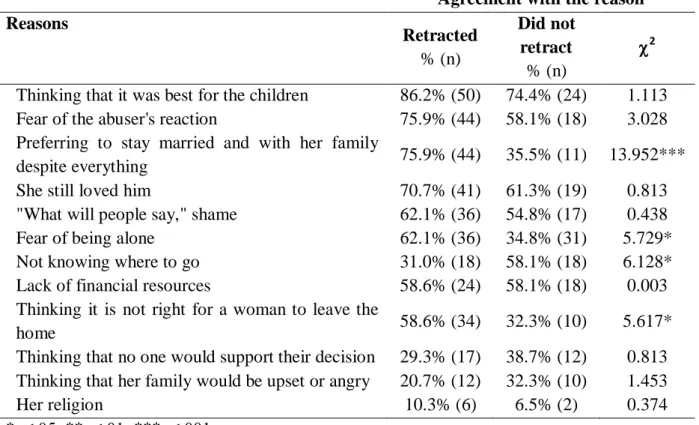
(10) 9. income of the interviewees, a higher percentage of interviewees earning their own incomes of between 20 and 80 dollars a week was observed among the women who had retracted, and higher percentages of women with no independent income or an income of less than 20 dollars a week were observed among those who had not retracted. Table 4. Differences in the reasons that influenced interviewees to stay with their attacker for more than a year, not to end the relationship with him or start it again after separating according to retraction among female victims of IPV in poverty in León (Nicaragua). Agreement with the reason Reasons Did not Retracted retract 2 % (n) % (n) Thinking that it was best for the children 86.2% (50) 74.4% (24) 1.113 Fear of the abuser's reaction 75.9% (44) 58.1% (18) 3.028 Preferring to stay married and with her family 75.9% (44) 35.5% (11) 13.952*** despite everything She still loved him 70.7% (41) 61.3% (19) 0.813 "What will people say," shame 62.1% (36) 54.8% (17) 0.438 Fear of being alone 62.1% (36) 34.8% (31) 5.729* Not knowing where to go 31.0% (18) 58.1% (18) 6.128* Lack of financial resources 58.6% (24) 58.1% (18) 0.003 Thinking it is not right for a woman to leave the 58.6% (34) 32.3% (10) 5.617* home Thinking that no one would support their decision 29.3% (17) 38.7% (12) 0.813 Thinking that her family would be upset or angry 20.7% (12) 32.3% (10) 1.453 Her religion 10.3% (6) 6.5% (2) 0.374 *p≤.05; **p≤.01; ***p≤.001 As shown in Table 4, the main reasons given by the women interviewed who reported remaining with their attacker for more than a year, not ending the relationship or getting back together again after ending the relationship, were "Thinking that it was best for the children" and/or "Fear of the attacker's reaction". A significantly higher percentage of the women who retracted did not leave their attacker or returned to him due to "Preferring to stay married and with her family despite everything" for the "Fear of being alone" and "Thinking it is not right for a woman to leave the home", while a larger percentage of those who had not retracted remained with their attacker or returned to him due to "Not knowing where to go"..
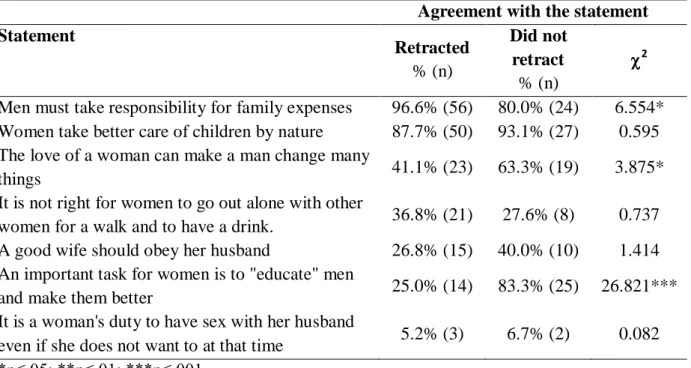
(11) 10. Table 5. Differences for various statements regarding the relationship according to retraction among female victims of IPV in poverty in León (Nicaragua). Agreement with the statement Statement Did not Retracted retract 2 % (n) % (n) Men must take responsibility for family expenses 96.6% (56) 80.0% (24) 6.554* Women take better care of children by nature 87.7% (50) 93.1% (27) 0.595 The love of a woman can make a man change many 41.1% (23) 63.3% (19) 3.875* things It is not right for women to go out alone with other 36.8% (21) 27.6% (8) 0.737 women for a walk and to have a drink. A good wife should obey her husband 26.8% (15) 40.0% (10) 1.414 An important task for women is to "educate" men 25.0% (14) 83.3% (25) 26.821*** and make them better It is a woman's duty to have sex with her husband 5.2% (3) 6.7% (2) 0.082 even if she does not want to at that time *p≤.05; **p≤.01; ***p≤.001. Table 5 shows that a larger percentage of the women who had retracted agreed that "Men must take responsibility for family expenses". Meanwhile, a larger percentage of the women who had not retracted agreed that "The love of a woman can make a man change a lot of things" and in particular, that "An important task of women is to educate men and make them better”. Discriminant analysis showed that the combination of five independent variables (family income, frequency of abuse, remaining with the attacker due to preferring to stay married and with the family despite everything, believing that men must take responsibility for family expenses and believing that an important task for women is to "educate" men and make them better) provided the best discrimination between the women who had retracted and those that had not. The inclusion of other circumstances and beliefs did not contribute significantly to discrimination between the two groups, and as such they were not included in the discriminant function. The estimated discriminant function was statistically significant, with a Wilks λ value of .541 (χ2 (2)=41.450, p<.001). The centroid in the group of women who had withdrawn the complaint was 0.563 and in the group who did not withdraw their complaint was -1.464. The standardised coefficients in Table 5 show the sign and magnitude assigned to each of the two variables in this discriminant function. The function correctly classified 87.5% of all the original cases. 92.3% of the group of women who had retracted and 75.0% of the group of women who had not were assigned to the correct group. The classification accuracy criteria suggested by Hair, Anderson, Tatham, and Black (1999) is met by both groups, and is at least a quarter higher than that obtained by random selection..
(12) 11. Table 6. Standardised coefficients of canonical discriminant functions with different circumstances and beliefs of female victims of IPV in poverty in León (Nicaragua). Function Family income 0.547 Frequency of abuse (daily/non-daily) -0.267 Staying with the attacker due to preferring to stay married and with her family 0.308 despite everything Believing that men must take responsibility for family expenses 0.470 Considering that an important task for women is to "educate" men and make -0.348 them better. Discussion The data obtained show that female victims of physical IPV living in poverty interviewed in León (Nicaragua) began living with their attackers at relatively early ages, and remained with them for significantly long periods of time. The Nicaraguan cultural context, especially among the most disadvantaged groups, leads women to enter relationships at early ages (Vázquez, 2016; Vázquez & Panadero, 2016), while socially censuring the changing of partners. In more than half the cases, the interviewees lived with their current partner at the time of the interview, and in most cases this was the attacker. Although two out of three female IPV victims interviewed had reported her attacker, most complainants had subsequently retracted. Retraction was very common among the interviewees, in a pattern consistent with the results reported by different authors in various cultural contexts (CGPJ, 2014; Ponce, 2013; Robinson & Cook, 2006; Rodríguez & Morales, 2008; Torres, 2013). Fewer than 7% of the interviewees had taken the complaint to its conclusion, while for 16% of them the complaint was in progress at the time of the interview, although it is probable that some of them may retract later. Retraction is a problem, as it hinders investigation, punishment of the attacker and therefore the eradication of IPV (Torres, 2013), exposing victims to potential further attacks (Rodríguez & Morales, 2008). Most of the interviewees had children, and concern for their well-being was one of the most frequently mentioned reasons for retraction. Indeed, concern for children is one of the main reasons given for retraction in various cultural contexts (Abarca, 2013; Bennett et al., 1999; Malecha et al., 2003; Robinson & Cook, 2006). In addition, concern for children’s well-being seems particularly widespread in Central America, according to Taylor (2010) because economic dependence on the attacker and the social pressure on female IPV victims to continue with their relationship are particularly acute in this region. The main reasons given by interviewees for retraction included those related to positive feelings towards the attacker (loving him, allowing herself to be convinced by him, fear of losing him, etc.), which is consistent with the findings of other studies carried out in the USA (Bennett, et al., 1999; Malecha et al., 2003), Australia (ACT Department of Justice and Community Safety, 2001) and Great Britain (Robinson & Cook, 2006). The desire for reconciliation with the partner or the hope that the attacker can be rehabilitated without having to be imprisoned are two of the transcultural reasons most frequently mentioned by female victims of IPV when retracting. The existence of a relationship between the attacker.
(13) 12. and the victim appears to be closely related to retraction. As a result, in cultural contexts that are very different to Nicaragua, such as Spain (Trigo et al., 2012) or Great Britain (Robinson & Cook, 2006), women who retracted continued a relationship with their attacker to a greater extent, to the point that the number of retractions doubled when the victims were still the partner of the accused. Among the female victims of IPV interviewed in Leon, the social pressure exerted by their environment (which translates into shame, not wanting to put the family through the legal situation, allowing themselves to be convinced by their relatives, etc.) is one of the main reasons for retraction. Social pressure therefore seems to play a particularly important role in the strongly collectivist Nicaraguan cultural context (Panadero, Guillén, & Vázquez, 2015; Vázquez & Panadero, 2016). Cultural background influences the way women interpret IPV, which determines their responses to this type of violence (Guillén, Panadero, Rivas, & Vázquez, 2015; Kasturirangan et al., 2004) and as Taylor (2010) points out, there appears to be some degree of social acceptance of IPV in Central America. Resistance to changing learned cultural aspects (Inglehart, 1991) appears to generate feelings of guilt among the female victims of IPV interviewed following making a complaint about their attacker, due to feeling that they are violating the socially imposed norm. As Cala et al point out (2012), guilt is a factor that significantly increases the likelihood of retraction. Another important issue when retracting mentioned by the respondents was the lack of financial resources. In situations where financial resources are limited, fear of losing the main breadwinner, when this is the attacker, is an important reason for retraction (Abarca, 2013). Unfortunately, the data obtained in this study suggest that not retracting could have a significant economic cost for women in poverty victims of IPV in Leon. Incomes were much lower in households where the women had not retracted, and the woman herself was the main breadwinner, usually with a very low income. However, incomes were significantly higher in the homes of women who had retracted, and the attacker was the main source of income. However, among the women who earned lower incomes, those who earned them personally, rather than their partners, had a lower tendency to retract, regardless of whether they lived with their attacker. The attacker’s failure to contribute any income to the household appears to give women strength to continue with their complaint, regardless of their situation in terms of living with their attacker. Finally, another reason for retracting given by the women interviewed in León was the opinion that the process of continuing with an ongoing complaint would be pointless. This reason for retraction is very common in various cultural contexts (Bennett et al., 1999; Malecha et al., 2003), and as such, it is crucial that legal proceedings against attackers have positive consequences for both the women making the complaint and their children. Moreover, having achieved that fundamental objective, it is important to raise public awareness about the usefulness of continuing with the legal process until its ultimate conclusion in order to reduce the risk of continued victimization, and to be able to eradicate gender violence (Torres, 2013). According to the findings of Sleath and Smith (2017) and Abarca (2013) regarding the characteristics of the victims, the duration of the relationship with the attacker and the number of children did not predict retraction. Among the women living in poverty who were victims of IPV interviewed in Leon, their decision to retract does not appear to be related to their.
(14) 13. basic demographic characteristics (age, marital status), the number of children, whether they live with the attacker, the age at which they started to live with him, or the time spent living with him. However, the frequency of the abuse did appear to be related to retraction, in that women who suffered daily abuse retracted to a lesser extent. This contrasts with the data reported by Robinson and Cook (2006) in Great Britain, where having previously suffered from IPV and in particular, being injured in the attack, increased the likelihood of retraction by women. Among the women interviewed in Leon, having been abused systematically appears to be a motivation for continuing with the legal process after they have decided to report their attacker. Female victims of IPV continue to a large extent to live with their attacker despite the violence they suffer from. In this regard, the respondents who had reported their attacker mainly mention "Believing that it was best for their children" and "Fear of the abuser's reaction" as the reason for staying with him for over a year, not ending the relationship or resuming it, although some differences in this respect were observed between those who retracted and those who did not do so. Accordingly, the women who had retracted mentioned cultural motivations and reasons derived from social pressure to a greater extent ("Preferring to stay married and with her family despite everything", "Fear of being alone", "Thinking it is not right for a woman to leave the home") when staying with their attacker or returning to him, while the women who had not retracted justified this to a greater extent in terms of "Not knowing where to go”. Although fear seems to be the main reason for staying with the attacker, social pressure, largely arising from the circumstances in the cultural context (Vazquez, 2016), appears to be a very important factor in maintaining the relationship with the attacker among the respondents who had retracted. Certain cultural variables and socially accepted beliefs about the family and romantic love can be related to retraction by female victims of IPV (Cala et al., 2012). For example, the women interviewed in León who had retracted agreed to a greater extent that "Men must take responsibility for family expenses". In fact, in the families of these women their partner was the main breadwinner, which led to them having higher household incomes than the women who had not retracted. Meanwhile, a larger percentage of women who had not retracted agreed that "An important task for women is to "educate" men and make them better". It may be that to some extent, some women see continuing with the judicial process as a way to "educate" the abuser. Finally, there is a combination of five variables (including personal circumstances and beliefs related to cultural issues) which are the best for discriminating between the women who had retracted and those who had not. The women who retracted after making the complaint had higher household incomes in their home, and had suffered from less frequent abuse. Furthermore, these women remained with their attacker largely because they preferred to stay married and with their family despite the abuse, and considered largely that "Men must take responsibility for family expenses", while hardly any considered that "An important task for women is to "educate" men and make them better". Some limitations of this study mean that it is difficult to generalize the findings to wider contexts. These limitations include the fact that the research was limited to a single city (León, Nicaragua), i.e. it is not possible to guarantee that the sample is representative of women living in poverty who are victims of IPV in Leon. However, relevant conclusions can.
(15) 14. be drawn from the study, which transcend the context studied. The results obtained show that it is extremely difficult to accurately determine the circumstances that influence retraction among women living in poverty victims of IPV who reported their attacker. Nevertheless, there is a clear need to provide security and support for both women who decide to report their attacker, and for their children - an issue which would in turn impact on the conclusion of a greater number of prosecutions for IPV. Likewise, it is essential to develop strategies aimed at preventing gender violence. To that end, it is necessary to raise awareness in a manner that is culturally appropriate to the social context, promoting the transformation of cultural patterns and beliefs regarding the relationship and family which might be favouring the persistence of IPV. In this regard, as a preventive strategy it is important to promote work with potential attackers in various areas such as masculinity and violence, in line with the work done by CEPREV (Violence Prevention Center) in Nicaragua. It is also important to strengthen court-mandated interventions with attackers, which could increase the number of women reporting their attackers and a decline in retractions of IPV. Finally, enacting legislative changes to implement protection and support for female victims of IPV, and raising awareness of the administration of justice, the security forces and various government agencies regarding the vulnerability and defencelessness experienced by many victims of IPV - an issue that is especially aggravated in contexts of poverty and social problems - is particularly relevant. References Abarca, C. (2013). Violencia en la pareja: variables que inciden en el fenómeno de la retratación femenina [Partner’s violence: variables that influence the phenomenon of female withdrawal]. Praxis, 24, 9-28. ACT Department of Justice and Community Safety (2001). Evaluation of the ACT Family Violence Intervention Program Phase II: Final Report. Camberra, Australia. Bennett, L., Goodman, L., & Dutton, M. A. (1999). Systemic obstacles to the criminal prosecution of a battering partner: A victim perspective. Journal of Interpersonal Violence, 14(7), 761–772. DOI: 10.1177/088626099014007006. Berk, R.A., He, Y. & Sorenson, S.B. (2005). Developing a practical forecasting screener for domestic violence incidents. Evaluation Review, 29(4), 358-383. DOI: 10.1177/0193841X05275333. Block, C.R., Devitt, C.O., Donoghue, E.R., Dames, R.J., & Block, R.L. (2000). Who becomes the victim and who the offender in Chicago intimate partner homicide? Diversity of homicide: Proceedings of the 2000 Homicide Research Working Group, 92-111. Bornstein, R.F. (2006). The complex relationship between dependency and domestic violence: Converging psychological factors and social forces. American Psychologist, 61(6), 595-606. DOI: 10.1037/0003-066X.61.6.595 Cala M. J., de la Mata, M.L., Saavedra, J., & Godoy, S. (2012). Conclusiones sobre las renuncias a continuar el procedimiento judicial por violencia de género y propuestas de intervención [Conclusions on disengaging from legal proceedings for intimate partner violence and intervention proposals]. In Instituto Andaluz de la Mujer (Ed.), La renuncia a continuar en el procedimiento judicial en mujeres víctimas de violencia de.
(16) 15. género: Un estudio en la Comunidad Autónoma Andaluza. Sevilla: Instituto Andaluz de la Mujer. CGPJ (Consejo General del Poder Judicial) (2014). Datos de denuncias. Procedimientos penales y civiles registrados. Órdenes de Protección solicitadas en los juzgados de violencia sobre la mujer y sentencias dictadas por los órganos jurisdiccionales en esta materia en el primer trimestre en el 2014 [Facts complaints. Criminal and civil procedures registered. Protection orders requested in the courts of violence on women and judgments of the courts in this area in the first quarter in 2014]. Observatorio contra la violencia Doméstica y de Género. Avalible at: http://www.poderjudicial.es/cgpj/es/Temas/Violencia-domestica-y-degenero/Actividad-del-Observatorio/Datos-estadisticos (10 June 2016, date last accessed). CIS (Centro de Investigaciones Sociológicas) (2011) .Violencia de Género [Gender violence]. Estudio nº 2858. Diciembre 2010 - Febrero 2011. Avalible at: http://www.cis. es/cis/opencm/ES/1_encuestas/estudios/ver.jsp?estudio=12144. (10 June 2016, date last accessed). Cretney, A. & Davis, G. (1997). Prosecuting domestic assault: Victims failing courts, or courts failing victims? The Howard Journal of Criminal Justice, 36(2), 146–157. DOI: 10.1111/1468-2311.00045 Dawson, M. & Dinovitzer, R. (2001). Victim cooperation and the prosecution of domestic violence in a specialized court. Justice Quarterly, 18(3), 593–622. DOI:dx.doi.org/10.1080/07418820100095031. Ellsberg, M., Peña, R., Herrera, A., Liljestrand, J. & Winkvist, A. (2000). Candies in hell: Women’s experiences of violence in Nicaragua. Social Science and Medicine, 51(11), 1595-1610. Ford, D. A. (1991). Prosecution as a victim power resource: A note on empowering women in violent conjugal relationships. Law and Society Review, 25, 313–334. DOI:10.2307/3053801 Grabe, S. (2010). Promoting gender equality: The role of ideology, power and control in the link between land ownership and violence in Nicaragua. Analyses of Social Issues and Public Policy, 10(1), 146-170. DOI: 10.1111/j.1530.2010.01221.x Guillén, A.I, Panadero, S., Rivas, E., & Vázquez, J.J. (2015). Suicide attempts and stressful life events among female victims of intimate partner violence living in poverty in Nicaragua. Scandinavian Journal of Psychology, 56, 349-356. Doi: 10.1111/sjop.12207. Haarr, R.N. (2010). Suicidality among battered women in Tajikistan. Violence Against Women, 16(7), 764-788. DOI: 10.1177/1077801210374409 Hair, J.F., Anderson, R.E., Tatham, R.L., & Black, W. (1999). Multivariate data analysis. New York: Prentice Hall. Hirschel, D. & Hutchison, I. W. (2001). The relative effects of offence, offender, and victim variables on the decision to prosecute domestic violence cases. Violence against Women, 7(1), 46–59. DOI: 10.1177/10778010122182299 Hoyle, C. & Sanders, A. (2000). Police response to domestic violence: From victim choice to victim empowerment? British Journal of Criminology, 40, 14–36..
(17) 16. Inglehart, R. (1991). El cambio cultural en las sociedades industriales avanzadas [Cultural change in developed industrial societies]. Madrid: Centro de Investigaciones Sociológicas/Siglo XXI. Kalmuss, D.S. & Straus, M.A. (1982). Wife´s marital dependency and wife abuse. Journal of marriage and the Family, 44, 277-286. DOI: 10.2307/351538. Kasturirangan, A., Krishnan, S., & Riger, S. (2004). The impact of culture and minority status on women’s experience of domestic violence. Trauma, Violence, & Abuse, 5(4), 318332. DOI: 10.1177/1524838004269487 Lerner, C.F. & Kennedy, C.T. (2000). Stay-leave decision making in battered women: Trauma, coping and self-efficacy. Cognitive Therapy and Research, 24(2), 215-232. DOI: 10.1023/A:1005450226110 Malecha, A., McFarlane, J., Gist, J., Watson, K., Batten, E., Hall, I., & Smith, S. (2003). Applying for and dropping a protection order: A study with 150 women. Criminal Justice Policy Review 14(4), 486–504. DOI: 10.1177/0887403403255496. Medrano, A.C. (2014). Política pública e inclusión de género en Nicaragua: La Ley 779 ¿Un instrumento de inclusión social para las mujeres nicaragüenses? [Public politic and gender inclusion in Nicaragua: Law 779, A instrument of social inclusion for nicaraguan women?]. Universidad y Pensamiento, 2, 27-36. MINSA (Ministerio de Salud de Nicaragua) (2013) Encuesta Nacional de Demografía y Salud 2011/12 [National Survey of Demographic and Health]. Managua: Ministerio de Salud. Panadero, S., Guillén, A.I., & Vázquez, J.J. (2015). Happiness in the street. Overall happiness among homeless people in Madrid (Spain). American Journal of Orthopsychiatry, 85(4), 324-330. Doi: dx.doi.org/10.1037/ort0000080. Peña, N., Maiques, M., & Castillo, G.E. (2008). Using rights-based and gender-analysis arguments for land rights for women: some initial reflections from Nicaragua. Gender and Development, 16, 55-71. DOI: 10.1080/13552070701876227 Ponce, M.V. (2013). Contexto de violencia de género en Honduras en el quinquenio 20082012 [Context of gender violence in Honduras in the period 2008-2012]. Revista Población y Desarrollo: Argonautas y Caminantes, 9, 66-77. Rhodes, N.R. & Baranoff, E.C. (1998). Why do battered women stay? Three decades of research. Aggression and Violent Behavior, 4, 391-406. Robinson, A. & Cook, D. (2006). Understanding Victim Retraction in Cases of Domestic Violence: Specialist Courts, Government Policy, and Victim-Centred Justice. Contemporary Justice Review, 9(2), 189-213. DOI:dx.doi.org/10.1080/10282580600785017 Rodríguez, R. & Morales, M. (2008). Hombres que agreden a sus mujeres [Men who assault their women]. Revista Jurídica del Ministerio Público, 34, 326-336. Sleath, E. & Smith, L. L. (2017). Understanding the factors that predict victim retraction in police reported allegations of intimate partner violence. Psychology of Violence, 7(1), 140-149. DOI: dx.doi.org/10.1037/vio0000035. Stout, K. D. (1993). Intimate femicide: A study of men who have killed their mates. Journal of Offender Rehabilitation, 19(3-4), 81-94..
(18) 17. Strube, M.J. & Barbour, L. S. (1983). The decision to leave an abusive relationship: Economic dependence and psychological commitment. Journal of Marriage and the Family, 45, 785-793. DOI: 10.2307/351791. Torres, S. (2013). Aproximación al fenómeno de la retractación en las causas de violencia intrafamiliar [Approach to the phenomenon of retraction in court cases of domestic violence]. Revista de derecho (Valdivia), 26(1), 167-180. DOI:dx.doi.org/10.4067/S071809502013000100008 Trigo, E., Sala, A. & Calderón, M. (2012). Hallazgos fundamentales sobre las renuncias al procedimiento judicial por Violencia de Género [Fundamental findings about rejections to judicial process for gender violence]. En Instituto Andaluz de la Mujer (ed.). La renuncia a continuar en el procedimiento judicial en mujeres víctimas de violencia de género: Un estudio en la Comunidad Autónoma Andaluza. Sevilla: Instituto Andaluz de la Mujer. UNDP (United Nations Development Programme) (2015). Human Development Report 2015. Work for human development. United Nations Development Programme. Avalible at: http://report.hdr.undp.org/ (10 June 2016, date last accessed). UNFPA (Fondo de Población de las Naciones Unidas) (2010). Salud y justicia para mujeres ante la violencia sexual en Centroamérica: El Salvador, Guatemala, Honduras y Nicaragua [Health and justice for women front to sexual violence in Central America: El Salvador, Guatemala, Honduras and Nicaragua]. Madrid: AECID. Avalible at: http://aecid.lac.unfpa.org/webdav/site/AECID/shared/files/Una%20mirada%20completa _Iniciativa4.pdf (10 Jun 2016, date last accessed) Vázquez, J.J. (2013). Happiness among the garbage. Differences in overall happiness among trash pickers in León (Nicaragua). Journal of Positive Psychology, 8(1), 1-11. Doi: 10.1080/17439760.2012.743574. Vázquez, J.J. (2016). The stigma of making a living from garbage: Meta-stereotypes of trashpickers in León (Nicaragua). Scandinavian Journal of Psychology, 57(2), 122-128. Doi: 10.1111/sjop.12268. Vázquez, J.J. & Panadero, S. (2016). Chronicity and pseudo inheritance of social exclusion: Differences according to the poverty of the family of origin among trash pickers in León (Nicaragua). Human Rights Quarterly, 38, 379-390. Vázquez, J.J., Panadero, S., & Martín, R.M. (2015). Regional and national differences in stressful life events: The role of cultural factors, economic development, and gender. American Journal of Orthopsychiatry, 85(4), 392-396. Doi: dx.doi.org/10.1037/ort0000029. Vázquez, J.J., Panadero, S. & Rivas, E. (2015). Happiness among poor women victims of intimate partner violence in Nicaragua. Social Work in Public Health, 30(1), 18-29. Doi: 10.1080/19371918.2014.938389..
(19)
Figure


+3

Documento similar
The women’s variables asso- ciated with partner abuse corresponded mostly to being under 55 years of age, having a lower level of education, a higher frequency of alcohol
Controlling Partner Inventory (CPI; Burke, Wallen, Vail-Smith, & Knox, 2011), which assesses control, surveillance by diverse means, threats, and excessive
Una vela para el diablo is unquestionably a representation of the Francoist female monster who needed to conform to their submissive role but transgressed the social and
While many studies point to a significant and greater prevalence (25-75%) of all types of violence and its severi- ty among women who are dependent on alcohol or other
And, (b) to distinguish the developmental nuances of intimate partner violence perpetration and victimization among adolescents based on age and gender, because the results obtained
In order to enlighten the original cultural space of Beauvoir and her work, the first chapter of the study provides an overview of Simone de Beauvoir and her work in
The RR values found in the VPR 2015 form’s indicators confirm that in contexts where protection of the victim is demanded based on the risk, the majority of risk indica- tors can
Consequently, and taking into account the abovementioned literature, the aim of the present study was to provide a new definition of psychological abuse in intimate partner
