Incidence of hepatocellular carcinoma in
hepatitis C cirrhotic patients with and without HIV infection:
a cohort study, 1999-2011
Nicolas Di Benedetto,* Mirta Peralta,* Estela Alvarez,** María Teresa Schroder,* Claudio Estepo,* Silvia Paz,* Hugo Fainboim*
* Hospital Muñiz, Liver Diseases, Buenos Aires, Argentina. ** Hospital Posadas, Pathology, Buenos Aires, Argentina.
ABSTRACT
Introduction. High activity antiretroviral therapy (HAART) has allowed people infected with human immuno-deficiency virus (HIV) to live longer. In the course of time, hepatocellular carcinoma (HCC) began to be found in these patients. Investigations have suggested that, as it has been described for other tumors, HIV infection raises the risk of developing HCC. However, convincing evidence is still required. Our aim was to quantify the incidence of HCC in hepatitis C cirrhotic patients with and without human immunodeficiency virus infection in the HAART era. Material and methods. This prospective cohort study was conducted in hepatitis C cirrhotic patients with and without HIV co-infection, between june 1, 1999 and May 21, 2010. Ultrasound screening for HCC was performed every 6 to 12 months to all the patients until January 15, 2011. Incidence rate and cumulative incidence (Kaplan-Meier) were calculated. Results. One hundred and forty eight patients (69 hepatitis C virus mono-infected and 79 HIV/hepatitis C virus co-infected) were followed for a median time of 43 months, with a total follow-up of 555 person-years (324 for co-infected and 231 for mono-infected patients). Twelve patients developed HCC (5 co-infected and 7 mono-infected). The incidence of HCC in co-infected patients and mono-infected patients was 1.54 (95% confidence interval = 0.5 to 3.6) and 3.03 (95% confidence interval = 1.22 to 6.23) cases per 100 person-year respectively (log-rank p = 0.3225). Conclusion. In the HAART era, HIV co-infection is not associated with a higher inci-dence of HCC in hepatitis C cirrhotic patients.
Key words. Liver neoplasms. Liver cirrhosis. Epidemiology.
Correspondence and reprint request: Nicolas Di Benedetto. Rivadavia 2559, 5º H. Buenos Aires. Argentina
Tel.: +54 011 4952 7260. Fax: +54 011 4305 8195 E-mail: [email protected]
Manuscript received: July 08, 2013. Manuscript accepted: July 31, 2013.
INTRODUCTION
Hepatocellular carcinoma (HCC), the most com-mon primary cancer of the liver, results in signifi-cant morbidity and mortality. Since the introduction of highly active antiretroviral therapy (HAART) in 1996, the survival of human immunodeficiency virus (HIV) infected patients has improved considerably, therefore chronic hepatitis C virus (HCV) infection has become an increasingly important problem and the epidemiology of HCC has been altered.1,2
Within HIV positive populations in different countries, relative proportions of HCV co-infection vary widely according to the prevalence of different high-risk behaviours. In Argentina HCV/HIV co-in-fection was observed in 30% of the HIV inco-in-fections.3
The effect of HIV infection in the progression of HCV morbidity is not fully understood, however evi-dence suggests that progression to end-stage liver disease occurs faster in co-infected patients. Thus, HIV/HCV co-infection increases the progression to cirrhosis, but whether it also increases the incidence of HCC remains to be elucidated.4-8
papilloma virus) and to cellular immune-depression. Some investigators have suggested that, as it has been described for other tumours, HIV infection rai-ses the risk of developing HCC, because they found a higher incidence of liver cancer among HIV-infec-ted patients than in the general population; howe-ver more than 80% cases of HCC are preceded by cirrhosis, and the higher risk has been essentially attributed to hepatitis B virus (HBV)/HCV co-infec-tions and alcohol abuse.7,9-16
Convincing evidence about the incidence of HCC in cirrhotic patients with and without HIV infection is still required. The aim of this study was to deter-mine the incidence of HCC in HCV infected cirrhotic patients with and without HIV infection in the HAART era.
MATERIAL AND METHODS
Study design
This prospective cohort study was conducted in HCV cirrhotic patients with and without HIV co-infection. All patients were attended at the liver unit of a public community hospital between June 1, 1999 and May 21, 2010. HCV cirrhotic patients were eli-gible for this study if they had at least 6 months of follow-up with 2 follow-up visits, and 2 evaluations by ultrasonography (US).
Chronic HCV infection was defined by detection of plasma anti-HCV antibody and HCV RNA. HIV infection was defined by detection of plasma anti-HIV antibody and confirmed by Western blot. Cir-rhosis was diagnosed by histological examination or by combination of clinical, biochemical, esophago-gastroduodenoscopy and US imaging data. All patients were tested for HIV and HBV at baseline visit and at regular intervals.
Follow-up began on the date of the first US and ended either when an event occurred, the patient died, or if no event occurred until January 15, 2011. All patients had a baseline visit and afterwards they were seen at least every 6 months and underwent US screening for HCC every 6 to 12 months. HIV positive and negative patients received similar care during follow-up. Both were mainly managed by he-patologists, and a group of infectologists provided care to HIV-infected patients.
Demographic (age and sex) and clinical variables (laboratory values pertinent to liver function, Child–Turcotte–Pugh scores, alcohol consumption, CD4 cell counts, plasma HIV-1 RNA, HCV RNA, and HCV treatment) at baseline and at the time of
can-cer diagnosis were evaluated to analyze the charac-teristics of the cancer patients and the general co-hort. At each visit clinical events, laboratory data, consumption of alcohol, HAART regimen, anti-HCV treatment and liver transplant criteria were re-viewed.
Every nodule smaller than 1 centimetre found at US was followed up at three months intervals with US, whereas lesions equal or larger than 1 cm were further investigated with either histological analysis, computed tomography scan, or dynamic contrast enhanced magnetic resonance imaging. HCC diagnosis recommendations have been changed since 1999, so the requirements for definite diagno-sis of HCC were changed throughout follow-up.
Between 1999 and 2001 confirmation diagnosis was reached via histological analysis. Later on bet-ween 2001 and 2005, HCC diagnosis was made via histological analysis or via computed tomography scan or magnetic resonance imaging, in lesions lar-ger than 2 cm showing early arterial phase contrast enhancement plus early venous phase contrast was-hout, with coincident findings in at least two ima-ging techniques, or using a single imaima-ging technique in the presence of a plasma alpha-fetoprotein level equal to or greater than 400 ng/mL. Finally in nodules which were found between 2005 and 2011, HCC diagnosis was made via histological analysis or via computed tomography scan or magnetic reso-nance imaging, in focal lesions of 1-2 centimetres showing arterial hyper-vascularization with was-hout in the portal/venous phase, with coincident find-ings in two dynamic studies, whereas for nodules larger than 2 cm only one dynamic imaging techni-que with typical features of HCC or plasma alpha-fetoprotein greater than 200 ng/mL were required for diagnosis.17-19
Statistical analysis
compa-red using the Log-Rank test. For all tests we consi-dered as statistically significant a bilateral p value < 0.05. All analyses were carried out in Statistix 8.0.
RESULTS
In the 11-year period from June 1, 1999 to May 21, 2010, one hundred and ninety one HCV cirrhotic patients were identified. To exclude non incident ca-ses of HCC, 11 patients (One HIV/HCV co-infected and ten HCV mono-infected) with pre-existing HCC were not included. One hundred and eighty patients began follow-up, and then 32 were excluded because their follow-up was shorter than 6 months. Finally 148 patients were included in the analysis, 69 (46.6%) HCV mono-infected and 79 (53.4%) HIV/ HCV co-infected patients.
The baseline characteristics of HIV positive and negative patients are displayed in table 1. In compa-rison with HIV negative patients, HIV positive patients were younger [median age: 40 years old (Interquartile range-IQR = 38-43) vs. 49 years old (IQR = 43-54.5)], displayed higher serum HCV viral load levels at the time of the inclusion in the study [median HCV RNA level: 5.9 log10 IU/mL. (IQR = 5.6-5.9 log10 IU/mL) vs. 5.7 log10 IU/mL. (IQR = 5.15-5.9 log10 IU/mL)]. And the percentage of daily alcohol consumption (more than 60 grams/day) was significantly higher (62.3% vs. 31.9%, p < 0.05). Anti-HCV Therapy was performed in a lower percen-tage of co-infected patients than mono-infected (38%
vs. 62%, p < 0.05). There was no other significant difference between both groups.
Almost all HIV/HCV co-infected patients (89.9%) were on HAART treatment at inclusion, and the me-dian of CD4+ T cell was 332/µL (IQR 227 to 500). Most patients had relatively preserved liver function at inclusion (Child A: 68.4% of HIV-HCV co-infected and 87% of mono-infected patients).
Patients were followed up for a median time of 43 months (IQR: 23.3-58.8), HIV/HCV co-infected pa-tients during 45 months (IQR: 25 to 65), and HCV mono-infected patients during 37 months (IQR: 20 to 53), p = 0.0907. Total follow up of 555 person-years (324 person/years for HIV/HCV co-infected patients and 231 for HCV mono-infected patients). Sixteen patients (Twelve HCV-HIV co-infected and 4 mono-infected patients) died during the study period, and 23 patients (fifteen co-infected and 8 mono-infected patients) were lost to follow-up.
A new development of HCC was seen in 12 pa-tients (5 co-infected and 7 mono-infected papa-tients), resulting in a total frequency of 6.3% in HIV/HCV co-infected patients and 10.1% in HCV mono-infec-ted patients. The density of incidence of HCC in
Table 1. Baseline characteristics of HIV-HCV co-infected, and HCV mono-infected patients.
HIV/HCV (n:79) HCV (n:69) P value
Male sex [No. (%)] 62 (78.5) 45 (65.2) 0.0721
Median age [years (IQR)] 40 (38-43) 49 (43-54.5) 0.0000*
Alcohol Consumption [No. (%)]† 49 (62.3) 22 (31.9) 0.0002*
Genotype 1 [No. (%)] 47 (59.5) 46 (66.7) 0.5216
Median HCV RNA [Log10 IU/ml (IQR)]‡ 5.9 (5.6-5.9) 5.7 (5.2-5.9) 0.0064*
HCV Treatment [No. (%)] 30 (38) 43 (62.3) 0.0031*
Sustained virological response [No. (%)]§ 4 (17.4) 9 (25) 0.4916
Child-Turcotte–Pugh Score A [No. (%)] 54 (68.4) 60 (87) 0.8435
HIV: human immunodeficiency virus. HCV: hepatitis C virus. IQR: interquartile range. † Alcohol consumption more than 60 grams/day. ‡ Baseline HCV RNA. § Proportion of the sustained virological response evaluations available at the moment of analysis. * Indicates significance at the P ≤ .05 level.
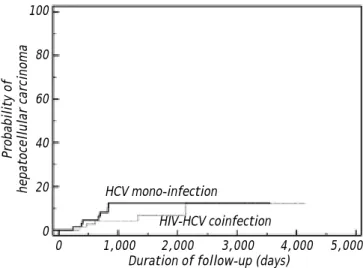
Figure 1. Kaplan-Meier cumulative risk of hepatocellular carcinoma among patients with HIV/HCV co-infection (n = 79) and patients with HCV mono-infection (n = 69). Difference was not statistically significant, log-rank test p = 0.3225. HCV: hepatitis C virus. HIV: human immunodeficiency virus.
100
80
60
40
20
0
Probability of
hepatocellular carcinoma
0 1,000 2,000 3,000 4,000 5,000 Duration of follow-up (days)
HCV mono-infection
HIV-HCV co-infected patients and HCV mono-infec-ted patients was 1.54 cases per 100 person-year (95% confidence interval = 0.5 to 3.6) and 3.03 cases per 100 person-year (95% confidence interval = 1.22 to 6.23) (log-rank p = 0.3225) respectively. The inci-dence ratio of HCC for HCV mono-infected relative to HIV-HCV co-infected patients was 1.97 (Figure 1).
The characteristics of patients who developed HCC are displayed in table 2. The median age at HCC diagnosis was 42 years old (IQR 34.5-50.5) in HIV/HCV co-infected patients and 64 years old (IQR 50-68) in HCV mono-infected patients (p 0.0147). Alcohol consumption higher than 60 g/day was present in 4 HIV/HCV co-infected and 1 mono-infected patients (p = 0.0357). Median levels of plasma alpha-fetoprotein were not statistically dif-ferent between HIV positive and negative patients (p = 0.4606). Almost all patients had relatively preserved liver function at inclusion (Child A: 80% of HIV-HCV co-infected and 85.7% of mono-infected patients). Genotype 1 was the most prevalent HCV genotype in the two groups, 20% of co-infected patients and 57.1% of mono-infected patients received anti-HCV treatment. Among HIV positive patients the median observation time to develop of HCC was 20.3 months (IQR14-58), and in mono-infected pa-tients was 22.4 months (IQR 13-27). Four co-infec-ted patients were on HAART treatment at inclusion, and the median CD4 cell count was 368 cells/µL (IQR 229 to 471). The only patient without HAART at inclusion had 349 CD4+ T cell/µL. One co-infec-ted patient and 3 mono-infecco-infec-ted patients died.
All HCV mono-infected patients with HCC were evaluated for Liver Transplantation (LT). LT was performed in only one patient, 3 patients dropped out of list, 1 patient did not accept the therapy and there are no data of two patients. Three HIV-HCV
co-infected patients were evaluated for LT. One pa-tient underwent curative radiofrequency ablation and another one was refused LT by the LT unit be-cause of his HIV condition. There are no data of one patient. Two patients were not evaluated for LT, one had active alcoholism, and another one died be-fore the evaluation.
DISCUSSION
End stage liver disease is currently a leading cause of death in HIV infected patients, and HCC repre-sents a quarter of liver-related deaths. In France, from 1995 to 2005, the proportion of AIDS-related deaths decreased from 92% to 35% and liver relat-ed deaths increasrelat-ed (by 11-fold) in HIV-infectrelat-ed adults. Moreover, Weber et al., in the Data Collec-tion on Adverse Events of Anti-HIV Drugs study (The D:A:D Study), found that liver-related death was the most frequent cause of non-AIDS-related death in HIV-infected persons.2,20 Furthermore, in the HAART era the epidemiology of AIDS/non-AIDS defining cancer is changing. For example, in the United States, Long et al. found that, between 1996 and 2005, AIDS defining cancer rates decreased from 12.5 to 3.5 cases/1,000 person-years (P = < 0.001 for trend) while non-AIDS defining cancer rates in-creased from 3.9 to 7.1 cases/1,000 person-years (P = 0.13 for trend).21
Among HCV infected patients, between 8-24% de-velop cirrhosis over two or three decades following the onset of the infection and 1%-4% of them will de-velop HCC annually. As HIV infected patients live longer and are exposed to the effects of mild and prolonged immune deficiency, hepatitis viruses can be expected to manifest their oncogenic potential in-creasingly.22-25
Table 2. Characteristics of patients with hepatocellular carcinoma.
HIV/HCV (n:5) HCV (n:7) P values
Male sex [No. (%)] 5 (100) 5 (71.4) 0.1904
Median age [years (IQR)] 42 (34.5-50.5) 64 (50-68) 0.0147*
Alcohol consumption [No. (%)]† 4 (80) 1 (14.3) 0.0357*
Median observation time [months (IQR)] 20.3 (14-58) 22.4 (13-27) 0.6261
Genotype 1 [No. (%)] 4 (80) 4 (57.1) 0.4076
Median HCV RNA [Log10 IU/ml (IQR)]‡ 5.8 (5.4-5.9) 5.6 (4.9-5.9) 0.6255
HCV treatment [No. (%)] 1 (20) 4 (57.1) 0.1982
Sustained virological response [No. (%)]§ 1 (100) 1 (25) 0.1709
Median α-fetoprotein [IU/ml. (IQR)] 5.5 (1.8-195) 20 (6.5-64) 0.4606
Child-Turcotte-Pugh Score A [No. (%)] 4 (80) 6 (85.7) 0.4279
Until now, the impact of HIV infection on the in-cidence of liver cancer in HCV cirrhotic patients has not been clearly established. This prospective study performed in the HAART era, showed that HIV co-infection is not associated with a higher incidence of HCC in HCV cirrhotic patients.
Most studies in these populations are case-control studies or retrospective cohorts, with insufficient follow-up to compare the incidence of HCC, and are not adjusted by HCV-HBV infection or alcohol consumption. Furthermore, these studies are subject to several sources of error. For example in one cohort the authors concede that up to 50% of the apparent HCV group was never tested for HIV. Finally, cirrhosis appears to be the most important risk factor and precedes HCC in more than 80% of cases; for this reason, HCC studies which include non-cirrhotic patients, should consider both cirrho-tic and non-cirrhocirrho-tic groups in the incidence rate analysis. In the present study only cirrhotic pa-tients were included.26
All studies proffer convincing evidence that HCC incidence in HIV patients is higher than in HIV ne-gative patients nearly exclusively in association with HCV or HBV infection, and cite increased lon-gevity as the principal cause of this phenomenon. To our knowledge up to now, there are no prospective studies that have found higher incidence of HCC in HIV and viral hepatitis co-infection compared to iso-lated HCV infection, as one might expect if HIV ac-celerates the disease progression of viral hepatitis towards HCC.
However, recent studies show that HIV-induced immunodeficiency is independently associated with a higher risk of HCC. One of the studies shows that patients with CD4 less than 500 cells/µ, are associa-ted with a higher risk of HCC, whereas the cumula-tive duration with immunodeficiency is not.27 Moreover, Clifford, et al., in a case-control study nested in the Swiss HIV Cohort Study, found a spe-cific association between HCC risk and Low CD4 cell count in the year preceding HCC diagnosis.25 It should be considered that both studies were retros-pective and including patients with HBV and HCV infection. Nevertheless, though studies on HCV na-tural history have shown that HIV-related immune suppression worsens the risk of cirrhosis and liver-related death, they have failed to identify a direct effect of HIV-related immunodeficiency on HCC risk.7,28
On the other hand, there are several studies showing no difference in the incidence of HCC bet-ween HIV positive and negative patients. Kramer,
et al., in a retrospective cohort performed between 1991 and 2000, could not find a higher incidence of HCC in the co-infected group. Another retrospective cohort study conducted in the setting of decom-pensated cirrhosis, found a higher incidence of HCC in HCV mono-infected subjects than in co-infected.7,29
Moreover a large retrospective cohort study of McGuinnis, et al. compared the incidence of HCC between 14018 HIV positive and 28036 age, sex and location-matched HIV-negative controls. A higher age-matched incidence of HCC was clearly demons-trated in the HIV positive group (incidence rate ra-tio 1.68) but when adjusted for HCV infecra-tion and/or alcohol consumption the incidence rate ratios were similar, suggesting that HIV co-infection confers no additional risk of HCC compared to HCV infection alone. Equally important, in a prospective trial in-cluding 384 HCV-infected patients (141 HIV co-infec-ted), only six patients developed HCC (One HIV/ HCV co-infected patient and five HCV mono-infec-ted). The incidence rate of HCC was 390 cases per 100,000 per year. Finally in 2009, a meta-analysis performed by Deng, et al. identifies no difference between HIV/HCV co-infected and HCV mono-infec-ted patients with regard to the development of liver cancer (Odds ratio 0.76).28,30-31
In the present study, HIV/HCV co-infected pa-tients were younger than mono-infected at HCC diagnosis. Since HCV-related HCC typically deve-lops in the setting of cirrhosis, the early age at HCC diagnosis in HIV-infected subjects could be attribu-ted to their young age at the time of acquisition of HCV infection. In addition, a more rapid course of HCV-related liver disease in HIV co-infected subjects could also have played a role. This observation was made in three previous studies.32-34
Excessive alcohol consumption is a well-known factor in morbidity and mortality resulting for chro-nic liver diseases, and it has been associated with an increased risk of HCC.35 Daily alcohol consumption was evaluated in the present study and the propor-tion was higher in HIV/HCV co-infected patients. Furthermore 80% of HIV/HCV co-infected patients with HCC, drank more than 60 grams/day.
Although HIV-positive status was previously an absolute contraindication for LT, the latter is now becoming more commonplace following several transplant series which have demonstrated similar survival outcomes in MELD-score matched HIV po-sitive and negative recipients.36-39 In this cohort all HCV mono-infected patients and 3/5 co-infected pa-tients with HCC were evaluated for LT.
This study has three major strengths. First the study was a prospective cohort. Second, the study cohort was matched with a similar cohort with equi-valent severity of liver disease and third all patients had HCV infection confirmed by anti-HCV antibo-dies and HCV RNA. However some limitations should be pointed out. Persons included were res-tricted to patients being treated for HIV infection in the hospital. Data about when infection was acqui-red was not available in most cases. Finally HCC is a condition with a typical long latency, so we need a longer follow up to detect significant differences on incidence.
CONCLUSION
It can be asserted that in the HAART era HIV co infection is not associated with a higher incidence of HCC in HCV cirrhotic patients.
ACKNOWLEDGMENT
The authors thank Marilin Tauterys and Maria Laura Pacheco for their technical assistance.
ABBREVIATIONS
• AIDS: acquired immunodeficiency syndrome. • HAART: high activity antiretroviral therapy. • HBV: hepatitis B virus.
• HCC: hepatocellular carcinoma. • HCV: hepatitis C virus.
• HIV: human immunodeficiency virus. • IQR: interquartile range.
• LT: liver transplantation. • US: ultrasonography.
REFERENCES
1. Salmon-Ceron D, Rosenthal E, Lewden C, Bouteloup V, May T, Burty C, Bonnet F, et al. Emerging role of hepatocellular carcinoma among liver-related causes of deaths in HIV-in-fected patients: The French national Mortalite 2005 stu-dy. J Hepatol 2009; 50: 736-45.
2. Rosenthal E, Salmon-Ceron D, Lewden C, Bouteloup V, Pia-loux G, Bonnet F, Karmochkine M, et al. Liver-related deaths in HIV-infected patients between 1995 and 2005 in the
French GERMIVIC Joint Study Group Network (Mortavic 2005 study in collaboration with the Mortalité 2005 sur-vey, ANRS EN19). HIV Med 2009; 10: 282-9.
3. Fay F, Benetti S, García Camacho G, Bessone F; Schroder T, Fainboim H. Prevalencia de la coinfección HIV/HCV y HIV/HBV en Argentina: Estudio observacional y prospecti-vo [Abstract]. Acta Gastroenterol Latinoam 2009; 39 (Suppl.): 7.
4. Benhamou Y, Bochet M, Di Martino V, Charlotte F, Azria F, Couteliier A, Vidaud M, et al. Liver fibrosis progression in HIV and hepatitis C virus coinfected patients. Hepatology 1999; 30: 1054-8.
5. Martin-Carbonero L, Benhamou Y, Puoti M, Berenguer J, Mallolas J, Quereda C, Arizcorreta A, et al. Incidence and predictors of severe liver fibrosis in HIV infected patients with chronic hepatitis C: a European collaborative study. Clin Infect Dis 2004; 38: 128-33.
6. Martínez-Sierra C, Arizcorreta A, Díaz F, Roldan R, Mar-tin-Herrera L, Pérez-Guzmán E, Girón-González JA. Pro-gression of chronic hepatitis C to liver fibrosis and cirrhosis in patients coinfected with hepatitis C virus and HIV. Clin Infect Dis 2003; 36: 491-8.
7. Kramer JR, Giordano TP, Souchek J, Richardson P, Hwang L, El-Serag HB. The effect of HIV co-infection on the risk of cirrhosis and hepatocellular carcinoma in U.S. veterans with hepatitis C. Am J Gastroenterol 2005; 100: 56-63. 8. Posthouwer D, Makris M, Yee TT, Fischer K, van Veen JJ,
Griffioen A, van Erpecum KJ, et al. Progression to end-stage liver disease in patients with inherited bleeding disorders and hepatitis C: an international, multicenter cohort study. Blood 2007; 109: 3667-71.
9. Centers for Disease Control and Prevention. 1993 revised classification system for HIV infection and expanded sur-veillance case definition for AIDS among adolescents and adults. MMWR Recomm Rep 1992; 41: 1-19.
10. Lowsky R, Lipton J, Fyles G, Minden M, Meharchand J, Tejpar I, Atkins H, et al. Secondary malignancies after bone marrow transplantation in adults. J Clin Oncol 1994; 12: 2187-92. 11. Curtis RE, Rowlings PA, Deeg HJ, Shriner DA, Socíe G,
Travis LB, Horowitz MM, et al. Solid cancers after bone marrow transplantation. N Engl J Med 1997; 336: 897-904. 12. Powles T, Macdonald D, Nelson M, Stebbing J. Hepatocellu-lar cancer in HIV-infected individuals: tomorrow’s pro-blem? Expert Rev Anticancer Ther 2006; 6: 1553-8. 13. Powles T, Robinson D, Stebbing J, Shamash J, Nelson M,
Gazzard B, Mandelia S, et al. Highly active antiretroviral therapy and the incidence of non-AIDS-defining cancers in people with HIV infection. J Clin Oncol 2009; 27: 884-90. 14. MacDonald DC, Nelson M, Bower M, Powles T.
Hepatocellu-lar carcinoma, human immunodeficiency virus and viral he-patitis in the HAART era. World J Gastroenterol 2008; 14: 1657-63.
15. Brau N, Fox RK, Xiao P, Marks K, Naqvi Z, Taylor LE, Trikha A, et al. Presentation and outcome of hepatocellular carci-noma in HIV-infected patients: a U.S.-Canadian multicen-ter study. J Hepatol 2007; 47: 527-37.
16. Llovet JM, Burroughs A, Bruix J. Hepatocellular carcinoma. Lancet 2003; 362: 1907-17.
17. Sbolli G, Fornari F, Civardi G, Di Stasi M, Cavanna L, Bus-carini E, BusBus-carini L. Role of ultrasound guided fine needle aspiration biopsy in the diagnosis of hepatocellular carci-noma. Gut 1990; 31: 1303-5.
19. Bruix J, Sherman M. Management of Hepatocellular Carci-noma. Hepatology 2005; 42: 1208-36.
20. Weber R, Sabin CA, Friis-Møller N, Reiss P, El-Sadr WM, Kirk O, Dabis F, et al. Liver-related deaths in persons infected with the human immunodeficiency virus: the D:A:D study. Arch Intern Med 2006; 166: 1632-41.
21. Long JL, Engels E, Moore R, Gebo K. Incidence and outco-mes of malignancy in the HAART era in an urban cohort of HIV-infected individuals. AIDS 2008; 22: 489-96.
22. Colombo M. Hepatitis C virus and hepatocellular carcino-ma. Best Pract Res in Clin Gastroenterol 1999; 13: 519-28. 23. Ikeda K, Saitoh S, Koida I, Arase Y, Tsubota A, Chayama K, Kumada H, et al. A Multivariate analysis of risk factors for hepatocellular carcinogenesis: a prospective observation of 795 patients with viral and alcoholic cirrhosis. Hepato-logy 1993; 18: 47-53.
24. El-Serah HB, Masson AC, Key C. Trends in survival of pa-tients with hepatocellular carcinoma between 1977 and 1996 in the United States. Hepatology 2001; 33: 62-5. 25. Clifford GM, Rickenbach M, Polesel J, Dal Maso L, Steffen I,
Ledergerber B, Rauch A, et al. Influence of HIV-related im-munodeficiency on the risk of hepatocellular carcinoma. AIDS 2008; 22: 2135-41.
26. Monto A, Wright TL. The epidemiology and prevention of hepatocellular carcinoma. Semin Oncol 2001; 28: 441-9. 27. Bruyand M, Dabis F, Vandenhende MA, Lazaro E, Neau D,
Leleux O, Geffard S, et al. HIV-induced immune deficiency is associated with a higher risk of hepatocarcinoma, ANRS CO3 Aquitaine Cohort, France, 1998-2008. J Hepatol 2011; 55: 1058-62.
28. McGinnis KA, Fultz SL, Skanderson M, Conigliaro J, Bryant K, Justice AC. Hepatocellular carcinoma and non-Hodgkin’s lymphoma: the roles of HIV, hepatitis C infection, and al-cohol abuse. J Clin Oncol 2006; 24: 5005-9.
29. Garcia-Garcia J, Romero-Gomez M, Giron-Gonzalez J, Rivera-Irigoin R, Torre-Cisneros J, Montero JL, Gonzalez-Serrano M, et al. Incidence of and factors associated with hepato-cellular carcinoma among hepatitis C virus and human immunodeficiency virus co-infected patients with decom-pensated cirrhosis. AIDS Research and Human Retrovi-ruses 2006; 22: 1236-41.
30. Tradati F, Colombo M, Mannucci PM, Rumi MG, De Fazio C, Gamba G, Ciavarella N, et al. A prospective multicenter study of hepatocellular carcinoma in Italian hemophiliacs with chronic hepatitis C. The Study Group of the Associa-tion of Italian Hemophilia Centers. Blood 1998; 91: 1173-7. 31. Deng LP, Gui XE, Zhang YX, Gao SC, Yang RR. Impact of human immunodeficiency virus infection on the course of hepatitis C virus infection: a meta-analysis. World J Gas-troenterol 2009; 15: 996-1003.
32. Bräu N, Fox RK, Xiao P, Marks K, Naqvi Z, Taylor LE, Trikha A, et al. Presentation and outcome of hepatocellular carci-noma in HIV-infected patients: a U.S.-Canadian multicen-ter study. J Hepatol 2007; 47: 527-37.
33. Puoti M, Bruno R, Soriano V, Donato F, Gaeta GB, Quinzan GP, Precone D, et al. Hepatocellular carcinoma in HIV-in-fected patients: epidemiological features, clinical presen-tation and outcome. AIDS 2004; 18: 2285-93.
34. Garcia-Samaniego J, Rodriguez M, Berenguer J, Rodri-guez- Rosado R, Carbo J, Asensi V, Soriano V. Hepatocellu-lar carcinoma in HIV-infected patients with chronic hepatitis C. Am J Gastroenterol 2001; 96: 179-83. 35. Austin H, Delzell E, Grufferman S, Levine R, Morrison AS,
Stolley PD, Cole P. A case-control study of hepatocellu-lar carcinoma and the hepatitis B virus, cigarette smok-ing, and alcohol consumption. Cancer Res 1986; 46: 962-6.
36. Prachalias AA, Pozniak A, Taylor C, Srinivasan P, Muiesan P, Wendon J, Cramp M, et al. Liver transplantation in adults co-infected with HIV. Transplantation 2001; 72: 1684-8.
37. Ragni MV, Belle SH, Im K, Neff G, Roland M, Stock P, Heaton N, et al. Survival of human immunodeficiency virus-infec-ted liver transplant recipients. J Infect Dis 2003; 188: 1412-20.
38. Neff GW, Bonham A, Tzakis AG, Ragni M, Jayaweera D, Schiff ER, Shakil O, et al. Orthotopic liver transplantation in patients with human immunodeficiency virus and end-stage liver disease. Liver Transpl 2003; 9: 239-47. 39. Fung J, Eghtesad B, Patel-Tom K, DeVera M, Chapman H,