“LIVING UP THE WORLD”
THE MATERIALS DEVELOPMENT PROCESS OF A MODULE FOR FIFTH GRADERS FOLLOWING THE MULTI-DIMENSIONAL APPROACH
PAOLA BENAVIDES BONILLA JUAN DAVID GONZÁLEZ VARGAS
PONTIFICIA UNIVERSIDAD JAVERIANA FACULTAD DE COMUNICACIÓN Y LENGUAJE
LICENCIATURA EN LENGUAS MODERNAS BOGOTÁ
“LIVING UP THE WORLD”
THE MATERIALS DEVELOPMENT PROCESS OF A MODULE FOR FIFTH GRADERS FOLLOWING THE MULTI-DIMENSIONAL APPROACH
PAOLA BENAVIDES BONILLA JUAN DAVID GONZÁLEZ VARGAS
PROJECT’S ADVISER HAROLD CASTAÑEDA
PONTIFICIA UNIVERSIDAD JAVERIANA FACULTAD DE COMUNICACIÓN Y LENGUAJE
LICENCIATURA EN LENGUAS MODERNAS BOGOTÁ
ABSTRACT
This practice-based project aims to develop a complementary material for learners of
English at a private school located in Bogota, Colombia. This material was developed following
the framework for materials writing proposed by Jolly and Bolitho (2011). Furthermore, this
material followed the theoretical guidelines proposed by the Multi-dimensional Approach
developed by Tomlinson (2000). Such approach intends to work with the whole subject, reaching
his/her emotional dimension in order to ensure a positive and long-lasting learning experience.
The material stems being from a short internship that the material designers had throughout a
period of time of six months in the private school. The needs were established by introducing
registers, made in charts as well as in teaching journals, of all the different activities that took
place in the observed classes and that let the designers identify problematic facts and conclude
that the material that was being used did not fulfill the needs and interests of the students nor the
teachers as they stated that it was too easy for them and the contents, too basic. In order to tackle
the identified problems, a set of activities, that covered 17 classes (2 classes per week), was
developed. The contextual and pedagogical realization as well as the physical production of this
complementary material included the text redaction, designing and editing of reading exercises as
well as the script design, recording and editing of listening exercises (with its corresponding
exercises and activities). Finally, the steps concerning the use and evaluation of materials were
not accomplished as the production time that the material took did not let the designers carry out
those processes; thus, they will be left for further investigations and projects. Last but not least,
the most relevant aspect of this study is the material that was designed as it contributes with the
little literature that there is on the materials that follow the Multi-dimensional Approach, a fairly
Keywords: Multi-dimensional Approach, whole subject, materials development, language
TABLE OF CONTENTS INTRODUCTION
CHAPTER 1: “I ONLY LIKE THE STICKERS ON IT’’
1.1 INTRODUCTION
1.2 HOW THIS PRACTICE-BASED PROJECT WILL BE DEVELOPED 1.3 IDENTIFICATION
1.3.1 THE SCHOOL AND THE STUDENTS
1.4 TEACHING JOURNAL AS A TOOL FOR THE PROBLEM IDENTIFICATION 1.5 ANALYSIS OF THE RESULTS
1.6 THE COURSEBOOK 1.7 CONCLUSION
CHAPTER 2: IS ANYONE CRAZY ENOUGH TO DO SOMETHING SIMILAR
2.1 INTRODUCTION 2.2 EXPLORATION 2.3 CONCLUSION
CHAPTER 3: LET’S TEXT…
3.1 INTRODUCTION
3.2 CONTEXTUAL REALIZATION
3.2.1 THE CONCEPTUAL CATEGORY OF MATERIALS 3.2.2 LEARNING
3.2.3 THE PRINCIPLES OF THE MULTI-DIMENSIONAL APPROACH MATERIALS WITHIN THE INCLUDED TEXTS
3.3 CONCLUSION
CHAPTER 4: SHOW ME THE ACTIVITIES
4.1 INTRODUCTION
4.2 PEDAGOGICAL REALIZATION 4.2.1 METHOD VS APPROACH 4.2.2 THE DESIGN
CHAPTER 5 THE MOMENT OF TRUTH
5.1 INTRODUCTION 5.2 PAGE PLANNING
5.3 OUTLINE OF THE COMPLEMENTARY UNIT 5.4 ELABORATION OF THE BOOCK MOCK-UP 5.5 ILLUSTRATIVE PROCESS
5.6 ASSEMBLY PROCESS 5.7 CONCLUSION
CHAPTER 6: FINAL THOUGHTS AND CONCLUSION
BIBLIOGRAPHY
ANNEX:
ANNEX 1: INTERVIEW MADE TO ENGLISH TEACHER 1 (TRANSCRIPTION FROM AUDIO – MAY, 2014)
ANNEX 2: INTERVIEW MADE TO ENGLISH TEACHER 2 (TRANSCRIPTION FROM AUDIO – APRIL, 2014)
LIST OF IMAGES
IMAGE 1. One of the readings included in the material is shown representing the principle of affection in texts.
IMAGE 2. One of the readings included in the material is shown illustrating the principle of making connections with experiences and relevance.
IMAGE 3. One of the readings included in the material is shown illustrating the principle of sensory imaging.
IMAGE 4. One of the readings included in the material is shown illustrating the principles of inner voice.
IMAGE 5. Sample of one of the pages of activities within the material to visualize the procedure of the approach.
IMAGE 6. Sample of an activity that was included in the material and that reflects the inclusion of the principles of affection, making connections and inner voice.
IMAGE 7. Outline of the page planner.
IMAGE 8. First manual draft of the material’s cover.
IMAGE 9. First manual draft of one of the activities proposed on the material.
IMAGE 10. First round of corrections presented by the project’s adviser about the material’s
cover.
IMAGE 11. First round of corrections presented by the project’s adviser about one of the pages
of the material.
IMAGE 12. Another manual draft is made, this time including the different suggestions that the
project’s adviser did on the manual draft.
IMAGE 13. First illustrated version based on the manual draft that included the first corrections that were made by the project’s adviser.
IMAGE 14. Final version of the material’s cover.
IMAGE 15. Draft made by hand including the first round of corrections that the project’s adviser suggested.
IMAGE 16. First illustrated version based on the manual draft that included the first corrections
that were made by the project’s adviser. IMAGE 17. Second round of corrections.
IMAGE 18. Final result of the creative process, after two rounds of corrections.
LIST OF CHARTS
Table 1.Evidence of materials in the school’s classrooms.
Table 2.Evidence of types of activities in the school’s classrooms.
Table 3.Evidence of types of skills in the school’s classrooms.
LIST OF ANNEXES
ANNEX 1. INTERVIEW MADE TO ENGLISH TEACHER 1 (TRANSCRIPTION FROM AUDIO – MAY, 2014)
ANNEX 2. INTERVIEW MADE TO ENGLISH TEACHER 2 (TRANSCRIPTION FROM AUDIO – APRIL, 2014)
1 LIVING UP THE WORLD
CHAPTER 1: “I ONLY LIKE THE STICKERS ON IT’’
1.1 INTRODUCTION
Teaching goes beyond the act of standing in front of a classroom, speaking for 45 minutes
and writing on the blackboard. Teaching requires of even hours of prior class preparation, which
is needed in order to clarify the technical and practical elements of the class as well as the
different stages that the same will have throughout the given time. Whenever a teacher has a
second language lesson, one of the main questions that arise prior to the realization of the lesson
is related to the method that will be used to develop the class. "Methods are the means or ways
that we use to teach material to our students. Our choice of methods depends on what we want to
teach (content), who we are teaching and the level of competence expected" (White, C. 2010: 1).
Now, teachers have a vast and wide variety of methods to choose from and that can be applied in
second language lessons; it is the experience, the target audience and even the chosen materials
the ones that tell every teacher which of those methods may work better than others, without
mentioning the teachers’ personal features. In other words, “Teaching methods are not an end in
themselves, they are a means to an end. They are the vehicle(s) we use to lead our students
towards particular learning outcomes” (Bourner, T: 1997: 345) and just like in real life, we can
choose from different routes and different vehicles to get to the final destination. Now, as years
pass on, research unveils more details about all the different elements that convey within the
effectiveness of the existing teaching methods; furthermore, research gets to propose some new
methods that according to theory and other knowledge branches may imply efficient learning and
2
be ensured by the method that is being used. Just as Wankat & Oreovicz (1993; 10) state, "being
effective requires both an attitude and a bag of tricks"; in other words, a method does not work
by itself only, materials, emotions, attitudes and even preparation are required to work along in
order to ensure a level of successfulness.
Within the different methods that are discovered by all the research that is done in the
second language acquisition field, outstands a fairly new teaching method proposed by Dr. Brian
Tomlinson (2000), a leading expert in the field of materials development for language learning,
known as the Multi-dimensional Approach. This teaching approach intends to work with the
whole subject, reaching his/her emotional field in order to ensure a positive and long-lasting
learning experience. Some of these characteristics, if not all, are the ones that teachers aim to
foster and reach in their classrooms; thus, it is of interest to go deeper into this new proposal in
order to discover how an approach like this works and better yet, how a material related to it
would look like.
1.2 HOW THIS PRACTICE-BASED PROJECT WILL BE DEVELOPED
The aim of this practice-based project is that of contributing with the analysis as well as
the materials bank that this new teaching approach has. We, the designers, feel very interested by
what this approach proposes and claims to achieve that we have decided to set the goal of
analyzing some of the theory that has been published and by using and applying it, create a
material that would reflect the guidelines that this approach suggests. However, how can that be
done? Within the wide variety of literature that can be found on the materials development field,
Jolly and Bolitho (1998) develop a series of seven different stages that any materials developer
3
order: a movement from the identification of a need for materials to their eventual use in the
classroom” (1998: 96). The stages that are then proposed are those of: Identification, Exploration,
Contextual Realization, Pedagogical Realization and Physical Production. Actually, these stages
will not only be the ones that will be followed to produce the final product of this practice-based
project, which is a teaching module; but also, they will be the development guide of this
dissertation itself.
1.3 IDENTIFICATION
Following the stages that were proposed by Jolly & Bolitho (1998) and taking into
account what has already been said about the objective of this practice-based project, the first
stage that has to be addressed is the Identification. It is in this stage where the teacher or
learner(s) are required to perform a reflexive process that results on the delimitation “of a need to fulfill or a problem to solve by the creation of materials” (Jolly and Bolitho, 1998: 97). In order
to carry out this identification stage, a short internship of six months was carried out in a school,
where a target audience was delimited and found.
1.3.1 THE SCHOOL AND THE STUDENTS
The context in which this practice-based study takes place is a private school in Bogota,
Colombia (South America). This school gave the material designers the possibility to be part of
them in the role of observants and later, as teachers in order to give the researchers the
opportunity to reflect on the teaching practices that they had. Thus, a teaching internship took
place in this school from the months of January to June of 2014, it was in this internship that the
designers could have an in depth look of the teaching environment and the features that this
4
on English as its students take two hours of English class per day; plus, they get to take other
subjects like science or social studies in the target language too. The grade that was observed and
analyzed was the fifth grade, which had students from ages between 10 and 12 years old. This
grade was chosen as the students come from the elementary school branch, which has the
classrooms of the students from kindergarten to 4th grade, to the high school branch, which has
the classrooms for the students from 5th grade to 11th grade. The students of fifth grade
experienced a whole change not only on the physical environment that surrounds them, but also
on the teachers and companions of other grades. Furthermore, they are used to an academic
rhythm that changes completely; however, the learning tools and materials (as it will be shown
later on this document) stay the same.
This is how the internship experience lead to an identification of certain problematic
factors related to the materials being used in the English class, which could be addressed and
improved. The identification of these problems was done by the analysis of the classes’ practices
that took place throughout the given time for the internship (which were properly registered on a
teaching journal) as well as informal interviews made to both, teachers and students. It was with
these informal interviews, which will be properly shown and referenced later in this document,
that it could be confirmed that teachers and students had a general feeling of dissatisfaction
toward the book and its role within the learning process of the students. Thus, our main goal with
this practice-based project is that of addressing the identified problems of the students and
teachers of that 5th grade (which will be properly presented later on) by proposing a
complementary material that covers those aspects and that suits their specific needs, following
5 1.4 TEACHING JOURNAL AS A TOOL FOR THE PROBLEM IDENTIFICATION
On this section, in order to obtain the different problematic facts that were taken as a
starting point to this practice-based project, a teaching journal was carried out. According to
Gebhard (1999: 79) a teaching journal is “a first person account of a series of teaching experiences. The idea is to write about teaching experiences as regularly as possible over a period
of time, then to analyze these entries for patterns and conspicuous events.’’ It is also relevant to
mention that teaching journals are not used only to identify problems in the teaching
environment, but that they can also serve to highlight positive aspects of the teaching practices. In
the case of this practice-based project, the teaching journal reported both, positive and negative
aspects that could be seen and identified throughout the lessons. A final report of these findings
was also given to the school.
Now, in order to develop a material it is necessary to have identified a population and the
possible needs that will be covered; in most of the cases, these needs come in the shape of
problematic facts. In order to identify and illustrate the problematic facts that were found and that
guide the present practice-based project, an observation was carried out for a period of time of six
months in the school in which three different classes of fifth grade were observed weekly.
Throughout this observation period, field notes were taken from those academic aspects that
caught the attention of the designers; they also helped to keep track of the different data that was
observed throughout the whole observation activity. At the end of the observation period and
after having analyzed and classified the information, it was possible to identify four different
categories in which the field notes had shown evidence of possible problematics: materials, types
6
different tables below; in order to keep the order of them, the date, field notes as well as class
objective will be kept.
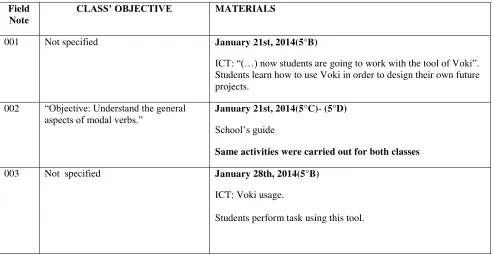
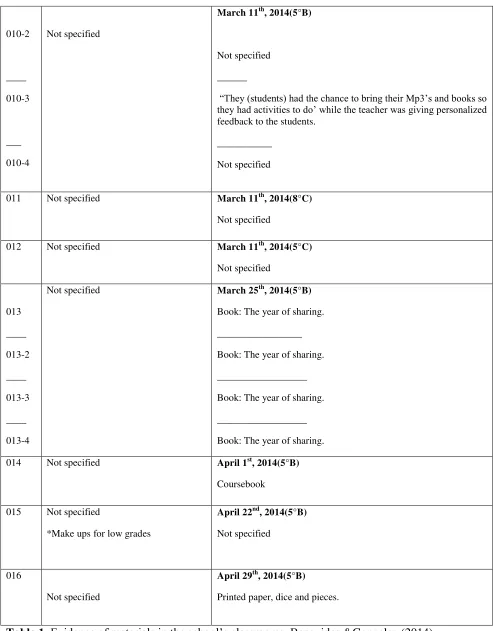
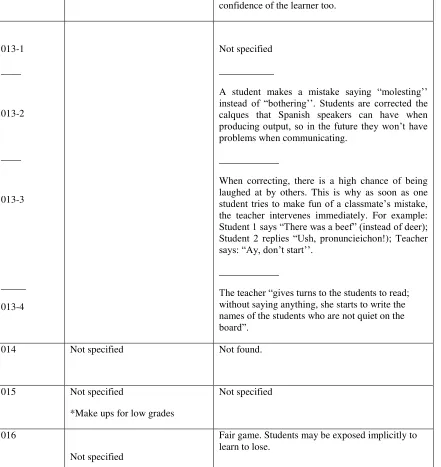
Table 1 addresses the first category of materials which was analyzed and taken into account. Thus, the following chart illustrates, with actual data from the teaching journal, those specific
aspects that could be identified in regards of the category of the materials. All the materials that
were identified in the classes were reported on the teaching journal that was being carried out by
the designers; thus, the following table shows what could be identified in terms of the materials
that were required for the classes’ development. Furthermore, the objective of the class, which
was openly shared with the students, was also reported with its respective date. The later analysis
will show some aspects that could actually be seen as problematic.
Field
Note CLASS’ OBJECTIVE MATERIALS
001 Not specified January 21st, 2014(5°B)
ICT: “(…) now students are going to work with the tool of Voki”. Students learn how to use Voki in order to design their own future projects.
002 “Objective: Understand the general
aspects of modal verbs.” January 21st, 2014(5°C)- (5°D) School’s guide
Same activities were carried out for both classes
003 Not specified January 28th, 2014(5°B)
ICT: Voki usage.
[image:15.612.67.561.345.600.2]7 004 ____ 004-2 ____ 004-3
“Objective: Modal verbs review” January 28th, 2014(5°C)
Not found
___________
Coursebook
(pg 32-33)
___________
Poster. “There is another big poster that has as a title the following: How can I help 5°C?”
005 Not specified February 18th, 2014(5°B)
Not specified/ Computer lab
006 “Objective: Understand the use of will
and be going to.” February 18
th, 2014(5°C)
Not found
007 “Objective: Review grammar topics”. February 25th, 2014(5°C)
Coursebook. Students have to read a text that is in the coursebook.
008 Objective:
“Grammar: Simple present, simple past, present progressive, present perfect, present perfect progressive, future (going to) and future (will)”
February 25th, 2014(8°C)
School’s guide
009 Not specified
*This activity was carried out by the designers.
March 4th, 2014(5°D)
Bag.
8 010-2 ____ 010-3 ___ 010-4 Not specified
March 11th, 2014(5°B)
Not specified
______
“They (students) had the chance to bring their Mp3’s and books so they had activities to do’ while the teacher was giving personalized feedback to the students.
___________
Not specified
011 Not specified March 11th, 2014(8°C)
Not specified
012 Not specified March 11th, 2014(5°C)
Not specified 013 ____ 013-2 ____ 013-3 ____ 013-4
Not specified March 25th, 2014(5°B)
Book: The year of sharing.
_________________
Book: The year of sharing.
__________________
Book: The year of sharing.
__________________
Book: The year of sharing.
014 Not specified April 1st, 2014(5°B)
Coursebook
015 Not specified
*Make ups for low grades
April 22nd, 2014(5°B)
Not specified
016
Not specified
April 29th, 2014(5°B)
[image:17.612.65.558.65.696.2]Printed paper, dice and pieces.
9
The previous table regarding materials presents different interesting aspects that can be
highlighted and used in further analysis. First of all, we can see that the table has one complete
column dedicated to mention the objective of the class. Most of the cases in which a goal is
reported, it is strongly related to grammar (field notes 002, 004, 006, 007, 008). Now the other
column accounts for some of the materials that could be identified as the main material that was
used to carry out a class, these materials ranged from printed ones provided and developed by the
teachers such as the guides (field note 002, 008), the coursebook (field note 004-2, 007 and 014),
literary books (field note 013) to virtual ones (field note 001, 003) as well as spare materials
such as extra printed papers to carry out games (field note 016 and 009).
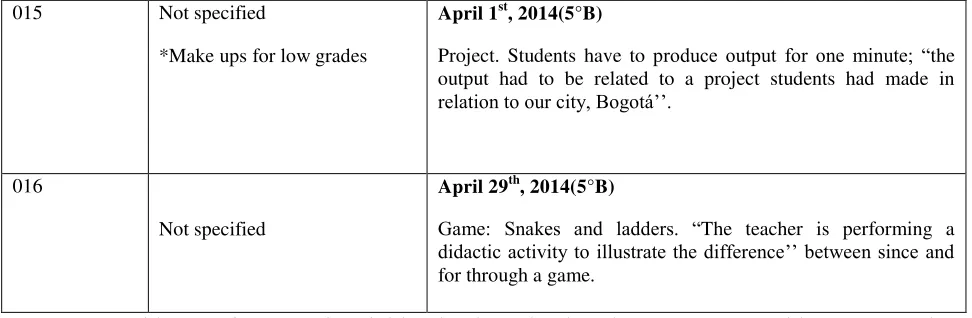
The second category that was addressed was related to the types of activities that were identified
within previous materials. You will notice that the same field notes are used as they are directly
related to them; in other words, the previously shown materials were used to carry out the types
of activities that will be illustrated next. Some of the aspects shown could also possibly be seen
as problematic in the further analysis.
Field Note CLASS OBJECTIVE TYPES OF ACTIVITIES
001 Not
specified January 21st, 2014(5°B)
Guided / Individual. “Teachers guide students through the different steps”; this is an individual work.
002 “Objective: Understand the
general aspects of modal verbs.” January 21st, 2014(5°C)- (5°D) Group:
The activity consists on “playing bingo. Students have to ask their classmates some questions (there are 24 questions)”, that include modal verbs, in order to find interesting aspects about them.
003 Not
specified January 28th, 2014(5°B)
10 004 _______ 004-2 _______ 004-3
“Objective: Modal verbs review” January 28th, 2014(5°C) Discussion:
“Teacher starts with a short discussion: How do you help others?”
____________
Reading entitled “How to create an effective poster or ad? _____________
Reflective: “...all members of the class have written suggestions to improve class performance”
005 Not specified February 18th, 2014(5°B)
Task to be performed online. 006
“Objective:
Understand the use of will and be going to.”
February 18th, 2014(5°C)
Charades: Teacher performs this activity to reward students. However at a certain point, she says “If you don’t stay quiet and seated, we are not playing charades”.
007 “Objective: Review grammar
topics”. February 25
th, 2014(5°C)
Reading comprehension
008 Objective:
“Grammar: Simple present,
simple past, present
progressive, present perfect, present perfect progressive, future (going to) and future (will)”
February 25th, 2014(8°C)
Group work.
“Teacher asks students to work in groups, everybody gathers into groups’’.
009 Not specified
*This activity was carried out by the designers.
March 4th, 2014(5°D)
11 010 _____ 010-2 ____ 010-3
Not specified March 11th, 2014(5°B)
Not specified
__________
Free. Students had the opportunity to perform whichever activity they wanted and to use their music players and books (comics, novels).
Group activities: “They (students) even get to read in groups and to share ideas with others’’
___________
Not specified
011 Not specified March 11th, 2014(8°C)
Not specified
012 Not specified Not specified
013 ____ 013-2 ____ 013-3 ____ 013-4
March 11th, 2014(5°C)
Before reading, the teacher carries a short discussion in which students summarize what has been read so far; “as she gives the chance to talk to different kids, many details can be remembered’’.
___________
Not specified
________
Peer correction (when not asked to be performed). In classrooms, students will tend to correct others when they make a mistake or an error.
____________
Reading.
Students are reading out loud the chapter, guided by the teacher.
014
Not specified
March 25th, 2014(5°B)
Guided reading: The teacher gives students turns to read an article.
12
015 Not specified
*Make ups for low grades
April 1st, 2014(5°B)
Project. Students have to produce output for one minute; “the output had to be related to a project students had made in relation to our city, Bogotá’’.
016
Not specified
April 29th, 2014(5°B)
Game: Snakes and ladders. “The teacher is performing a didactic activity to illustrate the difference’’ between since and for through a game.
Table 2. Evidence of types of activities in the school’s classrooms. Benavides & Gonzalez
(2014)
The previous chart related to class objectives and their corresponding types of activities presents
different interesting aspects that can be highlighted and used in further analysis. In a general
term, the types of activities specified whether the activities presented an individual (field note
001, 003, 005, 015) or group work (field note 002, 004, 006, 008, 013, 014, 016) activities based
on the previously mentioned and referenced in the Table 1. Apart from that, it was also delimited
what the nature of the activity was resulting in games (field note 002, 006, 016), tasks (field note
003, 005), discussion (field note 004, 013), readings (field note 004-2, 007, 013-4, 014), projects
(field note 015).
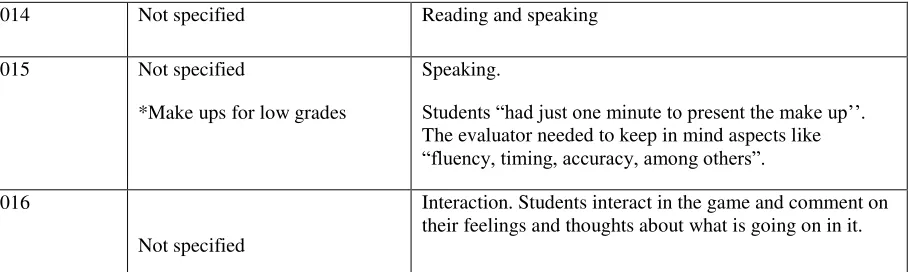
The third category that was addressed, and that will be addressed in the following table, was
related to the types of skills that were identified within previous materials and their
corresponding types of activities. You will notice that the same field notes are used as they are
directly related to the previously mentioned and shown categories exposed in the last previous
tables. Some of the aspects shown could also possibly be seen as problematic in the further
[image:21.612.63.549.71.230.2]13
Field Note CLASS’ OBJECTIVE TYPES OF SKILLS
001 Not specified Writing and speaking. When using this online tool,
students have to introduce text or to record themselves.
002
“Objective: Understand the general aspects of modal verbs.”
Speaking/Grammar
Students have to ask questions to their classmates and by doing so, teacher can get to make sure that they know how to make questions using the modal “can”.
003 Not specified Writing.
Students have to “put written speech” into the voki. 004
____
004-2
____
004-3
“Objective: Modal verbs review”
Speaking. Students “share their experiences related to donations, gifts and presents their families give to the people in need”.
____________
Reading and speaking.
Students are given turns to read and the teacher “carries out a short discussion on the reading. (…) The teacher motivates students to talk from their experiences and beliefs and that shows to have a great success”.
______________
Writing. Students have to write their own suggestions.
005 Not specified Not specified.
006 “Objective: Understand the use
of will and be going to.” Not found 007
“Objective: Review grammar topics”.
Read: Students “read technologic descriptions of future devices’’.
Listen: Students “listen to an audio recording (girl describing devices)’’.
14
008 Objective:
“Grammar: Simple present, simple past, present progressive, present perfect, present perfect progressive, future (going to) and future (will)”
Not specified
009 Not specified
*This activity was carried out by the designers.
Speaking. Students were intended to use a specific tense (modal verbs) without noticing.
010
_____
010-2
____
010-3
Not specified Informal in-class speaking.
___________
Various. There were students speaking, others reading and others listening to music.
Reading. The teacher tries to foster “reading among her students’’ as she gives them the opportunity to discover that it is fun.
____________
Not specified
011 Not specified Not specified
012
Not specified Not specified
013 ____ 013-2 ____ 013-3 _____ 013-4 Speaking.
Students are given the chance to give a summary of what they consider relevant of the story.
____________
Not specified
____________
Speaking. Students tend to correct the spoken output of their classmates.
___________
15
014 Not specified Reading and speaking
015 Not specified
*Make ups for low grades
Speaking.
Students “had just one minute to present the make up’’. The evaluator needed to keep in mind aspects like “fluency, timing, accuracy, among others”. 016
Not specified
[image:24.612.71.530.70.206.2]Interaction. Students interact in the game and comment on their feelings and thoughts about what is going on in it.
Table 3.Evidence of types of skills in the school’s classrooms. Benavides & Gonzalez (2014)
The previous date about the skills in class presents different interesting aspects that can be
highlighted and used in further analysis. Now that the materials and the types of activities have
been checked, the types of skills that were included and used in them have to be looked at, too.
Within the receptive skills of language, the listening skill was only evidenced once in the field
note 007. On the teaching journal; on the other hand, the skill of reading was evidenced in the
field note 007, 010-2 and 013-4. Now, referring to the productive skills such as speaking it was
evidenced in the field note 004, 009, 013, 013-3 and 015; in terms of writing, they were
evidenced on the field notes 003, 004-3. In the same way, some activities did not focus on only
one single skill but involved more than one; it is the case of the field note 001 which involved the
skills of writing and speaking, the field note 004-2 which involved the skills of reading and
speaking and 014 which involved reading and speaking. Finally, the free activity that was
reported in the field note 010 represented a curious case in which each student decided which
skill he/she wanted to use and practice.
Finally, the last aspect that was taken into account within this process of identification was the
one related to the values. In here, the table 4, exposed with different quotations or situations that
were related to the activities, skills and materials and that had a direct relationship with the
16
objective as it was influenced by the perception of the authors and what they could perceive in
the classes.
Field Note CLASS’ OBJECTIVE VALUES
001 Not specified Not found
002 “Objective: Understand the
general aspects of modal verbs.” “Teacher goes over the questions to find out who can do the things that are on the questions.” Students MAY get to learn how to socialize with others, accepting their differences.
003 Not specified Not found
004
____
004-1
____
004-2
“Objective: Modal verbs review”
Students MAY influence and impact others with their experiences of sharing and giving away to the people in need, giving a positive impact on others.
____________
Not found
_______________
Honesty / laborious-ness. Students MAY reflect upon those behaviors that do not let them improve their performance; they make a commitment to the class.
005 Not specified Values like independence and autonomy MAY be
worked. “This class was performed on individual work’’.
006 “Objective: Understand the use of
will and be going to.” The teacher prudence and respect as the strategy she used is of MAY want to teach the students writing “on the board the names of the students who are not quiet (she does not say anything, she just writes)’’.
007
_____
007-1
“Objective: Review grammar
topics”. Not found
___________
17
008 Objective:
“Grammar: Simple present, simple past, present progressive, present perfect, present perfect progressive, future (going to) and future (will)”
Not found.
009 Not specified
*This activity was carried out by the designers.
Giving advice is a daily activity in which people reinforce relationships with others, so in some way, students were practicing that. Empathy with others.
010
_____
010-2
____
010-3
Not specified Teacher MAY try to teach students respect as when they are speaking with their peers in a non suitable moment, she starts to write their names on the board. Students get affected by this; for example, “Pepe does as if he was crying while his name is being written on the board’’.
___________
Not specified.
____________
When giving feedback; “the teacher gives nine different grades (listening, speaking, reading, writing, grammar, interactive spot, project and final) being the last one, the behavior’’. Teacher makes comments like: “… I am worried because you are a great student and everything is good BUT behavior’’.
The teacher gives the students their “marks” (the number of times they spoke in Spanish and asks them to self grade their performance-behavior. One of the students gets to express his disagreement with this: “I have a question. Why does it affect… affect the academic part if it is behavior?” Teacher replies: “You should know that you have to speak in English and we are in the English class.
011 Not specified
Conversation teacher-student. Teacher gently asks the learner to pick up a paper that is on the floor. “This situation has nothing to deal with the academic part; however, it teaches something even more valuable’’ that is keeping the place of work clean as well as consciousness about this aspect.
012
Not specified
18 confidence of the learner too.
013-1 ____ 013-2 ____ 013-3 _____ 013-4 Not specified ___________
A student makes a mistake saying “molesting’’ instead of “bothering’’. Students are corrected the calques that Spanish speakers can have when producing output, so in the future they won’t have problems when communicating.
____________
When correcting, there is a high chance of being laughed at by others. This is why as soon as one student tries to make fun of a classmate’s mistake, the teacher intervenes immediately. For example: Student 1 says “There was a beef” (instead of deer); Student 2 replies “Ush, pronuncieichon!); Teacher says: “Ay, don’t start’’.
____________
The teacher “gives turns to the students to read; without saying anything, she starts to write the names of the students who are not quiet on the board”.
014 Not specified Not found.
015 Not specified
*Make ups for low grades
Not specified
016
Not specified
[image:27.612.70.511.72.539.2]Fair game. Students may be exposed implicitly to learn to lose.
Table 4. Evidence of values within the activities and class’ interactions. Benavides & Gonzalez
19 1.5 ANALYSIS OF THE RESULTS
Before starting with the analysis of results, it is important to remind the reader that all the
field notes were preserved throughout the different tables so the aspects that were reported
referred to the very same situation, but giving four different perspectives to the same (as seen in
the four different tables). Now, taking an overall look to the different categories of materials,
types of activities, types of skills and values, we can find that there is not a balance between
them. When looking at the category of class’ objective we can find an explicit grammar-focused
one. The fact of having a grammar-focused class objective can actually inhibit communication
and predispose the student to learn and memorize certain linguistic content in order to solve
certain given exercises, but not to apply them in their actual language use. The materials category
is not constant as there is not an exploitation of the high potential that some of the used materials
can get to have in the classes. Furthermore, it was evident in the different occasions in which
there was a lack of material to be used and the few occasions (just three reported on the field
notes 004-1, 007 and 014 in Table 1) that the coursebook was used by the students. On the other
hand, the category of types of activities is rich as it includes both group and individual work; as
well, as interactive and didactic activities. Finally, there is not an explicit axis of values (that
would definitely be of interest of the school as they intend to teach on values) within the
activities that are proposed in class; however, some situations were taken into account within this
field as they might reflect the effort of the teacher to possibly teach contents related to certain
values, in a non-conventional or implicit way.
When taking a detailed look at the previous tables and the practices that are evidenced in
there, one can find some aspects that need to be taken into account. One of the first aspects that
20
taught, according to what was observed, the students are exposed right at the beginning of the
lesson to an explicit grammatical objective, that they have to write on their notebooks and which
will set the path that the class will follow (e.g. field notes 002, 004, 006, 007 and 008 in Table
1).
Furthermore, this may not make students feel that there is a relationship between what
they are taught and real life context where communication can take place. Another aspect of
relevance has to deal with the value that respect (field notes 002, 006, 009 and 013-3 in Table 4)
as well as behavior (field note 006, 010-1 and 010-3 in Table 4) gain in the classroom. Now, the
evidence shows that the teacher being referenced believes that behavior is a really important
aspect that needs to be graded, even when students do not feel that it makes part of the academic
activities (field note 010-3 in Table 4); this one is also influenced by the language use (that is not
related to behavior at all), which gets relevance in the final grade students get. Probably, one of
the main aspects that we get to retrieve from the field notes is the always present “hall of talkers’’
(field notes 006, 010-1 and 013-4 in Table 4), another strategy used by the teacher to keep the
order and control of the classroom; in here, the names of the students who do not remain quiet or
who start to speak in Spanish end up being written on the board; exposing those students to the
rest of the class and leaving a bad mark (negative point) on the grades’ sheet.
Respect can also be evidenced on the peer correction processes that students make to their
classmates (field note 013-3 in all Tables). The teacher is aware of the negative effect that
making fun of the mistakes that other classmates make can get to cause on them as that probably
lowers the self-esteem of the student being mocked and can get to inhibit the learner’s future participation in class; furthermore, the immediate response and the attention being brought
towards this situation by the teacher is clearly evidenced and referenced. Another aspect to take
21
note 006 in all Tables); she tries to reward the students by letting them play a game or having a
fun activity only if they behave well during the class. In this sense, the evidence shows that
students get motivation from the prizes, extra points, games or activities that they can get to have
(field note 007-1 in all Tables).
1.6 THE COURSEBOOK
When we take a look at the content that each one of the categories have, we can see that
there is a clear unbalance among them. Some categories, like the one of material, evidence some
problems that need to be looked at. In order to find extra information about this matter both, two
fifth grade English teachers and some students were inquired, in informal conversations that were
recorded, about the perceptions, feelings and thoughts they had on the coursebook.
In an informal conversation that was recorded and that took place on May 6th of 2014, the
first teacher (referenced as Teacher 1), stated the following when she was inquired about the
coursebook students have. “I hate it with all my heart! I hate it because this school has a certain
level, right? And the book is very low for the level that students have in here. It is not that
students know everything but the book and the type of exercises are very low. It is not that the
students know everything; they don’t know everything but that book and the type of exercises are
very low. (...) Now, I don’t take this book as THE BOOK, right? That is a material, an extra work
that does not work as it should, with my students. Thus, the coursebook is not the way I am
teaching my students so I always have to design things. (...) In terms of content, I hate it too!
Well, the book is nice but it does not work for this school. I guess it would work in public
schools, schools that have lower level. (...) The kind of vocabulary, the complexity of activities,
the type of grammar that is used in there (is very low).
22
Furthermore, when a second teacher (referenced as Teacher 2) was inquired about the
same matter on a recorded informal conversation that took place on April 29th of 2014, she stated
that the last book they used to have the previous year “was better equipped for their needs so the
readings, the vocabulary, the grammar component were very good; but this one, is very basic. I
mean, yes it has some stuff but as you have seen they finish the activities like this (snapping
fingers), they are not asked to think, to analyze and to put themselves in other contexts… The book is too easy!” When the teacher was asked about the possibility of changing the book, she
answered: “Since this is the book they are using back in elementary school, from 1st to 4th (grade)
so that meant that we had to use it too but we do not like it. We both know that at the end of the
year, when we talk about the books and the materials and everything we do not want this. (...) I
do not think so… (referring to the possibility of changing books the next year) I believe we will have to keep working with this one next year and next year too but yes that’s what happens with
this book. However, I do like the online platform of the book because we can take the kids to the
computer lab but just because of that…”
(To check the full interview, please refer to Annex 2 at the end of this document.)
Now, the teachers were not the only ones that expressed unconformity with the
coursebook; the students also evidenced the same feeling. The answers that were given by three
students really caught our attention as they reflected a strong dissatisfaction with the book;
below, those three answers will be shown.
The same question was made to all three students: “Hi XXX (name of the student). I want
to ask you a question. I want you to tell me what you think about the XXX (name of the book that
23 readings and nothing fun. I just like the stickers it have at the end.” The Student 2 responded: “It
is the same that we use in elementary so it is no new. It is a little boring so we always use the
guides that the Miss gives to practice the topics.” The Student 3 answered: “Well, we do not use
it. Just like one or three times in the year... I think we don’t have to buy it.” (To check the full interview, please refer to Annex 3 at the end of this document.)
Now, according to all the evidence that has been shown related to the teachers and
students’ perceptions we can argue that there is definitely a problem that needs to be addressed.
Both students and teachers agree on the fact that the coursebook that has been chosen does not
fulfill or even address the needs of the target audience. As the coursebook does not even respond
to the level of complexity that the students demand and as the school is not likely to change it in
the near future, the workload of the teachers increases as they have to create extra material to
cover all the different gaps that the book has.
Right at this point there is a
1.7 CONCLUSION
Taking into account the sixteen different observations (plus the other made throughout the
6 months of observation), and their classification in individual charts as well as the informal
conversations with the teachers and students, we can argue that there is an urgent need to address
in this context. First of all, there is not a balance within the elements that could be identified in
the classes, giving more attention to aspects such as the grammar input that students have and
leaving aside other important categories like values or even materials. Furthermore, the lesson
would be even more appealing to both the institution and students if they could include social
responsibility elements, such as values, within the materials that serve as the core of the lessons
24 situations through which teach the course’s topics where the grammar component is not explicitly
taught and on the other hand, schools could take advantage of the same situation to instruct at the
same time on the language and on the school social and behavioral goals. We believe that we can
achieve this balance by proposing a more communicative and accurate material that appeals to
the multi-dimensional area of the students as well as the values that, as it will be seen later, the
school tries to foster.
On the other hand, keeping the actual model that the school follows may represent a
heavier workload on the teachers as they have to dedicate more time to prepare their own
materials for the lessons; finding ways to cover the lacks that the coursebook presents.
Furthermore, buying a coursebook, which is not cheap in our society, becomes a real problem
when it is only used a couple of times during the terms and academic year. The economic
resources dedicated to the purchase of the book could actually be invested in other types of
materials that can support the learning process of the students in a better way.
At this point, we realize that probably the main need of this population is that of finding a
solution to the problem that has been caused by a coursebook, the school needs a material that
involves and addresses the environment they have, their English level as well as the needs and
interests that the students and teachers have. Because of the amount of time that we have to carry
out this practice-based project, it is not possible for us to develop a complete coursebook that
replaces the existing material; we cannot even get to implement and test the material with the
actual students either. However, we are going to develop a short and concise complementary
module that addresses and faces the problems that have been exposed in this chapter. Finally, our
general goal and objective is to design a complementary didactic material with a
multi-dimensional approach for teaching values and English to students of a private school located in
25 CHAPTER 2: IS ANYBODY CRAZY ENOUGH TO DO SOMETHING SIMILAR?
2.1 INTRODUCTION
If we review what has been done so far throughout this project, we can find that some
specific needs, that need to be addressed, have already been delimited; plus, a teaching approach
has also been chosen to cover, through the use of the material, those identified needs and
problematic facts. Now, it is time to question ourselves about the path that will be followed to do
so. It is here where the second stage that is proposed within the materials writing framework
established by Jolly and Bolitho (1998), and known as the Exploration stage, is introduced.
According to the authors, this stage involves the “exploration of the area of need/problem in
terms of what language, what meanings, what functions, what skills, etc.” (Jolly & Bolitho, 1998:
97). When talking about the exploration stage, it is necessary to revise or better yet, explore the
samples of theoretical and practical literature concerning the field we are about to face;
furthermore, it is vital to find out whether a project like the one that is being proposed in this
practice-research project has been already developed or not under the same or similar
circumstances. In addition, it is necessary to check if the needs we are about to face have also
been fulfilled by using the teaching method we will implement and to identify if that has already
been done locally (our university, hometown and country) and/or internationally.
In other words, the exploration stage allows us, the designers, to find out to what extend
the field of study has been researched and discovered. Not only does it unveil the status of the
field of study and method that has been chosen, but also it allows the designers to look at actual
samples that have already been developed. In this specific context in which a fairly new
approach was taken and is intended to be applied into a real teaching material, by merely looking
at the theory and the principles that have been developed, this stage is of great use and help as it
26
exploration helps the designers to have a general and global view of how the research field has
been explored (taking into account the already discovered needs, the target audience and the
method). For instance, in this practice-based project we have tried to find some previous studies
that are related to the field of Materials Development in English, language teaching-learning and
education in values within the frame of the Multi-dimensional Approach.
2.2 EXPLORATION
To begin with, it is well known that English is probably one of the main languages that
people tend to learn in Colombia; government projects and reforms such as “Colombia Very
Well’’ (2015) and other projects that intend to form a future bilingual country support this idea.
As it was mentioned before, as years pass by research on the field of language teaching unveils
new possibilities, in the shape of methods and approaches, that can be implemented to, according
to the theory, teach in a more successful way a language. The so called, traditional methods are
put under the spot, revalidating their effectiveness and extent of success. However, “traditional”
methods still prevail in many parts of the world, and the benefits of an emphasis on
communication are widely accepted in principle by professionals everywhere’’ (Bax; 2003.
278).That is why, the Multi-dimensional Approach shows itself as a revolution in teaching as
according to its creator, Brian Tomlinson (2003;168), it allows an “effective and durable
learning’’. Before continuing, it is imperative to reiterate that our aim is not to invalidate other
foreign language methods, but to show another option that could probably work in the second
language classroom.
Now, the research trajectory that materials development has is vast in both, the
27 (1996) in her doctoral thesis “ Elaboración de materiales didàcticos en lengua inglesa: el caso de los formadores de profesores de educación primaria en España”, critics coursebooks in the sense
that they hold the information to be taught; furthermore, her research encompasses the following
aspects: the unidirectional treatment of contents, the way knowledge is presented as something
that is complete and without the possibility of being questioned. This is probably one of the main
critics that we can make to the traditional method which according to Arcos Checa (2006) it is
based on translation, grammar based on the conscious and deductive study of its rules, over all it
is a learning process guided by memory and decontextualized as an mental exercise”1. The material, as it is going to be seen later, does not let students have communicative interaction with
the language; that is why, materials, teachers and students have to be put at the same level, in a
way in which they can carry out a constant dialogue between them that enables a participative
and active role of all three elements (materials, teachers and students) that can actually get to
produce valuable lessons and learning experiences in which one can learn from the other. In this
sense, developing a material within the multi-dimensional approach gets value as it will involve
and address the whole subject, positively impacting the student and leaving a long-lasting
knowledge as they get to internalize what they have experienced.
Furthermore, when we take a look at our target audience, the students of English in the
chosen private school, we find some interesting aspects to reflect upon. The learning and teaching
environment has to be guided by the coursebook. Thus, the workload of teachers gets heavier as
they have to create extra materials such as guides or create in-class activities out of the blue that
can get to cover the topics and aspects that the coursebook lacks as they do not have contact with
what could be considered real or authentic language nor communicative input (as the register that
is spoken on daily basis is not included).
1
28
Second of all and related to the second language teaching area in the doctoral thesis
“English Textbooks for Teaching and Learning English as a Foreign Language: Do They Really
Help to Develop Communicative Competence?” published in 2010, its author Luis Fernando
Gómez Rodríguez exposes his main objective of determining, in five different textbooks used in
Colombia, the authenticity and the degree to which they develop the communicative competence.
After doing so, the author was able to conclude his whole research on three solid facts. The first
one is that the communicative practice that the textbooks offer is lower than the meaningful and
mechanical practices. Secondly, that there is a more grammar-oriented than skill-based approach;
and lastly, that these textbooks focus on formats that do not reflect authentic tasks, and that they
should implement more memorable and meaningful tasks for learners in the real life. To
conclude, it is relevant to take this research into account as it supports the fact that the target
audience has to deal with a material that is not suitable for the students nor the teachers, leaving
behind a significant learning based on authentic interaction.
Then, in the doctoral research “Materiales Didácticos para la Enseñanza del Inglés en Ciencias de la Educación” published in 2001 by Daniel Madrid its author reviewed the principal
functions of English teaching materials and their importance in the teaching and learning
processes, and as mediators between teachers, learners and real life. Thus, the author analyzes
some basic roles of English teaching aids and their contribution to learning processes. Also, he
presents some guidelines and criteria that materials designer should take into account for the
selection and elaboration of materials, this following the researches of LittleJonh and Windeatt
(1989), and Breen and Candlin (1981). To finish, he gives a special emphasis to Stern’s model
(1989, 1992) as a framework, not only for teaching and learning, but also for teaching materials
selection and design. This study is relevant to our practice-based project because even when the
29 and Windeatt’s model which will allow us to select, analyze and design our material taking into
account the criterion that we find relevant as well as the values and attitudes that materials and
instruction should reflect. It also encompasses the fact of learning how to learn.
To begin with values, the article “Teaching Values: avatars of the Official Curriculum, the Hidden Curriculum and Teaching across the curriculum” published in 2005 by Ángel Díaz
Barriga examines and analyzes at the same time how the formation of values goes beyond the
cognitive and how it is linked to the dynamics of the affective dimension, requiring not only the
rational knowledge of principles and norms, but also the grounding of this in attitudes. For this
reason, the author could conclude that it is important to remark the problems that values have in
education, and that its social reality goes beyond the classroom, which is related to the affective
domain. This article is useful for our project because the author analyses the values and
perspectives according to the complexity of the affect. In this case, the author did a relationship
between values and affection, so as our material is intended to cover the affective dimension that
will help students to reflect about their own learning and their classmates learning, using values
as a mean to develop empathy with others and a meaningful learning, where each one can find
their own learning way related to affection and the multi-dimensional approach.
In the sourcebook “Values Education’’ (1989) by Douglas Superka, Christine Ahrens and
Judith Hedstrom show a conceptual analysis of what materials should include in values. Then,
they propose some questions about the approach that is used in each material to transmit values.
However, this book is quite old, and it does not make reference to approaches like the
multi-dimensional one. Nonetheless, this sourcebook can be useful for our project because of the
suggestions that the sourcebook provides about the importance that values has into the
educational field as a way to reinforce the personal skills of the students; in other words, this
30
well as their cognitive field, solving daily problems that they and their partners can get to face,
and putting them in other’s shoes to foster a better development in their emotional intelligence. 2
When taking a look at the different research projects that have been carried out in the
Javeriana University, we could realize that the majority of the ones that are related to a teaching
method or approach are made in order to reinforce the students’ learning towards a specific
language skill, such as listening, reading, speaking or writing. The thesis “Diseño de material de
auto-acceso para la práctica de la comprensión auditiva en ELE para estudiantes del centro
Lationamericano de la PUJ” (Development of a self-access material for the practice of listening
comprehension of ELE students from the Latinamerican Center of the Javeriana University),
developed by Andrés Bernal and Óscar Garzón (2013) poses an example. This thesis followed the
principles proposed by Tomlinson (2012) to develop a material as well as the methodological
route proposed by Bolitho and Jolly (2011) to the materials design, which allowed them to come
out with a series of four different podcasts as well as activities sets that students could use to
improve their listening comprehension on their own. This proved to be efficient for the students.
This research project is the methodological closest one to our actual practice-based project as
they share some of the theoretical aspects the framework for materials writing proposed by Jolly
D. and Bolitho R. in Tomlinson (2011) and concerns that are included within the field of materials
development in terms of the fact of addressing identified problems that this field addresses.
Another thesis that we could find in the database of the university and that has to deal
with the materials development ends up focusing on the material itself being the audiovisual
material the chosen one. “Diseño de una unidad didáctica modelo para enseñar lenguaje
2
31
académico a los estudiantes del centro latinoamericano de la PUJ, a partir de material
audiovisual” (Materials design of a model for a didactic module that teaches academic language
to students of the Latin-American Centre of the Javeriana University, through audiovisual
material) written by Angela Pinto and Yuri Zambrano (2009). This research project proposes a
lesson in which elements such as short videos, images, icons and appealing colors work along to
foster students’ motivation, reflexive attitude and learning aimed to develop skills on academic
language in all the different language skills. Even though, this research project proposes a
material fulfilling specific needs, is not directly related to a clear teaching method or approach
and it is not aimed to prove the efficiency of a method. The study concludes with an invitation to
deepen the research on the didactic materials field in which this project can contribute to the
importance that teachers should create their own language material to improve their student’s language learning.
2.3 CONCLUSION
To start, it is important to remark that this practice-based project is intended to one
specific line of research, proposed by the university, and that is “Lenguajes, aprendizajes y
enseñanzas’’ (languages, learnings and teachings). This line of research tries to find the
relationships between language, teaching and learning. Consequently, one of the thematic axis in
this line is the materials development, processes and outcomes for learning and teaching; thus,
this research is relevant for the learning as well as the teaching processes because as future
language teachers -in this case of English- we know more than anyone the needs that our students
have, and we can solve them with materials that help them to make sense of the language
32
Furthermore, knowing the different teaching methods is a must for teachers as depending
on their students, the goal of the school as well as the lesson, and the personal features of the
teacher there is going to be some methods that would be more suitable for the lessons than others.
Furthermore, a teacher has to always be prepared to create new materials either to complement
his/her lessons, to fulfill any gaps that the school’s materials may have or as the plan B of a class
that has been developed in a shorter time than it was expected. We, teachers, have to be prepared
for using our skills on developing and adapting materials as we never know when they will be of
help.
Finally, we can contribute to the field of study of materials development and we can
encourage others to research on this very same topic. In addition, this research is relevant because
it brings light to the possible and theoretical effectiveness of a relatively new teaching method,
without mentioning that it tries to involve the social responsibility that we as teachers have to
educate human beings. Values, in this sense, should not be seen as a mere formal affair of social
content, but also as something that has to be included within the classrooms, materials, methods
and the whole educational system. Thus, this study affects in a positive way the society because
we attempt to give the importance that values, affection and cognitive development are needed
33 CHAPTER 3: LET’S TEXT…
3.1 INTRODUCTION
Now, that we already have the identification and the exploration of our practice-based
project, it is time to go with the third stage. The third stage that is proposed within the framework
of Jolly and Bolitho (1998; 97) is that of Contextual Realization and according to the researchers,
this stage demands a “contextual realization of the proposed new materials by the finding of
suitable ideas, contexts or texts with which to work’’. However, before going with the material
itself, it is relevant to go over the theory behind it. Our practice-based project will not produce a
material for language teaching out of the blue. As it has already been mentioned, we are working
with an approach that is fairly new and does not have a vast literature nor easy-access samples to
look at and use as a reference; this is why the theoretical review is so important as it will guide
and delimit the process of the development of the material in here presented. Research on the
method as well as the steps that will be followed have to be revised in order to come out with a
theory-based product that faithfully follows what has been stated.
3.2 CONTEXTUAL REALIZATION
As it has been mentioned before, the process of developing materials for language
learning should not be taken for granted; behind every textbook and module there is a whole
process that involves the revision of theory related to a specific teaching method that has been
chosen in advance and that has to be taken into account and even included in the designing
process. In order to unveil the different parameters, principles and guidelines that have to be
taken into account prior the later and imminent physical production of our material, fields like the