ECONOMIC
VALUATION
OF WETLANDS
A GUIDE FOR POLICYMAKERS AND PLANNERS
BY EDWARD B BARBIER MIKE ACREMAN AND DUNCAN KNOWLER
RAMSAR CONVENTION BUREAU
DEPARTMENT OF ENVIRONMENTAL ECONOMICS AND ENVIRONMENTAL MANAGEMENT, UNIVERSITY OF YORK INSTITUTE OF HYDROLOGY
Economic valuation of wetlands
A guide for policy makers and planners
Edward B Barbier, Mike Acreman and Duncan Knowler
Ramsar Convention Bureau Gland, Switzerland
1997
Dr Barbier and Mr Knowler are respectively Reader and Research Associate in the Department of Environmental Economics and Environmental Management, University of York, UK.
Copyright © Ramsar Convention Bureau, 1997. Published by the Ramsar Convention Bureau, Gland, Switzerland, with financial support from the United Kingdom Department of the Environment and the Swedish International Development Cooperation Agency.
Prepared in collaboration with the Department of Environmental Economics and Environmental Management of the University of York, the Institute of Hydrology, and IUCN-The World Conservation Union.
Reproduction of this publication for educational and other non-commercial purposes is authorised, indeed encouraged, without prior permission from the copyright holder, providing that full acknowledgement is given. Reproduction for resale or other commercial purposes is prohibited without the prior written permission of the copyright holder.
Note: The designation of geographical entities in this book, and the presenta-tion of the material, do not imply the expression of any opinion whatsoever on the part of the Ramsar Convention Bureau concerning the legal status of any country, territory, or area, or of its authorities, or concerning the delimitation of its frontiers or boundaries.
The opinions expressed by the authors in this publication do not necessarily represent the views of the Ramsar Convention Bureau, the University of York, the Institute of Hydrology, or IUCN.
Citation: Barbier, E. B., Acreman, M. C. and Knowler, D. 1997. Economic valuation of wetlands: A guide for policy makers and planners. Ramsar Con-vention Bureau, Gland, Switzerland.
ISBN 2-940073-21-X
Cover design: L’IV Communications S.A., 1110 Morges, Switzerland Editing and layout: Ramsar Convention Bureau, 1196 Gland, Switzerland Printed by Imprimerie Dupuis S.A., 1348 Le Brassus, Switzerland
Available from: Ramsar Convention Bureau Rue Mauverney 28, 1196 Gland, Switzerland Fax: ++41 22 999 0169, e-mail: [email protected] or
IUCN Publications Services Unit
Contents
Acknowledgements ...….. v
Foreword ...…... vi
Preface ...…... vii
Executive summary ...…... ix
1. Background to the global wetlands management problem 1 1.1 Definition of wetlands...……... 1
1.2 Types of wetland...…...…... 2
1.3 Importance of wetlands...…... 2
1.4 Wetland loss...…... 4
1.5 The role of Ramsar in wetland conservation...…...… 7
2. Why valuation?... 10
2.1 The role of economic valuation in decision-making….…10 2.2 The economic values of wetlands...……... 14
2.3 Why wetland resources and systems are undervalued in development decisions...…...… 17
2.4 Why valuation matters to Ramsar...…... 21
3. An appraisal framework for wetland valuation...…... 22
3.1 Stage one: defining the problem and assessment approach ...…… 26
3.2 Stage two: defining the scope and limits of the valuation and information needs ...…... 34
3.3 Stage three: defining data collection methods and valuation techniques required for the economic appraisal...…...….. 40
4. Valuation in practice ...…...…. 47
4.1 Hadejia-Nguru floodplain in Northern Nigeria...………48
4.2 Valuing prairie wetlands in North America: application of a bioeconomic model...… 52
4.5 Valuing coastal wetlands in the southeast USA ...… 69
4.6 Valuation and mangrove conservation in Indonesia...…. 75
4.7 Conclusions from the case studies ...…...… 79
5. Guidance Notes: the practicalities of planning and conducting a valuation study...………. 81
5.1 A step by step guide to undertaking a valuation study .. 81
5.2 Resources required for a valuation study ...…. 86
5.3 The valuation study team and sample Terms of Reference ...… 90
5.4 Non-economic factors ...… 92
5.5 Conservation of rare species ...…. 93
6. Recommendations...… 95
6.1 Economic valuation studies...…. 95
6.2 Interdisciplinary collaboration ...….. 95
6.3 Training and institutional capacity building ...…… 96
6.4 Research...…. 96
6.5 Networking... 97
7. Glossary...… 98
8. Sources and further reading ... 102
Appendices 1. Wetland components, functions and attributes and their human uses ... 112
2. Comparison of economic appraisal methods...…. 120
Acknowledgements
Funding for this work was provided by the United Kingdom Department of the Environment and the Swedish International Development Cooperation Agency (Sida).
The concept for the book was developed by Dr Mike Acreman when he was with the IUCN Wetlands Programme (now part of the Ecosystem Management Group) which is led by Dr Jean-Yves Pirot.
A database of wetland valuation studies was established and initial ideas for the table of contents were proposed by Michele Beetham from the Department of Environmental Economics and Environmental Manage-ment at the University of York, while she was on placeManage-ment with IUCN.
Comments on drafts of the text were provided by many individual specialists, especially Professor Kerry Turner (Centre for Social and Economic Research on the Global Environment, UK), Torsten Larsson (Swedish Environmental Protection Agency), Dr Robert K Davis (Ohio State University, USA), Dr Vilma Carande (Colorado State University, USA), Francis Grey (Australian Nature Conservation Agency), Dr Maria Zaccagnini (National Institute of Agricultural Technology, Argentina), various staff of IUCN (especially Frank Vorhies), the Ramsar Bureau, the UK Department of the Environment, the Department of Environmental Economics and Environmental Management at the University of York, UK and the Institute of Hydrology, UK.
Professor Kerry Turner and Gayatri Acharya (Department of Environ-mental Economics and EnvironEnviron-mental Management, University of York) provided new information on the costs of undertaking valuation studies.
Foreword
This publication contains much helpful information on various economic techniques that are available by which to value wetland areas. The Guide draws out the importance of weighing the advantages to be obtained by development with the damage which that development may do to wetlands.
The Guide is the result of considerable cooperation between scientists and economists, and I hope that it will be carefully studied as its primary purpose is that it should be practical.
Rt Hon the Earl Ferrers, Minister of State for the Environment and Countryside
United Kingdom
Preface
Today, most planning and development decisions are made on economic grounds and, more and more, on the basis of the forces at play in the free-market system. While this new paradigm has its own limitations and dangers, it would be unrealistic to ignore it and to base our quest for the conservation and wise use of wetlands on a completely different set of values. Hence, wetland goods and services must be given a quantita-tive value if their conservation is to be chosen over alternaquantita-tive uses of the land itself or the water which feeds the wetlands.
For many products, such as fish or timber, there is a world market which allows easy calculation of the worth of the wetland. The value of wet-land functions, such as water quality improvement, may be calculated from the cost of building a treatment works to perform the same processes. It is much more difficult, however, to value biodiversity or the aesthetic beauty of wetlands, as the market for such “products” is much more elusive and their economic valuation much more difficult to achieve with traditional methods. Another major hurdle is that developing countries face significant problems in appropriating the global benefits of wetland conservation, such as their biological diver-sity (Pearce & Moran, 1994). Consequently, new means of appropria-tion must be developed and added to.
At its meeting in Brisbane, Australia, in March 1996, the Conference of the Parties to the Convention on Wetlands approved a Strategic Plan that recognises the importance and urgency of carrying forward the work in the area of economic valuation of wetlands. According to Operational Objective 2.4 of the Strategic Plan, the Ramsar Convention will promote the economic valuation of wetland benefits and functions through dissemination of valuation methods. This book sets out to provide guidance to policy makers and planners on what the potential is for economic valuation of wetlands and how valuation studies can be undertaken. Since it is not expected that policy makers will undertake the valuation work themselves, guidance on planning a study and outline Terms of Reference for technical consultants are provided as well.
malaria and schistosomiasis. Indeed it is this view of wetlands as wastelands that has led to extensive drainage and conversion of wetlands for intensive agriculture, fish ponds, industrial or residential land or to improve public health. However, in recent years there has been increasing awareness of the fact that natural wetlands provide free of charge many valuable functions (e.g., flood alleviation, groundwater recharge, retention of pollutants), products (e.g., fish, fuelwood, timber, rich sediments used for agriculture in the floodplains, tourist attractions), and attributes (biodiversity, aesthetic beauty, cultural heritage and archaeology).
The trend towards wetland conservation is exemplified by the many countries that have adopted the policy that there should be no further wetland loss or degradation, that wetlands must be used in a sustainable way and research should be undertaken on quantifying wetland values. International mechanisms and institutions, such as the Ramsar Conven-tion on Wetlands, the ConvenConven-tion on Biological Diversity, the UN Commission on Sustainable Development, OECD, IUCN-The World Conservation Union, Wetlands International and WWF are promoting research, analysis and dissemination of information on economic valua-tion of natural systems, including wetlands. They advise that decision-makers should fully consider the social benefits of natural ecosystems as well as those of the development proposals being considered and that they should make full use of the available techniques for accurately expressing resource benefits in economic terms.
It is important to stress that economic valuation is not a panacea for all decisions, that it represents just one input into the decision-making process, along with important political, social, cultural and other considerations. The goal of this text is to assist planners and decision-makers in increasing the input from economic valuation in order to take the best possible road towards a sustainable future.
Delmar Blasco Secretary General
Executive summary
The aim of this book is to provide guidance to policy makers and planners on the potential for economic valuation of wetlands and how such valuation studies should be conducted. Although a number of economic valuation studies of wetlands have been undertaken around the world and economists have developed methodologies for valuing more intangible aspects of the environment, such as amenity or aesthetic factors, no one has synthesised from this literature a common approach to show its overall usefulness to wetland management worldwide. Consequently, this book provides details of the various techniques and examples of wetland valuation studies together with guidance on planning and managing a study and putting the result into a wider decision-making framework.
Wetlands are amongst the Earth’s most productive ecosystems. They have been described both as “the kidneys of the landscape”, because of the functions they perform in the hydrological and chemical cycles, and as “biological supermarkets” because of the extensive food webs and rich biodiversity they support. In Chapter 1, the features of the system are grouped into components (soil, water, plants and animals), functions (nutrient cycling and groundwater recharge) and attributes (biological diversity). Historically, many wetlands have been treated as wastelands and drained or otherwise degraded. The Ramsar Convention on Wet-lands of International Importance was created to promote the con-servation of wetlands and their wise use and management.
In Chapter 3, an appraisal framework is developed for assessing the net economic benefits of various wetland use options. Stage one of the framework involves determining the overall objective or problem and choosing the correct economic assessment approach from three broad categories, i.e., impact analysis, partial valuation or total valuation. Stage two requires definition of the scope and limits of the analysis and the information required for the chosen assessment approach. Stage three necessitates determining the evaluation techniques and data collection methods required for the economic appraisal including any analysis of distributional impacts.
To guide the policy maker on how to undertake a wetland valuation study, six examples are given in Chapter 4. These are: the Hadejia-Nguru floodplain in northern Nigeria; prairie wetlands in North America; the Norfolk Broads and Scottish flow country in the UK; nitrogen abatement using Swedish wetlands; coastal wetlands in southeastern USA and mangrove conservation in Indonesia. These case studies provide practical demonstrations of the use of various valuation methods in the field, in different types of wetlands, using a range of valuation methods and covering diverse geographical areas. Although their coverage cannot be claimed as exhaustive, several observations emerge from reviewing these studies. First, the importance of integrating ecological and economic approaches is critical, especially when the valuation of ecological functions is the objective. This requires more than complex mathematical techniques, but extends to continual collaboration between economists and ecologists. The studies also demonstrate that valuation should not be conceived of as an end in itself, but needs to be directed towards some policy issue. These issues may range from simply raising awareness of the importance of wetlands to choices among alternatives to meet some stated policy goal, with protecting wetlands representing just one option.
appropriate framework (e.g., cost-benefit analysis). Guidance is also given on resources needed and on compiling Terms of Reference for technical consultants using a fictitious example of a floodplain in Africa. In addition, emphasis is placed upon the need to consider other factors (political, social, historical or ecological), which may be considered alongside the economic valuation results when a decision is being made. Finally, an alternative methodology for decision-making is presented where rare species are at risk.
In Chapter 6, recommendations are made for future actions. These highlight the need to: undertake site-specific economic valuation studies; ensure appropriate interdisciplinary collaboration; provide training and institutional capacity building; undertake research on economic valuation theory and practice; and establish networks for the exchange of ideas and experience of applying valuation methods.
1. Background to the global wetlands
management problem
1.1 Definition of wetlands
It is clear, when you are up to your knees in mud in a backwater swamp in Zambia, that it is truly a wetland. But trying to draw experiences together to provide a precise definition of wetlands is fraught with controversy and difficulty, because of the enormous variety of wetland types and the problems of defining their boundaries. For example, how often and for how long does land have to be flooded before it is considered a wetland? The problems are compounded by the fact that many wetlands evolve over time, starting as open water, but infilling with sediment and vegetation eventually to become dry land. Nevertheless, wetlands certainly occupy the transitional zones between permanently wet and generally dry environments – they share characteristics of both environments yet cannot be classified unambiguously as either aquatic or terrestrial. The key is the presence of water for some significant period of time, which changes the soils, the microorganisms and the plant and animal communities, such that the land functions in a different way from either aquatic or dry habitats.
Fortunately, some pragmatic help is at hand. Some 100 countries have adopted a definition by signing the Ramsar Convention on Wetlands of International Importance (see section 1.5). The Convention adopts an extremely broad approach in determining the ‘wetlands’ which come under its aegis. In the text of the Convention (Article 1.1), wetlands are defined as:
“areas of marsh, fen, peatland or water, whether natural or artificial, permanent or temporary, with water that is static or flowing, fresh, brackish or salt, including areas of marine water, the depth of which at low tide does not exceed six metres”
“may incorporate riparian and coastal zones adjacent to the wetlands, and islands or bodies of marine water deeper than six metres at low tide lying within the wetlands”
As a result of these provisions, the coverage of the Convention extends to a wide variety of habitat types, including rivers, shallow coastal waters and even coral reefs, but not deep sea.
1.2 Types of wetland
In trying to categorise the wide range of wetlands encompassed by the Ramsar definition, Scott (1989) defined 30 groups of natural wetlands and nine manmade ones. However, for illustrative purposes it is possible to identify five broad wetland systems:
• estuaries – where rivers meet the sea and salinity is
intermediate between salt and freshwater (e.g., deltas, mudflats, salt marshes)
• marine – not influenced by river flows (e.g., shorelines and coral reefs)
• riverine – land periodically inundated by river overtopping (e.g., water meadows, flooded forests, oxbow lakes)
• palustrine – where there is more or less permanent water (e.g., papyrus swamp, marshes, fen)
• lacustrine – areas of permanent water with little flow (e.g., ponds, kettle lakes, volcanic crater lakes)
1.3 Importance of wetlands
nurtured the great civilisations of history. These wetlands pro-vided fish, drinking water, pasture land and transport and were part of the cultural history of early people, being a central element of mythology, art and religion.
As scientific understanding of wetlands has increased, more subtle goods and services have become apparent. Wetlands have been described both as “the kidneys of the landscape”, because of the functions they can perform in the hydrological and chemical cycles, and as “biological supermarkets” because of the extensive food webs and rich biodiversity they support (Mitsch & Gosselink, 1993).
Wetlands are among the Earth’s most productive ecosystems. The features of the system may be grouped into components, functions and attributes. The components of the system are the biotic and non-biotic features which include the soil, water, plants and animals. The interactions between the components express them-selves as functions, including nutrient cycling and exchange of water between the surface and the groundwater and the surface and the atmosphere. The system also has attributes, such as the diversity of species.
Wetland systems directly support millions of people and provide goods and services to the world outside the wetland. People use wetland soils for agriculture, they catch wetland fish to eat, they cut wetland trees for timber and fuelwood and wetland reeds to make mats and to thatch roofs. Direct use may also take the form of recreation, such as bird watching or sailing, or scientific study. For example, peat soils have preserved ancient remains of people and trackways which are of great interest to archaeologists.
downstream. By benefiting in this way, people are making indirect use of the wetland functions. These functions may be performed by engineering schemes such as dams, sea walls or water treatment plants, but such technological solutions are normally more expensive than when performed by wetlands.
Not all wetlands, however, perform all of these hydrological functions to the same extent, if at all. Indeed, some wetlands perform hydrological functions which may be contrary to human needs, such as riparian wetlands which may act as runoff generating areas, thus increasing flood risk downstream. It is therefore crucial to quantify the functions of a wetland before valuing it.
The mere existence of wetlands may be of great significance to some people. Those who have grown up in wetlands, but have moved away to a town, may have placed a high value on the wetland because it is part of their cultural heritage, even though they may never visit the wetland.
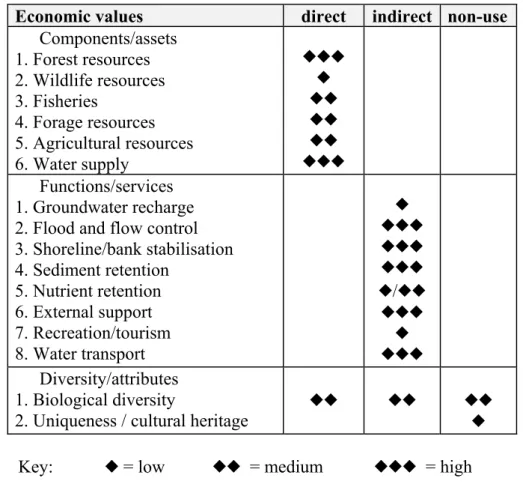
Further details of wetland components, functions and attributes are provided in Appendix 1, while Chapter 2 discusses these in an economic valuation context.
1.4 Wetland
loss
Wetlands are dynamic systems, continually undergoing natural change due to subsidence, drought, sea-level rise, or infilling with sediment or organic material. Thus, many wetlands are only temporary features of the landscape and will be expected to change and eventually disappear, whilst new wetlands are created elsewhere. Direct and indirect human activity has considerably altered the rate of change of wetlands. To some degree, we have created new artificial wetlands by building reservoirs, canals and flood storage areas. However, the loss of wetlands has far outstripped the gains.
available, has led to their conversion to intensive agricultural, industrial or residential uses. Individual desires of farmers or developers have been supported by government policy and sub-sidies. In addition to direct action on the land, river engineering schemes have diverted water away from wetlands, as it has been believed that this water is wasted in the wetland or at least has a lower value than its use for rice irrigation upstream. Some organi-sations still look upon wetlands only in terms of their potential to provide farm land to feed an ever-expanding population, which normally requires alteration of the natural system. Wetlands may also be lost by pollution, waste disposal, mining or groundwater abstraction.
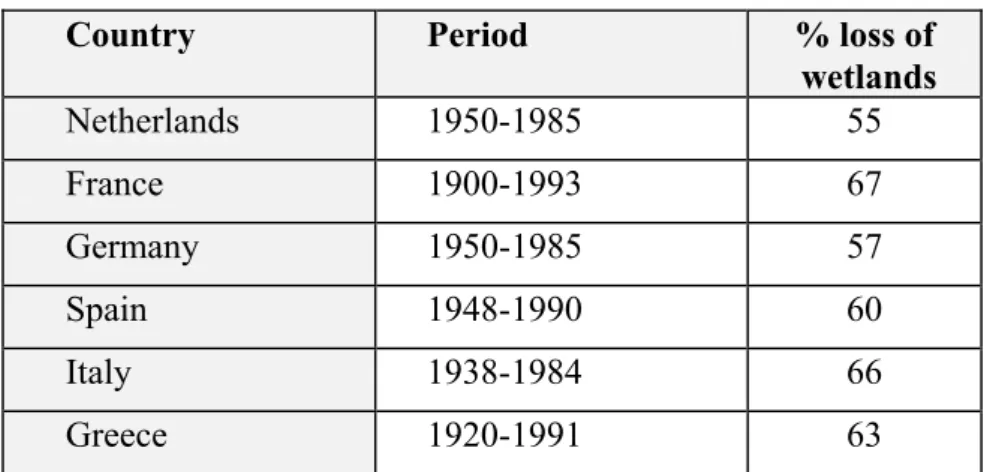
Table 1.1 Wetland loss in Europe (CEC, 1995)
Country Period % loss of
wetlands
Netherlands 1950-1985 55
France 1900-1993 67
Germany 1950-1985 57
Spain 1948-1990 60
Italy 1938-1984 66
Greece 1920-1991 63
country’s mangrove resources were lost in the 60 years from 1920 to 1980 (Zamora, 1984).
Table 1.2 Incidence of major threats to wetlands in Asia,
Latin America and the Caribbean (WCMC, 1992), expressed as % of sites.
Asia Latin America and
the Caribbean Hunting and associated
disturbance
32 30.5
Human settlement 27
Drainage for agriculture 23 19
Disturbance from recreation 11.5
Reclamation for urban and industrial development
10.5
Pollution 20 31
Fishing and associated disturbance
19 10
Commercial logging and forestry 17 10
Wood cutting for domestic use 16
Catchment degradation, soil erosion, siltation
15
Conversion to aquaculture ponds or salt pans
11
Diversion of water 9
Over-grazing by domestic stock 9
million per year by correctly releasing water from the Cabora Bassa dam which is not being utilised.
There are now many cases of wetland restoration, where the results of wetland degradation have been recognised. Making artificial releases from dams to re-inundate degraded floodplains is one mechanism (Acreman, 1994), of which there are examples on the rivers Senegal, Kafue (Zambia), Logone (Cameroon) and Phongolo (South Africa) (Acreman & Hollis, 1996). Nevertheless, these are exceptions rather than the rule and predictions suggest that pressure to “develop” wetlands is intensifying, especially in Asia, Africa and Latin America. Thus, there is still a great need for promoting the benefits of wetlands to encourage conservation and sustainable utilisation, through organisations such as IUCN-The World Conservation Union and the Ramsar Convention.
1.5 The role of Ramsar in wetland conservation
The Convention on Wetlands of International Importance especially as Waterfowl Habitat – commonly referred to as the Ramsar Convention from its place of adoption in Iran in 1971 – was the first of the modern global intergovernmental treaties on conservation and wise use of natural resources.
The mission of the Ramsar Convention (Ramsar, 1996) is “the conservation and wise use of wetlands by national action and international cooperation as a means to achieving sustainable development throughout the world”.
The Convention provides a framework for international coopera-tion and was established following concern in the 1960s about the serious decline in populations of waterfowl (mainly ducks). It came into force in 1975 and currently has 100 Contracting Parties, which are obliged to undertake four main activities. These are:
• to develop national wetland policies, to include wetland conservation considerations within their national land-use planning, to develop integrated catchment management plans and, in particular, to adopt and apply the guidelines for implementation of the Wise Use Concept, which is the sustainable utilisation of wetlands for the benefit of mankind in a way compatible with the maintenance of the natural properties of the ecosystem
• to promote the conservation of wetlands in their territory through establishment of nature reserves and to promote training in wetland research, management and wardening
• to consult with other Contracting Parties about transfrontier wetlands, shared water systems, shared species and development aid for wetland projects.
In this way the Convention plays an important role in helping to prevent detrimental changes to wetland sites in states that are party to the Convention. Technical support on wetland conservation is provided to the Convention from organisations such as IUCN-The World Conservation Union and Wetlands International (a new body formed from the International Waterfowl and Wetland Research Bureau, the Asian Wetland Bureau and Wetlands for the Americas). Notable successes include:
• prevention of agricultural development of habitat for
Spoonbill Platalea leucorodia in the Hortobagy Ramsar site, Hungary (1985)
• rejection of development proposals which would have had a harmful effect on the Swale Estuary Ramsar site in the UK (1992)
• rejection of plans to build an intensive piggery in the catchment of Lake Cundare and closure of a refuse tip adjacent to Lake Beeac in Victoria, Australia (1993)
2. Why
valuation?
To understand why economic valuation may be important to wetland management and policy, it is necessary first to review the role of valuation in decisions that concern the use of environmental resources generally and wetlands specifically. In this chapter we suggest that a major reason for excessive depletion and conversion of wetland resources is often the failure to account adequately for their non-market environmental values in development decisions. By providing a means for measuring and comparing the various benefits of wetlands, economic valuation can be a powerful tool to aid and improve wise use and management of global wetland resources.
2.1 The role of economic valuation in
decision-making
We can define economic valuation as the attempt to assign quan-titative values to the goods and services provided by environ-mental resources, whether or not market prices are available to assist us. However, such a definition goes only part way. We must be more specific about what economists mean by the term value. The economic value of any good or service is generally measured in terms of what we are willing to pay for the com-modity, less what it costs to supply it. Where an environmental resource simply exists and provides us with products and services at no cost, then it is our willingness to pay alone which describes the value of the resource in providing such commodities, whether or not we actually make any payment.
Loss of environmental resources is an economic problem because important values are lost, some perhaps irreversibly, when these resources are degraded or lost. Each choice or option for the environmental resource – to leave it in its natural state, allow it to degrade or convert it to another use – has implications in terms of values gained and lost. The decision as to what use to pursue for a given environmental resource, and ultimately whether current rates of resource loss are ‘excessive’, can only be made if these gains and losses are properly analysed and evaluated. This requires that all the values that are gained and lost under each resource use option are carefully considered.
For example, preserving an area in its natural state involves direct costs of preservation for setting up a protected area, and in devel-oping countries this may include paying guards and rangers to protect and maintain the area and perhaps the cost of establishing a ‘buffer zone’ for surrounding local communities. Development options are sacrificed if preservation is chosen, and these foregone development benefits are additional costs associated with the pres-ervation option. Such costs are easily identifiable as they often comprise marketable outputs and income sacrificed (e.g., fisheries’ revenue or subsistence agricultural income, in the case of wetlands). It is not surprising therefore that governments and donors usually consider the total costs – the direct costs plus the foregone development benefits – of preservation when choosing to retain an environmental resource in its natural or a managed state.
thus are generally ignored in private and public development decisions.
For example, the market value of environmental resources con-verted to some commercial use may fail to reflect the lost environmental benefits. Development decisions are therefore often biased in favour of those uses of environmental resources which do have marketed outputs. Thus, the failure to account more fully for the economic costs of conversion or degradation of environmental resources is a major factor behind the design of inappropriate development policies. The result is too much con-version and over-exploitation of environmental resources. As this failure is endemic in private and public decisions concerning the use of environmental resources – particularly wetland resources – it is necessary to assess more fully the net economic benefits arising from different wetland uses.
Valuation is only one element in the effort to improve manage-ment of environmanage-mental resources such as wetlands. At the same time, decision-makers must take account of many competing interests in deciding how best to use wetlands. Economic valua-tion may help inform such management decisions, but only if deci-sion-makers are aware of the overall objectives and limitations of valuation.
The main objective of valuation in assisting wetland management decisions is generally to indicate the overall economic efficiency of the various competing uses of wetland resources. That is, the underlying assumption is that wetland resources should be allo-cated to those uses that yield an overall net gain to society, as measured through valuation in terms of the economic benefits of each use less its costs.1 Who actually gains and loses from a par-ticular wetland use is not part of the efficiency criterion per se. Thus a wetland use showing a substantial net benefit would be deemed highly desirable in efficiency terms, even though the
1 Under certain conditions, it can be demonstrated that this welfare-maximizing
cipal beneficiaries may not necessarily be the ones who bear the burden of the costs arising from the use. If this is the case, then this particular wetland use may be efficient but it may also have significant negative distributional consequences. It is therefore often important that many proposed wetland investments or management policies are assessed not only in terms of their efficiency but also their distributional implications.
Economic valuation is also not a panacea for decision-makers making difficult choices concerning the management of wetland resources. Too often, decision-makers have already decided on what wetland management strategy to pursue, whether conversion or conservation, and simply want economic valuation to confirm this choice ex post facto. In such circumstances, valuation has done little to inform the decision-making process and essentially serves no purpose. At the other extreme, sometimes decision-makers ask the impossible from economic valuation. A major difficulty facing valuation of a complex environmental system such as wetlands is insufficient information on important ecological and hydrological processes that underpin the various values generated by the wetlands. If this information is lacking – which is often the case for many non-market environmental values that may be deemed important to value – then it is incumbent upon the analysts conducting the valuation to provide realistic assessments of their ability to value key environmental benefits. Equally, decision-makers must realise that under such circumstances valuation cannot be expected to provide realistic estimates of non-market environmental values – not, at least, without further investment of time, resources and effort in further scientific and economic research.
wetland resources is a matter of moral obligation rather than efficient or even fair allocation. There may be other motivations for managing wetlands in particular ways, such as political considerations. Thus, economic values represent just one input into decision-making, alongside important other considerations. The goal of this text is to assist planners and decision-makers with increasing the input from economic valuation in decision-making.
2.2 The economic values of wetlands
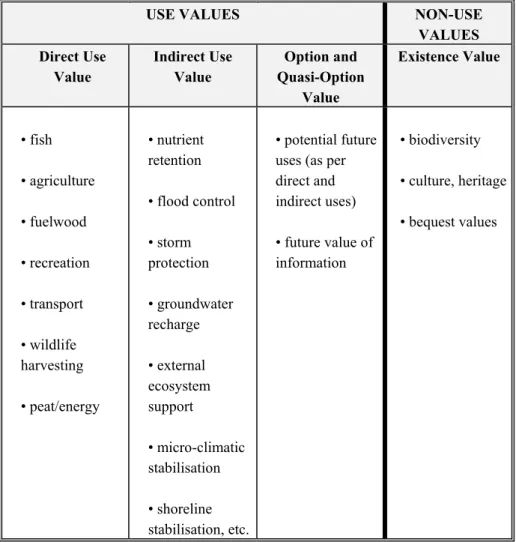
If researchers are to value wetland uses and decision-makers are to take these into account when making policies that affect wetlands, then a framework for distinguishing and grouping these values is required. The concept of total economic value (TEV) provides such a framework and there is an increasing consensus that it is the most appropriate one to use. Simply put, total economic valuation distinguishes between use values and non-use values, the latter referring to those current or future (potential) values associated with an environmental resource which rely merely on its continued existence and are unrelated to use (Pearce and Warford, 1993). Typically, use values involve some human ‘interaction’ with the resource whereas non-use values do not. The total economic valuation framework, as applied to wetlands, is illustrated in Table 2.1.
In contrast, various regulatory ecological functions of wetlands may have important indirect use values. Their values derive from supporting or protecting economic activities that have directly measurable values. The indirect use value of an environmental function is related to the change in the value of production or consumption of the activity or property that it is protecting or supporting. However, as this contribution is unmarketed, goes financially unrewarded and is only indirectly connected to Table 2.1 Classification of total economic value for wetlands
USE VALUES NON-USE
VALUES Direct Use
Value
Indirect Use Value
Option and Quasi-Option
Value
Existence Value
• fish
• agriculture
• fuelwood
• recreation
• transport
• wildlife harvesting
• peat/energy
• nutrient retention
• flood control
• storm protection
• groundwater recharge
• external ecosystem support
• micro-climatic stabilisation
• shoreline stabilisation, etc.
• potential future uses (as per direct and indirect uses)
• future value of information
• biodiversity
• culture, heritage
• bequest values
economic activities, these indirect use values are difficult to quantify and are generally ignored in wetland management decisions.
For example, the storm protection and shoreline stabilisation functions of a wetland may have indirect use value through reducing property damages, yet often coastal or riverine wetland systems are drained in order to build still more waterfront property. Mangrove systems are known to be breeding grounds and nurseries for shrimp and fish that are essential for coastal and marine fisheries, yet these important habitats are currently being converted rapidly in many regions for aquaculture, particularly shrimp ponds. Natural floodplains may recharge groundwater used for dryland agriculture, grazing livestock and domestic or even industrial use, yet many of these floodplains are threatened by dams and other barrages diverting water for upstream irrigation and water supply.
A special category of value is option value, which arises because an individual may be uncertain about his or her future demand for a resource and/or its availability in the wetland in the future. In most cases, the preferred approach for incorporating option values into the analysis is through determining the difference between ex ante and ex post valuation.2 If an individual is uncertain about the future value of a wetland, but believes it may be high or that cur-rent exploitation and conversion may be irreversible, then there may be quasi-option value derived from delaying the development activities. Quasi-option value is simply the expected value of the information derived from delaying exploitation and conversion of the wetland today. Many economists believe that quasi-option value is not a separate component of benefit but involves the analyst in properly accounting for the implications of gaining additional information.3
2 This is done by developing well-specified models of individual choice, through
reasoning about how marginal utility of income differs in the various contingency states (Smith, 1983, Freeman, 1984)
3 Quasi-option value can be calculated with an analysis of the conditional value
In contrast, however, there are individuals who do not currently make use of wetlands but nevertheless wish to see them preserved ‘in their own right’. Such an ‘intrinsic’ value is often referred to as existence value. It is a form of non-use value that is extremely difficult to measure, as existence values involve subjective valua-tions by individuals unrelated to either their own or others’ use, whether current or future. An important subset of non-use or preservation values is bequest value, which results from individuals placing a high value on the conservation of tropical wetlands for future generations to use. Bequest values may be particularly high among the local populations currently using a wetland, in that they would like to see the wetland and their way of life that has evolved in conjunction with it passed on to their heirs and future generations in general. While there are few studies of non-use values associated with wetlands (see the case study involving the UK’s Norfolk Broads in Section 4.3 for one example), campaigns by European and North American environmental groups to raise funds to support tropical wetlands conservation hint at the magnitudes involved.4 For example, several years ago the UK’s Royal Society for the Protection of Birds (RSPB) collected £500,000 (US$ 800,000) from a one-off membership mailing campaign to help save the Hadejia-Nguru wetlands of Northern Nigeria in West Africa.5
2.3 Why wetland resources and systems are
under-valued in development decisions
In sum, wetland resources are particularly susceptible to mis-allo-cation decisions because of the nature of the values associated with them. Wetlands are multi-functional resources par excellence. Not only do they supply us with a number of
4 Strictly speaking, the amounts collected by environmental groups through mail
outs and other techniques cannot be interpreted immediately as ‘non-use values’ because of the complex motivations people have for contributing. For example, some individuals derive a so-called ‘warm glow’ from giving to a good cause, which is not related to the cause itself.
important resource outputs (e.g., fish, fuelwood, wildlife), but they also perform an unusually large number of ecological functions which support economic activity. Many of these latter services are not marketed; that is, they are not bought and sold because the support they provide to economic activity is indirect and therefore largely goes unrecognised. In the case of tropical wetlands, many of the subsistence uses of wetland resources are also not marketed and are thus often ignored in development decisions.
Some of the ecological services, biological resources and amenity values provided by wetlands have the qualities of what economists call a public good, so that it would be virtually impossible to market the service, even if this were desired.6 For example, if a wetland supports valuable biodiversity, all individuals potentially benefit from this service, and no one individual can be excluded from the service. Such situations make it extremely difficult to collect payment for the service, since whether you pay or not, you may still reap the benefit. In such circumstances, wetland services are liable to be undervalued.
Some of the difficulty arising from the public good qualities of wetland values would be unimportant if all wetland benefits could be enjoyed simultaneously, without any conflict among the various uses. Aggregating all possible use values together in such an unfettered multiple-use situation would be more likely to lead to recognition of the importance of conserving a wetland in its natural or a semi-natural state. However, amongst many wetland
6 A public good exists where one individual may benefit from the existence of
uses there are inherent conflicts or tradeoffs, even when the wetland is maintained in a more-or-less natural state (Turner, 1991). For instance, it may not be possible to manage a wetland for recreation or commercial fishing while at the same time using it for wastewater treatment. Even if the latter use is more valuable, its non-market and public good properties mean that its value is unlikely to be reflected in market decisions automatically. If public policy is to allow individuals responding to market signals to determine the allocation of wetland uses – the so-called ‘free market’ solution – then it is unlikely that the wetland will be used for wastewater treatment. Thus, the resulting ‘undervaluing’ of a key ecological service may once again lead to inappropriate wetland uses.
A wetland and its resources may also be undervalued and thus mis-allocated because of the property rights regime governing wetland access and use. For example, the wetlands in question may be subject to open access, where no rules apply and use of its resources may be open to all and unregulated. Alternatively, in-formal and traditional arrangements may govern their use as com-munal or common property resources. Finally, state or private property may characterize the wetland resource base (Bromley, 1989). Each form of property rights may be characterized by quite distinct conditions of resource exploitation. For instance, open-access resources are often over-harvested, so observed use values may be very low. As a result, if attempts to value environmental resources are based on simple observations of current use rates, without taking into consideration the institutional context, they may undervalue the resource. This may be especially important if the institutional arrangement is changing informally, as when indigenous common property systems are reasserted after a period of dormancy, or a change has been mandated as an element in a project or programme affecting a wetland area, as when land is suddenly privatized or nationalized.
non-market goods and services.7 Such a dichotomy often results in the development option – i.e., conversion to agriculture, fish ponds, and commercial or residential property – being widely regarded as the most valuable wetland use. As such activities also generate additional government revenue, it is not surprising that decision-makers also support the conversion of wetlands to ‘commercial’ uses.
Even where revenues may not be the primary objective of wetland exploitation and conversion, agriculture, aquaculture, property de-velopment and other conversion activities are generally considered important for economic development and regional growth. They are seen as having significant ‘linkages’ to other sectors, especially processing and construction, and can provide much-sought-after jobs in regions with few other industrial alternatives. These are compelling arguments for planners and decision-makers in many countries for supporting wetland conversion at the expense of other wetland values. In contrast, non-marketed ecological functions and amenity values generated by natural or managed wetlands may create little in the way of spinoff benefits, and instead may even substitute for employment-generating activities (e.g., water treatment, flood control and storm protection) or require additional investments of scarce public resources (e.g., tourist facilities and roads for recreational uses). Some wetlands may also generate negative external effects in the form of support for disease vectors such as malaria-carrying mosquitoes which may be recognised while other indirect support functions are ignored.
In sum, the undervaluing of wetland resources and functions is a major reason why wetland systems are mis-allocated – often to conversion or exploitation activities yielding immediate commer-cial gains and revenues. Economic valuation may provide deci-sion-makers with vital information on the costs and benefits of alternative wetland use options that would otherwise not be taken
7 Obviously, there are opportunities for sustainable harvesting of some
into account in development decisions. In Chapter 3, we provide a general appraisal framework for wetland valuation that assists decision-makers in assessing the net economic benefits of alterna-tive wetland use options.
2.4 Why valuation matters to Ramsar
A key concept underlying the principles of the Ramsar Convention is that wetlands have great value. Conservation can only be achieved if wetlands can be shown to be of value and, in some cases, of greater value than proposed alternative uses of the wet-land site itself or of the water feeding the wetwet-land. In line with this, Contracting Parties are asked to provide physical and social values of wetlands as part of the information for designation on the List of Wetlands of International Importance. Contracting Parties are also committed to making environmental impact assessments, before initiating schemes that might affect wetlands, which should pay particular attention to maintaining the values of wetlands.
3. An appraisal framework for wetland valuation
In this chapter, we develop a general framework for assessing the net economic benefits of alternative uses of wetlands.8 Ideally any assessment ought to lead to an economic valuation of all benefits and costs associated with each wetland use option that is to be evaluated. The assessment methodology developed here is con-sistent with the economic technique of cost-benefit analysis. However, given that data limitations often constrain the analyst’s ability to value many environmental functions and resources, it will be necessary to adapt the assessment methodology in such circumstances to provide the best information possible to aid deci-sion-making. Appendix 2 provides a description of alternative assessment methodologies, including cost-effectiveness analysis, multi-criteria analysis and others.
One approach not discussed in Appendix 2 is a Safe Minimum Standard (SMS) decision rule. This technique has relevance where the fate of highly unique wetland resources may be at stake and caution may be advised to avoid potentially large irreversible losses to society (see Box 3.1). Obviously, not all wetland man-agement problems warrant the use of SMS, but when they do, analysts can modify the standard cost-benefit analysis approach accordingly. Regardless of the method selected, an interdiscipli-nary approach will be needed at virtually all stages in the assess-ment, and this should particularly involve collaboration between economists and ecologists. Figure 3.1 summarises the overall assessment framework for economic evaluation of wetlands.9
8 The appraisal framework presented in this chapter was developed by E. Barber
for IIED (1994). This approach was originally developed for economic valuation of tropical wetlands; see for example, Barber (1989b, 1993 and 1994).
9 Figure 3.1 is adapted from IIED (1994), and was originally developed by E.
Box 3.1 Applying the precautionary principle to wetland management decisions
Where decisions about the loss of unique ecosystem resources or attributes, such as biodiversity, involve uncertainty, alternatives to the standard cost-benefit analysis may be desirable. Such decision rules must recognise that we are not fully knowledgeable about the potential costs and benefits of wetland use or conversion, nor of their probabilities of occurrence. Although such information might be forthcoming as time passes, it is not available now, and yet important decisions about the conversion or conservation of highly unique wetland resources must be made in the interim. Preference for a risk-averse decision rule (erring on the side of caution) in such situations calls for application of the precautionary principle. In effect, employing such a management decision rule suggests that society may be willing to pay a premium for the conservation of resources whose full value may not yet be known or appreciated, in the same sense that we purchase insurance protection as individuals. In this case, society may wish to take the steps necessary to preserve important wetland resources as long as the cost or “premium” is not too high. Determining just what this limit might be is not easy, but is liable to involve a least-cost perspective. Use of the precautionary principle is evident in such international agreements as the Montreal Protocol on substances likely to damage the ozone layer or the Declaration of the Third Ministerial Conference on the North Sea with respect to the dumping of
potentially toxic materials (O’Riordan and Cameron, 1994).
The argument for applying a precautionary principle hinges on the dilemma that at present we do not know the risks or magnitudes of potential losses from doing nothing. We can guess that these may be quite large and that we might miss out on significant benefits or incur severe losses if key wetland resources are not conserved. Thus, it is argued that the burden of proof should be shifted to those who would argue against a safe level of conservation of important wetlands. Stated in this way, we could view the opportunity costs of delaying or prohibiting conversion of highly unique wetlands as part of the insurance premium which we would be willing to pay to conserve these wetlands for the future.
This evaluation process involves three stages of analysis:
• Stage 1 – Defining the problem and choosing the correct economic assessment approach.
• Stage 2 – Defining the scope and limits of the analysis and the information required for the chosen assessment approach.
• Stage 3 – Defining data collection methods and valuation techniques required for the economic appraisal, including any analysis of distributional impacts.
The first stage is necessary to determine the correct assessment approach required for the particular wetland that is to be evaluated. The second is to determine the information needs for carrying out the selected assessment approach. The third is the choice of appropriate economic appraisal methods and valuation techniques. The completion of all three stages of the analysis should yield an economic evaluation of the wetland that will indicate to policy makers whether that option should proceed or not.
Although the three stages in the analysis have the appearance of being sequential, which is also the impression given in Figure 3.1, actual implementation of the assessment should involve an iterative, or ‘feedback’, process. That is, at any stage in the analysis, it may be necessary to return to a previous stage in order to revise the assessment process, improve the analysis, redefine information needs, and so forth. Several such iterations may be necessary before the economic evaluation can be successfully concluded.
constraints may limit the analysis to a financial assessment. Only marketed goods and services can be valued, through the use of ‘unadjusted’ market prices.
Figure 3.1 The assessment framework for economic valua-tion of wetlands
Choose Appraisal Methods and Valuation Techniques
Stage three Stage one
Stage two
Ranking by Importance of Impacts List Values Identify System Type,
Scale & Boundaries 1 Impact Analysis
Define Information Needs
Choose Data Collection Methods
Determine Resource Constraints Ranking by Importance
of Values and Assessment Needs
List Values Identify System Type,
Scale & Boundaries 2 Partial Valuation
Ranking by importance of Value to Total System
List Values Identify System Type,
Scale & Boundaries 3 Total Valuation Choose Assessment
Approach Define Specific Problems,
Goals and Objectives
Source: adapted from IIED (1994).
physical changes in the goods and services provided by the wetlands or in any environmental impacts.
In the discussion that follows, three stages of the appraisal process are illustrated by assuming that a full economic assessment is the ultimate objective.
.
3.1 Stage one: defining the problem and
assess-ment approach
The first stage in the evaluation process is to determine the overall objective or problem. As indicated in Figure 3.1, the type of economic assessment approach chosen will depend directly on the problem confronting the analyst.
Three broad categories of issues are of most relevance to the economic analysis of wetlands. Corresponding to each of these three evaluation objectives would be a specific economic assessment approach. As shown in Figure 3.1, these are:
• impact analysis – an assessment of the damage inflicted on the wetland from a specific external environmental impact (e.g., oil spills on a coastal wetland)
• partial valuation – assessment of two or more alternative wetland use options (e.g., whether to divert water from the wetlands for other uses, or to convert/develop part of the wetlands at the expense of other uses)
• total valuation – assessment of the total economic contribu-tion, or net benefits, to society of the wetland system (e.g., for national income accounting or to determine its worth as a protected area).
Box 3.2 Time and discounting in economic valuation
When economists evaluate benefits and costs which extend over more than one time period, they can use one of two approaches. In the first case, they must make allowance for the fact that individuals view more distant benefits and costs differently than more immediate ones. Generally, the pattern observed is that we prefer costs to be postponed and benefits to be received as soon as possible (for a critique of this approach, see Price (1993)). This situation is referred to as time preference and is mimicked by financial institutions in that they must pay interest on deposits, reflecting the need to return a higher amount to the individual at a later date in order to make use of these funds in the interim. To account for time preference in valuation and cost-benefit studies, economists use a discount rate to weight benefits and costs occurring in different time periods, similar to the payment of interest on bank accounts. Since we would prefer having a sum of money in the present to waiting until a later time period for it, we weight current values more heavily than ones in distant periods. To accomplish this, we use a discount factor which incorporates the discount rate selected. Weighting a series of benefits or costs, and summing these, yields a present value. Once we have calculated the present values of benefits and costs, we normally take the difference between the two, the net present value, as an indicator of a project’s viability in economic terms.
A second approach is to look at the opportunity costof capital invested in a project, which refers to the profits which could have been obtained by investing this capital in the next best possible opportunity. These foregone profits represent the cost of the capital employed in the project, and the net benefits (i.e., benefits minus costs) of our project must at least equal these foregone profits if it is to be considered viable. Thus, when weighting benefits and costs in different time periods we use the opportunity cost of capital as our discount rate to reflect what the project should be generating in terms of benefits, if it is to be an attractive investment.
For example, there may be no need to value alternative land uses if the relevant issue is the external impact of a specific activity. Similarly, there may be no need to estimate the total economic value of wetlands under all potential uses if policy makers want to compare the relative costs and benefits of only a limited number of alternative proposals.
Before considering Stages 2 and 3 of the assessment process, it is worth briefly explaining what is involved in each of the above assessment approaches.
Impact Analysis
The first approach, impact analysis, is most relevant in situations where disturbance of a particular wetland results in specific environmental impacts.10 For example, assume that discharges of oil are regularly polluting an estuarine wetland, affecting both fish production and water quality in the wetlands. The costs of this activity are the losses in wetland values arising from damage to the ecosystem and its resources. These damages would amount to the losses in net production benefits (i.e., the economic benefits of production less the costs) from the impacts of the oil spills on the fishery plus the losses in net environmental benefits in terms of poorer quality water supplies for wetland and neighbouring settlements, as well as for general ecosystem functioning. Thus, by assessing and valuing these losses, we would arrive at an estimate of the net production and environmental benefits of the wetlands lost as a result of the oil spills. The total cost of this impact in terms of damage to the wetland are these foregone net benefits.
Essentially, what the impact analysis is telling us is that oil exploitation is imposing external costs on the wetland system. These off-site costs must be weighed against the net benefits
10 Impact analysis, as referred to here, should not be confused with Environmental
gained from additional oil developments. Thus only by assessing and valuing the external losses from reduced water quality and fish production in the wetlands would we arrive at a true measure of the net benefits of the oil development (see Box 3.5). Even if these net benefits from development exceed the costs of the impacts or oil discharges, calculation of the impacts on the wetlands may be important for determining whether it is worth investing in pollution abatement.
As discussed in Section 2.1, it may also be important from a policy perspective to assess the distributional impacts of wetland modifications, in terms of which communities are affected the worst. Finally, if the offsite costs of wetland disturbance are irreversible, then it may be economically efficient to continue with oil developments in the short term, but this outcome may not be sustainable over the long term.11
Partial Valuation
A second type of cost-benefit assessment, partial valuation, is the principal method used to evaluate alternative wetland use options. That is, choices involving diversion, allocation or conversion of wetland resources should compare the net benefits generated by each of the wetland uses. For example, assume that there is an upstream irrigation project on a river that is providing water for agriculture. If this project diverts water from a wetland downstream, then any resulting loss in wetland benefits must be included as part of the overall costs of the project. If the foregone wetland benefits are significant, then the failure to assess the loss of wetland benefits will clearly lead to an overestimation of the true net benefits of the development projects (see Box 3.5). This is tantamount to assuming that there is no economic cost of diverting floodwater from the wetlands, which is rarely the case. Moreover, it may not be necessary to measure all affected wetland benefits; for example, one or two impacts may prove to be sufficiently large to render the development project uneconomic. In any case, it is not necessary to measure all wetland benefits but
only those benefits which are affected by the development project – which is why this approach is called a ‘partial valuation’.
Box 3.3 Examples of impact analysis applied to economic
valuation
Dixon and Hufschmidt (1986) and Dixon et al. (1988) illustrate the application of impact analysis in determining the cost-effectiveness of various options for disposing of waste water from a geothermal power plant on the island of Leyte in the Philippines. In this case, it was necessary to decide which means of waste water disposal from the plant would protect the environment in the most cost-effective manner. For some of the options, the costs of the environmental impacts in terms of lost marine fishery and rice production were quantified. Other environmental costs, such as energy loss, lost riverine fishery production, human health effects and amenity impacts, were not possible to quantify. For example, the analysis showed that the quantifiable environmental costs of releasing untreated waste disposal into the Bao River or into the Mahiao River were quite high, accounting for 41% and 35% of total measurable costs of these options respectively. Both options may also seriously contaminate the marine ecosystem with unknown and unquantifiable effects. The result was that consideration of the quantifiable and unquantifiable environmental impacts made reinjection of wastewater into the geothermal source the more attractive option.
Box 3.4 Examples of partial analysis applied to wetlands valuation
A few examples may help to illustrate the partial valuation approach. An analysis by Barbier et al. (1993) following this approach was conducted for the Hadejia-Jama’are floodplain in Northern Nigeria, which is being threatened by upstream water developments. The analysis shows that the floodplain agricultural, fishing and fuelwood net benefits are much more substantial than the net benefits of an upstream irrigation project, which is diverting water from the wetlands. For example, the authors estimated the net present value of agricultural, fishing and fuelwood benefits from the wetlands to be N253 to 381 ($US 34 to 51) per hectare (in 1989/90 prices), while the net present value of benefits from diverting streamflow to the irrigation project were only N153 to 233 ($US 20 to 31) per hectare. An even more pronounced divergence was noted when benefits were calculated on the basis of water use (e.g., per thousand cubic metres) rather than land area.
Hanley and Craig (1991) conducted a partial valuation of alternative uses of peat bog in Northern Scotland’s ‘Flow Country’. This large area of blanket peat bog, covering over 400,000 hectares, has many unique plants and the area is an important bird habitat. It has been subjected to conversion through planting of pine and spruce in block plantations. Damage to the bog area results from habitat disturbance, disruption of water and soil regimes, and increased sedimentation and erosion, and there is a net release of carbon to the atmosphere. The authors calculate the net benefits of tree planting and estimate that the net present value of an infinite rotation is negative, at £895 (US$ 1595) per hectare (in 1990 prices), suggesting that it is only as a result of government incentive payments that planting has occurred (N.B. these payments have since been withdrawn). The benefits of retaining the area in its natural state were assessed using a survey questionnaire to solicit individuals’ willingness-to-pay for conserving the area (see Box 3.8). The net present value of conserving the area was estimated at £327 (US$ 580) per hectare, which contrasts with the already negative figure arrived at for converting the bog area to block plantations.
Chapter 4 provides full descriptions of these case studies.
Total Valuation
Box 3.5 Impact, partial and total valuations – a more formal analysis
The assessment approaches described in the main text – impact, partial and total valuation – can also be defined in a more formal, mathematical way, which helps clarify the distinctions. For impact analysis, we can use the example of regular oil discharges polluting a wetland, cited earlier. Losses in net production benefits from the impacts of the oil spills on the wetland’s fishery plus the losses in net environmental benefits (i.e., poorer quality water supplies for wetland and neighbouring settlements, as well as for general ecosystem functioning) can be referred to as NBW. The total costs of the impact on the wetlands, CI, are these foregone net benefits:
CI = NBW
If NBD is the direct net benefits of oil production, from society’s perspective, additional oil exploitation is worthwhile only if:
NBD > CI
For partial valuation, assume as in the main text an upstream irrigation project diverting water from a downstream wetland, resulting in losses in wetland benefits. These losses must be included as part of the overall costs of the project. Given direct benefits (e.g., irrigation water for farming), BD, and direct costs (e.g., costs of constructing the dam, irrigation channels, etc.), CD, then the direct net benefits of the project are:
NBD = BD - CD.
However, by diverting water that would otherwise flow into the downstream wetlands, the development project may result in losses to floodplain agriculture and other primary production activities, less groundwater recharge and other external impacts. Given these reductions in the net production and environmental benefits, NBW, of the wetlands, then the true net benefits of the development project (NBP) are NBD - NBW. The development project can therefore only be acceptable if:
NBP = NBD - NBW > 0
An objective requiring total valuation might be (as in the main text) the need to determine whether or not the wetlands should become a protected area. The total net wetland benefits, NBW, would therefore have to exceed the direct costs, CP, of setting up the protected area, including any costs of relocating or compensating existing users, plus the net benefits foregone, NBA, of alternative uses of the wetlands: