G
Guuiimmaarrããeess--PPoorrttuuggaall
paper ID: 100 /p.1
Noise Decline Analysis In Plastic Membrane Drainpipes
J. Domínguez Huerta
a, J. A. Gamallo
ba
Arquitecto Asesor Danosa, Av Somosierra,8, 28700 San Sebastián de los Reyes, España.
b
Jefe Departamento de Acústica Danosa, Av Somosierra,8, 28700 San Sebastián de los Reyes, España, [email protected]
ABSTRACT: The purpose of this analysis is to determine the insertion losses different plastic materials for drainpipe coating induce. Plastic masses when stuck to rigid elements reduce, as known, their resonance. We therefore achieve a relevant gain in their sound conditioning.
We built a special 4 floors laboratory to perform this test. We poured a fluid in the drainpipe, at constant speed, in order to study the noise both in straight parts and elbows, without any and with different materials.
We finally present the results. We indicate the most appropriate product, in our belief, considering both its sound insulation and building site setting characteristics.
1.
INTRODUCTION
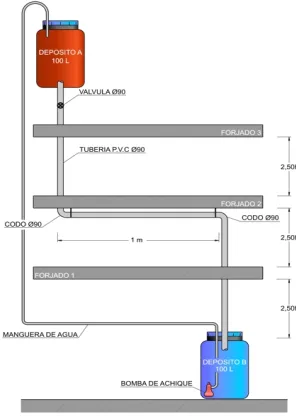
[image:1.595.244.392.524.732.2]The noise generated by the drainpipes (rainwater, soil or waste pipe) is a consequence of the adherence or hit made by the fluids in the internal wall lines. This is generating an air noise and a vibration which the best way to avoid is to act straight away on the phenomenon that produces it. We will focus on covering the wall lines with plastic materials that reduce or change the resonance frequencies of the lines at unannoying levels and inaudible frequencies.
G
Guuiimmaarrããeess--PPoorrttuuggaall
paper ID: 100 /p.2
For that purpose, an experimental laboratory has been built in which we reproduced with realism the discomfort made by a drainpipe in the vertical free falling of the fluid in the elbow
and in the horizontal route. A drainpipe has been installed over 4 floors. On the 4th floor, a
reservoir allows us to discharge the water through the drainpipe. On the 3d floor, the drainpipe
system recovers on a straight course and stripe raster which allow us to analyse the noise adherence. On the 2d floor, the drainpipe effectuates a double elbow, this configuration
permits us to study the noise made by the fluids hit in the drainpipe. And finally, on the 1st
floor a reservoir is installed with a pump that allows us to keep the continuity of the system and to measure continuously with a controlled and flat debit. (See figure 1)
2. MATERIALS ANALYSE
2.1 Testing Conditions
The test proposed to measure the degree of efficiency of the materials is the insertion loss generated by the material used in a system composed of floor and roof’s work, 2 sidewalls of work, 2 sidewalls of plaster board lines N15 and an artificial roof with plaster board lines. We measure it in 5 points of the receiving room without material and with material
conserving the position in terms of distance and height as the microphones directivity. The
receiving room’s volumes are between 20 and 30 m3.
2.2 Materials used
The products used are composed of materials with physical structures such as plastic, elastic, elastic-foam or a combination of all of them. The applied nomenclature to define the test is the following: the previous letter defines the physical structure type and the following number defines the thickness in mm.
Plastic Material P10 (10 mm plastic)
Elastic Material E10 (10 mm elastic)
The denominations of the combinations are made through series from the drainpipe to the outside.
Combination P10 E10 (Pasted to the 10-mm plastic drainpipe, 10-mm elastic outside the
drainpipe)
Combination E10 P10X10 (Pasted to the 10-mm elastic drainpipe, 10mm plastic in center,
10-mm elastic-foam outside the drainpipe)
2.3 Test carried out
The tests have been carried out the following way: the global value LAeq in the straight section
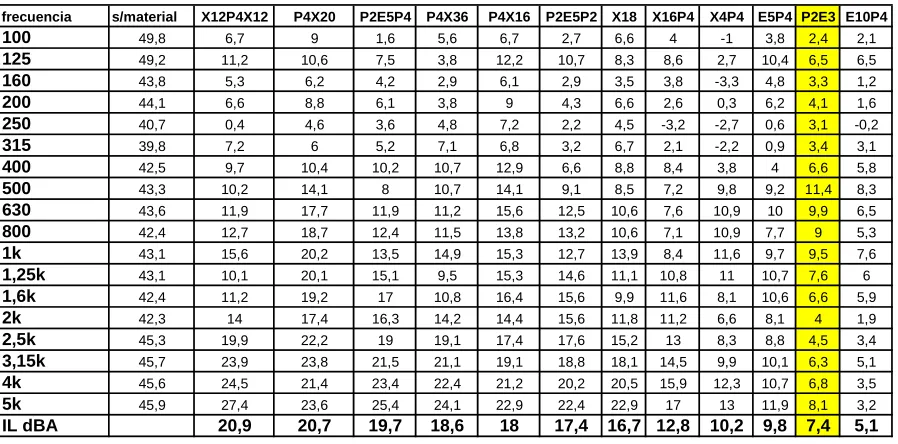
[image:2.595.219.376.44.125.2](see table 1) and is measured with two-thirds octave in the elbow area. (See table 2).
Table 1: General Results in the straight section
s/material P4X20 X12P4X12 P4X16 P2E5P4 P2E5P2 P2E3 X4P4 X16P4 P4X36 X18 E5P4 E10P4
G
Guuiimmaarrããeess--PPoorrttuuggaall
[image:3.595.72.521.172.394.2]
paper ID: 100 /p.3
Table 2: Results of tests carried out in the elbow area with various compositions
The analyse of the results in addition to the search for a material combining a good behaviour with an easy fitting with a reduced thickness, allow us to conclude that we had to choose a product that would easily improve its behaviour in the elbows with punctual straightening strings without needing to extend it to the rest of the drainpipe.
[image:3.595.101.484.559.767.2]All these variables allowed us to simplify it in a double surface product with easy fitting that can be straightened with a band of the product itself in the elbows obtaining similar results to more complex and thicker products. (P2E3). As it can be seen in the graph, the material chosen has a similar behaviour in the straight sections and allow us to reinforce easily in the concerned area of the system in the elbow. The results are presented in the graph 3
Table 3: Results of the tests with a resistive lining (reinforcing strings) in the elbow
frecuencia s/material X12P4X12 P4X20 P2E5P4 P4X36 P4X16 P2E5P2 X18 X16P4 X4P4 E5P4 P2E3 E10P4
100 49,8 6,7 9 1,6 5,6 6,7 2,7 6,6 4 -1 3,8 2,4 2,1
125 49,2 11,2 10,6 7,5 3,8 12,2 10,7 8,3 8,6 2,7 10,4 6,5 6,5
160 43,8 5,3 6,2 4,2 2,9 6,1 2,9 3,5 3,8 -3,3 4,8 3,3 1,2
200 44,1 6,6 8,8 6,1 3,8 9 4,3 6,6 2,6 0,3 6,2 4,1 1,6
250 40,7 0,4 4,6 3,6 4,8 7,2 2,2 4,5 -3,2 -2,7 0,6 3,1 -0,2
315 39,8 7,2 6 5,2 7,1 6,8 3,2 6,7 2,1 -2,2 0,9 3,4 3,1
400 42,5 9,7 10,4 10,2 10,7 12,9 6,6 8,8 8,4 3,8 4 6,6 5,8
500 43,3 10,2 14,1 8 10,7 14,1 9,1 8,5 7,2 9,8 9,2 11,4 8,3
630 43,6 11,9 17,7 11,9 11,2 15,6 12,5 10,6 7,6 10,9 10 9,9 6,5
800 42,4 12,7 18,7 12,4 11,5 13,8 13,2 10,6 7,1 10,9 7,7 9 5,3
1k 43,1 15,6 20,2 13,5 14,9 15,3 12,7 13,9 8,4 11,6 9,7 9,5 7,6
1,25k 43,1 10,1 20,1 15,1 9,5 15,3 14,6 11,1 10,8 11 10,7 7,6 6
1,6k 42,4 11,2 19,2 17 10,8 16,4 15,6 9,9 11,6 8,1 10,6 6,6 5,9
2k 42,3 14 17,4 16,3 14,2 14,4 15,6 11,8 11,2 6,6 8,1 4 1,9
2,5k 45,3 19,9 22,2 19 19,1 17,4 17,6 15,2 13 8,3 8,8 4,5 3,4
3,15k 45,7 23,9 23,8 21,5 21,1 19,1 18,8 18,1 14,5 9,9 10,1 6,3 5,1
4k 45,6 24,5 21,4 23,4 22,4 21,2 20,2 20,5 15,9 12,3 10,7 6,8 3,5
5k 45,9 27,4 23,6 25,4 24,1 22,9 22,4 22,9 17 13 11,9 8,1 3,2
IL dBA 20,9 20,7 19,7 18,6 18 17,4 16,7 12,8 10,2 9,8 7,4 5,1
frecuencia s/material P2E3 + ref codo X10 P2E3+ref codo P2X40 P2E3+ ref codoP2E3 P2E3 + ref codo P4
100 49,8 5,6 1,2 14 13,5
125 49,2 1 5,4 16,3 14,5
160 43,8 -5,3 3,9 11,5 6,8
200 44,1 4,7 8 13,3 13,1
250 40,7 2,1 3,8 5 10,3
315 39,8 3,8 7,4 6,4 11,4
400 42,5 10,6 12,7 11,3 16,9
500 43,3 10,9 15,4 11,3 19,5
630 43,6 13,4 17,6 13,3 18,7
800 42,4 13,8 18,9 13,6 15,4
1k 43,1 14,7 19,4 15,3 16,1
1,25k 43,1 15 21,5 13,6 18
1,6k 42,4 14,2 21,7 12 17,8
2k 42,3 14,6 23,8 12,8 17,5
2,5k 45,3 17,3 26,5 16,9 18,9
3,15k 45,7 18,5 27,5 18,1 21,3
4k 45,6 20,7 29,4 20,6 24,5
5k 45,9 22,5 32,3 22,8 28,5
G
Guuiimmaarrããeess--PPoorrttuuggaall
paper ID: 100 /p.4
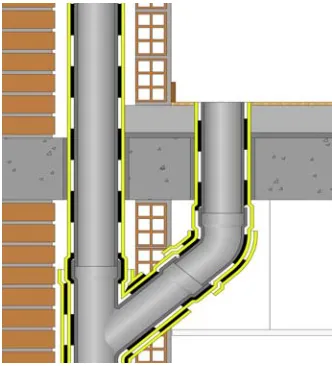
We keep the same material described as P2E2 with resistive lining in the elbow of the same material. We, this way, produce in this area an insulating system mass-spring-mass
2.3 Installation
The self-adhesive property of the material makes its fitting easier. We simply cut the material
according to the drainpipe’s length ¬ y− , remove the non-stick film® and recover it on the
drainpipe’s conduit¯ then a reinforcing string is fixed ° with the same material than in the
elbow enrolling it.
¬ − ® ¯ °
Figure 2 - Installation
3.CONSTRUCTIVE SYSTEM
.
[image:4.595.78.518.302.400.2]The constructive system consists in covering the drainpipe’s line with this material in the straight section as in the elbow. It will be then straightened with a REINFORCING STRING in the elbow and junctions of the drainpipe’s line. (See table 3) It will be fixed with specific materials leaving boxes perfectly watertight.
[image:4.595.208.374.540.723.2]G
Guuiimmaarrããeess--PPoorrttuuggaall
paper ID: 100 /p.5
4. CONCLUSION
- In straight courses, the materials made of plastic structure have very positive behaviour.
- The resistive lining in the elbow with this material allow us to elaborate a system