Sedimentary record of terminal Cretaceous accretions in Ecuador:
The Yunguilla Group in the Cuenca area
Etienne Jaillard
a,*, Peter Bengtson
b, Martha Ordon˜ez
c, Wilmer Vaca
d,
Annie Dhondt
!, Johnny Sua´rez
c, Jorge Toro
e,daIRD-UR 154, LMTG, 14 av. Edouard BELIN, 31400 Toulouse, France b
Geologisch-Pala¨ontologisches Institut, Universita¨t Heidelberg, Im Neuenheimer Feld 234, D-69120 Heidelberg, Germany cPetroproduccio´n, Centro de Investigaciones Geolo´gicas-Guayaquil, km 6,5 vı´a a la Costa, Guayaquil, Ecuador
dEscuela Polite´cnica Nacional, Ladro´n de Guevara s/n, PO Box 17-01-2759, Quito, Ecuador e
Petroproduccio´n, Av. 6 de Diciembre y G. Can˜ero, Casilla 17-01-1006, Quito, Ecuador
Abstract
A reappraisal of the ‘‘Late Cretaceous Yunguilla Formation’’ of the Cuenca area enables the definition of four distinct formations, correlatable with those of southwestern Ecuador. A mid- to late-Campanian marine transgression (Jada´n Formation) is overlain by quartz-rich conglomerates of fan-delta to turbiditic fan environment (Quimas Formation) of latest Campanian–earliest Maastrichtian age, which are interpreted as evidence of the accretion of a first oceanic terrane (San Juan). Disconformable, arkosic turbidites and cherts (Tabacay Formation) of early Maastrichtian age are thought to represent the erosion of the newly accreted oceanic terrane. A major unconformity of late Maastrichtian age, caused by the accretion of a second oceanic terrane (Guaranda), is followed by the deposition of quartz-rich micaceous shelf sandstones (Saquisilı´ Formation) of Paleocene age. A third accretion event (late Paleocene) is recorded in coastal Ecuador. Each accretion event correlates with the uplift and erosion of the Eastern Cordillera and with a sedimentary hiatus in the eastern areas. In Ecuador, accretion of oceanic terranes contributed to the build up of the Andes through tectonic underplating of low-density material, and the eastern areas did not behave as flexural foreland basins during late Cretaceous–Paleogene times. !2007 Elsevier Ltd. All rights reserved.
Keywords: Ecuador; Latest Cretaceous; Paleocene; Accretions; Uplift; Clastic sedimentation
1. Introduction
The Andes of Ecuador differ from the Central Andes by
the presence of mafic magmatic terranes (Goossens and
Rose, 1973; Gansser, 1973), interpreted as oceanic
frag-ments accreted during Late Cretaceous and Eocene times
(Feininger and Bristow, 1980; Lebrat et al., 1987; Daly,
1989; Reynaud et al., 1999; Kerr et al., 2002). More
recently, some authors (Arculus et al., 1999; Guillier
et al., 2001; Jaillard et al., 2002; Toro and Jaillard, 2005)
have proposed that the accreted oceanic material has been tectonically underplated and constitutes the crustal root of the Andes of Ecuador.
To constrain the date, processes, and consequences of accretions on Andean tectonics, we studied the dominantly clastic sediments coeval with the accretions (Late Creta-ceous–Eocene), located on the western edge of the conti-nental margin, which corresponds to the present-day Cordillera of Ecuador.
2. Geological setting
The coast and Western Cordillera of Ecuador consist of terranes of oceanic origin, whereas the continental Andean
0895-9811/$ - see front matter !2007 Elsevier Ltd. All rights reserved. doi:10.1016/j.jsames.2007.08.002
*Corresponding author. Present address: LGCA, Maison des
Ge´o-sciences, BP 53, 38 041 Grenoble Cedex 09, France.
E-mail addresses:[email protected](E. Jaillard), [email protected](P. Bengtson),[email protected](M. Ordon˜ez), [email protected](W. Vaca),[email protected](J. Toro).
! Deceased September 2006.
www.elsevier.com/locate/jsames
margin comprises the deformed Eastern Cordillera (
Lither-land et al., 1994), the sub-Andean zone, and the Oriente
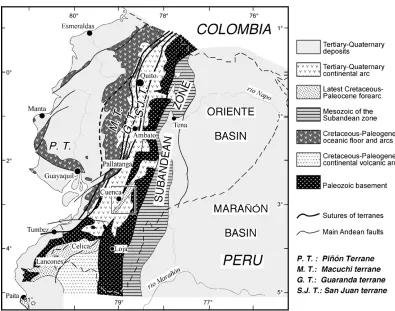
Basin (Jaillard, 1997;Fig. 1). In northern and central
Ecua-dor (1"N–2"S), the Western and Eastern Cordilleras are
separated by the Inter-Andean Valley, infilled by products
of Neogene–Quaternary volcanic arcs (Lavenu et al., 1996;
Hungerbu¨hler et al., 2002). Farther south (2"S–5"S), the
tectonic boundary between the allochtonous, oceanic units and the autochtonous continental margin is located west of
the Western Cordillera (Fig. 1), and the well-defined
Inter-Andean Valley vanishes.
The Cuenca area (!3"S) is situated on the western
edge of the Eastern Cordillera (Litherland et al., 1994)
and bounded to the west by uplifted Tertiary arc volca-nic piles, the basement of which is most probably conti-nental, as evidenced by crystalline outcrops west of
Cuenca (Dunkley and Gaibor, 1998; Pratt et al., 1998).
This relative depression received thick, marine to
subaer-ial deposits during the mid-Miocene; subsequent
compressional deformations were controlled by major
NE-trending faults (Bristow, 1980; Noblet et al., 1988;
Hungerbu¨hler et al., 2002). As for the Celica area of
southwestern Ecuador (Kennerley, 1973; Jaillard et al.,
1996, 1999), the basement of the Tertiary deposits of
the Cuenca area is mainly represented by Jurassic–Paleo-zoic metamorphic rocks and Cretaceous–Paleogene
sedi-mentary deposits (Bristow, 1980; Litherland et al., 1994;
Hungerbu¨hler et al., 2002). The latter sediments are the
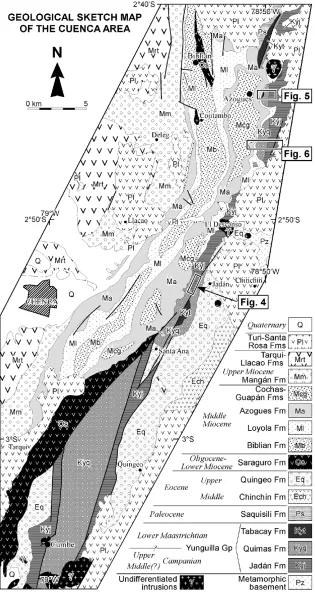
focus of this study (Fig. 2).
3. Previous work
The name ‘‘Yunguilla Formation’’ was introduced by
Thalmann (1946)for a succession of black shales and
sand-stones, dated with foraminifers as Maastrichtian, exposed northwest of Quito. Since then, comparable Maastrichtian sediments have been identified and dated with microfossils in the Western Cordillera of Ecuador, between Quito and
Cuenca (Tschopp, 1948; Sigal, 1969; Kehrer and Kehrer,
1969; Faucher et al. 1971; Bristow, 1973; Jaillard et al.,
2004), in southwestern Ecuador (Loja area; Sigal, 1969),
and locally in the sub-Andean zone (Limo´n area;Faucher
et al., 1971). Many rocks subsequently referred to the
Yun-guilla Formation have been dated as Paleocene or Eocene,
and new Paleogene units have been defined (Faucher et al.,
1971; Henderson, 1981; Egu¨ez and Bourgois, 1986; Santos and Ramı´rez, 1986; Hughes et al., 1999; Jaillard et al.,
2004).
In the Cuenca-Azogues area (Fig. 2), Bristow (1980)
considered that the ‘‘Yunguilla Formation’’ rests on Cre-taceous volcanic rocks, which subsequently were dated
by fission track analysis as Oligocene (Steinmann,
1997). The Late Cretaceous–Paleogene succession seems
to constitute the basement of the Miocene intermontane basin and rests on metamorphic rocks of the continental
basement of Ecuador (Noblet et al., 1988; Steinmann,
1997; Dunkley and Gaibor, 1998; Pratt et al., 1998;
Hungerbu¨hler et al., 2002; Vaca, 2005). The Yunguilla
Formation crops out east of Cumbe, Cuenca, and
[image:2.595.91.486.88.399.2]gues along a NNE-trending belt (Fig. 2). Farther north, in the Pallatanga area, the ‘‘formation’’ is tectonically associated with accreted oceanic terranes, with which it
is assumed to have been in stratigraphic contact
(McCourt et al., 1998; Hughes et al., 1999; Jaillard
et al., 2004). To the southwest, the uppermost
[image:3.595.145.460.93.686.2]ceous succession rests unconformably on Paleozoic–mid-dle Cretaceous rocks of the forearc zones of southern
Ecuador and northwestern Peru (Olsson, 1944; Jaillard
et al., 1998, 1999).
In the Cuenca-Azogues area,Faucher et al. (1971)and
Bristow (1973)identify three distinct lithologic units.
1. Cherts and greywackes, commonly silicified, yield scarce, poorly preserved fossils referred to the Maas-trichtian. They consider this unit the lower part of the ‘‘Yunguilla Formation’’ (but see discussion of the Taba-cay Formation).
2. Poorly consolidated shales with limestone lenses and arkosic sandstones beds, dated with microfossils as Maastrichtian. These rocks are interpreted as the upper
part of the ‘‘Yunguilla Formation’’ (Faucher et al.,
1971). Ammonites collected from these units are
assigned to the lower Maastrichtian (Bristow, inBristow
and Hoffstetter, 1977).
3. According to Bristow (inBristow and Hoffstetter, 1977),
marine shales and limestone lenses of the Cumbe area, referred to the ‘‘Yunguilla Formation,’’ grade upward into continental, volcanogenic redbeds. From the
‘‘Yun-guilla Formation,’’ Bristow (inBristow and Hoffstetter,
1977) reports one Inoceramus sp. and an unidentified
ammonite, andPratt et al. (1997)collected the ammonites
Hoploscaphitessp. andBaculitessp. of Maastrichtian age.
From the overlying fine-grained redbeds, Bristow (in
Bri-stow and Hoffstetter, 1977) collected Paleocene molluscs
andPratt et al. (1997)the bivalvePterotrigoniasp., known
from the Maastrichtian of Peru.
In the Cuenca area, the Yunguilla Formation is overlain by middle Eocene volcanics (Chinchı´n Formation, approx-imately 43 Ma) and unconformable continental volcano-genic redbeds of mid- to late-Eocene age (Quingeo
Formation, 42–34 Ma) (Steinmann, 1997; Hungerbu¨hler
et al., 2002). Pratt et al. (1997) correlate the continental
volcanogenic redbeds of the Cumbe area with the Quingeo
Formation (Fig. 2), defined and dated farther northeast by
Steinmann (1997).
4. Stratigraphy and depositional interpretation of the Late Cretaceous–Paleocene rocks of the Cuenca area
Based on geological surveys and study of strati-graphic sections, combined with exhaustive fossil collect-ing, we subdivide the rock succession formerly ascribed to the Yunguilla Formation into four formations rang-ing in age from the mid- or late-Campanian to the
Paleocene (Fig. 3). We therefore introduce the Yunguilla
Group, which comprises the middle (?) to upper Camp-anian Jada´n Formation, the conglomeratic Quimas
For-mation, and the lower Maastrichtian Tabacay
Formation. The Yunguilla Group is overlain by the Paleocene Saquisilı´ Formation, formerly included in the ‘‘Yunguilla Formation.’’
4.1. Jada´n Formation (middle(?) to upper Campanian)
Although it corresponds to the lithologic unit 2 described previously, the Jada´n Formation is the lowest unit of the Yunguilla Group. It consists mainly of shales and marls, with thin limestone and arkosic sandstone beds. The base of the formation is not exposed. Because metamorphic rocks crop out just east of the Yunguilla Group, the latter probably
overlies the continental margin unconformably (Steinmann,
1997), as is observed farther north (Vaca, 2005). The
lower-most part of the Jada´n Formation is strongly deformed and probably acted as a de´collement level.
The Jada´n Formation is best exposed along the El Des-canso–Jada´n road (Loma Tunasloma), which is proposed as the type section, and east of Azogues (Santa Ba´rbara). It is also exposed southeast of Santa Ana, northeast of El
Descanso, and around Cumbe (Fig. 2). The 500–800 m
thick formation can be subdivided into three lithologic units (‘‘members’’).
First, the lower part of the formation is made up of loose, silty shales and marls with thin beds of dark, micritic lime-stones and arkosic to lithic, fine- to medium-grained sand-stones. The limestones are locally nodular and sandy. The sandstones are locally rich in micas, and cementation is gen-erally calcareous. Local bioclastic limestones are interpreted as distal turbidites. The succession is composed of 100– 200 m thick, coarsening-, thickening- and
[image:4.595.305.550.96.399.2]shallowing-upward sequences. The abundance of the bivalvePinnasp.
indicates a moderate paleodepth (6100 m), whereas com-mon wood fragments suggest proximity to land. Amcom-monites collected along the El Descanso–Jada´n road are indentified as Diplomoceras sp. (upper Campanian–Maastrichtian)
(sample [02.C.52] Table 1) and Glyptoxoceras sp.
(Santo-nian–Maastrichtian) orNeoglyptoxocerassp. (lower–middle
Campanian) ([02.C.53, 02.C.G1, 03.Cu.05]Table 1).
Second, the middle part of the formation includes, in addition to the former lithologies, massive interbeds of black siliceous silts, thin-bedded calciturbidites, thin lime-stones interbedded with thin sandy laminae, and thick sandstone beds with coarsening-upward trends and pro-gressive unconformities reflecting synsedimentary tectonic activity. The lower part of this unit yields the Campanian
ammoniteNostoceras(Nostoceras?) sp. (upper Campanian)
([03.Cu.03] Table 1).
Third, the upper part of the formation (Fig. 4) consists
of shales, marls, and limestones rich in ammonites, gastro-pods, oysters, inoceramids, and other bivalves. This unit is composed of prograding, thickening-upward sequences of an external, distal shelf environment; therefore, it is inter-preted to represent a transgressive pulse. Near the top, the limestones become progressively more sandy and even-tually grade into conglomerates. We collected the
ammo-nites Libycoceras sp. [03.Cu.07] (upper Campanian to
lower or middle Maastrichtian), Nostoceras (Nostoceras?)
sp. [03.Cu.07] (upper Campanian),Glyptoxocerassp.
(San-tonian–Maastrichtian) or Neoglyptoxoceras sp. [03.Cu.08,
09, 10] (lower–middle Campanian), and Menuites sp.
[03.Cu.11] (Santonian–Maastrichtian) in Loma Tunasloma
(location in Table 1). In addition, a loose inoceramid
(found by D. Iza) is identified as Cataceramus cf.
pseud-oregularis(Sornay, 1962), which is known from the upper-most Campanian of Tercis, France (lower part of the Nostoceras hyatti Zone, Walaszczyk et al., 2002). East of
Azogues (Santa Ba´rbara), the upper part of the formation
yields Glyptoxoceras sp. (Santonian–Maastrichtian) or
Neoglyptoxoceras sp. [03.Cu.35, 03.Cu.36] (lower–middle
Campanian) and a pachydiscid, probably Menuites sp.
[03.Cu.34] of Santonian–Maastrichtian age (Fig. 5). Thus,
the weight of evidence suggests that the upper part of the Jada´n Formation is upper Campanian.
Within their lithology 2,Faucher et al. (1971) identify,
among others, the planktic foraminifers Globotruncana
[=Gansserina] gr.gansseriBolli, 1951,Plummerita hantken-inoides(Bro¨nnimann, 1952),Rugoglobigerina macrocephala
Bro¨nnimann, 1952,R. cf. reicheli Bro¨nnimann, 1952, and
R. gr. rugosa (Plummer, 1926), along with the benthic
foraminifersRzehakina epigonavar.lataCushman and
Jar-wis, 1929,Siphogenerinoidescf.bramletteiCushman, 1929,
S. cretaceaCushman, 1929, andS. reticulatus Stone, 1946
(det. J. Sigal). South of Santa Ana, in the Quebrada Salada,
we collected Platyceramus sp., of late Coniacian–early
Maastrichtian age from the undifferentiated Jada´n Forma-tion. Near Cumbe, shales and marls with limestone nodules and arkosic sandstone interbeds ascribed to the Jada´n For-mation yield planktic and benthic foraminifers; the
associa-tion ofBulimina midwayensis(Cushman and Parker, 1936)
(Campanian–Paleocene), Haplophragmoides aff. horridus
[image:5.595.325.547.93.427.2](Grzybowski, 1901) (Campanian–Paleogene), Hedbergella
Table 1
Origin and location of the fossil samples cited in the text
Sample Location Stratigraphic unit
Map (UTM)
02.C.52 Jada´n road, western slope of the ridge dividing rı´o Jada´n and quebrada Huangarcucho
73580–968350 Jada´n Fm Lower unit
02.C.53 73560–968330 02.C.G1 73570–968340 03.Cu.05 73530–968310
03.Cu.03 73520–968290 Middle Jadan Fm
02.Cu.07 Loma Tunasloma, ridge between rı´o Jada´n and quebrada Huangarcucho
73470–968250 Jada´n Fm Upper unit
02.Cu.08 73460–968240 02.Cu.09 73460–968240 03.Cu.10 73450–968230 03.Cu.11 73450–968230
D. Iza 73460–968250
02.C.G2 Southeast of Antonio Borero
74040–969310 Quimas Fm 02.C.52 73580–968350
02.C.53 Santa Barbara, east of Azogues
[image:5.595.42.293.552.771.2]73560–968330 02.C.54-55 73570–968340
holmdelensisOlsson, 1964(Late Cretaceous),Nodosariacf. longiscatad’Orbigny, 1846 (Maastrichtian–Eocene), Praeb-ulimina reussi(Morrow, 1934) (Late Cretaceous), and Turri-lina carseyae(Plummer, 1931) (Campanian–Maastrichtian) indicates a Campanian–Maastrichtian age for these outcrops.
4.2. Quimas Formation (uppermost Campanian–lowermost Maastrichtian)
The Quimas Formation consists of thick beds of coarse to microconglomeratic arkosic and lithic sandstones, poorly sorted conglomerates, and subordinate lithic are-nites and limestone nodules containing benthic foramini-fers. The base of the Quimas Formation is defined at the base of the first erosional conglomerate bed. However, the lithologic change from the upper Jada´n Formation to the lower Quimas Formation is progressive and mainly expressed by the increase in conglomerates and erosional
surfaces (Figs. 4 and 5). The Quimas Formation is best
exposed along the Cumbe–Quingeo road, notably in the Quebrada Quimas and Loma Huairapungu. This section is proposed as the type section. Other outcrops occur north of Santa Ana and east of the El Descanso–Azogues road. The conglomerates contain subangular to well-rounded clasts up to 10 cm in size. The clasts consist dominantly of quartz and metamorphic and sedimentary rocks, as well as scarce volcanic rocks. The sandstones are commonly turbidite beds, which contain quartz (30–50%), feldspar (20–35%), lithic fragments (30–40%), and scarce detrital
micas. Steinmann (1997) reports a heavy mineral
assem-blage (e.g., 34% zircon, 21% tourmaline, 20% apatite, 20% garnet) typical of crystalline, plutonic, and metamor-phic source zones. In the Quebrada Tabacay, north of Azo-gues, conglomerates with well-rounded quartz and metamorphic clasts contain gastropods and bivalves. In Loma Tunasloma, marine bivalves, plant remains, and bone fragments indicate a locally shallow-marine
deposi-tional environment. Fine-grained sediments show
biotur-bation, laminae, and ripples, suggesting a shelf
environment.
The formation contains numerous synsedimentary unconformities, folds, and slumps, as well as debris flows, which indicate contemporaneous tectonic activity and/or a steep slope. Conglomerate beds are commonly lens-shaped and channelized, indicating the proximity of flu-vial systems that fed fan deltas prograding on the shelf. The formation appears to reach a thickness of 1000 m in the Cumbe–Quingeo area and grades northward into much thinner (approximately 500 m) and finer-grained deposits, near Azogues. This trend suggests that the feed-ing alluvial system (alluvial fan and fan delta) was located in the Cumbe area. As a whole, the Quimas Formation is interpreted as a fan delta deposit prograding on a steep shelf.
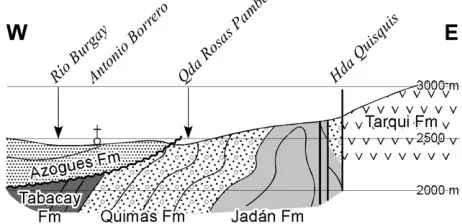
East of Antonio Borrero (Fig. 6), Bristow (inBristow and
Hoffstetter, 1977; personal communication, 2003) reports
Sphenodiscus peruvianus Gerth, 1928, and Solenoceras sp. of early Maastrichtian age (determined by M.K. Howarth, Natural History Museum, London). In the same area
(Fig. 6), we find ammonite fragments, which may be either
Glyptoxoceras sp. (Santonian-Maastrichtian) or Neo-glyptoxoceras sp. (lower–middle Campanian) ([02.C.G2,
03.Cu.38]Table 1). East of Azogues, the base of the
forma-tion yields unidentifiable ammonites [03.Cu.54-55] that directly overlie the upper Campanian species mentioned
pre-viously (Fig. 5). On the basis of this evidences, the Quimas
Formation is considered of latest Campanian to earliest Maastrichtian age.
4.3. Tabacay Formation (lower Maastrichtian)
The Tabacay Formation corresponds to lithologic unit 1
of Faucher et al. (1971). The base of the formation is not
exposed, except to the east of Azogues (Santa Ba´rbara),
where it is faulted (Fig. 5), and north of Azogues, where
it unconformably overlies both the Quimas Formation
and undated metamorphic rocks (Vaca, 2005). North of
[image:6.595.39.279.97.264.2]Santa Ana and in the Quebrada Tabacay, the formation seems to rest disconformably on the Quimas Formation. However, no suitable type section has been found.
[image:6.595.311.542.633.745.2]Fig. 6. Structural section of the Yunguilla Group, east of Antonio Borrero. Location inFig. 2.
Although the stratigraphic contact is not visible, the Taba-cay Formation seems to rest unconformably on the Quimas Formation, because the dip orientations and deformation styles are slightly different.
The Tabacay Formation consists of a succession of dark, laminated cherts, alternating with variably thick, fine-grained polygenetic conglomerates, volcanogenic grey-wackes, and arkosic lithic arenites. The clasts dominantly consist of volcanic rocks, associated with arkoses, lithic arenites, and chert fragments, as well as locally abundant white quartz. Nodules or irregularly bedded intercalations of micritic black limestones are common, whereas scarce calciturbidites with volcanic or feldspathic fragments are locally observed. The detrital beds are interpreted as turbi-dites on the basis of their erosional bases, presence of flat pebbles, and fining-upward bedding. The detrital compo-nents of the Tabacay Formation indicate a dominantly vol-canic source area and a subordinate crystalline basement provenance. The detrital fragments were deposited in a dysaerobic pelagic environment, in which autochtonous, fine-grained, siliceous mud was laid down. Although out-crops are scarce, the thickness of the Tabacay Formation seems to reach a few hundred meters.
Faucher et al. (1971)record Maastrichtian foraminifers
(buliminids, arenaceous forms, Robulus sp., Globigerinella
sp.) and scarce indeterminable bivalves, inoceramids, and ammonites within their lithologic unit 1. In Quebrada
Tabacay, Bristow (1973)found a diplomoceratid
ammon-ite. Farther north, in the Pallatanga area near Huangupud,
from a comparable lithology, we collectedExitelocerassp.
[99.G.74, 99.G.75] of Campanian age (or Glyptoxoceras
sp., Santonian–Maastrichtian?) and a Hypophylloceras
(Neophylloceras) sp. [99.G.75], of probably early
Maas-trichtian age (Jaillard et al., 2005).
4.4. Saquisilı´ Formation (Paleocene)
In the Quebrada Tabacay, though the contact is not vis-ible, the Tabacay Formation is overlain by grey to black shales, dark siltstones, sandstone layers, and thicker beds of dark, micaceous and arkosic sandstones. North of
Taba-cay, the basal contact is an unconformity (Vaca, 2005).
Beds or nodules of micritic dark limestones and thin-bed-ded sandy turbidites are locally observed. The beds of fine-grained sandstone show ripples, lamination, hum-mocky cross-stratification, and load structures; they
con-tain plant remnants and Glossifungites or Skolithos
burrows. These features suggest deposition in a clastic dis-tal shelf environment, above the storm wave base. The thickness of this unit may reach 500–1000 m.
The rocks referred to here as the Saquisilı´ Formation formerly were included in the ‘‘Yunguilla Formation.’’ They have yielded, among others, the benthic foraminifers Bathysiphon gerochi Myatlyuk, 1966(Paleocene),Bulimina midwayensis (Cushman and Parker, 1936) (Campanian–
Paleocene), and the palynomorph Tricolporopollenites?
sp., indicating a Paleocene age. Due to a similar lithology
with abundant detrital white micas, these beds are now referred to the Saquisilı´ Formation, which in the type
local-ity has been dated as early to middle Paleocene (McCourt
et al., 1998; Hughes et al., 1999). A sample from the water
divide between Cuenca and Quingeo yields the benthic
foraminifers Dorothia cylindracea (Bermu´dez, 1963)
(Paleocene–early Eocene) andHaplophragmoides cf.eggeri
(Cushman, 1926) (Paleogene), which suggests that the Saquisilı´ Formation also crops out east of Cuenca.
Farther north, graded-bedded conglomerates are
observed along the Azogues–Ingapirca road (Vaca, 2005).
These coarser-grained deposits correlate with the Gallo Rumi Member of the Pallatanga area, which is assigned
to the upper Paleocene (Jaillard et al., 2004).
Bristow and Hoffstetter (1977) assume that the
‘‘Yun-guilla Formation’’ of the Cumbe area grades progressively upward into Paleocene variegated, fine-grained subaerial
deposits. In the same area,Pratt et al. (1997)assume a
pro-gressive change from the marine ‘‘Yunguilla Formation’’ to Maastrichtian redbeds and then to the Eocene Quingeo Formation. However, the deformation of the Maastrich-tian deposits includes tight folds, the axis of which varies from E–W to N–S, whereas the continental deposits ascribed to the Quingeo Formation only exhibit NNE-trending gentle folds. Therefore, it is probable that a major unconformity separates upper Maastrichtian–Paleocene, fine-grained subaerial deposits from the coarser-grained, Eocene Quingeo Formation.
5. Correlations with neighbouring areas
5.1. Celica-Lancones Basin (southwestern Ecuador) and Paita area (northwestern Peru)
The unconformable, transgressive Campanian–Maas-trichtian sequence in the Celica-Lancones Basin appears to rest on the Albian volcanic arc in the east, deformed Cretaceous sediments in the central part, and Paleozoic basement or Albian transgressive limestones in the west
(Olsson 1934; Kennerley, 1973; Morris and Alema´n,
1975; Jaillard et al., 2005). The uppermost Cretaceous
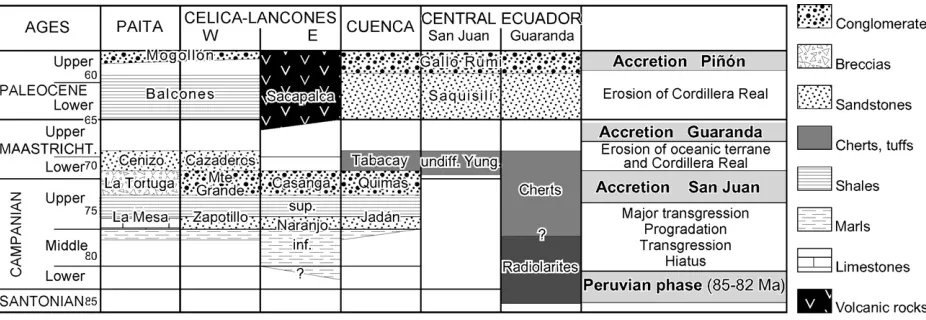
sequence comprises, from base to top (Fig. 7): (1) a
mid-dle to upper Campanian prograding sequence of marls, limestones, and arkosic sandstones, overlain by transgres-sive marls (Naranjo and Zapotillo formations); (2) coarse-grained conglomerates derived from either a volcanic source in the east (Casanga Formation) or a crystalline source in the west (Monte Grande or Tablones Forma-tion); and (3) lower Maastrichtian dark shales interbedded
with quartzose sandstones (Cazaderos Formation) (
Jail-lard et al., 1996, 1999). The latter are unconformably
overlain by Paleocene marine shales, with sandstone and
limestone interbeds (Balcones Formation) (Jaillard et al.,
1999).
In the Paita area (northwestern Peru,Figs. 1 and 7), the
marls and sandy limestones, which ends with shallowing-upward, rudist-bearing carbonate shelf deposits (La Mesa
Formation) (Olsson, 1944; Palacios, 1994; Jaillard et al.,
1998). The latter formation is overlain by upper
Campa-nian transgressive sandy marls, which rapidly grade upward into quartz-rich conglomerates. To the west, the Paleozoic basement is directly overlain by a 3500 m thick upper Campanian–lower Maastrichtian succession of fan
delta breccias (La Tortuga Formation) (Jaillard et al.,
1998; Taipe et al., 2004), which indicates that a deep
sedi-mentary basin was created between the late Campanian and the early Maastrichtian. These breccias are discon-formably overlain by lower Maastrichtian transgressive shoreline sandstones, which grade into shallow clastic shelf breccias and sandstones (Cenizo Formation). Paleocene marine marls unconformably overlie the Maastrichtian
sandstones (Taipe et al., 2004; Jaillard et al., 2005).
The upper Campanian marls, limestones, and arkoses of the Jada´n Formation in the Cuenca area are lithologically comparable and stratigraphically correlatable with the transgressive Naranjo, Zapotillo, and La Mesa formations of southwestern Ecuador and northwestern Peru. The con-glomerates of the Quimas Formation are stratigraphically correlatable with those of the Casanga and Monte Grande (or Tablones) formations of the Celica-Lancones area and the La Tortuga breccias of the Paita area. Although their source areas and depositional environments differ, the lower Maastrichtian cherts and volcanogenic turbidites of the Tabacay Formation may be correlated with the quartz-rich Cazaderos Formation of southwestern Ecua-dor and the transgressive Cenizo Formation of
northwest-ern Peru (Jaillard et al., 2005).
It follows that the sedimentary successions of the Paita, Celica-Lancones, and Cuenca areas represent a three-fold evolution: (1) a mid to late Campanian transgressive pro-grading sequence, followed by a renewed transgression; (2) a significant tectonic event, with deposition of thick, shallow-marine to continental, coarse-grained conglomer-ates or breccias in the lconglomer-atest Campanian–earliest
Maas-trichtian; and (3) a new transgression and clastic-shelf or deeper turbiditic deposition in the early Maastrichtian. The latter sequence closes with a regional hiatus in the late Maastrichtian–earliest Paleocene, which reflects a signifi-cant tectonic event.
5.2. Western Cordillera of central and northern Ecuador
In central Ecuador (0–2"S), the Yunguilla Group is
tec-tonically associated with basalts, dolerites, and greywackes, interpreted as an accreted oceanic terrane (part of the
Pal-latanga terrane ofMcCourt et al., 1998; Kerr et al., 2002;
Spikings et al., 2005; San Juan terrane of Mamberti
et al., 2004; Jaillard et al., 2004). To the west, the late
Campanian–Maastrichtian interval is represented by radiolarian-rich black cherts that overlie red or green
radi-olarites (Fig. 7). In northern Ecuador, the
radiolarian-bear-ing red mudstones are dated as Santonian–early
Campanian (Boland et al., 2000; Kerr et al., 2002) and
con-stitute the sedimentary cover of basalts, ankaramites, and picrites that represent an accreted oceanic terrane (part of
the Pallatanga terrane of McCourt et al., 1998; Kerr
et al., 2002; Guaranda terrane of Mamberti et al., 2003;
Jaillard et al., 2004). Thus, the Yunguilla Group was
deposited only on the eastern San Juan oceanic terrane. The Yunguilla sediments of central Ecuador are highly deformed, and it is difficult to ascribe them to any of the formations defined in the Cuenca area. However, their
quartz content is low (620%, Toro and Jaillard, 2005),
available paleontological data suggest an early
Maastrich-tian age (Jaillard et al., 2005), and there are no quartz-rich
conglomerates similar to the Quimas Formation. For these reasons, the Yunguilla sediments of the Quito–Pallatanga area are tentatively referred to the Tabacay Formation (lower Maastrichtian). If this assignment is correct, the Tabacay Formation postdates the accretion of the eastern
San Juan oceanic terrane (Hughes and Pilatasig, 2002; Kerr
et al., 2002) and predates the accretion of the western
[image:8.595.60.523.92.252.2]Gua-randa oceanic terrane (Jaillard et al., 2004). Therefore, the
deposition of the coarse-grained conglomerates of latest
Campanian–earliest Maastrichtian age (!75–70 Ma) are
interpreted as a sedimentary response to the accretion of the San Juan oceanic terrane.
The Paleocene Saquisilı´ Formation in the Cuenca area exhibits similar lithologies and is coeval with that in cen-tral and northern Ecuador. In the latter area, it uncon-formably overlies both the Maastrichtian Tabacay Formation (San Juan Terrane) and the Campanian– Maastrichtian black cherts (Guaranda Terrane),
conceal-ing the accretion of the latter to the former (Jaillard
et al., 2004). Therefore, the accretion of the Guaranda
terrane occurred in the late Maastrichtian–earliest
Paleo-cene (!68–65 Ma; Fig. 7).
5.3. Oriente Basin of Ecuador
The Cretaceous, fine-grained, shallow-marine sedi-ments in the Oriente Basin (Napo Group) record the arri-val of significant detrital input in the Santonian, which predates a major hiatus of late Santonian–early
Campa-nian times (Jaillard, 1997; Jaillard et al., 2005). These
deposits are disconformably overlain by a 5–20 m thick, middle to upper Campanian, transgressive sequence of
sandstones and thin marine shales (M-1 sandstones,
Ray-naud et al., 1993; Rivadeneira et al., 1995). However, in
the western part of the Oriente Basin and the sub-Andean zone, Campanian sediments are absent. There, lower Maastrichtian sandstones unconformably overlie the eroded marine shales and limestones, which are dated
as Turonian to Santonian, depending on the region (
Fau-cher et al., 1971; Jaillard, 1997). Therefore, in the western
part of the Oriente Basin, a late Campanian erosional hiatus coincides with the accretion of the eastern San
Juan terrane (Hughes and Pilatasig, 2002; Jaillard et al.,
2004).
The early Maastrichtian transgression (basal Tena For-mation) is overlain by prograding, fine-grained redbeds
(lower Tena Formation) (Faucher et al., 1971; Jaillard,
1997; Ruiz et al., 2004). These beds in turn are
disconform-ably overlain by a succession of Paleocene, coarser-grained,
fluvial redbeds (Mills, 1972; Jaillard, 1997). Thus, a hiatus
occurred some time after the early Maastrichtian and before part of the Paleocene, coinciding with the accretion
of the western Guaranda terrane (Mamberti et al., 2003;
Jaillard et al., 2004).
The Paleocene upper Tena Formation is in turn eroded and unconformably overlain by coarse-grained, fluvial con-glomerates of the poorly dated lower Tiyuyacu Formation
(Christophoul et al., 2002). Although poorly constrained,
this major unconformity may correlate with the accretion of the Pin˜o´n terrane of southern coastal Ecuador in the late
Paleocene (!58–55 Ma; Jaillard et al., 1995). These
obser-vations demonstrate that the accretion of oceanic terranes coincides with important sedimentary hiatuses in the sub-Andean zone and Oriente Basin and therefore with uplift and erosion in those areas.
6. Geodynamic interpretations and discussion
The mid- to late-Campanian Jada´n Formation represents the oldest Cretaceous sediments exposed in the Cuenca area. Although the stratigraphic contact is not visible, we assume it was unconformably deposited onto the metamorphic base-ment of the Andean margin. A similar unconformable con-tact of transgressive, mid- to late-Campanian deposits resting on deformed, Albian to Paleozoic rocks of the Andean margin is known from the forearc zones of
south-western Ecuador and northsouth-western Peru (Jaillard et al.,
1996, 1998, 1999; Taipe et al., 2004). Therefore, a strong
sub-sidence probably affected the western edge of the Andean continental margin of southern Ecuador by the mid-Camp-anian. Because this subsidence event followed the compres-sional ‘‘Peruvian phase,’’ we suggest that the latter was responsible for a strong tectonic erosion of the forearc con-tinental edge, which accounts for the subsequent subsidence
of the forearc zones (Jaillard and Soler, 1996).
The Cuenca succession exhibits four distinct lithological units that reflect distinct paleogeographic settings and
geo-dynamic events (Fig. 7).
The Jada´n and Quimas formations are separated by a significant, progressive coarsening of the detrital input, which implies a significant rejuvenation of the eastern reliefs in the late Campanian. Therefore, the accretion of the San Juan terrane provoked the incipient uplift and erosion of the Eastern Cordillera and ongoing coarse, quartz-rich, detrital input (Quimas conglomerates). The significant change from a crystalline source area in the Jada´n and Quimas formations to a mainly volcanic source area in the Tabacay Formation reflects the onset of ero-sion of the newly accreted San Juan oceanic terrane. The abundance of feldspars suggests that erosion mainly affected volcanic arc rocks. However, in southwestern Ecuador (Cazaderos Formation), the volcanic clastic input is less significant.
Accretion of oceanic terranes and related uplift and ero-sion of the Andean continental margin traditionally is
assumed to have begun in the Campanian (e.g., Lebrat
et al., 1987; Daly, 1989; Reynaud et al., 1999; Kerr et al., 2002; Hughes and Pilatasig, 2002; Jaillard et al., 2004; Toro
and Jaillard, 2005; Vallejo et al., 2006; Luzieux et al., 2006).
Using thermochronological studies, Spikings et al. (2001,
2005) propose that (1) uplift of the Andean continental
margin began earlier in southernmost Ecuador (75– 65 Ma) than in the rest of the country (65–60 Ma), though
Late Cretaceous (!75 Ma) cooling of continental basement
is recorded by Paleocene sediments in central Ecuador (
Spi-kings et al., 2005); and (2) uplift of the Andean margin
began earlier to the west than to the east. However, the Eastern Cordillera became a source area for deposits of
the Oriente Basin by early Maastrichtian times (!70 Ma;
Baldock, 1982; Jaillard, 1997; Ruiz et al., 2004). These
The Tabacay and Saquisilı´ formations differ in their dis-tinct clastic sources, different deformation styles, and sepa-ration by a probable unconformity, interpreted as the result of accretion of the Guaranda terrane during the late Maastrichtian (to earliest Paleocene?; 68–65 Ma). The change from a mainly volcanic source in the Maastrichtian to a crystalline source in the Paleocene may reflect the renewed uplift and erosion of the Eastern Cordillera, related to the Guaranda terrane accretion. This
interpreta-tion is in agreement with recent studies (Spikings et al.,
2001, 2005; Jaillard et al., 2005; Vallejo et al., 2006).
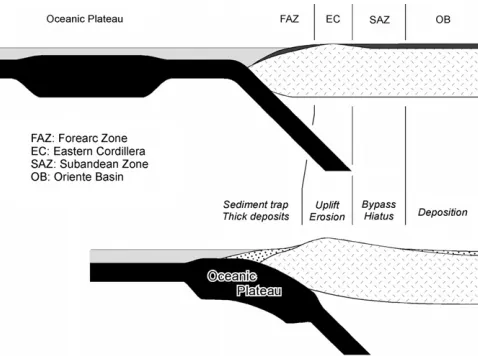
Most accretionary events of oceanic terranes resulted in the uplift and erosion of the Eastern Cordillera. Moreover, accretions of oceanic terranes in western Ecuador (late Campanian, late Maastrichtian, late Paleocene) correlate with significant sedimentary hiatuses in the sub-Andean zone and locally in the Oriente Basin (upper Napo/lower Tena, lower/upper Tena, and upper Tena/Lower Tiyuyacu unconformities). These observations demonstrate that accretions of oceanic terranes provoked the uplift of the Andean continental margin, which was higher toward the
west (Fig. 8). The Oriente Basin of Ecuador therefore
can-not be considered a flexural foreland basin at that time. Conversely, deposits in the forearc zone are thick and localized due to the structural sediment traps related to the deformation of both the Andean margin and the oce-anic terranes. We propose that accretion of oceoce-anic terr-anes through a subduction jam added relatively buoyant oceanic material beneath the western edge of the continen-tal margin, thus provoking its westward increasing uplift. According to this view, accretion and tectonic underplating of oceanic material beneath the continental margin would represent a major process in the creation of relief and
crus-tal thickening of the early Andes of Ecuador (Fig. 8).
7. Conclusions
The uppermost Cretaceous, unconformable clastic deposits of the Cuenca area, here referred to as the Yun-guilla Group, include, from base to top, distal shelf fine-grained marls, arkoses, and limestones (Jada´n Formation, middle and upper Campanian); coarse-grained, quartz-rich shelf and fan delta conglomerates (Quimas Formation, uppermost Campanian–lowermost Maastrichtian); and unconformable black cherts interbedded with volcanogenic turbidites (Tabacay Formation, lower Maastrichtian). This succession resembles that of the Paita and Celica-Lancones regions, indicating that the Campanian–Maastrichtian basin extended south as far as northern Peru. The creation of such a mid-Campanian forearc basin implies strong sub-sidence, interpreted as due to a significant tectonic erosion, resulting from the former compressional Peruvian phase (late Santonian–early Campanian). The Yunguilla Group is overlain, probably unconformably, by quartz-rich, micaceous distal shelf sandstones (Saquisilı´ Formation, Paleocene).
The conglomerates of the Quimas Formation are inter-preted as reflecting the accretion of the San Juan oceanic terrane (eastern part of Pallatanga terrane), whereas the Maastrichtian–Paleocene boundary unconformity is inter-preted as the result of the accretion of the Guaranda oce-anic terrane (western part of Pallatanga terrane). These accretionary events correlate with a rejuvenated erosion of the Eastern Cordillera and with uplifts and erosional hiatuses in the sub-Andean zone and Oriente Basin of Ecuador, which indicates that accretion and tectonic underplating of oceanic material beneath the continental margin induced the jerky uplift of a large western part of the continental margin. Therefore, the Oriente Basin of Ecuador cannot be considered a flexural foreland basin at that time.
Acknowledgments
This work was carried out in the frame of a scientific agreement between Petroproduccio´n (branch of Petroec-uador) and the Institut de Recherche pour le De´veloppe-ment-IRD. The IRD (UR 154) supported fieldwork and sampling expeditions. We are grateful to G. Gastineau, D. Iza, and W. Lugo for their participation in the field-work and fossil collecting; to R. Bristow and W. Pratt for fruitful discussions and correspondence; and to R. Campan˜a and M. Rivadeneira for their constant support of this scientific agreement. R. Spikings, J. Kellogg, and an anonymous referee are thanked for their constructive reviews.
References
[image:10.595.39.278.527.705.2]Arculus, R.J., Lapierre, H., Jaillard, E´., 1999. A geochemical window into subduction-accretion processes: the Raspas Metamorphic Complex. Ecuador Geology 27, 547–550.
Baldock, J.W., 1982. Geologı´a del Ecuador. Boletı´n de Explicacio´n del Mapa geolo´gico de la Repu´blica del Ecuador. Direccio´n General de Geologı´a y Minas, Quito, 70 pp.
Bermu´dez, P.J., 1963. Foraminı´feros de las lutitas de Punta Tolete, Territorio Delta Amacuro, Venezuela, p.765-768 en: Micropaleonto-logia general, University of Central Venez., 808 pp.
Boland, M.P., McCourt, W.J., Beate, B., 2000. Mapa geolo´gico de la Cordillera Occidental del Ecuador entre 0"–1"N, escala 1/200.000. Ministerio de Energı´a y Minas-BGS Publishers, Quito.
Bolli, H.M., 1951. The genusGlobotruncanain Trinidad, BWI. Journal of Paleontology 25, 187–199.
Bristow, C.R., 1973. Guide to the geology of the Cuenca Basin, southern Ecuador. Ecuadorian Geological and Geophysical Society, Quito, 45 pp.
Bristow, C.R., 1980. Mapa geolo´gico al 1/100.000, hoja Azogues. Ministerio de Recursos Naturales y Energı´a, Direccio´n de Geologı´a y Minas, Quito.
Bristow, C.R., Hoffstetter, R., 1977. Ecuador. Lexique Stratigraphique International, vol. 5a2. CNRS Publishers, Paris, 410 pp.
Bro¨nnimann, P., 1952. Globigerinidae from the Upper Cretaceous (Cenomanian–Maastrichtian) of Trinidad. BWI. Bulletins of American Paleontology 34, 5–71.
Christophoul, F., Baby, P., Rivadeneira, M., Da´vila, C., 2002. Strati-graphic responses to a major tectonic event in a foreland basin: the Ecuadorian Oriente Basin from Eocene to Oligocene times. Tectono-physics 345, 281–298.
Cushman, J.A., 1929. Some species of Siphogenerinoides from the Cretaceous of Venezuela. Contributions from the Cushman Labora-tory for Foraminiferal Research 5, 55–59.
Cushman, J.A., Jarwis, P.W., 1929. Cretaceous Foraminifera from Trinidad. Contributions from the Cushman Laboratory for Forami-niferal Research 4, 85–103.
Cushman, J.A., Parker, F.L., 1936. Notes on some Cretaceous species of Buliminella and Neobulimina. Contributions from the Cushman Laboratory for Foraminiferal Research 12, 510.
Daly, M.C., 1989. Correlations between Nazca/Farallo´n plate kinematics and forearc basin evolution in Ecuador. Tectonics 8, 769–790. Dunkley, P.N., Gaibor, A., 1998. Mapa geolo´gico de la Cordillera
Occidental del Ecuador entre 2"–3"S, escala 1/200.000. CODIGEM-Ministerio de Energı´a y Minas-British Geological Survey Publishers, Quito.
Egu¨ez, A., Bourgois, J., 1986. La formacio´n Apagua: edad y posicio´n estructural en la Cordillera occidental del Ecuador. Actas del IV Congreso Ecuatoriano de Ingenierı´a, Geologı´a, Minerı´a y Petroleo, t. 1, 161–178, Quito.
Faucher, B., Vernet, R., Bizon, G., Bizon, J.J., Grekoff, N., Lys, M., Sigal, J., 1971. Sedimentary formations in Ecuador. A stratigraphic and micropaleontological survey. Bureau d’E´tudes Industrielles et Coope´ration de l’Institut Franc¸ais du Pe´trole (BEICIP), 220 pp., 3 vols.
Feininger, T., Bristow, C.R., 1980. Cretaceous and Paleogene history of coastal Ecuador. Geologische Rundschau 69, 849–874.
Gansser, A., 1973. Facts and theories on the Andes. Journal of the Geological Society, London 129, 93–131.
Gerth, H., 1928. Neue Faunen der oberen Kreide mit Hippuriten aus Nordperu. Leidsche geologische Mededeel 2, 232–241.
Goossens, P.J., Rose, W.I., 1973. Chemical composition and age determination of tholeitic rocks in the basic Cretaceous Com-plex, Ecuador. Geological Society of America Bulletin 84, 1043– 1052.
Grzybowski, J., 1901. Die Microfauna der Karpathenbildungen; III – Die Foraminiferen der Inoceramenschichten von Gorlice. Science. Guillier, B., Chatelain, L., Jaillard, E´., Yepes, H., Poupinet, G., Fels,
J.-F., 2001. Seismological evidence on the geometry of the orogenic system in central-northern Ecuador (South America). Geophysical Research Letters 28, 3749–3752.
Henderson, W.G., 1981. The volcanic Macuchi Formation, Andes of northern Ecuador. Newsletters on Stratigraphy 9, 157–168.
Hughes, R.A., Pilatasig, L.F., 2002. Cretaceous and Tertiary terrane accretion in the Cordillera Occidental of the Andes of Ecuador. Tectonophysics 345, 29–48.
Hughes, R.A., Bermu´dez, R., Espinel, G., 1999. Mapa geolo´gico de la Cordillera Occidental del Ecuador entre 0"–1"S, escala 1:200.000. CODIGEM-Minist. Energ. Minas-BGS Publishers, Quito.
Hungerbu¨hler, D., Steinmann, M., Winkler, W., Seward, D., Egu¨ez, A., Peterson, D.E., Elg, U., Hammer, C., 2002. Neogene stratigraphy and Andean geodynamics of southern Ecuador. Earth Science Reviews 57, 75–124.
Jaillard, E´., 1997. Sı´ntesis estratigra´fica y sedimentolo´gica del Creta´ceo y Paleo´geno de la cuenca oriental del Ecuador. Orstom-Petroproduccio´n Publishers, Quito, 164 pp.
Jaillard, E´., Soler, P., 1996. The Cretaceous to early Paleogene tectonic evolution of the northern Central Andes and its relations to geody-namics. Tectonophysics 259, 41–53.
Jaillard, E´., Ordon˜ez, M., Benı´tez, S., Berrones, G., Jime´nez, N., Montenegro, G., Zambrano, I., 1995. Basin development in an accretionary, oceanic-floored forearc setting: southern coastal Ecua-dor during late Cretaceous to late Eocene times. In: Tankard, A.J., Sua´rez, R., Welsink, H.J. (Eds.), Petroleum Basins of South America, American Association of Petroleum Geologists Memoir, 62, 615–631.
Jaillard, E´., Ordon˜ez, M., Bengtson, P., Berrones, G., Bonhomme, M., Jime´nez, N., Zambrano, I., 1996. Sedimentary and tectonic evolution of the arc zone of southwestern Ecuador during Late Cretaceous and Early Tertiary times. Journal of South American Earth Sciences 9, 131–140. Jaillard, E´., Laubacher, G., Bengtson, P., Dhondt, A., Philip, J., Bulot,
L.G., Robert, E., 1998. Revisio´n estratigra´fica del Creta´ceo superior del Noroeste peruano y Suroeste ecuatoriano: Datos preliminares y consecuencias tecto´nicas. Boletı´n de la Sociedad geolo´gica del Peru´ 88, 101–115.
Jaillard, E´., Laubacher, G., Bengtson, P., Dhondt, A., Bulot, L., 1999. Stratigraphy and evolution of the Cretaceous forearc ‘‘Celica-Lan-cones Basin’’ of southwestern Ecuador. Journal of South American Earth Sciences 12, 51–68.
Jaillard, E´., He´rail, G., Monfret, T., Wo¨rner, G., 2002. Andean geody-namics: main issues and contributions from the 4th ISAG, Go¨ttingen. Tectonophysics 242, 1–15.
Jaillard, E´., Ordon˜ez, O., Sua´rez, J., Toro, J., Iza, D., Lugo, W., 2004. Stratigraphy of the Late Cretaceous–Paleogene deposits of the Western Cordillera of Central Ecuador: geodynamic implications. Journal of South American Earth Sciences 17, 49–58.
Jaillard, E´., Bengtson, P., Dhondt, A., 2005. Late Cretaceous marine transgressions in Ecuador and northern Peru: a refined stratigraphic framework. Journal of South American Earth Sciences 19, 307–323. Kehrer, W., Kehrer, P., 1969. Die oberkretazische San Juan Formation
der Westkordillere Ecuadors. Neues Jahrbuch fu¨r Geologie und Pala¨ontologie, Abhandlungen 133, 1–22.
Kennerley, J.B., 1973. Geology of the Loja Province, southern Ecuador. Institute of Geological Sciences, Overseas Division, Report 23, 34 pp. Kerr, A.C., Aspden, J.A., Tarney, J., Pilatasig, L.F., 2002. The nature and provenance of accreted terranes in Western Ecuador: geochemical and tectonic constraints. Journal of the Geological Society, London 159, 577–594.
Lavenu, A., Baudino, R., E´go, F., 1996. Stratigraphie des de´poˆts tertiaires et quaternaires de la de´pression interandine d’E´quateur (entre 0"et 2"15’S). Bulletin de l’Institut Franc¸ais d’E´tudes Andines 25, 1–15. Lebrat, M., Me´gard, F., Dupuy, C., Dostal, J., 1987. Geochemistry and
tectonic setting of pre-collision Cretaceous and Paleogene volcanic rocks of Ecuador. Geological Society of America Bulletin 99, 569–578. Litherland, M., Aspden, J.A., Jemielita, R.A., 1994. The metamorphic belts of Ecuador. British Geological Survey, Overseas Memoir 11, 147 pp., 2 maps, Keyworth, UK.
Mamberti, M., Lapierre, H., Bosch, D., Ethien, R., Jaillard, E´., Hernandez, J., Polve´, M., 2003. Accreted fragments of the Late Cretaceous Caribbean-Colombian Plateau in Ecuador. Lithos 66, 173–199. Mamberti, M., Lapierre, H., Bosch, D., Jaillard, E´., Hernandez, J., Polve´,
M., 2004. The Early Cretaceous San Juan plutonic suite, Ecuador: a magma chamber in an Oceanic Plateau. Canadian Journal of Earth Sciences 41, 1237–1258.
McCourt, W.J., Duque, P., Pilatasig, L.F., Villago´mez, R., 1998. Mapa geolo´gico de la Cordillera Occidental del Ecuador entre 1"–2"S., escala 1/200.000. CODIGEM-Ministerio Energı´a y Minas-BGS Publishers, Quito.
Mills, S.J., 1972. A review of micropaleontological evidence from the Ecuadorian Oriente. Anglo-Ecuadorian Oilfields Ltd, Ecuadorian Oriente Geological note n"26, Petroproduccio´n-Quito, 21 pp. Morris, R.C., Alema´n, A.R., 1975. Sedimentation and tectonics of middle
Cretaceous Copa Sombrero formation in northwest Peru. Boletı´n de la Sociedad geolo´gica del Peru´ 48, 49–64.
Morrow, A.L., 1934. Foraminifera and Ostracoda from the Upper Crretaceous of Kansas. Journal of Paleontology 8, 186–205. Myatlyuk, E.V., 1966. O foraminiferakh s kremnevym skeletom. Voprosy
Mikropaleontologii 10, 255–269.
Noblet, C., Lavenu, A., Schneider, F., 1988. E´tude ge´odynamique d’un bassin intramontagneux tertiaire sur de´crochements dans les Andes du Sud de l’E´quateur: l’exemple du bassin de Cuenca. Ge´odynamique, vol. 3. IRD Publishers, Paris, pp. 117–138.
Olsson, A.A., 1934. Contributions to the paleontology of northern Peru: the Cretaceous of the Amotape region. Bulletins of American Paleontology 20, 1–104.
Olsson, A.A., 1944. Contributions to the paleontology of northern Peru. Part VII: the Cretaceous of the Paita region. Bulletins of American Paleontology 28, 159–304.
Olsson, R.K., 1964. Late Cretaceous planktonic foraminifera from New Jersey and Delaware. Micropaleontology 10, 157–188.
Palacios, O., 1994. Geologı´a de los cuadra´ngulos de Paita, Talara, Sullana, Lobitos, Quebrada Seca, Zorritos, Tumbes y Zarumilla. Boletı´n INGEMMET, (A), 54, 190 pp., 1 pl. h.t., Lima.
Plummer, H.J., 1926. Foraminifers of the Midway Formation in Texas. University of Texas Bulletin 2644, 1–206.
Plummer, H.J., 1931. Some Cretaceous foraminifera in Texas. University of Texas Bulletin 3101, 109–203.
Pratt, W.T., Figueroa, J.F., Flores, B.G., 1997. Geology of the Cordillera Occidental of Ecuador between 3"00’ and 4"00’S. World Bank Mining Development and environmental Control Project, Report n" 1, CODIGEM-British Geological Survey, Quito, 58 pp.
Pratt, W.T., Figueroa, J.F., Flores, B.G., 1998. Mapa geolo´gico de la Cordillera Occidental del Ecuador entre 3"–4" S, escala 1/ 200.000. CODIGEM-Ministerio de Energı´a y Minas-BGS Publish-ers, Quito.
Raynaud, J.-F., Bouroullec, J., Homewood, P., Villanova, M., 1993. Equateur, Bassin de l’Oriente: Etude palynologique d’un intervalle Cre´tace´ supe´rieur sur 20 puits. Etude se´dimentologique des gre`s M-1. Elf-Aquitaine Production proprietary Report, 98 pp., 19 plates.
Reynaud, C., Jaillard, E´., Lapierre, H., Mamberti, M., Mascle, G.H., 1999. Oceanic plateau and island arcs of southwestern Ecuador: their
place in the geodynamic evolution of northwestern South America. Tectonophysics 307, 235–254.
Rivadeneira, M., Da´vila, C., Toro, J., 1995. La Arenisca «M-1» en la cuenca ecuatoriana. Congreso Petroleo y Medio ambiente, Quito, November 95, 15 pp., 9 Fig.
Ruiz, G., Seward, D., Winkler, W., 2004. Detrital thermochronology – a new perspective on hinterland tectonics, an example from the Andean Amazon Basin, Ecuador. Basin Research 16, 413–430.
Santos, M., Ramı´rez, F., 1986. La Formacio´n Apagua, una nueva unidad eoce´nica en la cordillera occidental ecuatoriana. Actas del IV Congreso Ecuatoriano de Ingenierı´a, Geologı´a, Mineralogı´a y Petro´leo, tomo 1, 179–190, Quito.
Sigal, J., 1969. Quelques acquisitions re´centes concernant la chronostra-tigraphie des formations se´dimentaires de l’E´quateur. Revista Espan˜-ola de Micropaleontologı´a 1, 205–236.
Sornay, J., 1962. Etude d’une faune d’inoce´rames du Se´nonien supe´rieur des Charentes et description d’une espe`ce nouvelle du Se´nonien supe´rieur de Madagascar. Bulletin de la Socie´te´ ge´ologique de France 7, 118–122. Spikings, R.A., Winkler, W., Seward, D., Handler, R., 2001. Along-strike
variations in the thermal and tectonic response of the continental Ecuadorian Andes to the collision with heterogeneous oceanic crust. Earth and Planetary Science Letters 186, 57–73.
Spikings, R., Winkler, W., Hughes, R.A., Handler, R., 2005. Thermo-chronology of allochthonous terranes in Ecuador: unravelling the accretionary and post-accretionary history of the Northern Andes. Tectonophysics 399, 195–220.
Steinmann, M., 1997. The Cuenca Basin of southern Ecuador: tectono-sedimentary history and the Tertiary Andean evolution. PhD thesis, ETH Zu¨rich, n"12297, 176 pp.
Stone, B., 1946. Stichocassidulina, a new genus of foraminifera from norhwestern Peru. Journal of Paleontology 20, 59–61.
Taipe, E., Jaillard, E´., Jacay, J., 2004. Estratigrafia y evolucio´n sedimen-tolo´gica de la serie del Creta´ceo superior de la Penı´nsula de Paita. Boletı´n de la Sociedad Geolo´gica del Peru´ 97, 7–27.
Thalmann, H.E., 1946. Micropaleontology of Upper Cretaceous and Paleocene in western Ecuador. American Association of Petroleum Geologists Bulletin 30, 337–347.
Toro, A.J., Jaillard, E., 2005. Provenance of the Upper Cretaceous to Upper Eocene clastic sediments of the Western Cordillera of Ecuador: tectonic and geodynamic implications. Tectonophysics 399, 279–292. Tschopp, H.J., 1948. Geologische Skizze von Ekuador. Bulletin der
Vereinigung Schweizerischer Petroleum-Geologen und -Ingenieure, 15, 48, 14-45.
Vaca, W., 2005. Sedimentologı´a, petrologı´a y tecto´nica de las secuencias creta´cicas entre Ingapirca y Pindilig, provincia de Can˜ar. Tesis Ingeniero Escuela Polite´cnica Nacional, Quito, 106 pp.
Vallejo, C., Spikings, R.A., Luzieux, L., Winkler, W., Chew, D., Page, L., 2006. The early interaction between the Caribbean Plateau and the NW South American Plate. Terra Nova 18, 264–269.