www.medigraphic.org.mx
Reperfusion in acute myocardial infarction
in the elderly (clinical characteristics and
prognosis). Results of the IMSS Nuevo
León Infarction Code Program
Reperfusión en el infarto agudo de miocardio en ancianos
(características clínicas y pronóstico). Resultados del
Programa Código Infarto del IMSS Nuevo León
Alejandro Zapata Ruiz,* Juan Manuel Palacios Rodríguez,** Ramón De la Cruz Obregón,***
Luis Arboine Aguirre,* Ángel Sierra Fragoso,* Carlos Muñoz Consuegra*
Key words: Coronary angioplasty, stent, elderly, acute myocardial infarction.
Palabras clave:
Angioplastia coronaria, stent, ancianos, infarto agudo de miocardio.
ABSTRACT
Introduction: The age is an important prognostic factor in patients with acute myocardial infarction. As there are no data in the Mexican population, it is important to establish the characteristics and prognosis of older adults in whom mechanical reperfusion treatment is carried out. Methods and results: We carried out a retrospective analysis from January 1, 2016 to December 31, 2017 in which a total of 1,025 patients were included in the Infarction Code Program and received a myocardial reperfusion treatment, being the 15.3% over the age of 75 years of our patients. The age range was 33 to 92 years. The mortality rate increased exponentially with age (3.4% for patients ≤ 54 years, 6.1% for 55 to 64 years, 9.2% for 65 to 75 years and 15.9% for ≥ 75 years, p < 0.001). In patients older than 75 years-old, primary angioplasty is the preferred method of reperfusion (77.7%), without an increase in cerebrovascular events. Over the age of 75 years-old, patients who develop cardiogenic shock have a higher mortality compared with younger ones (17.6, 28, 33 vs 56%, p < 0.001). Conclusions: Despite the different treatments of reperfusion, mortality remains higher in older adults, mainly due to multiple comorbidities and a higher rate of ventricular dysfunction.
RESUMEN
Introducción: La edad es un factor pronóstico en
los pacientes con infarto agudo de miocardio. Al no encontrar datos similares en la población mexicana, se busca establecer las características y pronóstico de los adultos mayores llevados a tratamiento de reperfusión mecánica. Métodos y resultados: Se llevó a cabo un análisis retrospectivo de enero de 2016 al 31 de diciembre 2017 en el que se incluyeron un total de 1,025 pacientes en el programa Código Infarto llevados a tratamiento de reperfusión, siendo el 15.3% mayores de 75 años. El rango de edad fue de los 33 a los 92 años. La mortalidad aumentó de forma exponencial a mayor edad (3.4% para los
pacientes ≤ 54 años, 6.1% para 55 a 64 años, 9.2% para 65 a 75 años y 15.9% para los ≥ 75 años, p < 0.001). En los
pacientes mayores de 75 años, la angioplastia primaria es
el método de reperfusión preferido (77.7%), sin encontrar
en este grupo de pacientes un aumento en el número de eventos vasculares cerebrales. Los pacientes mayores de 75 años que desarrollan choque cardiogénico tienen una mortalidad mucho mayor comparada con los más jóvenes
(17.6, 28, 33 vs 56%, p < 0.001). Conclusiones: A pesar de
los diferentes tratamientos de reperfusión, la mortalidad sigue siendo más elevada en los adultos de edad avanzada, principalmente por múltiples comorbilidades y una tasa más alta de disfunción ventricular.
* Fellow 2nd year Coronary Intervention. ** Chief Department Hemodynamics and Intervention. *** Interventional Cardiologist Assigned to the Department. Department of Hemodynamics and Interventionism, High Specialty Medical Unit Cardiology Hospital No. 34 IMSS, Monterrey, N.L. Mexico. Received: 22/10/2018 Accepted: 12/03/2019
O
riginalr
esearchVol. 30 No. 1 January-March 2019
C
ardiovascular andwww.medigraphic.org.mx
INTRODUCTIONC
ardiovascular disease is the main cause of morbidity and mortality among older adults, so this is the reason why this group is currently considered of vital importance in the study of ischemic heart disease.1 We know that age isa major cardiovascular risk factor and coronary artery disease (CAD) is the main cause of death in old age.2 In the United States, there is an annual
increase of 160,000 octagenarians estimating that by 2040, there will be an increase of 5 times the current population of that group of people.3
Although there is no established age cut-off for this group, people aged 75 and older are usually referred to as «older adults», based on the fact that the treatment guidelines emphasize this group of patients, issuing some changes from this age.3 Although it is true that these international
treatment recommendations make no difference in diagnosis and treatment according to age, in real life, older adults historically have lower rates of revascularization compared with younger patients,4 as well as in the main
controlled clinical trials this group of patients is underestimated or even excluded. However, in recent years there has been an attempt to offer percutaneous coronary intervention (PCI) to this group of patients, so that, in practice, one in five patients treated by PCI, belongs to this group.5 In our country, we do not have studies
that evaluate the outcome of this population in the context of an acute myocardial infarction with ST-segment elevation, so in this study it is intended to analyze the characteristics of this age group and the similarities or differences with the younger population and the results obtained with the reperfusion treatment.
METHODS
Cohort and study protocol
The «Infarction Code» program of the Mexican Institute of Social Security, consists of providing mechanical reperfusion treatment to patients with acute myocardial infarction with ST-segment elevation (STEMI), who come to the Emergency Department of our Hospital or are treated in hospitals without a primary angioplasty facility. This study is a retrospective analysis of a
single third level hospital center, which includes all patients with STEMI taken to mechanical reperfusion treatment in any of its modalities (primary, early or rescue angioplasty). The data were obtained in detail from the file and electronic database belonging to the Department of Hemodynamics and Interventionism. Acute myocardial infarction with ST segment elevation (STEMI) was defined as an episode of angina of more than 20 minutes duration in conjunction with any of the following: (1) ST segment elevation of more than 0.2 mV in two contiguous leads (V1 to V3) and more than 0.1 mV in any other derivation, or (2) the presence of left bundle branch block (LBBB). The success of the procedure was defined as a post-procedure TIMI 2 or 3 flow. The left ventricle ejection fraction was obtained from the transthoracic echocardiogram performed upon admission to the Coronary Care Unit. The outcomes that were compared between the four groups included non-fatal reinfarction, acute and subacute stent thrombosis, ischemic cerebral vascular event, major hemorrhage and intrahospital mortality at 30 days. In summary, 1,025 patients of any age with AMI within the first 12 hours at the onset of symptoms, between January 2016 and December 2017. All patients received aspirin and clopidogrel prior to the procedure. The frequency of events was assessed in both the in-hospital and extra-hospital phases through follow-up by external consultation.
Statistic analysis
The demographic, angiographic and procedural variables, and clinical results based on age were
determined by the analysis of four groups (≤ 54 years, 55-64, 65-74 and ≥ 75 years). Fisher’s
exact test was used for the comparison of the categorical variables and the test of χ2 for the
comparison between the four groups. Logistic and multivariate regression analyzes were performed to identify independent predictors.
RESULTS
Baseline characteristics
The average age of the 1,025 patients was 62
www.medigraphic.org.mx
54, 55-64, 65-74 and ≥ 75 years (group 1,
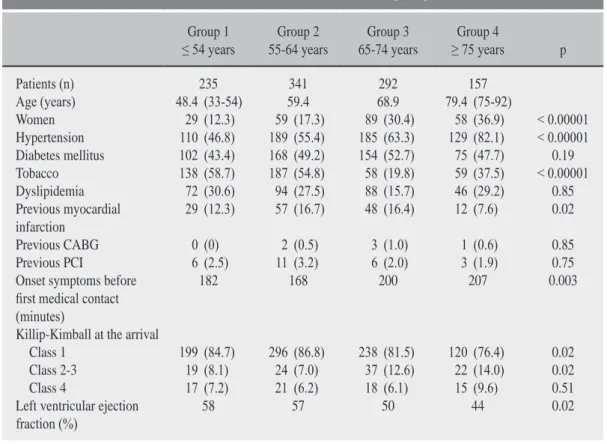
2, 3 and 4 respectively) form 22.9%, 33.2%, 28.5% and 15.4% of the study cohort. As seen in Table 1, older adults have a higher proportion of women, and a higher prevalence of hypertension, and previous cerebral vascular event. Cardiovascular risk factors such as diabetes mellitus, dyslipidemia or tobacco use were not more frequent in the group of older adults, and were more prevalent at younger ages. In our cohort, the history of infarction and revascularization treatment was found in a lower proportion in the older group.
Characteristics of the procedure
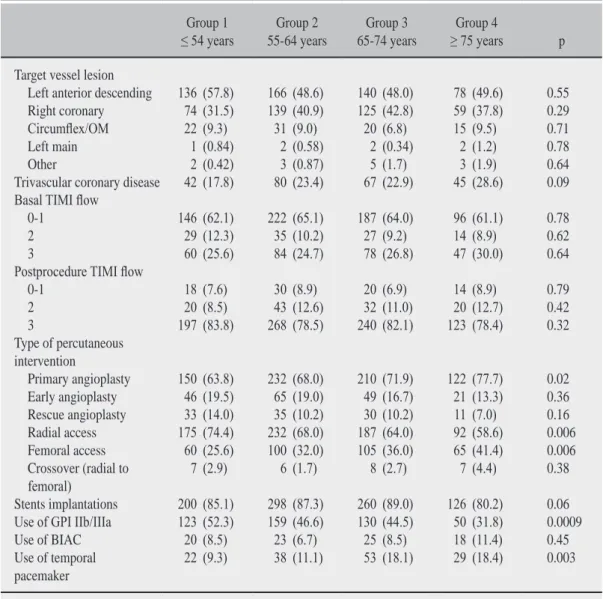
As shown in Table 2, the older adults compared with the younger ones, presented a tendency to greater coronary multivascular involvement as well as more diffuse disease, and arteries of smaller diameter. Basal and postprocedural TIMI flow was independent of age. The type of procedure also varied in different age groups,
with a preference for primary angioplasty in those of older age. The radial approach was used less frequently in the elderly, as well as the administration of glycoprotein IIb/IIIa inhibitors (abciximab or tirofiban).
Mortality and events greater than 30 days
As shown in Table 3, compared with younger patients, older adults had the highest mortality. In the multivariate analysis, advanced age is a strong independent predictor of death (hazard ratio 1.08, 95% CI 1.03 to 1.1, p < 0.001) and major bleeding (hazard ratio 1.05, 95% CI 1.03 to 1.09 p < 0.02). In contrast, the rate of ischemic stroke, intracerebral hemorrhage, and stent thrombosis were not directly related to age.
DISCUSSION
The main findings of this registry represent the largest cohort of the Mexican population
Table 1: Baseline characteristics according to age.
Group 1
≤ 54 years 55-64 yearsGroup 2 65-74 yearsGroup 3 ≥ 75 yearsGroup 4 p
Patients (n) 235 341 292 157
Age (years) 48.4 (33-54) 59.4 68.9 79.4 (75-92)
Women 29 (12.3) 59 (17.3) 89 (30.4) 58 (36.9) < 0.00001 Hypertension 110 (46.8) 189 (55.4) 185 (63.3) 129 (82.1) < 0.00001 Diabetes mellitus 102 (43.4) 168 (49.2) 154 (52.7) 75 (47.7) 0.19 Tobacco 138 (58.7) 187 (54.8) 58 (19.8) 59 (37.5) < 0.00001 Dyslipidemia 72 (30.6) 94 (27.5) 88 (15.7) 46 (29.2) 0.85 Previous myocardial
infarction 29 (12.3) 57 (16.7) 48 (16.4) 12 (7.6) 0.02 Previous CABG 0 (0) 2 (0.5) 3 (1.0) 1 (0.6) 0.85 Previous PCI 6 (2.5) 11 (3.2) 6 (2.0) 3 (1.9) 0.75 Onset symptoms before
first medical contact (minutes)
182 168 200 207 0.003
Killip-Kimball at the arrival
Class 1 199 (84.7) 296 (86.8) 238 (81.5) 120 (76.4) 0.02 Class 2-3 19 (8.1) 24 (7.0) 37 (12.6) 22 (14.0) 0.02 Class 4 17 (7.2) 21 (6.2) 18 (6.1) 15 (9.6) 0.51 Left ventricular ejection
www.medigraphic.org.mx
with these characteristics. There is no registry in our population that examines the results of mechanical reperfusion therapy in the elderly patients during hospitalization and
follow-up. First, older adults with acute myocardial
infarction who are taken to PCI present with a greater number of comorbidities, which confer a worse prognosis in the short and long term. It is striking that, in the population studied, the history of coronary artery disease and revascularization by any method is not more prevalent in older adults, which is not
in relation to that published in international series, rather, it reflects the lack of medical attention in this group of patients, and with it the importance of programs for the care of acute myocardial infarction. One of the main factors in the success of reperfusion treatment is to establish the time from the onset of symptoms to the reperfusion treatment, and between the onset of symptoms and the first medical contact, finding a relationship that, at older age, the diagnosis and treatment is delayed. It also correlates with clinical class
Table 2: Baseline angiographic and procedural characteristics according to age.
Group 1
≤ 54 years 55-64 yearsGroup 2 65-74 yearsGroup 3 ≥ 75 yearsGroup 4 p
Target vessel lesion
Left anterior descending 136 (57.8) 166 (48.6) 140 (48.0) 78 (49.6) 0.55 Right coronary 74 (31.5) 139 (40.9) 125 (42.8) 59 (37.8) 0.29 Circumflex/OM 22 (9.3) 31 (9.0) 20 (6.8) 15 (9.5) 0.71 Left main 1 (0.84) 2 (0.58) 2 (0.34) 2 (1.2) 0.78 Other 2 (0.42) 3 (0.87) 5 (1.7) 3 (1.9) 0.64 Trivascular coronary disease 42 (17.8) 80 (23.4) 67 (22.9) 45 (28.6) 0.09 Basal TIMI flow
0-1 146 (62.1) 222 (65.1) 187 (64.0) 96 (61.1) 0.78
2 29 (12.3) 35 (10.2) 27 (9.2) 14 (8.9) 0.62
3 60 (25.6) 84 (24.7) 78 (26.8) 47 (30.0) 0.64
Postprocedure TIMI flow
0-1 18 (7.6) 30 (8.9) 20 (6.9) 14 (8.9) 0.79
2 20 (8.5) 43 (12.6) 32 (11.0) 20 (12.7) 0.42
3 197 (83.8) 268 (78.5) 240 (82.1) 123 (78.4) 0.32 Type of percutaneous
intervention
Primary angioplasty 150 (63.8) 232 (68.0) 210 (71.9) 122 (77.7) 0.02 Early angioplasty 46 (19.5) 65 (19.0) 49 (16.7) 21 (13.3) 0.36 Rescue angioplasty 33 (14.0) 35 (10.2) 30 (10.2) 11 (7.0) 0.16 Radial access 175 (74.4) 232 (68.0) 187 (64.0) 92 (58.6) 0.006 Femoral access 60 (25.6) 100 (32.0) 105 (36.0) 65 (41.4) 0.006 Crossover (radial to
femoral) 7 (2.9) 6 (1.7) 8 (2.7) 7 (4.4) 0.38
Stents implantations 200 (85.1) 298 (87.3) 260 (89.0) 126 (80.2) 0.06 Use of GPI IIb/IIIa 123 (52.3) 159 (46.6) 130 (44.5) 50 (31.8) 0.0009 Use of BIAC 20 (8.5) 23 (6.7) 25 (8.5) 18 (11.4) 0.45 Use of temporal
pacemaker 22 (9.3) 38 (11.1) 53 (18.1) 29 (18.4) 0.003
www.medigraphic.org.mx
on admission, assessed by the Killip-Kimball scale, with a greater number of patients with grade II and III class. Although the presence of cardiogenic shock on admission was not more prevalent in the elderly, its presence does influence the prognosis. Compared with younger patients, in older adults coronary artery disease is more extensive, which has a direct relationship with more depressed ventricular function and the development of cardiogenic shock. Although in different series, the rate of ischemic or hemorrhagic cerebral vascular event is observed more frequently in the elderly,6 in our series this
phenomenon was not observed, which may be the explanation, that primary angioplasty is preferred, minimizing the risk of thrombolysis (the intracranial hemorrhage events of the cohort occurred in thrombolyzed patients)7 as
well as a decrease in the use of glycoprotein IIb/IIIa inhibitors, which have not shown a strong benefit in the elderly. While the radial approach was used less frequently in older
adults, the rate of bleeding related to access was not more frequent in this group and the need for conversion to the femoral approach is not greater compared with younger patients.5,8
It is important to emphasize that the success of the procedure is not affected by age, although we know that coronary anatomy is much more complex, mechanical reperfusion can be carried out in older adults with success rates similar to younger ones.9 With this, we
realize that the factors of greater weight in the mortality of this group are the comorbidities related to age, and mainly the development of left ventricular dysfunction.10 When we
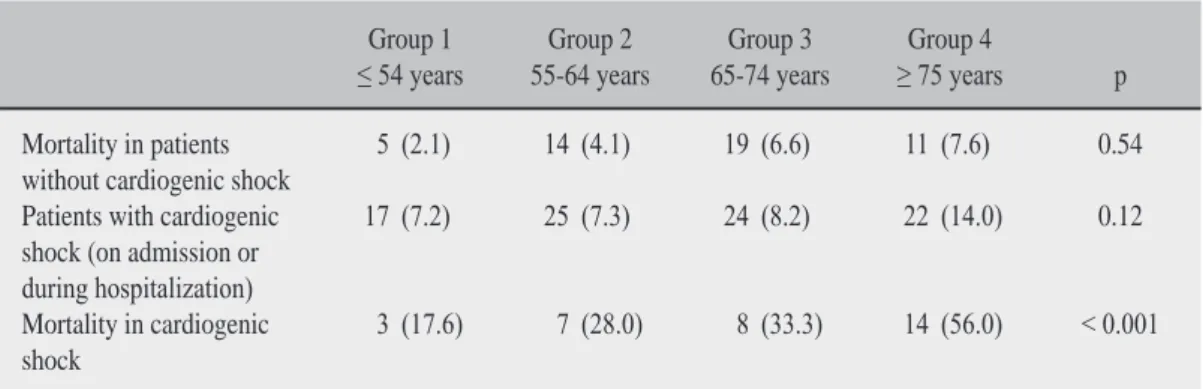
compare mortality in patients who do not develop cardiogenic shock, it is similar for any age group (2.1, 4.1, 6.6 and 7.6% p = 0.54 for groups 1, 2, 3 and 4 respectively). However, in the subgroup patients with cardiogenic shock, age is an independent factor for death, which implies that, in advanced age the possibility of reversing this state of shock is much lower (17.6, 28.0, 33.3 and 56.0% p = 0.001 for
Table 3: 30-day results.
Group 1
≤ 54 years 55-64 yearsGroup 2 65-74 yearsGroup 3 ≥ 75 yearsGroup 4 p
Death 8 (3.4) 21 (6.1) 27 (9.2) 25 (15.9) 0.0003 Acute/subacute Stent thrombosis 0 (0) 2 (0.58) 3 (1.02) 0 (0) 0.85
Stroke 3 (1.2) 2 (0.58) 3 (1.02) 0 (0) 0.81
Access site bleeding 0 (0) 2 (0.58) 1 (0.34) 2 (1.2) 0.64 Intracraneal hemorrhage 1 (0.42) 1 (0.29) 1 (0.34) 0 (0) 0.95
Table 4: Mortality associated with cardiogenic shock.
Group 1
≤ 54 years 55-64 yearsGroup 2 65-74 yearsGroup 3 ≥ 75 yearsGroup 4 p
Mortality in patients
without cardiogenic shock 5 (2.1) 14 (4.1) 19 (6.6) 11 (7.6) 0.54 Patients with cardiogenic
shock (on admission or during hospitalization)
17 (7.2) 25 (7.3) 24 (8.2) 22 (14.0) 0.12
Mortality in cardiogenic
www.medigraphic.org.mx
groups 1, 2, 3 and 4 respectively), this is largely conditioned by the extension of coronary artery disease, previous ventricular dysfunction and multiple associated comorbidities (Table 4).
Study limitations
This study has the limitations of the registries, where the comparison between the groups is not randomized. In addition, it is a record of a single hospital center, so these results are the accumulation of experience and management of this center, and can not be extrapolated to all hospitals in the country.
CONCLUSIONS
The elderly of the Infarction Code Program in our entity represent 15.3% of the procedures performed, with a tendency to increase their frequency in the short term. The clinical characteristics of older adults include higher comorbidity, more complex coronary anatomy, and acute myocardial infarction with more critical clinical presentation. Primary angioplasty is the method of choice in this group of patients, which significantly reduces the risk of major bleeding. Although postprocedural results are comparable among all age groups, mortality increases with age, results that are comparable to the series published in the literature.
REFERENCES
1. Shanmugam VB, Harper R et al. An overview of PCI in the very elderly. J Geriatr Cardiol. 2015; 12: 174-184. 2. Wang TY, Gutiérrez A, Peterson DE. Percutaneous
coronary intervention in the elderly. Nat Rev Cardiol. 2011; 8: 79-90.
3. Ibanez B, James S, Agewall S, Antunes MJ, Bucciarelli-Ducci C, Bueno H et al. 2017 ESC Guidelines for the management of acute myocardial infarction in patients
presenting with ST-segment elevation: The Task Force
for the management of acute myocardial infarction in patients presenting with ST-segment elevation of the European Society of Cardiology (ESC). Eur Heart J. 2018; 39 (2): 119-177.
4. Levine GN, Bates ER et al. 2011 ACCF/AHA/SCAI
Guideline for Percutaneous Coronary Intervention. J Am Coll Cardiol. 2011; 58: e44-122.
5. Campo C, Ferreira RP, Teixeira C et al. Percutaneous
coronary intervention using transradial access in elderly vs. non-elderly patients. Rev Bras Cardiol Invasiva. 2013; 21 (1): 36-42.
6. Thiemann DR, Coresh F, Shulman P et al. Lack of
benefit for intravenous thrombolysis in patients with myocardial infarction who are older than 75 years. Circulation. 2000; 101: 2239-2246.
7. Capodanno D, Angiolillo DJ. Antithrombotic therapy in the elderly. J Am Coll Cardiol. 2010; 56: 1683-1692. 8. Hsieh V, Jolly SS. Should radial access be the preferred
approach in the elderly? Rev Bras Cardiol Invasiva. 2012; 20 (1).
9. Sim WL, Mutha V et al. Clinical characteristics and outcomes of octogenarians presenting with ST elevation myocardial infarction in the Australian population. World J Cardiol. 2017; 9 (5): 437-441. 10. Guagliumi G, Stone GW, Cox DA et al. Outcome
in elderly patients undergoing primary coronary intervention for acute myocardial infarction, results from the controlled abciximab and device investigation to lower late angioplasty complications (CADILLAC) trial. Circulation. 2004; 110: 1598-1604.
Correspondence to:
Dr. Juan Manuel Palacios Rodríguez
Minnesota Núm. 300, Col. Rincón de las Puentes, 66460, San Nicolás de los Garza, Mty., N.L., México.
Phone: 80574286 y 87