Collect
Simulium ochraceum sensu lato
for Verification
of Onchocerciasis Elimination
Mario A. Rodrı´guez-Pe´rez1,2, Monsuru A. Adeleke3, Isabel C. Rodrı´guez-Luna1, Eddie W. Cupp4, Thomas R. Unnasch5*
1Centro de Biotecnologı´a Geno´mica, Instituto Polite´cnico Nacional, Reynosa, Tamaulipas, Me´xico,2Facultad de Medicina, Universidad Auto´noma de Nuevo Leo´n, Monterrey, Nuevo Leo´n, Me´xico,3Public Health Entomology and Parasitology Unit, Department of Biological Sciences, Osun State University, Osogbo, Nigeria, 4Department of Entomology and Plant Pathology, Auburn University, Auburn, Alabama, United States of America,5Global Health Infectious Disease Research Program, Department of Global Health, University of South Florida, Tampa, Florida, United States of America
Abstract
Background:Collection of the black fly vectors of onchocerciasis worldwide relies upon human landing collections. Recent studies have suggested that the Esperanza Window Trap baited with a human scent lure and CO2had the potential to replace human hosts for the collection ofSimulium ochraceum sensu latoin Southern Chiapas focus, Mexico. The feasibility of utilizing these traps in a community-based approach for the collection ofS. ochraceum s.l.was evaluated.
Methodology/Principal findings:Local residents of a formerly endemic extra-sentinel community for onchocerciasis were trained to carry out collections using the traps. The residents operated the traps over a 60-day period and conducted parallel landing collections, resulting in a total of 28,397 vector black flies collected. None of the flies collected were found to contain parasite DNA when tested by a polymerase chain reaction assay targeting a parasite specific sequence, resulting in a point estimate of infection in the vectors of zero, with an upper bound of the 95% confidence interval 0.13 per 2,000. This meets the accepted criterion for demonstrating an interruption of parasite transmission.
Conclusions/Significance:These data demonstrate that Esperanza Window Traps may be effectively operated by minimally trained residents of formerly endemic communities, resulting in the collection of sufficient numbers of flies to verify transmission interruption of onchocerciasis. The traps represent a viable alternative to using humans as hosts for the collection of vector flies as part of the verification of onchocerciasis elimination.
Citation:Rodrı´guez-Pe´rez MA, Adeleke MA, Rodrı´guez-Luna IC, Cupp EW, Unnasch TR (2014) Evaluation of a Community-Based Trapping Program to Collect
Simulium ochraceum sensu latofor Verification of Onchocerciasis Elimination. PLoS Negl Trop Dis 8(10): e3249. doi:10.1371/journal.pntd.0003249 Editor:Francis Mutuku, Technical University of Mombasa, Kenya
ReceivedMay 2, 2014;AcceptedSeptember 6, 2014;PublishedOctober 23, 2014
Copyright:ß2014 Rodrı´guez-Pe´rez et al. This is an open-access article distributed under the terms of the Creative Commons Attribution License, which permits unrestricted use, distribution, and reproduction in any medium, provided the original author and source are credited.
Data Availability:The authors confirm that all data underlying the findings are fully available without restriction. All relevant data are within the paper and its Supporting Information files.
Funding:This research was funded by a grant from The Bill & Melinda Gates Foundation (Project OPP1017870). The funders had no role in study design, data collection and analysis, decision to publish, or preparation of the manuscript.
Competing Interests:The authors have declared that no competing interests exist.
* Email: [email protected]
Introduction
Onchocerciasis or river blindness is a disease that results from infection with the filarial parasite Onchocerca volvulus. O. volvulus is a vector-borne infection parasite transmitted by blackflies of the genus Simulium. The disease has historically been a very serious problem in the developing world, where it is has had a devastating socio-economic in the most afflicted communities, primarily in sub-Saharan Africa and to a lesser extent in the 13 foci of Latin America [1–5]. The programs attempting to eliminate onchocerciasis all currently rely primarily on community-wide treatment of the endemic populations with ivermectin (Mectizan donated by Merck & Co.). Quarterly, semi-annual and semi-annual regimens of Mectizan treatment have been successful in interrupting, and in some cases eliminating transmis-sion of the parasite in different situations [6–12].
collector. Apart from the fact that this procedure has been criticized because of the potential risk of infection for the collectors [20], it can be difficult for the human landing collectors to capture the large number of flies needed to demonstrate that transmission has been interrupted. Thus, replacing human landing collection is ever more important as the focus of the onchocerciasis community shifts from control to elimination, and in some cases post-treatment surveillance [21].
In a recent study, a novel trap design (the Esperanza Window Trap) collected numbers of black flies similar to those obtained by a team of human landing collectors [22]. Here, we evaluated the Esperanza Window Trap using a community-based implementa-tion plan. Furthermore, we report the results of a PCR pool-screening assay for S. ochraceum s.l. collected using both Esperanza Window Traps and human landing collections. The data suggest thatO. volvulustransmission has been interrupted in this extra-sentinel community of the former Southern Chiapas focus in Me´xico.
Materials and Methods
Study Site
Studies were carried out in the village of Las Golondrinas, Chiapas, Mexico (15u259590N; 92u399060W; elevation 890 m). Las Golondrinas is in Southern Chiapas, which historically was the largest of the three foci of onchocerciasis in Mexico. Transmission ofO. volvuluswas widespread in this area prior to its elimination as a result of intensive mass treatment with Mectizan [23–25]. The studies were conducted during the 2013 dry season, when high populations of parousSimulium ochraceum sensu lato, the primary vector ofO. volvulusin the region occur [26].
Trap Design
Previous studies evaluating different trap designs for the collection ofS. ochraceum s.l. demonstrated that the Esperanza Window Trap baited with a commercial mosquito lure (BG-Lure; Biogents AG, Regensburg, Germany) and CO2 was an effective design for the collection of these black flies [22]. The original
days, and their positions rotated every day. Collections were retrieved once daily (12 PM). Flies were removed from the traps by dissolving the Tangle Trap glue with odorless mineral spirits. Flies were stored in the solvent for subsequent morphological identifi-cation and PCR pool screening. To determine if the collections of the two trap designs were significantly different, a one-way Analysis of Deviance was carried out using the SAS GENMOD procedure with distribution type set to the Negative Binomial, which is the standard model for over-dispersed Poisson data [27]. None of the goodness of fit statistics indicated any lack of fit.
Based upon the results obtained from the initial evaluations of the trap designs, a large-scale study was conducted evaluating the effectiveness of the traps when operated by community members. This study employed residents of the communities to operate and maintain the traps with minimal supervision. Volunteers from the community were identified and provided instruction on the operation of the traps and identification and removal of S. ochraceum s.l. from the trap surfaces. The teams were also instructed how to conduct human landing collections. Collections were carried out over a 60-day period within the village itself and in a nearby coffee plantation. A small intermittent stream flowed through each collection location, which served as a breeding site forS. ochraceum s.l. [22]. Two teams were employed to collect flies and conduct human landing collections at each site. Each team consisted of two local residents.
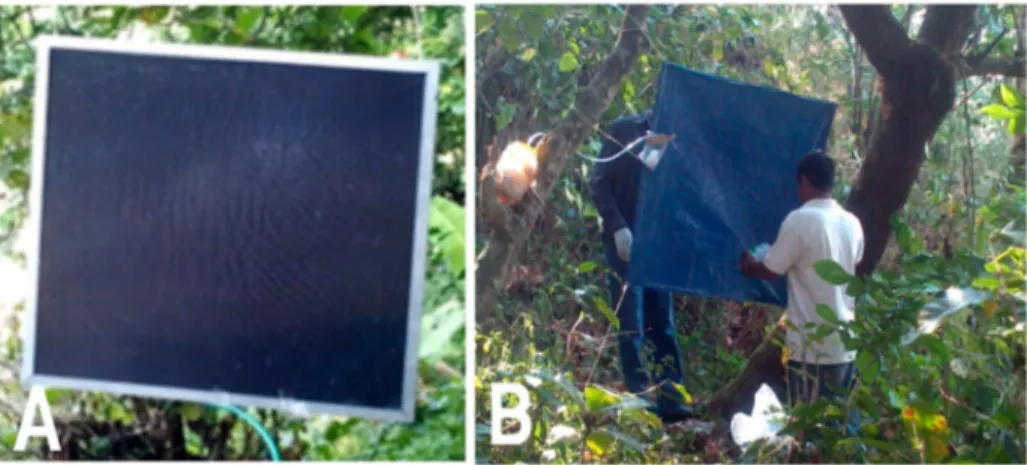
Five Esperanza window traps were set out in each location (the village and coffee plantation) in a circular pattern with the stream at the center, (Figure 2, Panels A and B). The traps were placed roughly 2–7 m from the breeding site, separated by a distance of 10–20 m from one another. The traps were run from 8 AM until 12 PM daily. Before every trapping session, any black flies that were collected during the non-experimental periods were removed from the traps. Collections were retrieved once daily (12 PM). While the traps were being run, the team at each plot conducted human landing collections, as previously described [7]. Human landing collections were carried out approximately 5 m from the traps. This distance was chosen to minimize the interference among traps and human collectors while still drawing from the same host-seeking black fly population. The team rotated the positions where the human landing collections were carried out among the positions where the traps were placed, to control for location-specific variation in the number of flies present among the trap sites.
Ethics Statement
The human landing collection procedures were reviewed and approved by the appropriate institutional review boards. These included the Bioethics Committees of the Center for Research and Development in Health Sciences of the Autonomous University of
Nuevo Leo´n (Monterrey, Nuevo Leo´n, Mexico), and the Institutional Review Board of the University of South Florida. Written informed consent was obtained from all participants.
PCR Pool-Screening Assay
Flies were grouped into pools containing a maximum of 200 individuals per pool and the heads and bodies separated as previously described [28]. The separated bodies were using a PCR assay specific for O. volvulus, as previously described [29]. Screenings focused on pools of bodies, as previous studies have shown that infection rates in bodies, which contain multiple life cycle stages of the parasite, provide a more sensitive indicator of parasite-vector contact than testing heads, which only contain L3 larvae [28,30]. As no body pools were found to be positive, head pools were not screened.
Data Analysis
PoolScreen v2.0 [31] was used to estimate the upper bound of the 95% confidence interval for the prevalence of flies carryingO. volvulus. The landing rate measured from the human collections was used to estimate the biting rate. This probably overestimated the biting rate, as some of the flies land but do not successfully take
a blood meal. Thus, the biting rate calculations provided below over-estimate the biting rate to some extent. The seasonal transmission potential [STP] was calculated as the product of the seasonal biting rate, the proportion of flies carrying L3 larvae in the transmission late dry season (from April through May), and the average number of L3 larvae in each infective fly. As previously discussed, after multiple rounds of Mectizan treatment, the number of infective larvae present in each infective fly was assumed to be one [7,8,25]. Because S. ochraceum s.l. females were not collected throughout the year, it was not possible to precisely calculate the annual transmission potential (ATP). However, given that the infected black flies are uncommon outside of the late dry season in Latin America [19,26], the STP probably provided a fairly accurate estimate of the ATP.
The GLIMMIX procedure in the SAS program package (SAS version 9.4 13w18 Media), was used to adjust the number of flies caught to a negative binomial distribution, and the least square means of the fly collections in the village and coffee plantation were calculated and compared. Using the same procedure, paired least square means of the collections from each trap position were calculated and compared using t-tests. GLIMMIX was also used to test for any interaction between the collection rates, as measured by the human landing collections and the trap positions.
Figure 1. Original and modified Esperanza trap designs.Panel A: Original acrylic sandwich design. Panel B: Modified tarpaulin design. doi:10.1371/journal.pntd.0003249.g001
Figure 2. Position of traps at the two collection locations.Panel A: Trap positions in the village. Panel B: Trap positions in the coffee plantation. Arrows indicate the trap position relative to local landscape features and photos show the actual trap placement.
Results
As a first step in adapting the Esperanza Window Trap for use in a community-based trial, a simplified version of the trap was constructed. This simplified design, consisting of a piece of blue plastic tarpaulin coated with Tangle-Trap insect paste and baited with BG-Lure and organically-generated CO2 (Figure 1) was evaluated in side-by-side comparisons with the original design, as described in Materials and Methods. The simplified design collected roughly five times as many flies as the original trap design (Figure 3; p,0.001, Tukey-Kramer adjusted), indicating that it was at least as effective as the original.
The blue tarpaulin traps were then evaluated in a community-based format, as described in Materials and Methods. Two teams consisting of two local individuals each were trained in the operation of the traps and in conducting human landing collections. One team was given responsibility for maintaining five traps and carrying out human landing collections at a site located in the village proper, while the second team maintained five traps and carried out human landing collections in a site located in a nearby coffee plantation (Figure 2). A total of 9,986 flies were collected using the traps at both sites (Table 1).
The collection data (fly counts per trap) were found to conform to a negative binomial distribution, and were thus examined using a generalized linear mixed model. The model:
#flies caught~siteztrapzdayzsite|trapzerror
of flies at both sites than did the five traps combined at each site (Table 1; p,0.001). Similar to the trap collections, human landing collections in the village were higher than in the plantation, though this difference did not reach statistical significance (F-value = 2.16, p = 0.05). No evidence for any interaction between the human landing collections and the trap collections at a given site were seen (F = 2.14, p.0.05).
A total of 7,400 flies collected by the traps were tested by pool screen PCR for the presence ofO. volvulus, a number that was sufficient to comply with the OEPA guideline of having at least 6,000 flies tested from each community. In addition, 20,997 flies collected by the human landing collections were tested. All body pools were negative forO. volvulusDNA, which suggested that no parasite-vector contact was occurring, and the point prevalence of flies carryingO. volvuluswas zero (Table 2). The upper bound of the 95% confidence interval of the infection rate was 0.13/2000, well below the threshold of 1/2,000 mandated by the OEPA guidelines. The upper bound of the 95% CI for the STP was calculated to be 0.96 L3s/person/season.
Discussion
In previous studies, we reported the development of a trap platform, designated the Esperanza Window Trap, which appeared to have potential as a replacement for human landing collections [22]. However, the bulky and costly design of this trap made it difficult to deploy in the field. The studies reported above suggest that a simplified design, consisting of a piece of blue plastic tarpaulin, was at least as effective as the original design. The tarpaulin design of the Esperanza Window Trap is lightweight and inexpensive (roughly $5.00 USD per trap). Furthermore, it is constructed of materials that are readily available in developing countries and is highly portable. This trap design therefore represents a very attractive alternative to human landing collections for the collection of the black fly vectors ofO. volvulus.
Figure 3. Performance of the original and tarpaulin based trap designs.Symbols present the mean and error bars of the standard error of collections taken over a three-day period. Open circles = collec-tions by the original acrylic sandwich design. Solid circles = colleccollec-tions by the modified tarpaulin based design. Open triangles = human landing collections.
doi:10.1371/journal.pntd.0003249.g003
Table 1.Mean6standard error (SE) of the daily number ofSimulium ochraceum s.l.captured over 60 days.
Location
Trap collection (total from
5 traps per location) Mean collection±SE1
Human landing
collections Mean collection±SE2
Village 5,941 18.1460.40 11,200 184.00611.20
Plantation 4,045 12.6060.30 9,797 162.2569.88
Total 9,986 16.6460.42 20,997 174.9768.40
1
Flies/trap/day. 2
Flies/team/day.
Given that these traps are intended to be used as a component of the surveillance activities to verify the interruption of O. volvulus transmission and to monitor for recrudescence of transmission in the post-endemic era, they will have to be operated routinely in the endemic communities. Employing residents of the communities themselves to operate the traps is logistically practical, since such a community based approach would be less expensive than devising a vertically integrated program involving small teams of highly trained individuals to operate the traps. In addition, employing local residents would permit a larger distribution of trap activities and enhance community involvement in the onchocerciasis elimination agenda. The data presented above suggest that such a community-based strategy may be feasible. Overall, the five traps set at each site combined to collect approximately 50% as many flies as did the human landing collectors. However, the performance of the traps, when operated by the residents, was approximately 20% of the catch when compared to when the traps were operated by trained entomologists [22]. Despite this difference, the traps, when operated by the residents, still represented a viable alternative to human landing collections. This is because a single person can easily maintain five traps, and a two-man human landing collection team can therefore maintain 10 traps per day. Furthermore, maintaining the traps only requires visits in the morning and evening, freeing up the rest of the day for other activities by the individuals maintaining the traps. Thus, when
maintained by local residents, the traps can be operated throughout the transmission season, resulting in better estimates of fly activity than can be obtained by human landing teams, which generally cannot operate continuously in every community through the transmission season.
The performance of the individual traps differed significantly among the locations at both the village and plantation sites. This is perhaps not surprising, as vision plays an important role in black fly host seeking behavior, and visibility varied from location to location due to the density of the local vegetation. Although the traps in the village were in more open areas, and thus more susceptible to changing climatic conditions such as sun, rain, and wind, it appeared that traps placed in the village were in general more effective than traps placed in the coffee plantation where human activity was lower than in the village. The data suggest that trap placement will play an important role in catch efficiency and that traps placed in more open areas with greater human activity may perform better than those placed in areas with dense vegetation.
In Las Golondrinas, pre-control entomological data were available and Mectizan treatment has reduced transmission by greater than 99% when compared to the levels that existed prior to the start of the elimination program (about 20 L3s per person per year) [23,24,28]. This meets the criterion developed by WHO indicating a ‘‘near absence’’ of transmission for areas where such pre-treatment data exist.
Figure 4. Mean (±Standard Error) of the number of flies caught by the five individual traps in coffee plantation (bars in white) and village (bars in grey).Collections among the traps at each site were compared in a pairwise fashion and the statistical significance of differences between the paired trap collections assessed using a t-test. Means with the same letter were not significantly different (p.0.05).
doi:10.1371/journal.pntd.0003249.g004
Table 2.Results of PCR pool screening for collected flies.
Method No. of flies No. of pools1
No. positive pools Prevalence of infected flies2
Esperanza Window traps 7,400 37 0 0 (0.51/2,000)
Human landing collections 20,997 105 0 0 (0.18/2,000)
Total 28,397 142 0 0 (0.13/2,000)
1
Maximum of 200 flies per pool. 2
near zero [19]. Thus, the upper bound of the 95% CI of the STP reported here probably represents a fairly accurate, though somewhat low estimate of the upper bound of the ATP.
In conclusion, the data suggest that transmission remains undetectable in Las Golondrinas, a village located within an area where transmission ofO. volvuluswas historically quite high [25]. The entomological findings from this village continue to meet the
the technical staff of the Centro Regional de Investigacio´n en Salud Pu´blica, Instituto Nacional de Salud Pu´blica, Tapachula, Mexico.
Author Contributions
Conceived and designed the experiments: MARP EWC TRU. Performed the experiments: MARP MAA ICRL. Analyzed the data: MARP TRU EWC. Wrote the paper: MARP EWC TRU.
References
1. Prost A (1986) The burden of blindness in adult males in the savanna villages of West Africa exposed to onchocerciasis. Trans R Soc Trop Med Hyg 80: 525– 527.
2. World Health Organization Expert Committee (1995) Onchocerciasis and its control. Geneva: World Health Organization. 852.
3. Murdoch ME, Asuzu MC, Hagan M, Makunde WH, Ngoumou P, et al. (2002) Onchocerciasis: The clinical and epidemiological burden of skin disease in Africa. Ann Trop Med Parasitol 96: 283–296.
4. Mathers CD, Ezzati M, Lopez AD (2007) Measuring the burden of neglected tropical diseases: the global burden of disease framework. PLoS Negl Trop Dis 1: e114.
5. Sauerbrey M (2008) The Onchocerciasis Elimination Program for the Americas (OEPA). Ann Trop Med Parasitol 102 Suppl 1: 25–29.
6. Lindblade KA, Arana B, Zea-Flores G, Rizzo N, Porter CH, et al. (2007) Elimination ofOnchocerca volvulustransmission in the Santa Rosa focus of Guatemala. Am J Trop Med Hyg 77: 334–341.
7. Rodriguez-Perez MA, Lizarazo-Ortega C, Hassan HK, Dominguez-Vasquez A, Mendez-Galvan J, et al. (2008) Evidence for suppression ofOnchocerca volvulus transmission in the Oaxaca focus in Mexico. Am J Trop Med Hyg 78: 147–152. 8. Rodriguez-Perez MA, Lutzow-Steiner MA, Segura-Cabrera A, Lizarazo-Ortega C, Dominguez-Vazquez A, et al. (2008) Rapid suppression of Onchocerca volvulus transmission in two communities of the Southern Chiapas focus, Mexico, achieved by quarterly treatments with Mectizan. Am J Trop Med Hyg 79: 239–244.
9. Diawara L, Traore MO, Badji A, Bissan Y, Doumbia K, et al. (2009) Feasibility of onchocerciasis elimination with ivermectin treatment in endemic foci in Africa: First evidence from studies in Mali and Senegal. PLOS Neg Trop Dis 3: e497.
10. Katabarwa M, Walsh F, Habomugisha P, Lakwo T, Agunyo S, et al. (2012) Transmission of onchocerciasis in Wadelai focus of Northwestern Uganda has been interrupted and the disease eliminated. J Parasitol Res 2012: 748540. 11. Tekle AH, Elhassan E, Isiyaku S, Amazigo UV, Bush S, et al. (2012) Impact of
long-term treatment of onchocerciasis with ivermectin in Kaduna State, Nigeria: First evidence of the potential for elimination in the operational area of the African Programme for Onchocerciasis Control. Parasit Vect 5: 28. 12. Traore MO, Sarr MD, Badji A, Bissan Y, Diawara L, et al. (2012)
Proof-of-principle of onchocerciasis elimination with ivermectin treatment in endemic foci in Africa: Final results of a study in Mali and Senegal. PLOS Neg Trop Dis 6: e1825.
13. World Health Organization (2001) Criteria for certification of interruption of transmission/elimination of human onchocerciasis. Geneva: World Health Organization. WHO/CDS/CPE/CEE/2001.18a. 64 p.
14. Onchocerciasis Elimination Program for the Americas Program Coordination Committee and Staff (2012) Guide to detecting potential recrudescence of onchocerciasis during the posttreatment period: The American paradigm. Res Rep Trop Med 3: 21–33.
15. Basanez MG, Razali K, Renz A, Kelly D (2007) Density-dependent host choice by disease vectors: Epidemiological implications of the ideal free distribution. Trans R Soc Trop Med Hyg 101: 256–269.
16. Gu W, Unnasch TR, Katholi CR, Lampman R, Novak RJ (2008) Fundamental issues in mosquito surveillance for arboviral transmission. Trans R Soc Trop Med Hyg 102: 817–822.
17. Walsh JF, Davies JB, LeBerre R, Garms R (1978) Standardization of criteria for assessing the effects ofSimuliumcontrol in onchocerciasis control programmes. Trans R Soc Trop Med Hyg 72: 675–676.
18. Davies JB, Seketeli A, Walsh JF, Barro T, Sawadogo R (1981) Studies on biting Simulium damnosum s.l. at a breeding site in the Onchocerciasis Control Programme area during and after an interruption of insecticidal treatments. Trop Med Parasitol 32: 17–24.
19. Porter CH, Collins RC (1988) Seasonality of adult black flies andOnchocerca volvulustransmission in Guatemala. Am J Trop Med Hyg 38: 153–167. 20. Jacobi CA, Enyong P, Renz A (2010) Individual exposure toSimuliumbites and
intensity ofOnchocerca volvulusinfection. Parasit Vect 3: 53.
21. Cupp EW, Sauerbrey M, Richards F (2011) Elimination of human onchocer-ciasis: History of progress and current feasibility using ivermectin (Mectizan) monotherapy. Acta Trop 120 Suppl 1: S100–108.
22. Rodrı´guez-Pe´rez MA, Adeleke MA, Burkett-Cadena ND, Garza-Herna´ndez JA, Reyes-Villanueva F, et al. (2013) Development of a novel trap for the collection of black flies of theSimulium ochraceumcomplex. PLOS One 8: e76814. 23. Ortega M, Oliver M, Ramirez A (1992) [Entomology of onchocercosis in
Soconusco, Chiapas. 6. Quantitative studies of the transmission ofOnchocerca volvulus by 3 species of Simuliidae in a community with high endemicity]. Revista de la Facultad de Medicina de la UNAM 34: 281–289.
24. Rodriguez-Perez MA, Rodriguez MH, Margeli-Perez HM, Rivas-Alcala AR (1995) Effect of semiannual treatments of ivermectin on the prevalence and intensity ofOnchocerca volvulusskin infection, ocular lesions, and infectivity of Simulium ochraceumpopulations in southern Mexico. Am J Trop Med Hyg 52: 429–434.
25. Rodrı´guez-Pe´rez M, Domı´nguez-Va´zquez A, Unnasch TR, Hassan HK, Arredondo-Jime´nez JI, et al. (2013) Interruption of transmission ofOnchocerca volvulusin the Southern Chiapas focus, Me´xico. PLOS Neg Trop Dis 7: e2133. 26. Collins RC, Merino ME, Cupp EW (1981) Seasonal trends and diurnal patterns of man-biting activity of four species of Guatemalan black flies (Simuliidae). Am J Trop Med Hyg 30: 728–733.
27. Hilbe JM (2007) Negative Binomial Regression. Cambridge, UK: Cambridge University Press.
28. Rodrı´guez-Pe´rez MA, Lilley BG, Domı´nguez-Va´zquez A, Segura-Arenas R, Lizarazo-Ortega C, et al. (2004) Polymerase chain reaction monitoring of transmission of Onchocerca volvulus in two endemic states in Mexico. Am J Trop Med Hyg 70: 38–45.
29. Gopal H, Hassan HK, Rodrı´guez-Pe´rez MA, Toe´ LD, Lustigman S, et al. (2012) Oligonucleotide based magnetic bead capture ofOnchocerca volvulusDNA for PCR Pool Screening of Vector Black Flies. PLOS Neg Trop Dis 6: e1712. 30. Guevara AG, Vieira JC, Lilley BG, Lo´pez A, Vieira N, et al. (2003)
Entomolological evaluation by pool screen polymerase chain reaction of Onchocerca volvulus transmission in Ecuador following mass Mectizan distribution. Am J Trop Med Hyg 68: 222–227.
31. Katholi C (2010) Poolscreen v2.0. http://www.soph.uab.edu/bst/poolscreen. 32. Wada Y (1982) Theoretical approach to the epidemiology of onchocerciasis in
Guatemala. Jpn J Med Sci Biol 35: 183–196.