UNIVERSIDAD TÉCNICA PARTICULAR DE LOJA
La Universidad Católica de Loja
ÁREA SOCIO HUMANÍSTICA
TITULO DE LICENCIADO EN CIENCIAS DE LA EDUCACION
MENCIÓN INGLÉS
Teachers and student
’
s perceptions of teaching English as a Second
language in small classes.
TRABAJO DE TITULACIÓN
AUTOR:Vivanco Aguirre, Patricia Magdalena
DIRECTORA: Salcedo Viteri, Karina Soledad, Mgs.
APROBACION DEL DIRECTOR DEL TRABAJO DE TITULACION
Magister
Karina Soledad Salcedo Viteri.
DOCENTE DE LA TITULACIÓN
De mi consideración:
El presente trabajo de titulación: Teachers a d stude ts’ perceptio s of teachi g
E glish as a seco d la guage i s all classes , realizado por Vivanco Aguirre Patricia
Magdalena, ha sido orientado y revisado durante su ejecución, por cuanto se aprueba la
presentación del mismo.
Loja, febrero de 2015
DECLARACION DE AUTORIA Y CESION DE DERECHOS
“Yo Vivanco Aguirre Patricia Magdalena declaro ser autor (a) del presente trabajo de
fin de titulación: Teachers and student´s perceptions of teaching English as a Second language
in small classes, de la Titulación de Licenciado Ciencias de la Educación mención Inglés,
siendo la Mgs. Karina Soledad Salcedo Viteri director (a) del presente trabajo; y eximo
expresamente a la Universidad Técnica Particular de Loja y a sus representantes legales de
posibles reclamos o acciones legales. Además certifico que las ideas, conceptos,
procedimientos y resultados vertidos en el presente trabajo investigativo, son de mi exclusiva
responsabilidad.
Adicionalmente, declaro conocer y aceptar la disposición del Art. 88 del Estatuto
Orgánico de la Universidad Técnica Particular de Loja que en su parte pertinente
textualmente dice: “Forman parte del patrimonio de Universidad la propiedad intelectual de
investigaciones, trabajos científicos o técnicos y tesis de grado o trabajos de titulación que se
realicen con el apoyo financiero, académico o institucional (operativo) de la Universidad”
f……….
Dedication
I dedicate this thesis to my husband Pablo, my children Cristy, Pablito and Danielita
who have meant and continue meant so much to me and also have been a source of love,
motivation, support and inspiration during this process. I also want to dedicate this work to
my parents who have always guided me and taught me the value of a hard work. And to my
loved family who have helped me in any way they could accomplish my dream.
Acknowledgement
I want to express my gratitude to Mgs. Karina Salcedo Viteri who has supported and
guided me throughout the process of this study.
Contents
Cover i
Aprobación del Director del Trabajo de Fin de Titulación ii
Declaración de Autoría y Cesión de Derecho iii
Dedication iv
Acknowledgement v
Contents vi
Abstract 1
Resumen 2
Introduction 3
Discussion 5
Literature Review 5
Method 19
Description, Analysis, and interpretation of Results. 21
Conclusions 40
Recommendations 41
References 42
Abstract
The acquisition of a new language is far more complicated when a student is part of a
large class. This research reports the findings of a survey study that examined the teachers’
and students’ perceptions of teaching English in small classes, its benefits, strategies and
limitations. Data was gathered through the use of a questionnaire with 22 items divided in
four large scenarios and took place in two public schools in Winston Salem, North Carolina.
Including in this survey were 37 Spanish speaking students between 9 and 16 years old from a
low social and academic level, and 5 English as a Second Language (ESL) teachers.
After a qualitative analysis of the surveys completed by the participants teachers-
students and my own observation, I found that rather than limitations, benefits were observed
when teaching English as a Second Language in small classes. The appropriate interaction
within a small classroom community along with a supportive strategies and resources used to
practice the four skills needed to learn a new language, help to better motivate students to
perform better and achieve higher goals in the class.
Key words: small classes, teachers and student´s perceptions, teaching English, benefits,
Resumen
La adquisición de una nueva lengua es mucho más complicada cuando el estudiante es
parte de una clase con muchos estudiantes. Este trabajo investigativo indica un estudio de las
percepciones de profesores y alumnos sobre la enseñanza de Inglés como segunda Lengua en
clases pequeñas, sus beneficios, estrategias y limitaciones. Se obtuvo la información a través
de un cuestionarios de 22 preguntas dividas en cuatro grandes grupos, este estudio fue
realizado en dos establecimientos educativos de la ciudad de Winston Salem en el estado de
Carolina del Norte, participaron en el mismo 37 estudiantes de habla hispana que fluctuaban
entre las edades de 9 a 16 años y que provenían de un bajo nivel socio-académico. 5
profesores de Inglés como segunda lengua también formaron parte del presente estudio.
Después del análisis de la información obtenida de las encuestas aplicadas a
profesores y estudiantes, y conjuntamente con las observaciones realizadas en las diferentes
clases se encontró más beneficios que limitaciones en la enseñanza del Inglés como Segunda
Lengua en clases pequeñas. La correcta interacción entre los participantes de una clase
pequeña, así como las adecuadas estrategias y recursos para prácticas las cuatro habilidades
necesarias al aprender una nueva lengua, ayuda a una mejor motivación en los estudiantes
para participar y alcanzar las metas.
Palabras clave: clases con pocos estudiantes, percepciones de maestros y estudiantes,
Introduction
One of the goals of the public schools is to create a helpful physical, emotional and
academic environment for the non-English speaking students and help them to gain the new
language in an accurate and effective way.
It has been said by many English teachers that learning a new language is a big
challenge for students whose native language is not English, and how difficult it is for them
not only to master the language but to be able to understand and learn all the school subjects
as well.
Students sometimes feel left out in the classroom due to the large size of the class.
Teachers also have mentioned their frustration when teaching English with a large size class.
Therefore, the teachers and students points of view will provide us the keys we need to find
new strategies to teach and learn a new language.
The main purpose of this study is to determine the teachers and students’ perceptions
of teaching and learning English as a Second Language in small classes, these four questions
have helped me to understand and conduct this study: What are the benefits of teaching and
learning English as a Second Language in small classes? What teaching strategies and
resources benefit the teaching English as a Second Language in small classes? How students
feel about learning English as a Second language in small classes? Are there any limitations
when teaching English as a Second Language in small classes?
Studies about teaching English in small classrooms have been conducted in the past,
and though some studies can sometimes provide different theories, they can also give us some
background on gaps that needed to be filled with new research.
Galton & Pell (2009) state that students in small classes perform better than students
in large classes and what seems to be the most important factor is the quality of the teaching
Similary, Kumer (1992) asserts that large classes do not bring interactive situations
for students. Small classes do provide more opportunities for individualization, classroom
control and students involvement, though he also believes that what teachers bring to the
classroom is more important than good relations between teachers and students.
There are also studies that help direct other ideas. Harfitt (2013) states that the
confidence students gain when participating in small classes comes from the security that they
feel when speaking English without being concerned about the negative feedback from their
writing task. Those aspects are important in a small class. More open questions are used as a
strategy in small classes
The American Language Center (2013) affirms that in a small class, a student tends to
be less overwhelmed, and one on one interaction between students as well as difficulties can
be easily recognized.
Harfitt (2013) mentions that teachers use different approaches and strategies and have
better management in small classes, and it also gives a better opportunity for a more accurate
feedback..
After reviewing previous studies about this topic; this following study will help
administrators, along with teachers, to have a better understanding of the benefits of having a
small class, and the big impact that the students’ physiological point of view will have by
being part of a small classroom. In addition, it will help teachers to have a better
DISCUSSION
Literature Review
Learning English as a Second Language can be challenging for teachers as well for
students. Some authors have commented about different topics related to this matter, giving
the teachers some ideas, tools and other resources to help their students in order to improve
teaching techniques.
Managing Learning
“Effective teachers manage their classroom, ineffective teachers discipline their
classroom” (Wong & Wong 2001, p.34). Every single teacher must be knowledgeable about
learning time, testing, discipline planning, following procedures and routines, learning styles,
motivations, learning disabilities and remediation.
A degree in English is the last thing a teacher need; the most important requirement to
become a teacher is to know how to manage a classroom with students. A teacher needs to
turn a group of students into productive learners. A teachers’ goal is to help students to be
involved and to cooperate in the classroom while simultaneously setting a productive working
environment.
Clear and detailed instructions along with visual demonstrations of what is been asked
by the teacher in any given task helps English as a Second language Learners to better
understand and perform an assignment. However, it is necessary for the students to have
written instruction to avoid frustration due to the lack of information. (Wong & Wong 2001).
A cursory oral explanation of an assignment can leave a student without a clue as what
to do to get started (Echeverria, Vogt & Short, 2004, p. 68).
“This is what I want to see” said (Mcleod, Fisher & Hoover, 2003, p.126). This is the
strategy teachers use in the classroom to help students understand what the teacher wants for
what the teacher is asking. After several times, a strategy is used in the classroom, less
explanation is needed in the future.
FeedBack
Echeverria, Vogt & Short (2004) cite that a continuous review of language learning
skills enable teachers to provide feedback that helps students to understand and correct
situations that were not clear for them. When the feedback is clear, it has a valid support and
helps to improve English proficiency.
They also consider that feedback may be given in written form, by paraphrasing or
comments written next to the given assignment, Feedback may also be given orally by having
a direct conversation with the student. For example, some teachers used facial expression to
give feedback, as others teachers may nod, smile, or pat students on the shoulder. Students
themselves can give feedback to each another; it is important when given feedback to take in
consideration the production the language and understanding of what is been said. The teacher
can model any situation as another way of feedback.
On the other hand, Tomlison & Mctighe (2006) consider that feedback has to be
timely, specific, understandable to the student, and it has to allow adjustments. They also state
that feedback needs to be given promptly to help the student discover their strengths and
weakness in order to correct them. Waiting a long time will not help with the learning process
and the students are less likely to use it because their thought processes have already move
on.
According to these authors, the best feedback is the one that is given after a
performance-based assessment, this kind of task involves an ongoing assessment. Even
though letters and grades are often use by teachers as a way of giving feedback, this does not
When specific feedback is given using written or oral comments directly to the
receiver, it is surely more effective for the student to be considered, understood, and used than
other ways of feedback.
Tomlinson & Mctighe agree with prior researcher on how feedback needs to be
presented, it has to be clear and comprehensive for the receiver to improve and learn.
Timing
Mcleod, Fisher & Hoover (2003) mention that there are actually three aspects that
should be considered in the students’ engagement: (1) allocated time, (2) engaged time, and
(3) academic learning time. Teachers need to manage the time wisely by dividing their time
frame in a way that can be constructive for the students. This means they must balance the
correct amount of time: introducing and explaining the topic and giving the adequate quantity
of time to process what is being received; practicing and applying in a real way what is being
explained, as well as the use of effective standards in what skills to use in a certain lesson.
Planning a lesson according with what needs to be learned invites the students to
participate in activities related with the material that is presented in the class and keep them
engaged in those activities using the whole class period efficiently. This it is what is called
academic learning time.
Mcleod, Fisher & Hoover (2003) also agree on the importance of the efficient use of
time in helping students to reach their academic goals. However, they also state that the use of
time in the classroom has been set accordingly with the school and district policies and
standards. When a lesson needs to fit into an extremely fixed time frame, it does not matter if
the student needs more time to understand or practice any topic, because the time frame has
been set for that specific lesson.
There are more variables that affect the use of time in the classroom, some examples
knowledge, low achievement level or transition between activities. In these cases, the teachers
need to wisely utilize their teaching time to reach the student’s needs in order to obtain high
scores in a specific test.
Student-Student Interaction
Students should use language towards understanding, according to Rea & Mercury
(2006), even though students interaction is a very important tool for them to practice and
apply what is being learned, little talking is used inside the classroom. Students are
encouraged to work alone, and paper and pencil are used more often to assess student growth.
Work group or pair group is highly recommended as a strategy to improve the understanding
of ideas and concepts of the new language that is being learned. Thinking is also believed to
increase when talking is used.
In addition to what has been said before, Fisher, Frety & Rothernberg (2001) think
that physical and emotional environment has a very important role. As an example, they
assure that a comfortable room helps to create a good interaction between students. They also
refer to the purpose of the interaction which has to be related to the goal of the lesson that is
been taught, likewise, prior knowledge is needed to enable the interaction without teacher
intervention.
Teacher-Student interaction
The most important skill is being firm but letting the kids know that the teacher cares,
and respects them, according to Fay & Fay (2002) thus creating a solid, positive and caring
relationship between teachers and students that can cause a good effect in a student’s learning
process and can go beyond any other strategy used in a classroom. This will also help to reach
a challenging student. The balance between what is expected as a student and what is
On the other hand, The American Psychology Association (2013) affirms that even
though a good relationship between students and teacher helps students to improve and
creates an appropriate environment to help the learning process, this is not the only powerful
key for the student’s achievement.
Class Size
The American Language Center (2013) assures that though teachers have different
opinions about the adequate number of students in a classroom, they affirm that when
teaching an English as a Second Language class it is more helpful to have a big class, where a
big group of students can help and pull up the students who are falling behind in terms of
what is been taught. It is also easier in a big group to pair them or group them to complete a
task because activities with a big group move faster and students help other students to relax.
However, one on one interaction between students is easier in small groups. Students
with difficulties are easy to recognize in small groups as well. Moreover students tent to be
less overwhelmed than in a big class group.
It is also said by The American Language Center (2003) that the important tool when
teaching ESL, despite the number of students, is the clarity of the instruction. Students should
be able to work together and they need to be able to hear the teacher when new material is
presented to them, as well.
The appropriate class size is one where the teacher feels comfortable teaching, yet a
class of 45 students will be quite of a challenge and difficult to handle for a teacher. A smaller
class, for instance a class of 20 to 25 students, will be more adequate to teach, allowing the
teacher to divide it into smaller groups.
Preparing the floor space is also very important to create a good environment for
learning, according to Wong & Wong (2001). To help minimize distractions in a classroom,
traditional row, they can be around the classroom but they must be in a place that is easy for
students to see the teacher; keep the desks away from doors sinks or anything that may cause
any distractions, yet all the chairs need to be facing forward so the students’ attention is on
the teacher, keep traffic areas clean. Students need to be able to see the teacher as well as the
board, bulletin board and demonstration areas.
The closer the teacher is to the students the fewer discipline issues will appear: when
the teacher is close enough to the students their on task behavior increase.
Teaching Techniques, strategies or activities for teaching ESL in small classes.
“We believe that scaffolding students learning is critically important for students
achievement as evidence” (Echeverria, Vogt & Short, 2008, p.15).
Scaffolding is a technique teachers use to help students move themselves from a
dependent stage to an independent stage. To do so, the instruction from the teacher needs to
be explicit and modeled carefully; in this way student can slowly understand and move from
the teacher’s guide of instruction to a self-guided instruction. By using this technique students
become more independent and more confident gaining experience.
Teachers need to be aware about the time this process takes. It is impossible to try to
do it in one lesson. Students will begin to move from one stage to another by the scaffolding
process.
Using this technique, teachers do not explain the students about the interrelation
between activities, and how these activities will help them to move to an independent stage.
Another strategy quoted from the authors is the Direct Reading – Thinking Activity. In
which the teacher reads aloud a narrative text. In order for the students to make a prediction
about the text, periodically stops are made by the teacher. This strategy has as a goal to help
They also make reference to a T-Chart Graphic Organizer. This technique is used to
help students brainstorm what they know about a chosen topic. It also helps with vocabulary
and writing skills.
Raimes (1983) also refers to a technique that can help improve language skills and can
be developed around the written skills. By using The Controlled Writing Exercise. Students
are able to work in small groups with a controlled composition. Students have to take in
consideration sentence combined, punctuation, and finding links between sentences to create
paragraphs. By doing drafts of the paragraph students are practicing writing skills. By putting
the paragraph together, students will practice their comprehension skills. By sitting in a small
group they are also able to discuss what has been written. And by reading the final version
students are practicing their reading skill.
There are also some useful techniques that help English learners with their listening
skills. Some techniques included matching, sorting, pointing, organizing information
physically, orally and writing. O Loughlin (2010).
Learning Environment
Tomlison & Mctighe (2006) states that some rules have been set in order to create a
safe and suitable learning environment for an English as a Second Language Learner.
Each student is treated with dignity and respect. Each student feels safe and valued in
the classroom. Each student makes meaningful contributions to the work in class. There has to
be a balanced between individual and group work as a whole. Students work together
collaboratively. Students are grouped based on similarities and differences to peers.
Evidences indicate that varied student perspectives are sought and various approaches
to learning are honored. The big ideas and essential questions are central to the work of the
There are high expectations and incentives for each student to learn the big ideas and
to answer the essential questions. All students have respect on tasks and assessments focused
on what matters most in the curriculum, Tasks structured need high-level thinking and need to
be equally appealing and engaging to learners. Big ideas, essential questions, and
criteria-scoring rubric need to be posted, samples/models of students work are visible.
Warner, Clyde & Warner (2001), also agree that it should have been some rules to
keep a good learning environment for the students. They affirm that there are a few things
where the teacher can control and demonstrate their own personality; classroom environment
is one of those things. They also believe the classroom becomes a second home for the
teachers and students as well. The setting in the classroom should be comfortable, friendly,
and happy so the students can feel at home. Furthermore, they also affirm that the
arrangement of the desks, the flow, the lighting, the noise, the temperature and the air
contribute to create a good educational environment for the students. To do so teachers need
to start planning even before the school year begins, Teachers need to decide how to set the
classroom and this is where they can put their imagination to work.
The acquisition of a new language often depends on how the process of learning in the
classroom is managed. Many studies have been done in the past to investigate different
strategies that can be helpful for teachers to reach out the student’s needs, and to try to
identify techniques to better teach a new language.
The first study done by Galton and Pell (2009), the purpose in his study, was to find
out the answer to the question: Do pupils in small classes make better progress in attainment
and improve attitudes and motivation compare to pupils in normal classes?
They started their study in Hong Kong in 2004, they pull out a small group sample
with that sample in 2006 they added 15 more schools to compare the results. They analyzed
three different levels: the school, the class and the pupils. A questionnaire was administer to
the parents which were considered school level. To gather information of the class level a
questionnaire was complete by the teachers along with their background data. To collect
information at pupils’ level official students’ records were obtained. A multiple choice test
with listening and reading in Chinese and English was constructed, to measure the pupils
attitude self-esteem, and motivation, the instrument used by Galton 2003 was also used.
Observations were also done.
The author concluded this study by answering the question. Do pupils in small classes
make better progress in attainment and improve attitudes and motivation compare to pupils in
normal classes? Students in small classes did better than students in normal classes, there
were no significant difference with attitudes and motivation between the samples. Some
difference in the learning process could be notice along the group where parental background,
school attendance, pupil’s orientation to learning, and principal leadership was involved. The
quality of the teaching seems to be the most important finding in the study.
The second research was conducted by Alghamdi & Gillies (2013) where the purpose
was to find out, what is the effect of cooperative learning in comparisons to traditional small
groups leanings on the achievement of EFL learnings?
This study took place in Saudi Arabia. Four schools with similar socio-demographic
background participated. 139 boys from 10th grade were selected as a sample for the study. A
workshop group was organized as an intervention to help the research.
To carry out this study the sample was divided in two groups. The first group was
trained for five weeks in cooperative learning skills. A cooperative learning-training program
leaning properly to teachers and students. A second group was a small group who did not
received any training.
To collect qualitative date, the instrument the researchers used was a pre-test and
post-test English Grammar Achievement Test. This test was used in both groups. The
collected data from the four schools showed that there was a significant difference between
the two groups the experimental (trained) and control (not trained). According with the result,
it was showed that the post test was in favor for the experimental condition.
The third research was done by Kumar (1992) the purpose of this study was to find out
whether it is class size which makes a difference in language learning opportunities made
available to learners.
To carry out this study two middle school English classes, a small and a large classes
with students between 6th and 9th graders from an Indian school system were observed.
Kumer used a rough measure between the times where the students and teachers took
turns to interact. To obtain a real and clear classroom as well as a natural teaching and
learning environment an audio - record system was used and notes were taken.
The results in this study indicated that class size alone does not bring more
interactional situation for students. On the other hand small classes do provide more
opportunities for individualization, classroom control and students involvement. This study
shows that interactional opportunities can be provide in a large class as well.
The observation in both classrooms indicated that the teacher has a central role in the
classroom, students are not given the opportunity to interact among them. It was also
observed that students are restricted to what the teacher asks them to do; the kind of
interaction was determinate for the teacher.
the class is more important and crucial than to create a good relation between teachers and
students. The class size should not to be concern. However, it may have implication for
teachers.
The fourth research done by Harfitt (2013) in which he studied four teachers who
volunteered their work to help the research to identify pedagogical practices which may
contribute to a better understanding of what effective teaching practices in small or reduced
size classes might looked like.
This study was based in a multiple case study. Four teachers from a Hong Kong
school were in charge of teaching one large and one small class, to compare the level of the
academic abilities, and where the teachers were the variable control for the investigation. The
research was conducted in a two-year period. One of the tools used to collect information
were interviews. The interviews focused in how teachers react in different case scenario:
lesson and objectives, especial classroom incidents, teacher’s decisions, classroom
organization, classroom interaction and teacher view on students’ interaction and
opportunities for individualized teaching in a class. These interviews lasted from 20 to 50
minutes each one and were audio-recorded.
Observations were made as well, silent moments were transcripts and analyzed in
qualitative and quantitative way.
This study showed that teachers used different approaches with the two classes, better
classroom management was observed too, along with different rules, more interaction
between students and teacher; pair and group work was often used. It was also observed that
working with a small class can create better opportunities for individual interactions with
The interviewed teachers thought that classroom positive behavior can also happen
when students and teachers are closer together. Teachers were also able to see the
opportunities they have when they are dealing with a reduced class.
Finally, it was shown that the success of teaching small class is a management issue.
Teachers need to be provided with a mental and physical space to change their practice. As an
example, in this study, none of the four teacher observed, were able to get support from their
schools to share good practices with small groups.
The same way it is imperative the dissemination of similar cases to help teachers
explore the benefits of teaching small classes.
The fifth research also done by Harfitt (2013) his purpose was to find how a class
reduction might help to alleviate language learning anxiety which has long been seen as an
obstacle to second language acquisition. This study was conducted in four secondary school
in Hong Kong. A typical class will contain 40 students, if the class contained 30 students it
will be consider as a small class. The participants in this study were students between 13 and
15 years old who were studying English as part of their curriculum.
Data was obtained from student's interviews and classroom observations using a
multiple case study from small and large classes. The two classes were taught for the same
teacher, this design differs from other design due to the teacher is a not control variable.
The interviews were done in English with the student’s acceptation and was focused in
episodes and insiders in the classroom. Student’s perception of what they like and dislike
from studying English in small or large classes, how they feel in relation with their peers in
the classroom, their participation and engagement in the classroom and the cultural aspect like
The researcher did not take any part of the observation, a video record was transcribed
extracting silent moments for a qualitative analysis, words, phrases and sentences were put
into sections to help reduced the collected data.
According with the research paper, the interview’s findings as well as the observation
indicated that the sense of community with the classmates, the confidence in speaking and
participation in the class and the security to speak English without concern about negative
feedback from their writing tasks are aspects of a small class.
The same way breaking down cultural barriers was more observed in a reduced class.
The cultural phenomenon including, point of view, perspectives and actions from the
participants in the classroom was more considerate in small classes.
In addition, the interaction between students and teachers created a respectful
atmosphere toward the teachers. The teacher is part of the group as a leader who guides and
helps them through the learning process and not as an authority who is there to make students
follow the rules. That explain the students’ confidence of being an active part of the group
that contrast from large classes where there is not that sense of community due to the number
or students.
Another characteristic that came as a result from the observations was the
unconditional support the students have in a small class. The participants help each and other
in any situation or task given by the teacher.
Additionally, the four teachers observed in this study used more open question in a
reduced class and gave more time to the students to interact with each other to answer
question or make suggestion about any topic. They also affirm they can distribute the setting
in the classroom in a way that it can improve interaction between teacher-students. The layout
Another big difference found in teaching a small class is the strong relationship built
between teachers and students, it helps the teachers to remember and use the students’ name
Method
Setting and participants.
This study took place in two public schools in Winston Salem, North Carolina; 37
Spanish speaking students from middle and elementary schools between the ages of 9-13
years old from a very poor community participated in this study. All of them attended English
as a Second Language Class. As a common quality from the sample, it was observed that
almost 97% of the students came from families that immigrated to this country and have no
high academic background. In addition, 5 English as a Second Language Teachers were also
part of the study. An observation of the five classes was also conducted by the researcher.
Procedure.
In order to obtain the data for this research the first step was to collect the relevant
information according to the material provided by the university which is learning,
teacher-student and teacher-student-teacher-student interaction, class size , teaching techniques, strategies or activities
for teaching English to small classes, and learning environment in small classes. Five
previous studies also were selected to have scientific reports to validate our research. All this
information was collected in bibliographic cards.
Second, in two public schools in Winston Salem, North Carolina with 37 Spanish
speaking students were visited asking for permission to observe their classes and to apply the
questionnaires. The surveys were filled out by 5 teachers and 37 students; and to observe the
class, it was used an observation sheet.
The approach of this study is qualitative and quantitative. The techniques used were
survey, note-taking and observations, and the instruments used to collect data were
questionnaires for teachers and students and observation sheet.
To analyze the data, the researcher divided the questions from the survey in four
The first block includes 8 questions about the benefits of teaching and learning
English in small classes, the second block includes 8 questions about strategies and resources
of small classes. Moreover the third block includes 4 questions about the feelings of being
part of a small class, and de last 2 questions about limitation of teaching and learning in small
classes will be part of the fourth block.
Once the surveys were administered to the 37 students in an Elementary and a Middle
school, both questionnaires were tabulated separately in order to be described and analyzed;
the responses of teachers and students were contrasted with bibliographic information and
from my own observation of classrooms.
To establish the average of responses, it was applied a method of finding a number in
the same ratio to a given number as exists between two other given numbers. Where the total
of the answers represented 100%.
This procedure was used in all the questions from teachers and students` survey with
its respective statements.
Once tabulation of the results have been done and according with the survey applied to
teachers, students it was possible to do an analysis of the results, which will allow us to
Description, Analysis and Interpretacion of Result
Once tabulation of the results have been done and according with the surve applied to
teachers, studentes and my own observation, now it is possible to do an analysis of the results,
which will allow us to determin some conclusions and recommendations of this study.
The results of the three scenarios of the study will be divided by blocks of questions
and will be presented graphically as follows.
The study shows the following findings:
Qualitative and Quantitative Analysis
What are the benefits on teaching and learning English as a Second Languages in small Classes?
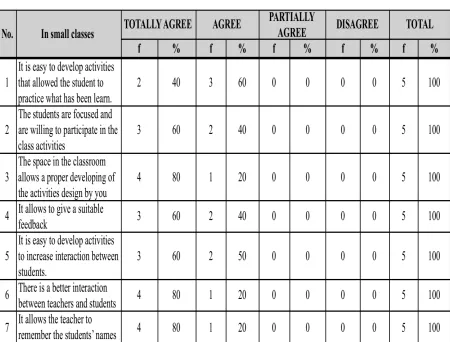
[image:27.595.87.537.407.749.2]Teacher´s perceptions
Table 1.
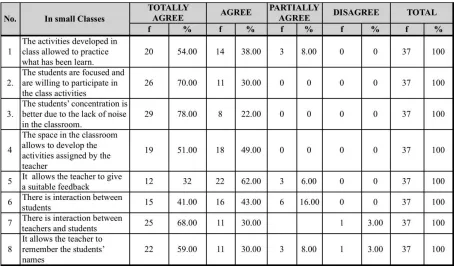
Student’s perceptions
Table 2.
Author: Patricia Vivanco Source: Student´s questionnaire
According to teachers’ answers, it is observed that in statement 1 the majority of the
participants agree that having small classes allows them to design and create suitable lesson
activities to practice what they have learned. The two teachers totally agreed, that means 40%
and three teachers agreed, that means the 60% of the total.
Taking data from the student’s survey, twenty students agreed that all the activities
given by the teacher allows them to practice what has been learned within the class, that
means the 54%; while fourteen students partially agreed with the statement, that means 38%;
and 3 students partially agreed; that means 8% of the total. It is important to stress that
observations conducted in the classroom showed that 100% of the teachers developed the
these activities. The discrepancy between the 20% of the sample could be due to the level of
English Proficiency.
Warner, Clyde & Warner (2001), also agree that it should have been some rules to
keep a good learning environment for the students. They affirm that there are a few things
where the teacher can control and demonstrate their own personality; classroom environment
is one of those things. They also believe the classroom becomes a second home for the
teachers and students as well.
Analyzing statement 2 it is observed that three teachers totally agreed that having a
small number of students allows them to be more focused and to participate in the class, that
means 60%; and two teachers agreed that class size is very important to help them
concentrate, that means 40%; of the total. In contrast with the answers from the students in
the survey, it was observed that not all the students participated actively in the classrooms,
only twenty six students totally agreed with the statement; that means 70% and eleven
students agreed, that means 30% of the total.
During the observation most of the students were focused on what was happening in
the class. They also showed special interest in being part of the class. A few students were
unfocused, and did not demonstrate any interest in what was taught. They did not participate
in the class activities performed in the classroom. It is possible that the reason for the
difference between the results from the surveys and the observation might be that a distraction
was caused by the presence of the researcher in the classroom.
The American Language Center (2003) that the important tool when teaching ESL,
despite the number of students, is the clarity of the instruction. Students should be able to
work together and they need to be able to hear the teacher when new material is presented to
The appropriate class size is one where the teacher feels comfortable teaching, yet a
class of 45 students will be quite of a challenge and difficult to handle for a teacher. A smaller
class, for instance a class of 20 to 25 students, will be more adequate to teach, allowing the
teacher to divide it into smaller groups.
Referring to concentration and noise as stated in statement 3, most of the teachers,
four of them totally agreed that having a small class helped prevent noise, that means 80%;
but, one teacher agreed, that means 20% of the total. Related to the students, twenty nine
totally agreed that concentration is important in the classroom which means 78% of the
students. The other 22% agreed to maintain a higher level of concentration. From the
observation within the class, it was clearly confirmed that most of the students were able to
concentrate due to the lack of noise in the classroom.
Warner, Clyde & Warner (2001), also agree the setting in the classroom should be
comfortable, friendly, and happy so the students can feel at home. Furthermore, they also
affirm that the arrangement of the desks, the flow, the lighting, the noise, the temperature and
the air contribute to create a good educational environment for the students.
The results for statement 4 indicated that 51% of the students totally agreed that the
space in the classroom allows them to complete suitable activities assigned by the teacher,
which means that nineteen students feel confortable in the class. And the eighteen students
agreed that the classroom space is important in order to do the activities, which means 49% of
the total. The observation made in the classroom indeed agreed with the other two groups. In
100% of the observed classes the Physical classroom environment invited and allowed
students to learn and perform the activities assigned by the teacher.
Additionally according to Wong & Wong (2001), in order to create a good
Concerning statement 5, the 60% of the teachers totally agreed that good feedback can
be given to the students promptly when having a small number of participants in a class,
which represents three teachers of the total. The 40% of the teachers agreed the importance of
feedback in class. In contrast, the results from the students’ survey shows that the majority of
the participant, 32% totally agreed, and 62% of the students agreed with the statement. In
contrast, 6% did not see the number of students in a class as an impediment to give effective
feedback. From my observation it was proved that in 100% of the observed classes the quality
of feedback was better when having a small class; teachers could notice mistakes with no
problems and correct them in no time. The reason for the discrepancy of the 6% of the
students that did not agree with the statement could be due to the possible confusion between
meaning of teachers’ feedback and teachers’ attention.
Harfitt (2013) in his study observes that a more accurate feedback to achieve students’
progress was given when working with small classes.
Referring to statement 6, most of the teachers, 60%, claim that the interaction between
students increased in a small class, and 50% of the teachers agree with the statement. The
answer from the students’ survey indicated that 41% of the participants, which means fifteen
students, totally agreed with having a good interaction among them in a small class. In
addition 43% of the students agreed that interaction among them is important in learning
process. In contrast, 6% of the students were not sure if having a small class helps them to
have a good interaction with other students. From the observed classes, the researcher cannot
agreed with the other two groups, due to the fact that only 60% of the students were
interacting when performing activities and when socializing in the classroom. The remaining
40%, did not show any kind of interaction between students. It was observed that the students
On the other hand, and according to Rea & Mercury (2006), even though interaction
between students is a very important tool to practice what is been learned, it is not used very
often. Individual work is encouraged, and little talking is used in the classroom.
The results for statement 7 in the teacher’s survey show that 80% of them totally
agreed that the number of students in a group is important in order to create a good interaction
between teachers and students. On the other hand, 20% of the teachers agree that the
interaction in class permits better results on teaching and learning English in small classes. In
contrast twenty-five students totally agreed which means 68%, that the number of students is
an important factor when the interaction between teacher and students come to place. The
30% of students think that the interaction between teachers and students is better in small
classes, and 3% disagree with this. It was observed that great interaction happened between
teachers and students in 100% of the classes who participated in the study. 100% of the data
from the observations proved what the majority of the students affirmed, that having a small
class created a trusting relationship among all the participants in the class. It is possible that
disagreement between the 20% of the teachers and 3% of the students and the observation
could be caused due to that the fact that participants might have established better
relationships in big classes rather than in small classes.
Fay & Fay (2002) affirms that a solid, positive and caring interaction between teachers
and students can create a positive effect in a students’ learning process.
Concluding with the last statement for this survey, four teachers, which means 80%
totally agreed it is easy for them to remember the students’ names. The 20% of the teachers
agreed the importance to remember the students´ names. The 59%, which means twenty two
students, totally agreed that teachers remembers their names. Eleven students, which means
remembering students’ names, participating teachers seem to feel much more comfortable and
it was easy for them to call the students by their names when they have a small class. It is
possible that 11% of the students who disagreed with the statement believe the teacher job is
to know their students’ names no matter how big or small the class is.
Taking into consideration the data from all survey answers from this section, and the
class observations done by the researcher, it guides us to provide an answer to the question:
what the benefits of teaching and learning English as a Second Language in small classes are.
It has been concluded that the benefits of teaching and learning English as a Second
Language in small classes allow students to be engaged in the process of learning and permits
teachers to maintain focus on the needs of each one of their students. The 8 statements in the
survey have shown that individual interaction and suitable feedback benefit a small class. It
also shown that having a small class prevents the excessive noise while the instruction is
being delivered and leads to a better participation and concentration among students.
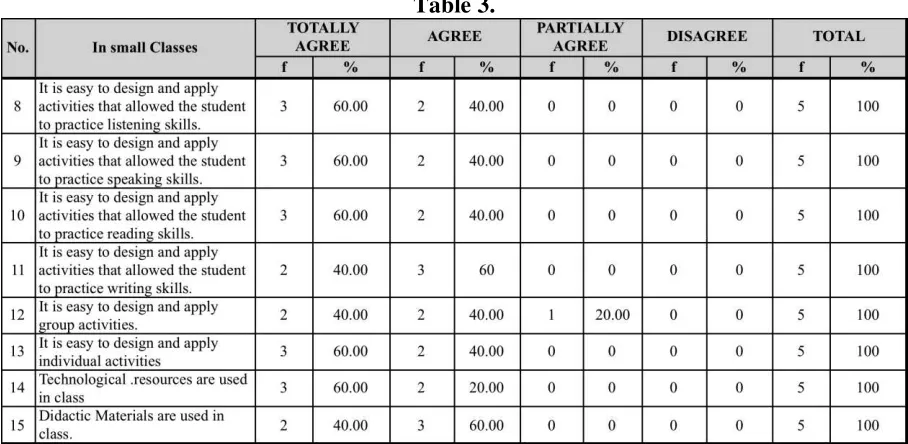
What teaching strategies and resources benefit teaching English as a Second Language in small classes?
[image:33.595.85.539.532.754.2]Teacher’s perceptions
Table 3.
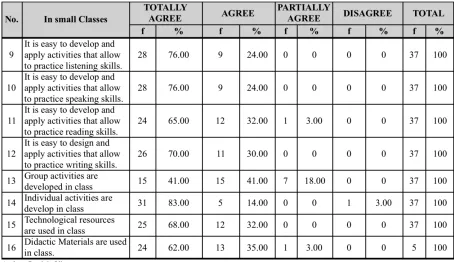
Students’ perceptions
Table 4.
Author: Patricia Vivanco Source: Student´s questionnaire
According to the results from statements 9, three teachers which stands for the 60% of
the sample, totally agreed that in small classes it is easier to design and apply activities that
allow students to practice listening skills; two teachers which represents the 40% of the total
number of teachers agreed with the statement; in the same way, twenty eight students which
represent the 76% of the total of the participants, totally agreed that a class with small number
of students makes it easy to complete and understand activities to practice listening skills;
equally nine students which is the 24% of the sample, agreed with this statement. The
observation conducted by the researcher, confirm that in 100% of the observed class, it was
easy for students to complete assigned activities by the teachers, in order to practice and to
improve the listening skill. Individual conversations were used as strategies to practice
O’Loughlin (2010) mention that there are some useful techniques that help English
learners with their listening skills. Some techniques included matching, sorting, pointing,
organizing information physically, orally and writing.
According to the results from statement 10, three teachers which represent the 60% of
the whole, totally agreed conducting a small class gives them a better and easy way to design
and develop activities to help students practice their speaking skills in class; the 40% of the
sample, which represents two teachers, just agreed with the statement; likewise, twenty eight
which makes up the 76% of the students’ sample, totally agreed that a class with a few
students allows them to complete activities developed by the teacher allowed them to practice
the speaking skills in a more accessible way . It was also shown by collected data that nine
students agreed with this statement which represents the remaining 24% of the sample. The
observation conducted in the five different classrooms with a small number of students it was
confirmed that in the 100% of the classrooms the students’ performance became easier when
practicing the oral activities designed by the teachers. Individual conversation and describing
pictures were used as strategies to practice speaking skills.
Rea & Mercury (2006), affirm that encouraging students’ thinking will increase their
speaking skills.
According to the results from statements 11, three teachers which is the 60% of the
sample, totally agreed that designing and applying activities for small classes to practice
reading skills was less complex and doable; and two teachers which represents the 40% of the
total number of teachers just agreed with the previous statement ; the students’ data showed
that, twenty four students which represents the 65% totally agreed that it was easier for them
to practice their reading skills in a small class setting. Twelve students which means the 32%
of the whole agreed with this statement. In the other hand, the data also showed that 3% of the
between them may be due to external factors such as lack of motivation, lack of interest or
understanding of the task. The observation conducted confirms, that in 100% of the observed
class that it was much easier for the students to complete assigned activities such as sequence
of events to practice reading skills in a small class.
Echeverria, Vogt & Short (2008, p.15). Refer to a T-Chart Graphic Organizer as a
technique to practice reading skills. This technique is used to help students brainstorm what
they know about a chosen topic. It also helps with vocabulary and writing skills
According to the results from statements 12, two teachers which represent the 40% of
the sample, agreed that design and apply activities to practice writing skills its easier in small
classes; three teachers which are the 60% of the whole just agreed with this statement; It is
also shown that twenty six students which stands for the 70% or the sample, totally agreed,
that in classes with small number it is less complicate to complete activities that allow them to
practice writing skills .Eleven students agreed with this statement which means the 30% of
the whole. The observation conducted confirms that in the 100% of the observed class,
students seemed to enjoy completing assigned activities to practice writing skill, due to find
small classes as the right environment for learning.
Raimes (1983) also refers to a technique that can help improve language skills and can
be developed around the written skills. By using The Controlled Writing Exercise. Students
are able to work in small groups with a controlled composition. Students have to take in
consideration sentence combined, punctuation, and finding links between sentences to create
paragraphs.
Raimes (1983) refers to techniques that can be developed for small classes to help
improve language skills and that are developed around the reading skills are: By doing drafts
able to discuss what has been written. And by reading the final version students are practicing
their reading skill.
From the teachers’ point of view, the outcome of statement 13 shows, two teachers,
which represents the 40% of teachers, totally agreed and two teachers, which represents 40%
agreed that is easy to design and apply group activities. On the other hand, it is also shown
that 20% of the teachers do not consider group activities to be a viable strategy in a small
class. The students’ point of view also shows that fifteen students which means 41% of them
have completed group assignments as a strategy to learn. And fifteen students which means
41% agreed with the statement. In contrast, 18% have not been part of group activities in the
class. The outcome from the observations disagrees in the percentage. In contrast with the 80
and 82% from the teachers and students surveyed. It was noted that in only 60% of the
observed classes, group activities were developed in the classroom, especially to practice
listening and speaking activities. The other 40% of the teachers did not use group activities.
The difference in the percentage could be related with the number of students in each
English as a Second Language groups that did not allow teachers to develop group activities.
The groups were no bigger than 7 or 8 students per group.
The American Language Center (2013) affirms that it is more helpful when teaching
English as a Second Language to have a big class because it would allow teachers to group
high level students with students who are falling behind. It was found that it is also better to
assign complex tasks to a group because a bigger class allows the students to help each other.
According with Rea & Mercury (2006), group work and pair work is highly
recommended to improve the understanding of the concepts of a new language.
The results from statements 14, three teachers totally agreed that is easy to design and
apply individual activities, which is equivalent to 60%; and two teachers agreed which
and fifteen students agreed, also they indicates that teachers assigned individual activities for
them to complete. Just 3% of the sample did not agree with the statement. The data obtained
from the observation disagree with teacher’s point of view. It was observed that in 2 classes,
which represent 40% of the sample, individual work was completed by students in a class
with a small number of students. In the 3 remaining classes, which represents 60% of the
sample, individual work was not used; teachers used a whole group work activities approach.
It is possible that the discrepancy found is due to the small number of students in each class.
Kumer (1992) asserts that large classes do not bring interactive situations for
students. Small classes do provide more opportunities for individualization, classroom control
and students involvement, though he also believes that what teachers bring to the classroom is
more important than good relations between teachers and students.
In the statement 15, three teachers, which is equivalent to 60% totally agreed, and two
teachers which represents the 40% of the sample agreed that technology is used as a resource
in the class. Therefore, technology allows students to learn according to their different needs;
likewise, twenty five students which represents the 68% of the sample totally agreed, and
twelve students which is equivalent to 32% of the sample agreed with the statement.
Technology nowadays benefits teachers in the classroom and has been prove as a great
resource to deliver a lesson.
Finally in the statement 16, two teachers which is equivalent to 40% totally agreed,
and three teachers which represents 60% of the sample agreed that didactic materials are also
a good resource that benefits the learning process. In the same way, twenty four students,
which equivalent to 62% of the sample totally agreed, and thirteen students which represents
35% agreed with the statement. This materials permit students to understand and clarify
It can be concluded that a small class allows teachers to use the same strategies that
they might use in a large class with the difference, being that in small classes, teachers can
use those strategies to reach every single students’ needs.
Mcleod, Fisher & Hoover (2003) mention that planning a lesson according with what
needs to be learned invites the students to participate in activities related with the material that
is presented in the class and keep them engaged in those activities using the whole class
period efficiently.
After analyzing the results from the surveys in conjunction with my own observations
in the classroom, an answer arises to the question: What teaching strategies and resources
benefit teaching English as a Second Language in small classes?. One strategy that benefits
teaching English in small classes are group activities. These group activities should be
developed to allow students to practice to acquire a new language. The data also shows that
the use of activities to practice the four skills are frequently used as strategies in small classes.
It also been stated by teachers and students and confirm by observations that
technology as well as didactic material are well used sources to teach and learn English in
small classes.
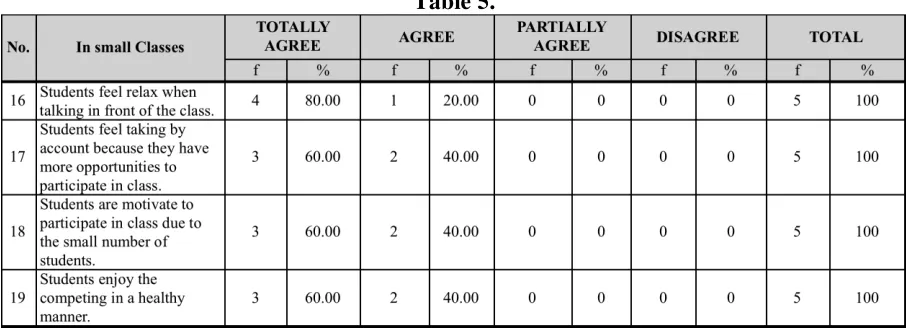
[image:39.595.85.538.589.754.2]How do the students feel learning English as a Second Language in small classes? Teachers’ perceptions
Table 5.
Student’s perceptions
Table 6.
Author: Patricia Vivanco Source: Student´s questionnaire
In statement 17, according to the results of the questionnaires, four teachers totally
agreed that students’ feelings improve as they become more secure and relaxed when talking
in a new language in front of a class with a small number of participants, which is equivalent
to 80% of the total number of teachers; and one teacher agreed, which corresponds to 20% of
the sample agreed with the statement. The outcome from the students’ survey shows that
thirty one participants totally agreed, which represents the 84%; six students agreed, which
corresponds 16% are less stressed in a small class. However, a difference was found between
the out coming from observation results, and the teachers and students answers. It was
observed that 80% of the classes showed that students feel more comfortable when practicing
their language skills in class. This is due to a common proficiency level of English within the
class. 20% of students in the observed class did not show any sign of relaxation. It could be
possible that these students were distracted and felt unsure about the language learned.
The outcome for statement 18 shows that three teachers, which represents 60% of the
sample totally agreed and 2 teachers which is equivalent to 40% of the sample agreed that
having a small class gives the students more opportunities to participate and feel part of the
class. Twenty six students that corresponds to a 70% of the participating are totally agreed
and eleven students which is equivalent to 30% of the sample agreed with the statement. From
the observations made in the classroom it was confirmed that students seemed to have more
opportunities to participated and be part of the activities.
Tomlison & Mctighe (2006) mention that when each student is treated with dignity
and respect they feel safe and valued in the classroom. Each student makes meaningful
contributions to the work in class. There has to be a balanced between individual and group
work as a whole. Students work together collaboratively. Students are grouped based on
similarities and differences to peers.
The same way, for statement 19 it was shown that three teacher from the sample and
which represents 60% totally agreed and 2 teachers that represents 40% of the participants
just agreed that students are motivate to participate in class, due to the small number of
participants in a class. A small variation was shown from the students’ survey, it is observed
that twenty nine students that correspond to a 78% of the sample are totally agreed and eight
participants which is equivalent to 22% agreed with the statement. After the observations, it
was confirmed what was assured by teachers and students. Students were better motivated to
participate in all the activities in the class.
Their confidence was demonstrated each time the teachers asked questions. The
student participation was high because they felt value in the class.
Mcleod, Fisher & Hoover, (2003), suggest another strategy to begin each day is
welcoming the class. Briefly explain the learning objective and what students will do. This
how it relates to the day’s lesson or reviews material taught earlier. If students perceive the
opening activity as busywork, you lose motivation before your class begins.
The results in statement 20 indicated that three teacher which is equivalent to 60% are
totally agreed that a small class allows students to keep a healthy competence, two teachers
that represents 20% of the sample agreed with the statement. From the students’ point of view
the outcome indicates that twenty six students, the 70% of the sample, felt that small class
invites them to have a healthy competence between classmates. Likewise, eight students
which correspond 5% just agreed with it. It was also indicated that three participant were
partially agreed with the statement. In contrary with the above, one student which represent
3%, did not feel that having a small number of the students in a classroom will allowed to a
healthy competence. This disagreement may be due to that the students has not enjoy any kid
of activities that required a competence. A clear competition was observed within the students
and that created a perfect environment and gave the students a great moment in which to
learn. It also invited the students to own the classroom learning process.
Tomlison & Mctighe (2006) affirm that each student needs to be safe and feel valued
in the classroom in order for learning to occur.
To answer the question, How do the students feel learning English as a Second
Language in small classes, the data from the surveys, student responses and the researcher
observations show that feelings play a very important part in the learning process. When
students feel part of the group, they are relaxed and motivated to participate in class. Their
high self-teem allows them to compete in a healthy way. In conclusion, once students feel
happy, motivated and are willing to participate without the fear of making mistakes, the
learning process begins.
Teachers’ perceptions
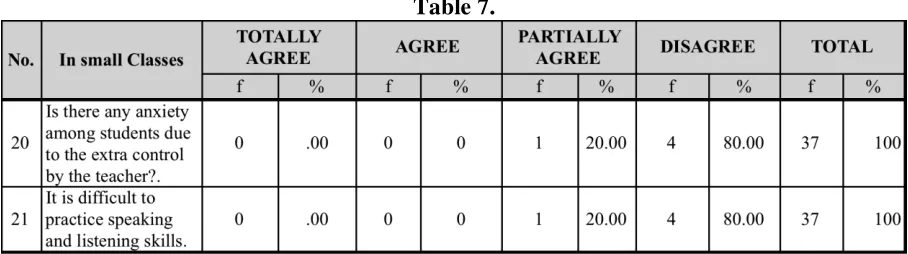
Table 7.
Author: Patricia Vivanco Source: Teacher´s questionnaire
Student´s perceptions
Table 8.
Author: Patricia Vivanco Source: Student’ s questionnaire
In the above chart for statement 21, one teacher partially agreed and indicated no
limitations in teaching English in small classes. There is not anxiety among the students due
to the teacher control, which is equivalent to 20%; and four teachers disagreed, which
correspond to 80% of the sample. In contrary to the responses of the teachers five students
totally agreed that in small classes there is anxiety among because there is more control,
which represents the 14%; one student agreed, which correspond to 3%; twenty two students
partially agreed, which equivalent to 59%; and nine students disagreed, which represents the
24% of the total. From the students’ sample, we can observe that 83% of participants agree
that the teacher control does not cause anxiety among the class. In contrary, 17% of the
sample indicated that since being part of a small class gives the teacher more control, the
[image:43.595.85.540.330.428.2]teacher control was minimal, as teachers seemed to be part of the group and were team
players, helping the students to feel comfortable. It was also observed that in 20% of the
sample, which represents 1 classroom, the level of stress was really high. It could be that
students are not yet used the extra control form the teacher.
Harfittz (2013) also agrees and indicates that as a result of his study that the level of
anxiety of a second language learner can be reduced when the teacher is part of the group as a
leader and help them through the learning process as a participant and not as an authority,
who makes them follow the rules.
In statement 22, one teacher partially agreed, and indicated is difficult to practice
speaking and listening skills, which corresponds 20%; four teachers who participated in the
research indicated that they do not find any kinds of difficulties in small classes when
practicing speaking and listening skills, which corresponds 80% of the total. In contrary that
students are not quite sure, in fact, seven students totally agreed, which corresponds to 19%;
one student agreed, which represent 3%; twenty students partially agreed and indicated that
there are some difficulties when practicing the skills, which means 54%; and nine students
disagreed, of them affirm that a small class cannot interfere with speaking and listening
activities, which equivalent to 24%. From the observation, it was proved and in contrast with
what students affirms. It was easy for students to complete activities when practicing listening
and writing skills. In addition, it was easy for the teacher to give quick feedback when a
mistake in pronunciation is made, which is difficult. The reason for the discrepancy might be
that students are used to being part of a big class where they have the opportunity to interact
and practice with more students.
Harfittz (2013), in his prior study, found that in small classes, teachers are able to
From the collected data, I have observed that the extra control of the teacher is not a
big issue to cause anxiety among the students. As an answer for the question, What are the
limitation when teaching English as a Second Language, It is been found that rather than
limitations, there are more benefits of learning English as a second language. It is easier to
reach each students needs when practicing speaking and listening skills due to the number of
Conclusions
The benefits of teaching and learning English as a Second Language in small classes
allow students to be engaged in the process of learning and permits teachers to maintain focus
on the needs of each one of their students.
In small classes the strategy that benefits teaching English is group activities. These group
activities allow students to practice the four skills in order to acquire a new language.
The use of technological and didactic resources in small classes permits students to
participate and develop tasks individually and in groups.
There is much teacher-student interaction, in small classes, which allows students to be
interested in the lesson and increase their participation.
The students feel relaxed to orally participate in front of the class; this permits teachers to
provide individual attention.
In small classes, the individual interaction and suitable feedback benefit students, and also