C
C
|
E
E
|
D
D
|
L
L
|
A
A
|
S
S
Centro de Estudios
Distributivos, Laborales y Sociales
Maestría en Economía
Universidad Nacional de La Plata
Modeling Informality Formally: Households and
Firms
Documento de Trabajo Nro. 47
Marzo, 2007
Modeling Informality Formally:
Households and Firms
Sebastian Galiani∗
Washington University in St. Louis
Federico Weinschelbaum Universidad de San Andrés
Abstract: Informality is widespread in most developing countries. In Latin America, 50 percent of salaried employees work informally. Three stylized facts characterize informality: 1) small firms tend to operate informally while large firms tend to operate formally; 2) unskilled workers tend to be informal while skilled ones have formal jobs; 3) Ceteris paribus, secondary workers are less likely to operate formally than primary workers. We develop a model that account for all these facts. In our model both heterogeneous firms and workers have preferences over the sector they operate and choose optimally whether to function formally or informally. There are two labor markets, one formal and the other informal, and both firms and workers act unconstrained in them. By contrast, a prominent feature of the pre-existing literature is the idea that worker’s decisions play no role in determining the equilibrium of the economy. Using our model, we show that an increase in the participation of secondary workers would tend to raise the level of informality in the economy. This effect partially accounts for the increases in informality seen in Latin America over the past two decades.
December 27, 2006
∗ Sebastian Galiani, Associate Professor, Department of E conomics, Washington University in St
1
1. IntroductionRecent estimates indicate that around 10 percent of GDP in the United States is
produced by individuals or firms that evade taxes (see Scheneider and E nste, 2000). In Latin
America, approximately 50 percent of all salaried employees work informally. An important
question is, therefore: What are the determinants of informality? Unfortunately, three decades of research have not yet yielded a consensus opinion on this point (Maloney, 2004).
The traditional explanation, initiated with the work of Lewis (1954), assumes the
existence of segmented labor markets in which some workers do not have access to jobs in
the regulated, formal sector. These workers are forced to accept lower-paying
informal-sector jobs that usually involve inferior working conditions. While this view has become
prevalent in the development literature, direct empirical tests of the premise that informal
workers would expect higher wages in the formal sector yield mixed results. For instance,
Magnac (1991), Maloney (2004), and Pratap and Quintin (2004) do not find compelling evidence of segmentation between the formal and the informal sectors using data from
Colombia, Mexico and Argentina, respectively. It is, nonetheless, certainly plausible that the
presence of unions might segment the labor market. However, even if we believe that
unionization has been an important factor in labor-market segmentation in the past, the
pronounced decline of unionization throughout Latin America over the last two decades
makes it appear to be a less satisfactory explanation of the phenomenon at the present time,
especially since informality increased substantially in Latin America during the same period
(see Gasparini and Tornarolli, 2006). Another approach emphasizes the role of labor-market regulation and taxation as the main cause of informality. A pioneering study by De Soto
(1989) describes how informal workers develop their own laws and institutions to make up
for the shortcomings of the official legal system. It is certainly true that the size of the
shadow economy is affected by the burden of taxes and social security contributions, as well
as by the many other regulations governing the official economy. The problem with
adopting this explanation of informality unreservedly, however, is that it overlooks the fact
that workers in the informal sector are not eligible for socially mandated benefits. In other
2
In this paper we present a model of an economy in which the sizes and wages of the
formal and informal sectors are endogenously determined. This model entails a continuum
of types on both sides of the labor market (i.e., firms and workers). Firms choose whether to operate formally or informally and workers choose in what sector they work. In equilibrium,
managerial ability determines size dualism at the firm level, and human capital is the factor
that determines whether workers are employed in the formal or informal sector. Thus, in our
model, both heterogeneous firms and workers have preferences over the sectors they
operate and choose optimally whether to function formally or informally. By contrast, a
prominent feature of the pre-existing literature is the idea that worker’s decisions play no
role in determining the equilibrium of the economy (see Section 2).
Our main findings are as follows: First, in equilibrium, the formal-sector wage premium is not signed. Formal wages can be higher than, equal to, or lower than informal wages. This
result contrasts with the consensus opinion expressed in the existing literature, which
identifies a positive formal-sector wage premium with the presence of labor-mark et dualism in
the economy, while the absence of a wage premium is taken to be indicative of the
prevalence of a competitive environment in the labor market. A large body of empirical
work rests on this view of informality.
Second, as in the previous literature that followed the lead of Rauch (1991), size dualism
is present in the equilibrium of the economy we model: small firms operate informally while large firms operate formally. Third, workers with low human capital work in the informal
sector while those with high human capital work in the formal sector. Fourth, distributions
of both human capital and managerial ability affect the equilibrium of the economy. A poor
economy with low levels of human capital and limited managerial capabilities is likely to
exhibit high levels of informality. This is observed in the data. Fifth, all the regulations –
fixed costs– that increase the cost of operating formally, both for firms and for workers,
influence the equilibrium as they would be expected to do. The same is true for payroll taxes
–or any taxation that affects labor demand in the formal sector of the economy- and enforcement.
Finally, and very importantly, ceteris paribus, secondary workers are less likely to operate
formally than primary workers are. This is because, whatever the net benefits of operating
formally may be for a worker having a given human capital endowment, they will be lower if
3
data. Furthermore, we also present econometric evidence that shows that secondary workers
are less likely to operate formally when primary workers work in the formal sector. This
result would not be understandable in a model where workers are not allow to choose purposefully the sector in which they work.
Thus, an increase in the participation of secondary workers would tend to raise the level
of informality in the economy. We believe this effect partially explains the increases in
informality in Latin America seen over the last two decades.1 For example, in Appendix I, we
simulate the rates of formality for Argentina, which is the Latin American country where
informality increased the most in the last two decades. We assume that only the
demographic composition of the labor force changed over time (and that the formality rates
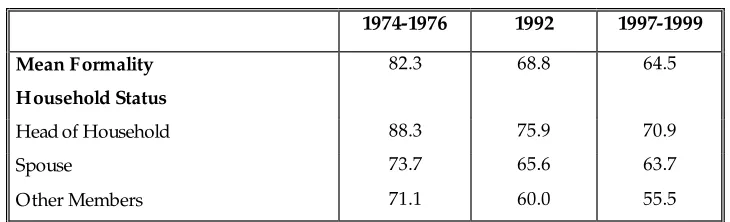
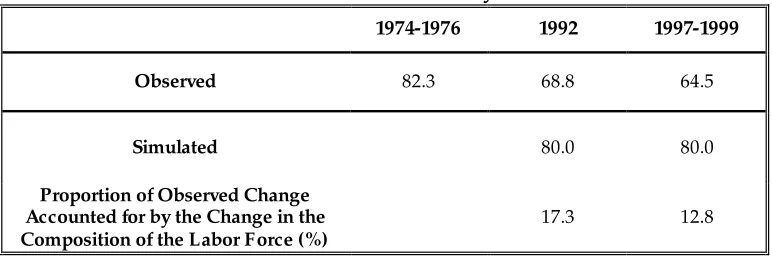
of all these groups are unaffected by these shifts in the labor force composition) and find that approximately 20 percent of the rise in informality between the early 1970s and the
1990s could be directly accounted by the reduction of the share of the labor force
represented by primary workers during that period.2 This exercise is in the spirit of Shimer
(1999) that argues that the U.S. unemployment rate is so much lower since the 1980s
compared to the one observed during the two previous decades because the population is so
much older now than then.3
The rest of the paper is organized as follows. Section 2 reviews the previous literature on
informality. Section 3 presents evidence on the nature of informality in Latin America, which serves as a basis for the analysis offered in this paper. Section 4 portrays the setup of our
model, while Section 5 reports on a set of comparative static exercises. In Section 6, we
study the effect of incorporating secondary workers into the labor market. Finally, Section 7
presents our conclusions.
2. Literature Review
Dualistic models of labor markets have pervaded the literature since the seminal work of
Lewis (1954). Firms and workers are assumed to comply with regulations in the formal
1 Although our empirical focus is in Latin America, where informality is pervasive, the model we developed in
this paper is very general and therefore relevant also for rich countries. For example, it might be of interest in the U.S. where recently there has been a reduction in the percentage of workers under age 65 with employment-based health benefits (from 66.8 percent in 2000 to 62.4 percent in 2004).
2 This demographic composition effect is quite large since, during the period considered, informality in
4
sector but not in the informal sector. Wages in the formal sector are set exogenously and
above the competitive equilibrium level. The labor market is then segmented, with only
some workers obtaining jobs in the formal sector. The classic model presented in this literature is the one developed by Harris and Todaro (1970).
An excellent formalization of this type of model is provided by Rauch (1991), who
develops a model in which the prevailing real wage in the formal sector is exogenous. Firms
can refrain from paying the exogenously determined real wage provided they operate on a
scale smaller than a given detection threshold. The product market is assumed to be
competitive. Workers are homogenous but firms differ in terms of managerial ability, which
in turn determines firm size as discussed in Lucas (1978). Thus, in equilibrium, there is a
break in the size distribution of firms. Informal wages are lower than formal wages. However, unemployment does not arise as in Harris and Todaro (1970) because, in this
model, workers’ utilities are not equalized in equilibrium. Some workers obtain jobs in the
formal sector while the others are underemployed (in the sense that they could be earning
more in a competitive equilibrium) in the informal sector.4 Note, however, that the emphasis
in this paper is on size dualism –i.e., the existence of a difference in size between the smallest
formal-sector firm and the largest informal-sector firm. In contrast, the earlier theoretical
literature focused on labor-mark et dualism, which is defined as the existence of a difference
between the formal-sector wage and the informal-sector wage for economically identical employees.
Fortin et al. (1987) extends Rauch’s model by introducing corporate profit and payroll
taxes and by assuming that the marginal cost of tax and regulation evasion increases with the
size of the firm. They derive three forms of dualism that are consistent with labor-market
segmentation: scale, wage and evasion. In equilibrium, small firms in the informal sector
3 See, for example, Acemoglu et al. (2004) for a study of the impact of large shifts in the participation of
women on other related labor market outcome such as the structure of wages.
4 Rauch’s model is consistent with many of the hypotheses advanced to account for the formal-sector wage
5
benefit by paying lower wages and taxes than firms in the formal sector do, but incur the risk
of being penalized for non-compliance with such labor regulations.
Thus, in this type of model, homogenous workers are paid less in the informal sector only as a result of the presence of labor-market regulations that affect the profit function of
firms operating in competitive product markets.
A significant departure from dualism is found in Amaral and Quintin (2006), who
explicitly model the labor market as a competitive market. They assume that both workers
and entrepreneurs are heterogeneous. As in the previous models, firms differ in managerial
ability. Firms in the formal sector pay taxes on profits but have access to the credit market,
while those in the informal sector do not pay taxes and have no access to credit. Therefore,
in equilibrium, large firms are formal and small firms are informal. Workers only derive utility from the wages they receive at work but have no intrinsic preferences for the sector
they work for (i.e., they do not have nonpecuniary preferences). Thus, there is a
differentiated demand for formal and informal employment but labor supply is the same in
both sectors. In other words, there is only one labor market in this economy. Therefore, and
contrary to the previous literature, similar workers earn the same amount in the formal and
informal sectors.
Two other interesting and related papers are Straub (2005) and de Paula and Scheinkman
(2006). Straub (2005) develops a model where formal firms pay an entry fee to become formal. Formal firms have access to a public good, while informal firms do not. The public
good is identified with access to a better credit market (lower interest rates). In this case as
well, in equilibrium, large firms are formal and small firms are informal. The labor market is
not modeled. For their part, de Paula and Scheinkman (2006) assume that firms pay taxes on
sales when they operate in the formal sector but, on the other hand, pay lower interest rates
on capital. Hence, in equilibrium, there is also a break in the size distribution of firms. As in
the previous models, firm size is determined by managerial ability. Workers are homogenous
but, in this model, they are paid the same in both sectors. Informality is defined as tax avoidance.
A major feature of the earlier literature is that workers’ decisions are seen as playing no
role in determining the equilibrium. On one hand, it is only firms that choose optimally
whether to operate formally or informally while homogenous workers are constrained to
6
but the latter do not derive nonpecuniary utility from the sector they work for. Thus, there is
only one labor market in the economy. Firms have differentiated demands for formal and
informal employment but workers are indeed indifferent about which sector they work for. By contrast, in our model workers do have nonpecuniary preferences for the sector they
work for. Therefore, there are two labor markets in the economy in which both firms and
workers act unconstrained. Firms choose whether to operate formally or informally, and
workers choose in which sector to work. At equilibrium, managerial ability determines size
dualism at the firm level, and human capital is the factor that divides workers into those who
work in the formal sector and those who work in the informal sector.
3. Informality in Latin America
Formality is usually defined on the basis of the right to exercise socially mandated
benefits such as health insurance and pensions. The criteria to be used should capture
whether or not the employee is registered with the authorities and has the typical set of
rights and benefits associated with legally recognized employment. We have followed the
trend exhibited in the literature and thus define formality on the basis of whether or not an employee pays social security taxes (see, among others, Gasparini and Tornarolli, 2006).
In the literature, workers are usually categorized into three groups: formal employees,
informal employees and independent workers. Independent workers are distinguished from
employees for two reasons. First, independent workers typically differ in their motivations
and skills. They tend to be individuals who display entrepreneurial skills and who attach a
high value to the non-pecuniary benefits of independent work (see, among others,
Blanchflower and Oswald, 1998). Second, the surveys most commonly used as a source of
data on the labor force in Latin America collects information on employees’ social security contributions but not on contributions by business owners or the self-employed.
Consequently, it is not possible to establish whether or not self-employed persons are
operating formally or informally. We have therefore abstracted from the decision to work as
an independent worker and focus our analysis on firms’ and salaried workers’ decisions as to
whether or not to operate within the formal sector of the economy.
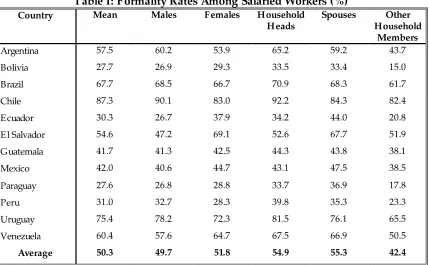
In Table I we present evidence on formality rates among salaried workers in Latin
America. The data are taken from household surveys for 12 countries in which the existence
7
the surveys used here are for the years 2002-2004. On average, approximately half of all
salaried workers hold informal jobs. Formality rates also appear to display a large variance
among countries –ranging from 87 percent in Chile to 27.6 percent in Paraguay– and tend to increase with development. The richest countries in this sample –i.e., Argentina, Brazil, Chile
and Uruguay– all have formality rates above 50 percent, while all the poorest countries
except E l Salvador (Bolivia, E cuador, Guatemala and Paraguay) exhibit formality rates
among salaried workers well below that level.
Table I: F ormality Rates Among Salaried Workers (%)
Country Mean Males Females Household
Heads
Spouses Other
Household Members
Argentina 57.5 60.2 53.9 65.2 59.2 43.7
Bolivia 27.7 26.9 29.3 33.5 33.4 15.0
Brazil 67.7 68.5 66.7 70.9 68.3 61.7
Chile 87.3 90.1 83.0 92.2 84.3 82.4
Ecuador 30.3 26.7 37.9 34.2 44.0 20.8
El Salvador 54.6 47.2 69.1 52.6 67.7 51.9
Guatemala 41.7 41.3 42.5 44.3 43.8 38.1
Mexico 42.0 40.6 44.7 43.1 47.5 38.5
Paraguay 27.6 26.8 28.8 33.7 36.9 17.8
Peru 31.0 32.7 28.3 39.8 35.3 23.3
Uruguay 75.4 78.2 72.3 81.5 76.1 65.5
Venezuela 60.4 57.6 64.7 67.5 66.9 50.5
Average 50.3 49.7 51.8 54.9 55.3 42.4
Notes: Statistics from the latest survey available for each country. All surveys are for the years 2002, 2003 or 2004. For Argentina, we excluded the individuals that work in the social program Jefes y Jefas de Familia since they are not salaried employees but welfare recipients. Sampling weights are used to compute all the statistics by country in this table. Average statistics are unweighted averages of country rates.
Source: Prepared by the authors based on data from the Socio-E conomic Database for Latin American and the Caribbean (CE DLAS).
On average, no appreciable differences are observed in the degree of formalization
between males and females or between heads of household and spouses. At first glance, this
might seem counter-intuitive, but it is actually the natural result of sample selection. Females
who participate in the labor market are, on average, more educated than males.5 In Table II
5 However, this is not true at the margin. Thus, the recent increase of female labor supply observed through
[image:9.612.95.524.233.498.2]8
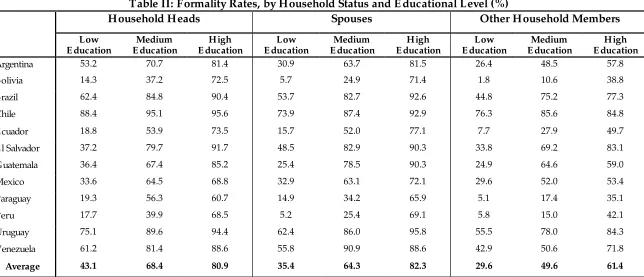
we present formality rates for household heads, spouses and other household members; each
of these groups is divided into three educational categories: low, medium and high education
level. Our findings indicate that the likelihood of a salaried worker being formally employed increases with the individual’s level of education. Conditioning on the level of education,
heads of household are more likely to be formally employed than their spouses are, but
among highly educated individuals, there are no differences at all. Other members of the
household tend to have lower formality rates than heads of household and spouses in all
cases. In Table III we present information similar to that in Table II after restricting the
sample to households where both the head of the household and the spouse are salaried
employees. Results are very similar.
We further investigate the results in Table III. When the head of the household and the spouse participate in the labor market, the decision could be for both to work in the formal
sector (FF), for one to work in the formal and the other in the informal sector (FI), or for
both two be employed in the informal sector (II). We estimate a Multinomial Logit Model
for these three potential outcomes focusing on the effect of human capital on the likelihood
of observing any of them. In the econometric model we include a full set of educational
dummies for each individual.6 We also include as regressors the age and the age squared of
both the head of the household and the spouse; country fixed effects and a dummy variable
indicating whether the household resides in an urban area. We summarize the results in Figure I. As can be seen, the probability that the head of the household and his spouse work
both formally increases monotonically in the education of the couple while the probability
that both of them are informal decreases monotonically in their education. Interestingly
enough, the likelihood that one works formally while the other operates informally first
increases with the education of the couple while then decreases.
6 For each individual, the omitted education category is no schooling while the schooling dummies included in
Table II: Formality Rates, by Household Status and E ducational Level (%)
Household Heads Spouses Other Household Members
Low E ducation
Medium E ducation
High E ducation
Low E ducation
Medium E ducation
High E ducation
Low E ducation
Medium E ducation
High E ducation
Argentina 53.2 70.7 81.4 30.9 63.7 81.5 26.4 48.5 57.8
Bolivia 14.3 37.2 72.5 5.7 24.9 71.4 1.8 10.6 38.8
Brazil 62.4 84.8 90.4 53.7 82.7 92.6 44.8 75.2 77.3
Chile 88.4 95.1 95.6 73.9 87.4 92.9 76.3 85.6 84.8
Ecuador 18.8 53.9 73.5 15.7 52.0 77.1 7.7 27.9 49.7
El Salvador 37.2 79.7 91.7 48.5 82.9 90.3 33.8 69.2 83.1
Guatemala 36.4 67.4 85.2 25.4 78.5 90.3 24.9 64.6 59.0
Mexico 33.6 64.5 68.8 32.9 63.1 72.1 29.6 52.0 53.4
Paraguay 19.3 56.3 60.7 14.9 34.2 65.9 5.1 17.4 35.1
Peru 17.7 39.9 68.5 5.2 25.4 69.1 5.8 15.0 42.1
Uruguay 75.1 89.6 94.4 62.4 86.0 95.8 55.5 78.0 84.3
Venezuela 61.2 81.4 88.6 55.8 90.9 88.6 42.9 50.6 71.8
Average 43.1 68.4 80.9 35.4 64.3 82.3 29.6 49.6 61.4
Notes: See Table I. The low education category includes all individuals that have not completed high school; the medium education classification includes individuals who have exactly completed high school while the high education category includes all individuals with more than high school (i.e., incomplete or complete tertiary/ college education).
Table III: F ormality Rates Among Households in which Both Members are Salaried Workers, by Household Status and E ducational Level (%)
Household Heads Spouses
Low E ducation
Medium E ducation
High E ducation
Low E ducation
Medium E ducation
High E ducation
Argentina 61.2 77.0 84.0 28.8 64.5 82.3
Bolivia 8.6 28.3 78.6 5.7 28.2 75.9
Brazil 71.2 88.0 92.9 53.8 82.6 92.2
Chile 89.9 96.5 97.0 72.9 87.4 93.3
Ecuador 21.8 62.3 79.6 16.0 51.8 78.1
El Salvador 50.8 81.6 92.8 54.7 85.2 90.0
Guatemala 44.5 73.5 79.2 31.3 80.6 85.0
Mexico 40.2 62.8 74.1 35.8 63.2 71.7
Paraguay 30.9 69.1 66.9 16.6 50.5 64.4
Peru 7.9 47.9 67.2 3.7 25.1 63.6
Uruguay 80.8 92.5 95.3 63.6 88.0 96.4
Venezuela 67.4 80.2 91.6 56.9 85.4 89.8
Average 47.9 71.6 83.3 36.6 66.0 81.9
Note: See Tables I and II. Source: See Table I.
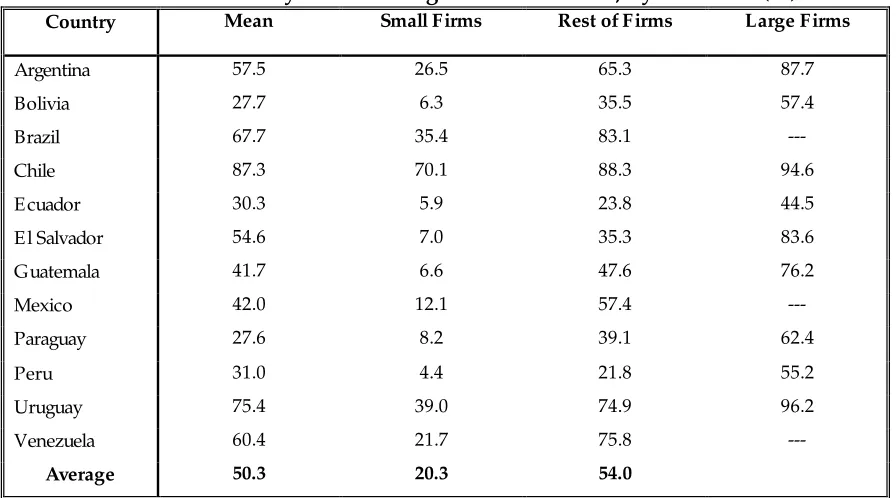
Finally, in Table IV we present formality rates by firm size. Overall, small firms tend to
operate informally while large firms are substantially more likely to operate formally.
In summary, informality is highly concentrated in small firms, and the likelihood that a
worker is employed in the informal sector of the economy decreases as his/her level of education rises. This relation between education and formality is more pronounced among
spouses than among heads of the household. In other words, an unskilled or semi-skilled
spouse is more likely to be employed informally than an unskilled head of household is.
Finally, other household members are, in every case, more likely to work informally unless
they are highly educated. In the next two sections we develop a model that accounts for all
11
Figure I: Predicted Probabilities from Multinomial Logit Model by E ducation Level
0 0.1 0.2 0.3 0.4 0.5 0.6 0.7 0.8 0.9
No schooling Primary Secondary Higher Education
Both Informal Formal-Informal Both Formal
Notes: This figure is constructed using the estimated coefficients of the Multinomial Logit Model. We settled the age of both household members in 46 and setting the Mexico fixed-effect and the urban dummy in one. Furthermore, we assume that both members of the household have the same education level.
Table IV: Formality Rates Among Salaried Workers, by Firm Size (%)
Country Mean Small Firms Rest of Firms Large Firms
Argentina 57.5 26.5 65.3 87.7
Bolivia 27.7 6.3 35.5 57.4
Brazil 67.7 35.4 83.1 ---
Chile 87.3 70.1 88.3 94.6
Ecuador 30.3 5.9 23.8 44.5
El Salvador 54.6 7.0 35.3 83.6
Guatemala 41.7 6.6 47.6 76.2
Mexico 42.0 12.1 57.4 ---
Paraguay 27.6 8.2 39.1 62.4
Peru 31.0 4.4 21.8 55.2
Uruguay 75.4 39.0 74.9 96.2
Venezuela 60.4 21.7 75.8 ---
Average 50.3 20.3 54.0
Notes: See Table I. Firm size is defined as follows (depending on the distinctions made in the available data): Small firm: fewer than 4 or fewer than 5 workers; Rest of firms: more than 4 or more than 5 workers. Large firms: more than 40 or more than 50 workers.
[image:13.612.83.531.412.661.2]12
4. Setup of the ModelWe model an economy with three types of economic agents: a continuum of firms, a
continuum of workers and the government. Firms are heterogeneous in their managerial
ability. They maximize profits by choosing whether to operate formally or informally and by
hiring labor. Workers are heterogeneous in their endowment of human capital. They maximize utility by choosing whether to work in the formal or informal sector. The
government, whose behavior is not modeled, collects payroll taxes, provides formal workers
and their families with nonpecuniary benefits, regulates formal activities and conducts
activities designed to detect and penalize informal operations in the economy.
4.1. Firms
Firms are assumed to produce an homogenous good that is traded in a perfectly
competitive market using managerial ability (a) and homogenous units of labor (l). Using an
approach similar to that used in the previous literature, we assume that there is a continuum
of firms indexed by their innate managerial ability and distributed with density function g(a)
with support in R+.
E ach firm in the economy chooses whether to operate formally or informally and
decides how many units of labor will hire to produce its output. If a firm operates in the formal sector of the economy, its profit function is given by:
( )
( )
,( )
1f a Pf a l w lf t τ
Π = − + −
where P is the price of the good produced by the firm, f(a, l) is the production function, wfis
the prevailing wage per unit of labor paid to workers in the formal sector (i.e., firms are
wage-takers), t is the payroll tax levied on firms and
τ
is a fixed cost incurred by firms thatoperate formally.
There are a large number of studies in the literature documenting various formal-sector
entry costs. The best-known example is the discussion in De Soto’s The Other Path of the cost
of starting a business in Lima, Peru. De Soto finds the complexity and stifling nature of
Peruvian laws and regulations to be a powerful disincentive for formality and hence a
13
and Benham, 2004), a series of comparative studies conducted by the Ronald Coase Institute
have also identified large costs involved in registering and operating firms formally in
developing countries (see also Stone et al., 1996).
If, on the other hand, a firm operates informally, then its expected profit function is
given by:
( )
(
( )
,)
(
1)
i a Pf a l w li q
Π = − −
where wi is the prevalent wage per unit of labor paid to workers in the informal sectorand q
is the probability that a firm is caught operating informally, in which case it will be closed
and will lose its current profits.
In the following discussion, we assume that the production function is Cobb-Douglas
with constant returns to scale:
( )
, 1f a l =a lβ −β
For the sake of simplicity, we normalize P = 1. Firms choose l in order to maximize
profits. Under the assumptions made, the derived labor demand for a firm with managerial
ability a is:
(
)
( )
1/1
1
f
f
l
a
w
t
β
β
−
=
+
if it operates formally and:
(
)
1/1
i
i
l
a
w
β
β
−
=
if it operates informally. Note that both demand functions are linear in managerial ability.
Thus, the size of a firm (assuming that it does not switch sectors), measured by l, is linearly
increasing in a.
Very small firms (i.e., those with managerial ability a close to 0) operate informally
14
Rauch (1991), we now show that in our model there is size dualism: small firms operate
informally while large firms operate formally. When there are firms operating formally and
the profit functions satisfy the following condition, there is a unique cut-off point in firm size:
( )
( )
f i
d
a
d
a
da
da
Π
>
Π
∀
a (1)Condition (1) is equivalent to:
( )
( )
(
)
( )1 / 1 /
1
1
1
1
f i
q
w
t
w
β β β β − −
> −
+
(2)Note that, since both profit functions are linear, inequalities (1) and (2) are not a
function of a.Hence, in equilibrium, it is necessary that inequality (2) be satisfied in order to
have firms operating formally. Therefore, we established that, in equilibrium, whenever there
are both formal and informal firms, there is a unique cut-off point (a) that satisfies:
( ) ( )
f
a
ia
Π
= Π
which in our case is implicitly defined by:
(
)
( )
(
( ) ( )
)
(
)
(
)
(
)
1 1 1 11
1
1
1
1
1
1
1
f f f i i ia
w a
t
w
t
w
t
a
w a
q
w
w
β β β β β ββ
β
τ
β
β
− −
−
−
−
+ −
+
+
−
−
=
−
−
Thus, firms with managerial ability a≤a choose to operate informally while firms with
managerial ability a>a choose to operate formally.
15
(
)
(
( )
)
( )
1 1 , 1 fd f i
f a
l w w a g a da
w t β β ∞ − = +
∫
while the demand for informal labor is:
(
)
(
)
( )
1 01
,
a id f i
i
l
w
w
a
g a da
w
ββ
−
=
∫
Therefore, the total demand for labor is given by:
(
)
(
)
( )
1 01
,
ad f i
i
L w w
a
g a da
w
ββ
−
=
∫
+(
)
( )
( )
1 1 1 f aa g a da
w t β β ∞ − +
∫
In looking at how a change in wages will affect total labor demand, it is useful to break
the impact down into direct and indirect effects. The direct effect is the derivative of total
labor demand with respect to wages, holding the cut-off point
( )
a
constant. The indirecteffect is the derivative of total labor demand with respect to wages that operates through
changes in the cut-off point
( )
a
, holding constant the integrand functions.4.2. Workers
Workers are endowed with l units of homogenous labor to sell in the market. There is a
continuum of workers indexed by their endowment of labor and distributed with density
function h(l) with support in R+. Thus, wages are set for units of substitutable labor. E ach
worker has to choose whether to sell his/her labor to a firm that operates formally or to a
firm that operates informally. Workers cannot split their units of labor between different
firms. In the first case, the worker receives wfper unit of labor plus mandated social benefits.
In the second case, the worker receives only wi per unit of labor.
The utility of a worker who chooses to work in the formal sector is:7
7 We assume that the utility function is linear in order to abstract from risk-pooling behavior when, as in
16
(
,
)
f f f
U
w l HI
=
w l
+
HI
−
γ
where H I are the nonpecuniary benefits that, for simplicity’s sake, we equate with a
government-provided health insurance package which, anticipating the analysis in the next
section, we assume covers all members of the worker’s family.8,9 Workers also incur a fixed
cost
γ
for working in the formal sector (see, among others, De Soto, 1989). When aninformal firm is detected, its workers do not receive their payment. The expected utility of a
worker who chooses to work in the informal sector is:
(
,)
(
1)
i i i
U w l HI =w l −q
Workers with very low levels of human capital are not able to afford the fixed cost of
working in the formal sector (wf l -
γ
≤
0 for some l > 0). This constraint determines theminimum level of human capital required to work in the formal sector:
f
l w
γ =
$
Thus, only workers with
l
≥
l
$
can afford to be employed in the formal sector.When there are workers in the formal sector and the utility functions satisfy the
following condition, then there is a unique cut-off point that determines that workers with
low levels of human capital will be in the informal sector and that those with high levels of
human capital will be employed in the formal sector:
theoretical abstraction and we are by no means attempting to suggest that risk aversion is not a consideration when households choose the portfolio of sectors where their members work.
8 Although, for the sake of simplicity, we equate mandated social benefits with a health insurance package (that
provides better health coverage than public hospitals), there are other mandated benefits associated with formal jobs that affect workers’ payoffs similarly. Examples are pensions and family allowances. Formal workers normally receive pensions from retirement age on, and, after they die, it is common for their surviving spouses, if they are not receiving a pension themselves, to start to receive a pension until their own death. Thus, a formal job provides the entire family with an old-age pension. Family allowances redistribute money among formal workers as a function of family size. Only one worker per family is typically entitled to this type of cash transfer even if both spouses work in the formal sector.
9 There is a large literature in the U.S. that shows that health insurance is an important determinant of job
17
( )
( )
f i
dU
l
dU l
dl
>
dl
∀
l (3)Condition (3) holds if and only if:
(
1
)
f
i
w
q
w
> −
(4)This cut-off point is the maximum of
l
$
and the level of l that makes workers indifferentas to whether they work in the formal or informal sector. We denote this level of l by l%,
which is determined by:
(
,
) (
,
)
f f i i
U
w l HI
%
=
U w l HI
%
or:
(
1
)
f i
w l
%
+
HI
− =
γ
w l
%
−
q
and solving for l% we obtain:
(
1
)
f i
HI
l
w
w
q
γ
−
=
−
−
%
Note that workers with
l
≥
l
$
are unconstrained to choose whether to work in the formalor informal sector, while only workers with l≥l%prefer to work in the formal sector.10 Since
the workers who operate formally must be willing and able to work in the formal sector, the
cut-off point separating workers in informal and formal jobs as a function of their human
capital is given by:
{ }
max ,
l = l l$ %
10 Note that if condition (4) holds and HI ≥ γ, all workers would prefer to work in the formal sector.
18
Workers with
l
≤
l
operate informally while workers withl
<
l
operate formally.The supply of formal labor is:
(
,
)
( )
f
s f i
l
l
w w
lf l dl
∞=
∫
while the supply of informal labor is:
(
)
( )
0
,
l i
s f i
l w w
=
∫
lf l dl
Accordingly, the total supply of labor is:
(
)
( )
0
,
l
s f i
L w w
=
∫
lf l dl
+( )
s llf l dl
L
∞=
∫
Since labor is inelastically supplied, wages determine the amount of labor that is supplied
to the formal or informal sector, but not the total quantity supplied.
4.3. E quilibrium
We restrict our analysis to equilibria where there are firms and workers operating in both
the formal and informal sectors and where workers’ decisions are fully voluntary (i.e.l =l%).
An equilibrium is a (wf ; wi ; ls
f
; ls i
; ld f
; ld i
) vector such that there is market clearing in both the
formal and informal labor markets:
l
s f(w
f,w
i)= l
d f(w
f,w
i)
(5)
l
s i(w
f,w
i)= l
d i(w
f,w
i)
(6)
19
A very interesting characteristic of this equilibrium is that it does not sign the
formal-sector wage premium: wf can be higher, equal or lower than wi (see inequality (4)). This result
contrasts with the previous literature, where a positive formal-sector wage premium is
identified with the presence of labor-mark et dualism in the economy, while the absence of a
wage premium is taken to be indicative of the prevalence of a competitive environment in
the labor market.
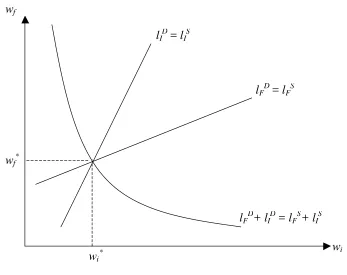
In order to represent an equilibrium for this economy graphically, we first derive the
locus of wages where total labor demand is equal to total labor supply. That is, the wage pairs
(wf ,wi) are such that Ld(wf, wi) = Ls. From this condition we derive an implicit function H(wf ,
wi) = 0 that we will denote
w
fH(w
i)
,
which yields a downward-sloping curve, as we assumethat the derivative of total labor demand with respect to both wages is negative (see Figure
II). Any equilibrium in this economy must lie somewhere on this curve.11 While total labor
demand and supply are equal along this curve, their composition is not. E ach point maps to a different (lsf; l
s i; l
d f; l
d
i) vector. For example, for a high informal wage (and hence a low
formal wage) such as point A, firms would demand relatively more formal workers than
informal ones. However, at that relative wage, a large proportion of workers would prefer to
be informal rather than formal. Thus, a point such as A would not be an equilibrium of that
economy. The opposite situation would arise at a point such as B.
In the same figure we can also draw the functions wf (wi) showing the wage pairs that
would align labor demand and supply within each sector of the economy. Differentiating (5)
with respect to both wages, we obtain:
(
)
(
)
(
)
(
)
, ,
, ,
f f
s f i d f i
f
i i
f f
i
s f i d f i
f f
l w w l w w
dw
w w
dw
l w w l w w
w w ∂ ∂ − ∂ ∂ − = ∂ ∂ − ∂ ∂ (7)
11 This always holds if the direct effects predominate over the indirect effects. If there is a case where the
indirect effect is positive and predominates over the direct effect,
w
fH(w
i)
is not necessarily a function (i.e., fora given informal wage there could be different formal wages that satisfy
w
fH(w
i)
). If this were the case, there20
F igure II: Locus of Possible E quilibria
which can easily be seen to be positive. Differentiating (6) with respect to both wages gives
us:
(
)
(
)
(
)
(
)
, , , , i is f i d f i
f
i i
i i
i
s f i d f i
f f
l w w l w w
dw
w w
dw
l w w l w w
w w ∂ ∂ − ∂ ∂ − = ∂ ∂ − ∂ ∂ (8)
which is also positive.
Given that total labor supply is inelastic, we know that:
(
,
)
(
,
)
f i
s f i s f i
i i
l
w w
l w w
w
w
∂
∂
= −
∂
∂
and:(
,
)
(
,
)
f is f i s f i
f f
l
w w
l w w
[image:22.612.139.458.87.299.2]21
And since we assumed that total labor demand is negatively sloped with respect to both
formal and informal wages, it holds that:
(
,
)
(
,
)
f i
d f i d f i
i i
l
w w
l w w
w
w
∂
∂
< −
∂
∂
and:
(
,
)
(
,
)
f i
d f i d f i
f f
l
w w
l
w
w
w
w
∂
∂
−
>
∂
∂
Therefore, it follows that (8) > (7). Figure III presents these three curves together and
graphically illustrates an equilibrium in this economy.12
F igure III: E quilibrium Wages
12 All the equilibrium points we analyze in this paper are in the area defined by inequalities (2) and (4). We have
not graphed these two relationships in order to keep the figure simple.
l
FD+ l
ID=
l
FS+ l
ISw
iw
fl
ID=
l
ISl
FD=
l
FSw
i* [image:23.612.101.448.378.653.2]22
5. Comparative StaticsWe now explore how the equilibrium we described in the previous section changes in
response to changes in the parameters. In particular, we are interested in how the
equilibrium of the economy changes in response to changes in the distribution of human
capital (l), changes in the distribution of managerial ability (a), the level of regulatory
enforcement (q), payroll taxes (t), and the cost to workers and firms of operating formally (
γ
and t). We will then look at how the equilibrium of the economy changes when we allow for
the incorporation of secondary workers.
All the comparative static exercises discussed below can be divided into two groups:
Those in which the function
w
fH(w
i)
is shifted, and those where it is not. Those that shiftthis function are exercises where the total supply of labor changed or where the composition of firms has been changed exogenously (i.e., not as a result of a change in wages), which has
in turn altered the demand for labor. When
w
fH(w
i)
remains constant, comparative staticexercises are straightforward and can be performed graphically (see, for example, Section
5.1). When this function is shifted, however, the comparative static exercises become more
complicated
5.1. Changes in the Distribution of Human Capital
We will first look at how different changes in the distribution of human capital affect the
equilibrium of the economy. In this exercise, we hold total human capital constant. The
distribution of human capital can change in three qualitatively different ways. First, the new
distribution can maintain the total amount of l both above and below the original cut-off
point that divides workers between the informal and formal sectors as a function of their
human capital. Second, the new distribution can shift l toward workers above the original
cut-off point. Third, the new distribution can shift l toward workers below the original
cut-off point.
In the first case, the equilibrium of the economy remains unaltered. At prevailing wage
levels, workers’ choices would remain unchanged and the aggregate formal and informal
labor supply and demand would remain balanced.
If, on the other hand, l is redistributed toward workers in the formal sector, then the
23
curve for the informal sector shifts to the right. Since the total supply of labor represented
by workers above the original cut-off point increases, at prevailing wage levels, there is
excess supply in the formal sector. This means that, for a given informal wage, equilibrium in the formal sector is only achieved if formal wages go down. The same reasoning applies to
the informal sector. Finally, since neither the total amount of human capital nor the
distribution of managerial ability change, the function
w
fH(w
i)
representing the wage levelsthat align the total supply of labor with the total demand for labor remains the same. We
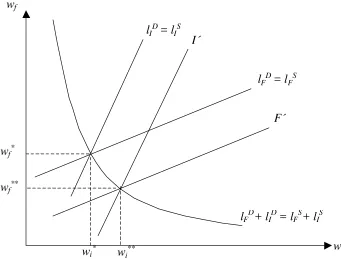
illustrate these changes in Figure IV. Thus, in the new equilibrium, the informal wage
increases while the formal wage decreases. Managerial decisions also change. At the new
wage levels, the managerial ability cut-off point is also lower than in the previous
equilibrium. Therefore, more firms choose to operate formally. Moreover, the firms that
originally were operating formally increase their total labor demand while those that remain
in the informal sector reduce their total labor demand. Thus, a change in the distribution of
human capital such as this increases the size of the formal sector. The opposite happens if l
[image:25.612.118.459.438.697.2]is redistributed toward workers in the informal sector.
Figure IV: Comparative Statics
l
FD+ l
ID=
l
FS+ l
ISw
iw
fl
ID=
l
ISl
FD=
l
FSF´
I´
w
f**w
f*-24
5.2. Changes in the Distribution of Managerial Ability
In this exercise, we redistribute managerial ability among firms but we hold total
managerial ability constant. Given that labor demand is linear in managerial ability (when
firms do not switch from one sector to the other), a redistribution of managerial ability
among firms belonging to the same sector does not change either total or sectorial labor demand. A redistribution of managerial ability from one sector to the other changes both
total labor demand and its composition between sectors.
The distribution of managerial ability can change in three qualitatively different ways.
First, the new distribution can maintain the total amount of a both above and below the
original cut-off point that divides firms into informal and formal operations. Second, the
new distribution can shift toward firms above the original cut-off point. Third, the new
distribution can shift toward firms below the original cut-off point.
In the first case, the equilibrium of the economy remains unaltered. At prevailing wage levels, firms’ choices would remain unchanged and aggregate formal and informal labor
supply and demand would remain balanced.
If, on the other hand, a is redistributed toward firms in the formal sector, at current
wages, then there is an increase in the demand for formal workers and a reduction in the
demand for informal ones. This means that the equilibrium curves for the formal and
informal sectors will both shift to the left. The function
w
fH(w
i)
will also shift but thedirection of its movement is undetermined.
In the new equilibrium, wages change to equilibrate the markets. The worker’s cut-off
point would be lower while the firm’s would be higher. Thus, in the new equilibrium there
are more workers and labor in the formal sector. The effect on wages is as follows: It could
be that wf increases and wi decreases or that both wages move in the same direction. But it
could not happened that wf decreases and wi increases since this would not equilibrate the
labor markets. The opposite will happen if a is redistributed toward firms in the informal
sector.
5.3. Changes in E nforcement
We will now consider how changing the probability that a firm is detected operating
25
expected profits of firms and the expected utility of workers that operate informally. This
directly lowers the cut-off point of formality as a function of managerial ability, which means
that more firms would choose to operate formally while fewer firms would choose to operate informally. The slope of the expected profit function for informal firms diminishes,
implying that the level of a at which formal and informal profits are equal is also lower. The
workers’ cut-off point for formality as a function of human capital also decreases, which
signifies that more workers also shift into the formal sector.
This does not determine, however, the effect on wages, which will depend on whether
the change in q has a stronger impact on firms or workers. At the prevailing wage levels, if
the firms that move into the formal sector increase their total labor demand by an amount
that exceeds the increase in the total supply of labor in that sector caused by the entry of workers coming from informal activities, then formal-sector wages will increase while wages
in the informal sector will decline. This, in turn, would curb the movement of firms from
one sector to the other but would reinforce the effect on workers. In this case we can
decompose the effect into two sub-effects: (1) the proportion of formality is greater because
formal labor supply and demand increase by the same amount; and (2) the proportion of
formality also rises because there is an additional increase in the demand for formal labor
owing to an effect similar to the one analyzed in Section 5.2.
If, on the other hand, as a result of the change in q, at prevailing wage levels, there is
excess supply (demand) in the formal (informal) sector, wages will go up in the informal
sector and down in the formal sector. As a consequence, the formality cut-off point for
firms would decrease further, reinforcing the initial effect on firms and tempering the effect
on workers. In this case, the overall effect can be decomposed into two other sub-effects: (1)
the proportion of formality is higher because formal labor supply and demand increase by
the same amount; and (2) the proportion of formality also rises because there is an additional
increase in the supply of formal labor owing to an effect similar to the one analyzed in
Section 5.1. The opposite happens when q decreases.
5.4. Changes in the Tax Rate
We will now consider how a change in the payroll tax rate t could affect the equilibrium
26
labor at both the intensive (i.e., the firms that were formal before the change in taxes and
continue operating formally after it) and extensive margins (i.e., some firms will move into
the informal sector after the increase in t). Thus, at prevailing wage levels, there will be an
excess supply of labor in the economy, since total labor demand has decreased, as well as an
excess supply (demand) of labor in the formal (informal) sector.
In the new equilibrium, the average wage in the economy would be lower, and formal
wages would fall relative to informal wages. In addition, at these new equilibrium wages,
workers’ formality cut-off point would be higher and consequently the share of informal
labor would increase.
5.5. Changes in the F ixed Cost of Operating F ormally
We will now look at how a change in the fixed cost of operating formally could affect the
equilibrium of the economy. Consider a reduction in the cost to workers of operating
formally (
γ
). At prevailing wage levels, the utility of working in the formal sector increaseswhile the utility of working in the informal sector remains constant. Thus, there is a
reduction in the formality cut-off point for workers. This has effects similar to the ones
brought about by an increase in the total endowment of labor for formal-sector workers. As discussed in Section 5.1., in the new equilibrium informal wages rise while formal wages
decrease. Managerial decisions also change. At the new equilibrium wages, the managerial
ability cut-off point is also lower than in the previous equilibrium. Therefore, more firms
choose to operate formally. Moreover, the firms that originally were operating formally will
increase their total labor demand while those that remain in the informal sector will reduce
their total labor demand.
Now let us consider what will happen if the cost to firms of operating formally declines
(t). At prevailing wage levels, the utility of operating in the formal sector increases while the
utility of operating in the informal sector remains constant, and the formality cut-off point
for firms therefore declines. This has effects similar to the ones generated by an increase in
the total endowment of managerial ability for formal-sector firms (discussed in Section 5.2.).
Workers decisions change. At the new equilibrium wages, the human capital cut-off point is
also lower than in the previous equilibrium. Therefore, more workers choose to work in the
27
6. Incorporating Secondary Workers into the Labor Market
We will now turn our attention to what happens to the equilibrium when it is subjected
to a major shock, which we produce by allowing households to have a second worker in the
labor market. Throughout this section, we assume that both workers in the same household
have the same level of human capital.
Let us consider first the household decision involved in this scenario. When two
members of a household participate in the labor market, the decision could be for both to
work in the formal sector, for one to work in the formal and the other in the informal sector,
or for both two be employed in the informal sector. We will compute the expected utility for
each of these possibilities and then analyze the corresponding household choices.
The utility of a household that has two workers in the formal sector is:
(
,
)
2
2
ff f f
U
w l HI
=
w l
+
HI
−
γ
A salient feature of the problem is that, whatever the net benefit of working in the
formal sector may be for a worker possessing a level of human capital l, it will be lower for a
second worker because she already enjoys some portion of the nonpecuniary benefits
generated by the first worker. For this reason, ceteris paribus, second workers are more likely
to operate informally than primary workers. The utility of a household that has one worker
in the formal sector and the other in the informal sector is:
(
,
)
(
1
)
(
)
fi f f f i
U
w l HI
=
qlw
+ −
q
w
+
w l
+
HI
−
γ
Finally, the utility of a household that has two workers in the informal markets is:13
(
) (
)
2(
)
,
1
2
2 1
ii i i i
U
w l HI
= −
q
lw
+
−
q q w l
Analyzing the derivatives of the utility functions for each case with respect to human
capital, we find that:
13 In order to simplify the explanation, we assume that the probabilities of detection are independent for
28
ff fi ii
dU
dU
dU
dl
>
dl
>
dl
whenever(
1
)
f
i
w
q
w
> −
which is the same condition we used before in order to establish that, in equilibrium, there
was a cut-off point dividing workers between the formal and informal sector.
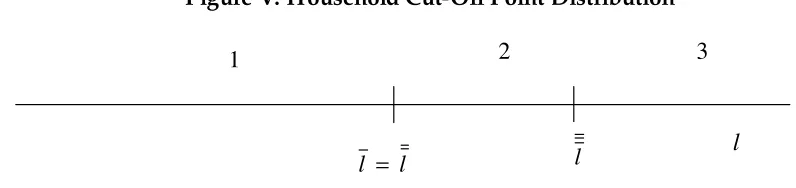
In this case there are two worker cut-off points. Both workers in households endowed
with low levels of human capital choose to work in the informal sector up to the first cut-off
point, while both workers in households endowed with high levels of human capital and
above the second cut-off point choose to work in the formal sector. Workers in households
with human capital levels between the two cut-off points choose to diversify sectors, with
one worker operating formally and the other informally.
The first cut-off point is determined by:
(
,
) (
,
)
fi f ii f
U
w l HI
=
U
w l HI
and, solving for our functional forms, we obtain:
(
1
)
f i
HI
l
w
q w
γ
−
=
− −
This cut-off point (
l
) that makes a household indifferent between having both workersin the informal sector and one worker in each sector is equal to (l), the cut-off point that
makes a household with only one worker in the labor market indifferent between working in
the formal and the informal sector. This is because the decision to operate formally or
informally is not influenced by the presence of an informal worker in the household.
The second cut-off point is obtained by equalizing the utility function when both
workers operate formally with the utility function when one worker operates formally and
the other operates informally:
, ,
ff f fi f
U w l HI=U w l HI