
Storytelling to Promote Participation in EFL Second Graders
248
0
0
Texto completo
(2) STORYTELLING TO PROMOTE PARTICIPATION IN EFL SECOND GRADERS. ELIANA PAOLA TORRES MONTAÑA JAZMÍN CAROLINA PABÓN ARIAS. A monograph work presented as a requirement for the degree of “Licenciatura en Educación Básica con énfasis en Inglés”. MG. ELIANA GARZON DUARTE TUTOR — TEACHER. UNIVERSIDAD DISTRITAL FRANCISCO JOSÉ DE CALDAS FACULTAD DE CIENCIAS Y EDUCACIÓN LICENCIATURA EN EDUCACIÓN BÁSICA CON ÉNFASIS EN INGLÉS BOGOTÁ D.C. 2015.
(3) 1.
(4) STORYTELLING TO PROMOTE PARTICIPATION IN EFL SECOND GRADERS. STORYTELLING TO PROMOTE PATICIPATION IN EFL SECOND GRADERS. NOTE OF ACCEPTANCE ____________________________________ ____________________________________ ____________________________________ ____________________________________. _____________________________________ JUROR. _____________________________________ TUTOR. Acuerdo 19 de 1998, Art. 167:.
(5) La Universidad Distrital Francisco José de Caldas no será responsable de las ideas expuestas por los graduandos en este trabajo. 2.
(6) STORYTELLING TO PROMOTE PARTICIPATION IN EFL SECOND GRADERS.
(7) As teachers we always aim to innovate our classes; it is like when architects design a building, they attempt to recreate the ideas of all the masters in it, and at the end they obtain a work of art, and so this is how we feel with our research project, even if it is not a break through in language pedagogy it helped us understand better our students and the kind of methods that could be used in the language classrooms of tomorrow.. This project is for all of those who believe in our ideas and convictions, thanks to everyone who helped throughout this project with a brick and some cement and in the hardest moments, always supported us..
(8) 3.
(9) STORYTELLING TO PROMOTE PARTICIPATION IN EFL SECOND GRADERS.
(10) Abstract. This study explores the effects of the application of storytelling activities on the learners’ participation in EFL classes with a population of second graders in a district public school. The question posed was: How is second graders participation when storytelling activities are implemented in the EFL class? To accomplish the objective of the study two major strategies were used: a qualitative approach in the data analysis and an action research for the type of research. Regarding the data collection, teachers’ journals entries, audio recording of classes, students’ documents were used, with a random selected population from the second grade group. It is found that active participation in the learning environment involves complex processes of classroom interaction, and student’s values’ perceptions. Furthermore, this kind of activities promotes an interaction where the dynamic teacher-students and student-student work together to obtain a common English language understanding.. Key words: Storytelling, Participation..
(11) 4.
(12) STORYTELLING TO PROMOTE PARTICIPATION IN EFL SECOND GRADERS.
(13) Table of contents ABSTRACT ………………………………………………………………………. 4. TABLES AND CHARTS. 7. ………………………………………………………. INTRODUCTION ………………………………………………………………. 8. Chapter 1 PROBLEM STATEMENT. …..……………………………………. 11. 1.1Research question. .………………………….…………….…….... 13. 1.2Research objective. ……………………………………………….. 13. 1.3Rationale ……………………………………………………………….. 13. Chapter 2 LITERATURE REVIEW. ………………………………………. 15. 2.1Storytelling. ………………………………………………………. 15. 2.2Participation. .……………………………………………………... 19. Chapter 3 RESEARCH DESIGN ………………………………………………. 24. 3.1Type of study. ………………………………………………………. 3.2Description of the context……………………………………… 3.2.1 Participants. 25 25. ………………………………………………. 25. 3.2.2 Setting ………………………………………………………. 26. 3.3Role of the researcher ………………………………………………. 26. 3.4Data collection techniques and instruments ………………………. 27. 3.5Validity and reliability ………………………………………………. 29. Chapter 4 INSTRUCTIONAL DESIGN ………………...……………………. 31. 4.1Visions in this instructional design ………………………………. 31. 4.1.1 Vision of curriculum: Constructivist curriculum perspective…………………. 4.1.2 Vision of language: Means of self-expression…………... 31 32.
(14) 5.
(15) STORYTELLING TO PROMOTE PARTICIPATION IN EFL SECOND GRADERS.
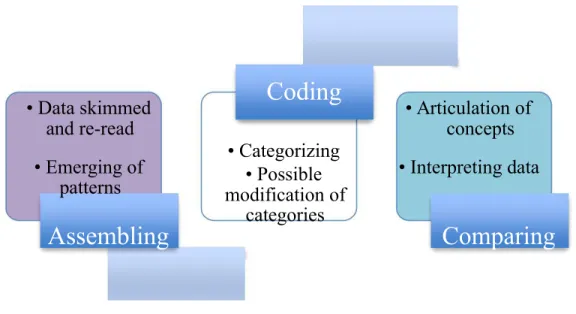
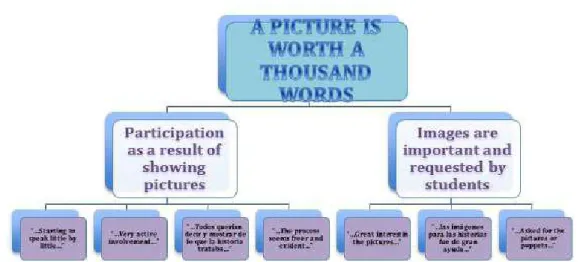
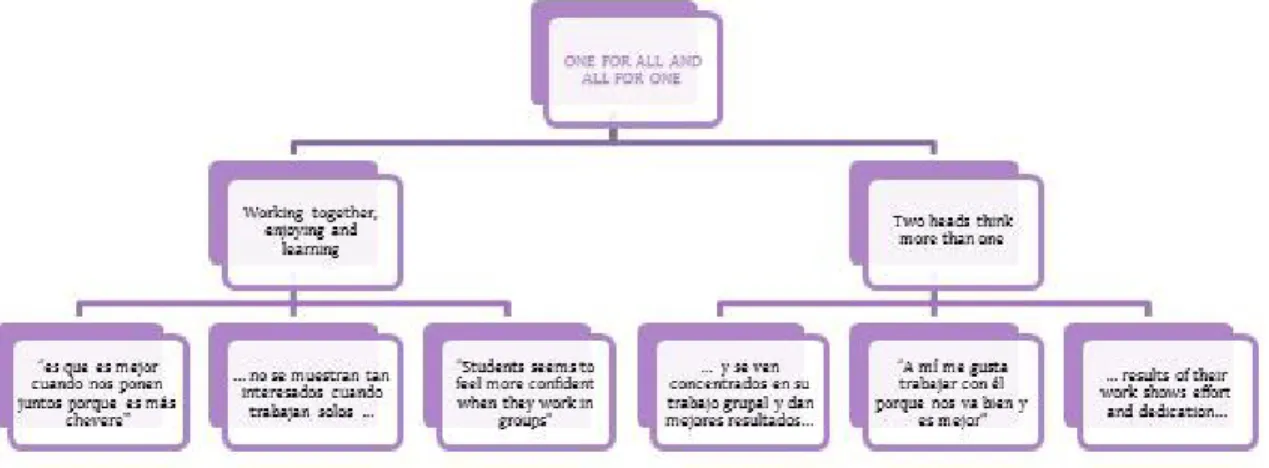
(16) 4.1.3 Vision of learning: Experiential learning………………. 32. 4.1.4 Vision of classroom: Classroom as a school of autonomy.. 33. 4.2 Pedagogical intervention……………………………………………... 33. 4.3 Description of the way the activities were developed…………….. 34. 4.4 Lesson plans and activities…………………………………………... 35. 4.5 Narrated lesson plans………………………………………………... 40. Chapter 5 DATA ANALYSIS……………………………………………………. 50. 5.1 “A picture is worth a thousand words”……………………………. 52. 5.1.1 “The use of pictures arises learners’ participation because they can have a glance of the story by inferring its meaning”…………………………………………………………... 55. 5.1.2 “With stories, I can make connections making it easier to get involved in the class”………………………………... 57. 5.2 “One for all and all for one”………………….….……………………. 59. 5.2.1 “Working together, enjoying and learning” ………………. 63. 5.2.2 “Two heads think more than one”...………………………... 66. Chapter 6 CONCLUSIONS AND PEDAGOGICAL IMPLICATIONS………. 69. RECOMMENDATIONS FOR FURTHER RESEARCH………………………. 72. REFERENCES……………………………………………………………………. 73. APPENDICES……………………………………………………………………. 76.
(17) 6.
(18) STORYTELLING TO PROMOTE PARTICIPATION IN EFL SECOND GRADERS.
(19) Tables and charts Table 3.1 Data Collection Techniques and Instruments Description…………………. 28. Table 4.1 TPRS Lessons Procedures………………………………………………….. 35. Table 4.2 Pedagogical Intervention Description.……………………………………... 36. Table 5.1 Grounded Theory Process………………………………………………….. 51. Table 5.2 Data Collection Instruments and Techniques………………………………. 52. Table 5.3 Emerging of Category #1: “An image is Worth a Thousand Words”………... 52. Table 5.4 Emerging of Category #2: “One for all and all for one”…………………….. 59.
(20) 7.
(21) STORYTELLING TO PROMOTE PARTICIPATION IN EFL SECOND GRADERS.
(22) Introduction. The old-fashioned one-way teaching where the learner just sits and the teacher talks, is hardly able to persuade and encourage young learners who are so curious and active; they need more interaction among them to get their interest in learning and keep it (Schank, R. C. & Jona, K., 1999:1-9). In this sense, we have found in storytelling a very good medium to enhance English language learning in the classroom since in storytelling, words are not memorized, but recreated through natural and active performance, supported by the listeners’ involvement. (Kao, S.; O'Neill, C., 1998:1).. Among a group of 25 second graders, five were selected as the participants of this study, taking into account their attendance and participation during the whole study. Artifacts, questionnaires and oral interventions of the students were observed and analyzed to approach the results of this research. Previous literature also indicates that learners might not work during class or express themselves when they do not see any relationship of the topic with their own lives (Hsu, L., 2008) so this study was carried out along with EFL young learners (second graders), focusing on using Storytelling in English as a teaching tool, not only to get the kids attention but also to encourage them to find ways to relate the fairy tales with their their context and life, so that they found them all meaningful and then be active participants of the same lessons and process of learning English as a foreign language; having the chance to also see what the children’s voices are, what their participation is in class and how they are involved in the lessons, not simply how many times they raise their hands. This study was developed at a Public School in Bogota with a group of 25 children of second graders between the ages 7 and 9 years. Most of them came from low-income families where most parents work all day and spend very little time with the kids. These learners involved did not take English classes before our intervention, shown here, since the school does not include English, as a subject in the curriculum, the only English teachers they have had.
(23) were us. Moreover, there are not any resources existing at the school for the use of the pupils or the teachers, connected with. 8.
(24) STORYTELLING TO PROMOTE PARTICIPATION IN EFL SECOND GRADERS.
(25) English. We, the teachers’ researchers supplied all the materials needed for every lesson such as posters, listening tapes, crafts, flash cards, photocopies, and so on. Different activities were done in order to get to know about students’ participation: how we could as their teachers, make them participate without forcing it out and to also get the content of it, what their participation was about and how was that represented in the students’ ELL. First, we inquired about learners’ likes and dislikes so that we could select the stories to be part of the lesson plans based on their interest. Based on that information gathered, we applied different activities such as telling the stories using props, having the kids acting the stories as they were being told, even having the kids tell the story using their own made up props and at their own way using their own words; which encouraged students to interact more in class with their peers and also to make contributions to the storytelling activities. Data collection was aimed at observing what the students’ participation was and how the different activities and tales worked and told were helping students feel more comfortable and confident and as a consequence, get more involved. Teachers’ journal entries, audio recording of classes and the students’ documents (which included what they did in class plus questionnaires and opinions) helped us getting the results and an understanding of participation in the EFL classroom along with the use of storytelling. The following chapters present the literature review, which shows our main constructs, all related with English as a foreign language and their impact in learning. Also, it is shown the role of the students in the process of language learning and how storytelling is linked with the teaching/learning process for young learners of a language, enhancing participation from the pupils as part of their role in the classroom. The next chapters, corresponding to Research Design and Instructional Design, present the methodology selected to carry out the lessons and the role of teachers and students according to it; as well as the instruments used to gather data, which further on is analyzed in the Data Analysis chapter. In these chapters our visions of language, learning and.
(26) classroom are shown and it is also included a deeper description of the activities that were done. 9.
(27) STORYTELLING TO PROMOTE PARTICIPATION IN EFL SECOND GRADERS.
(28) The fifth and sixth chapters, data analysis and conclusions and pedagogical implications, respectively, show the process of arranging and analyzing the data gathered, as well as the conclusions that were drawn after all the study. Right after this, we show some recommendations for further research, considering the importance of participation when learning a foreign language and the encouragement that storytelling has to help stimulate the students’ involvement in the class..
(29) 10.
(30) STORYTELLING TO PROMOTE PARTICIPATION IN EFL SECOND GRADERS.
(31) Chapter 1 Problem statement. During our pedagogical experience, we noticed there was not active participation of the students in the activities applied in the first English lessons. According to the homeroom teacher’s observations, when the classes were carried out, nobody (or a very low quantity of learners) participated actively in the classes and this was reported in the journals:. “…Students seemed to be paying attention while the teacher spoke or explained something but they did not participate or barely say anything…” (Translation from an excerpt from the Homeroom Teacher’s Journal (Translation from an excerpt from the Homeroom Teacher’s Journal #2 March 9th 2012).. Excerpt from the Homeroom Teacher’s Journal #2 March 9th 2012). (See appendix #2, annex 1). Our pupils, a group of 25 second graders from a school in downtown of Bogotá were the population in our pedagogical project. Through the think aloud technique used in each class, it was also evident that students did not participate:.
(32) “English Teacher: (speaking in Spanish and showing some animals flashcards one by one) Look at the image and tell me, what is this animal’s name? Students: 11.
(33) STORYTELLING TO PROMOTE PARTICIPATION IN EFL SECOND GRADERS.
(34) (silent) English Teacher: what sound does it make? Students: (silent) English Teacher: Is this a frog?” Students: (silent) English Teacher: (asking 1 student) Is this a frog? Student 2: (nods) English Teacher: (asking another student) Is this a chicken? Student 3: Mmmmm” (Translation from the think aloud report from the teacher-observer journal #2 March 9th / 2012). Here it was manifested during the whole class how learners did not participate actively, although they were silent most of the time during explanations from the teacher, they still did not answer questions or else, they were just not speaking or acting out. Regarding this previously quoted and explained situation, the homeroom teacher said in that day’s journal … “…they might not have been participating because they did not know the answers, or did not feel confident to speak, however in some other activities developed in Spanish, they did not do any intervention either …” (Homeroom Teacher’s Journal #2 March 9th / 2012). That motivated us to look for activities that might have encouraged students to be more active participants than just passive, like they were being. Wondering about that issue of passive participation, we decided to design our first questionnaire in which we asked pupils what kind of activities they liked doing and what activities they would like to do in English class. Moreover, the homeroom teacher answered a one-question questionnaire (See Appendix # 1 Questionnaire #2) inquiring what type of activities kids seemed to enjoy during other academic spaces with her. A common pattern raised from all those questionnaires was the interest of the kids in stories and tales; that made us find storytelling a very pertinent tool to use in the foreign language classes. “Children have a constant need for stories and they will always be willing to listen….
(35) The experience of the story encourages responses through speaking and body language performance.” (Wright, A., 1996:6&7) 12.
(36) STORYTELLING TO PROMOTE PARTICIPATION IN EFL SECOND GRADERS.
(37) 1.1 Research question How is second graders participation when storytelling activities are implemented in the EFL class? 1.2 Research Objective To observe and describe how students participation is during the EFL classes when storytelling activities are carried out. To conclude this section, it is important to recall that this study is focused on an exploration and analysis of students´ participation, what the process was and what we can do as teachers, to help learners be active participants in class without being forced to do it but because they have found in the activities and topics something meaningful and interesting. The most important is to hear students’ voices while working on strategies for storytelling that might make them feel more comfortable and find meaning in the topics, so that they get involved being active participants in the classes, in this specific case, English as a Foreign Language. 1.3 Rationale Through the experience teaching to second graders from a public school in Bogota, which had never had English lessons before carrying out this research, it was evident that learners were not participating during the English lessons in an active way; they barely nodded or said they understood or did not, or sometimes they did not even say anything. Therefore one of the main interests of our project became to focus our attention on using storytelling as a great tool to get the kids attention, but not just telling to tell, but engaging them in different activities planned out for the kids to probably find a reason why participating and not just to get a grade or say they participated these many times, but to contribute somehow or evidence the topics were meaningful and attractive for them, apart from benefiting the target language Learning..
(38) This research makes important contributions presenting to teachers of English as a foreign language, mainly of young children, that it is needed to provide a learning environment that allows students meaningfully to comprehend the target language. Simultaneously teacher should give 13.
(39) STORYTELLING TO PROMOTE PARTICIPATION IN EFL SECOND GRADERS.
(40) ways to the learners to face the difficulties they might have getting the messages communicated in English to also raise their participation. The implications of this study were addressed to storytelling as a means for young learners of English as a foreign language to enhance their participation in the activities proposed for the sessions. Taking into account the method proposed by Asher, J. (1972:133) who holds the stance that students learn a foreign language in the same way they learn their first language; it was needed to follow the students learning process while instruments were used, for detecting the effects those had brought to them in terms of language learning and involvement in class. Furthermore, this study goes into the difficulties that were found during the process teaching and learning the target language, through storytelling in the sessions and the likely solutions that were proposed and implemented after each session. Besides this, it is also important to mention that another purpose of this research was, also, to reflect on the sessions of storytelling as a teacher and researcher, and present the perceptions and personal-professional insights of all of it in this study.. As a conclusion to this chapter, it is key to recall that this study is focused on promoting the use of storytelling as a teaching tool, to stimulate pupils’ active participation particularly; going through definitions, theories and different activities found, read, transformed and carried out, showing from the beginning the whole process all the way to the outcomes got from it..
(41) 14.
(42) STORYTELLING TO PROMOTE PARTICIPATION IN EFL SECOND GRADERS.
(43) Chapter 2 Literature review This chapter, the literature review, presents the constructs of this study: Storytelling and participation, which are the main concepts to work on this research project. Also personal understanding and interpretation of these concepts, as an important part of the theorization of the constructs; then all interrelated with EFL and its impact on learning. Prior to going through the construction of concepts, it is important to define EFL and how this notion can be related to participation in the process of learning. At first, this concept is defined as the use or study of English language, having a different native tongue, for instance Spanish, in this situation. 2.1 Storytelling As the starter of time, storytelling has been used as a communicative vehicle for entertainment, transmit cultural identity, to develop critical thinking, and also for education. Storytelling is defined by Dudley, B (1996:98) as the art in which a teller conveys a message, truths, information, knowledge, or wisdom to an audience - often subliminally - in an entertaining way, using whatever skills, (musical, artistic, creative) or props he chooses to enhance the audience's enjoyment, retention and understanding of the message conveyed. Stories are sometimes told purely for joy and delight, being this a useful tool to help students to create their own concepts and ideas from the stories told; feeding their social development by means of classroom interaction. The exposure of a population to the influence of a catchy way of communication brings philosophical, cultural, intellectual and behavioral consequences, which can represents the adaptation and assimilation to a human being’s life, building stronger mental structures and having a great effect in their human behavior. As it is mentioned by Heather (2009) in his article “Storyworlds in the Classroom”, stories help children to share conversations, remember experiences, and grow into a collegial community of learners. (Heather.
(44) Forest, 2009: 247).. A great social contribution is made by the application of storytelling as a tool. for ELT, taking into 15.
(45) STORYTELLING TO PROMOTE PARTICIPATION IN EFL SECOND GRADERS. (Fisher, W. R., 1985:35)..
(46) account that English as a language, deals directly with communication and at the same time through the communication share ideas, feelings, emotions and opinions. The opportunity that storytelling gives to the students of interacting and expressing themselves is a meaningful way to promote the students’ active participation. Stories can become in the blocks of knowledge that we as teachers aim to build in students. It is important to highlight the benefits that the application of storytelling activities brings to the memory and learning. Stories help students to grasp abstract concepts and to make connections between the stories and their lives or curricular subjects (Heather Forest, 2009:248). Through this tool it is possible to establish strong connections between our subjective human reality and our time line, being possible to anticipate the possible consequences of our actions; which at the same time teaches something relevant to apply in a further similar situations. A theme can be expounded through the use of visual aids or general discussion, but a story has added power in that it does not only generates interest but it is also structured. “People have a need of symbols to help them. understand and represent their understanding of the world.” Storytelling has always been a powerful way of teaching and continues to be a compelling way to build and communicate theory. Storytelling paints a picture that captures the listener’s attention and imagination (Fawcett, 2011). Children's eyes are on the teller, but oddly unfocussed. They seem unaware of themselves or even their company. There is a phenomenon often described as the "magic of storytelling" or its "enchantment." This is when the listeners of the stories after having been noisy and not quite paying much attention, fall into stilled postures. Such unified, sustained interest contrasts with children's usual activity and participation in the classroom. They are usually noisier and less interested in what the teacher is saying. Storytelling has the power to transform a noisy room of disparate children into silent, absorbed unity. Thus, storytelling is a way to draw in the entire group and engage everyone's "attention". Of course teachers' use of storytelling is not done merely "to get attention". Most of my readers.
(47) know the rich affects and benefits of storytelling to the curriculum are many and diverse. Storytelling 16.
(48) STORYTELLING TO PROMOTE PARTICIPATION IN EFL SECOND GRADERS.
(49) stimulates children's motivation levels, expands or engages interest in a subject, sparks discussion, inspires reading, and so on (Barton, 1986, and 1990; Rosen, 1988; Rubright, 1996). Story worlds intrinsically offer learning, play, and pleasure. Listening to stories also provides students an engaging opportunity in which to exercise and nourish the ability for sustained attention (Heather Forest, 2009: 139). The students’ interpretation, plays a remarkable role if we consider the imagery that children possess and the importance that it has on their personal development. Thinking with stories help students grasp abstract concepts and make connections between the stories and their lives or curricular subjects (Heather Forest, 2009: 248). Children have a great imagination and if this ability is supported by an interesting story, it can grow, provoking joy as well as allow the students to establish connections between stories’ characters’ situations and feelings with their own lives. Long before stories were folded quietly between the covers of books, oral storytelling transported listeners into ephemeral story worlds filled with action, adventure, vivid characters, and inspired settings (Heather Forest, 2009:46). It is known that children are focused on a no-conscious way on building their own personal identity, that is way, to influence them through the use of a catchy element as storytelling is, can be easy to let them create their own point of view towards a situation. Working with stories is a great opportunity to promote social values such as respect, tolerance and fellowship. Using stories learners are exposed to the target language used in context, which gets meaning from the props, voice and different resources used to build a realistic environment in the story. This let us articulate the language with the semiotic component that telling a story for kids brings to their understanding, help them to put up meaning from the stories and the way in which those are told, as Barton, K.(2005:119) argues “By listening to stories children are introduced on a number of words in context. Very often repeated use of words.
(50) in the same context, or in varying contexts, helps them to infer the meanings of words and gradually assimilate them into their growing lexicon”.. 17.
(51) STORYTELLING TO PROMOTE PARTICIPATION IN EFL SECOND GRADERS.
(52) Through stories, learners have an experience with the real language of personal communication, not the usual teaching of the foreign language classroom. Colloquial or literary range of language is presented in stories (Ebong, B., 2004:21). Oral stories develop listening skills in a unique way. The pupils benefit from observing listening familiar vocabulary that becomes more understandable for them. While listening to stories, children foster a sense of structure that will later help them comprehend more dense messages. In storytelling there is no pressure on individually to produce language until they are ready to do so and join in with the narration of their own accord. It is widely observed, however, that children seem very ready to join in at an early stage, and the consequent choral contribution to a well-told tale becomes both a satisfying way for the class to participate. In this way, words, phrases and sentences that are included in the story are produced, maybe mechanically at first, but then, those with repeated association as the story is heard over and over again; these words are included in the creative production of language. In most of the cases, the lack of foreign language comprehension lowers the student’s participation in the English classes, making the students feel uncomfortable with the things they maybe think but they are not able to say in public. Through the application of storytelling activities, students have the possibility of raising their understanding through the visual aids used during the tales, provoking an evident increasing on their selfconfidence, which help them to create a positive environment of classroom interaction and gain confidence, shown in their active participation in the lessons. Heather Forest concludes that storytelling is an essential art for teachers. “In short, the teacher must be a storyteller”. (Heather Forest, 2009:186) .. Following Forest’s consideration,. storytelling has been adopted along this research as a tool to feed teachers’ roll in the class, with the contribution that a teller can make to an audience of children who are facing the challenge of being active participants during their English Learning Process..
(53) 18.
(54) STORYTELLING TO PROMOTE PARTICIPATION IN EFL SECOND GRADERS.
(55) 2.2 Participation Different theories have attempted to define and explain the construct of participation from diverse points of view. Some approximations share various principles, but others differ partly or wholly in their postulates. The concern of students’ participation has been considered as one of the most important aspects to explore by teachers in general and in this case, English teachers specifically; it must constitute a very meaningful part of the target language lessons, considering that learning a foreign language requires social interaction that emerges from the students’ involvement in the class. For achieving that social interaction it is necessary to design activities that promote it, as Charlesworth (2010:419) suggests, “Social experiences should be intentionally planed and organized”. The term of participation brings to our mind, in most of the cases, the interchange of ideas through asking and answering questions while the classes are carried out as Cornelious (2008:1) argues in her book “Students Participation in Classroom Discourse” (Chapter I); however it is important to know what participation is and how it is evidenced in an English class. Bearing in mind that the idea of participation cannot be measured just based on this interchange of ideas, we can think about other ways in which students are being involved in a lesson; taking into account the passive participation style that many students have towards the classes. On the other hand, voluntary participation is revealed in the lessons, when the teacher does not need to provoke students’ contributions, but they just decide to rise their voice and make part of the lesson;. “when teachers wait for three seconds or more, especially after a student response, there are pronounced changes in students language use and logic as well as in students and teachers’ attitudes and expectations” (Courtney, 2001:94). Students voluntary contribution in the lessons is the way in which we are interested on. Being aware that children have their own learning style and they must be motivated to participate, instead of being pushed to do it; we found in storytelling an ideal way to achieve it,.
(56) as we can notice in a similar research developed by Edder, D. and Hoylan, R. (2010:123) who mention “the storytellers also found the children were eager to participate in storytelling” what makes us confirm the 19.
(57) STORYTELLING TO PROMOTE PARTICIPATION IN EFL SECOND GRADERS.
(58) effectiveness of this tool for engaging students’ participation. For getting a freer students’ participation in the class it is necessary to consider the role of the teacher in the class, knowing that it can affect the learners’ performance as it is held in “Gender and University Teacher a Negotiated Difference” (Statham. A., Richardsom. L., and Lauren, C., 1991:66). “…to the extent that students are engaged to make original contributions and particularly are encouraged or allowed to be assertive, they act as equal partners on the pursuit of substantive knowledge reducing the focus on the professor as the sole authority”. In order to promote students active participation, the teacher is no longer being the main actor in the class, but the door for them to enter in world waiting for them, to allow them to take advantage of their imagination, to enjoy while learning and to strength their social relationships being the owners of their own opinions, decisions and behaviors. The teacher’s role could be described as a sensitive coach or an expert partner, who supports engagement in classroom activities (Tharp & Gallimore, 1988).. As it was mentioned above participation can be seen from different points of view and the one we want to explore is the active participation, characterized by students’ responses as speaking and signaling. Additionally, it occurs during teachers’ presentations rather that after or instead of presentations (Kay. M, Price. K, Nelson. L., 2010:14) planning effective instruction diversity responsive methods and managing. The use of storytelling in our research looks for the students’ motivation to participate during the lessons, not just answering possible questions asked by us, but encouraging them to find in the stories a reflexive issue to face in their own lives and a free interpretation and application of the things learnt in the course of these. One of the most important reasons to state the importance of active participation in a second grade English course, is the fact of working with a population that due to their ages are exposed to the influence that their context can offer to them in order to create their own personality and.
(59) at the same time to develop a criteria towards the world around them. Learning practices aim at providing learners with spaces and tools to participate in collective meaning-making as legitimized and authorized individuals (Nathan & Knuth, 2003; Wells, 1999; Wenger, 1998). The activities 20.
(60) STORYTELLING TO PROMOTE PARTICIPATION IN EFL SECOND GRADERS.
(61) developed in classes should allow to the students to show up themselves in terms of ideas, feelings, conceptions and perceptions in a determined situation. Thus, the participation opportunities and possibilities can be regarded as serving both the collective and the individual needs (Lima, 1995).. To be aware or the concept that a classroom has when active participation needs to be increased, is one of the most relevant stages for developing a research about it; due to the ordinary conception of classroom, it is normal to observe limited students’ participation in the class. The old fashioned concept of classroom did not go beyond of the physical place to give a class and to meet peers in an academic environment, to receive teacher’s instructions and to develop the assigned tasks. When the aim is to promote participation, the ordinary classroom concept needs to be though as a place where social, philosophical, and cultural interchange take place. This is the notch of social interaction and personal identity development. Classroom as a cultural site of meaning in which norms, values, rules, roles and relationships are socially constructed into being the local interactions of the community (Bowers, Cobb, & McClain, 1999; Castanheira, Crawford, Dixon, & Green, 2001; Cole, 1996). As well as the classroom concept is reestablished in participation, the teachers’ role has a remarkable transformation, the teacher-centered pedagogy needs to be transformed. Now the teacher is not the one who imposes knowledge, give the rules and possess the true, but he is who mediates and facilitates the students interactions to provoke active participation among the them, while there are building their own concepts, learning and teaching in an indirect way. The teacher’s role could be described as a sensitive coach or an expert partner, who supports engagement in classroom activities (Tharp & Gallimore, 1988). The adaptation that classroom, students and teacher need to have in order to achieve an active participatory environment, can be affected by the old concept that all of them have towards their roles in previous academic experiences; however, teachers need to learn how to keep the equilibrium between the students’ social development though the interaction and the.
(62) formal knowledge that they might acquire. Both teachers and students face various challenges in talking into being their new roles in the learning community. Moreover, teachers often face difficulties in 21.
(63) STORYTELLING TO PROMOTE PARTICIPATION IN EFL SECOND GRADERS.
(64) trying to obtain a proper balance between the provision of social and analytic scaffolding in the classroom community (Nathan & Knuth, 2003; Rasku-Puttonen et al., 2003; Williams & Baxter, 1996). There is a risk that raises from the changes proposed for this kind of teaching- learning dynamic based on interaction, it is the possibility of losing the clue for achieving the main objective which is the active participation promotion. For this reason, to keep in mind the teachers’ role is such important as students as active participants is. The students’ activities and learning opportunities have to be design focused on students’ voluntary participation. Those needs to be as interesting, and catchy that participation does not need to be ask but that it flows among the class, making the students raise their voices. There is also a danger that students participate in collective classrooms interactions in a routine manner in order to please the teacher’s expectations of their active role in meaning making. In these situations, communal classroom practices and discussions may become ritual rather than productive in nature (Williams & Baxter, 1996). In this process, individuals may also display actions that indicate their membership with other social groups they are part of (Bloome & Egan-Robertson, 1993; Wertsch, 1991).. The development of the individual’s repertoire of participatory skills in classroom interactions is, consequently, dependent of the kinds of opportunities she or he has access to and which opportunities he or she takes up during the joint activities of the classroom (Alton-Lee & Nuthall, 1992, 1993; Castanheira et al.,2001; Floriani, 1993; Heras, 1993). When an individual starts being active part of a community, he or she brings changes to it, as well as the community causes effects on the individual’s personal, social and cultural development; without forgetting the contributions that classmates’ participation can feed the individual’s development in many directions. The participatory practices of the classroom and the roles individual take during the practices develop and change at the same time as the community itself develops. (Kovalainen M.& Kumpulainen, 2007: 143).
(65) The appearance of active participation, in an English class specially, makes the teaching process easier to the students because it also gives us as teachers, a huge opportunity for interaction, which 22.
(66) STORYTELLING TO PROMOTE PARTICIPATION IN EFL SECOND GRADERS.
(67) facilitates the appliance of the foreign language use into the lesson, without forgetting the chance this gives to the learners of growing socially..
(68) 23.
(69) STORYTELLING TO PROMOTE PARTICIPATION IN EFL SECOND GRADERS.
(70) Chapter 3 Research design. This chapter presents the methodology we followed in this research, giving an account of how that type of study fits our purpose. We also report a description of the profile of the participants as well as the setting in which the intervention took place. Then we explain what the role of the researcher was and at the same time, this research design expounds the instrumentation used to collect data and its techniques and procedures. Finally, we explain and defend the validity and reliability of the data gathered. At first, it is important to recall the research objective of this project, in order to recontextualize the reader with the main intention of the work. This is to observe and describe how students’ participation is during the EFL classes when storytelling activities are carried out. This objective spouses the research question: How is second graders participation when storytelling activities are implemented in the EFL class? The study was done from March 2010 to June 2011, designing fourteen lesson plans. The lessons were planned under the scope of Total Physical Response by Storytelling (TPRS) approach. Furthermore, we worked with a qualitative study, considering the instruments used: teachers’ journals (homeroom’s and teacher-researchers’) students’ documents (artifacts and questionnaires) and audio recordings of every class (transcripts). It was relevant to use a variety of data collection techniques, which permitted us to find different ways to implement storytelling to second graders towards contributing not only to the target language learning but also to generate active participation in the children by interacting with their peers and to build opinions making their participation, an “evidence” to meaningfulness found in the topics from learners, not just a measuring of the quantity of times they participated in class. Another important fact to highlight is the type of design. As we were the guidance in the classroom, and we also had an effect on the population and the selected study subjects, as well as a self-reflection of teacher´s role in the classroom, we positioned our project under the light.
(71) of Action Research. In our research, we worked with 5 children from the group (the ones we got their 24.
(72) STORYTELLING TO PROMOTE PARTICIPATION IN EFL SECOND GRADERS.
(73) parents’ consent forms signed from and who attended every session of the intervention), which facilitated the data collection and analysis in further works. (See appendix #1, annex 5) 3.1 Type of Study Action Research, as it is known, focuses on generating improvements in the school, in teachers and their methodologies and the resources used in the education process. It also involves a deep evaluation to the teachers´ practice, and to the situations involving children's development, behavior, social interactions, as a cause of learning difficulties. In our case Action Research was used as a means to assess our own practice and at the same time to help students in their own performance in class by showing it through their participation. The action research process facilitated the intervention made by us since it works with a “possibility theory rather than a predictive theory”. (Wadsworth, Y., 1998:1). statement which we. relate to our project when storytelling is used to foster participation in EFL second graders aiming to cause an effect of growing of children’s participation in English classes, through the application of storytelling activities without forcing it but as a possible outcome after our intermediation. In this way action research gave us a guide to conduct our pedagogical intervention bearing in mind that action research links the conditions and effects of various forms of classroom interaction.. 3.2 Description of the Context 3.2.1 Participants The participants in the pedagogical intervention were second graders (202), in the morning. The group was composed by 25 children, 16 girls and 9 boys, between the ages 7 and 9 years and most of the students come from lower middle socio economic status from 1 to 2. These students had never received English classes before our intervention was carried out at their school, since English is not part of the school’s curriculum..
(74) In this pedagogical experience students had English, as a foreign language lessons only one hour per week, making it be not much time to develop the lessons or gather data, which is an issue to address for possible further research: to have another cycle in the action research process with 25.
(75) STORYTELLING TO PROMOTE PARTICIPATION IN EFL SECOND GRADERS.
(76) these children to see how the process with them could continue and maybe have more time with them. The criteria to select the specific population for the research, was first, to take into most important account the data gathered from the kids whose parents signed the consent form presented at the beginning of the project and also, narrow the numbers down to those students who attended every session of English. These two conditions gave us five students from whom we would, afterwards, gather the data from and analyze it in order to reach conclusions and answers to the problem found at the start of the study. 3.2.2 Setting The present research study was carried out in a public primary school located downtown Bogotá, Colombia; it is located on the San Martin neighborhood in the Santa Fe locality. Both mission and vision of the school are focused on the compromise to the formation of citizens with a social responsibility to transformation through art from a holistic and cultural perspective. This research was carried out during two semesters, the first and second of 2011. The building structure of the school is not the most appropriate for an educational institution, taking into account it used to be a big old house that was modified to work as a primary school; therefore in some classrooms the students’ desks organization is not the best for teaching, and the classrooms also have echo.. The mission and the vision of the school engage the institution as being compromised to the education of citizens with high social, artistic and intercultural transcendence from a holistic perspective; having the goal to the year of 2016, of being a well-known school for its formation of responsible people, compromised to social transformation. 3.3 Role of the Researcher We both the teachers in charge of the second-grade English class at the designated school to carry out the pedagogical project, a subject to fulfill as part of the curriculum in our studies at the Universidad Distrital Francisco José de Caldas, were both teachers and observers of the whole process. At the very beginning our role was to get to know the.
(77) pupils and to identify the problem that was going to enlighten the research question for this project. Afterwards, as part of the ethics 26.
(78) STORYTELLING TO PROMOTE PARTICIPATION IN EFL SECOND GRADERS.
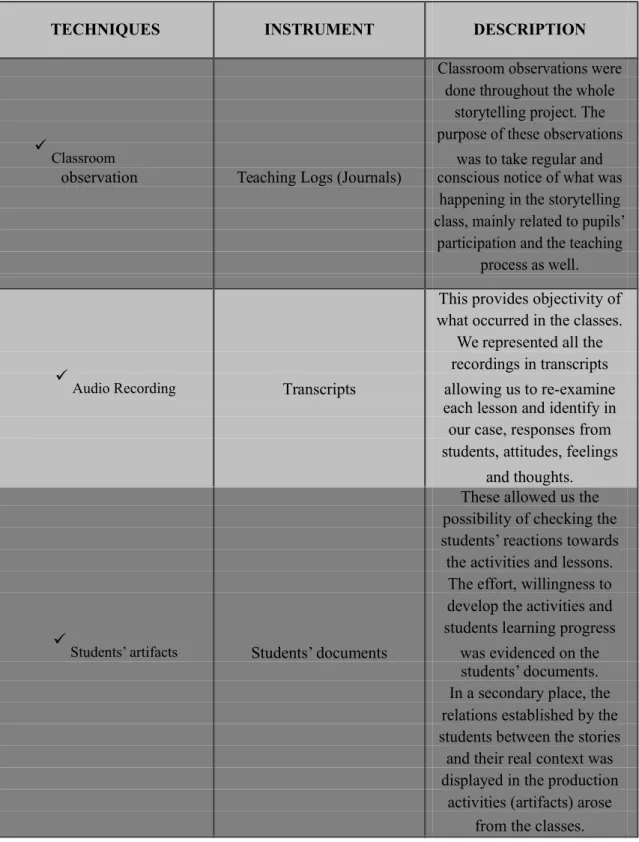
(79) involved, we wrote a consent form in order to explain the parents of the participants what it was going to be done and then ask for their permission to collect data and analyze it to come up with some answers to the question sated and see if the purpose of the research was also gotten after the intervention, with the compromise to also inform them all about those results. During the whole length of the experience with the assigned group of second-graders, it was a key to have a positive and motivating attitude towards the kids, so that we generated confidence and a nice environment for them to feel free and secure to be active participants of the classes. Finally, it was important the constant check of the teaching practice for trying to improve it every session that followed, and also, at the end to make a contribution to other teacher researchers that after the publication of the manuscript (or articles and reports issued from this paper) might be interested in our project and methods used to apply in their own studies to contribute to the EFL field. 3.4 Data Collection Techniques and Instruments Multiple data collection instruments and techniques were used as evidence in this study with the purpose of supporting the conclusions reached to provide an answer to the research question set at the beginning of the pedagogical experience. These consist of Classroom Observations entered in Teachers’ Journals (homeroom teacher and teacher-researchers), Audio Recordings that were transcribed by us, the researchers and Students’ Documents (which include their artifacts and questionnaires they answered) (Burns, A., & Hood, S., 1995:8). In the following chart, we give an account of the techniques and instruments used in along the study to collect data for further analysis, mentioning and relating them, then explaining very briefly what they were and how they were useful in this project..
(80) 27.
(81) STORYTELLING TO PROMOTE PARTICIPATION IN EFL SECOND GRADERS.
(82) Table 3.1 Data Collection Techniques and Instruments Description. TECHNIQUES. . INSTRUMENT. DESCRIPTION Classroom observations were done throughout the whole storytelling project. The purpose of these observations. Classroom. observation. . . Teaching Logs (Journals). was to take regular and conscious notice of what was happening in the storytelling class, mainly related to pupils’ participation and the teaching process as well. This provides objectivity of what occurred in the classes. We represented all the recordings in transcripts. Audio Recording. Transcripts. allowing us to re-examine each lesson and identify in our case, responses from students, attitudes, feelings and thoughts. These allowed us the possibility of checking the students’ reactions towards the activities and lessons. The effort, willingness to develop the activities and students learning progress. Students’ artifacts. Students’ documents. was evidenced on the students’ documents. In a secondary place, the relations established by the students between the stories and their real context was displayed in the production activities (artifacts) arose from the classes.. The chart above shows the data collection techniques used to gather the information managed during this research..
(83) 28.
(84) STORYTELLING TO PROMOTE PARTICIPATION IN EFL SECOND GRADERS.
(85) 3.5 Validity and Reliability Validity As it is known validity constitutes a very important part in the action research process, approximating the data to the truth as much as it can be possible. Managing, studying and analyzing the ways that we took to get close to real results, comparing and contrasting all the gather from the data collection were, as part of the grounded theory, used to work on this stage of our research, for establishing “true” patterns that helped us determine the validity of the instruments, which as previously mentioned were multiple data collection instruments and techniques to, again, enhance the validity of this research. Reliability Reliability as fundamental part of the data collection must be reviewed carefully, considering that it has to guarantee the effectiveness of the instruments used to measure the results and possible changes in a research. Thinking of this, we decided to compare different researches similar to ours, in order to find common or at least equivalent results to the ones put out in those; having many coincidences between our research work and the ones we were comparing. However it is important to remember that the population has a huge effect on the results of a research project and it makes the differences between two similar investigations, even when those keep general commonalities. At the beginning of the study, since it was necessary to taste the instruments we were going to use, there was a pilotage developed by us through a questionnaire applied to another group of students from the same school, grade and age, but from a different classroom, in order to know how students answer a questionnaire like this, to make sure about the proper design of it and to get closer to the students preferences regarding on class activities (see appendix #1, questionnaire#1).. A detailed observation was made by one of the students’ teachers in order to report every single students’ intervention. The head teacher’s observation was also reported in a document, to cooperate with ours, without forgetting that she was the one who already.
(86) knew the population and who could identify easer any behavior or reaction from the students towards the class.. 29.
(87) STORYTELLING TO PROMOTE PARTICIPATION IN EFL SECOND GRADERS.
(88) After the questioner application, we could notice that “yes, no” questions establish limits to the students’ answers and did not allow them to give their personal opinion, perceptions and expectations of the class or activities (see appendix #1 Questionnaire 1); on the other hand we observed that most of them liked to develop artistic activities such as singing, painting acting and dancing. The handwriting observation that we tried to do was a good intention, however the limited time to write down every single situation along the class, as well as students’ interventions and teachers’ interruptions, was not a simple task, for that reason we decided to tape the classes so it facilitated the observations and to examine every single situation presented on the class. The handwriting observations were not omitted but were supported by videos to go back to the lessons as many times as it was necessary. The head teacher’s observation helped us to recognize common patterns identified by us and the teacher, as well as allowed us to get a better knowledge of new or no-common behaviors presented by the students in the English class. To conclude this chapter it is needed to mention that the instruments were applied after a piloting process where we first observed if those instruments worked and gave us the insights to analyze the data. The data collected ended up being very useful in order to compare and contrast answers during the data analysis stage mostly. Moreover it is essential to recognize the importance of classroom management and the methodology that was carried out because it had a relationship with the purpose of the study: the students’ participation..
(89) 30.
(90) STORYTELLING TO PROMOTE PARTICIPATION IN EFL SECOND GRADERS.
(91) Chapter 4 Instructional design This chapter focuses on the pedagogical intervention we did during our pre-service teaching experience (pedagogical project). First, we will recall the statement of the problem that spouses all this work, and the research question that emerged from the problem we identified. Then, this instructional design displays the visions of curriculum, language, learning and classroom based on theories and authors supporting this instructional design. Afterwards, an account of the pedagogical intervention is given, which offers an overview of the activities, objectives, outcomes and resources of each session. As a final part of this chapter, it will be shown a table with the summary of the intervention and descriptions of the classes too. The question set to research in this study and answer was: What is second graders participation when storytelling activities are implemented in the EFL class? Recalling the research objective that this project espouses, it was to observe and describe how students’ participation is during the EFL classes when storytelling activities are carried out. 4.1 Visions in this Instructional Design 4.1.1 Vision of Curriculum: Constructivist Curriculum Perspective. According to the constructivism theory, learners construct their own understanding and knowledge through experiencing things. When we encounter something new, we reconcile it with previous ideas and experiences, activating us to be creators of our own knowledge (Rice, M. & Wilson, E.,1999:28). The constructivist view of curriculum in this research, outlooks the student as the person who creates new understanding while the teacher is only guiding knowledge but allowing the students to experiment. Through the retelling, role-plays and creating stories activities, students had the opportunity or internalize knowledge by applying it in a more realistic way. Pupils had a.
(92) chance of making relations between what they hear from the stories and their real lives as well as using what they were learning while they were doing the activities based on storytelling. “Learning by doing” 31.
(93) STORYTELLING TO PROMOTE PARTICIPATION IN EFL SECOND GRADERS.
(94) describes the process by which we come into knowledge of ourselves, of the world, and of our special talents as they relate to our potential contributions to society (Barson, 1998). The experiential learning proposes to the students to make connections between what they learn and what they normally do, it is with the intention of getting a better understanding of the learning purpose and the application of that learning in the real life. Dewey made it clear that learners must make connections between experiences in the classroom and knowledge they already possessed. In terms of language learning, we now call this process linking (Dewey, J.,1938).. 4.1.2. Vision of Language: Means of Self-Expression.. Tudor, I. (2001:65) points out that language is the one we use to help other people, and most important ourselves, to understand who and what we perceive. This concept is the most connected with the concept of language we planned to construct in this proposal. Our intention was not focused on classes that espoused a grammatical function of language, we wanted to go further than that; it was and continued being to give second graders the language tools in order to motivate them express their thoughts The importance of applying TPRS in our lessons, rises from the possibility that the students have, of relating what they do physically with the content of the activities. Every time that we ask to the students to perform a character of the story, they involved themselves in what they were doing; in this sense they were not just learning from what they heard or saw in the board, but from what they did to express and communicate an idea. The students’ personal contribution was made in each one of the activities, what make them meaningful for them, due to the necessity and desire they had to transmit an idea with the exercise.. 4.1.3. Vision of Learning: Experiential Learning.. The idea behind the experiential learning vision of learning is to learn by doing (Tudor, I., 2001:78).For learning to take place here, kids must be guided towards focusing on meaning rather than on grammatical form. It becomes our work as teachers to design activities to provide learners’ participation, in order to get the learner’s attention and.
(95) participation on the learning activities that we combined with non-verbal aspects of communication such as mime, gestures, visuals aids and actions. 32.
(96) STORYTELLING TO PROMOTE PARTICIPATION IN EFL SECOND GRADERS.
(97) 4.1.4. Vision of Classroom: Classroom as a School of Autonomy.. We agree in this vision of classroom because for us, classroom in not just an environment where the teaching and learning practice takes place that can bring a variety of knowledge, experience and insights which can allow the students to have an active role in their target language learning (Tudor, I., 2001:117). Besides, the active engagement and participation of the kids may enrich the learning process itself, helping learners to develop independent learning skills too.. 4.2 Pedagogical Intervention. As previously mentioned, the main goal for this pedagogical intervention was focused on observing and describing how students’ participation was during the EFL classes when storytelling activities were carried out. Our labor as foreign language teachers was to teach the basic knowledge of the target language for the participants; and also, to try to reinforce understanding of the target language so the student will be able to use the knowledge in a real context in a near or farther future. A strategy for teaching that we found useful for our population and goal was Total Physical Response by Storytelling (TPRS) (Warren, K., 2006:12). We recall here that our population subjects to this study, never had English classes before our intervention and that everything that was implemented and worked on was new to them, adding to that, that the methodology carried out was always not like the traditional one they were used to, where the teacher is the one who plays the active role and the students, the passive and listeners role. TPRS is a stress free teaching style that creates a learning environment similar to that one of a child’s environment. TPRS is a method taught by foreign language teachers to help students gain conversation skills and understanding of the target language (Asher, J., 1972:133). Conversation is a communication skill more commonly used in everyday life and is something learned at an early age to help people express themselves..
(98) 33.
(99) STORYTELLING TO PROMOTE PARTICIPATION IN EFL SECOND GRADERS.
(100) 4.3 Description of the Way the Activities Were Developed. In the storytelling class, in the warm up, teachers presented the keywords using pictures in order to help students understand the stories more easily. At the same time, students were also invited to make some guesses about the pictures, which may help arouse their curiosity and motivation towards stories. In the presentation part, teachers give students guided vocabulary related to the stories, the teachers reinforce vocabulary pronunciation, given to the students their role part in the story and then, teacher told stories in a slow pace with rich intonation, facial expression, body language, and a variety of prompts like pictures, drawings, or puppets. During the process of storytelling students are involved as participants of the stories. In the production part, students give their opinions about stories and respond questions in order to check their listening comprehension. In every session, the last part of the lesson was always somehow different. We, the teacher researchers added a part in which the children could express in their own ways and using their own means and/or words, the stories told during the lessons and as result of that, they could participate at a different level apart from just acting out the tales. With that we, the teachers, could also see evidenced what their understanding of the stories was and how they were interpreting them as well as, what words, phrases or even sentences the students grasped for them to use at the moment of them telling the story. Briefly, in the following chart we show the process carried out during the TPRS lessons just like explained above..
(101) 34.
(102) STORYTELLING TO PROMOTE PARTICIPATION IN EFL SECOND GRADERS.
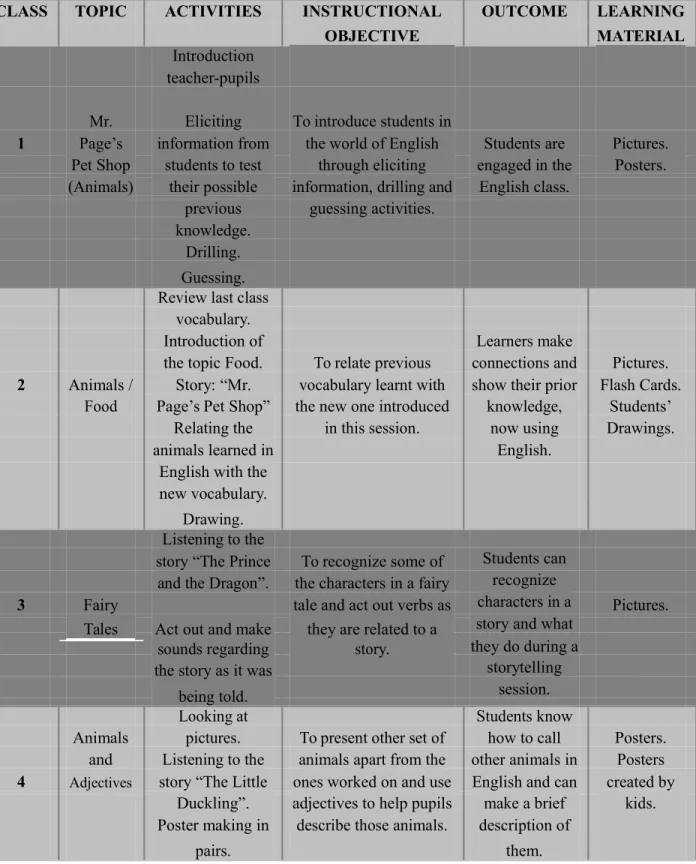
(103) Table 4.1 TPRS Lessons Procedures.
(104) 1 2 3 4 5.
(105) • showing a picture to the students • asking about the picture • giving the students guided vocabulary related to the story • practicing the pronunciation of the vocabulary • asking the students to check their understanding about the story • telling the story twice to make the it truly comprehension, student are.
(106) 6. characters voices and sounds of the story.. • asking the students about their opinion and feeling toward the story 7 The outline used during the classes is shown though the table above.. 4.4 Lesson Plans and Activities The following chart presents an overview of the topics and activities worked in class during the pedagogical intervention. The table also shows the instructional objectives, as well as the students’ outcome, and the resources used in each session. In the chart, we only present what we considered the most relevant sessions of the intervention but right below the chart, every session will be explained in detail, giving an account of the complete intervention.. 35.
(107) STORYTELLING TO PROMOTE PARTICIPATION IN EFL SECOND GRADERS. Table 4.2 Pedagogical Intervention Description. CLASS. TOPIC. ACTIVITIES. INSTRUCTIONAL OBJECTIVE. OUTCOME. LEARNING MATERIAL. To introduce students in the world of English through eliciting information, drilling and guessing activities.. Students are engaged in the English class.. Pictures. Posters.. To relate previous vocabulary learnt with the new one introduced in this session.. Learners make connections and show their prior knowledge, now using English.. Introduction teacher-pupils. 1. 2. Mr. Page’s Pet Shop (Animals). Animals / Food. Eliciting information from students to test their possible previous knowledge. Drilling. Guessing. Review last class vocabulary. Introduction of the topic Food. Story: “Mr. Page’s Pet Shop” Relating the animals learned in English with the new vocabulary. Drawing. Listening to the story “The Prince and the Dragon”.. 3. Fairy Tales. Animals and 4. Adjectives. Act out and make sounds regarding the story as it was being told. Looking at pictures. Listening to the story “The Little Duckling”. Poster making in pairs.. To recognize some of the characters in a fairy tale and act out verbs as they are related to a story.. To present other set of animals apart from the ones worked on and use adjectives to help pupils describe those animals.. Students can recognize characters in a story and what they do during a storytelling session. Students know how to call other animals in English and can make a brief description of them.. Pictures. Flash Cards. Students’ Drawings.. Pictures.. Posters. Posters created by kids..
(108) 36.
(109) STORYTELLING TO PROMOTE PARTICIPATION IN EFL SECOND GRADERS. 5. Family Members. Family Members. 6. (Value: Respect one’s parents and Listen to her). Storytelling: “The Little White Cat” using props. Acting dramatically of the story by children. Drawing. Listening of the story: “Little Red Riding Hood” with puppets. Drilling. Use of imperatives to have the kids act out the story. Re-telling the story by the children however. To relate a story with family members ‘names in English so kids recount easily the new vocabulary.. To present and explain new family members and introduce the value of respect and listen to parents.. they liked it.. Students can name their closest family members in English.. Children are able to recognize more members of the family when they’re mentioned in English, besides they review the values of respect and listen to. Props. Students’ Drawings.. Puppets.. parents.. Flashcards of “the boy and the apples” were shown.. Calificative. 7. adjectives / physical characteri stic and to be verb uses. Predictions were made by the students, about main characters’ behavior, based on their appearance. Imitation activity to identify the characters. Story told and listened twice. Recap of vocabulary and adjectives used. Think aloud exercise to know students opinions and feelings.. To recognize some vocabulary useful to describe people physically and to know some vocabulary about feelings and perceptions.. Students were able to remember some basic vocabulary about adjectives, to describe in simple words to somebody physically.. Flashcards, book.
(110) 37.
(111) STORYTELLING TO PROMOTE PARTICIPATION IN EFL SECOND GRADERS. 8. The Princess from the lake (story created by students’ teachers) (Adjectiv es to describe personalit y and feelings). 9. “the gold eggs’ (values and ant values). 10. Story created by the students (professio n and occupatio. Guessing and predicting activity. Coloring activity and organizing the images in a logic sequence for them. Storytelling. Sharing their own stories with their ends. Students giving a moral about the story created. Guessing and predicting activity by using the propts taken to the class. Simultaneous storytelling and drawing made from the story. Representing through a drawing one of the story’s scene and counting eggs drawn. Decorating work and socializing vocabulary. Listening and repeating activity based on the flashcards shown by teachers. Story told by students and. To teach some vocabulary about values, personality adjectives and a few set of verbs.. To give to the students some vocabulary related to values and ant values and some other related to behavior and attitudes.. To teach students some vocabulary about occupations and professions for them to use the to be verb to mention them.. Students were able to remember some of the vocabulary taught and they used the imagination and creativity to make their own story and to reflect about it.. Flashcards, photocopies, colors and cartoon with the story.. Students were able to associate the characters’ behavior and to judge by themselves positive and negative attitudes by using the vocabulary given, about values and ant values.. propts, paper, colors, scissors and glue.. Students were able to remember some of the vocabulary given about professions and. Photocopies of occupations and profession. Colors, flashcards..
(112) teacher adding. occupations 38.
Figure

+3
Documento similar
Given costly announcements, in the unique equilibrium outcome patient depositors would not announce their decision to keep the money deposited: 5 once all patient deposi- tors
These situations include showing knowledge of the answer of a question by students if they do not know how to say it in the second language or using the mother tongue to
When consumers do not do everything in their power to take care of the environment and see the benefits that could be achieved with everyday actions (using rechargeable
The purpose of this paper is to analyse the effect of positive affect on opportunity evaluation (i.e. novelty assessment and entrepreneurial selection) and to what extent this effect
84% refer to physical activity on a daily basis, in addition to the fact that 65.4% of students consider themselves to be under moderate stress, 16.6% do not present stress, 15.5%
The case study concludes that adolescents are clearly not able to discern intertextual characters that do not belong in their culture or they are not familiar with, even if one
Academic writers do not only need to make the results of their research public, but also persuasive, and their success in gaining acceptance for their work at least partly depends
We do not obtain any significant coefficients for our variable of interest when conducting estimations with two-year lagged accident rates (data not shown),
