1 23
International Review of Education
ISSN 0020-8566
Volume 58
Number 1
Int Rev Educ (2012) 58:109-127
DOI 10.1007/s11159-012-9273-9
illiterate and literate children
1 23
Comparing cognitive performance in illiterate
and literate children
Esmeralda Matute•Teresita Montiel•Noemı´ Pinto• Monica Rosselli•Alfredo Ardila•Daniel Zarabozo
Published online: 1 March 2012
ÓSpringer Science+Business Media B.V. 2012
Abstract While it is known that the process of becoming literate begins in early childhood and usually involves several years of schooling, research related to cognitive characteristics has been done mostly on illiterate adults, and information concerning illiterate children is therefore limited. The aim of the present study, involving 21 illiterate and 22 literate Mexican children aged 6 to 13, was to investigate the effects of literacy on neuropsychological characteristics during childhood. The children’s performance on 16 cognitive domains of theEvaluacio´n Neuropsicolo´gica Infantil (ENI, Child Neuropsychological Assessment) was
E. Matute (&)
Instituto de Neurociencias, Universidad de Guadalajara, Francisco de Quevedo 180, 44130 Guadalajara, Jal, Mexico
e-mail: [email protected]; [email protected]
T. Montiel
Department of Education, Universidad de Guadalajara, Guadalajara, Mexico e-mail: [email protected]
N. Pinto
Department of Psychology, Universidad del Valle de Atemajac, Guadalajara, Mexico e-mail: [email protected]
M. Rosselli
Department of Psychology, Florida Atlantic University, Boca Raton, FL, USA e-mail: [email protected]
A. Ardila
Department of Communication Sciences and Disorders, Florida International University, Miami, FL, USA
e-mail: [email protected]
D. Zarabozo
examined in three mixed within- and between-groups profile analyses. The results suggest that the effect of literacy observed in adults is already evident in children in almost every task analysed. Moreover, the fact that an age effect was detected for the calculation abilities suggests that maths learning is school- and environment-dependent.
Keywords Child literacyChild illiteracyMexicoPhonemic awareness
Resume´ Comparaison des performances cognitives des enfants alphabe´tise´s et analphabe`tes – S’il est notoire que le processus d’alphabe´tisation est amorce´ dans la petite enfance et s’accomplit en re`gle ge´ne´rale durant sept ans de scolarite´, les e´tudes sur les caracte´ristiques cognitives portent pour la plupart sur les adultes illettre´s, et les donne´es concernant les enfants analphabe`tes sont par conse´quent limite´es. La pre´sente e´tude, qui a implique´ 21 enfants mexicains illettre´s et 22 lettre´s, aˆge´s de 6 a` 13 ans, visait a` e´tudier les effets de l’alphabe´tisation sur les caracte´ristiques neuropsychologiques pendant l’enfance. Les performances des en-fants dans les 16 domaines cognitifs de l’E´ valuation neuropsychologique infantile (Evaluacio´n Neuropsicolo´gica Infantil, ENI) ont e´te´ examine´es dans trois analyses de profil croise´es intergroupes et entre les groupes. Les re´sultats laissent penser que l’effet de l’alphabe´tisation observe´ chez les adultes est de´ja` manifeste chez les enfants dans presque toutes les taˆches analyse´es. En outre, un effet d’aˆge de´tecte´ dans les capacite´s de calcul sugge`re que l’apprentissage des mathe´matiques de´pend de l’e´tablissement scolaire et de l’environnement.
Zusammenfassung Vergleich der kognitiven Leistungen von analphabetischen und alphabetisierten Kindern – Es ist zwar bekannt, dass der Alphabetisierungs-prozess in der fru¨hen Kindheit beginnt und normalerweise mehrere Schuljahre dauert, doch bescha¨ftigt sich die Kognitionsforschung bislang u¨berwiegend mit analphabetischen Erwachsenen, sodass die Informationen u¨ber analphabetische Kinder begrenzt sind. Ziel der vorliegenden Studie an 21 analphabetischen und 22 alphabetisierten mexikanischen Kindern zwischen 6 und 13 Jahren war die Untersuchung der neuropsychologischen Effekte der Alphabetisierung im Kindes-alter. Die Leistungen der Kinder in 16 kognitiven Bereichen derEvaluacio´n Neu-ropsicolo´gica Infantil(ENI, Neuropsychologische Evaluation von Kindern) wurden in drei gemischten Profilanalysen, jeweils innerhalb einer Gruppe und zwischen verschiedenen Gruppen, untersucht. Die Ergebnisse deuten darauf hin, dass bei fast jeder analysierten Aufgabe die bei Erwachsenen beobachtete Wirkung der Alpha-betisierung auch schon bei Kindern erkennbar ist. Daru¨ber hinaus fu¨hrt die Fest-stellung eines Alterseffekts fu¨r die Rechenfa¨higkeiten zu der Annahme, dass die Lernerfolge in Mathematik schul- und umgebungsabha¨ngig sind.
nin˜os analfabetos es limitada. El objetivo de este estudio, realizado en nin˜os mexicanos de 6 a 13 an˜os de edad, 21 de ellos analfabetos y 22 alfabetizados, consistio´ en investigar los efectos de la alfabetizacio´n sobre las caracterı´sticas neuropsicolo´gicas durante la infancia. El rendimiento de los nin˜os sobre 16 a´reas congnitivas de laEvaluacio´n Neuropsicolo´gica Infantil (ENI) se examino´ en tres ana´lisis de perfiles de grupos mixtos, intragrupales e intergrupales. Los resultados sugieren que los efectos de la alfabetizacio´n observados en adultos ya se evidencian en los nin˜os, en casi todas las tareas analizadas. Adema´s, el hecho de que se haya detectado un efecto de la edad para las habilidades de ca´lculo indica que el aprendizaje de matema´ticas depende de la escuela y tambie´n del entorno.
The influence of literacy on children’s neuropsychological test performance
Moreover, studies in neuropsychology and cognitive psychology carried out with illiterate subjects who are members of a mostly literate society have focused on differences in psychological and neuropsychological task performance between illiterate and literate individuals. In a pioneering study, Jose´ Morais et al. (1979) stated that illiterate people find it difficult to perform phonemic awareness tasks; such as for example counting how many sounds are in the word ‘‘dog’’ or being asked to delete the /l/ sound in the word /floor/. Many other studies have also found that scores on language tasks such as non-word repetition (e.g., Castro-Caldas et al.
1998; Reis and Castro-Caldas1997) and phonemic fluency (e.g. Matute and Casas
1999; Ostrosky et al. 1998; Petersson et al. 2001; Ratcliff et al. 1998; Reis and Castro-Caldas1997; Rosselli et al.1990) that depend upon phonemic awareness are low among illiterate adults. In general, it has been observed that literates outperform illiterates in many language-related tasks, including word repetition (Lecours et al.
1987; Reis and Castro-Caldas 1997), sentence repetition (Lecours et al. 1987), semantic verbal fluency (Gonzalez da Silva et al. 2004; Reis and Castro-Caldas
1997; Rosselli et al.1990), verbal memory (Reis and Castro-Caldas1997; Rosselli et al.1990), and visual confrontation naming (Carraher et al. 1982; Lecours et al.
1987; Reis et al. 1994, Reis et al. 2001; Schliemann and Acioly 1989). Low performance on calculation tasks (Rosselli et al. 1990, Deloche et al. 1999) and visual tasks (Ardila et al.1989; De Clerk1976; Kolinsky et al. 1987), as well as better performance in copying a complex figure (Ardila and Rosselli 2003) and constructional tasks (Matute et al.2000) have also been reported.
Most cognitive research on illiteracy has been carried out by studying adult populations, but the condition of being an illiterate adult cannot be fully understood if the individual’s past history and experience are not taken into account. Clearly, the development of integrative processes begins long before those processes become evident; for instance, several abilities must be acquired before a child can show that s/he is able to read, while the acquisition of others does not become apparent until reading acquisition has actually occurred. In fact, when analysing phonemic awareness as a predictor of learning to read, Heinz Wimmer et al. (1991) found that children with a high level of performance on phonemic awareness tasks early in grade one showed consistently high reading and spelling achievement by the end of that grade. Moreover, an effect of schooling and reading experience on phonemic awareness tasks has also been supported by Shlomo Bentin et al. (1991), who compared the performance of kindergarten and first-grade children matched by age in a phonemic segmentation task. They found that the effect of schooling was larger than that of age. These results support an association between reading instruction and the development of phonemic awareness. Whereas formal instruction in reading seems to influence phonological awareness,1at the phoneme level this influence is absent for syllabic analysis, rapid-naming and verbal memory span (Korkman et al.
1999). However, Frederick Morrison et al. (1995) found a significant influence of schooling on a picture memory task among kindergarten and first-grade children.
1 Phonological awareness subsumes awareness of phonological strings, awareness of syllables,
Most often, reading acquisition takes place in a school setting. Thus, the effect of reading acquisition must be considered together with the environmental character-istics of the site where it is carried out. More recently, some studies have inquired into the role of environmental factors upon certain cognitive domains. For instance, Dennis Molfese et al. (2003) analysed the effect of environmental factors on brain responses to speech and non-speech stimuli by comparing the event-related potentials (ERPs) of 134 children at 3 and 8 years of age. Their sample was divided into two stimulation groups (high and low) according to child-centred activities in the home and parenting practices associated with language and reading. Results showed that ERP responses to speech and non-speech analogues successfully discriminated between children who received low vs. high levels of stimulation. The authors suggest that parenting practices and the social experiences available to children influence not only their cognitive abilities but also the way their brains process speech sounds.
Neuropsychological development depends on two basic variables: brain matu-ration and the individual’s history (experience). Therefore, when studying the effects of literacy on neuropsychological characteristics it is crucial to consider that the process of becoming literate begins in early childhood and usually involves several years of schooling. Thus, reading acquisition is a slow process. Clearly, improving reading speed and reading level achievement are linked to the child’s opportunities to practise these skills. For example, schools with limited resources often waste instructional time, offer only limited instruction and lack textbooks; hence the students who attend those schools rarely practise reading and may remain illiterate for years (Abadzi2008).
It can be conjectured that during these years, differences in cognitive processes will be reflected in levels of reading achievement. Cognitive adjustment processes and compensatory strategies must develop in illiterates to allow them to function according to the demands of their environment, in terms of resolving everyday problems. Consequently, it becomes most important to determine whether the effects of illiteracy are already evident in neuropsychological test performance in children.
This study examines the effects of literacy and schooling on known school-related cognitive abilities, such as calculation and metalinguistic awareness, as well as on non-school-related functions, including perception and memory, in children aged 6 to 13.
An analysis of the demographic context gives our goals greater significance, since illiteracy (even at the beginning of the 21st century) represents a huge challenge. It is estimated that in the contemporary world about 759 million people are illiterate (UNESCO2010). The estimated global rate of children above the age of five who did not attend school in the 1992–2002 period was 28 per cent (UNICEF
2003). Even though elementary school is obligatory in Mexico, the 2000 Census reported that 2,431,655 out of 19,700,930 children in the country aged 6 to 14 did not know how to read and write; a figure that represents 12.3 per cent of all Mexican school-aged children (INEGI2001). Moreover, 1,617,710 children (8.2 per cent) in this age range do not attend school. A series of family circumstances may affect school non-attendance. In many cases, children do not go to school because they need to work in order to complement their parents’ income, or because they stay at home to take care of their younger siblings or grandparents while their parents are at work; in others, the financial costs or other requirements entailed in enrolling children in school may be prohibitive. These are intellectually normal children who have lost out on the school experience due to socioeconomic circumstances (Martin
1998; Ayala Rubio2001). While most Mexican children spend their days at school learning how to read and write, illiterate children spend their time outside learning other types of skills that will very likely shape their cognitive strategies in a way quite distinct from that of schoolchildren. The question, then, is to determine just how different these illiterate children are from their literate companions. Answering this question will allow us to better understand the impact of literacy on cognitive processes.
Method
Participants
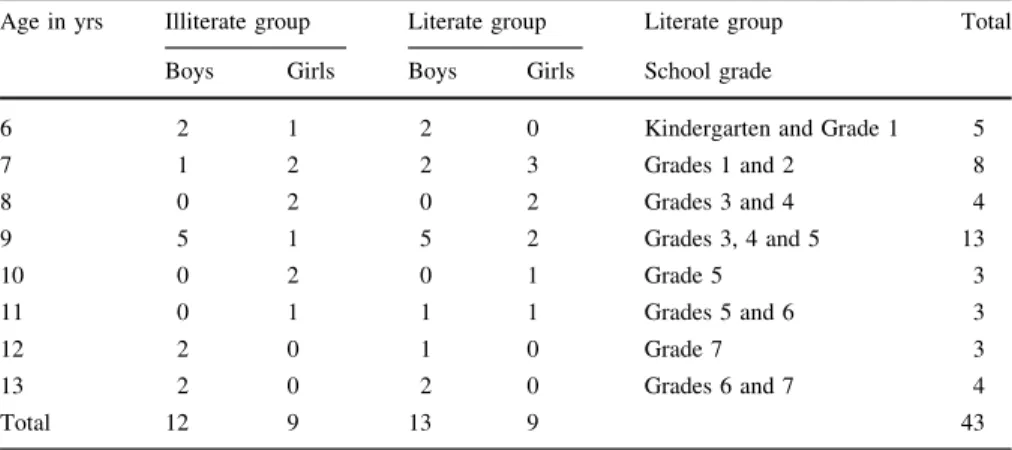
After conducting this procedure, the sample consisted of 43 healthy children ranging in age from 6 to 13 years. The illiterate group (IG) was composed of 21 children, 12 boys and 9 girls (mean age 9.0 years; SD=2.20), while the control literate group (LG) was composed of 22 children, 13 boys and 9 girls (mean age 8.9 years, SD=2.06) with schooling from kindergarten to Grade 7 (see Table1). All children were recruited from neighbourhoods with similar socioeconomic levels. Participants were selected from low-income areas with high rates of unschooled population located on the outskirts of two Mexican cities, Guadalajara and Tijuana. Information provided by INEA (Instituto Nacional para la Educacio´n de Adultos, the National Institute for Adult Education) was used to locate urban zones with high illiteracy rates in those two cities. Psychology students assisted in the study by carrying out a door-to-door survey: in each house in the selected zones they asked how many persons were living there, their ages and their years of schooling. Later, a visit was made to the homes where children with no schooling history had been identified.
Inclusion criteria for both groups were as follows: (a) daily life behaviour as expected for the child’s chronological age, according to an interview with a parent or grandparent; (b) no milestone development delays; (c) no history of brain injury, epilepsy or known neurological disorders; (d) no history of significant illness; (e) no hearing or visual impairment; and (f) no evident emotional disturbance. Children with a history of school failure were not included.
The additional inclusion criteria for IG were: (a) no history of school attendance; and (b) school non-attendance due to social-family reasons, such as children living with their grandparents while parents work elsewhere, or problems in complying with administrative requirements, such as presenting birth certificates, etc. For LG, all children (a) were screened for grade retention; (b) showed chronological age/ grade level concordance; and (c) had no previous or current learning difficulties, as determined through interviews with parents and teachers. A structured parents’ report was also used to establish familial and personal background, the child’s health history and behavioural characteristics. All children who met the inclusion criteria agreed to participate, and their parents or grandparents also consented.
Table 1 Frequency distribution of the sample by group, age, gender and school grade
Age in yrs Illiterate group Literate group Literate group Total
Boys Girls Boys Girls School grade
6 2 1 2 0 Kindergarten and Grade 1 5
7 1 2 2 3 Grades 1 and 2 8
8 0 2 0 2 Grades 3 and 4 4
9 5 1 5 2 Grades 3, 4 and 5 13
10 0 2 0 1 Grade 5 3
11 0 1 1 1 Grades 5 and 6 3
12 2 0 1 0 Grade 7 3
13 2 0 2 0 Grades 6 and 7 4
Materials
The neuropsychological test battery, Evaluacio´n Neuropsicolo´gica Infantil (ENI)
was used. This battery evaluates a total of 18 different cognitive domains, but only the following 16 were used in this study (the other two subtests, Reading and Writing, were excluded for the obvious reason that the study includes an illiterate population):
1. Constructional abilities (with items from 4 subtests): stick construction (copying a design using toothpicks), copying figures, drawing a human figure and copying a complex figure.
2. Verbal memory coding: word learning and free story-recall subtests.
3. Visual memory coding (consists of only one test): geometrical figure learning. 4. Delayed verbal recall: delayed recall of words (free recall, cue recall and
recognition) and delayed recall of a story.
5. Delayed visual recall: with items testing delayed free and cue recall, and recall by recognition of geometrical figures.
6. Tactile perception: evaluating by touch the recognition of real, out-of-sight objects; children were blindfolded and asked to identify objects placed on their right or left hand.
7. Visual perception includes the following visual subtests: recognition of superimposed figures and blurry images of objects, visual closure (identifi-cation of incomplete drawings), object integration (integrating the parts that make up an object) and recognition of facial emotional expressions.
8. Auditory perception: includes three tests that involve recognising musical notes and environmental sounds, plus identification of minimal phonological contrasts.
9. Oral language: includes repetition of syllables, words, non-words and sentences, naming objects, following commands, narrative coherence, length expression, pointing and discourse comprehension.
10. Metalinguistic awareness: uses oral language to assess phonemic blending within a word, phoneme counting within a word and word-counting within a sentence.
11. Calculation includes the following subtests: counting items, reading numbers, writing numbers, comparison of magnitudes, and simple and complex arithmetical facts.
12. Spatial abilities: verbal spatial abilities (expression and comprehension of spatial terms such as right and left terms) and non-verbal spatial skills (line orientation and tracing coordinates).
13. Attention: includes cancellation and digits forward and backward tasks. 14. Concept formation and reasoning: similarities, matrices and word problem
tests.
Procedure
All children were tested individually by either a psychologist or a graduate psychology student in a quiet room at the neighbourhood school or in their own home. Two sessions of about 1 hour each were required. In order to eliminate test order bias, the tasks were counterbalanced using four different orders. Children were tested only if we had received their agreement and their parents’ consent to participate. The family of each child received a box of groceries in exchange for their participation in the study.
Statistical analyses
In all cases, raw scores were transformed into z-scores, based on the performance of the entire group. Three Analyses of Variance (ANOVAs) were conducted; the first one to confirm that the members of each group (literate and illiterate) shared similar cognitive characteristics (within-group main effects); the second one to confirm that the two groups (literate and illiterate) scored significantly different (between-groups effects) on the non-school related cognitive domains (with 14 measures taken as dependent variables: constructional abilities, verbal memory coding, visual memory coding, delayed verbal recall, delayed visual recall, tactile perception, visual perception, auditory perception, oral language, spatial abilities, attention, concept formation and reasoning, verbal fluency and graphic fluency); while the third and final ANOVA compared the two groups (between-groups effect) on the school-related cognitive domains (2 measures: metalinguistic awareness and calculation). Participants’ ages were used as a covariate in the latter two analyses. The alpha level used was set atp\0.05.
Results
Cognitive domains
The first goal of this study was to determine cognitive differences between illiterate and literate children. Table2 shows the two groups’ z mean scores, standard deviations, range and skewness for the different cognitive domains. Differences between groups are also shown.
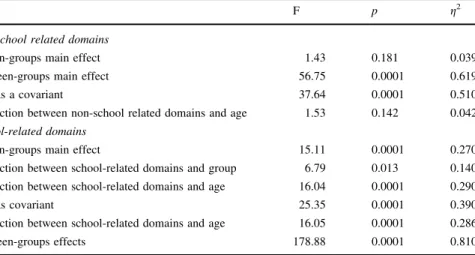
The first ANOVA, based on the non-school-related cognitive domains, did not show a within-groups main effect; i.e. children’s performance across tasks did not differ, whereas the between-groups (literate vs. illiterate) effect was significant, as the literate group performed better than the illiterate group across those measures (see Fig.1). A one-way ANOVA for each measure showed a significant group effect for all domains except tactile perception (see Table2). Though age was a significant covariant, no significant interaction between the non-school-related measures and age was evident (see Table3).
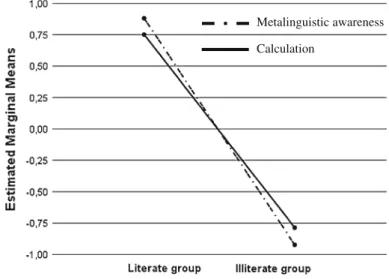
school-related cognitive domains, a significant between-groups effect was found. An interaction between school-related domains and group was also evident (Table3). As can be seen in Fig.2, the profile plot of this second analysis shows an inverse achievement between groups; that is, the illiterate group had higher results
Illiterate group
1 Constructional abilities 2 Verbal memory coding 3 Visual memory coding 4 Delayed verbal recall 5 Delayed visual recall
6 Tactile perception 7 Visual perception 8 Auditory perception 9 Oral language 10 Spatial abilities
11 Attention
12 Conceptual formation and reasoning 13 Verbal fluency 14 Graphic fluency
Literate group
Fig. 1 Non-school-related cognitive domains profile plot
Table 3 Results of the between-groups and within-groups ANOVAs
F p g2
Non-school related domains
Within-groups main effect 1.43 0.181 0.039
Between-groups main effect 56.75 0.0001 0.619
Age as a covariant 37.64 0.0001 0.510
Interaction between non-school related domains and age 1.53 0.142 0.042 School-related domains
Within-groups main effect 15.11 0.0001 0.270
Interaction between school-related domains and group 6.79 0.013 0.140 Interaction between school-related domains and age 16.04 0.0001 0.290
Age as covariant 25.35 0.0001 0.390
Interaction between school-related domains and age 16.05 0.0001 0.286
Between-groups effects 178.88 0.0001 0.810
in the calculation domain than in the metalinguistic awareness domain, whereas the literate group had a higher performance in the metalinguistic awareness domain than in the calculation domain. Age was a significant covariant, meaning that the effect of literacy on these tests depends on the age of the child. Also, a significant interaction between the school-related measures and age suggests that older children, who have longer periods of school exposure, achieve higher scores than younger children (see Table3).
Discussion
School-related domains
Neuropsychological studies conducted with illiterate adults, as well as research carried out with children beginning school, have found that the development of certain neuropsychological domains is school/literacy-related. In this study, we assessed two such domains: metalinguistic awareness and calculation abilities. In relation to the former, literacy has been linked to metalinguistic awareness, since it is by means of the latter that it becomes possible to transform aspects of language into objects of reflection. Specifically, studies associated with phonemic awareness suggest that learning to read leads children to dissect language into small, non-significant units. Studies of illiterate adults have shown that people who lack the ability to read and write found it difficult to consider words and non-words as sequences of phonemes (Morais et al. 1979) and, as a result, underperformed on tasks that require thinking about a word’s phonemic characteristics (e.g. phonemic fluency tasks) (Reis and Castro-Caldas1997). Our results show that, like illiterate
Metalinguistic awareness
Calculation
adults, illiterate children cannot divide words into phonemes or count the phonemes in a specific word (Phoneme Counting Test), nor are they able to manipulate phonemes by blending them to form other words (Phoneme Blending Test), though they can discriminate two words that differ by minimal phonological contrasts (Phonemic Perception Test).
The illiterate children in our study were only poorly able to identify the number of words in an oral sentence (Word Counting Test). Their performance on the word-counting task suggests that they found it difficult to think about language as a string of words. Although Annette Karmiloff-Smith et al. (1996) found that the segmentation of oral texts into word units can be taught orally, our illiterate children were unable to perform this task. It may be that a child’s awareness of words emerges only once written language is learned, or when specific training is provided through schooling. Moreover, if these children cannot divide a sentence into its constitutive words, they can hardly be expected to have the ability to use words as a category system. In fact, David Olson (2002) has suggested that children with alphabetic learning do come to think about language in terms of the category systems employed in writing. The lower performance of our illiterate children on visual confrontation naming, verbal fluency and similarities tests may well be related to their lack of word awareness, which interferes with their ability to use words as objects of reflection.
The other school-related cognitive domain tested in this study was calculation, which included eight tasks: one counting task, four tasks related to number-handling, and three associated with the ability to make calculations. Illiterate children showed a higher performance on the Counting Test; a result that suggests that counting is an ability that is learned mostly outside the school, whereas number-handling and calculation procedures are more school-dependent. Counting knowl-edge and counting skills are natural human enterprises (Crump1990) that begin to develop sometime between two and three years of age; i.e. before the pre-school years (Gelman and Gallistel1978; Gelman and Meck1983). In fact, some of our illiterate children were able to solve certain arithmetical fact problems in which they may have used counting as their problem-solving strategy. There is evidence of the development of mathematical skills in children prior to formal instruction in school (for a review, see Bizans et al.2005), and counting and recall are the most common procedures used by these children to solve arithmetical problems (Siegler and Jenkins1989).
For this study, we assumed that some mathematical knowledge is acquired through daily life experience; however, it is well known that calculation procedures constitute a skill that is taught explicitly in the classroom during schooling, so its acquisition is also directly related to the school environment. Indeed, a univariate general lineal model analysis revealed that age has a significant effect on the calculation domain in both groups:F(7, 14)=3.49,p=0.022,g2=0.63 andF(7,
Non-school-related domains
When comparing the neuropsychological profile of illiterate children with that of literate children in non-school-related cognitive domains, the latter outperformed the former in all cognitive domains except tactile perception. However, the greatest difference was found in Spatial Abilities (Fig.1 and Table2).
All the spatial ability tests used in this study involved graphic materials; therefore, the spatial difficulties experienced by illiterate children may be influenced by their lack of experience with these types of materials and tests. For this reason, these results cannot be generalised to other spatial tasks, such as identifying the position, movement or direction of objects or points in space. Moreover, three out of five spatial tasks (Right-left Comprehension, Right-left Expression and Different Angled Pictures) are language-related, since they involve the use of spatial words. On these three tasks, the differences seen between groups were smaller than on the other two – Line Orientation and Coordinates – which involve only visual abstraction. As Regine Kolinsky et al. (1987) have suggested, illiterate adults find it difficult to deal with graphic materials that require visual abstraction.
A word must be added about the Stick Construction task, which has been used in a different study with illiterate adults by one of the authors (Matute et al.2000). In that study, participants were asked to copy four different designs using toothpicks. Overall performance was used as a global criterion and the types of errors such as disarticulation between sticks (when a gap greater than two millimetres is present between two toothpicks tips that must be together to form an angle), omission of sticks, addition of sticks and rotation of the figure) were used as analytical criteria. Illiterate adults underperformed literate adults according to both the analytical criterion of disarticulation and the global criterion. In the present study, although the type of errors committed was not scored separately, the overall performance of illiterate children was lower than that observed in the literate group. The findings of both this study and the earlier one suggest that a lower performance by illiterate subjects on this type of task is evident across the life span.
Verbal fluency has frequently been assessed in illiterate adults (Ostrosky-Solis et al.1999; Reis et al.1994; Rosselli et al.1990). Though adults find it difficult to perform initial phoneme-fluency tasks (Reis and Castro-Caldas1997; Manly et al.
1999), results regarding semantic fluency tasks are inconclusive and seem to depend on the ecological validity of the task itself (Gonzalez da Silva et al.2004). Our findings show that illiterate children attained lower scores on the two verbal (phoneme and semantic fluency) tasks and the two graphic tasks, compared to literate children. However, the greatest score differences between the two groups were observed on the phonemic verbal fluency and graphic semantic fluency tasks.
Evaluation
for both groups. The only interaction observed was between group- and school-related domains, indicating that it is only on this type of task that the literacy effect is more clearly seen at this age.
It is certainly important to take into account the fact that pioneering studies related to illiteracy were carried out with adults; thus the effects of schooling that can be observed in adults today is related to the schools and schooling that existed 40 years ago or more. It is safe to assume that the schools of those days were distinct from modern ones in many ways, including scheduling, study programmes, materials and the teaching methods employed. For example, important reforms were introduced into Mexican public schools in the 1960s, including a reduction of the timetable, free textbooks for all children (Villa Lever1988), and an increase in both the number of schools and the number of children per class, all of which were related to the country’s demographic explosion. A library programme that began in 1986 helped those children who had no books at home to be in contact with them in a more recreational manner. By the same token, the society of 40 years ago differed from modern society even with respect to marginalised groups. Today, there is much more information that stimulates children outside school than there was 40 years ago. Upon taking into account the changes in schooling and society that have occurred in the past 50 years, together with the cognitive similarities observed between illiterate children and illiterate adults, our results confirm the existence of a stronger influence of literacy upon cognition in those cognitive areas in which low performances by both populations coincide.
Current results suggest that the neuropsychological measures traditionally used to assess children are highly dependent on literacy and schooling. Also, of course, the neuropsychological development of the subjects in our sample is not complete, since they are children, so it is possible that the effects of literacy on some tasks could become more evident at a later age. In other words, for some tasks where no differences between the IG and LG groups were evident, distinct results might be seen in older subjects.
Conclusion
The comparative research on cognitive characteristics in illiterate and literate children discussed above constitutes a pioneering study in the field of illiteracy in childhood. Our data show that literacy has an effect on all cognitive domains included in this study; though an age effect was also evident, as younger children generally attained lower scores. With respect to the domains of calculation and metalinguistic awareness, the development of which had been related mainly to schooling, our results suggest that calculation is acquired not only at school but also through daily life experience.
It is important to mention that our study has one important limitation: its small sample size. It is not easy to find urban children who are completely illiterate; in fact, urban children in Mexico who are completely illiterate represent only a very small portion of the population, since the vast majority of children have had at least a few months of school attendance. Studying the neuropsychological characteristics of illiterate children is a huge challenge and constitutes a unique tool with which to explore the relationship between literacy and cognition in a developing brain. A pragmatic issue that has to be dealt with in future research is that studying the relationship between cognition and children’s different reading levels could help teachers in developing countries strengthen the support provided by parents for reading acquisition. As in adults, norms for children’s tests in developing countries must also take into account literacy levels and years of schooling when chronological age/grade level concordance does not exist. Furthermore, research on unschooled, but literate, children and/or adults could provide additional data that would allow us to gain a better understanding of the relationship between literacy and cognitive characteristics.
References
Abadzi, H. (2008). Efficient learning for the poor: New insights into literacy acquisition for children. International Review of Education, 54(5–6), 581–604.
Ardila, A., Bertolucci, P. H., Braga, L. W., Castro-Caldas, A., Judd, T., Kosmidis, M. H., et al. (2010). Illiteracy: Neuropsychology of cognition without reading.Archives of Clinical Neuropsychology, 25, 689–712.
Ardila, A., & Rosselli, M. (2003). Educational effects on the ROCF performance. In J. Knight & E. Kaplan (Eds.),Rey-Osterrieth complex figure handbook(pp. 659–667). New York: Psychological Assessment Resources.
Ardila, A., Rosselli, M., & Rosas, P. (1989). Neuropsychological assessment in illiterates: Visuospatial and memory abilities.Brain and Cognition, 11, 147–166.
Ayala Rubio, S. (2001).La desercio´n escolar:>Un callejo´n sin salida? [School desertion: A dead end?]. In E. Matute & M. Romo-Beltra´n (Eds.), Los Retos en la Educacio´n del Siglo XXI[Educational challenges in the 21st century] (pp. 77–102). Guadalajara, Mexico: University of Guadalajara. Bentin, S., Hammer, R., & Cahan, S. (1991). The effects of aging and first grade schooling on the
development of phonological awareness.Psychological Science, 2, 271–274.
Cardona, G. R. (1994).Antropologı´a de la Escritura[Anthropology of writing].Barcelona: Editorial Gedisa.
Carraher, T. N., Carraher, D. W., & Schliemann, A. D. (1982). Na vida, dez; na escola, zero: Os contextos culturais da aprendizagem da matematica [In life, ten, at school, zero: The cultural contexts of learning mathematics].Cadernos da Pesquisa do Sao Paulo, 42, 79–86.
Castro-Caldas, A., Petersson, K. M., Reis, A., Stone-Elander, S., & Ingvar, M. (1998). The illiterate brain. Learning to read and write during childhood influences the functional organization of the adult brain.Brain, 121, 1053–1064.
Crump, T. (1990).The anthropology of numbers. New York: Cambridge University Press.
De Clerk, M. (1976). Le se´minaire ope´rationnel: Me´thode Novatrice de Formation pour le De´veloppement[The operational seminar: Innovative method for teaching to improve development]. E´ tudes et Documents d0E´ ducation, fascicle 20. Paris: UNESCO.
Deloche, G., Souza, L., Braga, L. W., & Dellatolas, G. (1999). A calculation and number processing battery for clinical application in illiterates and semi-literates.Cortex, 35, 503–521.
Gelman, R., & Gallistel, C. R. (1978).The child’s understanding of number. Cambridge, MA: Harvard University Press.
Gelman, R., & Meck, E. (1983). Preschoolers’ counting: Principles before skill.Cognition, 13, 343–359. Gonzalez da Silva, C., Petersson, K. M., Faisca, L., Ingvar, M., & Reis, A. (2004). The effects of literacy and education on the quantitative and qualitative aspects of semantic verbal fluency.Journal of Clinical and Experimental Neuropsychology, 26, 266–277.
INEGI (Instituto Nacional de Estadı´stica, Geografı´a e Informa´tica) (2001). XII Censo General de Poblacio´n y Vivienda, 2000. Tabulados ba´sicos y por entidad federativa [XII population and housing census, 2000. Basic general data and by state].Aguascalientes, Me´xico: INEGI. Karmiloff-Smith, A., Grant, J., Sims, K., Jones, M., & Cuckle, P. (1996). Rethinking metalinguistic
awareness: Representing and accessing knowledge about what counts as a ‘‘word’’.Cognition, 58, 197–219.
Kolinsky, R., Morais, J., & Content, A. (1987). Finding parts within figures: A developmental study. Perception, 16, 399–407.
Korkman, M., Barron-Linnankoski, S., & Lahti-Nuuttila, P. (1999). Effects of age and duration of reading instruction on the development of phonological awareness, rapid naming, and verbal memory span. Developmental Neuropsychology, 16, 415–431.
Lecours, A. R., Mehler, J., Parente, M. A., Caldeira, A., Cary, L., Castro, M. J., et al. (1987). Illiteracy and brain damage—1. Aphasia testing in culturally contrasted populations (control subjects). Neuropsychologia, 25, 231–345.
Manly, J. J., Jacobs, D. M., Sano, M., Bell, K., Merchant, C. A., Small, S. A., et al. (1999). Effect of literacy on neuropsychological test performance in non-demented, education matched elders. Journal of the International Neuropsychological Society, 5, 191–202.
Martin, C. J. (1998). La educacio´n primaria en tiempos de austeridad [Schooling in Mexico]. Guadalajara, Me´xico: Universidad de Guadalajara/British Council.
Matute, E. (1998). Neuropsicologı´a del analfabetismo.Neuropsychologia Latina, 4, 38–47.
Matute, E., & Casas, A. (1999).Actividad metalingu¨ı´stica en el analfabeto: Evaluacio´n de la nocio´n de palabra en una poblacio´n mexicana[Metalinguistic activity in illiterate people: Word awareness assessment in a Mexican sample]. Paper presented in September at the Instituto de Neurociencias, CUCBA, Universidad de Guadalajara, Guadalajara, Mexico.
Matute, E., Leal, F., Zarabozo, D., Robles, A., & Cedillo, C. (2000). Does literacy have an effect on stick construction tasks?Journal of the International Neuropsychological Society, 3, 668–672. Matute, E., Rosselli, M., Ardila, A., & Ostrosky, F. (2007).Evaluacio´n Neuropsicolo´gica Infantil—ENI
[Child neuropsychological assessment]. Guadalajara, Mexico: Editorial Manual Moderno, Univers-idad de Guadalajara/UniversUnivers-idad Nacional Auto´noma de Me´xico.
Molfese, D. L., Molfese, V. J., Key, A. F., & Kelly, S. D. (2003). Influence of environment on speech-sound discrimination: Findings from a longitudinal study. Developmental Neuropsychology, 24, 541–558.
Morais, J., Cary, L., Alegria, J., & Bertelson, P. (1979). Does awareness of speech as a sequence of phones arise spontaneously?Cognition, 7, 323–331.
Olson, D. R. (1995). La cultura escrita como actividad metalingu¨ı´stica [Written culture as a metalinguistic activity]. In D. R. Olson & N. Torrance (Eds.),Cultura Escrita y oralidad[Written culture and orality] (pp. 333–357). Barcelona: Gedisa.
Olson, D. R. (2002). What writing does to the mind. In E. Amsel & J. P. Byrnes (Eds.),Language, literacy, and cognitive development(p. 153 66). Mahwah, NJ: Lawrence Erlbaum.
Ostrosky, F., Ardila, A., Rosselli, M., Lo´pez-Arango, G., & Uriel-Mendoza, V. (1998). Neuropsycho-logical test performance in illiterates.Archives of Clinical Neuropsychology, 13, 345–660. Ostrosky-Solis, F., Ardila, A., & Rosselli, M. (1999). Neurospsi: A brief neuropsychological test battery
in Spanish with norms with age and educational level.Journal of the International Neuropsycho-logical Society, 5, 413–433.
Petersson, K. M., Reis, A., & Ingvar, M. (2001). Cognitive processing in literate and illiterate subjects: A review of some recent behavioral and functional neuroimaging data. Scandinavian Journal of Psychology, 42, 251–267.
Ratcliff, G., Ganguli, M., Chandra, V., Sharma, S., Belle, S., Seaberg, E., et al. (1998). Effects of literacy and education on measures of word fluency.Brain and Language, 61, 15–122.
Reis, A., & Castro-Caldas, A. (1997). Illiteracy: A cause for biased cognitive development.Journal of the International Neuropsychological Society, 3, 444–450.
Reis, A., Guerreiro, M., & Castro-Caldas, A. (1994). Influence of educational level of non brain-damaged subjects on visual naming capacities.Journal of Clinical and Experimental Neuropsychology, 16, 939–942.
Reis, A., Petersson, K. M., Castro-Caldas, A., & Ingvar, M. (2001). Formal schooling influences two- but not three-dimensional naming skills.Brain and Cognition, 47, 397–411.
Rosselli, M., Ardila, A., & Rosas, P. (1990). Neuropsychological assessment in illiterates II: Language and praxic abilities.Brain and Cognition, 12, 281–296.
Rosselli-Cock, M., Matute-Villasen˜or, E., Ardila-Ardila, A., Botero-Go´mez, V. E., Tangarife-Salazar, G. A., Echeverrı´a-Pulido, S. E., et al. (2004). Evaluacio´n Neuropsicolo´gica Infantil (ENI): una baterı´a para la evaluacio´n de nin˜os entre 5 y 16 an˜os de edad. Estudio normativo colombiano [Child neuropsychological assessment, Colombian normative study].Revista de Neurologı´a, 38, 720–731. Schliemann, A. D., & Acioly, N. M. (1989). Mathematical knowledge developed at work: The contribution of practice versus the contribution of schooling.Cognition and Instruction, 6, 185–221. Siegler, R. S., & Jenkins, E. (1989).How children discover New strategies. Hillsdale, NJ: Erlbaum. UNESCO (2010)Reaching the marginalized. Education for All Global Monitoring Report 2010. Paris/
Oxford: UNESCO/Oxford University Press.
UNICEF (2003).Estado Mundial de la Infancia 2003. New York: UNICEF.
Villa Lever, L. (1988).Los libros de texto gratuitos[Free textbooks]. Guadalajara, Mexico: Universidad de Guadalajara.
Wimmer, H., Landerl, K., Linortner, R., & Hummer, P. (1991). The relationship of phonemic awareness to reading acquisition: More consequence than precondition but still important. Cognition, 40, 219–249.
The authors
Esmeralda Matute, Ph.D., is a professor of neuropsychology at the Instituto de Neurociencias/
Universidad de Guadalajara in Guadalajara/Mexico. She is the current director of the Neuroscience Institute and chairs the Laboratory of Neuropsychology. Her research areas comprise the study of spoken and written language including the effects of the orthographic characteristics of Spanish on manifestations of dyslexia and the effect of literacy on cognition and functional brain organisation. She has also been interested in cognitive development, learning disabilities and child neuropsychological assessment. She has authored or edited 16 books. She co-authored a recent book published in Spanish entitledNeuropsicologı´a del Desarrollo Infantil.
Teresita Montielhas a Ph.D. in neuroscience from the University of Guadalajara in Mexico. Currently
Noemı´ Pintohas a Master’s degree in neurosciences from the University of Guadalajara in Mexico. At the present time she has a faculty position at the Universidad del Valle de Atemajac in Guadalajara, Mexico.
Monica Rosselli,Ph.D., is a professor of psychology in the Department of Psychology at Florida Atlantic
University (Boca Raton, Florida). One of Dr. Rosselli’s research interests centres on the influence of education in cognition. She has also been interested in developmental neuropsychology. She co-authored a recent book in developmental neuropsychology published in Spanish.
Alfredo Ardila,Ph.D., is a professor of neuropsychology in the Department of Communication Sciences
and Disorders at Florida International University of Miami. Dr. Ardila’s research interests focus on cross-cultural neuropsychology, language, and educational variables on cognition. He has published many papers in these areas, and is co-editor of theInternational Handbook of Cross-Cultural Neuropsychology.
Daniel Zarabozohas a Ph.D. in neuroscience from the University of Guadalajara and he is the current