REPRINTED FROM:
research
and
application
Cesia: A System of Visual Signs
Complementing Color
José Luis Caivano
José Luis Caivano
Cesia: A System of Visual Signs
Complementing Color
Olaya 1167, 8° C
1414Buenos Aires, Argentina
Color theory has been worked up by some researchers in order to consider factors such as transparence, brightness, opacity, etc., but no color order system has been devised to include these variables in addition to the usual three. This work proposes to treat these factors as theoretically separate from color (even if they are related with it), de- veloping an order system for them. When it is taken parallel to color, this system helps to describe all the visual per- ceptions produced by light stimuli.
INTRODUCTION: DOES COLOR NEED
MORE THAN THREE VARIABLES?
Certain authors who have written about color theory have been interested in some problems rising from the consid- eration of the number and type of perceptual variables in- volved in the definition of color. I am referring to those phenomena treated as variables, attributes, or modes of ap- pearance of color, such as brightness, brilliance, transpar- ency, luster, glossiness, etc., sometimes added to the three normally considered: hue, value, and chroma.
As Evans tells us, the OSA Committee on Colorimetry published a work in 1953 which-influenced by Katz’s cat- egories— classifies the perception of color into five “Modes of Appearance,” three “Attributes of Color Sensation,” and eleven “Attributes of Modes of Appearance” (including the three attributes of color sensation here).1 I quote the list as it
appears in Evans.2 Modes
Aperture (1-5) Illuminant (1-8) Illumination (1-3)
Object modes: Surface (1-11) Volume (1-9)
Attributes
1. Brightness (or lightness) 2. Hue
3. Saturation
4. Size 5. Shape
6. Location 7. Flicker 8. Sparkle 9. Transparency 10. Glossiness 11. Luster
In regard to the modes of appearance, the object modes, surface and volume, do not produce, from my point of view, any alteration of color characteristics. A color may be only on the surface or it may fill the entire volume of an object, but color itself does not change because of this. A square (a surface) and a cube (a volume) are two different visual forms; but a red color, whether it be over a surface or filling a volume, is always a red.
In regard to the attributes of modes of appearance, size, shape, and location are purely spatial perceptions, while flicker and sparkle are temporal changes in the amount of light, having nothing to do with color as a selective per- ception of light spectrum. But what happens with transpar- ency, glossiness, and luster?
Hesselgren, considering whether color is a sensation or a perception, says
If transparency and lustre are included in the attributes of colour, the latter must be regarded as a perception. If, on the other hand, the attributes are restricted to such qualities as lightness and hue, colour should be regarded rather as a sensation. If such be the case, transparency and lustre must be considered to be dif-ferent modes of appearance and colour.3
Lustre, reflection, sparkle and glitter are other modes of appearance of colour . . . They always occur on the object but do not appear to belong to the local colour of the object.4
ANTECEDENTS
Prior to the description of the specific system, I would like to say something about its origins and the place it occupies in a more general theory which involves the organization of different visual signs.
The whole process that reached this development took place at the School of Architecture of Buenos Aires Uni- versity, where, in the 1960s, César Jannello began research on the field of vision. Influenced by the proposals of color order systems, such as the ones formulated by Ostwald, Munsell, and Pope, he thought of similar organizations for visual texture11 and form (which he called more specifically
delimitation,12 and which Claudio Guerri recently labeled
as spatial delimitation13). The main efforts of Jannello were
on the spatial delimitation field, so much so that he was able to propose, one year before his death, the foundations for a theory of delimitation,14 a system which organizes the
spatial figures in a similar way as color systems organize colors. Nevertheless, he did not lose sight of the other visual categories, realizing also that phenomena such as brilliance, transparency, opacity, translucency, specular reflection, etc. were not explained by the classical theories of color. He proposed to treat these categories as separable from color, first calling this treatment the study of brightness. But as this term alludes only to one of the particular situations in the field (that of the bright objects), later on he proposed the name cesia for all the field.
This term may seem strange, and really it is. Jannello realized that we do not have a generic term for these visual perceptions, as we do for others. Yellow, red, blue, orange, violet, green, etc. are said to be colors. Triangle, square, pentagon, circle, rhombus, parallelogram, tetrahedron, cube, sphere, etc. are said to be spatial delimitations or forms. But what word can involve the visual signs listed in the paragraph above? Not finding a suitable one in any language, or a Latin or Greek root to conform it, Jannello decided, instead of creating an arbitrary term, to derive it from his name: César.
Summarizing, he set the basis for a general theory of design composed of the theories of spatial delimitation, visual texture, color, and cesia.
It was my purpose, working in the research program directed by Claudio Guerri since 1985,15 to develop the aspects less studied in the —at that moment incomplete— theory of design. I was first interested in the combinatorial aspects of figures.16 Then I centered my attention on a new
system for visual texture,17 and on the development of cesia, which, in Jannello’s proposal, existed only as a name in- volving the mentioned aspects of brilliance, transparency, etc.
The fact is that now we have a consistently structured theory of pure design, developed over the years by means of the collective efforts of various researchers working under In order to define any tone accurately from the visual
or psychological point of view, it is only necessary to state its hue and value and intensity (chroma); but the two further factors, which I shall call purity and bril- liance, must be considered if one is to possess a com- plete understanding of the subject.5
Evans treats the subject extensively and deeply. I will only quote some passages that are related with our concern at this moment.
The Munsell system, like all others, is based on the assumption that three perceptual variables are neces- sary and sufficient to describe all possible colors . . . We have found that three are not sufficient . . .6
I thus take the position that perceived color has five separate variables: hue, saturation, brightness, light- ness, and brilliance.7
[Brightness] is the variable chiefly affected by a change in the amount of light.8
[White] involves at least three concepts . . . These are: (1) the absence of hue, (2) the absence of grayness, and (3) the presence of diffusion that scatters the in- cident light in all directions . . . The third is the per- ception of a stimulus characteristic not related to color.9
We can make the following observations on these works: (1) There is a general agreement on the fact that more than the three usual variables are necessary to describe the perception of visual signs produced by light falling on ob-jects.
(2) In the mentioned works it is not completely clear whether the added variables belong to color itself or they are merely different modes of appearance of color, i.e., if they produce a variation of color or not. For example, it is normally assumed that shape, size, position; etc. of colored surfaces somehow do affect the perception of color, but it is only affected in an external manner which has nothing to do with color itself. On the other hand, it is not clear in those works, whether the same happens with brilliance, transparency, luster, etc. Of course, this problem has to do with the consideration of how broad or narrow is the mean-ing assigned to the word color.
(3) We can note some confusion in the use of terms. For example, Evans’ brightness seems to be used in the sense of Munsell and Pope’s value. The term lightness is also used with the same meaning, but this word has in Evans a different significance. Evans’ brilliance is close, if not iden-tical, to Pope’s purity, as Evans himself notes.10
I want to give support to the position that it is better to leave color as defined by the three variables (hue, value, chroma) and treat the other aspects as not belonging to color, even if they are related to it. This means that we will need to develop an explicative theory for those “noncolor” char-acteristics.
I will show a possible solution to these controversial themes by means of the description of a system which in-volves and organizes the problematic categories or attri-
butes. This system is closely related to color but can be taken as independent of it. The system also establishes a defined place for the meaning of most of the terms discussed.
a
A = — .
i
i – re
A = ——— .
i
t
P = — .
re
t
P = —— .
i – a
a common general paradigm or scientific research pro-gram.18
In regard to color theory, we accept and include in this theory of pure design, as Jannello did, the Munsell system (with respect to the variables hue, value, and chroma) and the Pope solid (with respect to its external simple shape). Here I will not discuss the disadvantages and benefits of both systems; I only want to point out that due to the study of cesia to treat those variables sometimes added in color theory, this last subject can be redirected to the treatment by means of the three classical variables.
In addition, not only color but the four subjects that make up the theory of pure design are developed, as we will see with cesia in this article, by means of three kinds of vari- ables, which in all cases are conceptually comparable throughout the four subjects and also with other subjects not related to visual perception.19
CESIA
Referring to cesia, we are dealing with the kind of visual signs produced by the transformation in quantity and/or spatial distribution of the luminous flux that reaches the eye after being either absorbed or re-emitted by an object. It also includes the extreme cases in which light does not suffer any transformation at all (in the theoretical case of total transparency) or in which no light is seen (in the theoretical case of total absorption). Thus, cesia includes visual signs such as brightness, brilliance, glossiness, luster, translu- cency, specular reflectiveness, opacity, matte(ness?), dif- fusivity, and also the mentioned transparency and absorp-tion.
Let us consider from the physical point of view the pro- cesses that light may follow when it falls over an object.20
Depending on the characteristics of that object, light may be:
(1) Absorbed so that the incident radiation does not emerge from the surface or body in any visible way (it may be transformed into another kind of energy such as heat but it does not concern us since we are only interested in visible radiation), or re-emitted so that there is visible radiation emerging in any way. H it is re-emitted it may be:
(2) Transmitted, passing through the object so that in- cident and emerging radiation are in opposite semispaces divided by the object, or reflected so that incident and emerging radiation are in the same semispace in relation to the object;
(3) Diffused or scattered in infinite directions, or re-emit- ted regularly in only one direction so that the emerging ray is as even and direct as the incident one.
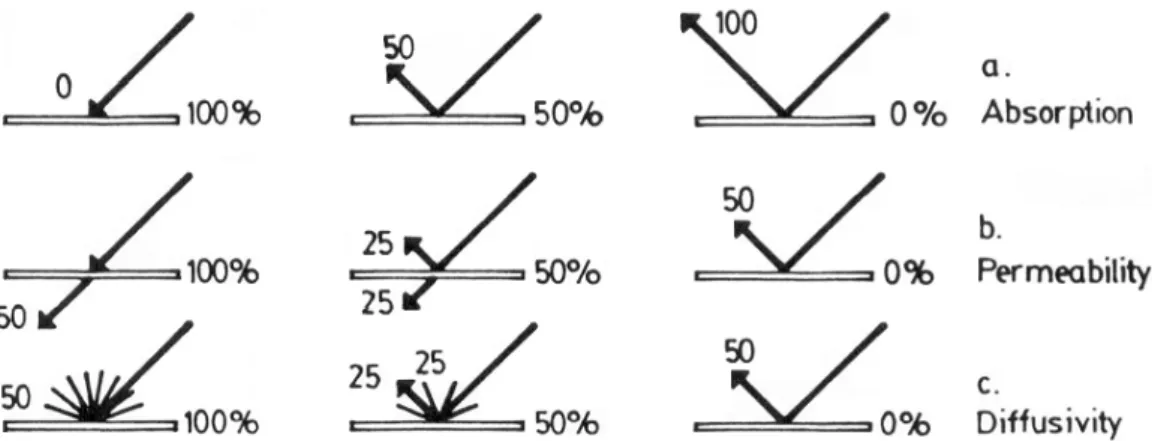
These situations are graphically expressed in Fig. 1. I do not consider the process of light refraction because it is a deviation of light that mainly produces a visual al- teration of the shape, and we are not dealing with this kind of phenomena.
I have exemplified these possibilities by means of the
logic of using extreme situations in the three cases. But we can observe that, in each possibility, both extremes can be linked with a continuum of intermediate cases.
For example, the first situation may vary from a total absorption to a total re-emission by means of intermediate steps with partial percentages of absorption. I call it a vari- ation of absorption.
The second situation may vary from absolutely permeable to absolutely reflective by intermediate steps with partial percentages of permeability. I call it a variation of perme- ability.
The third situation may vary from completely diffuse to completely regular, with intermediate steps of partial per- centages of diffusivity. I call it a variation of diffusivity.
As a result, the three perceptual variables or dimensions of cesia are
Absorption, which refers to the proportion between the quantity of luminous radiation absorbed and the quantity re- emitted by a surface or body. The coefficient of absorption is defined by the division between the absorbed flux and the total incident one:
As the absorbed amount is the incident minus the re-emitted, the same formula can be expressed
This dimension varies between two poles: totally absorb-ent and totally re-emitting, the first being the case of an absolutely black body which theoretically may absorb the 100% of the received radiation (A = 1), the second being the case of the bodies which theoretically may re-emit all the received radiation, i.e., with 0% of absorption (A = 0) [Fig. 2(a)];
Permeability, which refers to the proportion between the radiation transmitted or passing through a body and the radiation being reflected by it, considering only the non-absorbed radiation. The coefficient of permeability is de-fined by the division between the transmitted flux and the re-emitted one,
FIG. 1. Processes followed by light falling over objects. This dimension varies between two poles: permeable and
reflective, the first being the case of transparent and trans- lucent bodies in which theoretically the 100% of the non- absorbed radiation passes through (P = 1), the second being the case of specular, bright, and matte surfaces in which the total amount of nonabsorbed radiation is reflected (0% of permeability, or P = 0) [Fig. 2(b)];
Diffusivity, which refers to the way in which the non- absorbed radiation is re-emitted, whether it be scattered in infinite directions or re-emitted regularly in only one direc- tion. The coefficient of diffusivity is obtained by the division between the diffused flux and the re-emitted one:
d
D = — .
re
In a more complete formula,
d
D = ——— .
i – a
This dimension varies between two poles: diffuse and regular, the first being the case of translucent and matte surfaces, where diffusivity is 100% (D = 1), the second being the case of transparent and specular reflective sur- faces, where diffusivity is 0% (D = 0) [Fig. 2(c)].
I can define now, in more exact terms, the characteristics of surfaces or objects which produce various of the stimuli for visual sensation of cesia. Thus, ideal matte is a 100%
reflective and diffuse surface; specular is 100% reflective and regularly re-emitting; perfect translucent is 100% permeable and diffuse; transparent is 100% permeable and regularly re-emitting. It is necessary to make clear that I am defining ideal types; in practice, values which only ap- proximate in different degrees to the 100% are verified. The qualities of being bright, brilliant, glossy, lustrous, or other, may be described as partially having one or another of the mentioned characteristics. For example, bright is a reflective surface which re-emits light rather more regularly than dif-fusely.
It is important to remark the difference between the stim-uli that produce color sensation and those that are seen as cesias. In the case of color, the stimulus depends on the selection with respect to the wavelength of the radiation. In the case of cesia, the stimulus is due to the way in which the radiation is seen, regardless of its wavelength. In this sense I take color with a narrow meaning. Note that this coincides with the usual terminology in color. When we speak of a certain color we can specify a light red or a dark yellow, a pure vivid red or a grayish one. In these cases the adjectives are thought as belonging to color properties, to such a point that the language has individual words or color names for some of those tones, e.g., pink, brown, scarlet, terracotta, and others. This does not happen when we speak of a transparent, matte, or brilliant color. In such cases the color is thought to be the same and the different
FIG. 2. Variables of cesia. The numbers indicate the percentages in amounts of light radiation. a) Variation of absorption. b) Variation of permeability. c) Variation of diffusivity.
aspects tend to be seen as characteristics belonging to the material but external to color.
Cesia is mainly a visual sensation; it is what we see apart from color, form, and texture. We tend to understand it as a property of a material, but we can note that the same material under different conditions of observation presents different cesias. For instance, a piece of glass seen from the opposite side as the light is incident looks transparent, but if we see it from the same side as the light is coming, it behaves more like a mirror (being the specular reflection intensified as we increase the angle of observation). Stan- dard conditions of observation or measurement need to be established to make cesia be a parameter of classification of appearance of materials.
SOLID OF CESIAS
We can arrange the three variables of cesia in order to make up a model, a conceptual structure which organizes in a continuous way the totality of signs corresponding to the stimuli of cesia. The model takes a three-dimensional solid shape, where each point within it represents a different cesia. While we could construct a maquette with direct samples (for example pieces of glass, which is a very ductile material for getting changes in cesia), in graphic representations we are obliged to use diagrams like those in Fig. 2.
The construction of the solid is as follows:
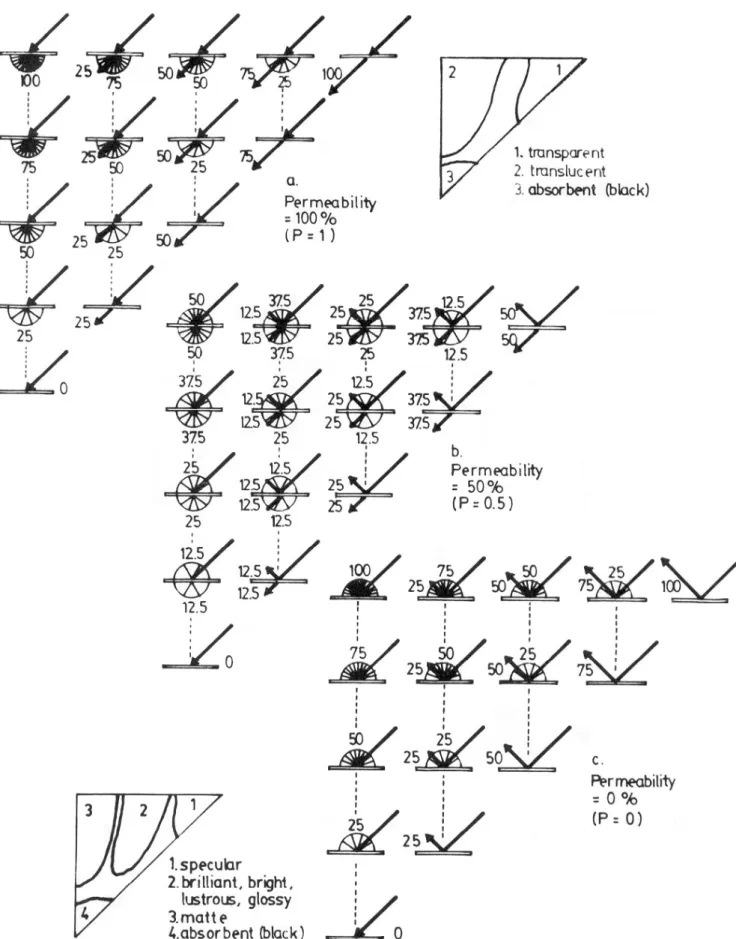
The cesias with constant permeability are organized in triangular planes where diffusivity and absorption vary. In Fig. 3(a), the 100% of nonabsorbed light passes through the material. This may seem confusing because of the fact that we actually see in Fig. 3(a) different absolute amounts of passing radiation. Let me explain this. The difference between the incident radiation (which is taken to be the 100%) and the re-emitted or emerging one (whether it be only one number or the sum of two different radiations) is the absorbed amount. In spite of the different amounts of absorption producing different absolute amounts of passing radiation, in all the cases within this plane the total of nonabsorbed radiation passes. It is in this sense that I say that the permeability is 100% (see definition of permeability) and that it remains constant for the whole plane. In Fig. 3(b) the 50% of nonabsorbed light passes, while the other 50% is reflected, thus, the permeability is constantly equal to 50%. In Fig. 3(c) the total quantity of light is reflected, thus, the permeability is equal to 0% in the whole plane. These planes are only the two opposite cases and an inter- mediate one. Permeability can vary continuously in per- centages from 100% to 0%, or in coefficients from 1 to 0.
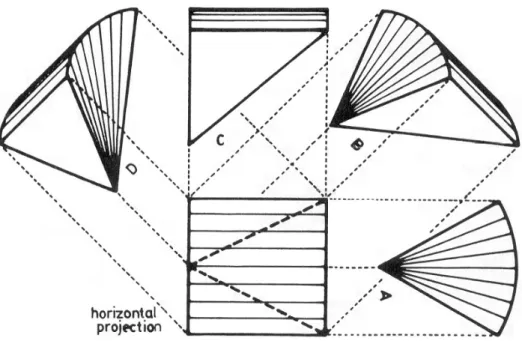
We can observe that there is a point common to all the planes of constant permeability. It is the total absorbent cesia (at the lowest vertex of the triangles). Consequently, it is possible to attach these planes at this point, and the result is a sequence which produces a solid as in Fig. 4.
Within each plane of constant permeability, we find cesias with constant absorption along horizontal lines [Fig. 5(a)] and cesias with constant diffusivity along lines converging to the point of total absorption [Fig. 5(b)].
If we take the horizontal lines of constant absorption for all the planes of constant permeability (each line is at the same distance from the vertex in the different planes), we obtain horizontally curved planes, each one containing ces- ias of constant absorption. Absorption also varies from 100% (total absorption) to 0%, expressing it in percentages, or from 1 to 0, expressing it is coefficients [Fig. 6(b)].
If we take the convergent lines of constant diffusivity for all the planes of constant permeability (each line has the same slope in the different planes), we obtain convergent planes, each one containing cesias of constant diffusivity. Diffusivity also varies in percentages from 100% to 0%, or in coefficients from 1 to 0 [Fig. 6(c)].
These two series of planes and the series of planes of constant permeability [Fig. 6(a)] are the three corresponding to the variables or dimensions adopted for the analysis of cesia.
LOGICAL HARMONIES FOR THE SELECTION
OF CESIAS
With these three variables and their corresponding planes of constancy in the solid, we can formulate certain rules for selecting cesias if we want to keep some “calculated” har- mony in the selection. This is important in design, in the same way as the harmonic selection of colors, spatial de- limitations, and textures is.
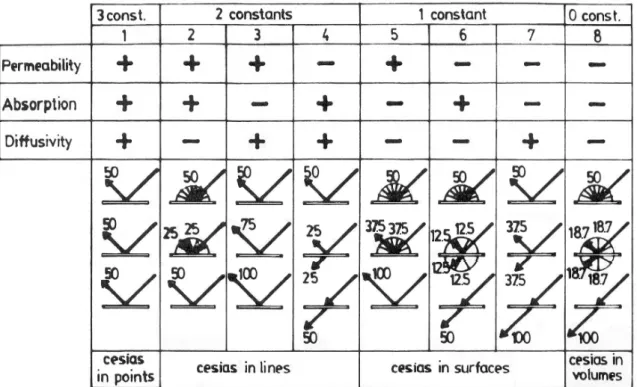
Considering for each one of the three dimensions of cesia (permeability, absorption, and diffusivity) the possibility of being constant (indicated by the sign +) or varying (indi- cated by the sign –), we can make up a matrix of logical relations, as shown in Fig. 7.
In the first case all the dimensions remain constant and the possible selection which exemplifies this formula is a repertory of identical cesias. This is the case if we take three planes of constancy (each one corresponding to one dimen- sion) within the solid of cesia. The intersection of these three planes is a point, and in a point we have only one and the same cesia [Fig. 8 (a)].
From the second to the fourth cases, we keep two di- mensions constant while the third varies. The possible dif- ferent formulas are three and the corresponding examples of repertories of cesias are exemplified below each one in Fig. 7. These are the cases if we take pairs of planes of constancy within the solid. The intersections are lines, and in a line we have a continuum of cesias, and only one dimension varies [Fig. 8(b); see also Fig. 5].
From the fifth to the seventh cases we keep only one dimension constant while the other two vary. Once again we obtain three formulas and possible repertories (Fig. 7). This is the case if we take cesias from individual planes of constancy within the solid [Fig. 8(c)].
Finally, the eighth case is that in which the three dimen- sions vary (Fig. 7). In this case we are selecting cesias throughout the whole solid or in a three-dimensional space within it [Figure 8(d)].
FIG. 3. Development and variation of cesias within planes keeping constancy of permeability. a) Plane of constant permeability (100% or 1). The small figure indicates approximately the place for transparent, translucent, and absorbent cesias. b) Plane of constant permeability (50% or 0.5). c) Plane of constant permeability (0% or 0). The small figure indicates approximately the place for specular, brilliant, bright, lustrous, glossy, matte, and absorbent cesias.
FIG. 4. Solid of cesias: Horizontal projection and vertical ones from different points of view (A, B, C, D).
FIG. 5. Sequence of lines of constancy within a plane of constant permeability. a) Each line is the place for cesias with constant absorption (and permeability). b) Each line is the place for cesias with constant diffusivity (and permeability).
FIG. 7. Matrix of logical relations or the selection of cesias from the solid. Each formula indicates the dimensions remaining constant (+) and varying (–).
FIG. 8. The eight logical relations exemplified in the solid by a point, lines, surfaces, or the whole volume. a) Intersection of three planes. Selection of only one and the same cesia placed in a point (with three constant dimensions). b) Intersection of two planes. Selection of cesias placed along lines (with two constant dimensions). c) Individual planes of constancy. Selection of cesias placed on the corresponding surfaces (with one constant dimension). d) Selection of cesias from the whole volume (with no constant dimension).
delimitation,21 and also used in order to control the har-
monies of color. In addition, I applied it to the selection of configurations (groups of related figures) in spatial delim- itation,22 to the selection of textures,23 and cesias.
The matrix sets the selections in an orderly manner, pro- ducing harmonies going from the absolute constancy or “monotony” (first formula) to the major possible variability
Volume 16, Number 4, August 1991
(matte) (specular)
0/0/1 0/0/0.75 0/0/0.5 0/0/0.25 0/0/0 0/0.25/1 0/0.25/0.66 0/0.25/0.33 0/0.25/0
0/0.5/1 0/0.5/0.5 0/0.5/0 0/0.75/1 0/0.75/0
/1/ Permeability = 0
(absorbent)
0.25/0/1 0.25/0/0.75 0.25/0/0.5 0.25/0/0.25 0.25/0/0 0.25/0.25/1 0.25/0.25/0.66 0.25/0.25/0.33 0.25/0.25/0
0.25/0.5/1 0.25/0.5/0.5 0.25/0.5/0 0.25/0.75/1 0.25/0.75/0
/1/ Permeability = 0.25
(absorbent)
0.5/0/1 0.5/0/0.75 0.5/0/0.5 0.5/0/0.25 0.5/0/0 0.5/0.25/1 0.5/0.25/0.66 0.5/0.25/0.33 0.5/0.25/0
0.5/0.5/1 0.5/0.5/0.5 0.5/0.5/0 0.5/0.75/1 0.5/0.75/0
/1/ Permeability = 0.5
(absorbent)
0.75/0/1 0.75/0/0.75 0.75/0/0.5 0.75/0/0.25 0.75/0/0 0.75/0.25/1 0.75/0.25/0.66 0.75/0.25/0.33 0.75/0.25/0
0.75/0.5/1 0.75/0.5/0.5 0.75/0.5/0 0.75/0.75/1 0.75/0.75/0
/1/ Permeability = 0.75
(absorbent)
(translucent) (transparent)
1/0/1/ 1/0/0.75 1/0/0.5 1/0/0.25 1/0/0 1/0.25/1 1/0.25/0.66 1/0.25/0.33 1/0.25/0
1/0.5/1 1/0.5/0.5 1/0.5/0 1/0.75/1 1/0.75/0
/1/ Permeability = 1
(absorbent)
TABLE I. Notation system for cesias. Each formula expresses the coefficients of: Permeability/Absorption/Diffusivity. Formulas are positioned in this table as cesias are in the solid (cf. Fig. 3).
etc.) within the solid. In such a case we obtain cesias which vary following that rule, having certain grade of constancy in the variation. The constancy (in this case) refers to the steps or degrees in which the variation is produced.
Harmonic rules regarding cesia can be used in design when selecting materials or specifying surface finishing of them.
1. The book by David Katz is Der Aufbau der Farbwelt, 1911. It has been published in England as The World of Colour, Kegan, Paul, Trench, Trubner, London, 1935. The book by the Optical Society of America-Committee on Colorimetry is The Science of Color, Crowell, New York, 1953.
2. Ralph M. Evans, The Perception of Color, Wiley, New York, 1974, p.90.
3. Sven Hesselgren, The Language of Architecture, Studentlitteratur, Lund, Sweden, 1967, p. 50.
4. Ref. 3, p. 53.
5. Arthur Pope, The Language of Drawing and Painting, Harvard Uni-versity Press, Cambridge, 1949, p. 28.
6. Ref. 2, p. 156. 7. Ref. 2, p. 94. 8. Ref. 2, p. 35. 9. Ref. 2, p. 86. 10. Ref. 2, p. 236.
11. César V. Jannello, Texture as a Visual Phenomenon, Archit. Des. 33, 394-396 (1963).
12. César V. Jannello, Fundamentos de Teoría de la Delimitación, FAU, Universidad de Buenos Aires, 1984. Page citations in this article refer to this Spanish edition. Also in French: “Fondemets pour une Théorie de la Delimitation”, in Semiotic Theory and Practice: Proceedings of the Third International Congress of the IASS (International Association for Semiotic Studies), Palermo 1984, M. Herzfeld and L. Melazzo (Eds.), Mouton de Gruyter, Berlin, 1988. The phrase “spatial delim-itation” intends to avoid the polysemy of the word “form.” When this last term refers to spatial shapes, or surfaces and volumes as defined by their boundaries, both expressions can be used interchangeably. 13. Claudio F. Guerri, “Arquitectura, Diseño y Teoría de la Delimitación
Espacial,” paper presented at the I Coloquio Internacional Latino-americano de Semiótica, Paris 1986. See also: “Aportes Sistemáticos a una Teoría del Diseño,” in Proceedings of the Eleventh CLEFA,
Universidad de Morón, Argentina, 1985; and “Architectural Design, and Space Semiotics in Argentina,” in The Semiotic Web 1987, T. A.
THE NOTATION FOR CESIAS
This system is proposed to be used either by means of visual estimation of the variables, or by measure and determination of the corresponding coefficients of permeability, absorp- tion, and diffusivity for a given material under specified conditions. It may be of benefit for the designer who need to specify a determined visual appearance, to have an atlas of cesias (which is yet to be materially constructed) as ref- erence for visual matching. Furthermore, he can use a no- tation involving the coefficients of the three variables.
Table I shows the notation system for cesias by means of the values of Permeability / Absorption / Diffusivity. The table is arranged according to the atlas in planes of constant permeability. Planes of permeability = 0.25 and perme- ability = 0.75 have been added in relation to Fig. 3. How- ever, this notation defines cesias independently from ref- erence to the position of cesias in the atlas, i.e., we do not need to know the position to have an idea of what the formula is expressing. This does not happen with Munsell notation for color, where numbers assigned to hue, value, and chroma are a convention regarding the position of colors in the atlas.24
FINAL CONSIDERATIONS
By means of this system —besides color, texture, and spatial delimitation systems— visual characteristics of designed products may be consciously controlled using predetermined harmonic rules. Different materials, such as plastics, glass, metals (which may cover a certain range of cesias) might be industrially produced to offer orderly and homogeneous sets of cesias.
The notation may have useful applications. As words to designate cesia sensations are scarce and ambiguous in most cases, specification of visual qualities is facilitated by the notation. It provides a different and univocal simple formula for each of the infinite cesias. This may be used also in industry to set specific tolerances.
Artists and designers may feel that systems of this kind work against spontaneity, freedom, or inspiration. This is a completely erroneous way of thinking. A system like this, the color systems, or the similar ones for spatial de- limitation or texture, contain, at least in abstract, the complete universe of possibilities. The theoretical models or solids contain all the signs we can use. The matrix of logical relations considers all the selections we can make; there is no one which does not fall into one of the for-mulas. In addition, for spatial delimitation we have de- veloped a model organizing all the possible combinations
Volume 16, Number 4, August 1991
between two figures.25 In this sense these systems do not
restrict freedom; all the choices are there. There is noth-ing to lose knownoth-ing them and, on the other hand, there is something to gain: the more we know the more our mind is open to new possibilities. Thus, inspiration may be stimulated to increase.
In regard not only to cesia, but to the four visual systems of the theory of pure design and their relations, I take them in two groups depending on some common features:
Color and cesia, on one hand, concern mainly the per-ception of light. Even if they need space (a surface or a volume) to be developed, spatial changes do not affect them intrinsically. Spatial delimitation and texture, on the other hand, concern mainly the perception of space. Their vari-ables or dimensions have necessity of space in order to be developed. Even if they need light to be seen, light does not produce intrinsic changes onto them.
Color and cesia are purely visual categories. We cannot perceive them by means of any other sense. Spatial delim-itation and texture may also be, when presented volumet-rically, perceived by touch.
Sebeok and J. Umiker-Sebeok (Eds.), Mouton de Gruyter, Berlin, 1988, pp. 389-419.
14. Ref. 12.
15. The objective (and also the title) of the research program is the elab-oration of a knowledge for the construction of systems of norms, for teaching and projective practice, in the field of architecture, graphic, and industrial design. It is carried out in the Secretaria de Investigación y Posgrado at the Facultad de Arquitectura. Diseño y Urbanismo of the Universidad de Buenos Aires.
16. José Luis Caivano and Claudio F. Guerri. “Arquitectura, Diseño y Teoría de la Delimitación Espacial,” paper presented at the I Congreso de la Asociación Argentina de Semiótica, La Plata, 1986. 17. José Luis Caivano, “Visual Texture as a Semiotic System,” Semiotica
(Journal of the IASS) 80-3/4, 239-252 (1990).
18. I have to mention also Ruben A. Gramón. Martín Fernández Meijide, Liliana Gutiérrez, Ladys Baldelli, among others.
19. José Luis Caivano, “Coincidences in the Syntactics of Diverse Systems of Signs Used In Architecture, Visual Arts, and Music,” paper pre-
sented at the Fourteenth Meeting of the Semiotic Society of America, Indianapolis, 1989. In Semiotics 1989 (proceedings of the meeting), J. Deely, K. Haworth, and T. Prewitt (Eds.), University Press of America, Lanham, 1990, pp. 175-184.
20. I am indebted to Roberto Daniel Lozano, whose suggestions induced me to adjust the terminology. His book, El Color y su Medición,
Americalee, Buenos Aires, 1978, is perhaps the most complete one published in Spanish on the science of color.
21. Ref. 12, p. 5. 22. Ref. 16, p. 13. 23. Ref. 17, p. 248.
24. Albert H. Munsell, A Color Notation, 1905, Munsell Color Company, Baltimore, Maryland, 1946, pp. 20-22.
25. Ref. 16, pp 4-5, 10-13.