Isocyano-triphenylene complexes of gold, copper, silver and platinum.
Coordination features and mesomorphic behavior
Rubén Chico,a Cristina Domínguez, a,b Bertrand Donnio,b Benoît Heinrich,bSilverio Coco,*a and Pablo Espinet.*a
a IU CINQUIMA/Química Inorgánica, Facultad de Ciencias, Universidad de Valladolid, 47071
Valladolid, Castilla y León, Spain. b Institut de Physique et Chimie des Matériaux de Strasbourg (IPCMS), UMR 7504 (CNRS-Université de Strasbourg), F-67034 Strasbourg Cedex 2, France.
Stable organometallic complexes [AuX(CN-TriPh)] [X = Cl, C6F5, C10H21), C6F4O-(R)-2-octyl)], [(µ-4,4’-C6F4C6F4){Au(CN-TriPh)}2], [AuX(CN-TriPh)], [CuCl(CN-TriPh)],
trans-[PtI2(CN-TriPh)2] and [Ag(CN-TriPh)2]BF4, bearing the previously unreported triphenylene-isocyanide ligand 1-isocyano-2,3,6,7,10,11-hexadodecyloxytriphenylene ( CN-TriPh), have been synthesized. The coordination features of the metal ion determine their thermal behavior. The free isocyanide ligand and all of the monomeric gold derivatives display enantiotropic mesomorphic behavior over a wide range of temperature (from 5 to 220 ºC), while the copper complex, with the same stoichiometry but not isostructural with the gold complexes, melts directly to an isotropic liquid. The bis-isocyanide platinum and silver complexes also melt directly to an isotropic liquid at low temperatures. In this case, the two trans coordinated isocyanide ligands, connected by a too short linker, cannot become coplanar, which prevents the formation of a mesogenic structure. On the contrary, in the dinuclear gold complex the two isocyanide trans ligands are, due to the long Au-C6F4-C6F4-Au bridge, sufficiently separated to become coplanar and this complex gives rise to a mesophase. The structures of the mesophases were determined by small-angle X-ray scattering. All materials prepared show a fluorescent emission centered on the triphenylene core.
Isocyano-triphenylene complexes of gold, copper, silver and platinum.
Coordination features and mesomorphic behavior
Rubén Chico,a Cristina Domínguez, a,b Bertrand Donnio,b Benoît Heinrich,bSilverio Coco,*a and Pablo Espinet.*a
a IU CINQUIMA/Química Inorgánica, Facultad de Ciencias, Universidad de Valladolid, 47071 Valladolid, Castilla y León, Spain. b Institut de Physique et Chimie des Matériaux de Strasbourg (IPCMS), UMR 7504 (CNRS-Université de Strasbourg), 23 rue du Loess, BP 43, F-67034 Strasbourg Cedex 2 (France).
* e-mail: [email protected]; [email protected]
ABSTRACT
Stable organometallic complexes [AuX(CN-TriPh)] [X = Cl, C6F5, C10H21), C6F4O-(R)-2-octyl)], [(µ-4,4’-C6F4C6F4){Au(CN-TriPh)}2], [AuX(CN-TriPh)], [CuCl(CN-TriPh)],
INTRODUCTION
Columnar discotic liquid crystals are functional materials with great potential for application in electronic devices, such as photovoltaic cells, light emitting diodes, or field effect transistors.1,2,3,4,5,6,7,8 These devices require high charge-carrier mobility for operation, and columnar liquid-crystalline materials displaying high charge-carrier mobility along their columnar stacks are particularly attractive for this purpose.1,9,10,11,12 The transfer efficiency depends on the nature and intensity of the intermolecular interactions that maintain the molecular stacks order over long ranges in the columnar structure. Understanding the dynamics and microscopic phase behavior of columnar discotics at the molecular scale is not simple, but it is fundamental for a rational design of new systems and devices with the desired functionality.
central column displays Pt···Pt interactions, which are the origin of the enhanced luminescence and are also responsible for the great stabilization of the mesomorphism.25
In the complexes mentioned above the isocyanide group is located at the end of one of the alkoxy chains, so that the triphenylene core and the metallic fragments bonded to the isocyanide group are far apart and electronically disconnected. There are also reports where various electron-withdrawing/donating side groups, such as nitro and amino groups,26,27,28,29 cyano group,30 halides,31,32 and alkyl/alkoxy fragments,33,34 have been covalently bonded directly to the triphenylene core. The change and the redistribution of the electron density across the aromatic skeleton in these systems, and the consequent change of molecular interactions, modifies markedly the range of existence of the mesophases.28,35,36 An interesting variation of these two kinds of triphenylene systems is to connect the metal fragment to the triphenylene core using a short conjugated linker. The isocyanide group is an efficient linker, and we are reporting here the synthesis of the previously unreported 1-isocyano-2,3,6,7,10,11-hexadodecyloxytriphenylene (CN-TriPh) ligand and its stable isocyanide-triphenylene metal complexes with gold(I), copper(I), silver(I) and platinum(II), and verify how the supramolecular structure and the properties of the original organic system change. The coordination and geometrical features of the metal moiety determine the very different mesomorphic behavior of the materials. The copper, silver and platinum complexes melt directly into an isotropic liquid, but the free isocyanide and all their gold derivatives display enantiotropic columnar mesophases over a wide temperature range. All complexes prepared are fluorescent materials.
RESULTS AND DISCUSSION
Synthesis and Characterization
isocyanides (Scheme 1).37 The metal complexes were prepared by reaction of CN-TriPh with the corresponding metal precursors, as shown in Scheme 1. C, H, N analyses, yields, and relevant IR and NMR characterization data are given in the experimental part (SI).
Scheme 1. Synthesis of 1-isocyano-2,3,6,7,10,11-hexadodecyloxytriphenylene (CN-TriPh)
and the gold(I), 1-4,6, copper(I), 5, silver(I), 8, and Pt(II), 7, complexes. i: Sn, CH3CO2H; ii: HCO2H, toluene, reflux; iii: triphosgene, NEt3, CH2Cl2.
R R R R R R NO2 R R R R R R NH2 R R R R R R H N C O H R R R R R R N C
i ii iii
R = OC12H25 (CN-TriPh)
[AuX(tht)] or CuCl
R R
R R
R R
NC MX AuCl (1) AuC6F5(2)
AuC6F4OC10H21(3)
AuC6F4-O-(R)-2-octyl (4)
CuCl (5)
MX
[Au(C6F4C6F4)(tht)2]
R R R R R R NC Au F Au F F F F F F F R R R R R R CN R R R R R R NC Pt R R R R R R CN [PtCl2(tht)2]
I
I
+
BF4
-R R R R R R NC Ag R R R R R R CN [AgBF4]
The IR spectra of 1-8 show one ν(C≡N) absorption for the isocyanide group. As expected,38 it appears at higher wavenumbers than in the free ligand CN-TriPh, by about 90 cm-1 for the AuI complexes, 74 cm-1 for the AgI derivative, 66 cm-1 for the PtII complex and 30 cm-1 for the CuI compound.The observation of one ν(C≡N) IR absorption for 7 supports a trans arrangement of the isocyanide ligands.39
All the 1H NMR spectra are very similar and display five peaks in the aromatic region, corresponding to the protons situated in the bay positions. The rupture of symmetry produced by incorporation of the isocyanide group and the metallic fragments, makes these protons non-equivalent. The protons of the -OCH2- fragment appear at 4.2 ppm and the rest of the protons of the alkyl chains in the range 1.94-0.88 ppm.
The 19F NMR spectra of the fluorophenyl complexes show the typical patterns of the corresponding fluorophenyl group: three resonances from an AA’MXX’ spin system for the C6F5 derivative;40 two somewhat distorted pseudodoublets from a AA'XX' spin system, with JAA’ ≈ JXX’ for the tetrafluorophenyl complexes;41 and two complex multiplets at 117.37 ppm and -140.48 ppm, corresponding to the ortho and the meta fluorine atoms of the two AA'XX' spin systems, for the 4,4'-octafluorobiphenyl compound.42
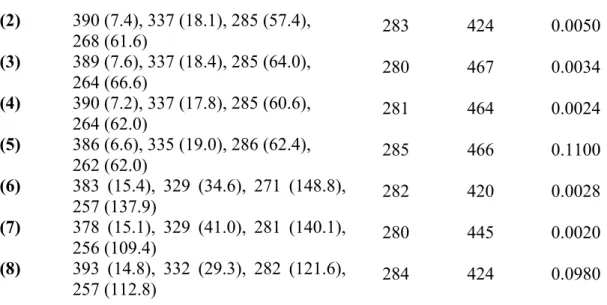
The UV-Vis absorption and fluorescence spectra of the free isocyanide and the metal complexes in dichloromethane solution are summarized in Table 1.
Table 1. UV-Visible and luminescence data for the free isocyanide, and for their metal complexes, in dichloromethane solution at 298 K (10-5 M).
Compd. λ (nm) (ε/103 (M-1 cm-1) λex/nm λem/nm Φf (x10-3)
(CN-TriPh) 375 (0.1), 320 (23.6), 284 (85.8), 255 (37.1)
283 421 0.2800
(1) 388 (9.7), 337 (22.3), 287 (65.8),
(2) 390 (7.4), 337 (18.1), 285 (57.4),
268 (61.6) 283 424 0.0050
(3) 389 (7.6), 337 (18.4), 285 (64.0),
264 (66.6) 280 467 0.0034
(4) 390 (7.2), 337 (17.8), 285 (60.6),
264 (62.0) 281 464 0.0024
(5) 386 (6.6), 335 (19.0), 286 (62.4),
262 (62.0) 285 466 0.1100
(6) 383 (15.4), 329 (34.6), 271 (148.8),
257 (137.9) 282 420 0.0028
(7) 378 (15.1), 329 (41.0), 281 (140.1),
256 (109.4) 280 445 0.0020
(8) 393 (14.8), 332 (29.3), 282 (121.6),
257 (112.8) 284 424 0.0980
The UV-Vis absorption spectrum of the free isocyanide ligand shows a very structured spectral pattern, with typical absorption bands and extinction coefficients (Figure 1) that are assigned as triphenylene π-π* transitions.43,44 The coordination of the isocyanide to the metal centers produces, in general, wider bands (Figure 1). These changes may arise from the decrease in symmetry and from the loss of planarity induced by the substituents in bay positions, generated upon coordination.45
The fluorescence data for the free isocyanide and the metal complexes are listed in Table 3. The free isocyanide and the metal complexes are luminescent at room temperature in dichloromethane solution. As for the electronic spectra, all the emission spectra are similar, with the maximum in the range 421-467 nm (Figure 2), typical of fluorescent 2,3,6,7,10,11-hexaalkoxytriphenylenes.43,44 The quantum yields for the metal complexes, Φ, measured in dichloromethane solution at room temperature,46 are considerably lower than for the free isocyanide ligand (Figure 2). It is probable that the presence of the metallic fragment (heavy atom effect) enhances non-radiative deactivation processes. In the solid state, the luminescence of these derivatives is lost, as reported for hexaalkoxytriphenylenes.43,44
Figure 2. Excitation and emission spectra of the free isocyanide and the complex [Au(C6F5)(CN-TriPh)] (2).
Thermal behavior and self-organization properties
complexes. The disappearance of the mesomorphic properties presumably originates from the modified geometry: gold ion leads to linear mononuclear derivatives, but copper(I) produces polynuclear complexes [CuX(CNR)]n .47,48
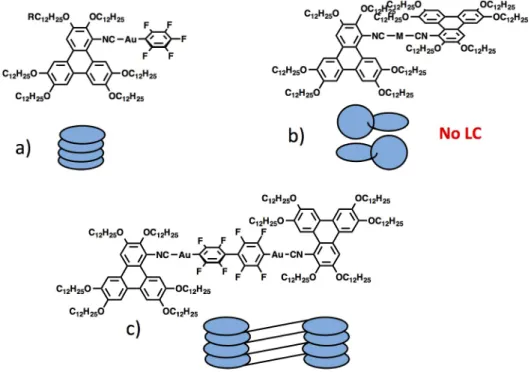
The monomeric trans-[PtI2(CN-TriPh)2] (7) and [Ag(CN-TriPh)2]BF4 (8) complexes also melt directly to an isotropic liquid at 47-48 ºC. In this case, it is obvious that the two isocyanide ligands, at the separation distance, would collide if they had to become coplanar. For this reason the two discotic fragments have to avoid this spatial conflict and their mean planes arrange twisted relative to each other, loosing the overall discotic shape (Figure 3a,b). In contrast, in the dimeric gold complex (6), due to the long Au-C6F4-C6F4-Au bridge, the two isocyanide trans
ligands are sufficiently separated to become coplanar and this complex gives rise to a columnar mesophase, and a nematic one at higher temperature (Figure 3c).
Figure 3. Schematic representation of molecular packing of triphenylene derivatives.
Compound Transitiona Temperatureb (oC)
ΔHb
(kJmol-1)
Isocyanide (CN-TriPh) Cr → Colhex
Colhex→ I
37
130 58.7 8.6 [AuCl(CN-TriPh)] (1) Cr → Colhex
Colhex→ I
5
220 29.8 10.9 [Au(C6F5)(CN-TriPh)] (2) Cr → Colhex
Colhex→ I
7
204 38.2 12.3 [Au(C6F4O-C10H21)(CN-TriPh)] (3) Cr → Colhex
Colhex→ I
7 206
33.4 9.6 [Au(C6F4O-(R)-2-octyl)(CN-TriPh)] (4) Cr → Colhex
Colhex→ I
6 207
37.3 13.9
[CuCl(CN-TriPh)] (5) Cr → I 80 31.9
[(µ-4,4’-C6F4C6F4){Au(CN-TriPh)}2](6) Cr → Colrec
Colrec → N
N→ I
102 122 172 7.5 8.9 0.6
trans-[PtI2(CN-TriPh)2] (7) Cr → Cr’
Cr → I
30
47 14.1 15.1
[Ag(CN-TriPh)2]BF4 (8) Cr → I 48 47.7
a Cr, Cr’ crystal phases; Col
hex, hexagonal columnar mesophase; Colrec, rectangular columnar mesophase;
N, nematic mesophase; I, isotropic liquid;. b Data collected from the second heating DSC cycle. The
transition temperatures are given as peak onsets. c Data from the second heating scan.
As reported for most α-substituted 2,3,6,7,10,11-hexakis(dodecyloxy)triphenylenes,26,34 a
hexagonal columnar phase (Colhex) is generated for 1-isocyano-2,3,6,7,10,11-hexadodecyloxytriphenylene at 37 ºC, and at the remarkably lower temperatures 4-7 ºC for the corresponding mononuclear gold organometallic complexes, [AuX(CN-TriPh)] (1-4). A Colrec phase at 102 ºC, and a nematic phase at 122 ºC, are observed for the dimetallic compound [(µ
-4,4’-C6F4C6F4){Au(CN-TriPh)}2] (6).
reversible and reproducible on subsequent heat/cool cycles. The transition temperatures deduced by POM were in good accordance with those obtained from DSC measurements (Table 2 and Figure 4).
Figure 4. Optical polarising microscopy photographs (x 100) of (a) CN-TriPh at 120°C on cooling from the isotropic phase; b) [AuCl(CN-TriPh)] at 217°C on cooling from the isotropic phase, c) [(µ-4,4’-C6F4C6F4){Au(CN-TriPh)}2]), first heating cycle at 135ºC; d) [(µ
-4,4’-C6F4C6F4){Au(CN-TriPh)}2]), on cooling at 150ºC. Crossed polarisers.
extends dramatically the mesomorphous temperature ranges (from 93 °C in the ligand to 195-215 °C in the monomeric complexes). The monomeric complexes 1-4 preserve the mean cylindrical shape of the columns and the Colhex phase, while the dimeric complex 6 deviates from the purely discotic architecture. The mesomorphism is nevertheless still observed for 6, but in combination with a symmetry break from hexagonal to rectangular, yielding a Colrec phase. Moreover, the early disappearance of the columnar lattice at around 120 °C is observed, giving rise to a nematic phase, with a range of existence of ca. 50 °C, which preserves the common preferential orientation of the columns. Apparently connecting the two-triphenylene units by a rigid bridge intruduces some hindrance to the formation of columns in the mesophase, as previously reported for structurally related triphenylene derivatives.49 Finally, the gold dimer 6 also shows a shorter liquid crystal range because of its higher melting point (102 ºC) compared to the gold monomers. This higher melting point is related to the contribution of the elongated rigid central part of the molecules to higher cohesion in the crystalline state, as reported for calamitic octafluorobiphenyl liquid crystals.50,51
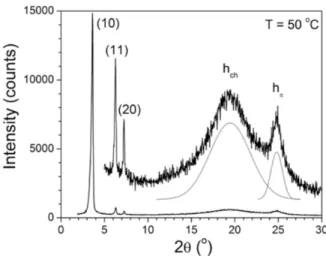
good segregation between the discotic cores including the metal ion with the aliphatic continuum. In the large-angle range, a very strong scattering halo spreading between ca. 3.5 and 5.5 Å (intensity maximum at about 4.4-4.6 Å) was observed, corresponding to the overlapping of different, undifferentiated, lateral distances between the protruding fragments and molten aliphatic tails (hfr+hch, Table 3), and a relatively sharp and intense signal at larger angle with a maximum at ca. 3.5-3.6 Å, corresponding to the orthogonal stacking of triphenylene cores (hπ)
Figure 5. SAXS pattern of CN-TriPh recorded in the Colhex phase (T = 50 °C)
Figure 6. SAXS pattern of [AuCl(CN-TriPh)] recorded in the Colhex phase (T = 50 °C).
For the bimetallic compound, the X-ray patterns of the lower temperature phase, recorded between 90 and 120 °C (and down to 70 °C on cooling), and assigned to Colrec, reveals 11 small-angle reflections (Table 2, Figure SI) that could be indexed according to a non-centered rectangular p2gg lattice. The ratio between the estimated molecular volume versus the area of the cell (Z = 2) provides a value for hmol of ca. 3.8 Å, close to hπ ≈ 3.5 Å, which is also consistent
further suggests that the phase has a strong lamello-columnar character, particularly on account of the presence of several intense, even lamellar orders (h0, h = 2n) and the concomitant absence of (0k) reflections. It can thus be deduced that sub-layers of high electronic density (conjugated aromatic moieties) and aliphatic sub-layers alternate periodically along the a-lattice parameter of the rectangular cell, and that the electron density contrast is annihilated along the b-parameter by the presence of biphenylene bridges connecting columns of triphenylenes (Figure 7). This rigid connection from the side of the triphenylenes also explains the mesophases broken symmetry with respect to a centered lattice of planar group c2mm, manifested by the presence of only two reflections of low intensity ((21) and (41); h+k=2n+1).
The interconnection of the columns into continuous lamella leads to the distribution of the bridges on either side of the columns and permits to avoid steric constraints of their largest section (ca 27.5 Å2, i.e. with an average spacing between biphenylenes of ca 5.0 Å). Such a distribution of the bridges seems nevertheless logical and expected as it optimizes the segregation between the various molecular fragments. However, the stacking of the triphenylenes is greatly perturbed by this arrangement, as evidenced by the greatly enlarged and barely visible signal corresponding to the stacking (hπ).
In the nematic phase, formed above 120 ºC, the maximum of the diffuse signal is no longer visible at the position of the hπ signal. However, the asymmetrical profile of the overall
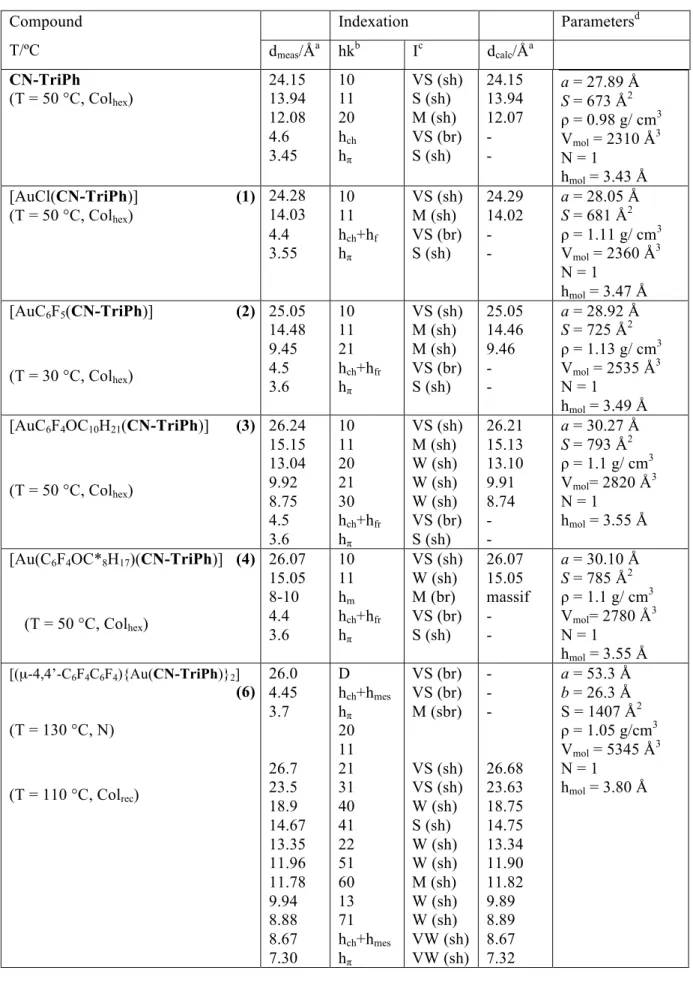
Table 3. Mesophase indexation and parameters. Compound
T/ºC
Indexation Parametersd
dmeas/Åa hkb Ic dcalc/Åa
CN-TriPh
(T = 50 °C, Colhex)
24.15 13.94 12.08 4.6 3.45 10 11 20 hch hπ VS (sh) S (sh) M (sh) VS (br) S (sh) 24.15 13.94 12.07 - -
a = 27.89 Å
S = 673 Å2 ρ = 0.98 g/ cm3
Vmol = 2310 Å3
N = 1 hmol = 3.43 Å
[AuCl(CN-TriPh)] (1)
(T = 50 °C, Colhex)
24.28 14.03 4.4 3.55 10 11 hch+hf
hπ VS (sh) M (sh) VS (br) S (sh) 24.29 14.02 - -
a = 28.05 Å
S = 681 Å2 ρ = 1.11 g/ cm3
Vmol = 2360 Å3
N = 1 hmol = 3.47 Å
[AuC6F5(CN-TriPh)] (2)
(T = 30 °C, Colhex)
25.05 14.48 9.45 4.5 3.6 10 11 21 hch+hfr
hπ VS (sh) M (sh) M (sh) VS (br) S (sh) 25.05 14.46 9.46 - -
a = 28.92 Å
S = 725 Å2 ρ = 1.13 g/ cm3 Vmol = 2535 Å3
N = 1 hmol = 3.49 Å
[AuC6F4OC10H21(CN-TriPh)] (3)
(T = 50 °C, Colhex)
26.24 15.15 13.04 9.92 8.75 4.5 3.6 10 11 20 21 30 hch+hfr
hπ VS (sh) M (sh) W (sh) W (sh) W (sh) VS (br) S (sh) 26.21 15.13 13.10 9.91 8.74 - -
a = 30.27 Å
S = 793 Å2 ρ = 1.1 g/ cm3
Vmol= 2820 Å3
N = 1 hmol = 3.55 Å
[Au(C6F4OC*8H17)(CN-TriPh)] (4)
(T = 50 °C, Colhex)
26.07 15.05 8-10 4.4 3.6 10 11 hm
hch+hfr
hπ VS (sh) W (sh) M (br) VS (br) S (sh) 26.07 15.05 massif - -
a = 30.10 Å
S = 785 Å2 ρ = 1.1 g/ cm3 Vmol= 2780 Å3
N = 1 hmol = 3.55 Å [(µ-4,4’-C6F4C6F4){Au(CN-TriPh)}2]
(6)
(T = 130 °C, N)
(T = 110 °C, Colrec)
26.0 4.45 3.7 26.7 23.5 18.9 14.67 13.35 11.96 11.78 9.94 8.88 8.67 7.30 D hch+hmes
hπ 20 11 21 31 40 41 22 51 60 13 71 hch+hmes
hπ VS (br) VS (br) M (sbr) VS (sh) VS (sh) W (sh) S (sh) W (sh) W (sh) M (sh) W (sh) W (sh) VW (sh) VW (sh) - - - 26.68 23.63 18.75 14.75 13.34 11.90 11.82 9.89 8.89 8.67 7.32
a = 53.3 Å
b = 26.3 Å S = 1407 Å2 ρ = 1.05 g/cm3
Vmol = 5345 Å3
4.45 3.7
VS (br) M (sh)
- -
Abbreviations: Colhex = hexagonal columnar phase; Colrec = rectangular columnar phase; N = nematic phase. admeas and dcalc are the measured and calculated diffraction spacings, respectively (dcalc is deduced from the following mathematical expression: a = 2x∑[dhk(h2+k2+hk)1/2(Nhk√3)-1], where Nhk is the number of hk reflections for the Colhex phase and from dhk = 1/[(h2/a2 + k2/b2)1/2] for the Colrec phase). bhk are the Miller indices of the reflections. hch, hch+hfr, hch+hmes corresponds to the maximum of the diffuse scattering due to lateral distances between molten aliphatic tails (ch), metallic fragments (fr) and mesogenic bridge (mes); hπ corresponds to the stacking periodicity
between triphenylene cores. cI is the relative intensity of the reflections (VS, very strong; S, strong; M, medium; W, weak; br and sh stand for broad and sharp signal). da is the lattice parameter of the Colhex phase and a and b the lattice parameters of the Colrec phase. Z is the number of columns per lattice, and S is the columnar cross-sectional area (S =2a(3)-1/2 for Colhex , Z = 1, and a×b for Colrec, Z = 2). Vmol is the molecular volume and ρ the density, and hmol = Vmol/S is the molecular thickness (N=1).
Figure 7. Schematic model of the Colhex and Colrec mesophases formed by the gold complexes (for representative complexes 2 and 6). For Colhex, random orientation of the side groups around the nodes of the hexagonal lattice preserve the hexagonal symmetry. Aliphatic chains occupying the white zones are not shown for clarity.
CONCLUSIONS
CN-TriPh)] and [Ag(CN-TriPh)2]BF4 offer diverse mesomorphism conditioned by the metal fragments. These influence the electronic interactions of the discotic triphenylene moiety, and also the intramolecular availability or restriction to arrange coplanar the triphenylene groups, when more than one is present in the molecule. Again, substituted triphenylene systems provide a powerful and versatile support to metal-containing molecular fragments, enabling to prepare columnar fluid multifunctional materials with metal-containing fragments directly connected to the triphenylene core. All the materials prepared show a fluorescent emission centered on the triphenylene group, which is lost in the solid and the mesomorphic states.
SUPPORTING INFORMATION
Materials and methods. Full details of synthetic methods, spectroscopic data and analytical data for the new compounds. Additional SAXS patterns
ACKNOWLEDGMENTS
This work was sponsored by the Ministerio de Ciencia e Innovación (Project CTQ2014-52796-P) and the Junta de Castilla y León (Project VA302U13). BD and BH thank CNRS and the University of Strasbourg for support.
REFERENCES
1 Kaafarani, B. R. Chem. Mater. 2011, 378−396.
2 Pisula, W.; Zorn, M.; Chang, J. C.; Müllen, K.; Zentel, R. Macromol. Rapid Commun.
2009, 30, 1179−1202.
3 Kato, T.; Yasuda, T.; Kamikawa, Y. Chem. Commun.2009, 729−739.
4 Sergeyev, S.; Pisula, W.; Geerts, Y. H. Chem. Soc. Rev.2007, 36, 1902−1929.
6 Hains, A. W.; Liang, Z.; Woodhouse, M. A.; Gregg, B. A. Chem. Rev. 2010, 110, 6689−6735.
7 Oukachmih, M.; Destruel, P.; Seguy, L.; Ablart, G.; Jolinat, P.; Archambeau, S.; Mabiala, M.; Fouet, S.; Bock, H. Sol. Energy Mater. Sol. Cells2005, 85, 535−543. 8 Schmidt-Mende, L.; Fechtenkotter, A.; Müllen, K.; Moons, E.; Friend, R.; MacKenzie, J. Science2001, 293, 1119−1122.
9 Pisula, W.; Kastler, M.; Wasserfallen, D.; Mondeshki, M.; Piris, J.; Schnell, I.; Müllen, K. Chem. Mater. 2006,18, 3634−3640.
10 O’Neill, M.; Kelly, S. M. Adv. Mater.2003, 15, 1135−1146; 11 Kumar, S. Chem. Soc. Rev.2006, 35, 83–109.
12 Wöhrle, T.; Wurzbach, I.; Kirres, J.; Kostidou, A.; Kapernaum, N.; Litterscheidt, J.; Haenle, J. C.; Staffeld, P.; Baro, A.; Giesselmann, F.; Laschat, S. Chem. Rev.2016, 116, 1139–1241.
13 Boden, N.; Bushby, R. J.; Clements, J.; Jesudason, M. V.; Knowles, P. F.; Williams, G. Chem. Phys. Lett. 1988, 152, 94−99.
14 Espinet, P.; Esteruelas, M. A.; Oro, L.; Serrano, J. L.; Sola, E. Coord. Chem. Rev.
1992, 117, 215−274.
15Metallomesogens; Serrano, J. L., Ed.; VCH: Weinheim, 1996.
16 Donnio, B.; Guillon, D.; Bruce, D. W.; Deschenaux, R. Metallomesogens. In
Comprehensive Organometallic Chemistry III: From Fundamentals to Applications; Crabtree, R. H., Mingos, D. M. P., Eds.; Elsevier: Oxford, U.K., 2006; Vol. 12, Chapter. 17 Bruce, D. W. In Inorganic Materials, 2nd ed.; Bruce, D. W., O’Hare, D., Eds., Wiley: Chichester, 1996; Chapter 8.
18 Kumar, S.; Varshney, S. K. Liq. Crystals2001, 28, 161−163.
19 Schulte, J. L.; Laschat, S.; Schulte-Ladbeck, R.; von Arnim, V.; Schneider, A.; Finkelmann, H. J. Organomet. Chem.1998, 552, 171−176.
20 Cammidge, A. N.; Gopee, H. Chem. Comm.2002, 966−967. 21 Mohr, B.; Wegner, G.; Ohta, K. Chem. Comm.1995, 995−996.
22 Yang, F.; Bai, X.; Guo, H.; Li, C. Tetrahedron Lett.2013, 54, 409−413.
23 Shi, J.; Wang, Y.; Xiao, M.; Zhong, P.; Liu, Y.; Tan, H.; Zhu, M.; Zhu, W.
Tetrahedron2015, 71, 463−469.
24 Tritto, E.; Chico, R.; Sanz-Enguita, G.; Folcia, C. L.; Ortega, J.; Coco, S.; Espinet, P.
Inorg. Chem.2014, 53, 3449−3455.
25 Tritto, E.; Chico, R.; Ortega, J.; Folcia, C. L.; Etxebarria, J.; Coco, S.; Espinet, P. J.
Mater. Chem. C, 2015, 3, 9385−9392.
26 Boden, N.; Bushby, R. J.; Cammidge, A. N. Liq. Cryst. 1995, 18, 673-676.
27 Boden, N.; Bushby, R. J.; Cammidge, A. N.; Headdock, G. J. Mater. Chem. 1995, 5, 2275-2281.
28 Kumar, S.; Manickam, M.; Balagurusamy, V. S. K.; Schonherr, H. Liq. Cryst. 1999,
26, 1455-1456.
29 Bushby, R. J.; Boden, N.; Kilner, C. A.; Lozman, O. R.; Lu, Z.; Liu, Q.; Thornton-Pett, M. A. J. Mater. Chem. 2003, 13, 470–474.
30 Boden, N.; Bushby, R. J.; Lu, Z. B.; Cammidge, A. N. Liq. Cryst. 1999, 26, 495−499. 31 Praefcke, K.; Eckert, A.; Blunk, D. Liq. Cryst. 1997, 22, 113−119.
32 Boden, N.; Bushby, R. J.; Cammidge, A. N.; Duckworth, S.; Headdock, G. J. Mater.
33 Boden, N.; Bushby, R. J.; Cammidge, A. N.; Headdock, G. Synthesis, 1995, 31−32. 34 Kumar, S.; Manickam, M.; Varshney, S. K.; Rao, D. S. S.; Prasad, S. K. J. Mater.
Chem. 2000, 10, 2483−2489.
35 Destrade, C.; Tinh, N. H.; Gasparoux, H.; Malthete, J.; Levelut, A. M. Mol. Cryst.
Liq. Cryst. 1981, 71, 111−135.
36 Akopova, O. B.; Kurbatova, E. V.; Gruzdev, M. S. Russ. J. Gen. Chem. 2010, 2, 268−274.
37 Cordovilla, C.; Coco, S.; Espinet, P.; Donnio, B. J. Am. Chem. Soc. 2010, 132, 1424−1431.
38 Bayón, R.; Coco, S.; Espinet, P. Chem. Eur. J. 2005, 11, 1079−1085.
39 Coco, S.; Díez-Expósito, F.; Espinet, P.; Fernaández-Mayordomo, C.; Martín-Álvarez, J. L.; Levelut, A. M. Chem. Mater.1998, 10, 3666−3671.
40 Coco, S.; Espinet, P. J. Organomet. Chem. 1994, 484, 113−118. 41 Bayón, R.; Coco, S.; Espinet, P. Chem. Mater.2002,14, 3515−3518.
42 Coco, S.; Cordovilla, C.; Domíınguez, C.; Espinet, P. Dalton Trans. 2008, 6894−6900.
43 Markovitsi, D.; Germain, A.; Millié, P.; Lécuyer, P.; Gallos, L. K.; Argyrakis, P.; Bengs, H.; Ringsdorf, H. J. Phys. Chem., 1995, 99, 1005−1017.
44 Marguet, S.; Markovitsi, D.; Millié, P.; Sigal, H.; Kumar, S. J. Phys. Chem. B 1998,
102, 4697−4710.
45 Rego, J. A.; Kumar, S.; Ringsdorf, H. Chem. Mater.1996, 8, 1402−1409. 46 Velapoldi, R. A.; Tønnesen, H. H. Journal of Fluorescence, 2004, 14, 465−472. 47 Fisher, P. J.; Taylor, N. E.; Harding, M. M. J. Chem. Soc.1960, 2303−2309.
48 Bowmaker, G. A.; Hanna, J. V.; Hahn, F. E.; Lipton, A. S.; Oldham, C. E.; Skelton, B. W.; Smith, M. E.; White, A. H. Dalton Trans. 2008, 1710−1720.
49 Kumar, S.; Varshney, S. K. Org. Lett.2002, 4, 157−159.
50 Coco, S.; Cordovilla, C.; Espinet, P.; Martín-Álvarez, J.; Muñoz, P. Inorg. Chem.
2006, 45, 10180−10187.
51 Bayón, R.; Coco, S.; Espinet, P.; Fernández-Mayordomo, C.; Martín-Álvarez, J. M.
Inorg. Chem.1997, 36, 2329−2334.
52 Domínguez, C.; Heinrich, B.; Donnio, B.; Coco, S.; Espinet, P. Chem. Eur. J. 2013,
FOR TABLE OF CONTENTS USE ONLY.

![Figure 4. Optical polarising microscopy photographs (x 100) of (a) CN-TriPh at 120°C on cooling from the isotropic phase; b) [AuCl(CN-TriPh)] at 217°C on cooling from the isotropic phase, c) C6F4C6F4){Au(CN-TriPh)}2]), first heating cycl](https://thumb-us.123doks.com/thumbv2/123dok_es/6645210.240993/11.892.464.762.293.511/figure-optical-polarising-microscopy-photographs-isotropic-isotropic-heating.webp)