A Study of Behavioral Intention for 3G Mobile Internet
Technology: Preliminary Research on Mobile Learning
Dulyalak Phuangthong and Settapong Malisawan, Ph.D. College of Management Mahidol University, Thailand
[email protected] [email protected]
Abstract
Nowadays education tends to go out of the campus. The rapid growth of mobile users will push educational institutions to adopt mobile learning solutions. The IT and telecommunication industries need to understand what factors will influence the users’ intention to adopt m-learning technology to support their implementation. In Thailand, there is lack of studies investigating the users’ intention to adopt this new technology, particularly focused on the Thai culture and society. Therefore, this research-in-progress paper primarily aims to examine the factors affecting the user adoption in mobile learning on 3G mobile Internet technology in Thailand by using technology acceptance model (TAM). This study will be primarily beneficial to the e-learning community since they will understand the innovators’ and non-innovators’ perception towards the m-learning.
1. Introduction
Abundant information has indicated that the proliferation of 3G technology or Mobile Internet allows consumers and businesses to build connectivity by transcending time and place, increasing accessibility, and expanding their social and business networks. This proliferation will provide the ubiquity, convenience, localization, and personalization for users participating in mobile communications and service activities (Clarke, 2001).
While there has been an increasing amount of wireless mobile activity, little attention has been given to user acceptance of 3G technology (Mobile Internet) in Thailand. Research on 3G technology acceptance, therefore, will be extremely worthy in providing useful information, especially at this early stage of 3G Mobile Internet development and implementation.
Therefore, this study will be primarily beneficial to the mobile service providers since they can understand the innovators’ and non-innovators’ perception of the service. Furthermore, the results of this study may allow them to better segment and target the market.
2. Literature Review
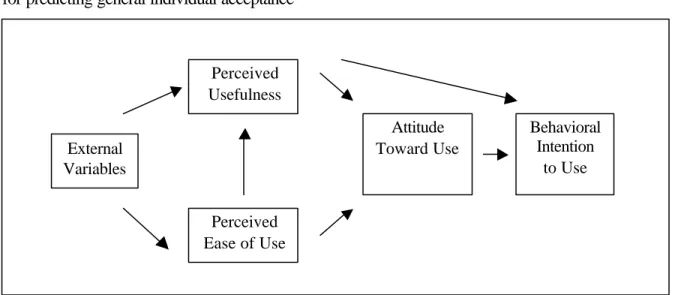
serve as the basis for attitudes toward using a particular system, which in turn determines the intention to use, and then generates the actual usage behavior.
TAM was applied to many different sample sizes and user groups within or across organizations, analyzed with different statistical tools, and compared with competing models (Gefen, 2000). It was applied to many different end-user technologies such as e-mail (Adams, Nelson & Todd, 1992; Davis, 1989), word processors (Adams, Nelson & Todd, 1992; Davis, Bagozzi & Warshaw, 1989), groupware (Taylor & Todd, 1995), spreadsheets (Agarwal, Sambamurthy & Stair, 2000; Mathieson, 1991), and World Wide Web (Lederer, Maupin, Sena & Zhuang, 2000). Some studies also extended TAM by including additional predictors such as gender, culture, experience, and self-efficacy.
However, many studies on the acceptance of IT/IS have received fairly attention from previous researches, there is no research that explores the factors influencing user intention to accept 3G technology, especially in Thailand. Furthermore, the TAM model was originally created to examine IT/IS adoption in organizations. The suitability of this model for predicting general individual acceptance
needs to be examined. Therefore, the proposed model in this research is an attempt to fill in the gap in this model.
3. Research Model and Hypotheses
In our proposed model, user acceptance is examined by attitude toward use and intention to use rather than actual use due to the fact that 3G technology (Mobile Internet) is still at an early stage, characterized by limited adoption and usage. At this stage, investigation of intention to use would enhance the predictive power of the present model.
However, many researchers have also recognized that the generality of TAM fails to supply more meaningful information on user’s opinions about a specific system by emphasizing only on cognitive determinants of IT use intention. There is the need for TAM to incorporate additional factors or integrate with other IT acceptance models for improvement of its specificity and explanatory utility (i.e. Agarwal and Prasad, 1998; Hu et al., 1999; Mathieson, 1991).
One of these other factors is affective variable. Affect has been proved to be an important concept in the fields of psychology, marketing and consumer research, and organizational behavior (e.g. Davis, Bagozzi and Warshaw, 1992).
Perceived Usefulness
External Variables
Perceived Ease of Use
Attitude Toward Use
Behavioral Intention
to Use
Therefore, this research attempts to integrate affect with cognition in order to improve our ability to understand user intentions for 3G mobile internet in Thailand.
Following is a brief explanation of the elements of our proposed model.
3.1 Perceived Usefulness
Perceived usefulness (PU) in the TAM model, was originally defined as the extent to which a person believes that using a system would enhance his or her job performance and effectiveness (Davis, 1989).
In the investigation of Chau (1996), he hypothesized that behavioral intention to use a particular technology is dependent on the two variables, which are perceived usefulness and perceived ease of use. The empirical findings supported his hypothesized relationships between perceived usefulness and intention to use.
Based on Chau’s modified TAM model, Jiang et al. (2000) developed utilization of the Internet technology model to explore user acceptance of Internet. Testing the utilization of the Internet technology model confirmed that utilization of the Internet technology is positively related to perceived usefulness. However, the utilization of the Internet technology model only investigated the use of the hardwired Internet. The research interest was centered on actual usage, rather than attitude and intention to use.
It will be interesting to see if their findings can be confirmed in the use of 3G technology adoption in Thailand, and if attitude toward using is determined by perceived usefulness. Thus, we propose the following hypothesis:
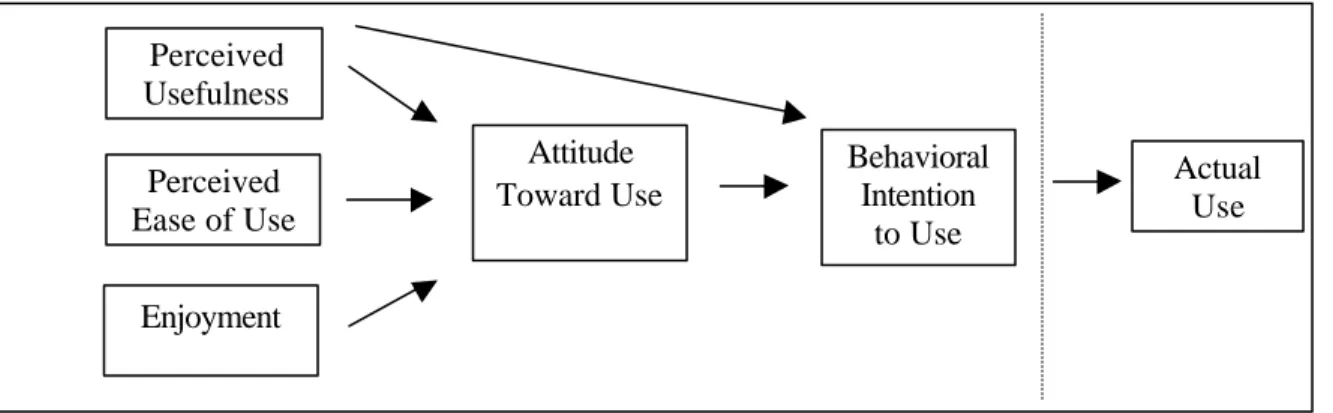
H1: Perceived usefulness of 3G technology (Mobile Internet) will have significant positive effect on attitude toward using 3G technology.
H2: Perceived usefulness of 3G technology (Mobile Internet) will have significant positive effect on intentions to use 3G technology.
3.2 Perceived Ease of Use
Perceived ease of use (PEOU) refers to the extent to which a person believes that using a system would be free of mental effort (Davis, 1989). This is another major determinant of attitude toward use in the TAM model.
Venkatesh (2000) believes that for any emerging IT/IS, perceived ease of use is an important determinant of users’ intention of acceptance and usage behavior. Likewise, a study by Clarke (2000) on the factors affecting the use of wireless handheld devices in England also supported this point. He found that ease of use is one among the top five significance factors determining use of wireless handheld devices. To better explain attitude toward using 3G technology, we propose the following proposition:
H3: Perceived ease of using 3G technology (Mobile Internet) will have significant positive effect on attitude toward using 3G technology.
3.3 Enjoyment
H4: Enjoyment of using 3G technology (Mobile Internet) will have significant positive.
3.4 Attitude toward Use
Attitude has long been identified as a cause of intention. Adapting this general principle, attitude toward use in the TAM model is defined as a mediating affective response between usefulness and ease of use beliefs and intentions to use a target system. In other words, a prospective user’s overall attitude toward using a given system is an approach to complete the study. As Kane, Sandretto, & Heath (2002) and Mathison (1988) advocated the use of triangulation method as increasing the validity of findings in relation to the issue under investigation.
4. Research Methodology 4.1 Data Collection Methods
To investigate such an issue, the research will use three distinct data collection methods and analyses which are: group interviews, survey, and written documents. In other words this research will be conducted by using the triangulative antecedent to intentions to adopt (Davis, 1989). For the same reason, in consumer research attitude is the construct that receives most attention and is used most widely for predicting consumers’ likelihood to adopt a new technology (Erevelles, 1998).
Therefore, the investigation of attitude toward using 3G technology and identification of its relationship with intention to use is valuable for predicting usage behavior. Then, we postulate the following proposition.
H5: Attitude toward 3G technology will have a significant positive effect on intentions to use 3G technology.
Based on the above discussions, a TAM model for 3G Mobile Internet, which depicts the relationships among the previously discussed constructs without considering external variables, is shown below.
A description of each data collection method used in the present study is as below: Group Interviews
This study uses group interview or focus group to validate the content of the questionnaire in terms of relevance, accuracy and wording prior to the distribution of the actual survey.
To conduct interviews, the researcher will use Morgan’s (1988), Stewart and Shaamdasami’s (1990) focus group strategies to apply in the interviews. Semi-structured interviews will be conducted under these techniques.
Perceived Usefulness
Perceived Ease of Use
Attitude Toward Use
Enjoyment
Behavioral Intention
to Use
Actual Use
Survey
In this study, the researcher used the questionnaire to measure the various constructs depicted in the research model. The questionnaire is divided into three parts, which are mobile phone usage, perception in terms of perceived usefulness, perceived ease of use, enjoyment, attitude toward use, behavioral intention to use and personal information.
All of the questions are applied and developed from the previous studies about technology acceptance by the researchers, such as Davis (1989), Mathieson (1991), Moore and Benbasat (1991), Venkatesh & Davis (1996), Kwon & Chidambaram (2000).
Written Documents
Written documents provide another source of data for the present study. Merriam (1988) and Hodder (2000) claim that written documents could enable the researcher to move forward the information that could not be observed or recalled, for example, historical studies. For the present study, written documents such as statistical and numerical data will be collected throughout a term of data collection.
4.2 Data Collection Procedures
For our study, a self-administered questionnaire is used as the method for collecting data, with an appropriate sample size designed by sequential sampling at 95% confidence level.
The proportion of this research sample based on the sample size of 385. The sampling proportion in this research will be the WAP user and is 50% of total respondents. This study employs stratified sampling, which is a probability sampling technique. The logic behind the stratified sampling technique is that sampling variables are categorized into group of subscribers, which currently use the WAP service and currently do not use the WAP
service or Non-WAP users represented as the sample of population of each group.
5. Data Analysis
5.1 Reliability and Validity Analysis
The Cronbach’s ? coefficients for perceived usefulness, perceived ease of use, enjoyment, attitude toward using 3G Mobile Internet and behavioral intention to use 3G Mobile Internet are tested with the cut-off of 0.7 (Nunnaly, 1994) to access the reliability of each construct.
5.2 Correlation Analysis
Correlation can be used to examine the relationships between two or more variables. If two phenomena are related in a systematic way they are said to be correlated. Correlation can be measured by means of the correlation coefficient. The closer the coefficient is to 1.0, the greater the correlation. The significance of a correlation coefficient depends on its magnitude (closeness to 1) and the sample size, and is assessed by means of a t-test. The t-test therefore indicates only whether the correlation coefficient is significantly different from zero. SPSS can be used to produce correlation coefficients between pairs of variables, and as with other tests, if the probability is below 0.05 we reject the null hypothesis.
5.3 Hypotheses Testing
A hypothesis is a statement or proposition that can be tested by reference to empirical study. Hypotheses are usually stated in a form that predicts there is a difference between two groups in relation to some variable, or that there is a relationship to some variable, or that there is a relationship between two variables. The hypothesis can be shown to be true or false as a result of empirical.
relationship between two variables. The research can accept the null hypothesis if the statistical differences between groups or the strength of relationships are absent, or small and significant. Alternatively, the researcher can reject the null hypothesis if the differences between groups, or the strength of relationship, are large enough to be significant (Kerlinger, 1973).
6. Discussion and Conclusion
TAM for 3G mobile internet proposes a framework for understanding, explaining and predicting factors that influence individual acceptance of 3G mobile internet. These factors was build on such constructs in the original TAM model as intentions to use, attitude toward using, perceived usefulness, and perceived ease of use, and expands to include new factors. The integration of common TAM determinants should be helpful for confirming the existing results in a new situation. Also, the results of the proposed model can be compared to other relevant model and can add to the existing knowledge of user acceptance.
References
Adams, D.A., Nelson, R.R. & Todd, P.A. (1992), “Perceived Usefulness, Ease of Use, and Usage of Information. MIS Quarterly, Vol. 16 No. 2, pp. 227-250.
Agarwal, R. and Prasad, J (1998), “A conceptual and operational definition of personal innovativeness in the domain of information technology”, Information Systems Research, Vol. 9 No. 2, pp. 204-15.
Agarwal, R., Sambamurthy, V. & Stair, R.M. (2000), “The Evolving Relationship between general and specific computer self-efficacy- An empirical assessment”, Information
Systems Research, Vol. 1 No. 4, pp.
418-430.
Ajzen, I (1985), “From intentions to actions: a theory of planned behavior”, in Jkhul, J.B. (Ed.), Action Control: From Cognition to
Behavior, SpringerVerlag, New York, NY,
pp. 11-39.
Ajzen, I (1991), “The theory of planned behavior”, Organization Behavior and
Human Decision Processes, Vol. 50 No. 2,
pp. 179-211.
Chau, P.Y.K. (1996), “An empirical assessment of a modified technology acceptance model”,
Journal of Management Information
Systems, Vol. 13 No. 2, pp. 185-204.
Choi, H., Choi, M., Kim, J., & Yu, H. (2002). “An empirical study on the adoption of information appliances with a focus on interactive TV,” Telematics and Informatics, Uncorrected proof.
Clarke, C. (2000), “Coming attraction”, Wireless
Review, Vol. 17 No. 12, pp. 12-16.
Davis, F.D., (1989), “Perceived usefulness, perceived ease of use, and user acceptance of information technology”, MIS Quarterly, Vol. 13 No. 3, pp. 319-40.
Davis, F.D., Bagozzi, R.P., and Warshaw, P.R.,(1989), “User acceptance of Computer Technology: A comparison of Two Theoretical Models,” Management Science, 35, pp.982-1003.
Davis, F.D., Bagozzi, R.P. and Warshaw, P.R. (1992), “Extrinsic and intrinsic motivation to use computers in the workplace”, Journal pf
Applied Social Psychology, Vol. 22 No. 14,
pp. 1111-32.
Erevelles, S. (1998), “The role of affect in marketing”, Journal of Business Research, Vol. 42, pp. 199-215.
Gefen, D. (2000), “Structural Equation Modeling and Regression: Guidelines for Research Practice”, CAIS, Vol. 4 No. 7.
Hodder, I. (2000). The intepretation of documents and material culture. In N.K. Denzin, & Y.S. Lincoln (Eds.), Handbook o f
qualitative research. Thousand Oaks: Sage
Publications. pp. 493-402.
Management Information Systems, Vol. 16 No. 2, pp. 91-112.
Igbaria , M., Guimaraes, T. and Davis, G.B. (1995), “Testing the determinants of microcomputer usage via a structural equation model”, Journal of Management
information Systems, Vol. 16 No. 2, pp.
91-112.
Jiang, J.J., Hsu, M.K., Klein, G. and Lin, B. (2000), “E-commerce user behavior model: an empirical study”, Human Systems
Management, Vol. 19 No. 4, pp. 265-76.
Kane, R., Sandretto, S.,& Heath, C. “Telling half the story: A critical review of research on the teaching beliefs and practices of university academics”. Review of Educational
Research,72 (2), 177-228, 2002
Kerlinger, F. (1973), “Foundations of Behavioral Research”, Harper Collins, New York. Kwon, H.S. & Chidambaram, L (2000). “ A test
of the technology acceptance model: The case of cellular telephone adoption,
Proceeding of the 3rd Hawaiian International
Conference on System Sciences, 3-6.
Lederer, A.L., Maupin, D.J., Sena, M.P. & Zhuang, Y. (2000), “The technology Acceptance model and the World Wide Web”, Decision Support Systems, Vol. 29 No. 3, pp. 269-292.
Mathison, S. (1988), “Why triangulate?”. Educational Researcher,17 (2), 13-17., 1988 Mathieson, K. (1991), “Predicting user
intentions: comparing the technology acceptance model with the theory of planned behavior”, Information Systems Research, Vol.2 No. 3, pp. 173-91.
Merriam, S.B. (1988), Case study research in
education: A qualitative approach. San
Francisco: Jossey-Bass.
Moore, G.C. (1987), “End user computing and office automation: a diffusion of innovations perspective”, Infor, Vol.25 No. 3, pp. 214-35.
Moore, G.C. and Benbasat, I. (1991), “Development of an Instrument to measure the perceptions of adopting an Information
Technology Adoption”, Information Systems
Research, Vol. 2, pp. 192-222.
Morgan, D.L. (1988), Focus Groups as
Qualitative Research. Newbury Park, CA:
Sage.
Nunnaly, J.C. and Bernstein, I.H.(1993),
Psychometric Theory, 3rd ed. New York:
McGraw-Hill.
Sheth, J.N., Newman, B.I., & Gross, B.I. (1991). “Why we buy what we buy: A theory of consumption values,” Journal of Business
Research in Marketing, 12, 137-156.
Stewart, D. and Shaamdasami, P. (1990) Focus
Groups: Theory and Practice. Newbury
Park, CA: Sage.
Sweeney, J.C. & Soutar, G.N. (2001). “Consumer perceived value: The development of a multiple item scale,: Journal of Retailing, 77, 203-220.
Teo, T.S.H., Lim, V.K.G. and Lai, R.Y.C. (1999),“Intrinsic and extrinsic motivation in Internet usage”, Omega, International
Journal of Management Science, Vol. 27, pp.
25 –37.
Taylor, S. and Todd, P.A. (1995), “Assessing IT Usage: the Role of Prior Experience. MIS
Quarterly, Vol. 16 No. 4, pp. 561-570.
Taylor, S. and Todd, P.A. (1995), “Understanding Information Technology Usage: A Test of Competing Models”,
Information Systems Research, 6, 1995, pp.
144-176.
Venkatesh, V. (2000), “Determinants of perceived ease of use: integrating control, intrinsic motivation, and emotion into the technology acceptance model”, Information
Systems Research, Vol. 11 No. 4, pp. 342-65.
Venkatesh, V. and Brown, S.A. (2001), “A longitudinal investigation of personal computers in home: Adoption of determinants and emerging challenges,” MIS
Quarterly, 25: 1, 71-102.