R E S E A R C H
Open Access
Cryptococcus
spp. isolation from excreta of
pigeons (Columba livia) in and around
Monterrey, Mexico
Yolanda Canónico-González
1, Juan Manuel Adame-Rodríguez
1, Roberto Mercado-Hernández
2and
Elva Teresa Aréchiga-Carvajal
1,3*Abstract
The presence ofCryptococcusspp. has been reported in Mexico’s capital city; however, to our knowledge there are no reports of its presence in the state of Nuevo León located in northeast Mexico. This is presumed to be because the hot and dry climate in this region does not favor cryptococcal proliferation. This study confirmed the presence ofC. neoformansandC. albidusin 20% (10/50) of randomly selected fecal samples of pigeons (Columba livia) in the Monterrey metropolitan area. The presence of this yeast in the state of Nuevo León is proof of its adaptation to the typically hot climate of the area and is consistent with recent reviews of cryptococcosis cases in several local hospitals. The two species were identified and characterized through microbiological tests and molecular
identification by DNA extraction and PCR amplification of highly conserved 18S ribosomal DNA using ITS1 and ITS2 as target regions. The PCR products were sequenced and compared with those reported in GenBank.
Keywords:Cryptococcosis;Neoformans;Albidus; Pigeon (Columba livia); México
Introduction
Thirty-eight yeast species within theCryptococcusgenus have been described, including C. neoformans, C. gatti, C. albidus,andC. laurentii, which have been extensively studied because of their clinical importance as etiologic agents of opportunistic cryptococosis (Rosarioet al.2008; Castañón Olivares et al.2000). Cryptococcosis can result in serious meningitis and is acquired by inhalation of in-fective yeasts present in wood, fruits, rotting vegetables, soil, dairy products, and most frequently fecal material from urban pigeons (Columba livia) (Ellis and Pfeiffer, 1992; Khawcharoenpornet al. 2007) that commonly ac-cumulate in metropolitan areas where this species has successfully become established. This kind of mycosis is not considered endemic, mainly because there is only
information about its presence in Mexico’s central region. The northeast region of the country has a dry and hot cli-mate, where summer temperatures reach up to 40°C (be-tween 35-40°C) even in the shade (Extreme temperatures and precipitation for Monterrey (OBS) 2000-2010 (in spanish) 2013). It has been suggested that these environmental conditions are not suitable for the growth ofCryptococcus spp. and that most strains cannot survive high tempera-tures because the majority of isolates reported are from tropical and subtropical countries where the average tem-perature is 22°C in the hottest month of the year (Lin and Heitman, 2006; Ishaqet al.1968; Ruizet al.1989; Dromer et al.1996; Manciantiet al.2002; Rivaset al.1999; Quintero et al.2005; Curoet al.2005; Colom Valienteet al.1997; Castañol-Olivares and Lopez-Martinez, 1994; Casaliet al. 2003). Surprisingly, there have been 190 reports of crypto-coccosis in six different state hospitals in Monterrey city from 1995 to 2011 (Casillas 2012). This could be evidence of its successful adaptation to the warm and dry climate present in this region. To investigate this we evaluated 50 random samples of pigeon droppings from three different Monterrey metropolitan locations.
* Correspondence:[email protected]
1Laboratorio de Micología y Fitopatología, Departamento de Microbiología e
Inmunología, Universidad Autónoma de Nuevo León, San Nicolás de los Garza, México
3
Unidad de Manipulación Genética, Laboratorio de Micología y Fitopatología (LMYF), Facultad de Ciencias Biológicas, Segundo Piso, Unidad C Universidad Autónoma de Nuevo León, Ave. Pedro de Alba s/n cruz Miguel L Barragán, Cd. Universitaria, San Nicolás de los Garza, Nuevo León, México
Full list of author information is available at the end of the article
Materials and methods
Fifty fecal samples were collected in the summer between the months of August and September of 2010. We first considered the population density for each of the three municipal zones sampled (Guadalupe, Monterrey, and San Nicolás de los Garza) in the Monterrey metropolitan area in the state of Nuevo León. We obtained one sample for approximately every 45,000 persons reported in the three most densely populated municipal areas according to the Mexican Institute of Statistics and Geography (INEGI) data for 2005 (Table 1) to give a good distribution of sam-ples. Pigeon excreta samples were collected using clean spatulas, transferred to sterile plastic bags, and properly labeled according to site and date. Samples were taken im-mediately to the laboratory and were processed as previ-ously reported by Shields and Ajello with modifications described by La Pal and Baxter (Shields and Ajello, 1966; Pal and Baxter, 1985). Yeasts were isolated and character-ized by phenoloxidase activity determination, capsule for-mation, presence of urease, sugars, nitrate assimilation, and ability to grow at 37°C (Pérezet al.2003). Species and varieties were identified using creatinine dextrose bro-mothymol blue thymine medium and l-canavanine glycine bromothymol blue agar. We also evaluated the color, mor-phology, and colonial growth in CHROMagar Candida media (Irokanuloet al. 1994; Kwon-Chung et al. 1982;
Garcíaet al.1998).Cryptococcus neoformansATCC 66031
and Candida albicansATCC 14053 were used as
micro-biological identification controls.
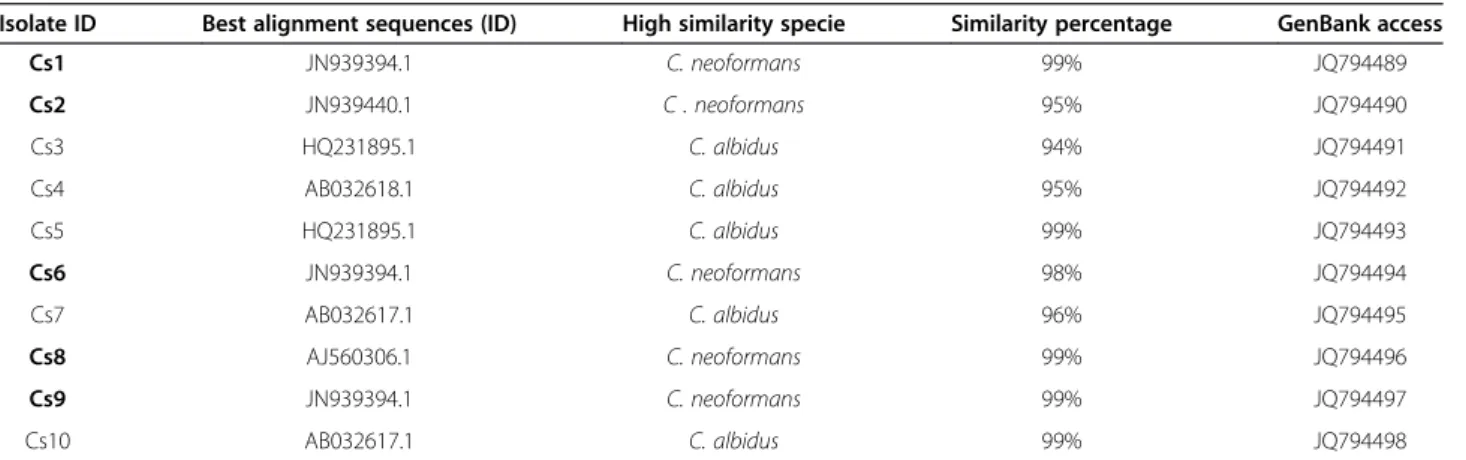
Microbiological identification was confirmed by ITS1– ITS2 ribosomal gene sequence determination (Whiteet al. 1990). DNA fragments were obtained by polymerase chain reaction (PCR) amplification from genomic DNA extracted using the Barth and Gaillardin method from isolated yeasts (Barth and Gaillardin, 1996). Sequences were aligned with those deposited in NCBI GenBank. Accession numbers of our nucleotide sequences are JQ794489, JQ794490, JQ79 4491, JQ794492, JQ794493, JQ794494, JQ794495, JQ794 496, JQ794497, and JQ794498 (Table 2).
The phylogenetic analysis was performed using MEGA view 5.2 with the Neighbor Joining algorithm (NJ), and included 18 sequences, 8 from Genbank and 10 generated in this research.
We developed a simple regression analysis using cor-respondence tables to determine whether there was any link between ambient conditions of the sample and the isolation results. The data were analyzed according to the isolation results using the statistics program SPSS version 17.0.
Results
Among the 50 pigeon fecal samples obtained from three different municipal zones in the metropolitan area of Monterrey, Nuevo León, México (Figure 1), 10 Crypto-coccus strains were isolated (20% of samples were positive) and identified using different biochemical and microbio-logical tests (Table 3). For each strain, sequences of approxi-mately 800 bp were PCR amplified from the ITS1–ITS2 genomic DNA (Figure 2). Based on very high similarity be-tween sequences from the present samples and those previ-ously reported in GenBank (Table 2), we identified fiveC. neoformansand fiveC. albidusisolates. Most of these (three C. neoformans and three C. albidus) were found in the
Table 1 Samples collected for the number of inhabitants
Municipal zones Population Samples Positive samples (C.n/C.a)
Monterrey 1.135.550 25 (3/3)
Guadalupe 678.006 15 (1/2)
San Nicolás 443.273 10 (1/0)
TOTAL 2.256.829 50 (5/5)
Total samples collected in relation to the number of inhabitants in each municipal zones.
Table 2 Sequences characteristics
Isolate ID Best alignment sequences (ID) High similarity specie Similarity percentage GenBank access
Cs1 JN939394.1 C. neoformans 99% JQ794489
Cs2 JN939440.1 C . neoformans 95% JQ794490
Cs3 HQ231895.1 C. albidus 94% JQ794491
Cs4 AB032618.1 C. albidus 95% JQ794492
Cs5 HQ231895.1 C. albidus 99% JQ794493
Cs6 JN939394.1 C. neoformans 98% JQ794494
Cs7 AB032617.1 C. albidus 96% JQ794495
Cs8 AJ560306.1 C. neoformans 99% JQ794496
Cs9 JN939394.1 C. neoformans 99% JQ794497
Cs10 AB032617.1 C. albidus 99% JQ794498
Figure 1Localization map for collected samples.Dots indicate the location of pigeon fecal samples collected and red dots point to positive samples forCryptococcusspp.
Table 3 Isolate’s characteristics
Isolate identification
Assays CDBT CGB CMa Microbiologic
identification
P U I L °C N C
Cs1 + + + - + - + - - White C. neoformans var. grubii
Cs2 + + + - + - + - - White C. neoformans var. grubii
Cs3 - + + + - + + - - Pink lavender C. albidus
Cs4 - + + + - + + - - Pink lavender C. albidus
Cs5 - + + - - + + - - Pink lavender C. albidus
Cs6 + + + - + - + - - White C. neoformans var. grubii
Cs7 - + + - - + + - - Pink lavender C. albidus
Cs8 + + + - + - + - - White C. neoformans var. grubii
Cs9 + + + - + - + - - White C. neoformans var. grubii
Cs10 - + + + - + + - - Pink lavender C. albidus
Cryptococcusspecies identification using biochemical assays: phenoloxidase activity (P), urease activity (U), inositol (I), lactose (L), Potassium nitrate (N) and Creatinine assimilation (C), growth at 37°C (°C), Color (+) or no color changes (-) observed Creatinine dextrose bromothymol blue thymine (CDBT) agar and Canavanine-Glycine-Bromothymol Blue (CGB) agar and colonial morphotype in CHROMagar plates (CMa).Cryptococcusinternal identification for each isolate (Cs1-Cs10).
Cs1 Cs2 Cs3 Cs4 Cs5 Cs6 Cs7 Cs8 Cs9
800 bp
Cs10
Monterrey city zone, which was the most populated area (Table 1). Analysis of the cladogram (Figure 3) of the 18S ribosomal sequences of our isolated strains aligned against previously reported sequences in GenBank showed that isolates 1, 9, 6, 8, and 2 are grouped withC. neoformans sequences and 3, 7, 5, 10, and 4 with C. albidus. This cladogram confirms the microbiological identification. Among 10 positive samples, 9 were isolated from shaded sites and simple regression analysis confirmed a statistical correlation (Table 2).
Discussion
Recent reports have indicated a significant prevalence of cryptococcosis in immunosuppressed patients in Monterrey city (Casillas 2012). The present study adds information about the distribution of this pathogenic yeast in the metropolitan area of Monterrey, a city with a very high population density and extreme temperature conditions in which the probability ofCryptococcus dissemination should be low.
Definitive Cryptococcus spp. identification of isolated yeasts was possible using previously reported biochemical, microbiological, and molecular characterization. From 50 pigeon excreta samples randomly collected from July to September of 2010 we identified five C. neoformans and fiveC. albidusisolates, representing an incidence of 20%. A similar incidence has been reported in Mexico City and in other countries such as Colombia and Perú (Castañón Olivares et al. 2000; Ruiz et al. 1989; Rivas et al. 1999; Quintero et al. 2005; Curo et al. 2005; Colom Valiente et al. 1997; Castañol-Olivares and Lopez-Martinez, 1994).
The finding that 50% of total Cryptococcus isolates corre-sponded toC. albidusis not surprising given the fact that 14% and 12% of pigeon excreta isolates in Seoul and Brazil correspond to this species and now it is considered an underestimated pathogen by several researchers (Janget al. 2011; Soares et al. 2005). Comparison of 18S RNA se-quence against other reported sese-quences shows that the isolates form clades with their corresponding species ac-cording to the microbiological test results. However, two of them group together, mainly because of augmented intra-species sequence variability. This must be probed with a greater number of sequences, therefore it is important to continue to report Criptococcus spp. ITS sequences from other isolates in order to study genetic variation.
The information obtained in this research will inform the medical community about the presence of the etio-logic agent of cryptococcosis in this area. Additional epi-demiological studies may help set the stage for health campaigns to clean and prevent the accumulation of pigeon droppings in areas of high human traffic, such as subway stations and hospitals.
Competing interest
This Project (No. SA367-10) was financially supported by the Universidad Autónoma de Nuevo León fromthe“Programa de Apoyo a la Investigación Científica y Tecnológica (PAICYT–UANL)”.
Authors’contributions
YC-G: Took samples, isolated and characterized ofCryptococcusspp. and manuscript writing. RM-H: Revised validation of methodology bystatistic and collaborated with writing. JMA-R: Revised Microbiological characterization of isolates. ETA-C: Developed molecular methodology and revised DNA sequences, revised philogenetic three revised manuscript. All authors read and approved the final manuscript.
Acknowledgements
We thank Dr. Laura Raya Garza for support in the standardization of microbiological assays for the characterization of the strains, and Nestor Casillas Vega MD for contributing results obtained from his thesis. This work was developed by the program to support scientific and technological research at the Universidad Autónoma de Nuevo León (PAYCIT SA-3671).
Author details
1Laboratorio de Micología y Fitopatología, Departamento de Microbiología e
Inmunología, Universidad Autónoma de Nuevo León, San Nicolás de los Garza, México.2Departamento de Ciencias Exactas Facultad de Ciencias
Biológicas, Cd Universitaria, San Nicolás de los Garza, NL, México.3Unidad de Manipulación Genética, Laboratorio de Micología y Fitopatología (LMYF), Facultad de Ciencias Biológicas, Segundo Piso, Unidad C Universidad Autónoma de Nuevo León, Ave. Pedro de Alba s/n cruz Miguel L Barragán, Cd. Universitaria, San Nicolás de los Garza, Nuevo León, México.
Received: 28 August 2013 Accepted: 11 November 2013 Published: 23 November 2013
References
Barth G, Gaillardin C (1996) Yarrowia lipolytica. In: Wolf K (ed) Non Conventional Yeasts in Biotechnology. Springer Verlag, Berlin, Heidelberg, pp 313–388 Casali AK, Goulart L, Rosa E, Silva LK, Ribeiro AM, Amaral AA, et al. (2003)
Molecular typing of clinical and environmentalCryptococcus neoformans
isolates in the Brazilianstate Rio Grande do Sul. FEMS Yeast Res 3:405–415 Casillas N (2012) Fenotipificación y genotipificación del complejo
Cryptococcusneoformans/Cryptococcusgattiien aislamientos clínicos del noreste de México. In: PhD thesis. Facultad de Medicina, Universidad Autónoma de Nuevo León
Castañol-Olivares LR, Lopez-Martinez R (1994) Isolation ofCryptococcus neoformansfrom pigeon (Columalivia) droppings in Mexico City. Mycoses 37:325–327
Castañón Olivares L, Arreguin Espinosa R, Ruiz Palacios G, López Martínez A (2000) Frequency ofCryptococcussp. and varieties in México and their comparison with some Latin American Countries. Rev Latinoam Microbiol 42:35–40
Colom Valiente MF, Alberdi M, Meseguer I, Torres-Rodríguez JM (1997) Aislamiento deCryptococcus neoformansen muestras de medio ambiente de Alicante. Rev Iberoam Micol 14:63–64
Curo M, Salinas M, Casquero J (2005)Cryptococcus neoformansin pigeon excreta, soil and air of palomares in the urban perimeter of ICA. Rev Peruana Medicina Experimental y Salud Pública 22:262–263
Dromer F, Mathoulin S, Dupont B, Y Laporte A (1996) Epidemiology of cryptoccosis in France: a 9-year survey. Clin Infect Dis 23:82–90
Ellis D, Pfeiffer T (1992) The ecology ofCryptococcus neoformans. Eur J Epidemiol 8(3):321–325
Extreme temperatures and precipitation for Monterrey (OBS) 2000-2010 (in spanish) (2013) Servicio Meterológico Nacional. http://smn.cna.gob.mx/climatologia/ Max-Extr/00019/00019052.TXT Accessed June 22, 2013
García P, García R, Hernández J, Marín P, Tallero E, Mira J (1998) Identification of yeasts of clinical interest on CHRO Magar Candida culture medium Rev. Iberoamericana 15:131–135
Irokanulo EA, Akueshi CO, Makinde AA (1994) Differentiation ofCryptococcus neoformansserotypes A and D using creatinine dextrose bromothymol blue thymine medium. Br J Biomed Sci 51(2):100–103
Ishaq C, y Bulmer GS, Felton FG (1968) An evaluation of various environmental factors affecting the propagation ofCryptococcus neoformans. Mycol Appl 35:81–90
Jang YH, Lee SJ, Lee JH, Chae HS, Kim SH, Choe NH (2011) Prevalence of yeast-like fungi and evaluation of several virulence factors from feral pigeons in Seoul. Korea Let App Microbiol 53(4):367–371
Khawcharoenporn T, Apisamthanarak A, Mundy LM (2007) Non-neoformans cryptococcal infections: a systematic review. Infection 35:51–58
Kwon-Chung KJ, Polacheck I, Bennett JE (1982) Improved diagnostic medium for separation ofCryptococcus neoformansvar. neoformans (serotypes A and D) andCryptococcus neoformansvar. gattii (serotypes B and C). J ClinMicrobiol 15(3):535–537
Lin X, Heitman J (2006) The biology of theCryptococcus neoformansspecies complex. Annu Rev Microbiol 60:69–105
Mancianti F, Nardoni S, Ceccherelli R (2002) Occurrence of yeasts in psittacines droppings from captive birds in Italy. Mycopathologia 153:121–124 Pal M, Baxter L (1985) Isolation ofCryptococcus neoformansfrom the environment
using a simplified sunflower seed medium. Proc N Z Microbiol Soc 29:155–158 Pérez C, Mata S, Hartung C, Roselló A, Colella MT, Olaizola C, Landaeta M (2003)
Preservation ofCryptococcussp. with the Castellani method. Rev de la SociedadVenezolana de Microbiología 23:153–157
Quintero E, Castañeda E, Ruiz A (2005) Environmental distribution ofCryptococcus neoformansin the Department of Cundinamarca Colombia. Rev Ibero Am Micología 22:93–98
Rivas F, De Martin MC, Rojas V (1999)Cryptococcus neoformansisolation from the soil in Panama. Rev Med Panama 24(1):4–6
Rosario I, Acosta B, Colom F (2008) Las palomas y otras aves como reservorio de
Cryptococcusspp. Rev Ibero Am Micol 25:S13–S18
Ruiz A, Velez D, Fromtling RA (1989) Isolation of saprophyticCryptococcus neoformansfrom Puerto Rico: distribution and variety. Mycopathologia 106:167–170
Shields AB, Ajello L (1966) Medium for selective isolation ofCryptococcus neoformans. Science 151:218–223
Soares M, Paula C, Dias A, Caseiro M, Costa SO (2005) Environmental strains of
Cryptococcus neoformansvariety grubii in the city of Santos, SP. Brazil 47(1):31–36
White TJ, Bruns T, Lee S, Taylor S (1990) Amplifications and direct sequencing of fungal ribosomal RNA genes for philogenetics. PCR protocols: a guide to methods and applications. Academic Press, Inc, San Diego, CA, pp 315–322
doi:10.1186/2193-1801-2-632
Cite this article as:Canónico-Gonzálezet al.:Cryptococcusspp. isolation
from excreta of pigeons (Columba livia) in and around Monterrey, Mexico.SpringerPlus20132:632.
Submit your manuscript to a
journal and benefi t from:
7Convenient online submission
7Rigorous peer review
7Immediate publication on acceptance
7Open access: articles freely available online
7High visibility within the fi eld
7Retaining the copyright to your article