FACULTAD DE EDUCACIÓN DE PALENCIA UNIVERSIDAD DE VALLADOLID
Bilingual School Reading Plan Proposal focused on
Fourth Grade
Propuesta de Plan de Lectura en un colegio Bilingüe
enfocado en Cuarto Curso
TRABAJO FIN DE GRADO
EN EDUCACIÓN PRIMARIA MENCIÓN LENGUA EXTRANJERA (INGLÉS)
AUTORA: Elena Gallego Martín
RESUMEN.
Este trabajo de fin de grado está basado en los planes de lectura, y tiene como objetivo
principal conseguir que los alumnos muestren interés en la lectura, centrándonos
principalmente en la lectura en una lengua extranjera (inglés). El proyecto está diseñado
para el 4º curso de Educación Primaria, tomando como experiencia el centro bilingüe en
el cual realicé el Practicum II. Previamente a la elaboración del diseño de un plan de
lectura, es necesario conocer los diversos proyectos que ha elaborado el centro durante
el año escolar (2015-2016), tomando como referencia parte de ellos. La lectura en esta
lengua extranjera favorece el aprendizaje de la misma. No debemos olvidar la
conveniencia de introducir nuevas metodologías para hacer este proyecto más atractivo.
Este trabajo está sustentado en documentos oficiales como la LOMCE (Ley Orgánica de
Mejora de la Calidad Educativa), el currículo integrado, diversos sitios web y libros de
animación a la lectura.
PALABRAS CLAVE: Lectura, Nuevas Tecnologías (Kahoot), Competencias, Lectura
por placer, Libros de Ficción y No ficción, diferentes evaluaciones y bibliotecas en el
aula.
ABSTRACT.
This final work is about Reading Plan Proposals, for that reason the main objective is
develop in the students the interest in reading in a foreign language. This project is
designed for 4th grade Primary Education, linked with the bilingual school in which I
stayed doing my internship, Practicum II. Before making the design of this Reading
Plan Proposal, it is necessary to know the previous projects elaborated during the
scholar year (2015/2016). The foreign language reading favours the learning of this
language. We cannot forget to introduce new methodologies to make the proposal more
attractive for students. This work is supported by official documents like LOMCE
(Organic Improvement Quality Education Law), the integrated curriculum, different
web pages and some reading books about promotion.
KEYWORDS: Reading, New Technologies (Kahoot), Competences, reading for
INDEX
1. Introduction……….4
2. Objectives………5
3. Theoretical foundation………9
3.1. Reading importance and benefits………..….17
4. Design of the project ….……….………...…19
4.1. Objectives………...…19
4.2. Development of a proposal………20
4.3. The process to choose the books………24
4.4. Design for each evaluation………..…...…25
4.4.1. Introduction activity……….25
4.4.2. First evaluation……….26
4.4.3. Second and third evaluations………...……29
4.4.4. Fourth evaluation………32
5. Conclusions………...………34
6. Bibliography………..37
1.
INTRODUCTION
Awake the interest for reading and get students to enjoy reading (Spanish and
English), is one of the main objectives in the bilingual schools. Reading is an
essential tool for the learning and developing of their language. With this project,
we intend children to start reading voluntarily and with autonomy. For getting this
idea, it is necessary to make funny and interesting activities, which promote reading.
I decided to elaborate this project based in a bilingual school in Valladolid, seizing
my training period as teacher, in order to check the reading activities elaborated in
the school during the current school year. I had the opportunity to work during my
internship in the 2nd Cycle of Primary Education, but I focused on 4th course to
elaborate this project.
During my internship, I made some observations in the school, focusing on reading.
I started observing the students daily; I explored the school and its library and I
asked questions to the teachers and the management team. Then, I used this
information to elaborate my project in the correct way. However, I did not only
focus on the school in a general way, I emphasize on the reading projects carried out
during the whole year (in 4th primary education and in the school). After that, I
could start my project.
Taking into account the project of autonomy “life in English” which is going to start
in the school next year 2016/2017, I consider the need to introduce a bilingual
reading plan proposal. For that, we have to take into account, the different areas,
where the students live, and which they develop in their education: family, school
2.
OBJECTIVES
The school has already initiated a bilingual programme, which they need to develop but
it is hard to work on it. Researching the class-libraries, school-library, projects, books,
etc. I observe that they have Spanish books to read for pleasure and to help searching
information to elaborate projects. Having this in mind, my proposal will implement this
libraries introducing books in English to read for pleasure and to help them research in
books connecting with the other subjects taught in English as Natural Science and Arts
and Crafts.
During my time in the school, I also observe that children are interested in reading and
they read at least a little in the school (in Spanish) once they finish their assignments.
Sometimes they take home the most interesting books to read them quietly there. I will
also have this in mind to develop my project.
First, I must mention the objectives I have acquired as a teacher during my period of
internship (Practicum) and the objectives achieved in the university, both through the
Basic and Compulsory subjects, apart from the ones connected with the foreign
language subjects I took. I will mark the main objectives of my Final Project, which I
have elaborated based on the contents of the school and the experience I have lived
during my stay in the school.
Subject: Practicum
1. Getting to know, participate and reflect about life in the classroom, learning to
collaborate with every sector of the educational community, linking theory and
practice. This competence will be implemented in the development of skills
which will form the person entitled to:
- Acquire practical knowledge in the classroom and classroom management.
- Be able to use the interaction and communication processes in the classroom.
Dominate social skills and abilities, necessary to make easier the way to learn
and live.
- Track and control the educational process and particularly teaching and learning
- Be able to relate the theory and practise with the reality in the school
- Be part of teaching and learning activity (know-how) to act and think in
innovation and improvement of teachers.
- Be able to control the interaction and communication between the students aged
6 to 12.
- Be able to collaborate with the different sectors of the educational community
and the social environment.
- Acquire habits and skills in an autonomous and cooperative learning and
promoting them in the students.
The previous competences, together with the proper ones from the different subjects,
will be reflected in this Final Project that conforms the knowledge acquired the Grade.
Subject: Foreign Language (English / French)
1. Communicative competence in a foreign language (English / French), level C1
Advanced, according to the European Framework of Reference for Languages. This
competence implies:
a. Acquire linguistic knowledge (phonetic-phonological, grammatical and
pragmatic) and sociocultural foreign language.
b. Know the cognitive, linguistic and communicative bases of language
acquisition.
2. Planning what will be taught and evaluated in relation to the appropriate foreign
language, as well as select, design and develop teaching strategies, types of activities
and teaching resources.
This competence will also insist:
- Know the main didactic trends of teaching foreign languages to children
and their application to foreign language classroom in the different levels
- Know the primary education curriculum and the curriculum development
in the area of foreign languages.
- Promote the development of oral and written languages, using the new
technologies as elements of long-distance communication in a foreign
language.
- Develop in a progressive way the communicative competence through
the integrated practice of the four skills in the foreign language
classroom.
- Be able to plan the teaching – learning process of a foreign language,
developing teaching strategies, type of activities and materials based on
the diversity of students.1
1 I made my translation of this information acquired from:
http://www.uva.es/export/sites/uva/2.docencia/2.01.grados/2.01.02.ofertaformativagrados/_docu
Subject: My final project.
- To develop the students interest in reading in a foreign language.
- Check the Spanish curriculum and use it for the elaboration of the project.
- Relate the project I have elaborated with the Reading Plan in the school.
- Promote Reading in English as a way to acquire culture and knowledge.
- Help the students (readers and no readers) to discover the wealth and diversity of books
in English.
- Educate students’ critical and rational sense though the use of resources for reading
analysis.
- Improve the language, at the same time they strengthen the vocabulary and expressions
used daily in their environment.
- Involve students to see reading as something fun, not something compulsory asked by
the teacher. Make the students be interested in reading and asking for new books.
- Classroom reading aloud: observe students’ capacity of pronunciation as well as their
3.
THEORETICAL FOUNDATION
The main idea of the project is to elaborate a reading plan proposal in a Spanish public
bilingual school working with English as first foreign language.
Before starting to elaborate the project, it is necessary to refer to what Spanish
education laws say about reading. We must refer to:
- The Organic Education law in Spain (nowadays adapted by another law)
which I will use to mention the curriculum of Primary Education, focusing
on reading.
- The ORDEN that established the curriculum in the Community of Castilla
and Leon. As the school I did my internship is in Valladolid, a city of
Castilla and Leon I should refer to this Law as well.
- The Common European Framework of Languages.
“La Ley Orgánica 2/2006, de 3 de mayo de Educación, modificada por la Ley Orgánica 8/2013, 9 de diciembre, para la Mejora de la Calidad Educativa”. This Law talks about the organization of the curriculum in Primary Education in Spain. It is
constitued by different chapters, which mention different stages of Education. As I said
before, I will focus on Primary Education.
Chapter II. Primary Education.
The Article 16: General principles shows three different points. I will mention the one related to reading. Bellow I will transcribe in English this point, which talks about
reading:
- The purpose of Primary Education is to facilitate the students the learnings
of oral expression and comprehension, including reading […] in order to
prepare the students for the Secondary school.
B- Develop individual and team work, effort and responsibility habits in the study,
self-confident, critical sense, personal initiative, curiosity […] This objective is very
important to develop when they work individually and in teams making them able to be
responsible in their work.
F- Acquire, in at least one foreign language, basic communicative skills which make
them able to express and understand simple messages and handle daily situations. As I
said before, this project is elaborated based on the first foreign language. Nowadays it is
very essential to control simple messages and daily situation of one foreign language.
I- Initiation in the using of new technologies (information and communication), for
learning, to develop a critical mind about the messages they receive and produce. The
use of ICT is very important because technologies will be the future, so the teachers
should show them these new methods to get and share information. During this project,
students will work with them, searching information about books.
Article 18: Organization of the scholar year. Primary Education consist of six courses and they are organized in different areas.
Point 2. Students should study the following areas (in their mother tongue) of core
subjects (compulsory) in the six courses.
a) Natural Science.
b) Social Science.
c) Spanish Language and Literature.
d) Mathematics.
e) First foreign language (English in this case).
As we can see, the first foreign language is one of these core subjects. In most of
schools, this core subject is English. To develop this project, I will take into account
what is already done in the school about the development of reading skills in “Spanish Language and Literature” and in English as “First foreign language”.
Point 3. In order to promote the habit of reading, it will take part in their daily.
Point 4. The Spanish language or the official language will only be used as support in
the process of learning a foreign language.Comprehension and oral expression is
prioritized.
It is necessary to point the Article 113: Scholar Libraries. Books are the focus of the
project, so the libraries are very important.
Point 1. All educative centres will have a scholar library. This school has a scholar
library but it also has a small library in each classroom. These small libraries contain
books in Spanish adapted to the group age and the students’ knowledge.
Point 2. The educative Administrations will provide the public school libraries with
books in a progressively. Schools buy books on their mother tongue to implement the
promotion of Spanish reading and the reading plan of the school. If it is possible,
schools should also ask for English books.
Point 3. The scholar libraries will contribute to promote Reading and for pupils to
access to information and learning resources for the rest of areas and subjects. Other
important objective of the libraries is to develop the critical thinking through readings.
Point 4.The libraries and their organization should become an open space for the
educative community in each school.
Point 5. The schools may reach agreements with the municipal libraires to develop
common projects through agreements with the cities councils.2
2 I have summarized and made my translation of this information taken from:
https://www.boe.es/buscar/act.php?id=BOE-A-2006-7899&b=30&tn=1&p=20131210#a19
After reading the Spanish Education Law, I will continue with “ORDEN EDU/519/2014, de 17 de junio, por la que se establece el currículo y se regula la implantación, evaluación y desarrollo de la educación primaria en la Comunidad de Castilla y León”, which talks about the Education in the Community of Castilla and Leon.
As I said, I would like to focus this project in the 4th group Primary Education I did my
internship with in a school situated in Valladolid, so I have read “ORDEN
EDU/519/2014, de 17 de junio” which established the curriculum of Primary Education
in the Community of Castilla and Leon. As my project is focus on reading routines, I
will mention the different points related with it in the Law.
First, talking about reading, I have to reference the Spanish Language and Literature
area, because it is the main Spanish subject, which students are in contact with reading.
There are many references about “reading” in the introduction of this area in the
curriculum. I adapted the sentences making my translation from ORDEN
EDU/519/2014:
“The area of Spanish language and literature aims to help the students to develop their language skills: listening, speaking, reading and writing.”
“The acquisition of the communicative competence includes an approach to the culture
and literacy through the reading and the comprehension of literary texts.”
“It is especially relevant in the school, considering reading as a basic skill to enlarge
the competence of linguistic communication and learning. Reading is the main way for
all areas, so that the contact with the diversity of texts is essential.”
“The design of a Reading plan, Writing plan and different strategies to use the school
library, should be the answer for a systematic planning of the competence in linguistic
communication.”
The previous paragraph shows us the relevance of reading, which takes us to the
analysing of the contents of this area: “Spanish Language and Literature” . Although
this area is divided into five different blocks our focus will be on “reading” so we will
Block 2. “Written communication: Read.”
The main objective in this block is to see if the student is able to understand texts
varying degrees of complexity being able to elaborate their own critical and creative
thinking. Understanding a text implies working with some strategies, which should be
practised in the school and projected in their daily life: “Reading to get information”,
“reading for learn the mother tongue” and “reading for pleasure”.
The evaluation criteria and assessed learning standards in 4th grade if Primary Education could be summarized and translated in:
- Reading aloud with the appropriate fluency and intonation. Reading in silence
evaluation the progress in speed and comprehension.
- Understanding different kind of texts adapted to their age, using the reading to
enlarge the vocabulary and improving orthography. Summarizing a text
reflecting the main ideas.
- The use of dictionaries, the school library and the new technologies (ICT) to get
information.
- Carrying out the “reading plan” which encourage the interest for the reading.
Block 5. “Literacy education.”
The main objective of this block is to make the students cultivated and competent
readers, implying them in a process of reading training that continues during their whole
life. It is necessary to alternate the reading, comprehension and interpretation of literary
books nearly to their personal preferences and knowledge, with works of literature,
which give them basic knowledge of the literature in their mother tongue.
This block is more focused on reading in their mother tongue and the learning of
Spanish literature. Some of the evaluation criteria and assessed learning standards in 4th grade in Primary Education can be adapted to the project I want to develop:
- Recognizing in the books their different parts of them: cover, back cover,
illustrations and other characteristics.
- Recognizing the difference between stories, legends and fables.
- Being able to point the narrative elements: introduction, develop and outcome.
- Reading with intonation.
As the project I want to elaborated is based on the first foreign language (English in this
case), I must also refere the area of the “First Foreign Language (English)”.
The curriculum is systematized around the following blocks that are very important for
each elaboration. The following block should be taken into account.
Block 1: Comprehension of oral text.
Block 2: Production of oral texts: expression and interaction.
Block 3: Understanding written texts.
Block 4: Production of written texts: expression and interaction.
Firstly, blocks 1 and 2, which talk about the ORAL comprehension and text production
(for expression and interaction). Next, I will summarize the evaluation criteria and assess learning standards of these two blocks:
Students will listen to their classmates talking about the book, so, to understand them,
they need to:
- Know how to apply the suitable basic strategies for the global
comprehension, essential information and main points of a text.
- Understand simple vocabulary of daily situations.
- Identify the subject of a simple conversation.
- Assess the foreign language as a communication tool.
They will also express their opinion sharing opinions aloud taking turns and arguing
together. To produce some texts, they need to:
- Know and apply the basic strategies to produce very short monological or
- Respond appropriately in simple communication situations, being part of
conversation face to face in daily situations.
- Assess the foreign language as a communication tool.
Secondly, blocks 3 and 4, develop the WRITTEN understanding and pronunciation. To
develop these blocks we will point, in a summarized way, the evaluation criteria and
the assess learning standards.
Talking about the reading project, understanding written texts, is one most important
point in this Area. Students need to:
- Understand essential information and locate specific information.
- Value the foreign language and respect people who talk it.
- Start to use a bilingual dictionary and the new technologies.
- Recognize basic punctuation marks and common symbols.
Students, for the production of written texts, need to:
- Know and apply basic strategies to produce very short, simple written
texts.
- Write simple narrative texts using previously worked structures and a
model.
- Get the main communicative function of written texts (for example, an
exchange of information).
- Control basic syntactic structures (link words or sentences with basic
connectors)3.
3 I have summarized and made my translation of this information acquired from:
Common European Framework of Languages
I have to mention the “Common European Framework of Languages” that provides a
common base for the elaboration of language programs, curriculum guidelines, exams,
manuals… in whole Europe. It describes what students have to learn about languages
with the aim of using it as a tool of communication, knowledge and skills that they have
to develop to act in a correct way.
To start, we have to talk about the student general competences which involve their
knowledge, derived from experience and formal learning; their skills by internalizing
knowledge and practice; and their existential competence, as individual characteristics
related to self-image; adding their capacity of learning, the willingness or ability to
discover what is different, indicated for languages.
One of the purposes of the framework is to help the users to describe the level of
language proficiency required by test and evaluation programs. Therefore, it is
important to point the common reference levels in which are described the different
levels (A1 and A2- basic user. B1 and B2- Independent user. C1 and C2- Competent
user). It can be read in “Cuadro 1” (global scale), “Cuadro 2” (self-evaluation) and
“Cuadro 3” (qualitative aspects of spoken language use). It is very important to know
and control the level of the students, to make easy to offer them a big variety of new
resources for their learning. Teachers should mark targets with these levels to make the
student improve their language, so that they will progres in their learning.
Another important item is the context;it is one of the main characteristics to develop the
students’ language. We can talk about the areas (personal, public, professional and
educative), situations (place, people, thing, objects, interventions…), conditions and
restrictions (Physics, socials, time…) and finally the mental context (user and
interlocutor). We have to take into account many aspects which surround the student,
adapting our units to them.
Finally, the evaluation. With evaluation, we can see the linguistic domain user. We have
to consider three important traditional concepts in evaluation: the validity, reliability
and feasibility. This subject has many different ways to be evaluated “Cuadro 7”, but
focusing on my project, it is perfectly assessed as a continued evaluation, because
the development of the oral communication between them. In addition, we can mention
the self-evaluation on users (students).4
3.1
.READING IMPORTANCE AND BENEFITS
Reading is one of the most important skills for students for learning and
self-development. Margaret Meek (1986) in her book “Learning to read” says, “We
instinctively know that reading and writing are strong means of enlarging our
humanity, and this makes them something more than a traditional, basic
technology”(Page 16). Reading allows us to be more reflective and, at the same time,
we learn new vocabulary. It also makes us improve our comprehension in any reading
and give us access to more experience than anyone can encompass in a single lifetime,
“good readers say that they discovered all of this in childhood” (Page 17).
Another author that has been helpful when dealing with reading is I. A. Richards (1980)
said: “A person who sets up to teach reading should recognize that he may be more
ambitious than he seems”. We have to be aware that children learn the most part of
what they see, so it is necessary to show them a big ambition and desire for the reading.
They will learn from parents but also from teachers, so we have a huge responsibility
for their education and, in this case, reading education.
What I have said above, it is also said by Margaret Meek (1986) in her book “Learning
to read” that comments children who are seven-years-old learn what they see in their
parents.
Meek makes reference on children are very influenced by their environment. That
means not only the family, also their friends, classmates, television, brand ads, sports,
etc., which makes me, reflect about: “Most children respond well to invitations to try
new things” (Page 110). In those ‘new things’ we can say, for instance, try to play a
sport in the school team, try to play an instrument, try to paint… children respond very
4 I have obtain this information in the following page:
http://cvc.cervantes.es/ensenanza/biblioteca_ele/marco/cvc_mer.pdf
well to this kind of invitations. Nowadays there are many reading club and libraries,
which have many activities that promotes reading, making the children be more
interested in books, stories and new adventures.
Meek points out some of the features that she considers important for seven-years-old
and I will have it in mind when developing my proposal:
“Whatever the teacher's private assumptions about the children may be, her explicit
expectations of seven-years-old are these:
- Fluent.
- Connected speech in response to questions.
- Well-established primary reading behaviour, such as holding a book and
turning the pages properly.
- The signs of fluency that are present when a child knows how to follow the
direction of print-to expect a message from the words, to have some
strategies for tackling a new set of sentences with unknown words.” M.
Meek(Page 118).
Reading is not something compulsory. We have to make them aware that this is
something that they will use their whole life. In the school and in their house, they read
a lot inadvertently (math exercises, lessons they have to study, exams, instructions toys,
videogames, adds on walls, comics…) but this reading should be correct, with the right
comprehension, otherwise it will be useless. How can we get it? Practicing, reading
daily, and getting a fluent reading.
“The child's world is full of print, and sooner or later the child will notice it.”(Cover
4.
DESIGN OF THE PROJECT
As I marked in the introduction, I will develop this proposal in the fourth grade of
primary education, focused on a bilingual school from Valladolid. I was doing my
internship in this school, so I did a research about reading, asking teachers and students,
observing them and searching books in their libraries. After that, I started the
elaboration of my project, relating the information acquired, with the new one that I will
to develop.
4.1.
OBJECTIVES
.This project promotes reading in general but focusing in English’s reading. Everybody
consider reading as a fundamental tool in their learning so, we have to get competent
readers, taking into account the importance of the development of their personality and
in their formation like a citizen in our society. During reading, children start to think in
English and this is the starting point for learning any foreign language.
The main specific objective of the project is to develop the student’s interest in reading in a foreign language. This task is not easy. The students always see reading as something boring and compulsory that they have to do in silence, so the main idea is
to get that interest in the students using different methodologies and activities. To make
more interesting the reading of a book, teachers should find books adapted to the
students needs, knowledge and their daily life. As the main idea of this project, I will
base this design in the contents offered by the English textbooks used in the school.
This makes reading and their learning easy for them, because reading is the most
appropriate method to lay down the learning of the new vocabulary. When they read,
they observe the vocabulary in a context and that makes it easy for them to assimilate.
As general objectives, I point:
The comprehension of texts. This comprehension will be different depending on
the kind of text fro each situation. Sometimes the students have to understand
the text in a global way. However sometimes they have to summarize and point
out the important parts of a text. It depends on the exercise or moment. To get
instance: formulas of greeting and farewell, customs, celebrations, life
conditions, etc. They cannot develop this objective using only grammar and
vocabulary acquired by the textbooks; they have to read more books, new texts
with different and interesting content, sentences they use in their daily life, etc.
The correct English pronunciation. Students are learning a lot during these years
at school and it is very necessary to teach them the correct pronunciation of the
words, the diphthongs, rhythm, intonation, etc. To work on it, teachers can play
audiobooks in class to listen to while they are reading a book or storytellers to
listen concentrated.
However, we can also point out other important objectives for the project:
Promote reading as a way of achieving academic and cultural knowledge.
Improve the critical and rational sense in the students by reading.
Encourage reluctant readers and engage avid readers.
4.2. DEVELOPMENT OF A PROPOSAL
Firstly, before starting the process to choose the books, we have to take into account
two important characteristics in the student’s daily life; the family and the school.
The family: While at home, with the family, a moment and a place should be found for children and parents to share reading. Children need to have an
example to follow their steps, and they normally choose a member of the family.
The students not only learn in the school, they are learning constantly, so the
family atmosphere should be the correct one. Talking about reading, and
focusing on this reading plan proposal, it is necessary to:
o Inform the students’ parents about the project (in a meeting, writing it in
the blog of the class in the webpage or sending an e-mail to their
parents), to make them aware about the necessity of the support at home.
o Know and control the reading habits of the family at home “Do they
can ask the students to play a game talking about their hobbies. During
this game, the teacher can lead the conversation to get the necessary
information about their families. This “hobbies game” make the teacher
conscious about the general reading situation of the children at home.
That is important because the routine in life (in this case reading) is very
necessary for young children, to make them focus on the school; “To encourage
parent to discover the riches of modern book for the young and to invite them to
enter into a working partner-ship with teachers” M. Meek (1994).
The school: School is the main place where students get the concepts, the knowledge and the learning. Before starting with the project, we have to know
the different reading plans developed in the school until now:
o To start talking about reading, I have to take into account one of the most
important things: Students have their own library in the class with the
books that correspond to their age and knowledge which are taken from
the school library, and that is why they do not spend much time in the
school library. This classroom library is very useful, because, students
use the books on a daily basis, for instance, if they have finished an exam
or homework, they can take a book from the library to use that extra
time. They can also take this books home, and when this happen, they
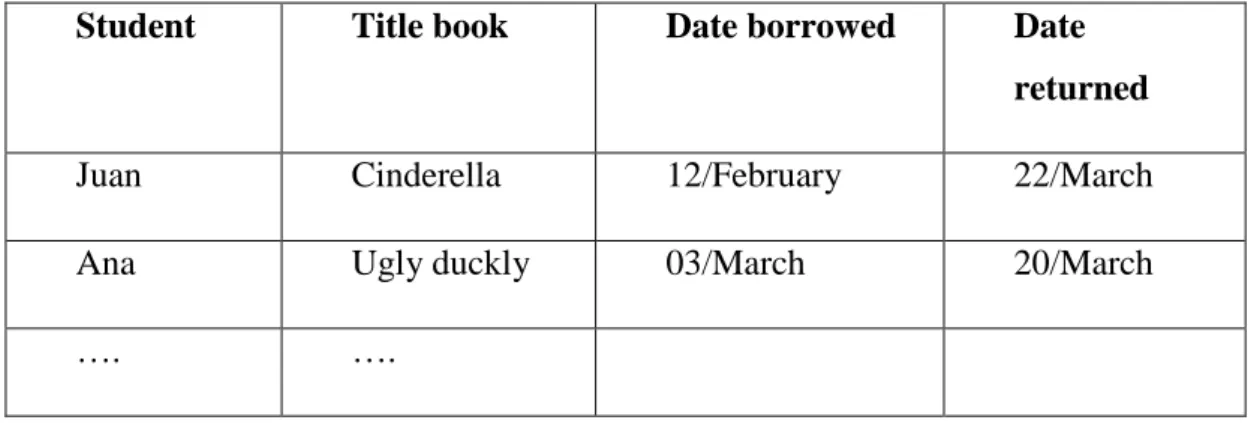
have to write down their name and the date on the paper registration
(Table 1) to know who has the books in his/her home, and after that, they
write down the day when they leave the book in the library again.
Table 1: paper registration
Student Title book Date borrowed Date
returned
Juan Cinderella 12/February 22/March
Ana Ugly duckly 03/March 20/March
o Hours of reading comprehension in Spanish Language and Literacy:
Students have a subject (Spanish Language and Literacy), which takes
part of it to use for the reading comprehension. They have special
textbooks, which contains many stories. After reading these stories, there
are some questions of comprehension about the story. These books are
very useful because it is very important to improve the students reading
comprehension, making them focus on what they have read. It is
important to develop: the capacity of summarize the main ideas and the
secondary ones, point the main characters, differentiate the important
parts of the text, etc.
o Students have three subjects in English language. Natural Science, Arts
and crafts and English. It could be a great idea to develop this reading
project relating these three subjects between them. It would be necessary
that the teachers from these subjects are in contact every time and reach
an agreement to develop it.
o The school has a programme called “Hermanamiento”, called twinning in
English. They celebrate these twinning for different festivities during the
year. I can talk about many twinning-projects that students carried out,
but, in this case, I will focus specifically in WORLD BOOK DAY.
During this celebration, students from 4th, 5th and 6th grade searched, at
home, different books adapted for infant education. These students went
to the kindergarten (infant education) and read some books to the
youngest children. Those students are called each other “siblings”.
During the twinning, they spend a fantastic time together, and most of
them are very excited when they met again. Depending on the
celebration, sometimes they gave each other a present elaborated by
themselves. I can take part of this idea to elaborate it in the project.
o Storytelling activity. Some publishing companies send to the school, as a
present, some storytelling activities for the students. When they come to
the school, the school adapt a classroom for that. The students from
different courses go there to listen the stories. The storytellers read some
stories in a funny way, using a big variety of resources and materials;
also recommends them many interesting books for their age. This is
something positive because it is a resource to make the students more
interested on books and they will start reading voluntarily as a pleasure.
It is a pity they do not have English storytellers yet, but the school can
ask the publishers for them.
o Reading club (William Shakespeare’s project): this reading club is an
extracurricular activity in the school library on Thursday afternoon where
children go there to read. Normally, they go there, they read together and
make activities. However, I want to point out the William Shakespeare’s
project, which was elaborated during the weeks before and after of the
world book day. The school received the book of“Romeo and Juliet”
from William Shakespeare, and they read it (in English) in this
extracurricular activity, during different days. They elaborated
summaries of the book, made draws, told each other their favourite part,
took photos, etc.
That is not all, children who are for 5th grade elaborated this project in
English during this week. Students had to make an individual work about
Shakespeares’ plays (Romeo and Juliet, Much ado about nothing, The
merchant of Venice, Hamlet…). Later, all the students of each class
made together a big mural for the corridor, with their works, pictures,
drawings, mind-maps, etc. and they also made some smaller ones for
their classrooms.
Teachers can use this opportunity to propose the idea of elaborate this
extracurricular activity in English just one Thursday per month. Teachers
could offer a variety of short readings that people from this club can read
it with the subsequent activities.
o The school has a webpage that is used as a bulletin board where the
secretary upload documents, photos, information for parents, etc., and
links to different web pages; one of them is a link to a page about
reading: leer.es This webpage is from the Spanish government. Here you
about books or readings, etc. It is a good resource for parents. Apart from
this, there are many links, for example a multilingual dictionary.
o RELEO: Bank of books. This project boosts the creation and
maintenance of a bank of books on textbooks and complementary
resources on 3rd to 6th levels, so students can use them by a borrowing
and re-use system.
4.3. THE PROCESS TO CHOOSE THE BOOKS.
As I said before, in their classroom, they have different books adapted to their age and
knowledge, instead of be in the school library, but all of them in Spanish language.
However, they have some books repeated 26 times, one for each student. This is for
make a reading plan followed by the teacher. To make able to develop the project, we
need to:
Introduce some English books and elaborate an English library corner. In this case, to be able to elaborate this idea, we need different books in English. In
some evaluations, we need one book for each student to do a reading plan.
The vocabulary of these new books has to be the suitable mainly to their
knowledge, instead for their age. We can know it based on (CEFR- Common
European Framework of Reference). We can do a game or a meeting talking
about different topics to discover the English level of the students. We can find
problems if we choose the books basing on the age instead in the knowledge.
It is necessary that these reading books be related with the vocabulary of the
different Units in the texts books to make them easy to understand the story and
also to improve and develop new vocabulary.
It is advisable to have the same books in every class, so that all the children have
access to the same materials for their work. They can also add their own books
to be used by the group during the year.
The variety of books is necessary to get the student read for pleasure. We need
based on the different pleasures of the students. Teachers can also use
audiobooks or storytellers to motivate them.
The content have to be attractive for them, touching themes related with ordinary
situations in their age. For example: problems in a student life in the school, live
adventures in summer, etc.
During their life, they could observe different reading text. Some of them are for
learning or acquiring knowledge (prepare an exam, game instructions, get new
information…), but there are some text, which are made for reading with
pleasure (the diary of Greg, Geronimo Stilton, etc.). However, teachers have to
get the perfect book, in which are mixed both different kind of texts, using the
idea of learning for pleasure.
To choose these books, the teachers of the different lines in that course (4th A, 4th B and
4th C), should meet and talk about the books that they are going to choose for the
elaboration of the project. Teachers should be coordinated and share the same objectives
and similar ways to work.
4.4. DESIGN.
4.4.1 Introduction activity.
Teachers can use an attractive activity to introduce the students on the foreign reading
world: First, the teachers will divide the class group in pairs. They will give the students
a list of books. After that, students will go to the computer room and start working in
pairs searching information about these books. They can find images, summaries,
games, read some pages of the books, activities, videos, etc. When the students get that
information, they will recommend to their classmates the most interesting one arguing
why.
During this activity, students develop the digital competence and start to control web
pages, knowing where they can find information of new English books. This activity is
also a method to make them interest in books and reading. The internet is a fantastic
After that introduction activity, as an approach to reading, the teacher can start with the
project. After observing the index of the book and reading the vocabulary of the units,
we have to mark which units are for the different evaluations. Then, we can start to
collect books related.
4.4.2 First evaluation.
- In the first evaluation, the English teacher will develop three units in English subject. Following the textbooks I will point the vocabulary, cross-curricular and
curricular themes of these units are: Unit 0. Autumn vocabulary and autumn
clothes VS summer clothes; Unit 1. Sports/hobbies and time expressions,
Ancient sports (History) and The Highland Games; Unit 2. Sea animals and
describing sea animals, Classification (Science) and The Great Barrier Reef.
(Appendix 1: Books first evaluation).
After the introduction activity, the teacher will start this first evaluation making
a slowly introduction in reading with a closer monitoring, so the teacher will not
give them a book to read at home. Students will start reading non-fiction books
related with the topics and vocabulary of the Unit. The teacher will focus in two
concrete topics: Sports and Sea Animals. The teacher will give them many
resources to work with (books, webpages, dictionaries, encyclopaedias,
photos…).
Students in each class will be divided in two groups. One group will focus in
“sports” and the other in “sea animals”. Each groups will work together
(searching information, watching videos, taking photos, etc. in books,
magazines, internet…) to elaborate a performance (theatrical, rap, dance, song,
etc.) followed by a big mural. This mural will be use it as an extra-resource to
explain, to their classmates, what they have learn. The searching information and
the elaboration of the performance and the mural will be in class (students will
work a day per week), but they can also search information at home.
As I said, at the end of the evaluation, students will make an explanation to their
classmates (using the performance and the mural). After that, students will
To evaluate:
The teacher will give them individually a template (Appendix 5: Template) with some
questions about the book or books they have used. Students have to complete it, as they
best think. It will take them some minutes. This template is used as self-evaluation,
which children use to see how much they have learned from the theme. However, the
evaluation cannot be boring.
After those minutes, they will play the “*finding game” in small groups. Children will
be very excited so they will run and move a lot. After that game, the whole class will go
back to the classroom and they will share their answers. The teacher will project the
correct ones on the smartboard. They can compare and complete their templates with
the lost information.
- *Finding game: To make the students disconnect and make the project more
attractive for them, it is interesting to introduce the movement, developing
the “social and civic competence” in the classroom; students will interact
with the environment and their classmates. The teacher will prepare some
clues, which describe the concrete place in the school where there are some
answers of the template. The class will be divided in small groups; they will
run to find these answers as fast as they can, because the winner team has a
prize.
To make this project using new methodologies and not be repetitive or bored for the
students, the teacher will introduce a new way to evaluate the reading. Teachers do not
want to know exactly if the students have understood the book completely (every word),
so they will check if they have read it, asking some basic questions. These questions
could be answered for those students who have read the books carefully and daily (that
is one of the objectives of this project, the global comprehension of texts), working hard
and being interested on their work.
To evaluate the children’s reading, the teacher will use an Internet programme game
called “kahoot” (Image 1). “Kahoot” is a platform in which the sign up is free. It is
similar as the typical quiz game, but with the difference that they have to use computers
or tablets individually to choose the answer. Teachers can also elaborate their own quiz,
number of questions, correct answers, wrong answers, time, etc. During this evaluation,
children will develop and strengthen their “digital competence”.
ICT Resources that we need:
For the teacher: A computer and a smartboard to project the questions.
For the children: Computers or tablets to answer the questions.
This programme is a funny way to carry out a self-evaluation, to see if they know about
the topic. We can find many “kahoots” made by other people but, as I said before we
can also elaborate our own “kahoots”.
Depending on the number of questions, children should get at least a minimum of
points, which the teacher have calculated before carry out the game. With this, the
teacher can know who has read the book and has been interested in the topic. To win the
game, it is allow answering wrongly 50% of the questions. At the end of the game, the
teacher can see their points reflected on the smartboard. What does it mean if they “win
the game”? They can get a prize. It is an extra point on the evaluation mark. If not, they
will not get it. (Appendix 6. Kahoots’ Screenshots).
After the evaluation and if it is possible the teacher could play a film or make a
performance of the book (depending on the time and on the resource availability).
As I said before, students celebrate “Twinnings” with infant education, and we can take
part of this. If it is possible:
Students could act as storytellers for the youngest children. They search stories
adapted to them and they read them those stories using some resources and
materials.
To complete this twinning, the teacher can ask to 4th grade students’ parents, if they
have any book at home for infant education that they will not use. Instead of throw them
away, they can give to the infant education, as a present, to enlarge their library in the
Image 1: Kahoot
4.4.3 Second and third evaluation.
Unlike the first evaluation, in the following second and third evaluation, students will
work hardly and individually.
- In the second evaluation, teachers will develop again three more units. The
vocabulary, the cross-curricular and cultural themes are: Unit 3.School subjects
and school activities, Computers (ICT) and Languages of the UK; Unit 4. Places
in a town and directions, Street Maps (Geography) and Cities in the USA; Unit
5. The world around us and past tense irregular verbs, Landscapes (Art) and
Yellowstone National Park. (Appendix 2: Books second evaluation).
- The third evaluation, other three units. The vocabulary, the cross-curricular and
cultural themes are: Unit 6. Jobs and actions, Firefighting (History) and
Unusual architecture; Unit 7. Health and jobs at home, the five senses (Science)
and Doctors and nurses; Unit 8. Cooking and quantities, Weights and
measurements (Maths) and Jamaican food. (Appendix 3: Books third
evaluation).
To elaborate the project during these two evaluations, the students have to work in class
and also at home.
Work in class:
First, to make more interesting the introduction of the book, the teacher will divide the
class in groups of five students. In each group, students will decide a “spokesperson” and a “secretary”. After that, the teacher will write the following questions in the
- What could you see in the cover?
- What do you think is it about?
- Who is the main character?
- What kind of book is it? (Drama, mystery, romance, horror, science,
fantasy…)
- It will be a sad o happy ending?
- What do they expect?
Each student has the same book and they can see and comment about the book cover
and the book summary. These small groups have just ten minutes to discuss the
questions. The secretary has to write the answers in a paper and later the spokesperson
will transmit it to their classmates. After ten minutes, students will sit making a circle
with the tables, to see and listen each other correctly.
After sharing this information, students have 5 minutes to make a drawing about the
book, making a prediction how they think it will be.
Secondly, students will start reading aloud. Teacher will try that every student could
read at least once or twice. During this time, the teacher can take notes about each
students’ pronunciation to be aware about who need to improve it. Then, teacher and
students will talk about the introduction of the book (first chapter), sharing information,
making a small summary and remarking the important aspects.
Finally, the teacher will make also some introductions and questions about what will
happen, opening their curiosity and make them think about “what is next?”. Children
will be anxious to arrive home and continue with the book. Teacher will ask them to
read aloud at home, the same as we have done in class (to improve the pronunciation).
After this first day, the teacher will let them the liberty of reading it at home, but
monitoring the reading (not in the same way as the first evaluation). The teacher will
ask them to point out one day in the calendar. This day will be in the middle of the
evaluation. This concrete day they will bring the book to class and they will read aloud
together. It is a great opportunity to take notes again about the improvement of the
To improve this pronunciation, the teacher will upload audiobooks to the web page of
the school. Students can read them at home while they listen the correct pronunciation
of the words.
Work at home:
Students will read the book at home doing the same as we did in class. Every day they
will read aloud a little and after each chapter (each chapter could take them some days-
it is not necessary to read one chapter per day), they will think about what they have
read and make a small summarize, just using few key words. If they cannot understand
some expressions or parts of the books, they will search it in the dictionary or in
internet. If it is not possible for them to get the meaning, they will underline it with a
pencil and they can ask it in class.
During the readings at home, the teacher will advise them to take notes about important
things because they will need it in the future.
To read it at home does not mean that they have to read the whole book. As I had said,
one day at the middle of the evaluation, students will bring the book read it in halfway,
(I tell them the concrete chapter). This day:
1) Students will comment in English what they have read during those weeks,
talking about the characters, the places, actions… reading summaries and the
notes they have taken. It is the opportunity for the teacher to see: if they are
working on the book, making a daily reading; how much they have understand
and; the participation of each student during this meeting.
2) Students will read one chapter together in class, making the corresponding
short summary and thinking about what they have read. If it is necessary, they
can take notes.
After that day, they will finish the book at home, the same as they have done until now.
Evaluation:
To evaluate the project, it will be the same way as in the first evaluation. Filling a
We can add that during the twinnings, students could represent, in infant education, one
of the books that students will read.
Besides, the students can do a drawing about the book and compare it with the first one
they have made before starting the book. They, voluntary, can tell to their classmates
the evolution of the two drawings.
At the end of the evaluation, students can give to their teacher the summaries and the
notes taken during the reading at home.
As an example of a kahoot, I have created a quiz based on “Goosebumps: the haunted
school”, R.L.Stine. It has 10 questions with four answers, but just one is correct. The
students will “win the game” if they answer well five at least.5
4.4.4 Fourth evaluation.
Changing the reading resources is important and the teachers will show to the students,
a big variety of them.
- The fourth evaluation is the most difficult one. There is just one unit, the last one: Unit 9. Weekend plans and special clothes, How to make a pair of shoes
(Science) and Scouts in the UK. (Appendix 4: Books fourth evaluation).
Students are not concentrated (because of the hot weather, the near summer
holidays, because of the short duration of the classes and excursions) so the best
idea is to elaborate the reading in class. To change the reading model, teachers
can offer a comic strip (Imagen 2) about a joke during the last 5 minutes of the
English lesson. Not every day, but sporadic days depending on the time. These
comics should be related with the vocabulary of the lesson. Teacher project the
comic on the smartboard and students will comment and discuss about it.
During this final evaluation, there will not be any work at home and final exam.
This is because there is not enough time to make a big work.
5.
CONCLUSIONS
Through a long research and a development project, I am able to point different main
factors or recommendations to carry out a reading project in class in a suitable way to
approach reading for pleasure and trying to get students reading habits.
Factors to take into account to design and elaborate the project.
- Time
Before starting planning the project, we have to think in the duration of it, the lessons
that it will take us. First, planning the timing of the different units inside each evaluation
and then adapting the project on it. It is very important the correct organization and
planning of the project, because if there is any problem the teacher can solve it easily.
Teachers have to plan about the general annual programming but we do not have to
forget the other subjects, because, if it is possible, we can relate the contents of the
units.
- Competences and skills developed:
In this reading project, these will be the competences that will be developed:
1. Competence in linguistic communication: This will be the main competence
that they will develop because the project is focused on a bilingual reading
project. The main objective is to develop on the students the interest in
foreign language reading.
2. Digital competence: Students improve their capacity of surfing the web
during the “introduction activity” and while they carry out the “final exam” or “evaluation”; they develop this competence using the computers.
3. Learning to learn: During the reading of the book appear new words and new
expressions, which give them the opportunity to search the meaning on the
dictionary or in internet. It makes maximize their ability to search
information.
4. Social and civic competences: At the end of the project, during the “finding
and developing social skills working in groups. They have to be conscious
that they will share information and their classmates will do the same. It is
good to be competitive because we can do the best of us and make big
efforts. However is more important to be nice and share with the classmates.
- Implicated agents
As I have said before, the importance of the family and parents in this project is
enormous. The teachers are not only the responsible for the education; the families are
an essential agent for this learning process. It is very important a routine at home, to
make the children be focused and responsible for their homework and exams. Talking
about reading routine, it is also very necessary because if children do not see that, they
will not do it. It is necessary to have a special space for reading at home, not changing
places every time; if it is possible, they should read always at the same time; Children
should read books adapted to their age and knowledge. For all these things, it is
necessary the family, to help the student get used to reading on a daily basis.
- Students’ opinions (for next year):
To make this project more interesting for them, I can offer them the opportunity to
make a list with English books they have read or are interested in read it. The teacher
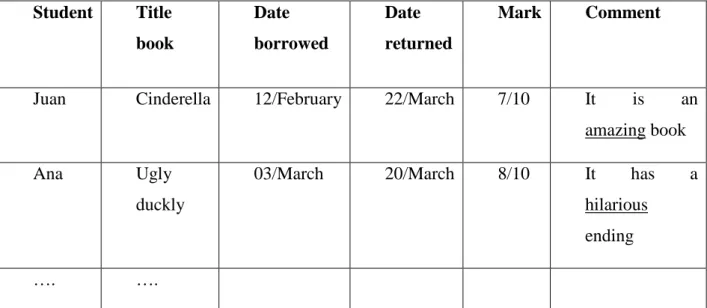
puts a paper with a white book-list (table 2) in class and students can recommend
interesting books. In this list, students can add the books they have chosen in the
“introduction activity”. Making a list is an opportunity to see their interests and
knowledge and consider it for following years. The teacher can choose any of them as
an example of book for the next school year. It is not necessary to choose always the
same books, year after year, to elaborate the project. Depending on the characteristics of
the students groups, it could be necessary -or not- to make changes.
To make more interesting and useful this book-list, student have to make a short
Student Title book
Date borrowed
Date returned
Mark Comment
Juan Cinderella 12/February 22/March 7/10 It is an
amazing book
Ana Ugly
duckly
03/March 20/March 8/10 It has a
hilarious
ending
…. ….
Table 2: Book list
In addition, I would like to add the importance of the movement. The physical aspect of
the students should be the most important thing in every moment. Children love to
move and we cannot make them be seated on a chair during long periods. Therefore, I
try to introduce at least some movement. The idea of the “finding game” is something
that will let them to have fun (competing with their classmates) at the same time that
they learn and reinforce the concepts (with the answers of the template about the book).
Nowadays, bilingual schools think that the important issue is to learn science
vocabulary, art and craft, music… but it is not. The best way to learn a new language
(English in this case) is reading, learning new words, expression that they will use daily,
the text comprehension and the communication with other people. Reading makes them
6.
BIBLIOGRAPHY
- Meek M. (1982). Learning to read. United Kingdom. Bodley Head
Children’s Book.
- Ley Orgánica 2/2006, de 3 de mayo, de Educación, modificada por la Ley
Orgánica 8/2013, 9 de diciembre, para la Mejora de la Calidad Educativa.
- ORDEN EDU/519/2014, de 17 de junio, por la que se establece el currículo
y se regula la implantación, evaluación y desarrollo de la educación primaria
en la Comunidad de Castilla y León.
- Bilsborough K. and Bilsborough S. (2014) Ace! 4: Class Book. Oxford
WEB REFERENCES.
- Universidad de Valladolid. (2016) Recuperado de:
http://www.uva.es/export/sites/uva/2.docencia/2.01.grados/2.01.02.ofertafor
mativagrados/_documentos/edprimva2_competencias.pdf
- Love Reading 4 Kids. (2016, 18 June) Books web page. Recuperado de:
http://www.lovereading4kids.co.uk
- Nuestras cosas en familia (2016, 17 de June). Comics. Recuperado de:
http://nuestrascosasenfamilia.blogspot.com.es/2011/11/libros-de-lectura-en-ingles-clasicos.html
- Common European Framework of languages (2002). Marco común europeo
de referencia para las lenguas. Strasbourg. Instituto Cervantes para la
traducción en español. Recuperado de :
http://cvc.cervantes.es/ensenanza/biblioteca_ele/marco/cvc_mer.pdf
- Children’s book publisher (2012) Scholastic. Scholastic Inc. Recuperado de:
www.scholastic.com
- Entertainment Industry Foundation (2016) Story Online. Sag-Aftra
7.
APPENDIXEX
Appendix 1. Books first evaluation. First evaluation:
0. Autumn vocabulary; Autumn VS summer clothes
NON-FICTION: Signs of Autumn- Paul Humphrey / Autumn Leaves
(Preparing for Winter)- Gail Saunders-Smith / Popcorn: Seasons:
Autumn- Kay Barnham
1. Sports/hobbies; time expressions
STORYTELLERS: Catching the Moon (Written by: Crystal Hubbard) is
the story of the girl who grew up to become the first woman to play for
an all-male professional baseball team.
(
http://www.storylineonline.net/catching-the-moon-the-story-of-a-young-girls-baseball-dream/ )(screen actors guild foundation)
FICTION: Soccer Show-Off- Jake Maddox
http://www.goodreads.com/book/show/18183552-soccer-show-off
2. Sea animals; describing sea animals
NON-FICTION: Seashells crabs and sea stars- Christiane Kump Tibbitts
https://www.amazon.com/Seashells-Crabs-Sea-Stars-Take-Along/dp/1559716754#reader_1559716754
Life in a Tide Pool (Rookie Read-About Science (Paperback)) - Allan
Fowler
https://www.amazon.com/Life-Rookie-Read-About-Science-Paperback/dp/0516260839/ref=pd_bxgy_14_img_3?ie=UTF8&refRID=J
52H04D3KK6EZ7EXADQS#reader_0516260839
Dolphin readers level 4 In the ocean
https://elt.oup.com/catalogue/items/global/graded_readers/dolphin_reade
rs/level_4/9780194401135?cc=cz&selLanguage=cs&mode=hub
POEMS: Ocean Soup: Tide-Pool Poems- Stephen r. Swinburne