LÓPEZ, M.; YÁÑEZ, A.; GOMES DA COSTA, S.; AVELLÀ, L., (Coord.). Actas del Congreso Internacional de Eficiencia Energética y Edificación Histórica / Proceedings of the International Conference on Energy Efficiency and Historic Buildings (Madrid, 29-30 Sep. 2014). Madrid: Fundación de Casas Históricas y Singulares y Fundación Ars Civilis, 2014. ISBN: 978-84-617-3440-5
Edited by
Fundación de Casas Históricas y Singulares Fundación Ars Civilis
Coordinated by
Mónica López Sánchez. Fundación Ars Civilis
Ana Yáñez Vega. Fundación de Casas Históricas y Singulares Sofia Gomes da Costa. Fundación de Casas Históricas y Singulares Lourdes Avellà Delgado. Fundación Ars Civilis
© Copyright
- 5 -
T
T
a
a
b
b
l
l
e
e
o
o
f
f
c
c
o
o
n
n
t
t
e
e
n
n
t
t
s
s
PRESENTACIÓN ... - 11 -
Eficiencia energética y edificación histórica: un reto del presente... - 13 -
Cristina Gutiérrez-Cortines y Mónica López Sánchez. Fundación Ars Civilis Eficiencia energética y edificación histórica: un reto del futuro ... - 14 -
Ana Yáñez Vega. Fundación de Casas Históricas y Singulares Committees ... - 15 -
Programme ... - 16 -
Governance, management, participation and mediation... 21
-SUSTAINABLE ENERGY ACTION FOR WORLD HERITAGE MANAGEMENT ... - 22 -
RONCHINI, C.; POLETTO, D. ENERGY EFFICIENCY AND URBAN RENEWAL OF A UNESCO-LISTED HISTORICAL CENTER: THE CASE OF PORTO ... - 38 -
SANTOS, Á.; VALENÇA, P.; SEQUEIRA, J. HISTORICAL HERITAGE: FROM ENERGY CONSUMER TO ENERGY PRODUCER. THE CASE STUDY OF THE ‘ALBERGO DEI POVERI’ OF GENOA, ITALY ... - 45 -
FRANCO, G.; GUERRINI, M.; CARTESEGNA, M. IMPROVING ENERGY EFFICIENCY IN HISTORIC CORNISH BUILDINGS – GRANT FUNDING, MONITORING AND GUIDANCE ... - 61 -
RICHARDS, A. ENERGY EFFICIENCY AND BUILDINGS WITH HERITAGE VALUES: REFLECTION, CONFLICTS AND SOLUTIONS ... - 75 -
GIANCOLA, E.; HERAS, M. R. PROPUESTA METODOLÓGICA PARA LA REHABILITACIÓN SOSTENIBLE DEL PATRIMONIO CONTEXTUAL EDIFICADO. EL CASO DEL CENTRO HISTÓRICO DE LA CIUDAD DE MÉRIDA, YUCATÁN / Methodological proposal for the sustainable rehabilitation of context heritage building. The case of the historic downtown of Merida, Yucatan ... - 82 -
- 6 -
Traditional and technological knowledge: concepts, techniques, practices, uses,
materials, methodologies ... 99
-SUSTAINABLE REFURBISHMENT OF HISTORIC BUILDINGS: RISKS, SOLUTIONS AND
BEST PRACTICE ... - 100 -
HEATH, N.
EFICIENCIA ENERGÉTICA Y VALORES PATRIMONIALES. LECCIONES DE UNA
INVESTIGACIÓN Y UN SEMINARIO / Energy efficiency and heritage values. Lessons of
a Research and a Seminar ... - 110 -
GONZÁLEZ MORENO-NAVARRO, J. L.
ARCHITECTURAL INTEGRATION OF PHOTOVOLTAIC SYSTEMS IN HISTORIC DISTRICTS.
THE CASE STUDY OF SANTIAGO DE COMPOSTELA ... - 118 -
LUCCHI, E.; GAREGNANI, G.; MATURI, L.; MOSER, D.
HISTORIC BUILDING ENERGY ASSESSMENT BY MEANS OF SIMULATION TECHNIQUES ... - 135 -
SOUTULLO, S.; ENRIQUEZ, R.; FERRER, J. A.; HERAS, M. R.
DESIGN OF A CONTROL SYSTEM FOR THE ENERGY CONSUMPTION IN A WALL-HEATED
CHURCH: SANTA MARIA ODIGITRIA IN ROME ... - 145 -
MANFREDI, C.; FRATERNALI, D.; ALBERICI, A.
EXEMPLARY ENERGETICAL REFURBISHMENT OF THE GERMAN ACADEMY IN ROME
"VILLA MASSIMO" ... - 160 -
ENDRES, E.; SANTUCCI, D.
SISTEMA MÓVIL INTEGRADO PARA LA REHABILITACIÓN ENERGÉTICA DE EDIFICIOS: LÁSER 3D, TERMOGRAFÍA, FOTOGRAFÍA, SENSORES AMBIENTALES Y BIM / Integrated mobile system for building energy rehabilitation: 3D laser, termography, fotography,
environmental sensors and BIM ... - 169 -
SÁNCHEZ VILLANUEVA, C.; FILGUEIRA LAGO, A.; ROCA BERNÁRDEZ, D.; ARMESTO GONZÁLEZ, J.; DÍAZ VILARIÑO, L.; LAGÜELA LÓPEZ, S.; RODRÍGUEZ VIJANDA, M.; NÚÑEZ SUÁREZ, J.; MARTÍNEZ GÓMEZ, R.
CONSECUENCIAS CONSTRUCTIVAS Y ENERGÉTICAS DE UNA MALA PRÁCTICA. ARQUITECTURAS DESOLLADAS / Energy and constructive consequences of a bad
practice. Skinned architectures ... - 186 -
DE LUXÁN GARCÍA DE DIEGO, M.; GÓMEZ MUÑOZ, G.; BARBERO BARRERA, M.; ROMÁN LÓPEZ, E.
EL BIENESTAR TÉRMICO MÁS ALLÁ DE LAS EXIGENCIAS NORMATIVAS. DOS CASOS. DOS ENFOQUES / Thermal comfort beyond legislation. Two examples. Two
approaches ... - 201 -
DOTOR, A.; ONECHA, B.; GONZÁLEZ, J. L.
LA MONITORIZACIÓN Y SIMULACIÓN HIGROTÉRMICA COMO HERRAMIENTA PARA LA MEJORA DEL CONFORT, PRESERVACIÓN Y AHORRO ENERGÉTICO DE ESPACIOS
PATRIMONIALES. EL CASO DE LA IGLESIA DE SAN FRANCISCO DE ASIS, MORÓN DE LA FRONTERA / Measurement and hygrothermal simulation model, a tool to enhance thermal comfort, preservation and saving energy of heritage site. Case study: the
church of San Francisco of Asís in Morón de la Frontera ... - 210 -
- 7 - TERESE3: HERRAMIENTA INFORMÁTICA PARA LA EFICIENCIA ENERGÉTICA MEDIANTE
LA SIMULACIÓN CALIBRADA DE EDIFICIOS / TERESE3: informatic tool for the energetic
efficiency through the calibrated simulation of buildings ... - 226 -
GRANADA, E.; EGUÍA, P.; MARTÍNEZ, R.; NÚÑEZ, J.; RODRÍGUEZ, M.
EFICIENCIA ENERGÉTICA Y ANÁLISIS TÉRMICO PARA SISTEMAS DE AIRE
CENTRALIZADO: UN CASO DE ESTUDIO / Energy Efficiency and thermal analysis for
centralized air heating systems: a case study ... - 238 -
MARTÍNEZ-GARRIDO, M. I.; GOMEZ-HERAS, M.; FORT, R.; VARAS-MURIEL, M. J.
ANALISIS ENERGETICO DEL MUSEO DE HISTORIA DE VALENCIA MEDIANTE DISTINTAS HERRAMIENTAS DE SIMULACIÓN / Energy assessment of the History Museum of
Valencia using various simulation tools ... - 249 -
TORT-AUSINA, I.; VIVANCOS, J.L.; MARTÍNEZ-MOLINA, A.; MENDOZA, C. M.
APROVECHAMIENTO SOLAR PASIVO EN LA RETÍCULA URBANA DE LA CIUDAD HISTÓRICA. EL CASO DE CÁDIZ / Passive solar gains in the urban grid of the historic
city. The case study of Cadiz ... - 257 -
SÁNCHEZ-MONTAÑÉS, B.; RUBIO-BELLIDO, C.; PULIDO-ARCAS, J. A.
TECHNICAL SYSTEM HISTORY AND HERITAGE: A CASE STUDY OF A THERMAL POWER
STATION IN ITALY ... - 275 -
PRETELLI, M.; FABBRI, K.
ANALISIS ENERGÉTICO Y PROPUESTAS DE MEJORA DE UNA CASA EN REQUENA MEDIANTE PROGRAMAS DE SIMULACIÓN / Energy analysis and improvement
proposal of a house in Requena (Spain) using simulation software ... - 281 -
TORT-AUSINA, I.; VIVANCOS, J.L.; MARTÍNEZ-MOLINA, A.; MENDOZA, C. M.
UNA REVISIÓN DE PUBLICACIONES EN EDIFICIOS DESDE EL ASPECTO ENERGÉTICO / A
review of papers in buildings from the energetic perspective ... - 292 -
TORT-AUSINA, I.; MARTÍNEZ-MOLINA, A.; VIVANCOS, J.L.
MORTEROS MIXTOS DE CAL Y CEMENTO CON CARACTERÍSTICAS TÉRMICAS Y ACÚSTICAS MEJORADAS PARA REHABILITACIÓN / Lime-cement mixture with
improved thermal and acoustic characteristics for rehabilitation ... - 303 -
PALOMAR, I.; BARLUENGA, G.; PUENTES, J.
NEAR ZERO ENERGY HISTORIC BUILDING. TOOLS AND CRITERIA FOR ECOCOMPATIBLE
AND ECOEFFICIENT CONSERVATION ... - 318 -
BAIANI, S.
INTEGRANDO RENOVABLES EN LA CIUDAD HEREDADA: GEOTERMIA URBANA /
Integrating renewable in the inherited city: urban geothermal ... - 329 -
SACRISTÁN DE MIGUEL, M. J.
ANÁLISIS Y PROPUESTAS DE MEJORA DE LA EFICIENCIA ENERGÉTICA DE UN EDIFICIO HISTÓRICO DE CARTAGENA: ANTIGUO PALACIO DEL MARQUÉS DE CASA-TILLY / Analysis and proposals for improving the energy efficiency of a historical building in
Cartagena: the former Palace of the Marquis of Casa-Tilly ... - 344 -
COLLADO ESPEJO, P. E.; MAESTRE DE SAN JUAN ESCOLAR, C.
- 8 -
MARTÍN, A.; MILLÁN, J. A.; HIDALGO, J. M.; IRIBAR, E.
IS TEMPERIERUNG ENERGY EFFICIENT? THE APPLICATION OF AN OLD-NEW HEATING
SYSTEM TO HERITAGE BUILDINGS ... - 366 -
DEL CURTO, D.; LUCIANI, A.; MANFREDI, C.; VALISI, L.
TERMOGRAFÍA INFRARROJA Y EDIFICIOS HISTÓRICOS ... - 380 -
MELGOSA, S.
SIMULATION MODEL CALIBRATION IN THE CONTEXT OF REAL USE HISTORIC
BUILDINGS ... - 388 -
ENRÍQUEZ, R.; JIMÉNEZ, M.J.; HERAS, M.R.
THE THERMOPHYSICAL CHARACTERIZATION OF TECHNICAL ELEMENTS IN THE
HISTORIC ARCHITECTURE: EXPERIENCES IN PALERMO ... - 397 -
GENOVA, E.; FATTA, G.
ENERGY EVALUATION OF THE HVAC SYSTEM BASED ON SOLAR ENERGY AND
BIOMASS OF THE CEDER RENOVATED BUILDING ... - 407 -
DÍAZ ANGULO, J. A.; FERRER, J. A.; HERAS, M. H.
Legal and technical regulation and historic buildings ... 419
-OLD BUILDING, NEW BOILERS: THE FUTURE OF HERITAGE IN AN ERA OF ENERGY
EFFICIENCY ... - 420 -
JANS, E.; ICOMOS, M.; KOPIEVSKY, S.; AIRHA, M.
HISTORIC WINDOWS: CONSERVATION OR REPLACEMENT. WHAT'S THE MOST
SUSTAINABLE INTERVENTION? LEGISLATIVE SITUATION, CASE STUDIES AND CURRENT
RESEARCHES ... - 432 -
PRACCHI, V.; RAT, N.; VERZEROLI, A.
ENERGY RETROFIT OF A HISTORIC BUILDING IN A UNESCO WORLD HERITAGE SITE: AN
INTEGRATED COST OPTIMALITY AND ENVIRONMENTAL ASSESSMENT... - 450 -
TADEU, S.; RODRIGUES, C.; TADEU, A.; FREIRE, F.; SIMÕES, N.
PARQUE EDIFICADO O PATRIMONIO EDIFICADO: LA PROTECCIÓN FRENTE A LA INTERVENCIÓN ENERGÉTICA. EL CASO DEL BARRIO DE GROS DE SAN SEBASTIÁN / Built Park or Built Heritage: Protection against energy intervention. The case of Gros
district of San Sebastian ... - 464 -
URANGA, E. J.; ETXEPARE, L.
SIMULTANEOUS HERITAGE COMFORT INDEX (SHCI): QUICK SCAN AIMED AT THE SIMULTANEOUS INDOOR ENVIRONMENTAL COMFORT EVALUATION FOR PEOPLE AND
ARTWORKS IN HERITAGE BUILDINGS ... - 478 -
LITTI, G.; FABBRI, K.; AUDENAERT, A.; BRAET, J.
PROBLEMÁTICA DE LA POSIBLE CERTIFICACIÓN ENERGÉTICA CON CE3X DEL
PATRIMONIO ARQUITECTÓNICO: EL CASO DEL ALMUDÍN DE VALENCIA / Difficulties found in the possible energy certification of heritage by using the CE3X software: the
case of El Almudín of Valencia ... - 495 -
CUARTERO-CASAS, E.; TORT-AUSINA, I.; MONFORT-I-SIGNES, J.; OLIVER-FAUBEL, E. I.
PROTOCOL FOR CHARACTERIZING AND OPTIMIZING THE ENERGY CONSUMPTION IN
PUBLIC BUILDINGS: CASE STUDY OF POZUELO DE ALARCÓN MUNICIPALITY ... - 506 -
- 9 -
Promotion, training, education ... 513
-THE WORK OF -THE SUSTAINABLE TRADITIONAL BUILDINGS ALLIANCE AND AN
INTRODUCTION TO THE GUIDANCE WHEEL FOR RETROFIT ... - 514 -
MAY, N.; RYE, C.; GRIFFITHS, N.
TRAINING OF EXPERTS FOR ENERGY RETROFIT AT THE FRAUNHOFER CENTRE FOR THE ENERGY-SAVING RENOVATION OF OLD BUILDINGS AND THE PRESERVATION OF
MONUMENTS AT BENEDIKTBEUERN ... - 528 -
KILIAN, R.; KRUS, M.
SPECIALIZED ENERGY CONSULTANTS FOR ARCHITECTURAL HERITAGE ... - 535 -
DE BOUW, M.; DUBOIS, S.; HERINCKX, S.; VANHELLEMONT, Y.
RENERPATH: METODOLOGÍA DE REHABILITACIÓN ENERGÉTICA DE EDIFICIOS PATRIMONIALES / RENERPATH: Methodology for Energy Rehabilitation of Heritage
Buildings ... - 543 -
PERÁN, J. R. ; MARTÍN LERONES, P.; BUJEDO, L. A.; OLMEDO, D.; SAMANIEGO, J.; GAUBO, F.; FRECHOSO, F.; ZALAMA, E.; GÓMEZ-GARCÍA BERMEJO, J.; MARTÍN, D.; FRANCISCO, V.; CUNHA, F.; BAIO, A.; XAVIER, G.; DOMÍNGUEZ, P.; GETINO, R.; SÁNCHEZ, J. C.; PASTOR, E.
LEVANTAMIENTOS ARQUITECTÓNICOS EN EL MEDIO RURAL / Architectural surveys in
rural areas ... - 553 -
HIDALGO, J.M.; MILLÁN, J. A.; MARTÍN, A.; IRIBAR, E.; FLORES, I.; ZUBILLAGA, I.
-- 11 --
P
P
R
R
E
E
S
S
E
E
N
N
T
T
A
A
C
C
I
I
Ó
Ó
N
N
En primer lugar y con carácter previo a abordar las diferentes cuestiones planteadas en el Congreso Internacional Eficiencia Energética y Edificación Histórica, la Fundación Casas Históricas y Singulares y la Fundación Ars Civilis firmamos un convenio de colaboración en mayo de 2013 que establecía un marco de cooperación entre las dos entidades, que comparten una parte de sus objetivos y fines fundacionales y un interés específico por el ahorro energético aplicado a elementos históricos, sean estos ciudades o bienes concretos. En este contexto, decidimos presentarnos a la convocatoria 2013 de ayudas para el fomento de la cultura científica, tecnológica y de la innovación, de la Fundación Española para la Ciencia y la Tecnología, con cuyo apoyo económico y técnico hemos abordado la organización y celebración de este Congreso Internacional.
Por consiguiente, el Congreso Internacional nació como una actuación de colaboración entre entidades públicas y privadas y con la intención de dar respuesta a uno de los retos de la sociedad española y europea para las próximas décadas, como es la adaptación energética y la generalización de prácticas que permitan alcanzar los compromisos nacionales y europeos de lucha contra el cambio climático (Estrategia EU Horizonte 2020) y con él pretendimos conseguir varios objetivos:
1) En el campo de la investigación, establecer puntos de interés común entre los sectores implicados y difundir aquellos estudios de caso que, tomando determinadas soluciones, mejoran la eficiencia energética de los inmuebles históricos preservando su carácter, valores y su integridad histórica.
2) Revisar los criterios de buenas prácticas y reunir en un mismo espacio a los agentes implicados en toda la cadena de la eficiencia energética y de la edificación histórica (investigación-mercado-usuario/cliente final-ciudadanía); y contribuir a asentar unas bases que permitan avanzar en un terreno aún por consolidar.
- 12 - Este Congreso se ha estructurado en cinco líneas temáticas,
consideradas fundamentales para el establecimiento de esas bases que se acaban de mencionar:
a) Gobernanza, gestión, mediación y participación (cómo tomar decisiones y facilitar procesos).
b) Conocimiento tradicional y tecnológico: conceptos, técnicas, prácticas, usos, materiales y metodologías (qué es lo que se puede hacer).
c) Regulación normativa y técnica y edificación histórica (cómo relacionar las imposiciones legales que afectan a los edificios históricos y las medidas de ahorro energético).
d) Formación y difusión (dónde se forman los especialistas y cómo se informa a la sociedad).
e) Mecanismos de financiación (cómo reunir los recursos económicos necesarios).
En todas ellas se han presentado diferentes experiencias relevantes de distintos países para iniciar el análisis, la discusión y el trabajo que ha permitido llegar a criterios consensuados.
En el Congreso Internacional han participado profesionales de distintas instituciones y disciplinas científicas, con responsabilidad y relacionadas con el Patrimonio histórico edificado, y ha sido un éxito como podrá verse en los diferentes trabajos que tratamos de recoger en estas Actas.
Por último, sólo nos queda agradecer a la Fundación Española para la Ciencia y la Tecnología su apoyo económico y a todos los ponentes, personas que han presentado comunicaciones y pósters, así como a los asistentes y entidades colaboradoras (portal Prefieres y Cetenma) su compromiso con este tema y el haber hecho posible este proyecto.
Teresa González-Camino Meade Presidenta Fundación Casas
Históricas y Singulares
- 13 -
E
E
f
f
i
i
c
c
i
i
e
e
n
n
c
c
i
i
a
a
e
e
n
n
e
e
r
r
g
g
é
é
t
t
i
i
c
c
a
a
y
y
e
e
d
d
i
i
f
f
i
i
c
c
a
a
c
c
i
i
ó
ó
n
n
h
h
i
i
s
s
t
t
ó
ó
r
r
i
i
c
c
a
a
:
:
u
u
n
n
r
r
e
e
t
t
o
o
d
d
e
e
l
l
p
p
r
r
e
e
s
s
e
e
n
n
t
t
e
e
La eficiencia energética es un tema que lleva implícito una presencia marcada de investigación y aplicación tecnológicas. No obstante, al haberse convertido en una prioridad política, de manera muy clara en el caso de la Unión Europea, sus implicaciones sociales hacen necesario un tratamiento más amplio y de mayor complejidad, que exige una visión holística e integral de todas las esferas que se van a ver afectadas por la aplicación y desarrollo a corto plazo de esas políticas. Sin embargo, si no se logra hacer de esa prioridad política una prioridad de la sociedad, difícilmente podrán alcanzarse los objetivos perseguidos.
Nos encontramos en este momento, por tanto, ante un escenario europeo de apoyo claro a las necesidades de adaptación energética, que incluye una normativa de obligado cumplimiento, al tiempo que ante el problema global de cómo hacerlo con el extenso parque edificado histórico existente en todas las ciudades europeas.
Como respuesta a ese reto, la Fundación Ars Civilis viene trabajando en los últimos años llevando a cabo una serie de actividades para dar visibilidad a ese desafío a la vez que presentar a quienes son los responsables de la toma de decisiones el conocimiento que se está generando desde la investigación, los resultados y aplicaciones y productos testados, y las entidades y ciudades que están aportando soluciones y aplicando medidas e iniciativas exitosas, en algunos casos con enfoques integrados e implicación y diálogo entre los agentes implicados.
Nuestro ámbito de actuación se había centrado hasta la fecha en las instituciones europeas en Bruselas (concretamente en el Parlamento Europeo), con el proyecto del que ahora presentamos las Actas nos propusimos generar un foro de debate que pudiera integrar a los diferentes perfiles profesionales y ámbitos de investigación que trabajan sobre estos temas, al tiempo que a gestores de diferentes entidades y administraciones privadas y públicas y a otros entes financiadores; todo ello, abierto a la participación ciudadana y de la mano de los propios usuarios. Un pilar de nuestra filosofía de trabajo es la visión integral, el enfoque sistémico, materializado en este caso en los 5 bloques temáticos que articulan el programa del Congreso. En un recorrido desde lo concreto, o cómo mejorar la eficiencia energética o el confort en un inmueble histórico, hasta lo global, o cómo dar visibilidad y avanzar hacia modelos de ciudad más equilibrada energéticamente que se proponen para el siglo XXI, y que se corresponden con las dinámicas propias de las ciudades históricas adaptadas inteligentemente a las demandas de nuestro momento.
- 14 -
E
E
f
f
i
i
c
c
i
i
e
e
n
n
c
c
i
i
a
a
e
e
n
n
e
e
r
r
g
g
é
é
t
t
i
i
c
c
a
a
y
y
e
e
d
d
i
i
f
f
i
i
c
c
a
a
c
c
i
i
ó
ó
n
n
h
h
i
i
s
s
t
t
ó
ó
r
r
i
i
c
c
a
a
:
:
u
u
n
n
r
r
e
e
t
t
o
o
d
d
e
e
l
l
f
f
u
u
t
t
u
u
r
r
o
o
En la actualidad, nuestra vida ha de afrontar, en todos sus ámbitos, los retos de la sostenibilidad. En la edificación, ello se concreta en normativas sobre rehabilitación, ahorro y mejora energéticas mediante la utilización de equipamientos y nuevos materiales y energías para la calefacción, iluminación, ventilación, acristalamiento, aislamientos, techumbres, etc. La Directiva Europea 2010/31 sobre la eficiencia energética en la edificación, reconoce la excepción de los edificios históricos, definidos como particulares, y defiende, no la imposición de una normativa general, sino la promoción de intervenciones adaptadas a la naturaleza cultural de los inmuebles históricos. La sostenibilidad energética, tema muy actual pero poco tratado en el ámbito del Patrimonio Cultural, genera gran interés entre investigadores y usuarios porque aporta beneficios medioambientales, así como posibilidades de ahorro y viabilidad económica, mediante la transferencia de conocimiento desde el ámbito de la investigación científica al de su aplicación práctica.
Las ciudades y edificios históricos de Europa tienen un papel fundamental en la vida y en la economía de la ciudadanía. Los inmuebles históricos son en realidad edificios vivos, residencias, locales de trabajo y fuentes de rendimiento para los ciudadanos, que los sienten como propios. Desde la Fundación de Casas Históricas y Singulares creemos que estos edificios pueden ser sostenibles energéticamente, siempre y cuando se respeten sus valores culturales, se eviten intervenciones poco afortunadas e irreversibles y se siga la reglamentación que les afecta en entornos históricos protegidos.
La celebración del Congreso Internacional Eficiencia Energética y Edificación Histórica ha significado para nuestra entidad sobre todo poder compartir con los diferentes agentes implicados que han participado en las sesiones y debates esta preocupación por la necesidad de acomodar, de una forma sostenible, la conservación de los bienes culturales con la deseable eficiencia energética. Esta experiencia compartida nos ha permitido constatar que diversos grupos de investigación de diferentes países están trabajando para conseguir resultados efectivos en elementos históricos y que, más que una falta de trabajos, no existe la suficiente visibilidad para que los estudios lleguen a la ciudadanía, que requiere datos para afrontar cambios en la gestión de los inmuebles históricos. Por ello, consideramos que la celebración del Congreso Internacional ha sido muy oportuna y entendemos que constituye una actuación que sin duda tendrá continuidad en el tiempo.
Por último, es una buena ocasión para agradecer el soporte constante y diario de los miembros de la Fundación de Casas Históricas y Singulares, pues gracias a ellos podemos desarrollar nuestro trabajo en la defensa del Patrimonio Cultural; también es un buen momento para agradecer a nuestros miembros corporativos, la Fundación Ramón Areces, la Fundación BBVA, la Fundación Mapfre y Kalam, que se hayan unido a nosotros en esta labor de mantenimiento de los bienes históricos.
- 15 -
C
C
o
o
m
m
m
m
i
i
t
t
t
t
e
e
e
e
s
s
SCIENTIFIC COMMITTEE
• Cristina Gutiérrez-Cortines. Chair of the Scientific Committee. Professor of History of Art. Former Member of European Parliament. Vicepresident of Ars Civilis Foundation.
• María del Rosario Heras Celemín. Head of the Energy Efficiency in Buildings Unit in CIEMAT (Centre for Energetic, Environmental and Technological Researches).
• Ralf Kilian. Fraunhofer of Fisic of the Construction IBP Institut.
• Margarita de Luxán García de Diego. Professor at the Superior Technical School of Architecture of the Polytechnic University of Madrid.
• José Luis González Moreno-Navarro. Professor of Architectural Construction at the Polytechnic University of Catalonia.
• Elena Lucchi. Accademia Europea di Bolzano (EURAC).
• Román Fernandez-Baca. Director of the Andalusian Historical Heritage Institute.
ORGANIZATION COMMITTEE
• Michèle Sanglier. Université Libre de Bruxelles. Coordinator of Innovation Area, Ars Civilis Foundation.
• Gabriel Ruíz Cabrero. Governor at the Historic Houses Foundation. Professor at the School of Architecture of the Polytechnic University of Madrid.
• Ana Yáñez. Director of the Historic Houses Foundation. Professor at Complutense University of Madrid.
• Mónica López Sánchez. Coordinator Cultural Industries and Heritage Area, Ars Civilis Foundation
COORDINATION
• Sofia Gomes da Costa. Coordinator of projects and activities at the Historic Houses Foundation.
- 16 -
P
P
r
r
o
o
g
g
r
r
a
a
m
m
m
m
e
e
29th September
INAUGURATION
Teresa González-Camino. President Historic Houses Foundation (FCHS)
Juan Ángel España. President Ars Civilis Foundation
Carlos Jiménez. Spanish Cultural Heritage Institute (IPCE)
Fernando Nasarre. Subdirector General de Política de Suelo del Ministerio de Fomento
OPENING SESSION
“Building of Tomorrow – Highlights of the Austrian Research and Innovation Programme”.Ingolf Schädler. Deputy Director General Innovation. Federal Ministry for Transport, Innovation and Technology. Austria
“Dans le cadre des travaux d’aménagement ou de restauration des monuments historiques, Il appartient au maître d’ouvrage (ou au propriétaire) de fixer les objectifs en matière de performance énergétique des bâtiments. Quelles stratégies peuvent-être mises en œuvre pour définir ces objectifs ?”. Philippe Charron. Assistant director, Direction of the preservation of monuments and collections of the Center of the National Monuments. France
“EU Research and Innovation Policy initiative Renaturing cities”. Maria Yeroyanni. Policy Officer. Unit
Sustainable Management of Natural Resources, Directorate-General for Research and Innovation. European Commission
Session 1: GOVERNANCE, MANAGEMENT, PARTICIPATION AND MEDIATION
Keynote lecture
“Sustainable Energy Action for World Heritage Management”. Chiara Ronchini. World Heritage Site Energy Efficiency Manager, Edinburgh World Heritage. UK
Keynote lecture
“Energy Efficiency and Urban Renewal of a UNESCO-listed historical centre: The case of Porto”.Álvaro Santos, José Sequeira & Paulo Valença. Porto Vivo Sociedade de Reabilitação Urbana da Baixa Portuense. Portugal
Presentations
“Historical heritage: from energy consumer to energy producer. The case of study of Albergo dei Poveri in Genoa, Italy”. Giovanna Franco & Marco Guerrini. Università degli Studi di Genova, Italy
“Improving energy efficiency in historic Cornish buildings: grant funding, monitoring and guidance”. Andrew Richards. Historic Environment (Team) Lead, Historic Environment Service, Economy Enterprise and Environment, Cornwall Council, UK
“Propuesta metodológica para la rehabilitación sostenible del patrimonio contextual edificado. El caso del centro histórico de la ciudad de Mérida, Yucatán”.Karla Isabel Medina, Antonio Rodríguez, Ileana María Cerón. University Modelo, Mexico
Questions and debate.
Chairmen: Pedro Ballesteros Torres. International Relations Officer, DG Energy, European Commission &
- 17 - Session 2: TRADITIONAL AND TECHNOLOGICAL KNOWLEDGE
Posters
“TERESE3: herramienta informática para la eficiencia energética mediante la simulación calibrada de edificios”. Enrique Granada, Pablo Eguía, (University of Vigo); Ramón Martínez (Proyestegal S.L.),
Jesús Núñez (Dielectro industrial S.A.) & Miguel Rodríguez (Clece S.A.). Spain
“Energy Efficiency and thermal analysis for centralized air heating systems: a case study”. María Inmaculada Martínez, Miguel Gómez, Rafael Fort, María José Varas. IGEO (CSIC-UCM), Spain
“Análisis energético del Museo de Historia de Valencia mediante distintas herramientas de simulación”. Isabel Tort, José Luis Vivancos, Antonio Martínez, Claudia Mendoza. Universitat Politècnica de València, Spain.
“Aprovechamiento solar pasivo en la retícula urbana de la ciudad histórica. El caso de Cádiz”. Benito Sánchez, Carlos Rubio, Jesús A. Pulido. University of Seville, Spain
“Technical system history and heritage”.KristianFabbri & Marco Pretelli, University of Bologna, Italy. Keynote lecture
“Sustainable Refurbishment of Historic Buildings: Risks, Solutions and Best Practice”. Nicholas Heath. Director, NDM Heath Ltd. UK
Keynote lecture
“Eficiencia energética y valores patrimoniales. Lecciones de una investigación y un seminario”. José Luis González. Polytechnic University of Catalonia. Spain
Presentations
“Architectural integration of photovoltaic systems in historic districts. The case study of Santiago de Compostela”. Elena Lucchi. EURAC, Italy.
“Historic building energy assessment by means of simulation techniques”. Silvia Soutullo, José Antonio Ferrer & María del Rosario Heras. CIEMAT, Spain
“Design of a control system for the energy consumption evaluation in a wall-heated church: Santa Maria Odigitria in Rome”. Carlo Manfredi (Politecnico di Milano); DanieleFraternali, Andrea Alberici (Servizi Territorio SRL), Italy
”Exemplary energetical refurbishment of the German Academy in Rome “Villa Massimo”. Daniele Santucci
(Ingenieurbüro Hausladen) & Elisabeth Endres (Engineering Company Hausladen, Technische Universität). Germany
“Sistema móvil integrado para la rehabilitación energética de edificios: láser 3D, termografía, fotografía, sensores ambientales y BIM”. Claudio Sánchez, Alexandre Filgueira, David Roca, Julia Armesto, Lucía Díaz, (University of Vigo); Susana Lagüela; Miguel Rodríguez (Clece S.A.), Jesús Núñez (Dielectro industrial S.A.) & Ramón Martínez (PROYESTEGAL S.L.). Spain
Questions and debate.
- 18 -
30th September
SESSION 2 (continued). Presentations
“Consecuencias energéticas y constructivas de una mala práctica. Arquitecturas desolladas”.Margarita de Luxán (ETSA-UPM, GIAU+S, UPM), Gloria Gómez (CC60), Mar Barbero (GIAU+S, UPM) & Emilia Román
(GIAU+S, UPM). Spain
“El bienestar térmico más allá de las normativas. Dos casos. Dos enfoques”.Alicia Dotor, Belén Onecha
(Efficient Heritage); José Luis González (Polytechnic University of Catalonia), Spain
“Environmentally sustainable performance of historic buildings. The case of places of worship”.Magdalini Makrodimitri, University of Cambridge, UK
“La monitorización y simulación higrotérmica como herramientas para la mejora del confort, preservación y ahorro energético de espacios patrimoniales. El caso de la iglesia de San Francisco de Asís, Morón de la Frontera”.Carmen María Muñoz, Ángel L. León & Jaime Navarro. University of Seville, Spain
Questions and debate.
Chairman: Juan Carlos Prieto, Director Fundación Santa María la Real, Spain
SESSION 3: LEGAL AND TECHNICAL REGULATION AND HISTORIC BUILDINGS
Keynote lecture
“Can EU Legislation Make European Buildings Sustainable, Comfortable & Beautiful?”. Randall Bowie, Chief Consultant at Rockwool International A/S. Denmark
Presentations
“Old building, new boilers: the future of heritage in an era of energy efficiency”.Edwina Jans. Museum of Australian Democracy at Old Parliament House, Australia
“Historic windows: conservation or replacement, what’s the most sustainable intervention? Legislative situation, case studies and current research”.Valeria Pracchi. Politecnico di Milano, Italy
“Energy retrofit of a historical building in a UNESCO World Heritage Site: an integrated cost optimality and environmental assessment”.Sérgio Fernando Tadeu, Carla Rodrigues, António Tadeu, Fausto Freire &
Nuno Simões. University of Coimbra, Portugal
“Parque edificado o patrimonio edificado: la protección frente a la intervención energética. El caso del Barrio de Gros de San Sebastián”.Eneko Jokin Uranga & Lauren Etxepare. UPV/EHU, Spain
“Simultaneous heritage comfort index (SHCI): quick scan aimed at the simultaneous indoor environmental comfort evaluation for people and artworks in heritage buildings”. Kristian Fabbri (University of Bologna, Italy), Giovanni Litti, Amaryllis Audenaert & Johan Braet (University of Antwerp, Belgium). Italy – Belgium
Questions and debate.
Chairmen: Isabel González. University of Málaga & José Luis González. Polytechnic University of Catalonia. Spain
Posters
- 19 -
“RENERPATH: Metodología de Rehabilitación Energética de Edificios Patrimoniales”.J. R. Perán, P. Martín Lerones, L. A. Bujedo, D. Olmedo, J. Samaniego, F. Gayubo, F. Frechoso, E. Zalama, J. Gómez-García Bermejo, D. Martín – (Fundación CARTIF, Spain); V. Francisco, F. Cunha, A. Baio (CTCV, Portugal); G. Xavier (RECET, Portugal), P. Domínguez, R. Getino (EREN, Spain); J. C. Sánchez & E. Pastor (Fundación Ciudad Rodrigo, Spain)
SESSION 4: PROMOTION, TRAINING, EDUCATION
Keynote lecture
“The work of the STBA and an introduction to the Retrofit Guidance Wheel”. Nicholas Heath. Sustainable Traditional Buildings Alliance, UK
Presentations
“Training of Experts for Energy Retrofit at the Fraunhofer Centre for the Energy-saving Renovation of Old Buildings and the Preservation of Monuments, Benediktbeuern”. Ralf Kilian. Fraunhofer of Fisic of the Construction IBP Institut. Germany
“Specialized energy consultants for Architectural Heritage”. Michael de Bouw, Samuel Dubois, Sandrine Herinckx & Yves Vanhellemont. Belgian Building Research Institute, Belgium
“Rehabilitación energética en edificios docentes. Lecciones aprendidas para su aplicación en edificación singular docente”.Antonia Pacios, ETSII-UPM, Spain
Questions and debate.
Chairman: Lourdes Pérez. Directora Técnica, Oficina Técnica, Consorcio de Santiago, Santiago de Compostela, Spain
SESSION 5: FUNDING MECHANISMS
Round Table
Chairman: Mario Aymerich Fabregat. Director, Environment and Regional Development, Projects Directorate, European Investment Bank (EIB)
Fernando García Mozos. Chief of Domestic and Buildings Department. Institute for Diversification and Saving of Energy (IDAE). Ministry of Industry, Energy and Tourism. Spain.
Begoña Beneytez. Director of Environment and Climate Change Office, Santander Bank Questions and debate
CONCLUSIONS AND CLOSURE
Marta García de Cassasola. Andalusian Historical Heritage Institute (IAPH)
Pedro A. Prieto. Director of Energy Saving and Efficiency. Institute for Diversification and Saving of Energy (IDAE). Ministry of Industry, Energy and Tourism. Spain
Ana Yáñez. Manager, Historic Houses Foundation (FCHS)
- 20 -
Posters only exhibition:
“Levantamientos arquitectónicos en medio rural”. Juan Maria Hidalgo, Jose Antonio Millán, Alex Martín, I. Flores (University of the Basque Country UPV/EHU); Eider Iribar (Laboratorio de Control de Calidad en la Edificación del Gobierno Vasco); I. Zubillaga (University of Deusto). Spain
“Análisis del comportamiento energético y confort térmico con DesignBuilder y Ecotect. Caso de estudio: vivienda de 1851 en Requena (Valencia)”. Isabel Tort, Antonio Martínez, Claudia Mendoza & Saúl Seguí. Universitat Politècnica de València, Spain
“Una revisión de publicaciones en edificios históricos desde el aspecto energético”. Isabel Tort, Antonio Martínez & José Luis Vivancos. Universitat Politècnica de València, Spain
“Near Zero Energy Historical Building. Tools and criteria for ecocompatibile and ecoefficient conservation”.
Serena Baiani. Sapienza University of Rome, Italy
“Lime-cement mixture with improved thermal and acoustic characteristics for rehabilitation”. Irene Palomar, Gonzalo Barluenga & Javier Puentes. University of Alcalá, Spain
G
G
o
o
v
v
e
e
r
r
n
n
a
a
n
n
c
c
e
e
,
,
m
m
a
a
n
n
a
a
g
g
e
e
m
m
e
e
n
n
t
t
,
,
p
p
a
a
r
r
t
t
i
i
c
c
i
i
p
p
a
a
t
t
i
i
o
o
n
n
a
a
n
n
d
d
m
m
e
e
d
d
i
i
a
a
t
t
i
i
o
o
n
n
• Models and strategies for management and decision making. • Governance: analysis of practices and case studies.
• Stakeholders: roles, issues, mediation and participation. • Feasibility studies of integrated solutions and models.
G
G
o
o
b
b
e
e
r
r
n
n
a
a
n
n
z
z
a
a
,
,
g
g
e
e
s
s
t
t
i
i
ó
ó
n
n
,
,
p
p
a
a
r
r
t
t
i
i
c
c
i
i
p
p
a
a
c
c
i
i
ó
ó
n
n
y
y
m
m
e
e
d
d
i
i
a
a
c
c
i
i
ó
ó
n
n
• Modelos y mecanismos de gestión y toma de decisiones.• Gobernanza: análisis de prácticas y casos reales.
- 22 -
S
S
U
U
S
S
T
T
A
A
I
I
N
N
A
A
B
B
L
L
E
E
E
E
N
N
E
E
R
R
G
G
Y
Y
A
A
C
C
T
T
I
I
O
O
N
N
F
F
O
O
R
R
W
W
O
O
R
R
L
L
D
D
H
H
E
E
R
R
I
I
T
T
A
A
G
G
E
E
M
M
A
A
N
N
A
A
G
G
E
E
M
M
E
E
N
N
T
T
RONCHINI, C.; POLETTO, D.
RONCHINI, C.: Edinburgh World Heritage. Edinburgh - UK. [email protected]
POLETTO, D.: UNESCO Regional Bureau for Science and Culture in Europe. Venice - Italy. [email protected]
ABSTRACT
We know that we need to adapt our historic environment to meet the challenges of climate change, and for our efforts to be sustainable, we must take collective action to mainstream energy efficiency in the management of UNESCO World Heritage Sites (WHS).
This paper examines sustainable energy governance both at local and international level, drawing on the successful experiences of Edinburgh, RENFORUS and the UNESCO Regional Bureau for Science and Culture in Europe. Joint action is necessary to tailor and apply sustainable energy principles to the different sites’ constraints and potential opportunities, as well as to the sites’ unique ‘genetic code’ – their outstanding universal value, authenticity (OUV), integrity and living communities.
Edinburgh is considered an exemplar of best practice in sustainable energy governance, policy and projects for the 252 cities in the World Heritage List, and for the thousands of historic cities and villages within the World Network of Biosphere Reserves. Climate change objectives and actions form an integral part of Edinburgh’s WHS Management Plan, the joint effort of local stakeholders - Edinburgh World Heritage (EWH), the City of Edinburgh Council (Local Authority) and Historic Scotland (Government Agency), user groups and the wider international community.
As the Edinburgh model demonstrates, Management Plans are only as valuable as the process of consultation and engagement at its core. Edinburgh’s innovative operational framework has enabled the Plan to focus its actions on the reduction of carbon emissions and abatement of fuel poverty, for both of which the WHS is a hot spot. Sustainable energy governance and common goals shared by the Site’s stakeholders are key to delivering projects on the ground. Along with partners, EWH has implemented energy efficiency programmes, community-led regeneration and innovative retrofitting projects that aim to sensitively address climate change issues in the WHS without compromising its authentic character.
Edinburgh projects, such as Energy Heritage, Renewable Heritage and Gilmour’s Close, raise awareness of the sustainable features inherent in our built heritage, and demonstrate that it is possible to successfully marry energy efficiency and heritage conservation.
UNESCO designated sites can therefore lead the way in terms of sustainable energy and climate change mitigation policies, acting as exemplars for other sites and foremost inspiring policies and practices of energy sustainability for non-designated sites globally.
Key words: energy, sustainability, heritage, World Heritage management
EXECUTIVE SUMMARY
- 23 - human-induced risks, such as pollution, urban sprawl and mass tourism that affect UNESCO
designated sites and WHCs in particular. It has thus become even more challenging to conserve these Sites.
However, despite the urgency of preserving their outstanding universal value (OUV), authenticity and integrity, we often face opposition when seeking to mitigate or adapt WHCs to the effects of climate change. Some ineffective management systems, lack of action at policy level, old fashioned ideas - which depict WHS as places where nothing is permitted and nothing should be experimented for the sake of their best conservation-, rigid financial mechanisms, poor involvement of local communities and insufficient critical mass all inhibit the delivery of projects for the abatement of carbon emissions, one of the primary causes of climate change.
When dealing with WHCs and climate change, it is essential that threats are identified and agreed by all stakeholders in order to create political support to carry out actions on the ground.
Exemplar governance structures, such as the one pioneered in Edinburgh, demonstrate that WHCs can lead by example in the fight against climate change. These models build on the existing strengths of the sites, both physical and organisational, to create a solid operational framework to deploy high-level actions.
For instance, historic cities are already inherently sustainable, thanks to their dense and compact structure, which allows for a more efficient, low-carbon mobility and thanks to their historic fabric, which utilise adaptive passive systems and locally sourced materials.
Furthermore, traditional governance systems can be employed to mainstream climate change mitigation in the city management, as they are recognised and accepted systems by the city stakeholders. These systems should be tailored to incorporate a grassroots approach to create a stronger political leverage as a driver to implement carbon reduction projects and ensure long-term custodianship.
1. EDINBURGH & ITS WORLD HERITAGE SITE
Edinburgh was inscribed as a World Heritage Site in 1995, because of its OUV, namely the striking contrast between the organic, medieval Old Town and the neoclassical New Town. The Old Town sits on a ridge laid out in a fishbone structure, with the Royal Mile as the main spine stretching from Edinburgh Castle to Holyrood Palace. The New Town not only features a completely different architecture, with its chessboard like structure, but also embodies a completely different school of thought – the Scottish Enlightenment, which since the 18th century has been exported all over the world.
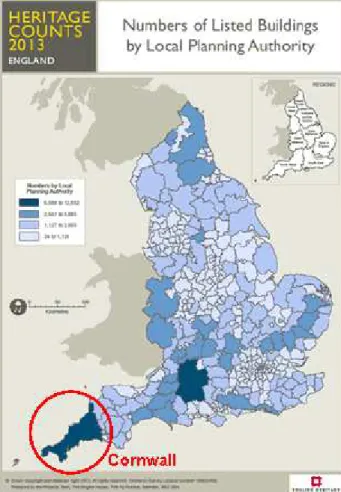
The World Heritage Site boundaries comprise the Old Town and the New Town, and contain seven conservation areas, defining different character areas and protected by stricter planning regulations. To add another layer of protection, 75% of the buildings in Edinburgh are listed, which is the highest percentage in the UK after London.
- 24 -
Figure 1: The Old and the New Towns of Edinburgh's World Heritage Site
- 25 -
Figure 3: Extract from the ‘Key View Policy’ in Edinburgh
There is an invisible layer, however, that cannot be seen with a naked eye. The World Heritage Site is, unfortunately, a hot spot for fuel poverty.
This is particularly true in the Old Town, due to the transient population and the buildings energy rating. The New Town, instead, appears to be in low fuel poverty not because the buildings are more energy efficient, but because its population is more affluent and can afford to pay bills.
Owing to the above-mentioned planning constraints and fuel poverty areas, it is extremely challenging to work towards the very high carbon reduction targets that the Scottish Government has set: 42% by 2020 and 80% by 2050 [3].
It is also very challenging when dealing with an exceptionally complex housing stock. In Edinburgh, 45% of the buildings are tenemental, i.e. in ownership and multiple-occupancy (this compares with a 20% Scottish average); 30% of the buildings are pre-1919, which are considered by most as hard-to-treat properties (this compares with an average across Scotland of 20%). The majority of Edinburgh’s listed buildings were built in either the Georgian or Victorian period, however, 4% are listed medieval buildings, featuring very thick stone walls and small windows. These present different challenges from post-War listed buildings, which represent a further 4% of the overall listed buildings in the WHS.
2. EDINBURGH WORLD HERITAGE AND THE MANAGEMENT PLAN
Tackling all these challenges holistically, Edinburgh World Heritage (EWH) is an independent non-governmental organisation, created in 1999 by a merger of the Edinburgh Old Town Renewal Trust and the Edinburgh New Town Conservation Committee. EWH represents therefore the amalgamation from these predecessor bodies with over 40 years experience.
- 26 - influencing and drafting the Management Plan (MP) for the Site together with the two key
partners, The City of Edinburgh Council (local authority) and Historic Scotland (Government agency for the protection of the historic environment).
Figure 4: Fuel poverty map and Edinburgh WHS boundaries
The MP is a UNESCO requirement and is the key document that sets out the vision for the Site. Per se, the MP is a simple a piece of paper; its value lies, instead, in the process of its creation.
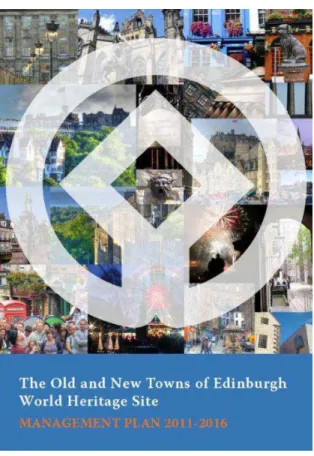
Edinburgh has already produced two MPs for its Site. The second MP sets out the strategic framework for 2011-2016 [4].
Best practice dictates that the engagement process needs to be at the core of the plan in order to create a vision and actions based on shared values. Far from being a tick-box exercise, in Edinburgh a year long consultation process was undertaken to incorporate everybody’s views, involving all key stakeholders, but also, professionals, community groups, academia, industry and the international community.
On top of issues such as historic environment, living communities, economy and transport, this second MP includes for the first time the concepts of climate change, sustainability and risk. Clear objectives, clear actions and clear monitoring strategies are defined by measurable indicators to ensure that these actions are implemented and objectives achieved:
- 27 - Objective 31: To understand Risk issues by establishing a Risk Register, which will be regularly
reviewed.
The MP is produced by a working partnership, the WHS Steering Group, comprising EWH, the City of Edinburgh Council and Historic Scotland. This innovative approach to the creation of the Plan ensures that all the key Site’s stakeholders agree on a strong vision, take ownership of the document and facilitate the delivery of its actions on the ground. The MP is not a still process or a finished product, but very much a cyclical system of management, actions and monitoring, which is continuously updated and reviewed by the WHS Steering Group.
Figure 5: Second Edinburgh WHS Management Plan
3. ENERGY EFFICIENCY AND TRADITIONAL BUILDINGS
On the wake of the publication of the MP in 2011, the only aspect that the press picked up was climate change. The BBC stated: “The aim of the project is to demonstrate how historic buildings are made more energy efficient, helping to alleviate fuel poverty without impacting on the character of the building”, which is the precise message the MP wants to convey [5].
Despite being widely used to describe listed and pre-1919 buildings, the term ‘hard-to-treat’ is a negative phrasing, focusing on problems instead of solutions. In the past eight years, EWH has instead focused on solutions, what can actually be achieved in order to make traditionally built properties more energy efficient without compromising their authenticity and integrity.
- 28 - their thermal mass, perform much better than assessed by standard energy software. (In note: In
situ calculations carried out by Historic Scotland demonstrated that solid stone walls have an average U-value of 1.0 W/m2K instead of 2.1 W/m2K as calculated by SAP.) All these aspects need to be considered when retrofitting and upgrading a traditional building with energy efficiency measures, avoiding instead any loss of original, sound fabric whenever practicable.
Figure 6: Historic Home Guide on Energy Efficiency
EWH has collected this wealth of experience in best practice guidance for homeowners living in traditional and listed properties [6], to demonstrate that it is possible to improve energy efficiency in these buildings without compromising their authentic character. EWH also runs a programme of awareness raising and capacity building initiatives for residents to improve their buildings and reduce their fuel bills. Funded by the Scottish Government programme ‘The Climate Challenge Fund’, energy efficiency workshops are held every autumn to help make residents more confident in looking after their traditional properties on their own, install simple and effective energy efficiency measures such as draught-proofing, loft insulation and reinstating wooden shutters, and ultimately save energy and money.
- 29 -
4. PROJECTS
Creating critical mass and political support through the MP exercise enabled EWH, together with numerous partners, to deliver many energy efficiency projects on the ground.
4.1. Gilmour’s Close, low-carbon social housing
Figure 7: Gilmour’s Close after the refurbishment in 2008, front (left) and rear (right)
An exemplar of successful marriage between heritage conservation and energy efficiency, Gilmour’s Close project was awarded Sustainable Social Housing Refurbishment in 2009.
The building is a B-listed 4 storey, 19th century stone tenement, with a commercial ground floor, located in the heart of the World Heritage site in the Grassmarket area. Before its refurbishment in 2008, the Gilmour’s Close was vacant and the shopfronts neglected. The refurbishment comprised a thorough façade protection scheme, with stone repointing and chimney repairs in traditional stone and lime mortar. The shopfronts were revamped and 17 supported flats for vulnerable young people were created and are now managed by Hillcrest Housing Association. Energy principles, such as secondary glazing, have been added on the main elevation.
At the rear, which was not subject to such strict planning constraints, the architects [8] were much freer to transform the building. Sun spaces were added for passive solar gain, internal lining, Mechanical Ventilation with Heat Recovery (MVHR) and a ground source heat pump, with 17, 70-metre deep boreholes down the bed rock. The heat is transformed in a plant room at the back of the building and then transferred to all 17 flats through under-floor heating.
- 30 - improve the thermal performance of a ‘hard-to-treat’ building without any detrimental effect on
its historic fabric.
4.2. Energy Heritage & Renewable Heritage
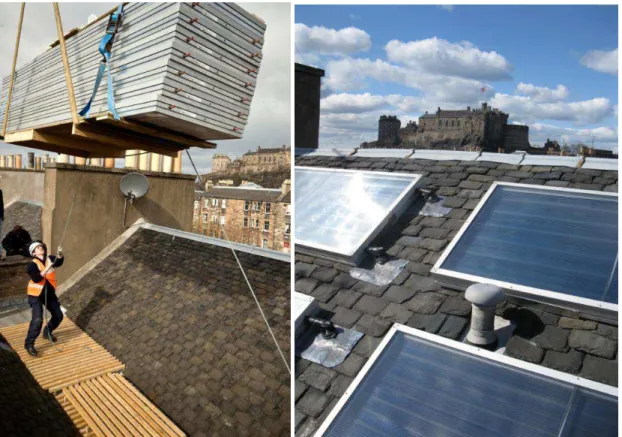
Figure 8: Solar panels being installed on the valley-gutter roof of listed buildings
In partnership with Edinburgh-based Changeworks, EWH promoted the Energy Heritage project, providing a best practice guide to improve energy efficiency in traditional and historic homes [9].
The project comprised the installation of a wide range of energy efficiency measures, as well as micro-renewables. Solar panels were installed on the valley gutter roof of these B-listed buildings, each panel providing solar hot water for each flat. Because of the ‘M-shaped’ roof, the panels are completely concealed from street level, which made it possible to overcome the strict planning constraints of the listing and the Old Town Conservation Area location that would normally forbid any alteration of the historic roofscape.
Very importantly, the refurbishment did not incur in any loss of historic fabric. On the contrary, the opportunity was taken to restore the building and reinstate original features, such as wooden shutters, which are excellent energy efficient as well as heritage friendly measures.
- 31 -
4.3. ‘Hardest-to-treat’
Figure 9: Sir Basel Spence’s Canongate Housing
EWH together with the Brown’s Close residents, Historic Scotland and the City of Edinburgh Council are working on a project to address both best practice conservation and energy efficiency in a post-War listed building with multiple ownership and multiple occupancy. The project can be a model for the 4% of listed buildings that are post-War in the Edinburgh WHS in, and the many more examples that can be found in Scotland and Europe.
The B-listed building is a fine example of modernist architecture from renowned architect Sir Basil Spence. It was built in 1969 as an interesting mix of brutalist, concrete construction with vernacular elements. The building has a 50-year design life, and definitely was not designed to be energy efficient.
In this project, best practice was followed from the start with the production of a Conservation Statement, which defines the areas of higher and lower significance in the building, and therefore what degree of alteration is permissible. The energy efficiency improvements proposed have been assessed against these parameters, in order to understand the impact they would have on the integrity and authenticity of the building as well as the actual efficacy of the measures.
- 32 -
Figure 10: Extract from the energy assessment matrix
4.4. Historic Street Lighting Strategy
Figure 11: Waverley Bridge LED installation
Edinburgh is targeting the historic fabric holistically, not just addressing energy efficiency to the buildings but also the space-between-the buildings. Energy efficient / smart historic street lighting is definitely becoming a more important topic for historic cities.
- 33 -
Figure 12: Long-life induction lamps in the historic core
However, LEDs are not always the most appropriate solution, as they do not give the quality of light needed for historic lighting. Long-life induction lamps are used instead of LEDs, as the equipment can be retrofitted within the existing original shell or a reproduction. Long-life induction lamps have also a more diffused light and a less sharp definition than LEDs. Long-life savings are made through maintenance, as the 10-year durability is comparable to LEDs. They are also quite adaptable, as they can be dimmed by electronic gear.
They both are still very expensive solutions. The hope is that further development is going to be made on LEDs to be widely applicable in the historic environment at a more convenient quality-cost-durability ratio.
5. DUBROVNIK PRINCIPLES
Edinburgh’s experience shows that good levels of energy efficiency can protect the sustainability of traditional homes (both their fabric and their function), and ensure that householders achieve affordable warmth and improved comfort levels. It has also demonstrated that clean renewable energy can also be generated on site and on a much smaller scale, without compromising the quality and authenticity of the heritage. With the appropriate knowledge and good governance, micro-generation has a future role to play in historic cities.
- 34 - in Dubrovnik to build capacity of professionals and local authorities in the management of WHSs
[10].
As the UNESCO RENFORUS initiative publication, Good Practices: success stories on sustainable and renewable energies in UNESCO Sites [7] highlights, there are several lessons to be learned on sustainable energy of historical towns and sites inscribed as UNESCO property. This is where Edinburgh finds its perfect location with the above listed projects and activities. It is all a matter of finding the balance between the need to conserve the OUV of the sites at stake, the criteria upon which the same sites have been nominated and the overall undertaking to make a sustainable use of it, and the energy issue, which is increasingly becoming a prominent chapter of sustainability.
The Operational Guidelines for the Implementation of the World Heritage Convention [11] state that World Heritage properties may support a variety of ongoing and proposed uses that are ecologically and culturally sustainable and that may contribute to the quality of life of the communities concerned. The translation of this general principle into practice in the field of energy and climate change mitigation policies is in the hands of inspired people within the management authorities of the sites, in its local communities and citizens, in its policy makers and in the management systems they are able to conceive and implement. Where such a set of inspired actors have room to manoeuvre in the right governance settings, the results are very encouraging and encompassing different scales of application, from single monumental sites to entire historical cities and towns.
Alongside Edinburgh, for instance, the Vienna’s second climate protection programme (Klip) underpins a set of combined measures to curb CO2 emissions and replacing fossil fuels by employing amongst other measures, a significant number of solar thermal power installations, wherever applicable. A combination of geothermal and waste energy sources constitutes the backbone of the district heating system of Ferrara, one of the most important examples of integrated energy systems. Furthermore, the largest abbey in Europe, the Abbey of Fontevraud, part of the WHS of the Loire Valley, runs virtually entirely on renewables with the completion of its newly built energy centre and its enhanced energy efficiency measures, including smart energy for lighting and a mix of renewables (wood boiler, solar panels etc.) all made without compromising the OUV and the criteria of integrity and authenticity at the base of its inscription in UNESCO properties. Last but not least, the bio-fuelled district heating in the medieval town of Visby located in the island of Gotland, which has banned fossil fuels in its district heating since year 2006.