BIBLIOTECA
Document downloaded from the institutional repository of the University of
Alcala:
http://ebuah.uah.es/dspace/
This is a postprint version of the following published document:
Soriano-Amat, M., Marcon, L., Costa, L., García-Ruiz, A., Martins, H. F.,
Martín-López, S., Palmieri, L. & González-Herráez, M. 2019, "Characterization and
modelling of induced virtual perturbations in chirped pulse
φ
OTDR“, Proceedings
of SPIE, vol. 11199, 7
thEuropean Workshop on Optical Fibre Sensors, 111992A
Available at
http://dx.doi.org/10.1117/12.2540760
©
2019 Society of Photo-Optical Instrumentation Engineers (SPIE). One
print or electronic copy may be made for personal use only. Systematic
reproduction and distribution, duplication of any material in this
publication for a fee or for commercial purposes, and modification of the
contents of the publication are prohibited.
(Article begins on next page)
This work is licensed under a
Characterization and modelling of induced “virtual” perturbations in
chirped pulse φ-OTDR
Miguel Soriano-Amat
*,a, Leonardo Marcon
b, Luis Costa
a, Andres Garcia-Ruiz
a, Hugo F. Martins
c,
Sonia Martin-Lopez
a, Luca Palmieri
b, and Miguel Gonzalez-Herraez
aa Departamento de Electrónica, Universidad de Alcalá, Edificio Politecnico, Madrid 28871, Spain
b Department of Information Engineering - University of Padova, Via G. Gradenigo 6/B, 35131 Padova (PD), Italy
cInstituto de Óptica “Daza de Valdés”, IO-CSIC, C/Serrano 121, Madrid 28006, Spain
ABSTRACT
Any temperature change or strain acting on a section of the fiber induces a local variation of the refractive index. If the fiber is monitored by a chirped pulse φ-OTDR system, the variation of the refractive index causes a local shift of the backscattering trace and produces a change in the round trip time of the light coming from any further position of the fiber. While usually negligible, due to the high sensitivity of the chirped pulse φ-OTDR, in extreme occasions the distributed round trip time change may appear in the measurement as an undesired “virtual” perturbation. In this paper, we discuss and experimentally validate a mathematical model to account for (and eventually correct) the “virtual” perturbation.
Keywords: Phase-sensitive OTDR, Rayleigh scattering, Distributed Acoustic Sensing.
1.
INTRODUCTION
Optical fiber scattering phenomena, namely Rayleigh, Brillouin or Raman, allow the realization of high performance
distributed sensors1. The easiest phenomenon to exploit is Rayleigh backscattering, generated by the local inhomogeneity
of the fiber refractive index, which is extremely sensitive to environmental perturbations like temperature changes or
vibrations2. A common setup used to realize distributed acoustic sensors (DAS) based on Rayleigh backscattering is the
phase-sensitive optical time domain reflectometer (φ-OTDR)3. This technique uses a coherent laser source to interrogate
tens of kilometers of fiber with spatial resolution of meters and acoustic bandwidth of kilohertz. To improve the performance of OTDR setups and partially mitigate its issues, (like coherent fading), a setup called chirped pulse
φ-OTDR has been reported recently4. In this setup, the traditional flat-phase input pulse is replaced with a linearly chirped
one, transforming the measurement procedure into a time-delay estimation process. This increases the robustness of the setup, allowing to reach sensitivities of mK or nε. However, the time delay estimation procedure may cause some impact since a very large perturbation acting on a section of fiber may cause a variation in the local refractive index that is translated into a certain delay there onwards in the measured trace. In other words, the perturbation induces a distortion in the round trip time of all the backscattering components generated beyond the stressed section of the fiber. This distortion, which can be considered negligible in the vast majority of the cases, may become significant if the variation of the refractive
index is very large. This is unlikely to happen in the usual applications of monitoring of long perimeters or pipelines5,6,
but may happen if long sections of the fiber experience a uniform and large environmental perturbation. In this paper, we discuss and validate experimentally a mathematical model for the perturbation-induced round trip time change that appears, in the measurement performed with a chirped pulse φ-OTDR, as a virtual perturbation. The experiment is performed by inducing a fairly large temperature change over a known section of the fiber and by monitoring a further fiber section kept at rest. The proposed model could be used by an algorithm to estimate the virtual perturbations induced by all the real stresses acting on fiber and progressively remove them.
2.
THEORETICAL MODEL
As the input pulse of a chirped pulse φ-OTDR 𝑃(𝑡, 𝑧), of width 𝜏𝑝, central frequency 𝜐0 and total applied chirp 𝛿𝜐,
propagates along the fiber, a small part of its power 𝐵(𝑡) gets back-reflected due to Rayleigh scattering. The round trip
time of the light in the fiber:
𝑡𝑅𝑇(𝑧) = 2 ∫
𝑛(𝑧)
𝑐 𝑑𝑧
𝑧
0
, (1)
where 𝑛(𝑧) is the refractive index of the fiber, is accurately measured at the receiver and is used to map the contributions
of 𝐵(𝑡) to the positions of the fiber that generates them. If the fiber is kept at rest, consecutive interrogations of the fiber
will generate always the same trace. However, if a perturbation 𝜉(𝑡) acts section of the fiber 𝐼 = [𝑧𝑖, 𝑧𝑗], the consequent
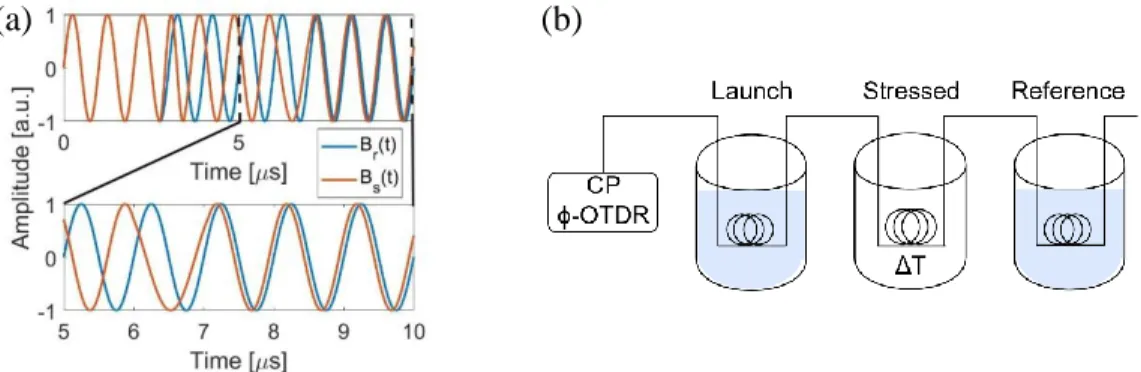
refractive index variation Δ𝑛(𝑡) induces a local shift in 𝐵(𝑡), for all 𝑡 = 𝑡𝑅𝑇(𝐼). This can be seen in Fig. 1(a), where the
exemplary simplified traces corresponding to a reference trace 𝐵𝑟(𝑡) and a stressed trace 𝐵𝑠(𝑡) collected respectively
before and during the perturbation 𝜉(𝑡) are represented. As can be seen, around 𝑡 = 5 𝜇𝑠 the stressed trace, which at the
beginning was perfectly overlapped with the reference, experiences a visible shift. In chirped pulse φ-OTDR setups, the
measure is performed by dividing 𝐵𝑟(𝑡) and 𝐵𝑠(𝑡) into corresponding windows. For each couple of corresponding
windows, a correlation operation is performed and the central peak is monitored. Due to the local shift induced by Δn(𝑡)
in 𝐵𝑠(𝑡) ,the correlation peak of the windows corresponding to the section 𝐼 of the fiber will move of a value Δ𝑡:
Δn(𝑡)
𝑛 = − (
1
𝜐0
) (𝛿𝜐
𝜏𝑝
) Δ𝑡. (2)
By inverting eq. (2) the value of Δ𝑛(𝑡), which is linearly proportional to the acting perturbation, can be extracted allowing
the sensing of temperature changes or vibrations with extremely high sensitivities (in the order of mK or n). Observing
eq. (1), it is possible to see that the refractive index variation induced by the perturbation in 𝐼 causes a change Δ𝑡𝑅𝑇(𝑧)
common to all the round trip times 𝑡𝑅𝑇(𝑧) with 𝑧 > 𝑧𝑗. All corresponding contributions of 𝐵𝑠(𝑡) will then experience a
small, common shift, visible in Fig. 1(a) for 𝑡 > 7 𝜇𝑠, where even if no perturbation is acting, the two lines are not as
perfectly overlapped as they were at the beginning. This common shift, due to eq. (2), will appear in the results as a small distributed virtual perturbation.
The theoretical model of this “virtual” perturbation is developed considering as stressing perturbation a uniform
temperature change 𝜉(𝑡) = Δ𝑇(𝑡) acting on a section 𝐼, of length 𝐿 = 𝑧𝑗− 𝑧𝑖 of the fiber. When the section of the fiber 𝐼,
supposed at room temperature, experiences a temperature change Δ𝑇(𝑡), the length of the fiber changes due to thermal
expansion, 𝐿̃(𝑡) = 𝐿 + Δ𝐿(𝑡), and the local refractive index changes due to the thermo-optic effect, 𝑛̃(𝑡) = 𝑛 + Δ𝑛(𝑡).
Knowing the silica linear thermal expansion coefficient7, 𝛼 ≅ 0.55 ∙ 10−6 [℃−1], and thermo-optic coefficient8, 𝜁
𝑇 ≅
6.92 ∙ 10−6[℃−1], the thermal expansion results Δ𝐿(𝑡) = 𝛼Δ𝑇(𝑡)𝐿 and the refractive index variation Δ𝑛(𝑡) = 𝜁
𝑇Δ𝑇(𝑡)𝑛.
The common change in the round trip times Δ𝑡𝑅𝑇(𝑧) for all positions after 𝐼 can then be expressed as:
Δ𝑡𝑅𝑇(𝑧) = 2 [∫
𝑛̃(𝑡) 𝑐
𝐿̃(𝑡)
0
𝑑𝑧 − ∫ n
𝑐
𝐿
0
𝑑𝑧] = 2𝑛̃(𝑡)𝐿̃(𝑡)
𝑐 − 2
𝑛𝐿
𝑐 ≈ 2
𝑛Δ𝐿(𝑡)
𝑐 + 2
n(𝑡)𝐿
𝑐 (3)
where the term proportional to Δ𝐿(𝑡)Δn(𝑡) is ignored since it is many orders of magnitude lower than the others.
According to eq.(2), the Δ𝑡𝑅𝑇(𝑧) reported in eq. (3) appears in the measurement as a virtual change of the refractive index,
thus as a virtual temperature change 𝛿𝑇(𝑡), according to
− (1
𝜐0
) (𝛿𝜐
𝜏𝑝
) Δ𝑡𝑅𝑇(𝑧) =
Δ𝑛𝑅𝑇(𝑡)
𝑛 = 𝜁𝑇𝛿𝑇(𝑡) (4)
By substituting (3) in (4), and solving for 𝛿𝑇(𝑡) we get:
Figure 1. (a) Consequences of a localized stress on a simplified 𝐵(𝑡). On the bottom a zoom of the traces after the perturbation. (b) Schematic representation of the setup.
𝛿𝑇(𝑡) = 𝐾 1
𝜁𝑇
1
𝜐0
𝛿𝜐
𝜏𝑝
[2𝑛Δ𝐿(𝑡)
𝑐 +
2Δn(𝑡)𝐿
𝑐 ] = 𝐾
1
𝜁𝑇
1
𝜐0
𝛿𝜐
𝜏𝑝
2𝑛𝐿
𝑐 [𝛼Δ𝑇 + 𝜁𝑇Δ𝑇(𝑡)] (5)
where the first term is related only to the thermal expansion and the second only to the thermo-optic effect. The two terms
differ only for the coefficients 𝛼 and 𝜁𝑇, thus the contribution of the thermo-optic effect on 𝛿𝑇(𝑡) is about one order of
magnitude higher than the one induced by thermal expansion. A constant scaling factor 𝐾 has been added in the model of
eq. (5), because the actual values of the thermo-optic coefficient 𝜁𝑇 and of the thermal expansion coefficient 𝛼 of the fiber
used may be different from the ones reported in the literature.
A similar model can be derived if the measured perturbation is translated into strain reading Δ𝜀(𝑡) instead of a temperature
change. In such a case the apparent strain may be derived as:
𝛿𝜀(𝑡) = 𝐾1
𝜁𝜀
1
𝜐0
𝛿𝜐
𝜏𝑝
2Δn(𝑡)𝐿
𝑐 (6)
where8 𝜁
𝜀 = 0.78 is the elasto-optic coefficient for germanium-doped silica-core fiber and Δn(𝑡)=𝜁𝜀Δ𝜀(𝑡)𝑛 is the change
in the fiber refractive index caused by the strain due to the elasto-optic effect.
3.
EXPERIMENTAL SETUP AND RESULTS
The setup used to validate the proposed model is schematically represented in Fig. 1(b). A link of standard SMF-28 fiber
of total length 𝐿 = 18.9 𝑘𝑚, made of three different sections called respectively launch, stressed and reference, is
connected to a standard chirped pulse φ-OTDR4. The laser source at 𝜆
0= 1550 𝑛𝑚 generates chirped pulses of width
𝜏𝑝= 100 𝑛𝑠 and total chirp of 𝛿𝜐 = 1 𝐺𝐻𝑧. The launch fiber is 𝐿𝐿= 0.9 𝑘𝑚 long and it is used to estimate and correct,
in post-processing, the laser phase-noise on the other fiber sections9. The temperature change Δ𝑇(𝑡) is induced on the
stressed fiber, which is 𝐿𝑆= 16.6 𝑘𝑚 long, by submerging it with water at different temperatures. Finally the reference
fiber, which is 𝐿𝑆= 1.4 𝑘𝑚 long, is used to measure the virtual temperature change δ𝑇(𝑡) induced by Δ𝑇(𝑡) on 𝐿𝑆. As
can be seen in Fig. 1(b), the launch and the reference fibers are immersed into room temperature water, represented by a light blue color, to partially isolate them from undesired environmental perturbations. To avoid the floating of the coils, a weight was placed on their top, anchoring them to the bottom of the bucket.
The measurement started by submerging 𝐿𝑆 in water at a temperature 𝑇𝐻= 15 𝐾 higher than the room temperature. To
allow a sufficient thermalization, the setup was left measuring unperturbed for the successive 10 minutes before changing
the warm water with cold one at a temperature 𝑇𝐶= 8 𝐾 lower than the room temperature for 10 more minutes. The amount
of water poured in both cases is sufficient to consider the water's temperature as a constant during the thermalization process. Due to the fiber low thermal conductivity, the temperature change induced by the water on different layers of the
stressed coil is not uniform and the chirped pulse φ-OTDR measures, along 𝐿𝑆, a position-depending perturbations
Δ𝑇(𝑡, 𝑧). This is clearly visible in Fig. 2(a) where the temperature changes measured at an outer (blue line, square marker)
and inner (red line, triangular marker) layers, are represented. As can be seen, during the whole measurement the temperature of the layer closer to the water shows a fast exponential-like response, in agreement with the Newtonian laws of warming/cooling, while the inner layer shows a delayed and almost linear change. Thanks to the linearity of the
Figure 2. (a) Temperature changes in the stressed fiber measured in different positions (marked lines); Mean temperature change of the stressed fiber (solid line). (b) Measured virtual temperature change in the reference fiber (blue line) compared with the expected result (marked red line).
(a
)
phenomena involved in the experiment, it is convenient to average all the position-dependent terms Δ𝑇(𝑡, 𝑧) into an
equivalent uniform temperature change Δ𝑇(𝑡), reported in Fig. 2(a) as a black solid line.
Due to instrument-related noise and remaining undesired environmental stresses, the measurements δ𝑇(𝑡, 𝑧) acquired in
the reference fiber represent position-dependent noisy replicas of the virtual perturbation δ𝑇(𝑡), which can be averaged
along the position axis. The result is shown in Fig. 2(b) where, with respect to the left vertical axis, the experimental (blue line) and expected (marked red line) curves are plotted. The expected curve was computed from the model in eq. (5), using
as parameters 𝐾 = 0.78, Δ𝐿 = 𝐿𝑆and the equivalent uniform temperature change Δ𝑇(𝑡). As can be seen, there is a great
agreement between the curves, even if a slight mismatch is visible during the cool-down. This difference is probably the consequence of the strains induced on the fiber during the water exchange phase, which distort the received backscattering
trace 𝐵(𝑧) reducing the quality of the correlation operation used to perform the measurement, thus increasing the noise.
4.
CONCLUSION
In this paper we have proposed a theoretical model representing the virtual perturbation introduced in the chirped pulse φ-OTDR measurement, by a real perturbation acting on a previous section of the fiber. An experiment has been performed to validate the model, obtaining results in great agreement with the theoretical prediction. The model can be used to estimate and progressively correct the errors introduced thus improving the quality of the measurement performed with chirped pulse φ-OTDR, especially for weak perturbations.
ACKNOWLEDGMENT
This work was supported by project FINESSE MSCA-ITN-ETN-722509; the DOMINO Water JPI project under the WaterWorks2014 cofounded call by EC Horizon 2020, the Spanish MINECO and Italian MIUR; Comunidad de Madrid and FEDER Program (P2018/NMT-4326); project TEC2015-71127-C2-2-R, RTI2018-097957-B-C31, HFM acknowledges financial support from the Spanish Ministery (MICINN) under contract no. IJCI-2017-33856, respectively.
LM acknowledge Fondazione Ing. Aldo Gini for partial financial support,
AGR.
University of Alcalá (FPI).REFERENCES
[1] Bao, X., and Chen, L., “Recent Progress in Distributed Fiber Optic Sensors,” Sensors., 12(7), 8601–8639 (2012)
[2] Bucaro, J. A., and Hickman, T. R., “Measurement of sensitivity of optical fibers for acoustic detection,” Appl.
Opt., 18(6), 938 (1979).
[3] Juarez, J. C. , Maier, E. W., Choi, K. N., and Taylor, H. F., “Distributed fiber-optic intrusion sensor system,” J.
Light. Technol., 23(6), 2081–2087 (2005).
[4] Pastor-Graells, J., Martins, H. F., Garcia-Ruiz, A., Martin-Lopez, S., and Gonzalez-Herráez, M., “Single-shot
distributed temperature and strain tracking using direct detection phase-sensitive OTDR with chirped pulses,” Opt. Express, 24(12), 13121 (2016).
[5] Juarez, J. C. , and Taylor, H. F., “Field test of a distributed fiber-optic intrusion sensor system for long perimeters,”
Appl. Opt., 46(11), 1968 (2007).
[6] Peng, F., Wu, H., Jia, X.-H., Rao, Y.-J., Wang, Z.-N., and Peng, Z.-P., “Ultra-long high-sensitivity Φ-OTDR for
high spatial resolution intrusion detection of pipelines,” Opt. Express, 22(11), 13804–13810 (2014).
[7] White, G. K., “Thermal expansion of reference materials: copper, silica and silicon,” J. Phys. D, 6(17), 2070–
2078 (1973).
[8] Koyamada, Y., Imahama, M., Kubota, K., and Hogari, K., “Fiber-Optic Distributed Strain and Temperature
Sensing With Very High Measurand Resolution Over Long Range Using Coherent OTDR,” J. Light. Technol., 27(9), 1142–1146 (2009).
[9] Fernández-Ruiz, M. R., Pastor-Graells, J., Martins H. F., García-Ruiz, A., Martín-López and M.