E.U. de Educación de Palencia
Universidad de Valladolid – Campus La Yutera
BILINGUAL SCIENCE TEACHING:
METHODOLOGY AND APPLICATION IN
PRIMARY EDUCATION CLASSROOMS
SINOPSIS
Con la relativamente nueva tendencia hacia la educación bilingüe en España, los maestros y maestras han ido descubriendo que no existen directrices oficiales o acordadas que deban seguirse en la enseñanza de ciencias y que de forma muy significativa las escuelas tienen la libertad de desarrollar su propio enfoque.
La primera parte de este trabajo analiza una metodología específica basada en el constructivismo, en el desarrollo del método científico, el enfoque comunicativo y en fomentar el cambio conceptual en los alumnos. En las secciones finales, se discute su aplicación en un aula de tercero de educación primaria.
PALABRAS CLAVE
Educación bilingüe, constructivismo, método científico, enfoque comunicativo, cambio conceptual.
ABSTRACT
With the relatively new trend towards bilingual education in Spain, teachers have been finding out that there are no official or agreed guidelines to be followed for the teaching of science and that to a very significant extent schools are free to develop their own approach.
The first part of this work examines a particular methodology based on constructivism, on the development of the scientific method, the communicative approach and on fostering conceptual change in learners. In the final sections, its application in a year-3 primary education classroom is discussed.
KEYWORDS
INDEX
INTRODUCTION ... 1 PURPOSE OF THIS STUDY ... 2-3 THEORETICAL BACKGROUND ... 4-10 The scientific method... 5-7 Communication in a foreign language ... 7-8 Conceptual change in science education ... 8-10 CONTEXT AND METHODOLOGY ... 11-17 Context ... 11 Method ... 12-17 Resources used ... 14-15 Language used ... 15 Importance and development of experiments ... 16 Evaluation ... 17
| 1
INTRODUCTION
Science teaching in foreign languages is a relatively new topic in Spain. In the past and until a few years ago, before the current trend towards bilingual education, science teaching was a theoretical subject, mainly teacher-centred and with students basically focused on preparing a final exam.
The most common experiment was to plant a chickpea in a pot, the topics were not related to children’s lives and knowledge was not applied to real life issues further than perhaps taking some cereal spikes to differentiate them.
Resources were poor and the school with more means had, at most, a couple of plastic human bodies and some minerals.
Now, we are trying to equate our education system with Europe, developing bilingual programs and thinking more seriously about how to incorporate the scientific method into our science lessons.
Apart from teaching a second language, we are trying to motivate our students by taking into account their preferences, trying to apply new knowledge to their daily lives, performing experiments in the classroom and asking for the participation of the students in the lessons and not just listening to the teacher. In addition, our resources are now much more diverse, versatile and accessible with the use of internet, smart boards and interactive activities.
But all these things are relatively new and teaching practice cannot be regulated by law. There are no official guidelines to be followed and schools are free to develop their own approach.
| 2
PURPOSE OF THIS STUDY
As we are focused on Science and its teaching methods in Spain, we must take into account the different guidelines we have. We can find them in the National Education Curriculum (ORDEN ECI/2211/2007. BOE 173, 31487-31566).
Apart from the development of the different competences and objectives, a brief paragraph explains the procedure to be followed in Science teaching:
“The specific learning procedures to this area are linked to observation, searching, gathering and organizing information, elaboration and communication of such information and reflection on the learning process as the basis of the scientific method.” (Own translation, BOE 173, 31498)
In addition, some pages below, we can find another paragraph which deals with assessment guidelines:
“...the verification on the learning processes in the subjects comprising the area [...] requires the use of laboratory experiments, fieldwork, map consulting...” (Own translation, BOE 173, 31509)
Thus, the official guidance helps us to position our teaching methods in order to develop the scientific method as a way of working with science in primary school.
To develop the scientific method is a clear objective, but if we look in detail at the assessment criteria included in the National Education Curriculum, we find that most of these criteria involve the use of language, for instance: Gather information, classify, and most importantly, explain.
| 3
the scientific method to explain its phenomena. The first one is fostered by exchanging of opinions, the narration of personal experiences on different topics and reading and writing simple texts. The second one is fostered by defining and solving problems, designing and carrying out simple experiments, working out solutions and analysing and describing their results. (Essential Science Plus 3 primary Teacher’s Book, 2012, 9) Language would not be a big issue if students could communicate in their mother tongue, but in a context of bilingualism, we find that students have to use a foreign language that in many cases they do not handle in the most appropriate way, so we are faced with the dual purposes of teaching the scientific method and, in addition, a foreign language.
We are not only trying to give them scientific and grammatical knowledge, but trying to help the learner to develop the communicative competence. That is, students should develop their autonomy in language use, which means that they will be able to understand and produce language in different contexts.
| 4
THEORETICAL BACKGROUND
The method I observed and worked with during my training period has its foundation in the pedagogical principles of constructivism.
Constructivism is based on the idea that knowledge is constructed when new information comes into contact with existing knowledge developed by experiences. Knowledge is created so human beings can adapt to the world in which they live.
By constructivism we understand the different contributions made by an individual himself to the act of knowing so that knowledge and learning are the result of the mental activity in which the individual interprets reality.
We can distinguish between cognitive constructivism mainly developed by Piaget, and sociocultural constructivism mainly developed by Vygotsky.
According to the cognitive constructivist theory, knowledge acquisition is made through the mechanisms of assimilation and accommodation which the individual uses to reach what is called adaptation. The most important sub-theories within cognitive constructivism are the inductive learning theory, developed by Bruner and the meaningful learning theory, developed by Ausubel.
In both theories the teacher has the task of helping the children with their development so they can operate in society. The teacher’s task is, in addition, to establish connections between learning and thought so the children can connect new knowledge with already acquired knowledge. The process is to guide the children from the most general to the most particular information, and give organized ideas that will be gradually completed and detailed.
| 5
Within the constructivist theory we can place the three axes that underpin science teaching in bilingual primary school:
- The scientific Method
- Communication in a foreign language - Conceptual change in science education
THE SCIENTIFIC METHOD
Scientists gather information and draw conclusions about the way the world around us works by applying the scientific method. This is a systematic form of inquiry which requires observation, speculation and reasoning. The ultimate objective in using the scientific method is to reach an improved understanding of physical or biological phenomena.
The scientific method provides a series of techniques and procedures for investigating phenomena, acquiring new knowledge or correcting and integrating previous knowledge. It is not only essential for investigation and elaboration of hypotheses but it is strongly recommended by the National Education Curriculum for science teaching in primary education.
The scientific method may be viewed as a sequence of steps to be followed or, alternatively, as a set of procedures that may take place at different levels of inquiry. In order to gain new knowledge of the world scientists follow methods and processes that can be considered at four levels of inquiry (Mix, Farber & King, 1992).
Observation
| 6
Generalization
A single observation considered in isolation cannot generally be very significant; it must be shown to be connected to some broader context. Scientists are always alert to the need to detect regularities, repetitions and patterns in their observations. Thus, generalizations are made possible.
Explanation
In an attempt to explain natural patterns, observations and single events, scientists make calculated guesses which can be tested directly, by reproducing the same characteristics of the observation, or indirectly, by gathering evidences to support them.
These guesses are called hypotheses. Hypotheses are not considered as true or false but accepted provisionally if researchers found positive results from different tests, or rejected, modified and test again if those results are negative.
Theory
After concluding the observation process and obtain positive results from different tests, scientists synthesise their different hypotheses in a coherent and unified formulation, called theory, which explains a vast quantity of data.
Theories are highly valued because they answer questions, unify knowledge and guide research by raising new questions as well as represent an impressive intellectual achievement.
Despite this, theories are not immutable statements, they are subjected to ongoing review and change.
| 7
essential role is part of the teachers' task. This task requires the teaching of science, the teaching of fundamental knowledge to students that happen to be beginners in a particular field of work and the way to teach these ideas is by imitating or mimicking some of the most basic steps and procedures followed by the scientists themselves. Teachers act as intermediaries because students need support in mastering the processes of acquiring new knowledge and building on old knowledge.
By creating different materials for each of these steps and following the steps themselves in our science lessons, we help children to organize the information and create simple schemes in their minds. We also help them to find their way through the different levels of inquiry that are available to them in the scientific method. As a result, they will gradually approach, embrace and use procedures of the scientific method with increasing confidence.
COMMUNICATION IN A FOREIGN LANGUAGE
As has been mentioned before, we are trying to help the learners to develop their autonomy in language use so they will be able to communicate in different contexts. It means that our work is to help the learners to develop their communicative skills: listening, speaking, interacting, reading and writing; and their Communicative competence.
The Communicative competence involves different sub-competences (Canale and Swain, 1980):
- Linguistic competence: It is the mastery of the linguistic code either verbal or non-verbal, including the features and rules of language.
- Discursive competence: It refers to the interpretation of individual discourse element in terms of the relationship between other elements in the message and to the entire discourse or text.
| 8
- Strategic competence: The ability to use linguistic and non-linguistic resources to cope with real communicative situations.
- Socio-cultural competence: The knowledge of cultural aspects of the target language speaking countries to achieve a deeper understanding of the ways of life forms of thought and cultural aspects in order to stimulate tolerance.
Children must be helped to develop these skills and competences through science. Here lies the relevance of one of the most important theories of communication in foreign languages acquisition: the communicative approach.
The communicative approach is based on the idea that learning a language successfully occurs when learners are involved in real communication so their natural strategies for language acquisition will be used and this will allow them to learn to use the language. Thus, children learn the language in contexts of significant communication.
Through the teaching of science in bilingual school we have to provide situations in which learners can use the foreign language in different contexts and always in ways similar to those we use in real life.
CONCEPTUAL CHANGE IN SCIENCE EDUCATION
| 9
As Carey (2000) points out, teachers must start “where the student is”. As far as science education is concerned, we now understand the starting point in a completely different way from what was believed half a century ago..
Some decades ago, the main difficulty in science learning was defined in terms of what the student lacked. It was seen as a lack of science content knowledge, combined with age-related limitations in general cognitive capacities, for example, children considered concrete thinkers incapable of abstract reasoning.
Today we understand that the main obstacle is not what the student is missing, but what the student brings into the classroom. Students come to science lessons with pre-existing conceptions that differ in significant ways from the ones that they are expected to gain through learning science. (Lewis & Kattmann, 2004)
Children have constructed a very different theoretical framework from that used by adults to understand natural phenomena and to understand how the world works.
These beliefs are true beliefs, formulated by the students using their own knowledge of phenomena and using valid evidences observed by them, with the same purpose of explaining and understanding their everyday life and their closest environment.
In constructivist approaches to science education, a key learning outcome is the achievement of conceptual change in learners, in which learners are seen as active participants who construct new understandings based on the evidences made available to them. In sum, learners will have to “reconsider” their everyday models. (Morton, 2012)
| 10
If they wish to foster conceptual change in the science classroom, teachers need to explore their students’ existing conceptions and use these to build new understanding that students find intelligible, plausible and fruitful.
As mentioned above, it is necessary to start “where the student is”. Ask them to express their points of view, their thoughts, their ideas about the different phenomena and about how the world around us works, and do it avoiding to treat them in a judgemental manner.
As Morton (2012) shows, classroom talk is the essential tool for teachers, through dialogic interaction with their students, they need to use it effectively to meet the learning objectives, such as building explanations and interpreting different frameworks in guiding experimentation.
But dialogic interaction gets complex when working on a CLIL School (Content and Language Integrated Learning), which combines the learning of academic content with the learning and use of a foreign language. This is where Vygotsky’s theory plays a key role. Vygotskian views of learning highlight the role of social interaction in individuals’ conceptual development. By interacting with the teacher and with the classmates, the students internalize information that differs from their own information and that complements and improves the old information. Then, the new knowledge is used to guide or regulate the students’ own performance, finally reaching language and conceptual development.
| 11
CONTEXT AND METHODOLOGY
After explaining the theoretical general guidelines of the observed method, we can immerse ourselves in the methodology, but first of all we have to know the context in which the method is applied.
CONTEXT
The analysed method was observed and applied in a specific school from Palencia. The school, Padre Claret, is a CLIL School for infant and primary education. As a CLIL School, it has some subjects taught in a foreign language. The main subject taught in a foreign language is Science and it is taught in English. The subject is distributed so that it has 3 hours per week taught in English and one per week taught in Spanish.
The observed group is a year-3 group of 19 students, 12 boys and 7 girls. They are between 8 and 9 years old.
There are some special characteristics with some children: there is a pupil with a curricular modification because of cognitive problems; also a Nigerian student, who is perfectly adapted, speaks the language but has attitude and behaviour problems; and a child who has serious problems of learning because of the English level that is not enough to follow the Science lessons.
| 12
METHOD
The method basis, apart from the theories, is a clear scheme of all the lessons and a clear distribution of time. In the first ten-fifteen minutes, the teacher accomplishes different routines, commonly used in the English language lessons, such as: What day is today?; What is the weather like today?; How are you feeling today and why?
All these things allow the teacher to greet the children, welcome them to the school, to the classroom or simply to the new lesson and they also allow the teacher to know better about the students, their interests, likes and dislikes to take into account when planning different activities, and the most important, they allow the teacher to make the students feel comfortable and an important individual in the classroom, which creates a confident environment.
It is also asked about the topic of the unit if there is a unit being studied, and if not, this time is used to asked about the previous topic and relate it to the new one.
The next twenty-twenty five minutes are used to introduce and explain the sub-topic of the lesson. The next ten minutes are dedicated to reading and listening to the main information reflected on the book and the last minutes are dedicated to a writing practice in which the students, with the teacher’s aid, have to elaborate a scheme organizing the information they have to study at home.
The distribution of time slightly changes as the topic comes to its end, for instance: more time is dedicated to reviewing the unit and less to practicing writing. (The writing practice becomes a kind of homework and involves the parents as it will be explained below).
| 13
Having all these things in mind, it is time to explain the method itself. According to the theoretical background, the different topics are taught in order to take into account the principles of constructivism, so they are related to the student’s daily experiences, to their previous knowledge, they are applied in real situations and contexts and using diverse social interactions.
When a new topic is started, or when it is being developed, the teacher always asks the students about their knowledge: What do you know about...?; Do you know why...?; Have you ever...?
Children answer to the different questions according to what they already know, to what they have observed, or maybe to what they have studied in previous years.
The questions are always asked so the children can talk about their experiences and make a kind of hypothesis when they are asked about different phenomena.
After the different questions, answers or hypotheses, the different things are explained in a well-structured scheme to help the students to organize the new information in their minds so they can connect it to the already known information.
Things are always explained from the most general information to the most particular. The teacher talks about a big classification or category, its characteristics; then about the different sub-categories, their characteristics, similarities and differences. For instance: animals, what is an animal, mammals, fishes, birds... their characteristics, similarities and differences.
All these helps the children to differentiate between sub-categories and to remember the information easily as they have it structured and connected in their minds.
| 14
Resources used
The resources used in the lessons are basically different posters, the student’s book, some activity sheets, the computer and sometimes the smart board.
They are basically visual and interactive materials which help the students to organize and assimilate the information.
The most used resource is the poster, which the teacher prepares for each unit and lesson. It comprises a large cardboard in which can be stuck different items that will help to explain the different things involved in the topic. There are also different labels referring to the main vocabulary in the unit.
Each label is related to an item or picture and it can be stuck or removed from the poster when necessary.
The poster is used as follows: First the teacher explains the different things while sticking the pictures in the poster. It helps the students to identify and relate the vocabulary to a known object or thing without the necessity of translation. Then, each label is shown and the word is repeated by the students and it is stuck next to the picture with the same meaning. This helps the children to pay attention to the way the word is written and to relate physically the word with the picture. After that, the teacher asks different questions related to the different items in the poster and the children repeat the information relating all the things and organizing them with the teacher’s help. Then the teacher asks one student to go up to the blackboard and explain the poster sticking the items as if he or she was the teacher. Their partners can help them if they do not know certain information. At the end of the unit, they must be able to explain the poster without any help.
| 15
The computer is mostly used to perform the listening practices, which consist in listening the important information as a review for each lesson. This information is the same information that appears in the book, so the listening and the reading practices are used as a whole, first listening and then reading.
Sometimes the smart board is used, when some videos are played in order to review or to watch phenomena, or when the teacher prepares some interactive activities in the wiki.
The wiki is a resource thought for the children where they can find different activities or information about the topic to review at home and in addition some listening activities to improve their pronunciation.
Finally, the teacher prepares some activity sheets to be filled by the children. They can be about information of the topic, for instance, the parts of a plant; or it can be a data collector model to observe an experiment in the classroom, take notes about the results and write conclusions.
Language used
Regarding the language used, it gradually increases in difficulty. At first the teacher asks the students to use a few adjectives and simple structures as definitions involving just a subject, a verb and an adjective. Then the structures become more and more complex until the students have to explain categories, sub-categories, their characteristics, similarities and differences or explain and organize a diagram.
| 16
Importance and development of experiments
As we are developing the scientific method, is not enough to follow it only in our lessons scheme, it is important to perform different experiments in the classroom (those which are possible) and let the children put themselves in a scientist shoes.
They must learn to collect data and reflect different results in a report and they must learn it by experimenting it. They must touch and manipulate different materials; they must observe real events and processes.
The development of an experiment in the classroom must have quite clear steps and objectives and the teacher must guide the students at any moment. First of all, the teacher has to explain the process they altogether are going to follow and must help the children to write the information in the experiment report sheet by asking and writing the information in the blackboard.
| 17
Evaluation
We have talked about the method, the materials used... but in every method there is an evaluation part. Sometimes it is just to evaluate children’s knowledge, other times is to evaluate the method itself. As I will talk about the method’s evaluation at the end of this study, we are going to focus in children’s evaluation.
What does the teacher take into account to evaluate the children? One important part of the evaluation is the one that involves interaction. The teacher takes notes when the children explain the poster during the lesson development and it is taken into account the everyday work, the pronunciation and the correction of the given information. In addition, at the end of each unit, children elaborate a project and present and explain it to their partners and to the teacher. The project’s topic and format is set by the teacher but each student decides the best way to make it. To evaluate the project, the whole project is taken into account, the information’s relevance, if the speaker has looked to the audience and explained each thing properly and the answers to the questions of the partners after the presentation.
Apart from the project, the evaluation is made through an exam. The exam has three parts as if it was a usual English language exam: writing, listening and reading. It usually consists on different questions about the unit in which the children have for instance to colour different indicated things related to the vocabulary, correct mistakes in different sentences, say if the sentences are true or false, complete a short text by listening a recording, read a text and answer some questions, draw a picture about a dictation...
| 18
METHOD APPLICATION
In reviewing how the methodology can be implemented in the classroom, a framework introduced by Mortimer and Scott (2003), mentioned by Morton (2012), will be followed. Such a framework helps teachers to gain a better understanding of their performance in the classroom and become aware of the part they play in trying to meet the pedagogic goals. The framework consists of five related areas that need to be taken into account when analyzing teacher performance in science classrooms. These areas are teaching purposes, content, communicative approach, patterns of discourse and teacher interventions. To simplify things, these five areas can be dealt with under three broad headings: focus, approach and action.
FOCUS
The chosen unit is unit number 9, which is about Air. Adapted from the book, as it is the case for the rest of units, the contents taught follow in general lines what is suggested in the book. Throughout this particular unit students will work on air and its properties, the atmosphere, the weather and the importance of preventing atmospheric pollution.
| 19
According to the National Education Curriculum, the minimum and general objectives to this unit are:
- To identify the characteristics of air and atmosphere.
- To identify the causes of air pollution and the actions to avoid it and preserve the atmosphere.
- To recognise weather elements such as temperature, humidity, wind and precipitation.
- To identify weather instruments and its utility for measuring weather.
As has been reflected above, after looking to the law main objectives, the teacher must set other objectives which must be more specific than the first ones proposed.
To set those objectives it is necessary to take a look to the contents that will be taught during the unit. These contents appear both in the official law (BOE 173, 31501-31504) and according to this, in the text book. (Essential Science Plus 3 PRIMARY Teacher’s Book, 2012, 74-81)
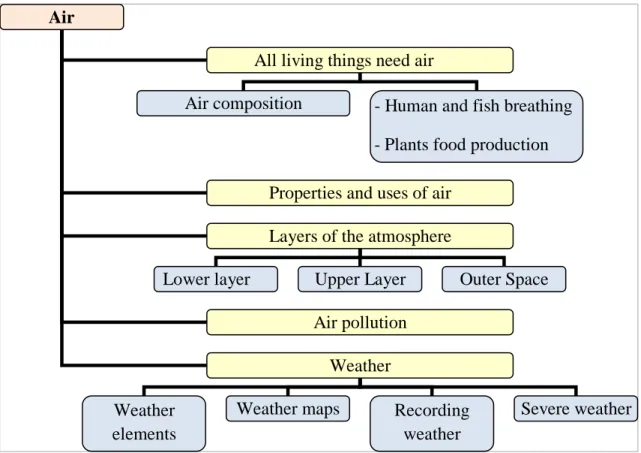
The contents are organized in different sections which we have called topics and subtopics. The main topic is air. Within air appear several subtopics such as: All living things need air, Properties and uses of air, Layers of the atmosphere, Air pollution and Weather.
Each subtopic has different parts and some of them have more subtopics within them, for instance: All living things need air has the subtopics of air composition, human and fish breathing, and plants food production. Layers of the atmosphere has as subtopics the different layers and its characteristics and properties: lower layer, upper layer and outer space. Finally, Weather has as subtopics weather elements, weather maps, recording weather and severe weather.
| 20
Once we have defined the contents and objectives proposed by the law, it is time to set the learning outcomes or more specific and centred objectives for the unit. We have set the following ones but depending on the time, the teacher and the circumstances, these contents may slightly change and so the learning outcomes.
- To know why living things need air. - To identify the main composition of air. - To identify the properties of air.
- To identify some uses of air.
- To recognise the causes of air pollution.
- To identify some actions to preserve the atmosphere. - To identify the basic elements that form weather. - To interpret a weather map.
Air
All living things need air
Properties and uses of air Layers of the atmosphere
Air pollution Weather
Air composition - Human and fish breathing - Plants food production
Lower layer Upper Layer Outer Space
Weather elements
Weather maps Recording weather
Severe weather
| 21
- To identify some weather instruments and its use.
- To interpret the information we get from the different weather instruments. - To identify some characteristics of severe weather.
The final purpose is to help children to reach these objectives. It is done by using the different resources and activities, but language is also an important part of the learning process.
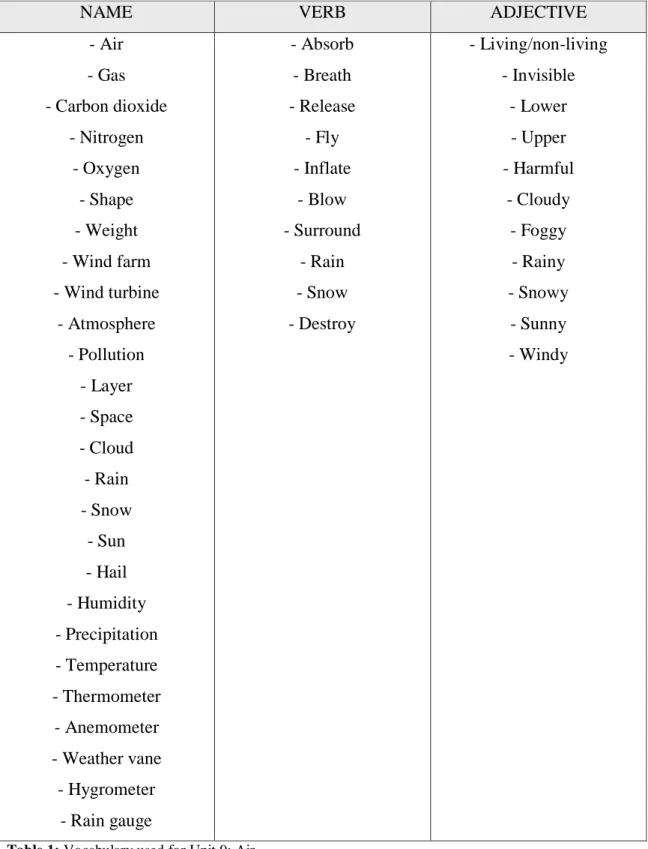
The main helpers to develop this unit are definitions, comparisons and descriptions. Definitions help the teacher to establish the main concepts for the unit and set the basis of each topic and subtopic. Knowing for instance the definition of atmosphere we also know that it is a layer surrounding the earth which in turn is made up of other layers. In this unit we can set as main concepts: air, atmosphere, air pollution, weather, temperature, wind, humidity, precipitation, lower layer, upper layer and outer space. In addition, definitions help the teacher to introduce the new vocabulary, for instance: Air is a mixture of different gases or The atmosphere is a layer of gases that surrounds the Earth. The main vocabulary used in this unit is the one presented on Table 1.
Comparisons also help the teacher to introduce new vocabulary and in addition, they provide and important resource to help children to remember better the information, by establishing differences and similarities between concepts, for instance: Tornadoes and hurricanes are violent storms with a swirling column of wind but tornadoes are formed in the ground and hurricanes are formed in the ocean.
| 22
NAME VERB ADJECTIVE
- Air - Gas - Carbon dioxide
- Nitrogen - Oxygen
- Shape - Weight - Wind farm - Wind turbine
- Atmosphere - Pollution - Layer - Space - Cloud - Rain - Snow - Sun - Hail - Humidity - Precipitation - Temperature - Thermometer - Anemometer - Weather vane
- Hygrometer - Rain gauge
- Absorb - Breath - Release - Fly - Inflate - Blow - Surround - Rain - Snow - Destroy - Living/non-living - Invisible - Lower - Upper - Harmful - Cloudy - Foggy - Rainy - Snowy - Sunny - Windy
| 23
APPROACH
As the preceding topics studied by the learners are concerned with living things such as animals and plants, this new unit can be readily related to that material.
As it was explained before, the teacher always asks the students about their knowledge, in this case, these questions are connected to living things. The teacher asks: What do all living things need to live? Children will provide several answers such as water, but the one which is relevant for the topic is air. Once the wanted answer has been elicited, the next step is to ask: And what is air? Children will answer using their own knowledge and the acquired knowledge from previous years and they will probably answer in Spanish as they are not familiar with the proper vocabulary. Some answers may show their own naive conceptions about air as something invisible and immaterial. Here is where the teacher starts to introduce new vocabulary and help the children to shape their new ideas about air using English. The objective is to develop different answers and reach the definition of air which is: Air is a mixture of different gases. Then, the teacher continues relating the new topic to the previous ones by asking: Why do we need air? What do we use air for? Here the answer being sought is: to breathe. As it is seen, the method to introduce a new topic has clear steps. Firstly the teacher asks questions connecting the previous knowledge to the new topic; then the teacher carefully introduces the very first definition included in the topic; after that the teacher continues relating several things with previous knowledge, helping children by introducing the new vocabulary.
In sum, the main aim of these questions and the main aim to ask about the previous knowledge, apart from discovering what children know, is to guide the answers and obtain, in the end, the desired response and gradually introduce definitions and new vocabulary. Children meet new vocabulary by using it in their responses. We could say that they learn it without being totally conscious of it.
| 24
explained, the posters have different items the children can stick or remove when necessary, and almost all the things are introduced and explained using them.
The posters allow the teacher to explain things in a really visual way, so children do not need to have any translations and they can easily relate the vocabulary with the meaning.
When introducing the first poster (Annex 2) the teacher asks: What can you see in this poster? Children will probably answer that they can see the Earth. Here the teacher’s task is to help by pointing at the main part of the poster and by giving some clues such as “we use it to breathe”, then children will mention air.
Then, using the already known definition, “air is a mixture of different gases”, the teacher asks: Do you know any gas? What gases do you know? Children will answer using Spanish. It is likely that they will mention oxygen and carbon dioxide. The teacher’s task is, again, to help children to re-elaborate their answers and introduce new vocabulary. After this, it is time to use the different items by sticking them to the poster. First the teacher explains the meaning of each picture if it is needed, as in this case in which the teacher explains that oxygen will use green colour, nitrogen will use yellow and carbon dioxide will use red. Then, the different items are placed on the poster in the part that belongs to air as they are components of air.
Afterwards, the teacher asks again about the uses of air, and shows the different items related to living things. Then asks: What do human beings use to breathe? As they have studied in previous topics, they will answer that human beings use lungs to breathe. The next question is: What do fish use to breathe? Children will answer that fish use gills to breathe. The last question is: What do plants use to make their own food? Children will answer that plants use their leaves to make their own food.
| 25
To stick the arrows, the teacher asks what do human beings breathe in and what do human beings breathe out. This is repeated with the breathing process in fish. Then the teacher asks what do plants absorb and what do plants release. All these questions are accompanied with different gestures to help children to understand better what is being asked.
After sticking all the pictures on the poster, is time to introduce the written words. First the teacher points to the different items and after the children’s answer, the teacher shows the written word and repeats it, then the children must repeat the word too.
The written words are stuck on the poster next to the pictures that represent them. This process is complemented by the whole explanation of the different things learnt during the lesson.
This process is repeated with the remaining posters (Annexes 3 and 4). First the teacher asks what is seen in the poster; then the teacher explains the different items when needed and sticks them on the poster. Finally, the teacher shows the written vocabulary and sticks the labels next to the pictures while repeating and relating the explanation. It is really important to help the children while using the posters. Sometimes things seem clearer to us than they may be to them. It is essential that the teacher complements his or her words with different gestures to foster understanding, and it is essential too, that the arrangement of the different items in the poster shows their relationships in a proper way and accompanied by a clear explanation which will provide the essential language and constructions that the children must manage at the end of the unit.
| 26
In addition, the questions allow the teacher to relate the topic to the children’s daily lives as they base their answers on their experiences in most cases, for instance: talking about things and phenomena that they have observed or sharing their own perspectives and thoughts. Sometimes materials allow us to get closer to the daily lives of students too. In this case, for instance, the third poster related to weather, (Annex 4) allows the teacher to organize a role play in which the children have to be the weathermen or women and explain to the audience the forecast for the next day in Spain.
Apart from the posters, we can also use other resources, for instance, those related to ICT as a power point presentation. In our case, the presentation’s aim is to introduce the different instruments to measure weather. It is a simple presentation, only made with photos as the purpose is that the children become familiar with the instrument’s shape, volume, external appearance… (Annex 5)
As with the posters, the teacher is in charge of asking different questions related to weather, such as: How can we measure weather? What do meteorologists use to measure weather and tell us, for example, if it is going to rain? Afterwards, the teacher explains that meteorologists use different objects to measure weather and starts showing the different pictures. With each new picture, the teacher asks the children what they think about the object, about its shape and appearance. Children will talk about their thoughts. The teacher will help them by pointing at different parts of the instruments that make them especial for their task. After all the guesses made by the children, the teacher shows the pictures again and explains the different parts and the function of each instrument.
| 27
Regarding the use of the book, we have to take into account that it is an important part of the learning process, not taking it as an essential reference but as any other resource to support knowledge.
After exploring the children’s knowledge about the different topics and sub-topics by the use of several questions and the different resources, the teacher must take the book as an important contributor to the reading part of the learning process. As it has been said before, the reading part is one of the language learning skills to develop.
During the topic or sub-topic explanation the reading part is not developed apart from the labels stuck on the posters or a few explanations or words written on the blackboard. This is why the last minutes of the lesson are dedicated to read the information from the book. This part must be developed as follows: First, using the CD-ROM included in the book, the teacher plays the track corresponding to the given information, which is basically the information written in the text book lesson. Children must read the information while listening to the recording.
The teacher must pause the recording after each paragraph so children can re-read aloud what they have heard.
As the information is presented in a clear and simple way in the textbook, very similar to the information given during the lessons, the listening-reading part helps to review the whole lesson and develop pronunciation, listening and reading skills.
| 28
ACTION
The teacher’s intervention is not only focused on the explanation of the information during the different lessons, but in raising their own awareness of the understanding and progress made by the children both at home and at school.
The teacher’s task is, in addition, to evaluate his or her own method and its contribution to the children’s learning process. It is necessary to check the comprehension of the given information; to review the different parts to reinforce those that are less clear; to help children to remember the information…
Remembering and summarizing information
The important part of the learning process is to remember the new information, if it is not remembered, it means that the learning process has not been successful. To help students to remember better the different contents, the teacher must help them to use different learning resources such as: contextualise, relate and summarize.
The first step is to contextualise the information, which means to know what field it belongs to. It is necessary to establish clear schemes during the lessons, organizing information from the most general category to the most particular one, for instance: The atmosphere has different layers; these layers have different characteristics; one of the characteristics of the lower layer is that weather happens there; weather has different elements; humidity is an element of weather. We have contextualised humidity within weather and weather within an atmosphere layer. This step is clearly connected with the second step which consists on relating information.
| 29
The last step is to summarize. Summarizing helps us to remember better the information. Children must know what humidity and precipitation are, but first they must remember that both are elements of weather. This step simplifies the information and emphasizes categories and simple ideas.
These three steps are followed in the different lessons by using the posters and other resources which help graphically to organize and simplify information.
Performing experiments
The purpose of experiments apart from making science more interesting for the students by experimenting, watching and touching the different things by themselves is to provide the students a valuable resource they can use at home. These kind of experiments allow the children to feel like real scientists and feel closer to the things they learn at school. In addition, they can show these things at home and teach their relatives as if they were teachers, which help them to remember better the different knowledge and to relate it to their daily lives.
Two experiments were chosen for this unit but there are a lot experiments to perform in the classroom, it is only necessary to take into account children’s likes and interests and school resources and places.
The first experiment helps to explain the properties of air. Some issues can be difficult for children to understand, such as the fact that air has weight. To perform the experiment two balloons and a hanger are used.
| 30
The second experiment is focused on severe weather. It has been observed that severe weather is interesting to children and that some children really want to know about tornados and its formation. The experiment includes creating a tornado in a plastic bottle and observing how it is formed.
To perform the experiment, everyday items such a plastic bottle, some water, sugar and washing up liquid are used. The first step is to pour ¾ parts of water into the bottle, then it is necessary to add two sugar envelopes and a little stream of washing up liquid. By mixing all this in a circular motion it is seen the formation of a little tornado inside the bottle.
During the performance of this experiment, a data gathering sheet is used (Annex 7), in which children must write the purpose of the experiment, the steps followed and the results and conclusions just as if they were real scientists.
Reviewing the lesson
Lesson reviews are important to check the students’ comprehension and their work at home. Teachers do not usually set their students homework assignments, particularly understood as specific exercises, but they must reread lessons every day, practice their writing and their pronunciation.
| 31
volunteer to “be the teacher”, which means to go up to the blackboard and stick the different items on the poster explaining its different parts as if he or she were the teacher.
After the reviews, the new sub-topic is related to the previous sub-topics in the same way that in the first lesson the new subtopic is related to the previous topics, which is asking about similarities, for instance: Do you remember what air is? (Air is a mixture of different gases) And do you know what is atmosphere? I can give you a clue: it is made of air (So the atmosphere is a mixture of gases too). Then, introducing the concept of layer the definition can be re-elaborated and we can reach the conclusion that the atmosphere is the layer of gases that surrounds the Earth.
At the end of the lesson the review is made at once with the listening-reading part using the text book. The difference between the two review parts is that the first one is a complete review of the unit sub-topics studied and the second one is a short daily review.
Parent’s role
Although the reviews are done at the beginning and at the end of all the lessons, they are not enough for a proper learning which must be reinforced at home.
As not all parents have adequate knowledge of English, it is the teacher’s task to provide them of some resources to help their sons and daughters at home.
| 32
RESULTS OBTAINED
After the application of this method in this classroom the results obtained in this unit were:
- 6 students obtained a mark between 9 and 10 - 7 students obtained a mark between 6 and 8 - 3 students obtained a mark of 5
- 2 students obtained a mark under 5
As can be seen, 88% of the students reached the required level of comprehension and knowledge about science and also about the foreign language, being able to communicate using the English language not only with scientific purpose but also in other contexts.
| 33
CONCLUSIONS
Based on the overall results, which are more or less the same throughout the whole year, it could be said that this is a successful method. A great percentage of students reach the required level of science content knowledge and a great level and handling of the English language, mostly in listening and speaking skills.
The motivation of the students in class is higher because of the dynamic presentation adopted and they are more participative during the lessons.
In addition their pronunciation, reading and comprehension in the foreign language improves day by day making real the bilingual project.
But not everything is as good as it seems at first glance. As the progress is more centred on verbal communication there are certain problems in acquiring basic writing skills; thus, students make a lot of misspellings and letter omissions. This is why a close collaboration between the school and the families is needed because reinforcement work at home is crucial to the success of this method. The more the student works at home, the wider the range of activities possible in the classroom, but when there is no work done at home, the pace of the class is slowed down and it is impossible to perform certain activities because more lesson time is needed for reviewing and reinforcement.
| 34
Apart from these problems, we should briefly mention the part of science instruction carried out in Spanish, Conocimiento del medio natural, social y cultural. In this school the time designated to this subject was one hour per week and the teacher was not the same as in the science class taught in English. In effect this means a different way to teach and in most cases a different methodology.
Major differences between science lessons taught in Spanish and those taught in English may explain why the children did not take seriously the Spanish subject which lasted only one hour. They felt that the real subject was the one which lasted more time. In addition, children were demotivated and not very participative during these lessons taught in Spanish which made that their results were lower than in the English subject.
Despite all these issues, it would not be fair to leave the impression that the disadvantages seem larger than the advantages. It is true that it is a method which requires huge coordination efforts between teachers, school and families but looking at the results obtained by children in motivation, English level and science knowledge it is a worthy effort.
For the time being schools need a better coordination between them to work altogether in the same way in bilingual projects. Besides that, teachers in charge of the same subject, especially when it is being taught both in English and Spanish, must agree in a way of teaching and working that does not detract from their pupils performance. And finally, families must be involved in their children’s education, helping at home and not undermining the teacher’s work.
| 35
REFERENCES
- Almarza Sánchez, M.A. (2000). An approach to the Integration of Skills in English Teaching. Didáctica. Lengua y Literatura, 12, 21-41.
- Canale, M. & Swain, M. (1980). Theoretical bases of communicative approaches to second language teaching and testing. Applied Linguistics, 1, (1), 1-47.
- Carey, S. (2000). Science Education as Conceptual Change. Journal of Applied Developmental Psychology, 21, (1), 13-19.
- Evnitskaya, N. & Morton, T. (2011). Knowledge construction, meaning-making and interaction in CLIL science classrooms communities of practice. Language and Education, 25, (2), 109-127.
- Lewis, J. & Kattmann, U. (2004). Traits, genes, particles and information: re-visiting students’ understandings of genetics. International Journal of Science Education, 26, (2), 195-206.
- Martín Bravo, C. & Navarro Guzmán, J. (2009). Psicología del desarrollo para docentes. Madrid: Ediciones Pirámide.
- Martín Bravo, C. & Navarro Guzmán, J. (2010). Psicología de la educación para docentes. Madrid: Ediciones Pirámide
- Ministerio de Educación y Ciencia (2007). ORDEN ECI/2211/2007. BOE 173, 31487-31566.
- Mix, M., Farber, P., King, K. (1992) Biology: The Network of Life. Glenview: Harper Collins.
- Morton, T. (2012) Classroom talk, conceptual change and teacher reflection in bilingual science teaching. Teaching and Teacher Education, 28, 101-110.
- Santillana Educación (2012). Essential Science Plus 3 PRIMARY. Teacher’s Book. Madrid: Richmond Publishing
| 36