Effects of overstorey canopy, plant-plant interactions and soil properties on
Mediterranean maritime pine
seedling dynamics
Encarna Rodríguez-García1,2, Felipe Bravo1,2 andThomas A. Spies3
1 Departamento de Producción Vegetal y Recursos Forestales. E. T. S. Ingenierías Agrarias de Palencia.
Universidad de Valladolid. UVA-INIA. Avenida Madrid, 44. 34004. Palencia, Spain. *Corresponding author
e-mail address: [email protected]
2 Sustainable Forest Management Research Institute UVA-INIA. Avda. Madrid, 44. 34004. Palencia, Spain 3 USDA, Forest Service. PNW Research Station. Forestry Sciences Lab. Corvallis, Oregon, 97330. USA.
ABSTRACT
Seedling emergence, survival and early growth of the Mediterranean conifer P. pinaster were studied under closed canopy and open canopy (gaps) cover conditions in a Mediterranean forest of central Spain during two consecutive years (March 2008 to January 2010). Our main objective was to understand how overstorey structure, shrubs and soil properties influence recruitment in this species. Natural emergence and seedling survival were significantly better under closed canopy cover than under open canopy during the two consecutive years of the study; survival increased as radiation decreased. Proximity to shrubs under closed canopy cover was associated with lower mortality rates as well as a positive and apparently transitive effect on early growth. Amelioration of microclimatic conditions is hypothesized as the primary facilitation agent of those observed. Younger seedlings established during the spring of 2008 experienced higher mortality rates than older seedlings established before 2008, and soil properties affected seedling survival significantly. Water stress during summer appeared to be the main cause of seedling mortality in both years. Our study suggests that seedlings of shade-intolerant species may require overstorey cover to establish successfully, and that positive plant-plant interactions in forest communities may be more important than expected in the milder conditions provided by overstorey canopy cover.
Key words: Abiotic conditions/Facilitation/ Natural establishment/ Plant-plant interactions/ Overstorey conditions
This is a pre-copyedited, author-produced PDF of an article published in 2011 in Forest Ecology and Management following peer review.
The final publication: Volumen 262, Issue 2, pp 244-251 is available at Elsevier via:
1 INTRODUCTION
Natural establishment in forest communities is influenced by multiple interacting factors and can be arranged into distinctand sequential stages(Matney and Hodges, 1991; Barnes et al., 1998a; Rebollo et al., 2001), with the seed and seedling phases recognized as the most critical and least stress-tolerant (Houle, 1996). One of the main abiotic factors limiting natural establishment of woody species in the Mediterranean region and in other Mediterranean ecosystems is summer drought (see Castro et al. (2004a) and references inside). Several studies have indicated that pioneer shrubs can facilitate tree seedling survival and growth during natural establishment in Mediterranean forest communities, acting as nurse shrubs (Callaway, 1992; Castro et al., 2004b; Gómez-Aparicio et al., 2005b; Rodríguez-García et al., 2010; Rodríguez-García et al., 2011). This leads us to think that facilitation might be a common process in Mediterranean plant communities at early stages and in moisture-limited environments, which agrees with the theory of the stress-facilitation relationship described by Bertness and Callaway (1994). Complex combinations of negative (competition and allelopathy) and positive (facilitation) interactions operating between plant species are common in most communities and biomes (Callaway, 1995). Facilitation and competition refer to the net effect of changes in the environment of a plant due to the presence of other plants, which includes aboveground and belowground components. Plants can modify temperature, moisture, and light beneath their canopies, thereby altering biological, physical and chemical soil properties. They may also act as seed traps or protect the seedlings of other species from herbivory (Callaway and Walker, 1997; Holmgren et al., 1997; García et al., 2000). The importance of plant-plant interactions appears to vary according to environmental heterogeneity (Hartgerink and Bazzaz, 1984; Kitzberger et al., 2000; Tielbörger and Kadmon, 2000; Beckage and Clark, 2003) and the intensity of abiotic stress experienced by the interacting species (Bertness and Callaway, 1994), as well as the life stages, size and physiologies of the interacting species (Callaway and Walker, 1997; Holmgren et al., 1997; Rodríguez-García et al., 2011).
with a range of shade tolerant physiologies (Catovsky and Bazzaz, 2002). However, seedling responses to light might be determined by belowground resource availability and could vary along soil fertility and seasonal drought gradients (Coomes and Grubb, 2000). Alternatively, this response may be dependent on adjacent vegetation. In forest communities, tree seedlings generally grow mixed in the same space with groups of different ages, sizes or development stages. Thus the plant-plant interactions would be transitive, or determined by their relative sizes. Where perennial woody plants are competing for light, small differences in seedling stature can have a critical effect on survival. Grime (1979) hypothesized that plant habitat competition intensifies along an increasing gradient of primary productivity. Bertness and Callaway (1994), hypothesized that the importance of competition would increase when abiotic stress and consumer pressure were relatively low, but competition between plants can be expected in highly stress-tolerant species (Grime, 1979).
Our understanding of the role of shrubs in this process is also quite limited. Given the current and predicted climatic trends (IPCC, 2007), shrublands are likely to expand in Mediterranean systems because pioneer shrubs, for example Cistus spp., are physiologically well adapted to dry conditions and recurrent fires (Werner et al., 1998). In this study we examined P. pinaster based on its ability to rapidly colonize open areas. This study is an extension of a previous study (Rodríguez-García et al., 2011) and provides new results about the natural establishment of Pinus pinaster. The prior study focused on the effects of shrub and canopy cover on the relative growth rate of different-sized Pinus pinaster saplings (growth in the late establishment dynamic). The present study focuses on processes of survival and growth in the early establishment dynamics of young seedlings. Our main objectives were to better understand natural recruitment in this species, to test the influence of overstorey canopy on seedling dynamics, to identify the most important factors affecting seedling survival and to determine whether adjacent shrubs affect seedling survival positively or otherwise. We expected that: 1) natural seedling emergence would be higher under open canopy due to greater wind-dispersal of seeds in open areas and the shade-intolerant nature of the species; 2) establishment would be limited (lower survival and growth rate) at more stressful sites, for example where open canopy with high light levels could produce photoinhibition and thermal fluctuations; 3) seedling survival and early growth would be influenced by shrub; 4) the intensity and the sign of the shrub-seedling interactions would vary depending on the overstorey canopy, with stronger and positive interactions at more stressful sites; 5) conversely, a negative or null effect would be expected under closed canopy conditions with greater availability of resources (soil water, air moisture); and 6) overstorey-understorey vegetation and soil properties would affect seedling dynamics.
2 METHODS
2.1 Site description
temperature of 10º C. Summer precipitation is usually scarce, with minimum annual values in July and August. The soil is siliceous and classified as an Entisol. The experimental site (~25 ha) was partially harvested in 1996 and 1997 using a shelterwood method that varied overstorey retention densities and created canopy gaps. The site had been fenced to keep out livestock and it was still fenced when the study started.
2.2 Study design and environmental factors
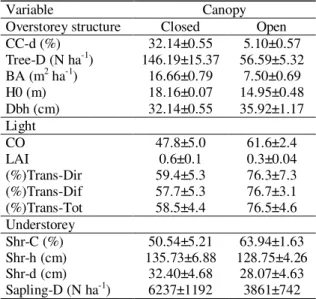
Table 1. Main overstorey-understorey characteristics of closed and open canopy plots in the study site (mean ± SE).
Variable Canopy
Overstorey structure Closed Open CC-d (%) 32.14±0.55 5.10±0.57 Tree-D (N ha-1) 146.19±15.37 56.59±5.32
BA (m2 ha-1) 16.66±0.79 7.50±0.69
H0 (m) 18.16±0.07 14.95±0.48 Dbh (cm) 32.14±0.55 35.92±1.17 Light
CO 47.8±5.0 61.6±2.4 LAI 0.6±0.1 0.3±0.04 (%)Trans-Dir 59.4±5.3 76.3±7.3 (%)Trans-Dif 57.7±5.3 76.7±3.1 (%)Trans-Tot 58.5±4.4 76.5±4.6 Understorey
Shr-C (%) 50.54±5.21 63.94±1.63 Shr-h (cm) 135.73±6.88 128.75±4.26 Shr-d (cm) 32.40±4.68 28.07±4.63 Sapling-D (N ha-1) 6237±1192 3861±742
Overstorey structure: CC-d: canopy cover measured with spherical densiometer; Tree D: tree density; BA: tree basal area; H0: tree dominant height (Assman); Dbh: tree diameter at breast height (1.30 m); Light: CO, canopy openness (%); LAI*, leaf area index (m2 m-2). *Note that variable LAI provided by GLA software may be
considered as Plant Area Index or Vegetation Area index, because of the inclusion of some trunks and tree branches in the captured image; (%)Trans-Dir, (%)Trans-Dif, (%)Trans-Tot, direct, diffuse and total radiation transmitted (%). Understorey: Shr-C: shrub canopy cover; Shr-h: shrub height; Shr-d: distance of seedling to the nearest shrub; Sapling-D: sapling density. The stand structure was characterized in a previous study (Rodríguez-García et al., 2011).
2.3 Pattern of establishment and seedling initial growth
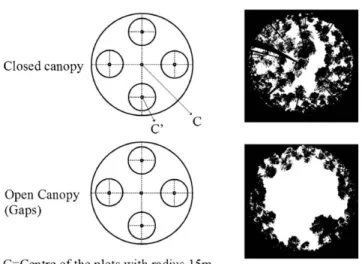
In early March 2008, circular plots (1m radius) were established within each 2.5m subplot per canopy cover, in order to observe the natural pattern of seedling establishment from the soil seeds bank (Figure 1). Seedlings established before March 2008, likely not older than 1 year (<6 cm height and presence of dry cotyledons in many seedlings) were measured and grouped into the Previous to Spring 2008 group (Seed<08). Seedlings that sprouted between March 2008 and August 2008 (first growth season) were labeled and classified as the Spring 2008 group (Seed08). Seedlings that sprouted between February and August 2009 (second growth season) were labeled and classified as the Spring 2009 group (Seed09). Natural emergence and survival were surveyed monthly during both years; from March 2008 to August 2008, and from February 2009 to January 2010, respectively.
h0 ln h0 ln -h1 ln =
RHG [1]
where h1 and h0 are the final and initial height (cm), measured above ground in the corresponding growth season. Initial height was measured in March 2008 in established seedlings (Seed<08), and in the month in which seedlings were sprouted and recorded (throughout the 2008-growing season in Seed08, and throughout the 2009-growing season in Seed09). Final seedling height measurements were recorded in February 2009 (RHG1 in
Seed<08 and Seed08) and in January 2010 (RHG1 in Seed09, and RHG2 in Seed<08 and
Seed08). The distance to the geometrical centre of the nearest shrub was measured when seedlings were recorded, and seedlings were classified as being either inside (0-30 cm) or outside (> 30 cm) the shrub canopy.
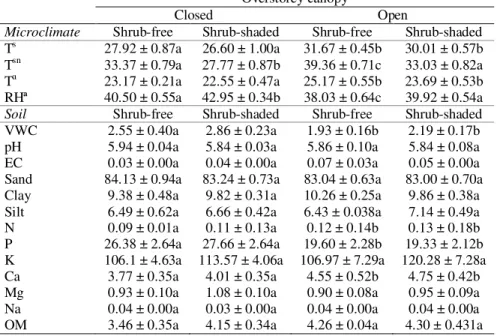
Table 2. Values of the microclimatic conditions and soil properties measured in July 2008 at shrub-shaded and shrub-free sampling points (mean ± SE). Different letters indicate significant differences (p<0.001).
Overstorey canopy
Closed Open
Microclimate Shrub-free Shrub-shaded Shrub-free Shrub-shaded
Ts 27.92 ± 0.87a 26.60 ± 1.00a 31.67 ± 0.45b 30.01 ± 0.57b
Tsn 33.37 ± 0.79a 27.77 ± 0.87b 39.36 ± 0.71c 33.03 ± 0.82a
Ta 23.17 ± 0.21a 22.55 ± 0.47a 25.17 ± 0.55b 23.69 ± 0.53b
RHª 40.50 ± 0.55a 42.95 ± 0.34b 38.03 ± 0.64c 39.92 ± 0.54a
Soil Shrub-free Shrub-shaded Shrub-free Shrub-shaded
VWC 2.55 ± 0.40a 2.86 ± 0.23a 1.93 ± 0.16b 2.19 ± 0.17b pH 5.94 ± 0.04a 5.84 ± 0.03a 5.86 ± 0.10a 5.84 ± 0.08a EC 0.03 ± 0.00a 0.04 ± 0.00a 0.07 ± 0.03a 0.05 ± 0.00a Sand 84.13 ± 0.94a 83.24 ± 0.73a 83.04 ± 0.63a 83.00 ± 0.70a Clay 9.38 ± 0.48a 9.82 ± 0.31a 10.26 ± 0.25a 9.86 ± 0.38a Silt 6.49 ± 0.62a 6.66 ± 0.42a 6.43 ± 0.038a 7.14 ± 0.49a N 0.09 ± 0.01a 0.11 ± 0.13a 0.12 ± 0.14b 0.13 ± 0.18b P 26.38 ± 2.64a 27.66 ± 2.64a 19.60 ± 2.28b 19.33 ± 2.12b K 106.1 ± 4.63a 113.57 ± 4.06a 106.97 ± 7.29a 120.28 ± 7.28a Ca 3.77 ± 0.35a 4.01 ± 0.35a 4.55 ± 0.52b 4.75 ± 0.42b Mg 0.93 ± 0.10a 1.08 ± 0.10a 0.90 ± 0.08a 0.95 ± 0.09a Na 0.04 ± 0.00a 0.03 ± 0.00a 0.04 ± 0.00a 0.04 ± 0.00a OM 3.46 ± 0.35a 4.15 ± 0.34a 4.26 ± 0.04a 4.30 ± 0.431a
Microclimate: Ts, daily average soil temperature (ºC); Tsn, Soil temperature (ºC) at noon (12-5 pm); Ta, average
air temperature (ºC) at soil surface level; RHa, average relative air humidity at soil surface level (%); Soil: VWC,
soil volumetric water content (%); pH, soil pH; EC, electrical conductivity (dSm m-1); Sand, Clay and Silt,
percentage of soil particles by size (%); N, nitrogen content (%); P, phosphorous content (mg Kg-1); K,
potassium content (mg Kg-1); Ca, calcium content (mg Kg-1); Mg, magnesium content (mg Kg-1); Na, sodium
content (mg Kg-1); OM, organic matter (%).The microclimatic conditions and soil properties were characterized
Figure 1. Layout of the plots and experimental design
2.4 Factors conditioning seedling survival
The relationship between seedling survival probability in summer conditions and site factors was examined. We included variables defining the overstorey-understorey structure, light and soil properties (the average values between shrub-free and shrub-shaded sampling microsites per 2.5 m subplot), distance to the nearest shrub and seedling group. We only evaluated seedling survival after the first growth season due to the very low number of seedlings found alive after the second season.
2.5 Statistical analysis
Differences in seedling emergence between years 2008 and 2009 as well as canopy cover type were analyzed with a split-plot GLM design (plot nested in canopy treatment). Differences in seedling relative height growth between canopy cover types were analyzed using the seedling class and distance from shrub as categorical factors. The variables RHG1 and RHG2 were transformed to their natural logarithm.
with two categories for seedling distance from the nearest shrub (0-30 cm y >30 cm). Due to the fact that most of the Spring 2008 seedlings emerged in June, we decided to compare differences in seedling survival probability between seedlings established previous to spring of 2008 and in spring of 2008, rather than looking at seedling groups based on month of emergence within the Spring 2008 group. Overstorey structure, light and soil properties were included as continuous independent variables. Prior to that, a Principal Component Analysis (PCA) was conducted to reduce the dimension of the observations and search for combinations of environmental variables that explained the largest variation in the data (Härdle and Simar, 2007). The PCA was based on the correlation matrix and the components were rotated according to the varimax method. The eigenvalues and explained variance shown in the text are from the initial values matrix. The PCA variables with a correlation to the principal components that was higher than 0.75 were selected to describe the environmental gradients indicated by the principal factors and were included in the survival probability model. Several models were tested and the final one was chosen based on its goodness of fit with Akaike information criterion (AIC) and statistical stability evaluated by the ratios of deviance to the respective degrees of freedom. The models were fitted using Statistica 6.0®.
2.6 Intensity of the seedling-shrub interaction
An index of interaction intensity was used to synthesize the net effect of seedling-shrub interaction and to determine the impact of facilitation on cumulative seedling survival after the first and second growing season, (end of the study), independently from the impact of other factors such as abiotic stress (Brooker et al., 2005). We modified the Relative Neighbour Effect index (RNE) of Callaway et al., (2002), so that
x Xt -Xc =
RNE [2]
height (Table 1), ‘shrub absence’ should apply to seedlings growing further than 30 cm from shrubs, even though there is a likely shelter effect. In the horizontal plane, the presence or absence of the neighbour shrub can be nuanced and interpreted as seedling proximity to the shrub, or as being inside or outside the shrub’s canopy.
3 RESULTS
3.1 Natural patterns of establishment and early seeding growth
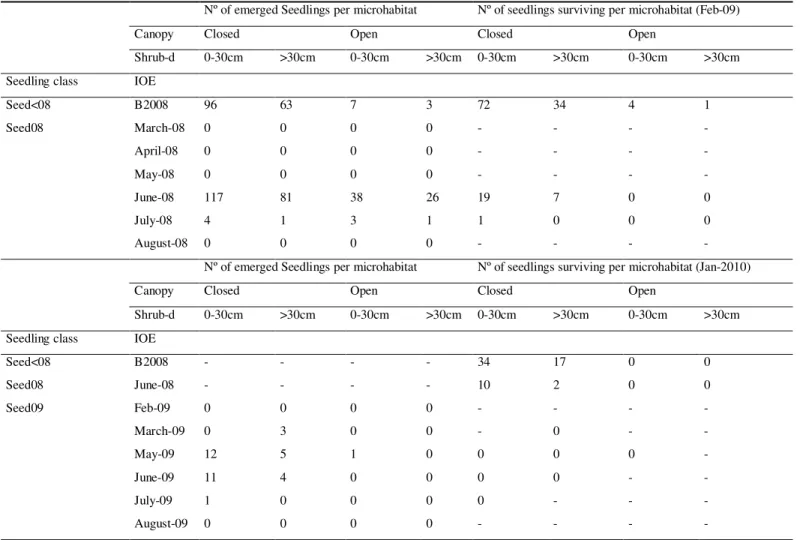
Initial densities of Pinus pinaster seedlings in March 2008 (Seed<08) were much higher under closed canopies (average of 16.7 seedlings m2) than under open canopies (average of 1 seedling m2). Seedling emergence from the soil seed bank during the spring of 2008 (Seed08) was higher under closed canopies and occurred mainly in June in all plots and for both canopy types. After the first growth season (August 2008), the Seed<08 density had decreased to an average of 11 seedlings m2 under closed canopy, and a total of 5 seedlings under open canopy cover (Table 3).
In the case of Seed08, only 27 out of a total of 271 established seedlings under closed canopy survived the summer, and none of the 68 seedlings established under open canopy cover survived the first summer (Table 3). Seedling emergence during the second year, 2009, began in March and continued through June, which corresponded with the peak month. The number of seedlings emerged was low (Table 3), and 100% of the seedlings had died by August 2009 under both canopy types. Only two seedlings from the Seed<08 group remained alive under open canopy cover. At the end of the study in January 2010, only closed canopy plots contained live seedlings. Seedling emergence was significantly higher under closed canopy than under open canopy during both years, and was significantly higher during 2008 (F=23.98; p<0.001). Dead seedlings were found to be desiccated at the time of recording, without symptoms of insect or fungus damage. Water stress during summer appeared to be the main cause of seedling mortality in both years.
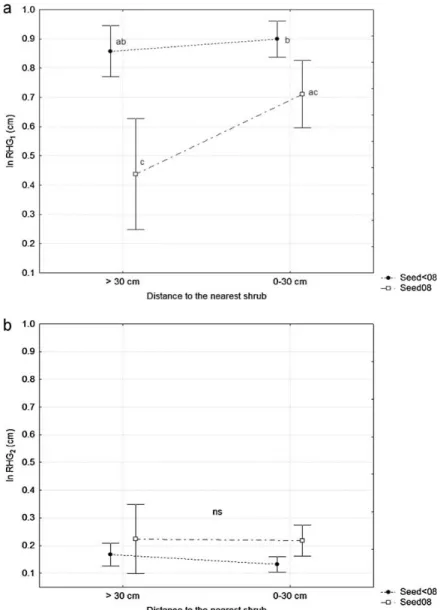
(F=6.33; p<0.001), and by the seedling class (F=23.74; p=0.013). Within a distance of 0-30 cm from the nearest shrub, there was a difference in relative growth between the seedling groups (Figure 2). However, the Seed08 RHG1 did not differ from the Seed<08 RHG1 for seedlings established further than 30 cm from shrub. These differences in RHG disappeared during the 2009 growth season (RHG2), when neither the distance to the shrub (Id-shrub; F=0.34; p=0.564), nor the seedling group (F=3.74; p=0.057) had a significant effect on the relative height growth.
3.2 Factors conditioning seedling survival
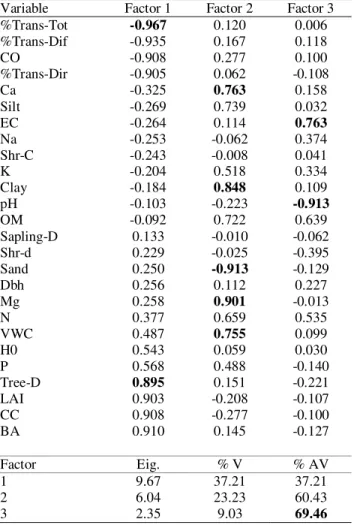
The first three principal components of the PCA explained 69.46% of the total variance. The eigenvalues, percentage variation of each factor and interpretation (with factor-variable correlations) are provided in Table 3. The first and most important factor described a ‘shade effect’ positively related to overstorey canopy cover, LAI, basal area and tree density and negatively related to canopy openness and transmittance. The second factor described soil textural properties along with soil water and Ca and Mg availability. The third factor described the soil chemical properties and explained only 9.03% of the variation. The role of sapling density and shrub cover was scarcely perceptible (Table 4), but seedling distance to the nearest shrub (Shr-d) was negatively correlated with the third factor (r=-0.395).
Table 3. Number of emerged seedlings per shrub-microhabitat and canopy cover type, and number of seedlings surviving after the first (Feb-09) and second growth season (Jan-2010).
Nº of emerged Seedlings per microhabitat Nº of seedlings surviving per microhabitat (Feb-09)
Canopy Closed Open Closed Open
Shrub-d 0-30cm >30cm 0-30cm >30cm 0-30cm >30cm 0-30cm >30cm
Seedling class IOE
Seed<08 B2008 96 63 7 3 72 34 4 1
Seed08 March-08 0 0 0 0 - - - -
April-08 0 0 0 0 - - - -
May-08 0 0 0 0 - - - -
June-08 117 81 38 26 19 7 0 0
July-08 4 1 3 1 1 0 0 0
August-08 0 0 0 0 - - - -
Nº of emerged Seedlings per microhabitat Nº of seedlings surviving per microhabitat (Jan-2010)
Canopy Closed Open Closed Open
Shrub-d 0-30cm >30cm 0-30cm >30cm 0-30cm >30cm 0-30cm >30cm
Seedling class IOE
Seed<08 B2008 - - - - 34 17 0 0
Seed08 June-08 - - - - 10 2 0 0
Seed09 Feb-09 0 0 0 0 - - - -
March-09 0 3 0 0 - 0 - -
May-09 12 5 1 0 0 0 0 -
June-09 11 4 0 0 0 0 - -
July-09 1 0 0 0 0 - - -
August-09 0 0 0 0 - - - -
Figure 2. Natural logarithm of the average relative height growth (RHG) of established seedlings of different cohorts under closed canopy cover, during the first growth season (a) and the second growth season after germination (b), and at different distances to the nearest shrub. Different letters show significant differences (p<0.05) between treatments. Vertical bars denote 0.95 confidence interval.
established between 0-30 cm had a significantly lower probability of mortality during summer (negative parameter estimate for the effect level, Id-shrub=1), than seedlings established further from the shrub canopy (Table 5).
Table 4. Principal factors and explained variance obtained from the PCA carried out with overstorey and structure variables and soil properties. Factor loadings higher than 0.75 are in bold.
Variable Factor 1 Factor 2 Factor 3 %Trans-Tot -0.967 0.120 0.006
%Trans-Dif -0.935 0.167 0.118 CO -0.908 0.277 0.100 %Trans-Dir -0.905 0.062 -0.108
Ca -0.325 0.763 0.158
Silt -0.269 0.739 0.032 EC -0.264 0.114 0.763
Na -0.253 -0.062 0.374 Shr-C -0.243 -0.008 0.041 K -0.204 0.518 0.334 Clay -0.184 0.848 0.109
pH -0.103 -0.223 -0.913
OM -0.092 0.722 0.639 Sapling-D 0.133 -0.010 -0.062 Shr-d 0.229 -0.025 -0.395 Sand 0.250 -0.913 -0.129 Dbh 0.256 0.112 0.227 Mg 0.258 0.901 -0.013
N 0.377 0.659 0.535
VWC 0.487 0.755 0.099
H0 0.543 0.059 0.030
P 0.568 0.488 -0.140
Tree-D 0.895 0.151 -0.221
LAI 0.903 -0.208 -0.107 CC 0.908 -0.277 -0.100
BA 0.910 0.145 -0.127
Factor Eig. % V % AV
1 9.67 37.21 37.21
2 6.04 23.23 60.43
3 2.35 9.03 69.46
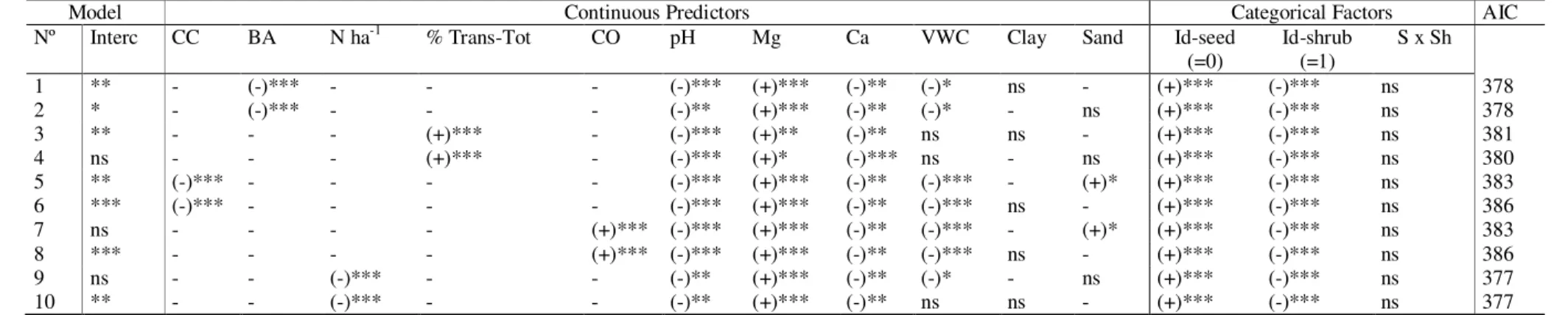
The influence of the overstorey canopy appeared to be very important, and all models tested showed that lower radiation resulted in higher survival of summer conditions. Greater canopy openness and total transmitted radiation increased the probability of seedling mortality, while higher basal area, tree density or canopy cover significantly decreased this probability during summer. Soil pH, Ca and Mg content were significant in all models but had opposite effects. Ca was associated with a decrease in the probability of seedling mortality, while Mg was associated with an increase. The percentage of clay in the soil was not significant, but the percentage of sand was significant in two models and was associated with increased mortality. The soil volumetric water content variable had a significant effect on decreasing the probability of seedling mortality when it was included with BA, CC, CO and tree density in the models; but it did not show a significant effect when it was tested together with the % Trans-Tot variable (Table 5).
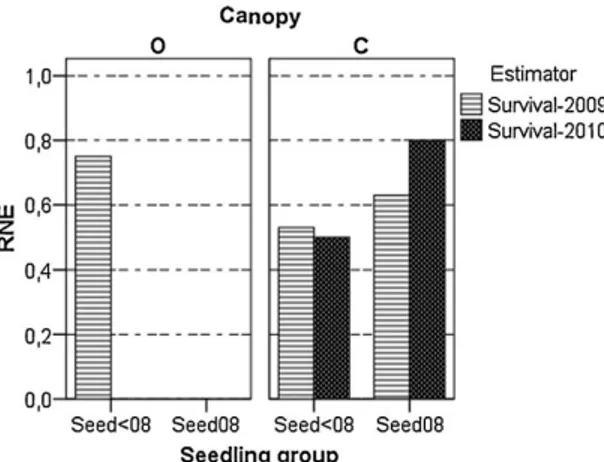
Figure 3. Sign and strength of the shrub-tree seedling interactions using the Relative Neighbour Effect (RNE). Positive values indicate facilitation. The RNE was calculated as the difference in seedling performance (survival) with shrubs (0-30 cm) and without (> 30 cm), relative to the case with the greatest performance in the pair. RNE was calculated for survivors after one growing season (February 2009) and at the end of the experiment (January 2010). O: open canopy; C: closed canopy.
3.3 Intensity of the seedling-shrub interactions and plant performance estimators
4 DISCUSSION
Table 5. GLZ models of mortality probability during the first summer of different P. pinaster seedling groups (Id-seed) established at different distances from shrub (Id-shrub).
Model Continuous Predictors Categorical Factors AIC
Nº Interc CC BA N ha-1 % Trans-Tot CO pH Mg Ca VWC Clay Sand Id-seed
(=0) Id-shrub (=1) S x Sh 1 ** - (-)*** - - - (-)*** (+)*** (-)** (-)* ns - (+)*** (-)*** ns 378 2 * - (-)*** - - - (-)** (+)*** (-)** (-)* - ns (+)*** (-)*** ns 378 3 ** - - - (+)*** - (-)*** (+)** (-)** ns ns - (+)*** (-)*** ns 381 4 ns - - - (+)*** - (-)*** (+)* (-)*** ns - ns (+)*** (-)*** ns 380 5 ** (-)*** - - - - (-)*** (+)*** (-)** (-)*** - (+)* (+)*** (-)*** ns 383 6 *** (-)*** - - - - (-)*** (+)*** (-)** (-)*** ns - (+)*** (-)*** ns 386 7 ns - - - - (+)*** (-)*** (+)*** (-)** (-)*** - (+)* (+)*** (-)*** ns 383 8 *** - - - - (+)*** (-)*** (+)*** (-)** (-)*** ns - (+)*** (-)*** ns 386 9 ns - - (-)*** - - (-)** (+)*** (-)** (-)* - ns (+)*** (-)*** ns 377 10 ** - - (-)*** - - (-)** (+)*** (-)** ns ns - (+)*** (-)*** ns 377 Interc, intercept of the model; See name of continuous predictors in Table 3; (+/-) sign of the parameter estimate; ***(p<0.001);**(p<0.01);*(p<0.05) significant
In our case, closed canopy cover plots may present greater productivity than open plots due to the greater content of soil water and phosphorous. The role of competition and facilitation along productivity gradients should be explored with greater attention to the conditions under which the findings of Goldberg and Novoplansky (1997) would be expected to apply in light of these two apparently contradictory hypotheses.
Soil pH, which was associated with decreased probability of seedling mortality, may influence both the supply of nutrients for plant growth by controlling the solubility of soil minerals, and the activity of soil microorganisms (Barnes et al., 1998b). Calcium was associated with decreased probability of seedling mortality and might be related to seedling growth. Unlike most nutrients, calcium is taken up almost exclusively by young root tips (Brady and Weil, 2002). The negative effect of Mg concentration on seedling survival might be connected to the photosynthesis process or to intra-specific competition for nutrients and light caused by the need to grow fast or increase shoot due to neighbour shade (Bloom et al., 1985). These relationships could be derived from other factors that drive both the mortality and the soil nutrient patterns, e.g. shrub litter effects on soil chemical properties. The negative effect of percentage of sand on seedling survival might be connected to soil temperature and/ or water holding capacity (Barnes et al., 1998b).
horizontal and vertical spatial dimensions should be considered in studies of this system.
The net effect of shrub on seedling survival was very strong and positive, while the intensity of the seedling-shrub interaction varied with the seedling group and growth season. The positive effect of shrub cover on survival may have been driven by increased moisture, resulting from the effects of shrub cover on soil temperature and relative air humidity (Holmgren et al., 1997). The negative effect of shrub cover on the older seedling class growth may have been due to energetic costs under adverse conditions, which implies a lower RHG but higher survival (Grime, 1979). It may also have arisen from improved seedling water status and competitive ability as well as increased light demand. Previous studies on Mediterranean systems describe similar results for Pinus sylvestris and P. nigra seedlings (Castro et al., 2004b; Gómez-Aparicio et al., 2005a), and P. halepensis (Gómez-Aparicio et al., 2005a). Higher survival percentages were observed under the live shrub canopy of Salvia lavandulifolia, Santolina canescens and Ulex parviflorus, and under mimicked shrub-canopy (open interspaces without vegetation where seedlings were covered with cut branches) than in open spaces or where the shrub canopy had been clipped and removed. Positive effects of shrubs on pine seedling survival have also been observed in North American P. ponderosa forests in xeric systems (Keyes and Maguire, 2005) and other conifers such as Austrocedrus chilensis in Patagonian forests (Kitzberger et al., 2000; Letourneau et al., 2004). A positive effect of woody debris over the soil surface (especially branches) on post-fire regeneration was recently reported for P. pinaster (Castro et al., 2010). It seems to be related to the amelioration of microclimatic and edaphic conditions in areas shaded by fallen branches. The presence of these “nurse objects” may reduce solar radiation and soil temperature and favor increased relative humidity, thus reducing the risk of damage from water stress. Although we have not explored these establishment microsites, our observations at the experimental site and in other field conditions tend to corroborate these results.
5 CONCLUSIONS
act as nurse plants facilitating tree establishment and contribute to successional changes in P. pinaster Mediterranean forests, based on the overall positive and strong effect on seedling survival. Amelioration of microclimatic conditions by shade is hypothesized as the primary facilitation agent. Nutrient availability, soil moisture and chemical soil properties may significantly affect seedling survival. Further research is needed, but our study suggests that seedlings of shade-intolerant species may be unable to establish in larger gaps, and that positive plant-plant interactions may be more important in the more moderate conditions provided by overstorey canopy cover.
6 ACKNOWLEDGEMENTS
We thank the Ministerio de Ciencia e Innovación for financial support in the framework of Projects AGL2001-1780, AGL2004-07094-CO2-O2 and AGL2007-65795, and Grant BES-2005-7498. We thank the Oregon State University and the USDA. We thank the Agencia Española de Meteorología (AEMET) for climatic data. We thank P. Abati and La Sociedad de las Navas del Marqués, S.A. for assistance with the study site selection. We thank V. Pando and M. Huso for statistical support. We thank Andrea Blanch for the English-language editing and we thank C. Ordóñez, E. Escalante, A. Sanz, S. Bogino, C. Herrero, P. Valbuena, I. Ruano, A. de Lucas, M. Gómez, J. Díez, A. Kassa and Y. Pallavicini for field assistance.
7 REFERENCES
Awada, T., Radoglou, K., Fotelli, M.N., Constantinidou, H.I.A., 2003. Ecophysiology of seedlings of three Mediterranean pine species in contrasting light regimes. Tree Physiology 23, 33-41.
Barnes, B.V., Zak, D., Denton, S.R., Spurr, S.H., 1998a. Regeneration Ecology. In, Forest Ecology. John Wiley & Sons, Inc., New York, pp. 94-121.
Barnes, B.V., Zak, D., Denton, S.R., Spurr, S.H., 1998b. Soil. In, Forest Ecology. John Wiley & Sons, Inc., New York, pp. 255-278.
Beckage, B., Clark, J.S., 2003. Seedling survival and growth of three forest tree species: the role of spatial heterogeneity. Ecology 84, 1849-1861.
Bertness, M., Callaway, R., 1994. Positive interactions in communities. Trends in Ecology and Evolution 5, 191-193.
Brady, N.C., Weil, R.R., 2002. Soil acidity. In, The nature and properties of soils Prentince Hall, New Jersey, pp. 363-411.
Brooker, R.W., Kikvidze, Z., Pugnaire, F.I., Callaway, R.M., Choler, P., Lortie, C.J., Michalet, R., 2005. The importance of importance. Oikos 109, 63-70.
Callaway, R., M., Brooker, R.W., Choler, P., Kikvidze, Z., Lortie, C.J., Michalet, R., Paolani, L., Pugnaire, F., Newingham, B., Aschhoug, E.T., Armas, C., Kikodze, D., Cook, B.J., 2002. Positive interactions among alpine plants increase with stress. Nature 417, 844-848.
Callaway, R.M., 1992. Effects of shrubs on recruitment of Quercus douglasii and Quercus lobata in California. Ecology 73, 2118-2128.
Callaway, R.M., 1995. Positive interactions among plants. The Botanical Review 61, 306-349.
Callaway, R.M., Walker, L.R., 1997. Competition and facilitation: a synthetic approach to interactions in plant communities. Ecology 78, 1958-1965.
Castro, J., 2006a. Corrigendum: Short delay in timing of emergence determines establishment success in Pinus sylvestris across microhabitats. Annals of Botany 98, 1233-1240.
Castro, J., 2006b. Short delay in timing of emergence determines establishment success in Pinus sylvestris across microhabitats. Annals of Botany 98, 1223-1240. Castro, J., Allen, C.D., Molina-Morales, M., Marañón-Jiménez, S., Sánchez-Miranda,
A., Zamora, R., 2010. Salvage logging versus the use of burnt wood as a nurse object to promote post-fire tree seedling establishment. Restoration Ecology DOI 10.1111/j.1526-100X.2009.00619.x.
Castro, J., Zamora, R., Hódar, J.A., Gómez, J.M., 2004a. Seedlings establishment of a boreal tree species (Pinus sylvestris) at its southermost distribution limit: consequences of being in a marginal Mediterranean habitat. Journal of Ecology 92, 266-277.
Castro, J., Zamora, R., Hódar, J.A., Gómez, J.M., Gómez-Aparicio, L., 2004b. Benefits of using shrubs as nurse plants for reforestation in Mediterranean mountains: a 4-year study. Restoration Ecology 12, 352-358.
Cavender-Bares, J., Bazzaz, F.A., 2000. Changes in drought response strategies with ontogeny in Quercus rubra: implications for scaling from seedlings to mature trees. Oecologia 124, 8-18.
Coomes, D.A., Grubb, P.J., 2000. Impacts of root competition in forests and woodlands: a theoretical framework and review of experiments. Ecological Monographs 70, 171-207.
Fajardo, A., Goodburn, J.M., Graham, J., 2006. Spatial patterns of regeneration in managed uneven-aged ponderosa pine/Douglas-fir forest of Western Montana, USA. Forest Ecology and Management 223, 255-266.
Fernández, p., Navarro, R., 2001. Estudio de la regeneración post-incendio en masas de
Pinus pinaster Ait. en Andalucía. In, Actas del III Congreso Forestal Español.
Consejería de Medio Ambiente, Junta de Andalucía, pp. 469-474.
García, D., Zamora, R., Hódar, J.A., Gómez, J.M., Castro, J., 2000. Yew (Taxus baccata L.) regeneration is facilitated by fleshy-fruited shrubs in Mediterranean environments. Biological Conservation 95, 31-38.
Gil, L., Gordo, J., Catalán, G., Pardos, J.A., 1990. Pinus pinaster Aiton en el paisaje vegetal de la Península Ibérica. Ecología 1, 469-495.
Gobbi, M., Schlichter, T., 1998. Survival of Austrocedrus chilensis seedlings in relation to microsite conditions and forest thinning. Forest Ecology and Management 111, 137-146.
Goldberg, D.E., Novoplansky, A., 1997. On ther relative importance of competition in unproductive environments. Journal of Ecology 85, 409-418.
Gómez-Aparicio, L., Gómez, J.M., Zamora, R., Boettinger, J.L., 2005a. Canopy vs. soil effects of shrubs facilitating tree seedlings in Mediterranean montane ecosystems. Journal of Vegetation Science 16, 191-198.
Gómez-Aparicio, L., Valladares, F., Zamora, R., Quero, J.L., 2005b. Response of tree seedlings to the abiotic heterogeneity generated by nurse shrubs: an experimental approach at different scales. Ecography 28, 757-768.
González-Alday, J., Martínez-Ruíz, C., Bravo, F., 2008. Evaluating different harvest intensities over understory plant diversity and pine seedlings, in a Pinus pinaster Ait. natural stand of Spain. Plant Ecology DOI: 10.1007/s11258-008-9490-2. Grime, J.P., 1979. Plant strategies and vegetation processes. Wiley, Chichester, United
Härdle, W., Simar, L., 2007. Applied multivariate statistical analysis. Springer-Verlag Berlín Heidelberg New York.
Hartgerink, A.P., Bazzaz, F.A., 1984. Seedling-scale environment heterogeneity influences individual fitness and population structure. Ecology 65, 198-206. Holmgren, M., Scheffer, M., 2010. Strong facilitation in mild environments: the stress
gradient hypothesis revisited. Journal of Ecology 98, 1269-1275
Holmgren, M., Scheffer, M., Huston, M., 1997. The interplay of facilitation and competition in plant communities. Ecology 78, 1966-1975.
Houle, G., 1996. Environmental filters and seedling recruitment on a coastal dune in subartic Quebec (Canada). Canadian Journal of Botany 74, 1507-1513.
IPCC, 2007. Fourth assessment report of the Intergovernamental Panel on Climate Change. In, Cambridge University Press, United Kingdom and New York, NY, USA.
Keyes, C.R., Maguire, D.A., 2005. Positive seedling-shrub relationships in natural regeneration of ponderosa pine. In. USDA Forest Service Gen. Tech. Rep. PSW-GTR-198, Corvallis, OR, pp. 95-107.
Kitzberger, T., Steinaker, D., Veblen, T., 2000. Effects of climatic variability on facilitation of tree establishment in northern Patagonia. Ecology 81, 1914-1924. Letourneau, F.J., Andenmatten, E., Schlichter, T., 2004. Effect of climatic conditions
and tree size on Austrocedrus chilensis- shrub interactions in northern Patagonia. Forest Ecology and Management 191, 29-38.
Martínez, M., Tapias, R., 2005. Photosynthetic response to light and temperature of Spanish pines young seedlings. In, International Conference of Conservation, Regeneration and Restoration of Mediterranean pines and their ecosystems MEDPINE. www.iamb.it/iamb2005/.
Matney, D.T., Hodges, D.J., 1991. Evaluating Regeneration Success. In: Duryea, M.L., Dougherty, P.M. (Eds.), Forest Regeneration Manual. Kluwer Adademic, Dondrecht.
McCullagh, P., Nelder, J.A., 1989. Generalized Linear Models. Chapman & Hall, London.
Richardson, D.M. (Ed.), 1998. Ecology and Biogeography of Pinus. Cambridge University Press, Cambridge.
Rodríguez-García, E., Juez, L., Bravo, F., 2010. Influences of environment on post-harvest natural regeneration of Pinus pinaster Ait. in Mediterranean forest stands submitted to seed-tree selection method. European Journal of Forest Research 129, 1119-1128.
Rodríguez-García, E., Ordóñez, C., Bravo, F., 2011. Effects of shrub and canopy cover on the relative growth rate of Pinus pinaster Ait. seedlings of different sizes. Annals of Forest Science DOI 10.1007/s13595-011-0039-5.
Rodríguez, R.J., Serrada, R., Lucas, J.A., Alejano, R., Del Río, M., Torres, E., Cantero, A., 2008. Selvicultura de Pinus pinaster Ait. subsp. mesogeensis Fieschi & Gaussen. In: Serrada, R., Montero, G., Reque, J.A. (Eds.), Compendio de selvicultura aplicada en España. Instituto Nacional de Investigación y Tecnología Agraria y Alimentaria. Ministerio de Educación y Ciencia, Madrid, pp. 399-430.
Ruano, I., Pando, V., Bravo, F., 2009. How do light and water influence Pinus pinaster Ait. germination and early seedling development? Forest Ecology and Management 258, 2647-2653.
Steinberg, P., de Lucía, E.H., Schoettle, A.W., Smolander, H., 1995. Photosynthetic light capture and processing from cell to canopy. In: Smith, W.K., Hinckley, T.M. (Eds.), Resource physiology of conifers. Academic Press, San Diego, USA, pp. 3-38.
Tielbörger, K., Kadmon, R., 2000. Temporal environmental variation tips the balance between facilitation and interference in desert plants. Ecology 81, 1544-1553. Valladares, F., Dobarro, I., Sánchez-Gómez, D., Pearcy, R.W., 2005. Photoinhibition
and drought in Mediterranean woody saplings: scaling effects and interactions in sun and shade phenotypes. Journal of Experimental Botany 56, 483-492.