Jorge Olivar Ruiz
Palencia, 2013
Effects of climate change on growth of pine species
in Mediterranean environments
DOCTORAL THESIS
SUSTAINABLE FOREST MANAGEMENT RESEARCH INSTITUTE UNIVERSIDADDE VALLADOLID-INIA
ESCUELA TÉCNICA SUPERIOR DE INGENIERÍAS AGRARIAS
INSTITUTO UNIVERSITARIO DE INVESTIGACIÓN EN GESTIÓN
FORESTAL SOSTENIBLE
TESIS DOCTORAL:
EFFECTS OF CLIMATE CHANGE ON GROWTH OF PINE
SPECIES IN MEDITERRANEAN ENVIRONMENTS
EFECTOS DEL CAMBIO CLIMÁTICO EN EL
CRECIMIENTO DE LOS PINOS EN AMBIENTES
MEDITERRÁNEOS
Presentada por Jorge Olivar Ruiz para optar al grado de
doctor por la Universidad de Valladolid
Dirigida por:
NOTE TO READERS ... 1
LIST OF ORIGINAL WORKS ... 1
OUTLINE OF THE THESIS ... 2
ABSTRACT ... 7
RESUMEN ... 9
ACKNOWLEDGEMENTS ... 13
AGRADECIMIENTOS ... 15
1 INTRODUCTION ... 19
1.1 Mediterranean environments and climate change ... 19
1.2 Species studied ... 20
1.2.1 Pinus halepensis Mill. ... 20
1.2.1 Pinus pinaster Ait... 21
1.2.1 Pinus sylvestris L ... 21
1.3 Growth-climate relationships ... 22
1.4 Intra-annual density fluctuations (IADFs) ... 23
1.5 Effects of thinning on growth dynamics and growth-climate relationships ... 24
1.6 Climate impact on wood density ... 26
1.7 Objectives ... 26
1.7.1 Climate impact on growth dynamic and intra-annual density fluctuations in Aleppo pine (Pinus halepensis) trees of different crown classes (Study I). ... 26
1.7.2 Changes in climate-growth relationships and IADF formation over time in Mediterranean pine species (Pinus halepensis, P. pinaster and P. sylvestris) in Spain (Study II) ... 28
sylvestris (Study IV) ... 29
2 MATERIALS AND METHODS ... 33
2.1 Study sites. ... 33
2.2 Dendrochronological analysis (Study I)... 36
2.3 IADFs occurrence (Studies I and II) ... 37
2.4 Climate impact on wood density (study IV) ... 39
2.5 IADFs occurrence (Studies I and II) ... 42
3 RESULTS ... 45
3.1 Dendrochonological study of Pinus halepensis trees of different crown classes (Study I) ... 45
3.2 Climate-growth relationships over time in Mediterranean pine species (Pinus halepensis, P. pinaster and P. sylvestris) in Spain (Study II) ... 45
3.3 IADF formation over time in Mediterranean pine species (Pinus halepensis, P. pinaster and P. sylvestris) in Spain (Studies I and II)... 46
3.4 Effects of thinning on growth dynamics and growth-climate relationships in Aleppo pine (Pinus halepensis) trees of different crown classes (Study III) ... 47
3.5 Climate impact on wood density in Pinus halepensis, Pinus pinaster and Pinus sylvestris (Study IV) ... 48
4 DISCUSSION ... 53
4.1 Dendrochonological study of Pinus halepensis trees of different crown classes (Study I) ... 53
4.2 Climate-growth relationships over time in Mediterranean pine species (Pinus halepensis, P. pinaster and P. sylvestris) in Spain (Study II) ... 55
4.3 IADF formation over time in Mediterranean pine species (Pinus halepensis, P. pinaster and P. sylvestris) in Spain (Studies I and II)... 56
sylvestris (Study IV) ... 60
5 CONCLUSIONS ... 65
CONCLUSIONES ... 67
REFERENCES ... 71
STUDIES ... 83
Study I: Climate impact on growth dynamic and intra-annual density fluctuations in Aleppo pine (Pinus halepensis) trees of different crown classes ... 87
Abstract ... 87
Introduction ... 88
Materials and Methods ... 89
Results ... 93
Discussion ... 108
Conclusions ... 111
Study II: Changes in climate-growth relationships and IADF formation over time in Mediterranean pine species (Pinus halepensis, P. pinaster and P. sylvestris) in Spain ... 117
Abstract ... 117
Introduction ... 118
Materials and Methods ... 120
Results ... 125
Discussion ... 128
Conclusions ... 130
Study III: Thinning has a positive effect on growth dynamics and growth-climate relationships in Aleppo pine (Pinus halepensis) trees of different crown classes ... 139
Abstract ... 139
Results ... 147
Discussion ... 153
Climate impact on wood density in Pinus halepensis, Pinus pinaster and Pinus sylvestris ... 163
Abstract ... 163
Introduction ... 164
Materials and Methods ... 164
Results ... 167
Discussion ... 173
NOTE TO READERS
This thesis is based on four original works, which are referred to in the text with Roman
numerals (I, II, III, and IV), published or under revision in different international journals.
Each article constitutes one of the studies or chapters of the thesis. Authors, coauthors, and
the stage of the publication are presented below.
Previously to the presentation of each study, the reader will find the outline of the thesis
and an abstract of the thesis written in English and Spanish. Then, a summary of the whole
thesis which includes an introduction with the general and specific objectives, the main
methodologies and analyses employed, the main results and a general discussion. After that,
the reader will find the four studies and the general conclusions of the thesis.
LIST OF ORIGINAL WORKS
I Olivar, J., Bogino, S., Spiecker, H., Bravo, F., 2012. Climate impact on growth
dynamic and intra-annual density fluctuations in Aleppo pine (Pinus halepensis) trees of different crown classes. Dendrochronologia 30, Issue 1: 35-47.
II Olivar, J., Bogino, S., Spiecker, H., Bravo, F., 2013. Changes in climate-growth
relationships and IADF formation over time in Mediterranean pine species (Pinus halepensis, P. pinaster and P. sylvestris) in Spain. Submited to European Journal of Forest Research.
III Olivar, J., Bogino, S., Rathgeber, C.B.K., Bonnesoeur, V., Leporati, J., Ordoñez, C.,
Bravo, F., 2013. Thinning has a positive effect on growth dynamics and growth-climate
relationships in Aleppo pine (Pinus halepensis) trees of different crown classes. Accepted with Major Revision in Annals of Forest Science.
IV Olivar, J., Rathgeber, C.B.K., Bravo, F., 2013. Climate impact on wood density in
2
OUTLINE OF THE THESIS
The thesis focuses on evaluating the impact of climate on pine trees growing under
Mediterranean conditions. To accomplish these general objective four studies have been
developed. First, study I identified relationships between radial growth and climate for
different crown classes of Aleppo pine (Pinus halepensis Mill.), quantified the presence of intra-annual density fluctuations (IADFs) according to crown class and cambial age and
established the relationships between IADFs and climate. Secondly, study II identified and
compared radial growth-climate relationships along time for P. halepensis, P. pinaster and P.sylvestris in Spain, quantified and compared the presence of intra-annual density fluctuations (IADFs) on the three species and defined the climatic variables that are
associated with the occurrence of IADFs. Study III identified the main climatic drivers of
intra-annual growth of Aleppo pine, analysed witch crown class is more affected by water
stress and investigated if the reduction of stand density through thinning decreases its
vulnerability to water stress. Finally, study IV identified the main climatic driver of the
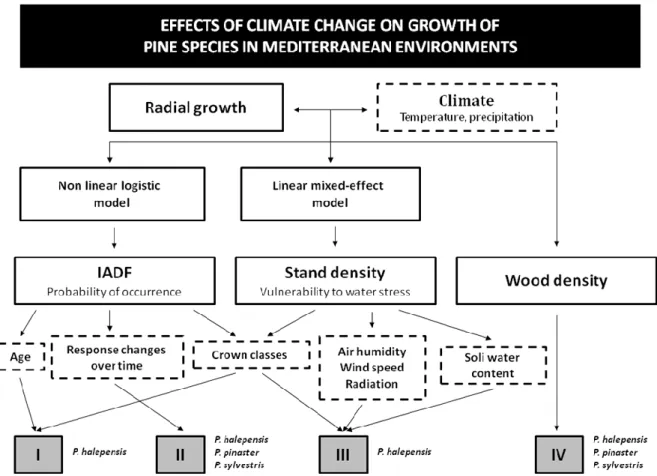
radial growth and wood density patterns for P. halepensis, P. pinaster and P. sylvestris; and established the relationships between tree-ring width and wood density. Fig. A shows the
3
Fig. A: Conceptual model of the thesis. Key factors (solid squares); main measured variables (discontinuous lines squares); studies (Roman numerals), species and links between them are
5
7 ABSTRACT
Understanding growth-climate relationships is a crucial issue to develop forest management
strategies to mitigate climate change impact. During the second half of the 20th century the
Mediterranean area has experienced an increase in the mean annual temperature, a decrease
in the mean annual precipitation, and an increase in the frequency of severe drought
periods. However, in western Mediterranean region winter and spring precipitations have
increased while summer precipitation has decreased. Dendroclimatological techniques were
applied in 28 sampling sites located in Spain to analyse the association between Pinus halepensis (8 sampling sites) P. pinaster (9 sampling sites) and P. sylvestris (11 sampling sites) and climatic variables in Mediterranean environments. The objectives of this thesis
were: a) to identify and compare inter-annual growth-climate relationships along time for P. halepensis, P. pinaster and P. sylvestris in Spain, b) to quantify and compare the presence of intra-annual density fluctuations (IADFs) on the three species and to define the climatic
variables that are associated with its occurrence, c) to identify the main climatic drivers of
intra-annual growth of P. halepensis, d) to analyse crown class differences in the effect of water stress, e) to investigate if the reduction of stand density through thinning decreases its
vulnerability to water stress, f) to establish the relationships between climate and wood
density for P. halepensis, P. pinaster and P. sylvestris. Results showed that precipitation is the main factor influencing tree growth and its fluctuation determines IADFs occurrence on
the three pine species, with P. pinaster being the species that had the highest correlation values. Wet periods during winter previous to the growth season and spring induced higher
growth rates for P. halepensis and P. pinaster, while the growth of P. sylvestris was mostly influenced by summer precipitation. However, the influence of these climatic variables on
the growth of these species changed along the studied period, showing an increase in
climate sensitivity at the end of the 20th century. Intra-annual growth of P. halepensis is mainly controlled by soil water availability during the growing season. However, relative
extractable water in the soil influenced the stem radial increment in a crown
class-dependent way. Both crown classes experienced a significant growth release at the most
intense thinning treatments. The negative effect of precipitation on wood density is
8
sensitivity of pine species during the most recent years, the trends in growth and mean
density did not change in a 5-year interval. The results of these studies demonstrate that the
inclusion of wood density and IADFs detection in chronologies adds new information to
ring-width chronologies improving its quality. Besides, they help understanding the effects
of stand structure on climate sensitivity and the differential effects of altering stand
structure on climate–growth relationships of Mediterranean forest trees, both of which may
9 RESUMEN
Entender las relaciones entre el clima y el crecimiento es un aspecto clave para generar
estrategias de mitigación del impacto del cambio climático. Durante la segunda mitad del
siglo XX, la región mediterránea ha experimentado un aumento de la temperatura media
anual, un descenso de las precipitaciones y un aumento en la frecuencia de los episodios de
sequía. Sin embargo, en la parte oeste de la región mediterránea, las precipitaciones durante
el invierno y la primavera han aumentado y las precipitaciones durante el verano han
disminuido. Se aplicaton técnicas dendrocronológicas en 28 sitios de muestreo situados en
España para analizar larelación entre el crecimiento de Pinus halepensis (8 sitios de muestreo) P. pinaster (9 sitios de muestreo) y P. sylvestris (11 sitios de muestreo) y las variables climáticas en ambientes mediterráneos. Los objetivos de la presente tesis son: a)
identificar y comparar las relaciones entre el crecimiento inter-anual y el clima a lo largo
del tiempo de P. halepensis, P. pinaster y P. sylvestris en España, b) cuantificar y comparar la presencia de fluctuaciones intra-anuales de densidad (IADFs) en las tres especies y
definir las variables climáticas asociadas a su presencia, c) identificar las variables
climáticas que regulan el crecimiento intra-anual de P. halepensis, d) analizar el efecto del estrés hídrico en las diferentes clases de copa, e) investigar si la reducción de la densidad de
la masa por medio de claras disminuye la vulnerabilidad de los árboles al estrés hídrico, f)
establecer las relaciones entre el clima y la densidad de la madera en P. halepensis, P. pinaster y P. sylvestris. Los resultados muestran que las precipitaciones son el factor más determinante en el crecimiento y el la aparición de IADFs en las tres especies, siendo P. pinaster la que muestra las correlaciones más altas. Las precipitaciones durante el invierno previo y la primavera fueron las que afectaron en mayor medida al crecimiento de P. halepensis y P. pinaster, mientras que el crecimiento de P. sylvestris se vio principalmente influido por las precipitaciones en verano. Sin embargo, la influencia de esas variables
climáticas en el crecimiento de las tres especies ha variado a lo largo del tiempo, mostrando
un aumento de la sensibilidad climática a finales del siglo XX. El crecimiento intra-anual
de P. halepensis está fundamentalmente controlado por la disponibilidad de agua en el suelo durante el periodo vegetativo. Sin embargo, el agua relativa extraíble del suelo influyó de
10
copa experimentaron un aumento significativo del crecimiento radial tras los tratamientos
de clara más intensos. El efecto negativo de las precipitaciones en la densidad de la madera
concuerda con su efecto positivo en el crecimiento radial. A pesar del aumento de la
sensibilidad climática de los pinos en los últimos años, las tendencias del crecimiento y la
densidad media de la madera no cambian en un intervalo de 5 años. Estos resultados
demuestran que la inclusión de IADFs en las cronologías añade nueva información
mejorando su calidad y enfatizan el impacto de los tratamientos selvícolas en las relaciones
entre el clima y el crecimiento. Además, ayudan a enteder los efectos de estructura del rodal
en la sensibilidad climática y los efectos de sus cambios en las relaciones clima-crecimiento
en los bosques mediterráneos, los cuales promueven bosques con mayor capacidad de
11
13 ACKNOWLEDGEMENTS
I would like to express my deep gratitude to everyone who stood by my side all these years:
Firstly, I would like to thank my supervisor Felipe Bravo for his valuable and constructive
suggestions during the planning and development of this research work. His willingness to
give his time so generously, the most precious asset at our institute, has been very much
appreciated. My grateful thanks are also extended to Heinrich Spiecker for his support,
guidance and useful critiques of this research work.
To my family for their endless love and support everytime and everywere. To my relatives
for all these great “vermut” on Sundays.
To new and old friends, for being always ready to go for a beer or pick the guitars and
organize a party at a wine cellar, terrace or anywhere.
To all my University colleagues for sharing so many hours in such a good mood. I would
like to thank the following companies for their assistance with the collection of my data:
Antonio Urchaga, Carlos del Peso, Cristina Prieto, Cristóbal Ordoñez, Encarna García,
Irene Ruano, Javier Castaño, Lucía Risio, Luis Fernando Osorio, María Menéndez, Stella
Bogino, Vivien Bonnesoeur and Wilson Lara.
To Celia Redondo for her support getting all necessary information and documentation
everytime I needed.
To the Spanish Research National Projects AGL-2007-65795-C02-01 and
AGL2011-29701-C02-02, the COST-Action FP0703 “Expected Climate Change and Options for European Silviculture” (ECHOES), and the scholarship program of the University of
Valladolid for their financial support for field trips, assistance to courses and congresses
and stays abroad.
To the Spanish Meteorological Agency (AEMET) and InfoRiego for providing the
meteorological data, and María José Fernández Nieto for her assistance in getting them.
14
University of Freiburg (Germany), Stella Bogino from the University of San Luis
(Argentina) and Cyrille Rathgeber from INRA Nancy (France) for their warm welcome and
to everybody who made these stays more pleasant.
To the co-authors of the manuscripts: Stella Bogino, Felipe Bravo, Heinrich Spiecker,
Cyrille Rathgeber, Cristóbal Ordoñez and Vivien Bonnesoeur for their time and their useful
and constructive comments.
To the LERFoB members for welcoming and supporting me at this final stage of the thesis.
Merci a tous!
To the artists Laura, Marimar y Michal for contributing with their drawings to the final
edition of the thesis.
To Sandra for her love and support, her dancing and cooking lessons. And to Benito, my
15 AGRADECIMIENTOS
Quería expresar mi más sincero agradecimiento a todas esas personas que han estado a mi
lado durante estos años:
A mi director Felipe Bravo por su apoyo permanente durante la realización de la tesis, sus
correcciones, sus consejos y, sobre todo, por su tiempo, un bien muy preciado en el
departamento. También me gustaría agradecerle a Heinrich Spiecker, su ayuda y sus
inestimables comentarios realizados a los trabajos que forman parte de esta tesis.
A mi familia por su cariño y apoyo constante en todo momento y en todo lugar. A mis tíos y
primos por esos vermut domingueros.
A los amigos de siempre y a los nuevos, por estar siempre dispuestos para tomar unas cañas
o coger las guitarras y organizar una fiesta en una bodega, terraza o donde sea.
A los compañeros de la Universidad por compartir tantas horas con tan buen ambiente, en
especial a todos aquellos que me ayudaron en los trabajos de campo, toma de muestras e
instalación de dendrómetros: Antonio Urchaga, Carlos del Peso, Cristina Prieto, Cristóbal
Ordoñez, Encarna García, Irene Ruano, Javier Castaño, Lucía Risio, Luis Fernando Osorio,
María Menéndez, Stella Bogino, Vivien Bonnesoeur y Wilson Lara.
A Celia Redondo por su ayuda con la documentación, siempre que la he necesitado.
A las a los Proyectos del Plan Nacional Español de I+D 2007-65795-C02-01 y
AGL-2011-29701-C02-02, a la COST-Action FP0703 “Expected Climate Change and Options
for European Silviculture” (ECHOES) y al programa de becas de la Universidad de
Valladolid por su ayuda financiera tanto en la obtención de muestras como en las estancias
en el extranjero.
A la Agencia Española de Meteorología e InfoRioego por haberme proporcionado los datos
climáticos y a María José Fernández Nieto por ayudarme a conseguirlos.
A los responsables de mis estancias en el extranjero: Heinrich Spiecker de la Universidad
16
y Cyrille Rathgeber del INRA de Nancy (Francia) por su buena acogida y a todos aquellos
que hicieron que las estancias fueran más agradables.
A los coautores de los artículos: Stella Bogino, Felipe Bravo, Heinrich Spiecker, Cyrille
Rathgeber, Cristóbal Ordoñez, Vivien Bonnesoeur por su tiempo y sus útiles comentarios.
A los miembros del LERFoB de Nancy por acogerme y ayudarme durante esta última etapa
de la tesis. Merci a tous!
A los artistas Laura, Marimar y Michal por aportar sus dibujos a la edición final de la tesis.
A Sandra por su amor y su apoyo, sus clases de baile y de cocina. Y a Benito, mi
19 1. INTRODUCTION
1.1. Mediterranean environments and climate change
Mediterranean regions, as transitional climate zones between arid and humid regions of the
world, are especially interesting for the study of the relationships between climate, tree
growth and wood anatomic features. In the Mediterranean region, where rainfall is a major
limiting factor for organisms, precipitation has decreased by about 30% during the last
century (Petit et al., 2005). Annual temperatures over Europe have increased about 0.8 °C
during the 20th century. A larger warming has been observed over the Iberian Peninsula
(Houghton et al., 2001), where the 1980–1995 period was characterized by intense
droughts, which produced severe damage to several woody species (Peñuelas et al., 2001).
Climate models project rising air temperatures and a decrease in annual mean precipitation
over the Mediterranean Basin for the twenty-first century leading to an increase in
evapotranspiration (Parry et al., 2007). Although the predicted warming trends are higher in
northern and central Europe than in southern Europe (Klein Tank and Können, 2003), most
of Europe will have a rather positive water balance, while precipitation in the countries
surrounding the Mediterranean Sea are expected to experience the largest decrease on the
globe, more than 20%. Therefore, the Mediterranean area is considered to be one of the
areas where climatic changes may have the greatest effects (Lavorel et al., 1998). Given the
magnitude of forecasted trends, there are great concerns for the particularly rich
biodiversity found in the region. Studies on the consequences of past climate shifts on
biodiversity represent one of the best sources of data to validate models of the ecological
and evolutionary consequences of future changes (Petit et al., 2005).
Precipitation is the main factor influencing tree growth of pine species in semiarid
Mediterranean conditions (Raventós et al., 2001). In coastal Mediterranean areas, with mild
winters and dry summers, cold season growth dormancy may not occur and, consequently,
cambial activity is likely continuous (de Luis et al., 2007). However, in inland areas with
continental Mediterranean climate, plants endure double climatic stress, caused by low
20
conditions are split into two mild periods with increased rainfall (spring and autumn),
which suggest a bimodal pattern of cambial activity (Camarero et al., 2010).
Trees of different sizes and crown classes compete differently for light, water and other
resources within a stand ( Peet and Christensen, 1987; Orwig and Abrams, 1997). Radial
growth responses to climate vary considerably according to local tree density and crown
class in areas where water is limiting (Linares et al., 2009; Martín-Benito et al., 2008).
Therefore, contrasting growth responses to climate among trees of different crown classes
might be particularly relevant for understanding the dynamics of forests dominated by
species that are highly sensitive to drought stress (Adams and Kolb, 2004).
1.2. Species studied
1.2.1. Aleppo pine (Pinus halepensis Mill.)
Aleppo pine (Pinus halepensis) is one of the most studied Mediterranean species. It plays an important role in the ecology and landscape of the Mediterranean basin. Stands of this
species provide a valuable system to explore how growth measured at different time scales
is constrained by climate (Pasho et al., 2012). It is considered as a species well adapted to
drought by reducing growth as water availability decreases (Rathgeber et al., 2005; de Luis
et al., 2007; Camarero et al., 2010).
It is generally found at low elevations, mostly from sea level to 200 metres, but it can grow
at an altitude of up to 1000 m in southern Spain. This pioneer and undemanding species is
easily regenerated and capable of colonizing very poor and degraded soils. It is an essential
component in reforestation strategy for limy soils in the arid or semi-arid climates of the
Mediterranean basin, due both to its intrinsic ability to colonize and to its effect in
improving soils and microclimates, thus in turn favouring the growth of broadleaved
21
1.2.2. Maritime pine (Pinus pinaster Ait.)
Maritime pine (Pinus pinaster) is a characteristic species in Mediterranean forests, and is mainly located in the Iberian Peninsula (Blanco et al., 1997). This species shows a wide
ecological range (Nicolás and Gandullo, 1967), and it can survive under high or low
temperatures, under regular or variable rainfall as well as under severe droughts. It is
adapted to the extremely cold winters of the continental climate in central Spain and to the
mild, temperate winters of the Atlantic coast in the western Iberian Peninsula (Alía et al.,
1996; Blanco et al., 1997).
In Spain, P. pinaster constitutes pure and mixed woodlands that are both natural (1 million ha) and planted (0.6 million ha) (DGCN, 2002). These woodlands are mainly spread over
the northern Spanish plateau up to 1500 m in elevation. In this area, the climate is
characterized by irregular between- and within-year rainfall, and high temperatures in
summer. The soils are sandy and rocky and very well drained. Even though the maritime
pine had been widely plantated in the Iberian Peninsula, this species grows naturally in
some areas, where it is the best adapted woody species (Blanco et al., 1997). Fossil P. pinaster cones and pollen dating from the Superior Pliocene have been found in the Iberian Peninsula, suggesting a Pre-Mediterranean origin for this species and evolution in
tropical-like environments that gradually incorporated seasonal aridity (Specht, 1981). Some
authors suggest that the Iberian System is the natural origin of and centre of distribution for
this species (Blanco et al., 1997) (Fig. 1b).
1.2.3. Scots pine (Pinus sylvestris L.)
Scots Pine (Pinus sylvestris) plays an important role in Spanish forestry because of its economic, ecological and social relevance. It is the most widely distributed species of pine
in the world (Blanco et al., 1997); along with Norway spruce (Picea abies L.), it possesses the highest dendrochronological potential in Europe (Schweingruber, 1996). It grows in the
cold continental climate of northern Asia as well as in the semiarid climate of southern
22
These dry areas of distribution of this species which usually grows in humid environments
are the first places to investigate the effects of increased aridity (Martı́nez-Vilalta and Piñol,
2002). Besides, in assessing the impact of global warming on ecosystems, any changes in
tree growth are likely to occur first in those tree stands located at the ecological boundary
of the species (Tessier et al., 1997). In Spain, P. sylvestris stands occupy 1.2 million ha, split approximately in 50% pure and 50% mixed stands (DGCN, 2002) (Fig. 1c).
Fig. 1: Natural distribution of Pinus halepensis Mill. (a), Pinus pinaster Ait. (b) and Pinus
sylvestris L. (c) in Spain (adapted from de Miguel
et al., 2012).
1.3. Growth-climate relationships
Kaennel and Schweingruber (1995) definded dendroclimatology as the use of tree rings to
study and reconstruct past and present climate. Dendroclimatology starts with site and tree
selection and continues with dating, measuring, data quality control, and chronology
construction. Tree rings are associated with climate using statistical models that are then
evaluated for their full length to reconstruct climate of the past (Sheppard, 2010).
a b
c
subsp. mesogeensis
subsp. atlantica
23 Different methodological approaches can be used to explore tree growth-climate
relationships, but dendroclimatological studies are valuable tools in detecting long term
changes in radial growth in woody species related to climatic variable response as a result
of warmer conditions and precipitation variability (Andreu et al., 2007).
Dendroclimatology generally assumes that climate–growth relationships are age and size
independent. However, there is evidence that climate response can be unstable across
different species, sites and age/size classes (Tardif et al., 2003; Campelo et al., 2013).
Climate change is resulting in both positive and negative trends in tree growth, the latter
frequently observed in drought-stressed environments (Camarero et al., 2010). The
influence of climatic variables on growth can be modified along time (Andreu et al., 2007)
and previous studies showed a changing association between climatic variables and growth
of Pinus species on the Mediterranean area (Bogino and Bravo, 2008; Vieira et al., 2010; Campelo et al., 2013). Since the mid 20th century, an overall increase of the mean annual
temperature, a decrease of the annual precipitation and a higher frequency of severe
drought periods have been observed in the Mediterranean area (Martrat et al., 2004;
Xoplaki et al., 2006). However, in the western Mediterranean regions, winter and spring
precipitation increased and summer precipitation decreased during that period (Bradley et
al., 1987; Maheras, 1988; Diaz et al., 1989). Although temperature and precipitation have
changed over the last 50 years, it is not clear yet how trees respond to these changes, how
these responses vary along time and which anatomical structures, if any, can be used to
document tree response to climate change (Vieira et al., 2010).
1.4. Intra-annual density fluctuations (IADFs)
Pine species have a typical conifer wood structure, containing resin canals and clearly
distinguishable tree rings with earlywood (EW) and latewood (LW), and a more or less
gradual transition between them (Schweingruber, 1993). Wood anatomical features in tree
rings have been interpreted as indicators of environmental change (Briffa et al., 2004).
However, species growing under Mediterranean climate, with summer droughts and high
inter-annual variability in precipitation and temperature, commonly show deviations from
such normal structure characterized by abrupt changes in ring width, variable frequency of
24
Luis et al., 2007).
IADFs are defined as “a layer of cells within a tree ring identified by different shape, size and wall thickness” (Kaennel and Schweingruber, 1995). IADFs are easily distinguishable
from annual tree ring boundaries by the gradual transition in cell size and wall thickness at
the outer borders of these anatomical structures. IADFs are identified by considering the
position of the density fluctuation within the ring (Campelo et al., 2007). The IADF type E
are characterized by latewood-like cells within earlywood, whereas the IADF type L are
considered when earlywood-like cells are within the latewood (study II, Fig. 3).
The inclusion of IADFs in dendrochronological studies allows detailed analysis of climatic
events within a particular growing season. Different studies of pine species showed a good
correlation between IADF formation and climate in the Mediterranean area. IADFs were
mainly correlated with precipitation in autumn in P. pinaster in Portugal (Vieira et al., 2009) and with precipitation in late winter and spring and higher temperatures in central
Spain (Bogino and Bravo, 2009). IADFs were caused by precipitation events early in
summer following a water deficit early in the growing season in P. pinea in southern Portugal (Campelo et al., 2007).
The consistency of the climatic signal among different pine species and areas suggests that,
in the future, a large-scale network of IADFs could be developed in the Mediterranean
region to study intra-annual climate variability (Campelo et al., 2013). The analysis of the
occurrence of inter-annual density fluctuations and the stabilized IADF frequency in
relation to calendar year allows a more detailed analysis of climatic events within affecting
25 1.5. Effects of thinning on growth dynamics and growth-climate relationships
The changing demands of today require a widened scope of forest management. Society is
asking for sustainable forestry emphasizing biodiversity and naturalistic forest
management. It is of great economic and ecological relevance to know on which sites today’s forests are most susceptible to climatic and other environmental changes and
hazards (Spiecker, 2003).
The response of tree growth to limiting factors can be influenced by silviculture. The effect
of different silvicultural scenarios and stand densities on tree growth response to climate is
likely to be a key factor for forest preservation, particularly on the driest sites
(Gea-Izquierdo et al., 2009). The influence of tree density on their response to climate and
drought is not a straightforward issue, since different approaches (e.g. ecophysiological,
dendroecological, growth modelling) might give different insights (Misson et al., 2003;
Moreno and Cubera, 2008). However, increasing resistance of forests will increase
economic and social benefits of forests and reduce the risks by maintaining sustainable
forestry (Spiecker, 2003).
Thinning experiment sites are the best option to determine adequate thinning alternatives
and density targets. However, stand densities can occur in an almost infinite array of
combinations, and as a result, it is unreasonable to expect that all possible combinations
could be test in field experiment before apply it in operational forestry (Valbuena and
Bravo, 2008). Data on growth dynamics is required to understand growth responses in
relation to climatic variability at short time scales, the delayed growth responses to climate
and the water budget which may not be detected by coarser assessments based on response
functions (Gutiérrez et al., 2011). Dendrometers (Fig. 2) are a valuable tool for these
studies since they provide short-term non-destructive measurements of radial fluctuations in
26
Fig. 2: Stainless-steel band dendrometer (Dendrometer Increment Sensor DB20 EMS Brno).
1.6. Climate impact on wood density
Changes in forest productivity in Europe indicate that forest growth has altered
considerably during the past decades (Spiecker et al., 1996). Future changes in climate
could affect not only tree growth, but also tree-ring structure. Wood density is especially
important as it is correlated with various physical, chemical, and anatomical features of the
wood and thus yields basic information concerning problems of wood technology, forestry
and climatology. Tree-rings are regularly composed of earlywood, in which tracheids have
relatively large diameters and thin cell walls and latewood, with small tracheids having
thick cell walls. Severe conditions during the growing season, such as water stress, may
generate the production of latewood-like cells within earlywood or earlywood-like cells
within latewood varying density patterns (Schweingruber et al., 1978; Fritts, 2001).
Previous dendroclimatic studies have shown that wood density is highly sensitive to
climate variations at the inter-annual time scale ( Parker and Henoch, 1971; Schweingruber
et al., 1978; Conkey, 1979; Briffa et al., 2001; Roderick and Berry, 2001; Bouriaud et al.,
2005) and intra-annual time scale (Sass and Eckstein, 1995; Horacek et al., 1999; Schmitt
et al., 2000; Mäkinen et al., 2003; Bouriaud et al., 2005; Büntgen et al., 2010; van der
27 the Mediterranean, where the cambial activity can vary from year to year presenting
continuous radial growth or one or two growth interruptions in line with the variability of
climatic conditions (de Luis et al., 2007). Previous studies in Spain concluded that the
growth of P. halepensis and P. pinaster was influenced by wet periods during winter previous to the growth season and spring, while the growth of P. sylvestris was mostly influenced by summer precipitation (Bogino and Bravo, 2008; Bogino et al., 2009; Olivar
et al., 2012). However, there were no previous detailed studies on the impact of climate on
wood density in these species.
1.7. Objectives
This thesis has a main objective: to explore the impact of climate on pine trees growing in
Mediterranean conditions. This general objective assess through the following specific
objectives.
1.7.1. Climate impact on growth dynamic and intra-annual density fluctuations in Aleppo pine (Pinus halepensis) trees of different crown classes: Study I
The knowledge of the growth response of P. halepensis to past climate variability can help us to explore how its populations, and the ecosystems they dominate, will behave in the
future. Besides reflecting changes in the environmental conditions during the growing
season, the inclusion of IADFs detection in chronologies adds new information to
ring-width chronologies improving its quality and allows detailed analysis of climatic events
within the growing season. The specific objectives of this study were: i) to identify the
relationships between radial growth and regional climate for different crown classes of P. halepensis, ii) to quantify the presence of intra-annual density fluctuations (IADFs) according to crown class and cambial age and iii) to analyse the relationships between
28
1.7.2. Changes in climate-growth relationships and IADF formation over time in Mediterranean pine species (Pinus halepensis, P. pinaster and P. sylvestris) in Spain: Study II
The analysis of the responses of Mediterranean pine species to climate change and which
anatomical structures can be used to document it will help understand future trends in
climate-growth relationships. The specific objectives of this study were: i) to identify and
compare radial growth-climate relationships along time for P. halepensis, P. pinaster and P. sylvestris in Spain ii) to quantify and compare the presence of intra-annual density fluctuations (IADFs) on the three species and iii) to define the climatic variables that are
associated with the occurrence of IADFs.
1.7.3. Effects of thinning on growth dynamics and growth-climate relationships in Aleppo pine (Pinus halepensis) trees of different crown classes: Study III
Silvicultural practices have an impact on growth-climate relationships. Since a warming
trend and a precipitation decline have been predicted for the forthcoming decades, this may
have a significant importance on future forest dynamics in Iberian pine forests at a regional
scale. The specific objetives of this study were: i) to identify the main climatic driver of
intra-annual growth of P. halepensis in our site, representing semi-arid Mediterranean environments ii) to analyse which crown class is more affected by water stress and iii) to
investigate if the reduction of stand density through thinning decreases its vulnerability to
29
1.7.4. Climate impact on wood density in Pinus halepensis, Pinus pinaster and Pinus sylvestris: Study IV
The study of wood formation and its dependence on climatic conditions is of major interest
because tree physiological processes, wood density and wood properties are interrelated.
The specific objectives of this study were: i) to identify the main climatic drivers of radial
33 2. MATERIALS AND METHODS
2.1. Study sites
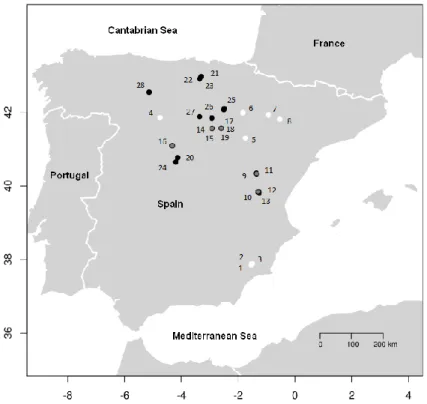
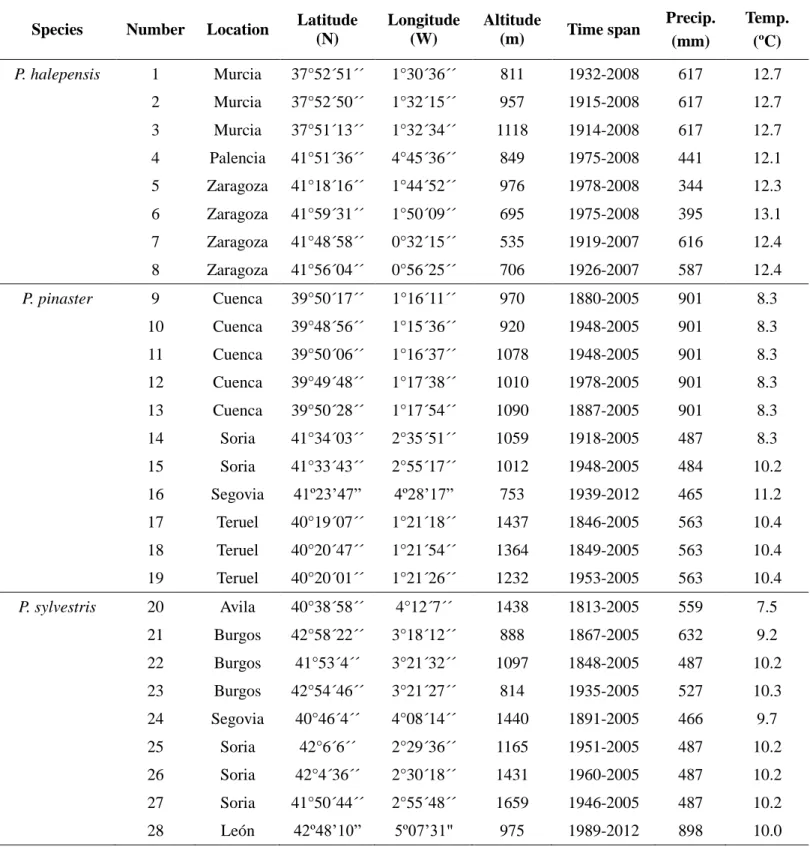
In order to achieve the general and specific objectives of each study, 28 study areas (8 P. halepensis sites, 9 P. pinaster sitesand11 P. sylvestris sites) were selected in Spain (Fig. 3, Table 1).
Fig. 3: Study areas of the three pine species in Spain. White: P. halepensis; grey: P. pinaster; black: P. sylvestris.
In study I, we analysed increment cores from 8 P. halepensis sites (tags 1 to 8 in Fig. 3). Fifteen dominant and fifteen suppressed trees were selected in each site. In study II, we
analysed increment cores from 8 P. halepensis sites (tags 1 to 8 in Fig. 3), 10 P. pinaster sites (tags 9 to 15 and 17 to 19 in Fig. 3)and8 P. sylvestris sites (tags 20 to 23 and 25 to 28 in Fig. 3). Fifteen dominant trees were selected on each site. In study III, a thinning
34
Table 1: Sampling sites description of P. halepensis, P. pinaster and P. sylvestris in Spain. Precp: Annual precipitation; Temp: Mean annual temperature.
Species Number Location Latitude (N)
Longitude (W)
Altitude
(m) Time span
Precip. (mm)
Temp. (ºC)
P. halepensis 1 Murcia 37°52´51´´ 1°30´36´´ 811 1932-2008 617 12.7
2 Murcia 37°52´50´´ 1°32´15´´ 957 1915-2008 617 12.7
3 Murcia 37°51´13´´ 1°32´34´´ 1118 1914-2008 617 12.7
4 Palencia 41°51´36´´ 4°45´36´´ 849 1975-2008 441 12.1
5 Zaragoza 41°18´16´´ 1°44´52´´ 976 1978-2008 344 12.3
6 Zaragoza 41°59´31´´ 1°50´09´´ 695 1975-2008 395 13.1
7 Zaragoza 41°48´58´´ 0°32´15´´ 535 1919-2007 616 12.4
8 Zaragoza 41°56´04´´ 0°56´25´´ 706 1926-2007 587 12.4
P. pinaster 9 Cuenca 39°50´17´´ 1°16´11´´ 970 1880-2005 901 8.3
10 Cuenca 39°48´56´´ 1°15´36´´ 920 1948-2005 901 8.3
11 Cuenca 39°50´06´´ 1°16´37´´ 1078 1948-2005 901 8.3
12 Cuenca 39°49´48´´ 1°17´38´´ 1010 1978-2005 901 8.3
13 Cuenca 39°50´28´´ 1°17´54´´ 1090 1887-2005 901 8.3
14 Soria 41°34´03´´ 2°35´51´´ 1059 1918-2005 487 8.3
15 Soria 41°33´43´´ 2°55´17´´ 1012 1948-2005 484 10.2
16 Segovia 41º23’47” 4º28’17” 753 1939-2012 465 11.2
17 Teruel 40°19´07´´ 1°21´18´´ 1437 1846-2005 563 10.4
18 Teruel 40°20´47´´ 1°21´54´´ 1364 1849-2005 563 10.4
19 Teruel 40°20´01´´ 1°21´26´´ 1232 1953-2005 563 10.4
P. sylvestris 20 Avila 40°38´58´´ 4°12´7´´ 1438 1813-2005 559 7.5
21 Burgos 42°58´22´´ 3°18´12´´ 888 1867-2005 632 9.2
22 Burgos 41°53´4´´ 3°21´32´´ 1097 1848-2005 487 10.2
23 Burgos 42°54´46´´ 3°21´27´´ 814 1935-2005 527 10.3
24 Segovia 40°46´4´´ 4°08´14´´ 1440 1891-2005 466 9.7
25 Soria 42°6´6´´ 2°29´36´´ 1165 1951-2005 487 10.2
26 Soria 42°4´36´´ 2°30´18´´ 1431 1960-2005 487 10.2
27 Soria 41°50´44´´ 2°55´48´´ 1659 1946-2005 487 10.2
28 León 42º48’10” 5º07’31" 975 1989-2012 898 10.0
35 pinaster site (number 16)andone P. sylvestris site (number 24).
Dominant trees were defined as those standing above all other trees in its vicinity and
receiving full light from above, whereas suppressed trees were defined as those growing
below the tree canopy. Two cores were extracted at 1.30 m above ground from each
selected tree.
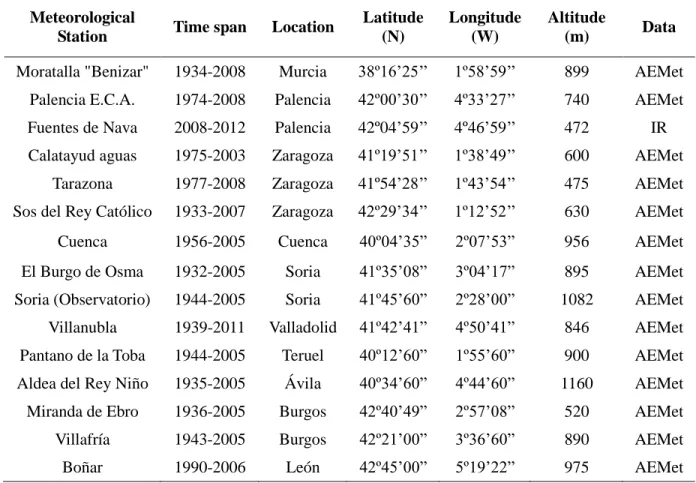
Mean monthly air temperatures and total monthly precipitations recorded at the closest meteorological stations were obtained from the “Agencia Estatal de Meteorología, Spain”,
while daily climatic variables (temperature, precipitation, air humidity, wind speed and
radiation) were obtained from www.inforiego.org (Table 2).
Table 2: Description of the meteorological stations. Data provided by Agencia Estatal de Metereología (AEMet) and InfoRiego(IR).
Meteorological
Station Time span Location
Latitude (N)
Longitude (W)
Altitude
(m) Data
Moratalla "Benizar" 1934-2008 Murcia 38º16’25’’ 1º58’59’’ 899 AEMet Palencia E.C.A. 1974-2008 Palencia 42º00’30’’ 4º33’27’’ 740 AEMet Fuentes de Nava 2008-2012 Palencia 42º04’59’’ 4º46’59’’ 472 IR Calatayud aguas 1975-2003 Zaragoza 41º19’51’’ 1º38’49’’ 600 AEMet
Tarazona 1977-2008 Zaragoza 41º54’28’’ 1º43’54’’ 475 AEMet Sos del Rey Católico 1933-2007 Zaragoza 42º29’34’’ 1º12’52’’ 630 AEMet
Cuenca 1956-2005 Cuenca 40º04’35” 2º07’53” 956 AEMet
El Burgo de Osma 1932-2005 Soria 41º35’08” 3º04’17” 895 AEMet Soria (Observatorio) 1944-2005 Soria 41º45’60” 2º28’00” 1082 AEMet Villanubla 1939-2011 Valladolid 41º42’41” 4º50’41” 846 AEMet Pantano de la Toba 1944-2005 Teruel 40º12’60” 1º55’60” 900 AEMet Aldea del Rey Niño 1935-2005 Ávila 40º34’60” 4º44’60” 1160 AEMet Miranda de Ebro 1936-2005 Burgos 42º40’49” 2º57’08” 520 AEMet
Villafría 1943-2005 Burgos 42º21’00” 3º36’60” 890 AEMet
36
2.2. Dendrochronological analysis (studies I and II)
In studies I and II, 8 P. halepensis sites (15 dominant and 15 suppressed trees per site), 10 P. pinaster sites (15 dominant trees per site)and8 P. sylvestris sites (15 dominant trees per site) were selected (Fig. 3, Table 1) and 2 increment cores were extracted from each
selected tree. A total of 960 increment cores of P. halepensis (420), P. pinaster (300) and P. sylvestris (240) were analysed. The increment cores were air dried, mounted on wooden supports and dated according to standard dendrochronological techniques (Stokes and
Smiley, 1996).
In order to assess the quality of crossdating and measurement accuracy of tree -ring series,
the COFECHA program (Holmes, 1992) was applied. This program calculates the Pearson
correlation indices between the indexed tree-ring series and a master reference chronology
in a series of consecutive, partially overlapped segments of a length specified by the user.
All series with potential dating errors or weakly correlated with the master site chronology
were corrected when possible or discarded. According to standard dendrochronological
methods, tree-ring series exhibiting correlation values with the master chronology below
0.4 were excluded. The proper use of COFECHA adds a high degree of confidence that tree
-ring samples have been crossdated correctly and measured accurately, en- suring that the
environmental signal is maximized (Grissino-Mayer, 2001).
The turbo ARSTAN program (Cook and Holmes, 1984; Holmes, 1992) was used to
eliminate biological trends in tree-ring series and to minimize growth variations that are not
shared by most trees. Standardization removes geometrical and ecological trends while
preserving inter-annual high-frequency variations that are presumably related to climate.
The long-term trend was removed from each time series of ring width measurements by
fitting and calculating an index defined as actual ring-width for each year divided by the
curve-fit value. Once the individual series were standardized, they were averaged in order
to obtain a master chronology at each study site (one for dominant trees and one for
suppressed trees in the case of P. halepensis). The master chronologies were examined separately to analyse differences in radial growth between species, sites and crown classes.
37 - Mean sensitivity (MS): a measure of the mean relative changes between adjacent ring
widths (Fritts, 2001).
- Signal-to-noise ratio (SNR): the proportion of the variability explained by climate or other
casual factors divided by the residual or unexplained variability (Fritts and Swetnam,
1989).
- Expressed population signal (EPS): the degree to which the particular sample chronology
portrays a hypothetically perfect chronology. Values higher than 0.85 imply that the
chronologies are representative of tree growth in the stands (Wigley et al. 1984).
The master chronologies were normalized by subtracting the mean and dividing by the
standard deviation. Values far from zero mean higher reactions. In the case of P. halepensis, the normalized difference index (NDI) was calculated by subtracting the normalized values
of the suppressed trees to the normalized values of the dominant trees. Positive NDI values
mean stronger reactions from dominant trees, while negative NDI values mean stronger
reactions from suppressed trees.
Monthly climatic variables (precipitation sum and mean temperature) measured at the
closest meteorological station (Agencia Estatal de Meteorología, Table 2) were divided in
climatic seasons: winter previous to the growing season (December-February), spring
(March-May), summer (June-August) and autumn (September-November) and regressed
against ring-width indices. In order to calculate Pearson correlation coefficients and
response functions DENDROCLIM 2002 (Biondi and Waikul, 2004) was applied. Moving
correlation function was used to test stationarity and consistency through time with a
20-year interval.
2.3. IADFs occurrence (studies I and II)
The accurately dated cores from studies I and II were visually examined for IADFs using a
stereomicroscope (magnification up to 25x). As opposed to the annual rings, IADFs show
a gradual transition boundary between earlywood and latewood cells (Fritts, 2001). IADFs
were only considered when present in both cores in the same tree ring, and they were
38
type E (latewood-like cells within the earlywood) were considered in our study since
IADFS type L (earlywood-like cells within the latewood) were rarely present in our sample.
As the number of samples changed over time, the relative frequency was calculated with
the following formula [1]:
[1] F = n/N
where F is the proportion of IADF in a particular year; n the number of trees that formed
the IADF and N the total number of trees analysed. The bias in the frequency was assessed
by calculating the stabilized IADF frequency (f), according to the formula of Osborn et al.
(1997) [2]:
[2] f = F0.5
The nonlinear logistic equation form was chosen to model the probability of occurrence of
IADFs [3]:
[3] P = (1.0 + e(-z))-1
where P is the probability of IADFs and Z = b0+b1(x1)+b2(x2)+……+bk(xk) + ε; where x1; x2... xk are the climatic variables and b0; b1; b2 ….. bk are unknown parameters of the model and ε is a normal random error N (0,1); and e is the exponential operator. The logistic equation can be formulated to accept a binary variable such as occurrence of
IADFs, and the parameters can be estimated by maximum-likelihood methods. The
resulting prediction is bounded by 0 and 1. Monthly rainfall and mean monthly temperature
were used as explanatory variables. The hydrological year was defined as a period of 12
months, from October of the previous year to September of the current growth year. A
stepwise selection method was used to find the best model.
The alternative fits were evaluated on the basis of Akaike information criterion (AIC), the –
2*Log Likelihood, the area under the receiver operating characteristic (ROC) curve and the
expected behavior - as indicated by the signs of the estimated parameters. ROC curve is
displayed for the models and the area underneath was calculated as a value of the accuracy
of the model. Value over 0.80 indicates an excellent discrimination (Hosmer et al., 2013).
39 proportion of correctly classified events and the specificity by the proportion of correctly
classified non-events (Hair et al., 1998).
Monthly climatic variables (precipitation sum and mean temperature) measured at the
closest meteorological station (Agencia Estatal de Meteorología, Table 2) were grouped in
climatic seasons: winter previous to the growing season (December-February), spring
(March-May), summer (June-August) and autumn (September-November) and regressed
against stabilized IADF frequency.
2.4. Effects of thinning on growth dynamics and growth-climate relationships (study
III)
Study III is based on a thinning experiment conducted in autumn 2010 in a P. halepensis plantation located in Ampudia (Palencia) (study site number 4; Fig. 3, Table 1) (study III,
Fig. 1, Table 1). The thinning experiment consisted of four 40m x 50m stands of similar
basal area and stand structure were three thinning intensities were tested: 15% reduction of
the total basal area (T15), 30% reduction of the total basal area, (T30) and 45% reduction of
the total basal area, (T45) using an unthinned stand as control (T0) (study III, Fig. 2).
To estimate intra-annual changes in diameter increment, 48 stainless-steel band
dendrometers (Dendrometer Increment Sensor DB20 EMS Brno) were mounted around the
stem at 1.3 m height in 12 randomly chosen trees per treatment (6 dominant and 6
suppressed). Dominant trees were defined as those standing above all other trees in its
vicinity and receiving full light from above, whereas suppressed trees were defined as those
growing below the tree canopy. In most cases, the diameter of dominant trees ranged from
20 to 25 cm and suppressed trees from 10 to 15 cm.
Before the installation of the dendrometers, the dead outermost tissue of the bark was
smoothly and evenly removed with a rasp before attaching the dendrometer. The barks were
removed in order to reduce swelling and shrinkage as a component of the increment
dynamics. Dendrometer readings to the nearest 0.01 mm were done biweekly in the
morning to reduce diurnal bias because daytime transpiration causes stem shrinkage
(Zweifel et al., 2001). Measurements obtained in the first 3 months after installation were
40
Sharitz, 1993).
Daily climatic variables measured at the closest meteorological station (Table 2) were
averaged (or accumulated in the case of precipitation) in 5, 15 and 30 days prior to the
growth measurements in order to determine which climatic variables were the main
constraints for its growth and at which temporal scales they act. These intervals were
chosen to detect delayed growth responses to changes of climate.
In addition to the climatic variables, soil water availability to the trees, which can be
characterized by relative extractable water (REW), was included in the analysis. REW can
be defined as the daily available water standardized by maximum available water. It was
calculated by the daily water balance model Biljou© (https://appgeodb.nancy.inra.fr/biljou/)
(Granier et al., 1999). This model requires daily potential evapotranspiration and rainfall as
input climatic data. Evapotranspiration was calculated with the Penman potential
evapotranspiration equation. Required site and stand parameters are maximum extractable
soil water and leaf area index (LAI). Soil conditions are considered homogeneous at the
four plots (study III, Table 2). LAI controls stand transpiration, forest floor
evapotranspiration and rainfall interception (Granier et al., 1999). LAI values differ
depending on thinning intensities. The comparison between REW and radial increment on
the four plots can be observed in study III, Fig. 3. Water stress is assumed to occur when
REW drops below a threshold of 0.4 under which transpiration is gradually reduced due to
stomatal closure (Granier et al., 1999).
In order to test similarity of growth rates prior to thinning among the four plots, increment
cores were extracted from a total of 15 trees in the four plots. As preliminary trials, we
fitted a linear model using past growth as response variable and a mixed model including a
plot random effect. The relative goodness of fit of the models was assessed using the
Akaike information criterion (AIC). Since AIC value (4399) did not change when the plot
random effect was included, we concluded that the average growth was not different across
the plots.
We fitted a linear mixed-effect model using the lme function with R-Package nlme (Laird
41 Grijk = β0+ β1*Climik + β2 im + β3*Sij + β4*(Climik*Sij) + β5im*Sij +bij + εijk
bij ~ N(0,σ2Tree)
εijk ~ N(0,σ2 |Climik|2δ)
where Gr is the radial growth, Clim are the mean (or accumulated) values of the bioclimatic variables (temperature, precipitation, evapotranspiration and relative extractable water), i is the plot index, j is the tree index, k is the two-week period index, m is the thinning intensity index such that:
m = 1 for the 15% thinning intensity m = 2 for the 30% thinning intensity m = 3 for the 45% thinning intensity
S is an indicator variable for the status of the tree (S = 0 for suppressed trees and S = 1 for dominant trees), bij is a tree random effect and the variance of the residual error terms εijk is
modelled as σ2, multiplied by the power of the absolute value of covariate Clim. The parameter δ is also estimated using a maximum likelihood estimator (see Zuur et al. 2009).
The period used for growth and climate analysis should corresponded only with the main
period of stem growth (Deslauriers et al., 2007). Therefore, the period between 20
November 2011 and 15 April 2012 was excluded from the analysis in our study. Statistical
analyses were performed using R software (R Development Core team, 2011).
Climate sensitivity is defined as the degree of growth response to climate variability.
Because our growth data are intra-annual, the coefficient of variation (hereafter abbreviated
as CV), which shows the extent of variability in relation to the mean, was calculated in
order to assess the climate sensitivity of the radial increment series. CV was calculated for
the radial growth during the 2-week growth periods on each tree and analysed for trees
42
2.5. Climate impact on wood density (study IV)
In study IV, we analysed increment cores from one P. halepensis site (number 4; Fig. 3, Table 1), one P. pinaster site (number 16; Fig. 3, Table 1) and one P. sylvestris site (number 24; Fig. 3, Table 1). 15 dominant trees were selected at each site and 2 increment
cores were extracted at 1.3m from each selected tree. The samples were processed
following standard techniques (Stokes and Smiley, 1996), conditioned to a 12% water
content and resawn in the transverse plane to a thickness of 2 mm. X-Ray negative
photographs of the samples were obtained and the resulting X-ray picture was processed
with CERD software (Mothe et al., 1998). The wood density profiles obtained are for each
ring and are based on 100 measured positions. Density profiles were produced by averaging
the values (XRD, kg/m3) obtained from these segments (Bouriaud et al., 2005; Rathgeber
et al., 2006).
To remove non-climatic age trends from the raw measurements, tree-ring width series were
detrended (standardized) on a modified negative exponential curve using the package dplR
(Bunn, 2008) in R. The standardization removes the geometrical and ecological trends
while preserving inter-annual high-frequency variations that are presumably related to
climate. The long-term trend was removed from each time series of ring width
measurements by fitting and calculating an index defined as actual ring-width for each year
divided by the curve-fit value.
Mean monthly temperatures and monthly precipitations recorded at the closest
meteorological stations (Agencia Estatal de Meteorología, Table 2) were divided in climatic
seasons: winter previous to the growing season (December-February), spring (March-May),
summer (June-August) and autumn (September-November) and correlated with tree-ring
width, earlywood width, latewood width, mean density, maximum density, earlywood
45 3. RESULTS
3.1. Dendrochonological study of P. halepensis trees of different crown classes (study I)
Two master chronologies were calculated for each sampling site, one for dominant trees
and one for suppressed trees. In sites Za1 and Za2 only a master chronology of the
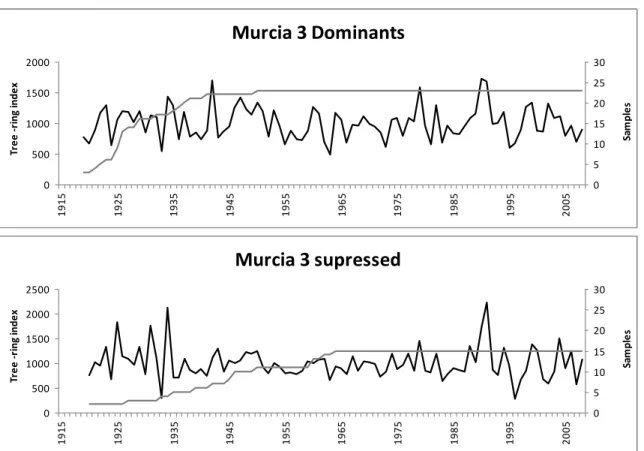
dominant trees was calculated (study I, Fig. 3). The master chronologies from Ampudia
showed higher mean sensitivity (MS) values (0.40 for dominants and 0.37 for suppressed)
than the other locations (study I, Table 2). The master chronology of the dominant trees in
Ampudia also showed higher SNR and EPS (66.08 and 0.98 respectively) than the rest of
the locations. The mean chronology of the suppressed trees showed slightly higher mean
sensitivity values (0.30 for dominants and 0.33 for suppressed) and higher SNR values
(26.64 for dominants and 12.77 for suppressed) than the mean chronology of the dominant
trees. The mean chronology of the dominant trees also showed higher variance and mean
correlation values than the mean chronology of the suppressed trees (study I, Table 3).
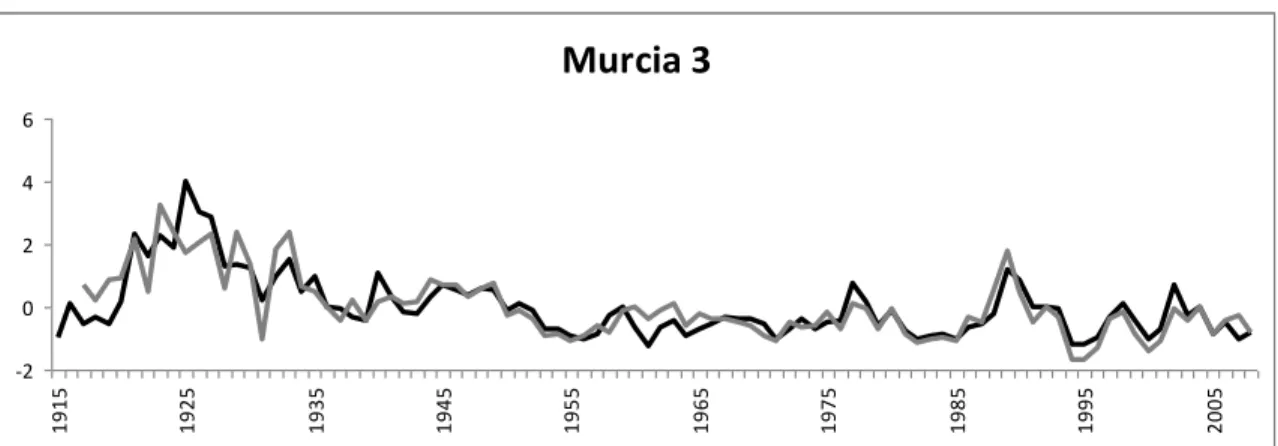
The normalized curves are shown in study I, Fig. 3. It can be observed that dominant trees
have stronger reactions than suppressed trees in favourable years in Ampudia while in
Tarazona suppressed trees react stronger than dominant trees in favourable years, the other
sites show no patterns. The Normalized Difference Index (study I, Fig. 4) showed that,
from 1980 to 2000 suppressed trees reacted stronger in Murcia and Aragón, while since
2000 no clear tendency was found.
3.2. Climate-growth relationships over time in Mediterranean pine species (P. halepensis, P. pinaster and P. sylvestris) in Spain (study II)
Precipitation proved to be the main factor influencing tree growth on the three species.
46
The analysis of the influence of the climatic variables over time also differed between the
three species. They experienced a shift in the influence of different climatic variables on its
growth at the last third of the 20th century. The positive influence of winter, spring and
summer precipitation on P. halepensis growth increased from the 1990s decade (study II, Fig. 3). During that period, spring temperature shifted its influence from negative to
positive, while summer temperature shifted from positive to negative. In the case of P. pinaster (study II, Fig. 3), the highest changes on the influence of the climatic variables on its growth occurred during the 1970s decade, where spring precipitation became its higher
influence followed by summer and winter precipitation. Also during that period, winter
temperature increased its positive influence; while the influence of spring, summer and
autumn temperature became negative. Summer precipitation had the highest correlation
values (0.33) on P.sylvestris (study II, Fig. 4) and remained essentially stable during the study period. Winter and spring temperature also had a positive influence on its growth, while summer temperature shifted its influence from positive to negative around 1980.
3.3. IADF formation over time in Mediterranean pine species (P. halepensis, P. pinaster and P. sylvestris) in Spain (studies I and II)
In study I, a detailed analysis of the IADF formation in P. halepensis was carried out. Samples were grouped according to site location (study I, Table 4) age (study I, Table 5)
and crown class (Table 6, I). The percentage of trees with IADFs was rather similar for
young and old stands. However, the proportion of IADFs and the mean stabilized IADF
was higher for young stands than for old stands. The percentage of trees with IADFs and
the percentage of IADFs were both higher for suppressed than dominant trees. Mean
stabilized IADF was the same for both crown classes.
In study II, P. pinaster and P. sylvestris were included in the analysis in order to have a more global understanding of IADF formation in pine species growing under
Mediterranean climate. The nonlinear logistic equation form was chosen to model the
probability of occurrence of IADFs in the three species with monthly precipitation and