i
UNIVERSIDAD TÉCNICA PARTICULAR DE LOJA
La Universidad Católica de Loja
ÁREA SOCIO-HUMANÍSTICA
TITULACIÓN DE LINCENCIADO EN CIENCIAS DE LA EDUCACIÓN
MENCIÓN INGLÉS
English teacher preference:
The case of Ecuador’s' English
academy
students
TRABAJO DE FIN DE TITULACIÓN
AUTOR: Coronel Golubenko, Yulia Mercedes
DIRECTOR: Dodd, Alexander Robert James, Mg
ii
APROBACIÓN DEL DIRECTOR DEL TRABAJO DE FIN DE TITULACIÓN
Magister.
Alexander Robert James Dood.
DOCENTE DE LA TITULACIÓN
De mi consideración:
El presente trabajo de fin de titulación: English teacher preference: The case of
Ecuador’s' English academy Students realizado por Coronel Golubenko Yulia Mercedes, ha sido orientado y revisado durante su ejecución, por cuanto se aprueba la presentación del
mismo.
Loja, agosto de 2014
iii
DECLARACIÓN DE AUTORÍA Y CESIÓN DE DERECHOS
“Yo, Coronel Golubenko Yulia Mercedes declaro ser autora del presente trabajo de fin
de titulación English teacher preference: The case of Ecuador‟s' English academy students,
de la Titulación de Licenciado en Ciencias de la Educación mención Ingles, siendo
Alexander Robert James Dodd directo del presente trabajo; y eximo expresamente a la
Universidad técnica Particular de Loja y a sus representantes legales de posibles reclamos o
acciones legales. Además certifico que las ideas, conceptos, procedimientos y resultados
vertidos en el presente trabajo investigativo, son de mi exclusiva responsabilidad.
Adicionalmente, declaro conocer y aceptar la disposición del Art. 67 del Estatuto
Orgánico de la Universidad Técnica Particular de Loja que en su parte pertinente
textualmente dice: “Forman parte del patrimonio de la Universidad la propiedad intelectual
de investigaciones, trabajos científicos o técnicos y tesis degrado que se realicen a través, o
con el apoyo financiero, académico o institucional (operativo) de la Universidad”
f………
Autor………..
iv
DEDICATION
This thesis work is dedicated to my parents, Sergio and Olga who have always loved me
unconditionally and supported me to reach this stage of my studies, whose good examples
have taught me to work hard for the things that I aspire to achieve.
I also dedicate this work to my husband, Jorge, who has been a constant source of support
and encouragement during the challenges of university and life. I am truly thankful for
having you in my life.
As well, this research work is also dedicated to my children who have been my greatest
v
ACKNOWLEDGEMENT
First, I want to thank God for blessing me all the time, for providing me this opportunity
and for granting me the capability to proceed successfully.
Also, I want to thank the professors of the Universidad Técnica Particular de Loja who
have always supported me to my personal and professional development.
I would like to express my gratitude and appreciation to my advisor, Mgs. Alexander
Robert James Dodd for his excellent guidance, caring, patience and help.
Finally, I would like to thank my parents, my husband, and my children for always being
vi CONTENTS
Cover
Aprobación del Director del Trabajo de Fin de Titulación
Declaración de Autoría y Cesión de Derechos
Dedication Acknowledgment Contents Abstract Resumen Introduction Method Literature Review Discussion
Description, Analysis and Interpretation of Results
7 ABSTRACT
The present study focuses on measure the students‟ preferences of native or non-native
speaking English in private language teaching institutions in the city of Loja After offering a brief
literature review, that was conducted to obtain a deeper insight in selecting teachers by student
and parents. A survey was applied to 40 participants (aged between 12 and 18) that come from 4
private language institutions and 40 parents to determine the perceptions of the quality of English
teaching depending on the origin of the teacher. In addition, the results contribute to discover
that factors like accent, knowledge about the culture, syntactic knowledge about the language,
methods and techniques used in class influence these perceptions that favor a possible preference
for a native or non-native teacher.
KEY WORDS: native-nonnative teachers, students‟ preferences, parents‟ preference, teacher
8 RESUMEN
El presente estudio se centra en medir la preferencia de los estudiantes hacia los profesores
de inglés nativos o no nativos en las instituciones privadas de enseñanza del idioma en la ciudad
de Loja. Después de ofrecer una breve revisión de la literatura que se llevó acabo para obtener
una visión más profunda en la elección de profesores por parte de los estudiantes y padres. Se
aplicó una encuesta a 40 participantes (edades comprendidas entre 12 y 18 años) que pertenecen a
4 academias particulares de inglés y 40 padres de familia para determinar la percepción de la
calidad de la enseñanza de Inglés en función del origen del profesor. Además, los resultados
contribuyen a descubrir que factores como el acento, el conocimiento sobre la cultura, el
conocimiento sintáctico sobre el lenguaje, métodos y técnicas utilizados en clase influyen en
estas percepciones que favorecen a una posible preferencia por un maestro nativo o no nativo.
PALABRAS CLAVE: profesores nativos-no nativos, preferencia de los estudiantes, preferencia
9
INTRODUCTION
It has been argued thatonly native speakers should teach English because they have the
best pronunciation. According Amin (1997), in Japan, Japanese English teachers often have very
little experience speaking Englishso their pronunciation can sometimes be quite poor. Assistant
language teachers from English speaking countries have easily found work in Japan due to the
boards of education trying to improve the pronunciation of their students via speaking practice
with native speakers in Japanese public schools. However, it is important to mention the variety
in supply of assistant language teachers. For example a teacher from Jamaica could be replaced
after a year by another teacher from Australia. This might cause a few problems due to the fact
that two native English speakers may have very different pronunciation and accent due to
geographical and cultural factors. Consistency is important when teaching a language, so there
must be a level of precaution on the part of the school administrators when attempting to apply
this approach.
On the other hand, in countries such as the Netherlands, non-native English teachers often
have very good English pronunciation and therefore students do not really need a native speaker
in order to achieve acceptable levels of pronunciation. After all, it is argued that good English
pronunciation does not mean using a British or American accent; if a teacher is French, a French
accent is perfectly acceptable as long as the words are being pronounced correctly (Amin, 1997).
Accents, as opposed to pronunciation, are not an indication of poor teaching but more, of where a
person is from. At any rate, audio and video clips demonstrating proper English pronunciation are
readily available and should be used by every ESL or EFL teacher in order to give students a
10
native English speakers or teachers with good pronunciation; it is simply another tool at the
teacher‟s disposal within the classroom.
In relation to the study, it is sometimes found that qualified non-native English speaking
teachers are not considered desirable by administrators when applying for teaching jobs. This
happens because they say they policy states that the institution must have a certain percentage of
native teachers and the positions of non-native teachers are filled. In some cases, students do not
realize how much they can learn from non-native speaking teachers because they simply believe
a native speaker is best. According to Mossu (2008), the myth of the native speaker as the ideal
teacher has been deconstructed due to the lack of substantial evidence behind the concept.
Most non-native speakers are trained teachers either in their country, an English speaking
country or the country they teach in which means that they often will have much more teaching
experience than native speakers (Byram, 1999). It seems irrational to assume that just because
someone speaks English they can teach it. They may be able to speak the language but explaining
it is an entirely different thing. Without training in classroom management and lessons in English
grammar, native speakers cannot be effective as ESL instructors. If a native speaker is a qualified
educator, then they will have an advantage but when teaching abroad, it is also beneficial to be
able to communicate with students in their native language. If a teacher from an English speaking
country comes to teach English in Ecuador and he does not know the basic or does not care in
learning Spanish. It will be very hard for beginner students to communicate effectively and it
might cause confusion between the students. The best option for language learners is perhaps
11
both worlds in that they have access to native speakers as well as knowledge from the local
teachers who have been through the same language learning process as their students. It is
worthwhile to explore the issue from the students‟ perspective in order to ascertain whether
students do show a preference for native English‐speaking teachers over non‐native counterparts.
The main objective of the study is measure the students‟ preferences of native or non
-native speaking English teachers in private language institutions in Loja. Not only measuring
students preference is important, but also measuring their parents perception of the quality of
English teaching depending on the origin of the teacher because at the end parents choose where
their children will go to study. In addition, it is also essential to discover the contributing factor
leading to a possible preference for their native or non-native speaking teacher
12
METHODOLOGY
This quantitative research was conducted in order to gather the students‟ and parents‟ attitudes
towards native and non‐native English‐speaking teachers with a closed questionnaire that was
designed by the author and distributed to 40 secondary school students as well as the students‟
parents in Loja.
Setting and Participants
The research took place in four private language institutions in the city of Loja, Ecuador.
The study was comprised of 40 participants between the ages of 12 and 18. The participants and
sites were chosen by purposeful sampling, meaning that they were intentionally selected in order
to learn or ascertain the perceptions of the students and parents regarding native and non-native
English teachers. A single class was chosen from each institution to participate in the study. This
meant that 10 students were included from Institution A, 10 students from Institution B, 10
students from Institution C and 10 students from Institution D. From each academy, the sample
was made up of 5 boys and 5 girls.
The students were asked to respond to a close-ended questionnaire and then later asked to
take a separate, different survey home to their parents to fill out. The 40 set of parents of the
students that were part of the study are derived from the four private language academies and
they gave back the survey two days after it was gave. All parents responded to the survey and as
such there was a 100% completion rate – as was that of the students.
Instrument
Both questionnaires were written in the participant‟s native language (Spanish) and contained a
total of seven closed-ended questions. All the questions required the students and their parents to
13
they may also indicate a neutral position in their answers. The parents‟ survey included 6 closed
questions in which they were given the three stipulated options and 1 closed-ended,
multiple-choice question. In the students‟ questionnaire they had to give general data like their age and
gender. In addition they had 5 closed-ended questions and 1 multiple-choice question where they
14
LITERATURE REVIEW
From the start it is important to mention that whatever the differences, what becomes
apparent in the literature is that no matter the definition or status of being a native English
speaking teacher (NEST) or non-native English speaking teacher (non-NEST), both groups bring
distinct and beneficial attributes as professionals in the language classroom (Cook, 1999)
A large used definition of a native speaker takes the circumstances of acquisition as the
major standard for defining a native speaker; a native speaker is seen as someone who acquires a
language in early childhood (Piller, 2001; Davies, 2003). Cook (1999) also sees „the language
learnt first‟ as a crucial element in defining what constitutes a native speaker. However, in the
case of balanced bilinguals who acquire two or more languages simultaneously since the earliest
days of language development, the term „native speaker‟ becomes problematic.
According to Davies (1991), “no agreement exists as to what is the proper definition of a
native speaker. The idea that the „native speaker is uniquely and permanently different from a
nonnative speaker‟, arguing that the notion of nativeness in language is a „myth‟.
Native and non-native English speakers
It is frequently believed that native speakers are perfect language teachers. According to
Braine (1999), native speakers are believed to possess a superior command of fluency and
idiomatically correct language forms. They are considered to have more knowledge about the
cultural connotations of the mother tongue and as the arbiters of the acceptability of any instances
of the language.
Kramsch (1997), suggest that „nativeness‟ constitutes a socially constructed identity rather
15
position is determined by „acceptance by the group that created the distinction between native
and nonnative speakers‟. Whether international speakers of English are considered as „native‟ or
„non‐native speaker‟ depends upon various social parameters, such as the preconceived notions of
what native speakers should look like or sound like.
Dominance and difference approaches
In the controversy of non-native English teachers and native English teachers in the ELT
profession, Brutt‐Griffler and Samimy (1999) identify two main approaches for non native
English speaking teachers based on the concept of “nativeness”, the dominance approach and the
difference approach. In particular, the dominance approach is premised on the paradigm of
„deficit linguistics‟ (Medgyes, 1994; Quirk, 1990), whereby NNESTs are viewed as
„linguistically handicapped‟ (Medgyes, 1994) in relation to NESTs. The difference approach to
the NNESTs, emphasizes the strengths of NNESTs. According to such an approach, both
NNESTs and NESTs are similarly capable of being good language teachers, regardless of their
different backgrounds. Indeed, NNESTs should not be considered inferior to NESTs, given that
they possess valuable linguistic and pedagogical resources which are as important as the
resources that NESTs possess. Scholars (see, for example, Braine, 1999) taking such an approach
places particular importance on pluralism and collaboration in the profession. However, what is
common in both approaches are the underlying assumptions and ideology of the opposed
identities of professionals in the field of TESOL (Brutt‐Griffler & Samimy, 1999)
Negative attitudes to differences
Therefore, is unsurprising that attention has tended to focus on differences between native
16
has been a somewhat divisive tone to much of this. It may take the form of over-fulsome praise
(Medgyes, 1992):
"The whole gamut of expressions was used by a group of questionnaire respondents to
describe the language of NS teachers: "natural, authentic, living, perfect, expert, best quality,
most correct, model, proper, fresh, current, best, faultless"." (Nizegorodcew, 1994)
Positive attitudes to differences
A positive approach is suggested by Bennett (1994) and explicitly by Medgyes (1992):
"the ideal NEST and the ideal non-NEST arrive from different directions but eventually stand
quite close to one another. In an ideal school, there should be a good balance of NESTs and
non-NESTs, which complement each other in their strengths and weaknesses."
What these strengths and weaknesses are is considered below. According Medgyes (1992)
“It is important to bear in mind, however, that the ideals referred to are exactly that, ideals, and
that few real teachers match up to these. The qualities such ideals should include are actually very
similar for both NESTs and non-NESTS: the „ideal teacher‟ who is to be found at the top of our
imaginary pyramid is qualified, experienced, bilingual (at least to some extent) and bicultural
(again at least to some extent). Their antitheses at the bottom of the slope, on the other hand, are
not so similar. On one side we have the „poor NEST‟, unqualified, inexperienced, unversed in the
local L1, and unfamiliar with the local culture, while on the other the „poor non-NEST‟, likewise
unqualified and inexperienced, is also likely to lack cultural awareness associated with the
language being studied and may well have a poor grasp of this language, the so-called „one
-page-ahead-of-the-class‟ syndrome. The lower down the pyramid they are, the greater the need for
17
Familiarity with learning
Medgyes (1994), points out the following advantages enjoyed by non-NESTs, who, as learners
themselves can serve as imitable models of the successful learner of English language, can teach
learning strategies more effectively, can provide learners with more information about the
English language, are more able to anticipate language difficulties, can be more empathetic to the
needs and problems of their learners, and can benefit from sharing the learners' mother tongue.
The use of the mother tongue can be of value not only for the effective explanation of
abstract notions but also class management, especially with elementary students for whom
instructions may be a hurdle (Spratt, 1985), for anticipating and explaining interference, and in
the realm of translation.
Although translation became something of a dirty word at the height of the
"communicative revolution", it has started to reappear in published textbooks (Soars and Soars,
1986) and be accepted again (Atkinson, 1993) as a powerful teaching/learning tool in a classroom
if used sensibly. The fact that translation may represent one of students' needs is one that has
often been overlooked.
There is considerable evidence which demonstrates that it is advantageous to be intimate
with learners' cultural background and expectations. Nizegorodcew (1994), states that “In
Slovakia, for example, it may take considerable time and explanation on the part of teachers to
persuade learners accustomed to more traditional, teacher-centered ways to accept pair work,
group work or role play activities. At first they resent them, sometimes they comment that NESTs
18
They expect to be taught grammar. They are not happy about ideas such as self-correction
or self-assessment. It is doubtful they would appreciate the views of writers such as Krashen
(1982) on error treatment. They know little about learner autonomy. Preconceptions such as these
are perilous for the teacher to ignore; the non-NEST is much less likely to do so.
Bennett (1994) also argues that learners often struggle with expressing untranslatable
elements of the mother culture which are important for them. While non-NESTs recognize these
and focus on them, NESTs are more likely to dismiss them as "not English" and therefore not
worth attention.
Knowledge of Institutions
Spratt (1985), argues that an important area where non-NESTs have the upper hand is in
their knowledge of institutional culture and goals. They are familiar with the administrative
framework. They know what to expect from and how to deal with management, colleagues, and
students. Sprat says “they understand (though they do not necessarily approve of) the system of
examinations, which may be radically different from the prevailing system in NESTs' countries
of origin. This awareness of norms not only enables them to analyze students' needs better but
also insulates them from the kind of institutional culture shock, brought on by having to cope
with a whole spectrum of issues, ranging from very different management practices to attitudes to
cheating in examinations. This may well handicap NESTs‟ effectiveness.”
This ignorance of local institutions may stimulate healthy and logical questions on the
part of NESTs which their local counterparts may not dare to ask, the so-called "battering-ram"
19
ignorance placed a heavy burden on already-busy colleagues who have to spend a lot of time and
energy "babysitting" NESTs and helping them with a wide range of practicalities (Tang, 1997).
While this is less of a problem the longer NEST remains, most of them do not stay long enough
for this to desist to cause difficulties. “The situation in many former Soviet bloc countries is
further exacerbated both by the lack of circulation of information that characterizes societies still
emerging from totalitarianism and by constant shifting of the goalposts occasioned by the
frenzied pace of change.” (Nizegorodcew, 1994)
Cultural background
Clearly, NESTs are steeped in cultural background knowledge and have an advantage
over non-NESTs in this regard. On the other hand, the knowledge can be limited to one culture or
one English-speaking country only, while curriculum demands information on several major
English-speaking countries. Even though, the presence of the native speaker broadens the
horizons not only of local students but also colleagues. It can have a particularly important role in
destroying clichéd images which still survive, such as a Britain inhabited by gentlemen in
pinstriped suits with umbrellas rather than the rather more pluralistic multiracial reality.
However, it is hard to predict which student will or will not come into direct contact and
with the world developing the probability of some contact grows. It is almost inevitable, for
example, that the student will encounter the problem in a film where some features specific to
one culture will stand out. Non-NESTs, if confronted with questions that they cannot answer,
may well feel embarrassed. The situation may be made worse as in Central Europe non-NESTs
20
their students, who now have far more chances than they ever did to spend holidays or periods of
study abroad. (Brutt‐Griffler and Samimy, 1999)
With the opening up of borders the issue of cross-cultural learning is bound to grow in
significance. In a world where change is, increasingly, the only constant, it will no longer be
sufficient to pass on bodies of facts; instead, a contrastive approach is likely to emerge as the
norm. The implications for the need for NESTs and non-NESTs to work together are clear.
Teaching attitudes
Both in their general attitude to teaching and at the chalkface there are several areas (for
example management of classrooms and of learning, attitudes to accuracy, fluency, and errors,
and use of resources) where NESTs and non-NESTs tend to differ in emphasis. A comprehensive
list of these, based on research conducted in a number of countries, can be found in Medgyes
(1994). These differences should be seen not as negative and contradictory but as positive and
complementary. They do not merely cater to learner preconceptions but also challenge them (and
vice versa) and also make it more likely that individual learning styles will be accommodated
(Watson & Pojanapunya, 2009)
Students’ and parent perceptions towards Native and non-native English speakers
As was the case with the students in Mahboob's (2001) study, both groups saw NEST and
NNEST as possessing different strengths. NESTs strengths included: high proficiency in English,
ability to use English functionally and awareness of the cultures of English-speaking countries.
NNEST's perceived strengths included: ability to empathize with students as fellow second
21
According Yau (2012), parents‟ perceptions of local English teachers and native English
teachers, through which it reveals the unequal linguistic relationship between local variety of
English and native-like English. It is found that parents have diverse views over the two groups‟
teaching methods, classroom management and provision of learner support. Yet, what stands out
is parents‟ perception of what should be the most accurate and desirable linguistic model for
22
DATA ANALYSIS
Quantitative data was collected and analysed to identify ESL students´ and parents‟ preferences
and perceptions towards Native English Speaking Teachers and Non Native English Speaking
Teachers in private English institutions in Ecuador.
Results and Discussion
Parents Survey
Do you consider English to be an important language for your child´s school development?
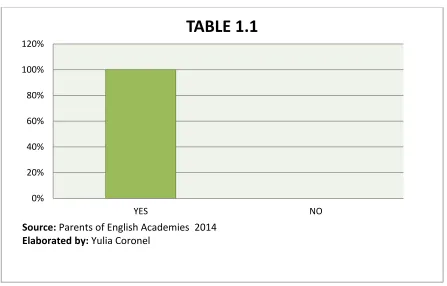
The parents were asked whether they consider the English language to be important for their
child´s school development. The entire population of participants that took part of the survey said
they do consider that English language is important. These results are perhaps not so surprising
when you consider that each parent is paying for extra private English classes, therefore you 0%
20% 40% 60% 80% 100% 120%
YES NO
TABLE 1.1
Source: Parents of English Academies 2014
[image:22.612.97.544.321.607.2]23
would expect them to understand the importance of language acquisition. Especially nowadays
the parents are aware the importance that English language has around the world. The question
was included at the beginning of the questionnaire in order to “warm up” the participants for the
later, more pertinent questions.
Do you feel satisfied with the quality of education provided by the institution and the teachers
working in the institution?
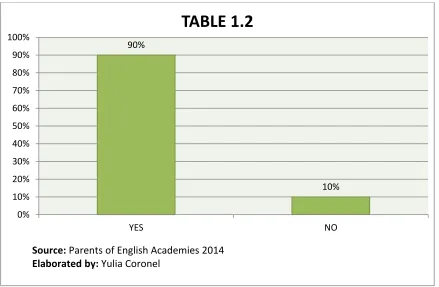
Parents were then asked if they feel satisfied with the quality of education offered as well as the
teachers working at their child´s institution. The results show that 90% of parents said they do
feel satisfied, with merely 10% responding to not being satisfied with the quality of education
and the teachers at their child´s institution. These results demonstrate that the parents generally 90%
10%
0% 10% 20% 30% 40% 50% 60% 70% 80% 90% 100%
YES NO
TABLE 1.2
Source: Parents of English Academies 2014
[image:23.612.102.541.306.593.2]24
approve of the education being received by their children, as well as the teachers working in the
institution for which they are paying. The reason why the 10% was not satisfied with the
education and the teacher was because of the absence of the head teacher during the course and
the repeated times that different replacement went to class. This is interesting as education is
often seen as a sticky topic in Ecuador where parents complain about lack of quality education on
offer in both private and public institutions. Could perhaps the prevalence of foreign teachers in
these institutions be the reason for such results?
Do you prefer an English academy where the teachers are native speakers for the language
learning development of your child?
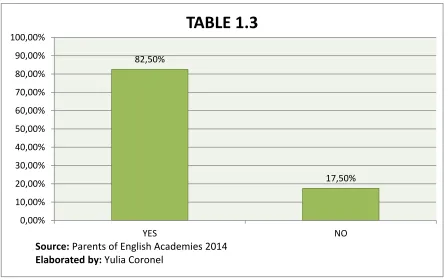
The parents were asked to provide their preference for an academy based on the native origin of
the teachers working there. The majority of parents (82.5%) said they do prefer an English
academy with native English speaking teachers and the rest of the participants (17.5%) said they 82,50%
17,50%
[image:24.612.97.545.350.630.2]0,00% 10,00% 20,00% 30,00% 40,00% 50,00% 60,00% 70,00% 80,00% 90,00% 100,00%
YES NO
TABLE 1.3
Source: Parents of English Academies 2014
25
do not prefer or choose an English academy based on whether the teachers are native speaking or
not. This demonstrates that these parents do not fall for the advertising that the institution makes
but they choose the institution based on references about them. These results show that the
majority of parents prefer their children receiving language classes from native speakers which
could affect their decision when choosing which English academy to send their children to.
Factors like accent, fluency and cultural knowledge influence in the parents‟ decision (Fiske&
Taylor, 1991).
What kind of teacher do you prefer to teach English Language?
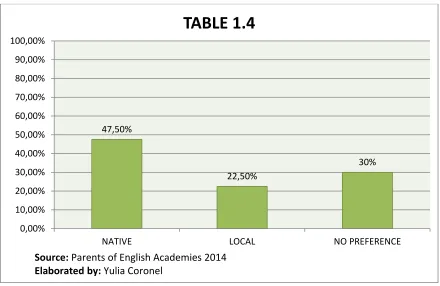
Parents were requested to stipulate what kind of teacher they prefer for their children in the
teaching of the English language. They had three options: native, local or no preference. Just
under half (47.5%) of the respondents claimed to prefer a native speaking English teacher for
their child. The second option (local teacher) had 22.5% of the respondents in favour and the 47,50%
22,50%
30%
[image:25.612.100.540.322.608.2]0,00% 10,00% 20,00% 30,00% 40,00% 50,00% 60,00% 70,00% 80,00% 90,00% 100,00%
NATIVE LOCAL NO PREFERENCE
TABLE 1.4
Source: Parents of English Academies 2014
26
remaining 30% of participants claimed to have no preference. These results are interesting due to
the fact that in the previous question parents claimed to prefer an institution with native English
speaking teachers and here the results showed that whilst the largest option (47.5%) prefer a
native person as a teacher, a majority either have no preference or non-native (52.5%). The
parents based their opinions about the teachers due to what their children say about the teacher‟s
method, behaviour, if the native teacher is easy to understand or if the non-native are too strict,
etc. This could be down to the vague wording of the question which could be interpreted in a
variety of ways.
Do you think if your child is studying the English language with a native teacher, his/her fluency
and pronunciation improve?
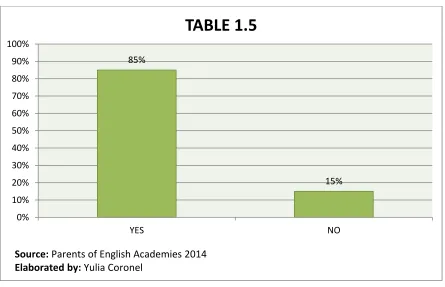
The parents were requested to answer whether access to a native speaking teacher will help their
children improve their fluency and pronunciation. The results show that 85% of parents said that 85%
15%
0% 10% 20% 30% 40% 50% 60% 70% 80% 90% 100%
YES NO
TABLE 1.5
Source: Parents of English Academies 2014
[image:26.612.98.543.375.662.2]27
a native teacher will improve these skills in their children. The rest of the parents (15%) said they
do not think that studying with a native teacher will improve these skills. These results match
with the answers parents gave about preferring a native or non-native teacher. The development
and improvement of fluency and pronunciation are the most important factors that parents
consider when learning English with a native teacher. However, parents are missing that local
teachers are capable to and some non-native teachers have a good fluency and pronunciation.
Do you think native speaking teachers are better at teaching grammar than non-native speaking
teachers?
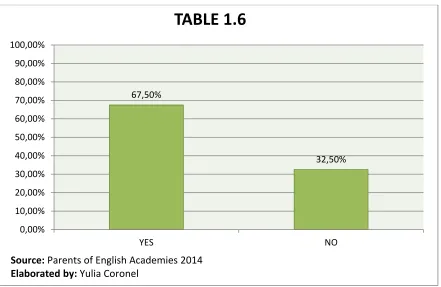
Parents were asked to respond if they think native speaking teachers teach grammar better than a
non-native speaking teacher. Some parents (67.5%) mentioned that they do think that native
teachers teach grammar better than a non-native teacher. The rest of parents (32.5%) said they do
not think that a native teacher teaches grammar better than a non-native teacher. These results 67,50%
32,50%
[image:27.612.101.542.321.608.2]0,00% 10,00% 20,00% 30,00% 40,00% 50,00% 60,00% 70,00% 80,00% 90,00% 100,00%
YES NO
TABLE 1.6
Source: Parents of English Academies 2014
28
possibly show a discrepancy between the teaching of grammar and pronunciation/ fluency. Given
that there is a higher percentage of parents believing that non-native speaking teachers are better
than native speakers in teaching grammar as opposed to the results we saw when asked a similar
question about pronunciation teaching. As it was said before, the students are the ones that pass
the information to their parents because they have experience learning English with both native
and non-native. That is why they can tell who is better in teaching each skill.
Do you consider that studying with a native English teacher increases the motivation of the
student?
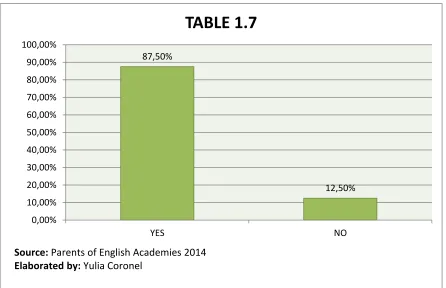
Motivation is one of the most important factors in education (Berry, 1990). As such, parents were
asked to decide whether they consider that studying with a native teacher is more motivating for a 87,50%
12,50%
[image:28.612.98.544.360.648.2]0,00% 10,00% 20,00% 30,00% 40,00% 50,00% 60,00% 70,00% 80,00% 90,00% 100,00%
YES NO
TABLE 1.7
Source: Parents of English Academies 2014
29
student. It can be seen that 87.5% of the respondents consider that a native teacher is able to
motivate the student better. On the other hand a minority (12.5%) of parents consider that native
teachers do not motivate the student more to study the English language. These results
demonstrate parents‟ perception towards the motivation factor and how the origin of the teacher
affects it. According to the results fluency, pronunciation and the importance of the English
language are the most important characteristics of a native speaking teacher that parents take into
30
Students Survey
General Data
Age
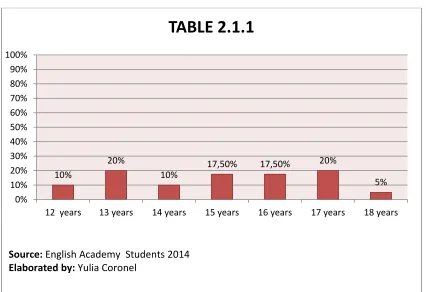
The survey was applied to 40 students from 12 to 18 years of age. This age was chosen because
teenagers are the ones that can notice the difference in accent, pronunciation and fluency.
Furthermore, teenage students are more aware in their decisions and can choose a native or
non-native teacher. There were 4 students aged 12, 8 students aged 13, 4 students aged 14, 7 students
aged 15, 7 students aged 16, 8 students aged 17 and 2 students aged 18. The percentages are
shown in table 2.1.1 10%
20%
10%
17,50% 17,50% 20%
5%
0% 10% 20% 30% 40% 50% 60% 70% 80% 90% 100%
[image:30.612.117.543.190.482.2]12 years 13 years 14 years 15 years 16 years 17 years 18 years
TABLE 2.1.1
Source: English Academy Students 2014
31 Gender:
The sample was comprised of 40 students (100%) who took part in this survey; 50% were male
and 50% female. The reason why both genders equally formed part of the survey is that both of
them have different points of view and different perceptions about teachers.
50% 50%
0% 10% 20% 30% 40% 50% 60% 70% 80% 90% 100%
[image:31.612.119.540.120.408.2]MALE FEMALE
TABLE 2.1.2
Source: English Academy Students 2014
32
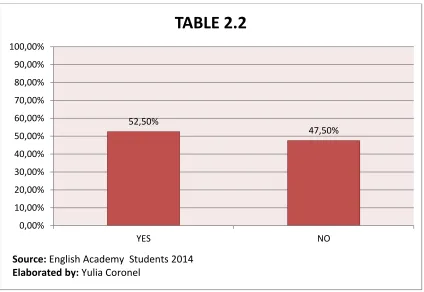
Does your current English teacher come from a native English speaking country?
Students were asked to confirm if their current teacher is from a native English speaking country.
More than half of students (52.5%) said that their current teacher is native and the rest of students
(47.5%) stated that their actual teacher is not from a native English speaking country. This comes
from the preference that parents have when they choose where their children are going to study
the English language falling or no for advertising that English academies do to promote their
methods and teachers.
52,50%
47,50%
[image:32.612.109.533.119.411.2]0,00% 10,00% 20,00% 30,00% 40,00% 50,00% 60,00% 70,00% 80,00% 90,00% 100,00%
YES NO
TABLE 2.2
Source: English Academy Students 2014
33
Referring to your previous experience with English language teachers: Do you feel as though
native or non- native teachers empathize better with you?
The students were requested to refer to their previous experience with English language teachers
to answer if native teachers empathize better with them than a non-native teacher. Most of the
students (52.5%) mentioned that native teachers empathize better with them than a non-native
teacher. Other students (47.5%) said that native teachers do not empathize better with them than
non-native teachers. These students have experience working with native and non-native and
these results show that native teachers empathize as well as non-native teachers do with the
students. There is not a pronounced preference. 52,50%
47,50%
[image:33.612.110.530.148.444.2]0,00% 10,00% 20,00% 30,00% 40,00% 50,00% 60,00% 70,00% 80,00% 90,00% 100,00%
NATIVE NON NATIVE
TABLE 2.3
Series1
Source: English Academy Students 2014
34
Which are the aspects you think are important in an English teacher? (Gender, methodology,
native, accent or knowledge of American or Australian culture)
Students were asked to choose as many aspects they think are important in an English teacher.
Gender was the aspect that appeared as the most important with 26%. Being a native teacher was
also a very popular aspect with 24%. The knowledge about American or Australian culture was
also an important aspect with 19%. The least important aspects in a language teacher for the
students were their teaching methodology (16%) and accent (15%). The methodology aspect was
not very important although it should be because this is what makes a good teacher. In addition,
aspects like gender and being a native or no, do not influence in being a good or bad teacher. 26%
16%
24%
15% 19%
0% 10% 20% 30% 40% 50% 60% 70% 80% 90% 100%
GENRE METHODOOGY NATIVE ACCENT CULTURAL KNOWLEDEGE
TABLE 2.4
Source: English Academy Students 2014
[image:34.612.107.533.147.445.2]35 What type of teacher facilitates learning grammar?
Students were requested to choose what kind of teacher if native or a non-native facilitates the
process of learning grammar. The statistics show that 55% of students chose a native teacher and
45% preferred a non-native teacher. These results demonstrate almost an equal preference for
native or non-native teachers to learn grammar. Although, this is one of the most difficult skill to
develop even if the students have native or non-native. There is a marked preference for native
teachers, in the case of learning grammar students show a small preference for non-native
teacher. It is very difficult to draw conclusions from results of this nature. 55%
45%
0% 10% 20% 30% 40% 50% 60% 70% 80% 90% 100%
NATIVE NON-NATIVE
TABLE 2.5
Source: English Academy Students 2014
[image:35.612.110.530.117.412.2]36
What kind of teacher most facilitates learning pronunciation and fluency?
The students were asked to select what type of teacher they think most facilitates the learning of
pronunciation and fluency. The results show that 87.5% of students chose native teachers and the
rest of the students (12.5%) selected non-native teachers. Fluency and pronunciation are the most
important skills that students perceive in a native teacher and they think a native teacher will
facilitate learning and developing them. Because of the previous experience that students have
with native teachers in their schools or academies, they feel more comfortable with a
non-native teacher when it comes to this specific skill. 87,50%
12,50%
[image:36.612.113.531.118.405.2]0,00% 10,00% 20,00% 30,00% 40,00% 50,00% 60,00% 70,00% 80,00% 90,00% 100,00%
NATIVE NON-NATIVE
TABLE 2.6
Source: English Academy Students 2014
37
What teacher do you prefer to have when studying English?
The last question was focused on finding out the students‟ preference towards the teacher they
prefer to study English. The results sustain that 70% of students prefer a native English speaking
teacher whilst 30% of them claimed to prefer a non-native teacher. With these results we can
infer that the preference of a native teacher comes from factors such as pronunciation, fluency,
accent and the main factor that they have is teaching grammar. This is one of the most difficult
skills to develop in English language. This big difference between preferring a native or
non-native teacher also comes from the different opinions and comments that between friends and
family say about these types of teachers. 70%
30%
0% 10% 20% 30% 40% 50% 60% 70% 80%
NATIVE NON-NATIVE
TABLE 2.7
Source: English Academy Students 2014
[image:37.612.107.535.118.411.2]38
CONCLUSIONS
This research demonstrates how parents choose a particular English institution for their
children based on what type of teachers they have. This means, parents prefer an
institution with native teachers. It is not so much the case that a native teacher will be
teaching their children but that in between all the non-native teachers that work in the
institution, there must be at least one native teacher there.
This research shows what characteristics parents see in a native teacher so they will prefer
them. The main aspect is fluency and pronunciation. Parents see these as a big plus for the
teachers because a native teacher will help to develop those skills better than a non-native
teacher. This is not the case with grammar where according to the results; we can see that
non-native teachers are capable to teach it as native teachers or even better. This happens
because of the facility of explaining grammar in the mother tongue.
The collected data in this research implies that students see some specific characteristics
in the teachers. The sex and the origin of the teacher are the most important qualities in
the teacher. If it‟s a native male teacher maybe the students will see the classes more
dynamic than if it‟s a non-native female teacher. This comes from the idea that native
teacher want to learn more about the new country and culture they are living in so they try
to get along with the students to exchange cultural knowledge.
The results in this study demonstrate that students do not take into account the
methodology the teacher has when teaching English. This could mean that students do not
know what is methodology or either is an aspect that is not important when learning
39
Finally, this research exposes that students prefer a native teacher rather than a non-native
to learn English. The students‟ preference towards a native teacher comes from the
assumption that a native teacher is a better teacher of pronunciation and fluency. In
addition factors as gender, accent and general knowledge about American or Australian
40
RECOMMENDATIONS
Before choosing an English academy parents should look up for information about the
teachers that work there and not just fall for the advertising of native or non-native
teachers.
Parents do not have to believe that pronunciation and fluency can be developed only with
a native teacher. A non-native teacher is just as capable to do it. Nowadays thanks to
technology there is access to so many resources where non-native teachers can learn and
improve their pronunciation and fluency. Some of them have lived in English speaking
countries, so their pronunciation and fluency could be as good as a native teacher. The
accent is not the most important factor as long as the words are being pronounced
correctly.
English institutions that hire native teachers should give them a general explanation about
the new culture that they are going to start living in. In addition, the administrators should
describe how students interact and behave in class. With this information native teachers
will have limits with the students and interact with them in a more professional way.
Teachers and administrators have to evaluate the students to conclude how the students
learn in a better way. Also, with this information the institution will recommend the
adequate methodology that teachers have to apply.
Students must be aware that some non-native teachers have lived in English speaking
41 REFERENCES
Amin, N. (1997). Race and the identity of the nonnative ESL teacher. TESOL Quarterly 31,
580-583.
Braine, G. (1999). Non‐native educators in English language teaching. Mahwah, NJ:
Erlbaum
Brutt-Griffler, J. and Samimy, K. K. (1999). Revisiting the colonial in the postcolonial:
Critical praxis for nonnative English-speaking teachers in a TESOL program. TESOL Quarterly 33, 413-432.
Byram, M. & Risager, K. Language teachers, politics and cultures. Clevedon: Multilingual
Matters Ltd, 1999.
Chalupova, E. and I. Vilemova. (1994). Making the Most of Native and Non-native Speaker Co-operation. Paper given at 1st MSSUA Conference, Karvina, Czech Republic.
Cook, V. (1999) Going beyond the native speaker in language teaching. Tesol Quarterly,
33(2): 185-209. Retrieved 2 Dcember 2013 from
http://homepage.ntlworld.com/vivian.c/Writings/Papers/NS.htm
Davies, A. (1991). The Native Speaker in Applied Linguistics. Edinburgh: Edinburgh
University Press.
Fiske, S. T. & Taylor, S. E. (1991). Social cognition (2nd ed.). Singapore: Mc Graw Hill.
Kershaw, G. (1994). Review of The Native Speaker in Applied Linguistics by A.Davies in
42
Krashen, S. (1982). Principles and Practice in Second Language Acquisition. Oxford:
Pergamon Press.
Krizkova, A. (1992). Should Native Speaker Teachers Help Czech Teachers or Vice Versa?.
Paper given at 2nd ATECR Conference, Hradec Kralove, Czech Republic.
Mahboob, A., Uhrig, K., Newman, K. L., & Hartford, B. S. (2001). Children of a lesser
English: Status of nonnative English speakers as college-level English as a second language
teachers in the United States. In L. D. Kamhi-Stein (Ed.), Learning and teaching from experience: Perspectives on non-native English speaking professionals (pp. 100-120). Ann
Arbor: University of Michigan Press.
Maum, R. (2003). A comparison of native and nonnative English-speaking teachers‟ beliefs
about teaching English as a second language to adult English language learners. Ph.D.
dissertation,University of Louisville.
Medgyes, P. (1994). The non‐native teacher. Hong Kong: Macmillan
Medgyes, P. (2001) When the teacher is a non-native speaker. Teaching pronunciation,
429-442. Retrieved 3 December 2013 from
http://teachingpronunciation.pbworks.com/f/When+the+teacher+is+a+non-native+speaker.PDF
Mossu, L., & Lludra, E. (2008) Non-Native English-speaking English language teachers:
History and research. State-of-the-Art Article. Language Teaching . 41(3):315-348. Retrieved
2 December 2013 from
43
Reves, T., and Medgyes, P. (1994). The non-native English speaking ESL-EFL teacher‟s self
-image: An international survey. Sytstem (22), 353-367.
Spratt, R. (1985). Error perceptions of native-speaking and non-native-speaking teachers of
ESL. ELT Journal 40.4, 306–312.
Tang, C. (1997). On the power and status of non-native ESL teachers. TESOL Quarterly 31,
577–580.
Thomas, J. (1999). Voices from the periphery: Non-native teachers and issues of credibility.
In G. Braine (ed.) Non-native educators in English language teaching (pp. 5-13). Mahwah,
NJ: Lawrence Erlbaum.
Watson, T. R. , & Pojanapunya, P. (2009). Implicit attitudes towards native and non-native
speaker teachers. System, 37(1), 23-33.
44 ANNEXES
AREA SOCIO-HUMANISTICA
TITULACION EN CIENCIAS DE LA EDUCACION MECION INGLES
ENCUESTA
Objetivo: El objetivo de esta encuesta es investigar las percepciones de los estudiantes del idioma Inglés hacia los
profesores nativos o no nativos de la localidad.
Señor/Señorita estudiante, sírvase leer detenidamente las preguntas y contestar las respuestas que UD. crea
correcta con una (x) si en caso tiene duda preguntar al investigador.
1. DATOS GENERALES
1.1 Edad: ………
1.2 Género: Masculino ( ) Femenino ( )
2. ¿Su actual profesor de inglés es nativo de un país de habla inglesa?
Si ( ) No ( )
3. Haciendo referencia a su previa experiencia con profesores del idioma inglés: ¿Los profesores nativos
empatizan mejor con usted que un profesor no nativo?
Si ( ) No ( )
4. ¿Cuáles son los aspectos que usted considera son importantes en un profesor de inglés?
género ( ) metodología ( ) nativo ( ) acento ( ) conocimiento de la cultura americana o
australiana ( )
5. ¿Qué profesor tiende a facilitar el aprendizaje de gramática?
Nativos ( ) No Nativos ( )
6. ¿Cuál profesor facilita el aprendizaje de pronunciación y fluidez?
Nativos ( ) No Nativos ( )
7. ¿Qué profesor prefiere para el aprendizaje del idioma inglés?
45
AREA SOCIO-HUMANISTICA
TITULACION EN CIENCIAS DE LA EDUCACION MECION INGLES
ENCUESTA
Objetivo: El objetivo de esta encuesta es investigar las percepciones de los padres de familia de estudiantes del
idioma Inglés hacia los profesores nativos o no nativos de la localidad.
Señor padre de familia, sírvase leer detenidamente las preguntas y contestar las respuestas que UD. crea correcta
con una (x).
1. ¿Considera usted el idioma inglés como una lengua importante para el desarrollo escolar de su hijo?
Si ( ) No ( )
2. ¿Se siente a gusto con el nivel de educación y personal docente de la institución educativa?
Si ( ) No ( )
3. ¿Usted prefiere una academia de inglés en donde los maestros sean de origen nativo para el desarrollo
de su hijo en el idioma?
Si ( ) No ( )
4. ¿Qué tipo de maestro prefiere para la enseñanza del idioma inglés?
Nativo ( )
Local ( ) Los dos( )
5. ¿Cree usted si su hijo estudia con un maestro nativo mejoraría su fluidez y pronunciación?
Si ( ) No ( )
6. ¿Cree usted que los profesores nativos enseñan mejor la gramática?
Si ( ) No ( )
7. ¿Considera usted que el estudiar con un profesor nativo motiva más al estudiante?