UNIVERSIDAD TECNICA PARTICULAR DE LOJA
La Universidad Católica de Loja
TITULACION DE LICENCIADA EN CIENCIAS DE LA EDUCACION
The use of supplementary materials in EFL classes: A comparative analysis of public and private high schools.
Trabajo de fin de titulación
Autor: Mención:
Tobar Ojeda, Alba del Consuelo Inglés
Directora:
Zúñiga Ojeda María Alexandra, Mgs.
Centro Universitario Quito
i
CERTIFICACIÓN Magister
Zúñiga Ojeda, María Alexandra
DIRECTORA DEL TRABAJO DE FIN DE CARRERA
C E R T I F I C A:
Que el presente trabajo, denominado: “The use of supplementary materials in EFL clases: A comparative analysis of public and private high schools” realizado por la
profesional en formación: Tobar Ojeda Alba del Consuelo; cumple con los requisitos
establecidos en las normas generales para la Graduación en la Universidad Técnica
Particular de Loja, tanto en el aspecto de forma como de contenido, por lo cual me
permito autorizar su presentación para los fines pertinentes.
Loja, diciembre de 2012
___________________
ii
CESIÓN DE DERECHOS
“Yo Alba del Consuelo Tobar Ojeda declaro ser autora del presente trabajo y eximo
expresamente a la Universidad Técnica Particular de Loja y a sus representantes legales
de posibles reclamos o acciones legales.
Adicionalmente declaro conocer y aceptar la disposición del Art. 67 del Estatuto
Orgánico de la Universidad Técnica Particular de Loja que en su parte pertinente
textualmente dice: “Forman parte del patrimonio de la Universidad la propiedad
intelectual de investigaciones, trabajos científicos o técnicos y tesis de grado que se
realicen a través, o con el apoyo financiero, académico o institucional (operativo) de la
Universidad”
___________________
Tobar Ojeda, Alba del Consuelo
iii AUTORÍA
Las ideas, conceptos, procedimientos y resultados vertidos en el presente trabajo de fin
de titulación, son de exclusiva responsabilidad de su autora.
___________________
Tobar Ojeda, Alba del Consuelo
iv
DEDICATION
This thesis is dedicated to my beloved family. Diego, who is more than my husband, he
is my support, my friend, and my confident. He encouraged me when I felt tired and
wanted to abandon this project. He is the only person in the world that is always proud
of my little or big victories.
It is also dedicated to my sons Diego Rodrigo, who at his early age was a wonderful
computer teacher, and Martín de Jesús whose bright smile lit my dark nights.
I hope that the entire effort placed on this work will be a model for them and a proof that
everything is possible if one believes on oneself.
v CONTENTS
CERTIFICACIÓN ………..………….……...i
CESIÓN DE DERECHOS ….………..………...……...ii
AUTORÍA ..………..iii
DEDICATION …..………..……….…iv
CONTENTS ……….………...……….…….v
ABSTRACT ………...………...…1
INTRODUCTION………..2
METHOD...……...……….6
DISCUSSION……….…...8
Literature Review………..8
Results……….25
Description, Analysis e Interpretation of Results……….…….………….... 39
Conclusions ………...….…83
Recommendations .………...………... 85
REFERENCES. ……….……..86
1 ABSTRACT
This study explores the use of supplementary materials in EFL Classes. The
purpose of this study was to determine which were the most frequent supplementary
materials used by teachers. Qualitative and quantitative methodologies were used in
order to ensure the best results. The Literature review was based on a wide-range of text
references; classes were structurally observed and data was collected in the observation
matrixes. Moreover, surveys were administered to students and English teachers. Two
high Schools, one public and one private were chosen randomly to do the research in the
north of the city of Quito, Ecuador. The sample was a group of students from first,
second, and third year as well as their teachers. As conclusion, it may be said that both
schools used supplementary material. In private school, supplementary materials were
used slightly more often than in public education. Visual aids rated as most commonly
used in both schools since teachers do not realize the importance of use different
supporting materials. The use of supplementary material increases the comprehension of
2
INTRODUCTION
The importance of English as a global language has made people learn it as early
as possible. The English teaching in a foreign country is an issue that has concerned
teachers trough times due to the complexity and diversity of the components that this
kind of work implies. First, the social-cultural component, it performs a very important
role because of the educational and historical context in which foreign languages are
taught and learned. It is significant when making decisions about teaching. Next, the
success of the teaching-learning process depends on the selection of the bibliographical
component. Finally, the third basic element is the methodological component, which in
my opinion is the most important because it considers a wide variety of aspects such as
the method used, the resources, and techniques applied in class, which altogether
collaborate to the success of the teaching-learning process.
Currently, it might be said that there is no a genuine method to teach English but a
combination of all. Some authors have labeled it as the Eclectic method. Methodological
techniques have evolved as well. Other aspects of education have done the same, and
have contributed to achieve the teacher goals. They rely on different kinds of aids and
sources, which will work effectively when they are used appropriately. One of the
principal aids is the use of supplementary material, which is definitely a great tool to
ease this process.
According to my own experience, using supplementary material makes classes
more appealing and motivating; however, choosing the accurate material for each class
3
reason, when choosing the correct material, it is essential to consider pertinence (topic,
objectives and content of the class) as well as appropriateness (needs of students). By
choosing the correct material, the teacher takes in consideration the different learning
styles, types of intelligences, abilities, capacities, skills, personality, and cultural
backgrounds.
There is a wide existing range of supporting materials to choose from; such as,
visuals, audio-visuals, flash cards, realia, websites, posters, among others. However, I
think the use of supporting material is not a common practice in our country.
Consequently, a research about the use of supplementary material for teaching English
to adolescents in Ecuadorian EFL classes is a must.
The purpose of this study is to discover whether teachers use supplementary
materials or not. If they do, how pertinent, appropriate, and qualified those materials are.
Since the study will take place in both public and private schools, the general objective
will be “Evaluate the pertinence and appropriateness of the supporting materials used in the EFL classes in a public and a private high school”
Many studies have been done in order to reach a successful acquisition of English
as a foreign language. Some important previous investigations will be reviewed in order
to check the outcomes from other authors dealing with the use of supplementary
materials for teaching in EFL classes. These are being mentioned as it follows.
Gebhardt (2004) studied the Use of Movie Trailers in an ESL CALL Class. Its
purpose was to demonstrate how a lesson could be done using movie trailers. Through
4
way to learn English as a Second or Foreign Language, since the activity provided a
meaningful and relevant content. There were no limitations in this study.
Qiang (2005) studied the way of teaching with movies. Its purpose was to
determine the efficacy of using English language movies to teach business to Chinese
students. After the research the author found out that in order to obtain positive results
through the use of movies, the teacher requires a movie with educational, informative and entertaining content, prepare students before watching as well as classroom activities to produce optimal output from students. Limitations found have to do with the great deal of preparation time needed as well as optimal input of students to
participate actively in the activities.
Florence (2006) studied online vocabulary games as a tool for teaching and
learning English vocabulary. Its purpose was to engage learners more in the learning
process by using multimedia. The conclusion showed that students who played online
vocabulary games tend to learn and retain vocabulary better and for a longer period
comparing with the students who attend face to face lessons. No limitations were
mentioned in this study.
The present study will benefit students and teachers because through it the
investigator will awake the interest of the teachers in using supplementary material in
their classes. As result, more motivating and interesting classes as well as an
improvement in the educational system will be created.
During this study, some limitations were born: first, students did not know about
5
answers were not critical enough. This behavior was more relevant in public schools.
Second, most of the teachers looked reluctant to the presence of an investigator in the
class. This fact did not help to have an open conversation; even though, it was told to
them that the real objective was to investigate about supplementary material. Private
teachers showed more preoccupation since two of the three teachers did not have a
bachelor degree in contrast to the public teachers that had University degree. It was
difficult to coordinate new topics during the classes because there were different
activities during the school period especially in third year. Public school teachers
preferred to introduce new themes when they counted with more than 60% of the class.
Hence, they could not have a formal schedule. On the other hand, private school teachers
just had two hours in a week to teach English so when a special activity occurred his or
her classes were interrupted. Third, it was difficult to identify the topic and the objective
of the classes during the observations of the Private school since the teachers did not
have class plans.
Finally, as the sample and the setting were specific, the conclusions may not be
generalized to the country. It would be a good initiative to research with thesis partners
from other centers in order to have a bigger sample and data from other places that may
be contrasted. Consequently, the results would be more representative as a reference for
6 METHOD
Setting and Participants
The current investigation was conducted in the northern part of Quito, Pichincha
province, during the academic year 2011 – 2012. Two high schools, which were the sample of the present study, belong to the public and private educational system. The
classes observed correspond to first, second and third years of senior high school of each
institution accordingly. Students were aged in their late teens (15 to 18 approximately).
It is important to mention that the students from public schools attended classes at the
night schedule from 7:00 P.M. to 10:00 P.M., and from Monday through Friday. These
students also attended school on Saturdays from 08:00 A.M. to 12:00 P.M. In the private
school the students attended classes in the morning, from 07:30 A.M. to 2:00 P.M., from
Monday to Friday. Ninety nine percent of students were male in public school while in
private 75% were male and twenty five percent female. Thirty classes were observed;
fifteen in each type of school; five in each grade, and a forty-five minutes of duration of
each class.
Procedures
Firstly, the research was done by consulting a wide range of bibliographic
resources such as books, magazines, Internet web pages, and sites. Then, it was
necessary to obtain educational institutions approvals in order to observe the English
lessons. It was a kind of hard process due to the nature of getting approval because of
7
The general approach of this study was Qualitative and Quantitative. The
collected data was explored, analyzed, described, and compared. Reading, note taking,
and surveys were the techniques used. Data collection formats, observation formats,
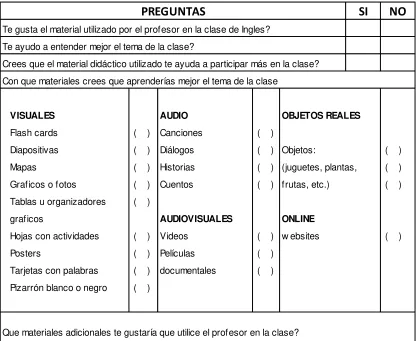
tables and questionnaires were the instruments applied.
The observation process applied for each class was as follows: first the teacher
was introduced by the supervisor, then a strategic space was selected to better observe
the class. The observation format was read in advanced and was completed according to
the parameters needed to achieve the research goals such as appropriateness, pertinence,
quality of the material, and learning styles since these aspects where the focus of the
observation. Next, the survey was administered to student at random. Once the five
observations were finalized, a questionnaire was also applied to each teacher. The
questionnaire, which was written in English, referred to the use, importance, and
preference of supplementary material in their lessons.
The process of data was done as follows; on one hand, the qualitative analysis
focused on the use of pertinence, appropriateness, and quality of the supplementary
material during the thirty observed classes. On the other hand, the quantitative
information collected through the questionnaire was included on the charts previously
prepared as an aid to summarize the data collected. . This information was transferred to
the Excel program to create graphs of frequency and percentages that were calculated
and represented in pie-statistics graphs. The quantitative analysis was also done to
compare both public and private school results. The results were analyzed and
8 DISCUSSION
Literature Review
Making students learn or acquire effectively the English language in a friendly
atmosphere is the main goal of every language teacher. Most of the time, we are tired of
standing on our heads to get the attention of students. Without motivation, students
certainly fail to make the necessary effort. Not all the students are motivated in the same
way due to their different learning styles; that is why, teachers must consider diverse
parameters to succeed in class. One of the main aspects considered to achieve the above
already mentioned goal is motivating them extrinsically through "operant conditioning
and social cognitive" processes Mejía (2009, p. 9) such as: a) a positive attitude of the
teacher, b) a vital teaching-learning methodology, c) an appropriate level of resources
and supplementary materials, among others.
Since it is important to analyze many other aspects that the learning process
involves, this work covers themes such as the necessity of learning English as foreign
language, different approaches of learners motivation, learning styles, contexts to take
into account when teaching EFL, as well as an overview of learning differences among
adults, adolescents and children.
A very important topic focused on this work deals with methodological procedures
for teaching adolescents despite the fact that it is critical to identify the best methods to
ensure success for this group. Previous studies regarding this exciting theme have been
reviewed as a way to enrich knowledge and take into account some data and
9 Teaching English as a Foreign Language
Mastering or having a well-organized domain of a foreign language is important.
The common sense could lead us to choose the most spoken language overseas,
Mandarin Chinese, which is spoken by the highest number of people around the world,
according to Rossenberg (2007). This statement will change if we consider other
statistics, which mentions the current importance of English as a lingua franca. Saleheen
(2011, p. 1) states that “1.68 billion people in total use English as a second language or learn as a foreign language … 46% of total population of the world including both native
and non-native speakers communicates in English”.
The necessity of learning English has been growing since World War II. The US
government realized how vital communication was during this period. For this reason,
the government decided to focus on supporting the English learning and the first
methods of teaching and learning ESL were born. Nowadays, English is greatly
spreading and gaining much more importance in many other technical and scientific
areas apart from geo-politic, economic, social and cultural issues.
Regmi (2011) finds that employment opportunities, communication for business
or recreation as some of the necessities to learn English. The skill of knowing a second
language empowers a person both in terms of social and economicparameters. Some
countries like India or Hong Kong have realized those facts; hence, they adopted English
as their official language.
Saleheen (2011) also emphasizes the importance of English in education. He
10
Most of the books used in College are written in English, and therefore, it is
fundamental, for people who are pursuing higher academic achievements to acquire
English proficiency.
Learners Differences among Children, Adolescents and Adults
Relying and serious studies have been conducted on the learning process and the
different groups of learners. Anthropogogy is the science, which deals with this research
that has to do with the teaching-learning object orientation. Therefore, and due to the
different characteristics, needs and necessity analysis of learners, Anthropogogy has
classified the groups of apprentices according to those features. Booth & Rowsell
(2007) consider the following classification: Pedagogy for learning and instruction with
children, Hebegogy for learning and instruction with adolescents, Andragogy for
learning and instruction with adults, Gerontogogy for learning and instruction with elder
adults, and Heutagogy for learning and instruction with self-directed learners.
Rodríguez (2006) states that “Hebegogy is a science that studies the education of
adolescents during their period of middle and high school. It is a tripartite relation:
students, teacher, and experience of learning. Chuy (2011) refers to other characteristics
of the adolescents, which is important to take in consideration since they may increase
the success of future classes. Adolescents are used to receiving fast information. They
prefer graphics rather than texts. They work better on internet and love to get small
11
It is quite known that there are differences in the way that children, adolescents,
and adults learn. For instance, children acquire the language naturally, and by playing
and laughing, and obeying commands or instructions (TPR: total physical response).
Warring (2008) suggests that a teacher has to bear in mind that it is very important to
make classes enjoyable while teaching to children under five. Concerning adolescents,
the method still works; the only aspect to consider is the level of fun used during the
lesson since it will lead to lose class control if it is not managed properly. Humor is the
characteristic that makes lessons laughable but humor in the English classroom has more
than just the effect to induce laughter. It brings together a chain-reaction by increasing
the motivation of learners, self-esteem, and self-confidence, which creates a positive
classroom atmosphere for a smooth acquisition of the language Warring (2008) stresses
the importance of maintaining engaging classes. He mentions that if at early age students
dislike English, this behavior will continue, as they grow older. It means that we will
have a less dedicated student. It is obvious that at any age, a student will enjoy
entertaining classes; however, an adult would better appreciate the efforts that a teacher
could make to fulfill their objectives as they can engage with abstract thoughts, have a
whole range of life experiences to draw on, tend to be more disciplined. They are often
prepared to struggle on despite monotony. They come into class with a rich range of
experiences that allow teachers to use a wide range of activities with them.
Regarding the learning ability, Saville-Troike (2006, p. 82) states: “brain
plasticity is listed as younger learners advantage, older learners are advantage by greater
12
adults also have superior analytic “since they are able to understand and apply explicit grammatical rules”. This proposal contradicts our traditional thinking as regards the
ability of children to learn faster than adults do. Brown (2000) also talks about the
superior cognitive abilities as well as more developed abstract thinking of adults, which
also includes adolescents above twelve. The attribute is still in development among
children; therefore, they would not be able to understand concepts that have multiple
meanings or interpret more ideas. It is important to keep in mind that experience and
previous education will also help adults and adolescents to transfer L1 to L2 and as
consequence it accelerates learning process.
One important difference refers to self-esteem. Authors like Saville-Troike (2006)
and Broughton (1978) indicate that young learners may be less inhibited to talk and
receive input from others since they are less formal than adults are. In contrast, Brown
(2000, p. 92) considers that “adults often bring a little of general self-confidence (global self-esteem) into a classroom, their fragility of egos may therefore not be quite as critical
as those of children”. The author also mentions about adolescents advising teachers on
how important self-esteem is during this stage “one of the most important concerns of the secondary school teacher is to keep self-esteem high by avoiding embarrassment of
students at all costs, affirming each the talent and strengths of each person, allowing
mistakes and other errors to be accepted”. Therefore, a good technique to keep
adolescents active and motivate is reassure their self-esteem and be very careful when
13 Learners Motivation
There are several studies that show how engagement decreases along the time. For
instance, Blue and Cook (2004) state that about five of every one hundred young adults
enrolled in high school in 1997 left school before October 1998 without finishing it. One
of the main reasons was the lack of motivation. In fact, Mejía (2009) mentions that "a
humane, sensitive, and a confident atmosphere should be considered as major and vital
factors in the classroom management to encourage learning in students as well as to
achieve better results in the EFL classes”.
There are two main types of motivation, intrinsic which relies with a individual
interest that makes a person to achieve an objective, and extrinsic motivation where
an external reward makes the person act in a specific way e.g., praising, grades, and so
on. Brown (2000) indicates how important it is to give students the opportunity to learn
English for their personal interests and encourage them to continue working since this
attitude will increase the chances of his or her success.
Sprats (2005, p. 38) comments that “motivation is the thoughts and feelings we
have which makes us want to do something, continue to want to do it, and turn our
wishes into action”. The author also suggests that in order to increase motivation among
young adolescents, we must develop a good relationship with the learners, personalize
the learning process, or just make classes interesting. Since intrinsical motivation is very
powerful, spending some time learning about the main motivations of our students is
necessary. This information will help to focus on their needs and prepare classes and
14
On the subject of extrinsical motivation, it is important to recall that people also
reacts through stimuli. The use of small prizes, positive feedback, and meaningful
attitudes could help to encourage students in the learning process. Supplementary
materials may also be part of them and will work extremely well especially when a topic
is hard, abstract or difficult to learn.
Learning Styles
After reviewing the classification that different authors have regarding learning
styles, it is concluded that they have many similarities since the different styles
mentioned are based on senses. It is interesting to analyze the position of Honey &
Mumford (2000) who used a questionnaire to prove that most people have never
consciously considered how they really learn. The authors also consider that people
moves constantly from one model to other and it depends on what they are learning.
Using a wide variety of strategies and supplementary materials is important to
acknowledge the learning styles and multiple intelligences of students. Fleming (2011)
classifies learning styles as follows: V stands for visual and refers to all information
presented in maps, charts, pictures or any other material that represents words; A stands
for aural or auditory and has to do with the information that is heard or spoken. People
who have this learning style learn better, when they converse or use any audio method.
R stands for read/write and includes all methods that use words. The author explains
that students and teachers have preferences for this method because they are able to
write well and read widely. Traditional education has helped to spread this method. K
15
physical activities. Besides, it includes practice and learning by doing and experiencing.
Reid (1987) ran a study on ESL students learning preferences and he concluded that
foreign students strongly preferred kinesthetic and tactile learning styles.
Gardner (1999) and his theory on ‘Multiple Intelligences and Learning Styles’ argues that students will be better served by a broader vision of education, in which
teachers use different methodologies, exercises and activities to reach all students, not
just those who are good at linguistic and logical intelligence. He encourages teachers to
find ways that can achieve learning acquisition of any topic.
Teaching Techniques for Teaching Adolescents
According to Broughton, Brumfit, Flavell, and Pincas (1978, p. 174) “there are
two stages in producing appropriate teaching, first is the preparation and selection of
materials, (course books, exercises, visuals, etc.) and second is classroom organization”.
The authors believe that it is essential to revise the material personally to ensure
appropriateness and organize the class using a lesson plan. Dinham & Rowe (2008) also
agree with Broughton et.al. about planning and implementation, but they also suggest
evaluation as a third element. This additional feature would be important in order to
check whether techniques are working well among students.
A good practice to pursue with teenagers has to be with the use of their literacy
level, “Written language can support oral development since literacy skills become well
established, written texts of all types offer a valuable source of new vocabulary,
16
p. 111). This strength will help to create a great number or activities to address the
different learning needs that a teenager presents.
Raimes (1983) proposes seven questions to plan writing classes. He states that any
activity has to be interesting and relevant for pupils, especially when students are
teenagers. In the case of writing, which is an important part of language acquisition, the
list encourages teacher to question himself about topics to write, how to make the
subject meaningful, what the correct time is or how to deal with errors. The author
points out that a teacher must be aware of these seven inquires in order to ensure that the
activity will be meaningful for adolescents and increase their interest and motivation.
Dinham & Rowe (2008) considers feedback as another an important element to
take in consideration when teaching adolescents. He indicates that the educator must
keep monitoring and assuring that the given information has been understood and all
needs fulfilled before presenting new topics.
Contexts for Teaching English
Brown (2000) emphasizes about the importance to create the context during
classes and gives some guidelines to help to compensate for the lack of real
communicative situations outside the classroom. He suggests the use of class time to
practice real language as well as interaction with other students. It would help to
experience authentic uses of English in their own lives and provide new and unique
experiences.
17
context as factors associated with the amount of attention that is being given to language
form during the production of the automaticity level versus control in processing or
intellectual demand in a particular task. She also refers to macro social contexts with
similar position as Regmi (2011) who points out that when he analyses how a learner
adopts the new target culture, he or she may also incorporate his or her own L1 culture.
Consequently, the integration of local culture and context is expected while a foreign
language is being learned.
In summary, it is particularly important to learn about students and understand
their culture, but it is also important to teach the English culture because language is not
a set of words, phrases and sounds. It is a compilation of traditions, situations,
principles, and beliefs of a group of people with similar characteristics.
Supplementary Material
According to Prastyo (2010) supplementary materials are significant and they are
additional resources which are added to the original material and have the capacity to
inform independently from the original resource. He states this material supports the
information that a person gives, and its role clarifies the ideas exposed by the speaker as
well as it makes the theme more interesting. Other aspect mentioned is variety, which
means that teacher should not rely excessively to one type of material but include
enough amounts of ideas that make them clear and compelling to students.
Madrid, D (1989, p.381) presents an important role on supplementary material,
dealing with how the use of them can create special conditions where teachers and
18
“didactic material often used as a link or element between the teacher and reality”. The
author mentions, other elements called teaching aids defined as any “resource and
equipment available in the classroom” Spratt (2005, p. 119). Examples of these aids are cassettes recorders, CD players, and video recorders.
Types of Supplementary Materials
Supplementary materials can be defined as “books and other materials used in addition to the coursebook” (Spratt, et.al. 2005: 115).
According to Derecki (2011) visual materials can be used to learn new vocabulary,
spelling, and numbers as well as help to increase understanding. Materials like an audio
CD, dialogs, and songs are very useful to practice listening and speaking skills.
Audiovisuals like movies or videos help to contextualize words since they show
gestures, actions and body movements. Realia refers to any real material used during the
class.
Other authors like Madrid (2008) and Hanin & Naaman (2009) list a variety of
available materials indicating that these additional materials not only contribute to make
classes more interesting but they also add variety, and they support the teaching-learning
process in heterogeneous classes. Finally, teachers might use this material when the
book does not include enough topics or it is not suitable for the class level.
Madrid (2008, p. 232) adds that through materials usage, it “can be seen that some
of these media are purely visual or auditory, but others integrate images and sounds.
Some require a passive attitude by the students, but others are interactive and require
19
As it has been analyzed so far, that supplementary material has a riveting
relevance in the classroom management due to its effectiveness in the meaningful
learning process as well as its validity and vitality to encourage students to be involved
in real and authentic situations. In order to support all the previous statements, some
evidence obtained overseas by other investigators who researched supplementary
material is detailed. Their experience on research and the results obtained widely
contribute to increase knowledge to be applied in this investigation.
The purpose of the study was to understand whether online learning games can
benefit learners. It was conducted between 100 freshmen students from Hong Kong
University through qualitative and quantitative methods. Five steps were involved:
pre-test, learning process, post-pre-test, survey questionnaires, and finally, interviews. There
were two lessons each week and each lesson lasted 50 minutes. In the first three weeks,
the subjects in the experimental group were asked to carry out online vocabulary,
exercises regularly done in class and in their own time before exploring the two
designated web sites. The teachers provided guidance in class and from time to time
observed the work of students. This ensured that both the control and experimental
groups were learning the same words. A number of activities designed to help subjects
develop strategies for vocabulary learning, namely drawing mind maps or concept maps,
drawing pictures or diagrams among others, were used in the lessons in the control
group. Questionnaires were given to the experimental group to evaluate the online
20
were asked to attend a group interview to elicit a more in-depth understanding of their
opinions and attitudes towards the online learning games.
First, they investigated whether there was any difference in English proficiency
between the experimental and control groups before and after the treatment. During
pretest the differences between groups were not significant but after posttest the
experimental group has a much larger mean score than that of the control group in the
posttest. The results appeared to suggest that learning with the vocabulary web sites,
which included games, is more effective than activity-based learning. Limitations
included problems to connect to technological devices. Other limitation could also be
that students were not good enough using internet and others technological material.
A similar research to find the point of view of students was carried on from Son
(2008). He studied the use of web site as a supplementary resource for teaching English
as a second language. Twelve ESL students (7 male and 5 female; mean age 27, ranging
from 18 to 41 years) were included within the study conducted at the University of
Southern Queensland, Australia. The Web site provided session plans for ESL students
containing activities such as quizzes, gap-fill exercises, jumbled-sentence exercises,
ordering exercises, and others to learn grammar, vocabulary, reading and listening.
Teachers provided students with language exercises directly related to their classroom
lessons in line with the evolving syllabus of their language courses. Through a self
report questionnaire the opinions of the ESL students was gathered. The researcher
wanted to know if the use of web site was useful for students to learn second language.
21
students agreed that they enjoyed the Web activities and would like to use more
activities. Web-based language learning (WBLL) increased students motivation through
language acquisition.
Study dealt with the use of motion pictures to teach Business English at Shanghai
International Studies University. The researchers made personal inquiries of more than
60 Chinese and foreign English teachers regarding their use of full length commercial
movies in the classroom. From this experiment it became clear that there are a group of
careless teachers that use movies in the classroom more as a babysitting device because
their employer has failed to provide teaching materials. Other group of professionals
uses movies primarily to supplement existing curriculum. The study concludes that
appropriate and effective use of motion pictures requires a range of elements: (1) movies
that are at one and the same time educational, informative, and entertaining; (2) a
workbook linked to such movies that enables students to get ready beforehand; (3) most
importantly, a range of classroom activities to induce and elicit timely and optimal
output from the students, so as to make talking and writing about communication easier
and more effective.
This first conclusion led investigators to inquire them if movies can be beneficial
in teaching English, why not utilize them to teach business English, business, culture,
history etc.? To find out this new query, they started other research. The researchers
chose the movie “Working Girl” and made a compiled a vocabulary list with words and
22
The movie was showed to a first group a 3rd year class of fifty business students.
After a small introduction to the movie, students watched the movie. Any movie
vocabulary was pre-taught. During the student’s viewing of the movie, more than half of the students dozed off, started chatting or playing games on their cell phones. The
post-viewing discussion was weak and involved a small group of students. The second group
had the same characteristics, this time the researchers informed the class that one of their
final exam questions would come directly from the movie as an additional motivator.
Similar results as in the first group were found. The third group showed same results
even though previous to the introduction to the movie, they learned list of movie words.
The next group had five hundred 1st, 2nd, 3rd and 4th year business major; the
investigators asked the students to make their own lists of words and phrases. In
post-viewing discussion with the students, it was discovered that they were so busy compiling
their lists that they were unable to comprehend the theme of the movie. Finally other
group of fifty 3rd year business majors was included. This time the examiners gave them
the students’ combined list with definitions, one week in advance of viewing the movie.
When this group watched the movie, no one fell asleep, no one chatted and no one
played cell phone games. The post-viewing discussion was lively, invigorating, and
exciting, participated in by moiré than 90% of the students.
Other research was focused on analyzing the impact that videos have on listening
skill. The study took place in public university in Colombia, located in the coffee area.
Five students native Spanish speakers: 4 females and 1 male (ages ranged between 17
23
the whole group, data were collected only from those five participants. The data was
collected through instruments such as Field notes as an instrument that serves to identify
and follow processes, Post video activity questionnaire used by students to reflect about
their learning process, and comprehension test during and after the presentation of each
video to identify the impact of videos in listening skill. The results concluded that video
strategies the students were positively impacted in their listening comprehension skills.
Furthermore, the research found that the students, in the interviews, mentioned how
video exposure had increased their motivation.
The study was done with a group of four sophomore classes chosen randomly
from different major classes like nursery, engineering, and computer technology. The
students were divided in two sections, the experimental group and the control group.
Those two groups were taught differently. The experimental group (EG) was assigned to
a foreigner teacher from an English speaking country that used supplementary materials
in class. On the other hand, the Control Group (CG) was assigned to a local teacher who
followed the departmental syllabus. In order to collect the information of the research
quizzes were applied to evaluate the progress of the students. The results of the study
showed a clear difference between the marks obtained by the EG which were noticeably
higher than the CG. The fact that EG worked with extra materials and the native speaker
teacher was the main reason. The study showed that the use of extra materials during the
class, not matter the subject, improves the skills of the students. It could be achieved
24
An interesting study was carried out by Gonzalez, (2006) in the Universidad of
Antioquia. The objective of the study was to demonstrate the effectiveness of the
materials and its use to guarantee a good learning process. The study was done with the
participation of student teachers who attended “Materials and Design Course”. Those teachers practiced in several High Schools using different materials to teach English as
Foreign Language. The materials used were elaborated and apply by them. To collect
the data, documentary analysis from the course was used. Evaluation files were used
with students and teachers. To analyze the results support of semiotic analysis of the
data was implemented. This research exposed some contradictory results. One of the
most noticeable fails was that, although the program of the University, and the student
teachers were confident about their knowledge and preparation about materials, during
the practice many empty spaces were found.
The author concluded that the preparation that teachers have during their career
was not enough. Although teachers force them preparing materials, the sources are very
limited in the educational system. The difference between the learning processes
developed in some schools is very big compared to some institutions which can access
25 Results
Chart One: Type of supplementary material used in public high school
Variable Indicators Yes No
Visuals
Flash cards X
Power point presentations X
Maps X
Pictures X
Charts X
Handouts X
Posters
Word cards
White / black board
Audio
Songs X
Dialogues
Stories X
Tales X
Audio – visuals
Videos X
Movies X
Documentaries X
Realia Objects (toys, plants, fruits) X
Online Websites X
Author: Alba Tobar
26
Chart Two: Type of supplementary material used in private high school
Variable Indicators Yes No
Visuals
Flash cards
Power point presentations X
Maps X
Pictures X
Charts
Handouts X
Posters X
Word cards X
Dictionary
White / black board
Audio
Songs X
Dialogues X
Stories X
Tales X
Audio –
visuals
Videos X
Movies X
Documentaries X
Interactive exercises computer Realia Objects (toys, plants, fruits)
Online Websites X
Author: Alba Tobar
27
Chart three: Pertinence and Appropriateness of the supplementary material used in
public high school
Variable Indicators
1st Class 2nd Class 3rd Class 4th Class 5tht Class
Pert App Pert App Pert App Pert App Pert App
Visual
Flash cards
Power point presentations
Maps Pictures Charts Handouts Posters Word cards
White / black board
Audio Songs Dialogues Stories Tales Audio- visuals Videos Movies Documentaries Realia Objects (toys, plants,
fruits) Online Websites
Author: Alba Tobar
28
Chart four: Pertinence and Appropriateness of the supplementary material used in public
high school
Variable Indicators
1st class 2nd class 3rd class 4th class 5tht Class Pert App Pert App Pert App Pert App Pert App
Visual Flash cards Power point presentation Maps Pictures Charts Handouts Posters Word cards White / black board
Audio
Songs
Dialogues
Stories Tales Audio- visuals Videos Movies Documentaries Realia Objects (toys,
plants, fruits) Online Websites
Author: Alba Tobar
29
Chart five: Pertinence and Appropriateness of the supplementary material used in public
high school
Variable Indicators
1st Class 2nd class 3rd class 4th class 5tht Class Pert App Pert App Pert App Pert App Pert App
Visual Flash cards Power point presentations Maps Pictures Charts Handouts
Posters X X
Word cards X X
White / black board
Audio Songs Dialogues Stories Tales Audio- visuals Videos Movies Documentaries
Realia Objects (toys, plants, fruits) Online Websites
Author: Alba Tobar
30
Chart six: Pertinence and Appropriateness of the supplementary material used in private
high school
Variable Indicators
1st Class 2nd class 3rd class 4th class 5tht Class Pert App Pert App Pert App Pert App Pert App
Visual Flash cards Power point presentations Maps Pictures
Charts
Handouts Posters Word cards
White / black board
Audio Songs Dialogues Stories Tales Audio- visuals Videos Movies Documentaries Realia Objects (toys,
plants, fruits) Online Websites
Author: Alba Tobar
31
Chart seven: Pertinence and Appropriateness of the supplementary material used in
private high school
Variable Indicators
1st Class 2nd class 3rd class 4th Class 5tht Class Pert App Pert App Pert App Pert App Pert App
Visual
Flash cards X X
Power point presentations Maps Pictures Charts Handouts Posters Word cards
White / black board X X
Audio Songs Dialogues Stories Tales Audio- visuals Videos Movies Documentaries
Interactive exercises
Realia Objects (toys, plants, fruits)
Online Websites
Author: Alba Tobar
32
Chart eight: Pertinence and Appropriateness of the supplementary material used in
private high school
Variable Indicators
1st Class 2nd class 3rd class 4th class 5tht Class Pert App Pert App Pert App Pert App Pert App
Visual Flash cards Power point presentations Maps Pictures Charts Handouts Posters Word cards
White / black board
Dictionary
Audio Songs Dialogues Stories Tales Audio- visuals Videos Movies Documentaries
Interactive exercises Realia Objects (toys, plants,
fruits)
Online Websites
Author: Alba Tobar
33
Chart nine: Frequency of use of supplementary material in 1st year
Variable Indicators Public Private
Visuals
f F
Flash cards
Power point presentations Maps
Pictures
Charts 1
Handouts Posters Word cards
White / black board 4 2
Audio
Songs Dialogues Stories Tales Audio –
visuals
Videos Movies
Documentaries
Realia Objects (toys, plants, fruits) Online Websites
TOTAL 4 3
34
Chart ten: Frequency of use of supplementary material in 2nd year
Variable Indicators Public Private
Visuals
f F
Flash cards 2
Power point presentations Maps
Pictures Charts Handouts Posters Word cards
White / black board 3 2
Audio
Songs
Dialogues 1
Stories Tales Audio –
visuals
Videos Movies
Documentaries
Interactive exercises 1
Realia Objects (toys, plants, fruits) Online Websites
TOTAL 4 5
35
Chart eleven: Frequency of use of supplementary material in 3rd year
Variable Indicators Public Private
Visuals
f f
Flash cards
Power point presentations Maps
Pictures Charts Handouts
Posters 1
Word cards 1
White / black board 2 3
Dictionary 1
Audio
Songs Dialogues Stories Tales Audio –
visuals
Videos Movies
Documentaries
Interactive exercises 1
Realia Objects (toys, plants, fruits) 1 Online Websites
TOTAL 4 6
36
Chart twelve: Frequency of use of supplementary material
Years Public (f) Private (f) TOTAL
f %
1st 4 3 7 27%
2nd 4 5 9 35%
3rd 4 6 10 38%
TOTAL 12 14 26 100%
37
Chart thirteen: Frequency of used material in the public senior high school
Variable Indicators
1st year
2nd year
3rd
year TOTAL f f f f %
Visual Flash cards Power point presentations Maps Pictures Charts Handouts
Posters 1 1 8,3%
Word cards 1 1 8,3%
White / black board
4 3 2
9 75%
Audio
Songs
Dialogues 1 1 8,3%
Stories Tales Audio- visuals Videos Movies Documentaries Interactive exercises Realia Objects (toys, plants,
fruits) Online Websites
TOTAL 4 4 4 12 100%
38
Chart fourteen: Frequency of used material in the private senior high school
Variable Indicators
1st year
2nd year
3rd
year TOTAL f f f f %
Visual
Flash cards 2 2 14,3%
Power point presentations Maps
Pictures
Charts 1 1 7,1%
Handouts Posters Word cards
White / black board
2 2 3
7 50%
Dictionary 1 1 7,1%
Audio Songs Dialogues Stories Tales Audio- visuals Videos Movies Documentaries
Interactive exercises 1 1 2 14,3%
Realia Objects (toys, plants, fruits)
1
1 7,1%
Online Websites
TOTAL 3 4 5 12 100%
39
Description, Analysis, and Interpretation of Results
This section discusses the results from the aspects taken into account for the
qualitative analysis, which are: pertinence (importance of the used material in relation to
the content: topic and objective of the class), appropriateness (related to the level of the
students and understanding), and quality (design and elaboration of the supplementary
material). In addition to this, learning styles considered by the teacher were analyzed
relating them to the variables proposed for this research study. These variables are
visual, audio, audiovisual, realia, and online, which correspond to 18 suggested
indicators.
Regarding the quantitative analysis, the number and frequency of the proposed
indicators were measured. The data on quantity and frequency were organized,
collected, and described in detail in charts based on the five observation made in first,
second, and third year of the senior high school of one public and one private institution.
The results were analyzed based on the information collected in the observation charts,
surveys administered to students, interviews with the teachers, and personal criteria.
Qualitative Analysis Public High School
Fifteen classes were observed in a public institution. During those days, real live
process of teaching and learning were seen. Teachers had years of experience but their
methodology, knowledge, and motivation did not match their experience. Since the
reality of public school is limited, not only different methodological points of view were
40
curriculum. Some teachers used the classical supplementary materials such as white
board and book while others struggled to use others occasionally. Supporting material is
still in development within this school.
1st year
Whiteboard
During the first class observation, it was noticed that the teacher did not use any
other material rather than the whiteboard and book. She said that the use of
supplementary materials has been forbidden by the Ministerio de Educación because
students must not buy any other material rather than the textbook.
The theme of the first attended class was New Year Celebrations and the topic was
Simple Present and Simple past. The objective of the class was to reinforce Simple present and past tenses.
The teacher started telling the students how she had celebrated the festivity in her
family. She was very specific and wrote three sentences on whiteboard regarding her
experience. Then, she asked also students to share their own experiences. Next, she
asked students to go to the whiteboard and write their statements. After writing every
sentence, the teacher made students to identify the structure of simple present or simple
past sentence accordingly by underlying the verb form. Along with her explanation, she
often wrote on the board key words or phrases to ensure that students understood her
explanation. The whiteboard for her was like a notebook where she wrote important
ideas as well as examples and structures. This learning tool was considered to be
41
underling to differentiate both type of sentences helped teacher to achieve the class
objective.
The use of the whiteboard was appropriate since the pupils had the chance to
contrast the differences between present and past simple and understand words or
phrases told by the teacher during the oral explanation. This practice made students
keep connected with the topic. At the end of the class the students were able to write
correctly both structures.
The teacher used color markers to underline and circle the key words and
sentences which also helped to draw the attention of the students to the structures
written. The quality of markers and handwriting was good.
The whiteboard was also used in the third class observed. The topic of this class
was First Conditional and the objective to reinforce first conditional that had already
been introduced in a previous class.
She started by asking students how much they remembered about the use of first
conditional introduced last class. Every time students said something correct about the
topic, she wrote it on the board. After receiving all the important needed aspects to
construct the first conditional, she encouraged students to practice the structure with
their own ideas. During the rest of the class, students wrote on the whiteboard a lot of
examples referring to their own experiences. Some of them were funny sentences that
helped to make them enjoy the class. She emphasized the parts of the structure all the
time using the sentences written by students. The use of whiteboard along with oral
42
that the use of the class time to practice real language as well as to interact with the
students would help to experience authentic use of English in their own daily lives and
provide them new and unique experiences. Since the use of the white board to teach the
class, supported the achievement of the goal of the class, it can be concluded that the use
of this supplementary material was pertinent.
The management of the white board was considered appropriate based on the fact
that students were able to create their own sentences correctly. They looked relaxed and
confident about the topic of the class.
As mentioned in the other classes, the clear handwriting as well as the use of
different color markers supported the class accomplishment and comprehension of the
students.
In the fourth class the same supporting material was used. This time the theme of
the unit was Lighting. The topic was Second Conditional and the class objective was to
introduce and practice the use of Second Conditional. The teacher used the whiteboard
to introduce the grammatical structure. She wrote the different parts of second
conditional with different colors. Then, she recalled together with students the structure
of first conditional as a way to show the differences between them. This initiative
helped students to contrast both topics. The teacher wrote few more sentences to explain
the new topic. During the rest of the class, she just explained the second conditional by
using oral examples. Every time that a new sentence was said, she stressed the different
parts and explained again showing the structure written on the board. Since the new
43
explain imaginary circumstances or dreams that were a good way to internalize the
concept. She took advantage of humor as another strategy. This method was good and
kept students aware stimulating their participation. Warring (2008) suggests that teacher
has to bear in mind that it is very important to make enjoyable classes. A good level of
humor creates a friendly atmosphere for effective class participation.
It was observed that the supplementary material was not used constantly even
though the topic was difficult to teach. Due to her ability to explain orally, the teacher
did not need to write a lot. This common practice among the other professionals was
mentioned by Fleming (2011) who said that students and teachers prefer the use of
visual aids because they are able to write well and read widely. Although, the white
board was used for a short period of time, it was appropriate as a resource to teach the
grammatical structure and to reinforce the oral explanation.
The supporting material was appropriate and helped students to identify the key
characteristics of second conditional and contrast differences versus first conditional
according to the age and level.
The size of her handwriting was big enough for the students to see and the colors
markers used were also adequate.
The whiteboard was used in the fifth class attended. The topics of the class were
Past Perfect, First and Second Conditional. The objective of the class was to prepare students for the second quarter test. The teacher arrived earlier and wrote on the board
five sentences. When students came to the class, she asked to copy the sentences written
44
circle the ones using second conditional, underline the sentences using first conditional
and make a red check mark next to past perfect sentences. Once the task was performed,
she made students open the book and work on tasks three and four from it. She walked
by every student and explained any doubts. About 10 minutes later, she asked students
to go to the whiteboard and write the answers. Most of the students did well, and in
case they made a mistake, she took advantage of the sentences written to point out once
more the correct structure of the three topics subject to review. Even when the teacher
did not use any other kind of supporting materials, the whiteboard content organization
contributed to clarify any doubts and interact between the teacher and the students.
Consequently, it was pertinent in relation to the content and objective achievement.
Students were very active. The teacher used the white board in a dynamic way.
Due to this fact, she kept students interested in her classes. The material helped students
to interact; therefore, it was appropriate to their age and level.
Regarding the quality of the material, the sentences on the whiteboard were well
organized in such a way that students could see and identify clearly the examples
displayed on it.
Learning Styles
According to Gardner (1991), students have different kind of intelligences and
learning styles. That is the reason why they learn, remember, perform, and understand in
different ways. Other authors, like Flemming (2011) and Honey & Mumford (2000),
also refer to the different learning styles that are present in students. During the
45
important aspect of education was not present in the mind of the teacher. The only
learning style used by the teacher was visual. When the teacher was asked about it, she
explained that the use of this material has been prohibited by Ministerio de Educación
which means that the only way to work with supporting material was by buying it
herself.
2nd year
Whiteboard
The frequent use of whiteboard was common among teachers in this public school.
This was the only material used in three of the five observed classes in second year.
In the second class observation, the theme was Thanksgiving, the topic was Tag
Questions, and the aim of the class to introduce and write tag questions. Students worked with the book and whiteboard simultaneously. At the beginning, the teacher
explained the definition of a Tag Question. Different examples of the topic were shown
on the whiteboard in order to teach the grammatical structure. It was not easy; despite
the fact that it was commonly used in normal conversations, it was difficult to explain
the concept in English. Therefore, the teacher had to explain the new topic to students in
Spanish. It is true that students at this age can understand abstract concepts as Brown
(2000) mentions “adolescents above twelve have superior cognitive abilities as well as more developed abstract thinking”, but in this case after almost ten minutes trying to explain the topic in English without success, it was necessary to explain in mother
tongue in order to continue with the content of the class. After students realized what a
46
also explained the type of punctuation needed to write tag questions properly. To ensure
that students identify and learn how to include punctuation within this type of sentences,
he wrote a sentence on the whiteboard and placed the comma and question mark in its
proper place with another marker color. The teacher asked students to pick the examples
from the book and wrote them on the white board. Every time that a new sentence was
written on the board, the teacher recalled the main structure and the punctuation. After
numerous exercises, the students seemed very confident regarding the use of the new
topic. It is considered pertinent the use of white board because it was a good support that
helped teacher to achieve his goal.
The whiteboard was used appropriately according to the level of the students, who
could participate and reproduce new sentences. Most of the sentences written by the
pupils were correct.
Regarding the quality of the material, the teacher encouraged students to write
with print letters which helped to read easily. This time the teacher just had one color
marker. It could be better to use more colors and other writing techniques like arrows or
circles to ensure an easy understanding.
During the third observed class, the same material was used. The class topic was
Tag questions. The goal was to check the proficiency of the topic by checking
homework. The teacher requested students to present their homework. He asked to
swap books among them to correct the exercises. Some students went to the whiteboard
and wrote the sentences. Teacher and students worked together to correct each task. He
47
when they found mistakes. The supplementary material was pertinent to achieve the
class objective because through the whiteboard the pupils were able to recognize right
and wrong sentences immediately. The young learners graded their classmates
according to what was correctly written on the board. After finishing the task, the
teacher included two more examples as a final attempt to make sure the whole class
understood the topic.
The white board was appropriate for the students, because by using the
whiteboard, the student not only shared the right answers but they also identify their
mistakes in the homework. Many times during the class a loud “ahhh” was heard meaning that they could realize the source of their mistake.
The use of the material was suitable for the age of the pupils because the exercises
from the homework were well organized and the calligraphy clear enough in order to
facilitate the objective of the class.
During all the classes attended, the teacher used to ask students the date in order to
write in the daily class report. In this particular class, the teacher asked students to write
down the date on the whiteboard. One student wrote the date on the whiteboard
wrongly, the teacher informed students that the topic of the class would be writing dates.
The class objective was to write dates properly. The teacher questioned students
regarding important dates in Ecuador and in the USA. All the responses were written on
the whiteboard. Every time a new date was written, he uses the example to teach the
main rules. He asked students to repeat after him the principal rules. They repeated
48
that a date should include and this initiative was very useful to achieve the objective of
the class. The rest of the class time, the students wrote some examples on the
whiteboard in order to master the lesson learned. The whiteboard was a pertinent
resource to teach grammar rule usage, and students showed secure about the topic.
The use of the material was appropriated for the students because the information
that it contained was the base to identify the rules and to comprehend the correct way to
write dates. It helped students to make the exercises confidently.
The students were encouraged to write clearly to ensure that the audience could
read. The organization of the board was also good, but unfortunately the quality of the
markers use was not good. Therefore, the writing was difficult to be seen by students
from the back. It made students to complaint about it.
Dialogues
In the fifth class the topic of the class was Tag questions. The aim of the class was
to reinforce the topic through listening.
The teacher brought a CD-player into the class, which made the students very
interested. He explained to his pupils that this time they would have a listening class.
The teacher shortly explained the task and the context of the dialogs. Every dialog was
played three times and after finishing the exercise, there was a whole-class discussion.
The discussion was about what they understood and how many times the students heard
the use of Tag questions.
Among all the observations in second year, this was the only time where students