COVER
UNIVERSIDAD TÉCNICA PARTICULAR DE LOJA
La Universidad Católica de Loja
ÁREA SOCIO HUMANÍSTICA
TÍTULO DE LICENCIADO EN CIENCIAS DE LA EDUCACIÓN MENCIÓN
INGLÉS
Teachers and students´ perceptions of teaching English in small classes in
Ecuador
TRABAJO DE FIN DE TITULACIÓN.
AUTOR: Flores Limongi, María de la Merced
DIRECTOR: Pinza Tapia, Eliana Ivanova, Mgs.
CENTRO UNIVERSITARIO MANTA
APROBACIÓN DEL DIRECTOR DEL TRABAJO DE FIN DE TITULACIÓN
Magíster.
Eliana Ivanova Pinza Tapia.
DOCENTE DE LA TITULACIÓN
De mi consideración:
El presente trabajo de fin de titulación: Teachers and students’ perceptions of teaching English in small clases in Ecuador realizado por Flores Limongi María de la Merced, ha sido orientado y revisado durante su ejecución, por cuanto se aprueba la presentación del mismo.
Loja, Mayo de 2015
DECLARACIÓN DE AUTORÍA Y CESIÓN DE DERECHOS
“Yo Flores Limongi María de la Merced declaro ser autor (a) del presente trabajo de fin de titulación: Teachers and students’ perceptions of teaching English in small clases in
Ecuador, de la Titulación de Licenciado en Ciencias de la Educación mención Inglés, siendo la Mgs. Eliana Ivanova Pinza Tapia directora del presente trabajo; y eximo expresamente a la Universidad Técnica Particular de Loja y a sus representantes legales de posibles reclamos o acciones legales. Además certifico que las ideas, conceptos, procedimientos y resultados vertidos en el presente trabajo investigativo, son de mi exclusiva responsabilidad.
Adicionalmente, declaro conocer y aceptar la disposición del Art. 88 del Estatuto
Orgánico de la Universidad Técnica Particular de Loja que en su parte pertinente textualmente dice: “Forman parte del patrimonio de la Universidad la propiedad intelectual de
investigaciones, trabajos científicos o técnicos y tesis de grado que se realicen a través, o con el apoyo financiero, académico o institucional (operativo) de la Universidad”
f) ……….….
DEDICATION
This work is dedicated to God who changed my life; to my husband and my son, who are my motivation, for their support; to my family, especially to my parents for everything they have done for me; to my mother-in-law and my friends who were encouraging me to continue; and everyone who helped me in different ways to finish this study.
ACKNOWLEDGEMENT
This acknowledgment is for all of my teachers from “Universidad Técnica Particular de Loja” for being part of my education; especially for my thesis director for her patient and her
dedication.
Finally, this acknowledgment is for high schools and institutes administrators who gave me their permission to develop this study in their institutions, also for the teachers and
CONTENTS
COVER ... i
APROBACIÓN DEL DIRECTOR DEL TRABAJO DE FIN DE TITULACIÓN ... ii
DECLARACIÓN DE AUTORÍA Y CESIÓN DE DERECHOS ... iii
DEDICATION... iv
ACKNOWLEDGEMENT ... v
CONTENTS ... vi
Abstract ... 1
Resumen ... 2
Introduction ... 3
Literature Review ... 6
Method ... 20
Discussion ... 23
Description, Analysis and Interpretation of Results ... 23
Conclusions ... 45
Recommendations ... 46
References ... 47
Abstract
The present study investigated the teachers and students’ perceptions of teaching
English in small classes in Ecuador; for this purpose, the population sample composed by five teachers and forty-four students was selected from three high schools and two institutes from the city of Manta in the province of Manabi. In order to gather data two questionnaires were applied, one for teachers and another for students; furthermore, additional information was obtained through class observations. The data obtained from both questionnaires was quantitatively presented, described and analyzed in comparison with the results of the
observations and the most relevant literature that was previously investigated. The results of the current study showed that there were many benefits of teaching and learning English in classes with small number of students; teachers provided an adequate feedback because they had enough time to spend for each student; there was much teacher-student interaction; also, listening, speaking, reading and writing activities were developed with more teacher control; finally, the students felt in comfort to talk in front of their classmates and motivated to participate because they were few.
Keywords: teacher and students’ perceptions, teaching English, small classes, benefits, learning, motivation.
Resumen
El presente estudio investigó la percepción de maestros y estudiantes sobre la enseñanza del Inglés en clases pequeñas en el Ecuador; con este propósito se seleccionó 5 maestros y 44 estudiantes de cinco colegios y dos institutos en la ciudad de Manta provincia de Manabí. Para obtener información se aplicaron dos cuestionarios, uno para maestros y otro para estudiantes; además se adquirió información adicional a través de observaciones de clases. La información obtenida de ambos cuestionarios fue presentada cuantitativamente, detallada y analizada en referencia con los resultados de las observaciones y con la más relevante literatura previamente investigada. Los resultados del presente estudio demostraron que hubo muchos beneficios en la enseñanza y aprendizaje del Inglés en clases pequeñas; los maestros brindaron una adecuada retroalimentación ya que tuvieron el tiempo necesario para cada estudiante; hubo mucha interacción entre maestros y estudiantes; además, las
actividades de escuchar, hablar, leer y escribir fueron desarrolladas con mayor control por parte del maestro; finalmente, los estudiantes se sintieron a gusto de hablar frente a sus compañeros y motivados a participar debido a que eran pocos.
Introduction
Nowadays, the importance of learning the English language is widely known in all aspects of our society. In fact, during the last years the Ecuadorian authorities have been concerned about schools improving their way of teaching English, and they have created different strategies to help teachers to enhance their competences; however, there are other aspects that may be considered to improve the teaching of English as the large number of students in the classrooms.
In most of the Ecuadorian schools there are many students per class; for some authors that situation does not allow the correct development of the teaching and learning process; and they state that teaching in small classes has more benefits than teaching in large ones. This study is conducted in order to clarify if teaching English to small groups of
students has positive or negative results; for this reason, the main purpose of the current study is to know the teachers and students’ perceptions of teaching and learning English in small classes through the following questions: What are the benefits of teaching and learning English in small classes? What teaching strategies and resources benefit the teaching of English in small classes? How do students feel about learning English in small classes? Are there any limitations when teaching English in small classes?
of the classroom environment, and they did not be worried about the negative evaluation from the other classmates. The limitation of this study was that it only considered four cases. Another study was directed by Moradi, Moin and Ketabi (2012) with the purpose to analyze if readiness to communicate is different through classes of different size; they concluded that the amount of students in the classroom affects their participation in a discussion.
Finally, Harfitt (2012) conducted a study with the purpose to know the perceptions of teachers of teaching English in large and reduce-size classes at secondary school; and also, to know about the differences between teaching English in large and reduce-size classes. The results revealed that in small classes the teachers planned more group works than in large ones; moreover, in small classes the teachers employed different kind of questions for each student; there was more teacher-student interaction with extensive dialogues; also, the
students were called by their names and there were moments of humor from the teachers. The limitation of this study was that it only focused on three teachers.
The results of the current study show the benefits of teaching and learning English in small classes with the purpose of letting either the Ecuadorian government or school
authorities create different strategies and make changes if needed to improve the teaching of the English language; moreover, this study represents a source of valuable information for teachers and everyone interested in knowing about the benefits of teaching and learning English with few students, the strategies and resources used to improve the teaching of English in small classes, and how the students feel to study with few classmates. Finally, the results of this study serve as an evidence for future studies.
Literature Review
Nowadays teaching English is vital to the success of students; it has a great impact on their lives because learning English allows students to be more competitive in all areas of our society. To achieve the effective English knowledge not only depends of the teaching quality; there are some other factors that influence the correct teaching and learning process.
With the purpose to establish a clear perception about the context of teaching and learning English in small classes, an overview of the most relevant literature is presented below.
The concepts and views of some authors and the information obtained from previous studies provide a scientific background which will be used as a reference to compare with the results of this study in the research process.
Managing Learning
Gebhard (2006) suggests that one feature of managing classroom is the manner that teachers give instructions, which should be planned with anticipation in order to be clear and to provide the opportunity of interaction among students; for example, dictate the instructions, write them on the board, and project them. When students understand the instructions, they work on time with the purpose to finish the activities; furthermore, it is important to give students enough time to develop the tasks in order that they keep working.
With respect to feedback, Brookhart (2008, p. 1) states, “Feedback is an important component of the formative assessment process…Giving good feedback is one of the skills teachers need to master as part of good formative assessment.” Corrective formative
feedback is doing correctly; furthermore, the students are able to catch the information which is included in a good feedback, they are able to listen and understand it.
Feedback should be present in the classroom evaluation environment in order that students see constructive criticism as something positive, and comprehend that they need to practice to learn. Similarly, Glasson (2009) expresses that there is a connection between assessment, self-esteem and motivation; for that reason, positive suggestions are related with adequate feedback.
Di Vesta and Shermis (2011) state that when feedback is used in practical activities, there is a progress of automaticity and fluency in employing the skill; finally, Di Vesta and Shermis (2011, p.114) conclude, “Feedback helps both students and teachers to be aware of goals, gaps in achievement of those goals, and constructive ways for closing the gaps.”
Timing to complete tasks needs to be prepared in order that the students neither feel pressure nor feel carefree because both conditions can permit that students feel disinterest and cannot reach the learning purpose; furthermore, in order that students concentrate and do the activities on time, the teacher has to communicate with anticipation the time for the activities; also, when students are doing their exercises, the teacher has to be attentive for some
demonstration of misunderstanding, irritation, or achievement; that control permits to fix the time that was planned (Cooper, Ryan & Tauer, 2013).
Additionally, Field and Pachler (2001) suggest that timing is not always precise; thus, teachers have to prepare extra interesting activities to fill the time when the lesson finish before it was planned.
Teacher-student, and student-student interaction
Vitto (2003, p.8) considers that “Teachers can have a tremendous impact on resilience development in their students.” The base of a relationship is the importance of caring it in
them are selected having in mind the importance of caring the relationship; in fact, all kind of interactions fortifies the teacher-student relationship, including corrective and disciplinary interactions; in addition, the author expresses that students behave correctly and feel
comfortable when there is a positive and personal relationship; that increases the motivation of students; in other words, there is a positive teacher-student relationship when there is not a negative interrelation.
Additionally, Goldstein, Miehls and Ringel (2009, p. 137) state, “The principle of mutual respect between students and teachers characterizes the learning environment that is influenced by relational thinking.” The mutual benefit through the teaching and learning process in class is part of the learning environment; in fact, the interaction between teacher and student is a significant source of knowledge; however, it is important to clarify that the role of teachers is different to the role of students because teachers have the knowledge that contains the essence of the lesson. Finally, learning can be reinforced through obstacles in classroom interactions since teacher promotes a positive dialogue to solve the problem. According to Jonson (1995), the appropriate interaction among students benefits their cognitive progress, academic goals, and develops social competencies. Cognitive problems can be provoked by the interaction among students; as a result, students can develop more exploratory language, and can find tactics and natural ways of learning; this motivates to have a collaborative environment rather than competitive, and positive behaviors which increase the communication in the classroom; furthermore, Jonson (1995, p.117) states, “…student -student interaction has the potential to play an important role not only in shaping the patterns of communication in second language classrooms but in creating opportunities for students to use language for classroom learning and second language acquisition.”
purpose of the lesson instructions, the tasks to achieve that purpose, and the kind of interaction among students that teachers expect to accomplish.
On the other hand, Dempsey (1993, p.137) expresses, “Student-student interaction may be structured in school classes in three ways: competitively, individualistically, and
cooperatively.” The students are competitive when they are ordered to compete with their
classmates for grades; in this situation, the students struggle to be better than the others trying to reach the purpose; as a result, in competitive environment there is a negative relation between the purpose and the accomplishment; on the other hand, when there is a cooperative learning, students work together and they try to benefit all of them; in this case there is a positive relation between the students’ purpose and the accomplishment.
Finally, Dempsey (1993) indicates that students induce the learning among them; for example, when they explicate how to do an activity, when they argue about any definition or tactics, etc.
Class size
The amount of students in the classroom is an important aspect to analyze in the context
of teaching and learning English; for many authors small classes are better than large ones, whereas other authors state positive characteristics in favor of large classes.
Lee (2005, p.88) states, “…teachers of small classes spend more time in direct instruction and less time on classroom management.” In small classes, teachers use more
receive personal attention which helps their different needs, and they are engaged in their own learning.
In accordance with Kottler, Kottler, and Street (2008) the information that students acquire from small groups may be better understanding than from large ones; also, the students are able to communicate in a less intimidate environment when they are with few students. In small groups, the students will be in contact with other students; consequently, they have the opportunity to hear other opinions, and practice their skills with their classmates before they can do it with their teacher.
According to this, Caspari, Kuhlthau and Maniotes (2007, p. 144) state, “Through small group conversation students clarify their ideas and construct knowledge by thinking and reflecting with each other.” In small classes, the principal way of interaction is conversing;
the students have more opportunities to talk when they are in groups of five or six members; in fact, they have the chance to express their thinking, ask questions, and get different views; that permits that students feel in comfort when they take a chance to express; the authors also suggest that in order to foster learning, teachers have to involve students in conversations through tactics of listening, modeling, and encouraging talk; moreover, they express that small groups permit that students work together; as a result of this interaction, the students meet each other better and they know their ways of work; in fact, that permits that students be collaborative with the other classmates.
To support small classes, Davies and Pearse (2000) express than is difficult to accomplish good outcomes in large groups; they mention some inconveniences like
communication, number of students, and co-operation; the communication is difficult because not all students may see or hear the teacher; with a large number of students, it is not easy to know all of them and their names; also, it is hard to control many pairs or groups of work; furthermore, the students cannot always receive individual feedback on their written works. In large groups, there are many students who are forced to be there; consequently, it is difficult that they co-operate with the teacher and their other motivated classmates.
On the other hand, Burns and Richards (2012) argue that teaching in large classes is not always unsuccessful; indeed, occasionally they encourage teachers to investigate and create instructional and pedagogical approaches; nevertheless, teachers need to change their position in relation to large classes.
Saraswathi (2004) states that in large classes teachers have to teach and monitor the class at the same time, which makes unrealistic requirements on teachers; nevertheless, it cannot be stated that in small classes the discipline is impeccable; moreover, the author add that teaching with a large amount of the students in the classroom can be a complete
experience if the center change from teacher to student, in fact, the students learn by doing, not by being relaxed.
Teaching techniques, strategies or activities for teaching English to small classes.
In order to learn about students in small classes, Gebhard (2006) suggests using dialogue journals which are written in informal way among the student and the teacher; also, it gives students the chance to express and communicate their interests and concerns; thus, teachers can know more their students.
have their own conversation unconnected to the classroom activity; in response to that Gebhard (2006, p.89) believes, “Personally, I have no problem with this, especially if their
discussions are in English and they come back to and are able to complete the task.” According to Bertrando (2012) for some learners it is better to acquire knowledge when they are with a few students in the classroom; in fact, English learners feel better in small groups talk because they have the opportunity for linguistic repetition and practice. The approach of differentiation is to be alert of all manners that students are different, and to create the ways to enhance those differences.
Additionally, Nunan (as cited in Kottler, Kottler, & Street, 2008) expresses that sometimes motivation is the key to learn, especially to learn English; motivate students to learn English is more important than create tactics for teaching it.
Similarly, Bartholomew (as cited in Kottler, Kottler, & Street, 2008) indicates that the common problematic in the learning process is that the framework of the lesson is not exciting for students. Students see the connection among their interests and the lesson content;
additionally, Bartholomew (2007, cited by Kottler, Kottler.& Street 2008, p.68) states,
“Monitor progress carefully. Intervene before students give up or experience failure. Arrange
for individual support, such as tutoring, peer help, and parent involvement. Develop achievement plans in which goals are divided into short-term and long-term units corresponding action guidelines.”
Learning environment in small classes
The environment in which the students develop influences their learning development;
the appropriate seating arrangement, learning framework, motivation, rules, instructions, physical environment, and classroom operation aim to improve the learning process.
Ming-tak and Wai-shing (2008, p. 48) state, “A good seating arrangement is one which facilitates specific learning tasks and activities and communicates a teacher’s beliefs about
learning and teaching,” In order to increase the knowledge of students, confidence and their
abilities in human relationships, teachers have to offer a safe and friendly learning environment to promote the social contact between teachers and students.
According to Ming-tak and Wai-shing (2008), the students are attentive and engaged in learning when they are motivated to learn; furthermore, to maintain a correct behavior in the classroom it is necessary to establish rules; it is advisable that teacher elaborates those rules with the students to interchange their points of view, aspirations, and outcomes in a
democratic way; also, it is better to state the rules in a positive manner; in fact, Bosch (2006, p. 8) states, “Whether the teacher refers to as rules, rights, expectations, or responsibilities, these principles govern classroom operation and become the written and unwritten code that allows a classroom work.” Furthermore, he expresses that the manner that classroom is
organized to maintain the teacher instruction and student learning is the principal component of the classroom management; this includes the environment of the classroom and the
classroom operation; in other words, the physical things like temperature, decoration, lighting, etc., and aspects that are force by teacher like rules, consequences, routines, etc.
exit the room.” According to Simmons (2002, cited by Bosch 2006, p. 7) the desks must be
placed correctly, they must allow the visibility to the board and the screen of the projector; additionally, Emmer, Evertson, Clements and Worsham (1997, cited by Bosch 2006, p.7) state, “effective room layout will be guided by attention to three elements – visibility, accessibility, and lack of distractibility.”
Finally, Bosch (2006) consider that two important aspects of effective classroom operation are routines and procedures; routines play a considerable role in managing task every day, and procedures are related with the appropriate time and the way to make requests. Additionally to this relevant literature, five previous studies are presented bellow in order to provide additional information about the issues of teaching English in small classes. The first study was carried out by Moradi, Moin and Ketabi (2012) with the purpose to analyze if readiness to communicate is different through classes of different size.
In this study, the students were chosen from three distinct classes; one class had five students, the other class had ten students, and finally, the last class was integrated by fifteen students.
Observations were done during six weeks; each observation lasted for ninety minutes. The researcher registered the amount of time that each student talked during the observation; also, the time that each student talked and took part in activities.
The authors concluded that the amount of students in the classroom affects the participations of the student in a discussion; furthermore, the authors recommended that teachers with large amount of students in the class should be conscious to applied tactics which permit to motivate participations of the students.
encouraging a better classroom environment which aids to reduce the anxiety in language students.
The information of this study was obtained from four High Schools in Hong Kong through many interviews with students and classroom observations. First of all, this research was conducted on eight classes, one large and one smaller class in each High School; the students were choosing randomly; there were 41 students in large class and 21 students in the smaller one; all of them were from 13 to 15 years old and their native language was Chinese. One large and one small class were given to the same teacher; both classes had the same grade largely; additionally, 231 interviews were reported from both groups; in fact, those interviews were addressed to students in English; the selection of the language of the interviews was a decision of the students who were asked to choose the language to use; in addition, the researcher observed 78 lessons avoiding his involvement.
The questions of the interviews were based on the following topics: important events or situations which were observed during the lessons; students’ opinions about the positive and
negative aspects of learning English in large and reduce-size classes; opinions of students about the relationship among them and also about teaching and learning in their own class; arguments of students for engagement in their class and their involvement during the lesson; cultural features and opinions of students about the anxiety in the learning process.
The third study was also carried out by Harfitt (2012) with the purpose to know the perceptions of teachers of teaching English in large and reduce-size classes at secondary school; and also, to know about the differences between teaching English in large and reduce-size classes.
In the study mentioned above, three teachers from different schools participated voluntarily; each teacher was responsible to teach two English language classes of the same grade, one large and one reduce-size class; the lessons were observed and video-recorded. Previous the observation period, the teachers were interviewed with the purpose to know their views and experiences of teaching their classes; also, during the observation lapse, they were interviewed after each class to know about the preparation of the lesson, events, views of teachers about teaching in both classes, the educational decisions of teachers, how they prepared the classroom in the process of learning, and views of teachers about the interaction during their lessons. The time of the interviews was from 20 minutes to 50 minutes long; moreover, each interview was audio-recorder and transcribed.
In addition, the observations of classes provided information about the incidents and the speech used in both cases, large and reduce-size classes; also, they allowed knowing if
teachers were trying to improve the student-student interaction during their lessons; finally, all the lessons observed were transcribed.
As a complement to the previous study, Harfitt (2012) conducted a research with the purpose to know the perceptions of students about the differences between teaching and learning in large and reduce-size class; and to know how those differences influencing the process of learning in the cultural and social context.
Three English teachers voluntarily accepted to participate in this study; each teacher had to teach two English language classes of the same grade, one in a large class and the other one in a reduce-size class.
The students for this study were selected randomly; moreover, the study was addressed in the second semester in order to have a more consolidated relationship between teachers and students.
In addition, 191 students were interviewed in group and individually; the interviews were done with the purpose to know the perceptions of students of learning and teaching English in large and reduce-size classes; they took place during the lunch and after school. The questions of the interview were about events in the classroom; views of students about their likes, dislikes and perceptions of learning and teaching English in large and reduce-size classes; views of students about the relationship between them; their participation in the lessons and their reasons for that engagement.
As a conclusion, the author stated that in Hong Kong and Asia the studies about class size are limited; most of them focus on the intellectual and educational benefits of class size; but this study exposed that social and psychological context of learning may be important elements too.
The author concluded that in reduce-size classes there was more teacher-student interaction; also, the students asked their teachers when they needed help; the relation between students was better than in large classes; moreover, in small classes there was less level of anxiety; there was events of humorous interaction; and finally, the learning
environment permitted the students to engage more on the lesson.
The last study was directed by Bassett, Blatchford and Brown (2011, p. 726) in order “to extend previous research by comparing effects of class size on pupil classroom
engagement and teacher-pupil interaction, and by examining if effects varied by pupil attainment level and between primary and secondary school years.”
In this study, observations were carried out in 88 classes with the purpose to register the behavior of the students; 49 schools were randomly selected from the list of the DISS
project’s, specifically 27 primary schools and 22 secondary schools; two groups were
observed per school – Year 1 (students are 5 or 6 years) and Year 3 (7 or 8 years) or Year 7 (11 or 12 years) and Year 10 (14 or 15 years); also, the students were categorized in three groups according to their achievement: low, medium and high.
The observations registered the details of the behavior of each student especially when they were developing an activity; the students were observed in classes of English,
As a result of these observations, the authors concluded that students received more individual attention and they interacted more with their teachers in small classes at primary and secondary schools; moreover, small classes provided a better educational environment which helped to all groups especially to low achievement students in secondary schools. On the other hand, the students in large classes did not have individual attention;
consequently, they spent time listening to their teacher when he was talking to the whole class and they were prone to leave the activities in which they were involved, so the teachers spent time trying to bring them back on the activities; contrary to this, the teachers in small classes could engage students in more personalized education.
Finally, according to others researches about working in collaborative group, the authors concluded that teachers in small classes should vary the educational methods and include collaborative learning and not only provide individualized attention.
Method
Setting and Participants
The current study was carried out in five institutions from the city of Manta in the province of Manabi, in Ecuador; specifically in three private high schools and two institutes. The population sample was selected from five classrooms with twenty students or less; as a result, five teachers (all women) and forty-four students in total were part of this study as participants; thirty-eight students from high schools and six students from institutes.
The students from high schools were sixteen from Bachillerato Unificado; twenty students from 11th grade (1er Año de Bachillerato); and two students from 10th grade (10mo Año de EGB); the students from the institutes were two from advance level (both teenagers) and four students from basic level (two teenagers and two adults).
Procedures
The questionnaire for teachers was structured of twenty-one questions and the
questionnaire for students was structured of twenty-two; in both questionnaires the questions were about the benefits of teaching and learning English in small classes (7 questions in the questionnaire for teachers and 8 questions in the questionnaire for students), the teaching strategies and resources used (8 questions), how students feel about learning English with few students (4 questions), and if there is any limitation when teaching English in small classes (2 questions).
The observation sheet was used in order to fill out twenty-two questions according to the class observations and to write down the relevant details observed during the class. Next, five English classes (one class per institution) with twenty students or less were randomly selected to collect the sample; one class per teacher was observed (forty-five minutes long per high school class and thirty minutes long per institute class); moreover, related aspects were recorded on the observation sheet and the most relevant details were written down for each class; finally, the teachers and students filled out their respective questionnaire.
The data gathered from both questionnaires was tabulated separately in order to be described and analyzed; the responses of teachers and students were compared and contrasted; additionally, these results were argued with the information obtained from the observations of classrooms and were sustained by the most relevant literature that was previously
investigated.
Discussion
Description, Analysis and Interpretation of Results
In this section of the study, the information gathered during the investigation is presented and analyzed considering qualitative and quantitative approaches.
The data gathered from the questionnaires of students and teachers is presented in a statistical table; after that, the data is analyzed by comparing the responses of teachers and students; moreover, it is argued with the results of the observations of classes; and finally, it is supported with the information from the literature review.
Qualitative and Quantitative Analysis
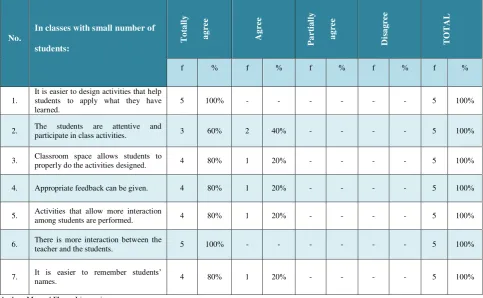
[image:29.595.85.569.417.715.2]What are the benefits of teaching and learning English in small classes?
Table 1 Teachers’ Perceptions
No.
In classes with small number of
students: To
ta ll y ag ree A gree P art ia ll y ag ree D is ag ree TOTA L
f % f % f % f % f %
1.
It is easier to design activities that help students to apply what they have
learned. 5 100% - - - 5 100%
2. The students are attentive and participate in class activities. 3 60% 2 40% - - - - 5 100%
3. Classroom space allows students to properly do the activities designed. 4 80% 1 20% - - - - 5 100%
4. Appropriate feedback can be given. 4 80% 1 20% - - - - 5 100%
5. Activities that allow more interaction among students are performed. 4 80% 1 20% - - - - 5 100%
6. There is more interaction between the teacher and the students. 5 100% - - - 5 100%
7. It is easier to remember students’names. 4 80% 1 20% - - - - 5 100%
Author: Merced Flores Limongi
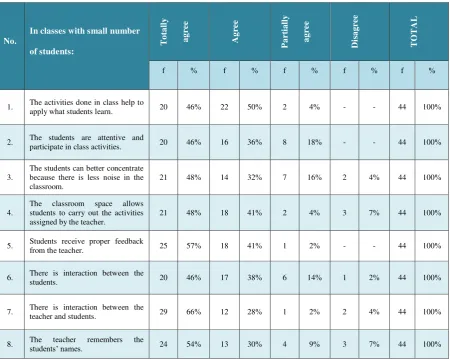
Table 2 Students’ Perceptions
No.
In classes with small number
of students: To
ta ll y ag ree A gree P art ia ll y ag ree D is ag ree TOTA L
f % f % f % f % f %
1. The activities done in class help to apply what students learn. 20 46% 22 50% 2 4% - - 44 100%
2. The students are attentive and participate in class activities. 20 46% 16 36% 8 18% - - 44 100%
3.
The students can better concentrate because there is less noise in the classroom.
21 48% 14 32% 7 16% 2 4% 44 100%
4.
The classroom space allows students to carry out the activities assigned by the teacher.
21 48% 18 41% 2 4% 3 7% 44 100%
5. Students receive proper feedback from the teacher. 25 57% 18 41% 1 2% - - 44 100%
6. There is interaction between the students. 20 46% 17 38% 6 14% 1 2% 44 100%
7. There is interaction between the teacher and students. 29 66% 12 28% 1 2% 2 4% 44 100%
8. The teacher remembers the
students’ names. 24 54% 13 30% 4 9% 3 7% 44 100%
Author: Merced Flores Limongi
Source: Teachers from two institutes and three high schools.
According to the results of the questionnaires, all five teachers totally agreed that in small classes it is easier to design activities that help students to apply what they have learned, they represent the 100% of the total number of teachers; furthermore, the majority of the students agreed with topic; twenty students totally agreed that in small classes the activities done help them to apply what they have learned, which corresponds to the 46%; twenty-two students agreed, they represent the 50%; and two students partially agreed, which
In addition, the observations showed that in all five classes the students did activities which permitted to practice what they had learned without any difficulty; thus, the results of the observations support the responses of the teachers and the students.
The difference was the kind of the activities; in two institutions the students spent all of their class time on writing exercises such as completing sentences whereas in the other
institutions, the students did written exercises, and also they watched videos, they shared their views, and they did listening, reading and speaking exercises.
These kinds of activities permitted students to engaged and participate more in the lesson; according to this, Finn and Wang (2002) state that small classes give the teacher the opportunity to apply strategies which help to improve the student engagement because in small classes the teachers have time to plan and supervise the development of their students and their activities in order to make the class more practical.
Referring to the statement that in small classes the students are attentive and participate in class activities, three teachers totally agreed, which corresponds to 60%; and two teachers agreed, which represents the 40% of the total number of teachers; these results are similar to the responses of the students in which twenty of them totally agreed with the above statement, which corresponds to 46%; sixteen students agreed, which is equivalent to 36%; and eight students partially agreed, which means the 18% of the total number of students.
According to the observations done, only the students from both institutes were really attentive and they participated more in the class activities, whereas in two high schools some of the students were distracted and only some of them participated in class; and the students from the last high school were attentive but only one of them participated in all class
were attentive and participated in class. As stated by Lee (2005), in small classes students seem to be interested in the lesson and participate more because the teachers use more practical instructions.
Continuing with the analysis, the majority of the students agreed that in small classes they can better concentrate because there is less noise in the classroom; twenty-one students totally agreed, they represent the 48% of the total; fourteen students agreed, which
corresponds to 32%; seven partially agreed, which is equivalent to 16%; and two students disagreed, they represent the 4% of the total.
The observations done support the responses of the students because in three
institutions they were concentrated and there was not much noise in the classroom; only some of the students from the last two institutions were distracted because they talk very much among them making noise during the lesson; consequently, the minority of the students were not concentrated during the entire class; to avoid this kind of noise Ming-tak and Wai-shing (2008) suggest that it is necessary to establish rules to maintain a correct behavior in the classroom.
In addition, Heishman and Kochhar (2010, p.216) state that in small classes there are “less noise and fewer distractions” which are related to the accomplishments of the students.
Furthermore, the observations done showed that in four of the five institutions there was enough classroom space to allow adequate development of activities; on the other hand, in the other institution the space was very limited; however, during the observation the students did activities which were according to their classroom space; in conclusion, the results of the observations support the responses of the teachers and the students.
According to this topic, Marsh (2010) states that in small classes there is more available space to do activities and to place the necessary equipment.
Continuing with the analysis, four teachers totally agreed that in classes with small number of students they provide an appropriate feedback, they represent the 80% of the total number of teachers; and two teachers agreed, which means the 20% of the total; similar to these results, twenty-five students totally agreed with the fact that in small classes they receive proper feedback from the teachers, which is equivalent to 57%; eighteen students agreed, which corresponds to 41%; and one student partially agreed, which represents the 2%; the majority of the responses of the students agree with this topic and with the responses of the teachers.
The observations done showed that in all institutions the teachers provided an
appropriate feedback; but, they provided a better feedback in those institutions in which there were less than five students per classroom; thus, the results of the observations support the responses of the teachers and the students.
Regarding feedback, Ranga (2006) considers that in small groups the students receive personal attention which helps their different needs, and they are engaged in their own learning; additionally, Lee (2005) agrees that in small classes the students receive more feedback.
represents the 80% of the total number of teachers; and one teacher agreed, which is
equivalent to 20%; similar to the responses of the teachers, twenty students totally agreed that in small classes there is interaction among them, which corresponds to 46%; seventeen students agreed, which is equivalent to 38%; six students partially agreed, which represents the 14%; and one student disagreed, which means the 2% of the total; although there were different responses of the students, the majority of them agree with this topic and with the responses of the teachers.
Even though most of the teachers totally agreed, the observations showed that only in three institutions the students did activities which permitted to practice among them; on the other hand, the activities observed in the other institutions were more individual; however, the observations agree with the responses of the teachers and the students because in the majority of the institutions the activities that allow more interaction among students were performed. About the importance of student-student interaction, Caspari, Kuhlthau and Maniotes (2007) state that in small classes the principal way of interaction is conversing; the students have more opportunities to talk when they are in groups of five or six members; in fact, they have the chance to express their thinking, ask questions, and get different views; furthermore, students feel in comfort when they take a chance to express their thinking and opinions; additionally, Jonson (1995, p.117) states, “…student-student interaction has the potential to play an important role not only in shaping the patterns of communication in second language classrooms but in creating opportunities for students to use language for classroom learning and second language acquisition.”
All teachers totally agreed that in small classes there is more teacher-students
interaction, which represents the 100% of the total number of teachers; furthermore, twenty-nine students totally agreed that teachers interact more with them in classes with small
28%; one student partially agree, which means the 2%; and two students disagreed, which represents the 4% of the total; although there were different responses of the students, the majority of them agree with this topic and with the responses of the teachers.
In addition, the observations showed that in all institutions there was interaction between teachers and students, which supports to the responses of both questionnaires; according to this, Lee (2005) states that there is more interaction among teacher-student in small classes; consequently, students seem to be interested in the lesson and they participate more.
The difference observed was the kind of interaction, in two institutions the interaction between the teachers and the students was based on the book activities that they were developing; making reference to this, Gebhard (2006) states that sometimes, the principal sources of teachers like textbook or a manual of teachers do not allow the deeper interaction that teachers desire to have in classroom; to encourage that interaction, teachers should go further the text or add new activities which are not related to it; for instance, teachers can introduce role plays, games, songs, movies, plan trips, tell stories, etc. On the other hand, the activities performed in the other three institutions were not only from the books;
Even though the minority of the students disagreed, the observations showed that all teachers called their students by their names, so the observations support the responses of the teachers and the students.
Making reference to the importance of knowing the names of the students, Jason and Westberg (1996, p.69) state that “Calling learners by their names helps in building
relationships with them.”
Based on all of the above results, there are many benefits of teaching and learning English in classes with small number of students; first of all, the amount of students allows teachers to design activities in order that students can apply what they have learned; second, the students have more participation in class because they do not have to contend for their turn to talk; third, teachers can provide an adequate feedback because they have more time to spend for each student giving them a personal attention that they need; fourth, there is more interaction between teacher and students because the teacher has enough time to interact with them; fifth, in small classes teachers can remember the names of the students which improve the relationship among them; and finally, the classroom space allows students an adequate development of activities assigned by the teacher.
What teaching strategies and resources benefit the teaching of English in small classes?
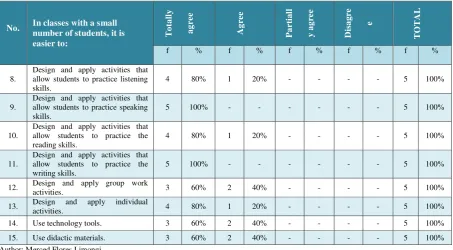
Table 3 Teachers’ Perceptions
No. In classes with a small number of students, it is
easier to: To
ta ll y ag ree A gree P art ia ll y ag ree D is ag re e TOTA L
f % f % f % f % f %
8.
Design and apply activities that allow students to practice listening skills.
4 80% 1 20% - - - - 5 100%
9.
Design and apply activities that allow students to practice speaking skills.
5 100% - - - 5 100%
10.
Design and apply activities that allow students to practice the reading skills.
4 80% 1 20% - - - - 5 100%
11.
Design and apply activities that allow students to practice the
writing skills. 5 100% - - - 5 100%
12. Design and apply group work activities. 3 60% 2 40% - - - - 5 100%
13. Design and apply individual activities. 4 80% 1 20% - - - - 5 100%
14. Use technology tools. 3 60% 2 40% - - - - 5 100%
15. Use didactic materials. 3 60% 2 40% - - - - 5 100% Author: Merced Flores Limongi
Source: Teachers from two institutes and three high schools.
Table 4 Students’ Perceptions
No. In classes with a small
number of students: To
ta ll y ag ree A gree P art ia ll y ag ree D is ag ree TOTA L
f % f % f % f % f %
9. The activities done allow students to practice the listening skills. 25 57% 19 43% - - - - 44 100%
10. The activities done allow students to practice the speaking skills. 21 48% 21 48% 2 4% - - 44 100%
11. The activities done allow students to practice the reading skills. 19 43% 21 48% 4 9% - - 44 100%
12. The activities done allow students to practice the writing skills. 22 50% 20 46% 2 4% - - 44 100%
13. Group work activities are used. 21 48% 17 39% 5 11% 1 2% 44 100%
14. Individual activities are used. 23 52% 18 41% - - 3 7% 44 100%
15. Technological tools are used. 12 28% 16 36% 14 32% 2 4% 44 100% 16. Didactic materials are used. 12 28% 24 54% 5 11% 3 7% 44 100% Author: Merced Flores Limongi
[image:37.595.84.539.504.748.2]According to the results of the questionnaires, four teachers totally agreed that in small classes it is easier to design and apply activities that allow students to practice listening skills, which is equivalent to 80%; and one teacher agreed, which represents the 20% of the total number of teachers; likewise, twenty-five students totally agreed that in classes with small number of students the activities done allow them to practice listening skills, they represent the 57% of the total; and nineteen students agreed, which corresponds to 43%; according to this, the responses of the students agree with this topic and with the responses of the teachers. Additionally, the observations showed that in three institutions the students did
listening exercises which permitted them to develop their listening skills; thus, the observations support the responses of the teachers and the students.
Referring to this topic, Verghese (1989) expresses that it is important to develop listening exercises because that prepares students to comprehend what they listen in real circumstances. Furthermore, Kottler, Kottler and Street (2008, p.110) state that teachers can encourage the listening skills through activities that permit students to talk in pairs, in groups or in the whole class; this kind of activities have the following benefits: “Promoting reasoning skills;
Furthermore, the observations showed that in all institutions the students developed activities which permit them to practice their speaking skills; therefore, the results of the observations agree with the responses of both questionnaires.
The importance of developing speaking skills is supported by Caspari, Kuhlthau and Maniotes (2007, p.144) who express that the principal way of interaction is conversing; also, they state that “Through small group conversation students clarify their ideas and construct knowledge by thinking and reflecting with each other.” In order to foster learning, teachers have to involve students in conversations through tactics of listening, modeling, and
encouraging them to talk. Furthermore, Hill and Miller (2013) add that maintaining the groups small is in general reasonable for all students, but it specially makes sense for students who learn English because they feel relaxed to speak using their new language in small groups; also, the students have more time to talk when they are in small groups because they do not have to contend with their other classmates to be heard; additionally to this, small groups permit to monitor the comprehension and to regulate the level of verbal
communication in the lesson.
Continuing with the analysis, four teachers totally agreed that in small classes it is easier to design and apply activities that allow students to practice reading skills, which represents the 80% of the total number of teachers; and one teacher agreed, which is
equivalent to 20%; similar to the responses of the teachers, the majority of the students agreed that in small classes the activities done allow them to practice the reading skills; nineteen students totally agreed, which means the 43%; twenty-one students agreed, which corresponds to 48%; and four students partially agreed, which represents the 9%.
According to Gebhard (2006, p.196) “Students learn to process what they read by reading”; this author states the benefits of applying reading activities in the classroom; he
expresses that teachers have to design activities that allow students to read as much as they can; as a result, the students acquire new vocabulary; they feel familiar with the new language; and they know the types of the text; similarly, Aslam (2003) adds other benefits; this author states that when students are learning a foreign language, reading includes understanding and comprehension the message from the written text; consequently, a good reader can separate the information that is relevant and irrelevant for him.
All of the five teachers totally agreed that in classes with small number of students it is easier to design and apply activities that allow students to practice writing skills, which is equivalent to 100% of the total number of teachers; likewise, the majority of the students agreed that in small classes the activities done allow them to practice writing skills; twenty-two students totally agreed, which represents the 50%; twenty students agreed, which is equivalent to 46%; and two students partially agreed, which represents the 4%.
In addition, the observations done support the responses of the teachers and the students because in three institutions the teachers developed activities which allowed students to improve their writing skills. When students have the opportunity to practice writing activities, Ediger, Dutt, and Rao (2003, p.81) express that those students are able to “write the letters of the alphabet at a reasonable speed; spell the words correctly; recall appropriate words and put them in sentences; use appropriate punctuation marks; link sentences with appropriate
sentence connectors and sequence signals; use the form and register appropriate for the subject matter and audience.”
furthermore, the majority of the students agreed that in small classes group work activities are used, twenty-one students totally agreed; which means the 48%; seventeen students agreed, which corresponds to 39%; five students partially agreed, which is equivalent to 11%; and one student disagreed, which represent the 2 %; although there were different responses of the students, the majority of them agree with the responses of the teachers.
In order to emphasize the importance of group work activities, Caspari, Kuhlthau and Maniotes (2007) express that small groups permit students to work together; as a result of this interaction, the students meet each other better and they know their ways of work; also, that permits that students be collaborative with other classmates. Furthermore, Mercer and Littleton (2007, cited by Bradford, Jones, Wolpert and Wyse 2013) express that activities in group permit students to improve their linguistic and social skills which are necessary for cooperation and collaboration; they use their new language to communicate, to transmit their ideas, and to support the contributions. In spite of the benefits mentioned above, the
observations done showed that only in two institutions group work activities were used; consequently, the observations do not support the responses of the teachers and the students. Most teachers totally agreed that in classes with small number of students it is easier to design and apply individual activities; four teachers totally agreed, which is equivalent to 80% of the total number of teachers; and one teacher agreed, which represents the 20%; similar to the responses of the teachers, twenty-three students totally agreed that in small classes individual activities are used, which means the 52%; eighteen students agreed, which corresponds to 41%; and three students disagreed, which represents to 7%; although there were different responses of the students, the majority of them agreed with this topic.
To support individual activities, Richards and Farrell (2011, p.109) state that
“Individual work allows students to work at their own pace and to work on activities suited to their proficiency level or interests”; furthermore, Waterhouse and Dickinson (2001) explain that students should be given the opportunity to work individually with a previous explanation and an extra support if it is necessary; in addition, Branson and Goodwyn (2005) express that individual activities are likely to be used when the students have concluded a lesson in order to apply what they have learned.
Continuing with the analysis, three teachers totally agreed that in classes with small number of students it is easier to use technological tools, which represents the 60% of the total number of teachers; and two agreed, which is equivalent to 40%; in addition, the majority of the responses of the students agree with the responses of the teachers; twelve students totally agreed that in small classes technological tools are used, which represents the 28%; sixteen students agreed, which corresponds to 36%; fourteen students partially agreed, which represents the 32%; and two students disagreed, which refers to 4%; although there were different responses of the students, the majority of them agreed with this topic
In respect of using didactic materials in classes with small number of students, three teachers totally agreed, which is equivalent to 60%; and two teachers agreed which represents the 40% of the total number of teachers; moreover, the majority of the students agreed that in small classes the didactic materials are used; in fact, twelve students totally agreed, which corresponds to 28%; twenty-four students agreed, which is equivalent to 54%; five students partially agreed, which means 11%; and three students disagreed, which represents the 7%; although there were different responses of the students, the majority of them agree with the responses of the teachers.
The observations done showed that in four institutions the students used didactic materials, whereas in the other institution the teacher used only the board to teach the lesson; thus, the results of the observations support the responses of the teachers and the students. The benefits of using didactic materials are stated by Dash and Dash (2007) who express that they help students to relate definitions with concrete practices; didactic materials aid students to shape images about meanings; also, they permit students to have a better acquire of a concept; consequently, they can retain it longer.
Based on the results, there are many teaching strategies and resources which benefit the teaching of English in classes with small number of students; first, the four skills can be developed easier in small classes, especially speaking. The amount of students allows teachers to develop reading and writing activities with more control and more feedback which are necessary to improve these skills; furthermore, the teachers can develop more speaking activities in small classes because students have more opportunities to participate;
Second, individual activities can be developed better in small classes because the amount of students permits teacher to monitor their learning advance and give a better feedback.
Finally, the technology resources and didactic materials benefit the teaching and learning of English in classes with small number of students; the technology resources allow students to learn according to their different needs; also, students can learn and feel
comfortable at the same time. Similarly, the didactic materials benefit the learning process because they permit students to understand and clarify different concepts and to practice what they have learned. If teachers use technological tools and didactic materials in small classes, they can have more control on the process of learning of students, they can continually check their activities, and they can give a correct feedback according to the needs of the students; consequently, the students can successfully learn. On the other hand, based on the results of the questionnaires, group work activity is not a strategy used to benefit the teaching of English in classes with small number of students.
How do students feel about learning English in small classes?
Table 5 Teachers’ Perceptions
No. In classes with small number
of students, To
ta ll y ag ree A gree P art ia ll y ag ree D is ag ree TOTA L
f % f % f % f % f %
16. They are relaxed when speaking in front of their classmates. 3 60% 2 40% - - - - 5 100%
17.
They are taken into account by the teacher because they have more opportunities to participate in the class.
5 100% - - - 5 100%
18.
They are motivated to participate because of the small number of
students. 3 60% 2 40% - - - - 5 100%
19.
They are at ease because they can healthy compete with their
classmates. 4 80% 1 20% - - - - 5 100%
Author: Merced Flores Limongi
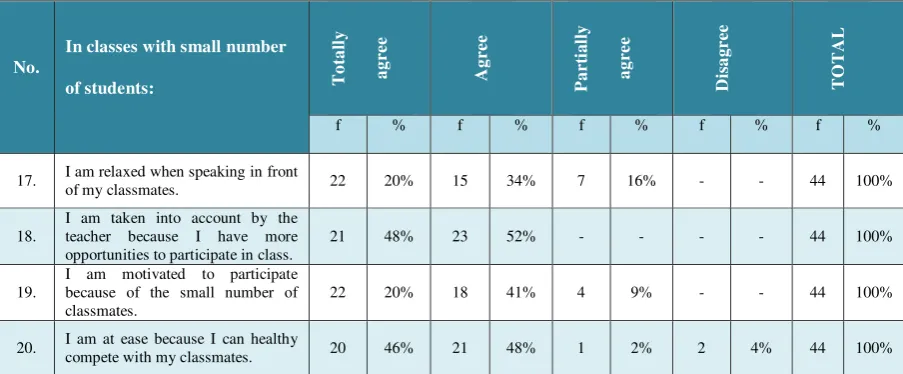
Table 6 Students’ Perceptions
No. In classes with small number
of students: To
ta ll y ag ree A gree P art ia ll y ag ree D is ag ree TOTA L
f % f % f % f % f %
17. I am relaxed when speaking in front of my classmates. 22 20% 15 34% 7 16% - - 44 100%
18.
I am taken into account by the teacher because I have more opportunities to participate in class.
21 48% 23 52% - - - - 44 100%
19. I am motivated to participate because of the small number of classmates.
22 20% 18 41% 4 9% - - 44 100%
20. I am at ease because I can healthy compete with my classmates. 20 46% 21 48% 1 2% 2 4% 44 100%
Author: Merced Flores Limongi
Source: Students from two institutes and three high schools.
According to the results of the questionnaires, three teachers totally agreed that in small classes the students are relaxed when speaking in front of their classmates, which is
equivalent to 60% of the total number of teachers; and two teachers agreed, which
corresponds to 40%; in addition, the responses of students agree with this topic and with the responses of the teachers; twenty-two students totally agreed, which represents the 50%; fifteen students agreed, which corresponds to 34%; and seven students partially agreed, which means the 16%. These results are supported by the observations done because in four
institutions the students seemed relaxed when they interacted with their teacher or participated in an activity; on the other hand, in the other institution in which there were only two students, one of them seemed relaxed to speak and the other student did not.
To support this topic, Hill and Miller (2013) add that maintain the groups small is in general reasonable for all students, but it specially make sense for students who learn English because they feel relaxed to speak using their new language in small groups.
opportunities to participate in class, which is equivalent to 100% of the total number of teachers; similar to these responses, the majority of the students agreed with the same topic; twenty-one students totally agreed, which represents the 48%; and twenty-three students agreed, which corresponds to 52%. The observations done support the responses of the teachers and the students because in all institutions the students were taken into account to participate during the lesson.
In addition, Caspari, Kuhlthau and Maniotes (2007) states that students have more opportunities to talk when they are in groups of five or six members; in fact; they have the chance to express their thinking, ask questions, and get different views; consequently, students feel in comfort when they take a chance to express their thinking and opinions. In respect of the motivation of students to participate, three teachers totally agreed that in small classes the students are motivated to participate because of the small number of them, which is equivalent to 60% of the total number of teachers; and two teachers agreed, which corresponds to 40%; similar to the responses of the teachers, the majority of the students agreed with this topic; in fact, twenty-two students totally agreed, which represents the 50%; eighteen students agreed, which means 46%; and four students partially agreed, which is equivalent to 9%.
With regard to healthy student competition, four teachers totally agreed that in small classes the students are at ease because they can healthy compete with their classmates, which corresponds to 80% of the total number of teachers; and one teacher agreed, which is
equivalent to 20%; likewise, most of the students agreed with this topic; twenty of them totally agreed, which represents the 46%; twenty-one students agreed, which represents the 48%; one student partially agreed, which is equivalent to 2%; and two students disagreed, which means 4% of the total number of students; although there were different responses of the students, the majority of them agree with the responses of the teachers.
Furthermore, the observations done showed that in all five institutions there was a healthy competition between students; so the results of the observations support the responses of the teachers and the students. To support the results about the healthy student competition, Hill and Miller (2013) express that students have more time to talk when they are in small groups because they do not have to contend with their other classmates to be heard.
Based on the above results, the students are relaxed to speak in English in small classes because they are few; consequently, they feel in comfort and motivated to participate in a non-intimidating environment; furthermore, the amount of students in small groups permits that they feel into consideration because they have more opportunities to participate in class; finally, in classes with small number of students they have a healthy competition with their classmates because they do not have to compete to be heard or to participate.
Although students in small classes feel in comfort, the teachers have a great impact in them, too; in classes with small number of students in which the teachers do not take
Are there any limitations when teaching English in small classes?
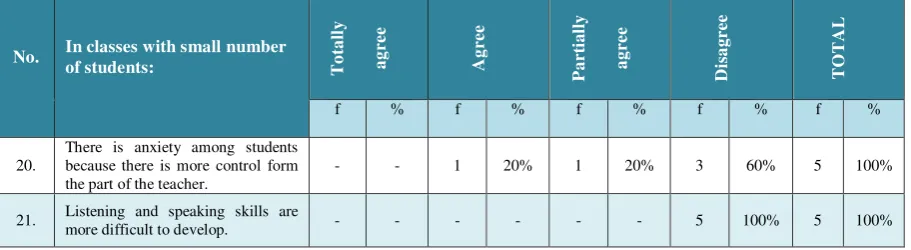
Table 7 Teachers’ Perceptions
No. In classes with small number of students:
To ta ll y ag ree A gree P art ia ll y ag ree D is ag ree TOTA L
f % f % f % f % f %
20.
There is anxiety among students because there is more control form the part of the teacher.
- - 1 20% 1 20% 3 60% 5 100%
21. Listening and speaking skills are more difficult to develop. - - - 5 100% 5 100%
Author: Merced Flores Limongi
[image:48.595.86.542.170.295.2]Source: Teachers from two institutes and three high schools.
Table 8 Students’ Perceptions
No. In classes with small number of students:
To ta ll y ag ree A gree P art ia ll y ag ree D is ag ree TOTA L
f % f % f % f % F %
21.
There is anxiety among students because there is more control form the part of the teacher.
14 32% 18 41% 8 18% 4 9% 44 100%
22. Listening and speaking skills are more difficult to develop. 5 11% 20 46% 14 32% 5 11% 44 100%
Author: Merced Flores Limongi
Source: Students from two institutes and three high schools.