On: 14 July 2011, At: 02:26 Publisher: Psychology Press
Informa Ltd Registered in England and Wales Registered Number: 1072954 Registered office: Mortimer House, 37-41 Mortimer Street, London W1T 3JH, UK
The Quarterly Journal of Experimental
Psychology
Publication details, including instructions for authors and subscription information:
http://www.tandfonline.com/loi/pqje20
Making the uncontrollable seem controllable:
The role of action in the illusion of control
Fernando Blanco ab , Helena Matute b & Miguel A. Vadillo ba
Department of Psychology, University of Leuven, Leuven, Belgium b
Departamento de Fundamentos y Métodos de la Psicología, University of Deusto, Bilbao, Spain
Available online: 22 Mar 2011
To cite this article: Fernando Blanco, Helena Matute & Miguel A. Vadillo (2011): Making the uncontrollable
seem controllable: The role of action in the illusion of control, The Quarterly Journal of Experimental Psychology, 64:7, 1290-1304
To link to this article: http://dx.doi.org/10.1080/17470218.2011.552727
PLEASE SCROLL DOWN FOR ARTICLE
Full terms and conditions of use: http://www.tandfonline.com/page/terms-and-conditions
This article may be used for research, teaching and private study purposes. Any substantial or systematic reproduction, re-distribution, re-selling, loan, sub-licensing, systematic supply or distribution in any form to anyone is expressly forbidden.
Making the uncontrollable seem controllable:
The role of action in the illusion of control
Fernando Blanco1,2, Helena Matute2, and Miguel A. Vadillo2 1Department of Psychology, University of Leuven, Leuven, Belgium
2Departamento de Fundamentos y Me´todos de la Psicologı´a, University of Deusto, Bilbao, Spain
It is well known that certain variables can bias judgements about the perceived contingency between an action and an outcome, making them depart from the normative predictions. For instance, previous studies have proven that the activity level or probability of responding, P(R), is a crucial variable that can affect these judgements in objectively noncontingent situations. A possible account for the P(R) effect is based on the differential exposure to actual contingencies during the training phase, which is in turn presumably produced by individual differences in participants’ P(R). The current two experiments replicate the P(R) effect in a free-response paradigm, and show that participants’ jud-gements are better predicted by P(R) than by the actual contingency to which they expose themselves. Besides, both experiments converge with previous empirical data, showing a persistent bias that does not vanish as training proceeds. These findings contrast with the preasymptotic and transitory effect predicted by several theoretical models.
Keywords: Contingency learning; Illusion of causality; Action; Cue density bias; Superstition.
Scientists would agree nowadays that every animal’s cognitive system has been moulded by natural selection, becoming more and more effi-cient at affecting the environment with its behav-iour, with the goal of producing desirable outcomes and avoiding the undesirable ones. Learning about the effects of one’s behaviour on the world is thus part of this adaptive strategy. Thanks to this ability, animals can evaluate to what extent their actions are useful and effective at producing relevant changes in the environment
and adapt their behaviour consequently. For instance, it is this ability that allows people to know whether taking a medicine increases the chances of recovering from an illness, thus even-tually leading to a regular use of the medicine.
But, how does this knowledge about the causal links between the actions and their outcomes emerge? It is a sensible assumption that animals adapt their behaviour on the basis of the pattern of covariation between their prior actions and the outcomes they observe (Jenkins & Ward, 1965).
Correspondence should be addressed to Helena Matute, Laboratorio de Psicologı´a Experimental, Universidad de Deusto, Apdo. 1, 48080 Bilbao, Spain. E-mail: [email protected]
Support for this research was provided by Direccio´n General de Investigacio´n of the Spanish Government (SEJ2007–63691/ PSIC) and Departamento de Educacio´n, Universidades e Investigacio´n of the Basque Government (IT363–10). Fernando Blanco was supported by a fellowship from the Basque Government (BFI081.20.0). We thank Mathijs Franssen, Samuel Hannah, and Ion Yarritu for their helpful comments on an earlier version of this article.
1290
#2011 The Experimental Psychology Societyhttp://www.psypress.com/qjep DOI:10.1080/17470218.2011.552727 2011, 64 (7), 1290 –1304
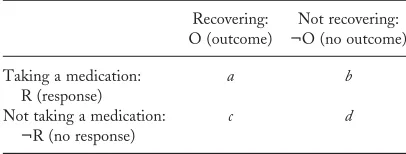
The covariation between two binary variables such as taking (or not taking) a medicine and recovering (or not recovering) from a disease can be summar-ized in a 2×2 matrix like that shown in Table 1, which contains the joint frequencies of the four possible action– outcome combinations. In Type
a events, the action is carried out (R), and the outcome follows (O); in Type b events, the action is carried out (R), yet the outcome does not occur (:O); in Typecevents, no action is per-formed (:R), but the outcome occurs (O); and finally, in Typedevents, neither the action (:R) nor the outcome (:O) takes place. For an action to be causally effective, the outcome must be contingent upon it—assuming that no additional variables are affecting their covariation. The most widely used normative index of contingency, DP (Allan & Jenkins, 1983; Jenkins & Ward, 1965), can be easily derived from the matrix in Table 1:
DP=P(O|R) −P(O|¬R) = a
a+b− c c+d
According to theDP index, if the probability of recovering from the disease when the medicine has been taken, P(O|R), is higher than the probability of recovering when the medicine has not been taken, P(O|:R), then one must acknowledge that taking the medicine is effective up to a certain extent (i.e., DP is higher than 0). But, if both conditional probabilities turned to be equal, it should be clear that the medicine has no effect on the disease whatsoever (i.e.,DP equals 0).
Experimenters have shown that people are capable of emitting normatively accurate (i.e., close to the output yielded by the DP index)
judgements of contingency (Shanks, 1995; Shanks & Dickinson, 1987; Ward & Jenkins, 1965; Wasserman, 1990b). But, on the other hand, reports of biases and systematic departures from the normative rule are also frequent (Alloy & Abramson, 1979; Chapman & Chapman, 1967; Matute, 1996). For instance, under some circumstances, people are likely to believe that they can control an outcome that is, in fact, inde-pendent of their behaviour. This effect was called the “illusion of control” (Langer, 1975; Matute, 1995; Matute, Vadillo, Vegas, & Blanco, 2007).
The illusion of control is known to be modulated by certain variables. The most relevant one, for our current purposes, is the probability of responding, P(R): that is, the frequency with which participants decide to respond. One of those few studies that directly studied the effect of this variable was conducted by Matute (1996). In her experiment, participants were allowed to decide when they wanted to respond—that is, to press a key—in order to make the computer play a tone (i.e., the outcome). These tones were actually prepro-grammed to appear randomly. Thus, the outcomes were uncontrollable. However, they were presented with high frequency in every condition (meaning that the overall probability of the outcome was high and fixed). Additionally, the P(R) was manipulated so that half of the participants were asked to press the key very often, and the other half were asked to press the key in only 50% of the trials. After the training phase, those partici-pants who pressed the key frequently gave higher judgements of control than those in the medium P(R) group, despite the outcome being completely uncontrollable for all participants. This was an early demonstration of the P(R) effect on the judgements of control: As the P(R) increased, so did the chances to develop an illusion of control over an actually uncontrollable outcome.
[image:3.536.56.259.543.620.2]Several studies have shown similar patterns of results (Blanco, Matute, & Vadillo, 2009; Hannah & Beneteau, 2009). But, to our knowledge, the effect of P(R) on judgements of contingency lacks a definitive explanation, and therefore it still demands further research. One possible account (Hannah, Allan, & Siegel, 2007; Matute, 1996) is
Table 1.Contingency matrix containing the four possible response– outcome combinations
Recovering: O (outcome)
Not recovering:
:O (no outcome)
Taking a medication: R (response)
a b
Not taking a medication:
:R (no response)
c d
that experiencing a high number of fortuitous coincidences between the response, R, and the uncontrollable outcome, O (i.e., Type a trials), may lead to the participant’s exposure to a contin-gency value higher than zero. Intuitively, one might think that the contingency between responses and completely uncontrollable (thus, not causally related) outcomes should be always zero. But none-theless, this does not need to be the case, and indeed the real life is full of situations where an uncontrol-lable outcome can incidentally be contingent upon a response that has no control over it. This is because outcomes do not stop appearing just because they are not controllable, rather they continue appearing independently of the participant’s behaviour, but according to the states of their actual causes. This allows some chance that both events, R and O, could coincide from time to time. Imagine the case of a bogus medicine that cannot increase your chances of recovering from a cold. The fact that you take the ineffective treatment every time you have a cold (i.e., high probability of responding) will not make you stay ill forever. Rather, you may recover from the colds sooner or later (i.e., high probability of recovering), and since these recoveries may incidentally coincide with the innocuous medicine, the illusion of a successful treatment would arise.
Indeed, in Matute’s (1996) experiment, partici-pants were told how often to respond, but they themselves freely decided when to respond. In her task, the uncontrollable outcomes appeared in random order with a certain fixed—and high—probability regardless of participants’ responses. Thus, responding very often should lead to a higher chance of accidental concurrence between the response and the outcome (i.e., Typeatrials). According to Equation 1, this indi-vidual variability in the P(R) exerts an impact on the actually experienced contingency. Specifically, being exposed to a higher number of Type a
trials would increase the final value ofDP, yielding a positive number even in an objectively noncon-tingent setting. Note that this is especially likely to occur when the sequence of trials is relatively brief, for the small sample of trials maximizes the impact of chance in the proportions of each type
of cell. Matute (1996) suggested that this hypothe-tical increase in the actual contingency was at the basis of the illusion, but she did not test it. Her experiment did not allow her to explore this poten-tial account for the P(R) effect, because the actual contingencies experienced by the participants were not computed. Therefore, our Experiment 1 is aimed at testing the hypothesis that the more active participants are exposed to positive contin-gency values during the objectively noncontingent training, and that this exposure is at the basis of their subsequent high contingency ratings.
Importantly, these predictions were already tested in a previous study carried out by Hannah and Beneteau (2009). These authors developed the “command-performance” procedure, in which participants are told to respond on certain trials and not on others, thus controlling for the contin-gency to which they are actually exposed. According to the conclusions from their research, P(R) can bias judgements even when the actual contingency is held constant. Nonetheless, this evi-dence was obtained by means of an unusual para-digm. We admit that the command-performance procedure possesses a decent amount of ecological validity (e.g., people’s behaviour is very often triggered by presentation of certain stimuli, such as traffic lights or a supervisor’s directives). However, the instances of free-response paradigms are more widely spread in everyday life than the command-performance paradigm. Moreover, they are also more relevant from a historical and theoretical viewpoint, since most of the classical studies in active contingency learning, especially those conducted with human beings in the illusion of control tradition, made use of free-response procedures (e.g., Alloy & Abramson, 1979). Hence our current two experiments were conducted under a free-response paradigm.
In addition to this, it must be noted that the command-performance procedure used by Hannah and Beneteau (2009) removes some degree of volition from the participant’s decision making thorough the experimental session. This leaves open the question of whether a P(R) effect similar to that obtained by these experimenters can be found in a more typical, and natural,
free-response paradigm in which this volitive component is left untouched. If we failed to repli-cate the P(R) effect in the current study, then this would suggest that some aspect of volition contrib-utes to normativity in the judgements of contin-gency. Otherwise, if we found the P(R) effect in this fully volitional situation where the agent has full control over all aspects of the decision making (i.e., when and how often to emit a response), this evidence would point out that voli-tion does not override the P(R) bias, thus suggesting that decision making in active scenarios is very similar (i.e., engages similar mechanisms) to merely observational tasks.
EXPERIMENT 1
Method
Participants and apparatus
The sample consisted of 82 students from the introductory course of Psychology at Deusto University, who volunteered to take part in the experiment. Experiment 1 was programmed with the software E-Prime for PC, and carried out in a classroom of the Department of Psychology. Participants sat 1 metre apart from each other. The experimental session lasted approximately 20 min, including instructions and postexperimen-tal debriefing.
Procedure
In Experiment 1, we programmed an instrumental task similar to that of Alloy and Abramson (1979), but adapting the cover story of the standard allergy task, which is widely used today in the research on human contingency learning (e.g., Aitken, Larkin, & Dickinson, 2000; Vadillo, Vegas, & Matute, 2004; Wasserman, 1990a). The procedure described below was intended to assess both the actual contingency to which participants exposed themselves (in a situation that was actually pro-grammed as noncontingent) and the perceived contingency they reported after training, so that both measures can be contrasted.
Participants were instructed to imagine that they were medical doctors who had to deal with a fictitious, dangerous disease called “Lindsay syn-drome” in the emergency department of a hospital. Crises induced by this rare illness could be treated with a new experimental drug, “Batatrim”, whose effectiveness had not yet been proven. Participants were also told that this medicine pro-duces severe side effects in every patient who takes it (this phrase was added just in order to make par-ticipants refrain from using the medicine all the time). A copy of the complete instructions, trans-lated from the original in Spanish, is available in the Appendix.
During the training phase, 50 medical records of different fictitious patients, all of them suffering from Lindsay syndrome, were serially presented to the participants. On each trial, participants were allowed to decide whether they wanted to give the medicine to the current patient (by pressing a key on the keyboard) or not (by doing nothing). The participants’ choices (pressing the key or not pressing it on each trial) were recorded in order to calculate the probability of responding, P(R)—that is, the number of trials on which a par-ticipant responded divided by the total number of trials (i.e., 50). Participants who preferred to inoculate the medicine frequently exhibited a high probability of responding and thus produced a high number of Type aand Type btrials (i.e., response-present trials).
After 2 s, regardless of the participant’s decision, the current patient either was healed (a happy, healthy face and the text “The patient is healed!” were presented) or remained ill (a sick face and the text“The patient has not been healed”
were presented). This feedback was showed for 2 s, before a 1-s blank screen gave way to the next trial. Importantly, outcome-present (i.e., healed patient) and outcome-absent (i.e., not healed patient) trials were presented in a randomized sequence, which was fixed and identical for all participants. We did this in order to simulate natural conditions in which desired outcomes are scheduled to occur as a function of causes that have nothing to do with participants’ behaviour. That is, the programmed contingency between responses and outcomes was
zero, and hence the outcomes were uncontrollable. Still, participants’ responses could accidentally turn out to be contingent with these outcomes, depend-ing on the precise moments (trials) in which partici-pants decided to respond. Thus, the actual contingency that participants experience would differ between individuals. For example, a prepro-grammed outcome-present (healed patient) trial will become a Typeatrial if the participant responds on that trial and a Typectrial if the participant does not respond. According to one hypothesis, this chance to fortuitous concurrence is at the basis of the illusion of control in natural situations. Thus, during the training phase, we recorded how many trials of each of the four types (a, b, c, andd) were actually experienced by each participant and then computed the value of the overall contingency that each participant was actually exposed to, as stated by theDP rule (see Equation 1).
Crucially, in some previous studies, changes in P(R) have also affected the probability with which the computer programs presented the outcome (see Hannah et al., 2007, for discussion). In our procedure, by contrast, P(O) was fixed and independent of responding. In the sequence of trials that was presented to all participants, 38 out of 50 trials were preprogrammed to show the healed patient in the feedback screen; that is, the probability of the outcome, P(O), was .76 for all participants. We decided to use this high P(O) condition because it is well known that it promotes the overestimation of contingency (Allan & Jenkins, 1983; Alloy & Abramson, 1979; Matute, 1995).
After the 50 training trials, participants had to rate the efficacy of the medicine Batatrim: “To what extent do you think Batatrim has been effective to heal the crises in the patients you have seen?”. This test question was answered numerically, in a scale ranging from 0 (labelled “Definitely not”) to 100 (labelled “Definitely yes”). Because outcomes (healings) were response independent, the programmed contingency was zero, and thus we considered that any participant whose judgement markedly departed from this value exhibited an overestimation of contingency up to a certain extent.
Results and discussion
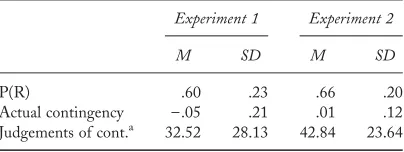
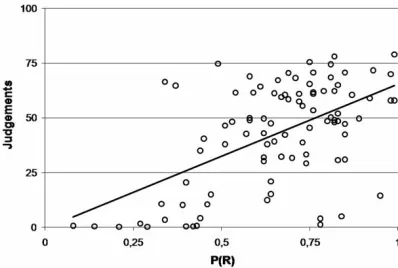
Table 2 summarizes the descriptive statistics from Experiment 1. The judgements of contingency collected after the training phase were significantly different from the programmed contingency, 0, thus revealing an overestimation of the contin-gency, t(81)¼10.46, p,.001. A simple linear regression analysis yielded a significant effect of P(R) on judgements of contingency, b¼.37,
t(81)¼3.56, p,.001. Those participants who decided to respond in most of the trials also devel-oped the strongest overestimation at the end of the training phase (Figure 1). This result, known as the P(R) effect, is consistent with previous studies (Blanco et al., 2009; Hannah & Beneteau, 2009; Matute, 1996), and it is parallel to the cue density bias reported in observational tasks in which the cue or the potential cause, C, is an external event rather than the participant’s response (Matute, Yarritu, & Vadillo, 2010; Perales, Catena, Shanks, & Gonza´lez, 2005; Vadillo, Musca, Blanco, & Matute, 2010; Wasserman, Kao, Van Hamme, Katagari, & Young, 1996).
[image:6.536.280.482.512.588.2]As reported above, we replicated the finding by Matute (1996) that higher levels of P(R) lead to higher judgements of contingency. The following analyses tested the possibility that the P(R) effect is due to the exposure of participants to different levels of actual contingency. It is interesting to point out that, despite the mean of the actual contingency experienced by participants being close to zero (M¼ – .05;SD¼.21), it was signifi-cantly different from this latter value,t(81)¼2.23,
Table 2.Descriptive statistics from Experiments 1 and 2
Experiment 1 Experiment 2
M SD M SD
P(R) .60 .23 .66 .20
Actual contingency –.05 .21 .01 .12 Judgements of cont.a 32.52 28.13 42.84 23.64
Note: P(R)¼probability of responding. aJudgements of
cont. ¼ judgements of contingency (which refers to the numerical rating provided by the participants).
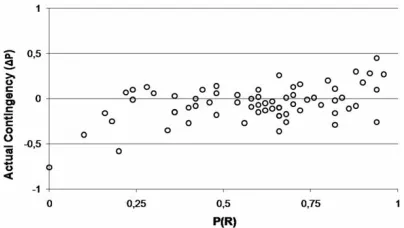
p,.05. In addition, there was some interindivi-dual variability, as can be concluded from Figure 2. Indeed, the minimum value of the actual contin-gency in our sample was – .76 (high negative contingency) while the maximum value was .45 (moderate positive contingency), despite the fact that all participants were exposed to an identical sequence of uncontrollable outcomes.1 If the observed variance in the judgements of contingency reflected differences in the actual contingencies received by participants, then we should find that the contingency values to which participants are actually exposed increase with the P(R). The ana-lyses showed that, indeed, as P(R) went up, so did
the actually experienced contingency, b¼.54,
t(81)¼5.83,p,.001 (see Figure 2).
Then a multiple regression analysis, with P(R) and actual contingency as factors, was conducted on the judgements. The extent to which the actual contingency values could predict the judgements, while controlling for the P(R) effect, was checked, yielding a nonsignificant result,
b ¼.07, t(80)¼0.59, p¼.56. In contrast, the effect of P(R) on judgements remained significant even when controlling for the effect of the actual contingency, b¼.33, t(80)¼2.64, p,.01. Thus, the effect of P(R) on judgements that we found and reported cannot be explained by the differential exposure to contingencies during the training phase.
The actual contingency values were calculated at the end of the training phase, which means that they are overall values. One could argue, then, that participants may not have based their judgements on the overall actual contingency values, but on the actual contingency values experi-enced only during the first part of training, or perhaps only during the last part of it, showing either a primacy or a recency bias. This possibility was tested by means of two simple linear regressions. Neither the contingency presented during the first 10 trials of the training phase (M ¼– .06; SEM¼.05), b¼ – .04, t(81)¼
0.39, p¼.70, nor the contingency presented during the last 10 trials of the training phase (M ¼.03;SEM¼.05), b¼ – .03,t(81)¼0.32,
p¼.75, was able to predict the subsequent judge-ments of contingency. Note that the probability of the outcome, P(O), was exactly .80 in these two blocks of the training phase. This is a high P(O) condition that warrants a fair comparison with the previous analyses on the whole learning phase (in which the probability of the outcome was also high, .76).
[image:7.536.59.259.57.192.2]Taken together, our analyses show no evidence that participant’s ratings about the efficacy of the medicine were based on the actual contingency
Figure 1. Judgements as a function of probability of responding, P(R), in Experiment 1.
Figure 2. Variability in actual contingency in Experiment 1. P(R)
¼probability of responding.
1Note that only P(R) and actual contingency were allowed to vary from one participant to another: The P(O) was identical for
every participant (38 out of 50 trials were preprogrammed as outcome present), and, therefore, the P(O) cannot be on the basis of variability in the actual contingency.
[image:7.536.58.260.243.357.2]that participants were exposed to, but they were rather directly and reliably based on P(R). This is clearly at odds with studies showing a high corre-lation between participant’s judgements of contin-gency and DP (Shanks, 1995; Shanks & Dickinson, 1987; Ward & Jenkins, 1965; Wasserman, 1990b). Nevertheless, an alternative view on our data could claim that our results are more easily accounted for by insufficient training. For example, the predictions of the Rescorla – Wagner model (Rescorla & Wagner, 1972) match those of the DP rule only when learning has reached its asymptote. If not enough training is given to participants, then the Rescorla – Wagner model predicts positive departures from the normativeDP rule in a high outcome density condition like that of our Experiment 1. Moreover, the Rescorla – Wagner model predicts that these asymptotic biases depend on P(R) as well (see the computer simulations conducted by Matute, Vadillo, Blanco, & Musca, 2007).
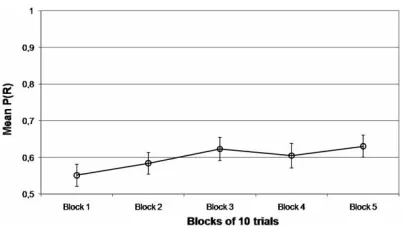
This argument leads us to consider the examin-ation of the evolution of the P(R) along the whole training phase, because this evolution represents an indirect measure of the perceived efficacy of the medicine during the training session. If partici-pants believe that using the medicine (i.e., their responding) increases the chances that the patients are healed, then they will try to maximize the benefit by keeping a high level of responding. Conversely, whenever they stop believing that giving the medicine increases the chances of success, this would lead to a response cessation that would be registered as a drop in P(R), thus indicating that the illusion is preasymptotic. Figure 3 depicts the mean P(R) in each of five blocks of 10 trials. We can conclude that partici-pants did not give up responding as the training phase proceeded. Indeed, the lowest mean P(R) value was found in the first block (M¼.55,SEM ¼.03), whereas the highest one was measured in the last block (M¼.63; SEM¼.03), and these means were significantly different,t(81)¼2.31,p
,.05. This pattern of responding during training could be taken as evidence of a persistent and even increasing belief that the outcome is controlla-ble (we reasonably assume that participants would
have stopped responding before the end of the training if they had realized that outcomes were actually response independent). As we have just remarked, associative models’ predictions (Lo´pez, Cobos, Can˜o, & Shanks, 1998; Matute, Vadillo, Blanco, et al., 2007) support the idea that the illu-sion of control and other overestimations of contin-gency are preasymptotic biases that should vanish as the training goes further. Therefore, our current finding is at odds with this particular prediction.
EXPERIMENT 2
Experiment 2 was conducted in order to ensure that results from Experiment 1 were reliable and not attributable to insufficient training. In Experiment 2, the number of training trials was increased such that learning was taken closer to the asymptote than in Experiment 1. Notice that the procedure in Experiment 1 features already a much longer training session (i.e., 50 trials) than most associative learning paradigms. Thus, using an even longer procedure in Experiment 2 allows us to check whether bringing the response level closer to the asymptote results in the overestima-tion of contingency and the P(R) effect wearing off, as predicted by certain associative models. Interestingly, this constitutes additional motiv-ation to examine the evolution of P(R) over the course of the training phase, as an indirect, online measure of the participants’ beliefs of causality.
[image:8.536.280.481.57.171.2]Moreover, increasing the number of trials should lead to a lesser impact of each participant’s
Figure 3. Mean probability of responding, P(R), during training in Experiment 1. Error bars depict the standard error of the mean.
particular choices on the actual overall contin-gency, keeping it closer to the programmed value than in the previous experiment. Therefore if, as suggested by the results from Experiment 1, the P(R) has a much stronger impact on judgements of contingency than the actual contingency experi-enced by participants, we should still observe a P(R) effect on the judgements in Experiment 2, even when most participants are now more likely to be exposed to an actual contingency of zero. In other words, Experiment 2 lets us examine the P(R) effect while controlling empirically for the actual contingency value.
Method
Participants and apparatus
Ninety-two anonymous students from the intro-ductory course of Psychology at Deusto University volunteered to take part in the experiment. This experiment was programmed in E-Prime and was conducted in a classroom of the Department of Psychology at Deusto University, in similar conditions to those of Experiment 1.
Procedure
We used the same procedure as that in Experiment 1, but doubled the number of trials in the training phase. Out of 100 trials in the current experiment, 75 were programmed to be outcome-present trials (i.e., 75% of the patients were healed, and thus the probability of the outcome is .75). The outcomes were presented in a randomized sequence, identi-cal for all the participants and independent of their responses.
Results and discussion
Table 2 summarizes the descriptive statistics for P(R), actual overall contingency, and judgements of contingency in Experiment 2. Mean judgements were significantly higher than 0, which is the pro-grammed contingency value, t(91)¼17.38, p ,
.001, therefore indicating an overestimation of the null contingency. Also, given that the number of trials was increased as compared to that in Experiment 1, the mean actual contingency was
expected to be brought closer to the programmed value: As the number of trials becomes higher, the impact of chance and the particular choices during training decrease. Unsurprisingly, this was precisely what we found: In Experiment 2, mean actual contingency was not different from 0,t(91)
¼1.23,p¼.22. Also in line with our predictions, the variance of the actual contingency was reduced as compared to Experiment 1,F(1, 172)¼16.72,p
,.001. These data taken together suggest that the overestimation of contingency that we have detected in both experiments cannot be due to the exposure to high overall actual contingencies. Then, the effect of P(R) on judgements could be assessed while controlling for the effect of contin-gency not only statistically, but also empirically, by keeping this latter variable at the zero level. We should mention that Hannah and Beneteau’s (2009) “command-performance procedure” was aimed at controlling the actual contingency as well, yet our free-response procedure offers more ecological validity and, in principle, fairer compari-son to the literature.
As in Experiment 1, we discovered a significant effect of P(R) on actual contingency by means of a simple linear regression, b¼.31, t(91)¼3.15,
p ,.01, the contingency values being higher when the participants responded frequently. In addition, we also replicated the significant effect of P(R) on judgements of contingency observed in Experiment 1, b¼.55, t(91)¼6.26, p,.001. The most active participants were likely to develop a stronger overestimation of the objectively null contingency (Figure 4). On the other hand, these judgements failed to be predicted by the overall actual contingency,b¼.15,t(91)¼1.42,
p¼.16. That is, again, judgements seemed to be based on P(R) and not on the actual contingency. Experiment 2 successfully replicates, therefore, the main findings from Experiment 1, but increas-ing their reliability because (a) we prolonged the learning stage in order to bring the response level closer to its asymptote, and (b) the increase in the number of trials served, in addition, to keep the actual contingency close to zero, thus controlling effectively for the influence of this variable. The results from Experiments 1 and 2 can be taken, in
sum, as convergent evidence supporting our conclusion.
We also tested the possibility that the judge-ments could be based on the actually experienced contingency during the first part of the training phase, or during the last part of it. According to these analyses, neither the contingency presented during the first 10 trials (M¼ – .05,SEM¼.04),
b¼.17, t(91)¼1.62, p¼.11, nor the contin-gency presented during the last 10 trials of the training phase (M¼.09, SEM¼.04), b¼.09,
t(91)¼0.91, p¼.36, predicted the subsequent judgements. The P(O) in these two blocks was .80, very similar to the P(O) value in the whole training phase (.75).
Additionally, the P(R) was monitored along the 100 training trials as an indirect assessment of the participant’s perceived contingency. The training phase was divided into 10 blocks of 10 trials. Figure 5 depicts mean P(R) in each block, so that the evolution of this variable along the training phase could be observed. Again, the lowest mean P(R) value was found in the first block (M¼.60,
SEM¼.02), while the highest mean was that of the last block (M¼.68,SEM¼.03). A marginally significant difference between these two means was detected, t(91)¼1.93, p¼.056. Participants tended to respond at least as frequently at the end of the training phase as at the beginning, even in this experiment where the number of trials was very large. Thus, we are now able to contribute at
least another argument in line with the latter one: If the illusory overestimation of contingency found in Experiment 1 were a preasymptotic effect, as certain models predict, then we should expect a relative reduction of the judgements in Experiment 2, which features identical treatment, except for the longer training phase. Cross-experimental comparisons revealed that not only was this not the case, but rather the opposite result was found: Participants in Experiment 2 gave significantly higher judgements of contin-gency than those in Experiment 1,t(172)¼2.63,
p,.01. That is, the illusory overestimation of contingency we reported became even stronger as the length of the training phase was increased.
GENERAL DISCUSSION
[image:10.536.279.481.56.167.2]The literature on human contingency learning contains many examples of biased perception of covariation (e.g., Allan & Jenkins, 1980; Alloy & Abramson, 1979). This is usually assessed by numerical judgements of contingency subsequent to an actually noncontingent task. Given certain settings, people tend to overestimate null contin-gencies, leading to illusory correlations and the illusion of control. Among the variables that are known to bias these contingency judgements, the probability of responding, P(R), has not received much attention from researchers (but see Blanco et al., 2009; Hannah & Beneteau, 2009; Matute, 1996). To our knowledge, no satis-factory explanations have been provided for the
[image:10.536.61.260.59.193.2]Figure 4. Judgements as a function of probability of responding, P(R), in Experiment 2.
Figure 5. Mean probability of responding, P(R), during training in Experiment 2. Error bars depict the standard error of the mean.
P(R) effect so far. In the current two experiments, we tested—and discarded—one of the potential accounts for the P(R) effect—namely, that the more active participants are, the higher the actual contingency value will be, and that their judgements will mirror this exposure to higher contingency values.
The two experiments reported here were con-ducted by means of a task similar to that used by Alloy and Abramson (1979). Even though the programmed contingency between the partici-pants’ behaviour (a key pressing) and the outcome (the patient’s recovery from the disease) was fixed to zero, the judgements of contingency were significantly higher than zero in both exper-iments. This indicates that participants tended to believe that, through their behaviour, they were able to control the occurrence of the outcome, which suggests that they developed an illusion of control like the one described by Langer (1975). Also, the effect of P(R) on judgements that Matute (1996; see also Hannah & Beneteau, 2009) documented was reliably replicated in both experiments. Active participants were more prone to develop the illusion of control than those who responded less often. This result is worth further investigation, as many experiments have shown that contingency judgements are a reliable func-tion of the programmed contingency (e.g., Wasserman, 1990b). The question is raised: How do we reconcile the P(R) bias documented here with findings of accurate contingency detec-tion? It is interesting to point out that, in many of the studies where contingency judgements were best predicted by the normativeDP rule, par-ticipants were instructed to respond with a moder-ate P(R) of .50 (e.g. Shanks & Dickinson, 1987; Wasserman, 1990b; see Matute, 1996, for discus-sion). Therefore, it is unlikely that any bias would arise in those conditions, for the P(R) was at least partially controlled for. Moreover, since the P(R) and the actual contingency are not reported in most of instrumental contingency learning studies (as noticed by Hannah et al., 2007), our present findings could help understand some of these previous results, that might even need to be revised in light of our current insights.
In the current experiments, the experimenters computed the value of the contingency to which participants were actually exposed during the session. As expected, this value was dependent upon the P(R) exhibited by participants. More active participants exposed themselves to a higher contingency value, consistent with the hypothesis described above. However, these contingency values failed to predict the variability in the judge-ments provided that P(R) was included in the regression model. By contrast, P(R) was a good pre-dictor of participants’ judgements. This is especially evident in Experiment 2, where the mean actual contingency over the whole training session was not different from zero, while judgements still departed from this value and were reliably predicted by P(R). Additional analyses excluded the possi-bility that partial contingency values from either the first trials or the last trials of the training phase were able to account for the illusion.
Thus, our two experiments show no evidence for the hypothesis that differential exposure to contin-gencies during the training phase can account for the effect of P(R) on the judgements of contin-gency. This converges with the findings of Hannah and Beneteau (2009). In their exper-iments, the contingency to which participants were actually exposed was controlled by having them respond on certain trials and withhold their responses on other trials. Despite the actual contin-gency being controlled in this manner, judgements exhibited a P(R) effect. Therefore, Hannah and Beneteau’s work as well as the present two exper-iments (which were conducted in a very different, and somewhat more natural, free-response setting) provide complementary and convergent evidence that differential exposure to contingency cannot account for the P(R) effect on judgements. Several alternative hypotheses to account for the P(R) effect hold. First, for example, partici-pants’ judgements could rely on their P(R) during training because of the mediation of a kind of cognitive dissonance phenomenon: The more they have responded, the more prone they are to judge that their effort was not in vain. An emotional evaluation of the degree of involvement in the task (that is, the activity level) would then be
responsible for the overestimations of contingency. Secondly, one could suggest that the illusion is what affects the activity level, and not vice versa. In fact, it has been claimed that the way in which certain illusions and superstitions may sometimes improve performance is by enhancing self-efficacy perceptions, thus making people be more active, which in turn makes them obtain more reinforcers as long as the latter are under their control (Damisch, Stoberock, & Mussweiler, 2010). This has been shown for con-tingent, skill-based tasks such as playing golf or anagram games—that is, situations for which increasing self-efficacy expectations and P(R) actually result in a larger number of positive out-comes. We admit the possibility that, also in an uncontrollable setting like the one in our exper-iments, expecting to exert control a priori may result independently in both higher P(R) and greater overestimation of contingency. This is actually a mechanism that, in principle, is compa-tible with the one that we have favoured through-out this report (that is, that higher levels of activity lead to overestimations of efficacy), as both pro-cesses could work additively to yield the same effect. However, given previous studies in which manipulations of P(R) via preexperimental instructions did lead to illusions of contingency (see Blanco, Matute, & Vadillo, 2010; Matute, 1996), we tend to think that resorting to the former causal direction is unnecessary to explain the P(R) effect on judgements. These experiments also converge with Hannah and Beneteau’s (2009) experiments using the command-performance procedure. In both types of manipulation (preex-perimental instructions and command perform-ance), at least some extent of the participants’ volition was removed, as they were not allowed to decide how often to respond (via preexperimen-tal instructions: Blanco et al., 2010; Matute, 1996) or when and how often to respond (via exper-imenter’s commands: Hannah & Beneteau, 2009). Yet in both cases, the high P(R) led to illu-sions, just as in those other situations in which the volitive component of the response remains intact (i.e., the current two experiments). That the
participants may be naturally prone to believe, a priori, that they have control over the outcomes can hardly explain why a direct manipulation of P(R), such as the instructional sets or the command-performance procedure, is enough to produce an effect on the judgements. The evidence provided by the manipulation of P(R) suggests that participants’ prior beliefs were not responsible for all the variance in the judgements. We admit, in any case, that this particular hypothesis was not tested in our current two experiments; there-fore it is still possible that a priori beliefs of control, whilst influencing the P(R), directly biased the judgements to some extent as well.
The abovementioned aspect of volition leads us to the following point. According to our two experiments and to Hannah and Beneteau (2009), the P(R) effect is readily observed despite the actual contingency being controlled for (i.e., held at a fixed, null value). Removing the volitional component of the response by means of the exper-imenter’s instructions or commands does not seem to make any qualitative difference as compared to the current two experiments in which participants were free to respond whenever and as frequently as they wanted . This suggests that the P(R) effect reported in active procedures (e.g., Matute, 1996) may be governed by the same mechanisms as the P(C) effect, or cue density bias, found in observational, passive, tasks (e.g., Matute et al., in press; Perales et al., 2005; Vadillo et al., in press), in which the cue, C, is not the participant’s response but an external event. And, perhaps, both are analogous to the well-known P(O) effect (also known as cue density bias), which has been proven independent of the contingency level and pervasive both in observational and active procedures (e.g., Allan & Jenkins, 1983). On the other hand, it must be pointed out that the magnitudes of the P(R) effects observed in our two experiments (R2 ¼.14 in Experiment 1;R2¼.30 in Experiment 2) are far larger than the effect sizes usually reported for the P(C) effect (Hannah & Beneteau, 2009; see Perales & Shanks, 2007, for a review).
Interestingly, that the effects of P(R) in Experiments 1 and 2 are larger than those reported
in observational studies or in the command-per-formance paradigm may favour the hypothesis that some volitional or motivational component of behaviour, which is missing in Hannah and Beneteau’s (2009) procedure and in observational tasks, is important for the P(R) effect to be obtained. This view is in line with previous exper-iments in which truly intentional motor actions were perceived as more contiguous to outcomes, whereas motor actions produced by electric stimu-lations (i.e., actions without the volitional com-ponent) did not lead to this perceptual shift (Haggard, Clark, & Kalogeras, 2002). Therefore, it might be the case that the P(R) effect is evoked by a second factor in addition to the covar-iational bias of P(C). As a matter of fact, the expla-nations that researchers have proposed traditionally in order to account for the P(C) and P(R) effects differed depending on whether the procedure was active or observational. That is, the P(C) and the P(R) effects have been accounted for from different perspectives, with motivational, personality-related, and social mechanisms growing in importance in those paradigms where the participant’s response, and not an external event, played the role of the cue or potential cause (e.g., Alloy & Abramson, 1988; Alloy, Abramson, & Kossman, 1985). In light of this apparent superiority of the effect size of P(R) over the effect size of P(C), it seems clear to us that further research is needed to fully understand the commonalities and differences between the P(R) and P(C) effects. Our research, together with that of Hannah and Beneteau (2009), consti-tutes a first step in this direction.
An additional—and insightful—finding from our two experiments is that the illusions are per-sistent after 50 and 100 trials (in fact, the illusion was significantly stronger in Experiment 2, with the longer training phase). Also, the pattern of P(R) along the training phase showed that partici-pants generally did not give up responding as training proceeded, which suggests that they were unaware of the futility of their actions to produce the outcome (again, this was even more clear in the case of Experiment 2, where the train-ing phase was longer). The traditional point of
view on the illusion of control assumes that it is a preasymptotic effect (Lo´pez et al., 1998; Shanks, 1995), due to spurious associations between responses and outcomes, which are in turn produced by accidental response – outcome coincidences. Given a high P(O) condition, a high activity level should increase the chance of these accidental coincidences. As training con-tinues, however, the effect of chance on the pro-portions of each cell type should be minimized, and thus, according to associative models (e.g., Rescorla –Wagner; Rescorla & Wagner, 1972), the illusion is expected to eventually disappear. Contrary to this claim, experimental results showing persistent illusions exist (Shanks & Dickinson, 1987). In particular, our results are in line with those from Allan, Siegel, and Tangen (2005), where the bias produced by the outcome density, P(O), not only did not vanish, but became even stronger with a longer training phase, challenging the traditional associative explanation of the outcome density bias (by means of accidental cue – outcome concurrences). Moreover, recent computer simulations with the Rescorla –Wagner model revealed the importance of the probability of responding on the rate by which the illusion disappears (Matute, Vadillo, Blanco, et al., 2007): Simulations with a fixed high P(R) of .90 led to the most persistent illusion of control, while lower levels of responding resulted in relatively more fleeting biases. Additionally, these simulations showed another feature of the illusions predicted by the Rescorla –Wagner model: These illusions were particularly persistent when the probability of responding was allowed to adapt dynamically to the associative strength between the response and the outcome. More precisely, frequent coinci-dences between the two events led to stronger associations, which in turn encouraged higher P(R), rendering future coincidences more likely. As mentioned above, the P(R) itself, when moni-tored through the training phase, becomes an indirect measure of the belief of control.
The current two experiments, like many others showing that people’s judgements depart from the predictions ofDP, support the claim that theDP
rule is not a good candidate to model these learning situations. Thus, it is not surprising that several mechanisms have been proposed to adapt the rule to the empirical evidence. For instance, according to some authors, deviations from this contingency norm could be accommodated via cell weighting: People would give different degrees of importance to each type of cell, a, b, c, and d (Wasserman et al., 1996). A recurrent finding in previous studies is that the highest weight is given to Type
a trials (Kao & Wasserman, 1993; Levin, Wasserman, & Kao, 1993; Wasserman et al., 1996). Interestingly, Typea trials were the most prevalent cells in those participants showing a high P(R) in our current experiments, since the probability of the outcome was high too.
Although the predictive validity of theDP rule can be noticeably improved by means of several strategies, such as differential cell weighting, some authors have questioned its very foundations as a valid index of normativity in covariation. Hence, other rules have been proposed to compute normative covariation. For instance, the Power PC model (Cheng, 1997) assesses the con-tingency while taking into account the base rate of the outcomes, P(O|:C). Another, very influential, approach to what we should consider a normative covariation rule is grounded in Bayesian reasoning: The Causal Support Index (Griffiths & Tenenbaum, 2005) has been proven to successfully model human judgements in different settings and scenarios where DP fails to offer any accuracy, while at the same time it mirrors the normative, optimal, behaviour according to the Bayesian reasoning. It is interesting to mention that differ-ential cell weighting, a mechanism that was orig-inally proposed to adaptDP and similar rules and to account for deviations from their normative pre-dictions (see above), becomes, under certain prior assumptions, an actually normative, rational, strat-egy to achieve optimal judgements of covariation (McKenzie & Mikkelsen, 2007). Nevertheless, despite these promising approaches to normativity, we stress that the task used in the two experiments reported here is objectively uncontrollable: Any coincidence between the response and the independently delivered outcome is actually
produced by chance. Therefore, whatever the rational analysis one might conduct, the partici-pants’ beliefs in the effectiveness of the medicine represent a bias, an illusory overestimation of the actual contingency.
Finally, there are several practical implications that could be derived from our current research. In our two experiments, the participants had to judge the extent to which an objectively bogus treatment was effective at healing the patients. And, as we discovered, a crucial variable that pre-dicted the participants’ judgements was the P(R), the frequency with which they decided to deliver the medicine to the patients. This situation can be translated into the real world where pseudome-dicines, such as homeopathic pills, are quite com-monly used due to the absence of side effects. According to our results, if a completely useless medicine turned out to be administered very frequently with the aim of healing a disease that actually disappears on its own very often (e.g., a cold, a flu), the chances that the person will believe the medicine worked would increase substantially. Thus, a nice and effective way to prevent the superstitious belief in pseudomedicines may consist of reducing the use of that treatment, such that the probability of fortuitous coincidence between the use of the pseudomedicine and the healing (and, hence, the illusion) would be diminished (Matute et al., in press). This would constitute an argument against the policies of free use, without additional warnings, of therapeutic practices that have not been proven to be effective.
Original manuscript received 2 March 2010 Accepted revision received 13 December 2010 First published online 22 March 2011
REFERENCES
Aitken, M. R. F., Larkin, M. J. W., & Dickinson, A. (2000). Re-examination of the role of within-com-pound associations in the retrospective revaluation of causal judgements. The Quarterly Journal of Experimental Psychology, 53, 59–81. doi:10.1080/
02724990042000029
Allan, L. G., & Jenkins, H. M. (1980). The judgment of contingency and the nature of the response alterna-tives. Canadian Journal of Psychology, 34, 1–11. doi:10.1037/h0081013
Allan, L. G., & Jenkins, H. M. (1983). The effect of representations of binary variables on judgement of influence. Learning and Motivation, 14, 381–405. doi:10.1016/0023-9690(83)90024-3
Allan, L. G, Siegel, S., & Tangen, J. M. (2005). A signal detection analysis of contingency data. Learning & Behavior,33,250–263.
Alloy, L. B., & Abramson, L. Y. (1979). Judgment of contingency in depressed and nondepressed stu-dents: Sadder but wiser? Journal of Experimental Psychology: General, 108, 441–485. doi:10.1037/
0096-3445.108.4.441
Alloy, L. B., & Abramson, L. Y. (1988). Depressive realism: Four theoretical perspectives. In L.B. Alloy (Ed.),Cognitive processes in depression(pp. 223–265). New York, NY: Guilford Press.
Alloy, L. B., Abramson, L. Y., & Kossman, D. A. (1985). The judgement of predictability in depressed and nondepressed college students. In F. R. Brush & J. B. Overmier (Eds.),Affect, conditioning, and cogni-tion: Essays on the determinants of behavior
(pp. 229–246). Hillsdale, NJ: Lawrence Erlbaum Associates.
Blanco, F., Matute, H., & Vadillo, M. A. (2009). Depressive realism: Wiser or quieter? The Psychological Record,59,551–562.
Blanco, F., Matute, H., & Vadillo, M. A. (2010).
Activity level, not mood, predicts the optimistic illusion of control. Manuscript in preparation.
Chapman, L., & Chapman, J. (1967). Genesis of popular but erroneous psychodiagnostic signs.
Journal of Abnormal Psychology, 72, 193–204. doi:10.1037/h0024670
Cheng, P. W. (1997). From covariation to causation: A causal power theory. Psychological Review, 104,
367–405. doi:10.1037/0033-295X.104.2.367 Damisch, L., Stoberock, B., & Mussweiler, T. (2010).
Keep your fingers crossed! How superstition improves performance. Psychological Science, 21(7), 1014–1020. doi:10.1177/0956797610372631 Griffiths, T. L., & Tenenbaum, J. B. (2005). Structure and
strength in causal induction.Cognitive Psychology,51,
334–384. doi:10.1016/j.cogpsych.2005.05.004 Haggard, P., Clark, S., & Kalogeras, J. (2002).
Voluntary action and conscious awareness. Nature Neuroscience,5,382–385. doi:10.1038/nn827
Hannah, S., Allan, L. G., & Siegel, S. (2007). The con-sequences of surrendering a degree of freedom to the participant in a contingency assessment task.
Behavioural Processes, 74, 265–273. doi:10.1016/
j.beproc.2006.09.007
Hannah, S., & Beneteau, J. L. (2009). Just tell me what to do: Bringing back experimenter control in active contingency tasks with the command-performance procedure and finding cue density effects along the way. Canadian Journal of Experimental Psychology,
63,59–73. doi:10.1037/a0013403
Jenkins, H. M., & Ward, W. C. (1965). Judgment of contingency between responses and outcomes.
Psychological Monographs,79,1–17.
Kao, S.-F., & Wasserman, E. A. (1993). Assessment of an information integration account of contingency judgment with examination of subjective cell impor-tance and method of information presentation.
Journal of Experimental Psychology: Learning, Memory, and Cognition, 19, 1363–1386. doi:10.1037/0278-7393.19.6.1363
Langer, E. J. (1975). The illusion of control.Journal of Personality and Social Psychology, 32, 311–328. doi:10.1037/0022-3514.32.2.311
Levin, I. P., Wasserman, E. A., & Kao, S.-F. (1993). Multiple methods for examining biased information use in contingency judgments. Organizational Behavior and Human Decision Processes, 55,
228–250. doi:10.1006/obhd.1993.1032
Lo´pez, F. J., Cobos, P. L., Can˜o, A., & Shanks, D. R. (1998). The rational analysis of human causal and probability judgment. In M. Oaksford & N. Chater (Eds.), Rational models of cognition
(pp. 314–352). Oxford, UK: Oxford University Press.
Matute, H. (1995). Human reactions to uncontrollable outcomes: Further evidence for superstitions rather than helplessness. The Quarterly Journal of Experimental Psychology,48,142–157.
Matute, H. (1996). Illusion of control: Detecting response-outcome independence in analytic but not in naturalistic conditions. Psychological Science, 7,
289–293. doi:10.1111/j.1467-9280.1996.tb00376 Matute, H., Vadillo, M. A., Blanco, F., & Musca, S.
C. (2007). Either greedy or well informed: The reward maximization—unbiased evaluation trade-off. In S. Vosniadou, D. Kayser, & A. Protopapas (Eds.), Proceedings of the European Cognitive Science Conference (pp. 341–346). Hove, UK: Lawrence Erlbaum Associates.
Matute, H., Vadillo, M. A., Vegas, S., & Blanco, F. (2007). The illusion of control in Internet users and college students. Cyberpsychology & Behavior,
10,176–181. doi:10.1089/cpb.2006.9971
Matute, H., Yarritu, I., & Vadillo, M. A. (2010). Illusions of causality at the heart of pseudoscience.
British Journal of Psychology. Advance online publi-cation. doi:10.1348/000712610X532210
McKenzie, C. R. M., & Mikkelsen, L. A. (2007). A Bayesian view of covariation assessment.
Cognitive Psychology, 54, 33–61. doi:10.1016/
j.cogpsych.2006.04.004
Perales, J. C., Catena, A., Shanks, D. R., & Gonza´lez, J. A. (2005). Dissociation between judgments and outcome expectancy measures in covariation learning: A signal detection theory approach. Journal of Experimental Psychology: Learning, Memory, and Cognition, 31,
1105–1120. doi:10.1037/0278-7393.31.5.1105 Perales, J. C., & Shanks, D. R. (2007). Models of
covar-iation-based causal judgments: A review and synthesis.
Psychonomic Bulletin & Review,14(4), 577–596. Rescorla, R. A., & Wagner, A. R. (1972). A theory of
Pavlovian conditioning: Variations in the effective-ness of reinforcement and nonreinforcement. In A. H. Black & W. F. Prokasy (Eds.),Classical con-ditioning II: Current research and theory(pp. 64–99). New York, NY: Appleton-Century-Crofts. Shanks, D. R. (1995). Is human learning rational?The
Quarterly Journal of Experimental Psychology, 48,
257–279.
Shanks, D. R., & Dickinson, A. (1987). Associative accounts of causality judgment. In G. H. Bower
(Ed.), The psychology of learning and motivation
(Vol. 21, pp. 229–261). New York, NY: Academic Press. doi:10.1016/S0079-7421(08)60030-4 Vadillo, M. A., Musca, S. C., Blanco, F., & Matute, H.
(2010). Contrasting cue density effects in causal and prediction judgments. Psychonomic Bulletin & Review. Advance online publication. doi:10.3758/
s13423-010-0032-2
Vadillo, M. A., Vegas, S., & Matute, H. (2004). Frequency of judgment as a context-like determinant of predictive judgments. Memory & Cognition, 32,
1065–1075.
Ward, W. D., & Jenkins, H. M. (1965). The display of the information and the judgement of contin-gency. Canadian Journal of Psychology, 19,
231–241.
Wasserman, E. A. (1990a). Attribution of causality to common and distinctive elements of compound stimuli. Psychological Science, 1, 298–302. doi:10.1111/j.1467-9280.1990.tb00221
Wasserman, E. A. (1990b). Detecting response– outcome relations: Toward an understanding of the causal texture of the environment. In G.H. Bower (Ed.), The psychology of learning and motivation
(Vol. 26, pp. 27–82). San Diego, CA: Academic Press.
Wasserman, E. A., Kao, S.-F., Van Hamme, L. J., Katagari, M., & Young, M. E. (1996). Causation and association. In D. R. Shanks, K. J. Holyoak, & D. L. Medin (Eds.),The psychology of learning and motivation: Vol. 34. Causal learning (pp. 207–264). San Diego, CA: Academic Press.
APPENDIX
Instructions in Experiments 1 and 2 (translated from the original in Spanish) Imagine that you are a medical doctor who works at the emer-gency section in a hospital. You are a specialist in a rare, danger-ous, disease called “Lindsay syndrome”, which must be treated quickly.
Crises induced by this illness may be healed immediately by a medicine called “Batatrim”, but this medicine is still in its
experimental phase, so its reliability has not been yet proven. In addition, you should know that Batatrim always produces side effects, which may be severe, in every patient who takes it, so it must be administered with caution.
Remember, every time a patient appears on the screen, you have two possibilities:
a Press the “s” key, and you will give the patient the medi-cine “Batatrim”.
b. Do nothing, and no medicine will be given.
Try to heal as many patients as you can. Good luck.