UNIVERSIDAD TÉCNICA PARTICULAR DE LOJA
La Universidad Católica de Loja
ÁREA SOCIO HUMANÍSTICA
TITULO DE LICENCIADO EN CIENCIAS DE LA EDUCACIÓN
MENCIÓN INGLÉS
Teachers and Students’ perceptions of teaching English in small classes in
Ecuador
TRABAJO DE TITULACIÓN
AUTOR: García Almeida, Diana Clemencia
DIRECTOR: Solano Jaramillo, Lida Mercedes, Mgs.
Esta versión digital, ha sido acreditada bajo la licencia Creative Commons 4.0, CC BY-NY-SA: Reconocimiento-No comercial-Compartir igual; la cual permite copiar, distribuir y comunicar públicamente la obra, mientras se reconozca la autoría original, no se utilice con fines comerciales y se permiten obras derivadas, siempre que mantenga la misma licencia al ser divulgada. http://creativecommons.org/licenses/by-nc-sa/4.0/deed.es
APROBACIÓN DEL DIRECTOR DEL TRABAJO DE TITULACIÓN
Magister
Lida Mercedes Solano Jaramillo
DOCENTE DE LA TITULACIÓN
De mi consideración:
El presente trabajo de titulación: Teachers’ and students’ perceptions of teaching and
learning English in small clases in Ecuador realizado por García Almeida Diana Clemencia,
ha sido orientado y revisado durante su ejecución, por cuanto se aprueba la presentación del
mismo.
Loja, 2015
f) ….……….
DECLARACIÓN DE AUTORÍA Y CESIÓN DE DERECHOS
“Yo, García Almeida Diana Clemencia declaro ser autor (a) del presente trabajo de
titulación: Teachers’ and students’ perceptions of teaching and learning English in small
clases in Ecuador, de la Titulación de Ciencias de la Educación mención Inglés, siendo la
Mgs. Lida Mercedes Solano Jaramillo director (a) del presente trabajo; y eximo
expresamente a la Universidad Técnica Particular de Loja y a sus representantes legales de
posibles reclamos o acciones legales. Además certifico que las ideas, conceptos,
procedimientos y resultados vertidos en el presente trabajo investigativo, son de mi
exclusiva responsabilidad.
Adicionalmente, declaro conocer y aceptar la disposición del Art. 88 del Estatuto
Orgánico vigente de la Universidad Técnica Particular de Loja que en su parte pertinente
textualmente dice: “(…) forman parte del patrimonio de la Universidad la propiedad
intelectual de investigaciones, trabajos científicos o técnicos y tesis o trabajos de titulación
que se realicen con el apoyo financiero, académico o constitucional (operativo) de la
Universidad”.
f. ……….. García Almeida Diana Clemencia 1705160370
DEDICATION
This thesis is dedicated to my family for their support, understanding, and help during these years, which have leaded me to finish this career.
Contents
COVER ………i
APROBACIÓN DEL DIRECTOR DEL TRABAJO DE FIN DE TITULACIÓN ... ii
DECLARACIÓN DE AUTORÍA Y CESIÓN DE DERECHOS ... iii
DEDICATION ... iv
ABSTRACT ... 1
RESUMEN ... 2
INTRODUCTION ... 3
METHOD ... 6
DISCUSSION ... 8
Literature Review ... 8
Description, Analysis and Interpretation of Results ... 21
Conclusions... 52
Recommendations ... 53
REFERENCES ... 54
ANNEXES ... 56
ABSTRACT
The present study intends to analyze the perceptions of teachers and students about
teaching and learning English in small classes, since this is one of the factors influencing the
teaching and learning process.
The purpose of this study is to know the possible teaching benefits, strategies, and
resources used, as well as the students’ feeling, and the probable limitations when teaching
English in small classes. Qualitative method with observations made in classes, and
quantitative method by the application of surveys were used for this analysis. The sample
consisted on five teachers and seventy-five students from the ninth year of basic education
to the third year of senior high school from a private high school of the city of Quito.
The results revealed that teaching and learning English in small classes ensure
benefits for both teachers and students. Working in small classes allows the possibility of a
better understanding of contents and tasks, improved interaction and interest in learning.
Key words: small classes, interaction, learning strategies, limitations.
RESUMEN
El presente estudio tiene la intención de analizar la percepción de los profesores y
estudiantes de la enseñanza y aprendizaje del inglés en clases pequeñas, ya que éste es uno
de los factores que influye en el proceso de enseñanza aprendizaje.
El propósito de este estudio es conocer los posibles beneficios de la enseñanza,
estrategias, recursos utilizados, como se sienten los estudiantes, y las probables limitaciones
de la enseñanza en clases pequeñas. Para este análisis se utilizó el método cualitativo con
observaciones realizadas en las clases y cuantitativo mediante la aplicación de encuestas.
La muestra consistió de cinco profesores y setenta y cinco estudiantes de noveno año de
educación básica al tercero de bachillerato de un colegio privado de la ciudad de Quito.
Los resultados revelaron que con grupos pequeños se dan resultados positivos, el
progreso que reflejen los estudiantes se ve en el grado de interacción y el interés que
demuestran en aprender inglés.
Palabras clave: clases pequeñas, interacción, estrategias de aprendizaje,
limitaciones.
INTRODUCTION
Due to the process of globalization together with the improvement and fast
development of the technological aspects, English has become a worldwide spoken
language all over the world. This fact marked the importance of understanding and being
able to communicate in English effectively.
The current research wants to know about teachers and students´ perceptions of
teaching and learning English in small classes through the following questions:
What are the benefits of teaching and learning English in small classes?
What teaching strategies and resources benefit the teaching of English in small classes?
How do students feel about learning English in small classes?
Are there any limitations when teaching English in small classes?
Previous studies about this topic have been carried out. An interesting study is the
one conducted by Feng (1999), whose purpose was to obtain data on how Chinese school
teachers perceive issues like class size, its benefits end effectiveness, and designed a study
to investigate: (a) What kind of factor is class size? (b) What are the benefits for having
small classes in schools? (c) What should teachers and students in large classes do to teach
and learn effectively?
The findings of this study indicated that Chinese rural teachers perceived small
classes as a beneficial factor in schools since they facilitate classroom management, more
individualized help from teachers, teaching effectiveness, a better learning atmosphere, more
student-teacher interactions, and reduced teachers’ workloads, but all of these was not directly
related to student achievement. They also believed in teachers creating and encouraging
competition and peer help among students, which they regarded as important for students in
large classes to learn better. Some cultural differences were also found.
Another study is the one conducted by Harfitt (2012), whose purpose was to know
how class size reduction might alleviate one key psychological aspect of learning in Hong
Kong and Asia, namely language learning anxiety from the students' perspective.
Multiple case studies in four Hong Kong secondary schools were employed. One
teacher teaching English language to first language Chinese students in a reduced-size class
(where class size was between 21 and 25 students) and a large class (where class size was
between 38 and 41 students) of the same year grade, and of similar academic ability
constituted each case. The case studies data reveal that students' sense of anxiety can be
reduced in smaller classes, class size reduction may assist in breaking down cultural
barriers, also this study suggested that the student voice can provide insights into language
learning classrooms.
Similarly, Blatchford, Moriarty and Martin (2005) carried out a study with the
purpose of examining the effect of class size differences on teacher-pupil interactions, pupil
engagement and pupil-pupil interaction. The two main conclusions obtained in this study
were: 1) small classes students in the elementary grades are more engaged in learning
behaviors, and they display less disruptive behavior than the students in larger classes do; and
2) that effects on processes appear to fade out by later grades and that class size seems to
affect student engagement more than teaching, though there is some evidence that teachers
interpersonal styles benefit from small class reductions.
The present research can be a guide for institutions which are willing to improve
the English learning and teaching process. Besides, it will be useful for teachers in Ecuador
will determine the success or failure of the teaching and learning processes. It will also
influence in future researches whose aim is related to the improvement of the educational
system.
During the conduction of this research, teachers and students cooperated positively
answering the questions stated. Since it was an institution with small classes, there was no
limitations to obtain the results.
METHOD
Setting and Participants
This study was carried out in a private, bilingual high school located in the Province
of Pichincha, in the city of Quito.
The sample selected consisted on five English teachers and seventy five students of
middle class, from ninth year of basic education to the third year of senior high school, aged
between 13 and 17 years old.
Procedures
The background for this study was the information gathered from similar studies
around the world and books on this research topic, as shown in the literature review section.
The main factors that direct this research were the benefits of teaching and learning English
in small classes, the different teaching strategies and resources that benefit the teaching of
English in small classes, the way students feel about learning English in small classes, and
the possible limitations when teaching English in small classes.
The school´s director allowed that a sort of the population of students and teachers
were inquired into their perceptions to conclude whether they consider there are benefits of
working in small classes that lead to the students’ better results related to their academic
achievement.
The qualitative (perceptions about class, students, teachers) and quantitative
(calculate the answers in percentages) methods were used to carry out this research. The
main instruments used were observation sheet and questionnaires. Five classes were
observed and questionnaires were applied to five English teachers and seventy five students.
The techniques used were note-taking and surveys.
The collected data was tabulated, classified, explored, analyzed, and described
through tables for every aspect detailed in the questions proposed in the questionnaire.
Aspects that were observed in each of the five classes were used to corroborate or contrast
the teachers and students´ answers as well as some information from the theoretical findings
was considered to support the analysis.
All the questions followed the same process making a general sum to obtain the
percentage at the end. Conclusions and recommendations based on the results obtained were
stated.
DISCUSSION
Literature Review
In this era of globalization, English has become the great international language that
has impacted all countries and it is used in all areas of human knowledge and development.
Practically, it can be said that it is the language of today's world, so, more than ever, it is
essential to learn English as a foreign language.
With this in mind, it is relevant to indicate that in this section the supporting
concepts and definitions used through the present research are presented below.
Managing Learning
The difference between success and failure for a classroom can be made by
establishing productive norms for student behavior. According to Emmer (1987,
pp.236-237), early in the year, a variety of ways such as “teacher praise for appropriate behavior,
corrective feedback, formally presented rules, establishing procedures that regulate behavior
during classroom activities and academic work requirements” are best norms to be set in the
classroom. Students must learn how to behave in a variety of work and social situations.
Effective instructional strategies and good classroom curriculum design are built on the
foundation of effective classroom management. Long and Frye (1985) stay that effective
teachers can prevent all discipline problems, to name just few, when students experience
difficulties at home which spill over into the classroom, or when students experience
problems with peers during class breaks and in the classroom, which often involve the
teacher, and also when they experience mood changes which can generate problems, by
keeping students interested in learning through the use of exciting classroom materials and
activities (Marzano, Marzano, & Pickering, 2003).
Additionally, an effective teacher performs many functions that can be organized
into major roles: making wise choices about the most effective instructional strategies to
employ, and by designing classroom curriculum to facilitate student learning.
There is a wide array of instructional strategies at teachers’ disposal such as
cooperative learning and graphic organizers; they know the best way to use homework and
how to use questions and advance organizers, and when to use these strategies with specific
students and specific content (Marzano, Pickering, & Pollock, 2001).
To lay out in advance the desired expectations for some situations as student
seating, well-used areas of the room, and quite access to materials and equipment, will more
likely make that students behave in the desired manner as well as some planned activities
such as whole-class instruction, teacher-led small groups, independent, small, cooperative
workgroups. It is necessary to be sure that students know exactly what it looks like to
cooperate and give them the opportunity to practice individual seatwork, transitions between
activities, tutoring students, giving and receiving assignments (Bray, & Kehle, 2011).
Praise like corrections, for example, need to be thoughtfully given if they are
about to support our learners. A positive climate, where learning is encouraged and can
strengthen the relationship between the teacher and the students, can be helped to establish
by specific, informative, and genuine praise statements. This praise, which flows with the
lessons, can enhance academic learning, increase on-task behavior, shape future actions,
improve teacher-student relationships, and help create a more positive learning climate
(Archer, & Hughes, 2011). When students consistently respond correctly, meet behavioral
expectation, or demonstrate exemplary academic or behavioral performance, more
elaborated praise can be offered.
To determine the content that requires emphasis and the appropriate sequencing
and presentation of it, it´s necessary to consider the needs of the students individually and
collectively rather than relying totally on the scope and sequence provided by the district or
the textbook. It will be useful, too, to present new knowledge in different formats and media
as for example stories, explanations, oral presentations, video and web-based presentations,
simulations, etc. (Marzano, Robert, & Pickering, Debra, 2003).
Experienced teachers become more adept at planning the time and more able
during the lesson to make judicious choices that affect the timing. Pace, a lesson´s timing
combined with spontaneous decision making, is crucial in keeping students alert, motivated,
engaged and on course (Marzano, Pickering, &Pollock, 2001).
Teacher-Student, and Student-Student Interaction
Johnston (1990) says that students in reduced classes are more likely to initiate
contacts and interact more frequently with their teachers. Instruction teachers in smaller
classes were more likely to respond more positively overall to students compared with large
classes (Bourke, 1986). Overall teachers reported having more enthusiasm, higher morale,
and more positive interactions with learners when they taught small classes (Zahorik, 1999).
An optimal teacher-student relationship consists on equal parts of dominance and
cooperation; an effective teacher-student relationship addresses the needs of different types
of students. Some ones need encouragement, others need a gentle reprimand and still others
might require a not-so-gentle one. A strong recommendation by Brophy (1996) is that
teachers develop a set of “helping skills” to employ with different types of students. The
possibility to increase participation and to place students in situations where knowledge
must be negotiated, is provided by having students collaborate together in the process of
constructing understandings of the subject matter. In this regard, Slavin and colleagues
(Slavin, Leavy & Madden, 1984; Stevens & Slavin, 1995) affirm that the use of cooperative
learning strategies where students read and ask questions and work together to ask questions
and explain concepts to each other contribute to students´ learning. So, students´
interactions have been found to be effectively shaped with the use of participatory roles at
the classroom level.
The introduction of sufficient modeling and feedback by the teacher of a
particular role and its relation to the subject, reduces ambiguity (Cornelius, 2008). The
responsibility for ensuring each student´s learning is communicated to the group. The
balance between the group and the individual is an essential component of ensuring that all
students participate and learn; each student´s success is determined by each member of the
group´s success. Teachers should be able to listen to students ideas and implement them,
students want to voice their opinions on aspects of school life, and this will help them to
become more capable and able to take on responsibility. Although teachers accept
suggestions from the children, they retain control over what goes on, how it goes on, and
when it goes on. Students’ participation will create a class that manages lessons and time
well and a best learning environment with teacher modeling (Marzano, Jana, Marzano,
Robert, and Pickering, Debra 2003).
According to Kerman, Kimball and Marin (1980), to keep students working
together, cooperatively, talking through the material with each other and making sure that
all group members understand is the best way students may have to learn more material than
when they compete with one another or work alone, individualistically.
Also, teachers have the privilege and unique opportunity to be a significant adult in a
student´s life, as they can say every day, to a number of students, that they believe in them
and that they can do things well (Boynton & Boynton 2005). This is a positive relation
strategy as well as an instructional one. With this powerful message they help to build
confidence in students and increase their chance for success and a culture of positive
expectations. They will work hard and behave appropriately to prove their confidence is
justified as well as their respect for them.
Class Size
As cited in Bray and Kehle (2011), according to Deutsch, working with a reduced
group can offer many advantages:
Class size is defined as the number of students that are regularly present in a
teacher´s classroom for instruction. A class size of less than 20 students is
considered to be small, and is associated with positive student outcomes,
classrooms with more than 20 students are viewed as large. The benefits of
reduced class size are explained in three types of outcomes: a) student´s learning
behaviors; b) student´s social behaviors; and c) students – teacher interactions.
Compared to students in large classes (more than 20 students), students in small
classes were found to display higher levels of academic engagement, which is
positively correlated with academic achievement.
As mentioned before, a positive and appropriate students´ behavior, a higher level of
interaction, individualized attention together with students´ engagement can be on the list
when talking about the benefits of teaching English in small classes.
The opportunity for each student to reveal his or her understanding or skill level
increases dramatically as the class becomes smaller and gives the opportunity to the teacher
to prove, give help, demonstrate, encourage, assess and, if needed reteach (Finn, Wang,
2002).
Articulation and critique are the specific elements of individualization that seem
to account for the success of reduced class size teaching in promoting student learning.
Constant request to students to share their knowledge and constant feedback to students
regarding the knowledge that is shared, fill the newly acquired time of reduced size classes.
Even though, some fluidity in lessons is desirable, time is lost if the teacher’s lessons are not
clearly organized at the start. Several teachers believe that they can quickly redirect to an
emerging lesson in small class because it is more manageable than a regular class. On the
other hand, the reduced class size can result in some cases in less planning and preparation,
less firm goals, activities are only partially organized because there are only few students. In
all teaching, regardless of class size, an emphasis on knowledge and skill acquisition as well
as on an orderly class and structured learning activities is important, according to Finn,
Jeremy, Wang, Margaret (2002).
Glass and Smith (1978) found that being taught in a one-on-one tutorial, as opposed
to a 40-student class, improved student performance by 30 percentage ranks, and concluded
that small classes produce higher levels of student achievement than large classes. They
argued that, to be most effective, classes should have about 15 students.
Teaching techniques, strategies or activities for teaching
Teachers´ concern must be that each student learns, and for this, they need to
create an accountability system that can provide feedback not only to the individual learner
but also to the group. The key to this accountability system is that the members of the group
are aware that each individual will receive a grade and that each is a participant in the
evaluation process. Each group member may provide feedback on his or her own
performance and the work of others (Frey, Fisher & Everlove, 2009).
Also, an opportunity for communication, planning, research, oral, and visual
presentations in the classroom can be provided by Cooperative Learning. (Diaz-Rico &
Weed, 2002) claims that a form of cooperative learning is particularly effective with English
language learners because of the opportunities for verbal interaction and the support it
provides.
In this matter, group work should promote frequent use of interpersonal and
small-group skills. Students in classrooms that feature productive group work are learning
each day how to organize and coordinate efforts and are acquiring results-orientedoutlook
that will serve them well through years to come. These valuable skills can be taught and
practiced using a helping curriculum (Sapon-Shevin, 1998).
With fewer students, the effect is that teachers individualize their instruction; the
needs of each student are adjusted to their teaching. Individual students’ understanding are
elicited, critiqued and corrected or extended through one-to-one tutoring, small groups
teaching, and total class teaching. The teaching procedures vary with the student but the
content of instruction is uniform.
Consequently, the increased use of individualization in reduced-size classes is a
result of increased knowledge of students: less discipline problems, which makes more time
available for instruction; and greater teacher enthusiasm. The individualization that is
produced along with an increased use of hands-on activities that these three elements also
enable, results in increased content, in more student self-direction and, ultimately, it is
speculated, in greater student achievement as evidenced by higher achievement scores
(Molnar, Smith, & Zahorik, 1998, 1999; Zahorik, 1999).
Learning Environment in Small Classes
Real student achievement depends on many course components: appropriate
pedagogy aligned with the preparation level and learning preferences of students, the
expectations and outcomes of the course, class size, and many other important elements of a
well-designed course. Teachers’ role to develop and design a powerful, productive learning
environment in any size class cannot be emphasized enough. In small or large classes, when
versatile, responsive, engaged instructors synchronize goals, methods, materials,
assessment, and outcomes with size, level and student learning styles, wonders can be done.
But matching a well-trained teacher with a small class of eager students yields a winning
combination (Nilson & Miller, 2010).
Researchers suggest that properly engaged students would be more effectively
stimulated and fulfilled in small class. The argument, however, has several provisions.
When the variables of discipline, course level, teacher characteristics, goals, methods,
assessment, and outcomes work together to inspire and produce significant learning, good
students can also thrive in large classes. Not every student wants or needs a small class
environment. Not every course needs to be situated in a small class. Not every discipline
requires small classes for all its offerings. Not every instructor is suited for or has the
pedagogical skill to succeed in the small class (Nilson & Miller, 2010).
Despite a lack of unanimity and the research on class size, size makes a
difference, lends sufficient credence to faculty intuition that smaller classes, or alternatively
small-class methodologies adapted to large-class environments, substantially enhance
learning. Students will respond when the classroom environment encourages growth and
development. The teacher is called to construct and allow cooperative, collaborative
strategies to create such environments. For Cole (2008), arranging the room to make the
best use of space and to create a comfortable learning climate—both physically and
psychologically is just the meaning of classroom design. But the ways in which the teacher
orchestrates high-quality instructional activities helping children to take charge of their
learning and eliminating unwanted behavioral and discipline problems reflects a well
classroom management.
The important role of environmental preferences in students' motivation and their
ability to learn is strongly supported in researches. The quality of the environment in which
we live and work is vitally. Harmony makes it easier to concentrate and remember
information, as individuals tend to respond to their physical environment first in terms of
personal comfort (Cole & Robert, 2008).
Appropriate classroom design empowers teachers to create instructional areas,
such as learning and interest centers and media centers that will offer students varied
learning opportunities and accommodate individual learning needs and interests displaying
high levels of student cooperation, academic success, and task involvement. Intrinsic
motivation in students is essential to create lifelong learners (Cole & Robert, 2008).
There is much more information not only in published books but also in many
previous studies about the importance, repercussion, and handling of the learning of English
as foreign language that helps students not only to better understand their first language but
also to increase their vocabulary, to improve opportunities in school, University, and even in
labor stages, and allows the interaction with other cultures.
One study is the one carried out by Batchford, Russell, Basset, Brown, and
Martin (2006), whose purpose was to report about the relationship between class size and
teaching with pupils in KS2 (7 – 11 years). The authors concentrate on interactive aspects of
teaching drawing on multiple methods of data collection asking two questions: 1) Do
teachers in large and small classes differ in time spent on teaching or instructional activities
overall, time in individual, group, and class contexts, and amount of teacher – child contact
and individual attention from teachers?; 2) Apart from these more obviously quantitative
dimensions, do teachers in large and small classes differ in more qualitative dimensions of
teaching, concentrating particularly on interactions between teachers and children?.
They used a multi-method approach, integrating qualitative information from
teachers’ end-of-year accounts and data from case studies with quantitative information from
systematic observations; questionnaires and teachers’ own experiences and detailed case
studies. In other words, for teachers, it can be easier in small classes to spot problems and
give feedback, identify specific needs and gear teaching to meet them, set individual targets
for pupils, and be more flexible and adventurous in the use of different styles of teaching,
more time to mark work, assess pupils in terms of process as well as product, and plan work.
Questionnaires and case studies were consistent in showing the importance teachers
attach to individual attention as the basis for effective teaching and how this could suffer in
larger classes. These also indicated that space and equipment become less available as
students increase and both can adversely affect planning and choice of tasks.
Similarly, Blatchford, Bassett, and Brown (2005) studied the effect of class size
differences on teacher-pupil interactions, pupil engagement, and pupil-pupil interaction which
is examined in this paper. The literature on class size effects on classroom processes and the
earlier observation is extended in two ways: 1) the extent to which class size effects are
affected by school subject; and 2) the effect of extra adults in the classroom on teacher and
pupil behavior, considering three aspects of teacher and pupil behavior: Teacher-Pupil
Interactions, Pupil Engagement and Off-Task Behavior, and Peer Relations In Class.
Classes were selected on a random basis from class size information supplied by
the school. Multilevel statistical models. Systematic classroom observation through data
collection. The participating schools were selected randomly with a longitudinal research
design and regression models were used.
The need to add two other factors to general models of effects on classroom
processes was shown by this study. The first is the presence of extra adults, and the need to
consider ways in which relationships between class size and teacher and pupil behavior can
be moderated by the school subject, it was suggested to do more in teacher training and
professional development to consider more strategic linkages between the curriculum,
pedagogy and classroom contexts.
Feng (1999), with the purpose of obtaining data on how Chinese school teachers
perceive issues like class size, its benefits end effectiveness, designed a study to investigate:
(a) What kind of factor is class size? (b) What are the benefits for having small classes in
schools? (c) What should teachers and students in large classes do to teach and learn
effectively?
On a sample of Chinese rural teachers (N = 55) a random survey with open-ended
questions was conducted. Functions and benefits of small classes to both teachers and students
related issues were investigated. The participating teachers were full-time teachers in the
school district with five or more years of teaching experience. According to an official of the
school district, the teachers of the district were not different from teachers in other rural areas
of the country.
The findings of this study indicated that the Chinese rural teachers perceived class
size as a beneficial factor, that small classes in schools facilitate classroom management, more
individualized help from teachers, teaching effectiveness, a better learning atmosphere, more
student-teacher interactions, and reduced teachers’ workloads, but all of these was not directly
related to student achievement. They also believed in teachers creating and encouraging
competition and peer help among students, which they regarded as important for students in
large classes to learn better. Some cultural differences were also found.
On the other hand, Blatchford, Moriarty and Martin (2005) extended previous
research on younger pupils by using a more sophisticated form of data analysis that recognizes
the hierarchical nature of observation data, and the confounding influence of other variables,
this study examined the effect of class size differences on teacher-pupil interactions, pupil
engagement and pupil-pupil interaction.
Random selection of schools within the participating LEAs involved the designed
research. These schools drew from a wide range of social backgrounds and were situated in
urban, suburban, and rural areas. Schools were either all-through primary schools (i.e.,
children aged 4–11 years), constituting 74%, or infant schools (i.e., children aged 4–7 years),
constituting 26%. At the start of the study, 49% of the sample were female and 51% male,
17% were eligible for free school meals (a measure of low family income), the vast majority
(97%) spoke English as a first language, and most (91%) were classified as from White U.K.
ethnic backgrounds. All children entering reception in a selected school during the year were
included in the study.
The two main conclusions were: 1) small classes students in the elementary grades
are more engaged in learning behaviors, and they display less disruptive behavior than the
students in larger classes do; and 2) that effects on processes appear to fade out by later grades
and that class size seems to affect student engagement more than teaching, though there is
some evidence that teachers´ interpersonal styles benefit from small class reductions.
Another study, made by Harfitt (2012), seeks how class size reduction might
alleviate one key psychological aspect of learning in Hong Kong and Asia, namely language
learning anxiety from the students' perspective. As for long this has been seen as an obstacle
to second language acquisition the aim of this study was to examine whether, and how, class
size reduction might help to alleviate it.
Multiple case studies in four Hong Kong secondary schools were employed. One
teacher teaching English language to first language Chinese students in a reduced-size class
(where class size was between 21 and 25 students) and a large class (where class size was
between 38 and 41 students) of the same year grade, and of similar academic ability
constituted each case. Conducting multiple interviews with the four teachers, and data
stemmed from group and individual interviews with 231 students. Their perspectives and
experiences of studying in large and reduced-size classes was the focus of the student
interview questions.
The case studies data reveal that students' sense of anxiety can be reduced in
smaller classes, class size reduction may assist in breaking down cultural barriers, also this
study suggested that the student voice can provide insights into language learning classrooms.
Description, Analysis and Interpretation of Results
The interpretation of different perceptions that teachers and students can have about
the benefits and limitations of teaching and learning English in small classes was the base of
this analysis.
The elements considered were the answers obtained in the questionnaires given to
the teachers and students which were tabulated generating the following results.
Qualitative and quantitative analysis
What are the benefits of teaching and learning English in small classes?
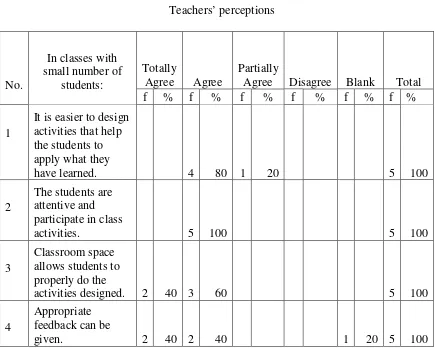
To measure the benefits of teaching and learning English in small classes, seven
[image:27.595.94.529.399.747.2]aspects were stated for teachers and eight for students.
Table 1
Teachers’ perceptions
No.
In classes with small number of
students:
Totally
Agree Agree Partially Agree Disagree Blank Total f % f % f % f % f % f %
1
It is easier to design activities that help the students to apply what they
have learned. 4 80 1 20 5 100
2
The students are attentive and participate in class
activities. 5 100 5 100
3
Classroom space allows students to properly do the
activities designed. 2 40 3 60 5 100
4
Appropriate feedback can be
given. 2 40 2 40 1 20 5 100
5
Activities that allow more interaction among students are
performed. 1 20 3 60 1 20 5 100
6
There is more interaction between the teacher and the
students. 2 40 2 40 1 20 5 100
7
It is easier to remember students`
names. 2 40 1 20 2 40 5 100 Author: Diana García Almeida
[image:28.595.94.530.83.261.2]Source: Liceo Mixto Mediterráneo
Table 2 Students´ perception No. In classes with small number of students: Totally
Agree Agree Partially Agree Disagree Blank
Total
f % f % f % f % f % f %
1 The activities done in class help to apply what students
learn. 18 24 40 53,3 12 16 3 4 2 2,7 75 100
2 The students are attentive and participate in class activities.
15 20 44 58,7 10 13,3 5 6,7 1 1,3 75 100
3 The students can better concentrate because
less noise in the classroom.
4
The classroom space allows students to carry out the activities assigned by the
teacher. 20 26,7 35 46,7 15 20 3 4 2 2,6 75 100
5
Students receive proper feedback from the
teacher. 17 22,7 33 44 15 20 7 9,3 3 4 75 100
6
There is interaction between the
students. 22 29,3 40 53,3 10 13,3 2 2,7 1 1,3 75 100
7
There is interaction between the teacher and
students. 17 22,7 38 50,6 13 17,3 4 5,3 3 4 75 100
8
The teacher remembers the
students`
names. 31 41,3 23 30,6 15 20 4 5,3 2 2,7 75 100 Author: Diana García Almeida
Source: Liceo Mixto Mediterráneo
The activities done help to apply what students learn.
The results above show that 80% of teachers agree with the fact that working in a
small class gives them the opportunity to design and carry on activities that allow students
to practice what they have learned and 20% partially agree. On the other hand, 24 % of
students totally agreed that in small classes the activities done during the class help them to
apply what they have learned, 53.3% also agree with it, 16% partially agree, and only 4%
disagree. 3% did not answer.
In the five classes that were observed, the teachers worked on the activities
pre-stablished in the textbook, but they always made the students practice what they had been
already taught. Also, a discussion was carried on, where students were encouraged to ask
challenging questions as a way to co-evaluate peers. Through these activities, students were
assessed in content and the skills they developed.
This confirms that with few students in a class, teachers can apply multiple strategies
to teach and evaluate pupils. According to Caplan and Owings (2002), teachers in small
classes are able to align the curriculum so all their students have the chance to learn the
content that will be later evaluated and measured.
0%
80% 20% 0%0%
Teachers
Question 1
Totally Agree Agree Partially Agree Disagree Blank
24%
53% 16%4%3%
Students
Question 1
Totally Agree Agree Partially Agree Disagree Blank
The students are attentive and participate in class activities.
In this statement, 100% of teachers agree that the level of concentration and
participation of their students is better in small classes. Twenty percent of the students
totally agree that in small classes they are often attentive and participative during class
activities, 59% agree, and 13% partially agree. Additionally, 7% disagree and just 1% did
not answer.
Based on the observation performed, it can be said that most of the students were
attentive and took an active part in the class activities; while others were not fully alert
maybe because of students’ personality; no matter how active some classmates and teachers
can be, they just prefer to listen to others and let them do most of the work.
In this regard, Blatchford (2003) indicates that students in small classes are more
persistent and concentrated due to the teachers’ constant help and observation; this fact was
confirmed with the results obtained in this statement.
0%
100% 0% 0% 0%
Teachers
Question 2
Totally Agree Agree Partially Agree Disagree Blank
20%
59% 13%7%1%
Students
Question 2
Totally Agree Agree Partially Agree Disagree Blank
Classroom space allows students to properly do the designed activities.
Question 3 shows that 40% of the teachers surveyed totally agree that the physical
space in small classes allows the adequate development of the designed activities and 60%
of them agree. Question 4 reports that 27% of students totally agree that in small classes the
classroom physical space allows carrying out appropriately the activities assigned by the
teacher, 19% partially agree, 4% disagree, and 2% left it in blank.
In the observations done, it was noticed that classrooms have enough space and
teachers were able to move students’ chairs easily in order to make groups or to work
individually allowing them to walk around. Having the appropriate physical space in the
classroom, gave teachers the opportunity to develop activities using different interaction
patterns with a great functional development.
In this aspect, Bray and Kehle (2011) agree with the fact that the physical space is
related to the possibility of making students work in groups according to the nature of the
activity in order to achieve better results.
40% 60%
0% 0% 0%
Teachers
Question 3
Totally Agree Agree Partially Agree Disagree Blank
27%
47% 20%
4%2%
Students
Question 4
Totally Agree Agree Partially Agree Disagree Blank
Less noise in the classroom allows the students a better concentration.
According to the results obtained in statement three, most of the students feel that the
level of noise in small classes is low enough to let them work, as 19% totally agree, 50%
agree, and 19% partially agree, only 19% of the students disagree, and 4% did not answer.
During the observations, it could be perceived that the level of noise was acceptable
due to the group activities performed. Parallel conversations were a significant factor to the
lack of concentration that the students showed.
In the same way, Bray and Kehle (2011) consider the noise level as an important
physical characteristic in a classroom that can affect students’ performance.
19%
50% 19%
8% 4%
Students
Question 3
Totally Agree Agree Partially Agree Disagree Blank
Appropriate feedback can be given.
Forty percent of teachers totally agree that in small classes they can provide an
appropriate and immediate feedback, 40% of them agree; so 80% of the interviewed
teachers agreed with this fact, only 20% of teachers did not answer. In the same sense were
the answers obtained from the students, since 23% of them totally agree that in small
classes the teacher provides an appropriate feedback, 44% agree, 20% partially agree, just
9% disagree, and 2% did not answer.
During the class, teachers guided students through their process of learning,
checking, monitoring, and observing. Besides, it was noticed that teachers asked students to
clarify and paraphrase the word order to correct mistakes; this made the students correct
themselves, and assess their work. The immediate feedback they received in the class was
an advantage of having a small class.
As a matter of fact, according to Bray and Kehle (2011), in small classes the students
hardly ever have to wait for support or feedback because the teacher is always concerned
about the students’ quality of work.
40%
40% 0% 0%
20%
Teachers
Question 4
Totally Agree Agree Partially Agree Disagree Blank
23%
44% 20%
9%4%
Students
Question 5
Totally Agree Agree Partially Agree Disagree Blank
The students are allowed to perform more interaction activities.
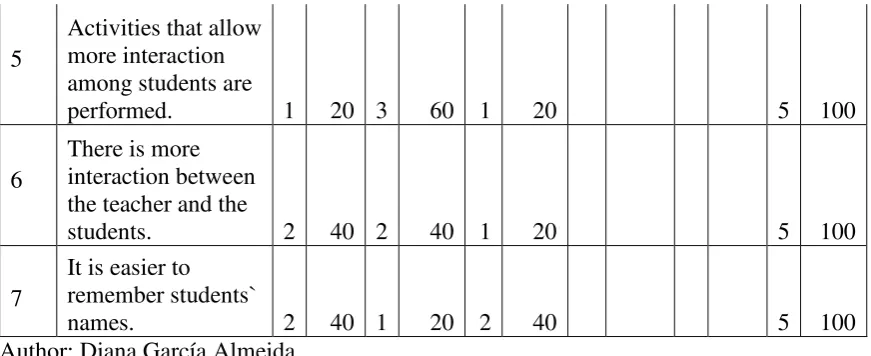
As observed in graph 5, it is confirmed that all teachers agree with the fact that
working in small classes is advantageously because they can plan their activities in order to
promote interaction among students. Twenty percent of teachers totally agree, 60% agree,
and 20% partially agree, and nobody disagrees. Similarly, graph 6 shows that 29% of
students totally agree that there exist student-student interaction, 54% agree, and 13%
partially agree, and only 2% of the students disagree and 1% did not answer.
In the observations performed, it was noticed that students interacted in academic
topics centered in the class activity. Also, students liked to work together in pairs and in
assigned groups that showed that they are accustomed to this type of working. So, it is
confirmed that in small classes, it is easier to have more occasions to interact with others,
which contributes in the growth of students’ confidence and fluency.
This advantage is stated by Bray and Kehle (2011), who found that interactions in
small classes had such a high level, that students became supportive, caring, and cooperative
with their classmates.
20%
60% 20%0%0%
Teachers
Question 5
Totally Agree Agree Partially Agree Disagree Blank
29%
54% 13%3%1%
Students
Question 6
Totally Agree Agree Partially Agree Disagree Blank
There is more interaction between the teacher and the students.
Based on the results from question 6, it can be said that 40% of teachers totally
agree, and 40% of them agree that in small classes there is more teacher-student interaction,
20% partially agree and nobody disagrees. Students, by the way, totally agree in a 23% that
there is teacher-student interaction, 51% agree, 17% partially agree, almost 4% disagree,
and 4% did not answer.
In the observations done, it was noticed that teachers and students have a good
relationship, so the interactions were of a high quality. Students did not seem afraid to ask
for help and teachers were most of the time enthusiastic when offering guidance; this fact,
made students feel close enough to ask for help and explanation when needed. At the same
time, all the teachers managed to be friendly without losing their authority.
This is corroborated by Berns (2010), who states that a small class enables students
to interact more often, giving them multiple occasions to understand one another,
increasing, and improving the learning opportunities.
40%
40% 20%0%0%
Teachers
Question 6
Totally Agree Agree Partially Agree Disagree Blank
23%
51% 17%
5%4%
Students
Question 7
Totally Agree Agree Partially Agree Disagree Blank
The students’ names can be easily remembered.
Based on question 7, 40% of teachers totally agree that in small classes it is easier
for them to remember the learner´s names, 20% agree, and 40% partially agree. In contrast,
41% of students totally agree that in small classes the teacher remembers their names, 31%
agree, 20% partially agree, only 5% disagree, and 3% gave no response.
During the observations, it could be perceived that students and teachers treated each
other in an informal, but respectful way. Both teachers and students called each other by
their names.
According to Finn and Wang (2002), one advantage of working in small classes is
that teachers get to know students better; teachers can even dedicate time to have one-to-one
tutoring and individualized attention. So teachers know not only students’ names, but also
some of their personal background.
So, with these results, it is stated that small classes are beneficial for the teaching
and learning process. Teachers and students perceive that due to class size, it is highly
possible to plan and carry out activities that allow students to show what they have learned
40%
20% 40%
0% 0%
Teachers
Question 7
Totally Agree
Agree
Partially Agree Disagree
Blank
41%
31% 20%
5%3%
Students
Question 8
Totally Agree Agree Partially Agree Disagree Blank
through a variety of techniques and strategies. As their names can be easily remembered,
students feel they are part of the group. Teachers and students friendly interaction gives the
students the security needed to experiment with the language in a safe environment.
Teachers, on the other hand, have the opportunity to assess students and detect who needs a
special attention and guidance. So, students’ motivation can be increased because they can
feel that the teacher has more time for them and that makes them feel important and special.
What strategies and resources benefit the teaching of English in small classes?
Teachers’ and students’ perception about strategies and resources used in small
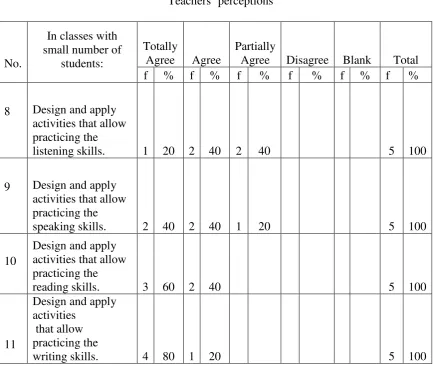
classes are analyzed in detail through eight aspects, the results are shown below and
[image:38.595.95.529.395.761.2]analyzed one by one.
Table 3
Teachers’ perceptions
No.
In classes with small number of
students:
Totally
Agree Agree
Partially
Agree Disagree Blank Total f % f % f % f % f % f %
8 Design and apply activities that allow practicing the
listening skills. 1 20 2 40 2 40 5 100
9 Design and apply activities that allow practicing the
speaking skills. 2 40 2 40 1 20 5 100
10
Design and apply activities that allow practicing the
reading skills. 3 60 2 40 5 100
11
Design and apply activities
that allow practicing the
writing skills. 4 80 1 20 5 100
12
Design and apply group work
activities. 4 80 1 20 5 100
13 Design and apply
individual activities. 3 60 2 40 5 100
14
Use technological
tools. 1 20 3 60 1 20 5 100
15
Use didactic
materials. 3 60 2 40 5 100
Author: Diana García Almeida
[image:39.595.94.527.81.270.2]Source: Liceo Mixto Bilingüe Mediterráneo
Table 4 Students´ perception No. In classes with small number of students: Totally
Agree Agree
Partially
Agree Disagree Blank Total f % f % f % f % f % f %
9
The activities done allow to practice listening
skills. 28 37,3 30 40 11 14,6 5 6,7 1 1,3 75 100
10
The activities done allow to practice speaking
skills. 20 26,7 40 53,3 12 16 2 2,7 1 1,3 75 100
11
The activities done allow to practice
reading skills. 26 34,6 38 50,6 7 9,3 3 4 1 1,3 75 100
12
The activities done allow to practice
writing skills. 29 38,6 42 56 2 2,7 1 1,3 1 1,3 75 100
13
Group work activities are
used. 18 24 39 52 12 16 4 5,3 2 2,7 75 100
14
Individual activities are
used. 20 26,7 37 49,3 15 20 1 1,3 2 2,7 75 100
15
Technological tools are
used. 20 26,7 31 41,3 12 16 10 13,3 2 2,7 75 100
16
Didactic materials are
used. 21 28 26 34,6 20 26,7 7 9,3 1 1,3 75 100 Author: Diana García Almeida
Source: Liceo Mixto Bilingüe Mediterráneo
Activities that allow students to practice listening skills are designed and applied.
According to question 8, it can be seen that 20% of teachers totally agree that in
small classes it is easy to design and apply activities that allow practicing listening skills.
40% agree, and 40% partially agree. So, it can be said that the majority of teachers accept
this fact as nobody disagreed. On the other hand, students also in their majority (37%) agree
that in small classes the activities done allow to practice listening skills, 40% agree, 15%
partially agree, 1% did not answer, and only 7% disagree.
During the observations done, it was confirmed that both listening and speaking
skills were developed by students, who were demanded to talk, discuss, and share ideas.
Besides, the activities were student-centered; teachers also took part in the discussions and
gave instructions. Students’ responses also demonstrate that listening and speaking activities
are daily developed.
Activities that allow students to practice speaking skills are designed and applied.
All of the teachers in this research seem to agree that in small classes it is possible to
apply and design activities directed to develop speaking skills, as the 40% totally agree,
40% agree and 20% partially agree in this assertion, nobody disagrees. On the other hand,
only 3% of students disagree, which is a minor percentage, 27% totally agree that in small
classes the activities done allow to practice speaking skills, 53% agree, and 16% partially
agree, 1% did not answer.
In the observed classes, students were asked to participate in oral discussions,
presentations, and debates, which are always good activities to work with learners in their
development and improvement of oral fluency. Additionally, these activities enhance
students’ ability to communicate effectively. Finally, it is relevant to recognize that small
40%
40% 20%0%0%
Teachers
Question 9
Totally Agree Agree Partially Agree Disagree Blank
27%
53% 16%3%1%
Students
Question 10
Totally Agree Agree Partially Agree Disagree Blank
classes allow the development of activities that are oriented to practice and improve
speaking abilities.
According with this, Berns (2010) says that as the number of students’ decreases, the
participation in discussions increases, and this way students develop their speaking skills.
Activities that allow students to practice reading skills are designed and applied.
It was found that teachers think that working in small classes offers them the
advantage to design and apply activities to develop reading skills easily, 60% totally agree,
and 40% agree with it. Meanwhile, in the students perception only 4% disagree, 1% did not
answer, 35% totally agree, 51% agree and 9% partially agree that in small classes the
activities done allow to practice reading skills.
The observed classes were based on activities from text book that contained reading
activities, which included critical thinking, comparison and contrast, description of
characters, recalling main idea and details. Students demonstrated to have developed
reading skills since they were able to support ideas, discuss and think critically.
60% 40%
0% 0% 0%
Teachers
Question 10
Totally Agree Agree Partially Agree Disagree Blank
35%
51% 9%4%1%
Students
Question 11
Totally Agree Agree Partially Agree Disagree Blank
Activities that allow students to practice writing skills are designed and applied.
In question 11, it can be seen that 80% of the surveyed teachers totally agree with the
fact that it is viable to design and apply activities oriented to help students practice and
develop writing skills in small classes, while the other 20% agree with this fact. Students’
answers, by the way confirm that 39% totally agree that in small classes the activities done
allow to practice writing skills, 56% agree, 2% partially agree, only 1% disagree, and 1%
did not answer.
In the observations done, it was noticed that teachers assigned a part of the class
period to make students write about a given topic. Most of the writing activities were
designed to be accomplished individually and teachers evaluated grammar structures,
connection between ideas, paragraphs’ organization, and creativity among some other
criteria. The writing skills were developed accurately, students were able to work
independently showing security and domain of the tools needed to write in a clear and
effective way.
80% 20%0%0%0%
Teachers
Question 11
Totally Agree Agree Partially Agree Disagree Blank
39%
56% 3%1%1%
Students
Question 12
Totally Agree Agree Partially Agree Disagree Blank
Group work activities are designed and applied.
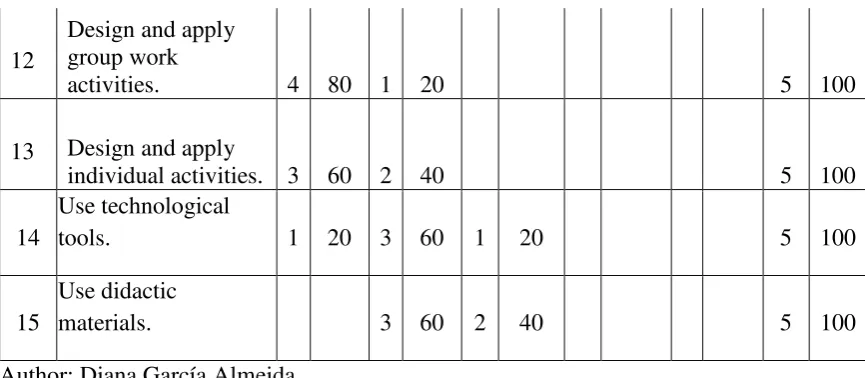
Question 12 shows that the majority of teachers find it very likely to design and
apply group activities in small classes. 80% totally agree and 20% agree, nobody disagree
with this assertion. However, 24% of students totally agree that in small classes it is used
group work activities, 52% agree, 16% partially agree, 5% disagree, and 3% did not answer.
The observed classes included group activities; it seemed that students were
accustomed to work in that way because they were fast in organizing the groups and
effective in the accomplishment of the tasks. Students joined together to analyze texts, to
share ideas and opinions, and to write summaries about a given topic.
This confirms what Herrell and Jordan (2012) state about how group work is not
only a strategy, but also a way of enhancing cooperative learning. According to the authors,
group work offers students the huge advantage of improving and increasing interactions
among them.
80% 20%0%0%0%
Teachers
Question 12
Totally Agree
Agree
Partially Agree Disagree
Blank
24%
52% 16%
5%3%
Students
Question 13
Totally Agree Agree Partially Agree Disagree Blank
Individual activities are designed and applied.
Question 13 shows that 60% of teachers totally agree that in small classes it is easier
to design and apply individual activities. The other 40% of teachers agree and nobody
disagrees with this assertion. Students, by the way, also think that in small classes it is used
individual activities since 27% totally agree, 49% agree, 20% partially agree, 1% disagree,
and 3% did not answer.
In the observations done, there was a balance between the group and individual
activities; so these two activities were a major part of the class period.Due to small number
of students, teachers were able to check and respond to students’ work immediately; so
students were clear about what had to be improved. Individual work gives teachers a real
picture of what students have understood and learned about a topic because this type of
activities are done without any peers’ help, so teachers also receive a real feedback on their
teaching.
In this regard, Molnar, Smith, and Zahorik (2003) state that the individualization
that is produced along with an increased use of hands-on activities results in increased
content, in more student self-direction and, ultimately, it is speculated, in greater student
achievement as evidenced by higher achievement scores.
60% 40%
0% 0% 0%
Teachers
Question 13
Totally Agree
Agree
Partially Agree Disagree
Blank
27%
49% 20% 1%
3%
Students
Question 14
Totally Agree Agree Partially Agree Disagree Blank
Technological tools are used.
The results obtained in this statement reveal that in small classes it is easier to use
technological resources for teaching purposes. The results show that 20% of teachers totally
agree, 60% agree, and 20% partially agree. On the other side, students’ perception shows
that 27% totally agree that in small classes it is used technological resources, 41% agree,
16% partially agree, and 13% disagree. Only 3% did not answer.
Even though the majority of the teachers surveyed think that the use of
technological resources is easier in small classes, during the observation stage, it was found
that only two of the teachers used them. On the other side, the students’ opinion was that not
all the technological resources are used despite the school is equipped with them.
The use of technological resources is a great advantage because it makes classes
more dynamic and allows catching students’ attention. Herrel and Jordan (2012) stayed that
20%
60% 20%0%0%
Teachers
Question 14
Totally Agree Agree Partially Agree Disagree Blank
27%
41% 16%
13%3%
Students
Question 15
Totally Agree Agree Partially Agree Disagree Blank
technological resources can be indispensable for providing learners with valuable language
experiences when learning a new language.
Didactic materials are used.
Teachers confirm that working with didactic material in small classes is possible. It
was found that 60% of teachers agree with this and the other 40% partically agree; nobody
disagrees. In the students point of view, 28% totally agree that in small classes it is used
didactic material, 35% agree, 27% partially agree, 9% disagree and, 1% gave no answer.
Even though teachers and students used their text book, posters and teaching cards in
classes, only some teachers used electronic devices like audios and videos. In addition, it is
stated that teachers in small classes can easily make materials to be used in planned
activities, on quizzes and other type of assessments that can help them evaluate the students’
learning.
As Brown (2007) stated, the use of didactic materials allows the teacher to explain
the class with visual input, as the teaching cards, pictures, graphs, posters, etc., can be used
as graphical feedback.
All these findingts take us to the conclusion that the perception of teachers and
studetnts in classes with a reduced number of students allow teachers to help learners
0%
60% 40%
0% 0%
Teachers
Question 15
Totally Agree
Agree
Partially Agree Disagree
Blank
28%
35% 27%
9%1%
Students
Question 16
Totally Agree Agree Partially Agree Disagree Blank
develop and improve their skills in listening, speaking, reading, and writing, as well as to
apply strategies and resources that can favor to the teaching and learning of English as a
foreing language.
Besides, in small classes teachers can demand students to change interaction patterns
and seating arrangement depending on the learning goal and to work independently or in
group according to the nature and complexity of a task. Finally, small classes allow teachers
and students develop social skills, increase the quality of interaction, and boost cooperative
work.
What is your opinion about the way students feel when learning English in small classes?
Through the interpretation of the four questions below, teachers’ and students’
perceptions about the way students feel through their learning process in small classes are
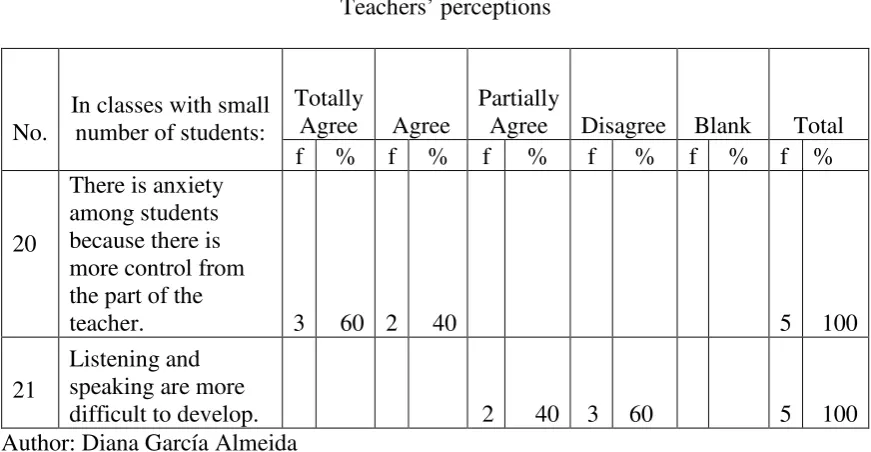
[image:48.595.95.530.457.744.2]going to be analyzed.
Table 5
Teachers’ perceptions
No.
In classes with small number of
students:
Totally
Agree Agree
Partially
Agree Disagree Blank Total f % f % f % f % f % f %
16
They are relaxed when speaking in front of their
classmates. 3 60 1 20 1 20 5 100
17
They are taken into account by the teacher because they have more opportunities to
participate in class. 1 20 4 80 5 100
18
They are motivated to participate
because of the small
number students. 3 60 2 40 5 100
19
They are at ease because they can healthy compete with their
classmates. 4 80 1 20 5 100 Author: Diana García Almeida
[image:49.595.101.531.81.163.2]Source: Liceo Mixto Bilingüe Mediterráneo
Table 6 Students´ perception No. In classes with small number of students: Totally
Agree Agree
Partially
Agree Disagree Blank Total f % f % f % f % f % f %
17
I am relaxed when
speaking in front of my
classmates. 35 46,7 22 29,3 10 13,3 6 8 2 2,7 75 100
18
I am taken into account by the teacher because I have more opportunities to participate in class.
30 40 25 33,3 11 14,6 8 10,6 1 1,3 75 100
19 I am motivated to participate because of the small number of classmates.
33 44 31 41,3 9 12 1 1,3 1 1,3 75 100
20
I am at ease because I can healthy compete with my
classmates. 30 40 37 49,3 5 6,7 2 2,7 1 1,3 75 100 Author: Diana García Almeida