DOES THE ACTUAL TRANSPORTATION SYSTEM COVERS THE NEED OF AN
INTEGRATED TRANSPORTATION SYSTEM IN BOGOTA
LUIS GUILLERMO CARRASCO AFANAR BACHELOR IN BUSINESS ADMINISTRATION
THESIS
RECOGNIZED BY UNIVERSITY ROSARIO-BUSINESS FACULTY
2
DOES THE ACTUAL TRANSPORTATION SYSTEM COVERS THE NEED OF AN INTEGRATED TRANSPORTATION SYSTEM IN BOGOTA
LUIS GUILLERMO CARRASCO AFANAR BACHELOR IN BUSINESS ADMINISTRATION
THESIS
RECOGNIZED BY UNIVERSITY ROSARIO-BUSINESS FACULTY THESIS DIRECTOR
ZGOULLI SALOUA
3
DEDICATIONS
4
ACKNOWLEDGMENT:
5 INDEX
ABSTRACT ... III
KEY WORDS: ... V
PALABRAS CLAVE: ... V
RESUMEN ... VI
SUMMARY ... VII
GLOSSARY: ... VIII
LITERATURE REVIEW... IX
INTRODUCTION ... 1
1. BOGOTA AS AN INVALID CITY. ... 2
1.1. CITY STATISTICS ... 2
1. 2CIVIL TRANSPORTATION COMPANIES ... 5
1.3ACTUAL SITUATION ... 8
1.4FUTURE DEVELOPMENT PLANS OF THE CITY ... 10
1.5SECURITY ... 12
2. HARD PROBLEMATIC SPECIAL CITY. ... 13
2.1INVESTIGATION OF THE PROBLEMATIC BASED IN A SOCIAL AND ECONOMIC POINT OF VIEW. ... 13
2.2POLLUTION IN BOGOTA ... 15
2.3ANALYZE OF FOREIGN CIVIL TRANSPORT COMPANIES ... 15
2.4GLOBAL TRENDS ... 16
2.5FOREIGN SYSTEMS PROBLEMS ... 17
3.RESULTS ... 18
3.1DESCRIPTION OF THE PEOPLE WHO USE TO MOVE OVER THE CITY ... 18
3.2 TRAFFIC ... 23
3.3BUSES,MINI BUSES,TRANSMILENIO WHAT’S NEXT ... 24
3.4 DIFFERENT SOLUTIONS EFFICACY ... 25
6
4. BREAKING PARADIGMS ... 27
4.1.UNPLAYABLE TRANSPORT TICKETS ... 27
4.2MOBILITY CONGESTION SOLUTION ... 29
4.3IMPLEMENTATION DISCUSSION ... 30
4.4CITIZEN BEHAVIOR SEGMENTATION ... 31
4.5IMPORTANT DIFFERENCES BETWEEN TRANSPORTATION SYSTEMS ... 32
5. UNIQUE MEASURES FOR A UNIQUE CITY ... 33
5.1THE ACTUAL MEASURES ARE NOT ENOUGH FOR THE CITY NEEDS ... 33
5.2COVER THE FUTURE DEMANDS AND THE ACTUAL NEEDS ... 33
5.3FROM FRANCE TO BOGOTA ... 34
5.4COVER THE TOTALITY OF THE CITY ... 35
5.5ADAPTATION TO THE BOGOTÁ’S MARKET ... 35
BIBLIOGRAPHY ... 35
SPECIAL LIST
List of Illustrations
Ilustración 1 Transmilenio bus ... ix
Ilustración 2 Transmilenios map ... 8
Ilustración 3 transportation congestion ... 14
List of tables
Table 2 localities ... 3Table 1 social classes ... 3
Table 3 vehicles per locality ... 11
Table 4 security ... 13
Table 5 vehicles index ... 17
Table 6 transportation chosen factors ... 18
Table 9 Paris survey ... 19
Table 11 results option 1 Paris ... 20
Table 13 public transportation survey ... 20
Table 7 results transportations option 1 ... 19
Table 8results transportations option 2... 19
Table 10 results option 2 Paris ... 20
Table 12 public transportation survey graphic ... 20
Table 14tickets price perception ... 21
Table 16 system needs ... 21
Table 17 needs indicator ... 21
Table 15 indicators tickets price ... 21
Table 18 time of transportation perception in short distances ... 22
Table 19time of transportation perception in long distances ... 22
Table 20 system integration index ... 22
Table 21 system integration chart ... 22
Table 22 pico y placa chart ... 23
Table 23 transmilenio users per zone ... 25
Table 24 transportation comparation ... 25
Table 25 transports qualities ... 26
Table 26 transport chart of qualities ... 26
Table 27 transmilenio needs ... 27
Table 28 transmilenio needs chart ... 27
Table 29 price solution to Bogota's transportation system ... 28
ii
iii
ABSTRACT
:Colombia is a South American country, with forty five millions two hundred thousand three hundred forty six ( 45.200.346) habitants, limited in the south by Brazil, Peru and Equator, in the north by the Caribbean Sea and Panama, at west by the Pacific Ocean and at east by Venezuela.
The Actual president is Alvaro Uribe, elected in 2006 for the second time, is a democratic country, who has 32 departments, the local currency is the Colombian peso, is the third most populated country in South America; the official language is Spanish, the most important cities are Medellin, Cartagena, Barranquilla, Cali and the capital Bogota.
The Capital Bogota, is a six millions seven hundred seventy eight thousand six hundred nineteen one (6.778.691) habitant’s city located in the center of the country, in the middle of the “cordillera oriental”, it has an extension of 177.598 hectares, and it has 20 principal divisions, who are called “localities”, it has a population density of 3.9 citizens by square kilometer.1
The minimum wage is five t hundred thousand seventy six ($576.500 ) so per day is $19.219, that minds in Euros is one hundred seventy four point eighty three (174, 83472€ 5.63€ per day) following an exchange rate of Euro/COL 2.837,75.2
The population growth rate is one point five (1.5%) percent, and the city have just one big public way of transport called “Transmilenio”
There are 4 different kinds’ lines to cover in Bogota, who are: Troncales (principal Streets) this one have one special way in the streets so it doesn’t share the ways with particular vehicles, the Auxiliary and alimentation Buses, who function in the secondary streets their main function is to feed the principal transportation (Transmilenio) and the fourth one an specialized line who goes into those neighborhoods who have a difficult entry because of the streets state. 3
Tercer Milenio s is a half private & public company, who is in charge of the only one massive transport, it mobilize the seventy percent (70%) of the population who use the public transport, the twenty three percent (23%) use particular
1
Sadistic and administrative National department, General Population Counting, 2005, http://www.dane.gov.co
2
Sadistic and administrative National department, Economic indicators, 2009, http://www.dane.gov.co
3 Transmilenio S.A, Audience of risks, Functional model in Hierarchy systems streets, Transmilenio/Bogota
iv
vehicles, and the less seven percent (7%) use the bus or other systems who are not very well organized.4
Bogota doesn’t have a metro or a tramway because of several reasons, some of those are the high prices of the construction of a metro, the terrain difficulties caused for been located next to the “cordillera oriental” who involves the constant possibility of an earthquake, and the frequent small temblors.
Also as Ángela Benedetti said, the actual protects have more weakness than advantages for the city, until now the failed metro consulting was twenty thousand millions Colombian pesos(7.037.018,40270€), and a publicity inversion of 500 millions Colombian pesos(175.925,46007€), those numbers were out of the city investment capacity, specially following the over expected demand behavior
4 Transmilenio System, general Statistics, 2009,
v
KEY WORDS:
PALABRAS CLAVE:
Transmilenio Bus
vi
RESUMEN
El problema de transporte en Bogotá es cada vez algo mas grande, pues las medidas actuales y los planes a futuro para el desarrollo de un sistema integrado de transporte parecen no ser suficientes para la magnitud poblacional de la capital Colombiana; de igual manera los precios son elevados y representan un inconveniente para los ciudadanos puesto que la cantidad de estos que puede pagar un pasaje del actual sistema transmilenio es cada vez más baja debido al alto incremento que su tarifa tiene anualmente.
vii
SUMMARY
The main transportation problem in Bogota its becoming a real issue for the city, caused because of the poor measures in the short and long term in order to solve the traffic problem and to created a solution to the integrated public transportation. The actual solutions are not enough to cover the population density of the city, also the ticket prices are to expensive compared with the average income of Bogotá’s citizens, so the percentage of people that it’s in the conditions to pay the ticket of the actual system “transmilenio” its less every year, because of the constant rise of the ticket price.
viii
Glossary
:Transmilenio S.A the enterprise who is in charge of the mobility management in Bogota.
Localities: the way Bogota is divided in zones
Cordillera Oriental the mountain who is across Bogota. 1€ between $2600 and $3000
Troncales: are those principal streets, who are circulate by transmmilenio, they have a division, who makes an exclusive way for transmilenio buses.
Secondary streets: those who serve to communicate the principal streets with the different sectors of the city, in general located up and down of the troncales.
DANE : National department of administration
Articulate buses: are a kind of busses that have two or three wagons Portal: the place where Transmilenio ways finish.
ix
LITERATURE REVIEW
What is Transmilenio?
Is a bus who cross the city, with a private high way, so It doesn’t get stock in the traffic, but it makes stops in the traffic lights and also when the particular vehicles are out of control, for example when the cars get stop in the middle of the traffic lights.
This bus is an articulate bus conformed by two wagons, with a total capacity of one hundred sixty (160) persons for the single articulate, and two hundred fifty (250) persons in the bi-articulate.
Ilustración 1 Transmilenio bus
5
This system is made with 2 kinds of stations: the principals who are located at the beginning and the end of each line, and the simple stations who are during the whole travel (Mains Streets), there are located each 500 Meters, and the stops depends of the itinerary of each bus, there are express ones and also all station stopper; actually there are 114 Stations around Bogota.
Transmilenio is the principal way of transport in Bogota; it moves around the principal streets, the average speed is 27 km/h, following the studies of Transmilenio S.A in November 2009 the system transports around two millions six hundred sixty-nine passengers by day, and during the high traffic hours there are 174.368 persons who use the system.
5 Transmilenio S.A, Audience of risks, kinds of vehicles in the transportation system, Transmilenio/Bogota
x
The Company have one thousand one hundred nine (1.109) buses, the 82.28% of the users are happy with the system, but not about the auxiliary and alimentation Buses.6
PROBLEM.
As I said this system uses just the principal ways of the city, but the people need to arrive to those principal streets, so the problems are the traffic jams between the main streets and the secondary streets, at the same time the insecurity, the ticket high price consequence of the unexcited integrated system (double, triple ticket pay), the excess of demand in the small bus the people takes to arrive into the principal avenues.
Transmilenio is a good option in the short term, but in a 6 million citizen’s city, there must be several transportation solutions and also some auxiliary ways that don’t get block in traffic jams.
Other way even if Bogota finally constructs a metro, the people would take the same period of time to arrive into their destinations (the saved time in the metro is consumed by the arriving time to get into the station). At the same time the ticket could be unplayable, consequence of two different systems that for sure would involve a double ticket pay.
The price of a ticket is three thousand Colombian pesos ($3000 1€) roundtrip, and the ticket price of an auxiliary bus (simple stations) is two thousand four hundred ($2400 0.84€) for a diary total of five thousand four hundred ($5400
1.90€).
When a person wins sixteen thousand nineteen ($16.019) per day and is forced to spend at less five thousand four hundred ($5.400) means it would just have ten thousand six hundred nineteen ($10.619 3.73€) to eat and save for his personal live costs.
To get a small idea about how important is this social-economic problem I propose some examples of the living costs in Bogota:
Free budget per day transport include ten thousand six hundred nineteen ($10.6193.73€)
6 Transmileniio S.A, transmilenio system numbers, statistics June 2008,
xi
A single lunch is three thousand ($3.000) by person (average 1€) in the best of cases (not drink) imagine a family with two children, who also use the public transport, because in Bogota everybody pay, and there isn’t a reduce price.
There are just two public quality universities in Bogota, and the privates ones are between $2 million and $6 million (705€ and 2117€) per semester.
The best results in the ICFES7 (equivalent to the Baccalaureate) are obtained from the privet High schools who also teach English which minimum price is one million ($1.000.000). This exam it’s the only chance to win a scholarship in a private university.
Another problem of the actual solution (Transmilenio) is the maintenance of the streets, which are always under some reparations, because of the ways construction materials, and the ground conditions.
According a study made by the business magazine “Dinero” the project “Armando Calles” was a completely failure because the inversion of almost $1 billion (352.893.066€), this investment was wasted in bad mixes for the construction and reparation of several streets, the consequence are non durable ways, and the need of a new investment.8
Bogota is one of the most polluted cities in South America, so the solution this city would take must be not only efficient it has to be eco-friendly.
So the idea of this project is to develop an integrate transport system, with the construction of a Tramway, who serves to transport the people from their houses into the Transmilenio (principal avenues).
The idea is basically a copy of the principal public transport companies in France like the TAM in Montpellier who creates 1760 jobs by year9, also the integrate solution in Turin, or Clermont-Ferrand tramway and others.10
It’s sure the most of those alternative solutions must be modified in order to get adapted to the Bogota culture.
7 Instituto Colombiano para el fomento de la educación. (Colombian institute for the education
development)
8 David Luna, one billion to the garbage, Dinero, March 2008,
http://www.dinero.com/edicion-impresa/agenda-publica/billon-pesos-basura_45656.aspx
9
Montpellier agglomeration, Dossier de presse, February 2 ,2005, http://www.montpellier-agglo.com/tam/page.php
10
xii
For example:
The necessity to make the pay in the entrance of the system, in this way there is a job generation (low payroll, who permits to have this controls managed by persons instead of machines) and at the same time provides to have a control of the diary entrance.
The implementation of cameras in the whole system, to abide the aggressions.11 The incorporation of a Tramway is a cheap solution, and permits the future development of a subway, like in the case of Paris the RATP it’s a company who shows the perfect model of how we can integrate the metro, bus and tramway. The copy of this model adapted to Bogota needs, must begin in the same way it did it in Paris in 1992, with the neighborhoods of Saint Denis, La Coumeuve, Drancy, Bobigny and Noisy-le-sec12, in the same way Bogota must begin solving the mobility problem of those neighborhoods that have the biggest traffic troubles.
11
Stephan Richard, Croissance générale sur les quatre continents, connex rapport des activités, 2004
12RATP, dossie e d’e uete, oti e expli ative,
Introduction
The objective of this work is to show why the actual measures taken by the Major Samuel Moreno and the government, are not sufficient for the future of the city; to explain why the Transmilenio is not working any more, why the metro is not the only solution and why it construction without a good feed system will be useless. To show why because of the pollution and the maintenance costs, the actual measures are not sustainable in a city like Bogota, and how can this problems be solve in a efficient and economic way.
This Work involves the transport with a social and economic problem, it critic some decisions and give some ideas to implement in the SIT.
The copy of the French models like Paris or Montpellier solutions are aboard in this work, and they are tested by a survey made during the investigation of the Transport in these two cities.
The objective is to prove why the actual measures are just efficient in the short term and which could be the complementary ideas to solve the transportation problem in the long term, the insecurity and the uncomfortable transports the city has in our days.
2
1. Bogota as an invalid city.
1.1. City Statistics
Bogota, is a six millions eight hundred forty three thousand five hundred five (6.843.505) habitant’s city located in the center of the country, in the middle of the “cordillera oriental”, it has an extension of 177.598 hectares, and it has 20 principal divisions, who are called “localities”, it has a population density of 2.98 citizens by square kilometer.13
The minimum wage is five t hundred thousand seventy six ($576.500) so per day $19.219, that minds in Euros is around two hundred twenty (220€ 7.096 per day) following an exchange rate of Euro/COL 2.612.14
At the same time Bogota has a GDP per person of US $2,756 (2,034€), that means in average the population of the city Survives with the minimum wage, this city is growing in a 2,2% per year, following this rate, for the 2020 the city will have around (8.089.560 *(1+2.2%)^10) 10.056.199, converting Bogota in one of the biggest cities in America.
This Metropolis organizes the citizens in 6 different social classes, in numbers from 1 to 6, 1 being the poorest class and 6 the richest one. The average budget in Bogota fluctuates from $791.400 (303.01€) to $6.375.228 (2.440€) per family in a month.15
The majority of the population lives in the 2 and 3 level, which are distributed in the poorest localities. (Graphic 1.1)
13Sadistic and administrative National department, General Population Counting, 2005,
http://www.dane.gov.co
14 Sadistic and administrative National department, Economic indicators, 2009, http://www.dane.gov.co 15 Metro cuadrado, the richest and poorest zones, Quality life style /DANE 2009,
3
Bogota is a city that has a big difference between the high class and the low one, first because of the income and also because the level of education, transportation and location around the city.
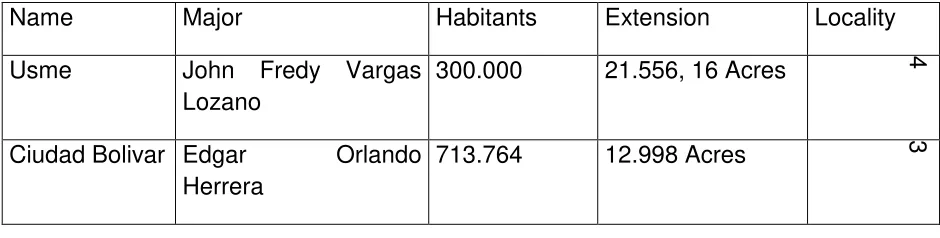
The poorest localities are Usme and Ciudad Bolivar that have 78% and 68.2% of their people who live in extreme poverty, wining less than the minimum wage 16, they are wining around $182.000 (69.7€)
There are also 12 localities who lived with an income that is lower than the minimum legal one, like the case of Bosa, Kennedy ,Fontibon , Santa fe, San Cristobal, Engativa, Tunjuelito, Rafael Uribe, Puente aranda, Candelaria, Antonio Nariño, Los martires and Suma paz (14 of 20 localities are under the minimum wage). The other 6 localities are located in the north of Bogota, Barrios unidos, Suba and Teusaquillo are the middle class localities with an average wage of $711.112 (270€) ; and the richest localities are Chapinero and Usaquen who have an incoming of $1.570.671 (597€)and $1.350.134(513€) average per locality.
[image:21.612.87.557.550.669.2]Localities: Table 2 localities
Name Major Habitants Extension Locality
Usme John Fredy Vargas Lozano
300.000 21.556, 16 Acres 4
Ciudad Bolivar Edgar Orlando Herrera
713.764 12.998 Acres 3
16 Metro cuadrado, the richest and poorest zones, Quality life style /DANE 2009,
http://contenido.metrocuadrado.com 8%
36% 40%
10% 6%
Social Classes
4
Bosa Janeth Jiménez
Garzón
525.459 2.392 Acres
Kennedy Jesús Antonio Mateus 898.185 3.857 Acres Fontibon Betty María Afanador 284.449 3.326 Acres Santa fe María Esmeralda
Arias
126. 014 4.488 Acres 4
San cristobal William Herrera Hernández
488.407 4.816 Acres
Sumapaz Magnolia Agudelo 2.478 78.096 Acres
Engativa Leonor Guatibonza 796. 518 3.556 Acres 3
Tunjuelito Diana Marcela Martínez
225. 511 1.028 Acres 4
Rafael Uribe Marta Janneth Bolívar 422.969 1.310 Acres Puente aranda Andrea Álvarez
Castañeda
288.890 1.724 Acres
Antonio Nariño Antonia Celestina Suárez
104. 102 494 Acres
Candelaria Xinia Rocío Navarro Prada
26.892 184 Acres
Los martires Luís Ernesto Rincón 101. 755 655 Acres
Suba and
Barrios unidos
Rubén Bohórquez 805. 245 10.055 Acres 2
Teusaquillo Juan Carlos Almonacid
155. 841 1.421 Acres 1
5
Table Data base.17
Bogota is a not organized city, which is super populated in some zones, and under populated in others; is a completely anomaly that there are zones with 0.92 citizens by square kilometer (locality 4), and another with 123.17 citizens by square kilometer (locality 3). 18
Who is possible that localities who are one next to the other have a difference of 20 points in the habitants density, even when their extension is pretty the same.
1. 2 Civil transportation companies
There are 4 different kinds’ lines to cover in Bogota, who are: Troncales (principal Streets) this one have one special way in the streets so it doesn’t share the ways with particular vehicles, the Auxiliary and alimentation Buses, who function in the secondary streets their main function is to feed the principal transportation (Transmilenio) and the fourth one an specialized line who goes into those neighborhoods who have a difficult entry because of the streets state. 19
The City has 69 transport companies; most of them specialized in one locality, at the same time they are not very organized, together they have 19.539 vehicles, but only 17.883 are legal and follow the statements of the transport ministry. 20
Tercer Milenio s is a half private & public company, who is in charge of the only one massive transport, it mobilize the seventy percent (70%) of the population who use the public transport, the twenty three percent (23%) use particular vehicles, and the less seven percent (7%) use the bus or other systems who are not very well organized.21
17 Bogota por localicades,Bogota Como Vamos, government Secretary of Bogota, 2009,
http://www.bogotacomovamos.org/scripts/localidades.php
18 Attached, in Statistic in excel document No 1
19 Transmilenio S.A, Audience of risks, Functional model in Hierarchy systems streets, Transmilenio/Bogota
Government,2009, http://www.transmilenio.gov.co/transmiftp/audienciariesgos20091109.pdf
20 Specialized services of transport and transit, quantity of vehicles in public transportation of Bogota,2009
Bogota Mobility, http://www.movilidadbogota.gov.co/admin/contenido/documentos/Kpacid-Transp_14_22_1.pdf
21 Transmilenio System, general Statistics, 2009,
6
The only company who has an integrate transport system is Tercer Milenio S.A , who has the monopoly of the Troncales in the city, this enterprise works with 114 stations around the city, it transported around 2.726.551.975 people until January 2010, it has The Company has one thousand one hundred nine (1.109) buses, the 82.28% of the users are happy with the system, but not about the auxiliary and alimentation Buses.22
The transport present a high level of CO2 emissions and a very low speed (27 km per hour average) compared to the cost it represent for the city, because a Tramway could be equal or faster (tramway top speed is 80km/h)23, it also would emit less CO2 and the maintenance costs would be lower, because of the change GAS electricity.
The Transmilenio Buses have to make stops in each traffic light, that decrease their speed and when the traffic is out of control some time the bus get stock in the middle of the traffic lights.
This system works with a private way in the principal highways of the city, that suppose to give it more speed, thing that works but not enough, the ways that this buses use are extremely deteriorate, because of the ground conditions of the city. The ticket price is $3000(1,13€) round trip.
there are not days tickets, or weekend tickets, so always a person goes out of the system is obligatory to pay again, there is not a discount for students, and not even for handicap persons, nighters a year or a month card, so each person who use the transport all days in the month should pay $93.000 per month (35,25€), it looks not to high this price, but a I explain before those buses circulate just in the Troncales so the people have to take another bus from other company (a not organized one) which round trip is $2.400 (0,90€).
Transmilenio dosent has a bicycle renting System, first because of the social behavior of the citizens, and the insecurity of the city, the system cover 84 km who are in reparation constantly.
The people is forced to use the system because is the faster and the only one which arrive to downtown traversing the city from the extreme north to the south.
22
Transmileniio S.A, transmilenio system numbers, statistics June 2008,
http://www.transmilenio.gov.co/WebSite/Contenido.aspx?ID=TransmilenioSA_TransmilenioEnCifras_Estadi sticasGenerales
23
7
Transmimenio Was created the 4th December of 2000, covering the Caracas Avenue and the Comuneros Street, it’s based in the Model that Curitiba (Brazil) has.
It Works with stations which have access from the both directions, in that ways is easy to move back in case that the user make a mistake taking the wrong bus. Each bus has specific stops which are determinate in the entrance of each station next to the plan of the system, there are two types of buses those which are express and those which stop in all the stations, this model makes easier to get into a destiny, because people can take an express one until two stops before the station they are looking for and then they just have to take another bus which stops in the other two stations until arrive to their destination.
8
streets.
Ilustración 2 Transmilenios map
24
1.3 Actual situation
Bogota doesn’t have a metro or a tramway because of several reasons, some of those are the high prices of the construction. The metro involves an investment of $135Us millions by Km, rather Transmilenio costs $22US millions, other reason are the terrain difficulties caused for been located next to the “cordillera oriental” who involves the constant possibility of an earthquake, and the frequent small temblors. As Ángela Benedetti said, the actual metro protects have more weakness than advantages for the city, until now the failed metro consulting was twenty thousand millions Colombian pesos(7.037.018,40270€), and a publicity inversion of 500 millions Colombian pesos(175.925,46007€), those numbers were out of the
24Transmilenio System, Plane su viaje,
9
city investment capacity, specially following the over expected demand behavior that the consulting group made.25
The actual system cover just 9 lines of 20 localities, As I said this system uses just the principal ways of the city, but the people need to arrive to those principal streets, so the problems are the traffic jams between the main streets and the secondary streets, at the same time the insecurity, the ticket high price consequence of the unexcited integrated system (double, triple ticket pay), the excess of demand in the small bus the people takes to arrive into the principal avenues.
Transmilenio is a good option in the short term, but in a 6 million citizen’s city, there must be several transportation solutions and also some auxiliary ways that don’t get block in traffic jams, because the average speed in the city is 26km per hour for the particular vehicles and 23km/h for the public service ones26.
Tercermilenio had pay $19.460.967.467 (7.377.899€) from 2000 to 2005, only in security and maintenance of the stations27, additionally it pay $235.807.101 in
secondary stations, in the first 5 years of maintenance. (First five years working capital), those costs are to elevated for company which use public resources, that should be used in the reconstruction and improvement of the public roads that need it the most like the case of the localities of the zone 3 and 4.
In 2004 Bogota had a total of 14.628 km of transit roads which 6.290 km of those are in bad conditions, that’s means, the 43% of it have difficult transit, (The localities of Kennedy and Ciudad Bolivar were the most affected) the 34% of the roads were in good conditions (5.581 km), and the last 23% (3.405 km) were in regular conditions.
Following the numbers of the road conditions in Bogota, they show a clear decrease of the roads in good conditions, thing it’s weird because the taxes keep increasing in the last 5 years.
25 Angela Benedetti, Planeación Nacional no firmará el Conpes para el metro de Bogotá, EL espectador,22 December 2009,
Articulo178680
26
Boletin No 3. ISSN. 2027-1026, mobility observatory, Chamber of Commerce, Andes University/2009, http://camara.ccb.org.co
27Trasmilenio S.A., payroll contracts and orders, Subdirección de Analysis by zones, Direction of
10
From the 2006 to 2008 the bad roads decreased in 9% (1.316 km) but the regular roads increased in 15% (2.194km) so the quality is not really getting better is just less bad, because also the good roads decrease in 8% (1.170km).28
The most of those roads in regular conditions are the streets that communicate the troncales with the neighborhoods located at the east and west of the city; those streets are the ones that need to be reconstructed in function to give it speed circulation and decrease the time people need to mobilize from their homes to the transmilenio, but at the same time it need to be organized in level of transport industries, because the buses that transit in those streets doesn’t have any control, there are not specified stops, so each bus pick a passage every 10 meters, those two reason make of this roads extremely slow.
1.4 Future development plans of the city
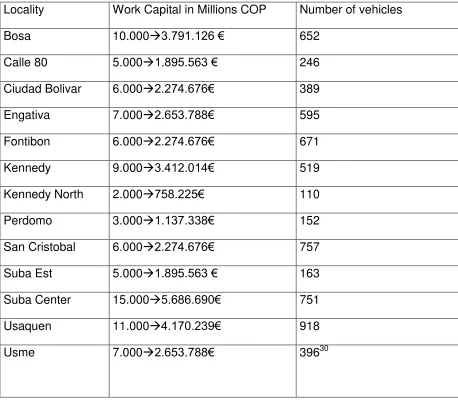
Actually Bogota is developing a SITP (Integrate Public transport System), that suppose to cover 13 localities, Usaquen, Tintal, Engativa,Kennedy, Fontibon,Bosa, San Cristobal, Perdomo, Suba Oriental, Ciudad Bolivar, Suba centro, Usme, y Calle 80.
The plan includes the use of existence and new resources; it has 8 specific points29: Creation of new optimized routes, define an operational zone A better use of the existence resources, price integration and implementation of electronic resources, integration between systems of information, an open concourse to the companies that wants to apply to the construction, the active participation of landlords, gradual implementation.
The integration is based in the infrastructure the existence resources and the companies able to build the project, it wants to use the 3 kinds of buses existence in the city (Transmilenio for Troncales, alimentadores like auxiliary bus, Colectivos to help the alimentadores)
The SITP has a budget per zone based in the dept capacity, the resources and the number of users; also the implementation is based in the number of vehicles which can be used in the project.(the 40% of those vehicles all ready exist and they are from the non organized companies, the other 40% is Tercer Milenio S.A and the 20% new companies)
28 Boletin No 3. ISSN. 2027-1026, mobility observatory, Chamber of Commerce, Andes University/2009,
http://camara.ccb.org.co
29
11
Table 3 vehicles per locality
Locality Work Capital in Millions COP Number of vehicles
Bosa 10.0003.791.126 € 652
Calle 80 5.0001.895.563 € 246
Ciudad Bolivar 6.0002.274.676€ 389
Engativa 7.0002.653.788€ 595
Fontibon 6.0002.274.676€ 671
Kennedy 9.0003.412.014€ 519
Kennedy North 2.000758.225€ 110
Perdomo 3.0001.137.338€ 152
San Cristobal 6.0002.274.676€ 757
Suba Est 5.0001.895.563 € 163
Suba Center 15.0005.686.690€ 751
Usaquen 11.0004.170.239€ 918
Usme 7.0002.653.788€ 39630
30
12
The Subway in Bogota is a polemic topic, that have been evaluated since 1987, when developed countries made studies about the construction, and proposed a plan for it, several times it was refused because of the costs it would involve and the impact in the city.
In 2008 the Mayor of Bogota (Samuel Moreno) began a project to finally build up the subway, in this year companies like GMBH & IDOM & GOPA (Germany), PRICE WEATER HOUSE COOPERS (Argentina), UBS Investment Bank (“UBS”) y Skadden (USA), some chine’s, and Italians companies also presented their projects..31
In 2009 the Compes document approve the financial costs of the metro in Bogota, and authorized the taken of a credit of US$40 million (29.491.999€), following the words of specialists like Luisa Pulido Rangel, a high percentage of this credit will be used in the first studies for the construction.
The beginning of the works is planned for the early 2011, the other part of the city founds will be used to reformed and improve the existent resources.
The Compes was supervised and approved by the Director of national planeation (Carolina Renteria) and the sub director(Andres Escobar), the document specify the pay back of this money should be in 17 years; they will use it between 2009 and 2011.32
1.5 Security
The situation in Colombia since 2002 with the beginning of de Alvaro Uribe mandatory, became better, is safety to travel around the country, and the critic zones became less and less.
But in Bogota since the beginning of the new major Samuel Moreno (2007) the security problem is now again a big trouble in the city, based in the statistics in the last 3 years de number of crimes is more than 6.809, which 3.801 are committed by young people (-18 years old) and are directly related to still.
In the 2008 between March and December there were a number of crimes superior to 2827, this represents an increase of 4.12% (112 new crimes) in the criminality rate.
31 Metro Bogota, Alcaldia mayor de Bogota, Mobility deparment,2009,
http://www.movilidadbogota.gov.co/contenido.asp?plantilla=1&pag_id=1508&pub_id=803&cat_id=282
32
13
[image:31.612.93.395.144.304.2]Based in a criminalist study, the 68% of the young people who get catch in illegal acts didn’t finish their high school.33
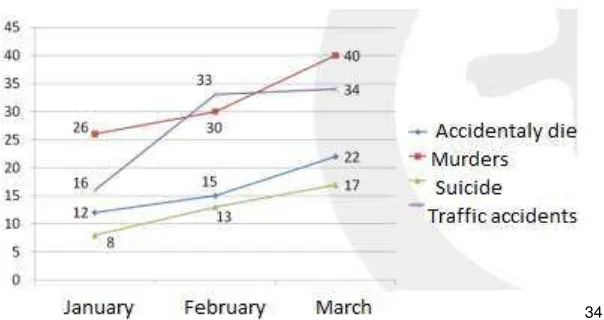
Table 4 security
34
The graphic shows a clear growing of the numbers of murders, in the last month the growing rate is 33%, also the case of still in the first 3 months of 2009 was of 459 cases, an increase of 16.79% compare to the 2008.
2. Hard problematic special city.
2.1 Investigation of the problematic based in a social and economic point of view.
The actual system is collapsing, the strikes became more often, in the congestion schedules the Transmilenio became dangerous because of the congestion, the traffic jams are longer, and the demand still increasing.
33EL “PECTADOR, A “a uel Mo e o se le salió Bogota de las a os , Ma ia A gela Tova Bogota, Ap il
2009
34 Tendencia Mensual de Muertes Violentas en Bogotá, Balance Primer Trimestre 2008 – 2009,Bogota
14
As I said the ticket price is three thousand Colombian pesos ($3000 1,13€) roundtrip, and the ticket price of an auxiliary bus (simple stations) is two thousand four hundred ($2400 0.95€) for a diary total of five thousand four hundred ($5400
2.081€).
When a person wins sixteen thousand nineteen ($19.219) per day and is forced to spend at less five thousand four hundred ($5.400) means it would just have thirty thousand eight hundred nineteen ($13.819 5.32€) to eat and save for his personal live costs.
To get a small idea about how important is this social-economic problem I propose some examples of the living costs in Bogota:
Free budget per day transport include ten thousand six hundred nineteen ($10.6192.55€)
A single lunch cost three thousand ($3.000) by person (between 1€ and 1.5€) in the best of cases (not drink) imagine a family with two children, who also use the public transport, because in Bogota everybody pay, and there isn’t a reduce price.
There are just two public quality universities in Bogota, and the privates ones are between $2 million and $10 million (771€ and 3855€) per semester.
The best results in the ICFES35 (equivalent to the Baccalaureate) are obtained from the privet High schools who also teach English which minimum price is one million
35 Instituto Colombiano para el fomento de la educación. (Colombian institute for the education
development)
Even if Transmilenio has his own highway, it get block in the traffic lights.
The number of buses is to much for the roads, and they became in bad conditions
The over demand open doors to strollers and people who doesn’t pay the thicket
There are not automatic machines who help the workers congestion in the entrance.
15
($1.000.000385€). This exam it’s the only chance to win a scholarship in a private university
So now imagine for the class 1.2 and 3 to pay a School, a university and the transport for three members of the family, is unviable, I would say the ticket became unpayeble for those 3 Social classes so even if in the mobility plans they want to develop the transport in those zones, the people wouldn’t pay to use the SITP
The streets conditions, are bad, according a study made by the business magazine “Dinero” the project “Armando Calles” was a completely failure because the inversion of almost $1 billion (352.893.066€), this investment was wasted in bad mixes for the construction and reparation of several streets, the consequence are non durable ways, and the need of a new investment.36
2.2 Pollution in Bogota
Bogota has the first place in Colombia as the most polluted city and the one with the most emissions of CO2, the principal cause of it are the public transports, and the industries, that uses fossil combustible.
The transport in Bogota use a 62% gasoline and 37% of Diesel, so they produce the 85% of the CO2 produced by the city.37
The city take some measures like make CO2 evaluations to the cars models older than 5 years, the implementations of laws to take out of circulation old buses, the construction of roads exclusive for the bicycles, the implementation of a day with no car once a year, but even with all that measures Bogota keep being the most polluted Colombian city.
2.3 Analyze of foreign Civil transport companies
RATP(Paris): Has a integrate system, control for a company called RATP, the demand of transportation in this city increase year by year, in the 2007 there were one and a half million users, they did 50 million trips more than the last year, and they register a turnover of 3.7 million euro’s.
They follow the theory that in 2030 more than the 60% of the people will live in the big cities. This system is integrated for a metro; a Tramway, a bus system with determined stations and a RER (train for the Localities outside of the urban
36 David Luna, one billion to the garbage, Dinero, March 2008,
http://www.dinero.com/edicion-impresa/agenda-publica/billon-pesos-basura_45656.aspx
37
16
perimeter).
The ticket price is about 1.60€, it give the possibility to the user to move around the four systems (metro, tramway, bus and bicycle), if the user doesn’t go out of the system it can use the ticket during 2 hours.
The RATP also have the option of reduced tickets for young people (under 25) , or weekend ticket and daily one, in general it have several possibilities that goes according to the user needs.
TAM (Transports de l'agglomération de Montpellier): this system has 2 tramway lines, and they are constructing a third, it have 29 bus lines, a nocturne line and a bus that transport people in the night (Friday and weekends) to the principal night clubs of the city.
It also have a bicycle system called Velomagg, that involves a rent of bicycles which are located all around the city, the users have the option to borrow one in each Velomagg station, and give it back in other station (if the borrow is for less than one hour) if they borrow the bicycle for longer they should give it back in the same station where they borrow it, before 24 hours.
The tariff in the TAM begin in 1.40€ for the single trip, the round trip is 2.45€, there is also the possibility to take a 10 tickets option to save money that costs 11.50€.
One of the great thing of this system especially in a student city, is the possibility of a year card; that cost around 250€, this card give to the student the possibility to use the bus, tramway and the bicycles, as much as he wants.
2.4Global Trends
Brasilia is the capital of Brazil, this city has 2.557.158 habitants 729.066 more than Curitiba city (the city that was used like model to constructed Transmilenio), this city is coping the Tam model, to construct their first tramway line, that will be ready in 6 years and will have a cost of 350.000€ and 8.7 km.
17
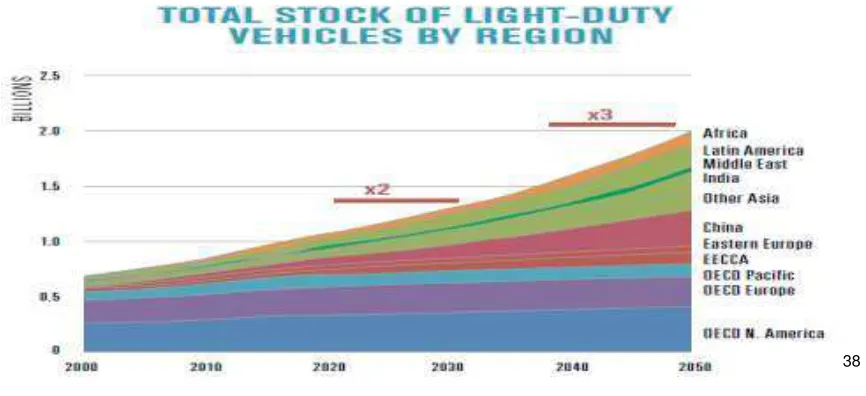
Table 5 vehicles index
38
The graphic indices that the undeveloped continents would be those which have the biggest trouble, because of their culture, they will keep buying cars, so the traffic and the pollution in Lain America would touch uncontrollable levels.
So as the number of vehicles would increases also the quantity of oil consumption would do it, especially in the transport segment, In order to this Trend, copy an existence system could be a solution not only to avoid the traffic jams, also to solve environmental problems and the control growing of the traffic in the cities.
2.5 Foreign systems problems
In order to identify the real problems of foreign systems I interview several people from different cities, this questions are simple and are just 7 in order to look for true answers.
The opinion of each user is important, in order to build the best model for Bogota this interviews are focus in young people, and to make it as much global possible I chose international Students at the same time to get some comments and compared with their home cities.
Questions39:
Which is the transport you use the most?
Persona Car b) Tramway c) Bus d) Bicycle e) Metro
38 Global Environment Facility, Investing in our planet, Urban transportation, 2009,
http://www.gefweb.org/uploadedFiles/Publications/Investing-Urban-Transportation.pdf
39
18
How often do you use public transportation?
Between 0-2 times a week b) Between 3-5 times a week c) more than 5
Do you thing the ticket price is? expensive b) according c) cheap
In your opinion the system covers the needs of the city?
Yes No
The time of transportation in short distance is? Fast b) According c) slow
The time of transportation in long distance is? Fast b) According c) slow
When you use the system do you change from one to another? Yes No
3.Results
3.1 Description of the people who use to move over the city
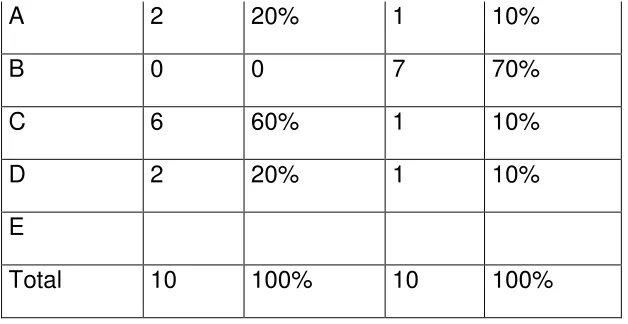
[image:36.612.159.464.660.717.2]Montpellier: in a group of 10 persons, that I chose and I know use the system often 1) Which is the transport you use the most?
Table 6 transportation chosen factors
19
A 2 20% 1 10%
B 0 0 7 70%
C 6 60% 1 10%
D 2 20% 1 10%
E
Total 10 100% 10 100%
40
[image:37.612.152.466.70.232.2]Paris: in a group of 10 persons, that I chose and I know use the system often. Which is the transport you use the most?
Table 9 Paris survey
First Option Second option
Paris Number percentage Number Percentage
A 0 0
B 0 3 30%
C 1 5 50%
D 0 2 20%
E 10 100% 0
40
Survey, Luis Guillermo Carrasco, February 2010, Montpelier-Paris Table 7 results transportations option 1
20% 0% 60% 20%
Which transport do you use the most
[image:37.612.99.483.71.415.2]A B C D
Table 8results transportations option 2
10%
70% 10%10%
Second option
[image:37.612.89.472.506.700.2]20
Total 10 10
[image:38.612.80.472.191.363.2]
Table 11 results option 1 Paris
41
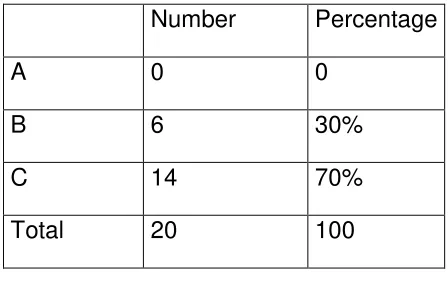
2) How often do you use public transportation?
Between 0-2 times a week b) Between 3-5 times a week c) more than 5 Table 13 public transportation survey
Number Percentage
A 0 0
B 6 30%
C 14 70%
Total 20 100
3) Do you thing the ticket price is?
a) expensive b) according c) cheap
41
Survey, Luis Guillermo Carrasco, February 2010, Montpelier-Paris 0% 30% 50% 20% 0% Second option
A B C D E
0% 0%
9% 0%
91%
[image:38.612.80.304.456.597.2]Which transport do you use the most? A B C D E Table 10 results option 2 Paris
Table 12 public transportation survey graphic
0%
30%
70%
21
Table 14tickets price perception
Number Porcentage
A 8 40%
B 12 60%
C 0 0
total 20 100%
[image:39.612.85.581.89.208.2]4) In your opinion the system covers the needs of the city? Yes No
Table 16 system needs
Number Porcentage
YES 16 80%
No 4 20%
total 20 100%
42
Table 17 needs indicator
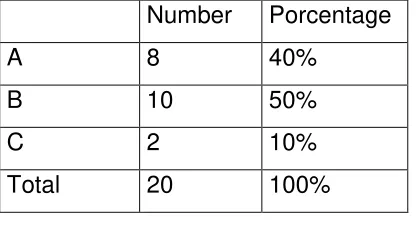
5) The time of transportation in short distance is? a) Fast b) According c) slow
42
Survey, Luis Guillermo Carrasco, February 2010, Montpelier-Paris
0 5 10 15 20 25
1
1 2
YES 16 80%
No 4 20%
Table 15 indicators tickets price
40% 60%
0%
[image:39.612.82.291.298.389.2]22
Table 18 time of transportation perception in short distances
Number Porcentage
A 8 40%
B 10 50%
C 2 10%
Total 20 100%
[image:40.612.86.329.298.418.2]6) The time of transportation in long distance is? a) Fast b) According c) slow
Table 19time of transportation perception in long distances
7) When you use the system do you change from one to another? Yes No
[image:40.612.323.530.553.639.2]Table 20 system integration index
Table 21 system integration chart
7 9
4 35%
45%
20%
A B C
20%
80%
Yes No
Number Porcentage
A 7 35%
B 9 45%
C 4 20%
Total 20 100%
Number Porcentage
Yes 4 20%
No 16 80%
23
3.2 traffic
In the entire big metropolis around the world the traffic management represents a big issue to the local government; Bogota has one of the biggest problems in what concerns to traffic jams and mobility speed and times.
Bogota has around 1.170.000 vehicles and a projection for the 2015 of 1.800.000 vehicles, around 1 million of this vehicles are for particular usage, that minds 58.82% of the vehicles transport just the 20% of the total trips which are dally presented in the city43.
In our days, different universities as the “Universidad Distrital de Bogota”, are developing studies about who to optimized the city mobility, one of this is the implementation of intelligent traffic lights, which in base to the studies will augment the cars speed from 36 Km/H to 48.1 km/H thanks to this speed improvements the average time travel around the city will perform from 42.4 minutes to 37.1 minutes (25% time less).
Bogota has a measure called PICO Y PLACA44, it consist in forbid the traffic per days, based in the last number of the car matriculation, it minds each particular car has a restriction to circulate 2 times a week (the weekendsno restriction).
Example: the car matriculation in Bogota is like this “ASA 503” and the restriction law (PICO Y PLACA) said this car can circulate the Tuesday and the Friday.
Table 22 pico y placa chart
Monday Tuesday Wednesday Thursday Friday
7-8-9-0 1-2-3-4 5-6-7-8 9-0-1-2 3-4-5-6
43Bogot, Mobility, Statistics, Diego Romero, Germán Palomino, Oscar Gonzalez, Diego Romero, Orlando Galeano,
http://miseptimacarrera.blogspot.com/2007/09/estadisticas.html
44Schedule Pico y Placa Bogota, Mobility, Bogota http://www.movilidadbogota.gov.co/,2010
24
The second problem in the mobility are the 47.000 taxis that also bloc the highways and the small streets, fighting between themselves to get the most of people, gendering insecurity for the civilians and the other cars.
The 20.162 Buses, which are not organized and stop every 10 meters in not specified stations.
In base to the last information Bogota needs a Massive transport which dissolves the Taxis, particular vehicles and buses congestions, but at the same time it should be payable and it should avoid the total cannibalization of the Transmilenio, who transport the 24.03% of the citizens, it means the SIT should transport at less 30% of the population who don’t use Transmilenio.45
3.3 Buses, Mini buses, Transmilenio what’s next
The last national Study made by the DANE (National Administration department) shows a clear cannibalism from Trasmilenio to the other Transport companies. The particular buses transports transports around 370.843 passengers (-9.88% less than the last year), the mini bus made 285039 trips it decrease also in a -7.02%, but the Transmilenio transports around 77729 passengers, it increase in a 36% compared whit the last year.46
According to this numbers the Transmilenio is killing the other transport systems, because is the only one which is increasing the number of passengers.
So a new transport should involves a forecast that describes what’s going to happen with the other transports, because they can get absorb for the new one, and the old investment in Transmilenio would be useless, and a new social
problematic will appear.
In a normal day Transmilenio transports 1.420.000 users, with an average per hour of 61.536 passengers, is an efficient transport, but at the way Bogota is growing
45 Encuesta Transporte Urbano, DANE (Nacional administration department),2006 Bogota
46 Dirección de Difusión, Mercadeo y Cultura Estadística Departamento Administrativo Nacional de Estadística - DANE -
25
the city needs at less one other system, that for sure must be integrated with the existent.
[image:43.612.78.529.173.346.2]The next table shows the numbers of users who use the Transmilenio by Zone.
Table 23 transmilenio users per zone
Zone Users
CENTRO 470.971
SUR 202.034
CALLE 80 159.183
NORTE QUITO SUR 98.714
AMERICAS 172.396
SUBA 117.020
SUBA NORTE 322.153
47
The new transportation systems should cover the demand of 3.2 million users that transport daily the public service.
The actual number of public buses needed to transport this number of users is 19.087 buses, that could be supported by a metro line or a tramway line in order to accelerate the transportation speed, or the facilities to arrive to the principal stations.
3.4 different solutions efficacy
Table 24 transportation comparation
Passagers System Implementation Price US$ millions
20,000-40,000
Metro US$30 to US$160
Organized bus
system US$5 to US$20
[image:43.612.86.484.559.670.2]Tramway Us$ 50
Figure from the World Bank 2003
47
26
Table 25 transports qualities
From 1 to 5 in a scale, been 5 the highest score and 1 the lowest48
Goals Organized bus Transmilenio Tramway Metro
Credit necessity 1 2,5 3 5
financed by private
sector 1 2,5 2,5 2,5
Short time of
implementation 1,5 2,7 3 5
Helps the city
Development 3 3 4 5
Helps to dissolve the
traffic problems 3 2 5 4
Impacts in other
[image:44.612.83.563.110.371.2]transports 1 2,7 4 5
Table 26 transport chart of qualities
Figure Calculate by the author.
48
Streiner DL, Norman GR. Health measurementscales. A practical guide to their development and use. Oxford: Oxford UniversityPress, 1999.
0 1 2 3 4 5 6
Organized bus Transmilenio Tramway Metro
[image:44.612.89.574.408.603.2]27
3.5 Statistics of the people who needs an external transportation to arrive to Transmilenio
Table 27 transmilenio needs
first analyze users Second analyze users
Americas 19% 19%
Caracas Sur 27% 28%
NQS SUR 9% 9%
Suba 13% 13%
Calle 80 18% 17%
Norte 14% 14%
[image:45.612.86.536.117.480.2]Total 347586 361426
Table 28 transmilenio needs chart
49
4. Breaking paradigms
4.1. Unplayable transport tickets
In Bogota the implementation of any new transport would be useless if the tickets are too expensive to be paid for the users. The zone that reports the most of users Is the center with 470.917, this zone is one of the poorest of the city, the statistics reflected there are 12 localities that their average citizens gain less than the minimum wage.
49
SITP characteristics, Department of mobility we all make mobility, Bogota ,2009 0%
5% 10% 15% 20% 25% 30%
Americas Caracas Sur
NQS SUR Suba Calle 80 Norte
28
In order to that the only solution for Bogota to have a Fair ticket is to compromise the private sector companies with the existence transportation companies, to create a ticket according to the income of the classes 1, 2 and 3.
The ticket sales must be based in two categories.
[image:46.612.117.564.254.395.2]1) By time: the system must create the possibilities of monthly, annual, weekend or daily ticket. That give to the users the option to save money buying the trips they need.
Table 29 price solution to Bogota's transportation system
Standard price Card price Reduction Saving
1.5000.54€ Daily $4.5001.72€ N/A
15.0005.74€ Week $14.5005.55€ -3.3%
69.00026.43€ Month $45.50017.43€ -34%
828.000317.23€ Year $538.200206.22€ -35%
$1500 (ticket value)*2(number usage of the transport)* 23(days people work per month) = $69.000 26.43€
If a user buys a month card it should save 34%. (To make this calculation I use a 3 rule apply to the discount people have in developed countries).
In Colombia the people who wins the minimum wage have a transport help of $59.21822.6€ per month (total salary $576.500220.89€) so the companies would be able to pay $710.616272.28€ per year to transport their minimum wage employees.
29
The companies would keep the same pay roll so they wouldn’t be affect for this measure, the employees would be able to live more comfortable so the productivity can improve because of the happiness.50
4.2 Mobility congestion solution
The implementation of a metro without an alimentation system is useless, Bogota doesn’t need a transport which consume all the resources to don’t be use by the citizens.
In small and medium cities 60% of the public transport users takes the bus as first option, and in a 10 person target no one use the tramway as a first option, but if we analyze that as second option is the tramway for the 70% of the users, that can be because to arrive to the tramway is easier if they take the bus. other option is that the tramway is bad located, or simply the people follows the principle that if they take the faster way of transport is arriving fast to the principal transportation in this case the Tramway.
In Big cities the 91% of the users take the metro like first option, and as second they take the tramway 30% and the bus 50%, these results can be associated with the city structure (Paris circle).
Also it can be taken as the possibility that in big cities people don’t trust in buses because of the traffic jams, or because of the cannibalism that mega transports like a metro, have related to the small transport like the bus.
In both cases the people use to change in a 20% from one transport to another, this could happened because of the waiting time in the change from one transport to another, the season (cold or hot weather),the double pay of the ticket when the people don’t have a month, a day or a year card.
In Bogota around 350.000 users per day need to take complementary transport to arrive to Transmilenio,
50
EFFICACY DISPERSION IN TEAMS: MOVING BEYOND AGREEMENT AND AGGREGATION (p 1-40) D. SCOTT DeRUE, JOHN HOLLENBECK, DAN ILGEN, DEBORAH FELTZ
30
The 27% of these users are located in the south of Bogota, so this is the locality that needs the firs solution that could transport them fast and comfortable to Transmilenio, avoiding the traffic jams, and the insecurity of an over capacity bus.
4.3 Implementation discussion
The new system that will create a huge credit to the city, should assure to the city that it will have own financing capacity five years after the final implementation. Also it should have lower maintenance costs that the actual registered by Transmilenio which are paid by the government.
The new system should focus in the poorest localities and the south of Bogota that accumulates the 68% of the population, the discussion have been opened during the last years, about decide which one is the most efficient transport for city and how to create the SIT.
To create the SIT the first thing to know is the mission of it and the orientation; in order to this, I’ll do market segmentation for the users of the future SIT should be elaborated.
First who use the SIT what do they need, what do they care, their purchasing power, their schedules; second is necessary to classify it by zones, and to specified which zone have the most of needs.
Users:
Table 30 user’s description and needs
Social class Occupation Needs
1 and 2 Primary sector and construction workers, low income workers
Cleanness, speed, price, security, schedule cover, location of stations, avoid traffic jams to take the SIT 3,4
Students (university), medium income workers, just graduate, jobless, teachers.
31
5 and 6
High income workers, companies CEO’s, high income students.
dissolve the traffic on the main avenues of the city, in order to save time diving to their work place or houses
The city also needs to control more the excess of taxis in Bogota, because even if the informal buses are under control, if the taxis warm to pick up passengers continues, the civilians and the particular drivers will never be safe.
The pollution is another topic that Bogota should aboard; the city is becoming a potential Mexico D.C, so the city must contemplate the option of an electric transport.
With the constant growing of the numbers of cars, that don’t get control with the Pico y Placa, because the classes 5 and 6 now have around 2 or 3 cars by person to continue using their cars every day, so the Pico y Placa doesn’t change the conditions of the city in a high percentage.
4.4 Citizen behavior Segmentation
In Bogota is impossible to have a tramway system without controllers, because of the cultural behavior of the citizens, also because of the level of poorness the insecurity in Bogota is a complex issue, if the transport is to full, there will be always people who profit of it to steal.
The people from Bogota cares about been comfortable, have a fast and safe transport, that’s why the vote for Samuel Moreno actual major of the city, who propose a metro as solution for the traffic problem of the city, but until now the cost and the planning are not enough for what the city needs.
32
Basically Bogota has three types of users: workers, students and visitants.
There is just 1 simple model of market segmentation the three of them want a fast, economic and safety transport.
4.5 Important differences between transportation systems
[image:50.612.45.571.364.605.2]From one to five, I classified the useful of each possible transport in Bogota, according to the city needs that I recognized thanks to the survey, if the SIT is copied from another country it will need cultural adaptations, but it will be good for the environment, in what concerns to the investment the metro is for sure the one which needs the most of investment, but the relation Cost-benefit will be profitable if it’s well constructed an feed for other systems.
Table 31 characteristics of the transportation solutions
Transport Eco
friend investment
High
transportation
capacity
Solve traffic
jams
cultural
acceptance Speed
Metro 4,5 5 5 4 3 5
Tranmilenio 3,8 3 5 3 5 3
Tramway 4,8 4 4 4 4 3
Organized
buses 3
3 3 4
1 3
Existent
bus system 1
2 3 0
4 1
33
Table 32 chart of transport solutions
5. Unique measures for a unique city
5.1 The actual measures are not enough for the city needs
All the actual measures are good, but are not enough to satisfy the city needs, Bogota is growing in all aspects, traffic, habitants, insecurity, congestions, traffic jams and others.
The government are doing well implementing Transmilenio, and planning a metro, but that’s not enough for a city that doesn’t have organized buses, that is becoming more polluted every day, Bogota should look for solutions that organize the actual traffic, and at the same time solve the over use of Transmilenio.
If we follow the solutions proposed until now, the traffic problem would maybe solve for 5 or 10 years, but every short period Bogota will have to fight with the traffic issue.
5.2 Cover the future demands and the actual needs
For a city that forecast ten million citizens for the 2020, with 20 localities, and 60% of the total population in the poverty the SIT must be reachable, it should assure to each citizen a safety trip and human transportation conditions.
0 5 10 15 20 25 30
Speed
cultural acceptance Solve traffic jams
High transportation capacity investment
34
The SIT should use part the existence resources to avoid economic lost and social strikes, also the construction of an organized bus system, with organized stations, specific schedules that make easy to plan the daily life.
It should assure the city a low investment in the future and a high intern return rate of the actual investment.
The city will keep growing so the SIT must keep growing to, at les in the same rate the population will do it.
The construction and maintenance of the streets must be an important issue, to assure the speed and security of the system, but the maintenance cost of the SIT should be financed by itself, not for the city.
5.3 From France to Bogota
Bogota needs a SIT with principles like the RAPT in Paris or the TAM in Montpellier, an integrated system between all the transports the city has.
The bicycle innovation is something culturally in Bogota would be hard to implement but in downtown or in the small neighborhoods it can work, the buses with fix stops is something that should be implemented only in the secondary streets, and let the principal highways to Transmilenio.
About the Tramway it could be a good solution also for the secondary streets but the problem is that it can destroy the bus system, so the tramway implementation should be only in the secondary streets that wouldn’t have organized bus system.
The Metro is the most long term solution, and also the most expensive and hard to construct in Bogota, so in order to prove how this system will evolves and works, the implementation of a first line like the city plans are, is the best alternative, but it should be well feed by a secondary transport, in order to avoid the metro works empty or under it capacity.