Drug induced liver injury:
accuracy of diagnosis in published reports
Rolf Teschke,* Christian Frenzel,** Albrecht Wolff,*** Axel Eickhoff,* Johannes Schulze****
* Department of Internal Medicine II, Division of Gastroenterology and Hepatology, Klinikum Hanau, Academic Teaching Hospital of the Medical Faculty of the Goethe University Frankfurt/Main, Germany.
** Department of Medicine I, University Medical Center Hamburg Eppendorf, Germany.
*** Department of Internal Medicine II, Division of Gastroenterology, Hepatology and Infectious Diseases, Friedrich Schiller University Jena, Germany. **** Institute of Industrial, Environmental and Social Medicine, Medical Faculty, Goethe University Frankfurt/Main, Germany.
ABSTRACT
The diagnosis of drug induced liver injury (DILI) is based primarily on the exclusion of alternative causes. To assess the frequency of alternative causes in initially suspected DILI cases, we searched the Medline data-base with the following terms: drug hepatotoxicity, drug induced liver injury, and hepatotoxic drugs. For each term, we used the first 100 publications. We reviewed references, selected those reports relevant to our study, and retrieved finally 15 publications related to DILI and alternative causes. A total of 2,906 cases of initially assumed DILI were analyzed in these 15 publications, with diagnoses missed in 14% of the cases due to overt alternative causes. In another 11%, the diagnosis of DILI could not be established because of confounding variables. Alternative diagnoses included hepatitis B, C, and E, CMV, EBV, ischemic hepatitis, autoimmune hepatitis, primary biliary cirrhosis, primary sclerosing cholangitis, hemochromatosis, Wilson’s disease, Gilbert’s syndrome, fatty liver, non alcoholic steatohepatitis, alcoholic liver diseases, cardiac and thyroid causes, rhabdomyolysis, polymyositis, postictal state, tumors, lymphomas, chlamydial and HIV infections. Causality assessment methods applied in these 15 publications were the CIOMS (Council for International Organizations of Medical Sciences) scale alone (n = 5) or combined with the Maria and Victorino (MV) scale (n = 1), the DILIN (Drug-Induced Liver Injury Network) method (n = 4), or the Naranjo scale (n = 1); the qualitative CIOMS method alone (n = 3) or combined with the MV scale (n = 1). In conclusion, alternative diagnoses are common in primarily suspected DILI cases and should be excluded early in future cases, requiring a thorough clinical and causality assessment.
Key words. Drug hepatotoxicity. Drug induced liver injury. Drugs.
Correspondence and reprint request: Rolf Teschke, M.D.
Professor of Medicine, Department of Internal Medicine II
Klinikum Hanau, Academic Teaching Hospital of the Goethe University of Frankfurt/Main, Leimenstrasse 20 D-63450 Hanau Germany.
Tel.: +49-6181/21859 E-mail: [email protected]
Manuscript received: September 17, 2013. Manuscript accepted: December 12, 2013. INTRODUCTION
Drug induced liver injury (DILI) is no specific disease entity but bundles multiple diseases with variable clinical manifestations caused by numerous drugs with different chemical structures. DILI is of idiosyncratic nature and occurs at recommended doses, excluding thereby cases with overdose. The variability includes clinical symptoms, latency periods,
dechallenge characteristics, laboratory results, im-munological signs, hepatotoxicity criteria, histologi-cal findings, outcome, natural disease history, and incidence, with details thoroughly being discussed in recent publications.1-7 This heterogeneous appearance
provides particular clinical and pharmacovigilance challenges, since the diagnosis of DILI still is one of exclusion, lacking positive diagnostic biomarkers that are validated and universally applicable for all cases.8,9 Future challenges will have to focus on
biomarkers in patients with established DILI causality, bearing in mind the characteristics of its idiosyncra-tic nature. Results from animal studies and data after acute administration of high drug doses certainly do not reflect the idiosyncratic features of DILI in humans.
are to be excluded as far as possible.10,11 However,
important clinical elements for the diagnosis of DILI often were underreported, as described in detail after reviewing numerous published cases.12 Some reports
did not provide initial ALT (alanine aminotransfer-ase) or ALP (alkaline phosphataminotransfer-ase) activities, and data on abnormal results including ALT and ALP from serial liver tests frequently were absent. Others studies reported negative tests for hepatitis A, B, and C, but the descriptions were vague without presentation of specific serological parame-ters used as basis for exclusion. Competing viral etiologies were reported as excluded in less than half of the analyzed cases. These shortcomings in case data quality led to the question whether correct diagnoses unrelated to drugs may have been missed in reports of initially assumed DILI.
In this study, we analyze case series of 2,906 DILI cases for frequency and type of alternative diagnoses in initially assumed DILI.
MATERIAL AND METHODS
Literature search
We searched the Medline database in March 2013 with the following terms: drug hepatotoxicity, drug induced liver injury, and hepatotoxic drugs. For each term, we used the first 100 publications repre-senting single case reports, case series, review arti-cles, or letters to the editor. Based on these publications, we reviewed the references, selected re-ports relevant to the aim of our study, and retrieved 102 English language publications related to DILI.
Publication selection
Our initial assessment of the 102 DILI publi-cations showed that only case series specifically addressed the question of alternative diagnoses in assumed DILI cases. They provided alternative causes in 15 publications as specified confirmed diagnoses; cases with DILI causality gradings of excluded, un-likely, unrelated, or possible for the individual drug, implied that alternative causes exist but are not specifically presented as diagnoses; or cases with unspecified alternative causes.13-27 In the
analyzed 15 publications, causality for DILI cases was assessed by the CIOMS scale (Council for Inter-national Organizations of Medical Sciences),28
which is quantitative and the commonly used diag-nostic algorithm for suspected hepatotoxicity;29-34
the rarely applied qualitative CIOMS method35 as
the precursor of the CIOMS scale;28 the MV scale
(Maria & Victorino);36 the DILIN method
(Drug-Indu-ced Liver Injury Network);22,37 and the Naranjo scale.38
Assessment approach
The principal goals were assessing the frequency of alternative causes and evaluating further the ca-ses with confirmed alternative diagnoca-ses in the 15 case series with initially suspected DILI. In addi-tion, we looked at the frequency of verified DILI ca-ses and asca-sessed those caca-ses with unverified DILI regarding major confounding variables.
RESULTS
Study cohort
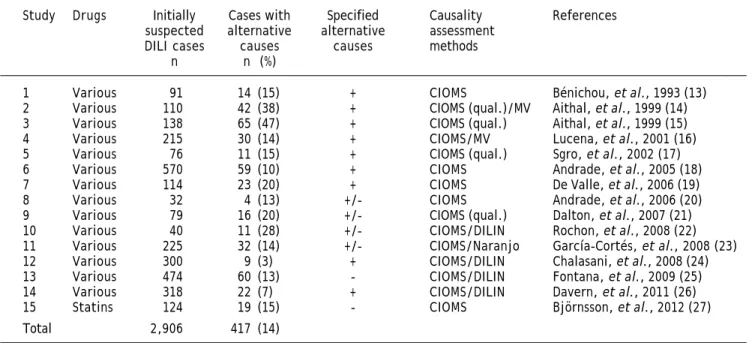
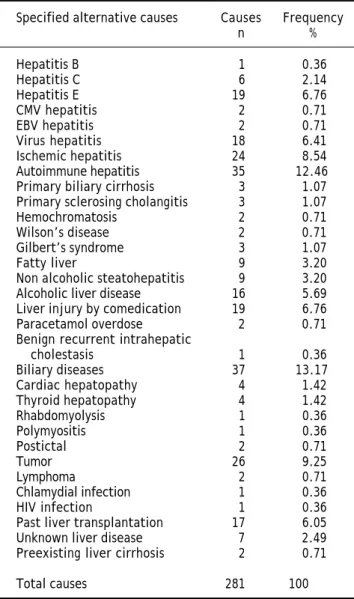
The study cohort was retrieved from 15 publica-tions of case series with assumed DILI addressing al-ternative causes (Table 1). In 14/15 publications, multiple drugs for various treatment indications were involved, in one publication several different statins were reported. A total of 2,906 cases of ini-tially assumed DILI were analyzed in these 15 publi-cations, with an average of 194 cases (range 32-570 cases) per publication (Table 1). These reports men-tioned alternative diagnoses in 417/2,906 cases (14%), with details of all specific alternative diagno-sis presented in 9 studies; both specified and unspe-cified alternative causes were presented in 4 studies, and in 2 others, none of the alternative causes was specified. Therefore, in only 281/417 cases specific alternative causes were presented (Tables 2 and 3). Causality assessment methods in these 15 publica-tions were the CIOMS scale alone (n = 5), combined with the MV scale (n = 1), the DILIN method (n = 4), or the Naranjo scale (n = 1); the qualitative CIOMS scale alone (n = 3) or combined with the MV scale (n = 1) (Table 1).
Alternative diagnoses
Table 1. Frequency of alternative causes in initially suspected DILI cases.
Study Drugs Initially Cases with Specified Causality References
suspected alternative alternative assessment
DILI cases causes causes methods
n n (%)
1 Various 91 14 (15) + CIOMS Bénichou, et al., 1993 (13)
2 Various 110 42 (38) + CIOMS (qual.)/MV Aithal, et al., 1999 (14)
3 Various 138 65 (47) + CIOMS (qual.) Aithal, et al., 1999 (15)
4 Various 215 30 (14) + CIOMS/MV Lucena, et al., 2001 (16)
5 Various 76 11 (15) + CIOMS (qual.) Sgro, et al., 2002 (17)
6 Various 570 59 (10) + CIOMS Andrade, et al., 2005 (18)
7 Various 114 23 (20) + CIOMS De Valle, et al., 2006 (19)
8 Various 32 4 (13) +/- CIOMS Andrade, et al., 2006 (20)
9 Various 79 16 (20) +/- CIOMS (qual.) Dalton, et al., 2007 (21)
10 Various 40 11 (28) +/- CIOMS/DILIN Rochon, et al., 2008 (22)
11 Various 225 32 (14) +/- CIOMS/Naranjo García-Cortés, et al., 2008 (23)
12 Various 300 9 (3) + CIOMS/DILIN Chalasani, et al., 2008 (24)
13 Various 474 60 (13) - CIOMS/DILIN Fontana, et al., 2009 (25)
14 Various 318 22 (7) + CIOMS/DILIN Davern, et al., 2011 (26)
15 Statins 124 19 (15) - CIOMS Björnsson, et al., 2012 (27)
Total 2,906 417 (14)
Specified and in detail presented alternative causes were provided for all (+), some (+/-), or none (-) of the cases. Causality assessment methods refer to the CIOMS scale (Council for International Organizations of Medical Sciences),29 which is quantitative and represents the most commonly used algorithm;29-34
the qualitative CIOMS method lacking any quantitative criteria;35 the MV scale of Maria and Victorino;36 and the method of DILIN (Drug-Induced Liver Injury
Network).22,37
hepatitis was overlooked in 24/281 cases and repre-sented 8.5% of the alternative diagnoses, and autoimmune hepatitis, primary biliary cirrhosis and primary sclerosing cholangitis were found in a total of 41/281 cases corresponding to 14.6% (Ta-bles 2 and 3). Genetic liver diseases like hemochro-matosis and Wilson’s disease were missed in 2 cases each. In 3 patients, Gilbert’s syndrome – commonly lacking increased liver values – was misidentified as DILI (Table 3). Fatty liver, non al-coholic steatohepatitis, and alal-coholic liver diseases are commonly observed in the general population and were misinterpreted in 34/281 cases (12%) of this study cohort (Tables 2 and 3). Liver injury by comedication other than the incriminated drug was found in 19/281 cases corresponding to 6.8%, whereas paracetamol overdose, an intrinsic but not an idiosyncratic form of liver injury, was causal in 2 cases (Table 3).
Rare alternative extrahepatic causes include cardiac failure and thyroid diseases, rhabdomyolysis, polymyositis, and postictal states (Tables 2 and 3). With 26/281 cases (9.3%), solid tumors were misdiagnosed as DILI, rarely also lymphomas (Table 3). In 1 case each, chlamydial and HIV infections were incorrectly classified as DILI (Table 2 and 3).
In 26/281 additional cases, DILI was erroneously attributed to patients with a history of liver
trans-plantation and associated transplant related compli-cations (n = 17), with unknown or questionable liver disease (n = 7), and with preexisting liver cirrhosis (n = 2) (Tables 2 and 3). There are nume-rous alternative causes in extrahepatic diseases with liver involvement, with biliary diseases being the most frequent alternative cause, accounting for 37/ 281 cases (13.2%) of all alternative causes (Table 3) within the broad spectrum of this particular disease (Table 2).
Table 2. Analysis of alternative causes of initially suspected DILI cases.
Alternative causes in initially suspected drug induced liver injury
• Hepatitis B. Hepatitis B cirrhosis 1/138 cases.15
• Hepatitis C. Acute hepatitis C 4/254 cases;24 Chronic hepatitis C 2/40 cases.22
• Hepatitis E. 10/45 cases,21 9/318 cases.26
• CMV Hepatitis. 2/138 cases.15
• EBV Hepatitis. 2/138 cases.15
• Viral hepatitis. Unspecified viral hepatitis 2/91 cases,13 5/215 cases,16 11/570 cases.18
• Ischemic hepatitis. 4/91 cases,13 1/110 cases,14 10/138 cases,15 3/215 cases,16 6/570 cases.18
• Autoimmune hepatitis.
° 5/110 cases,14 8/138 cases,15 7/215 cases,16 6/570 case,18 7/114 cases,19 2/32 cases,20 2/474 cases.25
• Primary biliary cirrhosis. 3/114 cases.19
• Primary sclerosing cholangitis. 3/114 cases.19
• Hemochromatosis. 1/91 cases (13), 1/40 cases.22
• Wilson’s disease. 1/215 cases,16 1/570 cases.18
• Gilbert’s syndrome. 3/138 cases.15
• Fatty liver. Steatosis 3/138 cases,15 1/95 cases;17 Non alcoholic fatty liver 5/114 cases.19
• Non alcoholic steatohepatitis. 5/215 cases,16 4/570 cases.18
• Alcoholic liver disease.
° 6/110 cases,14 3/138 cases;15 Alcoholic hepatitis 1/215 cases,16 3/570 cases.18 ° 2/114 cases;19 Chronic alcoholism in 1/95 cases.17
• Liver injury by other comedication. 9/73 cases.27
• Paracetamol overdose. 2/138 cases,15 2/474 cases.25
• Benign recurrent intrahepatic cholestasis. 1/254 cases.24
• Biliary diseases.
° Biliary obstruction 5/91 cases;13 Cholangitis 1/138 cases;15 ° Choledocholithiasis 3/215 cases,16 13/570 cases,18 1/114 cases;19 ° Common bile duct stone 12/138 cases,15 Oddi spasms 2/95 cases.17
• Cardiac hepatopathy. Cardiac failure 1/91 cases,13 3/95 cases.17
• Thyroid hepatopathy. Hypothyroidism 1/215 cases,16 2/570 cases,18 Thyrotoxicosis 1/138 cases.15
• Rhabdomyolysis. 1/95 cases.17
• Polymyositis. 1/254 cases.24
• Postictal. 2/138 cases.15
• Tumor.
° 11/110 cases,14 3/215 cases,16 10/570 cases;18
° Metastatic bladder cancer 1/95 cases;17 Liver metastasis from carcinoid tumor 1/114 cases.19
• Lymphoma. 2/138 cases.15
• Systemic sepsis. 2/110 cases,14 12/138 cases,15 1/215 cases,16 3/570 cases.18
• Chlamydial infection. 1/91 cases.13
• HIV infection. End-stage HIV disease 1/95 cases.17
• Past liver transplantation
° Transplant related complications 17/110 cases;14
° Liver or bone marrow transplant prior to DILI onset 2/474 cases.25
• Unknown liver disease
° 3/254 cases;24 Abnormal liver biochemical tests 3/40 cases;22 ° Isolated γ-glutamyltransferase increase 1/95 cases.17
• Preexisting liver cirrhosis. Cryptogenic cirrhosis 1/138 cases;15 Unspecified cirrhosis 1/40 cases.22
Missed diagnoses in cases of initially suspected DILI cases including the respective references. CMV: cytomegalovirus. EBV: Epstein Barr virus. HSV: herpes simplex virus. LKM: liver kidney microsomes. SMA: smooth muscle antibodies. VZV: varicella zoster virus.
Verified DILI cases
Out of 2,906 cases with initially suspected DILI, the diagnosis of DILI was presented as established in 2,188 cases, which corresponds to 75%; in the other 25%, DILI remained unverified (Table 4) with
Table 3. Frequency of specified alternative causes of DILI.
Specified alternative causes Causes Frequency
n %
Hepatitis B 1 0.36
Hepatitis C 6 2.14
Hepatitis E 19 6.76
CMV hepatitis 2 0.71
EBV hepatitis 2 0.71
Virus hepatitis 18 6.41
Ischemic hepatitis 24 8.54
Autoimmune hepatitis 35 12.46
Primary biliary cirrhosis 3 1.07
Primary sclerosing cholangitis 3 1.07
Hemochromatosis 2 0.71
Wilson’s disease 2 0.71
Gilbert’s syndrome 3 1.07
Fatty liver 9 3.20
Non alcoholic steatohepatitis 9 3.20
Alcoholic liver disease 16 5.69
Liver injury by comedication 19 6.76
Paracetamol overdose 2 0.71
Benign recurrent intrahepatic
cholestasis 1 0.36
Biliary diseases 37 13.17
Cardiac hepatopathy 4 1.42
Thyroid hepatopathy 4 1.42
Rhabdomyolysis 1 0.36
Polymyositis 1 0.36
Postictal 2 0.71
Tumor 26 9.25
Lymphoma 2 0.71
Chlamydial infection 1 0.36
HIV infection 1 0.36
Past liver transplantation 17 6.05
Unknown liver disease 7 2.49
Preexisting liver cirrhosis 2 0.71
Total causes 281 100
DISCUSSION
In this analysis of 2906 cases with initially repor-ted liver injury attriburepor-ted to a specific drug, the diagnosis of DILI was incorrect in 14% (Table 1) due to obvious alternative causes (Tables 1, 2 and 3), and could not be proven in another 11%, resul-ting in a total of 25% of cases without verified DILI (Table 4). Confounding variables described in all re-ports created additional major problems for causali-ty assessment (Table 5).13-27 These percentages are
based on 15 case series with unknown degrees of case selection, with 55-72% unproven DILI cases in 5 publications, compared to 3-14% in the 5 case se-ries with the lowest number of unproven cases (Ta-ble 5). These data support the contention that
assessments of suspected DILI cases may be proble-matic and require substantial efforts for valid cau-sality attributions.
The high rate of 55-72% unverified DILI cases, published for some case series of initially suspected DILI (Table 4)14,15,17,21,27 indicate causality
assess-ment problems. For instance, a rate of 55% for unve-rified DILI cases was published for cases that were reported by physicians, using a standardized notifi-cation form to report the case; the physician group consisted of 75 general practitioners, 5 gastroentero-logists, and 59 specialists such as rheumatogastroentero-logists, psychiatrists, gynecologists, dermatologists, inter-nists, and anesthesiologists.17 A comparable rate of
56% was obtained for reports of suspected DILI by statins received by the Swedish Adverse Drug Reac-tions Advisory Committee.27 DILI cases were not
proven in 60% based on computerized histological records of patients with a histological diagnosis of DILI or cholestasis/hepatitis in Newcastle-upon-Tyne (UK),14 and in 62% of suspected DILI reports
provided to the Committee on Safety of Medicines in the Northern region of the UK.15 Finally, a rate of
72% unverified DILI cases was found for patients at-tending the Jaundice Hotline service of a teaching hospital in the southwestern England.21 These
pro-blems will perpetuate if regulatory agencies use re-port numbers of hepatotoxicity cases for pharmacovigilance purposes without consideration whether causality was established or not, as has re-cently been published for cases of herb induced liver injury (HILI).11 This approach inevitably leads to
disputes of regulatory case overdiagnosing and over-reporting.
Major issues in DILI case assessments are possi-ble alternative causes, which may explain on avera-ge 14% of all DILI cases with a maximum of 47% of all primarily suspected DILI cases in the 15 analy-zed publications (Table 1).13-27 Alternative causes
are manifold and include hepatic diseases and extra-hepatic disorders with extra-hepatic involvement (Tables 2 and 3). A careful analysis of 65 patients with DILI unrelated alternative causes revealed that the pri-mary underlying diagnoses were not recognized by the reporting physician in 35 cases.15 The delay in
Table 5. Compilation of major confounding variables in cases with unverified DILI.
Study Ques- Come- Lacking Drug Unde- Unlikely Missed Incom- Patially Preexis-
Refe-tionable dicated causality into- termi- CIOMS hepato- plete completed ting liver rences
reaction hepato- with any xication ned causality toxicity case causality disease
course toxic drug drug cause grading criteria data adjunction
1 + + - - - 13
2 - - + + - - - 14
3 - - - - + - - - 15
4 + - - - - + - - - - 16
5 + - - + - - + - - - 17
6 + - - - + - - - 18
7 - - - + - + - - 19
8 + - - - 20
9 - - - + + - - 21
10 - - - + - - - - 22
11 - - - + - - - - 23
12 - - - + - 24
13 - - - + - - + 25
14 - - - + - - - - 26
15 - - - + - - - 27
Total 5 1 1 3 1 5 5 3 1 1
Missed primary diagnoses, unrelated to the erro-neously implicated herbal product, are also a pro-blem in cases of suspected HILI cases, again with a broad range of alternative causes22 similar to the
present analysis of suspected DILI cases (Tables 2 and 3). In the HILI study, 23 publications with 573 suspected HILI cases were analyzed, alternative cau-ses were evident in 278/573 cacau-ses (48.5%). For sus-picion of both DILI and HILI cases, causality assessment requires substantial improvement at the
Table 4. General problems of evaluation of unassessable, initially suspected DILI cases.
Study Initially suspected Cases with verified DILI Cases with unverified DILI References DILI cases
n n (%) n (%)
1 91 49 (54) 42 (46) 13
2 110 44 (40) 66 (60) 14
3 138 52 (38) 86 (62) 15
4 215 ≤185 (≤86) ≥30 (≥14) 16
5 76 34 (45) 42 (55) 17
6 570 461 (81) 109 (19) 18
7 114 77 (68) 37 (32) 19
8 32 28 (88) 4 (12) 20
9 79 22 (28) 57 (72) 21
10 40 35 (88) 5 (12) 22
11 225 193 (86) 32 (14) 23
12 300 291 (97) 9 (3) 24
13 474 367 (77) 107 (23) 25
14 318 296 (93) 22 (7) 26
15 124 54 (44) 70 (56) 27
Total 2,906 2,188 (75) 718 (25)
level of the physician caring for these patients, best achieved by the liver specific and well validated CIOMS scale.13,28-34 Accurate diagnoses are needed
to avoid possible health hazards for the patients, due to missed diagnoses and delayed treatment.
CONCLUSIONS
with evident alternative causes, and DILI diagnosis could not be proven in another 11% due to confoun-ding variables such as low data quality. A thorough clinical evaluation with firm exclusion of alternative causes and the use of the liver specific CIOMS scale should be mandatory for the physician caring for patients with suspected DILI to avoid delays in diag-nosis and treatment.
ACKNOWLEDGEMENT
The authors declare that they have no conflict on interest.
REFERENCES
1. Kaplowitz N, DeLeve LD. Drug-Induced Liver Disease. 3rd. Ed. Mass., USA: Academic Press, Waltham; 2013.
2. Sistanizad M, Peterson GM. Drug-induced liver injury in the Australian setting. J Clin Pharm Ther 2013; 38: 115-20. 3. Fontana RJ, Hayashi P, Bonkovsky HL, Kleiner DE, Kochhar S, Gu J, Ghabril M. Presentation and outcomes with clini-cally apparent interferon beta hepatotoxicity. Dig Dis Sci 2013: 58: 1766-75.
4. Sembera S, Lammert C, Talwalkar JA, Sanderson SO, Po-terucha JJ, Hay JE, Wiesner RH, et al. Frequency, clinical presentation, and outcomes of drug-induced liver injury after liver transplantation. Liver Transpl 2012; 18: 803-10.
5. Grant LK, Rockey DC. Drug-induced liver injury. Curr Opin
Gastroenterol 2012; 28: 198-202.
6. Chalasani N, Björnsson E. Risk factors for idiosyncratic drug-induced liver injury. Gastroenterology 2010; 138: 2246-59.
7. Ghabril M, Chalasani N, Björnsson E. Drug-Induced liver in-jury: a clinical update. Curr Opin Gastroenterol 2010; 26: 222-6.
8. Hawkins MT, Lewis JH. Latest advances in predicting DILI in human subjects: focus on biomarkers. Expert Opin Drug
Metab Toxicol 2012; 8: 1521-30.
9. Urban TJ, Shen Y, Stolz A, Chalasani N, Fontana RJ, Rochon J, Ge D, et al., Drug-Induced Liver Injury Network, DILI-GEN, EUDRAGENE, Spanish DILI Registry, International Serious Adverse Events Consortium. Limited contribution of common genetic variants to risk for liver injury due to a variety of drugs. Pharmacogenet Genomics 2012; 22: 784-95.
10. Teschke R, Wolff A, Frenzel C, Schulze J, Eickhoff A. Her-bal hepatotoxicity: a tabular compilation of reported ca-ses. Liver Int 2012; 32: 1543-56.
11. Teschke R, Frenzel C, Schulze J, Eickhoff A. Herbal hepa-totoxicity: challenges and pitfalls of causality assessment methods. World J Gastroenterol 2013; 19: 2864-82. 12. Agarwal VK, McHutchison JG, Hoofnagle JH, Drug-Induced
Liver Injury Network (DILIN). Important elements for the diagnosis of drug-induced liver injury. Clin Gastroenterol
Hepatol 2010; 8: 463-70.
13. Bénichou C, Danan G, Flahault A. Causality assessment of adverse reactions to drugs – II. An original model for vali-dation of drug causality assessment methods: case repor-ts with positive rechallenge. J Clin Epidemiol 1993; 46: 1331-6.
14. Aithal PG, Day CP. The natural history of histologically pro-ved drug induced liver disease. Gut 1999; 44: 731-5. 15. Aithal GP, Rawlins MD, Day CP. Accuracy of hepatic adverse
drug reaction reporting in one English health region.
Br Med J 1999; 319: 154.
16. Lucena MI, Camargo R, Andrade RJ, Perez-Sanchez CJ, Sanches de la Cuesta F. Comparison of two clinical scales for causality assessment in hepatotoxicity. Hepatology 2001; 33: 123-30.
17. Sgro C, Clinard F, Ouazir K, Chanay H, Allard C, Guilleminet C, Lenoir C, et al. Incidence of drug-induced hepatic inju-ries: a French population-based study. Hepatology 2002; 36: 451-5.
18. Andrade RJ, Lucena MI, Fernández MC, Pelaez G, Pachko-ria K, García-Ruiz E, García-Muñoz B, et al., Spanish Group for the Study of Drug-induced Liver Disease. Drug-indu-ced liver injury: an analysis of 461 incidences submitted to the Spanish registry over a 10-year period.
Gastroentero-logy 2005; 129: 512-21.
19. De Valle MB, Klinteberg V AV, Alem N, Olsson R, Björnsson E. Drug-induced liver injury in a Swedish University hospi-tal out-patient hepatology clinic. Aliment Pharmacol Ther 2006; 24: 1187-95.
20. Andrade RJ, Lucena MI, Kaplowitz N, García-Muñoz B, Bo-rraz Y, Pachkoria K, García-Cortés M, et al. Outcome of acute idiosyncratic drug-induced liver injury: long term follow-up in a hepatotoxicity registry. Hepatology 2006; 44: 1581-8.
21. Dalton HR, Fellows HJ, Stableforth W, Joseph M, Thurairajah PH, Warshow U, Hazeldine S, et al. The role of hepatitis E virus testing in drug-induced liver injury. Aliment
Pharmacol Ther 2007; 26: 1429-35.
22. Rochon J, Protiva P, Seeff LB, Fontana RJ, Liangpunsakul S, Watkins PB, Davern T, et al., for the Drug-Induced Liver Injury Network (DILIN). Reliability of the Roussel Uclaf Causality Assessment Method for assessing causality in drug-induced liver injury. Hepatology 2008; 48: 1175-83. 23. García-Cortés M, Lucena MI, Pachkoria K, Borraz Y,
Hidal-go R, Andrade RJ. Evaluation of Naranjo Adverse Drug Reactions Probability Scale in causality assessment of drug-induced liver injury. Aliment Pharmacol Ther 2008; 27: 780-9.
24. Chalasani N, Fontana RJ, Bonkovsky HL, Watkins PB, Davern T, Serrano J, Yang HQ, et al., for the Drug Induced Liver Injury Network (DILIN). Causes, clinical features, and outcomes from a prospective study of drug-induced liver injury in the United States. Gastroenterology 2008; 135: 1924-34.
25. Fontana RJ, Watkins PB, Bonkovsky HL, Chalasani N, Da-vern T, Serrano J, Rochon J, for the DILIN Study Group. Drug-induced liver injury Network (DILIN) prospective study. Rationale, design and conduct. Drug Saf 2009; 32: 55-68.
26. Davern TJ, Chalasani N, Fontana RJ, Hayashi PH, Protiva P, Kleiner DE, Engle RE, et al., for the Drug-Induced Liver Injury Network (DILIN) . Acute hepatitis E infection ac-counts for some cases of suspected drug-induced liver in-jury. Gastroenterology 2011; 141: 1665-72.
27. Björnsson E, Jacobsen EI, Kalaitzakis E. Hepatotoxicity associated with statins: Reports of idiosyncratic liver in-jury post-marketing. J Hepatol 2012; 56: 374-380. 28. Danan G, Bénichou C. Causality assessment of adverse
29. Tajiri K, Shimizu Y. Practical guideline for diagnosis and early management of drug-induced liver injury. World J
Gastroenterol 2008; 14: 6774-85.
30. García-Cortés M, Stephens C, Lucena MI, Fernández-Castañer A, Andrade RJ, on behalf of the Spanish Group for the Study of Drug-Induced Liver Disease. Causality assessment methods in drug induced liver injury: Strengths and weaknesses. J Hepatol 2011; 55: 683-91.
31. Aithal GP, Watkins PB, Andrade RJ, Larrey D, Molokhia M, Takikawa H, Hunt CM, et al. Case definition and phenoty-pe standardization in drug-induced liver injury. Clin
Phar-macol Ther 2011; 89: 806-15.
32. Bunchorntavakul C, Reddy KR. Review article: herbal and dietary supplement hepatotoxicity. Aliment Pharmacol
Ther 2013; 37: 3-17.
33. Teschke R, Schulze J, Schwarzenboeck A, Eickhoff A, Fren-zel C. Herbal hepatotoxicity: suspected cases assessed for alternative causes. Eur J Gastroenterol Hepatol 2013; 25: 1093-8.
34. Teschke R, Eickhoff A, Schulze J. Drug- and herb-induced liver injury in clinical and translational hepatology: Causa-lity assessment methods, quo vadis? J Clin Translat
Hepa-tol 2013; 1: 59-74.
35. Bénichou C. Criteria of drug-induced liver disorders. Re-port of an international consensus meeting. J Hepatol 1990; 11: 272-6.
36. Maria VAJ, Victorino RMM. Development and validation of a clinical scale for the diagnosis of drug-induced hepatitis.
Hepatology 1997; 26: 664-9.
37. Rockey DC, Seeff LB, Rochon J, Freston J, Chalasani N, Bonachini M, Fontana RJ, et al., for the US Drug-induced Liver Injury Network. Causality assessment in drug-induced liver injury using a structured expert opinion process: Comparison to the Roussel-Uclaf causality assessment method. Hepatology 2010; 51: 2117-26.